Every summer, a Druidry group I am part of gets together to grill, tell stories, sing, and swap goods and gear. Some of these are things we’ve made (like artwork or preserves), some are things we’ve grown (like plant starts and seeds), and some are things we’ve purchased, and want to find a new home for. I’ve taken home books, macrame plant hangers, sculpture, watercolor art, camping gear, oracle cards, some vintage Le Creuset, and one very unique tool.
This is the Spark Magic box. It describes itself as a way to “[k]indle that inner spark,” and carries this idea through the prompts themselves. They’re all derived from various creative and spiritual practices, with a bit of self-care mixed in, printed on 50 cards shaped like matches. This makes it easy to shuffle through them just by shaking the box, plus the match design is just a really fun, unique idea.
This isn’t your standard oracle deck or list of journaling prompts, however. There are some writing prompts, of course, but this box also contains ideas for physically and mentally taking care of yourself, beautifying and enhancing the health of your immediate environment, and cultivating a regular practice to help you feel empowered and self-fulfilled.
Personally, I like it a lot. I often experience periods where I feel sort of dull and lifeless (enhanced, no doubt, by cyclothymia). While the prompts in here aren’t a substitute for a therapist, the ideas are usually pretty good at helping me to re-engage with practices that I’ve allowed to fall by the wayside. They help me feel more enthusiastic about doing stuff again. I feel like they’ve been much more helpful in this regard than the usual lists of self-care suggestions and journaling prompts that I see online.
Part of this may be due to the structure of the deck itself. It’s not a pick-and-choose list of things to do — there’s an oracle deck-style element to it. Part of the fun isn’t just drawing a match and seeing what it says, it’s taking some time to think about why I’ve drawn the specific match that I did. This also makes it fun to combine with tarot or oracle readings.
Would I recommend this? Yes, absolutely. If you’re someone who feels like they could use a little boost or some inspiration now and then, Spark Magic may be helpful for you. At $12.95, it’s also pretty inexpensive. If you like cartomancy, try combining Spark Magic with your oracle or tarot readings as a fun, interesting way to gain more insight.
Last time, I mentioned struggling with imposter syndrome. Yesterday, my Handsome Assistant and I braved the cold (it is bonkers freezing right now, especially considering that it’s going to be like 60° F next weekend) and went to the opening of the art show.
The venue itself was beautiful (it’s history, not so much) and its tall ceilings, many windows, and twists and turns were very conducive to hosting a large art show without everything feeling too cluttered or busy. Sadly, I didn’t really get any pictures of the interior or the show itself (it would’ve been difficult to do without getting some of the possibly-unconsenting public in the shots) but you can see all of the entries here. Interestingly, the majority of them were portraits of people — there were fewer animals than I expected, though I did find one other lovely painting of a corvid.
The volunteers and other artists were all very nice, too. Everyone I spoke to was kind and helpful. We even ran into one of my Handsome Assistant’s friends, whose child had won an award for their work in the juried student exhibit.
While it was a nice outing overall (the artwork was beautiful and moving, the venue was gorgeous, and the rolling hills of the grounds were streaked with kids on brightly colored sleds), it was also pretty mentally exhausting. There’s a COVID surge, so being indoors in a group was a bit tense. I also felt a very acute sense of imposter syndrome. An inner critic kept telling me that I didn’t really belong there, that my work was only chosen to humor me, so I wouldn’t get discouraged and withdraw my membership. Anxiety turned what should have been a relaxing, inspiring day into a bit of an internal mess.
But still, we did the thing! As cold as it was, and as much as my various social anxieties kept urging me to pull out, we went and did it. All that remains now is to figure out how to make it easier on myself in the future and be more confident in my art. It’s something that’s much easier said than done.
As I write this, JJ is playing with the snow I tracked in on my boots, while I am listening to pan flutes and drinking a smoothie to try to combat a killer bout of agita.
One of my paintings was accepted for a juried show starting later this month (it is this guy). This morning, my Handsome Assistant gave me a ride to drop it off at the gallery… By which I mean he drove me there and he went in to drop it off, while I sat in the car and tried not to throw up.
I’ve been through this before. I’ve entered shows, had my work accepted, and gone through the whole process, but, somehow, it still never seems to fail to launch me into a tiny existential crisis. I end up expending a ton of mental and physical energy to compare myself to other people, compare my work to other artists’, and make a carefully curated mental list of all of the reasons I don’t deserve to be there.
I know a lot of people have imposter syndrome and are probably doing the same thing. However, I am sure that they pale in comparison to my level of utter charlatanry.
But even that is a kind of talent, I guess. Maybe I don’t deserve to be where I am. Unfortunately, there are no shows for chicanery. There are no legitimate places where a skilled imposter can showcase their ability to fake a level of competence. Until there’s a place for the most impostery of imposters, maybe this is where I belong after all.
If you’ve followed me on Instagram, you probably know that I’ve had a shaved head for years at this point. A few months back, I decided to experiment with letting some of my hair regrow. This was mainly a test to see how much of my particular case of trichotillomania is an ingrained habit, versus a deeper issue. Half of my head is currently almost shoulder-length, while the other half is still shaved.
Recently, this all got me thinking — out of all of the things I’ve tried to beat this, which ones actually seemed to help? Trichotillomania is commonly regarded as a kind of obsessive-compulsive disorder. Believe it or not, pulling out the “right” hairs (usually ones that are of a different texture than the others) can give a dopamine rush, while failing to do so can cause feelings of anxiety and an intense compulsion to find and pull the offending hair. It’s not the kind of thing you can sort out just by switching shampoos.
With that said, here are the things I tried… and how well they measured up against my apparent desire to destroy my own head:
1. Tea tree shampoos and conditioners
These feel nice. They’re supposed to help with itching and give the scalp a cooled, refreshed feeling. This is all very temporary, however. A couple of hours after a wash and condition, the desire to pull is back.
2/10
2. Fidget toys and objects that mimic hair pulling
These might work for some, but they didn’t really do it for me. The problem here is that the feeling of needing to pluck my hair doesn’t really feel like it originates in my hands, so keeping them busy doesn’t get rid of the tickle in my scalp or the feeling that there’s a weird hair I need to get rid of.
A lot of the objects geared toward people with trichotillomania also aren’t refillable. You could end up going through multiple vinyl plucking toys per week, and what do you do with all of them afterward?
Fidget objects that mimic hair pulling or skin picking are also somewhat controversial. For some people, they can help redirect the behavior to an object. For others, they may just reinforce the undesirable picking/plucking.
1/10
3. Smoothing hair products
Ugh, no.
My thought was that, since the desire to pluck starts as a subtle tickling sensation on my scalp, which progresses to me finding a hair that’s grown in with an odd texture, smoothing products would help. This was not the case. In fact, they either didn’t make any difference at all, or made my hair feel oilier and itchier. No. No, thank you.
0/10
4. Essential oils
Like the tea tree oil shampoos and conditioners, these helped for brief periods. The oils I used were chiefly rosemary and cedar, both credited with helping to regrow hair and improve hair and scalp health in general. They smelled nice. They felt nice. They made my scalp feel better, but they didn’t last very long.
4/10
5. Head massagers
These things look a bit like metal spiders with a wooden handle. You hold the handle and use the spidery bit to massage your scalp. They feel nice, they help temporarily increase blood flow to that area, but they don’t really get rid of the urge to pull.
These are often either witch hazel based, or castor oil based. You find castor oil in formulas to moisturize the scalp and promote hair growth and witch hazel in ones for scalp health. Like other topical treatments mentioned here, these serums seemed to fall into one of two camps. They either 1) felt soothing for a couple of minutes, or 2) just made me feel stickier/greasier and itchier. The cooling sensation of some non-oil-based serums did seem to make a difference, but they needed to be reapplied frequently. The oil-based serums did seem to help regrow hair, but they were also a lot heavier. but weren’t soothing.
5/10
7. Gloves
Like a parent trying to keep a kid with chicken pox from scratching, I tried sticking gloves on my hands. “Maybe,” I thought, “if I just make my hands worse at pulling my hair, I’ll eventually stop.”
The trouble is that the things that it harder to pull at my hair also made it harder to do absolutely everything else. There was zero incentive to keep gloves on, and very easy to forget them somewhere after cooking, washing up, etc. While this solution might work for kids, or people who don’t need to perform a lot of hands-on tasks, it didn’t for me.
3/10
8. Self-hypnosis
People have used self-hypnosis to help with all kinds of addictions and bad habits in the past, so why not this? I mean, I have a vivid memory of being a tiny child, sitting on the couch while my mother watched a self-hypnosis video to quit smoking. (It didn’t work and I felt like I was in a Twilight Zone episode, but I still figured this was worth a shot.)
It didn’t work, and I felt like I was in a Twilight Zone episode. Other people have used self-hypnosis with success, but it definitely fell short for me here.
1/10
9. Anxiety medication
OCD is connected to anxiety, so anxiety medication is sometimes used to help relieve the negative feelings connected to the obsessive-compulsive behavior. Unfortunately, trichotillomania is notoriously difficult to medicate. While anxiety medication did help tremendously when it came to controlling my panic disorder, it didn’t really do much for the hair pulling.
3/10
10. Cognitive behavioral therapy
I’ve written before about how CBT was less than helpful for me. In this case, it failed at lessening my trichotillomania because it relies on reasoning. You can’t reason yourself out of something you didn’t reason yourself into.
While it might help some people deal with feelings of anxiety and shame surrounding the behavior or the effect that it has on their appearance, it didn’t seem to touch the root cause of trichotillomania itself.
What if the weird hairs and tickly feeling of needing to pull were the symptoms of some kind of weird deficiency? What if I just wasn’t growing healthy hair, and my scalp was irritated because of it? What if I just straight-up ran out of other things to try?
So, I tested out multiple brands of “hair vitamin.” These are multivitamin and mineral supplements that focus primarily on hair and skin health. If you aren’t experiencing a deficiency in any of the vitamins and minerals in them, however, they’re primarily a fast way to give yourself nausea and neon yellow urine. They did not, unfortunately, help suppress the urge to pick at my hair.
1/10
11. Shaving it off and letting it grow back
It takes a while to break a habit. I figured that, if I couldn’t suppress the desire to pull, I could get rid of my hair. Without weird hairs to pull out and reinforce the behavior (and addiction dynamic), maybe my brain could sort itself out.
However, keeping my hair short and unpluckable did give my scalp a chance to recover, and that’s important.
5/10
12. Shaving it off, but strategically
Since shaving it completely and letting it grow back didn’t work the way I wanted to, I hit upon another potential solution: What if I just shaved the areas that I plucked the most? I wouldn’t have to commit to a full buzzcut if I didn’t want to, but I still wouldn’t be able to pull at the areas that I used the most.
Lo and behold, this finally seemed to work. Right now, I’ve got hair down to my shoulder on one side, and a full shave on the other. I make it work.
This might not be a great option for people who chiefly pluck from the crowns of their heads, but can definitely be a useful tool for those who pluck from the sides or bottom. For me, it’s been working very well.
9/10
Trichotillomania sucks, to be blunt. It’s hard to treat and can be a source of deep shame (particularly for women from cultures who highly value hair). It’s also not good for you, since it can damage your scalp and eventually cause your hair to stop growing back. There are a lot of options out there to help with the symptoms, but almost no effective permanent solutions. This is what worked and didn’t work for me, but you may find that your results are different. The important thing to remember here is that your hair doesn’t determine your worth as a person — whatever helps you live without anxiety, shame, and physical pain is worth pursuing, even if it isn’t a perfect solution to trichotillomania.
I’ve mentioned before that I’m a big fan of the Wheel of Life exercise. I was introduced to it by my psychologist, and I found that it was a) really helpful and b) fun. I like lists. I like charts. I like ways to visualize data, and that’s pretty much exactly what this exercise does. It’s also really flexible and customizable.
This last bit is why I’ve made it part of my full moon observations. I light a candle (a handmade full moon candle from the wonderful 13 Magickal Moons in Occoquan, VA) and some incense. I draw the wheel. I section it off and label it however is most fitting. I make the assessments, I draw the lines, and I compare the shape with the shape of the previous month.
It’s a meditative exercise that helps me to acknowledge the changes I’ve made from month to month, because I can see them right in front of me. It highlights areas that need help, so I can use the power of the full moon to change them. By doing the wheel monthly, instead of every few months, it makes it easier for me to make incremental changes (and keep tabs on things like The Ennui).
It’s also useful for relating to the cycle of the moon. Even at the height of its power, the full moon heralds its own decrease. By that same token, the waning moon promises future growth. Looking at the Wheel of Life shows what has grown, what hasn’t, and, if need be, what should be pruned.
Below is a simple ritual outline that just about anyone can use to help better their physical and mental health, improve their relationships, and generally pull off a whole-life glow up.
The Wheel of the Full Moon
You will need:
A pen or pencil.
A piece of paper with a circle drawn on it.
A candle, preferably in white or silver.
Incense. Ethically harvested sandalwood, myrrh, white rose, bay leaf, or lemon balm work well here.
If this isn’t your first time performing the ritual, you may also want to have a fireproof bowl.
First, consider the areas of your life that you wish to focus on. This could be your physical health, mental health, physical environment, friendships, family, love life, career, spirituality, creativity, or anything else you desire. Count up how many areas you want to work on, and divide the circle up into that many sections — like a pie chart. Alternatively, you can use an online Wheel of Life creator.
Think of each area carefully. If you had to rate that area of your life from 1 to 10, what would you rate it? Pretend the center of the circle is zero, and the very edge of each slice is 10. Draw a dot roughly corresponding to the numerical rating you choose for each section. Connect these dots with lines, and you should have a kind of asymmetrical star shape.
Here’s an example from Wheeloflife.io’s generator.
This is your Wheel of Life. It’s a visual representation of how you feel about things right now. Look at the areas where the shape is most lopsided — this is where you feel your life needs the most help at this moment. For example, if you rated “family relationships” at a 7, and “career” at a 3, “career” would be the area to focus on.
Now, light the candle and the incense. If you can, place the Wheel of Life in a spot where the full moon’s light can fall on it. If not, observe it under the candle’s glow.
Say,
“See the moon’s glow, charging the Wheel. My life is unfolding, with each turn I feel. Full moon energy, guide me this night. Transform me, renew me, With your radiant light.”
As you meditate on your Wheel, consider what changes you can make to the areas of your life that need the most help. What can you do within the next week? The next two or three weeks? The next month?
Come up with three simple actions you can do over the next week. They can follow the energy of the waning moon, but they don’t necessarily have to.
Come up with three more that you can do over the next two to three weeks.
Finish by coming up with three more that you can complete by the next full moon.
Save this Wheel. Place it somewhere where you’ll see it often. Refer to it as many times as you need to in order to keep yourself motivated and on track.
(If you like, you can turn your actions into statements of intent, and use your preferred method to further empower them. Turn them into sigils, shorten them to symbols and inscribe them on candles, and so forth.)
Repeating the Wheel
If this isn’t your first time performing this ritual, then take out the last full moon’s Wheel.
Take a moment to compare this full moon’s Wheel to the last one. What progress have you made? What seeds have you sown, and what have you reaped? Give thanks for any advancements you’ve made, no matter how small.
If you wish, you can light the last full moon’s Wheel in the candle’s flame and drop it into the fireproof bowl. Scatter the ashes on the wind.
So, my Handsome Assistant and I took a bit of a staycation. Our original plan was to stay in a lovely (and haunted) bed and breakfast in Cape May, but we decided to put that trip off until next year and do more local activities.
I’ve wanted to check it out for a while. I like the idea of exploring caves. We didn’t really have them around where I grew up, so my friends and I compensated by finding unguarded drainage culverts and having many adventures in the glorious sewers of Long Island. I covered miles upon miles of that place, completely underground.
I had some reservations about Luray at first — not because I’m scared of caves (how much worse than a sewer can they be?) but because a lot of the reviews pointed out that the owners seemed to be more concerned with making money by packing as many people into the place as possible versus protecting and presenting the natural features of the caverns.
Still, we were planning on going in the middle of the week. It seemed kind of doubtful that we’d have massive throngs of people to contend with, so the crowd thing didn’t really worry me.
I did not, however, realize that my biggest problem would be air.
Let me be totally upfront with you — still, heavy air is an enormous panic trigger for me. It makes me feel like I can’t breathe. Like my lungs are working to pull air in, but not enough is actually moving. A lot of caves still have air flow patterns, governed by changes in air pressure and temperature. Caves with multiple entrances can even have breezes as fresh air enters and pushes old air out. I figured it’d be okay. Can’t be worse than a storm sewer, right?
We were somewhere on the banks of Dream Lake when the adrenaline began to take hold.
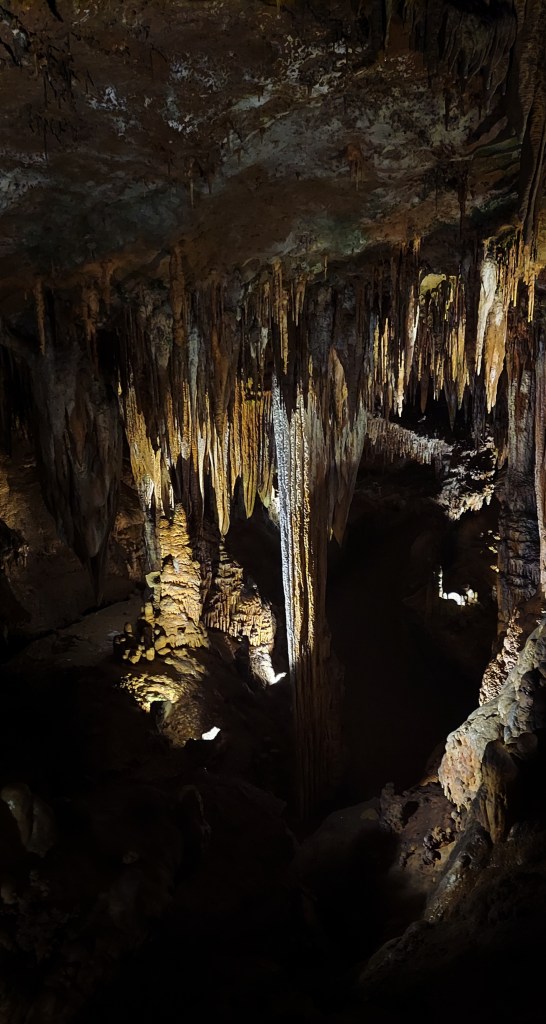
Dream Lake. The water here is so clear and still, it perfectly reflects the stalactites above.
The closeness of the space, the thick, humid air, and the lack of any kind of movement got to me. It got to me bad. I felt a hot flush in my cheeks, tingling down both my arms, and a heavy feeling in my chest. Sweat prickled over every inch of my skin. I turned to my Handsome Assistant.
“OkayIneedtogooutside.“
Pluto’s Ghost.
We turned around and started heading back in the wrong direction. Luray is arranged so that, once you’re in, the only way out is through. Fortunately, we weren’t super deep in and there weren’t large crowds. The walk back felt like it took forever, but we made it back out to breezes, space, and sunlight.
As far as the caverns themselves, they’re strange and beautiful. A lot of the formations have been damaged by irresponsible patrons, but many of them are still “living.” You can see water dripping. You can see the patterns of growth and erosion forming in real time. You can see the bright orange of deposited iron oxides, the white of calcite, the greens and blues of algae blooming from the lights in the cave.
I do agree with a lot of the reviews that criticize the ownership, however. For example, you enter and exit through the gift shop. While this may have been a matter of practicality in the beginning, they’ve recently excavated a new entrance and probably could have done so in a way that would’ve made the shop’s traffic patterns a bit easier to manage.
There are also a lot of very tight areas. People mentioned having to stand shoulder-to-shoulder and shuffle along the entire length of the caverns, which can be tough to manage with small, antsy children. One reviewer’s daughter experienced an asthma attack, and still had to go through the entire length of the caverns because there was no way to get her out otherwise. Things weren’t nearly as crowded when we went, but, again, we were able to go on a weekday. Scheduling a trip for an off-peak time seems like it makes everything a lot easier.
Would I go again? I don’t think so. Even though we weren’t there for very long, I feel like we got enough out of the experience. I also wouldn’t want to chance being there with a large crowd. Has this experience turned me off of caves in general? Also no. If anything, it’s made me more interested.
I just need to have a good escape plan. You know, just in case.
I’ve been taking inventory. Thinking of stuff I want to change (well, mostly get rid of) with next week’s new moon.
I have times where I feel like I’m wearing memories like a lead apron. Protective in some ways, perhaps, but ultimately smothering, uncomfortable, and heavy. We don’t yet have ways to erase them, à la Eternal Sunshine of the Spotless Mind, but man do I wish we did.
Sometimes, it almost feels like physically they have hooks in me. Nasty, twisting wires that seem to pull on my limbs, as if some invisible hand were trying to turn me into a marionette. It’s times like this that I can really see the tremendous value in cord cutting.
To that end, here’s a simple ritual for cutting unwanted connections and starting this moon cycle with a clean slate. I’ve written in the past about cord cutting to sever toxic familial ties, but this is a much more general practice that serves just as well as a kind of energy cleanse.
The Tools
A dull knife or knife-shaped object. I have a bone ceremonial knife, but a butter knife, rubber knife, or even a knife shape cut from cardboard will work. The important thing is that it does not have a sharp or serrated edge.
A candle. I typically use unaltered beeswax candles (hey, if it’s good enough for the bees, it’s good enough for me), but you can choose whatever wax or color feels correct to you. I’d suggest white (as a neutral color), black (as a neutralizing color), or red (as a strengthening color), myself.
That’s it!
The Process
Like I said, this is a very simple ritual.
Take a moment to take an inventory of yourself. Feel your physical body. If you can’t relax, that’s okay. Feel where tension, pressure, or “stuck” feelings seem to reside. Feel where you store stress.
Now consider your energetic body or aura. Feel out any inconsistencies. Are there any energetic cords or tethers?
Take the representation of the knife. Hold it an inch or so above your skin, parallel. Pass it over your entire body, as if you were shaving your aura. Picture this knife paring away whatever unwanted connections you may have.
As you do this, tell these connections goodbye. Affirm that your dealings with them are complete — they are severed from you and you are no longer connected. Continue this until you feel like you’ve removed all of the unwanted energies or tethers that you can.
Next, wipe the knife on the candle. Whatever energetic residue remains, just wipe it off on the wax. If the candle is in glass, wipe the knife off over the wick portion. Dust your hands off over it, too, for good measure. Anything that’s left that you don’t want, send it into the wax and wick.
Now, light the candle. Picture that energetic residue burning up like dust. There is nothing more for you to worry about, nothing more for you to do. The connections are cut, the slate is clean. You are free.
Allow the candle to burn completely if you wish, or snuff it. When you discard it, you can do so far from your home if you wish. It doesn’t require any special ceremony, as its job is finished — it has burned away the remains of the energy and connections that you don’t want. The less acknowledgement you give these things, the better.
If you use a cardboard representation of a knife, you can even burn that and scatter the ashes, too. Otherwise, just clean and cleanse your knife very well.
If you have any shielding or restorative meditative practices, now is a good time to do them. Removing these unwanted connections frees up energetic space, and it’s a good idea to either protect that space or have something good in mind to fill it up with.
Here’s hoping for a happy, refreshed moon cycle for everyone!
Note: Nobody paid me or otherwise compensated me for this. I just really like Alex Dav’s music.Notice me, senpai.
I need background music.
Music, lighting, and scents are the most effective ways to set a vibe, to me. I can be in a parking garage, but if there’s some chill music playing, the faint scent of incense wafting on the air, and patches of a nice, peachy-colored sunset kind of sliding in between the concrete pillars, it’s nice. Cozy. Meditative.
All of the songs feature a hang (also called hang drum), guitar, kalimba, piano, variety of drums, and more. Most, if not all, are tuned to a frequency of 432 Hz.
432 Hz is regarded as a “healing frequency.” Meditating to it is said to produce deeper states of relaxation. Doing so before bed may even improve sleep quality. Some also credit it with helping to release energetic blockages within the body.
While this all sounds very unscientific, there is a little bit of research to back it up. A double-blind cross-over study comparing listening sessions involving music at 440 Hz and 432 Hz had some very interesting results: The study participants experienced a slight decrease in blood pressure values (although not significant), a marked decrease in heart rate, and a slight decrease of respiratory rate values when listening to 432 Hz versus 440 Hz. These values do point to a greater state of relaxation. Subjectively, researchers also noted that “[t]he subjects were more focused about listening to music and more generally satisfied after the sessions in which they listened to 432 Hz tuned music.”
I use it for meditation, divination, maintaining a relaxed atmosphere at home, and just as background sound. It’s at once organic and ethereal, earthy and dreamlike. Personally, even as just background music, I feel like it helps me be more relaxed and creative. It’s even what inspired me to pick up a (smaller, less fancy) tongue drum.
If you’d like something that you can just turn on and go about your day, Alex Dav’s YouTube channel also has multiple live streams that are just music, all day long. If you want sleep music, there are some tracks that subtly loop for 12 hours. I highly recommend them!
As we kill off our grass, we’re working hard to replace it with plants that serve multiple purposes. Ideally, they should be native (or at least semi-local), attract pollinators, provide food for both humans and animals, and either return or self-seed. One of the plants that passed muster is this area’s native species of passionflower, Passiflora incarnata.
Also known as maypop, true passionflower, purple passionflower, and wild apricot, P. incarnata is a really pretty, fast-growing vine that provides both wild-looking purplish blue flowers and edible fruits. The flowers don’t last long, but they’re very striking!
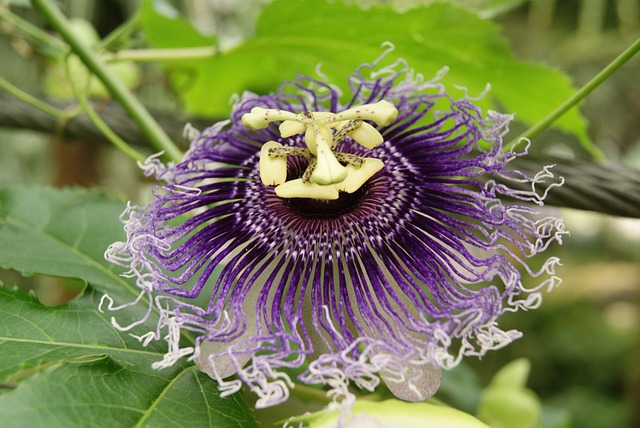
A flower of P. incarnata.
Unfortunately for me, I didn’t heed the old adage, “the first year they sleep, the second year they creep, the third year they leap.” As a result, I planted way too many passion vines. They’re going to eat my porch. Help.
Anyway, as I watch my yard speedily being consumed by passion and pumpkin vines, I figured I’d write a bit on the magical uses and folklore of the passionflower.
Passionflower Folklore and Magical Uses
Despite the name, I’ve mostly seen passionflower used as an herb to dampen passions, not stoke them. They’re said to be useful for calming libido, cooling relationships, and cultivating platonic or romantic rather than erotic love.
This could be because the word “passion” has a number of very different and contradictory meanings. As Mark Z. Danielewski wrote in House of Leaves, “Like patience, passion comes from the same Latin root: pati. It does not mean to flow with exuberance. It means to suffer.”
As a new world herb, passionflower was a novel plant to the Spanish missionaries who arrived in Peru in the 1500s. Giacomo Bosio, a monk and historian, referred to passionflower as “La Flor de las cinco Llagas” (“the flower with the five wounds”). This refers to the five wounds the Christian figure Jesus Christ is said to have endured at his crucifixion. The Biblical usage of passion equates to suffering, so, to missionaries, the passionflower represented divine suffering.
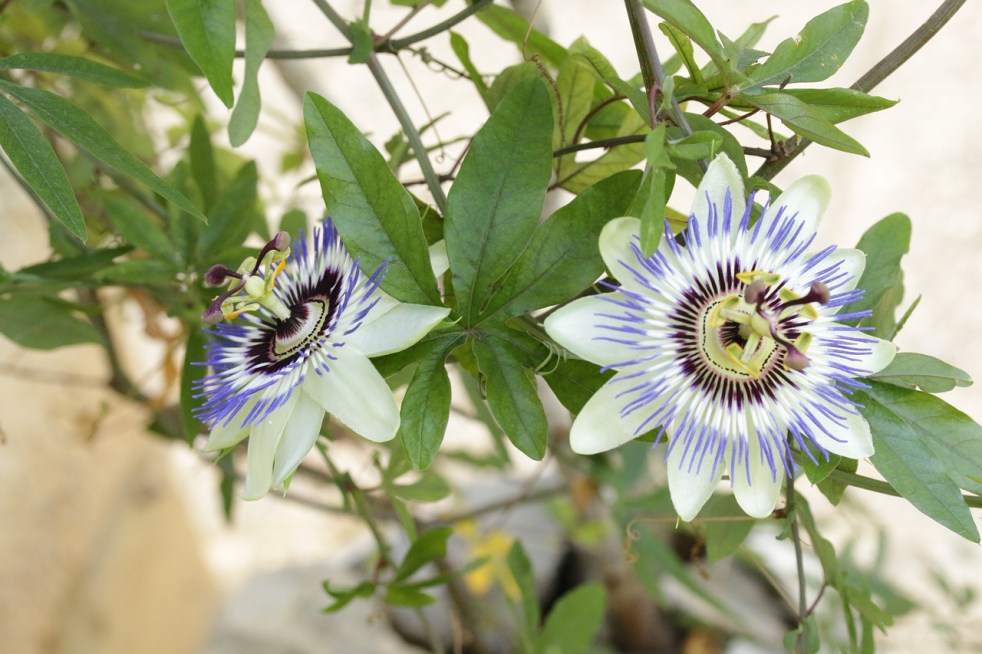
P. caerulea, a passionflower native to South America.
One tale from Brazil says that the passionflower grew from the tears of a woman who was separated from her lover.
Medicinally, passionflower is used as a calming herb. Evidence suggests that it’s safe to use internally, but there’s been some controversy as supplement manufacturers didn’t meet FDA requirements for safety data. It may interact with sedatives, monoamine oxidase inhibitors (MAOIs), and drugs to prevent blood clots, and is contraindicated in pregnancy.
In traditional indigenous herbal medicine, passionflower is used as a poultice to reduce inflammation and soothe pain.
In the garden, passionflower is irresistibly delicious to Japanese beetles. They’ll eat the leaves and flowers like there’s no tomorrow, which is bad news if you actually want to harvest any fruit!
Taken together, this paints the picture of passionflower as an herb to ease suffering. Since it was said to represent the five wounds endured by Jesus Christ, you could look at it as a “wounded healer.” This isn’t a plant that flows with exuberance, it’s one that knows suffering and eases it in others.
In Victorian flower language, passionflower was said to represent religious fervor or superstition.
Passionflower corresponds with the element of Water and the planet Venus.
Using Passionflower
If passionflower both represents and alleviates suffering, how do you use it? Since it’s native to North and South America, there isn’t really any information about it in ancient magical texts. Nonetheless, there are many ways to work with this unique plant.
As a vine, passionflower grows and clings (hence the whole porch thing.) This makes it useful in workings to bind something to yourself. Since it’s also a plant for relieving suffering, I’d use it specifically in situations where you’d like to bind a solution to a problem — for example, using passionflower to tie yourself to a stable, fulfilling job or enjoyable living situation.
Passionflower is also sometimes used in pillows or sachets for restful sleep and dream magic. Be careful with this, however, as placing passionflower under one’s pillow is also said to be a remedy to dampen libido.
This herb is also used in love magic. Bathing in an infusion is said to attract a potential partner to you, and it’s an often-seen ingredient in sachets, jars, and other charms for love. It works well for this purpose, as long as you know what kind of love you’re looking for. (If you’re after a passionate fling, skip it and go for cinnamon or ginger instead.)
Infuse the flowers in a carrier oil and use this to help ease worries and sooth the heart and mind. Anoint the temples and heart area whenever relief is needed.
All told, passionflower is a delightful herb. It’s beautiful, feeds bees and hummingbirds, and provides valuable medicine. As long as you don’t let its name fool you, it can help you with an array of spells and charms.
I try to give back as much as I can to every community I’m involved with — my community, Meetup groups, even (well, especially) the band of lovable weirdos who inhabit the yard.
One way to do that is sharing skills, but… that’s not always easy.
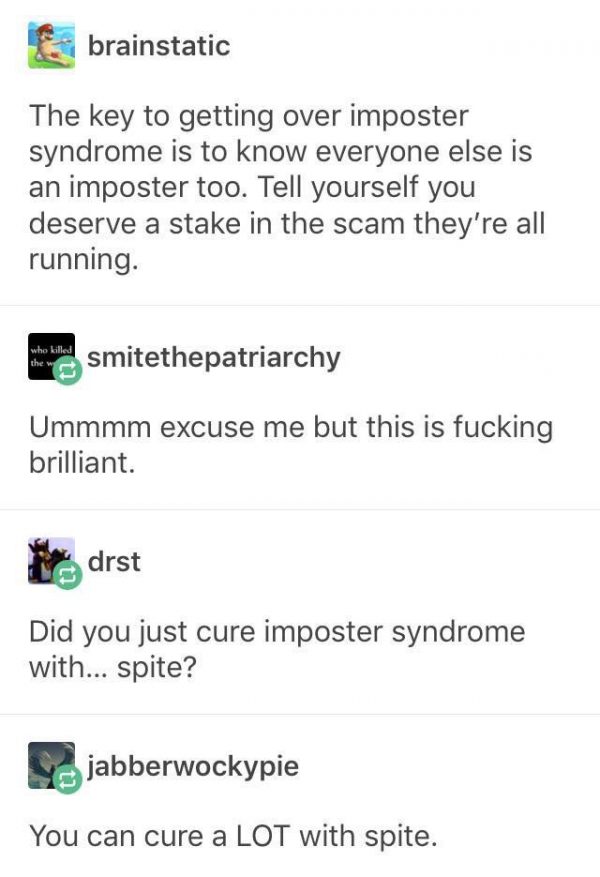
Right now, I’m struggling with a quandary. I have some skills I could share with one of my Druidry groups, but I’m also dealing with a massive case of imposter syndrome. It’s hard to share your knowledge with anyone when you feel like your skills aren’t worth offering.
The thing is, I obviously wouldn’t be where I am without knowing how to do stuff. Even bullshitting is a skill. I mean, it’s a skill I wholeheartedly admire in other things. My favorite stories have always been about tricksters. Trickster deities, tiny heroes, and animals who compensated for their lack of size, sharp teeth, or fearsome claws by using their cleverness. Even the deity with whom I have the closest relationship is often regarded as a trickster figure, who uses his wisdom, magic, knowledge of the Otherworlds, and trickery in equal measure.
Why’s it so hard to see any of that in myself? Why can’t I manage to share something that I’ve been doing since I was a child?











 Marble Crow