
Neodruidry · Witchcraft

Does AI have a place in witchcraft?

I discovered a YouTuber fairly recently, GrumpyOldCrone. I find her videos delightful — she’s talented and funny, and it’s refreshing to hear someone else complain about the same minor things that I find annoying, but don’t really have anyone else with which to gripe about them. She’s fun. I like her. You might, too.

Two months ago, she posted a video about AI’s increasing presence in witchcraft circles:

I watched it when it first came out, I agreed with it, and it recently popped up again for me. So, I thought I’d reiterate it here: I wholeheartedly agree that artificial intelligence doesn’t have a place in witchcraft.

Like, literally anywhere.

When it comes to spellcraft, why would the Universe heed something that nobody could be bothered to actually make? The process of performing a spell starts long before you’ve lit the candles, said the chants, et cetera. On top of that, a lot of thought, research, and history goes into developing a good magical working. A generative AI that pulls concepts from various internet spells (some of which are already highly questionable on their own) and mashes them together isn’t doing that. If it has any results at all, they’re likely to be unpredictable at best.

When it comes to herb lore, it’s a bad idea to trust a web-based hallucination machine to give advice. There are already problems with computer-generated foraging guides allegedly “written” by authors that have never existed. Of course, human error is also a thing. (As evidenced by that crystal worker who put an ore of mercury in a fire, and that lifestyle blogger who put out a cookbook that included a recipe for raw, chocolate-dipped morels.) This is why it’s important to read multiple sources, and to both vet and question what you read. This is getting increasingly difficult as it is as AI models begin to poison the well of their own information — if kludging together flawed information was a problem to begin with, it’s one that’s only getting worse as more computer-generated “guides” enter the info pool.
Have you ever seen the movie Multiplicity?
It’s like that, but with more poison.

Obtaining this information doesn’t have to be expensive or challenging, either. There are tons of Pagan, witchcraft, foraging, and nature crafting communities online, and in real life via Meetup groups. A library card and an app like Libby can give you access to tons of e-books. Scribd offers a free trial, during which you can straight-up download your choice of 3 books in PDF form. I have read some fascinating research on historical magical artifacts and techniques through Academia, for free. If you’re looking for instruction in a specific technique, Udemy often has sales where their courses are as low as $10 a pop.
The only challenge is that the seeker actually has to consume it and absorb this information themselves. It isn’t as easy as asking ChatGPT for instructions, then following them. Few worthwhile pursuits are.

I also want to take a second to bitch about the uptick in AI generated Pagan “art.” My objections here are twofold: For one, I hate that artists are having their actual work taken, mashed up, and squirted out of the digital equivalent of a Play-Doh Fun Factory as something with too many fingers and its legs on backward. I also hate that so much of it is legitimately ugly and bad. I’ve gone to marketplaces and seen a lot of Pagan-flavored AI slop, and it’s honestly really disheartening. I’m not exactly stoked about the proliferation of the same handful of resin mold and 3D printed designs either, but at least they require a modicum of effort (and have the right number of limbs).

Some things take time and work, and there isn’t really a way around that. The “industry disruption” phenomenon doesn’t work in every context, and this is one of them. AI is not making witchcraft more accessible; it’s providing something that poorly apes it. Even if it were to improve, it isn’t a substitute for learning from a human, or for community, or tradition, or genuine artfulness.

While there are some things that modern AI models can do and do much better than humans (accurately diagnosing certain medical conditions, for one, or processing phenomenally large amounts of data into a useful form and suggesting a course of action), witchcraft isn’t it.

Witchcraft

The Magical Meaning of String

When I was a tiny child (very tiny, maybe six or seven), my grandma taught me to crochet. I didn’t learn much — my clumsy little hands weren’t able to do more than work a piece of string into a basic chain — but it was something I’ve wanted to get back into. So, as part of my desire to continue reskilling this year, I picked up some merino yarn and a basic #5 hook and got to it.

(So far, I’ve managed to make one tiddy portion of a bikini top in single crochet, and most of a scarf that I accidentally did entirely in slip stitch. This is okay, though. Even if you do crochet wrong, as long as you do it wrong enough and consistently enough, you’ll most likely end up with a useable item once you’re done anyway.)

Close up photo of teal yarn and a copper colored crochet hook.
Photo by Castorly Stock on Pexels.com

So, since I’ve ended up with a number of odds and ends of string, I thought it’d be a good idea to point out its many magical virtues and uses.

Witches and Pagans — at least, the ones I know — are nothing if not resourceful. Every weed, seed, stick, stone, empty jar, scrap of paper, and bit of string has potential. Sure, supplies from a local metaphysical shop are beautiful and fun, but you’d be amazed at what you can get up to with the contents of your trash.

(Literally. One of my most successful workings involved nothing more than a Sharpie, some toilet paper, and about ten seconds a day for a week.)

Anyway. String.

One of the most recognizable uses of string/yarn/floss/twine/thread/etc is the witch’s ladder. This is a length of cord knotted at intervals, often with feathers, leaves, stones, or other curios placed within the knots. Ultimately, the ladder is a talisman — as it’s made, the creator imbues each knot and curio with their intention for the ladder.

Wikipedia describes a specific instance known as the Wellington Witch Ladder, the first recorded instance of someone finding a witch’s ladder in an old house. Charles Godfrey Leland discovered that it was remarkably similar the description of a kind of folk charm used in Italy. Witches would utter a baneful spell as they braided the cord (along with locks of the victim’s hair and feathers from a black hen) and place the finished piece under a victim’s bed, in order to cause them pain, illness, and misfortune.

(As a magical device, a witch’s ladder isn’t solely for baneful magic. The inclusion of different curios and chanting a different spell would, by necessity, give the finished product a different effect.)

String, envelopes, and a pocket knife.
Photo by Fotografia Eles Dois on Pexels.com

A more stripped-down version if the witch’s ladder is basic knot magic. This involves taking a length of string and tying knots (usually nine) at intervals, starting with the center, then both ends, then working back toward the center. Each knot is accompanied by a chant.

This is useful as a kind of magic “bank” — each knot holds a portion of the spell and, when the knots are undone, the spell is released. One way to use this involves untying a knot once a day for nine days. I’ve also used them to tie around my wrist or ankle. Once the string breaks, the spell is released.

Strings also have the more mundane use of securing magical sachets and pouches. In Hoodoo, the traditional knot for this is the miller’s knot. Other traditions may have their own methods that call for a particular knot (or number of knots), or none in particular. Here, the string is mostly just intended to keep the contents of the pouch from falling out, but it’s easy to apply basic techniques like color magic if you so choose.

If you know how to embroider, it’s easy to apply this skill to creating sigils or other magical images. Embroider them onto pouches, clothing, altar cloths, or any other fabric items sturdy enough to handle them. This is a great method for magic you wish to keep with you — think workings for protection, prosperity, or attraction.

Lastly, strings have a powerful symbolic component. Take the photographs of two would-be lovers, for example, place them face-to-face, and tie them together with red or pink string for a love spell. Or, use a string as a component of cord cutting magic, to help you visualize and act directly on the “etheric tethers” that hold you to old relationships, situations, or other undesirable things. Strings represent the “ties that bind,” for good or ill, and you can use them to either strengthen or sever these ties as you wish.

Okay, so. Like I said, I’ve been crocheting. I’ve ended up with a lot of odds and ends of yarn as a result. I probably don’t need all of these bits of yarn, so it pays to be a bit selective in what I decide to keep. If you hold on to odds and ends of string for magical purposes, you’re likely to end up in the same boat.

So, how do you decide?

First, I recommend against using synthetic fibers for magical purposes. This isn’t because I feel like they’ll necessarily have a bad impact on the magic itself — they’re just not practical. They don’t break down like cotton, hemp, linen, silk, or wool do, so they’re not great for spell cords that need to fall apart eventually. They also don’t burn well (and, when they do, tend to melt and produce awful, migraine-inducing fumes), so they’re not great for any spells that involve burning cords.

Close up shot of blue yarn in a wicker basket.
Photo by Miriam Alonso on Pexels.com

Second, you don’t necessarily need a ton of strings of the same length and color. You probably know what spells you tend to work the most, and what it makes sense to hold onto. (For example, if you’ve been focusing a lot on money magic, you probably don’t need an ever-increasing stash of red strings.) If you don’t, that’s fine — shoot for white or black strings, and one or two in other basic colors. Develop your preferences from there.

Third, destash periodically. There are a ton of posts and vlogs about people who fall out of practice, or struggle to find the motivation to continue regularly doing magical workings. Let decluttering your magical supplies be a reason to use them. With knot magic, this is especially practical — knot your cords, recite your chants, and put what you’ve made to good use. (Or gift them to your witchcraft-inclined friends.)

Often times, working magic means seeing the potential in what would otherwise be discarded. A plain piece of string can be everything from a curse to a love spell, from a healing charm to a magical battery.

animals · Plants and Herbs

Tooth Folklore and Magical Properties

The other day, my Handsome Assistant and I had the chance to watch the movie Moon Garden. It’s a beautiful, strange, surreal, very dark fantasy about a (very parentified) little girl who suffers an injury and falls into a coma. While she’s comatose, she has to find her way through an industrial horror landscape to make it back to her family. The entire movie is done with practical effects, and it has some of the most striking imagery — and villains — I’ve ever seen. Particularly the main antagonist: Teeth.

(Admittedly, I was a bit disappointed that Teeth turned out to be the only villain. The Mud Witch looked extremely cool and I would very much have liked for her to have a bigger role.)

Teeth is a manifestation of emptiness. An anthropomorphization of a chattering teeth toy and her grandpa’s dentures. Human teeth can also be transient — the little girl is at the age when she’d start to lose her baby teeth, and Teeth’s decayed-looking maw is an embodiment of neglect.

Outside of Moon Garden, teeth still have meaning and symbolism. They’re useful, beyond their biological function. They’ve been at the root of myth, legend, and folklore for as long as humanity’s had any of those things (or teeth, for that matter).

In the US, western Europe, and other areas with a heavily European influence, there’s the Tooth Fairy. When children lose baby teeth, they’re told to put them under their pillows. Then, at night, the Tooth Fairy is said to come to trade a little bit of money for the lost tooth.
(Traditionally, anyway. Today, some parents have moved away from giving money and give small toys, stickers, or other treats as “payment” instead.)
In Italy, the Tooth Fairy is a little mouse named Topolino. In France, La Petite Souris. In Spain and other Spanish-speaking countries, El Ratoncito Perez. In Scotland, it’s a white rat.

Finland has a modern figure (or figures) known as Hammaspeikko, or “tooth troll.” The tooth troll isn’t a Tooth Fairy like figure, though. Instead, it’s an explanation for dental cavities that comes from a 1949 Norwegian children’s book. Eating candy lures in tooth trolls, and these trolls drill holes in teeth. Luckily, they can be scared away by brushing.

Close up of a mugger crocodile in Bangladesh.
He’s grumpy because he’s got all them teeth and no toothbrush. Photo by RatuL CR♠️ on Pexels.com

Interestingly, the Tooth Fairy doesn’t really have direct parallels in European myth or folklore. Some folklorists say that the idea comes from an old Scandinavian practice of tand-fé, a “tooth fee,” but this is unlikely. In the Norse Eddas, tand-fé is described as ritual in which a child’s mother would give them a small amount of money for the loss of their first baby tooth — no fairies involved.

Ditto for other old practices for dealing with baby teeth. In England during the Middle Ages, children were told to throw their baby teeth in the fire. If they didn’t burn them, they’d spend their afterlife searching for all of their lost teeth.

For the most part, the Tooth Fairy, tooth-burning, and tooth-purchasing do seem connected to one core belief: The idea that those teeth need to be either accounted for or destroyed. There may be a good reason behind this (and it’s not as heartwarming as needing something to put in a baby book or keepsake box).

In spellcraft, there’s the idea of including some “personal concerns” (sometimes called taglocks) in order to help the spell reach and act on its target more effectively. These can be pretty much anything — a piece of jewelry worn by the target, a scrap of fabric cut from their clothing, a shoelace — but the best are physically connected to the target. That means nail clippings, hair, or teeth.
These can be used to very good effect — like sending healing to someone through a poppet with a lock of hair inside, or creating a kind of protective magical decoy — but can also be used for ill. Hexes, curses, jinxes, and other attacks work a lot better when they have a good idea of who they’re going to!

In other words, if you didn’t want anyone to work malevolent magic on your offspring, you had better either keep hold of those baby teeth or make sure they’re totally unusable. Children were regarded as a common target of things like the evil eye or the jealousy of spirits, so it’s not a huge leap from “don’t compliment babies too much or they’ll be cursed,” to “better hide all those baby teeth from witches, just in case.”

Alternatively, children’s teeth were sometimes treated as a kind of talisman. In this case, you wanted to keep those teeth for good luck and success in battle.

Close up of hippopotamuses in a river. One hippo's mouth is open, showing their very impressive teeth.
The “success in battle” bit might work better if the teeth in question come from a juvenile hippopotamus, just saying. Look at those things! Photo by William Warby on Pexels.com

Sometimes, mothers would even swallow lost baby teeth, or encourage their children to swallow them.

Another common ritual involved offering the lost tooth to an animal, typically a rodent or other animal with strong teeth. The idea was that, if the animal received the tooth along with the appropriate prayers, the child’s teeth would grow in as strong as the animal’s.

Close up of a nutria, showing its strong, orange-hued teeth.
May your offspring have teeth as strong as those of the noble nutria. Photo by Petr Ganaj on Pexels.com

Teeth show up in more than just Tooth Fairy stories. In ancient Greek legend, the teeth of a dragon feature prominently in the story of the quest for the Golden Fleece and the tale of Cadmus.
King Aeëtes of Colchis demanded that Jason sow dragon’s teeth given to him by Athena in order to get the Golden Fleece. His daughter, knowing what was up, told Jason that warriors would spring up where the teeth were planted and, if he didn’t want them to turn on him, he needed to throw a stone between them. He did so, and the warriors turned on each other and battled to the death.
Cadmus, on the other hand, killed a dragon that served as the guardian of a spring dedicated to Ares, the God of War. Athena gave Cadmus half of the creature’s teeth and told him to sow them as he would seeds. He did so, and fierce warriors sprang up from the soil. He, like Jason, threw a stone into their midst and they all turned on each other. Only five remained standing, and they helped Cadmus found the city of Thebes.

In Chinese medicine, each tooth is said to be connected to a different organ through energy meridians. Pain in a tooth, then, indicates a problem or imbalance with that particular organ.

Ideally, you have a source of baby teeth. Otherwise, I’d strongly recommend against trying to seek them out elsewhere for magical purposes because 1) it’d hurt, B) it’s likely to be wildly unethical, and III) desecrating corpses is against the law.

A wild boar in close up shot, showing its curving tusks.
They might not be useful for biting, but those tusks are a defensive weapon nonetheless. Photo by Dario Fernandez Ruz on Pexels.com

That aside, human teeth are great taglocks for poppets, spell jars, and other workings. Still, all things considered, you’re probably better off sticking with a lock of hair or a few nail clippings.

Animal teeth are used for animal magic, or (in the case of canine teeth from predators) protection. They can be worn as amulets or talismans on their own or included in protective sachets.

Losing baby teeth is a rite of passage for most kids and parents alike. It’s a sign of growth and, depending on your culture, potentially a source of danger. Whether you still have your teeth saved in a keepsake box somewhere, or you’re creating ways to make visits from the Tooth Fairy special for your own kids, you’re partaking traditions with ancient roots.
(No pun intended.)

life

How to Protect Your Magical Stuff

About a week or so ago, I got a lovely message from someone who I wasn’t able to email back. In it, they asked if this site functioned as a kind of grimoire for me, and, if not, if I had any charms for protecting a hard copy grimoire or other magical text.

To the first point, I wouldn’t say that this site is really a grimoire for me personally. Right now, I have a pretty solid background in magical techniques and a running list of go-to ingredients to be able to do what I need to do on the fly. Magic in Druidry also tends to have a different emphasis than witchcraft and folk magic. I mostly keep this site because I have fun writing about folklore and exploring the connections between old beliefs, way-less-old traditions, and modern science.

I do have a small notebook and couple of pages in a notes app that I use for working out recipes. This is for when I’m working on a specific brew, incense, or oil and need to take notes.

As far as protecting things goes, this can be very important. I grew up in an abusive household headed by someone who went from staunch Catholic to American Evangelical, with all of the emphasis on fear, the End Times, and absolutely everything being Satanic. Every few months was another sign of the Apocalypse and a miniature Satanic panic. It was exhausting. The psychological aftermath of it is still exhausting.

Fortunately, there are a lot of ways you can protect yourself and your materials if you’re in a situation where you need to.

I’ll be honest, I’m not super into protection charms for hiding objects. I don’t have a real reason why, other than that I like to rely on more mundane means first. Still, a short, sweet protection charm, when slapped on over several other layers of security, can certainly be a welcome addition.

The easiest protection charm is an old Wiccan bit I picked up ages ago. It’s succinct, it’s simple, and it’s nice as an added layer on top of mundane infosec.

  1. Place the object in front of you.
  2. Hold your dominant hand over it.
  3. Channeling your energy into your hand, send it down into the object.
  4. Trace a pentagram over the object.
  5. Say, “With this pentagram, I lay protection here both night and day. And the one who should not touch, let their fingers burn and twitch. This is my will, so it will be.”
    (The original contained the line, “I now invoke the Rule of Three. This is my will, so mote it be.” I leave most of that out, as the Rule of Three doesn’t actually have any meaning in my tradition.)

Whatever you do, don’t just look up lists of “protection herbs” and throw a bunch of them together. Lists of magical correspondences are useful for some things, but every herb has a folkloric and often medical or scientific basis for its use. Carraway seed, for example, is usually invoked for protection against theft and loss. Good for keeping chickens and such from wandering off, not so much for keeping someone from reading your diary.

Also, the presence of these herbs may be a tip-off. Most regular notebooks don’t come dusted with a generous helping of bindweed and St. John’s wort.

Magical alphabets are writing systems that are sometimes said to have a unique power of their own but also function as cyphers. Some of them are 1-to-1 swaps for the Latin alphabet. Someone who isn’t well-versed in them would have no idea what they say and, even if they had an inkling, they’d have to find the right alphabet and painstakingly translate letter by letter.

You want to create something that an interloper wouldn’t be able to immediately decipher? A magical alphabet is your friend.

Magical alphabets can also be used to hide things in plain sight. Get a sketchbook, memorize a magical alphabet (or create your own cipher), and draw something. Anything. Write the information you want to record in your cipher or magical alphabet, incorporating it into the drawing or background. At most, it’ll look like asemic writing.

If you can’t have a handwritten magical text, the next best bet is to go online and start stashing stuff in weird places.

If you have an email address or app, start writing an email. Don’t send it. Let it stay in your “Drafts” folder. Use it to save whatever information is important for you.

Open up Notepad, Wordpad, or something like it. Write strings of gibberish and symbols. In the middle, write the information that you need to save. If possible, change the font to Wingdings. Save the file as something innocuous, preferably stashed in a program file somewhere on your computer. Few people are going to bother hunting for occult secrets in “Sims 4 > Mods > earringconfig.txt.”

Even better, set it to be “hidden,” stick it in a ZIP file and encrypt it, or password-protect it.

You can also start a free blog on something like tumblr, Blogger, or WordPress. Don’t access it through an app that you need to download, use the site’s interface instead. Don’t use a URL or username that you use anywhere else, especially not your actual name or birthdate. (For best results, use a common word you’d find in the dictionary. It’ll obfuscate your stuff in search engine results.) If you can, password protect it or mark it as private. Use that to organize whatever information you need. Clear your browsing history after each time you update it, and don’t save your login information to your computer or phone.

If you have an altar space or tools that you want to protect, do like the old heads did: Use the most mundane stuff imaginable.

I’m talking a stone to represent the Earth (or the pentacle, if that’s your jam). A mug, cup, or jar for a chalice. Your hand for a wand or athame. A scented candle (even if its unlit) for Fire or the hearth. A bud vase of flowers for the Tree.
(Of course, your tradition/path may call for all, none, or more of this, but you get the idea.)

The principle here is to strip everything down to its most basic. A fancy altar with a cloth embroidered with occult symbols, a towering pillar candle, a chalice, a ritual sword, a staff, and a cauldron is going to attract attention. A windowsill with a tea light, a bud vase, and a rock, not so much.

There’s an old trick that won’t exactly protect a book or small box of objects but can tell you when someone’s been snooping.

If you have long hair, pull out a single strand. Tie it around the book or box. It’s inconspicuous but will easily break when someone tries to go through your stuff. If you go back and your hair is no longer there, you know someone has read your grimoire or gone through your things.

There are some who’ll probably say, “But J., you’ve just told people how to find all of our secrets!” I don’t really think this will be the case, especially if you use several measures at once — save part of what you want to save in an email Draft, another part in an innocuous file, and another in a drawing. Even if one part gets found out, you can still maintain plausible deniability.

Having to protect yourself, your stuff, and your desire to learn is a pain. It’s demoralizing and disheartening. Unfortunately, it’s also sometimes necessary. If you have secrets you need to keep, it’s better to pile on both magical and mundane measures to make sure your stuff stays safe.

Witchcraft

The Wheel of the Moon

I’ve mentioned before that I’m a big fan of the Wheel of Life exercise. I was introduced to it by my psychologist, and I found that it was a) really helpful and b) fun. I like lists. I like charts. I like ways to visualize data, and that’s pretty much exactly what this exercise does. It’s also really flexible and customizable.

This last bit is why I’ve made it part of my full moon observations. I light a candle (a handmade full moon candle from the wonderful 13 Magickal Moons in Occoquan, VA) and some incense. I draw the wheel. I section it off and label it however is most fitting. I make the assessments, I draw the lines, and I compare the shape with the shape of the previous month.

The full moon rising behind some pines.

It’s a meditative exercise that helps me to acknowledge the changes I’ve made from month to month, because I can see them right in front of me. It highlights areas that need help, so I can use the power of the full moon to change them. By doing the wheel monthly, instead of every few months, it makes it easier for me to make incremental changes (and keep tabs on things like The Ennui).

It’s also useful for relating to the cycle of the moon. Even at the height of its power, the full moon heralds its own decrease. By that same token, the waning moon promises future growth. Looking at the Wheel of Life shows what has grown, what hasn’t, and, if need be, what should be pruned.

Below is a simple ritual outline that just about anyone can use to help better their physical and mental health, improve their relationships, and generally pull off a whole-life glow up.

You will need:

  • A pen or pencil.
  • A piece of paper with a circle drawn on it.
  • A candle, preferably in white or silver.
  • Incense. Ethically harvested sandalwood, myrrh, white rose, bay leaf, or lemon balm work well here.
  • If this isn’t your first time performing the ritual, you may also want to have a fireproof bowl.

First, consider the areas of your life that you wish to focus on. This could be your physical health, mental health, physical environment, friendships, family, love life, career, spirituality, creativity, or anything else you desire. Count up how many areas you want to work on, and divide the circle up into that many sections — like a pie chart. Alternatively, you can use an online Wheel of Life creator.

Think of each area carefully. If you had to rate that area of your life from 1 to 10, what would you rate it? Pretend the center of the circle is zero, and the very edge of each slice is 10. Draw a dot roughly corresponding to the numerical rating you choose for each section. Connect these dots with lines, and you should have a kind of asymmetrical star shape.

Here’s an example from Wheeloflife.io’s generator.

This is your Wheel of Life. It’s a visual representation of how you feel about things right now. Look at the areas where the shape is most lopsided — this is where you feel your life needs the most help at this moment. For example, if you rated “family relationships” at a 7, and “career” at a 3, “career” would be the area to focus on.

Now, light the candle and the incense. If you can, place the Wheel of Life in a spot where the full moon’s light can fall on it. If not, observe it under the candle’s glow.

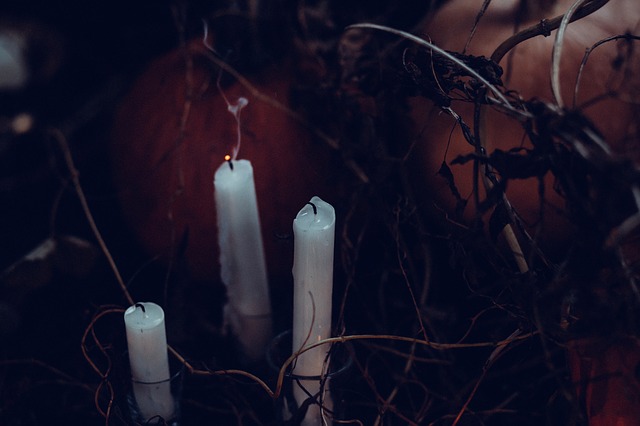
White candles, burning.

Say,

“See the moon’s glow, charging the Wheel.
My life is unfolding, with each turn I feel.
Full moon energy, guide me this night.
Transform me, renew me,
With your radiant light.”

As you meditate on your Wheel, consider what changes you can make to the areas of your life that need the most help. What can you do within the next week? The next two or three weeks? The next month?

Come up with three simple actions you can do over the next week. They can follow the energy of the waning moon, but they don’t necessarily have to.

Come up with three more that you can do over the next two to three weeks.

Finish by coming up with three more that you can complete by the next full moon.

Save this Wheel. Place it somewhere where you’ll see it often. Refer to it as many times as you need to in order to keep yourself motivated and on track.

(If you like, you can turn your actions into statements of intent, and use your preferred method to further empower them. Turn them into sigils, shorten them to symbols and inscribe them on candles, and so forth.)

If this isn’t your first time performing this ritual, then take out the last full moon’s Wheel.

Take a moment to compare this full moon’s Wheel to the last one. What progress have you made? What seeds have you sown, and what have you reaped? Give thanks for any advancements you’ve made, no matter how small.

A crackled clay firebowl filled with burning herbs. A small pile of herbs sits in the foreground.

If you wish, you can light the last full moon’s Wheel in the candle’s flame and drop it into the fireproof bowl. Scatter the ashes on the wind.

Witchcraft

Let the new moon wipe it away.

I’ve been taking inventory. Thinking of stuff I want to change (well, mostly get rid of) with next week’s new moon.

I have times where I feel like I’m wearing memories like a lead apron. Protective in some ways, perhaps, but ultimately smothering, uncomfortable, and heavy. We don’t yet have ways to erase them, à la Eternal Sunshine of the Spotless Mind, but man do I wish we did.

Sometimes, it almost feels like physically they have hooks in me. Nasty, twisting wires that seem to pull on my limbs, as if some invisible hand were trying to turn me into a marionette. It’s times like this that I can really see the tremendous value in cord cutting.

To that end, here’s a simple ritual for cutting unwanted connections and starting this moon cycle with a clean slate. I’ve written in the past about cord cutting to sever toxic familial ties, but this is a much more general practice that serves just as well as a kind of energy cleanse.

  • A dull knife or knife-shaped object. I have a bone ceremonial knife, but a butter knife, rubber knife, or even a knife shape cut from cardboard will work. The important thing is that it does not have a sharp or serrated edge.
  • A candle. I typically use unaltered beeswax candles (hey, if it’s good enough for the bees, it’s good enough for me), but you can choose whatever wax or color feels correct to you. I’d suggest white (as a neutral color), black (as a neutralizing color), or red (as a strengthening color), myself.

That’s it!

Like I said, this is a very simple ritual.

Take a moment to take an inventory of yourself. Feel your physical body. If you can’t relax, that’s okay. Feel where tension, pressure, or “stuck” feelings seem to reside. Feel where you store stress.

Now consider your energetic body or aura. Feel out any inconsistencies. Are there any energetic cords or tethers?

Take the representation of the knife. Hold it an inch or so above your skin, parallel. Pass it over your entire body, as if you were shaving your aura. Picture this knife paring away whatever unwanted connections you may have.

As you do this, tell these connections goodbye. Affirm that your dealings with them are complete — they are severed from you and you are no longer connected. Continue this until you feel like you’ve removed all of the unwanted energies or tethers that you can.

A burning beeswax candle on a dark background.

Next, wipe the knife on the candle. Whatever energetic residue remains, just wipe it off on the wax. If the candle is in glass, wipe the knife off over the wick portion. Dust your hands off over it, too, for good measure. Anything that’s left that you don’t want, send it into the wax and wick.

Now, light the candle. Picture that energetic residue burning up like dust. There is nothing more for you to worry about, nothing more for you to do. The connections are cut, the slate is clean. You are free.

Allow the candle to burn completely if you wish, or snuff it. When you discard it, you can do so far from your home if you wish. It doesn’t require any special ceremony, as its job is finished — it has burned away the remains of the energy and connections that you don’t want. The less acknowledgement you give these things, the better.

If you use a cardboard representation of a knife, you can even burn that and scatter the ashes, too. Otherwise, just clean and cleanse your knife very well.

If you have any shielding or restorative meditative practices, now is a good time to do them. Removing these unwanted connections frees up energetic space, and it’s a good idea to either protect that space or have something good in mind to fill it up with.

Here’s hoping for a happy, refreshed moon cycle for everyone!

life · Witchcraft

Really, if you think about it, I’m just helping them sell their house (in a sense).

I can’t say I’ve ever lived in a very close-knit community. My custodial parent was tired and angry all of the time, so we didn’t really do community activities, either. Now that I’m adult enough to do that kind of thing on my own, I love it. I can’t say that I really have any super close friends in my neighborhood, but I still love things like street fairs, farmers’ markets, and that gem and mineral show we went to not that long ago.

That’s why I approached the sudden appearance of a “For Sale” sign in my neighbor’s front yard with equal excitement and trepidation.

The house belongs to an older couple who have an adult daughter and young grandchild. It’s just like the others on my street — a post-war Cape Cod in a decent-sized yard, but theirs has an addition to give it some more space.

I never really saw the owners much, so I’ve never had the chance to really get to know them. I’m pretty much a golden retriever in a human suit, and my baffling levels of friendliness and desire for connections to other organisms yearn for expression, so this is a regret on my part. Honestly, the people who own the place could’ve moved weeks ago.

But this now raises a question: Who’s gonna buy it and move in? We’re in a walkable location that’s not far from DC, so I could see it going to someone who wants to Airbnb it (which is kind of a huge problem in this area in general). I hope not, though.

Honestly, I just hope whoever chooses to move in doesn’t suck.

Then I figured — if you can use magic to draw love, luck, and friendship into your life, why not cool neighbors?

Two candles, one pink and one yellow, lay sideways under a chunk of rose quartz. They are surrounded by four black Herkimer diamonds, and a stick of cedar incense burns just above them. There's a small quantity of incense ash on the wood near the candles.

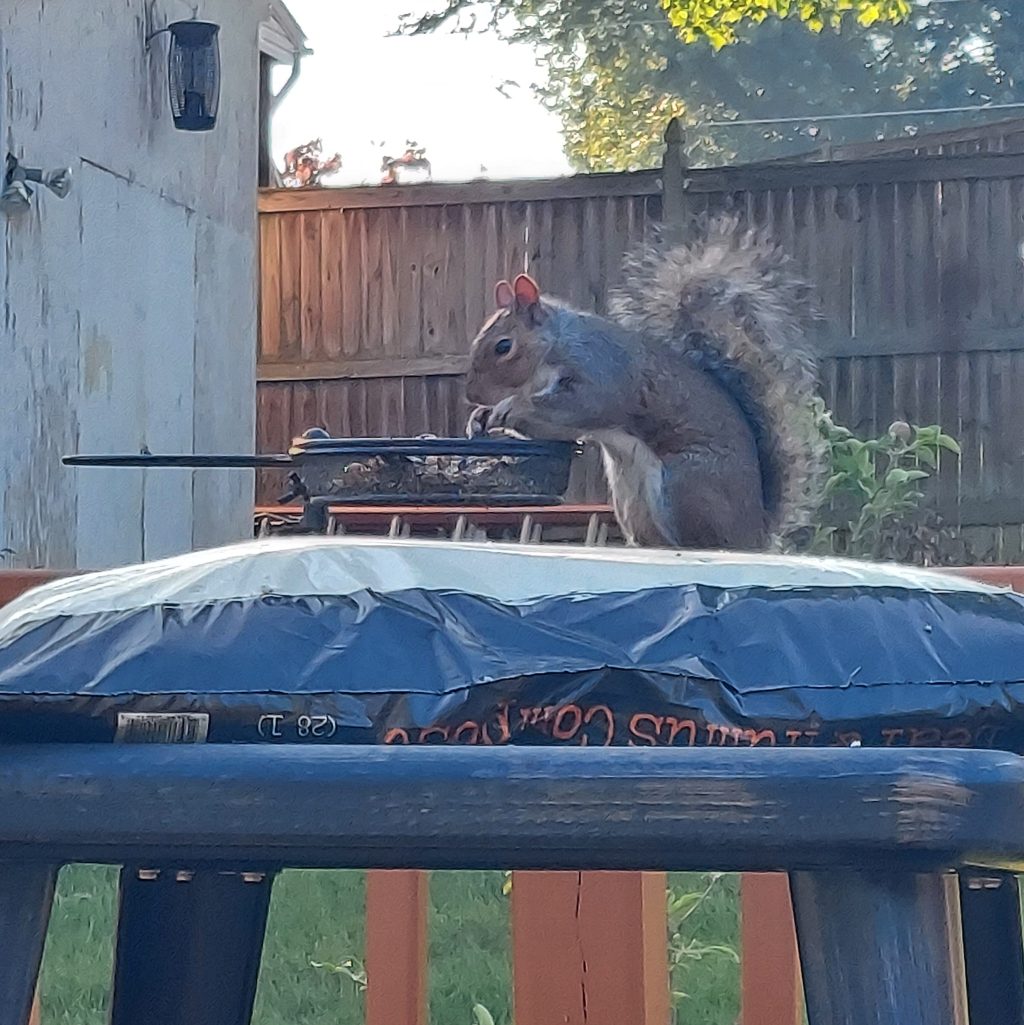
This train of thought it what has found me sitting on my deck, fuming a set of candles (pink for platonic good feelings, yellow for friendship) and a bit of rose quartz in cedar incense, all while arguing with Frederick de Bonesby that it is actually very rude to let his gigantic ass take up the entire platform feeder, and there is a line of sparrows squabbling behind him while they wait their turn.

(Frederick de Bonesby does not care. His primary concern is maintaining his skin and his flesh and his fats, even though he is a tubby squirrel and not a powerful 92-year-old lich. He does this chiefly through consuming copious amounts of peanuts and dried corn.)

A squirrel sits on the railing of a deck, paws busily rummaging through a pile of nuts and seeds in a platform feeder.

But I digress.

Really, I’ve been using yard work as a kind of stealth mission. See, there’s a porcelain berry vine (pretty, but invasive) near the driveway that needs to be torn out. It’s right next to the fence dividing the properties, and also right by our gate. According to my calculations, this makes it an excellent spot to conceal a sweetening jar, which I can do by digging up the porcelain berry vine and stealthily burying the jar in its place.

I could fill it with sugar syrup and honey. Cinnamon and petals from the big Virginia rose bush in the front yard. Clover blossoms snuck from the edge where our yards meet.

I could also modify a love spell to attract a good neighbor. There are a bunch of them that involve listing the ideal qualities of a potential lover. But instead of “physically attractive” and “financially independent,” I could put things like, I don’t know, “fond of crows,” and “has strong feelings against lawns,” and “doesn’t think the entire LGBT community is a cadre of secret predators.”
Really, the principle is the same.

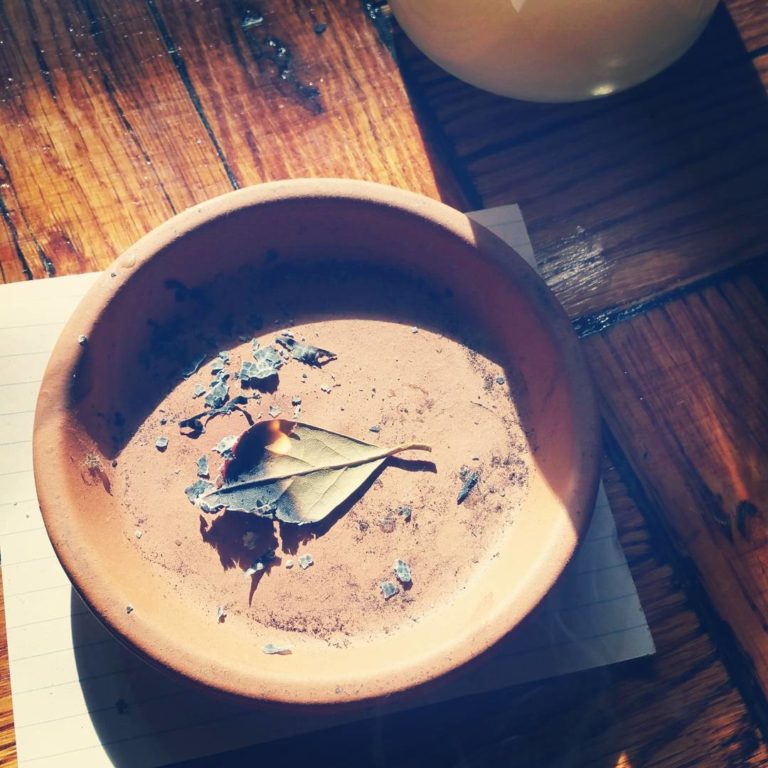
I could fold up the list and put it in a sachet with a magnet and the right herbs and stones. I could take the items on the list, write them on bay leaves, and sit on my deck while I burn them and blow the smoke to the four winds.

A terracotta dish holding a burning bay leaf.

I could whisper my wishes to a handful of birdseed, throw it on the ground, and let the birds carry them where they need to go.

I’m also considering modifying another love spell that involves using human image candles. It’s a kind of sympathetic magic where you take an image candle of the appropriate gender for each person, then move them incrementally closer together over a period of seven days, burning the candles a little bit each night. Once they reach each other, you burn them together and either bury the remains near your front door, or melt the wax together, pour it into a mold with bits of herbs, and make a pretty charm of it.

I could find a candle shaped like a house instead, then mark it with the address. Then I’d just need a general human-shaped image candle (or even a plain white one, in a pinch). The moving and lighting part would be the same. Once all I’ve got is stubs and wicks, I could hide the candles under the sweetening jar where the porcelain berry will… have… used to have been.
(I don’t know how tenses work for situations like this. I feel like I need Douglas Adam’s help.)

Honestly, I just want neighbors like the two ladies whose tend was next to mine during a celebration I attended years ago. One was a Unitarian Minister, one was an experienced mushroom forager, and they were very kind, generous, and friendly (and fabulous cooks). One of the first things they said to us was, “Nice to meet you! Breakfast is at seven.”

A lot of people consider such spells questionably ethical, even if you perform them without the intent to manipulate a specific person’s behavior. If you really think about it, in a way, I’m kind of just helping my neighbors to sell their house. I’m also attracting people who don’t want to exploit the area for its Airbnb potential and prefer native ecological diversity to monoculture lawns.

So really, I’m also kind of in in the right.

I just hope none of my other neighbors see me burying a bunch of jars and candle stubs in the front yard, or it could get awkward.

Witchcraft

Is energy manipulation necessary for magic?

Funnily enough, I got the idea for this post a long time ago — when I was reading up on reasons why cognitive behavioral therapy might fail. That, coupled with a lot of books and papers on traditional and folk magic, raised an interesting question in my mind:

Is energy manipulation requisite for magic?

I’ve seen some experienced witches who poke fun at the spells created and posted by younger ones. I’ve even written about raising and directing power myself. Here’s the thing though — none of that shows up in the really old stuff.

Seriously. I can point you to a hundred different old bits of magical folklore and formulae, and not a one will mention anything about raising, directing, or releasing power. Nonetheless, these spells were important enough for the practitioners to pass them down.

If you look at modern spells and rituals, though, some manner of energy manipulation is considered absolutely requisite. If you skip it, or somehow do it wrong, you won’t achieve your goal. You could argue that the old wise women and cunning men raised and directed power without doing so in so many words, or even worked old magic without realizing that that’s what they were doing. If that’s the case, then who’s to say that this power-raising has to be done on a conscious level?

I have a theory that I find pretty interesting. It’s similar to one posed by Phil Hine in Condensed Chaos, when he talks about Spirit, versus Energy, versus Cybernetic models.
I don’t think magic changed. I think we did.

The Guardian posted an article a couple of years ago on the apparent decline in effectiveness of CBT. Oddly enough, this decline might be due to nothing more than CBT’s reputation. When it was first developed, it was lauded as a marvel of modern psychology. This perception may have influenced how effective it was for people who tried it — believing they were learning a miracle cure for their problems, they experienced one. As more and more people went through CBT with less than stellar results, this perception shifted. It’s declining in effectiveness because it no longer benefits from a reputation as a miracle.

This isn’t to say that all magic is a product of the placebo effect (though there are certainly branches of mental magic that rely on it to a degree). I’ve had experiences I definitely can’t attribute solely to that. But, as the article above mentions, a 1958 book by psychoanalyst Allen Wheelis stated that Freudian psychology no longer worked because people had changed. Modern humans were better at self-understanding. They now needed different tools.

The old techniques weren’t completely wrong; they’d just outlived their usefulness.

Oliver Burkeman

Modern humans are better at understanding the physical underpinnings of the world (arguably at the expense of our metaphysical understanding and psychic sensitivity). We have knowledge that would’ve been unthinkable to our ancestors. Learning changes us. We interact with energy — and therefore magic — differently. One of my ex-partners’ grandmothers cured people of worms by snapping a handful of straw over their stomachs. My ancestors did things that, if I posted them to an online grimoire, would have experienced witches laughing and poking fun at them for being ineffective “baby witch” spells.

The act of observing changes the observer as well as the observed, and we’ve done a lot of observing.

Does this mean that one way is better, more legitimate, more powerful? I really don’t think so. As Burkeman says, old tools outlive their usefulness. We’ve changed. Ten thousand years ago, nobody could digest milk in adulthood. (And don’t even get me started on what we’ve done to our jaws.) We occupy and interact with our environment differently — including the unseen world. It’s entirely possible we need to consciously manipulate energy because that’s what we’ve adapted to.

I’m curious to see what shape the future takes.

art · divination · life · Witchcraft

Bustin’ (Disappointment) Makes Me Feel Good

Yesterday, literally the same day that I posted that tarot reading, I got a bit of disappointing news. I don’t want to get into the details, but it turns out that an artistic opportunity that I’d been pretty excited about isn’t going to happen for me. C’est la guerre. Even amid fulfillment and happiness, it’s a bit much to expect everything to be a slice of fried gold.

Still, understanding that fact doesn’t really banish the bad feelings. Here’s what did, though:

I set a timer.

I gave myself ten minutes to be completely self-indulgent in my complaining. After that, the grumpling grace period was over and I had to keep quiet about it. This serves two purposes:

  1. It keeps me from dwelling on whatever’s bothering me.
  2. It keeps me from becoming insufferable to absolutely everyone around me.

Don’t get me wrong, though. I use this time. I flop dramatically on furniture. I go full Howl’s-Moving-Castle-goopy-wizard. I get to feel my feelings, I can be cartoonishly whiny until I laugh at myself, and other people won’t secretly wish they could lock me in a dumpster.

I did some agitation pedaling.

My partner calls it “having the zoomies.” I call it having more energy than I know what to do with. Sometimes it’s from anger or annoyance. Sometimes it’s boredom. Sometimes, it’s because I ate four bowls of cereal for dinner.

All that corn syrup and riboflavin

Either way, ten minutes of furious living room biking usually sorts it out decently well. I work myself up to my top speed, and hold it as long as I can — all while mentally focused on a goal I have. When I get to the point where I can’t sustain it anymore, I release the energy toward that goal.

Sweat is also cleansing. Sweating can be a sacred act. There are reasons why so many cultures have traditions built around inducing a good sweat.

Singing along to Turisas is entirely optional, but it helps.

RA-RA-RASPUTIN, RUSSIA’S GREATEST LOVE MACHINE

I took a bath (with friends).

(No, not human ones. I don’t think any of them would talk to me afterward.)

When it comes to spells to fix a disappointment, I think they should be spontaneous. It’s not really the time to go worrying about moon phases or astrological timing — if you have needs, fulfill them. Emergency magic performed from the heart can be just as effective as a meticulously planned ritual.

Water is the element of emotions. It’s cleansing. It’s healing. It’s a great way to kill some time doing something that’s objectively good for you. It was late at night, so I didn’t have the energy to make myself a full-on brew, but I do pretty much own my weight in various teas. I boiled some water, added two bags of peppermint and one of chamomile, and asked for their help.

“Peppermint,” I said, said I, “I feel like complete ass and would like that to not be a thing anymore. Peppermint, clear my energy from all that’s dragging me down, and, with chamomile, fill that space with luck and prosperity.”

If you’re putting it in a bath, the garnish is probably kind of excessive

I held my projective (dominant) hand over the vessel, and did the energy thing. When I felt that it was good enough, I asked the brew if it was ready.

“If this be done, and done well, push my hand away from the vessel.”

(Fortunately, I felt the familiar little energetic “push” against my palm. I don’t think I had it in me to sit on my bathroom floor and troubleshoot this spell.)

I poured the brew in a bath full of warm, fresh water, dumped in an unmeasured buttload of Trader Joe’s $1.99 sea salt, stirred it with my projective hand, and called it good. As soon as I stepped in, feeling the silkiness of the water, smelling the fragrant peppermint-and-chamomile steam curling up from the surface of the water, I began to feel better.

I also had a bright, unmistakable vision of a wolf’s face when I closed my eyes, but that’s probably going to take some further research.

I followed the advice I’d been given in the first place.

There’s a lot to be said for the idea of conceptualizing things as happening “for” you instead of “to” you, though that can be tough to remember in the moment. Personally, every setback I’ve ever experienced — every call I never received after a job interview, every breakup — has always led to something better within the space of a few weeks, like clockwork. I don’t force positivity on myself, and you shouldn’t either if you’re really not feeling it, but I try to keep this track record in mind.

Anyway, all of this is to say that, when the sun is shining and everything’s going great, sometimes a minor bump in the road can seem bigger than it is. Tarot readings function as more than a prediction and an energetic snapshot of your life. They’re also advice. Yesterday’s advice was to celebrate, spread joy, and not let my emotions overrule my discernment. I have a lot to celebrate (I sold a painting recently! I can hike longer trails! I did a bunch of paid writing!), I’m hoping this post might be helpful to someone else who’s feeling the slings and arrows of outrageous fortune, and, logically, I know this disappointment will pass and be forgotten before long.

I turned it around.

Creativity is deeply personal. When you put yourself into what you make, it’s hard not to take rejection pretty hard. Most of the time, though, that rejection has nothing to do with you — because creativity is so personal, there’s no accounting for what people want. What I consider my best work is almost never as popular as the things I’m not nearly as attached to.

Similarly, this situation in no way impugns me as a person or a creative force. So, worn out from pedaling, freshly minty, and completely called out by my own tarot deck, I went to varnish some paintings.

I don’t want to suggest that vigorous cycling and a bath are the way to deal with, say, a house fire, the loss of a loved one, someone stealing your car, or a loved one burning down your house and stealing your car, but these techniques can help shift the energy around the things that occasionally show up to heck your day apart.

Witchcraft

Raising Power (and Then What?)

The whole moon hexing-thing seems to have opened up a whole can of worms, hasn’t it?

It seems like most witchy spaces have kind of gotten past the collective initial reaction to it, but it continues to raise a lot of interesting questions — some thought-provoking, some annoying and gatekeepy.

One discussion I came across involved the validity of using the internet as a magical learning tool. Sure, there’s a lot of very “Well, in MY day” attitudes about it among older witches and Pagans, but there are some valid criticisms to levy. The internet has democratized the spread of information, but that goes hand-in-hand with the spread of misinformation (as anyone currently dealing with relatives who believe COVID-19 is a hoax can attest). Granted, a lot of books on the subject are no better. I can’t recall the title, but I vividly remember reading one passage about an Irish potato goddess that someone not only wrote, but someone else published and other people bought. Misinformation still spread, just more slowly.

From this sprouted a discussion about the validity of online spells, and the preponderance of people looking for magic as a kind of quick fix. “Ceremonial” magic gets derided, while simple candle and jar spells pop up and get passed around everywhere. The only problem there is that the “ceremonial” stuff is often not ceremonial it all — it’s the power-raising and the meat of what makes the magic happen. Candle and jar spells are completely valid and workable, but there’s more the thing than putting herbs in a jar and hoping for the best.

This, in turn, hosted a conversation about power raising. One person was completely unconcerned about online spells — they could never work to begin with, because the instructions didn’t include anything about raising power “properly.” Why, one person asked, would you send your energy into your materials?
That, in particular, got me thinking: What does proper power raising and releasing even look like?

Before I even came to witchcraft, I was familiar with raising power — not as a practice, but as a feeling. I picked up on the bright, effervescent thrill that went through me when I was dancing, or when the song I was listening to hit that crescendo that was just perfect, and I could feel the build and release of energy. It wasn’t going anywhere in particular, but it was happening.

As I learned, I was taught the basic circle casting, power-raising, releasing toward your goal construction of a spell. While that’s a perfectly workable means of spellcasting, it’s also not the only way to do it “right.”

Like anything else in magic, it depends on the intention. I don’t mean the intent of the spell, I mean your intention to cast it in the first place. Your intent might be to get a new job, but your intention is to use a candle/jar/sigil/whatever spell to get a new job. That determines what your spellcasting looks like, even down to the release of power. Not every situation calls for a “cast a circle, raise power, release it toward your goal” strategy.

Candle spells are nice because they’re a simple, accessible type of sympathetic magic. You want something to happen as the candle burns. Maybe you want to reverse a hex, so you use a two-color candle and watch the black wax neutralize whatever the other color is. Maybe you want to feel better, so your fatigue decreases as the wax is consumed. Maybe you want to attract a lover, so their heart warms as the flame grows and burns. Versatile!

That also means that the candle is a way of releasing that power. You light the wick, the flame consumes the wax, it releases it as the products of combustion — heat, light, soot, and water vapor. Sending your intention and energy into the candle allows it to be burned when the time is right, or as needed — you raise and release power once, direct it into the sympathetic vessel, and let the element of fire do the rest. You could raise and release power toward your intent, but, at that point, the candle is strictly ambiance.

Jar spells are nice because they’re long-lasting. You fill a container with symbols of your intent, and put it somewhere to work. Maybe you want to keep a happy and stable home, so you fill it with peaceful ingredients and bury it in your back yard. Maybe you want to attract a new lover, so you fill it with rosebuds and bury it near your front door. Maybe you work with someone who really sucks, so you fill it with nails, hot pepper, and stolen pieces of hair and ditch it by a railroad crossing. In this case, much like the candle, the spell isn’t necessarily helped or hurt by a one-time release of energy toward a goal.

Sigils are their own thing entirely. They hopscotch back and forth over the line between magic and psychology as a matter of course, so they’re not going to follow the rules for raising and releasing power. That doesn’t mean that they don’t work, though.

Servitors are interesting energetic constructs, but that means that your energy should be directed toward making them. You don’t really need a circle for it — you’re going to give the energy its own shape, anyway. If you can’t keep it from getting away from you without a magical container, you’re probably going to have trouble with that second part as it is.

Knot magic is another time-release kind of spell. It’s a form of sympathetic magic where the tying or untying of knots contains and releases energy as needed. If you aren’t putting your energy into the knot-tying itself, then the action of untying the string doesn’t actually release anything.

Does this mean that energy raising and releasing have no real rules, and any online spell will work? Well… No.

The common thread of all of the types of spells I mentioned above is that the materials and actions in the spell have a reason for being there. The spell jar’s a magic battery. The knotted string is a string of magical firecrackers. The candle is a way of holding energy until the flame releases it. There are definitely some spells out there that are unfocused, at best.

For example, say you want to draw in a new lover. You fill a pretty dish with rosebuds, lavender, and jasmine flowers, add a drop of love-drawing oil, and send your energy and intent into the dish. You feel that the herbs have absorbed all of the energy they can, so the spell is over and you dispose of the remnants.

And then what? Where does the energy go? How does it get to its goal? You could burn the herbs and release it with the element of fire, fire’s related to warmth and passion. You could even scatter them in a moving body of water, water’s related to the emotions. But, unless the spell tells a novice witch to do that, are they going to?

I like online spell resources because they’re good for ideas. You can usually tell which have a chance of working (and which don’t stand a brine shrimp’s chance in a photon tube) by asking a pretty simple question for each ingredient and instruction: Why is this here?

Most will tell you to meditate or visualize. These are ways of raising mental and magical energy, but not the only ones. You can dance, sing, or ride a twelve-speed vibrator the size of a Thermos until your eyes bug out, and it’ll work just as well as long as you keep your goal in mind.

They might not give you an effective way to direct or release this energy. Don’t get me wrong, you can do way worse for yourself than holding a bunch of lavender flowers and meditating on something that would bring you joy, but that probably isn’t going to bring you much closer to your goal.

At each step, ask why. At each ingredient, ask why. Not only will it let you know if you’re wasting your time, it’ll make it easier to write your own spells or make substitutions when necessary.