Plants and Herbs

The robot uprising is here, and they’re trying to kill us with bad foraging advice.

When foraging, it’s said that you should be as confident identifying edible plants in the wild as you are in a grocery store. Foragers also say that the best way to learn is to have an experienced person to guide you. Not everyone has access to someone like that, though. Enter: Books about foraging.

Ripe wineberries. They are shiny, red raspberry-like fruit on a stem covered in red hairs.

Now, gathering and eating wild plants based entirely on the photos and descriptions in a book can be a bit intimidating. For some plants, this isn’t a big deal — wineberries, for example, are an invasive edible that’s really easy to pick out. Garlic mustard and wild onions, too. Some plants don’t really have poisonous lookalikes, so the odds of making a dangerous mistake are pretty slim. Others, not so much.

All of this is to say that books about foraging aren’t all bad. At least, they weren’t.

Here’s where shit gets weird.

People looking to make a quick buck have turned to artificial intelligence and Amazon’s publishing platform to pump out a lot of barely-concealed drivel. A lot of this is in the form of children’s books, I guess because they seem easier to make than a full-length novel. This is far from harmless, because children’s books play a role in the development of literacy and empathy that you don’t really want to hand off to a computer.

This attempt to cash out isn’t limited to children’s books, either. Amazon and other online book sellers have become the proud purveyors of foraging books written by AI. This isn’t really a new phenomenon, but, on the off chance any of you out there’re in the market for foraging guides, I figured I’d give you a heads up.

To be fair, a lot of these are simply useless and the worst they’ll do is waste your money. The books in this category claim to be foraging guides, but end up being about why foraging is good, listicles on the benefits of eating more fruits and vegetables, and recipe ideas. Pretty harmless overall.
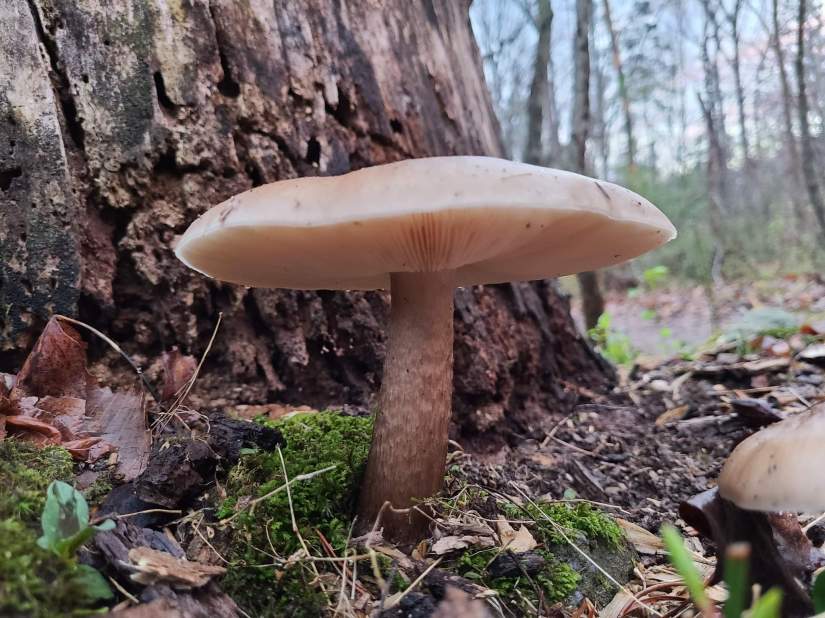
An underside view of the gills of a cream-colored mushroom.

On the other hand, there are books offering actual descriptions of “edible” plants and mushrooms(!). Some of them even list “taste” as an identifying feature of plants and fungi, which could encourage inexperienced foragers to taste things they haven’t positively identified. Since many extremely poisonous mushrooms are visually similar to harmless ones, this could get someone killed. Hell, plenty of people already mistake poisonous mushrooms for edible ones even without books encouraging them to taste them.

It’s not always easy to pick out which books are written by actual human people, and which aren’t. There are a couple of things that you can look for:

  • Publishing dates. Books written before the rise of AI generated content are a safer bet here.
  • The author’s web presence. Even if they have a photo, that doesn’t necessarily mean that they’re a person. The photo could be stolen (just see any of the fake identities on Scamfish), or made up by a different AI. Look for a blog. A Facebook page. A TikTok. An Instagram. Something to indicate an existence beyond the cover of a dodgy book.
    As this article from 404 Media states, “‘Edwin J. Smith’”’ is the author listed on two books[,] but doesn’t have any other books, or an online presence otherwise. The only Edwin J. Smith I could find was a Professor Emeritus of medicine at Indiana University from a staff list that’s more than a decade old.”
  • The author’s credentials. They should be actual, and not completely made up. Beware of author bios that offer vague, unrelated information.
  • A sample of the prose. A lot of bots pull from very varied sources, so you’ll get bits that sounds like they’re cut from a recipe blog, a florist’s website, an actual foraging manual, and so forth. These are also likely to be thrown together without much thought, because no actual humans looked at it to make sure it’d make any damn sense at all.
  • The editing. Bad, AI generated foraging guides often have mistakes that any human editor (or writer, for that matter) would pick up on right away.
  • A bad score from an AI-detection tool, like Scribbr or GPTZero. Get a sample of the text, paste it in a detection tool, and see what it says. While you’re at it, paste the author’s bio in there, too.

Again, if you’re able to, connect with an experienced foraging expert before going out in the field on your own. Your local university may be able to help you. You might even be able to find a group of foraging enthusiasts on sites like Meetup. Even if you can’t go out with a foraging expert, they may be able to recommend actual, useful guides, videos, and other resources for you.
life · Neodruidry

Happy Samhain!

It’s New Year. Halloween. Samhain. Whatever you want to call it, it’s when the “veil is at its thinnest,” children ignore everything they’ve been told about not taking candy from strangers, and the leaves are at their peak here.

This year, I’ll be celebrating Samhain with other Neodruids for the first time. That’s not all, though — after our ill-fated trip to the caverns, my Handsome Assistant and I decided to go somewhere that was the complete antithesis of a cave.

The mountains.

An image of a nearly-full moon rising over the Shenandoah mountains. The sky is shades of deep pink, blue, and lavender.

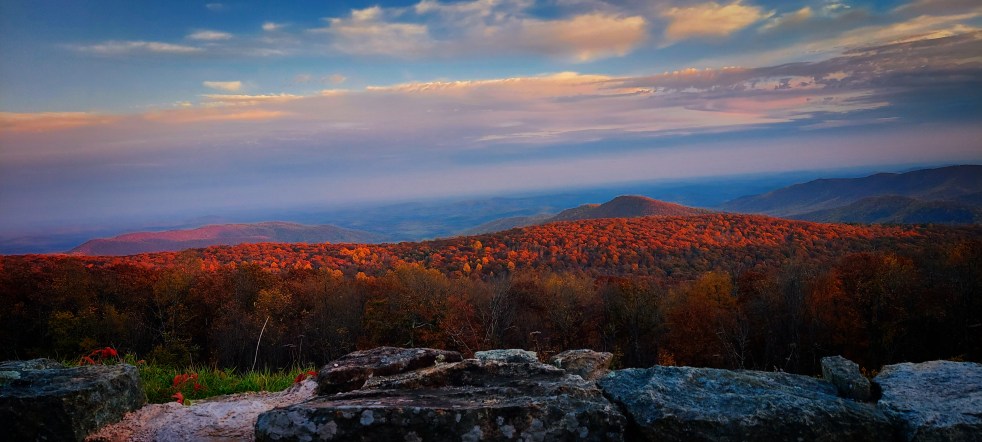
We took a road trip down Skyline drive to go leaf snarping. It was unseasonably warm, but the elevation made it quite a bit cooler. The leaves were brilliant, and the air was full of the earthy, musky, spicy-sweet smell of decomposing foliage. The strange bit of warm weather we’ve had meant that there were still some wildflowers clinging to life, bringing even more color to the already-saturated landscape. It was near sunset, so the nearly-full moon was shining just above a bank of bright pink clouds. The landscape looked like a Klee painting, the sky was a vaporwave album, and the air was filled with a smell a perfumer could only dream of replicating.

The moon peeking over a cloud bank at sunset. Below, there's a view of the mountains covered in trees in brilliant shades of red, orange, and gold.

It was pretty nice. Especially after the cave incident.

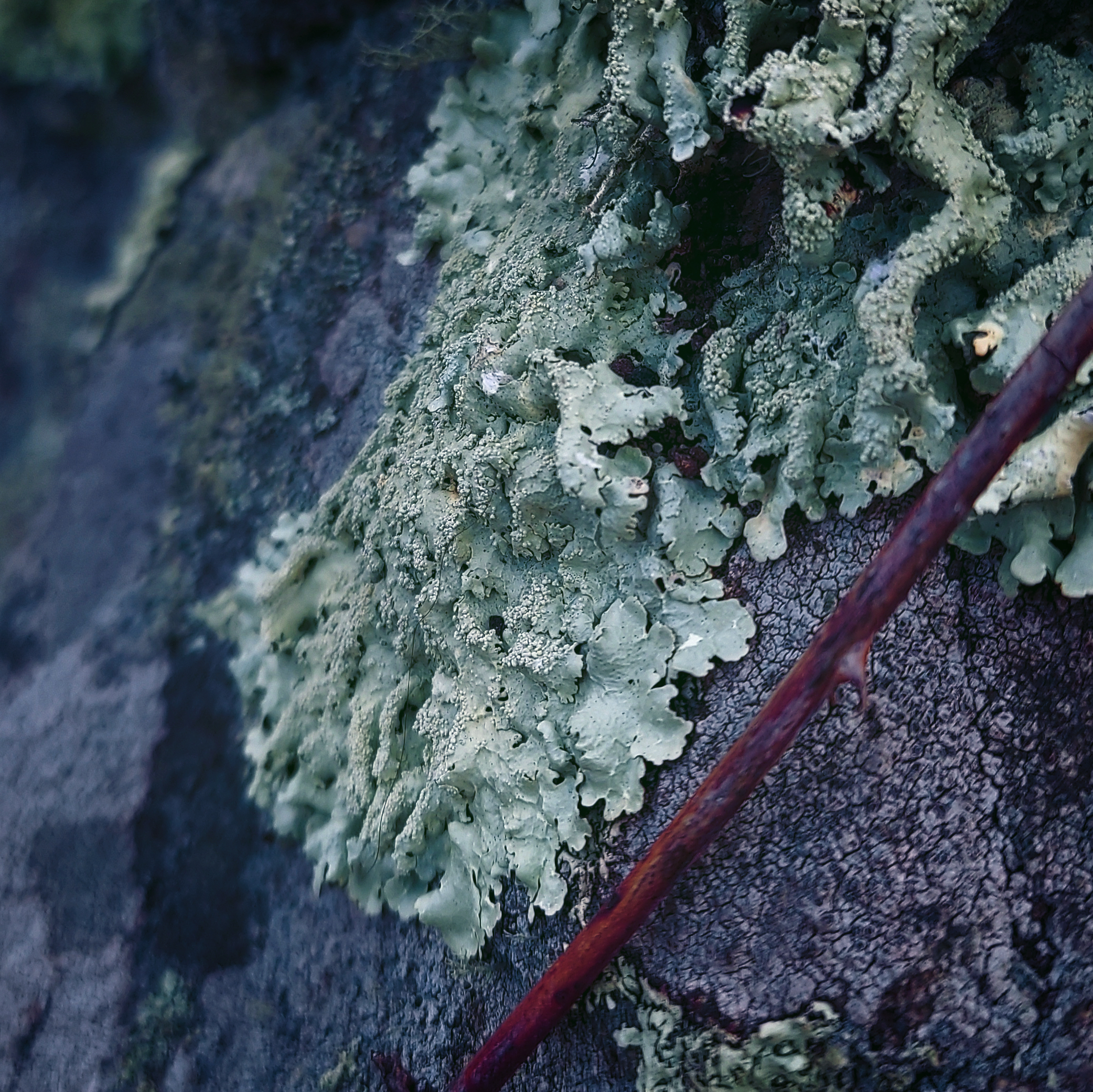
My Handsome Assistant teased me gently for taking tiny pictures. Snaps of an individual leaf, or a really interesting piece of lichen. I do that a lot. The larger landscape is fascinating, but the way the sun seemed to melt through the spaces in the trees backlit the leaves and made them glow like flames.

I took a special research elective in high school, where we had to report on abstracts of other research studies, then formulate our own. My teacher remarked that I mostly seemed interested in the extremely macro and micro — either the far reaches of distant galaxies, or the inner workings of organelles. Not so much the stuff in between.

(My experiment was about teaching hamsters to differentiate between different symbols and was in no way a way to get the school to pay for me to have several hamsters and hamster supplies, I promise.)

I feel like this is still reflected in the kind of pictures I take and the things I paint. I like to focus closely on a small individual subject, or on a very large landscape. It is also why I think I get so bored by portraits or character reference sheets.

A road curves around a hill and into a forest filled with orange, red, and green trees. Some boulders stud the hillside in the foreground.

Today, I’m making some roasted vegetables to share at a potluck. (And possibly some bread — I’ve been slacking on baking lately — or lentil pasta in pumpkin cream sauce.)

This Samhain, I’m also focusing on all of the rad things I want to do next year. Stuff’s winding down, but it’s still warm enough to be active. I’m also filled with creative energy right now, so it’s time to plan, save, and sow for spring. My Handsome Assistant and I just planted a plum tree (surrounded with some bulbs, for the bare beginnings of a tree guild), black raspberries, and swamp milkweed before the ground gets too cold to dig. We still need to prune the apples and get everyone else ready for winter, but we’re well on our way to a happy and fruitful spring and summer.

Here’s hoping all of you can get out to do some leaf snarping of your own and have a very good Samhain.

Plants and Herbs

Rosehip Folklore & Magical Properties

Roses (t least in their wild form) are fruit-bearing plants. These fruits, called rosehips or rose haws, are bright red, berrylike fruits that serve as a source of food for wildlife and people alike through the autumn and winter months. They’re high in vitamin C, and are frequently used in everything from supplements, to teas, to jellies, to skincare products.

They’re best harvested right after the first frost, when the fruits are bright red and slightly soft. That’s actually what prompted me to write this post — see, our first frost date is supposed to be in the middle of October. As of this writing, next weekend is supposed to be in the 80s. According to the National Weather Service, we’re not actually going to get frosty temperatures until the middle of freaking November. I could harvest the fruits anyhow and mimic the action of a frost by popping them in the freezer for a few hours, but still. 80 degrees.

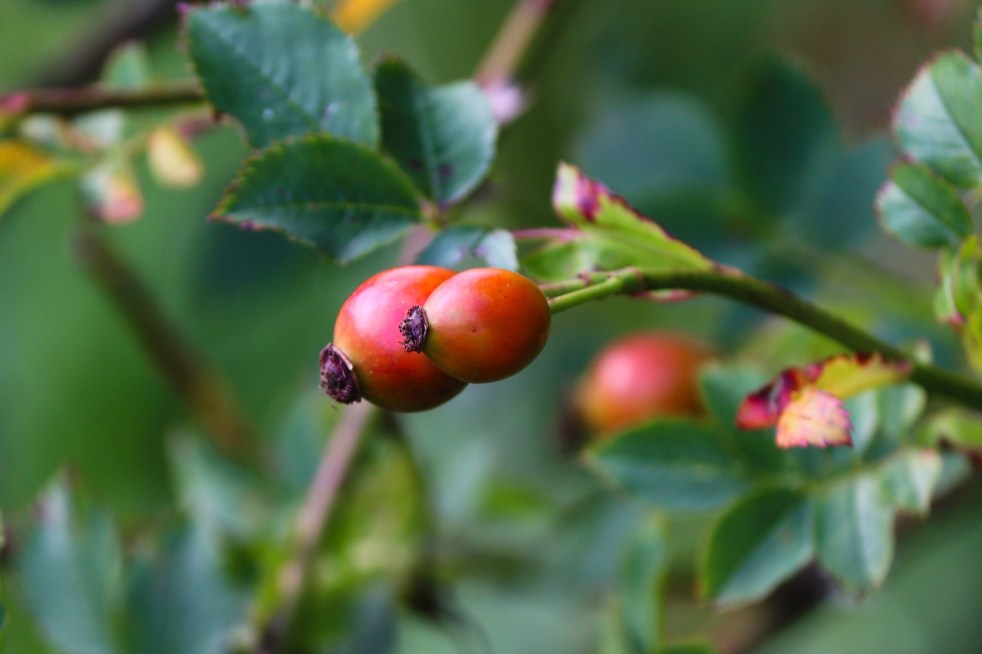
Some bright red, round rosehips on the plant.

(Side note, my Handsome Assistant and I were planning on taking a very off-season vacation on the beach. We weren’t planning on trying to swim or anything, but we decided to cancel anyway since it’d likely be too chilly to do much but hole up. Go figure!)

Rosehip Magical Uses and Folklore

Medicinally, rosehips are used for anything that benefits from more vitamin C. They’re boiled into syrup and given for colds, and used in tea over winter (when fresh fruit is in short supply). The fruit is also a mild diuretic that can help with certain urinary disorders, while the seeds, when boiled, may be helpful for symptoms of gout.

The fruit portion of a rosehip forms a kind of capsule around the seeds. These seeds are covered in irritating hairs, which is why it’s important to clean rosehips before using them. These hairs are so irritating, in fact, that they can be used to make itching powder!

Not all roses will form hips. Flat blooms, as opposed to cup or globular blooms, generally have the easiest time doing so. The reason for this is simple: cup and globular blooms are bred for show, and have masses of petals that cover their stamens and pistils. Since pollination is necessary for fruit production, bees need to be able to get in there to pollinate. This is easy for them with flat blooms, and next to impossible with more complex shapes. Deadheaded roses also won’t produce hips, since the portion that would become the hip gets cut off in the process.

Rosehips are useful for all of the same things that roses are. They shine in love and beauty magic (due, in part, to their vitamin C content). Used in ritual baths or to infuse oils, they can have a brightening effect on the skin.

Some more rosehips. These are still very green and not yet ripe.

Rosehips are also used in spells for good luck and prosperity.

To banish nightmares, place some rosehips under your pillow. You might want to use dried hips for this, since fresh ones could end up leaving you with a sticky, squishy, unpleasant surprise in the morning!

Since rosehips house rose seeds, they’re a good general addition to spells to increase anything. All seeds have immense potential and are used in magic for growth, so you can include rosehips in any spell to increase love (including self-love), money, luck, you name it.

Using Rosehips

To use fresh rosehips, wash them well, slice them open, and remove the seeds and hairs with a spoon. You can then dry them, make them into jelly, or eat them fresh. Dried hips from the store are good to go as they are.

Add fresh or dried hips to magical teas or other recipes. They have a tart flavor that pairs well with lots of drinks and dishes. Stir with your dominant hand as you cook, and intentionally infuse the mixture with the energy that you want to attract or increase.

To keep nightmares at bay, include dried hips in a dream pillow. Lavender, lemon balm, and rosemary also work very well here.

Dried rosehips (and rose seeds) are great additions to spell jars. As I mentioned above, they bring extra energy to increase whatever it is you’re looking to grow or attract.

On the other hand, the irritating hairs around rose seeds are good for protection or banishing spells. Add them to powders to keep unwanted people or spirits at bay. Sprinkle them under your doormat and instruct them to annoy anything and anyone who shouldn’t be at your door.

Rosehips are as useful as they are beautiful. If you have garden space, I highly recommend planting some wild type roses to help feed birds and other animals (and provide you with lots of powerful magical ingredients). If you don’t, keep your eyes peeled when you’re out and about — you may just find some wild roses with plenty of hips to share.

Plants and Herbs

Maple Folklore & Magical Properties

This past weekend, my Handsome Assistant and I took a small drive down Falls Road (alias Scenic Route 25). This was recently dubbed the second-best route in the country for seeing fall colors, and, while the leaves haven’t quite reached their peak just yet, it was a really lovely drive.

Red maples (Acer rubrum) are one of my favorite trees to see in autumn, and I’m lucky to share a home with one. Their leaves turn a vibrant scarlet every autumn, hence the name.

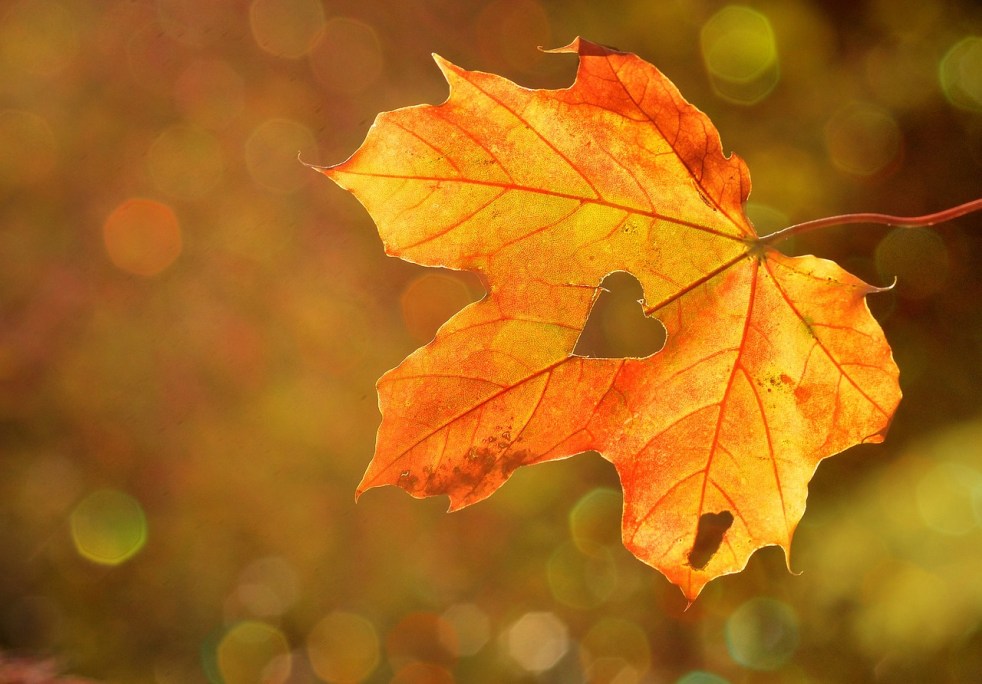
Bright red maple leaves on a branch.

Honestly, I just love maples in general. As a little kid, I used to pick up their samaras (we called them “pollynoses”) from the sidewalk, open the seed capsules, and stick them on the end of my nose. I bake primarily with maple syrup. I’m trying to convince my Handsome Assistant to make his next back of mead a batch of acerglyn (a similar beverage made of half honey, half maple syrup) instead.

I probably don’t need to say that trees have featured prominently in Pagan practices probably ever since the first Pagan. Each one has its own traits and associations, and, when it comes to working with the wood, leaves, or fruits, its own magical properties.

To be honest, maples were so ubiquitous where I grew up that I didn’t know they weren’t more widely harvested from. When I was thirteen, I was a foreign exchange student, which resulted in a brief stay in the Netherlands before going to Sweden. My student group (jetlagged and exhausted) stopped at a cafe on our first day there, where I happily ordered a plate of silver dollar pancakes and syrup.

But it was not syrup.
It was stroop.

Stroop (rhymes with “rope”) is often made of boiled-down fruit, water, and sugar, but can also be made with molasses and brown sugar. While it isn’t bad by any means, the latter variety is kind of an unpleasant surprise when you’re a kid who’s used to maple syrup with pancakes, hates molasses, and also desperately needs a nap. Not knowing any better, I drenched my pancakes in stroop and made myself a very avoidable struggleplate.

Anyway, all of this is to say that maples rock, maple syrup is the food of the Gods and should absolutely never be taken for granted, and I may still carry some molasses-induced trauma.

Maple’s genus, Acer, is Latin for “sharp.” This is due to their very unique, pointy leaves.

An Abenaki story tells how maple syrup once flowed freely from trees. It came so easily, people would lay on their backs and just let the syrup run right into their mouths. The legendary figure Glooskap saw how lazy people had become, so he turned the thick, sweet syrup into runny sap. From then on, if people wanted to eat maple syrup, they would have to work for it!

Another story, said to be of Haudenosaunee origin, tells of a man who watched a red squirrel nibble the end of a maple branch. The sap flowed until the sugars dried, hardened, and crystallized. The squirrel then came back to lick the sweet maple sugar.

In European-based magical systems, maple syrup is often used as an ingredient in love spells.

Maple sugar or syrup is also a useful ingredient in sweetening jars.

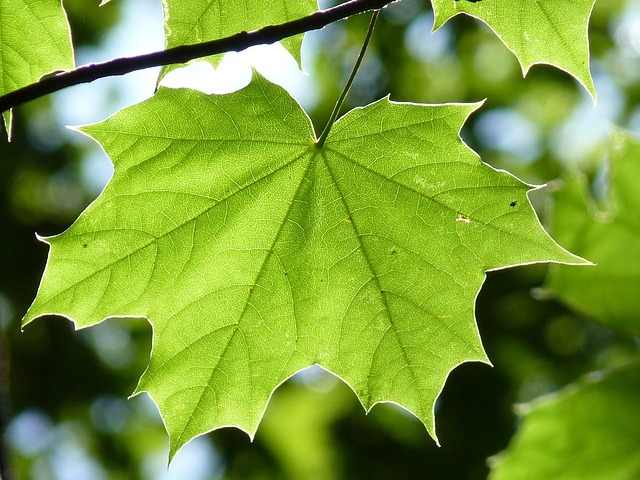
A bright green maple leaf.

By contrast, maple wood is considered very protective. It was sometimes incorporated into doorframes for this purpose.

Some sources consider maple to be good for prosperity and abundance in general.

As wand wood, maple is known for having a somewhat erratic energy. It also helps dispel negative energy, center oneself, and reveal paths and options one may not have considered.

Maples, particularly silver maple (Acer saccharinum) are considered Moon plants. They’re also associated with the element of Water.

Working with maple can be as simple as using magical tools made from the wood. Every tree — and thus every wood — has its own energy. I haven’t personally found maple to be erratic, but, to be totally honest with you, I’m erratic enough myself. (I think it also helps to have sourced the wood from a tree that I know pretty well!)

If you’re in the eastern US, you’re probably located near a maple tree. If that maple tree is anything like the one here, it probably drops plenty of sticks and smallish branches every time there’s a storm. Should you be of a mind to make your own magical tools, deadfall maple wood is honestly really easy to come by.

I can only vouch for red maple, but, once the bark and cambium are stripped off, the wood itself is light and silky-feeling. Sanded well, it takes on an almost metallic sheen. I love it.

The next easiest way to work with maple is to use maple syrup. You’ll need the real stuff for this, unfortunately — the fake stuff is cheaper, but also doesn’t really bear any resemblance to the genuine article. (There’s a good reason for that, too. Maple sap is chemically very complex, and we still don’t really understand all of the different compounds and reactions that give boiled sap its flavor. That makes it pretty much impossible to make a decent imitation syrup.)

If you’re looking to make a sweetening jar, artificial syrup is probably fine if you can’t get your hands on the real stuff. That said, plain sugar and tap water will make you a perfectly fine simple syrup that’ll a) be cheaper, b) let you add your intention or energy during the syrup-making process, and c) let you bypass the artificial flavors, colors, and other ingredients that don’t really add anything to the magic-making.

Otherwise, add maple syrup to your favorite edible magical recipes. Like I mentioned above, I bake with it almost exclusively — it’s pricey, but I love what it does for the flavor and texture of desserts. Seriously. It makes amazing breads and cakes, and is fantastic in chocolate chip cookies. Add the maple syrup, thank the tree for its sacrifice, tell the syrup what you want it to do for you, and stir your concoction clockwise using your dominant hand. Easy peasy.

Maple samaras (aka, pollynoses) can also be helpful additions to a charm bag. They end up all over the place in late spring to early autumn, so, if there’s a maple anywhere near you, you probably won’t have any trouble finding some. Add them to bags for prosperity, love, or protection.

Plants and Herbs

The beauties are berrying!

Thank you for being patient with me while I slept for essentially a week straight. It may have “just” been a vintage cold, but that coupled with the rainy weather was enough to put me out. If there’s one nice thing to come out of that, though, it’s emerging from my tiny, forced hibernation to see the ways the garden is changing as the days shorten and temperatures drop.

Earlier this year, I planted an American beautyberry (Callicarpa americana) bush. By “planted a bush,” I primarily mean “stuck a stick in the ground.”

The original sapling was a tiny, nearly leafless thing with just a few roots. This year alone, it’s managed to grow into a roughly three-foot-tall bush with tons of leaves, tiny flowers, and — eventually — fruits.

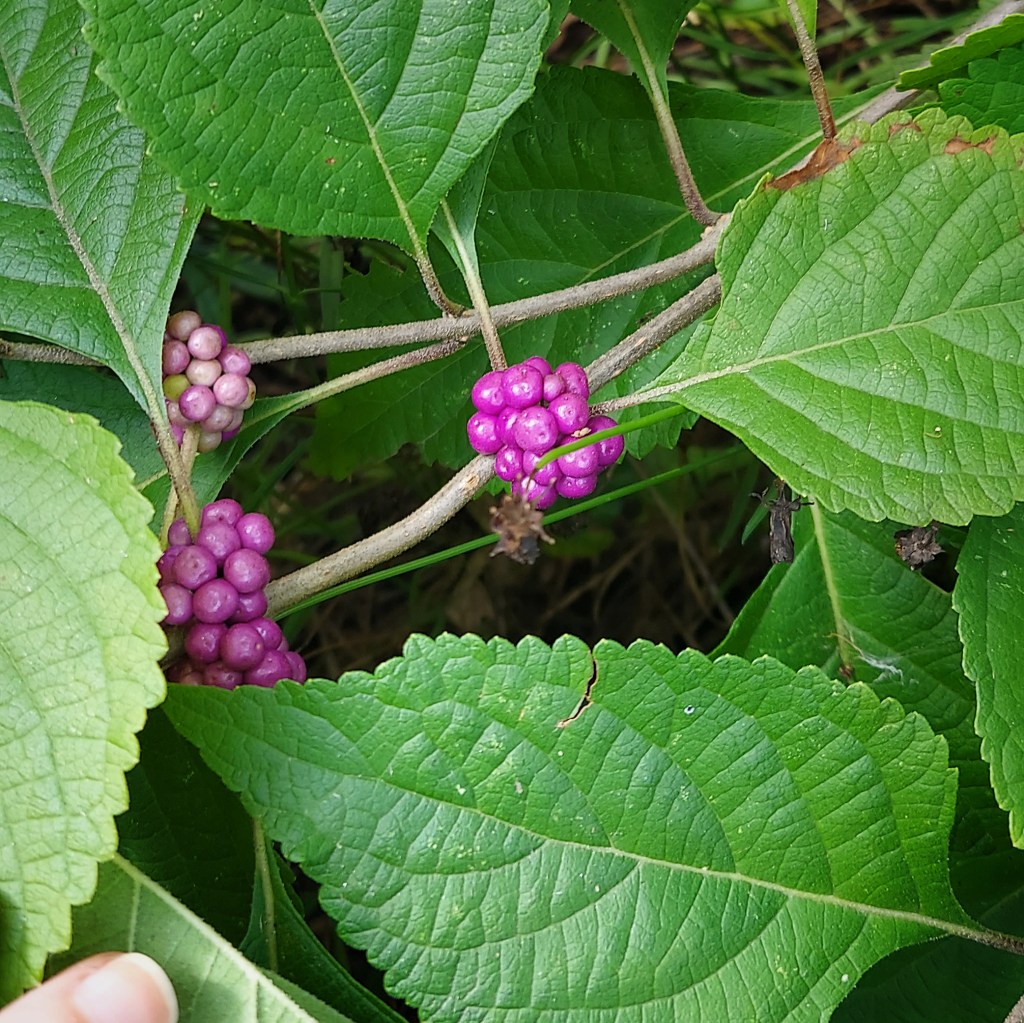
Tiny clusters of bright pink beautyberries hidden among serrated green leaves.

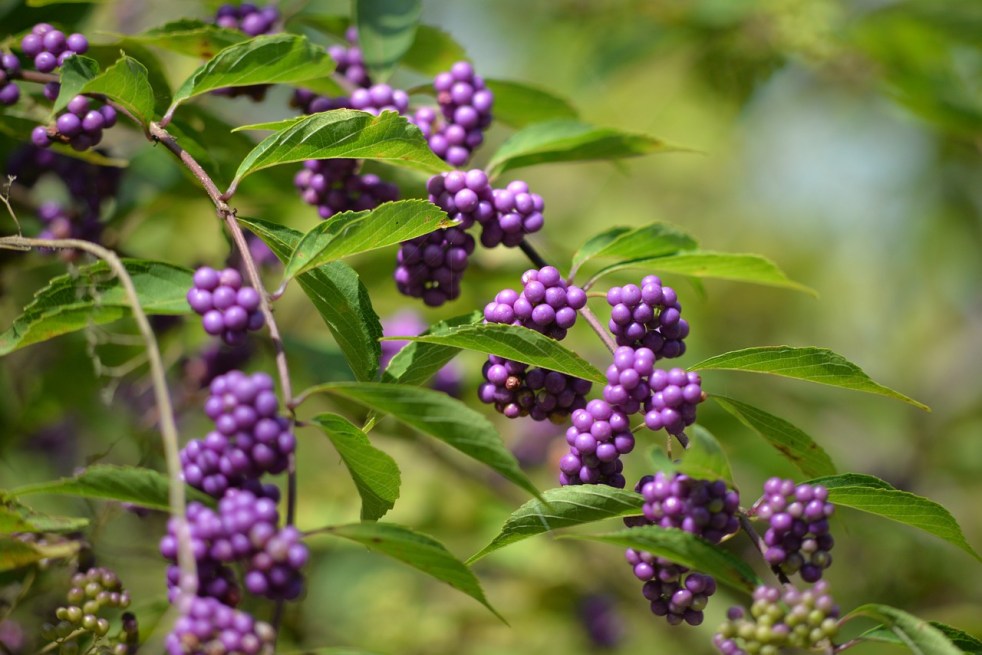
The fruits are all starting to really ripen, which has been incredible to see. While the flowers of beautyberry are rather indistinct and unremarkable, the berries are absolutely gorgeous: tight clusters of tiny, round, bright magenta berries that can persist through the cold months. While they aren’t a first choice for birds and other animals, this actually makes them even more valuable to wildlife once winter really hits. When other, more palatable sources of food are used up, beautyberry’s there to help keep everyone going.

The berries are bright, attention-grabbing, and non-toxic, so why aren’t they more popular among wildlife? It’s purely a matter of taste — literally. I’ve eaten a few ripe beautyberries straight off of the bush, and the opening flavor is sweet and very unique. It’s hard to describe, but, if I had to, I’d say it’s a combination of lemon, grape, and cucumber, perhaps with very subtle notes of raspberry and bergamot.

A close-up of a cluster of beautyberries, held in the palm of my hand.

Unfortunately, this is followed by a rather bitter aftertaste. I don’t think it’s a dealbreaker when it comes to snacking on a few here and there, but I can absolutely see how an animal with an abundance of other food sources might. If I had to describe the bitterness, I’d say it’s about on the level of grapefruit.

Medicinally, beautyberries are really interesting. The leaves contain aromatic compounds that have been said to repel mosquitoes comparatively to DEET. People indigenous to its range have used it as a natural bug repellent, and researchers have extracted some unique compounds that “showed significant repellent activity against [Aedes egypti] and Anopheles stephensi.” Anecdotally, some people claim it’s also effective against ticks, but other users have found it to be of little use. There are loads of DIY mosquito repellent recipes using C. americana available on the internet, but those that macerate the leaves in alcohol (ethanol or isopropanol) are likely to be more effective than those that use water.

Other than making mosquito repellent, the leaves and roots are traditionally used to treat colic, edema, dysentery, stomach pain, rheumatism, and symptoms of malaria.

Researchers have also found an aromatic compound, 12(S),16ξ-dihydroxycleroda-3,13-dien-15,16-olide, that can help treat antibiotic-resistant staph infections. MRSA is a big deal because it can be very difficult to treat. Beta-lactam antibiotics are some of the safest ones we’ve got, but don’t work very well against resistant bacteria. The compound found in beautyberry helps to restore drug-resistant staph’s sensitivity to oxacillin, a beta-lactam antibiotic.

C. americana is only one species of beautyberry. There are also C. japonica from Japan, and C. dichotoma and C. bodinieri from China. Beautyberries all look alike, but there are some key differences to look for if you’re not sure which bush you’ve got.

C. americana has magenta berries that grow very closely around the stems of the bush. There’s basically no airspace between the bark and the berries, which gives these plants a rather unusual appearance. One cultivar, C. americana var. lactea, produces white berries.

A close-up of C. americana, showing the berries closely packed around the stems.
Another shot of “my” beautyberry, showing the lack of space between the berries and the stem.

Asian species of beautyberry look very similar to C. americana but produce berries in clusters on short stems. Instead of closely circling the branches of the bush, there’s a little bit of air space between them.

An image of C. bodinieri, showing the fruits on short stems.
C. bodinieri, showing its slightly different fruit distribution.

If you’re me, you get a little sapling, find a place with lots of sun, stick it in the ground, and wish it the best of luck. Wild beautyberry is found in meadows, woods, and the edges of ponds and streams. It’s not really picky.

I admit, I’m probably not a great person to ask how to grow things. Most of my most successful plants have been accidents (hi, pumpkins) and part of the reason that I love gardening with native plants and nativars is because they don’t require coddling. Find an appropriate spot, and the plant’ll know what to do.

At the moment, the beautyberry bush I planted is still fairly small. While it’s putting out berries like a champ, there aren’t enough for me to harvest some and leave enough for the birds. Since it’s done so well, though, I’ll definitely be looking for more places to add it to the landscape. By next year, I’ll hopefully have enough for jam, sauce, and even pie!

Plants and Herbs

Pumpkin Folklore & Magical Properties

I mean, this one was pretty much inevitable.

(For a useful companion guide, you may also want to read this bit about nutmeg.)

I was never much of a fan of pumpkins growing up, but my experience with them was also limited to cleaning handfuls of cold, stringy, slimy pumpkin guts out of jack-o-lanterns and eating pasty-textured pumpkin pie from the grocery store. This year was my first experience processing fresh pumpkins, and it’s changed my entire outlook.

For as much work as it is to halve them, remove the prickly stems, clean them out, roast them, and puree them, it’s very well worth it. The flavor of a freshly roasted pumpkin is sweet, almost buttery, and nothing like the canned pumpkin pie filling of my youth. (Which is, let’s be honest, mostly made of other types of squash anyhow.)

As I’ve been gradually processing more of my ludicrous pile of pumpkins, I figured it’d be a good time to write a bit about their magical uses and relevant folklore.

While pumpkins are the predominant produce for jack-o-lanterns in the US, it wasn’t always this way. The original jack-o-lanterns were carved from turnips, and absolutely terrifying. While they’re a lot smaller than your average carving pumpkin, you can fit a ton of unsettling details into a turnip.

Jack-o-lanterns were originally used to keep confused or malevolent spirits at bay during the autumn months. They’re also connected to the Irish tale of Stingy Jack, a drunkard who managed to get himself barred from entering Heaven or Hell, and was thus condemned to roam the Earth with a candle in a turnip to light his way.

A big pumpkin, carved with a big, pale, toothy grin.

While the origins of the poem “Peter, Peter, Pumpkin-Eater” are unclear, it may have some fairly dark origins. One source claims that “Had a wife, and couldn’t keep her” refers to his wife’s infidelity. Putting her “in a pumpkin shell” was a euphemism for using a chastity belt. Another source claims that putting her in a pumpkin shell was intended more literally — Peter murders his wife, and conceals her body in a large pumpkin. The structure and subject matter of the poem hints that it may have come from an older rhyme from Scotland. While this rhyme doesn’t mention pumpkins (since pumpkins are native to the Americas), it does mention a Peter and an unkeepable wife. However, rather than putting her in a pumpkin shell, he lets her be eaten by rodents:

Peter, my neeper

Had a wife

And he couldn’t keep her

He pats her I the way

And lat a’ the mice eat her.

What the fuck, Peter.

Seeds, in general, are considered useful for beginning or attracting new things. Pumpkin seeds, being large, are easy to mark. This means that pumpkin seeds can be ideal components for any spell that involves making positive changes in your life. (As long as those don’t involve banishing things. You’ll probably want to use cloves or garlic for that instead.)

In religions that sprang from the African diaspora, pumpkins are associated with several major deities, particularly Oshun and Shango. Oshun is a goddess of rivers, love, and fertility, which echoes the connections between pumpkins, the element of Water, and the concepts of fertility and abundance as seen in other cultures and traditions.

To some groups indigenous to Mexico, pumpkins were considered a strengthening, fortifying food that increased endurance and protected against cold.

According to a Huron creation story, pumpkins arose when a divine woman died in childbirth. All of the plants necessary for life sprang up from her body: Beans grew from her legs, corn sprang from her body, and pumpkin vines grew from her head.

Pumpkins are associated with the Moon and the element of Water. They’re generally considered symbols of prosperity, protection, and fertility.

Like muscadines, these are one of the easiest magical ingredients to use. They’re edible, so prepare them with intention and the proper techniques, then eat them. Bingo, bango.

To use the seeds, clean them well and dry them thoroughly. Using a fine, non-toxic, felt-tipped pen, write your desires on a pumpkin seed. (You’ll probably only be able to fit a single word, or a symbol. That’s fine!) Seeds represent the power of infinite possibility. You can plant the seed so your luck grows as the pumpkin vine does, set it outside so your wishes may be carried to the divine by birds or squirrels, or cast it into a body of water.

Pumpkins, candles, and a pair of hands holding a deer skull.

Pumpkins are traditionally a good offering to water spirits. Depending on the spirit, however, cutting or cooking the pumpkin first may be taboo.

If you decide to carve a jack-o-lantern, empower it to protect your home from evil. Set one or two as guardians at all of the doors leading into your home.

While there’s a ton of pumpkin scented and flavored things around this time of year, most of them don’t actually contain pumpkin. They’re more likely to be a combination of fragrance oils or artificial flavors. Likewise, pumpkin spice doesn’t contain pumpkin — it’s a blend of spices used in pumpkin dishes, like pies and cakes. This spice blend can be used for its own magical purposes, but it isn’t really the same as actual pumpkin.

I’ve still got a lot of pumpkins to go through, but, according to my Handsome Assistant, I’ve also devised a pumpkin bread recipe that knocks it out of the park. (I’ll post it, it just needs a Mabon feast test drive first!) I’ve got a ton of potlucks with like-minded individuals to attend over the next few months, so I’ll be bringing plenty of prosperity and protection magic with me.

life · Plants and Herbs

The most important things I’ve learned about gardening.

I’ve posted a lot about my stumbling efforts at growing things, from murdering the front lawn on purpose, to accidentally planting way too many passionflower vines. It’s certainly been a learning experience, though not in any of the ways that I ever expected.

A pair of ripening pumpkins.

See, I thought I’d learn stuff about soil composition and companion planting. I kind of did the former, if by “learning about soil composition” you mean “discovering that this soil is almost entirely hard clay, good luck.” I have developed strong opinions about mulch, however.

If I had to sum up the two biggest lessons that I’ve learned in my first full year of being responsible for an entire yard, they’d go something like this:

As part of my current course of Druid studies, I’m required to plant and tend a tree (or, lacking a tree, another, smaller plant). I began this study pretty much right after my Handsome Assistant and I planted an Eastern redbud in the front (formerly grass) plot. I was given the okay to use that tree, so that’s what I’ve been working with.

The lesson is supposed to involve building a relationship from planting, watering, and helping a young tree become established, to watching it grow. To be honest, I think I’ve watered this tree maybe three times over several months. It’s native to the area. It’s fine with this soil. It’s putting out new branches and beautiful, heart-shaped leaves on a nearly daily basis.

This seemed a bit like cheating, so I thought I’d start a smaller, auxiliary tree. I wasn’t sure what to plant at first, but the birds made that decision for me: There are an abundance of mulberry sprouts, courtesy of the crows and other birds. They didn’t enjoy being moved, but are doing just fine with minimal intervention. My takeaway here if that if I have to carefully nurture a plant, it probably isn’t the right one. Nature, even transplanted nature, doesn’t really need as much intervention as one might assume.

As for the potluck… I’ve mentioned all of the pumpkins in previous entries. (They’ve made for some amazing pumpkin bread.) There’re also sprigs of various kales popping up random places where they were certainly not planted, a thriving bush of bright orange cherry tomatoes, the aforementioned mulberry bushes, and what appears to be a chia plant.

A carpenter bee, a Peck's skipper butterfly, and a sachem butterfly visiting the same flower spike on an anise hyssop plant.

Really, it seems like I don’t actually have to worry about planting fruits and vegetables myself. If I help make this place welcoming enough, tiny guests will show up and bring food. That food may not always show up where I anticipate it, but it flourishes, and I end up with more than enough to share.

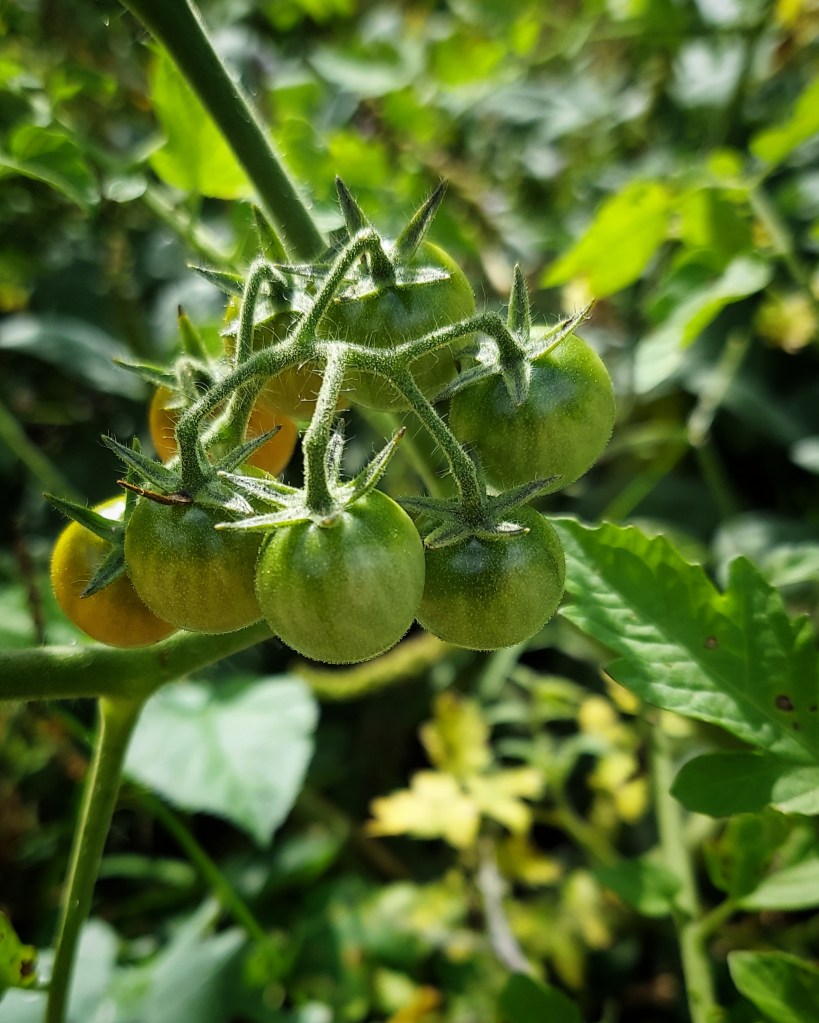
A cluster of cherry tomatoes. Most are still green, but a few are beginning to blush orange.

The plants here have mostly gone to seed, so the pollinator garden is as full of birds as it is bees and butterflies. I have no idea what horticultural surprises next spring and summer may hold, but I’m excited to find out!

Plants and Herbs

Grape Folklore & Magical Properties

It’s the most wonderful time, of the year.

Okay, so.
There’s a new fruit quest. (If you have been reading here for a while, you might be familiar with the persimmon quest that I force my Handsome Assistant to accompany me on every year.)

A year ago, I tried my first muscadine. It was almost the size of a wild plum, the deep purple of a cloudless night sky, with firm flesh that tasted like a combination of grape jelly and extremely good wine. It was sweet and juicy, in perfect, balanced contrast to the firm, tart, slightly tannin-y skin. I could probably wax rhapsodic about muscadines and scuppernongs for way longer than anyone would be comfortable with.

Muscadines ripening on the vine.

Anyhow, I saw them pop up at the farmer’s market at about $13 a container and was sad to pass them up. Immediately after that, I saw them at Aldi for about $3.69. (Nice.)

Normally, I’d advocate for buying from farmer’s markets versus a supermarket whenever you’re able to. The thing about muscadines is that their range is very limited, so even the grocery store variety has traveled, at max, a few states away. They’re also seasonal, so they’ll disappear from the shelves as soon as their time is up.

This is why the other evening saw me leaving Aldi with arms full of containers of muscadines and scuppernongs (they’re the same species, but scuppernong is usually used for muscadine grapes that are kind of a light bronzy-green in color). I was also quietly singing a little song about how excited I was to have tasty grapes, and possibly skipping. (I am fortunate that my Handsome Assistant seems to find my goofball-ass qualities endearing.)

So, since it’s muscadine season, I figured I’d write a bit about grapes. Muscadines (Vitis rotundifolia) are strictly an American fruit, so they’re another plant you won’t find in old grimoires or European mythology, but that’s okay! They’re a kind of grape (Vitis species), and grapes in general have had a prominent place in myth and magic everywhere they appear.

Grapes figure heavily in Greek and Roman legend. According to the Greeks, the first grapevine came from a satyr named Ampelos. He caught Dionysus’ eye, and the deity romantically pursued him… at least, until Ampelos mocked the Moon Goddess Selene and got himself gored by a bull. Heartbroken, Dionysus transformed Ampelos’ body into the first grapevine.

(According to Ovid, things panned out a bit differently. In this version, grapes already existed, Ampelos fell while picking them, died, and Dionysus transformed him into a constellation.)

In Christian mythology, grapes are associated with abundance. Moses sent spies into Canaan (the “promised land”), who then returned with a cluster of grapes so large, it required two people to lift it.

On the other hand, some scholars claim that the “forbidden fruit” of the Garden of Eden was also a grape, not an apple as it’s commonly portrayed. Other scholars claim it may even have been wheat, so who knows.

Two bunches of grapes. They're a mixture of ripe and unripe fruits, showing shades of deep blue, to purple, to bright green.

In the ogham alphabet, muin, is often said to be a grape vine. However, grapes aren’t native to Ireland (they showed up with the Romans), and tend not to grow well there anyhow. Grapes also don’t really appear in Celtic legends with significance. Etymologically, connecting muin to the word “vine” is also tricky. For this reason, you’ll find a lot of debate about the actual meaning of this fid, as well as what plant it was even meant to represent in the first place. (Probably originally thorny brambles, like blackberries, though this meaning may have shifted over time.)

Grapes and wine are also generally good offerings for a wide variety of spirits and deities.

Vines, in general, are associated with binding. This isn’t necessarily binding in a negative or protective sense — binding can also be used to hold a favorable situation to you.

Elementally, grapes are associated with Earth and Water. They’re also associated with the Moon.

They’re…
They’re grapes.

All kidding aside, grapes are possibly one of the easiest magical plants to use. Eat, brew, or cook with them while visualizing yourself as prosperous and happy.

If you have the space and ability to do it, plant a grape vine in your yard to bring abundance to your home. (This may work even better than intended. Birds love grapes as a source of both energy and water, and tend to excrete more seeds when they hang out to feed. This is how I ended up with free, thriving tomato and mulberry plants, and possibly even the pumpkin vine. Free food!)

Grape vines make fantastic bases for wreaths. I’d like to devote a longer post to making and empowering magical wreaths, but, in short, take a grapevine wreath, add whatever other magical dried plants or curios you like, and hang it where it’ll do the most good. A protective wreath on the front door, for example, one for prosperity in the kitchen, or one for passion or fertility in the bedroom.

Though it also isn’t one of their traditional meanings, I also associate grapes with protection. Dark grapes make red wine, the color of courage, strength, vitality, and protection. The leaves themselves are covered in trichomes, which are small, pointy, hairlike structures. Covering the floor around your bed with grape leaves is said to be a folk remedy to control and protect against crawling pests like bedbugs.

Whether you’re like me (and do a goofy little happy dance when you’ve gotten special grapes) or your feelings about the fruit are more ambivalent, grapes are worth considering for your magical practice. They’re sweet, tasty, easy to use, and pretty straightforward in their properties and associations.

Plants and Herbs

Milkweed Folklore & Magical Properties

I planted a swamp milkweed (Asclepias incarnata) in the back yard not too long ago. Though I did it well after I could hope for monarch butterflies, I still wanted one of these beautiful, interesting native plants. (Besides, they’re perennials — if it could survive this year, there’ll be plenty of plant for the monarch babies next year!)

It was blooming happily, playing host to all kinds of tiny fauna, and finally put out lots of big, fat pods. Apparently it wanted to wait until the recent supermoon to bust those suckers open, because that whole part of the yard is inundated with milkweed fluff!

Flat, brown milkweed seeds, showing their tassels of silky white fluff.

I gathered a good quantity of the fluff and seeds to save, share, and use for various purposes. So, I figured, now’s probably a good time to write about this lovely plant’s magical properties!

Like many of the plants I choose to explore, this one’s native to the Americas. That means that you won’t see it in a lot of older folk or ceremonial magic resources. This plant is still powerful, however, and has a lot to offer practitioners in its native range.

Like I mentioned, milkweed produces tons of fluff. This fluff appears as silky white tassels on its seeds and helps them disperse via wind — just like dandelions. If you catch a floating milkweed seed, make a wish, then release it to go along its merry way, its said that your wish will come true.

Milkweed fluff can also be used as filling for pillows, sachets, and poppets. Thistledown is a traditional poppet filling, but, if you don’t live in an area with abundant thistles, milkweed fluff can be used as a substitute.

Filling a dream pillow with milkweed fluff is said to cause the user to dream of the fae.

The juices of the milkweed plant, when used for anointing, are said to strengthen one’s “third eye.” (However, these juices are also irritating, so maybe just place a whole leaf or sprig of flowers to your forehead instead.)

In World War II, military life jackets were filled with milkweed fluff as an alternative to kapok (Ceiba pentandra).

Milkweed’s genus, Asclepias, was named for Asclepius. He’s the Greek God of Healing, and a son of Apollo.

Though it’s associated with a god of Healing, one of milkweed’s primary virtues is its toxicity. When monarch caterpillars feed on milkweed, they take in the plant’s toxins. This, in turn, makes the vulnerable caterpillars toxic and unpalatable to predators. As a result, milkweed is associated with protection.

A plump, stripey monarch caterpillar.

There’s also a very fine line between “poison” and “medicine.” To the people indigenous to milkweed’s native range, milkweed sap was used to remove warts. Boiling helps leach out the toxins in the plant’s sap, and cleaned up extracts of milkweed proved useful for respiratory ailments, sore throats, and kidney problems. Some of the toxins in milkweed sap are cardiac glycosides, which, in small doses, behave similarly to the digitalin extracted from foxglove (genus Digitalis).

Milkweed is a very liminal plant. Swamp milkweed (A. incarnata) can be found at the edges of wetlands, where the water meets the land. Common milkweed (A. syriaca) often grows in disturbed areas, like roadsides.

Milkweed is associated with the Moon and the element of Earth. (Personally, I also associated swamp milkweed with water.)

Milkweed’s a really lovely plant, though it can also be hazardous to work with if you aren’t careful. Personally, I limit myself to the flowers, fluff, and seeds — I have sensitive skin, and the last thing I want to worry about is getting milkweed sap on myself!

The fluff is really lovely as a filling for poppets and dream pillows. Blend it with herbs like mugwort, hops, and lavender, and add a clear Herkimer quartz crystal for a wonderful dream pillow that’ll help improve dream recall and make it easier to dream lucidly.

The seeds, like a lot of native American seeds, need to be stratified. That means that they’re great to use for sowing rituals during the colder months — the winter solstice, for example.

Seeds are a great spell component in general, because they embody as-yet-unrealized potential. They’re a bit of sympathetic magic, too. As the seed grows, so will the thing you hope to get from your spell.

Milkweed seeds are also flat, so they’re nice to incorporate into homemade paper. Once the paper’s used, you can plant it and allow the seeds to grow. Just make sure that you’re using varieties native to your area!

The pink flower clusters of A. incarnata.

Milkweed is a beautiful, protective plant that has much to offer those who can get past its defense mechanisms. Inside those pods, protected by poisonous, milky-white sap, is an abundance of silky, silvery fluff and seeds. If you have the ability to grow or otherwise hang out with milkweed, I highly recommend it.

Plants and Herbs

I decided to eat the anise hyssop (and here’s a really tasty recipe).

Not too long ago, I wrote a bit about the magical properties of hyssop. The thing that prompted me to do this was the ludicrous abundance of anise hyssop blooms (and also bees, moths, and butterflies) in the little pollinator garden in the front yard.

Anise hyssop and regular hyssop aren’t related, though. Anise hyssop, also called anise mint, is a member of the mint family. It’s called “anise hyssop” because the leaves and flowers have an anise-like scent and flavor — though I think it’s more reminiscent of root beer!

Anyhow, since some of the anise hyssop was getting tall enough to block the coreopsis and beautyberry, I figured I’d go harvest some. Sickle in hand, I shooed the bees to the other anise hyssop plants and got cutting. I also cut a few lavender flowers that were growing at odd angles.

From there, I separated the good leaves from the wilted or damaged ones, and removed the flower heads. I gave everything a good wash, then boiled it in equal parts sugar and water to make a lovely, herb-infused simple syrup.

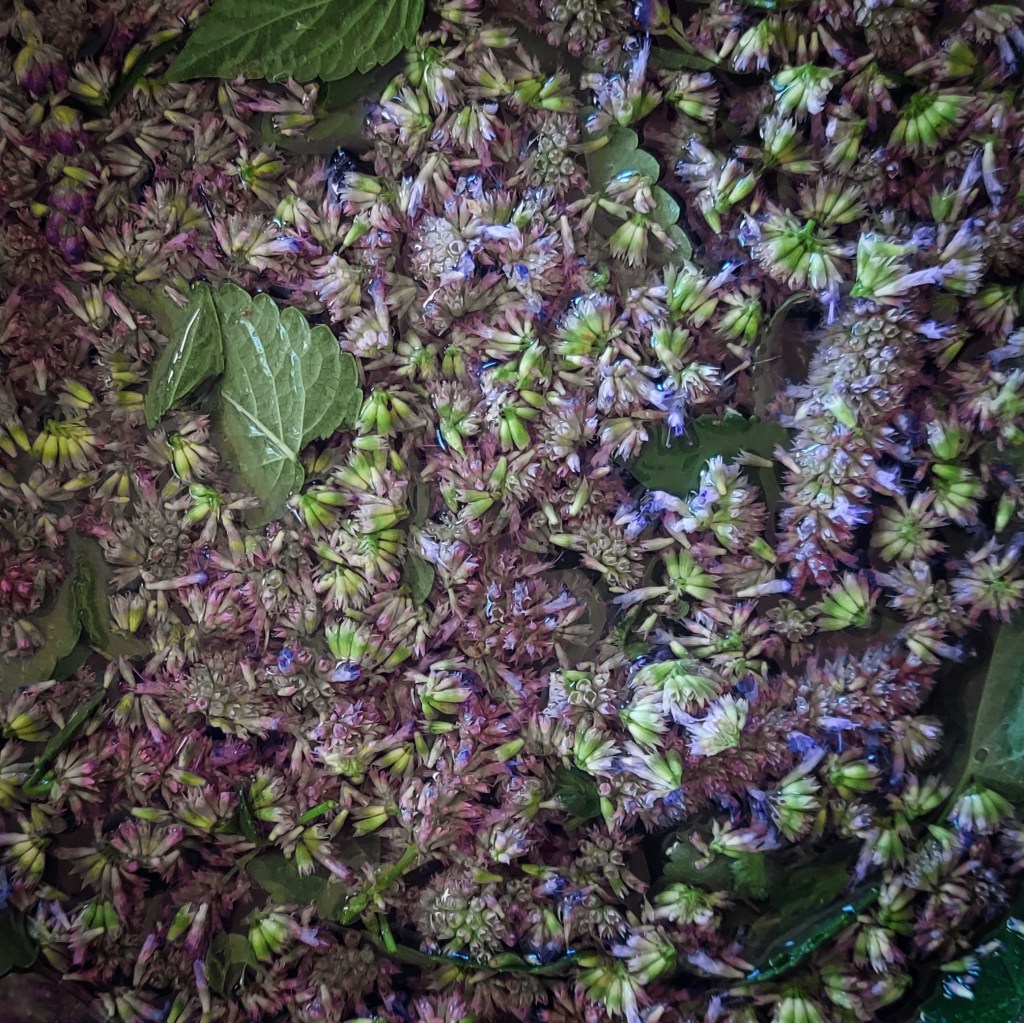
A bowl of small, bright purple flowers and green leaves soaking in water.

Once the syrup was made, I strained out the plant matter and spread it on a bit of parchment paper in my dehydrator. After an hour and a half at 165 degrees F, once everything was dried to a crisp, I was left with some lovely candied flowers that do, in fact, taste exactly like root beer.

Anise hyssop is used as a carminative and expectorant, and is very soothing. I don’t really need an expectorant right now, but I plan to use the flowers and syrup to ease digestive complaints. The only thing is, I don’t really need that much. So what do I do when I’ve got way more delicious candied flowers than I need?

I make scones.

These are easy, nut-, egg-, and dairy-free, and delicious. They only require one bowl and about half an hour of your time.

Dry Ingredients:

  • 2 cups of flour (I used einkorn, but regular wheat flour is fine)
  • 1/2 cup sugar
  • 1 tablespoon flaxseed meal
  • 2 teaspoons baking powder
  • 1/2 cup cold vegan butter or coconut oil
  • 1 handful fresh anise hyssop flowers
  • 1 generous cup of blackberries (depending on their size, you may want to cut them into smaller pieces)

Wet ingredients:

  • 1/2 cup milk substitute of your choice (I used pea milk)
  • 1 teaspoon of vanilla extract

Tools:

  • A nice big mixing bowl
  • A spoon
  • A whisk or fork
  • A pastry cutter or fork (optional)
  • Measuring cups and spoons
  • A baking sheet
  • A sharp knife

Making the Scones

  1. Preheat your oven to 400 degrees F.
  2. Place the sugar and fresh anise hyssop flowers in your mixing bowl.
  3. Rub them together with your hands, until the flowers are mashed with the sugar and the mixture resembles moist sand.
  4. Add the flour, flaxseed meal, and baking powder. Whisk together until well mixed.
  5. Add the cold butter substitute or coconut oil. (You might want to do this in cubes or spoonfuls, it’ll make the next bit easier.) Use a fork, pastry cutter, or just your hands to work the fat into the dry ingredients. Keep at it until the mixture looks like coarse crumbs.
  6. Measure out a half cup of milk substitute. Add the vanilla extract to the milk and stir.
  7. Pour your milk into the mixing bowl. Stir until it’s just combined — avoid over stirring. If it seems too dry to hold together, add another tablespoon or two of milk.
  8. Fold in your blackberries.
  9. With floured hands, lightly knead the dough until it all comes together. Visualize yourself kneading health, love, and prosperity into the dough.
  10. Turn the dough out onto a floured surface. Form it into a ball, and pat it out into a flat circle roughly an inch thick.
  11. Slice it into triangles. If you like, you can use a toothpick or the tip of a knife to carve the tops with runes, sigils, ogham feda, or other symbols significant to you.
  12. Place the triangles on a baking sheet. Bake for about 25 minutes, or until they’re golden brown.
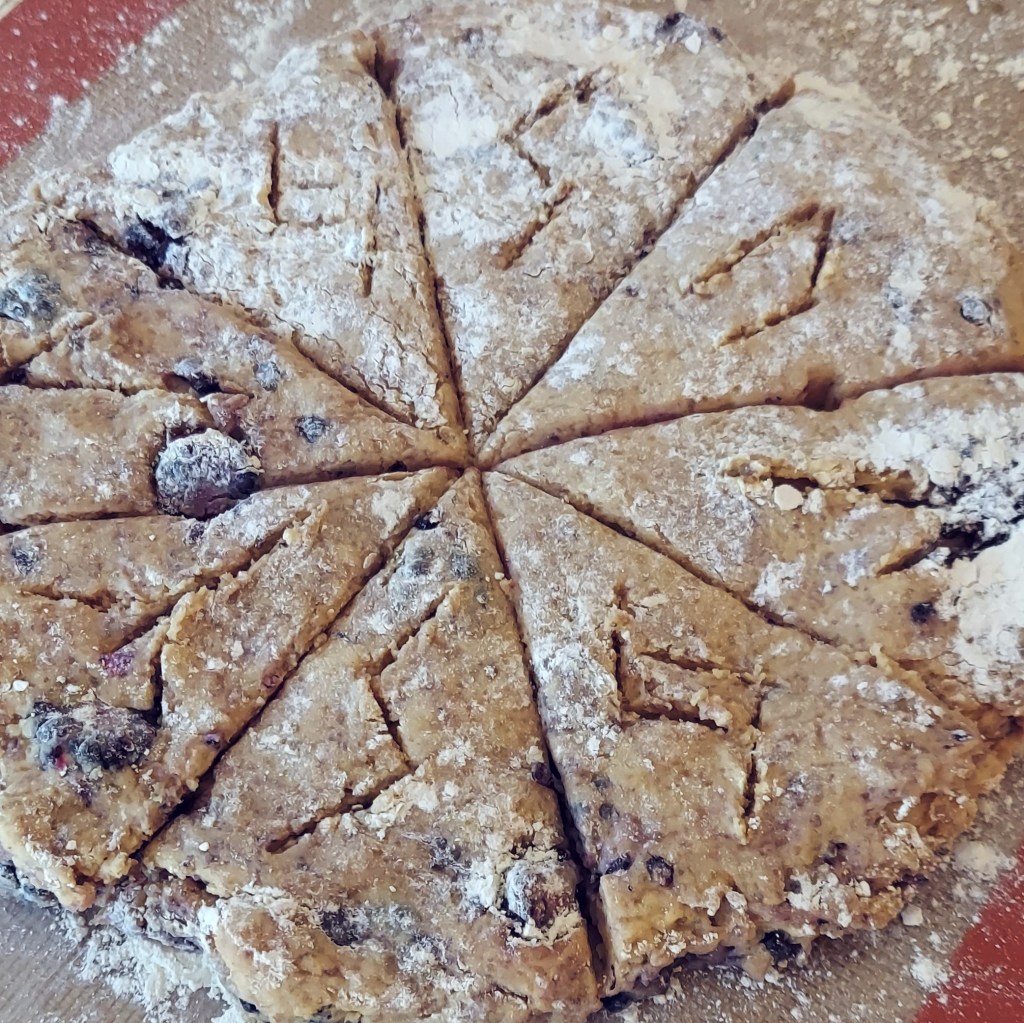
Unbaked blackberry scone dough, formed into a circle, cut into triangles, and inscribed with the runes jera, sowilo, teiwaz, uruz, algiz, and laguz.

Making Them Extra Fancy

If you like, you can also ice your scones. Mix up a cup of confectioner’s sugar, two tablespoons of milk substitute, and, if you like, some finely crumbled candied anise hyssop leaves and flowers. Stir well until the mixture is smooth and liquid. If it seems too thick, add some more milk substitute. If it’s too thin, add more sugar.

Once your scones are cool (give them about 20 minutes), drizzle the icing on with a spoon. Give the icing a few minutes to harden, then serve.

A baked scone, inscribed with the rune uruz and covered with a sweet glaze.