Pansies remind me of my late grandmother. She used to grow them in her backyard garden, as little cheery-faced border plants. She also had a very gentle, relaxing aesthetic — I remember the grandfather clock in the hallway, the little embroidered pillow full of fragrant pine needles, the print of geese with cheery blue ribbons on the kitchen wall, the way the hallway always smelled like roses and the kitchen smelled like fresh coffee. I can always tell when she’s around me because of those smells.
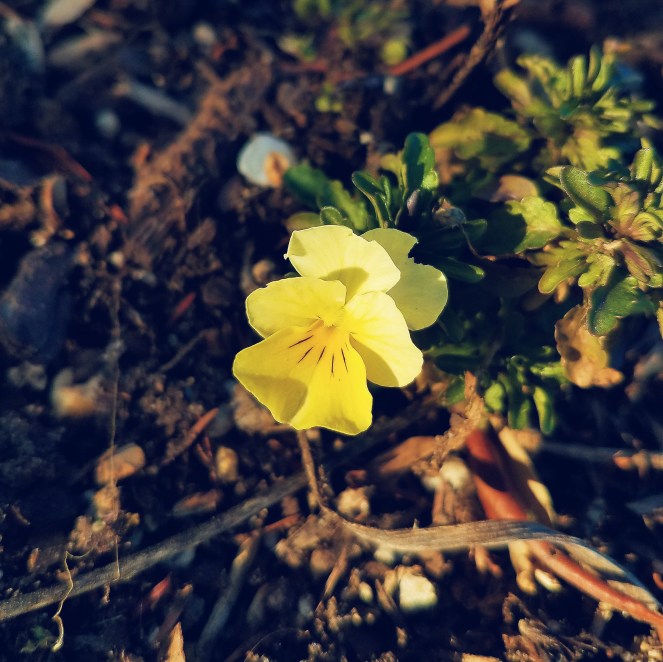
It was nice spotting these little flowers last week, with their yellow faces turned toward the sun. I’m not positive about their exact species, but they resembled my grandmother’s pansies enough to make me curious about their uses.
And this appears to be some yellow Viola tricolor.
It’s probably unsurprising to hear that pansies have a wealth of properties associated with them. You can heart it in their names, too — heartsease, call-me-to-you, love-lies-bleeding, love-in-idleness.
Heartsease Magical Properties and Folklore
In Roman mythology, the viola turned to love-in-idleness when Eros mistakenly struck it with one of his arrows, causing it to smile.
In Greek mythology, Zeus created the flowers as a way to repent for his treatment of his lover, Io. She was once a beautiful maiden, but Zeus’ wife, Hera, became jealous. To protect Io, Zeus transformed her into a cow. Since she was forced to be on a diet of grasses and herbs, Zeus made the earth yield flowers.
In another legend, Cupid worshipped the heartsease flowers. To stop this, Aphrodite turned them from white, to tricolored.
Pansies and violets are associated with Venus, and often used as a love ingredient. Placing some under your pillow is said to attract a new lover. Planting them in a heart shape is a bit of sympathetic magic — if they thrive, so will your relationship.
They are also associated with Pluto, and death and rebirth.
Picking the herb on a sunny day is said to cause a storm to come. Picking one that’s still dewy brings death.
Using Heartsease
I think love magic gets a bad rap. When many people think of it, they picture a desperate, lovelorn person, performing spell after spell to convince the object of their affections to want them back. That’s not really the case, though. I mean, if you think about it, everything is love.
Want more money? You really want your boss or your clients to love your work.
Want to be more successful or popular? That’s platonic love.
Love magic is attraction magic. If you draw in love, you can use those same attributes to attract whatever you desire.
Pansies come in a variety of colors, which lends them well to color magic. Each color has its own particular attributes. The little yellow ones I found could be found for mental abilities, divination, happiness, travel, or blessing a new home.
If I could, I’d plant a pot of yellow pansies near the front door of my home. Bless the space and draw in love all at the same time!
Medicinally, heartsease has been used to treat asthma, inflammatory lung conditions, and cardiac complaints. Externally, it’s used for skin problems like eczema. Considering this, and considering how many other herbs’ medical uses mirror their magical ones, it’s really not surprising that it’s an herb of love and death.
Pansies are demulcent, mucilaginous, and anti-inflammatory. They have been used to calm irritated skin, ease chest complaints, and soothe other matters of the heart, too. They’re also easy to grow, so, if you have the room, I definitely recommend planting some of these cheerful little flowers!
I don’t really know as much as I’d like about mushrooms. I mean, I know enough to know that I don’t know enough to trust myself to eat one I pick myself. (Every mushroom is edible. Many of them are only edible once.)
I still like looking for them, though. My S.O. and I find some very neat ones sometimes — a massive chicken-of-the-woods, honey fungus, bird’s next fungus, eyelash mushrooms, all kinds. I know it’s still early to find any here (probably? I’m mean, I’m assuming), but I was still stoked to go looking for some. It’s only barely March, and things like morels and dryad’s saddles probably won’t be around for weeks yet. After being cooped up all winter, I would’ve been happy to find some of last year’s dried-out bracket fungi.
Alas, there were no mushrooms.
I did find some really neat moss, though. Complete with seed heads!
We sat on a fallen tree to have a picnic. It was really beautiful out — chilly, but not cold. Bright, with the sun slanting through the trees and not a cloud in the sky.
“Are you taking a pic of me eating a sandwich?”
“Yeah. The sun looks neat. Besides, you’re one of my favorite subjects to photograph.”
“Aww…”
“… Y’know, I’m glad you took that as a compliment. I just realized that my dumb ass came out here unreasonably excited to see, like, fungus and moss and shit, so there were a lot of ways that could’ve gone.”
He’s pretty cool about indulging my whims. Even when those whims mean crawling around in dirt and leaves to get pictures of extremely tiny things.
Or when they mean me dragging him through the art supply store and spending twenty minutes deliberating between cotton and linen canvas, which I did on the way home.
Next weekend, I might take him hunting for cryptids. We’ll see.
Every time I find a new plant buddy, I end up spending a few hours reading up on what they’re used for — even things like mushrooms, lichen, and moss. When I spotted these pretty little blue flowers, I was immediately curious. I’d never seen them before, and their color was so vibrant against the brown dirt and handful green leaves poking out of the chilly ground. They were so small, I almost missed them.
Scilla siberica, wood squill.
I wasn’t able to find much about wood squill specifically, other than that it’s native to Southwestern Russia (despite its other name, Siberian squill).
When most herb lore and magical texts talk about squill, they’re really talking about red (Drimia maritima) or white squill (Scilla mischtschenkoana). All of these are in the same subfamily, Scilloideae, but aren’t otherwise really synonymous.
The word “scilla” comes from the ancient Greek “skilla,” which is of unknown meaning. (A Modern Herbal claims that it means “to excite or disturb,” the way that an emetic disturbs the stomach, but I haven’t been able to verify this.)
For some people, only the actual plant that a spell calls for will do. For others, it’s okay to use a relative, if they’re close enough. This can be especially useful if the plant you want to work with is poisonous, endangered, not native to your area, or otherwise not a super great idea.
Squill Magical Properties and Folklore
Squill root is a money herb.
In hoodoo, placing squill in a container with one coin of each denomination, is used to draw in cash. (Some practitioners say it’s particularly effective if you can get a hold of old silver currency for this spell, like Mercury dimes. Others say that silver objects, like chains or beads, are even more effective than non-silver money.)
Holding squill root in your hands, focusing your intention to be unhexed, charging it, and carrying it with you is said to break all hexes and curses.
Using Squill
Red squill is used as a rodenticide, owing to a toxin called scilliroside. In creatures without a vomiting reflex, scilliroside is deadly.
White squill, on the other hand, has historically been used as a diuretic and expectorant. Compounds called glucosamides, found in the bulbs, are sometimes used in traditional medicine to treat irregular heartbeats. Wood squill also contains cardiac glycosides. This is not intended as medical advice, just an indicator of what kind of practical, medicinal applications it’s used for. As with any herb, medicinal properties can quickly become poisonous properties, so keep them away from children and pets.
Considering its medicinal properties and its appearance, it’s kind of easy to understand why it’s a money herb. It’s got that lovely plump bulb full of stored energy — fat like an onion, or the way you’d want your bank account to be. Its use as an emetic and diuretic make sense here, too. Squill has the power to eject all kinds of substances from the body. You put it in a stomach, the stomach’s contents are coming out in abundance. Metaphysically, it stands to reason that it would be placed in a container with money in the hopes that it’d spew more money into your life.
The emetic and diuretic virtues also go hand-in-hand with hex breaking. If your body needs to purge a physical ill, squill helps. If you need to purge a magical ill, squill helps that, too.
White squill seems to be abundant and easy to find on the market, but there are areas where other varieties of squill (like the wood squill pictured above, or alpine squill) have become invasive. If you’re looking to use squill in your work, I’d suggest picking up a good plant identification guide, and seeing if your area has any invasive varieties lurking around. (Various species of squill are used as ornamental plants. If you decide you want to grow some, be sure to do it in a way that will keep it from escaping into its environment.) You can get the magical ingredients you need, develop a deeper relationship with the plants themselves, and remove damaging invasive species from your environment at the same time.
I think I probably get enough vitamin D, in the sense that I’m not technically deficient, but months spent indoors have given me the preternatural paleness of a consumptive Victorian heroine. On some people, this look works. My skin has naturally beige/green undertones, so I just look like I’m half iguana.
This past weekend promised to be sunny and warmish, so my S.O. and I packed up and went for a drive. Saturday was Lake Accotink, where we walked along the edge of the water, enjoyed the light for a bit, did some people-watching, then took a detour on the way home for cheeseburgers.
(By the bye, Big Buns Damn Good Burgers lives up to the name. If you get the veggie burger, though, get it as a burger bowl. It’s very good, but very soft and probably too skooshy to hold in a bun without it falling apart.)
Even though the trees were leafless and the sand was chilly, the sun was warm and the breeze was gentle.
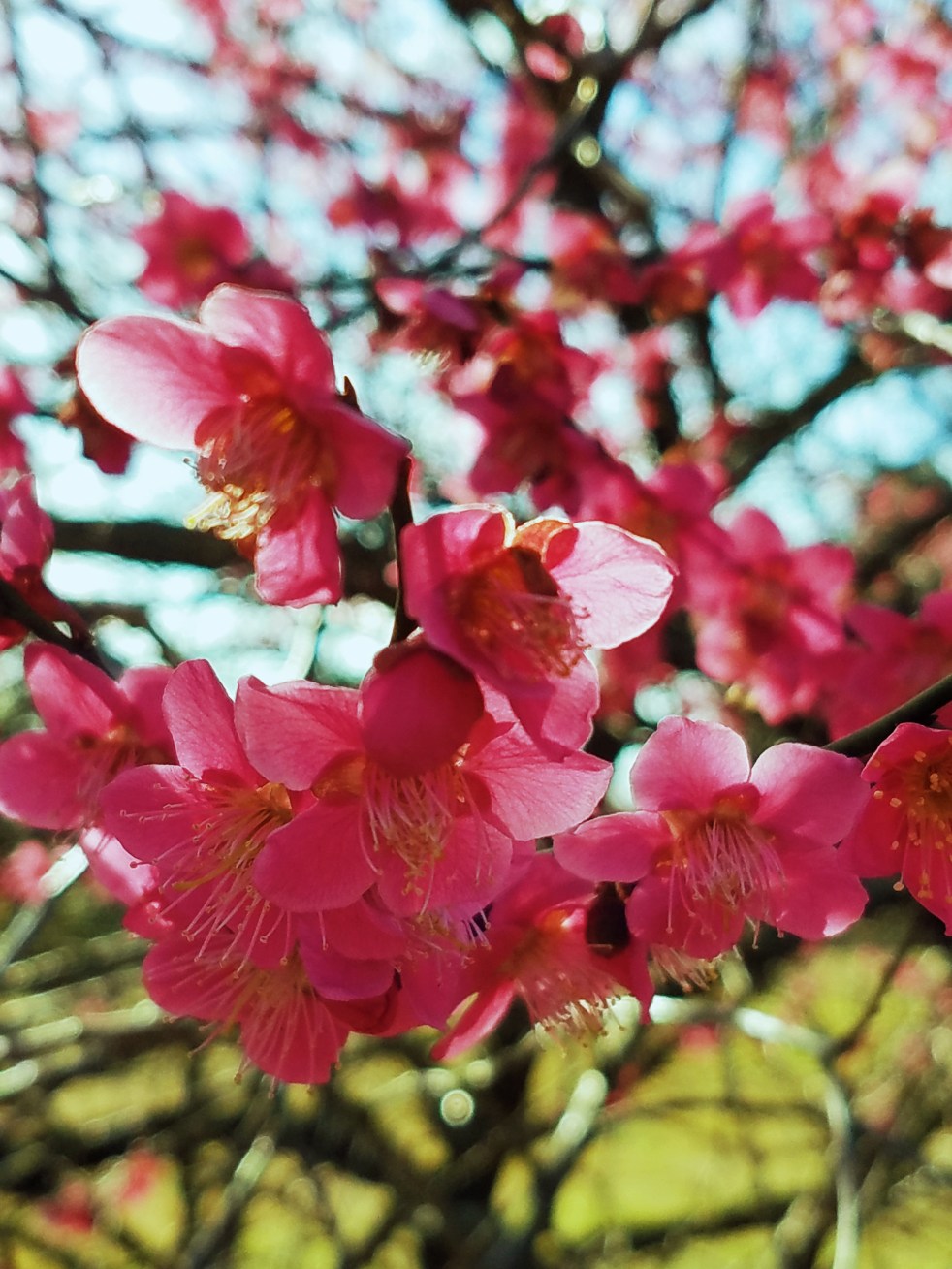
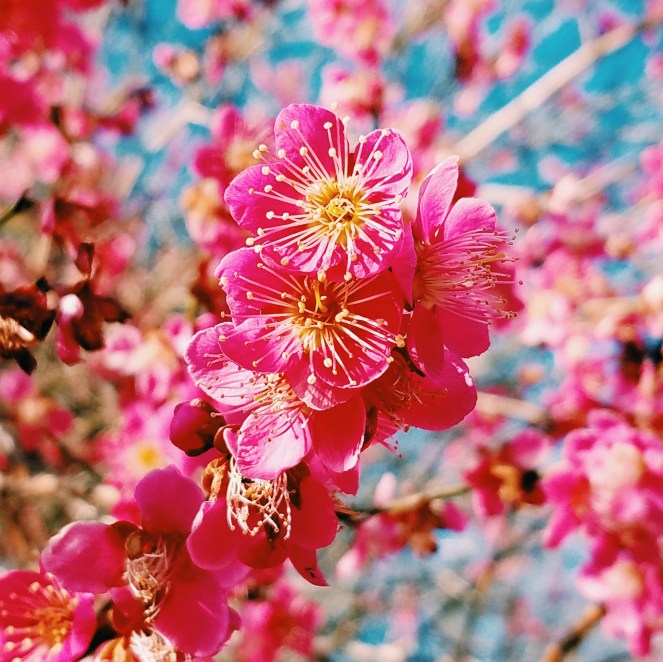
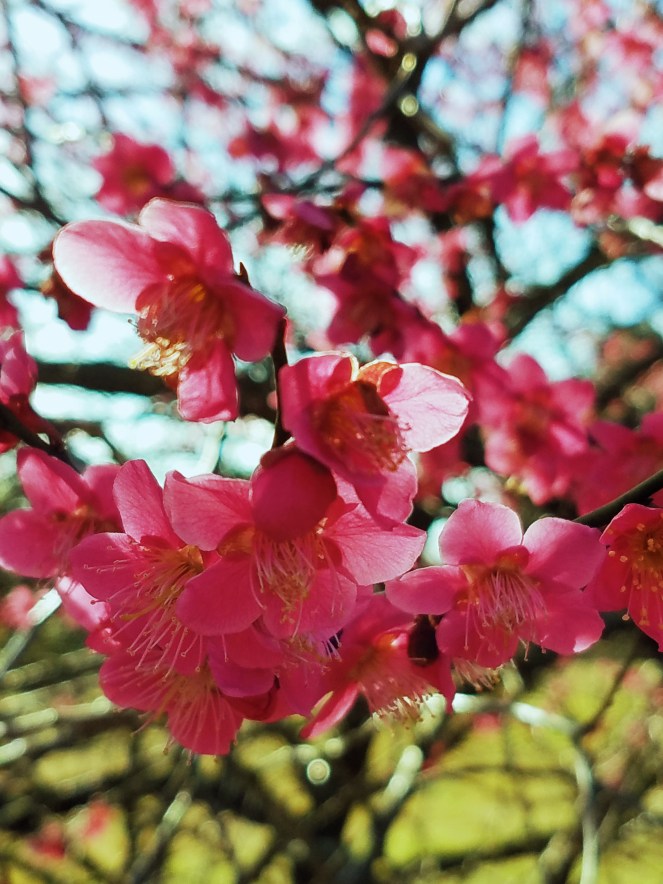
The next day, we decided to drive to the Arboretum. Most of the trees were still leafless, twisted branches scrabbling at the sky, laden with the remains of last year’s bird’s nests. Still, it seems like every time we go, we find something neat that we didn’t spot before — first the dogwood trees, then the path through the conifer specimens. This time, it was this beautiful Prunus mume, branches half-covered in fragrant, pink blooms, humming with honeybees.
It smelled so good.
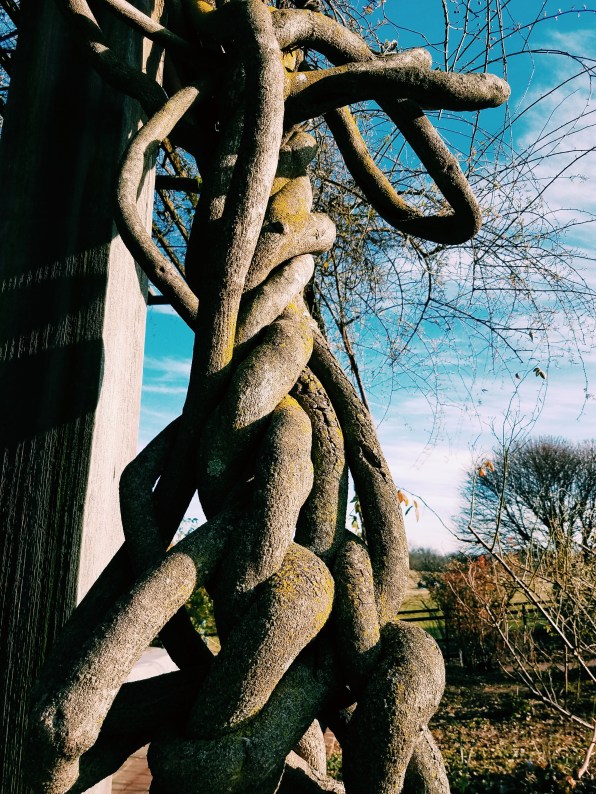
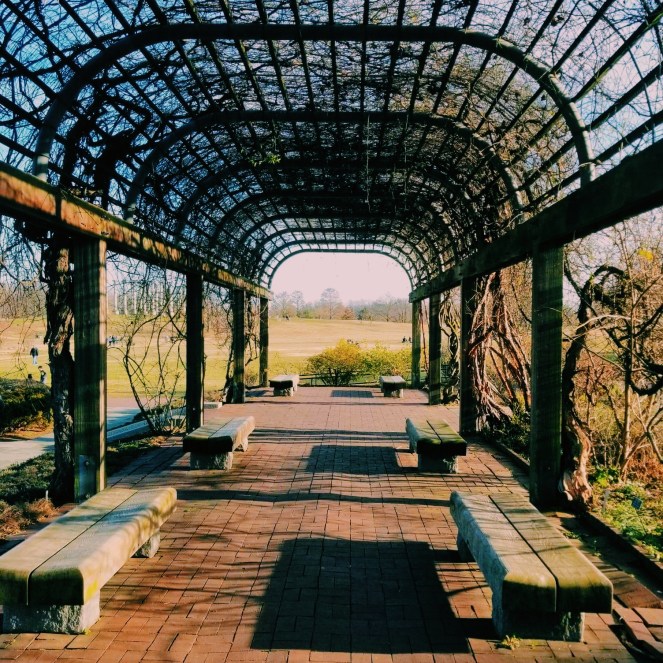
We wandered around until we found a bonsai museum and an herb garden — closed and bare, respectively, but the area was still beautiful enough. We found an arbor to sit under, which had this really cool-looking (albeit one I couldn’t identify) vine braided along one side.
With the sun slanting through the trees, backlighting the few leaves and flowers daring enough to open up this early, it was nice. Relaxing.
… Though maybe I should’ve waited for it to warm up a little before I buzzed my hair again. Whoops.
As we drove through the park, I heard my S.O. huff softly.
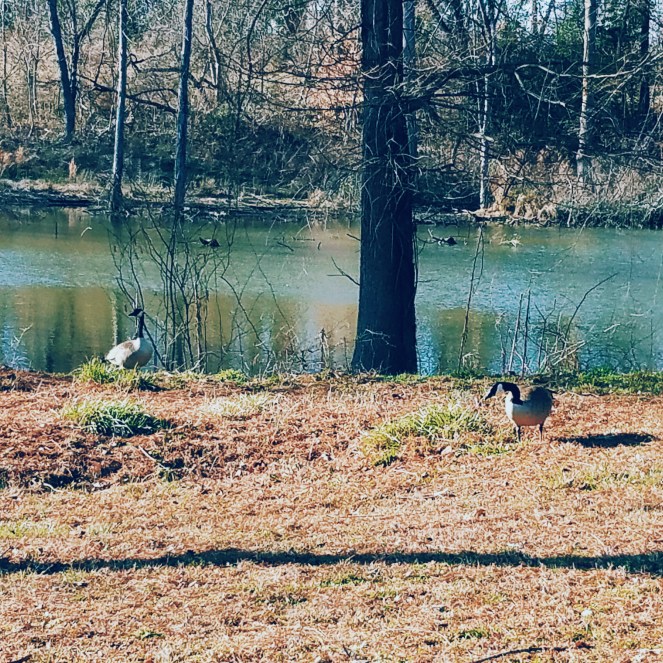
“Degenerates,” he groused.
“What?”
“Look.”
I turned my head and squinted in the light.
… I mean, he’s not wrong. I do not like the cobra chickens.
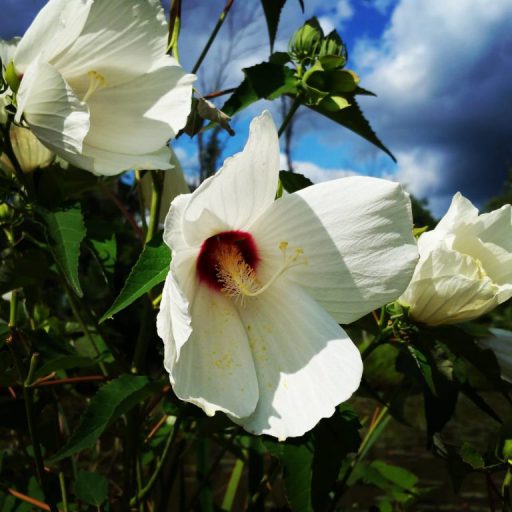
There are a lot of spots in the Arboretum that come alive with color in the warmer months. Bright splashes of orange, pink, and purple nestled into tufts and spikes of foliage, rosemallows the size of dinner plates, the works. There weren’t as many this time of year, but still plenty of color if you didn’t mind hunting for it.
I think these guys are Scilla siberica, wood squill.
… And also looking very strange while laying on your stomach in order to get close enough for a picture.
And this appears to be a yellow Viola of some kind.
There were some very pretty crocuses, too, but they were a bit too far off the path for a picture (I’m not about to go trampling sensitive terrain for a pic or two, but, unfortunately, my zoom isn’t quite good enough for a clear shot). Next weekend’s probably going to be too cloudy and cold for more adventures like this, but that’s okay. I’ve got some other plans. Secret ones.
This week’s tarot card’ll be up tomorrow. Have a good Monday!
No, I mean it. I have a devotion to the stuff that borders on fanatical. I am a chamomile evangelist. Spiritual, physical, or mental problem? Chamomile tea will probably at least help. Even if it doesn’t, it might make you take a nap, and those make everything at least a little less crappy. (Unless you’re allergic to it, but I digress.)
Chamomile Magical Properties and Folklore
In Hoodoo, gamblers wash their hands in an infusion of chamomile for luck.
Burning chamomile is said to help bring more money into the household.
The daisy-like flowers with their bright yellow centers are strongly associated with the Sun. Because of this, it’s used to bring positive energy into people and places. Sprinkling a room or washing windows and doorways with an infusion of chamomile chases away negative energy, while inviting in the good stuff.
Chamomile’s relaxant properties make it useful as an herb for dream magic and meditation.
Growing chamomile plants near windows and doors keeps away evil spirits.
Using Chamomile
The easiest way to buy and use the herb is in the form of a teabag — you can steep it in hot or cold water for tea, alcohol for a tincture, oil for an infused oil, or treat the bag itself as a simple herb sachet.
Steeping chamomile in hot bath water, or pouring a fresh cup of tea into bath water, is a fast and easy way to create a spiritual bath for removing negativity.
In medieval times, when strewing floors with fragrant herbs was common, chamomile was a favorite. When crushed, the flowers release a sweet, fruity aroma. With chamomile’s fragrance, coupled with the very solar appearance of the flowers, and its relaxing properties, it’s easy to see where its associations with the Sun and positivity come from.
The fragrance of chamomile might be part of why it’s considered effective against evil spirits. When the miasma theory was still popular, pomanders and pleasant-smelling herbs were credited with keeping disease at bay. It’s not a long jump between foul odors and disease to evil spirits — many of the most powerful negativity-banishing herbs are also the most pungent.
Chamomile is a pretty versatile herb. It keeps bad things at bay, and attracts good. While it’s often used to help gamblers, it can easily be adapted to any situation where you could use a little luck — enchant a tablespoon of chamomile and brew it into a tea before setting out to do anything that could benefit from a helping hand from fate.
Note: This post contains affiliate links to the herbs I talk about here. These allow me to earn a small commission, at no additional cost to you. Thank you for supporting independent artisans, and this site!
I drink so much marshmallow, it borders on the absurd.
It’s not for the flavor, either — marshmallow root doesn’t really have much of one. Let me tell you, though, if you’ve got a stomach ache, bladder pain, or an annoying, dry cough? There’s nothing more soothing than a big cup of swamp root goo. No joke.
I cannot overstate the debt of gratitude I owe to marshmallow.
(I’d also eat my weight in toasted vanilla Smash Mallows if science would let me, but that’s a subject for another time.)
Marshmallow Magical Properties and Folklore
As its name implies, marshmallow (Althea officinalis) is considered a water herb. It’s often associated with deities of love and beauty, and used in fertility and attraction spells. (Some sources say that the slippery marshmallow extract was even used as a lubricant, so using it in sex and fertility magic isn’t much of a stretch!)
Marshmallow is sometimes burned to cleanse a space, or used to make protective oils.
It’s considered to be a favorite of benevolent spirits. Spirit bottles, used to house helpful spirits, are filled with marshmallow root. Keeping a jar of it and a dish of water on your altar is said to help call helpful spirits to your aid.
Planting marshmallow on or near a grave, or decorating a grave with the flowers, is used to honor the dead.
Using Marshmallow
A big part of why marshmallow root is medicinally valuable is its mucilage content. Marshmallow mucilage is a polysaccharide with a very thick, slippery consistency. When you stand the root overnight in water, you’ll notice that the water becomes more viscous.
Marshmallow expresses its mucilage best as a cold infusion. I usually measure the dose of marshmallow root I need (depending on what I’m trying to do) into a tea strainer, fill a glass jar with clean water, plop the strainer in it, and set it in my fridge overnight.
If need be, you can brew the root the way you would any other tea, it just won’t produce quite as much mucilage. I usually do this if I have a sore throat — the mucilage and the warmth are really soothing.
Marshmallow leaf contains less mucilage than the root. It’s a diuretic and helps with expectoration, and is sometimes used as a topical poultice.
The key words here are “soothing,” “protecting,” and “comforting.” On a physical level, the mucilage in marshmallow root soothes irritated membranes, forms a protective layer, and brings comfort. This is reflected on a metaphysical level, too — as an ingredient in beauty preparations, it’s not surprising to see it used in spells for the same. As something that helps banish pain, it’s natural to use it to banish evil. As an herb that offers comfort, it makes sense to use it to comfort and placate the spirits of the dead.
Even if you don’t regularly perform spiritwork or work with the dead, marshmallow’s a helpful herbal ally to keep around. It makes a soothing tea, and its gentle, comforting nature lends it well to a variety of magical applications. Even though marshmallow is used as a food as well as medicine, consult with an experienced practitioner before use — especially if you are pregnant, nursing, or have any medical conditions.
Rule number one of keeping a Nepenthes is that you keep the fertilizer far, far away. Some horticulturists have had success with foliar feeding, but I don’t yet trust myself not to hurt mine — they’re more delicate than they seem, sometimes.
Carnivorous plants are carnivorous because their roots are not well adapted to extracting nutrients from their substrates. That’s why they eat bugs. Digestive enzymes are nature’s way of making sure they get fed, roots or no. Well… Unless they’re one of the types that evolved to digest fallen leaves or be a sleeping bag for bats, but I digress.
My N. ventrata’s pitchers are still fairly tiny (there are a bunch of them now, though), and my apartment is mercifully bug-free aside from the occasional spider or stray stinkbug, so there isn’t much hope when it comes to leaving my plant to its own devices. If it’s hoping to catch a meal here, it’s going to be very disappointed for a very long time.
That’s okay, though. I’ve got this covered.
Pitcher plants are easier to hand feed compared to Venus fly traps. For fly traps, you have to rehydrate dried insects into a kind of bug-burger, then wiggle it around until the trap activates. Too much water, and the liquid might cause the plant to rot. Not enough, and the plant’s digestive enzymes might not be able to break it down adequately.
Pitcher plants, though? They’re a breeze:
Delish!
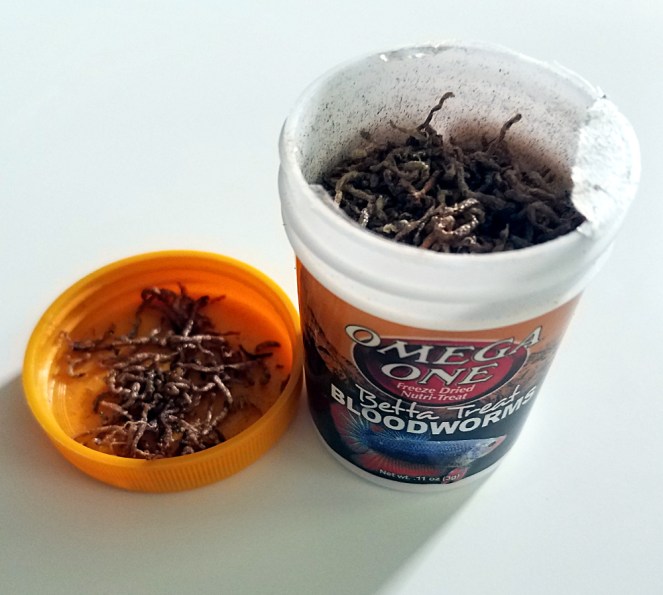
Nepenthes pitches contain so much liquid, rehydration isn’t really an issue. They also lure insects rather than trap them, so I don’t have to put on a dead bug puppet show to get them to latch on. Take a pair of tweezers, pick up a pinch of dried bloodworms, and drop them in. You can even crush the worms to powder for particularly small pitchers. It doesn’t take many, so one container will last for ages.
Larger pitchers benefit from dried crickets or mealworms instead, but my guys are much too little for that. Pinhead crickets are often available as a special order from some pet stores, but they usually only come in large increments. I also don’t want to have to fight with fitting live crickets into those tiny pitcher mouths!
Feeding is kind of a misnomer, though — nepenthes are still photosynthetic, and depend on carbohydrates for energy. Bugs are more akin to fertilizer than actual food. As with other types of fertilizer, it’s better to err on the side of not feeding enough versus feeding too much. I don’t feed my pitchers often — once a month, if that. Regardless of what you feed them or how often, it’s important to make sure that the insects are completely submerged in the digestive fluid. If they aren’t, they’ll just end up growing mold instead of breaking down and feeding the plant.
Hopefully, I’ll have some pitchers large enough for crickets soon. Until then, I’ve got loads of bloodworms!
As someone with a chronic health condition, I’ve heard a lot about how all I really need are essential oils. This comes from a place of love (usually, though it sometimes comes from a place of “please buy this from me or my upline is going to be pissed”) and from people who mean well, but that doesn’t make it any less grating. I still smile, say thank you, and accept the advice in the spirit in which it was given — a desire to help me be healthy again. As hard as it is to continually hear that I’m only suffering through medication and medical procedures because I haven’t properly tried oils/yoga/meditation/green juice/coffee enemas, I can’t really get mad over it.
Sometimes, though, this advice crosses the line between “well meaning, but misinformed” to “please stop telling people to do this.”
That line is when people begin telling me I should be eating essential oils.
There are a couple of reasons for this. Sure, some oils are routinely used in food — by commercial food operations, who use industrial food-grade oils to flavor batches of food intended to feed hundreds at a time — but this is not what I’m talking about.
You’ve probably experienced this scenario: You’re on Facebook or Instagram, minding your own business, and you get a message. Not just any message, oh no. It’s a friend you haven’t spoken to since high school, and they want to tell you about their wonderful new business opportunity. One look at their profile tells you all you need to know: their feed is hashtagged out the wazoo, and replete with photos featuring crockpots of soup, fresh-baked pies, and water bottles glistening with condensation… All serving as backdrops for tiny, all-too-familiar amber bottles.
My primary gripe with putting essential oils in food comes from two things:
What’s actually in essential oils.
Deceptive marketing tactics (and those who uncritically repeat them).
There’s too much oil in the oil.
Look at it this way. Oil is… well, oil. This is why is needs to be diluted for use — it doesn’t mix with water, and will sit, undiluted, on your skin/in your esophagus/wherever else it touches and burn the living crap out of you if you aren’t careful. Adding a few drops of oil to a meal without a sufficient volume of liquid fat (or an emulsifying agent), for example, may not end up flavoring the meal. It will, however, set up one poor bastard for one hell of a flavor adventure.
Essential oils are also highly concentrated. If a recipe calls for a teaspoon or tablespoon of rosemary, for example, this is not going to be answered by using rosemary essential oil instead. It takes a tremendous amount of plant matter to yield a comparatively tiny amount of essential oil (which is also why they’re not exactly as sustainable or green as many oil sellers would have you believe, but that’s a subject for another day). Not only that, but, by not using the whole herb when it is called for, you’re missing out on the compounds that don’t get released as oil. Anything water-soluble is lost to the hydrosol during distillation, and doesn’t end up in the finished oil at all.
Oils are more expensive, less safe, and don’t even give you all of the flavor or benefits of the whole herb.
That’s not what “purity” means.
Sometimes you’ll hear multi-level marketing reps defending essential oil consumption by saying something like, “My essential oils say they’re safe to use internally!” or “My essential oils are more pure than the competition, therefore they’re safe!” This is a bit of marketing jargon likely passed down to them from their upline that misses one obvious issue: The reason essential oils aren’t safe to eat is that there’s too much essential oil in them.
I mean, theoretically the less-pure oils might be safer, because at least then you’re slightly less likely to OD on the equivalent of eight pounds of lavender in one sitting. In this context, “pure” does not equal “safe to consume.”
So is it medicine, or not?
One thing that I find fascinating is the discussion about whether essential oils are medicine or not. Sure, they’re required to say they can’t treat, cure, or prevent any disease, but there is still a lot of historical evidence of herbs and herbal distillates used as medicine before isolating, refining, and synthesizing active compounds became the pharmaceutical standard. So, some people who doubt the safety or efficacy of a pharmaceutical approach will reach for an essential oil bottle over a prescription slip.
And then reach for that bottle again when they want to cook a meal. And again for a relaxing bath. And again for an air freshener.
So are essential oils medicine, or aren’t they? If they are effective at treating anything, they are medicine and should at least be treated with the respect you’d afford a bottle of gummy vitamins. Essential oils don’t work through fairy dust, they contain compounds that act on processes in the body just like medicines do. This is why the same oils that can help dry up a blemish or disinfect a cut are outright neurotoxic to animals — differences in the way these compounds are metabolized yield dramatically different results from species to species.
Essential oils work therapeutically because those compounds are concentrated within them. If “the dose makes the poison,” why use a concentrated form of an herb instead of what a recipe actually calls for? I don’t drink Nyquil because I like the way it tastes, so I’m not going to put concentrated plant compounds in my food or water for flavoring.
Less is more.
Overexposure to essential oils is definitely something you want to avoid. Some oils can have unwanted effects if they’re used on a daily basis, and some are known to cause sensitization with repeated exposure.
While sensitization can happen at any time, the risk is increased with certain oils and improper dilution. Most reactions cause localized skin rashes, but some particularly unfortunate people will go into anaphylactic shock. It’s not at all uncommon for aromatherapists, for example, to become sensitized to even the safest oils purely due to daily exposure. This isn’t meant to scare anyone away from using essential oils, but to underline the importance of treating them like what they are — a highly concentrated form of plant-based volatile compounds.
So, why do some people advocate eating essential oils?
I want to make one thing clear — it isn’t doctors or certified health practitioners that I’m taking issue with, here. These are people who know what they’re doing, and are both aware of and prepared to weigh the risks (adverse reactions, sensitization) against the potential benefits to their patients. They also generally don’t push adding essential oils to food. A health practitioner might recommend enteric-coated capsules of peppermint oil to someone with IBS, to ensure that standardized levels of the therapeutic compounds in the oil are delivered where they are needed (instead of just irritating the crap out of the esophagus because lemon oil is literally never going to mix properly with your bottled water, Taylor). Actual medical usage isn’t the problem. I mean, I’ve got a fat stack of FDgard samples from my gastroenterologist, and they’re basically coated caraway oil and menthol.
The thing is, I use essential oils on a consistent basis. I even make things that I give away, trade, or sell to other people. It’s safe to say that I go through more essential oil than your average person, but, even so, a bottle will last me for a while.
That’s bad news for an essential oil rep. The more ways they can find to sell oil, the better. People don’t make new bottles of homemade spray cleaner every day. They don’t take long, luxurious baths every day. They don’t need to make their own herbal salves or cold-process soaps every day.
You know what they do do every day? Eat and drink.
Suddenly, the bottle of lemon oil that could last all year only lasts for two months. Tell people that only X-brand of essential oil is pure enough to eat, and the oil rep can lock in a customer base that will not only keep returning to them for the “purest” oil, but go through it much faster than they otherwise would (and likely end up joining the rep’s downline in order to save money). All of these things add up to more profit for the MLM.
People are fond of essential oils as a “safer,” “greener” alternative to things they mistrust. Big Pharma, spray cleaners, air fresheners, personal care products, all of these are multi-billion dollar industries, and that breeds mistrust. Businesses don’t just rake in billions without considerable effort and a strong profit drive. If they are profit-driven, how often does the safety of their customers take a back seat to money?
In 2016, the global essential oils market was valued at over $6.6B USD. Of that, doTerra alone pulls in over $1B in sales annually.
I love my little pitcher plant. It’s helpful (especially in summer), weirdly cute, and caring for it has been a really interesting learning experience. All told? 10/10 plantbro.
I’d wanted a Nepenthes ever since one of my exes and I spotted an enormous, stunningly beautiful N. ventricosa at this nursery we used to frequent years ago. (Old Country Gardens, in Delaware. Visiting that place was like going to weird plant zoo, and I loved it. They had a great collection of strange succulents and ornamental plants, as well as the usual fare. But anyway, I digress.) I was immediately drawn to it, but, since we lived in a place with barely any natural light to speak of, it was not to be.
When my S.O. and I saw a pretty little N. ventrata, we jumped on the opportunity. The pitchers didn’t last long after we brought it home, as they’re kind of prone to dropping off — Nepenthes are pretty sensitive to changes in light and humidity, and few homes are able to provide the kind of sun, temperatures, moisture, and tightly-controlled setting that a professional grower can.
Fortunately, N. ventrata is pretty adaptable. It’s a hybrid between N. alata and N. ventricosa (a lowland and highland species, respectively) and its needs are a bit better suited to the typical home environment. Even if the pitchers drop off, they’ll grow back once the plant acclimates as long as its basic needs are met.
This one grows like a weed. I have to cut it back regularly, and it seems like every spring brings me a fresh batch of these guys:
New shoots!
Sometimes, Nepenthes produce basal shoots, which seem to grow out of (or very close to) the soil. They’ll also grow new shoots further along the vine. I’m no carnivorous plant expert, but, as far as I can tell, there isn’t an enormous difference between the two. They don’t develop their own root systems like aloe pups or spider plant offsets, but they can detach and eventually root. Left alone, they’re also a great way for a plant to continue on after it’s gotten a little too long. My plant tends to look scragglier as it vines. I also much prefer its lower pitchers to those that it produces on its upper portions, so I like to prune it back to maintain a more compact shape. (I also don’t really have the room to properly cultivate a vine just yet, so compact it is!)
Plus the rosette has the cutest baby pitcher ever.
Fortunately for me, I’ve got a ton of new shoots to work with this year. This plant’ll be full and leafy in no time.
Scale has kind of been the bane of my existence. It came in on an aloe plant, and was a total bear to battle. We don’t have any outdoor space here, so all of my plants are somewhat in proximity to one another. As you can probably guess, this makes controlling pests a bit of a challenge.
Lately, I feel like the worst plant parent ever. See, my S.O. and I got this little Norfolk pine as a live Yule tree about two years ago. I love it, like I do all of my plants, and try my best to keep it healthy.
Unfortunately, up until recently, “my best” did not include “knowing what pests it’s susceptible to.” It’s got spikes all over, it has really aromatic sap, it never goes outside… what could possibly want to eat it?
As it turns out, in addition to being spiky and smelling piney, it is also irresistibly delicious to scale insects. I’m not going to lie, I cried a little when I found out. I felt like I failed as a caretaker.
Notice the dust and cat hair? As scale insects feed, they excrete a very sticky, sugary substance called “honeydew.” This can end up attracting other pests, encouraging mold growth, and, if the plant’s indoors, catching a ton of dust.
What are scale insects?
Scale insects are tormentors sent directly from Satan’s fiery butthole.
… Okay, but for real, they’re awful. They’re insects that latch onto plants and pretty much suck them dry. They’re also flattish, usually brown or beige, and the adults don’t move at all, so they blend in very well with their environment. It’s really easy to mistake them for plant tissue, especially if there aren’t many. Trouble is, their populations can grow pretty fast.
To give you an idea of how small and unobtrusive scale can be, even when there’s a ton of them.
Outdoors, scale insects aren’t usually a huge problem. Sure, they move in, but a healthy plant and a thriving population of predatory insects and birds will keep them from causing serious damage. So, in the wild (or the “wilds” of a garden, at least) they’re much more of an easily ignored nuisance than an actual problem.
For indoor plants, it’s more of an issue. Being otherwise healthy isn’t always enough for a potted plant to keep scale at bay, most homes don’t keep predatory lacewings or ladybugs as pets, and natural Bti pest control only works on bugs that are both in soil and susceptible to Bti bacterial toxins.
So, what do you do when one of your plants turns into a scale bug buffet?
To me, part of being a good steward is doing things that don’t have a negative ripple effect. For this reason, I try my hardest to avoid systemic pesticides, or any pesticides that could potentially harm anything other than the pests I’m trying to target. In a perfect world, I could just relocate unwanted bugs instead of killing them. That’s not this world, though, and I have more of a responsibility toward the plants I’ve taken into my care than I do to the pests attacking them. That’s why, when these critters rear their (nonexistent. Seriously, they are so flat) heads, I:
1. Prune, prune, prune.
A lot of plant tissue that’s been seriously damaged by scale won’t recover. If the bugs have heavily infested a certain branch or leaf, or have dried things out too much, it’s best to just cut it. Pruning away the areas where scale insects have latched on the most will immediately and drastically lower their numbers, making it easier for other measures to work.
Once you’ve identified and removed affected limbs, leaves, and other plant parts, then it’s time to start stage 2.
2. Rub them with alcohol.
Scale insects, like mealybugs, are protected by a waterproof waxy coating. This doesn’t just keep water out, it keeps moisture in. One way to get rid of scale insects is to disrupt this natural coating, which causes them to dehydrate.
Rubbing alcohol is a fast, cheap way to do this. Unfortunately, it can also harm plant tissue, so it has to be applied individually by hand. Fill a jar with alcohol, grab some cotton swabs, and start hunting the bugs down. When you see one, dip the swab in the alcohol, and give it a rub. Most times, the scale insect will come right off. Those that remain will dry out and die.
3. Soap them up.
Soap is another way to tackle the young, mobile stage of scale. It doesn’t take much, either — a few tablespoons in a gallon of water will do the trick.
As with rubbing alcohol, this has to come into contact with the scale to be effective, and will most likely need a couple of reapplications. Too much soap can also harm sensitive plants, so it’s best to start will a relatively low concentration and test it on a small area before going whole-hog.
To start with, I mix:
2.5 T Castile soap
1 gal water
2 T cooking oil (usually grapeseed) — optional
If that doesn’t seem to harm the plant, I might go up to:
5 T Castile soap
1 gal water
2 T cooking oil — optional
Once it’s mixed up, add it to a sprayer or spray bottle and thoroughly spray any areas showing signs of scale. This soap solution also has to come into contact with the insects in order to kill them, so be as thorough as you can without harming your plants. The cooking oil helps smother the bugs, but can easily be left out.
Using actual soap is important here — detergents and some surfactants aren’t great for plants, and their potential for harm may outweigh their scale-killing benefits. I like to use Dr. Bronner’s soap for this, because it’s inexpensive and readily available everywhere from the fancy organic market to the Giant down the block. If that doesn’t work for you, try your regular dish liquid, just test it on a small area to make sure your plants won’t be damaged.
As with anything else of this nature, use the lowest effective concentration of soap. If 2.5 tablespoons seems to be working alright for you, 5 tablespoons won’t necessarily be any more effective.
4. Dust them.
Diatomaceous earth is amazing stuff. I dust it under all of my appliances because, while my particular domicile doesn’t have an ongoing bug problem, we invariably get one or two trying to take refuge when pest control shows up to treat the basement or one of the other units. Such is apartment life.
Diatomaceous earth looks like a white powder. On a microscopic level, though, it is actually made up of needle-sharp splinters of the shells of tiny creatures called diatoms. These splinters are so tiny that they’re incapable of piercing skin, so diatomaceous earth is safe around people and pets. (Just don’t inhale it!) However, while they can’t injure us, they wreak absolute havoc on insects. The tiny splinters pierce and abrade their shells, which causes them to dehydrate.
To use diatomaceous earth, either dust plants with an applicator (the dust is very fine and so tends to clump together a bit, using an applicator gives a nice, light, even coating) after watering, or mix into a solution like the soap mixture given above. Shake it vigorously as you work, because the powder will settle pretty quickly.
As a warning, diatomaceous earth is not selective. Think of it like microscopic barbed wire — it’s going to injure anything that tries to cross it, not just the things you want it to get. So, if your plants spend time outdoors, drape them with a sheet while you’re letting the powder take effect. This will protect bees, ladybugs, lacewings, and other beneficial insects from injury.
Scale insects are an enormous pain. They can hide in tiny spaces and suck your plants dry, and getting rid of them involves vigilance and thoroughness. With these measures, you should be able to control scale on your plants without having to resort to pesticides.
Oh, and… Don’t do what I did. Read up on what pests your plants are susceptible to!













 Marble Crow