Plants and Herbs

The beauties are berrying!

Thank you for being patient with me while I slept for essentially a week straight. It may have “just” been a vintage cold, but that coupled with the rainy weather was enough to put me out. If there’s one nice thing to come out of that, though, it’s emerging from my tiny, forced hibernation to see the ways the garden is changing as the days shorten and temperatures drop.

Earlier this year, I planted an American beautyberry (Callicarpa americana) bush. By “planted a bush,” I primarily mean “stuck a stick in the ground.”

The original sapling was a tiny, nearly leafless thing with just a few roots. This year alone, it’s managed to grow into a roughly three-foot-tall bush with tons of leaves, tiny flowers, and — eventually — fruits.
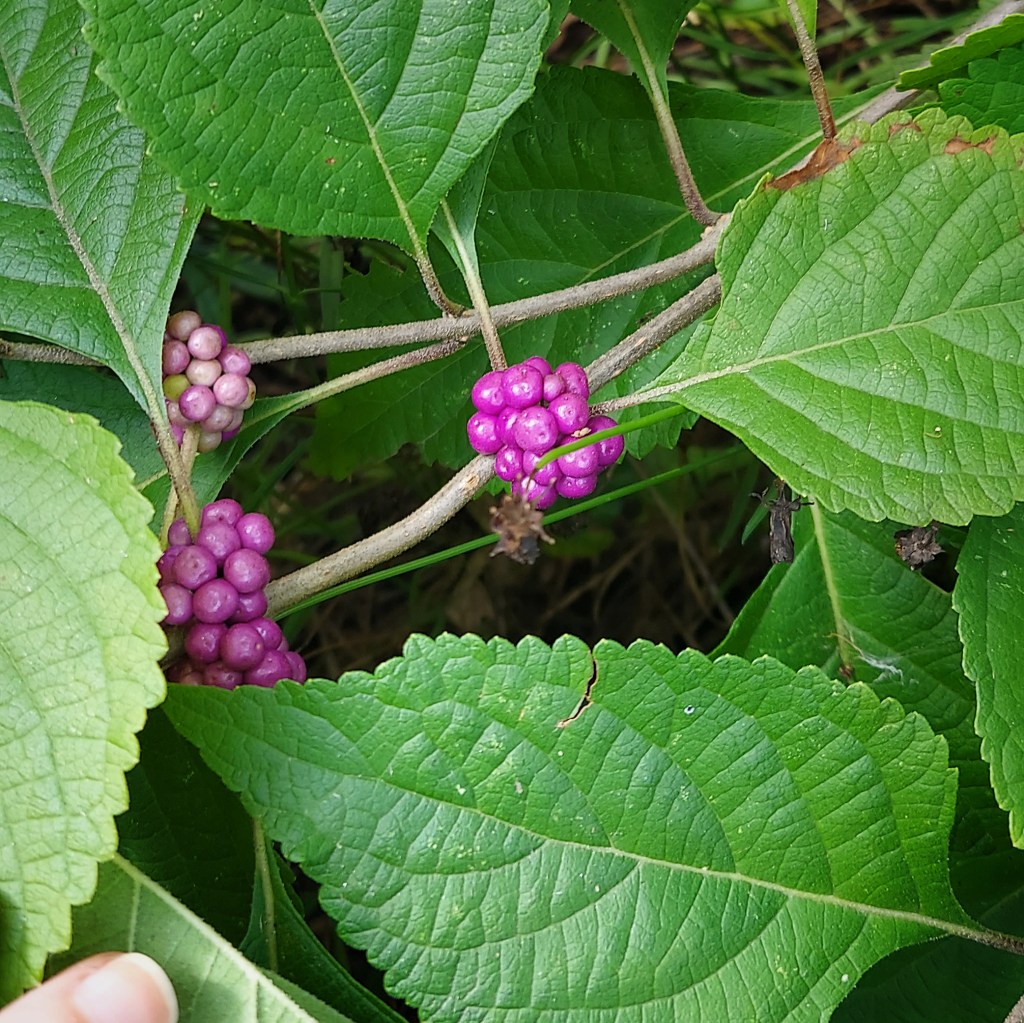
Tiny clusters of bright pink beautyberries hidden among serrated green leaves.

The fruits are all starting to really ripen, which has been incredible to see. While the flowers of beautyberry are rather indistinct and unremarkable, the berries are absolutely gorgeous: tight clusters of tiny, round, bright magenta berries that can persist through the cold months. While they aren’t a first choice for birds and other animals, this actually makes them even more valuable to wildlife once winter really hits. When other, more palatable sources of food are used up, beautyberry’s there to help keep everyone going.

The berries are bright, attention-grabbing, and non-toxic, so why aren’t they more popular among wildlife? It’s purely a matter of taste — literally. I’ve eaten a few ripe beautyberries straight off of the bush, and the opening flavor is sweet and very unique. It’s hard to describe, but, if I had to, I’d say it’s a combination of lemon, grape, and cucumber, perhaps with very subtle notes of raspberry and bergamot.

A close-up of a cluster of beautyberries, held in the palm of my hand.

Unfortunately, this is followed by a rather bitter aftertaste. I don’t think it’s a dealbreaker when it comes to snacking on a few here and there, but I can absolutely see how an animal with an abundance of other food sources might. If I had to describe the bitterness, I’d say it’s about on the level of grapefruit.

Medicinally, beautyberries are really interesting. The leaves contain aromatic compounds that have been said to repel mosquitoes comparatively to DEET. People indigenous to its range have used it as a natural bug repellent, and researchers have extracted some unique compounds that “showed significant repellent activity against [Aedes egypti] and Anopheles stephensi.” Anecdotally, some people claim it’s also effective against ticks, but other users have found it to be of little use. There are loads of DIY mosquito repellent recipes using C. americana available on the internet, but those that macerate the leaves in alcohol (ethanol or isopropanol) are likely to be more effective than those that use water.

Other than making mosquito repellent, the leaves and roots are traditionally used to treat colic, edema, dysentery, stomach pain, rheumatism, and symptoms of malaria.

Researchers have also found an aromatic compound, 12(S),16ξ-dihydroxycleroda-3,13-dien-15,16-olide, that can help treat antibiotic-resistant staph infections. MRSA is a big deal because it can be very difficult to treat. Beta-lactam antibiotics are some of the safest ones we’ve got, but don’t work very well against resistant bacteria. The compound found in beautyberry helps to restore drug-resistant staph’s sensitivity to oxacillin, a beta-lactam antibiotic.

C. americana is only one species of beautyberry. There are also C. japonica from Japan, and C. dichotoma and C. bodinieri from China. Beautyberries all look alike, but there are some key differences to look for if you’re not sure which bush you’ve got.

C. americana has magenta berries that grow very closely around the stems of the bush. There’s basically no airspace between the bark and the berries, which gives these plants a rather unusual appearance. One cultivar, C. americana var. lactea, produces white berries.

A close-up of C. americana, showing the berries closely packed around the stems.
Another shot of “my” beautyberry, showing the lack of space between the berries and the stem.

Asian species of beautyberry look very similar to C. americana but produce berries in clusters on short stems. Instead of closely circling the branches of the bush, there’s a little bit of air space between them.

An image of C. bodinieri, showing the fruits on short stems.
C. bodinieri, showing its slightly different fruit distribution.

If you’re me, you get a little sapling, find a place with lots of sun, stick it in the ground, and wish it the best of luck. Wild beautyberry is found in meadows, woods, and the edges of ponds and streams. It’s not really picky.

I admit, I’m probably not a great person to ask how to grow things. Most of my most successful plants have been accidents (hi, pumpkins) and part of the reason that I love gardening with native plants and nativars is because they don’t require coddling. Find an appropriate spot, and the plant’ll know what to do.

At the moment, the beautyberry bush I planted is still fairly small. While it’s putting out berries like a champ, there aren’t enough for me to harvest some and leave enough for the birds. Since it’s done so well, though, I’ll definitely be looking for more places to add it to the landscape. By next year, I’ll hopefully have enough for jam, sauce, and even pie!

Plants and Herbs

Grape Folklore & Magical Properties

It’s the most wonderful time, of the year.

Okay, so.
There’s a new fruit quest. (If you have been reading here for a while, you might be familiar with the persimmon quest that I force my Handsome Assistant to accompany me on every year.)

A year ago, I tried my first muscadine. It was almost the size of a wild plum, the deep purple of a cloudless night sky, with firm flesh that tasted like a combination of grape jelly and extremely good wine. It was sweet and juicy, in perfect, balanced contrast to the firm, tart, slightly tannin-y skin. I could probably wax rhapsodic about muscadines and scuppernongs for way longer than anyone would be comfortable with.

Muscadines ripening on the vine.

Anyhow, I saw them pop up at the farmer’s market at about $13 a container and was sad to pass them up. Immediately after that, I saw them at Aldi for about $3.69. (Nice.)

Normally, I’d advocate for buying from farmer’s markets versus a supermarket whenever you’re able to. The thing about muscadines is that their range is very limited, so even the grocery store variety has traveled, at max, a few states away. They’re also seasonal, so they’ll disappear from the shelves as soon as their time is up.

This is why the other evening saw me leaving Aldi with arms full of containers of muscadines and scuppernongs (they’re the same species, but scuppernong is usually used for muscadine grapes that are kind of a light bronzy-green in color). I was also quietly singing a little song about how excited I was to have tasty grapes, and possibly skipping. (I am fortunate that my Handsome Assistant seems to find my goofball-ass qualities endearing.)

So, since it’s muscadine season, I figured I’d write a bit about grapes. Muscadines (Vitis rotundifolia) are strictly an American fruit, so they’re another plant you won’t find in old grimoires or European mythology, but that’s okay! They’re a kind of grape (Vitis species), and grapes in general have had a prominent place in myth and magic everywhere they appear.

Grapes figure heavily in Greek and Roman legend. According to the Greeks, the first grapevine came from a satyr named Ampelos. He caught Dionysus’ eye, and the deity romantically pursued him… at least, until Ampelos mocked the Moon Goddess Selene and got himself gored by a bull. Heartbroken, Dionysus transformed Ampelos’ body into the first grapevine.

(According to Ovid, things panned out a bit differently. In this version, grapes already existed, Ampelos fell while picking them, died, and Dionysus transformed him into a constellation.)

In Christian mythology, grapes are associated with abundance. Moses sent spies into Canaan (the “promised land”), who then returned with a cluster of grapes so large, it required two people to lift it.

On the other hand, some scholars claim that the “forbidden fruit” of the Garden of Eden was also a grape, not an apple as it’s commonly portrayed. Other scholars claim it may even have been wheat, so who knows.

Two bunches of grapes. They're a mixture of ripe and unripe fruits, showing shades of deep blue, to purple, to bright green.

In the ogham alphabet, muin, is often said to be a grape vine. However, grapes aren’t native to Ireland (they showed up with the Romans), and tend not to grow well there anyhow. Grapes also don’t really appear in Celtic legends with significance. Etymologically, connecting muin to the word “vine” is also tricky. For this reason, you’ll find a lot of debate about the actual meaning of this fid, as well as what plant it was even meant to represent in the first place. (Probably originally thorny brambles, like blackberries, though this meaning may have shifted over time.)

Grapes and wine are also generally good offerings for a wide variety of spirits and deities.

Vines, in general, are associated with binding. This isn’t necessarily binding in a negative or protective sense — binding can also be used to hold a favorable situation to you.

Elementally, grapes are associated with Earth and Water. They’re also associated with the Moon.

They’re…
They’re grapes.

All kidding aside, grapes are possibly one of the easiest magical plants to use. Eat, brew, or cook with them while visualizing yourself as prosperous and happy.

If you have the space and ability to do it, plant a grape vine in your yard to bring abundance to your home. (This may work even better than intended. Birds love grapes as a source of both energy and water, and tend to excrete more seeds when they hang out to feed. This is how I ended up with free, thriving tomato and mulberry plants, and possibly even the pumpkin vine. Free food!)

Grape vines make fantastic bases for wreaths. I’d like to devote a longer post to making and empowering magical wreaths, but, in short, take a grapevine wreath, add whatever other magical dried plants or curios you like, and hang it where it’ll do the most good. A protective wreath on the front door, for example, one for prosperity in the kitchen, or one for passion or fertility in the bedroom.

Though it also isn’t one of their traditional meanings, I also associate grapes with protection. Dark grapes make red wine, the color of courage, strength, vitality, and protection. The leaves themselves are covered in trichomes, which are small, pointy, hairlike structures. Covering the floor around your bed with grape leaves is said to be a folk remedy to control and protect against crawling pests like bedbugs.

Whether you’re like me (and do a goofy little happy dance when you’ve gotten special grapes) or your feelings about the fruit are more ambivalent, grapes are worth considering for your magical practice. They’re sweet, tasty, easy to use, and pretty straightforward in their properties and associations.

Plants and Herbs

Milkweed Folklore & Magical Properties

I planted a swamp milkweed (Asclepias incarnata) in the back yard not too long ago. Though I did it well after I could hope for monarch butterflies, I still wanted one of these beautiful, interesting native plants. (Besides, they’re perennials — if it could survive this year, there’ll be plenty of plant for the monarch babies next year!)

It was blooming happily, playing host to all kinds of tiny fauna, and finally put out lots of big, fat pods. Apparently it wanted to wait until the recent supermoon to bust those suckers open, because that whole part of the yard is inundated with milkweed fluff!

Flat, brown milkweed seeds, showing their tassels of silky white fluff.

I gathered a good quantity of the fluff and seeds to save, share, and use for various purposes. So, I figured, now’s probably a good time to write about this lovely plant’s magical properties!

Like many of the plants I choose to explore, this one’s native to the Americas. That means that you won’t see it in a lot of older folk or ceremonial magic resources. This plant is still powerful, however, and has a lot to offer practitioners in its native range.

Like I mentioned, milkweed produces tons of fluff. This fluff appears as silky white tassels on its seeds and helps them disperse via wind — just like dandelions. If you catch a floating milkweed seed, make a wish, then release it to go along its merry way, its said that your wish will come true.

Milkweed fluff can also be used as filling for pillows, sachets, and poppets. Thistledown is a traditional poppet filling, but, if you don’t live in an area with abundant thistles, milkweed fluff can be used as a substitute.

Filling a dream pillow with milkweed fluff is said to cause the user to dream of the fae.

The juices of the milkweed plant, when used for anointing, are said to strengthen one’s “third eye.” (However, these juices are also irritating, so maybe just place a whole leaf or sprig of flowers to your forehead instead.)

In World War II, military life jackets were filled with milkweed fluff as an alternative to kapok (Ceiba pentandra).

Milkweed’s genus, Asclepias, was named for Asclepius. He’s the Greek God of Healing, and a son of Apollo.

Though it’s associated with a god of Healing, one of milkweed’s primary virtues is its toxicity. When monarch caterpillars feed on milkweed, they take in the plant’s toxins. This, in turn, makes the vulnerable caterpillars toxic and unpalatable to predators. As a result, milkweed is associated with protection.

A plump, stripey monarch caterpillar.

There’s also a very fine line between “poison” and “medicine.” To the people indigenous to milkweed’s native range, milkweed sap was used to remove warts. Boiling helps leach out the toxins in the plant’s sap, and cleaned up extracts of milkweed proved useful for respiratory ailments, sore throats, and kidney problems. Some of the toxins in milkweed sap are cardiac glycosides, which, in small doses, behave similarly to the digitalin extracted from foxglove (genus Digitalis).

Milkweed is a very liminal plant. Swamp milkweed (A. incarnata) can be found at the edges of wetlands, where the water meets the land. Common milkweed (A. syriaca) often grows in disturbed areas, like roadsides.

Milkweed is associated with the Moon and the element of Earth. (Personally, I also associated swamp milkweed with water.)

Milkweed’s a really lovely plant, though it can also be hazardous to work with if you aren’t careful. Personally, I limit myself to the flowers, fluff, and seeds — I have sensitive skin, and the last thing I want to worry about is getting milkweed sap on myself!

The fluff is really lovely as a filling for poppets and dream pillows. Blend it with herbs like mugwort, hops, and lavender, and add a clear Herkimer quartz crystal for a wonderful dream pillow that’ll help improve dream recall and make it easier to dream lucidly.

The seeds, like a lot of native American seeds, need to be stratified. That means that they’re great to use for sowing rituals during the colder months — the winter solstice, for example.

Seeds are a great spell component in general, because they embody as-yet-unrealized potential. They’re a bit of sympathetic magic, too. As the seed grows, so will the thing you hope to get from your spell.

Milkweed seeds are also flat, so they’re nice to incorporate into homemade paper. Once the paper’s used, you can plant it and allow the seeds to grow. Just make sure that you’re using varieties native to your area!

The pink flower clusters of A. incarnata.

Milkweed is a beautiful, protective plant that has much to offer those who can get past its defense mechanisms. Inside those pods, protected by poisonous, milky-white sap, is an abundance of silky, silvery fluff and seeds. If you have the ability to grow or otherwise hang out with milkweed, I highly recommend it.

Plants and Herbs

Echinacea Folklore and Magical Properties

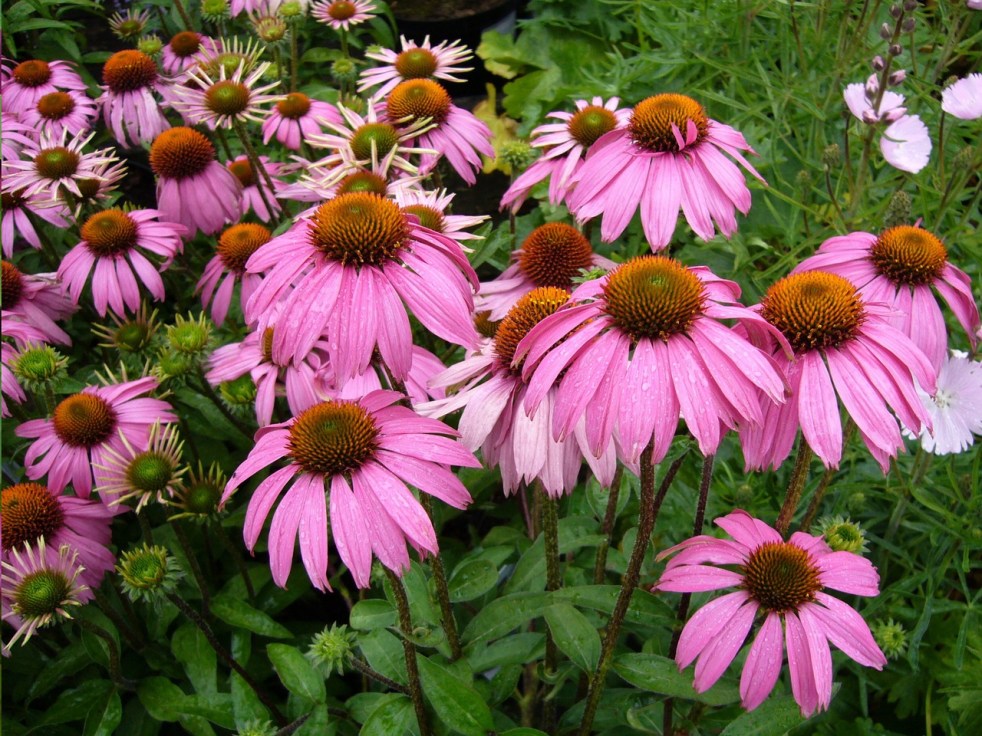
Echinacea, or coneflower, is a genus of flowering plants found solely in parts of the US. They’re native to where I currently live, so I’ve added several different wild type and nativar plants to the front and back yards here. They’re a unique addition to the landscape, and help bring in even more pollinators than the bee balm and anise hyssop already do!

These flowers are probably best known for their medicinal qualities. The first time I’d ever heard of echinacea was from my father’s former significant other. She had some echinacea tea, and I overheard her talking about how she used it medicinally. (Though they’ve since split up, I’m still friends with her — she went on to become a bodywork therapist who specializes in sound healing and craniosacral therapy, and is one of the founders of the nonprofit Columbia Resilience Integrated Health Community Project. She’s a pretty cool lady.)

Unfortunately, the popularity of echinacea means that wild populations are suffering from overharvesting (two species, E. tennesseensis and E. laevigata, have only recently recovered from being on the endangered species list). If you want to use these plants, it’s best to grow your own. Fortunately, that’s really easy to do — they self-seed super easily and will grow pretty much anywhere there’s sun. They’re also great for helping populations of native pollinators.

Since these are American plants, they’re not found in European-based grimoires. They’re still very valuable to develop a relationship with, even if they don’t show up in old world folk or ceremonial magic.

To the Ute people, echinacea’s traditionally called “elk root” due to the belief that injured elk sought out these plants to use medicinally.

Echinacea roots are used as a physical and spiritual medicine. They’re a traditional healing herb for burns, pain, and inflammation, and some peoples have chewed them as part of their ritual purification ceremonies.

The name “echinacea” comes from the Greek word for hedgehog, “ekhinos.” This is because the center of the flowers is round and spiky, like a hedgehog.

Today, echinacea is often touted as a way to help prevent or eliminate respiratory viruses like the common cold. Research doesn’t really bear out assertions that coneflower can significantly help with the common cold, but there’s evidence to suggest that coneflower’s immune activity may have a lot to do with the bacterial populations within the plant itself. These studies are on isolated cells in vitro, however, not on humans. Overall, it seems like echinacea isn’t really a great remedy for upper respiratory viruses.

Topically, infusions of echinacea are helpful for soothing the skin. Prepare a strong brew of the root (and any other soothing herbs you like, like chamomile or marshmallow), filter out the plant matter, and add the liquid to a bath.

Some green witches use echinacea as a way to increase the power of their spells. It’s best employed when attempting to overcome a problem that doesn’t respond to other measures, but adding a little of the root or seeds to any spell will help increase its effectiveness.

Hanging a sachet of echinacea over the bed is said to act as a fertility charm.

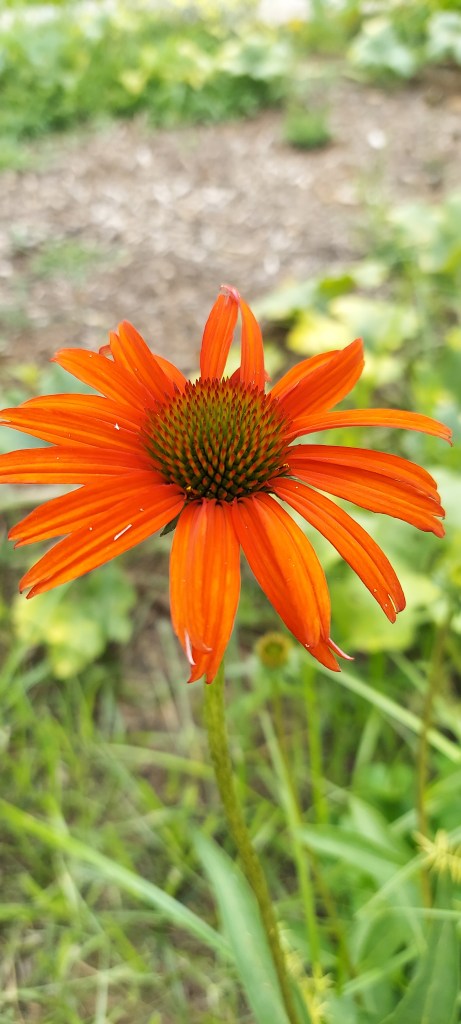
A bright red cultivar of echinacea, showing the characteristic spiky center surrounded by a ring of bright, daisy-like petals.
One of the bright scarlet echinacea cultivars in the front yard. You can see a bit of the mysterious pumpkin vine in the background.

Coneflowers are also associated with strength and vitality. Sprinkling powdered echinacea root in one’s shoes is said to increase physical vitality and endurance. This is particularly interesting to me, since the same is said of mugwort. Both echinacea and mugwort are pretty opportunistic plants that will tolerate poor soils. The plants’ own resilience could be why they’re connected to the idea of endurance and strength.

Some sources also claim that placing a single echinacea flower on one’s brow can enhance psychic abilities. Interestingly, mugwort is also used to enhance psychic abilities.

When cut and kept in a vase, it’s believed to bring prosperity into the home.

The large, brightly colored flowers are frequently used as natural offerings to the spirits of a place.

Coneflowers are also part of an herbal formula to attract same-sex love, particularly by men. Combine deerstongue herb (which has a lovely vanilla aroma), echinacea, and imitation musk, ambergris, and civet.

Echinacea is associated with the planet Mars and element of Earth.

In general, it seems like the flowers are used for offerings and laying on the body, and the roots and seeds are used for everything else. The roots and seeds are also said to have the most magical power. I can definitely see that — seeds, in particular, are symbols of infinite potential. If you want to start something new, include some seeds in your spell.

The easiest way to use echinacea magically is to include a bit of the whole seeds or ground root in sachets, jars, or herbal spell blends. There doesn’t seem to really be a limit to what this plant can empower.

You can also steep some larger bits of root in a carrier oil and use it as a protective or empowering anointing oil.

Personally, I plan to experiment with using echinacea alongside and in place of mugwort. There seems to be a fair amount of crossover in both their ecological and magical uses, though their planetary and astrological correspondences differ. Echinacea is native and grows like nobody’s business here, while mugwort is invasive. I’ll definitely harvest invasive wild populations of mugwort when I have the chance, but I’d like to see how far I can get with the herbs that I grow myself.

Medicinally, echinacea tea may be made from the flowers, leaves, or roots of Echinacea purpurea. This can be taken internally or used topically. Traditionally, it’s a remedy for inflammation and pain. Nowadays, it’s often touted as a treatment or preventative for respiratory viruses, but research shows that it probably isn’t very good at that last bit.

Overall, this herb is pretty safe, but people who are allergic to members of the daisy family will definitely want to avoid it. It isn’t known how safe this is for people who are pregnant or nursing, so ask your doctor if you have any concerns.

life · Plants and Herbs

Maypops!

Passiflora incarnata is a weird plant.

I bought three root cuttings last year, but they turned crispy and died shortly afterward.

Disappointed, I decided to try again with two more. Those died back to the ground late that autumn, and that seemed to be it. There was no sign of them this past spring, so I figured that particular experiment was also a failure.

Undaunted, I decided to try again. I purchased two more baby vines and planted them in roughly the same spot.

And then one (and only one) of the previous vines shot up out of the ground like it had something to prove. Like I’d committed some terrible affrontery by daring to try to replace it. Vining with a vengeance.

Not only did it reappear, it’s also about twice as big as the other two, and all three of them seem to be trying to outdo each other by putting out more and more buds.

A passionflower with bright bluish-purple, fringe-like petals and a white center.
My very first passionflower.

The only thing is that, while Passiflora species are generally considered self-fertile (the flowers contain both male and female parts, and they are positioned in a way that makes it very easy for pollen to just kind of end up where it needs to go), I’ve read a lot of sources that claim that P. incarnata is self-incompatible. In other words, the flowers are built in a way that should facilitate self-fertilization, but it’s just not into that.

Since the flowers also only last for a day, that means that there needs to be some very timely coordination between pollinators and the plant itself. Pumpkins are the same way, really — they have separate male and female flowers, but the flowers don’t last long. If a bug or hummingbird doesn’t show up at the right time, the flowers close up and that’s that.

Anyway, all of this is to say that, after my disastrous experiences trying to grow passionflower, I wasn’t expecting much. That’s why I was really surprised to go out on the porch and see these guys:

A close-up of a vine with a pair of small, green, vaguely egg-shaped fruit.

Maypops! (Aka, passionfruit!)

These aren’t anywhere near ripe yet. You have to wait for them to get really soft and wrinkly, or even to just drop off of the vine. (I probably won’t let them get that far, because I doubt I’d find them again once they fell.) In this way, they’re kind of like pawpaws and American persimmons — once they seem like they’re way overripe and on the way to the compost bin, they’re perfect.

I’d like to try harvesting the rest of the plant for medicinal purposes, too. (I talked about some of these in my post about the folklore and magical uses of passionflower.) My handsome assistant and I go through a ton of chamomile, to the point where I’m starting to wonder if it’s possible to build up a tolerance. I’d like to try augmenting some of that with other relaxants. If I can grow them myself, so much the better.

Passionflower fruit are apparently much like pomegranates, in that the edible portion is little bags of juice around seeds. I’m not much for making jams or jellies, so that’s out. I don’t think they’d be conducive to drying, though I may try combining their juice with a more solid, neutral-tasting fruit (like pears) to make fruit leather. We’ve also been using our excess strawberries and pumpkins to flavor mead, so I could see using a batch to experiment with maypop juice.

So many possibilities!

Plants and Herbs

Passionflower Folklore and Magical Properties

As we kill off our grass, we’re working hard to replace it with plants that serve multiple purposes. Ideally, they should be native (or at least semi-local), attract pollinators, provide food for both humans and animals, and either return or self-seed. One of the plants that passed muster is this area’s native species of passionflower, Passiflora incarnata.

Also known as maypop, true passionflower, purple passionflower, and wild apricot, P. incarnata is a really pretty, fast-growing vine that provides both wild-looking purplish blue flowers and edible fruits. The flowers don’t last long, but they’re very striking!

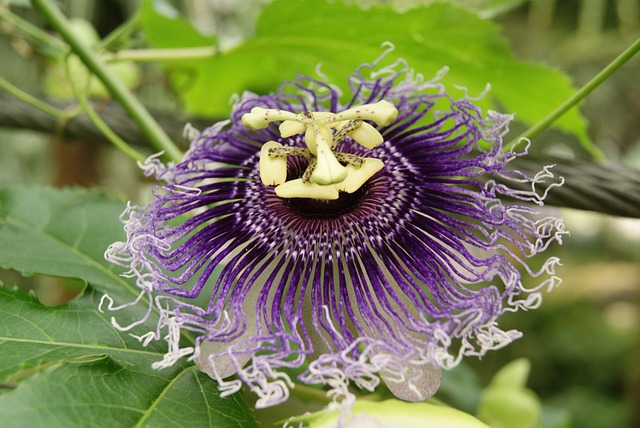
A fringy, bright purple Passiflora incarnata flower.
A flower of P. incarnata.

Unfortunately for me, I didn’t heed the old adage, “the first year they sleep, the second year they creep, the third year they leap.” As a result, I planted way too many passion vines. They’re going to eat my porch.
Help.

Anyway, as I watch my yard speedily being consumed by passion and pumpkin vines, I figured I’d write a bit on the magical uses and folklore of the passionflower.

Passionflower Folklore and Magical Uses

Despite the name, I’ve mostly seen passionflower used as an herb to dampen passions, not stoke them. They’re said to be useful for calming libido, cooling relationships, and cultivating platonic or romantic rather than erotic love.

This could be because the word “passion” has a number of very different and contradictory meanings. As Mark Z. Danielewski wrote in House of Leaves, “Like patience, passion comes from the same Latin root: pati. It does not mean to flow with exuberance. It means to suffer.”

As a new world herb, passionflower was a novel plant to the Spanish missionaries who arrived in Peru in the 1500s. Giacomo Bosio, a monk and historian, referred to passionflower as “La Flor de las cinco Llagas” (“the flower with the five wounds”). This refers to the five wounds the Christian figure Jesus Christ is said to have endured at his crucifixion. The Biblical usage of passion equates to suffering, so, to missionaries, the passionflower represented divine suffering.

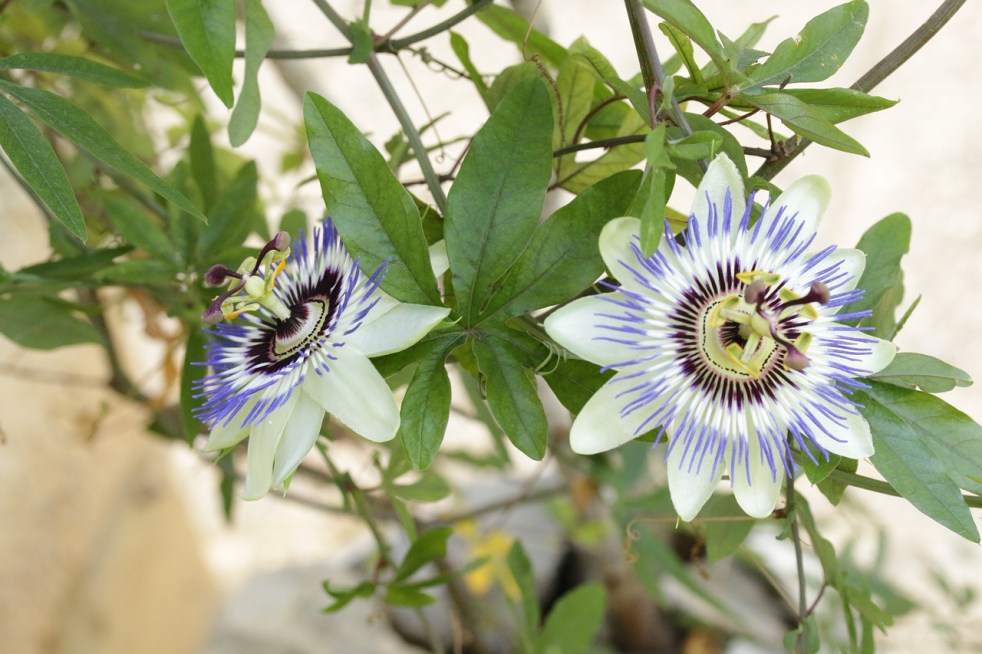
A blue and white flower of P. caerulea.
P. caerulea, a passionflower native to South America.

One tale from Brazil says that the passionflower grew from the tears of a woman who was separated from her lover.

Medicinally, passionflower is used as a calming herb. Evidence suggests that it’s safe to use internally, but there’s been some controversy as supplement manufacturers didn’t meet FDA requirements for safety data. It may interact with sedatives, monoamine oxidase inhibitors (MAOIs), and drugs to prevent blood clots, and is contraindicated in pregnancy.

In traditional indigenous herbal medicine, passionflower is used as a poultice to reduce inflammation and soothe pain.

In the garden, passionflower is irresistibly delicious to Japanese beetles. They’ll eat the leaves and flowers like there’s no tomorrow, which is bad news if you actually want to harvest any fruit!

Taken together, this paints the picture of passionflower as an herb to ease suffering. Since it was said to represent the five wounds endured by Jesus Christ, you could look at it as a “wounded healer.” This isn’t a plant that flows with exuberance, it’s one that knows suffering and eases it in others.

In Victorian flower language, passionflower was said to represent religious fervor or superstition.

Passionflower corresponds with the element of Water and the planet Venus.

Using Passionflower

If passionflower both represents and alleviates suffering, how do you use it? Since it’s native to North and South America, there isn’t really any information about it in ancient magical texts. Nonetheless, there are many ways to work with this unique plant.

As a vine, passionflower grows and clings (hence the whole porch thing.) This makes it useful in workings to bind something to yourself. Since it’s also a plant for relieving suffering, I’d use it specifically in situations where you’d like to bind a solution to a problem — for example, using passionflower to tie yourself to a stable, fulfilling job or enjoyable living situation.

Passionflower is also sometimes used in pillows or sachets for restful sleep and dream magic. Be careful with this, however, as placing passionflower under one’s pillow is also said to be a remedy to dampen libido.

This herb is also used in love magic. Bathing in an infusion is said to attract a potential partner to you, and it’s an often-seen ingredient in sachets, jars, and other charms for love. It works well for this purpose, as long as you know what kind of love you’re looking for. (If you’re after a passionate fling, skip it and go for cinnamon or ginger instead.)

Infuse the flowers in a carrier oil and use this to help ease worries and sooth the heart and mind. Anoint the temples and heart area whenever relief is needed.

All told, passionflower is a delightful herb. It’s beautiful, feeds bees and hummingbirds, and provides valuable medicine. As long as you don’t let its name fool you, it can help you with an array of spells and charms.

life · Neodruidry · Plants and Herbs · Witchcraft

Wood Sorrel Folklore and Magical Properties

Take a look at your lawn. Unless you maintain it to putting-green smoothness, you’re likely to see some yellow flowers.

Not the dandelions — look closer.

You might mistake them for buttercups at first, but they’re really quite different. These little yellow five-petaled flowers are yellow wood sorrel (Oxalis stricta). They’re a native wildflower where I live, and vastly superior to the grass that still attempts to poke its way up through their heart-shaped leaves and small yellow flowers.

A plant with heart shaped leaflets and five-petaled yellow flowers.
A tuft of yellow wood sorrel.

As a native herb here, it doesn’t have a long history of use in old European grimoires. There are, however, many other varieties of wood sorrel — some native, some not, and some of questionable origins.

I’m a big proponent of using native alternatives to exotic herbs whenever possible, so I figured I’d give some background on wood sorrel and a few ways to use its magical (and delicious) American cousins.

Wood Sorrel Folklore

The species name Oxalis comes from the Greek word oxus, meaning “acidic” or “sharp.” The leaves of wood sorrel have a very tart flavor which makes them a tasty addition to salads. When dried, wood sorrel can be used to curdle milk for cheesemaking.

These plants are connected to fairies and woodland spirits. In Wales, wood sorrel is called fairy-bells.

A European wood sorrel plant (Oxalis acetosella), with heart-shaped leaflets and white, bell-shaped flowers.
The white flowers of Oxalis acetosella show why this plant’s sometimes known as “fairy bells.”

In herbal medicine, a decoction of the leaves was used for thirst and fever. Applied externally, the crushed leaves have an astringent effect which helps with abscesses, boils, and wounds.

Dried leaves are said to attract luck and, due to the doctrine of signatures, be healing and protective to the heart.

It’s also said that the dried leaf will allow the user to see fairies.

There’s some debate about shamrocks (an Anglicization of the Gaelic seamróg, meaning “little or young clover”). Shamrocks are associated with Saint Patrick, who used a three-leafed plant to explain the idea of the Christian Holy Trinity. Most depictions of the shamrock show it with three heart-shaped leaves. Since clovers have rounded leaves, this indicates that the shamrock may actually be a species of Oxalis and not a clover at all.

The ancient Druids were said to have regarded the shamrock as a sacred plant with the power to drive off evil spirits.

In the Victorian language of flowers, wood sorrel represented joy and motherly affection.

Wood Sorrel Magical Uses

Magically, wood sorrel is used in spells for luck, healing, protection from evil and misfortune, and love.

These plants can also be useful for working with three-part deities, like the Triple Goddess or Brighid. They make good offerings, or even natural representations of the deities themselves in a pinch.

Using Wood Sorrel

Wood sorrel isn’t a substitute for a visit to a doctor, but it can be a helpful herb for minor problems. Be sure you can reliably identify sorrel before attempting to consume it or use it topically.

If you live where wood sorrel naturally grows, you may want to cultivate a native species in your yard or garden space. This is especially true if you have an altar or dedicated space for nature spirits — wood sorrel is strongly connected to these entities. I’m planning to put an offering bowl and some large bull quartz crystals on the edge of the patch of yellow wood sorrel here, for example.

Using wood sorrel as a protective plant is an interesting idea. This protection may stem from the plant’s three-leaved appearance, which is reminiscent of various triple deities. The number three is also regarded as sacred in itself, since it reflects the past, present, and future; youth, adulthood, and old age; birth, life, and death; and the upper, middle, and lower worlds. Wood sorrel may also be considered protective because it’s very sour. Sour things, like lemons and vinegar, are often used to ward off or cleanse away negative energy.

Yellow wood sorrel leaves. The leaves consist of three heart-shaped leaflets, arranged similarly to clover leaves.
This picture shows the heart-shaped leaves and small yellow buds of yellow wood sorrel.

With all of this in mind, I’d brew a tea of wood sorrel and use it to wash doors, windows, and thresholds. Growing wood sorrel could also have a protective and luck-drawing quality.

The dried leaves and flowers would make a very nice addition to jar spells and sachets for love magic. I’d probably combine the flowers with roses, apple blossoms, and other seasonal blooms associated with love-drawing, then use this mixture in a magical bath.

If you’ve never tasted wood sorrel, I highly recommend it. The tart leaves and flowers are a very interesting addition to salads, soups, and sauces. If you’re into kitchen witchery, these edible wildflowers can be a powerful way to work with your local landscape to bring love, protection, and luck into your life.

Environment · life · Neodruidry · Plants and Herbs

Persimmon Foraging Quest

Hello! If you’ve been reading here for a while now, you may have come across the Persimmon Quest.

This is an annual quest my partner and I go on every autumn. We call around or visit grocery stores in order to find out who actually has persimmons (preferably the astringent kind, but non-astringent will also do). Then, we purchase and eat massive quantities of persimmons.

The first time I had one was when I still lived in California. It was a Fuyu persimmon (Diospyros kaki), crunchy and sweet, and I was sold. When I had my first perfectly ripe Hachiya, like a water balloon filled with sweet, flavorful jelly, I was smitten. When I realized that one of the trees planted here by one of the former occupants was probably a persimmon, I was ecstatic.

A Druidry group I belong to recently offered a small foraging expedition. One of our members is a biologist, and he’s kind and generous enough with his time to lead seasonal foraging walks. Last spring, we hunted for ramps. Now that it’s persimmon season, we went to track down some trees.

And oh, did we ever.

Three bags of soft, bright orange American persimmons, along with a sprig of coralberry and some dried mountain mint.

Several of them were already bare, picked over by wildlife and wind. Some were still laden with fruit that fell at the slightest touch. We picked only the ripest, squishiest ones, leaving the rest to soften in the sun and feed other things.

My partner and I came away with several pounds, which I cleaned and froze for future use. They’re very different from Japanese persimmons — we snacked on a few as we foraged, and it was striking just how much the flavor seemed to vary from tree to tree. American persimmons (Diospyros virginiana) are most similar to Hachiya-type Japanese persimmons, in that they’re very astringent before they’re ripe. When they look like they’re nearly rotten, they’re at their best.

Most of the ones I tasted were almost floral when compared to a Hachiya. Still very sweet and soft (with a slight astringent bite in a few places), but floral like lavender lemonade is floral. The comparatively large seeds got in the way a bit, but I’ve read some interesting recipes for roasting and grinding them to make a coffee substitute. As someone who doesn’t drink coffee, I’m intrigued! If I can get a foraged equivalent for Dandy Blend that isn’t dandelion root, I’ll be excited.

I haven’t yet decided what to do with the persimmons themselves. I might separate the seeds and pulp, then freeze the pulp again in an ice cube tray. I figure, if I want to add them to smoothies, sauces, or desserts, I can just thaw out some cubes of prepared persimmon mush fairly quickly and easily. I could even pop a cube or two in a jar for making persimmon kefir. (One member of the group was considering doing fruit leather but based on my experiences trying to make strawberry leather in the oven, I don’t think I want to tackle that without a dehydrator.)

There was a lot more to see than just persimmons, too. Dogbane (Apocynum cannabinum) with its stringy bark (good for stripping and braiding into twine). Horsenettle (Solanum carolinense) with its bright yellow, tomato-like, deceptively delicious-looking poisonous fruits. Fragrant tufts of mountain mint (Pycnanthemum muticum), gray and brittle with age. The most striking were the coralberries (Symphoricarpos orbiculatus), their tiny, bright magenta fruits standing in vibrant contrast to their bright green leaves.

I found these berries particularly intriguing. As it turns out, they’re a valuable native food plant for birds, grow in shade, can stabilize banks, don’t have any major pest or disease vulnerabilities, and thrive on neglect. I’m still looking for native/non-invasive plants to help feed the yard’s hard clay soil and reverse some of the damage from supporting a lawn, and coralberry fills a very important niche here. From what I have read, coralberries aren’t of much value as food for humans. That’s okay, though. Not everything in the yard has to — or should — be for me to eat.

Plus they are so pretty.

I’m considering growing some mountain mint, too. Like other mints, they can take over a yard. Since they’re a native plant, I think it’ll be easier to keep them at a reasonable level than, say, the old peppermint that’s slowly eating part of the back yard. Interestingly, it’s closer to bee balm (monarda) than it is to peppermint, and there’s a faint bee balm-ness to its scent that gives that away. Mountain mint also attracts an incredible variety of native pollinators and predatory wasps, and is both edible and medicinal. Medicinally, it’s treated almost as a panacea — it’s considered a digestive, carminative, emmenagogue, expectorant, and more, though I haven’t thoroughly researched the active constituents myself yet. If it can serve as a home-grown, native substitute for peppermint tea, I’ll be all for it. The flavor does lead me to think that it’d be great for seasoning poultry or wild game, and I’m eager to try.

That’s what I love about foraging trips. Not only do I come away with tasty food, but I also get a better idea of ways to try to heal the land I’m now responsible for. Seeing a wide variety of native plants shows me what this patch of grass could be and tells me how I can help it get there. I’m excited!