He’s back. At least, I’m pretty certain sure it’s him, though he appears able to fly now. This crow has a distinctive appearance and a set of behaviors I had previously only observed in Boink, so I am somewhat confident in my assertion that The Shed-Dwelling Scrunglemuppet Has Returned.
Last year, he spent evenings roosting in the big apple tree, and mornings and afternoons sitting on top of the shed. When I went outside, he’d run to the far side to “hide.” If he heard the back door close, his little head would pop up over the shed’s roofline to see if I was still there. If not, he’d hop his way over to the feeders to grab some food before the other crows came.
Now, he appears with the rest of the family. He still appears to be pushed away from the food and scolded, and he still does the same goofy little run, but he’s at least better able to get away from predators. I don’t think there are many animals who would go out of their way to eat a Boink, but there are certainly creatures who would take the opportunity to hunt a land-locked crow.
Boink still has to be a bit opportunistic when he eats. He’s still scrungy. His tail is still kind of karked up, and I don’t think he’s capable of not looking bedraggled, but his flight feathers are back and that’s what’s important.
Vervain (Verbena officinalis) is a prominent herb in European folk and ceremonial magic. Its roots also extend to American Hoodoo.
Though most old grimoires mean V. officinalis when they refer to vervain, there are actually about 80 species in the genus Verbena. In my area (and all of the continental US, and fair bit of Canada) we have Verbena hastata, also known as blue vervain. While it’s not the same plant, you’ll often find V. hastata labeled simply as “vervain” in metaphysical contexts.
Lemon verbena, Aloysia citrodora, is also a member of the Verbenaceae family. However, since it’s a somewhat more distant relative, I wanted to limit this post to V. officinalis and V. hastata.
Vervain Magical Properties and Folklore
Vervain is sometimes called “the enchanter’s plant,” since it’s one of the most versatile herbs in European magic. Even outside of Europe, it was (and continues to be) considered a plant of considerable medicinal and spiritual significance.
Many odd old wives’ tales are written of Vervain tending to witchcraft and sorcery, which you may read elsewhere, for I am not willing to trouble your ears with supporting such trifles as honest ears abhor to hear.
Magically, it’s used for purification, protection, divination, peace, luck, love, and wealth. It’s a pretty solid all-purpose herb that is often added to formulas to increase their power.
The name vervain comes from the Latin “verbena,” which refers to leaves or twigs of plants used in religious ceremonies. This, in turn, came from the Proto-Indo-European root “werbh,” meaning to turn or bend. I have also seen the origins of the word vervain given as a Celtic word “ferfaen,” meaning to drive stones away. However, I haven’t found strong evidence for this origin — all attempts to look up “ferfaen” only yield articles claiming it as the word origin of “vervain,” and most of them only give “Celtic” as the language of origin. One source did cite the Cymric words “ferri” and “maen” as a possible origin, with the word “maen” mutating over time into “faen” to eventually yield “ferfaen.” (Upon further searching, I was not able to find the word “ferri,” though I did find “fferi,” meaning “ferry.” This would give the word “ferfaen” a meaning closer to “ferry away stone(s).”) Nonetheless, the etymological sources I looked at gave “verbena” as the origin of vervain, not “ferfaen.”
Pliny the Elder credited vervain with quite a lot of magical properties. According to him, it was used to cleanse and purify homes and altars. He claimed the Gaulish people used it in a form of divination, and that Magi said that people rubbed with vervain would have their wishes granted, fevers cooled, friends won, and diseases cured. Interestingly, he also pointed out that vervain was considered a bit of a party plant, for when dining-couches were sprinkled with water infused with vervain “the entertainment becomes merrier.”
While vervain is strongly associated with the Druids, they didn’t leave a whole lot of records of their activities behind. What we do know is largely through sources like Pliny, and it’s likely because of writers like him that vervain became strongly connected to the ancient Druids.
For the best potency, vervain should be gathered in a specific fashion. It’s best cut between the hours of sunset and sunrise, during the dark moon. Like many other herbs harvested for their leaves, it’s best to cut the leaves before the flowers open. After cutting, it’s best to offer some fresh milk or honey to the plant.
Vervain is thought to be the origin of the name “Van van oil.” While the van van oil recipes I’ve seen don’t include vervain or vervain oil, it’s possible that the Verbena family loaned its name, nonetheless. (In that case, it was most likely lemon verbena, vervain’s citrus-scented South American cousin.)
Vervain is also one of those contradictory herbs that is simultaneously said to be used by witches, but also effective against witchcraft.
In the very distant past, bards would use brews of vervain to enhance their creativity and draw inspiration.
Medicinally, vervain is an emetic, diuretic, astringent, alterative, diaphoretic, nervine, and antispasmodic. According to Hildegard of Bingen, a poultice of vervain tea was good for drawing out “putridness” from flesh.
Using Vervain
Soak some vervain in water, then use the stems to asperge an area, person, or object that you wish to cleanse. It’s also an excellent addition to ritual baths for this purpose.
Sprigs of vervain are also worn as protective amulets, specifically against malevolent magic. Tie a bit with some string, put it in a sachet, and carry it with you. Tuck a sprig of it in the band of a hat. Use a small bud vase necklace and wear a bit of vervain like jewelry.
Planting vervain around your property is said to ward off evil and guard against damage from bad weather. If you choose to do this, please select a variety of vervain native to your area — in most of the US, V. hastata is a safe bet.
V. officinalis is often used medicinally, V. hastata is considered both medicinal and edible, but avoid consuming it if you’re pregnant, trying to become pregnant, or are breastfeeding. Talk to a qualified herbalist if you have any chronic conditions, or routinely take any medications. Avoid consuming a lot of it, since it is an emetic. It’s also important to be sure that the herb you’re working with is really V. hastata or V. officinalis — there are plenty of Verbena species that don’t offer the same benefits.
Vervain is a powerful plant, as long as you know which member of Verbenaceae you’re looking at. If you have the ability to grow a native vervain, by all means do so — these plants are tall, with interesting-looking flower spikes. They’re also easy to dry and store, ensuring that you’ll always have a stockpile of this powerfully magical plant.
This past weekend was the yearly Goods and Gear Swap. The Druidry group that I’m part of does one every June — we get together, bring songs, poems, stories, and food to share, and find new homes for things. Every year, I come back with plants, books, you name it.
It’s also a lovely way to connect with people in a not-strictly-ritual setting. Sure, this gathering has some ritual elements since it’s Midsummer, like the opening of the bardic circle, but it’s mostly a way to catch up and eat excellent food.
I admit, lately I’ve been having an antisocial streak. Maybe it’s from doomscrolling, maybe it’s the beginnings of an ennui, I don’t know. I just know that I’ve been feeling more and more at home when I eat breakfast with the crows in the yard, and more and more on edge around other human beings. This year’s Goods and Gear Swap did a lot to help pull me out of it.
It made me realize just how fortunate I am to know such talented, smart, funny, genuinely cool people. Every conversation I had was interesting and validating, from stuff about gardening, to stuff about spiritual practices. People sang. Read poems (either ones by other authors, or ones they wrote themselves). Told stories. Played instruments. We shared food. We swapped books, plants we’d grown, things we’d made. It was an excellent antidote to the doomscrolling and general people fatigue I’d been feeling.
I came away with several fascinating books, two dragonfruit plants, some camping supplies, and a ukulele. Though it was only one afternoon, I feel recharged, in a way — inspired, energized, full of ideas for my art and my garden.
Here’s hoping this season is treating you well, too.
This is a place where people congregate, distinct from their homes and workplaces (first and second place, respectively). This can be a pub, or a community center, or a church, or salons and barber shops.
For much of the Pagan community, metaphysical shops hold the distinction of “third place.” They’re more than a place to buy candles and incense. They’re where you attend events. Classes. Opportunities to socialize with and learn from other people like you. A place to find community.
I’m fortunate in that, as part of a group of Druids, many of my community meeting spaces are forests. Even so, natural meeting spaces can be taken away, too. Photo by Ian Turnell on Pexels.com
Not long ago, I found out about the closing of a metaphysical shop near me which I loved dearly. A week or two ago, I found out about the closing of another. The owners had been looking to retire and sell their business, but the ownership of their location changed hands. The new owner opted not to renew their lease, leaving them without much choice other than to close the business.
A lot of metaphysical business owners and event coordinators are older, and there haven’t yet been enough people to take their place. I wish I could, but money is often the obstacle to doing so. I’ve donated money to ongoing efforts, supported businesses, reached out to figure out what I could do as far as vending, teaching, or anything else, but the problem is usually much, much bigger than I am. Every time we lose a shop, a group, or a festival, it’s like losing a friend.
Whether you’re Pagan or not, the third place is important. For many people, it’s life- and mental health-sustaining. Don’t take your third place for granted — there are a lot of things that can take it from you. Support the local businesses that matter to you, even if they’re more expensive than big box stores. Attend community events. If you have a skill or craft to share, see what you can do to become a part of things. If you have the means, consider creating or contributing to a third place for your people.
Sacred Circle, in Alexandria, VA, will be closing at the end of the month. In the meantime, they’re having a sale with deep discounts on everything. Books, journals, candles, herbs, crystals, musical instruments, you name it.
Hello (and a relaxed and happy Pride Month to all of my fellow LGBT+ people)!
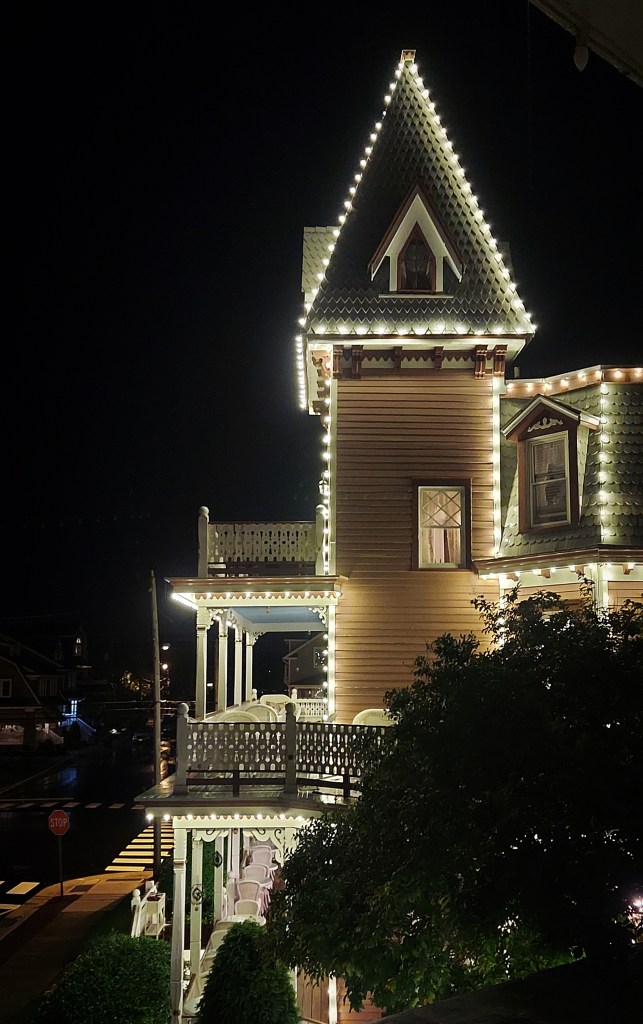
I am freshly returned from a brief trip to Cape May, NJ. My Handsome Assistant and I wanted to take some time to be near a beach for a bit, and managed to time things so we would a) have nice weather, but also b) be there during the “off season” when accommodations are generally a lot cheaper and easier to get. Fortunately for us, the stars aligned and we got a very nice room in the Angel of the Sea bed and breakfast.
(And when they say “and breakfast,” they mean it. You want breakfast? There’s fresh fruit, fancy breads, and three different entrées to pick from. Feeling snacky? There’s tea and pastries in the afternoon. Want to relax in the evening? There is wine and mountains of charcuterie. Even after you check out, you’re invited to return later that day to enjoy the amenities.)
The Angel of the Sea even comes with its own ghosts. It’s a very old building that was actually kind of… cut in half and transported to its current location. As a result, parts of it aren’t very accessible — think the narrow hallways and steep staircases you get with historic buildings — but are super haunted. As many as four ghosts have been reported to make an appearance there. There’re electrical shenanigans, shaking beds, and mysterious phantom coughs.
Our room even had a complimentary Grandma.
I brought my ghost box, figuring it’d be interesting to mess around with during our downtime. I wasn’t able to get much on the scanner, but we also didn’t experience anything out-of-the-ordinary in our particular room, either.
We did meet a gentleman named Gary who was there with his wife. Gary was a lot of fun — always enthusiastic and down for a conversation, where he’d flit from subject to subject like a hummingbird. We talked about all kinds of things every time we ran into each other: history, haunted places, music, life, death, rehab, and more. He told us a story about someone close to him passing away. Even though this person appeared to have flatlined, they turned their head, looked into the empty doorway of their hospital room, and asked, “Which way do I go?” before they passed.
Even if you don’t find a ghost in your hotel room, places like this are generally home to absolute treasure troves of fun and interesting paranormal stuff. You’ve just got to know where to look. (Antique stores. The answer is antique stores.)
I have made the weird and occasionally embarrassing habit of going into antique stores, finding someone who works there, and straight-up asking them, “If you had to guess, what object here would you say is the most likely to be haunted and/or carry some kind of terrible curse?”
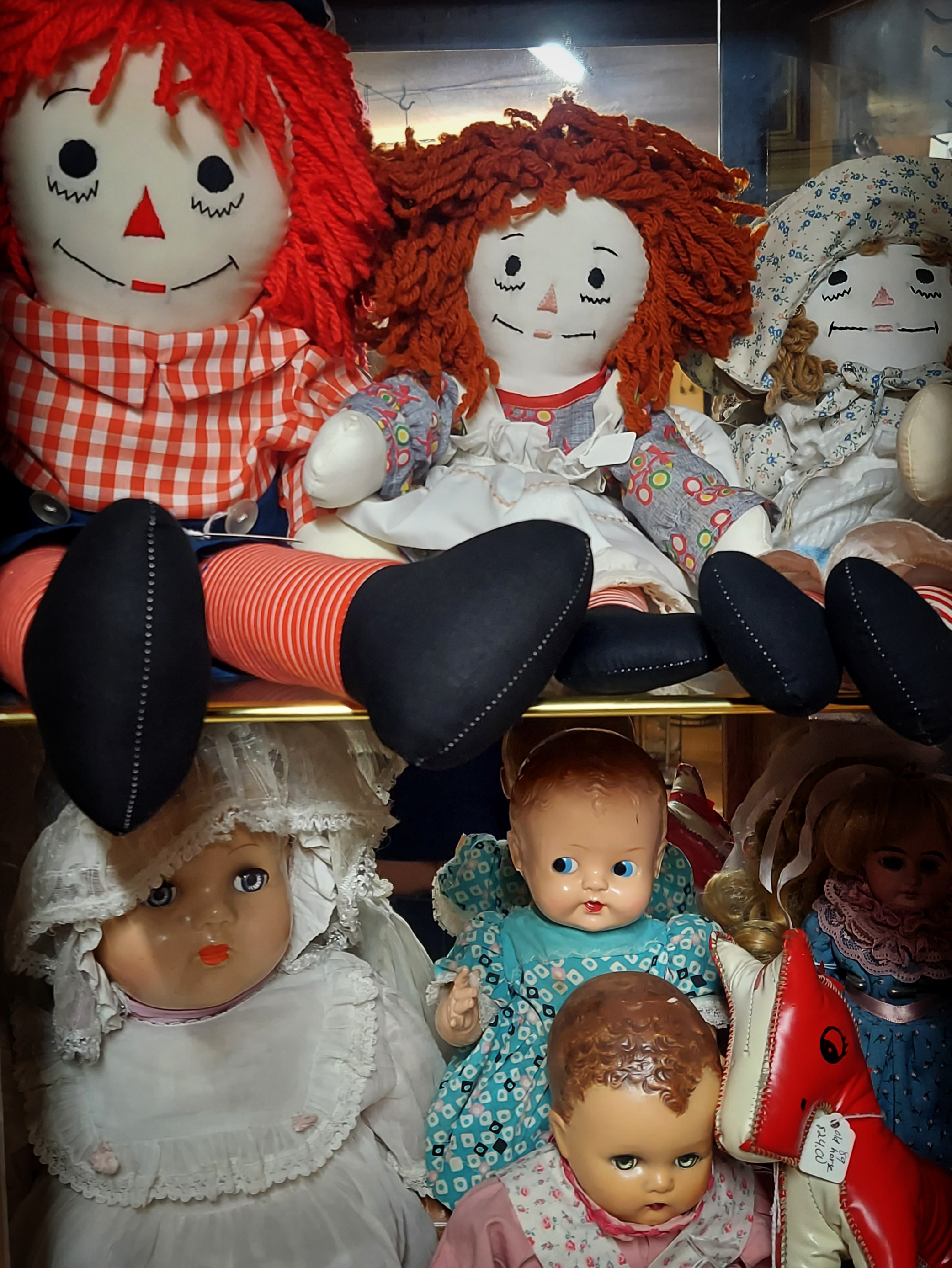
(If I had to guess, it would be any one of these things. Did you know the original Annabelle doll was a Raggedy Ann? Fun!)
As it turns out, antique stores are usually not super busy and are full of dead people’s stuff. I have yet to meet an antique store employee who has not jumped right in to talking about the weird stuff that goes on there at night. Some are more skeptical, but most of them will eagerly tell you about all of the things they’ve seen or heard.
For example, Antiques Emporia is home to the ghost of a little girl. She rearranges things at night and opens the packaging of vintage toys.
Capt. Scraps in Ocean City has even been the subject of a professional paranormal investigation. Multiple customers, on several separate occasions, have reported the sense that there was something there. Eventually, an associate of one of the owners brought in a full team with EMF readers, scanners, and the works. While investigating, they were able to decipher the words “Henry. Fire. Dog.” It was later discovered that a local antiques dealer named Henry had lost his shop, his dog, and his life in a terrible fire. Some of his paintings ended up at Capt. Scraps, and Henry decided to come along with them!
I don’t know if this was one of his paintings, specifically, but something about it really struck me and I had to get a picture of it.
This store also has its share of shadow people, odd phenomena on security cameras, and the general “sense” of a ghostly presence. It’s a really neat shop.
So, while I wasn’t able to get any recordings or paranormal experiences of my own, I did come away with lots of stories.
We also found a lot of shops that were right up our alley. Good Scents has a ton of local art and jewelry, candles, soaps, and incense. (We picked up some soaps, massage oil, and a box of “smokeless” Hinoki cypress Japanese incense.) Best of all, it’s quality stuff — not the kind of smells that immediately make my throat puffy and make me feel like someone is driving nails into my face.
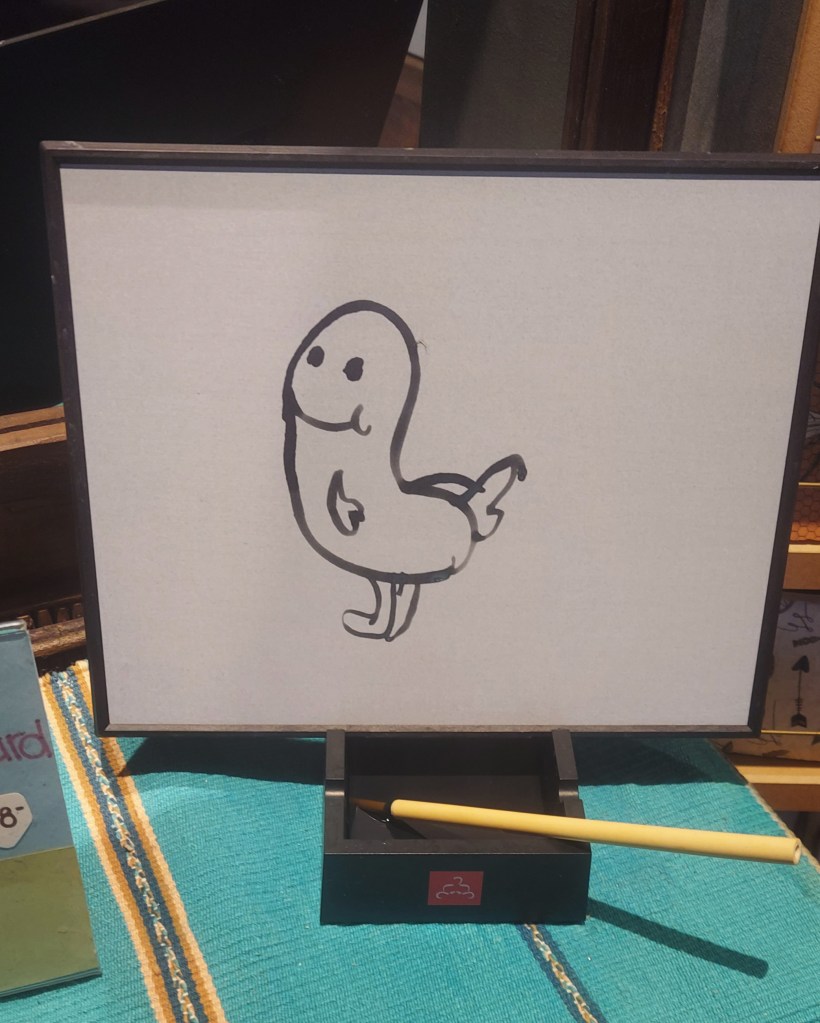
They also had one of those boards that you can draw on with water. Usually, you use them to write little notes or affirmations. Because I am a giant obnoxious child, I used it to draw a rushed, ersatz Dickbutt. (Don’t worry, I didn’t leave him there for impressionable childs to see. I drew over it.)
Guardian is another delightful place to stop if you enjoy metaphysical shops. It’s small, but well-stocked. It has some tarot and oracle decks I hadn’t seen anywhere else, and a very nice selection of books. (I picked up one that I can’t wait to review here.) When we checked out, the proprietor had us choose cards from an oracle deck — we read the affirmations and she had us keep the cards as a little bit of positivity.
We also went on a bit of a hunt for vegan cupcakes. We’d managed to find plenty of meat-, egg-, and dairy-free meal options for me, and tons of fresh seafood for my Handsome Assistant at places like The Mad Batter (like their seitan hot wings and vegan tostadas) and Good Earth (which had an amazing cauliflower steak with chimichurri), so finding vegan restaurants in Cape May wasn’t a problem at all.
My Handsome Assistant also brought me some fancy chocolates, like the Gay Bar. It’s pretty much an Old Fashioned cocktail in chocolate bar form, and it was delightful. I’ve had boozy chocolate before, but mostly just those little chocolate bottles filled with rum. Nothing really cocktail-inspired and uniquely flavorful like this.
We did eventually find Chocolate Face, a bakery that had vegan cupcakes. The chocolate ones were even oat- and nut-free, so they ticked all of my “weird dietary issues” boxes. This was about twenty minutes from where we were staying, so we decided to poke around at a couple of neat looking shops we’d seen on the map.
And buddy, we were not prepared.
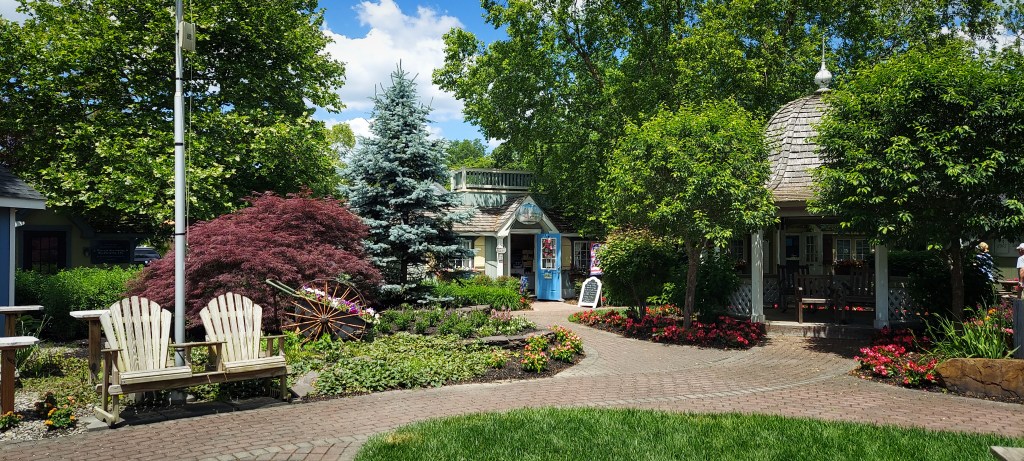
Just look at this idyllic-ass nonsense.
Don’t mind Longcat. He is protecting a stranger’s identity.
I thought it was going to be a couple of strip-mall type shops clustered around a parking lot. I was so wonderfully wrong. It was Woodland Village.
It was like… I don’t know. Little fairy cottages. Pricey goods, but not of the cheap, souvenir variety. All of this stuff was high-end. Handmade art and sculpture. Handmade clothing with vegetable-dyed fabrics. Handmade gemstone jewelry. Fine gemstone specimens. Handmade incense. Upscale men’s clothing. Teas. Perfumes. Spices.
In Red Door Gallery, I wanted to show my Handsome Assistant a pour-over coffee funnel in a beautiful, glazed ceramic. While I reached for it, I clumsily knocked over a small sculpture of a sheep. We thought he was okay, but, sadly, one of his ears was knocked off in the fall.
Obviously, I was going to bring him home and fix him.
Once we’d finished shopping, we brought our purchases (mostly handmade cat toys for the dummy squad back home). I set the small, broken figure on the counter.
“He was a casualty of the fall, but it’s okay. I can repair him. I have the technology.”
“You… really don’t have to do that,” the proprietor said.
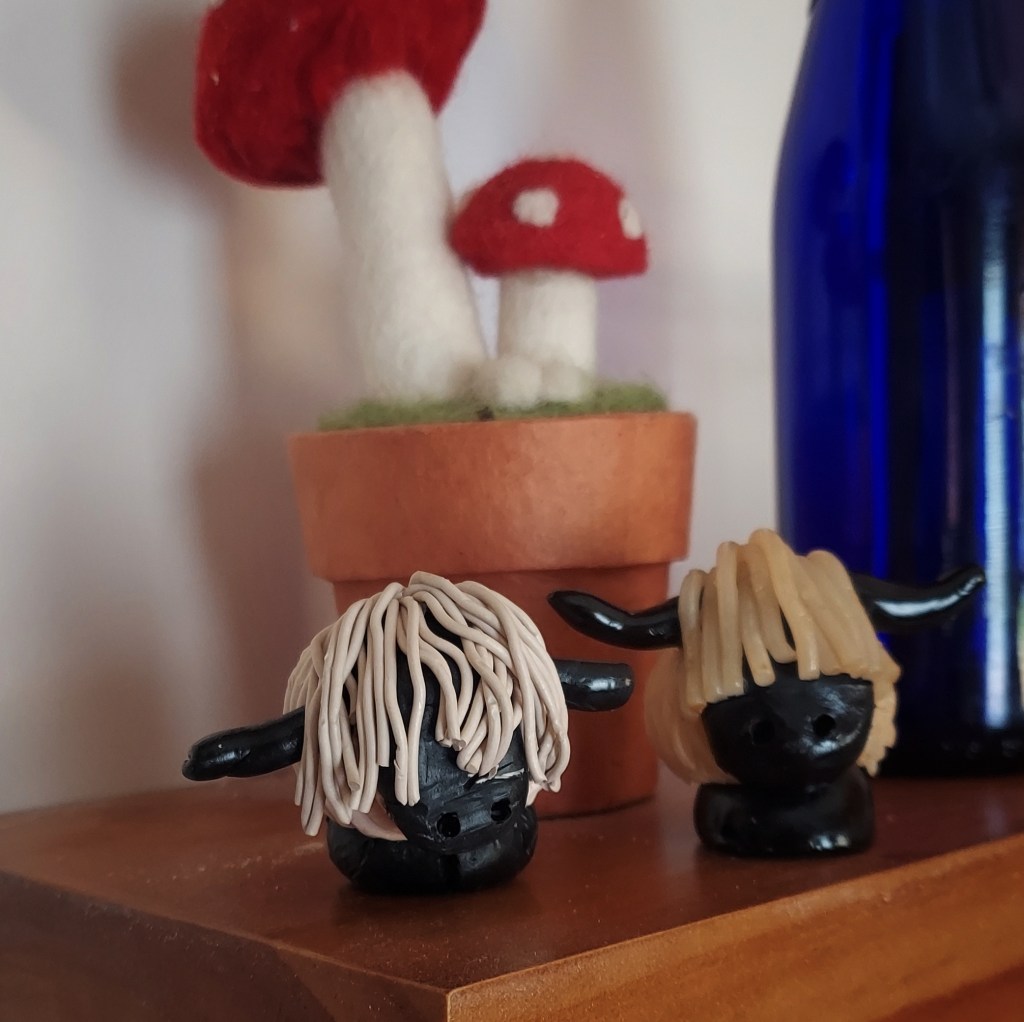
As it turns out, she was the artist who made the little figures. She didn’t want us to buy him just because he was broken, and insisted we pick out a whole one instead. I thought they were cute anyhow, so I did — even though I felt bad about the little sheep with his broken ear.
“Can you fix the broken one?” My Handsome Assistant asked.
“Oh, I don’t know,” she explained. She said she’d likely end up throwing him away.
My Handsome Assistant came over and whispered to me.
“Okay, would you really rather have the broken one, or the other one?”
“I mean… They’re both very cute, but I am going to feel terrible if the broken one ends up in the trash.”
Sure enough, he went back to the cash register and asked if, since the broken one was likely to be tossed anyhow, we could have it.
So, a bit of glue and patience later, I now have two small clay sheep in my kitchen, and a partner who is very understanding of all of my strange bullshit.
We also stopped in Summer Studio Avalon, which I probably could’ve spent all day in. It was just filled with gorgeous, handmade things. (I got a rutilated quartz, moonstone, and pyrite bracelet, some incense, and a pair of flowy teal pants that I am probably going to live in from now on.) There was beautiful embroidery, handmade incense, artwork, accessories, sculptures, crystals, all kinds of the exact sort of things I could happily spend an inordinate of time looking at and/or smelling. The proprietor was also very nice — we got caught up in a conversation about writing things, painting, and the fact that rainbow moonstone isn’t actually a moonstone and is more like a white labradorite.
We also stopped in Northeast Man, mostly for my Handsome Assistant. I found some really nice shirts and a solid cologne (Duke Cannon’s Bourbon, which he bought and I have been sneaking from him because it smells excellent and is the exact way I want to smell forever), but everything fit me in a less “mysteriously androgynous” way and more in a “fourth grader wearing their dad’s shirt” way. Most of the things there weren’t quite my Handsome Assistant’s aesthetic — more “Boat Dad” than “Office Druid” — but there were some really nice, high-quality pieces that suited him very well.
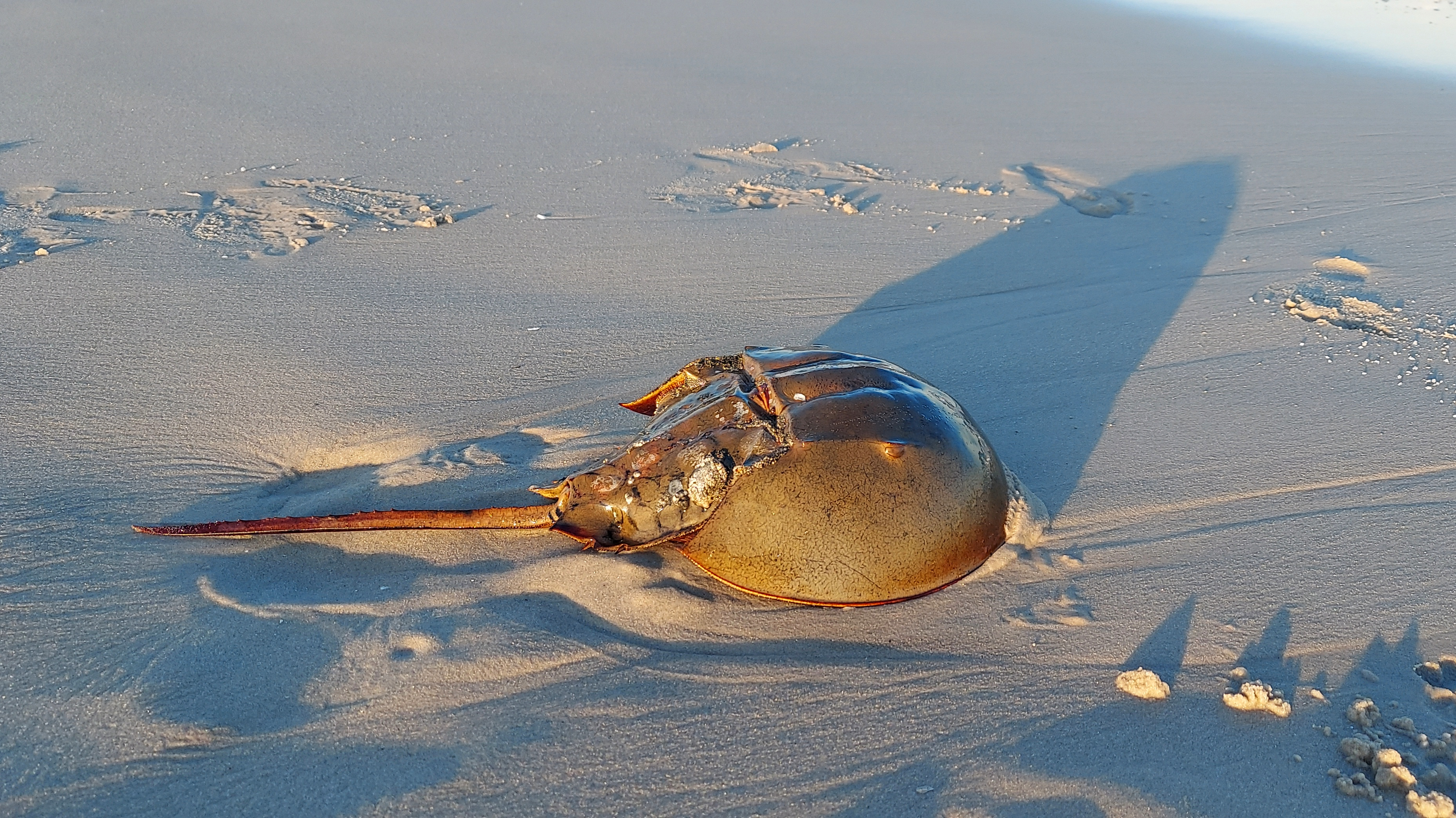
Since the Angel of the Sea is about a half a block from the ocean, we spent some time doing sunset beach walks. The weather was gorgeous, and the slanting golden light made the crests of the waves seem to glow. We also came upon a very large (and extremely deceased) horseshoe crab, which my Handsome Assistant had never encountered before. (He’s from a landlocked state, so his experience with wild marine life is somewhat limited.)
We also kept an eye out for trash, like we always do. There really wasn’t much — I think we picked up two cellophane wrappers and a water bottle, all told. It was very clean, especially compared to some beaches and hiking trails we’ve been on.
Fortunately for my Handsome Assistant, we did stop at the Nature Center of Cape May. We watched gulls and ospreys overhead, listened to the songbirds on the balcony, and admired the large, live horseshoe crabs in the marine lab.
Am I disappointed that we didn’t find any ghosts ourselves? Not really. It would’ve been interesting, but I’m fully satisfied with the experience that we had. Even during the tail end of its “off” season, Cape May was a lot of fun. Woodland Village was great, the abundance of antique stores (and antique store ghost stories) was awesome, the food was fantastic, and the beach was beautiful.
(There isn’t really a long or terribly interesting story there, and it’s one that sadly seems to be all too common: I was tired of being smacked around and humiliated, I knew nobody around me was going to put a stop to it, so I did it myself. Fin.)
Rather than dedicating this post to practices to help heal from damaged or diseased familial relationships, this is for people who have had to come to the realization that they weren’t taught how to thrive and had to re-learn and re-parent themselves. Sometimes, people don’t seem to recognize that they aren’t just keeping little extensions of themselves — they’re raising future adults who will have to function in the world on their own. From seeing how other kids my aged lived, and what their families were like, I learned that things weren’t normal in mine.
Once I was on my own, I had to un-learn and re-learn everything. Nutrition. Cooking. Hygiene. How to relate to people different from me. How to recognize and recover from religious abuse. It was a lot, and I screwed (and still screw) up regularly.
So, if you’re a grown-up kid who’s also had to go back, undo the damage that was done to you, and re-learn how to live in ways that aren’t completely karked, this is for you. Chances are you’ve messed up time and again in the re-learning process, but that’s normal. The important thing is to not give up. No matter how old you are, it’s never too late for you to become the person you’ve always wanted to be.
This is a simple, but very tasty, recipe for rose petal confiture. Don’t be intimidated — it’s really very easy, it just looks and tastes fancy. To be honest, the hardest part is sourcing enough rose petals. (You’ll want ones that aren’t sprayed with anything or treated with systemic pesticides. I grew these myself, picked, and cleaned them right before cooking.)
Pictured on a slice of fresh-baked einkorn bread.
Roses are an excellent herb for a variety of purposes, but they’re most commonly associated with love in all its forms. Visualize what life could be like if you were able to forgive yourself for whatever mistakes you’ve made in the re-learning process, and parent yourself the way that younger you needed. Infuse the preserves with this self-love as you stir them (clockwise, using your dominant hand). Eat them on bread, ice cream, yogurt, or fresh fruit.
Rose Petal Confiture
Ingredients:
2 cups of rose petals. Stronger-fragranced roses have a stronger flavor. For this, I used native Virginia rose petals.
1 cup of water.
1 cup of sugar.
2 tablespoons of lemon juice.
A clean jar with a tight-fitting lid.
If you like, you can also add a bit of fruit to the preserves. I had an extra handful of strawberries, so I chopped them up and tossed them in, too.
Directions:
In a medium saucepan, combine sugar, water, and lemon juice. Bring to a boil, stirring constantly, until the sugar dissolves.
Add the rose petals. Lower the heat to a simmer.
Continue to cook, stirring frequently, until the rose petals release their color into the surrounding liquid and turn kind of pale and translucent and the syrup thickens a bit. (This’ll take about 20-30 minutes.) It won’t gel the way that fruit jellies or jams do and will maintain a somewhat syrupy consistency. That’s okay!
Remove from heat and immediately pour into the jar. Put the lid on tightly.
Keep the finished preserves in your refrigerator. They’ll keep for about a month but will probably get eaten long before then!
Remember when I said I couldn’t maypole dance because my ankle’s still janky (a jankle, if you will) and so I had to pick my battles? This is what I meant.
Sunday, my Handsome Assistant and I got to see Korpiklaani. They were part of a lineup of bands that were mostly symphonic metal — Foretoken, a local band from Virginia; Illumishade, formed by some members of Eluveitie; and Visions of Atlantis, which I wasn’t familiar with but, if I had to describe them, I’d probably say “what would happen if Nightwish got really into seafaring.”
Also, also, also! As we were pulling up to the parking garage, we passed within a few feet of Jonne Järvelä. I waved and smiled, he waved and smiled back, I had an embarrassing fan nerd moment in the car in front of my Handsome Assistant, it was rad. (I didn’t stop, get out of the car, or try to actually talk to him or anything, of course. Man was taking a break, and I definitely didn’t want to be rude or make a nuisance of myself. It was just a brief gesture of, “Hello! I am super excited about what you are about to do,” and it was cool to get a smile and wave back.)
The show started on time, which kind of amazed me. I don’t think I’ve ever been to a concert that actually started when it said it was going to before. There wasn’t a lot of downtime between bands, either.
All of the bands were enjoyable — Visions of Atlantis, in particular, was a lot of fun — but Korpiklaani brought the house down. Since my motion was somewhat limited and it’s still a bit challenging to put weight on my ankle for too long, I had to stay by the railing. Even so, I danced enough that I accidentally butt-donated (or, I guess, leg-donated) to the Share the Meal app. Multiple times. With a working ankle, I probably could’ve solved world hunger and gone devastatingly and irreversibly into debt. My Handsome Assistant, on the other hand, went into the pit to dance.
There wasn’t a lot of banter or downtime between songs. As soon as Korpiklaani got on stage, they kept the energy up the whole time. It was sometimes hard to hear Jonne Järvelä singing, but I think this was a mic issue and it wasn’t exclusive to them.
Honestly, this was one of my bucket list items. I’ve got a pretty long list of bands that I need to see either before I die, or they stop touring. Korpiklaani absolutely lived up to and surpassed my expectations. I had a fantastic time.
Some kind soul has also made a Spotify playlist of Korpiklaani’s setlist, if you’d like to know it. I’ve been listening to it pretty much on repeat ever since.
If you get the chance to see them live, do it. It’s absolutely worth it.
Yesterday marked the average last frost date for my area (as calculated by the National Arboretum in DC). If you’re like me, you’re probably itching to get your garden started, or at least reclaim some desk space by moving your indoor plants outside for a little bit.
I’ve seen a lot of posts about using crystals and other minerals to help plants. You’ve probably seen the same kind of advice that I have — tuck a quartz point in with your plants to help them grow. Bury four green jades, one at each corner of your garden, to protect your plants and help them flourish.
This got me thinking: What are the absolute worst crystals you could conceivably use for your plants? If some crystals can help, it stands to reason that others can hurt. And hoo boy, can they ever.
While there aren’t many crystals whose metaphysical properties would cause problems in this context, there are definitely plenty that can harm your plants. Or ruin your life. Either or.
1. Halite
Halite is salt. Like, it’s just rock salt. When people joke about “going to the salt mines,” this is the stuff they’re talking about.
If you’ve ever heard about conquerors razing towns and salting the earth, you probably know that salt and plants don’t mix. (Well, not while they’re growing, anyway. Once harvested, washed, and lightly steamed, it’s a whole other story.)
The reason behind this is that plants’ roots take up water and dissolved nutrients through osmosis. Osmosis works because nature attempts to establish equilibrium. Things move from areas of high concentration to areas of low concentration, until that equilibrium is achieved. It’s much easier for cell membranes to allow water to pass into and out of the cell than to try to move minerals around, and this works out okay because soil almost always has less dissolved solutes in it than the plants’ cells do. The plants’ roothair cells let more water in, osmosis balances the concentration of solutes vs water on either side of the cell membranes, and everything’s good.
Since salt is very soluble, adding salt and water to soil can make it so that there’s more dissolved solutes in the soil than there are in the roothairs. Taking up more water won’t fix things, and so the roots end up losing water to their surroundings.
Some types of soil (specifically heavy clays) can also form compounds that are impermeable to water when they’re exposed to salt. All plants also depend heavily on soilborne bacteria and fungi, which tend to be much less resilient when exposed to sudden changes in their environment. (Like, say, adding a bunch of salt to it.) Kill off these crucial microorganisms, and the plants will soon follow suit.
2. Selenite or Satin Spar
Selenite, satin spar, and desert roses are all forms of gypsum. Gypsum is a calcium sulfate mineral. It’s also soft and somewhat soluble in water. This means that, when you go to water your plants, you’re likely melting these crystals at the same time. This not only damages the stones, it also deposits all of that calcium sulfate in the soil, altering its pH and potentially negatively impacting plant growth.
Interestingly, gypsum is one of the few materials that exhibits something called “retrograde solubility.” This means that it’s actually more soluble at lower temperatures than it is at higher ones. That’s not great news for anyone who may want to place a selenite specimen in their garden — as soon as a chilly rain hits, they may end up with a disappearing crystal and a whole bunch of dead plants.
3. Calcite
Calcite is a calcium carbonate mineral. It’s not really soluble in regular water, but it is in dilute acids. It’s also pretty soft.
This means that calcite can easily be scratched by other minerals present in soil. Rainwater also tends to be on the acidic side, so placing it in your garden or watering your plants with saved rainwater can cause it to dissolve over time. This will alter the pH and level of solutes in the soil, which can be detrimental to your plants. While that’s less likely to be catastrophic in a whole garden, it can definitely cause problems for the small volume of soil in the average plant pot.
4. Hematite
Hematite is an ore of iron. When it’s found in nature, it often doesn’t look like the smooth, mirrorlike, silvery-black pieces commonly seen in stores. In fact, it usually looks closer to a hunk of vaguely rusty metal. Some massively crystal specimens can exhibit that shiny silver-black appearance, but a lot of inexpensive hematite is rough and rusty and gets polished up before sale.
Hematite is fine to occasionally clean with fresh water, as long as it’s dried soon afterward. It isn’t great to put in with plants or outdoors, though, because this creates the right conditions for it to rust. That’ll damage the stone and leach all kinds of iron oxides into the soil. While natural soil is often pretty high in iron oxides already (like the red clay in my garden), it’s definitely not something you want to introduce if you can avoid it.
5. Pyrite
While hematite is a form of iron oxide, pyrite is an iron sulfide. The concern here isn’t rust, however. The “sulfide” portion of pyrite’s chemical formula is a bigger problem than the “iron” bit.
Pyrite is considered insoluble in water, but there’s a lot more than just water going on where plants grow. When pyrite is exposed to both moisture and oxygen, it oxidizes. This produces iron ions (specifically Fe2+) and sulfuric acid. In fact, the oxidation of pyrite and the resulting acid has been responsible for a number of ecological disasters.
This isn’t to say that putting a piece of tumbled pyrite in your yard is instantly going to turn it into a Superfund site, but it’s still best avoided whenever practicable. At best, you’ll end up with damaged pyrite. At worst, a lot of dead plants and possibly a stern letter from the city.
6. Cinnabar
Okay, so. Cinnabar is divisive. On one hand, some mineral enthusiasts act like it might as well be plutonium. On the other, some claim it’s absolutely no big deal.
Here’s the thing: Cinnabar is an ore of mercury, and mercury is toxic. However, mercury is at its least toxic when it’s in its elemental (aka, scoodly silver liquid) form. Metallic mercury isn’t all that well absorbed through your skin during brief, incidental contact — it’s much more dangerous when it’s in its organic form, or as a salt. This is not to say that cinnabar or mercury is safe to handle, I just want to avoid engaging in too much hyperbole.
Mercury vapor, on the other hand, can be readily absorbed by lung tissue. While it takes temperatures of about 674 °F (357 °C) to boil mercury, mercury doesn’t need to boil to evaporate and contaminate the air. Even just breaking an old fashioned thermometer can contaminate indoor air for a significant amount of time if it isn’t appropriately cleaned up.
While it’s true that cinnabar is traditionally roasted to liberate liquid mercury, some specimens do exhibit beads of pure mercury on their surfaces.
Anyhow, all of this is to say that the question of “how safe is cinnabar for plants” is too complicated for me to say that it’s safe. Cinnabar was used as a decoration (and even cosmetic) in antiquity, but buildings also weren’t nearly as air-tight as they are now. (Also, a lot of people lost their minds, went into convulsions, and died back then, while doctors blamed things like “eating cherries and milk,” “riding too fast,” and “wearing lace.”)
In the interest of safety, maybe just keep cinnabar away from heat, water, soil, your plants, your lungs, small children, et cetera. It might be safe, but it might not, and you might not find out how unsafe until it’s too late.
7. Quartz spheres
“But J,” you might be saying, “Everything says that quartz is perfectly safe in water. It’s not going to dissolve, leach anything weird, kill my plants, or turn my yard into an acidic death pit. What gives?” And you’re absolutely right!
The issue here isn’t so much the quartz itself as it is the refractive quality of crystal spheres. If the sun hits a clear glass or crystal sphere in just the right way, it can produce an effect similar to the sun shining through a magnifying glass. Crystal spheres have the ability to concentrate sunlight into a laser, and this laser can burn stuff.
So, while other crystals are mostly a problem if they get wet, crystal spheres are a problem if they’re sitting in a window. Like, say, where one might place a sun-loving potted plant.
This issue doesn’t just end at your front door, either. While I haven’t read reports of crystal balls starting fires when placed outdoors, the combination of intense sunlight, dry vegetation, and a clear sphere can definitely cause some trouble. If you have vinyl siding, the reflection of the sun just off of a neighbor’s windows can be enough to damage your home’s exterior.
What can you use instead?
Assuming you’re not in the mood to ruin your horticulture (or your life) with an ill-placed stone, the solution is pretty easy.
You can opt for different crystals instead. Any variety of silica-based mineral will work, as long as it isn’t able to concentrate sunlight. Moss agate, while not a “true” agate, is a lovely green type of cryptocrystalline silica. Jades are silicates, too.
For stones that shouldn’t get wet, like your gypsums and sulfides and such, you can always place them near indoor plants. Just avoid putting them in places where they’ll come in contact with water or the soil.
For quartz spheres, it’s best to keep them covered when they aren’t actively in use. (That’s a big part of where the custom of covering one’s scrying ball comes from.) If you have to put them in with your plants, either bury them entirely in soil or place them in a small, opaque bag first. Just keep them out of the sunlight.
That’s pretty much it. Do your homework on the chemical composition of your crystals, avoid stones that will actively turn into acid or poison when exposed to water, and be careful with the ones that’ll burn your house down. Happy growing!
As the weather warms up, the crows come back in force. They distribute themselves around the perimeter of their territory, sending a single “caw” in a kind of relay. As far as I can tell, it seems to mean, “Hi, I’m a bird! Status update: Still a bird!”
This single “caw” is passed from sentry to sentry until something happens to disrupt it. That could be a cat, an owl, a snake, or the sudden appearance of a quantity of snacks.
One of these sentries is positioned in the big maple tree in the back yard. As far as I can tell, he has exactly one mission: Keep tabs on my comings and goings.
I know this because I hear his single cries throughout the day, echoed by the equally single cries of his family group. As soon as I show up on the back deck, that single “caw” turns into a rapid series of calls. If I start putting out the crow salad, the shouts get even faster and more high-pitched. By the time I turn around to go back inside, the apple trees and the roof are full of black shapes.
Pardon the raindrops on the window pane.
Sometimes, they don’t even wait for me to go all the way inside before they swoop in and start eating. If they’re particularly feisty, they’ll barely hop away when I go out to refill. This seems to be out of a sense of avian practicality, rather than fear — it really seems like they fly up to the roofs to wait in order to be out of the way, not because they’re genuinely wary of me anymore.
I’ve found a mix of food that doesn’t seem to appeal much to other bird species, so this family can feed safely without concerns about being hassled or coming into contact with pathogens from unrelated birds that might otherwise swarm the feeder.
I can’t be positive, but I’m also reasonably certain that this sentry is the same li’l nerd who came and stared in my bathroom window after my Handsome Assistant and I returned from being out of town for a few days.
I can’t overstate how helpful they’ve been to have around — they deal with nuisance animals, and I’ve gotten a ton of free garden plants from them (and one small bouncy ball). I love this band of weirdos so much. It always makes me so happy to see them.
Hello! It’s Tuesday. It’s also the Equinox, Alban Eilir, or, in some traditions, Ostara. (Unless you’re in the southern hemisphere, in which case: Happy Mabon!) This is essentially the second part of the celebrations of spring: Imbolc, the Equinox, and Beltane. If Imbolc is when spring wakes up, the Equinox is when it really gets going, and Beltane is the height of its strength.
Since it’s Tuesday, our celebrations this year are small. There’s a bigger ritual and feast planned for this weekend, but this weekend’s also likely to be very cold and rainy. Appropriate for early spring, but it does nonetheless put a damper on being outside. (⍩)
As you read this, my Handsome Assistant and I will be replanting a rose bush. It’s a lovely bush with bright pink flowers, and I pruned it quite a bit to get rid of the crossed branches and dead wood. We’re moving it to the back yard, between the raspberries and the Carolina allspice sapling. That area gets tons of sun and, since the yard is essentially a hill, could use more plants to help absorb rainfall and keep everything in place.
I’m also planting some arugula and extra peas in the raised vegetable bed. I planted plenty of peas in containers, and they’re growing well already, but I’ve still got lots to use! The arugula came as a gift from an Etsy seller, secreted away inside a package with a beautiful vintage linen shirt. (This is part of why I love Etsy and indie sellers in general — I can’t tell you how many times I’ve gotten vegetable seeds, small crystals, stickers, or other fun things with orders.)
We’re also sifting through compost. Our tumbler is black and in a sunny area, so, between the solar radiation outside and the heat of biological activity inside, it fortunately manages to stay plenty warm all year round. It’s a good time to sort through, separate the finished compost from the still-composting scraps, and put it away for use in the near future.
Otherwise, it’s time to air out the house some more, bring in fresh spring flowers, give all of the windows and linens a good wash, and use up the last of the food that was stored for winter.
This year, I’d like to honor Fliodhais. She’s an Irish Goddess of cattle and fertility, though, in the recent past, she was mistaken for a forest deity as well. I don’t have cattle, and I don’t drink milk, but some fertility could certainly help my garden right now. I’d also love to see the crows and other birds bring their babies back! There’s whiskey in the chalice, seeds for new growth, and blessed incense to release into the air.
Whether you celebrate this High Day or not, it’s hard not to see the way that the land is really reviving herself. Yards are full of spring ephemerals, there are red-breasted robins everywhere, and the shifting angle of the sun brings renewed light and warmth. Happy Equinox!
May the song of this, my blessing, be joined by the chorus of the birds in the sky, May the spring breezes bring peace and balance.























 Marble Crow