Plants and Herbs

Radish Folklore & Magical Properties

We’re fortunate to have a service in our area that delivers goods from the local farmers’ market. Even if we can’t go there ourselves for whatever reason, we can still pick out what we want and get it dropped off for not a whole lot of money. A week’s worth of fruit and vegetables for us is about $40, plus $2-4 for delivery. Pad that out with beans and rice or potatoes, and it’s a good way to have a reasonably healthy, varied, local diet without spending a ton or having to go to the store a bunch. If you have fewer people to feed, a box with five items of your choice is only $25ish. It’s nice.

This week, we’re getting celery, bok choy, apples, tomatoes, kale, fennel, and a ton of radishes. Why so many radishes? ‘Tis the season! They’re cool weather plants that mature in a short time, so there’s always a bunch available in spring and autumn.

Radishes originated in China and entered the historical record in the 3rd century BCE, and spread across Europe from there. They were also one of the first plants introduced to the Americas by European colonizers.
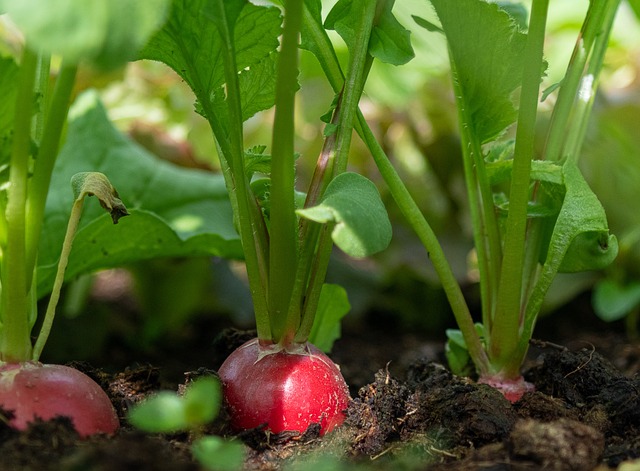
A close up of some radishes, still in the soil. The tops of the round, red roots are visible just above the soil line.

In antiquity, opinions on radishes were divided. Pliny and Discorides prized them, while Hippocrates claimed that they were “vicious” and difficult to digest.

To be fair, radishes are cruciferous vegetables. This puts them in the same group as plants like kale, mustard, cauliflower, and broccoli. They’re not the easiest things in the world to digest and are notorious for causing gas.

Radishes were offered to Apollo, but not just any radishes. It was customary to present gifts to deities in the form of intricate carvings. Radishes were so prized, Apollo received ones made of solid gold.

In Oaxaca, Mexico, people observe the Night of the Radishes. Artists compete by creating intricate sculptures carved entirely from radishes. These aren’t the typical small, round guys you see in the grocery store, however — they’re a specially grown variety cultivated specifically for this festival.

An old folk remedy for nagging and gossip involved tasting a radish before bed while fasting. This was said to protect men from being harmed by “the chatter of women.”

One old English book says that uprooting a radish while reciting the proper incantations would allow one to find witches. (Unfortunately, the author didn’t write down the incantations.)

Radishes are also associated with lust spells and protection. This makes sense, considering their peppery heat and red color. Both of these qualities are associated with sexual desire and protection and can be seen across many magical ingredients used for these purposes.

Wearing a garland of radish flowers around one’s neck was said to keep demons at bay.

The juice and oil of radishes were also considered protective and curative. Washing one’s hands in radish juice was said to enable one to safely handle venomous creatures. Another source claimed that dipping a whole radish in a glass of poison would render the poison safe to drink.
(Do not do any of these things pls.)

In Germany, radishes were associated with evil spirits. Well, one specific evil spirit: the demon Rübezahl. He is a mountain spirit who is often portrayed as a trickster figure. On one hand, he could help humans and teach them the secrets of medicine. On the other, he represents the capriciousness of the weather of the mountains. In Czech fairytales, Rübezahl (called Krakonoš) gave humans sourdough.

It’s also said that he was fond of taking whatever he pleased without asking. He kidnapped a princess who was very fond of radishes (in some versions, turnips) and locked her away in a tower. When the princess began to wither away from loneliness, the spirit turned a radish into a cricket. He warned her that, once the leaves of the radish began to wither, the cricket would die. The clever princess sent the cricket off to find her true love and bring him back to rescue her. Sadly, the radishes withered and the cricket died before he could, but he succeeded in chirping his tale to all of the other crickets in the world. Now, whenever you hear crickets chip, you hear them tell the tale of Rübezahl and the stolen princess.

It should be noted that Rübezahl is actually a mocking nickname — it’s more respectful to refer to him as Lord of the Mountains, Herr Johannes, or Treasure Keeper.

As a common culinary ingredient, radishes are pretty easy to use. Combine them in a salad with other ingredients that relate to your intention, and enjoy. Radishes, strawberries, and basil can be eaten (or fed to a consenting lover) for lust. Radishes, lettuce, oregano, and garlic can be eaten for protection. Radish greens are edible, too!

A bunch of red radishes on a cutting board, tied together with red and white string.

For best results, stick with young radishes. The older they get, the tougher and more difficult to digest they become.

Since radishes are a cool weather crop, they’re a good choice for off-season growth spells. For example, if you want to bring more love and lust into your life but it isn’t exactly growing season, you may still be able to get decent results by sowing radish seeds.

Since flowering radish tops repel evil, you may wish to include these plants in beds near your front, back, and side doors. Let them flower and keep your home protected from malevolent spirits.

Radishes are a fun, easy to grow, easy to use ingredient in food and spells alike. I remember growing some in a tiny plastic vegetable garden kit that came from McDonald’s when I was very little, and I’ve kind of had a soft spot for them ever since. If you have any space to dedicate to these little guys, give them a shot!
Plants and Herbs

Rosehip Folklore & Magical Properties

Roses (t least in their wild form) are fruit-bearing plants. These fruits, called rosehips or rose haws, are bright red, berrylike fruits that serve as a source of food for wildlife and people alike through the autumn and winter months. They’re high in vitamin C, and are frequently used in everything from supplements, to teas, to jellies, to skincare products.

They’re best harvested right after the first frost, when the fruits are bright red and slightly soft. That’s actually what prompted me to write this post — see, our first frost date is supposed to be in the middle of October. As of this writing, next weekend is supposed to be in the 80s. According to the National Weather Service, we’re not actually going to get frosty temperatures until the middle of freaking November. I could harvest the fruits anyhow and mimic the action of a frost by popping them in the freezer for a few hours, but still. 80 degrees.

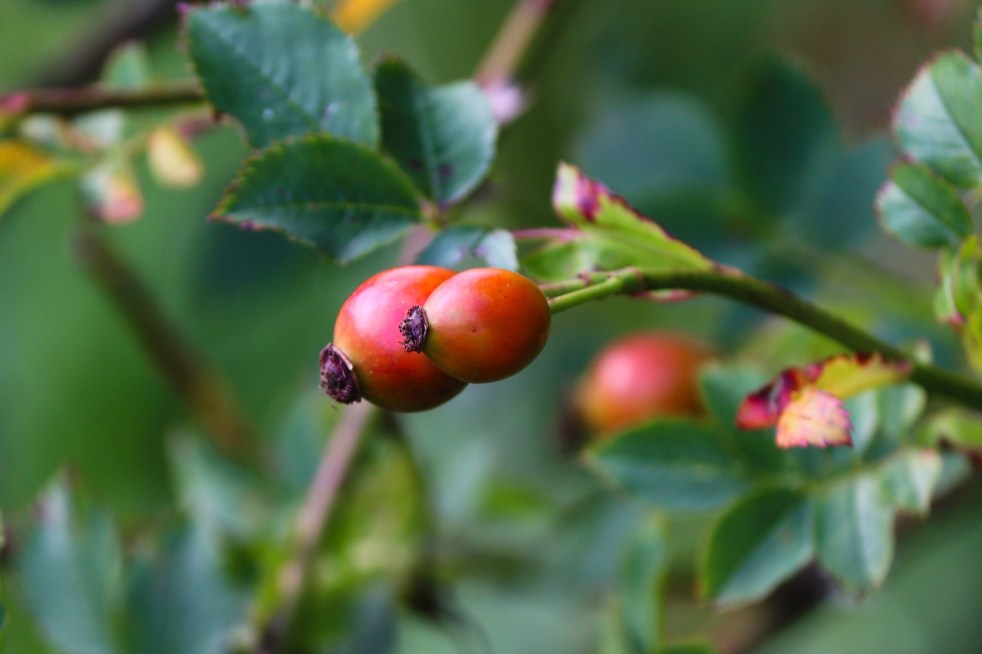
Some bright red, round rosehips on the plant.

(Side note, my Handsome Assistant and I were planning on taking a very off-season vacation on the beach. We weren’t planning on trying to swim or anything, but we decided to cancel anyway since it’d likely be too chilly to do much but hole up. Go figure!)

Rosehip Magical Uses and Folklore

Medicinally, rosehips are used for anything that benefits from more vitamin C. They’re boiled into syrup and given for colds, and used in tea over winter (when fresh fruit is in short supply). The fruit is also a mild diuretic that can help with certain urinary disorders, while the seeds, when boiled, may be helpful for symptoms of gout.

The fruit portion of a rosehip forms a kind of capsule around the seeds. These seeds are covered in irritating hairs, which is why it’s important to clean rosehips before using them. These hairs are so irritating, in fact, that they can be used to make itching powder!

Not all roses will form hips. Flat blooms, as opposed to cup or globular blooms, generally have the easiest time doing so. The reason for this is simple: cup and globular blooms are bred for show, and have masses of petals that cover their stamens and pistils. Since pollination is necessary for fruit production, bees need to be able to get in there to pollinate. This is easy for them with flat blooms, and next to impossible with more complex shapes. Deadheaded roses also won’t produce hips, since the portion that would become the hip gets cut off in the process.

Rosehips are useful for all of the same things that roses are. They shine in love and beauty magic (due, in part, to their vitamin C content). Used in ritual baths or to infuse oils, they can have a brightening effect on the skin.

Some more rosehips. These are still very green and not yet ripe.

Rosehips are also used in spells for good luck and prosperity.

To banish nightmares, place some rosehips under your pillow. You might want to use dried hips for this, since fresh ones could end up leaving you with a sticky, squishy, unpleasant surprise in the morning!

Since rosehips house rose seeds, they’re a good general addition to spells to increase anything. All seeds have immense potential and are used in magic for growth, so you can include rosehips in any spell to increase love (including self-love), money, luck, you name it.

Using Rosehips

To use fresh rosehips, wash them well, slice them open, and remove the seeds and hairs with a spoon. You can then dry them, make them into jelly, or eat them fresh. Dried hips from the store are good to go as they are.

Add fresh or dried hips to magical teas or other recipes. They have a tart flavor that pairs well with lots of drinks and dishes. Stir with your dominant hand as you cook, and intentionally infuse the mixture with the energy that you want to attract or increase.

To keep nightmares at bay, include dried hips in a dream pillow. Lavender, lemon balm, and rosemary also work very well here.

Dried rosehips (and rose seeds) are great additions to spell jars. As I mentioned above, they bring extra energy to increase whatever it is you’re looking to grow or attract.

On the other hand, the irritating hairs around rose seeds are good for protection or banishing spells. Add them to powders to keep unwanted people or spirits at bay. Sprinkle them under your doormat and instruct them to annoy anything and anyone who shouldn’t be at your door.

Rosehips are as useful as they are beautiful. If you have garden space, I highly recommend planting some wild type roses to help feed birds and other animals (and provide you with lots of powerful magical ingredients). If you don’t, keep your eyes peeled when you’re out and about — you may just find some wild roses with plenty of hips to share.

Plants and Herbs

Maple Folklore & Magical Properties

This past weekend, my Handsome Assistant and I took a small drive down Falls Road (alias Scenic Route 25). This was recently dubbed the second-best route in the country for seeing fall colors, and, while the leaves haven’t quite reached their peak just yet, it was a really lovely drive.

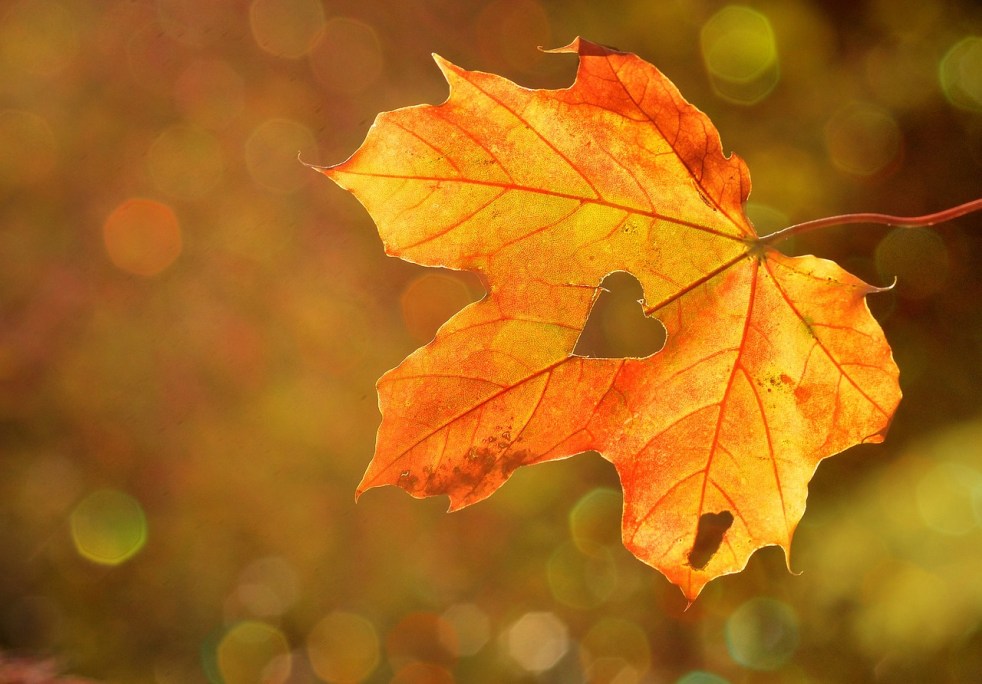
Red maples (Acer rubrum) are one of my favorite trees to see in autumn, and I’m lucky to share a home with one. Their leaves turn a vibrant scarlet every autumn, hence the name.

Bright red maple leaves on a branch.

Honestly, I just love maples in general. As a little kid, I used to pick up their samaras (we called them “pollynoses”) from the sidewalk, open the seed capsules, and stick them on the end of my nose. I bake primarily with maple syrup. I’m trying to convince my Handsome Assistant to make his next back of mead a batch of acerglyn (a similar beverage made of half honey, half maple syrup) instead.

I probably don’t need to say that trees have featured prominently in Pagan practices probably ever since the first Pagan. Each one has its own traits and associations, and, when it comes to working with the wood, leaves, or fruits, its own magical properties.

To be honest, maples were so ubiquitous where I grew up that I didn’t know they weren’t more widely harvested from. When I was thirteen, I was a foreign exchange student, which resulted in a brief stay in the Netherlands before going to Sweden. My student group (jetlagged and exhausted) stopped at a cafe on our first day there, where I happily ordered a plate of silver dollar pancakes and syrup.

But it was not syrup.
It was stroop.

Stroop (rhymes with “rope”) is often made of boiled-down fruit, water, and sugar, but can also be made with molasses and brown sugar. While it isn’t bad by any means, the latter variety is kind of an unpleasant surprise when you’re a kid who’s used to maple syrup with pancakes, hates molasses, and also desperately needs a nap. Not knowing any better, I drenched my pancakes in stroop and made myself a very avoidable struggleplate.

Anyway, all of this is to say that maples rock, maple syrup is the food of the Gods and should absolutely never be taken for granted, and I may still carry some molasses-induced trauma.

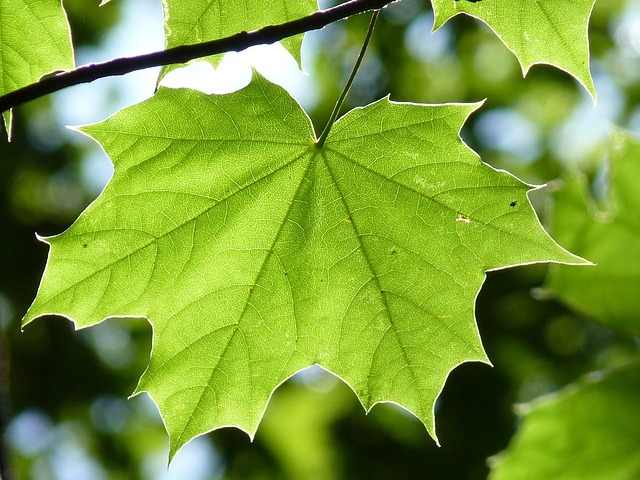
Maple’s genus, Acer, is Latin for “sharp.” This is due to their very unique, pointy leaves.

An Abenaki story tells how maple syrup once flowed freely from trees. It came so easily, people would lay on their backs and just let the syrup run right into their mouths. The legendary figure Glooskap saw how lazy people had become, so he turned the thick, sweet syrup into runny sap. From then on, if people wanted to eat maple syrup, they would have to work for it!

Another story, said to be of Haudenosaunee origin, tells of a man who watched a red squirrel nibble the end of a maple branch. The sap flowed until the sugars dried, hardened, and crystallized. The squirrel then came back to lick the sweet maple sugar.

In European-based magical systems, maple syrup is often used as an ingredient in love spells.

Maple sugar or syrup is also a useful ingredient in sweetening jars.

A bright green maple leaf.

By contrast, maple wood is considered very protective. It was sometimes incorporated into doorframes for this purpose.

Some sources consider maple to be good for prosperity and abundance in general.

As wand wood, maple is known for having a somewhat erratic energy. It also helps dispel negative energy, center oneself, and reveal paths and options one may not have considered.

Maples, particularly silver maple (Acer saccharinum) are considered Moon plants. They’re also associated with the element of Water.

Working with maple can be as simple as using magical tools made from the wood. Every tree — and thus every wood — has its own energy. I haven’t personally found maple to be erratic, but, to be totally honest with you, I’m erratic enough myself. (I think it also helps to have sourced the wood from a tree that I know pretty well!)

If you’re in the eastern US, you’re probably located near a maple tree. If that maple tree is anything like the one here, it probably drops plenty of sticks and smallish branches every time there’s a storm. Should you be of a mind to make your own magical tools, deadfall maple wood is honestly really easy to come by.

I can only vouch for red maple, but, once the bark and cambium are stripped off, the wood itself is light and silky-feeling. Sanded well, it takes on an almost metallic sheen. I love it.

The next easiest way to work with maple is to use maple syrup. You’ll need the real stuff for this, unfortunately — the fake stuff is cheaper, but also doesn’t really bear any resemblance to the genuine article. (There’s a good reason for that, too. Maple sap is chemically very complex, and we still don’t really understand all of the different compounds and reactions that give boiled sap its flavor. That makes it pretty much impossible to make a decent imitation syrup.)

If you’re looking to make a sweetening jar, artificial syrup is probably fine if you can’t get your hands on the real stuff. That said, plain sugar and tap water will make you a perfectly fine simple syrup that’ll a) be cheaper, b) let you add your intention or energy during the syrup-making process, and c) let you bypass the artificial flavors, colors, and other ingredients that don’t really add anything to the magic-making.

Otherwise, add maple syrup to your favorite edible magical recipes. Like I mentioned above, I bake with it almost exclusively — it’s pricey, but I love what it does for the flavor and texture of desserts. Seriously. It makes amazing breads and cakes, and is fantastic in chocolate chip cookies. Add the maple syrup, thank the tree for its sacrifice, tell the syrup what you want it to do for you, and stir your concoction clockwise using your dominant hand. Easy peasy.

Maple samaras (aka, pollynoses) can also be helpful additions to a charm bag. They end up all over the place in late spring to early autumn, so, if there’s a maple anywhere near you, you probably won’t have any trouble finding some. Add them to bags for prosperity, love, or protection.

Plants and Herbs

Pumpkin Folklore & Magical Properties

I mean, this one was pretty much inevitable.

(For a useful companion guide, you may also want to read this bit about nutmeg.)

I was never much of a fan of pumpkins growing up, but my experience with them was also limited to cleaning handfuls of cold, stringy, slimy pumpkin guts out of jack-o-lanterns and eating pasty-textured pumpkin pie from the grocery store. This year was my first experience processing fresh pumpkins, and it’s changed my entire outlook.

For as much work as it is to halve them, remove the prickly stems, clean them out, roast them, and puree them, it’s very well worth it. The flavor of a freshly roasted pumpkin is sweet, almost buttery, and nothing like the canned pumpkin pie filling of my youth. (Which is, let’s be honest, mostly made of other types of squash anyhow.)

As I’ve been gradually processing more of my ludicrous pile of pumpkins, I figured it’d be a good time to write a bit about their magical uses and relevant folklore.

While pumpkins are the predominant produce for jack-o-lanterns in the US, it wasn’t always this way. The original jack-o-lanterns were carved from turnips, and absolutely terrifying. While they’re a lot smaller than your average carving pumpkin, you can fit a ton of unsettling details into a turnip.

Jack-o-lanterns were originally used to keep confused or malevolent spirits at bay during the autumn months. They’re also connected to the Irish tale of Stingy Jack, a drunkard who managed to get himself barred from entering Heaven or Hell, and was thus condemned to roam the Earth with a candle in a turnip to light his way.

A big pumpkin, carved with a big, pale, toothy grin.

While the origins of the poem “Peter, Peter, Pumpkin-Eater” are unclear, it may have some fairly dark origins. One source claims that “Had a wife, and couldn’t keep her” refers to his wife’s infidelity. Putting her “in a pumpkin shell” was a euphemism for using a chastity belt. Another source claims that putting her in a pumpkin shell was intended more literally — Peter murders his wife, and conceals her body in a large pumpkin. The structure and subject matter of the poem hints that it may have come from an older rhyme from Scotland. While this rhyme doesn’t mention pumpkins (since pumpkins are native to the Americas), it does mention a Peter and an unkeepable wife. However, rather than putting her in a pumpkin shell, he lets her be eaten by rodents:

Peter, my neeper

Had a wife

And he couldn’t keep her

He pats her I the way

And lat a’ the mice eat her.

What the fuck, Peter.

Seeds, in general, are considered useful for beginning or attracting new things. Pumpkin seeds, being large, are easy to mark. This means that pumpkin seeds can be ideal components for any spell that involves making positive changes in your life. (As long as those don’t involve banishing things. You’ll probably want to use cloves or garlic for that instead.)

In religions that sprang from the African diaspora, pumpkins are associated with several major deities, particularly Oshun and Shango. Oshun is a goddess of rivers, love, and fertility, which echoes the connections between pumpkins, the element of Water, and the concepts of fertility and abundance as seen in other cultures and traditions.

To some groups indigenous to Mexico, pumpkins were considered a strengthening, fortifying food that increased endurance and protected against cold.

According to a Huron creation story, pumpkins arose when a divine woman died in childbirth. All of the plants necessary for life sprang up from her body: Beans grew from her legs, corn sprang from her body, and pumpkin vines grew from her head.

Pumpkins are associated with the Moon and the element of Water. They’re generally considered symbols of prosperity, protection, and fertility.

Like muscadines, these are one of the easiest magical ingredients to use. They’re edible, so prepare them with intention and the proper techniques, then eat them. Bingo, bango.

To use the seeds, clean them well and dry them thoroughly. Using a fine, non-toxic, felt-tipped pen, write your desires on a pumpkin seed. (You’ll probably only be able to fit a single word, or a symbol. That’s fine!) Seeds represent the power of infinite possibility. You can plant the seed so your luck grows as the pumpkin vine does, set it outside so your wishes may be carried to the divine by birds or squirrels, or cast it into a body of water.

Pumpkins, candles, and a pair of hands holding a deer skull.

Pumpkins are traditionally a good offering to water spirits. Depending on the spirit, however, cutting or cooking the pumpkin first may be taboo.

If you decide to carve a jack-o-lantern, empower it to protect your home from evil. Set one or two as guardians at all of the doors leading into your home.

While there’s a ton of pumpkin scented and flavored things around this time of year, most of them don’t actually contain pumpkin. They’re more likely to be a combination of fragrance oils or artificial flavors. Likewise, pumpkin spice doesn’t contain pumpkin — it’s a blend of spices used in pumpkin dishes, like pies and cakes. This spice blend can be used for its own magical purposes, but it isn’t really the same as actual pumpkin.

I’ve still got a lot of pumpkins to go through, but, according to my Handsome Assistant, I’ve also devised a pumpkin bread recipe that knocks it out of the park. (I’ll post it, it just needs a Mabon feast test drive first!) I’ve got a ton of potlucks with like-minded individuals to attend over the next few months, so I’ll be bringing plenty of prosperity and protection magic with me.

Plants and Herbs

Grape Folklore & Magical Properties

It’s the most wonderful time, of the year.

Okay, so.
There’s a new fruit quest. (If you have been reading here for a while, you might be familiar with the persimmon quest that I force my Handsome Assistant to accompany me on every year.)

A year ago, I tried my first muscadine. It was almost the size of a wild plum, the deep purple of a cloudless night sky, with firm flesh that tasted like a combination of grape jelly and extremely good wine. It was sweet and juicy, in perfect, balanced contrast to the firm, tart, slightly tannin-y skin. I could probably wax rhapsodic about muscadines and scuppernongs for way longer than anyone would be comfortable with.

Muscadines ripening on the vine.

Anyhow, I saw them pop up at the farmer’s market at about $13 a container and was sad to pass them up. Immediately after that, I saw them at Aldi for about $3.69. (Nice.)

Normally, I’d advocate for buying from farmer’s markets versus a supermarket whenever you’re able to. The thing about muscadines is that their range is very limited, so even the grocery store variety has traveled, at max, a few states away. They’re also seasonal, so they’ll disappear from the shelves as soon as their time is up.

This is why the other evening saw me leaving Aldi with arms full of containers of muscadines and scuppernongs (they’re the same species, but scuppernong is usually used for muscadine grapes that are kind of a light bronzy-green in color). I was also quietly singing a little song about how excited I was to have tasty grapes, and possibly skipping. (I am fortunate that my Handsome Assistant seems to find my goofball-ass qualities endearing.)

So, since it’s muscadine season, I figured I’d write a bit about grapes. Muscadines (Vitis rotundifolia) are strictly an American fruit, so they’re another plant you won’t find in old grimoires or European mythology, but that’s okay! They’re a kind of grape (Vitis species), and grapes in general have had a prominent place in myth and magic everywhere they appear.

Grapes figure heavily in Greek and Roman legend. According to the Greeks, the first grapevine came from a satyr named Ampelos. He caught Dionysus’ eye, and the deity romantically pursued him… at least, until Ampelos mocked the Moon Goddess Selene and got himself gored by a bull. Heartbroken, Dionysus transformed Ampelos’ body into the first grapevine.

(According to Ovid, things panned out a bit differently. In this version, grapes already existed, Ampelos fell while picking them, died, and Dionysus transformed him into a constellation.)

In Christian mythology, grapes are associated with abundance. Moses sent spies into Canaan (the “promised land”), who then returned with a cluster of grapes so large, it required two people to lift it.

On the other hand, some scholars claim that the “forbidden fruit” of the Garden of Eden was also a grape, not an apple as it’s commonly portrayed. Other scholars claim it may even have been wheat, so who knows.

Two bunches of grapes. They're a mixture of ripe and unripe fruits, showing shades of deep blue, to purple, to bright green.

In the ogham alphabet, muin, is often said to be a grape vine. However, grapes aren’t native to Ireland (they showed up with the Romans), and tend not to grow well there anyhow. Grapes also don’t really appear in Celtic legends with significance. Etymologically, connecting muin to the word “vine” is also tricky. For this reason, you’ll find a lot of debate about the actual meaning of this fid, as well as what plant it was even meant to represent in the first place. (Probably originally thorny brambles, like blackberries, though this meaning may have shifted over time.)

Grapes and wine are also generally good offerings for a wide variety of spirits and deities.

Vines, in general, are associated with binding. This isn’t necessarily binding in a negative or protective sense — binding can also be used to hold a favorable situation to you.

Elementally, grapes are associated with Earth and Water. They’re also associated with the Moon.

They’re…
They’re grapes.

All kidding aside, grapes are possibly one of the easiest magical plants to use. Eat, brew, or cook with them while visualizing yourself as prosperous and happy.

If you have the space and ability to do it, plant a grape vine in your yard to bring abundance to your home. (This may work even better than intended. Birds love grapes as a source of both energy and water, and tend to excrete more seeds when they hang out to feed. This is how I ended up with free, thriving tomato and mulberry plants, and possibly even the pumpkin vine. Free food!)

Grape vines make fantastic bases for wreaths. I’d like to devote a longer post to making and empowering magical wreaths, but, in short, take a grapevine wreath, add whatever other magical dried plants or curios you like, and hang it where it’ll do the most good. A protective wreath on the front door, for example, one for prosperity in the kitchen, or one for passion or fertility in the bedroom.

Though it also isn’t one of their traditional meanings, I also associate grapes with protection. Dark grapes make red wine, the color of courage, strength, vitality, and protection. The leaves themselves are covered in trichomes, which are small, pointy, hairlike structures. Covering the floor around your bed with grape leaves is said to be a folk remedy to control and protect against crawling pests like bedbugs.

Whether you’re like me (and do a goofy little happy dance when you’ve gotten special grapes) or your feelings about the fruit are more ambivalent, grapes are worth considering for your magical practice. They’re sweet, tasty, easy to use, and pretty straightforward in their properties and associations.

Plants and Herbs

Milkweed Folklore & Magical Properties

I planted a swamp milkweed (Asclepias incarnata) in the back yard not too long ago. Though I did it well after I could hope for monarch butterflies, I still wanted one of these beautiful, interesting native plants. (Besides, they’re perennials — if it could survive this year, there’ll be plenty of plant for the monarch babies next year!)

It was blooming happily, playing host to all kinds of tiny fauna, and finally put out lots of big, fat pods. Apparently it wanted to wait until the recent supermoon to bust those suckers open, because that whole part of the yard is inundated with milkweed fluff!

Flat, brown milkweed seeds, showing their tassels of silky white fluff.

I gathered a good quantity of the fluff and seeds to save, share, and use for various purposes. So, I figured, now’s probably a good time to write about this lovely plant’s magical properties!

Like many of the plants I choose to explore, this one’s native to the Americas. That means that you won’t see it in a lot of older folk or ceremonial magic resources. This plant is still powerful, however, and has a lot to offer practitioners in its native range.

Like I mentioned, milkweed produces tons of fluff. This fluff appears as silky white tassels on its seeds and helps them disperse via wind — just like dandelions. If you catch a floating milkweed seed, make a wish, then release it to go along its merry way, its said that your wish will come true.

Milkweed fluff can also be used as filling for pillows, sachets, and poppets. Thistledown is a traditional poppet filling, but, if you don’t live in an area with abundant thistles, milkweed fluff can be used as a substitute.

Filling a dream pillow with milkweed fluff is said to cause the user to dream of the fae.

The juices of the milkweed plant, when used for anointing, are said to strengthen one’s “third eye.” (However, these juices are also irritating, so maybe just place a whole leaf or sprig of flowers to your forehead instead.)

In World War II, military life jackets were filled with milkweed fluff as an alternative to kapok (Ceiba pentandra).

Milkweed’s genus, Asclepias, was named for Asclepius. He’s the Greek God of Healing, and a son of Apollo.

Though it’s associated with a god of Healing, one of milkweed’s primary virtues is its toxicity. When monarch caterpillars feed on milkweed, they take in the plant’s toxins. This, in turn, makes the vulnerable caterpillars toxic and unpalatable to predators. As a result, milkweed is associated with protection.

A plump, stripey monarch caterpillar.

There’s also a very fine line between “poison” and “medicine.” To the people indigenous to milkweed’s native range, milkweed sap was used to remove warts. Boiling helps leach out the toxins in the plant’s sap, and cleaned up extracts of milkweed proved useful for respiratory ailments, sore throats, and kidney problems. Some of the toxins in milkweed sap are cardiac glycosides, which, in small doses, behave similarly to the digitalin extracted from foxglove (genus Digitalis).

Milkweed is a very liminal plant. Swamp milkweed (A. incarnata) can be found at the edges of wetlands, where the water meets the land. Common milkweed (A. syriaca) often grows in disturbed areas, like roadsides.

Milkweed is associated with the Moon and the element of Earth. (Personally, I also associated swamp milkweed with water.)

Milkweed’s a really lovely plant, though it can also be hazardous to work with if you aren’t careful. Personally, I limit myself to the flowers, fluff, and seeds — I have sensitive skin, and the last thing I want to worry about is getting milkweed sap on myself!

The fluff is really lovely as a filling for poppets and dream pillows. Blend it with herbs like mugwort, hops, and lavender, and add a clear Herkimer quartz crystal for a wonderful dream pillow that’ll help improve dream recall and make it easier to dream lucidly.

The seeds, like a lot of native American seeds, need to be stratified. That means that they’re great to use for sowing rituals during the colder months — the winter solstice, for example.

Seeds are a great spell component in general, because they embody as-yet-unrealized potential. They’re a bit of sympathetic magic, too. As the seed grows, so will the thing you hope to get from your spell.

Milkweed seeds are also flat, so they’re nice to incorporate into homemade paper. Once the paper’s used, you can plant it and allow the seeds to grow. Just make sure that you’re using varieties native to your area!

The pink flower clusters of A. incarnata.

Milkweed is a beautiful, protective plant that has much to offer those who can get past its defense mechanisms. Inside those pods, protected by poisonous, milky-white sap, is an abundance of silky, silvery fluff and seeds. If you have the ability to grow or otherwise hang out with milkweed, I highly recommend it.

Plants and Herbs

I decided to eat the anise hyssop (and here’s a really tasty recipe).

Not too long ago, I wrote a bit about the magical properties of hyssop. The thing that prompted me to do this was the ludicrous abundance of anise hyssop blooms (and also bees, moths, and butterflies) in the little pollinator garden in the front yard.

Anise hyssop and regular hyssop aren’t related, though. Anise hyssop, also called anise mint, is a member of the mint family. It’s called “anise hyssop” because the leaves and flowers have an anise-like scent and flavor — though I think it’s more reminiscent of root beer!

Anyhow, since some of the anise hyssop was getting tall enough to block the coreopsis and beautyberry, I figured I’d go harvest some. Sickle in hand, I shooed the bees to the other anise hyssop plants and got cutting. I also cut a few lavender flowers that were growing at odd angles.

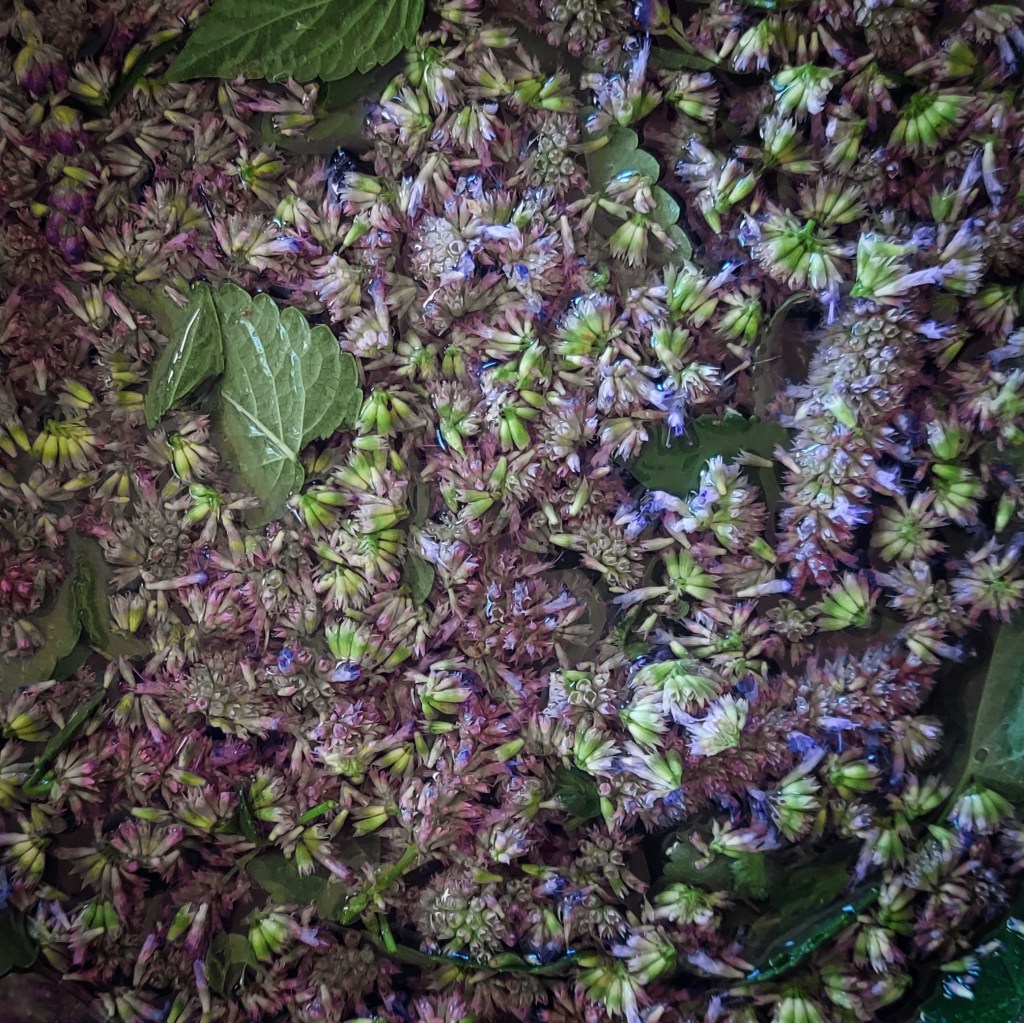
From there, I separated the good leaves from the wilted or damaged ones, and removed the flower heads. I gave everything a good wash, then boiled it in equal parts sugar and water to make a lovely, herb-infused simple syrup.

A bowl of small, bright purple flowers and green leaves soaking in water.

Once the syrup was made, I strained out the plant matter and spread it on a bit of parchment paper in my dehydrator. After an hour and a half at 165 degrees F, once everything was dried to a crisp, I was left with some lovely candied flowers that do, in fact, taste exactly like root beer.

Anise hyssop is used as a carminative and expectorant, and is very soothing. I don’t really need an expectorant right now, but I plan to use the flowers and syrup to ease digestive complaints. The only thing is, I don’t really need that much. So what do I do when I’ve got way more delicious candied flowers than I need?

I make scones.

These are easy, nut-, egg-, and dairy-free, and delicious. They only require one bowl and about half an hour of your time.

Dry Ingredients:

  • 2 cups of flour (I used einkorn, but regular wheat flour is fine)
  • 1/2 cup sugar
  • 1 tablespoon flaxseed meal
  • 2 teaspoons baking powder
  • 1/2 cup cold vegan butter or coconut oil
  • 1 handful fresh anise hyssop flowers
  • 1 generous cup of blackberries (depending on their size, you may want to cut them into smaller pieces)

Wet ingredients:

  • 1/2 cup milk substitute of your choice (I used pea milk)
  • 1 teaspoon of vanilla extract

Tools:

  • A nice big mixing bowl
  • A spoon
  • A whisk or fork
  • A pastry cutter or fork (optional)
  • Measuring cups and spoons
  • A baking sheet
  • A sharp knife

Making the Scones

  1. Preheat your oven to 400 degrees F.
  2. Place the sugar and fresh anise hyssop flowers in your mixing bowl.
  3. Rub them together with your hands, until the flowers are mashed with the sugar and the mixture resembles moist sand.
  4. Add the flour, flaxseed meal, and baking powder. Whisk together until well mixed.
  5. Add the cold butter substitute or coconut oil. (You might want to do this in cubes or spoonfuls, it’ll make the next bit easier.) Use a fork, pastry cutter, or just your hands to work the fat into the dry ingredients. Keep at it until the mixture looks like coarse crumbs.
  6. Measure out a half cup of milk substitute. Add the vanilla extract to the milk and stir.
  7. Pour your milk into the mixing bowl. Stir until it’s just combined — avoid over stirring. If it seems too dry to hold together, add another tablespoon or two of milk.
  8. Fold in your blackberries.
  9. With floured hands, lightly knead the dough until it all comes together. Visualize yourself kneading health, love, and prosperity into the dough.
  10. Turn the dough out onto a floured surface. Form it into a ball, and pat it out into a flat circle roughly an inch thick.
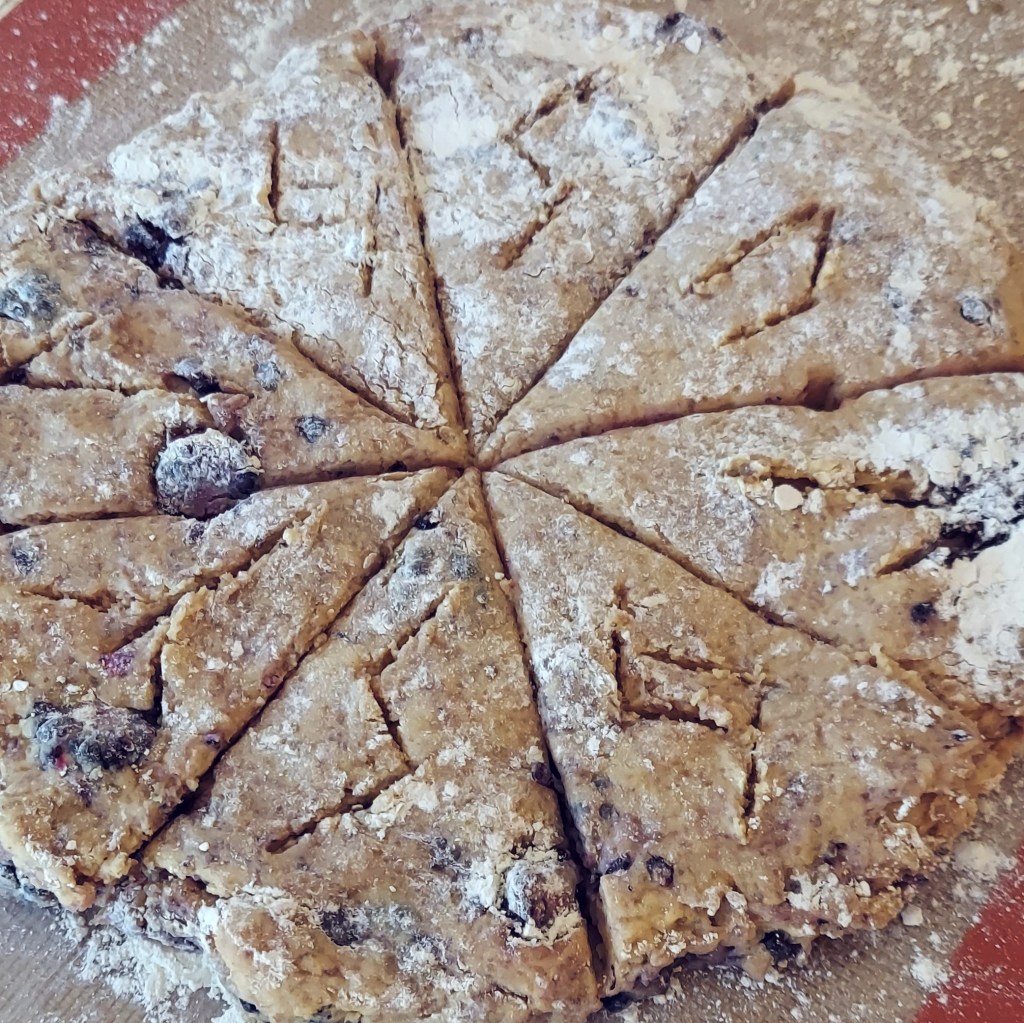
  11. Slice it into triangles. If you like, you can use a toothpick or the tip of a knife to carve the tops with runes, sigils, ogham feda, or other symbols significant to you.
  12. Place the triangles on a baking sheet. Bake for about 25 minutes, or until they’re golden brown.
Unbaked blackberry scone dough, formed into a circle, cut into triangles, and inscribed with the runes jera, sowilo, teiwaz, uruz, algiz, and laguz.

Making Them Extra Fancy

If you like, you can also ice your scones. Mix up a cup of confectioner’s sugar, two tablespoons of milk substitute, and, if you like, some finely crumbled candied anise hyssop leaves and flowers. Stir well until the mixture is smooth and liquid. If it seems too thick, add some more milk substitute. If it’s too thin, add more sugar.

Once your scones are cool (give them about 20 minutes), drizzle the icing on with a spoon. Give the icing a few minutes to harden, then serve.

A baked scone, inscribed with the rune uruz and covered with a sweet glaze.
Plants and Herbs

Passionflower Folklore and Magical Properties

As we kill off our grass, we’re working hard to replace it with plants that serve multiple purposes. Ideally, they should be native (or at least semi-local), attract pollinators, provide food for both humans and animals, and either return or self-seed. One of the plants that passed muster is this area’s native species of passionflower, Passiflora incarnata.

Also known as maypop, true passionflower, purple passionflower, and wild apricot, P. incarnata is a really pretty, fast-growing vine that provides both wild-looking purplish blue flowers and edible fruits. The flowers don’t last long, but they’re very striking!

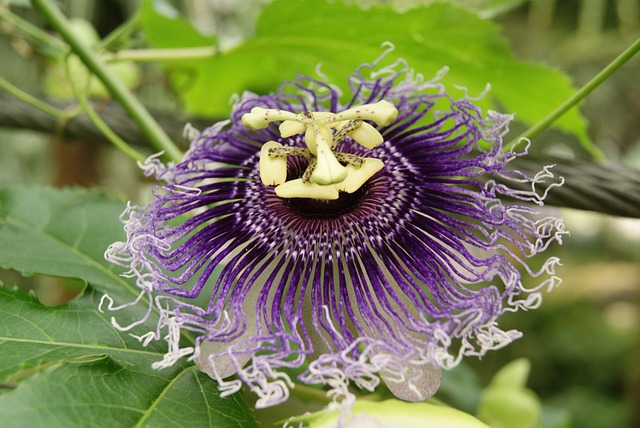
A fringy, bright purple Passiflora incarnata flower.
A flower of P. incarnata.

Unfortunately for me, I didn’t heed the old adage, “the first year they sleep, the second year they creep, the third year they leap.” As a result, I planted way too many passion vines. They’re going to eat my porch.
Help.

Anyway, as I watch my yard speedily being consumed by passion and pumpkin vines, I figured I’d write a bit on the magical uses and folklore of the passionflower.

Passionflower Folklore and Magical Uses

Despite the name, I’ve mostly seen passionflower used as an herb to dampen passions, not stoke them. They’re said to be useful for calming libido, cooling relationships, and cultivating platonic or romantic rather than erotic love.

This could be because the word “passion” has a number of very different and contradictory meanings. As Mark Z. Danielewski wrote in House of Leaves, “Like patience, passion comes from the same Latin root: pati. It does not mean to flow with exuberance. It means to suffer.”

As a new world herb, passionflower was a novel plant to the Spanish missionaries who arrived in Peru in the 1500s. Giacomo Bosio, a monk and historian, referred to passionflower as “La Flor de las cinco Llagas” (“the flower with the five wounds”). This refers to the five wounds the Christian figure Jesus Christ is said to have endured at his crucifixion. The Biblical usage of passion equates to suffering, so, to missionaries, the passionflower represented divine suffering.

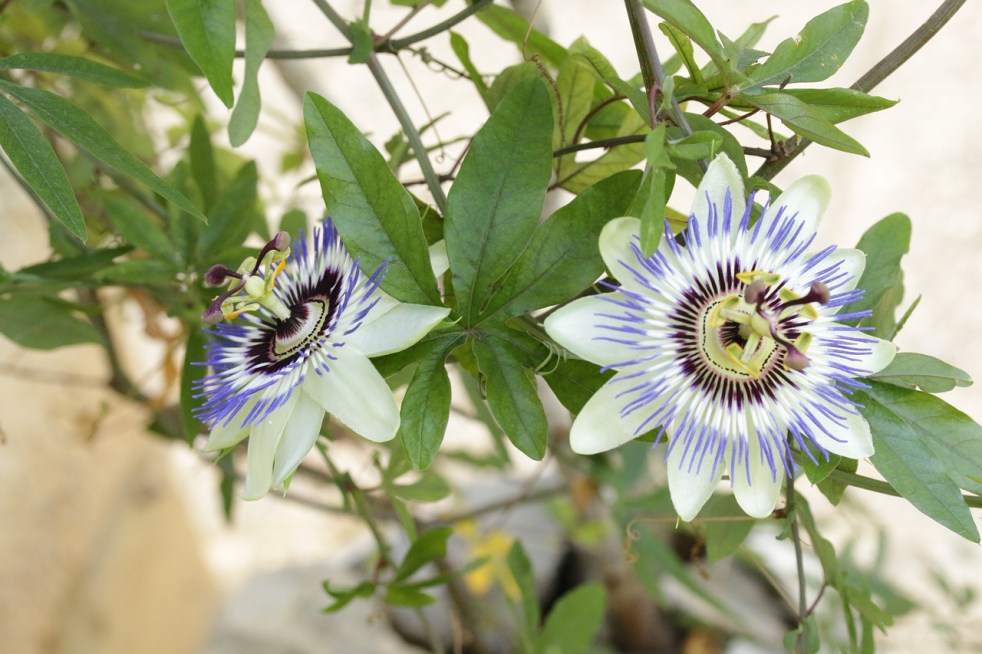
A blue and white flower of P. caerulea.
P. caerulea, a passionflower native to South America.

One tale from Brazil says that the passionflower grew from the tears of a woman who was separated from her lover.

Medicinally, passionflower is used as a calming herb. Evidence suggests that it’s safe to use internally, but there’s been some controversy as supplement manufacturers didn’t meet FDA requirements for safety data. It may interact with sedatives, monoamine oxidase inhibitors (MAOIs), and drugs to prevent blood clots, and is contraindicated in pregnancy.

In traditional indigenous herbal medicine, passionflower is used as a poultice to reduce inflammation and soothe pain.

In the garden, passionflower is irresistibly delicious to Japanese beetles. They’ll eat the leaves and flowers like there’s no tomorrow, which is bad news if you actually want to harvest any fruit!

Taken together, this paints the picture of passionflower as an herb to ease suffering. Since it was said to represent the five wounds endured by Jesus Christ, you could look at it as a “wounded healer.” This isn’t a plant that flows with exuberance, it’s one that knows suffering and eases it in others.

In Victorian flower language, passionflower was said to represent religious fervor or superstition.

Passionflower corresponds with the element of Water and the planet Venus.

Using Passionflower

If passionflower both represents and alleviates suffering, how do you use it? Since it’s native to North and South America, there isn’t really any information about it in ancient magical texts. Nonetheless, there are many ways to work with this unique plant.

As a vine, passionflower grows and clings (hence the whole porch thing.) This makes it useful in workings to bind something to yourself. Since it’s also a plant for relieving suffering, I’d use it specifically in situations where you’d like to bind a solution to a problem — for example, using passionflower to tie yourself to a stable, fulfilling job or enjoyable living situation.

Passionflower is also sometimes used in pillows or sachets for restful sleep and dream magic. Be careful with this, however, as placing passionflower under one’s pillow is also said to be a remedy to dampen libido.

This herb is also used in love magic. Bathing in an infusion is said to attract a potential partner to you, and it’s an often-seen ingredient in sachets, jars, and other charms for love. It works well for this purpose, as long as you know what kind of love you’re looking for. (If you’re after a passionate fling, skip it and go for cinnamon or ginger instead.)

Infuse the flowers in a carrier oil and use this to help ease worries and sooth the heart and mind. Anoint the temples and heart area whenever relief is needed.

All told, passionflower is a delightful herb. It’s beautiful, feeds bees and hummingbirds, and provides valuable medicine. As long as you don’t let its name fool you, it can help you with an array of spells and charms.

Plants and Herbs

Hyssop Folklore and Magical Properties

The anise hyssop in my little pollinator garden is putting of spikes of beautiful purple flowers, so I thought I’d write a bit about the magical uses and folklore of hyssop.

A fun fact first, though — anise hyssop (Agastache foeniculum) is not that closely related to actual hyssop (Hyssopus officinalis). Both of them are members of the mint family, Lamiaceae, but so are teak, rosemary, and chia. Anise hyssop is native to Central and North America, while hyssop is from the Mediterranean eastward to Asia.

Anise hyssop is definitely a useful plant, but I figured I’d cover hyssop-hyssop first. If you practice one of the many branches of European-based witchcraft or folk magic, you’re more likely to encounter Hyssopus in old texts.

Hyssop Folklore and Magical Uses

A lot of the modern lore about hyssop comes from its mention in the Bible. It’s indicated numerous times as a cleansing and protective herb. For example:

Cleanse me with hyssop, and I will be clean; wash me, and I will be whiter than snow.

Psalm 51:7

Take a bunch of hyssop, dip it into the blood in the basin and put some of the blood on the top and on both sides of the doorframe. None of you shall go out of the door of your house until morning.

Exodus 12:22

To purify the house he is to take two birds and some cedar wood, scarlet yarn and hyssop.

Leviticus 14:49

When Moses had proclaimed every command of the law to all the people, he took the blood of calves, together with water, scarlet wool and branches of hyssop, and sprinkled the scroll and all the people.

Hebrews 9:19

There’s more, but you probably get the idea. However, this runs into the same problem as anise hyssop versus hyssop. The hyssop mentioned in the Bible is not H. officinalis. (Biblical hyssop is more likely to be Capporis spinosa or Origanum syriacum.) Nonetheless, I figured the Biblical references to hyssop were worth including because they inform quite a bit of the body of lore about H. officinalis.

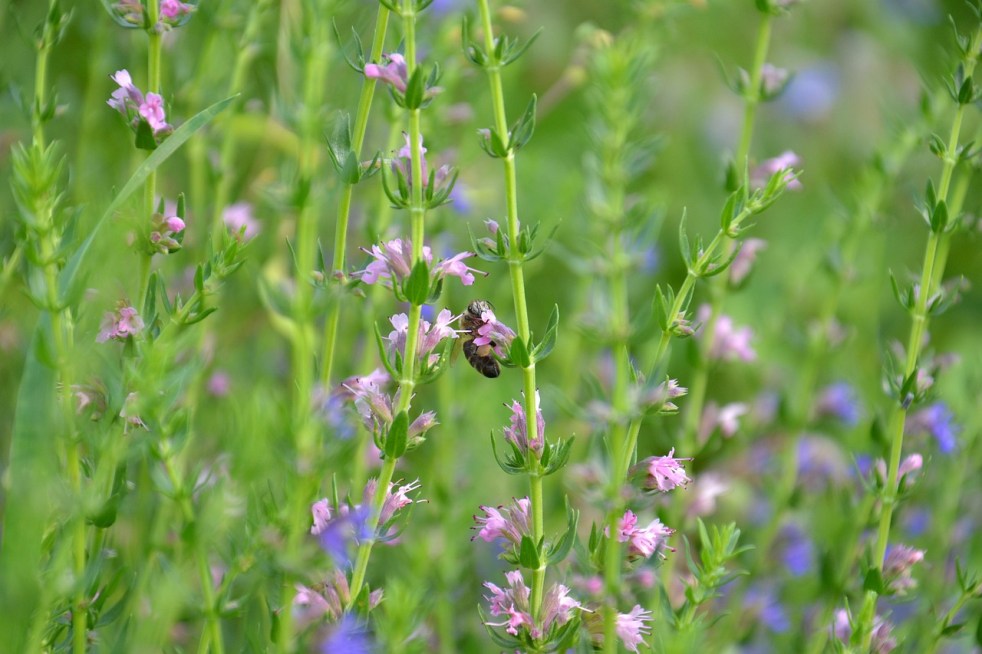
A spike of bright violet-blue hyssop flowers.

The name “hyssop” derives from the Greek word hyssopos, which derives in turn from ezov or azob, the sacred hyssop mentioned in the Bible.

In Egypt, Priests used hyssop as an additive to purify food. This was necessary to make certain foods acceptable for their restricted diet.

Magically, hyssop corresponds to the element of Fire and the planet Jupiter. Following the uses of Biblical hyssop, it’s most commonly employed as a purification and protection herb.

Medicinally, a decoction of hyssop was used topically for treating head lice. It was also used a topical remedy for minor wounds.

In Europe, hyssop was used as a strewing herb. It’s fragrant and seems to have had some action against pests (like head lice, as mentioned above). This may have made it an effective way to keep fleas and other unwanted guests away!

This last bit is particularly interesting to me. In my herb lore reading, I’ve found that the Venn diagram between “herbs used magically for protection” and “herbs that keep bugs out” is almost, but not quite, a circle. Since the Biblical hyssop probably wasn’t hyssop at all, it’s interesting to me that the purposes of Biblical hyssop and European hyssop are so close. It raises a kind of chicken-and-egg scenario — was H. officinalis named for the Biblical hyssop because its pest repellent action “purified” spaces?

Using Hyssop

Sprigs of hyssop make lovely aspergilla. Dip them in water, and use them to asperge sacred spaces, rooms, people, or objects.

Brew hyssop as a tea, strain out the spent leaves, and add the water to ritual baths for purification, cleansing, and hex-breaking. Prepare hyssop the same way, then add to a bucket of fresh water and use it for washing floors, windows, and doors for the same purpose.

A fritillary butterfly on a spike of hyssop flowers.

Add dried hyssop to charm bags for protection, particularly against the evil eye.

Hyssop is sometimes used to season food, and that’s fine. It’s even sometimes used internally in a medical context, and that’s okay too (as long as it’s under the supervision of a qualified herbalist). Otherwise, avoid eating or drinking hyssop. Large doses can cause seizures and cause miscarriages. It’s not known how much of hyssop’s active constituents may pass through breastmilk, and the threshold for hyssop toxicity is much lower for children, so it’s best avoided while breastfeeding.

Environment · Plants and Herbs

Dead Nettle Folklore and Magical Properties

’tis the season for deadnettles!

If you have any semi-neglected patches of ground in your life, you may have seen them — short plants with heart-shaped leaves, arranged like low towers accented by tiny flowers. Though they’re not native to this area, they’re pretty abundant. If you’re into controlling invasive plants, you’ll probably be happy to know that they’re also delicious edibles!

Don’t let the name fool you. Dead nettles aren’t poisonous, and they’re not nettles. They’re called “dead nettle” because they look an awful lot like stinging nettle, but their leaves are stingless. In reality, they’re part of the mint family (which probably explains their prolific growth and ability to thrive pretty much anywhere).

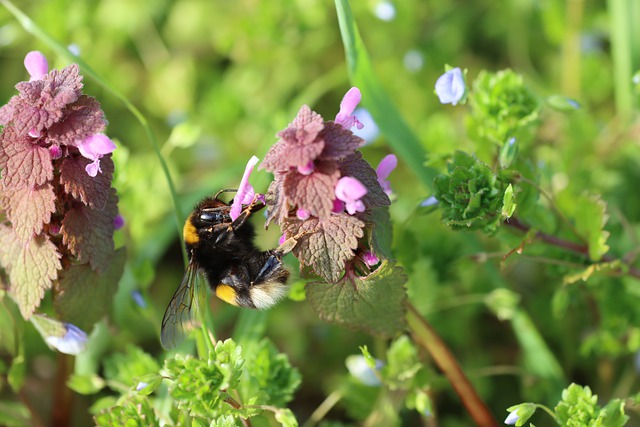
A bee enjoying some soft pink dead nettle flowers.

One of the best things about these nutritious plants? They’re easy to identify and don’t have any poisonous lookalikes. They’re also useful in all kinds of other ways.

Dead Nettle Folklore

Medically, purple dead nettle is used for allergies. It’s rich in quercetin, and has anti-inflammatory properties that make it useful for people with spring hay fever.

Some areas call it purple archangel, because it appears there around the Feast of the Apparition (May 8th). This was when the archangel Michael was said to have appeared on Mount Gargano, Italy, in the sixth century.

White dead nettle is sometimes called bee nettle. This is because it provides an early source of pollen and nectar, so it’s very popular with bees (and children! Kids sometimes suck the nectar from white dead nettle flowers, kind of like how kids used to suck the honeysuckle flowers that grew on the elementary school’s fence when I was little).

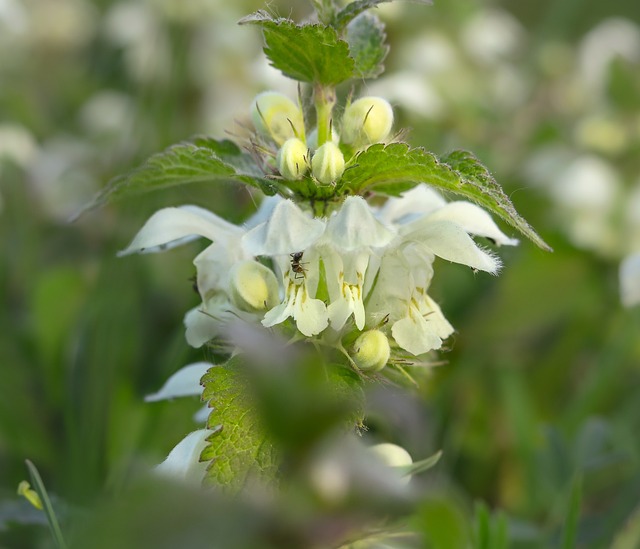
Some white dead nettle flowers. A small ant is crawling inside of one of them.

In Lancashire, it was said that white dead nettle flowers always come in twos, because they’re actually pixie shoes that have been left outside. These flowers also have two black spots inside, which are sometimes called “Cinderella’s slippers.”

White, spotted, and purple dead nettles are all used to treat stings from actual nettles. Mash the plant, squeeze out the juice, and apply it to the stung area. You can also chew some of the leaves and apply the resulting paste.

Magical Properties of Dead Nettle

Dead nettle is associated with determination, due to its ability to grow pretty much anywhere. (I’ve been harvesting it from cracks in the concrete, here.) It’s also connected to happiness, optimism, and relief.

Bright pink dead nettle flowers.

Like other members of the mint family, it dries well. Harvest some, hang it upside-down, and put a paper bag around it to keep off dust and catch any dropped leaves or flowers. Once you have some dried dead nettle, you can use it in teas, incense blends, sachets, poppets, jar spells, or pretty much anything else. This small, unassuming herb is fantastic any time you need a hit of joy and motivation.

Dead nettle is also useful in kitchen witchery. Add it to soups, salads, or even pesto to benefit from its magical and anti-inflammatory properties.

This plant also works wonderfully in tinctures, salves, and oils. This is a great way to preserve it well beyond its season.

For now, I’m pulling it out of my raised beds to prepare them for other things. Some will be left for the birds (chickens, especially, seem to love the stuff), and the rest will be brewed into tea, blended into smoothies, eaten fresh, dried, and pureed and frozen in ice cube trays to add to soup or fill out pesto!