life · Plants and Herbs

Strawbin’.

Okay! Hear me out.

We… went strawberry picking.

If you’ve been following this blog, I know what you’re probably going to say.

“J. You already accidentally bought 47 strawberry starts. You were concerned about what you’d do with up to 140 pounds of basically-almost-free strawberries. Why did you go pay to pick strawberries somewhere else?”

You’re right. This was part of a meetup with one of my Druidry groups, and, to be honest, I wanted to go hang out. Besides, my own strawberry plants aren’t pumping fruit out just yet, so I figure this’d give me some tasty fruits for the meanwhile.

We went to Larriland Farm about an hour after the fields opened. You pay for your container in the beginning, take it to a designated area in the field, and fill it up as much as you can. Since you’re not paying by weight, the more you can fit, the better. My partner was initially going to get us two of those little blue molded fiber baskets, but we soon decided a larger flat box was a better idea.

J. crouched in a strawberry field, filling a flat cardboard tray with fruit.
To think, I thought the box was getting full here.
J.'s partner standing in a strawberry field, holding a flat box filled with berries.
To his credit, he did.

A little less than an hour later, we had pounds upon pounds upon pounds of juicy, very ripe berries. I kept warning him that the box was full, but he was determined to heap them as high as possible. “Nah,” he said, “I can totally Tetris more in.”

All of us paused for meditation (and to eat a few berries) before leaving. Then, after tucking the box of strawberries in the back seat like it was a newborn baby, we carefully trucked them home.

At home, I pureed a bunch of the fruit with spinach, then poured it into an ice cube tray to freeze. Once frozen, it’ll be an easy, space-saving way to keep smoothie ingredients. Some of the fruit will be for salads, frozen for later use, used to flavor water kefir, or macerated in sugar for waffles and shortcake. I sliced a whole bunch, layered it with caramel and pastry, and made a tarte Tatin. Even with all of that in mind, there are still so many strawberries.

A very gooey strawberry tart, with vanilla ice cream.
I hadn’t counted on how juicy the berries would be, so I ended up with a bit too much liquid. Neither of us complained, though!

It’s kind of funny. The blue paper pulp boxes wouldn’t’ve been nearly enough. The next size up, I feel like I’m drowning in berries. It is a problem I enjoy.

I also discovered that it’s possible to break out in a rash from touching strawberry plants, even if you’re not at all allergic to the fruit. Strawberry leaves have trichomes, which are possibly best known as the little hairs on cannabis plants. Strawberry trichomes come in two types: glandular and non-glandular. The non-glandular ones are just little poky hairs that are kind of physically irritating, and help keep bugs at bay. The glandular ones, on the other hand, are attached to glands. These trichomes can inject tiny amounts of defensive compounds.

Imagine if, to protect yourself from bears and muggers, you never left the house without putting on a special anti-bear-and-bandit coat covered in hypodermic needles filled with acid.

The end result was one mother of a rash from the back of my hands to my elbows. This probably isn’t a true allergy, and more a product of spending like an hour accidentally injecting myself with tiny amounts of liquid “fuck off” in strawberry language. I even tested this idea by taking a fresh berry, eating a tiny bit, and rubbing the bitten portion on the inside of my elbow. Aside from a red stain, there was no rash, no itching, no welts, nada. So I’m pretty much free to gorge myself on as many strawberries as I desire.

Here until the ocean wears rubber pants to keep its bottom dry,
j.

Plants and Herbs

Grass Folklore and Magical Uses

I admit, I’m staunchly anti-lawn. Only 50% of this mindset comes from the fact that I’m very allergic to grass. The other 50% comes from the fact that lawns consume more than their share of water, pesticides, and synthetic fertilizers; take up space that could be better used by useful plants; and seem to be a weird kind of status symbol. Also, I hate homeowners’ associations with a passion, and they seem to be really anal about grass.

(I used to try to deliberately sabotage a particularly douchey HOA president by discreetly hucking cannabis seeds into his lawn at every opportunity, and I apologize to no man.)

A tree in the middle of a grassy field, under a cloudy sky.

Since it’s getting into late spring soon, my feelings about grass are at a particularly high peak. It had me wondering — short of raising very small quantities of grazing livestock, is grass actually good for anything?

I also read an old recipe for a hand of glory that involved smoking the severed hand of a hanged man with a mixture of hay and other herbs, and hay is basically large grass, so I thought there might be something there. Could lawns be hiding a treasure trove of magic?

Grass Magical Properties and Folklore

First, it should be noted that “grass” on its own isn’t terribly descriptive. There are a ton of grasses that are known for their magical and medicinal properties, like vetiver and lemongrass. Others, like sweetgrass, have religious or ceremonial significance. For the purposes of this post, I’m going to confine the idea of grass to species like timothy hay and Kentucky bluegrass — the kind of grasses that you’re likely to see appear in paddocks or lawns, either intentionally or as weeds.

A spotted butterfly on a blade of grass.

Sweet vernal grass (Anthoxanthum odoratum) is said to be particularly aggressive when it comes to triggering hay fever. Interestingly, preparing a tincture of the fresh grass, splashing some into one’s hands, and inhaling the fumes is said to help halt an allergy attack.

Hay, in general, is associated with pregnancy and fertility. Some sources treat it as a healing herb.

Couch grass (Elymus repens) is used for happiness, love, lust, hex-breaking, and exorcisms. It appears to be a general “get rid of bad stuff, bring in the good” herb, particularly when it comes to getting rid of malevolent-but-not-terribly-powerful spirits.

Goosegrass is name applied to several species, some of which appear as common weeds in lawns. Cleavers (Galium aparine), which doesn’t really resemble grass, is sometimes called goosegrass. It’s often used for spells to bind two things together. Indian goosegrass (Eleusine indica) is a species that is considered a nuisance plant in lawns and golf greens. Goosegrass is generally associated with dreams, wisdom, and luck.

Bermuda grass (Cynodon dactylon), a common lawn grass in the U.S., is an important Ayurvedic herb. Some research has shown that it may be helpful for controlling blood sugar. It’s also said to regulate bowel movements, ease digestion, heal mouth ulcers and skin problems, and help stop bleeding from hemorrhoids. It has some antimicrobial properties, which can make it useful for healing minor infections.

“Hungry Grass”

In Irish folklore, there’s a phenomenon called féar gorta — famine grass, or hungry grass. This was a patch of grass, completely indistinguishable from any other, that would cause intense hunger pangs in anyone who stood upon it. Some unlucky steppers might even become suddenly exhausted, or even pass away where they stood.

In some tellings, this is because the grass is growing over the grave of a victim of the Great Famine. In others, hungry grass is attributed to malicious faeries.

Delicious Crabgrass

Crabgrass seems to be the bane of many a stereotypical suburban dad. Far from merely being an unsightly interloper into a perfect putting-green lawn, this grass is useful as animal fodder, producing fiber for paper, and even produces edible seeds. Hairy crabgrass (Digitaria sanguinalis) is sometimes cultivated in Europe, and the seeds are known as “Polish millet.” When ground, these seeds produce a useful white flour for baking.

Hairy crabgrass is also medicinally useful. In a decoction, it was used as a treatment for gonorrhea. It was also sometimes used as an emetic, or for general debility — though I’m not sure how throwing up a whole bunch would really help there.

The Hand of Glory

As I mentioned above, hay is (sometimes) instrumental in making a Hand of Glory. This was a kind of grisly candleholder intended to help thieves go about their business. When set with a candle (in some tellings, one made with the semen of the hand’s former owner), it would cause all of the occupants of a house to fall into a deep sleep, as well as unlocking any pesky doors that might stand in between you and the house’s valuables.

All recipes for this grisly curio involve cutting the left hand off of a man freshly hanged on the gallows. If he was a murderer, it should be the hand that did the deed.

According to one recipe, the hand then needed to have as much blood removed as possible. In one recipe, it must then be picked in the urine of a man, woman, stallion, mare, and dog for a month. Then, it should be smoked with hay and other herbs, then hung from a church door overnight. At that point, it’ll be ready to use.

In another, the hand must be packed in a jar with salt, pepper, and saltpeter, and left for two weeks. After that, it should be baked in an oven heated with vervain and ferns for one hour.

Recipes for the candle are pretty specific, too. Some require it to be made of the dead man’s fat and semen, with a wick made of his hair. (Unfortunately, getting hair to light isn’t exactly easy — unlike cotton, it doesn’t really burn. Animal fibers tend to just smolder.) Other instructions say it was best to just dip the whole dingdang hand in wax, then light the fingers directly. This seems a bit wasteful to me, though. After a month of pickling with horse pee and smoking with herbs, I’d like my dead guy’s hand to be more than a one-use item!

Using Grass

First, you want to make sure that you’ve removed all of the stems and see-

Wait. Hang on.

Using grass magically or medicinally is fairly simple; the only really tricky part is figuring out what you’ve got. There are reasons why all those short green lawn plants are just called “grass,” and, if you’re not an expert, it’s probably pretty tricky to tell the difference between Bermuda grass, Kentucky bluegrass, or fine fescue.

Once you’ve figured out what you’re dealing with, the next step is pretty much up to you. It’s worth acknowledging that a lot of the grass species used for lawns aren’t from Europe, so there isn’t going to be a lot of Witchcraft or Druidic lore behind them.

A kitten about to go primal on some flowers in a grassy field.

In general, grasses seem to be treated as positive omens that bring luck. This isn’t too surprising — grass is fodder for grazing animals, and its appearance in spring meant that they could graze, and not rely on stored hay. Hungry animals meant hungry people, and grass made all of the difference. Fresh grass chased away the evil spirit of starvation.

Assuming you aren’t allergic, you can place dried grass in a sachet or charm bag for luck, fertility, and protection from evil. You could also steep dried blades in hot water, and add the liquid to a floor wash for the same purposes. Sufficiently long grass blades could be dried and bound together in an herb bundle to fumigate an area, as well.

I can’t vouch for using grass medicinally, particularly given the difficulty with distinguishing one species from another. If you want to use it that way, you may be better off buying dried or tinctured grasses, versus trying to harvest and prepare your own. (Grasses are also generally doused in pesticides, fertilizers, and other things you probably don’t want in your medicine.)

Until lawns fall out of fashion, at least we can use grass for something positive.
Well, you can. I’ll be over here with the antihistamines.
life · Neodruidry

Could 15th century poetry have an antidote for toxic positivity?

So, toxic positivity. If you haven’t personally encountered it, you might be thinking, “J, you absolute drill bit, how could positivity be toxic?” Just roll with me on this.

What’s toxic positivity?

Eat a healthful diet and exercise regularly, and that’s healthy. Obsessively count calories and jog for hours to burn off every meal, and that’s an eating disorder. Play video games to relax, and that’s good and fun. Play video games for hours on end, to the point where you’re eating at your desk and your room looks like a Superfund site, and that’s unhealthy escapism. Looking on the bright side of things is healthy. Police your thoughts to avoid having an iota of negativity sneak in, and that’s toxic positivity.

Toxic positivity shows up in a wide variety of ways. In this context, I want to talk about the stay-positive-at-all-times-to-attract-a-better-life-for-yourself that still seems to pervade the internet and new age thought in general.

In some sects of fundamentalist Christianity, women are told to “keep sweet.” Despite what they may feel, they must be “joyfully available” to their husbands. No matter what, that positive facade must be upheld.

This happens in new age circles, too. Concepts like the Law of Attraction tell people that negativity begets negativity. That means that you should fill your life and thoughts with positivity, so your life gets better. If things are bad, you’ve clearly brought it on yourself by being negative.

Positivity becomes toxic when it’s rigidly enforced in the face of all sense and reason. When you’re told that your negative thoughts and feelings attract bad things to you, thereby holding you responsible for all of the slings and arrows of outrageous fortune, that’s not healthy. It’s natural to feel bad — and even act on that feeling — when bad things happen. People who are born into poverty, become disabled or very ill, or experience other misfortunes don’t manifest these things for themselves.

Toxic positivity happens in a climate that enforces a status quo. When you’re made to feel responsible for misfortune in your life, and, above all, not to ever let on that you’re unhappy, you’re less likely to agitate for necessary changes in your life and the world around you.

It wasn’t always like this.

It’s also not uncommon to see new age gurus misappropriating very spiritual concepts in order to push this modified version of the prosperity gospel. You can see this in the idea that ever having or expressing a “negative” emotion could block one’s chakras, disrupting one’s internal energy flow (at least, until you pay a guru for a class, video, tool, or treatment to fix it).

The thing is, while this idea isn’t exactly new, it’s relatively recent. It’s also something that crops up as a means of control — tell people that their negative emotions will harm them, and it saves you from the inconvenient work of having to care about other people. Get enough people to believe that their misery is their own fault, and the rich and powerful get to stay rich, powerful, and beyond criticism.

The Three Cauldrons as a Remedy for Toxic Positivity

Amergin was a Druid and bard in the Irish mythological cycle. The idea of the Three Cauldrons is attributed to him, taken from a collection of poetry and prose that dates back to the fifteenth century CE. While these writings come from that period, the ideas within them may hearken back as far as the eighth century.

In these writings, humans are regarded as having three cauldrons within them: Coire Goiriath, the Cauldron of Warmth; Coire Ernmae, the Cauldron of Motion (or Vocation); and Coire Sois, the Cauldron of Wisdom. These should not be conflated with the energy centers found in other spiritual writings and systems — the Three Cauldrons aren’t simply a European equivalent to chakras. The writings don’t actually specify where, exactly, the cauldrons are. Are they in the body, the soul, both, or neither? Despite this, it’s generally accepted that Coire Goiriath resides in the lower belly, Coire Ermae in the chest, and Coire Sois in the head.

With this in mind, people are generally considered to be born with their Cauldron of Warmth upright, filled with vitality and the capacity for physical growth. Their Cauldron of Motion/Vocation is on its side, and turns upright only after growing, learning, and experiencing things. The Cauldron of Wisdom is upside-down. It should be noted that not everyone’s cauldrons are oriented the same way — some people have differing talents, levels of physical vitality, and so forth. There is no ideal way for your cauldrons to be, they simply are. It’s your job to do the work to maximize the potential of what you’ve been given.

My own existence springs forth from the Cauldron of Poesy,
Which was created by the gods from the dúile;
Enlightened is each inspiration
That streams forth in my speech and from my center of being.
I am Amergin White Knee,
Ancient in years and gray of hair.
My inspirations are found within
The many forms of poetry
That are born within my Cauldron of Warming.
The Gods do not orient each person’s Cauldrons equally
Or fill them with the same talents and abilities:
Some are formed upside down, some tilted or upright.
Some are empty, while others are half full,
Some are filled with knowledge like Eber and Donn,
Capable of creating chants of life and death,
Through a skillful combination of words
In the power of three genders: masculine, feminine, and neuter,
And possessing the strength of three measures: double letters,
Long vowels and short vowels.
My Cauldron of Vocation is trained
Through a study of the arts of poetry
And sustains me through proper composition.
I sing also of the Cauldron of Knowledge
That allocates the gifts of wisdom
According to the laws of each art
And the work of each artist in general.

Amergin, The Cauldron of Poesy

The Cauldron of Motion

While people can be born with their cauldrons oriented in different ways, they don’t need to stay like that. For people who wear blinders throughout their lives, their Cauldron of Motion may be upside down. Those who practice the arts may have their cauldron on its side. Those who go through the depths of sorrow and heights of ecstasy may turn their cauldron upright.

I want to highlight that last part: the depths of sorrow and heights of ecstasy. Eighth century poetry acknowledged that, in order to write, sing, and create art, you needed to experience things. Not just one kind of thing. Sorrow is as integral to the process as joy is.

The writings get more specific here, too. Longing, grief, envy, and the search for the divine are all acknowledged forms of sorrow. Good health, marriage, and accomplishment are some of the acknowledged forms of joy. The concept of balance — not just between joy and sorrow — is further emphasized:

The Cauldron of Vocation
Fills and is filled,
Grants gifts and is enriched,
Nourishes and is enlivened,
Sings praises and is praised,
Chants invocations and is enchanted,
Creates harmonies and is harmoniously created,
Defends and is strongly defended,
Orients and is aligned,
Upholds and is upheld.

Good is the wellspring of measured speech.
Good is the home of the well of speech.
Good is the joining of their powers:
Strength is made durable.

It endures longer than any fortress.
It is better than any tradition.
It is our guide to wisdom,
As we free ourselves from ignorance.

Amergin, excerpt from The Cauldron of Vocation

This power comes not from upholding positivity in the hopes of attracting a better life. It comes from the work of experiencing both joy and sorrow, devoting yourself to a greater pursuit, and acting and speaking with honesty and integrity. This is the origin of strength, endurance, and freedom. This is what lets us change things not only for ourselves, but for the world.

Neodruidry · Plants and Herbs · Witchcraft

Strawberry Folklore and Magical Properties

Ever since my strawberry buying and planting misadventure, I figured it’d be worthwhile to write a bit about the historical and potential magical uses for them. (Especially since, having done the math, I may need to find uses for up to 140 pounds of ’em.)

Strawberries come from various species of the genus Fragaria. Like so many other popular fruiting plants, they’re actually related to roses. The typical strawberries that you grow in the garden or buy in the store are varieties of a hybrid cultivar called Fragaria × ananassa, but there are over 20 species that appear all over the world. Another popular species is Fragaria vesca, the Alpine strawberry. These plants produce small fruits with a flavor reminiscent of pineapple.

A cream-filled strawberry cake roll, decorated with fresh berries.

I remember playing in a patch of wild strawberries when I was very small. We had a ton of volunteer Fragaria virginiana in our back yard, which returned every year with pretty much no effort on anyone’s part. The birds usually got to the fruits long before we could, so finding the tiny, jewel-like berries hidden under the leaves was like finding treasure.

Strawberry Magical Uses and Folklore

The term “strawberry” comes from the Old English streawberige. This may refer to the tiny seeds on the outside of strawberries (the actual fruits — what we generally think of as the “berry” part, isn’t!) which resemble wheat chaff. A cognate name was eorðberge, for “earth-berry.” This can still be seen in the modern German word for the fruit, Erdbeere.  

The deep red color and heart shape of strawberries makes them sacred to Venus and Aphrodite. One may extend this to other goddesses of love and beauty, as well.

This connection to love goddesses may be the source of one legend about the berries. It’s said that double strawberries are potent love charms. If you find one, break it in half and give one half to your intended partner. If you both eat the halves of the double strawberry, you’ll fall in love with each other.

In some parts of Bavaria, strawberries are used to ensure healthy cattle and abundant milk. Farmers hang small baskets of wild strawberries on the horns of their cows, as an offering to local faeries. These faeries are said to love strawberries, and will protect the cattle in return.

A small wild strawberry.

Strawberry plants are potent emblems of fertility. They reproduce via seed, largely by attracting birds to their bright red fruit. The birds eat the flesh, and the seeds (actually achenes, or ovaries containing a single seed) pass through their digestive systems. Strawberry seeds only require light and moisture to germinate, so they grow easily pretty much wherever they’re dropped. The plants also reproduce via runners, or specialized shoots that grow out from the mother plant and produce full plants of their own. In other words, it’s almost harder not to grow strawberries!

Using Strawberries

I mean… You can just eat them. Strawberries are kind of neat that way. Convenient. This advice is probably not what you’re here for, however.

It should be noted that, while it’s highly likely you have wild strawberries in your area, you may also stumble across the mock strawberry. This is Potentilla indica, and not a variety of true strawberries (though, like true strawberries, they’re also a member of the Rosaceae family). They very closely resemble wild strawberries, but have yellow flowers and less flavor. Fortunately, they aren’t toxic.

Medicinally, the leaves and roots can be brewed into a tea. This tea is believed to help get rid of “toxins,” which means that it acts as a diuretic. That helps flush compounds like uric acid, so strawberry may be prescribed as a treatment for gout. The astringent properties of this tea is also said to help with gastritis, intestinal bleeding, heartburn, and other digestive complaints.

When used topically, an infusion of the leaves and roots may help clear up acne by acting as an astringent. The fruits, too, are also rumored to be beneficial here — eat a strawberry, then rub the leftover bit of flesh at the top on your face. The natural acids present in the fruit can help with cell turnover and unclog pores.

Magically, you can offer strawberry fruit and flowers to deities of love and beauty. You may also want to use the fruit in kitchen witchery for beauty or attraction spells. If love spells are your bag, you may even wish to include these fruits in brews or desserts to share with your desired partner.

A brew of mint and lime, with fresh strawberries.

Strawberries are a beautiful part of the transition into spring. Their medicinal properties are helpful for shaking off the effects of winter, and their vibrant taste and color are a treat after months of gray weather.

Environment · life · Neodruidry

Silvering the Well

One practice that’s part of my tradition involves “silvering the well.” This is pretty much exactly what it sounds like — making an offering of silver to the well.

The well, in this case, is a vessel of water (taken from three different natural sources). Outside of a ritual, it’s just a bowl. During a ritual, it becomes something more. It’s a representation of the primordial waters. It’s the healing cauldron, the sacred spring, and the sea of Manannán mac Lir. It’s representative of Water as an element, and the past from which we all spring.

The thing is, silvering the well is more complex than it seems. To people who’re used to ceremonial magic, it probably looks pretty simple. You have a vessel to serve as your well, and you make an offering to it. Silver goes in, boom.

There are also multiple different approaches to making this offering. One involves purchasing (or upcycling) small silver or silver-plated beads, which are then offered to the Earth once the ritual is concluded. Another uses a dedicated silver object which is designated as the offering anew each time, then taken out, dried off, and saved for the next ritual.

I spent a lot of time teasing out what this part of the process means for me. I’ve always understood the word “offering” to be a kind of euphemism for “sacrifice.” When you offer something, you no longer have it. Even if you don’t necessarily get rid of it (like dedicating an altar sculpture to a deity), it isn’t for you to use anymore. In this context, it makes sense to use small offerings of pieces of silver, requiring you to sacrifice the time, money, and energy it takes for you to get more when you run out.

On the other hand, international supply chains make the ethics of buying literally anything incredibly dubious. (I mean, a hobby store got caught trafficking antiquities, for crying out loud.) Even if it wasn’t, making an offering of small pieces of new silver involves mining silver (and possibly other base metals, for silver-plated objects) and then offering them to a place they didn’t come from. In less confusing words, you’re taking valuable material from one part of the Earth, and putting it somewhere else. Sure, silver isn’t exactly blood diamonds, but it’s still something that stuck in my mind like a fishhook. How do I know that the material for these “disposable” pieces of silver didn’t come from child labor, or a mine that dumps poison into the waters of the very people who have to work there? Could I justify offering something to the primordial waters, knowing that it might be poisoning the water?

(The environmental chemistry nerd in me isn’t even going to get into rainwater, leachates, and their effect on the soil, or I will be here all night.)

Eventually, I managed a compromise. I found a coin collector who had a stash of silver Mercury dimes. They weren’t suitable for collecting, since they’d been heavily circulated and were worn nearly smooth by time. I bought one, and this is my offering. I give it to the well, and the letter of the ritual has been fulfilled. The well is silvered.

Fulfilling the spirit of offering comes afterward. The coin itself is almost collateral — it’s a token of a promise, the symbol of an offering rather than the offering itself. Once the coin has been removed from the well and dried off, I make the sacrifice. Each ritual costs a monetary donation to a water charity — from the Water Protector Legal Collective, to Ocean Conservancy, to Jug Bay Wetlands Sanctuary, to one of the many other organizations working to protect people’s access to clean drinking water, remediate water pollution, or preserve vital wetlands. Failing that, it costs an afternoon of cleaning a beach or the banks of one of the smaller local waterways.

What does this mean for other people? Probably nothing. It’s just something that sat in my mind for a while, and a practice that I put in place years ago. Maybe it’ll have value for others, maybe not. Either way, I thought it might be worth writing down.

Books · life · Neodruidry

Sacred Actions: Yule

This past Sunday, one of my Meetup groups had a meeting to discuss Dana O’Driscoll‘s Sacred Actions: Living the Wheel of the Year through Earth-Centered Sustainable Practices. Luckily for me, I’d picked up a copy several months ago from Three Witches’ Tea Shop. It’d been in my “to read” pile for a bit, so I was very happy to have the extra encouragement to get into it.

We went over the first high day, Yule. For this time of year, Sacred Actions emphasizes learning one’s place in the consumption web of life — observing your consumption patterns, seeing how you can live in a way that’s more regenerative and nurturing for the Earth and other people, and learning to discern between a need and a want so that there are enough resources for everyone to live comfortably.

This chapter also encourages the reader to take a look at their ecological impact using the Footprint Calculator quiz. Mine came out at a 1.8 — meaning that, if everyone in the world lived like I do, it would take 1.8 Earths to sustain us all. Unfortunately, this number is actually at the lower end of the spectrum, but I’ll get to that in a minute.

The discussion was lively and fruitful. It was nice to know that we were all in a similar place — aware of tactics like “greenwashing” and propaganda that emphasizes individual responsibility over corporate abuses, and knowing exactly how difficult it is to engage in ethical consumption within our economic system.

One thing I particularly liked was O’Driscoll’s emphasis on regeneration and nurturing over sustainability. Sustainability is nice, but comes with a pretty heavy subtext. The implication is that we should find a way to do things that allows us to continue to live, consume, and behave in the way to which we’ve become accustomed. This isn’t just impossible, it’s not exactly a noble goal. Instead, we should work toward regeneration — giving back to the planet and exploited people to replace what has already been depleted.

(I could go into a super long and weird discussion about extinct megafauna, human cities, and the importance of poo here, but I will spare you this. Instead, here is a giant gorilla fighting a t-rex:)

The idea that we have a responsibility to more than just the planet was refreshing, too. My ecological footprint is low for someone living in a wealthy, developed nation. I’m not bragging here — the reason it’s low is that disability (and, let’s be real, an at times paralytically rigid sense of ethics) keeps me from engaging much in many aspects of society. The things that make my footprint as large as it is aren’t even things I can control. It’s almost all the snowball effect of having a long, multinational supply chain.

With that in mind, there’s only so much else I can trim. It’s frustrating to look for ways to make your lifestyle more sustainable (read: regenerative), and just get the same bits of advice over and over and over again. Use reusable paper products. (Check.) Use metal straws. (Check.) Compost. (Check.) Instead of this, O’Driscoll’s work provides some other lenses through which to consider sustainability. Even if I can’t change the supply chain that delivers the things I need, I can focus my energy on supporting, regenerating, and nurturing the people involved.

(Incidentally, I think I’ve begun to hate the word “nurturing.” I’ve seen it co-opted so many times by new-agey wellness articles about consumerist self-care strategies, I think they’ve ruined it for me. I will, however, continue to use it here for lack of a better term.)

(The phrase “nurturing the people involved” also gives me mental images of someone breastfeeding a forklift operator, but I’m not sure how else to say it. Your mileage will hopefully vary.)

The next step is to engage with the exercises. This means placing one of three ideas at the forefront of my mind for a week at a time. First, emphasizing care for the Earth and all of its inhabitants. Next, will be emphasizing people. After that, ensuring that there is enough for all.

As I write this, news stations are broadcasting about the deaths of workers in an Amazon warehouse that was hit by a tornado. The tornado wasn’t a surprise. People, driven by desperation, went to work. The company higher-ups didn’t see fit to let them stay home. Jeff Bezos says he’s heartbroken about the tragedy, but has yet to commit any actual money to providing for the families of the dead.

In the meantime, Bezos’ Earth Fund has also committed another $443M (USD) to conservation efforts, or roughly 1/500th of his net worth. A net worth that comprises assets gained through exploiting people and the planet.

His attitude and position is not unique. Remember, while you make adjustments to your lifestyle, that the people serving as conduits for environmental and human exploitation are not gods. They have names and addresses. When living sustainably as an individual only goes so far, there is always direct action.

For more information, I recommend episode 320 of The Dollop, The Wobblies Go to Everett.

Blog · divination · Environment · life · Neodruidry

Friday: Black. Hike: Taken. Hams: Strung.

I don’t like Black Friday. Part of it comes from several years of retail work, part of it comes from reading way too many stories of people getting shanked over Elmo dolls and discount TVs. It sucks for workers, it sucks for shoppers, it just sucks all around.

So, when a Meetup group I’m in posted a late afternoon hike this past Friday, I was more than happy to do that. The weather didn’t look promising, but there’s no such thing as bad weather — just the wrong clothes. As long as it kept me from being bombarded with reminders of Black Friday, I would’ve hiked in a storm.

This came right after a Zoom session about the role of walking as a spiritual practice. It was a really enjoyable discussion, and I was intrigued by the number of different roles it seems to occupy for people. I never really gave walking much thought — it’s part of my spiritual practice, but not one I really had to devote brainspace to, if that makes sense. Some talked about entering a kind of flow state, where the walk itself was a way to disconnect from the body. For others, walking was the opposite — a chance to focus on mindful movement, and quiet the mind. It all depends on what you need from it. Will walking be an external practice, or an internal one?

For me, it’s always been a weird form of augury. I don’t want to use the phrase “connect with nature,” because I feel like the wellness movement has worn it pretty thin. Really, it’s a way to make friends, as long as your definition of “friends” is flexible enough to include fungi and holes in the ground. If I meet a lot of new friends, it’s a pleasant walk and a good omen. If I don’t, it isn’t.

It can be a more specific divinatory practice, too. I know it’s not uncommon for people experiencing a lot of synchronicities (angel numbers, and the like) to ask for a sign or some kind of answer. Asking for one, then going out for a walk to see what you get is a useful form of divination. It’s definitely easier than trying to find a haruspex in this day and age.

It’s also a gratitude practice for me. I’m not about to get all gratitude journal on you, but, after spending several years too sick and deconditioned to do much of anything, I feel like the best way to express thanks for still having a mostly-functioning body is to use it for stuff.

We started out by meeting up in a parking area near one of the picnic groves. (There are trails all over this area, so you can pretty much start walking in any direction and end up on one.) It was really good to finally meet some of the people I’d only be able to speak to on Zoom calls, and the hike itself wasn’t too tough — three miles start to finish, through trees that helped cut some of the blustery wind and whose leaves lit up like lanterns once the sun sank below the lead-colored clouds. The air was scented with the vaguely spicy smell of gently decaying leaves, and so cold that I could feel it like a razor every time I reached the top of a hill.

Which is exactly how I ended up having to stop and catch my breath a bunch of times, wrestling with my jacket to pull out the carton of warmish coconut water I’d kept snuggled against my chest like a newborn. Fortunately, I brought a bandana-style mask with me. It helped warm the air before I breathed it in, which made things a bit easier, and also allowed me to pretend to be normal while actually gasping like a malfunctioning Billy Bass.

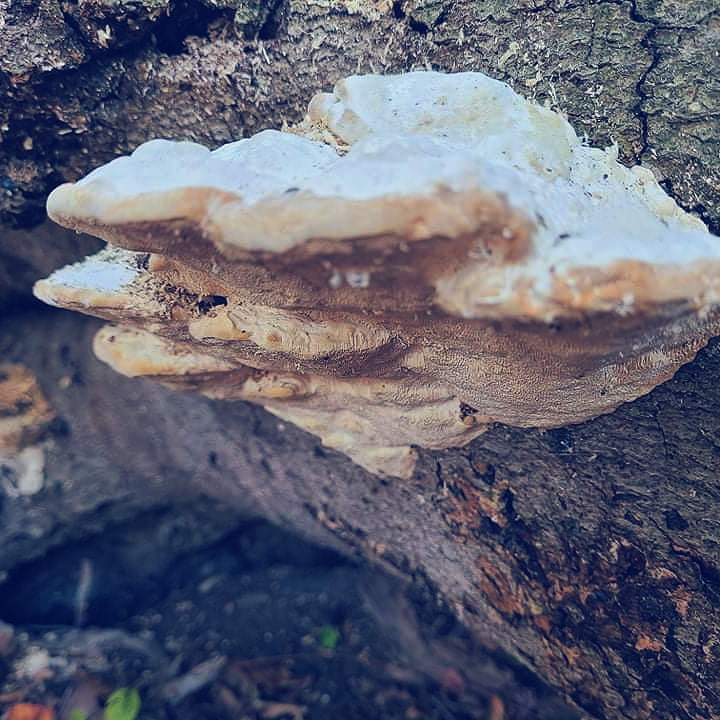
The entire forest is slowed down for the cold seasons, so it wasn’t like hiking earlier in the year. While the moss was still green, it was confined to neat, short little mats without their long, almost eerie-looking spore capsules. There were no eyelash cups or jack-o-lantern mushrooms. I did spot some neat-looking shelf fungi, and scrambled down into a space under a fallen tree for a picture. Another branch held some tiny specimens that were so fine and woody, they almost looked like ruffled feathers.

We all made it to the end, just before sunset. The light had that “golden hour” magic going on, which turned the treetops and patches of sky into a stained-glass canopy and the fallen leaves into a blanket of gold and copper. There was a peaceful moment where we paused before leaving, to make offerings of water and close out the experience. My partner and I picked up tea and dinner, then headed home.

It was the longest uninterrupted hike I’d been able to do in years. It gave me a chance to push my limits a bit more, and feel the edge of where my endurance is now. I get winded and dizzy easier than I did before IH, but I did it, and I’m intensely happy and grateful.

A good walk, and a good sign.

Neodruidry · Plants and Herbs · Witchcraft

Spruce Folklore and Magical Properties

I’m finally moved, and luckily settled in to a place that my partner and I absolutely love. Seriously — we decided against buying a house right now (it’s very much a seller’s market), and it’s going to take a very special house to get me out of here once we are ready to buy. There are lots of very lovely trees around, from neighborhoods full of crape myrtle and magnolias, to a Kousa dogwood whose fruits tempt me every time I walk past it. (I always have to tell myself no, it’s part of the landscaping, not really owned by anyone in particular, and there’s no way to tell what it’s been treated with.)

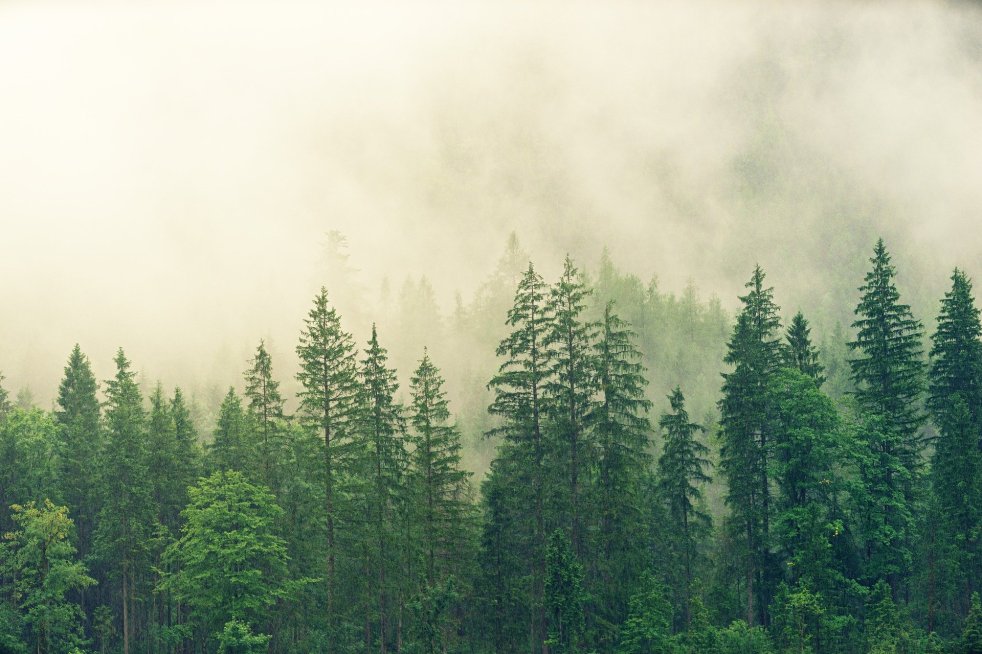
My favorite, however, is a big blue spruce.

It has a weeping growth habit, so its massive branches of smoky blue needles hang dramatically. It has a really cool energy, too — not necessarily the “loving, supportive, enlightened” feeling a lot of herbal energy guides point to, more like a very old and wise thing who is also very curious about the tiny things around it. I get a gentle amusement from it. It even has a natural face in the bark. I love it.

How to Tell a Spruce vs. Pine vs. Fir

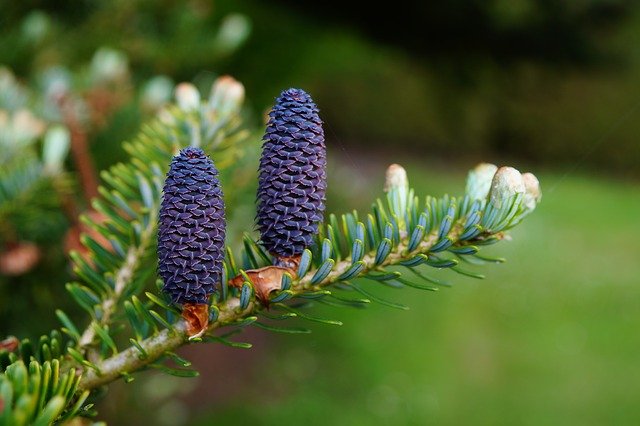
First, the big question: What kind of tree are you looking at? All of these species fall under the general category of conifers, meaning that they are cone-bearing seed plants. Spruce, pine, and fir all produce needles, too, which can make identification tricky from afar. Fortunately, there’s a pretty easy way to tell.

Pine

Are the needles long, thin, and sprout from a single spot in groups? You’re looking at a pine.

Fir

Are the needles short and flat? Pick one up (there’ll probably be plenty shed on the ground) and pinch it between your index finger and thumb. Does it roll easily? If the answer’s no, then you’ve got yourself a fir.

Spruce

Are the needles similar to fir needles, but have a square cross-section instead of a flat one? Try rolling them between your index finger and thumb. If they roll, that’s a spruce.

Spruce Magical Uses and Folklore

In western Sweden, researchers have found a spruce that may be the world’s oldest living tree. It’s nearly ten thousand years old, and has survived by cloning itself via layering.

According to the Hopi people, the spruce was once a medicine man who turned himself into a tree. It’s a sacred plant.

To the A’â’tam, the father and mother of humanity escaped a flood by floating in a ball of spruce pitch.

Northern Algonquian people used it to prevent illness.

One source indicates that blue spruce is a symbol of pure intentions, while, in a more general sense, spruces represent generosity, enlightenment, protection, healing, and intuition.

Using Spruce

Just befriend one. It’s both easier and more difficult than it sounds.

Trees are individuals, so the easiest way to tell if you’re barking up the wrong tree (ha ha) is by sitting near one. They have natural ways to mount a defense against creatures they don’t want around them, so see if you end up covered in ants, breaking out in a rash, or otherwise having a bad time. That’s a sign that this tree doesn’t want to be friends — at least not yet.

On the other hand, if you’re sitting by a tree and smell a sweet fragrance, maybe feel a gentle breeze and the sun on your face, hear the birds singing, get a sense of comfort and acceptance, and otherwise generally feel good, this tree might want to get to know you.

Once you’ve found a tree to be friends with, look at it. Look at it from afar, and examine the bark close up. Let your pareidolia take over, and see what features you can see in the bark. The tree might choose to show you its face to make it easier for the two of you to connect. After all, it’s easier to converse when you can see the other party’s face, right?

Talk to the tree. It doesn’t have to be out loud. Hang out. Make it little offerings, like fresh water or an interesting (and plant-safe) rock. Remember, this is a friendship — do small things to show you’re thinking of it, and don’t forget that, sometimes, the best gift you can give is your time.

The relationships you forge in the natural world are part of the foundation of magic. You’ve gotta learn to speak the language if you’re going to try to ask for help.

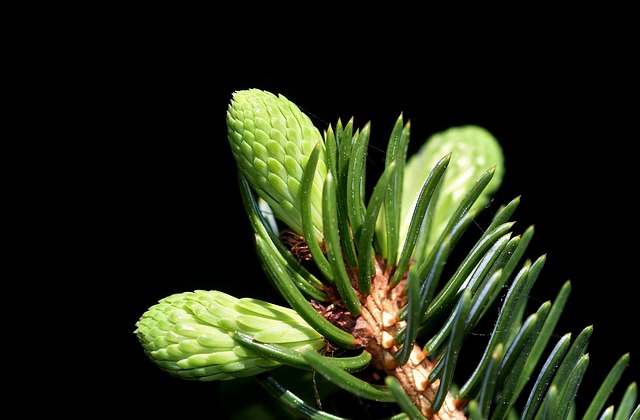
You can also consume spruce buds, as long as you’re sure the tree hasn’t been exposed to a systemic pesticide, industrial runoff, or car exhaust. Spruce buds are high in vitamin C, and have been used for tea, in syrup, and even to make a beer to sustain sailors over long voyages. You can also eat the young buds directly, if you’re into that.

Spruce trees are beautiful things native to the northern regions of the world. I can’t speak for all of them, but the ones I’ve known have been very nice to work with, even if that “work” is just sitting and exchanging energy for a time. If you don’t live in an area with native spruce trees, and you’d like to work with them, consider using spruce bud tea or syrup to experience some of their power.

life · Neodruidry · Witchcraft

How Antidepressants Made Me Better at Witchcraft

Have you ever seen that meme about psychiatric medication? The one that’s all, “pills are trash, forests are medicine!” (Which, by the way, is a toxic, steaming load of horse puckey.)

It’s not an uncommon attitude in some new age and Pagan-adjacent circles. I could digress into a discussion of the destructive power of the naturalistic fallacy, but it’d take at least eleven posts just to contain it. Instead, I want to point out one thing:

Medication made me way better at everything, including witchcraft and Druidry.

A lot of people express reluctance at trying psychiatric medication, and I can’t blame them. It can take awhile to find the right one, and, after that, to work out the right dose. That’s frustrating, even scary. Some worry that medication will “dope them up,” reduce their creativity, or subdue the traits that make them them. For me, nothing could be further from the truth. Without the constant high-pitched background buzz of anxiety and panic disorder, I’m much freer. I have some side effects, but they’ve been a small price to pay.

I do occasionally feel stabs of resentment that I’m reliant on something “unnatural” — but that’s a me problem. If there were a “natural” equivalent to what I need, believe me, I would have found it. I didn’t, despite years of experimentation. I came close a few times, but there was no herbal remedy for my panic that didn’t also knock me unconscious, make me throw up, or worse.

The fact is, the idea of “perfect” physical or mental health is a construct. It’s not a birthright, it’s not even a natural concept. In Sick Woman Theory, Johanna Hedva explains,

“Sickness” as we speak of it today is a capitalist construct, as is its perceived binary opposite, “wellness.” The “well” person is the person well enough to go to work. The “sick” person is the one who can’t. What is so destructive about conceiving of wellness as the default, as the standard mode of existence, is that it invents illness as temporary. When being sick is an abhorrence to the norm, it allows us to conceive of care and support in the same way.

By contrast, in nature, an organism that is “well” is one that’s able to meet the challenges of its environment. That isn’t a super high bar to clear — it also very often doesn’t look like the human conception of wellness. In reality, few creatures would meet the definition of “well” to which humans aspire. Animals live with parasites. Crows steal lit matches and bow over ant hills, seeking relief from mites when they need to. One crow with an injured beak needed the help of his mate to eat, and she gave it. We find deer that have lived for years with teeth or bullets embedded in them, muscle and bone growing gnarls over what biology apparently considered an impolite intrusion. We find creatures that have existed, eaten, and fucked for a lifetime, tumors and abscesses locked away behind walls of thickened bone. As salmon amply demonstrate, as long as you can survive to adulthood and pass on your genes, nature doesn’t much care what state you’re in. If you end up truly unwell, you don’t survive. If you’re surviving, even if it takes an anthill, a patchwork of scars, or an understanding mate to keep you there, you’re doing well.

“Perfect wellness” is not a natural standard, and the kind of health sold by the wellness industry is not only unnatural, it is deeply damaging.

Natural perfect health is rare enough to be nearly mythical, because there is no real binary opposite to sickness. Everyone will experience a significant amount of pain and disability at some point in their life. Some are fortunate enough not to experience that until they are very old. For others, that point just comes earlier and lasts a bit longer.

We are pushed to consider caring for ourselves as temporary, which perpetuates the myth of being “well” as a default, natural state. As long as the aspirational standard of natural perfect health exists, we’ll keep working ourselves to death trying to reach it. So, the idea that you must be naturally, perfectly clear-headed in order to commune with the Divine or perform magic? It’s kind of crap.

It’s an idea that’s also used to delegitimize practices that use entheogens — practices where altered mental states are valuable, if not necessary. It derides rituals that use substances in favor of quiet, whitewashed sensibilities.

In my case, it’s just a lot easier for me to get things done when my brain isn’t dysfunctionally revved up on a constant stream of high-test adrenaline, neurons struggling to swap about four serotonin molecules between them. It doesn’t matter if the “things” I’m trying to do are dishes or divination.

It’s not wrong to prefer natural tools in ritual, but the standards that apply to a wand or an herb don’t work when you try to apply them to the self. Medication — the help that gets us closer to the functional, animalistic concept of “wellness” — isn’t an enemy or a detraction from spiritual experiences.

If you’re hanging in there, even if you need medication to keep you here, you’re doing well. Nature and the divine won’t reject you for that.

divination · life · Neodruidry · Witchcraft

The Accidental Journey

When I was little, I loved to sleep. I still do, to be honest.

At least, the adults around me thought it was sleep. I wasn’t really sure what it was. While hypersomnia has been a part of my life for as long as I can remember, sleeping was never really just a means to an end.

I didn’t really have any privacy growing up, I didn’t have my own bedroom until I moved out — if I didn’t have to share it with my brother, I had to share it with my mother. You couldn’t even get five minutes in the bathroom without someone either banging on the door or just barging in. But the time and space behind my eyelids was mine.

When I was little, I learned the patterns my brain followed when it started its spiral into sleep. As soon as my thoughts turned into free-association nonsense, I learned to tweak them just enough to influence my dreams. If I timed it just right, I could dream lucidly, or, if nothing else, have dreams that were vividly beautiful and meaningful to me.

Sometimes, I wouldn’t be tired enough to descend into sleep. I experimented with ways to make myself dream — slowing my breathing, blinking my eyes in certain patterns, listening to certain songs, repeating phrases or disembodied snippets of poetry under my breath.

The first “awake dream” I had shocked and confused me as much as it delighted me. It was brighter and more vivid than the most memorable lucid dream I had, and I still retained a sense of the “real” world around me — I had a sense of awareness in two places at once, and gently ignored the walls around me for the impossibly lush, green gateway ahead. Unlike a dream, I could control my body. Unlike a fantasy, I couldn’t control anything else.

I didn’t know hedge riding, shamanism, or path-walking was a thing yet, I was only eight or nine years old. I kept it to myself, knowing that my experiences would either be dismissed as childish make-believe or decried as somehow demonic.

It was a long time before I learned what it was, and how lucky I’d been. I learned that doing this could be useful for more than just me. I’d spent a lot of time journeying as a scared, angry kid, and was fortunate to find things that (for the most part) were helpful at soothing my hurts and teaching me to avoid the destructive patterns I was being taught. It was because I was able to accidentally find my way there that I was able to find my way into a better life.

I know I was extraordinarily lucky, and things could have gone very wrong if I hadn’t been. Waking, sleeping, or journeying, I’m grateful every day for the way they turned out.