life · Neodruidry · Witchcraft

Frederick Pagan Pride 2023

It’s just this past Saturday, and my Handsome Assistant and I pull up to the Unitarian Universalist Church in Frederick, MD. The friendly young people attending the lot tell us there aren’t any parking spaces left. We’ll have to go to the lot a mile down the road, they direct us, and take the shuttle.

Personally, I’m shocked. It’s only a quarter past ten, how could the lot be full already?

A rustic pendant made of copper, quartz crystall, and azurite malachite on a copper chain.

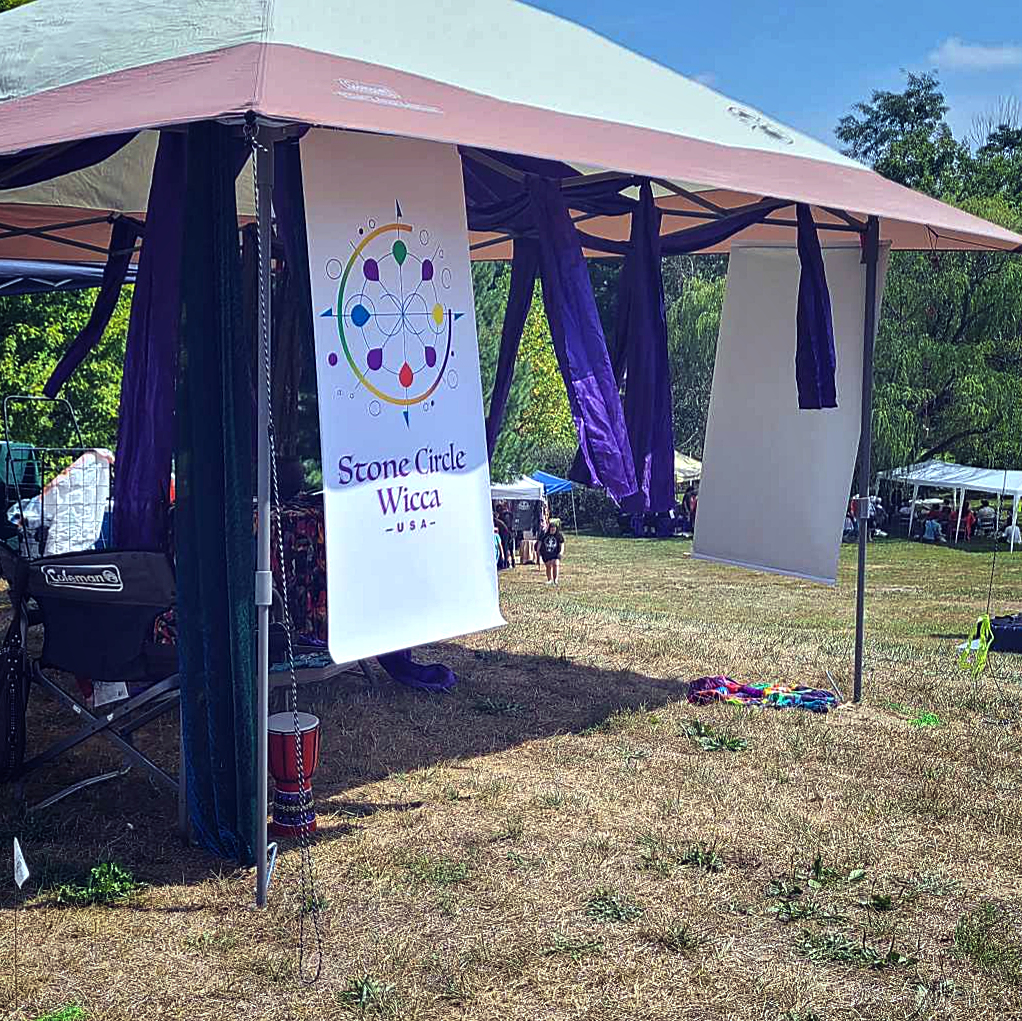
They weren’t kidding, though. Even the other lot was filling up, and the shuttle was almost completely full as we rode back. The grounds themselves were ringed with vendors, information booths, and more — there was Tempered Raven, who hand-forges beautiful blades There were so many booths of jewelry (I bought a beautiful quartz, azurite malachite, and copper necklace from Unclaimed Treasures). There were herbs, incenses, soaps, pottery, handmade brooms and whisks, woodcarvings, altar supplies, and amazing desserts. There was even free coffee, tea, and cold brew from the awesome people at Stone Circle Council (check them out — they do some very cool things).

A handmade ceramic watercolor palette with eight wells.
I also picked up a handmade palette. It’s intended for watercolor, but I’d like to see how it does with casein. Casein paint dries out so fast and softens up with a bit of water, so working with it is a bit more like gouache than acrylic. I’m thinking a glazed surface will be perfect!

There were also loads of workshops and live music. It was busy, it was vibrant, it was great. I always regret not taking more pictures of the event itself, but I always feel a bit odd about snapping pics of people unaware. (Sure, there’s no expectation of privacy in public, but something being legal doesn’t preclude it from being a bit of a dick move, you know?)

The busyness was at once a wonderful sign, and an unfortunate one.

On the one hand, it’s great that events like this are attracting a bigger audience. Aside from vendors of beautiful crafts and delicious food, there are lots of tables for different Pagan, metaphysical, and mystical organizations. If you’re looking for a path to call to you, or people to network with, this is the place to find that thing. In an era where social media has allowed — even encouraged — the proliferation of misinformation that’s unhelpful at best and dangerous at worst (and don’t get me started on AI generated books), it’s really nice that there’s still a wonderful variety of actual organizations dedicated to study and practice.

Last year, I got a little emotional about how events like Pagan Pride make me feel about community, aging, and tradition. It’s a feeling I hope everyone gets to experience at least once.

On the other hand, a big part of the reason for this large audience is that two other Pagan Pride events — the one in DC, and one in Manassas, VA — effectively no longer exist. A friend pointed out that they’d even contacted the coordinators of the DC pride event and hadn’t heard anything back at all. As if the email address was going unchecked. I looked up information on Manassas everywhere I could, but it was pretty scarce. The last event seemed to be in 2019, and the 2022 event was cancelled. According to their Facebook, they weren’t able to hold one in 2023.

A lot of Pagan community organizers seem to be either getting burned out (with everything else going on right now, who can blame them? Add the often-thankless work of organizing to the struggles everyone else is dealing with right now, and it’s completely understandable) or just aging out of their roles. All of the organizations I know, even the ones I’m a part of, operate on budgets that would make a shoestring look luxurious by comparison.

It’s something I’d love to help with, but I’m not really sure where to start. I’ve often said that, if I were handed enough money to live off of for the rest of my life, I’d put it into a small house on a large piece of property. I’d rewild as much as I could and put it under a conservation easement. Some, I’d want to guide into operating as a permaculture food forest (I have tiny fantasies of adopting a rescue donkey or small pony, having them carry a basket, and walking around with them to pick fruits and vegetables). The rest, I’d want to make into an event space for musicians, dancers, and events like Pride. I have no heirs, so, when I died, I’d will it back to whatever Indigenous group formerly held it. In the meantime, I’d want it to be a place for community members to interact — flora, fauna, and human alike.

I mean, I feel like I’m basically describing a two-person commune, but I feel like you get the gist.

I suppose what I’m saying is that it’s a shame that the world has done us up all wretched, and I wish I knew how to take on some of the burden of organizing and setting up events like this with the resources that I already have. (A tiny yard, most of which is steeply uphill, an even tinier bank account, and massive social anxiety).

In the meantime, support your local Pagan organizations and artisans, yeah?
life · Neodruidry

A Fruitful Lughnasadh

Today marks Lughnasadh, the celebration of the first harvest. This usually focuses on summer fruits and grains, so there’s lots of blueberries/bilberries, baked goods, apples, and pears.

In another sense, it’s about coming together to share. Traditionally, it happened during a time of year when the earliest crops were spent, and the next round wasn’t ready for harvest yet. Lugh is also credited with battling the powers of blight, which is connected to the scorching, drying heat of the summer’s hottest days. That meant celebrating with foods that either stored well (like apples and grains) or could be foraged this time of year (like bilberries).

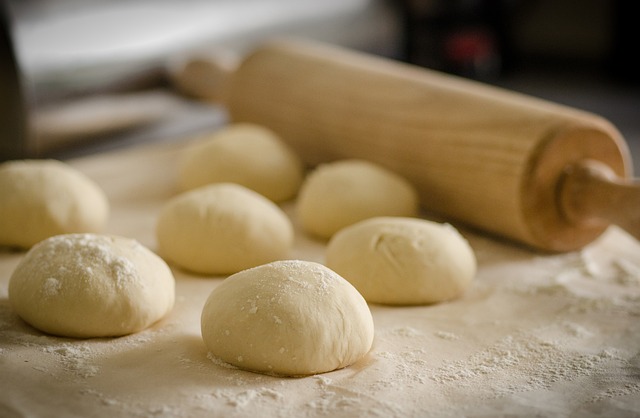
A rolling pin and several balls of biscuit dough on a floured board.

It also started as a funerary feast. While it’s associated with the Celtic deity Lugh, he created this festival in remembrance of Tailtiu, his mother figure. She’d died of exhaustion after clearing the land for growing crops. That makes this festival a poignant combination of anticipation of what’s to come, and gratitude for what has passed. It’s joy and sorrow, thanksgiving and mourning. Tailtiu has passed on, but the land is ready.

This year, we were supposed to join in a camping trip and Lughnasadh celebration. Unfortunately, a combination of high temperatures and severe weather meant that that didn’t pan out the way we’d wanted. Instead, it’s given me more time to think and (as overused as this phrase may be) connect with this High Day.

Really, I’m at a Lughnasadh point in my life. The rise of AI chat bots has coincided with the natural end of several long-term paid writing projects that I’d been working on, so I’m not getting the same volume of work that I once was. At the same time, I’m investing more of my time, money, and energy into other things that haven’t yet paid off. There’s mostly been a lot of planning and reading stuff to help me figure out how to navigate this transition.

Fresh blueberries on a wooden surface.

But I’m not doing that today. Today, I’m extremely thankful for everything that the old cycle has given me. I’ve reaped some very generous harvests from it, and that’s awesome. I’m also excited for my next projects. Having less paid writing means less money, but it also means a lot more time and creative energy to put into things that have deeper meaning for me.

Today, I’m baking bread. I’m making these very strange (but very delicious) cookies full of dried berries and cacao chunks. I’m eating dried blueberries by the handful, and searching my strawberry plants for ripe, red berries.

Have a happy and abundant Lughnasadh, and I hope we all reap a good harvest in the days to come!

Plants and Herbs

Hyssop Folklore and Magical Properties

The anise hyssop in my little pollinator garden is putting of spikes of beautiful purple flowers, so I thought I’d write a bit about the magical uses and folklore of hyssop.

A fun fact first, though — anise hyssop (Agastache foeniculum) is not that closely related to actual hyssop (Hyssopus officinalis). Both of them are members of the mint family, Lamiaceae, but so are teak, rosemary, and chia. Anise hyssop is native to Central and North America, while hyssop is from the Mediterranean eastward to Asia.

Anise hyssop is definitely a useful plant, but I figured I’d cover hyssop-hyssop first. If you practice one of the many branches of European-based witchcraft or folk magic, you’re more likely to encounter Hyssopus in old texts.

Hyssop Folklore and Magical Uses

A lot of the modern lore about hyssop comes from its mention in the Bible. It’s indicated numerous times as a cleansing and protective herb. For example:

Cleanse me with hyssop, and I will be clean; wash me, and I will be whiter than snow.

Psalm 51:7

Take a bunch of hyssop, dip it into the blood in the basin and put some of the blood on the top and on both sides of the doorframe. None of you shall go out of the door of your house until morning.

Exodus 12:22

To purify the house he is to take two birds and some cedar wood, scarlet yarn and hyssop.

Leviticus 14:49

When Moses had proclaimed every command of the law to all the people, he took the blood of calves, together with water, scarlet wool and branches of hyssop, and sprinkled the scroll and all the people.

Hebrews 9:19

There’s more, but you probably get the idea. However, this runs into the same problem as anise hyssop versus hyssop. The hyssop mentioned in the Bible is not H. officinalis. (Biblical hyssop is more likely to be Capporis spinosa or Origanum syriacum.) Nonetheless, I figured the Biblical references to hyssop were worth including because they inform quite a bit of the body of lore about H. officinalis.

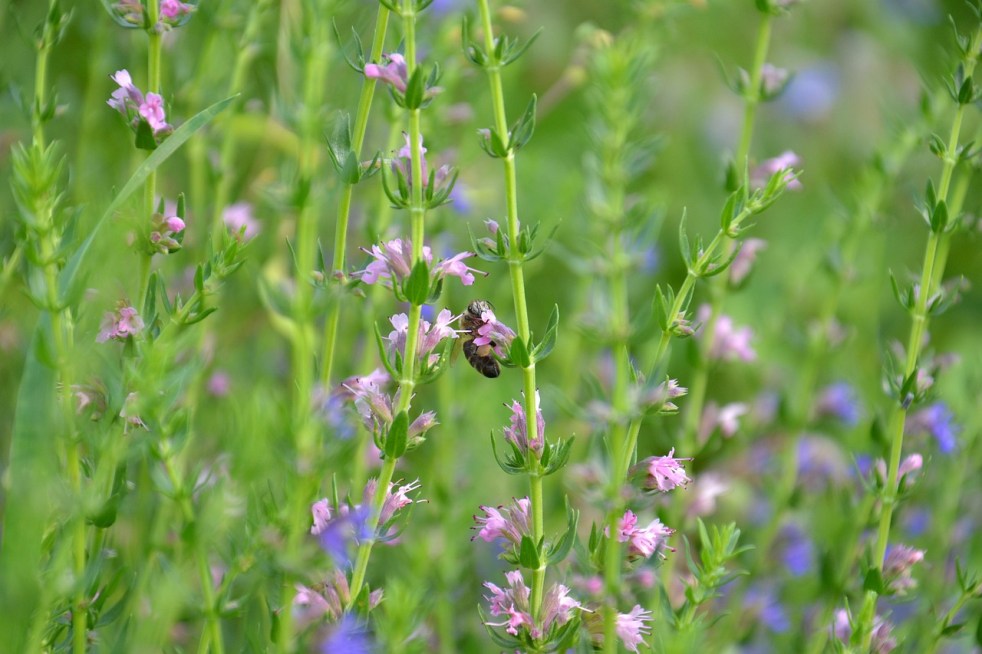
A spike of bright violet-blue hyssop flowers.

The name “hyssop” derives from the Greek word hyssopos, which derives in turn from ezov or azob, the sacred hyssop mentioned in the Bible.

In Egypt, Priests used hyssop as an additive to purify food. This was necessary to make certain foods acceptable for their restricted diet.

Magically, hyssop corresponds to the element of Fire and the planet Jupiter. Following the uses of Biblical hyssop, it’s most commonly employed as a purification and protection herb.

Medicinally, a decoction of hyssop was used topically for treating head lice. It was also used a topical remedy for minor wounds.

In Europe, hyssop was used as a strewing herb. It’s fragrant and seems to have had some action against pests (like head lice, as mentioned above). This may have made it an effective way to keep fleas and other unwanted guests away!

This last bit is particularly interesting to me. In my herb lore reading, I’ve found that the Venn diagram between “herbs used magically for protection” and “herbs that keep bugs out” is almost, but not quite, a circle. Since the Biblical hyssop probably wasn’t hyssop at all, it’s interesting to me that the purposes of Biblical hyssop and European hyssop are so close. It raises a kind of chicken-and-egg scenario — was H. officinalis named for the Biblical hyssop because its pest repellent action “purified” spaces?

Using Hyssop

Sprigs of hyssop make lovely aspergilla. Dip them in water, and use them to asperge sacred spaces, rooms, people, or objects.

Brew hyssop as a tea, strain out the spent leaves, and add the water to ritual baths for purification, cleansing, and hex-breaking. Prepare hyssop the same way, then add to a bucket of fresh water and use it for washing floors, windows, and doors for the same purpose.

A fritillary butterfly on a spike of hyssop flowers.

Add dried hyssop to charm bags for protection, particularly against the evil eye.

Hyssop is sometimes used to season food, and that’s fine. It’s even sometimes used internally in a medical context, and that’s okay too (as long as it’s under the supervision of a qualified herbalist). Otherwise, avoid eating or drinking hyssop. Large doses can cause seizures and cause miscarriages. It’s not known how much of hyssop’s active constituents may pass through breastmilk, and the threshold for hyssop toxicity is much lower for children, so it’s best avoided while breastfeeding.

life · Neodruidry

A Midsummer Bardic Circle

I love bardic circles. There’s something that’s so much fun about finding a song, poem, or story to share, and listening to the things that others have brought to share with you. Hearing these things can tell you more about a person than hours of conversation can — what they find beautiful or moving. What they want others to hear. What they hold as important.

A daisy opens to the sun.

There are few feelings as good as finding your feelings, crystallized and stated by someone more eloquent than you. Bardic circles are a chance to find those things and show them to others.

This year’s was busier than last year’s, which was nice. There were plenty of old and new friends, tons of food, and lots of things for the goods and gear swap.

I shared two poems from Jarod K. Anderson‘s “Love Notes from the Hollow Tree,” ate a ton of black raspberries, watermelon, homemade pickles, and (veggie) hot dogs, and traded books and crystals for more books, homemade incense, peach preserves, pickled watermelon, camping supplies, and a beautiful card of the Druid’s Prayer for Peace done in purple watercolor.

Raspberries ripening on the bush.

We sang together, laughed, and talked about things. The crows in my yard. Gardens. Where the wild berries were ripening, and when to gather to forage for them. Next month’s camping trip. History, legends, and prayers.
Too much to enumerate here, and even trying to do so would just make the words flatten like toothpaste.

As usual, I went home to immediately agonize over everything I said and did (and everything I didn’t), but the social anxiety is worth it. I’m grateful for having a community of such generous, creative, intelligent, and warm people. I’m grateful that we’re welcoming to anyone who wants to come along to learn and share as well.

Deep within the still center of my being, may I find peace.

Silently within the quiet of the grove, may I share peace.

Gently within the greater circle of human kinds, may I radiate peace.”

The Druids Prayer for Peace
Plants and Herbs · Witchcraft

Yarrow Folklore and Magical Properties

You know, I never really connected with yarrow. I know it’s kind of a magical herb staple, but I was always more into mugwort and its ilk. For some reason, yarrow just didn’t quite grab me the way that certain other herbs did.

All of that aside, I have lots of it now. When I embarked on my crusade to murder the grass and replace it with useful things (my rules are that they must either feed me or the local fauna, and preferably both), yarrow was a natural fit. It’s a lovely plant that gets tall enough to fill the space in my flower beds, and it’s very aromatic. Working with it in a gardening capacity has given me a new appreciation for it as a magical and medicinal herb, and the bees really seem to enjoy it.

Yarrow Folklore and Magical Uses

Yarrow is one of the oldest medicinal herbs. Like, pre-pre-history old. Archaeologists have identified yarrow among the belongings of a 65,000 year old Neanderthal.

Achillea specimens are found pretty much everywhere, with the exception of Africa and Antarctica. There are Achillea millefolium subspecies found in Europe, Asia, the Arctic, the Himalayas, the Alps, the Carpathians, the western US, Alaska, the US in general, and one particular that’s endemic solely to California. It’s probably not surprising that it’s often considered an aggressive weed, and may be best confined to areas that you either don’t mind having it take over, or allow you to control its spread.

Interestingly, all of these subspecies seem to have different medicinal effects. There’s some overlap, of course, but each subspecies appears to have different ratios of medicinal compounds.

The genus Achillea is named for the Greek hero Achilles. Chiron taught him the plant’s medicinal properties (specifically using it to treat wounds — hence its other common name, woundwort) and carried it into battle. It’s anti-inflammatory and antibacterial, so it’s a good plant to reach for to treat minor cuts, scrapes, and bruises.

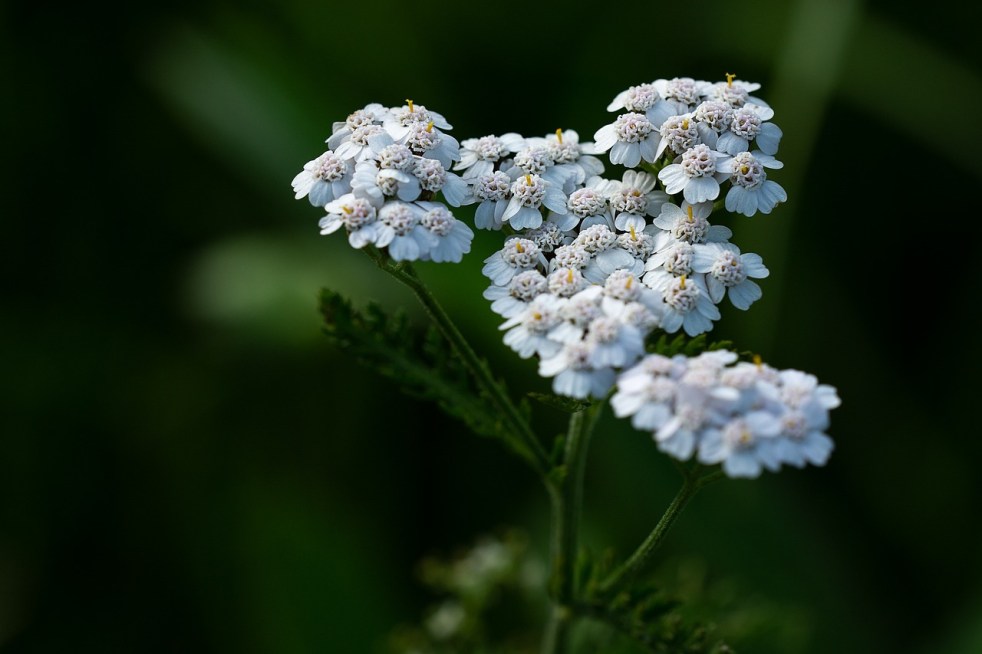
White, yellow, and pink yarrow flowers in a green field at sunset.
Chiron was half-man, half-horse, and a great healer. That makes him the Centaur for Disease Control.

This connection with battle may be why yarrow is also used as an herb for courage.

Yarrow is a protective and purifying herb. Like many herbs used to cleanse and protect, this action is borne out by its ability to repel pests. Experiments with birds using yarrow as a nest lining found that it inhibits the growth of parasites. The connection between repelling pests and magical protection is seen pretty often, as with pennyroyal, or fennel, for example.

In Europe, scattering yarrow across the threshold of a home was believed to keep evil from entering.

Yarrow is historically a divination herb. In China, one way to cast the I Ching involved counting stalks of yarrow. In Europe, it was used for love divination. You’d take a yarrow leaf and stick it up your nose, tickling yourself with it as you said,

Yarroway, yarroway

Bear a white blow.

If my love love me,

Let my nose bleed now.”

Traditional

Another method for love-divination involved placing yarrow under your pillow. If you dreamt of your love, it was a positive omen. If you had a bad dream, or dreamt of other people, it wasn’t.

An old Gaelic incantation for yarrow-picking went thus:

I pluck the smooth yarrow,

That my finger be sweeter,

That my lips be warmer,

That my voice be gladder.”

Yarrow was said to be a sacred plant to the ancient Druids, used for weather divination.

In the Victorian language of flowers, yarrow represented everlasting love.

Yarrow is connected to Venus and the element of Water.

Using Yarrow

Since so many practitioners of witchcraft and Druidry have pets and small children, I probably wouldn’t recommend just strewing your threshold with yarrow. Instead, scatter some of the dried herb under your front doormat, where curious hands or snouts can’t get into it. You can also grow yarrow near your front door — it’ll feed your local pollinators and help keep evil away.

Yarrow hydrosol is another useful way to work with this herb. It’s good for your skin. (For real, an ointment containing yarrow was researched for its ability to help heal episiotomies. Ouch!) It can also have a purifying effect, so it’s a nice way to prepare yourself for rituals. The leaves and hydrosol are also fragrant, so the scent is a nice for getting into a magical mindset.

For divination, you could either learn to cast the I Ching with traditional yarrow stalks, or include it in a spray or sachet to use while reading tarot, runes, or Ogham staves. Including it in a dream pillow is said to lead to prophetic dreams.

A soft, dreamy image of pink yarrow flowers.

As a Venus-ruled herb, it’s also a good choice to include in love jars or sachets. Traditionally, its power was to help the user find their true love, and keep lovers together. That makes it a worthwhile addition to spell to draw in true love and help it last.

Medicinally, yarrow hydrosols, infusions, and ointments are great for topical conditions like stings, bug bites, scrapes, burns, scratches, cuts, and bruises. (Never put anything ointment-y over deep wounds, puncture wounds, or animal bites, however.) Teabags or poultices of yarrow are also nice for easing sore eyes — just be careful not to get yarrow in them! If you’re allergic to yarrow or other members of the Asteraceae family, skip yarrow and use something else.

This herb is also used for treating a ton of internal conditions, from digestive trouble to colds and flu. But, like I mentioned previously, each subspecies seems to have its specialties. Before using yarrow internally, you should consult with a qualified herbal practitioner to choose the safest and most effective herbs for your condition.

life · Neodruidry

“You can go your own way.”

The other day, I got a bunch of emails. Each one regretfully informed me that my email address had been taken off of one of ADF’s mailing lists — artisans, Gael, and a handful of others.

My emotions mixed. First, there was a tinge of embarrassment. I was removed because my email was no longer on their member rolls, which is because I didn’t pay this year’s dues. Next was sadness, then relief.

I wanted to study the Initiate’s Path according to ADF‘s curriculum, but, every time I tried, I always found it difficult to start. It didn’t seem quite as structured as the Dedicant’s Path, and their site migration seemed to cut me off from finding out what I was supposed to be doing.

On the other hand, I got exactly what I needed from ADF. Years ago, I was dealing with a sense of discontentment and a lack of focus. Being an eclectic practitioner resonates with me, and I never really felt quite “at home” in other traditions I had contact with along the way. Still, I felt like I needed something.

That something, as it turns out, was more structure. Following the Dedicant’s Path gave me that: High Days, rigorous study, and the Core Order of Ritual. Once I had that, I didn’t really interact with ADF as much as I would’ve liked. Even the Neodruidry groups I’m in now are primarily made up of members of OBOD and the AODA, so it doesn’t really matter where one studies or what brought them to Druidry.

I chose to take forgetting to renew my membership as a sign. Rather than have my lack of progress on the Initiate’s Path hanging over my head, I’m going to take this time to formulate my own study plan.

I might rejoin ADF in the future, join a different group, or use the foundation provided by ADF to build on myself. I still consider myself an eclectic practitioner and always have, so it could be that I’ve already taken what I needed from this experience.

Either way, I can’t wait to see what the future brings. 💚

life · Neodruidry · Plants and Herbs

Increasing Landscape Resilience with Native-ish Plants

Hello! It’s April, it’s going to be almost 90° F this weekend, and winter skipped us.

Well, we had like one cold week, but that was it.

Honestly, it’s had me worried. A number of plant species that are native to this area require cold stratification — in other words, they need a period of cold and some pretty big temperature swings in order to trigger them to germinate at the correct time. This includes a tree that’s very important to me, the bald cypress. They’ve evolved to need cold stratification because without it, their seeds could germinate far too early and die off in the middle of winter.

I have packets of seeds that I want to plant, too, that need to be sown within a narrow window of time. I’m talking when temperatures are cool (but not too cool), usually right around the last frost date. The trouble is… like I said, it’s going to be in the high 80s this weekend. Our official last frost date was a few days ago.

Now that I’ve gotten my complaining out of the way, there’s an idea I’ve been exploring.

I first ran into it when I was researching native hydrangeas. I love hydrangeas in general (my grandfather had a big hydrangea next to the house I grew up in, alongside a strangely persistent and hardy opuntia cactus), but they’re not really known for their heat tolerance. They are, by far, not the only plants that are going to suffer as temperatures increase either.

A hand touches a cluster of purple Hydrangea macrophylla flowers.

Smooth hydrangea (Hydrangea arborescens) is native to this area. They also prefer daytime temperatures in the 70s and require supplemental irrigation when it gets too hot and dry.

Oakleaf hydrangeas (Hydrangea quercifolia) are native to the Southeastern United States. In other words, they’re from the US, just a bit lower than where I live. Changes in average temperatures are expanding the range of some southern plants and animals, while driving others further north.

Unfortunately, there’s not much that a single person can do to keep their cool temperature-loving plants from suffering from this effect. It’s also debatable whether we should — landscapes are ever-changing and evolving, and state borders are artificial constructs that plants and animals don’t recognize. It may increase the resilience of the landscape to work with this shift, rather than against it.

For this reason, I’m experimenting with oakleaf and smooth hydrangeas. Experts point out that this area’s climate is slowly aligning with species that used to be relegated to more southern states. Blending some Southern species with Midatlantic species could help create a plant, animal, and fungal community that’s more resilient to climate change, and decrease the need for supplemental irrigation or treatment for diseases related to heat stress.

Saving seeds from the individual native plants that seem to struggle less with the heat can help their species adapt over time, which will feed and protect the native animal species that depend on them. Adding in native-ish species from a bit further south can help the land adapt. It also ensures sources of food and nesting sites for the animals that are also being driven north as temperatures rise.

crystals

Andara Crystals — What are they, and what’s their deal?

There are a number of stones in the gemstone trade that are referred to as crystals, when they really aren’t. Some, like art glass, don’t have a crystalline structure. Others might be mineraloids, which also lack a crystalline structure. All of this is to say that a fair amount of “crystals” aren’t really crystals at all.

With that out of the way, let’s look at Andara crystals. These are often brightly colored, very fancy-looking clear stones that are purported to have a ton of healing and metaphysical properties (and fetch correspondingly high prices). But what are they, and why are they controversial?

What are Andara crystals?

Andara crystals are said to be natural glass which comes from a handful of specific sites in northern California and Nevada, which are the foci of particularly high-energy vortices. These crystals come in every shade of the rainbow, and fans say that they can heal, balance the chakras, raise vibrations, and more. Some even claim that they’re the philosopher’s stone of legend, or an ancient healing tool used in Atlantis.

These stones are said to contain etherium, which is a blend of 70 different minerals. Some are listed as monatomic, which refers to substances made up of elements that naturally exist as a single atom.

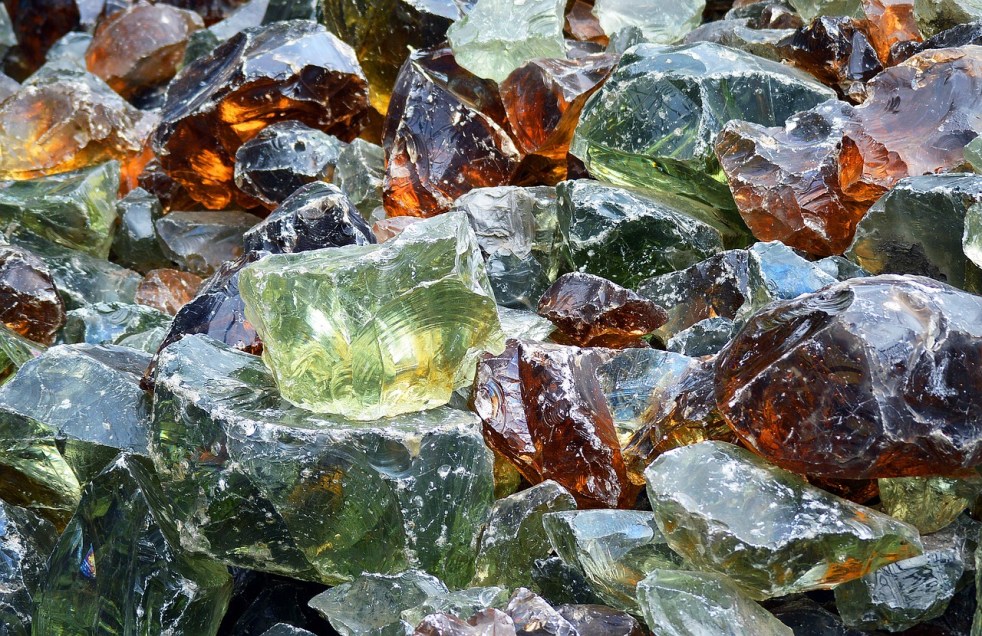
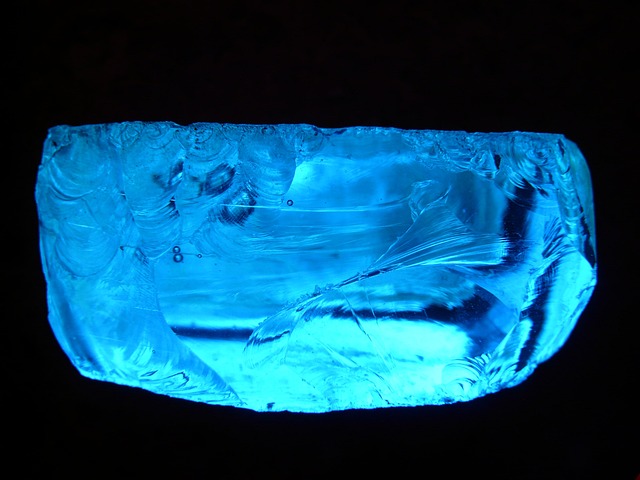
A chunk of blue glass on a black background.

Okay, so why are they controversial?

Andara crystals are controversial for a few reasons. For one, they’re not crystals. They’re a type of glass.

For two, they’re not natural (as in, formed by nature). Andara crystal deposits correspond to land dumps of slag glass from manufacturing. They look like slag, and their chemical composition correlates to soda lime glass, of the type used to make bottles. It doesn’t resemble other forms of natural glass, like obsidian or moldavite. The chart in this post gives a pretty thorough breakdown.

The funny thing is that some sellers extol the virtues of Andara crystal and claim that part of its specialness lies in its dissimilarity to other natural glasses. Yes, of course it’s not similar to them — because it’s soda lime glass.

Selling Andara crystals as a natural product is a bit like selling beach glass and claiming it was formed by nature. It may have been shaped and influenced by it, but it’s a man-made material at its heart.

The controversy doesn’t like in Andara crystal’s man-made origins, however — it’s because it’s literally a manufacturing byproduct. Chunks of slag glass get dug up, cleaned off, labeled with a lot of healing and metaphysical properties, then sold for sometimes hundreds to thousands of dollars.

This has caused trouble with not only buyers, but also dealers. When you’re selling something indistinguishable from a chunk of broken bottle, it becomes a race against “counterfeiters.” (I use “counterfeiters” here because the counterfeits are, again, indistinguishable from the alleged genuine articles.) This has led to dealers claiming that their glass is the only true Andara crystal, and dealers selling specimens back and forth to each other — accompanied by certificates of authenticity.

The Emperor’s New Crystal

Is it bad to use a man-made material for metaphysical, spiritual, or even energetic healing purposes? Not necessarily. I honestly love the idea of using slag glass this way, because it removes manufacturing waste from the environment and gives it a second life.

(A crystal — any crystal — isn’t going to take the place of the services of a competent medical professional. If you need insulin or to have a tumor removed, there is no stone that will make that not be the case anymore. I’ve used crystals to get relief alongside conventional treatment and complementary therapies, but I’m not out here trying to cure pseudotumor cerebri by rubbing rocks on my head.)

But here’s where we get into what I think of as the Barmicide Feast of crystals — or, if you prefer, the Emperor’s New Crystal.

It’s true that developing your own personal associations is important for any magical or spiritual tool. I have stones I work with that I love, but other people don’t get anything from. Other people have crystals or herbs that they love, but I get nothing from. These relationships shift and evolve over time, and that’s good and fine.

Unfortunately, some proponents of Andara crystal have used this as a selling point in a way that’s, frankly, kind of gross. They attach long lists of metaphysical attributes to this glass, then claim that only the special and spiritually evolved can feel or access them. If you see the slag for what it is — slag — then you need to get on their level.
See? Nasty.

The biggest problem here is that they’re exploiting a grain of truth to build up the cachet of a manufacturing byproduct in order to charge exorbitant amounts of money for it. They’re not wrong when they say that not everyone can experience the energy of a stone — even glass. The shitty part comes from using this exclusionary tactic to get money from people who want to be part of the in-group. Vulnerable people who want to feel that special energy, to feel elevated and included, and are willing to pay for it.

The underlying message is that when you compliment the Emperor’s gorgeous robes and rave about Barmicide’s pistachio-fed lamb cutlets, you, too, can be spiritually evolved.

Again, the shady part isn’t using (or even selling) soda lime glass as a magical or spiritual tool. The shady part is overcharging for a common, inexpensive material.

If you have and use Andara glass, that’s wonderful. My only advice here is, if you feel drawn to it, use this as a starting point to unpack your relationship with crystals. What’s different about that soda glass versus other materials that are around you? If it’s its place of origin, consider visiting this energy vortex and experiencing it for yourself — you might find a piece of regular quartz or some other mineral that gives you just as much, but you won’t have to overpay for it. If it’s the metaphysical claims and the experience of buying the stone from a dealer, then that may be something worth exploring further.

Environment · life · Neodruidry · Plants and Herbs

Persimmon Foraging Quest

Hello! If you’ve been reading here for a while now, you may have come across the Persimmon Quest.

This is an annual quest my partner and I go on every autumn. We call around or visit grocery stores in order to find out who actually has persimmons (preferably the astringent kind, but non-astringent will also do). Then, we purchase and eat massive quantities of persimmons.

The first time I had one was when I still lived in California. It was a Fuyu persimmon (Diospyros kaki), crunchy and sweet, and I was sold. When I had my first perfectly ripe Hachiya, like a water balloon filled with sweet, flavorful jelly, I was smitten. When I realized that one of the trees planted here by one of the former occupants was probably a persimmon, I was ecstatic.

A Druidry group I belong to recently offered a small foraging expedition. One of our members is a biologist, and he’s kind and generous enough with his time to lead seasonal foraging walks. Last spring, we hunted for ramps. Now that it’s persimmon season, we went to track down some trees.

And oh, did we ever.

Three bags of soft, bright orange American persimmons, along with a sprig of coralberry and some dried mountain mint.

Several of them were already bare, picked over by wildlife and wind. Some were still laden with fruit that fell at the slightest touch. We picked only the ripest, squishiest ones, leaving the rest to soften in the sun and feed other things.

My partner and I came away with several pounds, which I cleaned and froze for future use. They’re very different from Japanese persimmons — we snacked on a few as we foraged, and it was striking just how much the flavor seemed to vary from tree to tree. American persimmons (Diospyros virginiana) are most similar to Hachiya-type Japanese persimmons, in that they’re very astringent before they’re ripe. When they look like they’re nearly rotten, they’re at their best.

Most of the ones I tasted were almost floral when compared to a Hachiya. Still very sweet and soft (with a slight astringent bite in a few places), but floral like lavender lemonade is floral. The comparatively large seeds got in the way a bit, but I’ve read some interesting recipes for roasting and grinding them to make a coffee substitute. As someone who doesn’t drink coffee, I’m intrigued! If I can get a foraged equivalent for Dandy Blend that isn’t dandelion root, I’ll be excited.

I haven’t yet decided what to do with the persimmons themselves. I might separate the seeds and pulp, then freeze the pulp again in an ice cube tray. I figure, if I want to add them to smoothies, sauces, or desserts, I can just thaw out some cubes of prepared persimmon mush fairly quickly and easily. I could even pop a cube or two in a jar for making persimmon kefir. (One member of the group was considering doing fruit leather but based on my experiences trying to make strawberry leather in the oven, I don’t think I want to tackle that without a dehydrator.)

There was a lot more to see than just persimmons, too. Dogbane (Apocynum cannabinum) with its stringy bark (good for stripping and braiding into twine). Horsenettle (Solanum carolinense) with its bright yellow, tomato-like, deceptively delicious-looking poisonous fruits. Fragrant tufts of mountain mint (Pycnanthemum muticum), gray and brittle with age. The most striking were the coralberries (Symphoricarpos orbiculatus), their tiny, bright magenta fruits standing in vibrant contrast to their bright green leaves.

I found these berries particularly intriguing. As it turns out, they’re a valuable native food plant for birds, grow in shade, can stabilize banks, don’t have any major pest or disease vulnerabilities, and thrive on neglect. I’m still looking for native/non-invasive plants to help feed the yard’s hard clay soil and reverse some of the damage from supporting a lawn, and coralberry fills a very important niche here. From what I have read, coralberries aren’t of much value as food for humans. That’s okay, though. Not everything in the yard has to — or should — be for me to eat.

Plus they are so pretty.

I’m considering growing some mountain mint, too. Like other mints, they can take over a yard. Since they’re a native plant, I think it’ll be easier to keep them at a reasonable level than, say, the old peppermint that’s slowly eating part of the back yard. Interestingly, it’s closer to bee balm (monarda) than it is to peppermint, and there’s a faint bee balm-ness to its scent that gives that away. Mountain mint also attracts an incredible variety of native pollinators and predatory wasps, and is both edible and medicinal. Medicinally, it’s treated almost as a panacea — it’s considered a digestive, carminative, emmenagogue, expectorant, and more, though I haven’t thoroughly researched the active constituents myself yet. If it can serve as a home-grown, native substitute for peppermint tea, I’ll be all for it. The flavor does lead me to think that it’d be great for seasoning poultry or wild game, and I’m eager to try.

That’s what I love about foraging trips. Not only do I come away with tasty food, but I also get a better idea of ways to try to heal the land I’m now responsible for. Seeing a wide variety of native plants shows me what this patch of grass could be and tells me how I can help it get there. I’m excited!

life · Neodruidry

Letting my mind and spirit free.

I’m writing the after a soak in loads of epsom salt. My muscles are sore and tired, but the kind of “vacation” sore and tired you get from a day of activities you’ve long looked forward to.

Can I tell you how much I love Pagan Pride Day? In the past, it was just nice to go to a place where I felt less isolated. This year, my partner and I were able to go, hang out, and just enjoy the company of good people from the Druid group I’m involved in.

We sat under the spread of an oak tree that occasionally dropped a gentle rain of acorns on us when the wind blew right, eating fruit, shaved ice, and very good Filipino food (provided by Rollz On Wheelz). There was music and dancing, and friends and acquaintances who passed by, stopped for a chat or an introduction, then drifted back into the crowd. My partner and I walked by all of the vendors, secretly pointing out what we’d bring home that afternoon and what we’d hope to see next year.

I picked up handmade soap, Florida water, supplies for offerings, a beautiful devotional bracelet to my patron deity, and a horseshoe for the front door. I also obtained a large, crocheted axolotl, and the seller and I laughed about his adorably wonky eye — as it turns out, we’re both people who gravitate toward things that are slightly off. Not always things in need of repair, but things that are a little out of the norm and likely to get overlooked. He was the last one of his kind, and I knew that leaving him behind was going to eat at me. He’s also made of very, very soft chenille, is delightful to hug, and I apologize to no one for my strange sympathies for inanimate objects.

Admittedly, the event had a strange kind of melancholy for me, too. I was talking to two people about the generational differences between witches and Pagans, open and closed practices, gatekeeping, “Witchtok,” and the seemingly shrinking role of elders in the ever-expanding online community. The internet has provided more interaction and connectivity than ever seen in history, but at a cost — the wisdom of experienced people is easily drowned out by teachings that can be inaccurate at best, and dangerous at worst.

I say it was melancholy for two reasons: For one, I feel a pain in my heart for people looking for a place for themselves. I was one for a long time. I was happy with an eclectic practice, but opportunities to learn from experienced practitioners were few and far between. I kludged together what scraps of information I could get but becoming part of a more organized tradition gave me something that eclecticism and patchwork internet teachings didn’t. This won’t be the case for everybody, but damn do I wish that people had access and opportunities that would let them discover and decide for themselves rather than feeling like their only options are books and social media. I know I would’ve loved to have had that opportunity years ago, even if I might’ve turned it down at the time. At the very least, I wish I had been free to make that choice for myself when I was young.

For two, I feel melancholy because it was a bit of a memento mori. Every day brings me closer to being an elder, or a spiritual ancestor. The idea of mortality isn’t really what bothers me — I more than made peace with that a long time ago — but the feeling of ever-plodding obsolescence is. It’s like a sense of loss for something that isn’t gone yet. I don’t really know how to describe it.

So I guess all of this is to say that I love feeling like I’m in a place I belong. It reminds me of the warm, vibrant, thrumming dance of life, with all of its sweetness and bitterness and joy and sorrow and love and loss. I love the drums and the hum of insects. I love the smells of incense and late summer wind through oak leaves. I love the candy sweetness of syrupy ices and the coolness of Florida water on my temples. I love the warmth of tree-dappled sunlight and the smooth coolness of polished bone.

Arright, I’m gonna go before I get more emotional. I need to get the cabbage butterflies off my broccoli anyhow.

Here ’til the lettuce peeks to see the salad dressing,

j.