divination · Neodruidry · Witchcraft

Footprint Folklore & Magical Properties

With so much snow on the ground, it’s been even easier to keep track of all of the visitors to the front and back yards. From the efficient single-track prints of stray cats, to snowshoe prints of rabbits, to the rodent tracks ending in the sudden whump of an owl, they all stand out starkly in fresh snow.

A set of squirrel tracks in snow.
For example, these prints by resident Absolute Unit Frederick de Bonesby, the gray squirrel.

The weather is warming up bit by bit (it’s supposed to be in the 60s F this weekend, go figure), so the snow isn’t long for this world. With that in mind, I thought this might be a good time to look at different folk beliefs and folk magic practices involving animal tracks and footprints.

Unique footprints and strange feet are a defining characteristic of many cryptids and folk monsters:

  • The Tupi-Guarani people of Brazil have the Curupira (Tupi for “blister-covered”), a kind of demon with fiery red hair and backwards feet.
  • The Scottish have the glaistig or maighdean uaine (“Green maiden”); a gray skinned, blonde-haired woman with a long green skirt to hide her goat legs.
  • In Madagascar, there is the Kalanoro. This is a humanoid cryptid described as a small, hairy person with red eyes and backwards-facing legs and feet. While they are said to have once lived in corporeal forms, habitat destruction has left only their spirit forms behind.
  • In the Himalayas, there are Abarimon (“mountain-dweller”). These are said to be vicious humanoids with backwards feet who lived solely in a single mountain valley. While Abarimon were dangerous, they could only breathe the air of their valley home, and thus were unable to ever leave it.
  • In Trinidad and Tobago, there is the Douen. This entity is another humanoid with backwards facing feet but has the distinction of also lacking any facial features other than a mouth. If they hear a child’s name, they are said to be able to mimic the parents’ voices, calling to the child to lure them into the forest. Douen may be related to the duende, humanoid spirits from Spain and Latin America.
  • In Australia, there’s the Yowie. This is a tall creature covered in dark hair, often said to have backwards-pointing feet.
  • The Dominican Republic has La Ciguapa, a lovely wild woman with long, dark, silken hair, beautiful bronze skin, and backwards feet. While small, she is perfectly proportioned and incredibly agile. She’s said to use her beauty and agility to prey on those who are foolish enough to venture into the woods — her domain — alone.
  • On the Indian subcontinent, there are ghosts known as bhuta. These can shapeshift into any animal, but often appear as perfectly normal humans — save for their backward-facing feet.

To be honest, you’d probably be hard pressed to find a culture that doesn’t have some version of “cryptid whose main thing is having weird feet.” Many of them serve as cautionary tales against wandering dangerous places alone, especially for children. They’re the personification of situations that seem perfectly safe, or even nice (like meeting a beautiful woman on a walk in the woods), and lure you in before you notice the danger that you’re in (like the fact that she’s a cannibalistic cryptid with weird feet). Across cultures, the message here is also pretty consistent: Stay away from strangers, and out of the wilderness at night.

In northeastern Tanzania, there are a series of incredibly ancient footprints set in stone. These point to two small groups of hominids (likely members of Australopithecus afarensis) traveling in the same direction. The Maasai people associate these footprints with Lakalanga, a hero so big that he was said to leave footprints sunk into the ground wherever he walked. He is said to have helped the Maasai win a battle against a neighboring enemy, long, long ago.

In South Devon, England, a heavy snow fell in the winter of 1855. The next day, and for two days after that, mysterious sets of very hooflike marks appeared. They were in single file, roughly 4 inches long by 3 inches wide, and managed to cover a total area of about 40 to 100 miles. Strangely, these hoofprints didn’t seem to care about obstacles — they traveled straight over fences, hedgerows, walls, and even houses. Called the “Devil’s Footprints,” hypotheses for their appearance range from experimental balloons to kangaroos… But there’s still no accepted explanation.

In some magical traditions, footprints are used for sympathetic magic. Any spell benefits from the addition of something belonging to the target — a nail clipping, a lock of hair, or a scrap from their clothing, perhaps. (I once managed to pull something off by getting a target just to touch a grass poppet that I’d made, but that’s neither here nor there.) In the absence of these, footprints often suffice.

Some magical powders, like the hot foot powder used in Hoodoo, are sprinkled into a person’s footprints to control their actions. This derives from the traditional West African practice of foot track magic, brought to the Americas by the transatlantic slave trade.

Reading animal tracks is also a method of divination. While augury was traditionally divination using the flight paths of birds, you can also gather omens from the number, direction, and maker of tracks you come across.

A set of cat tracks through snow.
These belong to a stray cat. Cats conserve effort when walking trough snow by placing their hind feet directly in the prints of their forefeet.

When it comes to divination using a human’s footprints, the practice is called “ichnomancy.” This comes from the Greek “ixnos,” meaning “footstep,” and “manteia,” meaning “method of divination.”

Divining with footprints can be a little difficult, since you need to be able to read them in a mundane sense first. For example, deep footprints indicate a heavy load. Widely-spaced ones indicate a long stride, perhaps someone running. The different depths of the impression in the heel and ball of the foot areas can also tell you different things.

My first suggestion for working with animal tracks and footprints is to familiarize yourself with what you’re likely to encounter. If a deer walked through your yard, what would it look like? How about a dog, or a bear? What impressions does it leave when a bird of prey scoops up a rat, or a squirrel? Consider your connections and associations to each of these creatures. What would their appearance mean to you?

Next, consider their other qualities. Movement to the left is often considered an ill omen, while the right is considered a positive one. For example, seeing the tracks of a bear or mountain lion moving quickly toward your left could be an omen of danger. Seeing the tracks of an animal you have a positive connection to, moving at a leisurely pace toward your right, could be a very good omen.

Working with footprints in a magical context is a bit different. You can collect the dirt from within a footprint and use it to target a spell toward whoever left the footprint. You can also sprinkle magical powders or crushed herbs in someone’s tracks, or over a place where you expect them to step. (There are far too many magical powders to enumerate all of their uses and qualities here, unfortunately. Since this is a method frequently employed by Hoodoo practitioners, you may wish to consult with one for more information. Many online sellers of Hoodoo supplies offer consultations and can answer your questions on foot track magic.)

As for me, I love seeing fresh tracks in the snow. It’s a reminder that, while the outdoors seems to sleep under its cold, fluffy comforter, there’s still plenty happening. Tracks also give me another way to gauge the way everything’s activity increases as we inch closer to spring. I look forward to seeing tracks in the mud and snow just as much as I look forward to seeing new faces at the feeders and in the fruit trees.

Neodruidry · Witchcraft

Traditional Healing Chants (also my blender tried to kill me)

Hello! I haven’t been around for like two weeks. Originally, I did plan to take a couple of days off for Yule, however one of my household’s Yuletide gifts was a hugely upgraded blender.

(To be fair, our bar for a blender upgrade was not high. The one we were using before cost, I think, six dollars at a thrift store. We used that thing until it flat out refused to be used anymore.)

Anyhow, long story short, fancy blenders do not always fit together the way that I assumed they would. They’re also way sharper than my old one. Yadda yadda yadda, the middle felt out, hit the side of my hand on the way down, and it took so many Steri-Strips to put everything back together. I’m talking a solid half-inch thick flap of hand meat. Enough blood for an axe murder. Half a box of strips. Most of a tube of some kind of fish glue that I’m told is supposed to seal cuts closed.

A large, flamey explosion. The remains of some kind of structure can be seen silhouetted in the flames.
A reenactment.

Anyhow, typing was problematic, so I took a little bit longer. I don’t generally keep a big bank of posts to drop automatically, hence there being no content for a little bit. C’est la guerre.

This seemed like a good time to talk about healing chants. I find these really interesting — they’re not quite sympathetic magic, since they’re just spoken words, but they do remind me a lot of certain forms of weather magic. In those, you pretty much go outside, pour water on the ground, and tell the sky to get its act together because it’s not like raining is difficult. Healing chants are essentially an instruction, telling bones to knit together, wounds to close, and blood to clot.

You can see this in the following healing chant, excerpted from Joanna van der Hoeven‘s The Book of Hedge Druidry (Spell for healing, page 274-275):

Bone to bone,

Flesh to flesh,

Sinew to sinew,

Vein to vein;

As Brighid healed that

May I heal this

This is far from a modern invention. The second Merseburg charm goes as follows:

Phol ende uuodan
uuorun zi holza.
du uuart demo balderes uolon
sin uuoz birenkit.
thu biguol en sinthgunt,
sunna era suister;
thu biguol en friia,
uolla era suister;
thu biguol en uuodan,
so he uuola conda:
sose benrenki,
sose bluotrenki,
sose lidirenki:
ben zi bena,
bluot zi bluoda,
lid zi geliden,
sose gelimida sin

“[B]en zi bena, bluot zi bluoda, lid zi geliden, sose gelimida sin” translates to “Bone to bone, blood to blood, joints to joints, so may they be glued.”

Similar healing spells are used to cast out “worms” (which may be literal parasites or maggots, or a way of conceptualizing infection in general). These use a similar “flesh to flesh, bone to bone, blood to blood” formula as the chants above, with the added step of sending the infection or infestation into an object — perhaps back into the object from which the wound and infection originated.

Interestingly, these chants are often called “horse charms.” Even the Merseburg charm above relates a story of how Uuodan (Odin), Sinthgunt, and Friia (Frigg) healed Phol’s (Balder’s) horse’s sprained foot. Of the surviving examples of these chants and charms, a disproportionate number of them seem to be for healing leg and hoof ailments in horses and sheep. (Charms for fixing blender accidents are conspicuously absent.)

This photo shows a crouched figure holding a horse hoof in one hand. It shows the relative tininess of the hoof and slenderness of the leg.
Four of these have to support an animal between 900 to 1400 pounds. It is not super surprising that there are a lot of charms for fixing horse problems. Even wild horses aren’t immune to issues — the life expectancy of a wild horse is, on the high end, about half that of a domestic one.

This form of charm isn’t exclusive to Europe, either. The Wikipedia article above cites an example from the Atharvaveda, hymn IV, that follows a similar construction:

 róhaṇy asi róhany asthṇaç chinnásya róhaṇî
róháye ‘dám arundhati
yát te rishṭáṃ yát te dyuttám ásti péshṭraṃ te âtmáni
dhâtấ tád bhadráyâ púnaḥ sáṃ dadhat párushâ páruḥ
sáṃ te majjấ majjñấ bhavatu sámu te párushâ páruḥ
sáṃ te mâmsásya vísrastaṃ sáṃ ásthy ápi rohatu
majjấ majjñấ sáṃ dhîyatâṃ cármaṇâ cárma rohatu
ásṛk te ásthi rohatu ṃâṇsáṃ mâṇséna rohatu
lóma lómnâ sáṃ kalpayâ tvacấ sáṃ kalpayâ tvácam
ásṛk te ásthi rohatu chinnáṃ sáṃ dhehy oshadhe

Here, “majjấ majjñấ sáṃ dhîyatâṃ cármaṇâ cárma rohatu ásá¹›k te ásthi rohatu ṃâṇsáṃ mâṇséna rohatu” translates to “Let marrow be put together with marrow, let skin grow with skin, let thy blood, bone grow, let flesh grow with flesh.” (Here is a further analysis from Sanskrit-linguistics.org.)

This charm is especially fascinating to me, because it means one of two things are true: Either this and the “horse charms” of Europe have a common, incredibly ancient root, or they’re an example of convergent cultural evolution. I’m inclined to believe it’s the former, but the latter would be really cool. I always get such a wonderful sense of eerie mystery when things like that happen, whether it’s culturally (everyone has some kind of bread) or physically (flight has evolved multiple times in unrelated organisms and nature tries to turn everything into crabs). It’s neat. It’s a little spooky. I love it.

Long story short, after a lot of Steri-Strips, gauze, fish glue, multiple recitations of a chant primarily intended to fix horses, and some healing time, my hand is operational again and normal content should resume next week unless I, I don’t know, get my head caught in the stand mixer or light my pants on fire again.

This is why my Handsome Assistant does the dishes, though.
I can’t be trusted.

crystals · Neodruidry · Plants and Herbs · Witchcraft

Working with the elements (when everything’s been paved).

They paved paradise, and put up a parking lot.
Or office blocks, apartments, and retail space, as it were.

A lot of, though certainly not all, magic involves working with all of the elements. Some people do this in absolutely every spell, some only invoke them in longer, more formalized rituals. Some keep representations of all of them on their altars, some have specific, strategically placed altars dedicated to each. Point being, Earth, Air, Fire, and Water will probably come into play at some point.

But what do you do if your daily contact with nature is limited to a window box, a weedy alley, or a grassy strip of median?

For a lot of people in urban areas, working with the elements takes a little ingenuity. You have to branch out from the idea of the sea as crashing waves and be able to see it in the azure blue of a stone, or the briny scent of a vial of seawater. You probably can’t build a bonfire, but you can smell its power in the warm spice of cinnamon incense.

Every element has its own correspondences. Each has its respective colors, crystals, herbs, and symbols. Bringing them into your home or your altar space is as good a beginning as any when it comes to working with natural energies you may not fully experience in your usual environment. You can follow your intuition here, or use some herbs, stones, or other objects usually associated with each element:

Earth

Herbs: Vetiver, potato, turnip, ivy, mushrooms, alfalfa, myrrh, patchouli, sandalwood.
Crystals: Jade, onyx, salt.
Tools: Dishes of salt, crystals or other stones.
Animals: Turtles, bulls, wolves, bears.

Generally, brown, black, or green things, root vegetables, and autumnal herbs are associated with Earth.

Air

Herbs: Anise, fennel, lavender, mint, lemon.
Crystals: Celestite, citrine.
Tools: Incense, wands, fans, feathers.
Animals: Eagles and other birds.

Generally, yellow or blue things, pastel colors, and “bright” flavors are associated with Air.

A person holds a handful of lit incense sticks. Smoke wafts from their glowing, ash-covered tips.

Fire

Herbs: Ginger, rosemary, chili pepper, sunflower, dragon’s blood, cinnamon, clove.
Crystals: Amber, citrine, carnelian, ruby, fire agate, fire opal, red tourmaline, sunstone.
Tools: Blades, wands, candles, burned things.
Animals: Deer, dragons, salamanders.

Generally, red or orange things, things that thrive in sunlight, stinging things, and things that are warm or spicy correspond to the element of Fire.

Water

Herbs: Benzoin, clary sage, Irish moss, water lily, buckthorn, lotus, aloe vera, cacti.
Crystals: Aquamarine, coral, pearl, opal.
Tools: Cups or chalices, cauldrons.
Animals: Salmons and other fish, sea mammals, frogs.

Generally, blue, green, or black things, things that grow in water, things with a high water content, and things that are cool and moist correspond to the element of Water.

A big part of Druidry is the idea of reciprocity. It’s the idea that building a relationship with something — anything, whether it’s a person, a community, or the spirits of the land — requires a conscious effort to give back. Nobody waters dead flowers, and relationships that are one-sided quickly fade.

Cities provide ample opportunities to engage in reciprocity. I remember laying in bed once, in a studio apartment in Washington DC, and seeing a black and white hummingbird hover just outside the window. It was a wonderful little surprise, and a reminder that, once natural sources of food, water, and shelter are taken away, it’s up to us to make up for the loss.
Pavement and metal don’t kill the spirits of the land, just muffle them for a while.

If you work with plants, cities can provide a surprisingly diverse biome. Bricks are a substrate for multiple species of moss. Concrete is no match for the plants that push themselves up through the cracks. Climbing vines, native and otherwise, cling on to rain gutters and windowsills with an admirable tenacity.

Moss growing on and around pavement at the base of a brick wall.

Urban areas are really good for some elemental work, though. The element of Earth is present in the bones of a city, from the steel beams of buildings to the ubiquitous concrete underfoot. Tall buildings give great access to working with Air — few things are as invigorating as a good energy cleanse by standing on a balcony in a strong breeze.

Living in an urban environment doesn’t always make it more difficult to work with the elements. It just takes a little digging.

Plants and Herbs

Holly Folklore and Magical Properties

I’m lucky to live not too far from an arboretum, which means that I have the ability to observe all kinds of incredible trees. A Druid group that I’m part of regularly visits it, too, in order to learn more about native trees and the traditional trees of the ogham. This season, we’re focusing on holly.
The US boasts multiple species of native holly. While these are all of the same genus as the European holly (Ilex aquafolium) of the ogham, they’re not really the same. Nonetheless, if you’re studying the ogham’s history, significance, and usage, making friends with your local trees certainly helps.

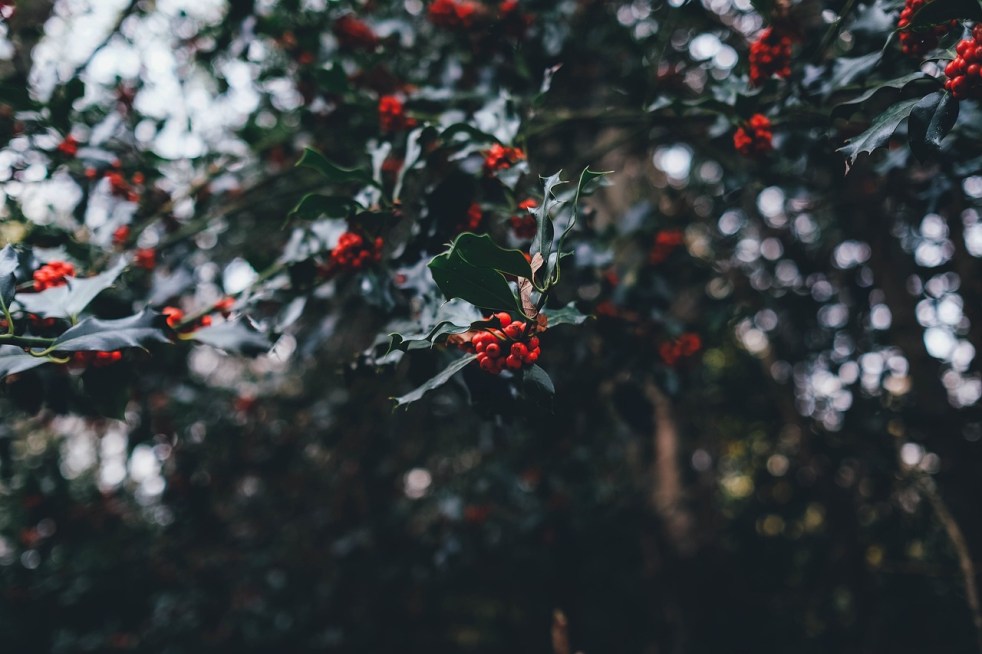
Red holly berries nestled among dark green, prickly leaves.

Holly is good for far more than its significance in the ogham. It has a long history the world over as a medicinal and magical plant.

The ogam letter “tinne” didn’t always mean holly. (There’s strong evidence that it wasn’t originally a tree alphabet, but that’s a subject for another time.) Kennings indicate that “tinne” originally referred to a metal bar or ingot.

An ogham kenning is known as a Bríatharogam. These were used to explain the meaning of each symbol, as well as to help scholars memorize them. The three Bríatharogam for tinne are “trian roith,” “trian n-airm,” and “smiur gúaile.” These translate to “one of three parts of a wheel,” “one of three parts of a weapon,” and “marrow of coal.”

In European folklore, holly was considered a highly protective plant. (If you’ve ever felt it’s hard, prickly, waxy leaves, this probably isn’t too surprising!) It was also regarded as unlucky to cut down an entire holly tree — probably because you’d be removing its ability to protect you. Instead, there was a tradition of coppicing holly trees. This let farmers use the leaves as fodder, and gave artisans access to the highly valued holly wood.

This connects interestingly to the concept of holly as “one of three parts of a wheel/weapon.” All trees and woods have their own magical properties, and holly was considered useful for controlling. That made it useful for crafting horsewhips.

Also interestingly, holly’s ability as a protective plant has some mundane basis. Holly trees often exhibit a phenomenon known as “heterophylly,” where multiple types of leaves are present on a single plant. It’s not at all uncommon to see holly trees and bushes with both smooth and prickly leaves. Researchers have found that the appearance of prickly leaves correlates to recent browsing by herbivores. After a holly tree’s smooth leaves get eaten, it replaces them with prickly leaves to defend itself!

Ilex aquifolium, exhibiting heterophylly. Many of the leaves on this branch are spiny, but some are smoother and more oval in appearance.

Holly was also believed to protect against lightning strikes. There’s evidence that the prickly shape of holly leaves helps conduct lightning, protecting the plant itself and neighboring trees and structures from damage. Somewhat ironically, certain holly species are also extremely flammable. Please thoroughly research specific species of holly before choosing to plant one near your home.

Celtic legend speaks of the Oak King and the Holly King. Each one ruled over one half of the year — the Oak King over the warm months, and the Holly King over the cold. They would do battle each solstice, and the loser would have to submit to the victor. The Holly King wins each summer solstice and rules until the winter solstice, when he’s once again defeated by the Oak King.

In the Victorian language of flowers, holly represented defense and domestic happiness.

While some species of holly have been used medicinally for inflammation, fevers, and skin problems, it isn’t commonly seen in modern herbalism. There are generally safer alternatives that are equally as effective.

In addition to protection, holly is associated with beauty, prosperity, good luck, and vengeance.

Holly makes for good, strong wands. The wood is also really white in color, so it can take decoration well. Wands made of holly wood are said to be powerful for working with and commanding spirits.

Planting a holly bush near your house is useful for protecting against malevolent entities and energies, as well as lightning. Please note that some hollies are really flammable, however, so make sure you choose the right variety for this purpose. Alternatively, bring some fresh holly boughs into your home instead.

Place some prickly holly leaves in a glass bowl of fresh water, and let it stand in the morning sunlight. Bring it in before noon, remove the leaves, and use the water to asperge rooms or objects that you wish to protect.

Holly boughs, when brought into the home, are said to protect from mischievous fairies. It’s believed that fairies come into the home with the holly boughs, so bringing them in gives the fairies a place to stay peacefully during the winter months so they don’t cause trouble. However, the fairies must be shooed away and the boughs burned by Imbolc, or the fairies may decide to stick around and become a problem. In some cultures, it’s considered unlucky to ever burn holly, so it may be better to bring the boughs outside and leave them there instead.

Hollies are also valuable food plants for birds, even though they’re poisonous to other animals. If you’re trying to cultivate a better relationship with the local fauna and spirits of the land, it may be worth planting a native holly species. The berries are hard and unpalatable for birds during the warm months, but the last a long time and grow softer and sweeter after being frozen. This means that they’re one of the last sources of food in areas that experience cold winters.

Snow on a holly branch. The bright red berries are still clearly visible and vibrant.

In my area, we have native inkberry holly (Ilex glabra). These are a bit different from the usual hollies you see on cards and decorations, since it has smooth, oval leaves and small black berries. Even if you’re like me, and the traditional spiny, red-berried holly is in short supply, native hollies are just as valuable, powerful, and interesting to meet.

life · Neodruidry

Happy Samhain!

It’s New Year. Halloween. Samhain. Whatever you want to call it, it’s when the “veil is at its thinnest,” children ignore everything they’ve been told about not taking candy from strangers, and the leaves are at their peak here.

This year, I’ll be celebrating Samhain with other Neodruids for the first time. That’s not all, though — after our ill-fated trip to the caverns, my Handsome Assistant and I decided to go somewhere that was the complete antithesis of a cave.

The mountains.

An image of a nearly-full moon rising over the Shenandoah mountains. The sky is shades of deep pink, blue, and lavender.

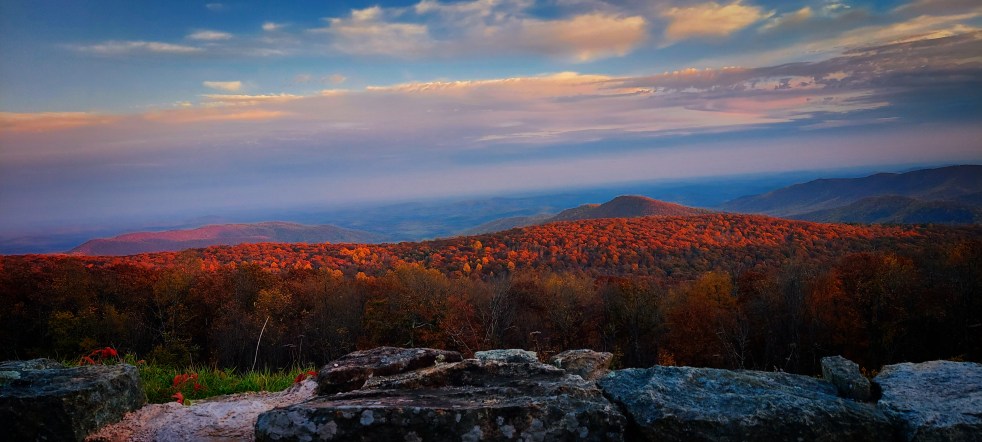
We took a road trip down Skyline drive to go leaf snarping. It was unseasonably warm, but the elevation made it quite a bit cooler. The leaves were brilliant, and the air was full of the earthy, musky, spicy-sweet smell of decomposing foliage. The strange bit of warm weather we’ve had meant that there were still some wildflowers clinging to life, bringing even more color to the already-saturated landscape. It was near sunset, so the nearly-full moon was shining just above a bank of bright pink clouds. The landscape looked like a Klee painting, the sky was a vaporwave album, and the air was filled with a smell a perfumer could only dream of replicating.

The moon peeking over a cloud bank at sunset. Below, there's a view of the mountains covered in trees in brilliant shades of red, orange, and gold.

It was pretty nice. Especially after the cave incident.

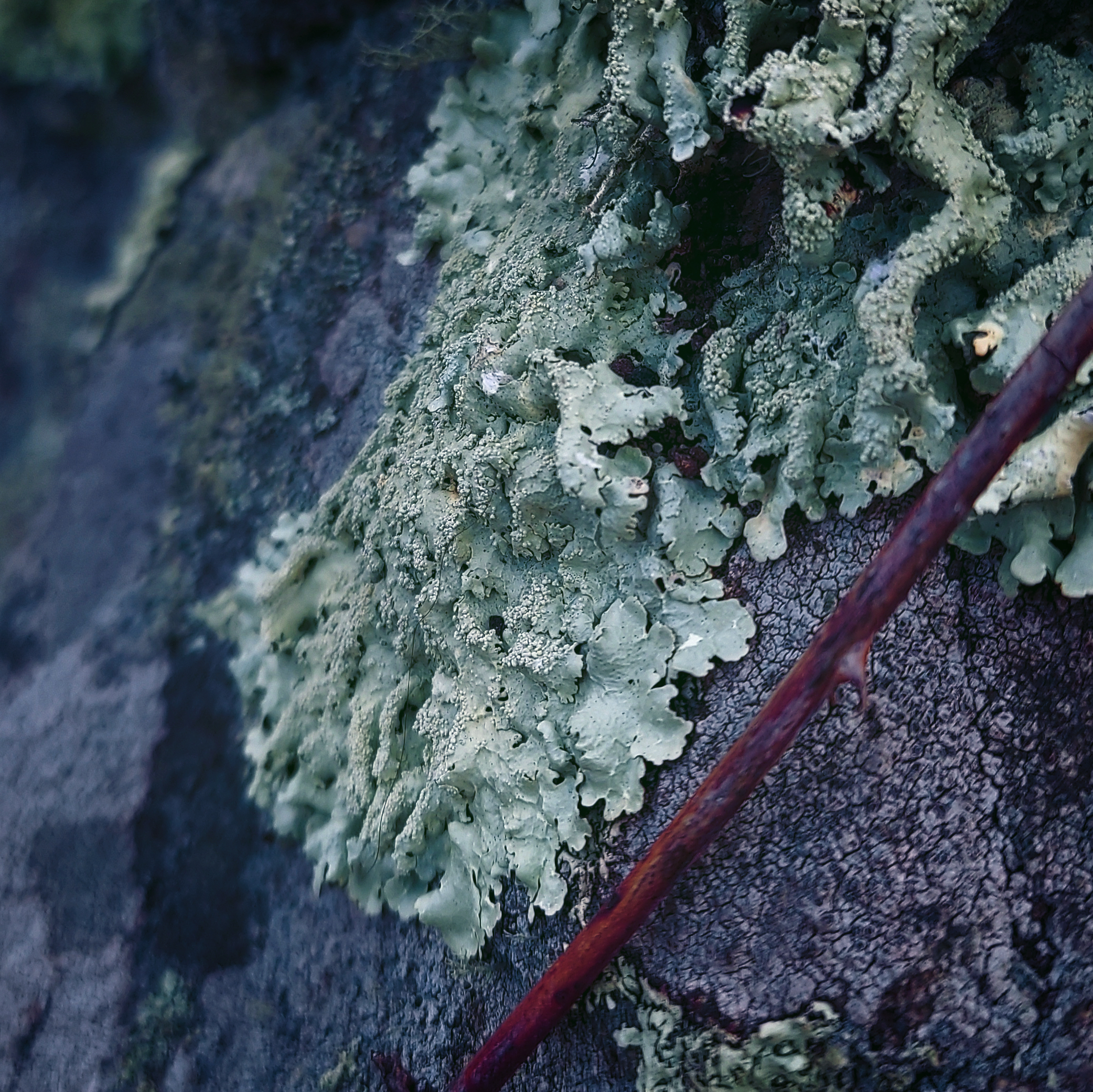
My Handsome Assistant teased me gently for taking tiny pictures. Snaps of an individual leaf, or a really interesting piece of lichen. I do that a lot. The larger landscape is fascinating, but the way the sun seemed to melt through the spaces in the trees backlit the leaves and made them glow like flames.

I took a special research elective in high school, where we had to report on abstracts of other research studies, then formulate our own. My teacher remarked that I mostly seemed interested in the extremely macro and micro — either the far reaches of distant galaxies, or the inner workings of organelles. Not so much the stuff in between.

(My experiment was about teaching hamsters to differentiate between different symbols and was in no way a way to get the school to pay for me to have several hamsters and hamster supplies, I promise.)

I feel like this is still reflected in the kind of pictures I take and the things I paint. I like to focus closely on a small individual subject, or on a very large landscape. It is also why I think I get so bored by portraits or character reference sheets.

A road curves around a hill and into a forest filled with orange, red, and green trees. Some boulders stud the hillside in the foreground.

Today, I’m making some roasted vegetables to share at a potluck. (And possibly some bread — I’ve been slacking on baking lately — or lentil pasta in pumpkin cream sauce.)

This Samhain, I’m also focusing on all of the rad things I want to do next year. Stuff’s winding down, but it’s still warm enough to be active. I’m also filled with creative energy right now, so it’s time to plan, save, and sow for spring. My Handsome Assistant and I just planted a plum tree (surrounded with some bulbs, for the bare beginnings of a tree guild), black raspberries, and swamp milkweed before the ground gets too cold to dig. We still need to prune the apples and get everyone else ready for winter, but we’re well on our way to a happy and fruitful spring and summer.

Here’s hoping all of you can get out to do some leaf snarping of your own and have a very good Samhain.

Plants and Herbs

Rosehip Folklore & Magical Properties

Roses (t least in their wild form) are fruit-bearing plants. These fruits, called rosehips or rose haws, are bright red, berrylike fruits that serve as a source of food for wildlife and people alike through the autumn and winter months. They’re high in vitamin C, and are frequently used in everything from supplements, to teas, to jellies, to skincare products.

They’re best harvested right after the first frost, when the fruits are bright red and slightly soft. That’s actually what prompted me to write this post — see, our first frost date is supposed to be in the middle of October. As of this writing, next weekend is supposed to be in the 80s. According to the National Weather Service, we’re not actually going to get frosty temperatures until the middle of freaking November. I could harvest the fruits anyhow and mimic the action of a frost by popping them in the freezer for a few hours, but still. 80 degrees.

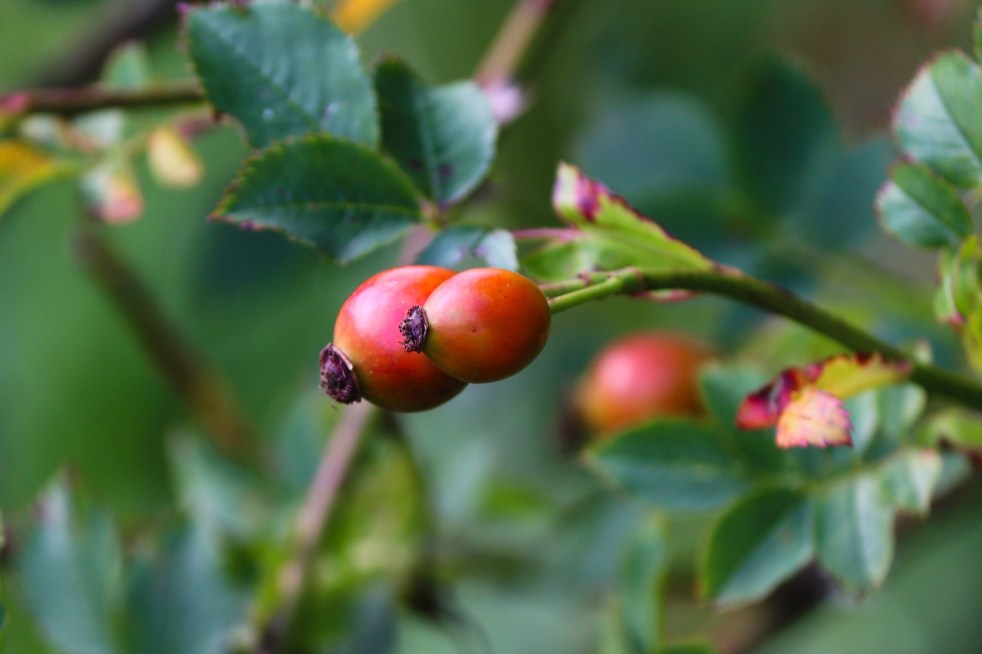
Some bright red, round rosehips on the plant.

(Side note, my Handsome Assistant and I were planning on taking a very off-season vacation on the beach. We weren’t planning on trying to swim or anything, but we decided to cancel anyway since it’d likely be too chilly to do much but hole up. Go figure!)

Rosehip Magical Uses and Folklore

Medicinally, rosehips are used for anything that benefits from more vitamin C. They’re boiled into syrup and given for colds, and used in tea over winter (when fresh fruit is in short supply). The fruit is also a mild diuretic that can help with certain urinary disorders, while the seeds, when boiled, may be helpful for symptoms of gout.

The fruit portion of a rosehip forms a kind of capsule around the seeds. These seeds are covered in irritating hairs, which is why it’s important to clean rosehips before using them. These hairs are so irritating, in fact, that they can be used to make itching powder!

Not all roses will form hips. Flat blooms, as opposed to cup or globular blooms, generally have the easiest time doing so. The reason for this is simple: cup and globular blooms are bred for show, and have masses of petals that cover their stamens and pistils. Since pollination is necessary for fruit production, bees need to be able to get in there to pollinate. This is easy for them with flat blooms, and next to impossible with more complex shapes. Deadheaded roses also won’t produce hips, since the portion that would become the hip gets cut off in the process.

Rosehips are useful for all of the same things that roses are. They shine in love and beauty magic (due, in part, to their vitamin C content). Used in ritual baths or to infuse oils, they can have a brightening effect on the skin.

Some more rosehips. These are still very green and not yet ripe.

Rosehips are also used in spells for good luck and prosperity.

To banish nightmares, place some rosehips under your pillow. You might want to use dried hips for this, since fresh ones could end up leaving you with a sticky, squishy, unpleasant surprise in the morning!

Since rosehips house rose seeds, they’re a good general addition to spells to increase anything. All seeds have immense potential and are used in magic for growth, so you can include rosehips in any spell to increase love (including self-love), money, luck, you name it.

Using Rosehips

To use fresh rosehips, wash them well, slice them open, and remove the seeds and hairs with a spoon. You can then dry them, make them into jelly, or eat them fresh. Dried hips from the store are good to go as they are.

Add fresh or dried hips to magical teas or other recipes. They have a tart flavor that pairs well with lots of drinks and dishes. Stir with your dominant hand as you cook, and intentionally infuse the mixture with the energy that you want to attract or increase.

To keep nightmares at bay, include dried hips in a dream pillow. Lavender, lemon balm, and rosemary also work very well here.

Dried rosehips (and rose seeds) are great additions to spell jars. As I mentioned above, they bring extra energy to increase whatever it is you’re looking to grow or attract.

On the other hand, the irritating hairs around rose seeds are good for protection or banishing spells. Add them to powders to keep unwanted people or spirits at bay. Sprinkle them under your doormat and instruct them to annoy anything and anyone who shouldn’t be at your door.

Rosehips are as useful as they are beautiful. If you have garden space, I highly recommend planting some wild type roses to help feed birds and other animals (and provide you with lots of powerful magical ingredients). If you don’t, keep your eyes peeled when you’re out and about — you may just find some wild roses with plenty of hips to share.

Plants and Herbs

Maple Folklore & Magical Properties

This past weekend, my Handsome Assistant and I took a small drive down Falls Road (alias Scenic Route 25). This was recently dubbed the second-best route in the country for seeing fall colors, and, while the leaves haven’t quite reached their peak just yet, it was a really lovely drive.

Red maples (Acer rubrum) are one of my favorite trees to see in autumn, and I’m lucky to share a home with one. Their leaves turn a vibrant scarlet every autumn, hence the name.

Bright red maple leaves on a branch.

Honestly, I just love maples in general. As a little kid, I used to pick up their samaras (we called them “pollynoses”) from the sidewalk, open the seed capsules, and stick them on the end of my nose. I bake primarily with maple syrup. I’m trying to convince my Handsome Assistant to make his next back of mead a batch of acerglyn (a similar beverage made of half honey, half maple syrup) instead.

I probably don’t need to say that trees have featured prominently in Pagan practices probably ever since the first Pagan. Each one has its own traits and associations, and, when it comes to working with the wood, leaves, or fruits, its own magical properties.

To be honest, maples were so ubiquitous where I grew up that I didn’t know they weren’t more widely harvested from. When I was thirteen, I was a foreign exchange student, which resulted in a brief stay in the Netherlands before going to Sweden. My student group (jetlagged and exhausted) stopped at a cafe on our first day there, where I happily ordered a plate of silver dollar pancakes and syrup.

But it was not syrup.
It was stroop.

Stroop (rhymes with “rope”) is often made of boiled-down fruit, water, and sugar, but can also be made with molasses and brown sugar. While it isn’t bad by any means, the latter variety is kind of an unpleasant surprise when you’re a kid who’s used to maple syrup with pancakes, hates molasses, and also desperately needs a nap. Not knowing any better, I drenched my pancakes in stroop and made myself a very avoidable struggleplate.

Anyway, all of this is to say that maples rock, maple syrup is the food of the Gods and should absolutely never be taken for granted, and I may still carry some molasses-induced trauma.

Maple’s genus, Acer, is Latin for “sharp.” This is due to their very unique, pointy leaves.

An Abenaki story tells how maple syrup once flowed freely from trees. It came so easily, people would lay on their backs and just let the syrup run right into their mouths. The legendary figure Glooskap saw how lazy people had become, so he turned the thick, sweet syrup into runny sap. From then on, if people wanted to eat maple syrup, they would have to work for it!

Another story, said to be of Haudenosaunee origin, tells of a man who watched a red squirrel nibble the end of a maple branch. The sap flowed until the sugars dried, hardened, and crystallized. The squirrel then came back to lick the sweet maple sugar.

In European-based magical systems, maple syrup is often used as an ingredient in love spells.

Maple sugar or syrup is also a useful ingredient in sweetening jars.

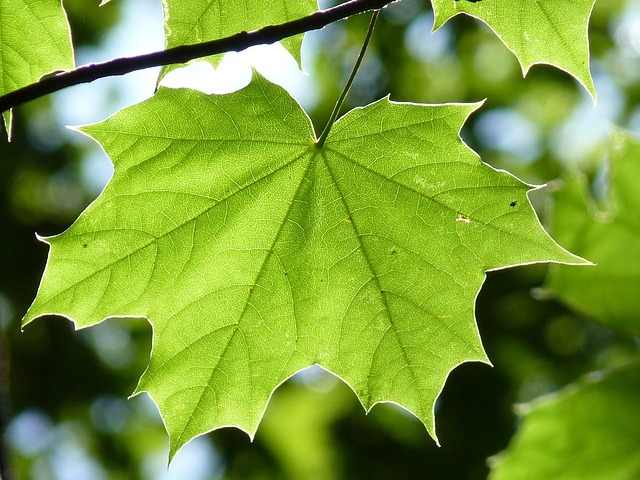
A bright green maple leaf.

By contrast, maple wood is considered very protective. It was sometimes incorporated into doorframes for this purpose.

Some sources consider maple to be good for prosperity and abundance in general.

As wand wood, maple is known for having a somewhat erratic energy. It also helps dispel negative energy, center oneself, and reveal paths and options one may not have considered.

Maples, particularly silver maple (Acer saccharinum) are considered Moon plants. They’re also associated with the element of Water.

Working with maple can be as simple as using magical tools made from the wood. Every tree — and thus every wood — has its own energy. I haven’t personally found maple to be erratic, but, to be totally honest with you, I’m erratic enough myself. (I think it also helps to have sourced the wood from a tree that I know pretty well!)

If you’re in the eastern US, you’re probably located near a maple tree. If that maple tree is anything like the one here, it probably drops plenty of sticks and smallish branches every time there’s a storm. Should you be of a mind to make your own magical tools, deadfall maple wood is honestly really easy to come by.

I can only vouch for red maple, but, once the bark and cambium are stripped off, the wood itself is light and silky-feeling. Sanded well, it takes on an almost metallic sheen. I love it.

The next easiest way to work with maple is to use maple syrup. You’ll need the real stuff for this, unfortunately — the fake stuff is cheaper, but also doesn’t really bear any resemblance to the genuine article. (There’s a good reason for that, too. Maple sap is chemically very complex, and we still don’t really understand all of the different compounds and reactions that give boiled sap its flavor. That makes it pretty much impossible to make a decent imitation syrup.)

If you’re looking to make a sweetening jar, artificial syrup is probably fine if you can’t get your hands on the real stuff. That said, plain sugar and tap water will make you a perfectly fine simple syrup that’ll a) be cheaper, b) let you add your intention or energy during the syrup-making process, and c) let you bypass the artificial flavors, colors, and other ingredients that don’t really add anything to the magic-making.

Otherwise, add maple syrup to your favorite edible magical recipes. Like I mentioned above, I bake with it almost exclusively — it’s pricey, but I love what it does for the flavor and texture of desserts. Seriously. It makes amazing breads and cakes, and is fantastic in chocolate chip cookies. Add the maple syrup, thank the tree for its sacrifice, tell the syrup what you want it to do for you, and stir your concoction clockwise using your dominant hand. Easy peasy.

Maple samaras (aka, pollynoses) can also be helpful additions to a charm bag. They end up all over the place in late spring to early autumn, so, if there’s a maple anywhere near you, you probably won’t have any trouble finding some. Add them to bags for prosperity, love, or protection.

life · Neodruidry · Witchcraft

Mabon 2023 (Or, “And then we accidentally gatecrashed a youth group.”)

I hope everyone had a good autumnal equinox, as rainy and chilly as it may have been!

Friday saw my Handsome Assistant and I hurriedly packing — he’d had to work and wasn’t able to get time off, and I’d spent most of Thursday processing fruits and vegetables and baking things. So, we pretty much grabbed whatever seemed like it’d come in handy for camping, shoved it in the car, and zoomed off.

A few hours later, we were driving down winding roads through the forest during golden hour, looking at the Shenandoah Mountains bathed in that soft orange light and listening to the wind through the trees. I couldn’t help myself — I turned on The Hu, and I turned it up.

We pulled into the campground moments later, windows down and music blaring, and hopped out to use the bathroom before going to find our group. There was a handful of people standing by one of the cabins in the distance, so we cheerfully strode up to them to discover that they were actually complete strangers. Baffled strangers. Slightly disturbed strangers.

“Um. Is this the MeetUp group…?” I asked.

“… No. This is a Lutheran Youth Group.”

“… Oh. Sorry. Mybadgottagobye!”

A few more moments and a short drive later, we found our actual campground.

After this minor slipup, the rest of the weekend passed with feasting (so much feasting), singing, chanting, poems, stories, a bonfire, divination, and rain (so much rain).

We stayed in a cabin affectionately called the Murder Cabin. Oddly enough, this was called the Murder Cabin before I discovered that one of the bunks had what appeared to be a bloodstain (it was not. We discovered this after a friend realized it looked too shiny to be blood and tentatively touched it. It was still wet and slightly oily, and we both jumped back shouting, “Oh God! Oh no! Oh God! Oh God!” One of our other friends woke up in the middle of the night to discover that he was sharing his bunk with a family of fieldmice, and I feel like fieldmice are too cute to just hang out in a Murder Cabin.)

I’d stayed in a cabin just like this as a kid, when I went to summer camp one year. I knew that they fit a twelve-year-old reasonably well but wasn’t entirely sure how well they’d fit one jacked, full grown human man and a smaller, more gremlin-style human at the same time. We’d brought our tent but forgot a second sleeping bag and the air mattress. As a result, we both crammed into a single sleeping bag, in a single bunk, and he ended up with his butt out the window and the beginnings of hypothermia. (I, however, felt fine and toasty where I was, nestled in the sleeping bag with him as a draft blocker.)

I always feel energized by being in the woods with friends. At events like this, I honestly rarely sleep. The first WickerMan I went to, I stayed up for three days then went home and absolutely crashed for a day and a half. This was no different — Handsome Assistant and I stayed up until about threeish every evening, only going back to the cabin once everyone else was ready to go back to theirs, too. (The first night, we accidentally dropped his heavy leather coat from the top bunk and startled one of our bunkmates awake, but they were very good-natured about it.)

I didn’t drink, which was probably good. I’m the kind of drunk who immediately starts complimenting strangers, telling people I love them, and becoming Eternal Best Friends with people whose names I may or may not actually remember in the morning. Also, I get terrible hangovers.
I did, however, enjoy some herbal medicine and enough sugar to send a hummingbird into a diabetic coma. (These things are probably connected.)

The Mabon ritual was beautiful. It was originally planned for outdoors, but there was a ton of rain and a big drop in temperature, so we moved it into a pavilion instead. We sang and chanted, taking turns going to a meditation tent for some solitary reflection and relaxation. When we each returned, we took a small wooden lantern as a reminder of the light that we’d each carry within us through the dark months.

Afterward, there was a feast. I’d brought pumpkin bread, strawberry scones, a vegan quiche, and vegan queso and chips, but the only things that had survived the previous day were the scones, so I put them out alongside the other dishes. Handsome Assistant grilled venison and bison burgers and brought homemade blackberry mead, someone had made a gorgeous salad with pecans, apples, greens, and pomegranate, there were black and white cookies (perfect for the equinox), breads, cheeses, fruits, salads, and just so much beautiful food.

One of the completely unironically fun things about this gathering was that it was two separate groups. On one hand, there were the Druids. On the other, there were the pan-Pagans, with more of a Witchy vibe. It was just neat seeing the similarities and differences in cultures and practices. Kind of a “fancy” versus “feral” groove, in the best way. As someone who has identified with both Druids and Witches at various points, I can see why I ended up on the path of Druidry.

After the ritual, the rain stopped for a bit. A friend built a fire, and those of us who didn’t go to bed early went out to stand around it, tell jokes and stories, and get warm and dry again. (An awning had dumped what felt like a cup of water down the back of my neck, so I was turning like a person-shaped pile of döner kebab to make sure I got evenly dry and toasty.)

This same friend remarked that he was sad that the weekend was almost over. I agreed. Even though it’d been cold and rainy, the laughing, the camaraderie, and the connection was just so awesome. I pointed out that, while it was almost over, it was also a day closer to next year’s.

And that’s what it’s about, right? Recognize the turning of the year. We’re heading into the cold days, but that just means that there’s an entire spring and summer ahead in the future. Just like I came home and crashed for seventeen (!) hours straight, I’ll have a restful winter and be ready to run amok again.

life · Neodruidry

“Going within” and “seeking inner wisdom” are mostly code for boredom, tbh.

I’ve spoken in the past about some of the issues that I’ve had with various types of meditation. I don’t really get on with a lot of mindfulness meditation, because anxiety and panic disorder make it so that I’m already detrimentally hyper-aware of my breathing and heartbeat. Being instructed to focus on my breathing is a bit like telling a drowning person to take a relaxing bath.

I was introduced to a different type of meditation through a course of Druid study that I’m working on. It’s discursive meditation, and it involves many of the same key ideas as mindfulness, with one big difference. You’re still training your mind to focus, let irrelevant thoughts pass by, and gently return from wandering. The difference is that you choose a subject for your meditation to focus on. Thoughts and ideas related to this subject are desirable, and you just return to the subject at hand if you find yourself going off on a tangent.

It’s a great way to really let yourself play in a space and do a deep dive into a specific subject. It’s included as part of these studies because so much of ancient Druidry is coded in oral traditions, which means that what the tiny bit that was actually recorded was often through a poetic, mnemonic lens designed to help Druid scholars remember all of the information they were expected to know. The idea is that so many of these ancient ideas require pondering to get their meanings, and discursive meditation is a way to achieve this.

It’s a bit like if the US ceased to exist, and the only historical record of it was that Animaniacs song about state capitals. It’s not a lot of information on the surface, but some deep dives could still give you something to work with.

Consider Bríatharogaim. These are two-word kennings designed to explain the meanings of the names of the letters of the ogham. Like saille, willow, is “pallor of a lifeless one.”

Saliax alba, white willow.
I could see it.

The thing is, brains are characteristically not good at staying on one subject. That’s why, like uncooperative puppies, they need to be led back now and then. Brains are not good at boredom., because boredom feels uncomfortable.

The trick is understanding that boredom isn’t bad.

“Profound boredom” is actually an important component of creativity. Forcing oneself to sit with a single subject and exhaust all possible tangents related to it is how breakthroughs happen.

If you’re meditating for the purpose of going within and seeking inner wisdom, this state of profound boredom is the nug. It’s the fertile ground where the good stuff comes from. If you think of it in terms of seasons, profound boredom is the fallow period. It’s the late autumn to early spring when the leaves all fall, break down, and enrich the soil. Without profound boredom, your brain dirt gets all bad.

It doesn’t even require a lot of boredom. Thus far, in my experience, thirty minutes of discursive meditation is sufficiently boring to yield about two paintings, some prose, and a few lines of poetry. If I have a specific problem, I get solutions. Everyone should be more bored more often, because being bored on purpose rules.

The difference lies in the difference between the kind of boredom you get in, say, a waiting room, and the kind of boredom you experience when you focus on a single topic. A waiting room’s boredom isn’t helpful because it’s anxiety-provoking. There’s no opportunity to relax and give your mind room to be profoundly bored, because your name might get called at any minute. The freed-up brainspace isn’t focused on creativity, it’s focused on vigilance. Being bored in the comfort of your own home, on your own timetable, though? Chef’s kiss.

To go within is to seek out this fallow period that allows new things to spring forth. Inner wisdom lies in boredom.

life · Neodruidry · Witchcraft

Frederick Pagan Pride 2023

It’s just this past Saturday, and my Handsome Assistant and I pull up to the Unitarian Universalist Church in Frederick, MD. The friendly young people attending the lot tell us there aren’t any parking spaces left. We’ll have to go to the lot a mile down the road, they direct us, and take the shuttle.

Personally, I’m shocked. It’s only a quarter past ten, how could the lot be full already?

A rustic pendant made of copper, quartz crystall, and azurite malachite on a copper chain.

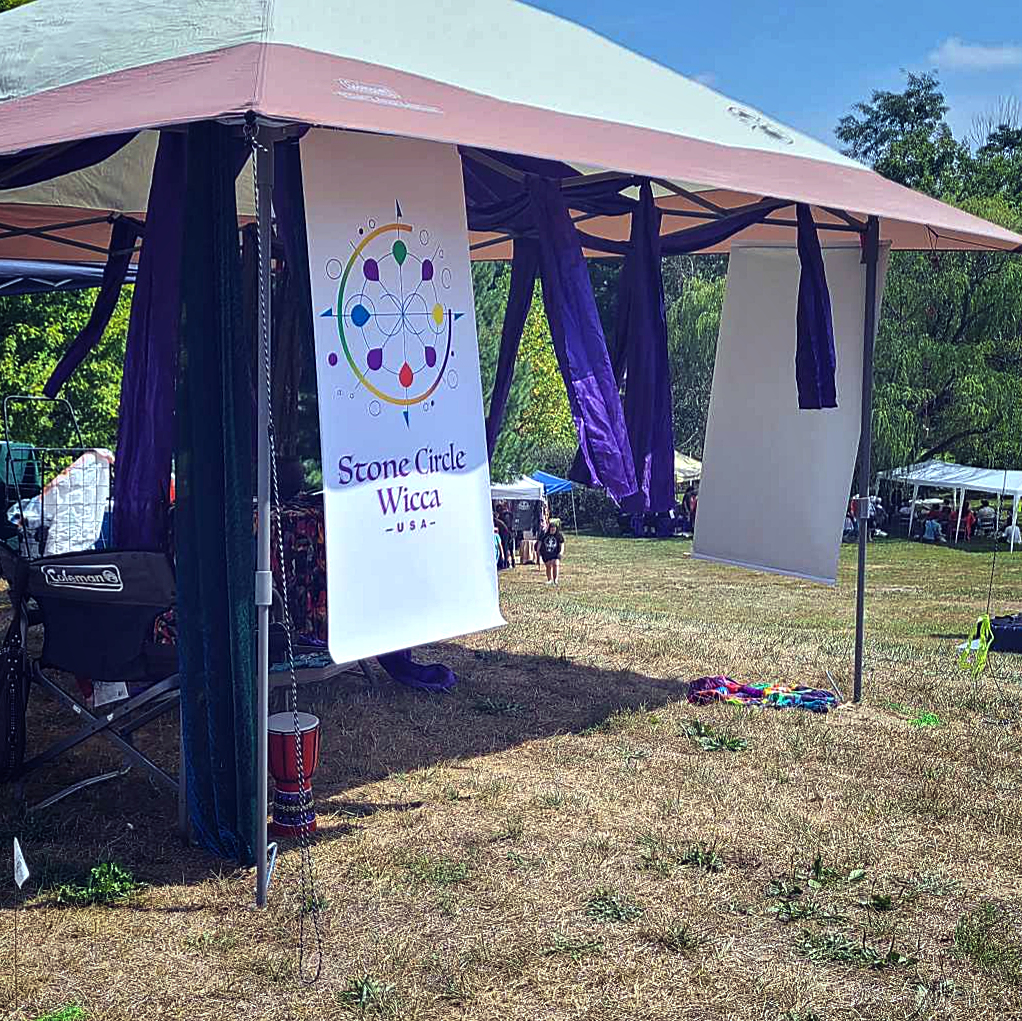
They weren’t kidding, though. Even the other lot was filling up, and the shuttle was almost completely full as we rode back. The grounds themselves were ringed with vendors, information booths, and more — there was Tempered Raven, who hand-forges beautiful blades There were so many booths of jewelry (I bought a beautiful quartz, azurite malachite, and copper necklace from Unclaimed Treasures). There were herbs, incenses, soaps, pottery, handmade brooms and whisks, woodcarvings, altar supplies, and amazing desserts. There was even free coffee, tea, and cold brew from the awesome people at Stone Circle Council (check them out — they do some very cool things).

A handmade ceramic watercolor palette with eight wells.
I also picked up a handmade palette. It’s intended for watercolor, but I’d like to see how it does with casein. Casein paint dries out so fast and softens up with a bit of water, so working with it is a bit more like gouache than acrylic. I’m thinking a glazed surface will be perfect!

There were also loads of workshops and live music. It was busy, it was vibrant, it was great. I always regret not taking more pictures of the event itself, but I always feel a bit odd about snapping pics of people unaware. (Sure, there’s no expectation of privacy in public, but something being legal doesn’t preclude it from being a bit of a dick move, you know?)

The busyness was at once a wonderful sign, and an unfortunate one.

On the one hand, it’s great that events like this are attracting a bigger audience. Aside from vendors of beautiful crafts and delicious food, there are lots of tables for different Pagan, metaphysical, and mystical organizations. If you’re looking for a path to call to you, or people to network with, this is the place to find that thing. In an era where social media has allowed — even encouraged — the proliferation of misinformation that’s unhelpful at best and dangerous at worst (and don’t get me started on AI generated books), it’s really nice that there’s still a wonderful variety of actual organizations dedicated to study and practice.

Last year, I got a little emotional about how events like Pagan Pride make me feel about community, aging, and tradition. It’s a feeling I hope everyone gets to experience at least once.

On the other hand, a big part of the reason for this large audience is that two other Pagan Pride events — the one in DC, and one in Manassas, VA — effectively no longer exist. A friend pointed out that they’d even contacted the coordinators of the DC pride event and hadn’t heard anything back at all. As if the email address was going unchecked. I looked up information on Manassas everywhere I could, but it was pretty scarce. The last event seemed to be in 2019, and the 2022 event was cancelled. According to their Facebook, they weren’t able to hold one in 2023.

A lot of Pagan community organizers seem to be either getting burned out (with everything else going on right now, who can blame them? Add the often-thankless work of organizing to the struggles everyone else is dealing with right now, and it’s completely understandable) or just aging out of their roles. All of the organizations I know, even the ones I’m a part of, operate on budgets that would make a shoestring look luxurious by comparison.

It’s something I’d love to help with, but I’m not really sure where to start. I’ve often said that, if I were handed enough money to live off of for the rest of my life, I’d put it into a small house on a large piece of property. I’d rewild as much as I could and put it under a conservation easement. Some, I’d want to guide into operating as a permaculture food forest (I have tiny fantasies of adopting a rescue donkey or small pony, having them carry a basket, and walking around with them to pick fruits and vegetables). The rest, I’d want to make into an event space for musicians, dancers, and events like Pride. I have no heirs, so, when I died, I’d will it back to whatever Indigenous group formerly held it. In the meantime, I’d want it to be a place for community members to interact — flora, fauna, and human alike.

I mean, I feel like I’m basically describing a two-person commune, but I feel like you get the gist.

I suppose what I’m saying is that it’s a shame that the world has done us up all wretched, and I wish I knew how to take on some of the burden of organizing and setting up events like this with the resources that I already have. (A tiny yard, most of which is steeply uphill, an even tinier bank account, and massive social anxiety).

In the meantime, support your local Pagan organizations and artisans, yeah?