animals · life

What I’ve learned from coexisting with crows.

Crows (and corvids in general) can be pretty divisive. I don’t think I’ve met someone who can just take or leave them — it’s always either a fervent love, or a deep dislike.

And I get it, honestly. They’re noisy. They’ve been known to eat nestlings, eggs, and small mammals. To many, they’re a nuisance and they don’t understand why anyone would go out of their way to make their yard more attractive to these birds.

Ever since we moved here, I’ve been feeding a small family of crows whom I’ve come to love dearly. I’ve hesitated to feed other species, because I don’t want to encourage them to congregate (and potentially spread avian flu) when that isn’t their normal feeding pattern. While the debate about feeding birds and crow/raven behavior will likely never come to an end, here are a couple of things I’ve personally observed when making an effort to coexist with crows:

With most members of corvidae, you’re dealing with a very intelligent animal. With crows specifically, something on the level of a toddler or a very bright dog.

I wanted to mention this right off the bat because it heavily impacts a lot of my other points.

In general, crows aren’t really hunter hunters. They do eat meat, and they will eat young, weak, or sick animals, but they’re opportunistic feeders. If the opportunity isn’t there, or there’s an easier source of high-value food somewhere else, they’ll go elsewhere.

Crows are also a prey species for larger carnivores. When they’re eating, they’re vulnerable because their attention is directed toward that and not toward looking for threats. This is why groups typically have a sentry or two, to keep an eye on things while the others feed.

A blue jar, perched on a twig, looks over his shoulder.
A blue jay, one of the more colorful members of the corvid family. Photo by Pixabay on Pexels.com

They’re also still wild animals, no matter how closely they may coexist with humans. Wild animals will go for easier-to-get food sources whenever possible, because more challenging ones a) aren’t guaranteed, and b) require more effort (read: calories) and attention to access. The exception to this seems to be when there’s a particularly appealing, usually calorie-dense food item available that’ll make up for the potential danger and extra effort expended to get it.

With the above things in mind, you can direct their behavior to a degree.

I’ll give you an example. When I worked in pet retail, I had customers that’d come in and complain that squirrels and large birds that kept getting into their bird feeders. We had tons of anti-squirrel technology available — baffles, special lubricants for poles, specially shaped feeders, and even battery powered ones that vibrated, spun, or did all kinds of other gymnastics. I’d gently try to guide these customers to dedicated platform feeders and bags of corn, but they always turned it down.
No matter what they bought, they’d be back in a few weeks for something else. A greased pole was no longer enough, because the squirrel learned how to jump from a tree at just the right angle to defeat it. A specially shaped feeder wasn’t enough, because the crows would team up to work around it.
The cycle would inevitably repeat, until they finally just gave up and bought the platform feeder and the bag of corn. After that, the squirrels and large birds would eat the easy to access food, and the smaller birds had their own.

Since this crow population was already established here (and has since grown due to habitat destruction caused by some recent construction), giving them high-value, easy to access food has ensured that I get to keep more of the fruit and vegetables from my garden. This isn’t just because the crows don’t take as much, either — they’ve also done quite a bit to keep various garden pests away.

I don’t leave their food unattended — I usually feed them items I know they like, then sit out there just a few feet away with my own lunch. I have never once been harassed for my food. I’m pretty sure it’s because, like other intelligent animals, they’re able to distinguish between what food is given to them and what food is mine. Why bother me to eat off of my plate, when their plates are right over there? Why run the risk of a potential conflict with a human when they have accessible, desirable food already?

This study covers the relationship between various predator and prey species. One of its findings is that, as prey species numbers increase, so do predator species numbers, and there isn’t strong evidence that native (non-invasive) predators alone drive species decline.

A single predator, or small group of predators, can impact local numbers of prey animals, but don’t appear to correlate with a decline in overall numbers. The thing here is that crows are, like I said, opportunistic. They take prey from nests, where other predators are more likely to be less discriminating and take reproductively mature animals (since those are the ones they’re most likely to encounter out and about). Many corvids are also very territorial — an established family of crows will actively drive off other, larger, less opportunistic predators. They appear to exert both a predatory and protective influence on local prey species.
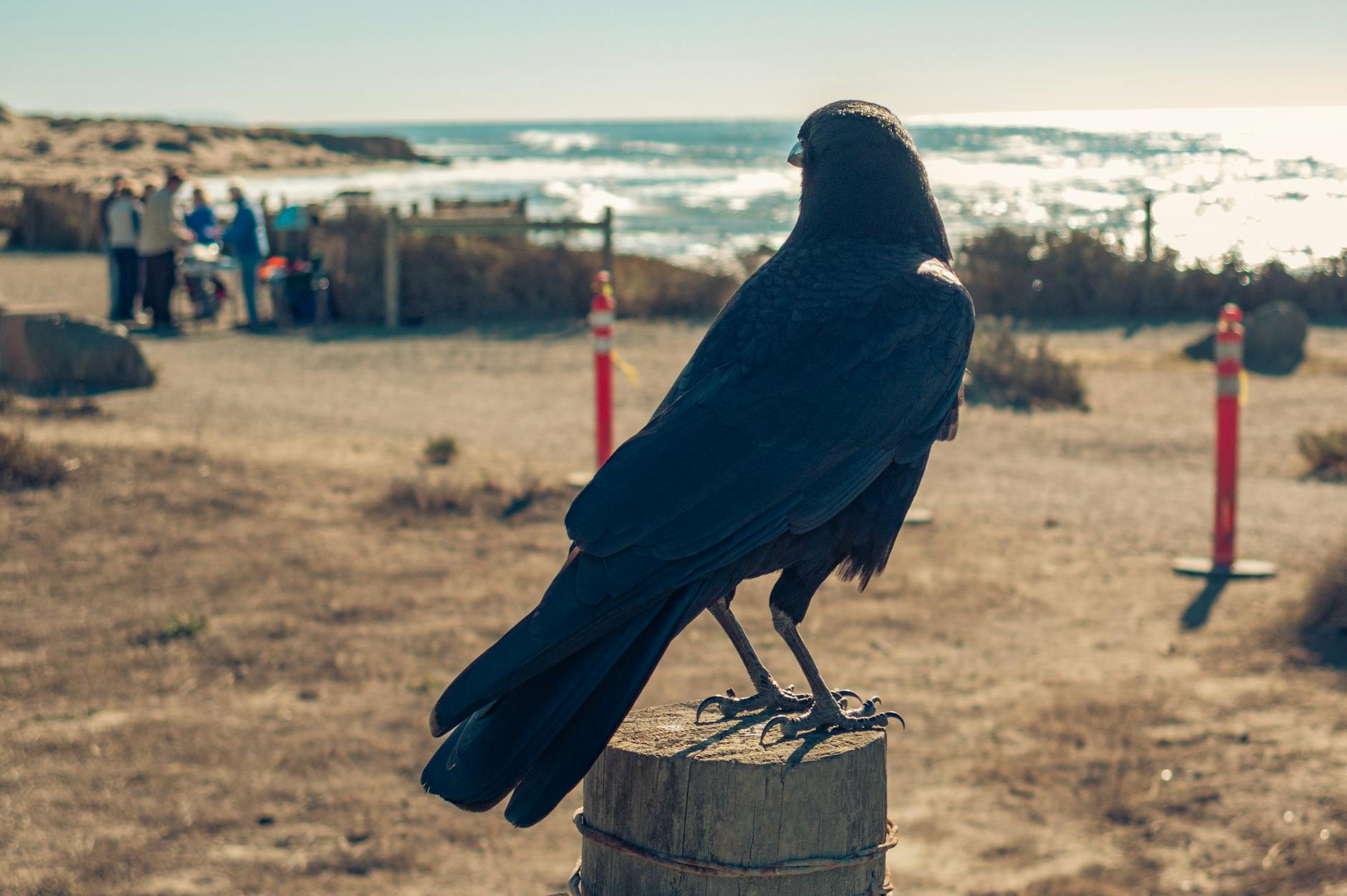
A crow, perched on a fence, observes a distant group of people.
A crow. Photo by mali maeder on Pexels.com

While I offer food for the local birds and squirrels, I’m careful not to do it every day. (Water, on the other hand, is always available.) Nobody goes hungry, and there seems to be less impetus for them to eat what I’m growing or trying to protect, but they still need to engage in natural foraging behavior.

This works in my case because this crow family had already established this area as their territory. If you listen to their calls, you can hear them relaying from one tree to the next. While they’ll cover a lot of ground in order to find food and water, a sentry alerts the others when there are snacks available. They can go about their business and stop by when there’s food.

(One funny thing I’ve noticed is that their vocalizations change when I’m on the deck, whether I’m putting food out or not, like they’re telling everyone that it’s almost time to eat. Once, I was only watering a few plants and went right back inside, and I got to hear a very excited crow call trail off into something that sounded unmistakably like disappointment.)

Crows (and many other members of corvidae) will get into dumpsters if there’s an opportunity, somewhat rightly earning them the nickname of “garbage chickens.” Stories abound of people feeding them fries, chips, and other very palatable, salty, oily, and largely carbohydrate-based foods. These really aren’t optimal dietary contributions for them, though, and having a positive relationship with your local corvids should mean taking their actual nutritional needs into account.

I explored the foraging habits of crows, plus the diets fed to pet pied crows in captivity as well as crows and ravens at rehabilitation centers. In the end, I came up with a mixture of cat or puppy kibble, cracked corn, raisins, and a low sodium, unfortified cereal as a base. To that, I add hardboiled eggs (cut into quarters, shell attached), dried mealworms or black soldier fly larvae, peanuts (in the shell), and fruit, depending on what I have on hand. Sometimes, if I have the leftover tail end of a loaf of homemade bread, I’ll cut that into cubes and toss it in too. This all seems to work out pretty well — they appear to enjoy it, and they’ve got some of the darkest, shiniest feathers I’ve ever seen on an urban crow.

One thing people bring up often is that crows will get used to humans, which will cause problems.

There are definitely cases of birds, including corvids, losing their fear in areas with frequent, close contact with a variety of people. Anyone who’s ever tried to eat French fries on a boardwalk can probably give you several examples.
(I was almost eaten by a pelican when I was little. It was a defining experience.)

I can’t speak to this in general, but I can point out my own observations as someone dealing with an urban crow population that already has a lot of incidental contact with humans. Like I mentioned above, I also stay out there by the feeders after I fill them. While the family of crows has certainly grown bolder with time, this change in behavior seems to be limited to me. If I’m out there and my Handsome Assistant joins me, their behavior switches gears immediately. They keep their distance, and even make some unique vocalizations. If I’m there with a stranger, the difference is even more stark. As intelligent animals with the capacity to recognize individuals, they seem to have drawn some very firm lines between “human what puts the food,” “other human,” and “some guy, idk.”

One interesting experiment with ravens kind of highlights this. A researcher was teaching a raven to trade, by offering the bird a small piece of cheese (a high-value food item) in exchange for a piece of bread (a lower-value one). At one point, the researcher accepted the raven’s bread, then had the audacity to eat the cheese right in front of them. The raven, understandably pissed, refused to engage in any more trading exercises… but only with that particular researcher.

Animals have their own agenda, though it’s often tempting to see them through a humanized lens. I’ve seen a lot of posts from people asking why their local population of crows just left — do the birds not like them anymore? Did they offend them somehow???

The truth is, wild animals have their own schedule. They likely won’t, don’t need to, and shouldn’t come hang out every day. During summer, when a lot of fruits ripen and grains are harvested, crows are likely to go off to agricultural areas to eat the dropped grain. They also have babies, so they’ll be off doing parent activities. In winter, they may need to go to a more desirable climate or more abundant food and water source. If the larger murder of crows is going off to do something, a given crow family will go with them.

If they stop showing up for a while, it can honestly be a good sign because it means they’re still being wild birds. It might suck if larger carnivores move in and start causing trouble in their absence, but that’s nature for you.

A magpie, flying in front of a group of rose bushes.
A magpie. Photo by Manuel Torres Garcia on Pexels.com

On top of all of this stuff, I’ve also noticed some interesting impacts on my hyper-local environment since I began putting food out for these birds:

In the beginning, I was lucky to get some house sparrows, starlings, and the occasional mourning dove. As time goes on, I’ve begun to see more species. Like, a lot more. Blue jays, cardinals, finches, dark-eyed juncos, woodpeckers, and grackles, to name a few. (Even a mockingbird that has absolutely given the crows a run for their money when it comes to territoriality.)

Part of this may be because there’s more food available, but most of the food I put out consists of things that would appeal to crows and jays, not necessarily other species. I have, however, noticed that the local crows do a lot to keep the smaller birds safe, because…

I’ve written before about how this family of crows have effectively become my unpaid, unasked-for yard bouncers. In addition to dispatching particularly chaotic squirrels, I’ve seen them bounce bigger predators, too. They’ll get together and mob a hawk (which is honestly fascinating to watch). They’ll chase away stray and feral animals. They’ll even warn me if there’s a particularly suspicious snake in the vicinity. They’ve kept rats, mice, and grubs away, too.
They have very definite ideas about Who Belongs and Who Does Not.

These crows seem like a protection racket. Like a dragon that demands an occasional sacrifice from a local village, or a rat snake that keeps mice and rats out of a chicken coop in exchange for the occasional egg. It’s weird, but I’ve seen them on my deck, coexisting perfectly fine with the smaller birds and other squirrels… So, I guess it’s all chill?

Granted, a lot of this is because I’m not particularly fussy about garden borders. If something neat springs up, isn’t a noxious weed, and won’t run the risk of poisoning me, I’m inclined to let it be and see what happens.

As it turns out, “what happens” is a ton of volunteer tomatoes, corn, grapes, and berries. (The smaller birds even planted a bunch of millet and broccoli.)

They’ve also brought me occasional small gifts, but I can’t eat those.

When it comes to coexisting with these incredible animals, the important thing to remember is that a) they’re very smart, b) they have the capacity to remember and distinguish between individuals, and c) they’re wild. While it might seem flattering to feel needed and loved like you would with, say, a dog, that’s counterproductive to a wild animal’s survival both physically and mentally. It is possible to interact positively with them without harming their ability to live without you, and this should be the goal of anyone who really loves these birds.

life

Reskilling: In which I make a cool little guy.

Note: Some of these links may be affiliate links. They allow me to earn a small finder’s fee for stuff I would share with you anyhow, at no additional cost to you. It helps me keep the servers firing and the crows fed, so thank you for supporting these sellers and this site!

For the past few years, ever since reading Dana O’Driscoll’s Sacred Actions: Living the Wheel of the Year through Earth-Centered Sustainable Practices, I have been on a reskilling bent. To be honest, it’s also one of the things that helps ease my climate anxiety (and anxiety in general) — increasing my ability to be self-sufficient, gaining skills I can use to help others, and learning how to do things that I can potentially barter with if everything goes pear shaped.

Honestly, Etsy has been a huge help when it comes to this kind of thing. I’ve learned so much about fermentation, soapmaking, pottery, and so much more from kits and patterns that I’ve picked up there. (It’s also been a huge help for hard-to-find supplies, but more on that at another time.)

All of this is to say that I made a cool little guy, and I am going to take him on Adventures.

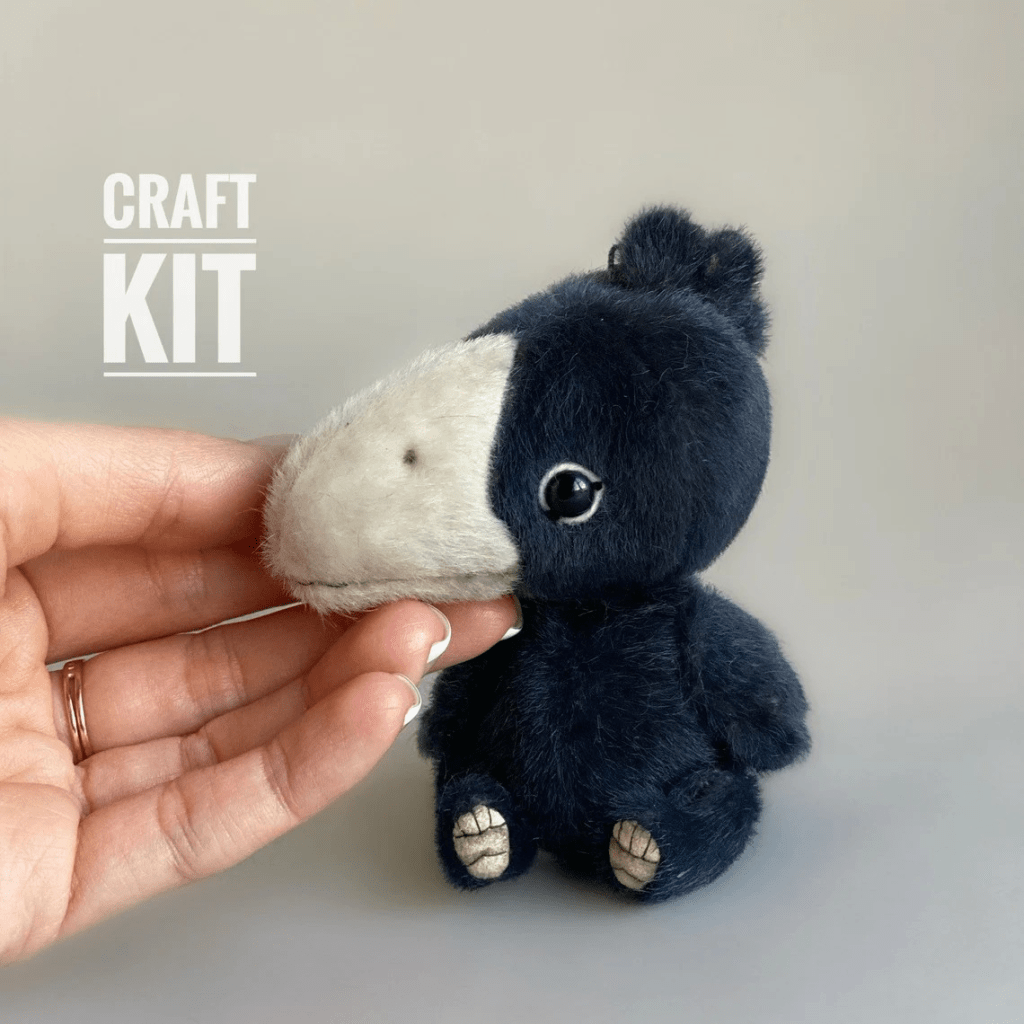
Image taken from the shop listing, by Tatiana Skalozub.

My Handsome Assistant bought me this kit from an Etsy shop called TSminibears. I’d had it favorited for a while, and he surprised me with it over winter. I was initially a bit intimidated — the finished doll is only a few inches tall, which means lots of tiny, fiddly bits to cut out (while maintaining the proper seam allowances, natch), sew, turn out, stuff, attach, et cetera. So, I put off starting it.

Finally, I got over my initial inertia, traced the pattern, and got to work. As is so often the case, actually starting to do the thing was the hard part. Once I did that, the process seemed to fly by.

The written instructions of this kit are fairly sparse, but that’s okay. The bulk of what you need to know is in the form of a YouTube video, where the creator walks you through the entire process of assembling the pieces, stuffing the crow, adding details, and so forth. As someone who’s had to both write and follow written instructions before, I know it can sometimes be difficult to describe exactly what steps you need to do, and what the desired result should be. This is especially true when it’s an art project, where so many things can influence the outcome and there’s a pretty broad tolerance for minor errors or stylistic choices.

I found myself choosing to skip a few of the steps, myself. I knew I’d probably want to make him some tiny clothes at some point, so I left off the bits that I thought might interfere with this. (For example, the feathers on his head. That might make wearing tiny hats or hoodies difficult. Also, not gonna lie, I kind of fell in love with his very spherically domed, Charlie Brown look and didn’t want to change it.) I stuffed him with a bit of wool with a tiny Herkimer diamond for a heart and, even with some steps skipped, I think he turned out awesome.

I mean, look at him.
He’s adorable.

I can’t wait to make him many tiny scarves.

If crows aren’t your thing (which, how dare), there are a ton of other kits for elephants, dragons, bunnies, a triceratops, and even a bizarrely cute cobra and weirdly endearing mussel. If you’d like to learn more about making stuffed toys and aren’t sure where to start, this is definitely a good place. Take your time, make sure you know which direction the faux fur lays, and follow the instructions on Skalozub’s videos, and you will also make a cool little guy.

Neodruidry · Plants and Herbs · Witchcraft

Vervain Folklore and Magical Uses

Vervain (Verbena officinalis) is a prominent herb in European folk and ceremonial magic. Its roots also extend to American Hoodoo.

Though most old grimoires mean V. officinalis when they refer to vervain, there are actually about 80 species in the genus Verbena. In my area (and all of the continental US, and fair bit of Canada) we have Verbena hastata, also known as blue vervain. While it’s not the same plant, you’ll often find V. hastata labeled simply as “vervain” in metaphysical contexts.

Lemon verbena, Aloysia citrodora, is also a member of the Verbenaceae family. However, since it’s a somewhat more distant relative, I wanted to limit this post to V. officinalis and V. hastata.

Vervain is sometimes called “the enchanter’s plant,” since it’s one of the most versatile herbs in European magic. Even outside of Europe, it was (and continues to be) considered a plant of considerable medicinal and spiritual significance.

As John Gerard wrote in 1597,

Many odd old wives’ tales are written of Vervain tending to witchcraft and sorcery, which you may read elsewhere, for I am not willing to trouble your ears with supporting such trifles as honest ears abhor to hear.

Magically, it’s used for purification, protection, divination, peace, luck, love, and wealth. It’s a pretty solid all-purpose herb that is often added to formulas to increase their power.

The name vervain comes from the Latin “verbena,” which refers to leaves or twigs of plants used in religious ceremonies. This, in turn, came from the Proto-Indo-European root “werbh,” meaning to turn or bend.
I have also seen the origins of the word vervain given as a Celtic word “ferfaen,” meaning to drive stones away. However, I haven’t found strong evidence for this origin — all attempts to look up “ferfaen” only yield articles claiming it as the word origin of “vervain,” and most of them only give “Celtic” as the language of origin. One source did cite the Cymric words “ferri” and “maen” as a possible origin, with the word “maen” mutating over time into “faen” to eventually yield “ferfaen.” (Upon further searching, I was not able to find the word “ferri,” though I did find “fferi,” meaning “ferry.” This would give the word “ferfaen” a meaning closer to “ferry away stone(s).”)
Nonetheless, the etymological sources I looked at gave “verbena” as the origin of vervain, not “ferfaen.”

A close-up of vervain flowers.
Photo by Tom Fisk on Pexels.com

Pliny the Elder credited vervain with quite a lot of magical properties. According to him, it was used to cleanse and purify homes and altars. He claimed the Gaulish people used it in a form of divination, and that Magi said that people rubbed with vervain would have their wishes granted, fevers cooled, friends won, and diseases cured.
Interestingly, he also pointed out that vervain was considered a bit of a party plant, for when dining-couches were sprinkled with water infused with vervain “the entertainment becomes merrier.”

While vervain is strongly associated with the Druids, they didn’t leave a whole lot of records of their activities behind. What we do know is largely through sources like Pliny, and it’s likely because of writers like him that vervain became strongly connected to the ancient Druids.

For the best potency, vervain should be gathered in a specific fashion. It’s best cut between the hours of sunset and sunrise, during the dark moon. Like many other herbs harvested for their leaves, it’s best to cut the leaves before the flowers open. After cutting, it’s best to offer some fresh milk or honey to the plant.

Vervain is thought to be the origin of the name “Van van oil.” While the van van oil recipes I’ve seen don’t include vervain or vervain oil, it’s possible that the Verbena family loaned its name, nonetheless. (In that case, it was most likely lemon verbena, vervain’s citrus-scented South American cousin.)
Vervain is also one of those contradictory herbs that is simultaneously said to be used by witches, but also effective against witchcraft.

In the very distant past, bards would use brews of vervain to enhance their creativity and draw inspiration.

Medicinally, vervain is an emetic, diuretic, astringent, alterative, diaphoretic, nervine, and antispasmodic. According to Hildegard of Bingen, a poultice of vervain tea was good for drawing out “putridness” from flesh.

Soak some vervain in water, then use the stems to asperge an area, person, or object that you wish to cleanse. It’s also an excellent addition to ritual baths for this purpose.

A cup filled with dried herbs.
Photo by lil artsy on Pexels.com

Sprigs of vervain are also worn as protective amulets, specifically against malevolent magic. Tie a bit with some string, put it in a sachet, and carry it with you. Tuck a sprig of it in the band of a hat. Use a small bud vase necklace and wear a bit of vervain like jewelry.

Planting vervain around your property is said to ward off evil and guard against damage from bad weather. If you choose to do this, please select a variety of vervain native to your area — in most of the US, V. hastata is a safe bet.

V. officinalis is often used medicinally, V. hastata is considered both medicinal and edible, but avoid consuming it if you’re pregnant, trying to become pregnant, or are breastfeeding. Talk to a qualified herbalist if you have any chronic conditions, or routinely take any medications. Avoid consuming a lot of it, since it is an emetic. It’s also important to be sure that the herb you’re working with is really V. hastata or V. officinalis — there are plenty of Verbena species that don’t offer the same benefits.

Vervain is a powerful plant, as long as you know which member of Verbenaceae you’re looking at. If you have the ability to grow a native vervain, by all means do so — these plants are tall, with interesting-looking flower spikes. They’re also easy to dry and store, ensuring that you’ll always have a stockpile of this powerfully magical plant.

Neodruidry · Witchcraft

Snake and Lizard Skin Folklore and Magical Uses

To be upfront, I do not have a snake. I have had snakes in the past, and I live in in an area frequented by them, and I do have a large male bearded dragon I adopted from a classified ad.

Being a healthy, full-grown bearded dragon, he occasionally goes through periods of shedding skin while being a very sulky boy. A lot of the time, he eats it in order to reclaim the protein and minerals that would otherwise be lost. Sometimes, I find pieces just kind of around, like tiny laundry.

The skins of animals have been used in ceremonies for… about as long as humans have existed, most likely, and they’re still used today. Each animal has its own power and domain, including lizards and snakes. To be honest, serpents alone have so much symbolism and mythology behind them that it’s far too much to get into here. Instead, I want to focus specifically on the folklore and magical properties of shed reptile skin.

Perhaps one of the most prevalent and enduring qualities attached to snakes is the concept of renewal or rebirth. It makes sense — unlike a lot of lizards, snakes shed their skin all at once. In a pretty short span of time, they go from appearing dull and milky-eyed, to bright, smooth, and rejuvenated.
By extension, this has also made snakes a symbol of fertility, healing, and transformation.

Snakes are also associated with protection. This is particularly true of venomous snakes.

In the Danish tale King Lindworm, an infertile queen wishes to bear a child. She follows the advice of a crone and eventually gives birth to twins: one healthy boy, and one boy who’s a half-human, half-serpent lindworm.
When the time comes for the lindworm to marry, his bride is horrified on their wedding night. The lindworm eats her. This continues over and over, until a shepherd’s daughter is brought to marry him. The clever girl wears every dress she owns on their wedding night and, when her lindworm husband insists she get undressed, she demands that he shed a layer of skin for every dress she removes. Finally, as he removes his last skin, he reveals his fully human body and is cured.
By mimicking layers of snakeskin with her clothing, the girl tricks the lindworm-prince into shedding until he is effectively “reborn” as his human self.

In some forms of American folk magic, snakeskin is carried for luck. Some people also rub it on their hands to help them “hold onto” things.

If you find a shed snakeskin on your property, it’s said to be a sign of spiritual protection. This can also be interpreted quite literally — snakes are vulnerable mid- and post-shed, so they try to do it in places where they feel safe. If a snake feels safe on your property, rats, mice, and other potential pests won’t.

A leopard gecko eyeing a mealworm.
Leopard geckos frequently eat their sheds. Before they do, though, they can end up wearing them like little lizard hoodies. Photo by Pixabay on Pexels.com

Snakes are also sometimes used as a symbol of initiation, as an extension of them as a metaphor for rebirth. In this context, they represent the death of the old self, and birth of the new. This may be part of why they’re considered symbols of wisdom — with each shed, a snake metaphorically moves into a new incarnation of itself. It’s certainly a potent metaphor for becoming wise enough to realize how little we know!

Lizards carry many of the same connections and magical associations as snakes, since they go through the same shedding and renewal process. However, since reptiles very often “recycle” their sheds while snakes don’t, there isn’t as much lore on using shed lizard skin. (After all, even if you find an uneaten one, it’s unlikely to be a very large piece.)

In general, snakes and reptiles are associated with the element of Earth.

Reptile skin is pretty delicate (and becomes more so the more it dries out), which is good to keep in mind. A freshly shed skin may seem like great material for a poppet or spell bag, but you’re likely to be disappointed once it’s fully dry and crumbly!

Shed skin from prickly, aggressive, or venomous reptiles is good for enemy work. Grind it into dust, combine it with banishing or protective herbs, and sprinkle it around the border of your home, in front of your front door, or in the footprints of an enemy in order to keep unwanted people or entities from darkening your doorstep.

A very handsome bearded dragon on a moss pole in the middle of a Monstera deliciosa.
A very handsome boy.

You can also put shed reptile skin in spell jars, bottles, or sachets for protection. I prefer jars or bottles for spells that you want to keep at home (for example, keeping a protection spell bottle near your front door), and sachets for carrying. Since they’re made of fabric, they’re soft. If you’ve got a protection sachet stuck in a purse or backpack, it’s unlikely to break and get herb dust and bits of skin on things.

You don’t have to use an entire shed skin per working. If you have access to a full snake or lizard shed, you can use pieces. Consider ways to incorporate them in workings for change (like finding a new job or home), renewal, initiation, or healing spells.

Shed reptile skins also make for powerful altar pieces. Place them in a fancy bottle, make sure they’re completely dry, cork or cap them to keep the contents protected, and place them on your altar when you have need to tap into snake or lizard energy or work with deities associated with snakes.

Avoid putting shed reptile skin in anything that’s intended to be ingested. While the risk of danger is small, reptiles can carry zoonotic pathogens like Salmonella or E. coli. If any fecal matter remains on the shed, there could be a risk of infection.

Reptiles shed their skins naturally and, if all goes well, safely and painlessly. If they aren’t eaten, these shed skins are a powerful and ethical way to work with the energies of these powerful animals.

life · Neodruidry

How is everyone so good and cool?

This past weekend was the yearly Goods and Gear Swap. The Druidry group that I’m part of does one every June — we get together, bring songs, poems, stories, and food to share, and find new homes for things. Every year, I come back with plants, books, you name it.

It’s also a lovely way to connect with people in a not-strictly-ritual setting. Sure, this gathering has some ritual elements since it’s Midsummer, like the opening of the bardic circle, but it’s mostly a way to catch up and eat excellent food.

I admit, lately I’ve been having an antisocial streak. Maybe it’s from doomscrolling, maybe it’s the beginnings of an ennui, I don’t know. I just know that I’ve been feeling more and more at home when I eat breakfast with the crows in the yard, and more and more on edge around other human beings. This year’s Goods and Gear Swap did a lot to help pull me out of it.

It made me realize just how fortunate I am to know such talented, smart, funny, genuinely cool people. Every conversation I had was interesting and validating, from stuff about gardening, to stuff about spiritual practices. People sang. Read poems (either ones by other authors, or ones they wrote themselves). Told stories. Played instruments. We shared food. We swapped books, plants we’d grown, things we’d made. It was an excellent antidote to the doomscrolling and general people fatigue I’d been feeling.

I came away with several fascinating books, two dragonfruit plants, some camping supplies, and a ukulele. Though it was only one afternoon, I feel recharged, in a way — inspired, energized, full of ideas for my art and my garden.

Here’s hoping this season is treating you well, too.

animals

The Magical Meaning of Black Squirrels

The other day, I was on the deck having breakfast with my local crowbros. (It’s funny — as soon as I go outside, I hear their calls pick up speed and intensity. Then they start to swoop around and gather in the big maple tree. Once some of the braver members of the family are present, they’ll start making forays to the feeders. Gradually, once they’ve proven its safe, the timid members follow suit.) This day was different, though.

This day had squirrels.
Not just the usual suspects (Freddy de Bonesby and the pruno-making delinquents), either.
Today, there was a black squirrel.

A photo of a black squirrel on a clover-covered hillside. He looks like he's just realized he left his stove on.

Black squirrels are a naturally occurring melanistic variation of grey or fox squirrels. They’re fairly rare under normal circumstances, appearing at a rate of about one for every 10,000. This is overall, however — black squirrels do occur more commonly in specific areas. They’re generally seen more often in urban places (theoretically because they blend in better there than they do elsewhere) and at the northernmost portions of their ranges (theoretically because they absorb sunlight more efficiently, keeping them warm and extending their active, foraging times during the cooler months).

Melanism in squirrels doesn’t occur with the same beautiful variety as human skin colors, and isn’t even the same as melanism in other animals. In most other animals, melanism is a recessive gene and an individual must inherit it from both parents. In humans, coloration is controlled by multiple genes that come in a variety of alleles that show incomplete dominance, resulting in an incredible variety of hair, eye, and skin colors. In squirrels, melanism is associated with the is associated with the MC1R-Δ24 E B allele EB and is incompletely dominant with the “wild” coloration allele E+. So, a squirrel that inherits two wild coloration alleles will be the color of the average gray squirrel (E+ + E+). A squirrel that inherits one copy of the melanistic allele will exhibit a dark brownish, nearly black coloration (EB + E+). A squirrel that inherits two copies will be a deep, shiny, inky black (EB + EB).

Even rarer than melanistic squirrels are leucistic squirrels — white squirrels with black eyes. These are not the same as albino squirrels, which typically have pink and blue eyes. Albino squirrels typically have poor eyesight. Leucistic squirrels have normal eyesight. Both stick out like sore thumbs to predators and generally don’t survive long in the wild.

Where I live, melanistic squirrels more common because it’s a) by a major city, where b) a bunch of them escaped from a zoo this one time.

I had seen a few here and there in the past, but I’d never seen one in the yard before. Out of curiosity, I decided to look up the magical and folkloric significance of these adorable weirdos.

Remember that bit about escaped zoo squirrels? Well, the tale goes like this: As far back as 1900, Frank Baker (superintendent of the National Zoo) repeatedly requested rare, beautiful black squirrels from several locations in Ontario, Canada. Two years later, Thomas W. Gibson (Ontario’s former commissioner of Crown lands) sent the National Zoo eight black squirrels. Canada is in the northernmost portion of the eastern gray squirrel’s (Sciurus carolinensis) range, so melanistic individuals are far more common there.
In 1906, eighteen of the black squirrels were released onto the zoo’s grounds. For some reason, people okayed this decision because they literally didn’t think they’d get out. However, being squirrels, that’s exactly what they did. As a result, DC has an exceptionally high population of melanistic squirrels.

A close-up of a black squirrel in autumn leaves.
Photo by Lauren Hedges on Pexels.com

Remember when I wrote about solar eclipses a bit ago? I briefly mentioned the Choctaw legend about greedy squirrels coming to eat the Sun. These weren’t just any squirrels, though — they were particularly hungry and mischievous black squirrels.

In Ireland and the UK, black squirrels were viewed similarly to black cats: as signs of good luck or prosperity. Rare as they are, they were also thought to have connections to the fae realm. While they don’t appear to have the “messenger” connotations of animals like crows, they are no less connected to occult knowledge.

Given squirrels’ propensity for burying things, black squirrels were associated with finding hidden treasure.

Of course, as has often happened throughout history, the spread of various forms of Christianity during the medieval period turned what were once good luck symbols into something sinister. Black animals, like cats, crows, ravens, and even squirrels, were then associated with misfortune and evil. They were often accused of being witches’ familiars.

In general, black squirrels are associated with good luck. English coal miners would keep them around for luck, and it was considered very unlucky to ever harm one.

Even in cultures where melanistic squirrels are viewed as troublesome, they were typically seen more as eccentric trickster figures than something expressly evil.

Today, places that are fortunate enough to be blessed with lots of black squirrels often take pride in it. Some of them are jokingly called “squirrel towns,” and feature black squirrels on their signs, as the subject of annual festivals, and represented on souvenirs in gift shops.

In a divinatory sense, the appearance of a black squirrel heralds a positive change of some sort.

While they may not be super rare here, black squirrels are still delightful to see. From what I’ve noticed, they seem jumpier and more skittish than other eastern gray squirrels, so being able to get a photo of one (or even a clear look at one) is a treat.

life

On the importance of the Third Place.

There’s a concept called the “third place.”

This is a place where people congregate, distinct from their homes and workplaces (first and second place, respectively). This can be a pub, or a community center, or a church, or salons and barber shops.

For much of the Pagan community, metaphysical shops hold the distinction of “third place.” They’re more than a place to buy candles and incense. They’re where you attend events. Classes. Opportunities to socialize with and learn from other people like you. A place to find community.

A picture of a tranquil stream wending through a forest.
I’m fortunate in that, as part of a group of Druids, many of my community meeting spaces are forests. Even so, natural meeting spaces can be taken away, too. Photo by Ian Turnell on Pexels.com

Not long ago, I found out about the closing of a metaphysical shop near me which I loved dearly. A week or two ago, I found out about the closing of another. The owners had been looking to retire and sell their business, but the ownership of their location changed hands. The new owner opted not to renew their lease, leaving them without much choice other than to close the business.

A lot of metaphysical business owners and event coordinators are older, and there haven’t yet been enough people to take their place. I wish I could, but money is often the obstacle to doing so. I’ve donated money to ongoing efforts, supported businesses, reached out to figure out what I could do as far as vending, teaching, or anything else, but the problem is usually much, much bigger than I am.
Every time we lose a shop, a group, or a festival, it’s like losing a friend.

Whether you’re Pagan or not, the third place is important. For many people, it’s life- and mental health-sustaining. Don’t take your third place for granted — there are a lot of things that can take it from you. Support the local businesses that matter to you, even if they’re more expensive than big box stores. Attend community events. If you have a skill or craft to share, see what you can do to become a part of things. If you have the means, consider creating or contributing to a third place for your people.

Sacred Circle, in Alexandria, VA, will be closing at the end of the month. In the meantime, they’re having a sale with deep discounts on everything. Books, journals, candles, herbs, crystals, musical instruments, you name it.

Plants and Herbs

Zucchini Folklore and Magical Uses

It’s that time of year!

Have you been visited by a Zucchini Fairy yet? It’s a little early, but I have it on good authority that there have been a few of them about.
Zucchini Fairies are magical creature known to visit neighborhoods where at least one person has planted zucchini. Overnight, a Zucchini Fairy scopes out these gardens and, the next day, all of that person’s neighbors wake up to boxes of unasked-for zucchini on their doorsteps.
They’re very mysterious creatures. In fact, nobody’s ever seen one. All that’s known about them is that they are most definitely not the neighborhood zucchini-grower attempting to get rid of some of the absolutely outrageous number of vegetables that their plants put out.

Ahem.

Three zucchini on a wood table.
Photo by Angele J on Pexels.com

Honestly, zucchini are really great plants for beginning gardeners. They’re both prolific and easy to grow, so it’s not hard to end up with an absolute buttload of fresh zucchini. You can make them into noodles (aptly named “zoodles”), roast them, slice them thin and fry them, or even bake them into desserts. If you’re more magically inclined, you can also tap into their metaphysical properties.

The zucchini we have come to know and love was developed in Italy in the 19th century but did not originate there. It’s one of many plants that came from the Americas and underwent generations of selective breeding to arrive at its current form. Because the modern zucchini is relatively new, there’s not a lot of traditional herb lore around it.

In some areas, locals warn that you should never leave your car windows open during zucchini season. You may return to find your car packed full of it (probably by Zucchini Fairies).

(On a related note, August 8th is official Sneak Zucchini onto Your Neighbor’s Porch Day. I’m not doing zucchini this year, so, if you live near me, yas better strap in for some pumpkins instead.)

While squash is one of the Three Sisters in the traditional foodways of many Indigenous American cultures, that involves other species of squash and not what we picture when we hear the word “zucchini.” Combining corn, beans, and squash creates a food ecosystem in which each plant is fed, supported, and protected. In some Indigenous agricultural practices, each of the three plants is believed to be looked after by one of the Three Sister Spirits. These Spirits are three siblings who were never apart in life — so now, the Three Sister plants much always be planted together, eaten together, and celebrated together as sustainers of life.

If you intend to eat zucchini more or less as-is, seasoned growers suggest picking it when it’s between 6-8″ in length. When it becomes larger, it can get a bit seedy and lose its tenderness. Don’t worry, though — the bigger, tougher zucchini are still delicious when grated and made into breads, cakes, or fritters, so they don’t need to go to waste.

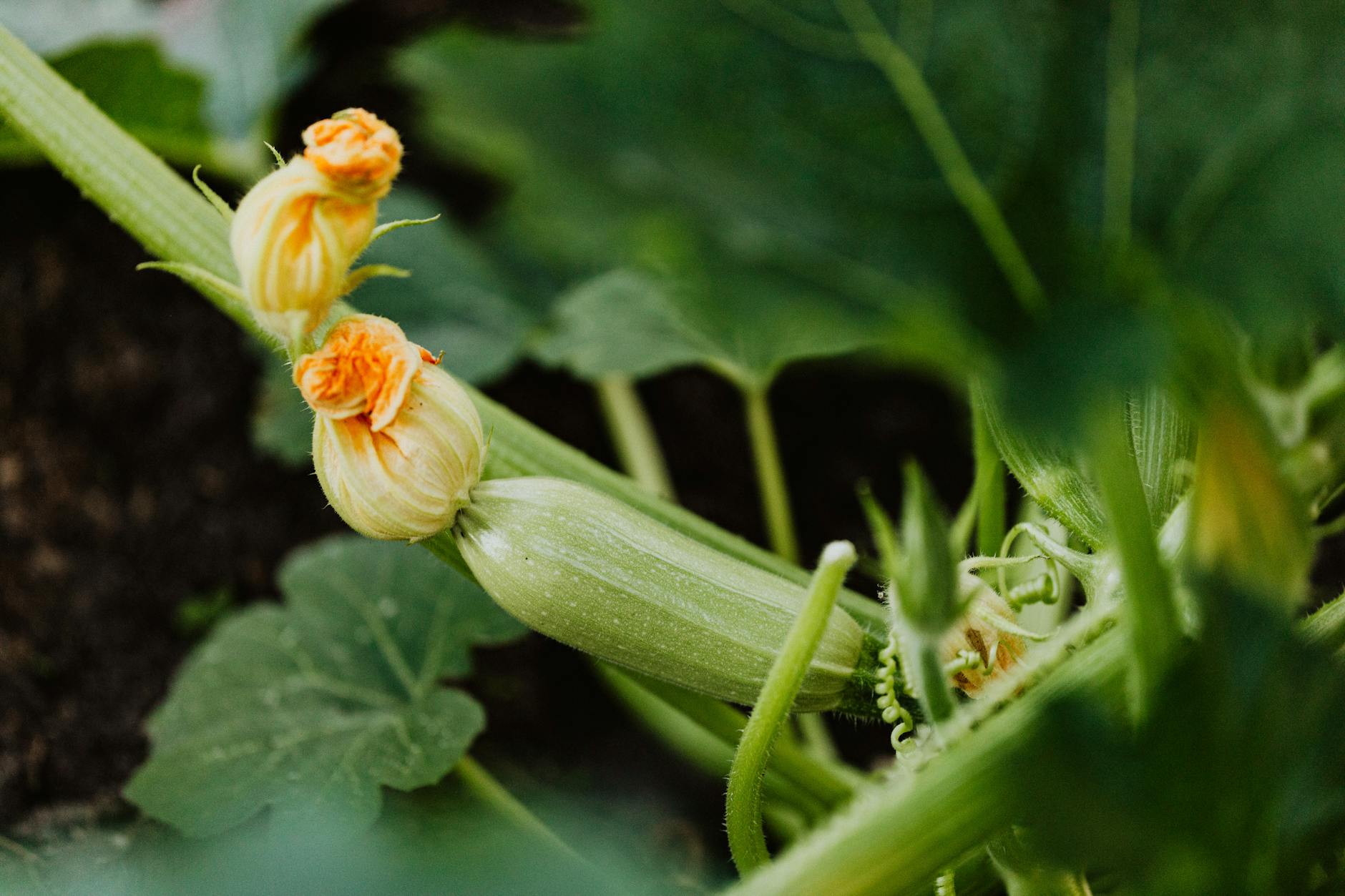
A zucchini ripening on the vine, with the blossom still attached.
Photo by Karolina Grabowska on Pexels.com

Due to its prolific nature, zucchini is commonly used in magic for fertility and abundance.

Zucchini is associated with the element of Earth. Practitioners who use the masculine/feminine energy dichotomy also associate this plant with “feminine” energy.

It’s possible to pick zucchini leaves or flowers to use in things like sachets or jar spells, if you wish. You can also batter and fry the flowers, which are delicious.

Personally, I prefer to leave the leaves and flowers where they are. I find the leaves unpleasant to touch, and the plant needs them more than I do. The flowers also provide food and shelter for pollinators — at night, squash bees like to crawl up inside them just before the flowers close. It gives them a safe, cozy little sleeping bag to curl up in.

As for the vegetables themselves… They’re not exactly the kind of thing you’ll be tucking into your dream pillows or anything (though that mental image is hilarious). So, in lieu of all that, here’s a fantastic recipe for egg-free, dairy-free, nut-free zucchini bread. It also uses cinnamon, which is considered a magical catalyst and love/money herb. Project your intention into the batter as you mix it, and you’ll have a delicious loaf of abundance and prosperity magic when you’re done!

  • 1 cup white einkorn flour (or use regular wheat flour)
  • 1/2 cup whole grain einkorn flour
  • 1/2 teaspoon baking soda
  • 1/2 teaspoon baking powder
  • 1/2 teaspoon salt
  • 1 teaspoon cinnamon
  • 1 tablespoon ground flaxseed
  • A whole bunch of chocolate chips, walnuts, or anything else you’d like to mix in (optional)
  • 1/4 cup avocado oil (or other oil or fat source of your choice)
  • 2/3 cup maple syrup
  • 1 teaspoon vanilla extract
  • 1 C grated zucchini
  1. Preheat your oven to 350 degrees Fahrenheit.
  2. While that happens, whisk or sift together your dry ingredients.
  3. Add your wet ingredients and mix thoroughly. (If you’re using regular wheat flour instead of einkorn, you may wish to add a little extra oil, maple syrup, or a few tablespoons of a milk of your choice — einkorn typically requires less liquid than regular flour.)
  4. Spread the batter in a well-greased loaf pan. Bake for 50-55 minutes, or until a toothpick inserted in the center comes out clean.
  5. Allow to cool, slice, and serve. I like it with a little of the Date Lady’s chocolate spread.

Whether you’re visited by the Zucchini Fairy, are your local Zucchini Fairy, or purchase your zucchini from the grocery store, these versatile vegetables are a great way to inexpensively pad out pretty much any recipe you can think of. Breakfast? Zucchini muffins. Lunch? Zoodles and pesto. Dinner? Roasted zucchini as a side. Dessert? Chocolate chip zucchini bread. Focus on the abundant, fertile, and prolific nature of these amazing plants, and invite their energy into your life.

life

Ghost Hunting in Cape May

Hello (and a relaxed and happy Pride Month to all of my fellow LGBT+ people)!

I am freshly returned from a brief trip to Cape May, NJ. My Handsome Assistant and I wanted to take some time to be near a beach for a bit, and managed to time things so we would a) have nice weather, but also b) be there during the “off season” when accommodations are generally a lot cheaper and easier to get. Fortunately for us, the stars aligned and we got a very nice room in the Angel of the Sea bed and breakfast.

(And when they say “and breakfast,” they mean it. You want breakfast? There’s fresh fruit, fancy breads, and three different entrées to pick from. Feeling snacky? There’s tea and pastries in the afternoon. Want to relax in the evening? There is wine and mountains of charcuterie. Even after you check out, you’re invited to return later that day to enjoy the amenities.)

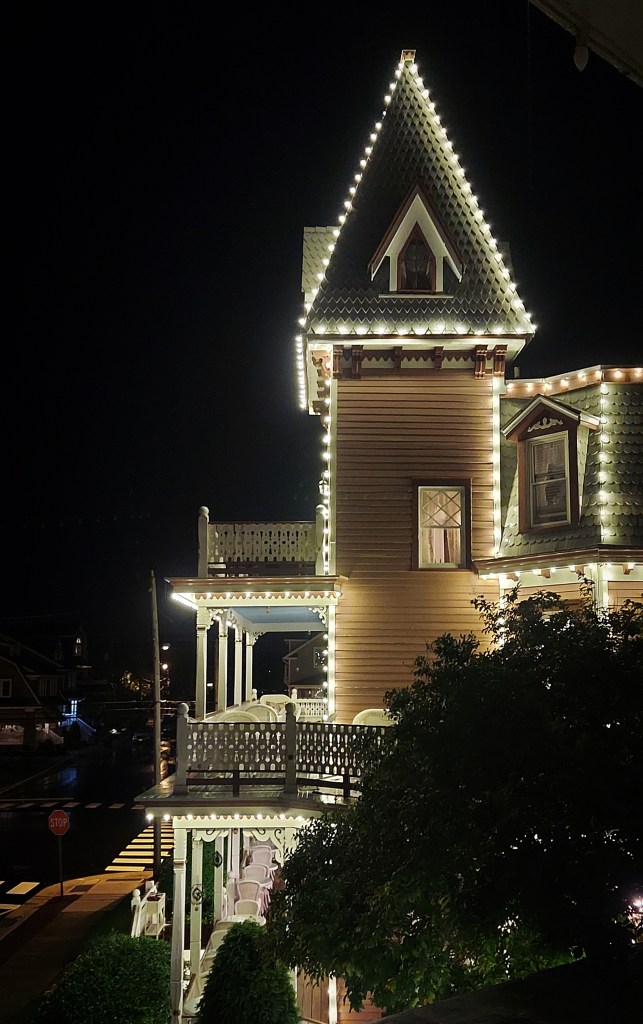
A view of a pink Victorian house at night. It has "gingerbread" details and a scalloped roof and is lit with strings of cafe lights.

The Angel of the Sea even comes with its own ghosts. It’s a very old building that was actually kind of… cut in half and transported to its current location. As a result, parts of it aren’t very accessible — think the narrow hallways and steep staircases you get with historic buildings — but are super haunted. As many as four ghosts have been reported to make an appearance there. There’re electrical shenanigans, shaking beds, and mysterious phantom coughs.

A photo of a picture on a wall. It's a very old, oval photograph of a sad-looking woman, in an ornate gilt frame.
Our room even had a complimentary Grandma.

I brought my ghost box, figuring it’d be interesting to mess around with during our downtime. I wasn’t able to get much on the scanner, but we also didn’t experience anything out-of-the-ordinary in our particular room, either.

We did meet a gentleman named Gary who was there with his wife. Gary was a lot of fun — always enthusiastic and down for a conversation, where he’d flit from subject to subject like a hummingbird. We talked about all kinds of things every time we ran into each other: history, haunted places, music, life, death, rehab, and more. He told us a story about someone close to him passing away. Even though this person appeared to have flatlined, they turned their head, looked into the empty doorway of their hospital room, and asked, “Which way do I go?” before they passed.

Even if you don’t find a ghost in your hotel room, places like this are generally home to absolute treasure troves of fun and interesting paranormal stuff. You’ve just got to know where to look.
(Antique stores. The answer is antique stores.)

I have made the weird and occasionally embarrassing habit of going into antique stores, finding someone who works there, and straight-up asking them, “If you had to guess, what object here would you say is the most likely to be haunted and/or carry some kind of terrible curse?”

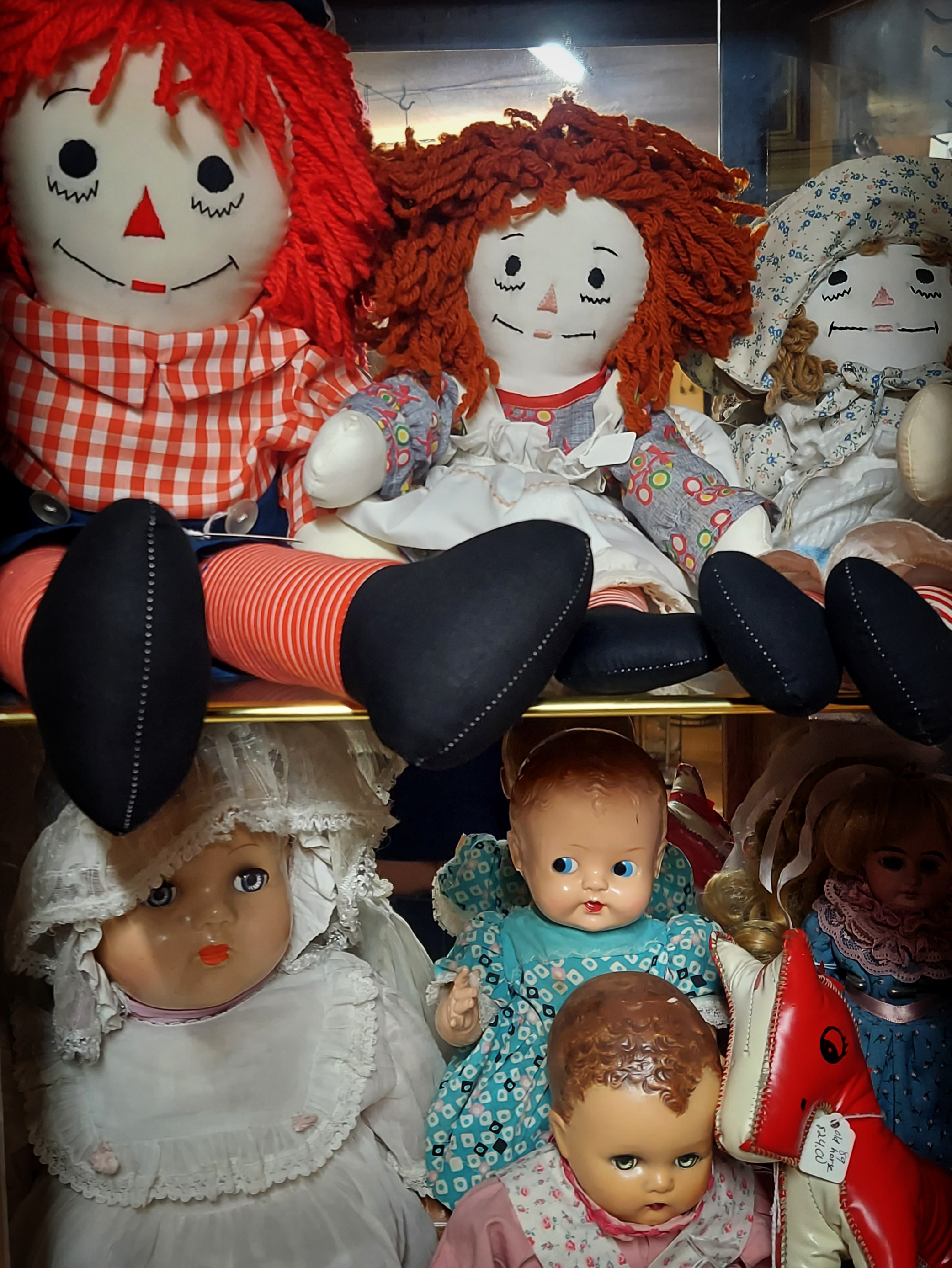
(If I had to guess, it would be any one of these things. Did you know the original Annabelle doll was a Raggedy Ann? Fun!)

As it turns out, antique stores are usually not super busy and are full of dead people’s stuff. I have yet to meet an antique store employee who has not jumped right in to talking about the weird stuff that goes on there at night. Some are more skeptical, but most of them will eagerly tell you about all of the things they’ve seen or heard.

For example, Antiques Emporia is home to the ghost of a little girl. She rearranges things at night and opens the packaging of vintage toys.

Capt. Scraps in Ocean City has even been the subject of a professional paranormal investigation. Multiple customers, on several separate occasions, have reported the sense that there was something there. Eventually, an associate of one of the owners brought in a full team with EMF readers, scanners, and the works. While investigating, they were able to decipher the words “Henry. Fire. Dog.” It was later discovered that a local antiques dealer named Henry had lost his shop, his dog, and his life in a terrible fire. Some of his paintings ended up at Capt. Scraps, and Henry decided to come along with them!

A painting of a black-eyed woman in a large hat. The background is indistinct and abstract, and the colors are very bright. There's a large red flower in the foreground.
I don’t know if this was one of his paintings, specifically, but something about it really struck me and I had to get a picture of it.

This store also has its share of shadow people, odd phenomena on security cameras, and the general “sense” of a ghostly presence. It’s a really neat shop.

So, while I wasn’t able to get any recordings or paranormal experiences of my own, I did come away with lots of stories.

We also found a lot of shops that were right up our alley. Good Scents has a ton of local art and jewelry, candles, soaps, and incense. (We picked up some soaps, massage oil, and a box of “smokeless” Hinoki cypress Japanese incense.) Best of all, it’s quality stuff — not the kind of smells that immediately make my throat puffy and make me feel like someone is driving nails into my face.

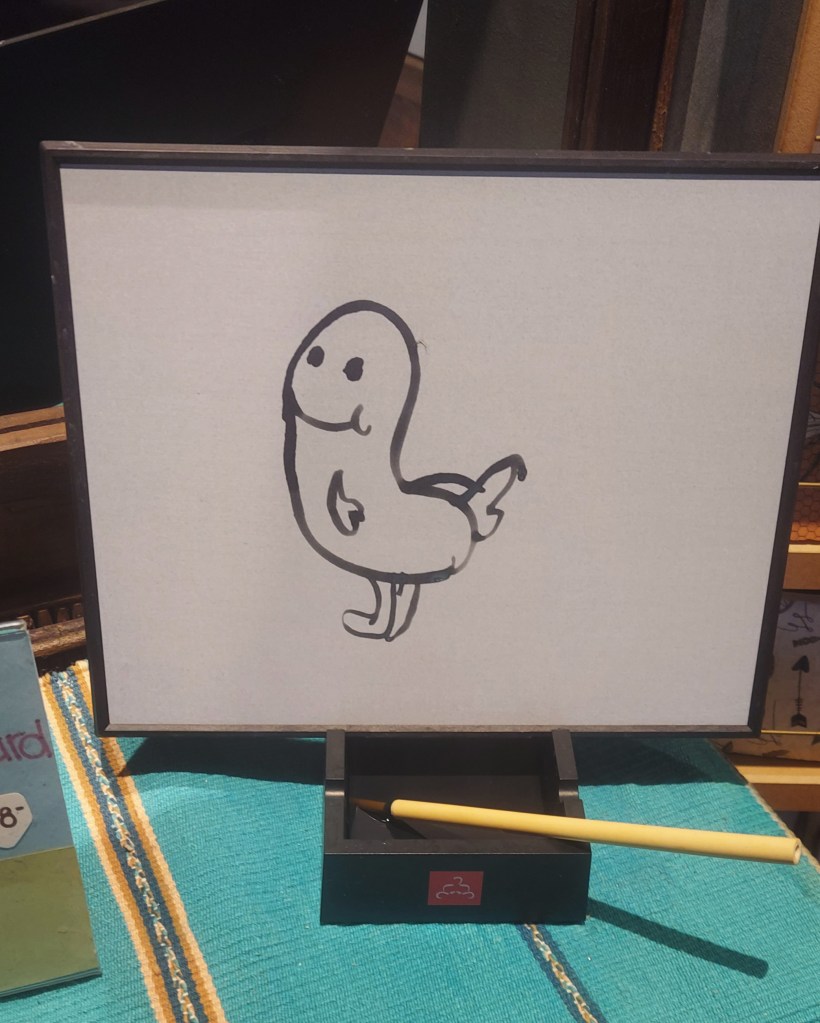
A crude drawing of Dickbutt.
A large black heart.

They also had one of those boards that you can draw on with water. Usually, you use them to write little notes or affirmations. Because I am a giant obnoxious child, I used it to draw a rushed, ersatz Dickbutt. (Don’t worry, I didn’t leave him there for impressionable childs to see. I drew over it.)

Guardian's storefront. There is a chain of copper bells and a wooden image of an angel on the front door.

Guardian is another delightful place to stop if you enjoy metaphysical shops. It’s small, but well-stocked. It has some tarot and oracle decks I hadn’t seen anywhere else, and a very nice selection of books. (I picked up one that I can’t wait to review here.) When we checked out, the proprietor had us choose cards from an oracle deck — we read the affirmations and she had us keep the cards as a little bit of positivity.

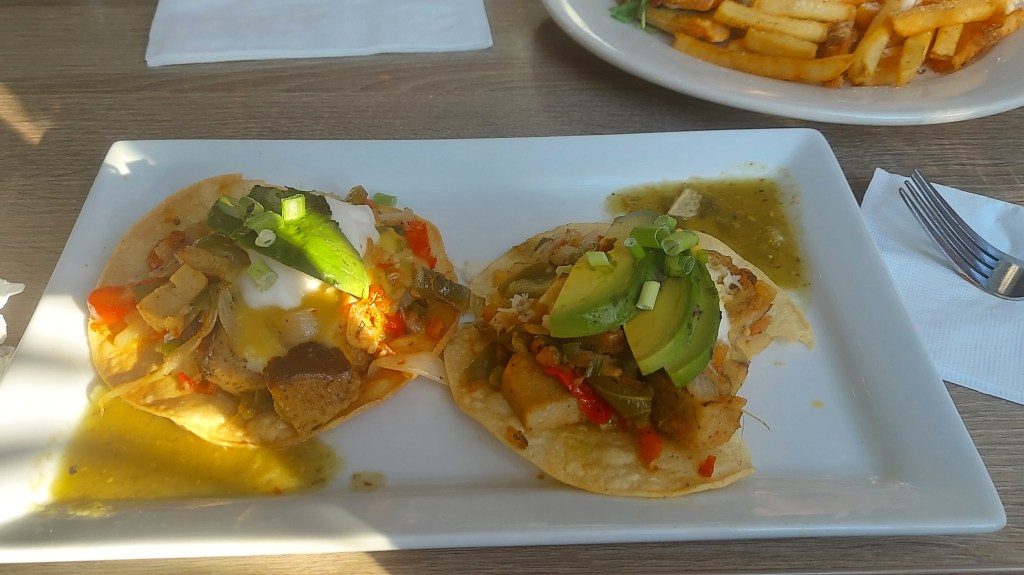
We also went on a bit of a hunt for vegan cupcakes. We’d managed to find plenty of meat-, egg-, and dairy-free meal options for me, and tons of fresh seafood for my Handsome Assistant at places like The Mad Batter (like their seitan hot wings and vegan tostadas) and Good Earth (which had an amazing cauliflower steak with chimichurri), so finding vegan restaurants in Cape May wasn’t a problem at all.

Vegan tostadas from The Mad Batter.

The outside packaging of Fruition's Gay Bar. It's primarily purple and depicts several anthropomorphic animals: a bear in drag, a deer bartender in a rainbow scarf, and a small beaver dressed as Rosie the Riveter.

My Handsome Assistant also brought me some fancy chocolates, like the Gay Bar. It’s pretty much an Old Fashioned cocktail in chocolate bar form, and it was delightful. I’ve had boozy chocolate before, but mostly just those little chocolate bottles filled with rum. Nothing really cocktail-inspired and uniquely flavorful like this.

We did eventually find Chocolate Face, a bakery that had vegan cupcakes. The chocolate ones were even oat- and nut-free, so they ticked all of my “weird dietary issues” boxes. This was about twenty minutes from where we were staying, so we decided to poke around at a couple of neat looking shops we’d seen on the map.

And buddy, we were not prepared.

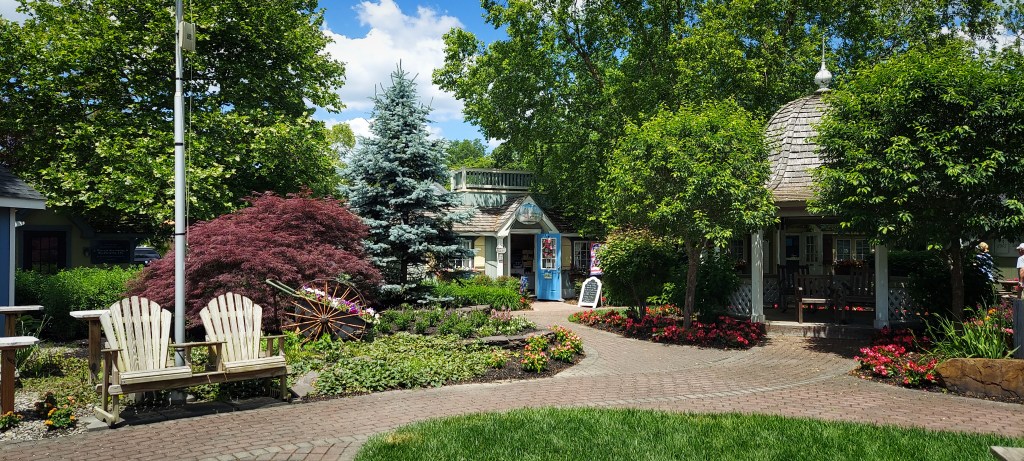
Just look at this idyllic-ass nonsense.

A photo of tiny cottages surrounded by brick paths and immaculate gardens. Lanterns hang from a large tree in the foreground, and the buildings are surrounded by flowers.
Don’t mind Longcat. He is protecting a stranger’s identity.

I thought it was going to be a couple of strip-mall type shops clustered around a parking lot. I was so wonderfully wrong. It was Woodland Village.

It was like… I don’t know. Little fairy cottages. Pricey goods, but not of the cheap, souvenir variety. All of this stuff was high-end. Handmade art and sculpture. Handmade clothing with vegetable-dyed fabrics. Handmade gemstone jewelry. Fine gemstone specimens. Handmade incense. Upscale men’s clothing. Teas. Perfumes. Spices.

Another view of Woodland Village, showing a gazebo, brick pathways lined with flowers and trees, an old-fashioned wheelbarrow full of plants, a set of wooden Adirondak chairs, and a shop in the background.

In Red Door Gallery, I wanted to show my Handsome Assistant a pour-over coffee funnel in a beautiful, glazed ceramic. While I reached for it, I clumsily knocked over a small sculpture of a sheep. We thought he was okay, but, sadly, one of his ears was knocked off in the fall.

Obviously, I was going to bring him home and fix him.

Once we’d finished shopping, we brought our purchases (mostly handmade cat toys for the dummy squad back home). I set the small, broken figure on the counter.

“He was a casualty of the fall, but it’s okay. I can repair him. I have the technology.”

“You… really don’t have to do that,” the proprietor said.

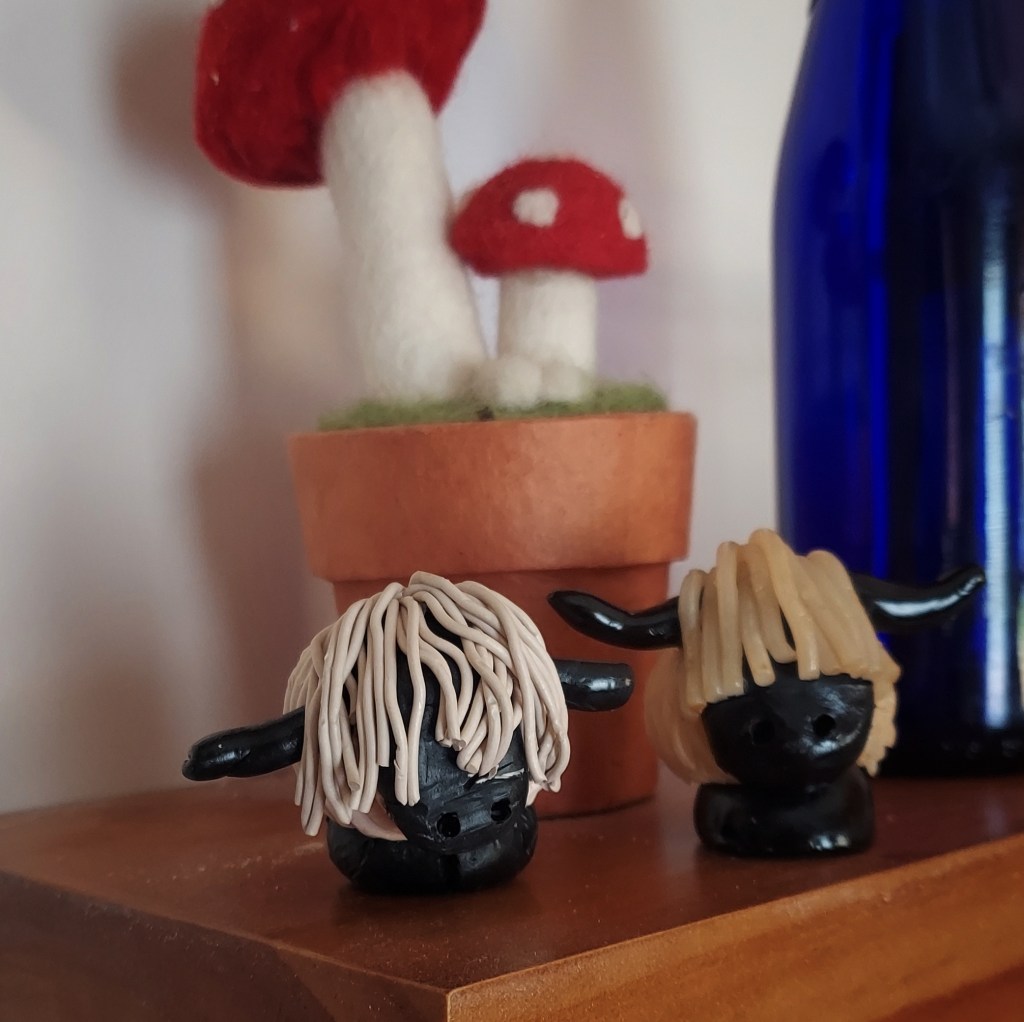
As it turns out, she was the artist who made the little figures. She didn’t want us to buy him just because he was broken, and insisted we pick out a whole one instead. I thought they were cute anyhow, so I did — even though I felt bad about the little sheep with his broken ear.

“Can you fix the broken one?” My Handsome Assistant asked.

“Oh, I don’t know,” she explained. She said she’d likely end up throwing him away.

My Handsome Assistant came over and whispered to me.

“Okay, would you really rather have the broken one, or the other one?”

“I mean… They’re both very cute, but I am going to feel terrible if the broken one ends up in the trash.”

A pair of small, polymer clay sheep in front of a blue glass bottle and a needlefelted Amanita muscaria.

Sure enough, he went back to the cash register and asked if, since the broken one was likely to be tossed anyhow, we could have it.

So, a bit of glue and patience later, I now have two small clay sheep in my kitchen, and a partner who is very understanding of all of my strange bullshit.

We also stopped in Summer Studio Avalon, which I probably could’ve spent all day in. It was just filled with gorgeous, handmade things. (I got a rutilated quartz, moonstone, and pyrite bracelet, some incense, and a pair of flowy teal pants that I am probably going to live in from now on.) There was beautiful embroidery, handmade incense, artwork, accessories, sculptures, crystals, all kinds of the exact sort of things I could happily spend an inordinate of time looking at and/or smelling. The proprietor was also very nice — we got caught up in a conversation about writing things, painting, and the fact that rainbow moonstone isn’t actually a moonstone and is more like a white labradorite.

We also stopped in Northeast Man, mostly for my Handsome Assistant. I found some really nice shirts and a solid cologne (Duke Cannon’s Bourbon, which he bought and I have been sneaking from him because it smells excellent and is the exact way I want to smell forever), but everything fit me in a less “mysteriously androgynous” way and more in a “fourth grader wearing their dad’s shirt” way. Most of the things there weren’t quite my Handsome Assistant’s aesthetic — more “Boat Dad” than “Office Druid” — but there were some really nice, high-quality pieces that suited him very well.

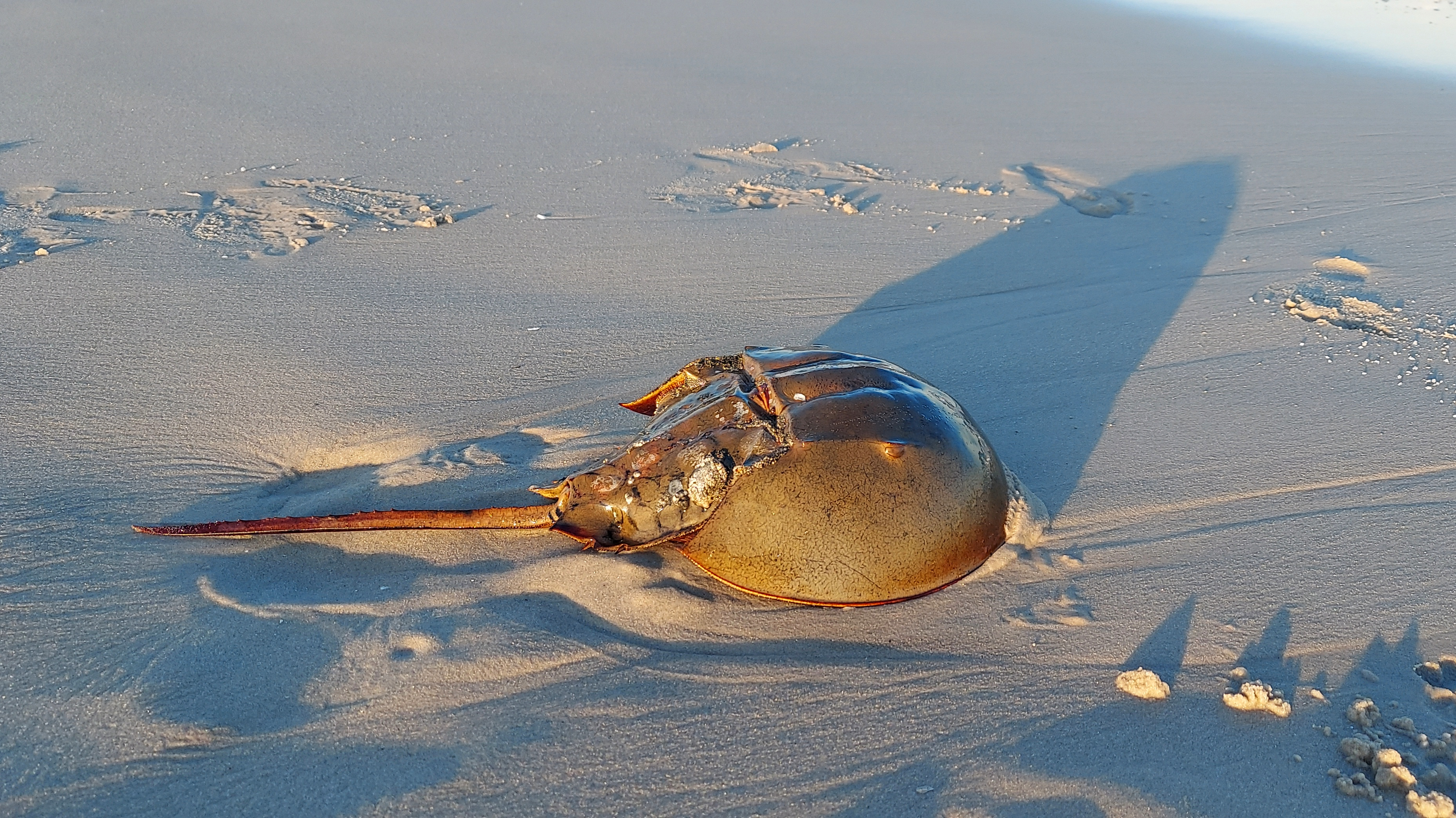
Since the Angel of the Sea is about a half a block from the ocean, we spent some time doing sunset beach walks. The weather was gorgeous, and the slanting golden light made the crests of the waves seem to glow. We also came upon a very large (and extremely deceased) horseshoe crab, which my Handsome Assistant had never encountered before. (He’s from a landlocked state, so his experience with wild marine life is somewhat limited.)

We also kept an eye out for trash, like we always do. There really wasn’t much — I think we picked up two cellophane wrappers and a water bottle, all told. It was very clean, especially compared to some beaches and hiking trails we’ve been on.

Fortunately for my Handsome Assistant, we did stop at the Nature Center of Cape May. We watched gulls and ospreys overhead, listened to the songbirds on the balcony, and admired the large, live horseshoe crabs in the marine lab.

Am I disappointed that we didn’t find any ghosts ourselves? Not really. It would’ve been interesting, but I’m fully satisfied with the experience that we had. Even during the tail end of its “off” season, Cape May was a lot of fun. Woodland Village was great, the abundance of antique stores (and antique store ghost stories) was awesome, the food was fantastic, and the beach was beautiful.

Plants and Herbs

Hen and Chicks Folklore and Magical Uses

Do you have little to no success with plants?
Do you want to get into gardening, but lack confidence?
Hoo boy, are hen and chicks succulents made for you.

Members of the genus Sempervivum, these succulents are also known as “live forever” or “houseleek.” They have the plump leaves of your average succulent but can thrive in growing zones 9-4. I have one that I stuck in a pot on my deck and did literally nothing for — not even water — and it’s filled the pot, put out tons of little green pups, and is flowering like there’s no tomorrow.

A top-down view of a Sempervivum plant in a pink pot. In the center of the photo, several pink flowers and buds are visible.
A close up of that plant’s first flowers. In the background, you can kind of see other buds emerging on their talk stalks.

Along with their easygoing nature, hen and chicks plants have some interesting folklore and usages in magical disciplines.

Let’s look at their common names first. “Hen and chicks” derives from their most notable method of reproduction — in addition to producing seeds, they send off little offsets in the form of round rosettes which give the impression of a large mother “hen” plant surrounded by baby “chicks.” They’re called “live forever” because they’re evergreen and very difficult to kill. Lastly, the name “houseleek” has no relation to the other plants known as leeks. Instead, the word “leek” comes from the Anglo-Saxon word “leac,” meaning “plant.”

As for why they’re called something that literally translates to “house plant,” there’s an excellent reason for this. Hen and chicks plants were (and are) frequently grown on houses. (When I lived in California, the house I stayed in had some lovely Sempervivum growing on the roof.) This practice originated with the belief that these plants helped to ward off fire and lightning strikes.

These plants are also associated with prosperity, health, and luck. Possibly as an extension of their fire- and lightning-protective connections, some cultures grew Sempervivum on roofs as a way to ensure the health and wealth of a house’s occupants. In Wales, these plants are still sometimes grown on roofs for luck.

(Of course, if you live in the US and have an average modern shingle roof, you may not want to grow plants there. Excess moisture could cause problems, and using your roof as an ersatz garden could void your warranty. Sempervivum are great for green roofs, however.)

As for warding off fire and lightning strikes, there are a few reasons for this. Some species of Sempervivum grow fine, snow-white hairs on them, that look a bit like fine wool or thick cobwebs, and their growth habit can make them resemble a jutting, sculpted beard. This is reflected in the German name “Donnerbart,” or “Thunder beard.” These plants are connected to various thunder deities, like Thor and Zeus.

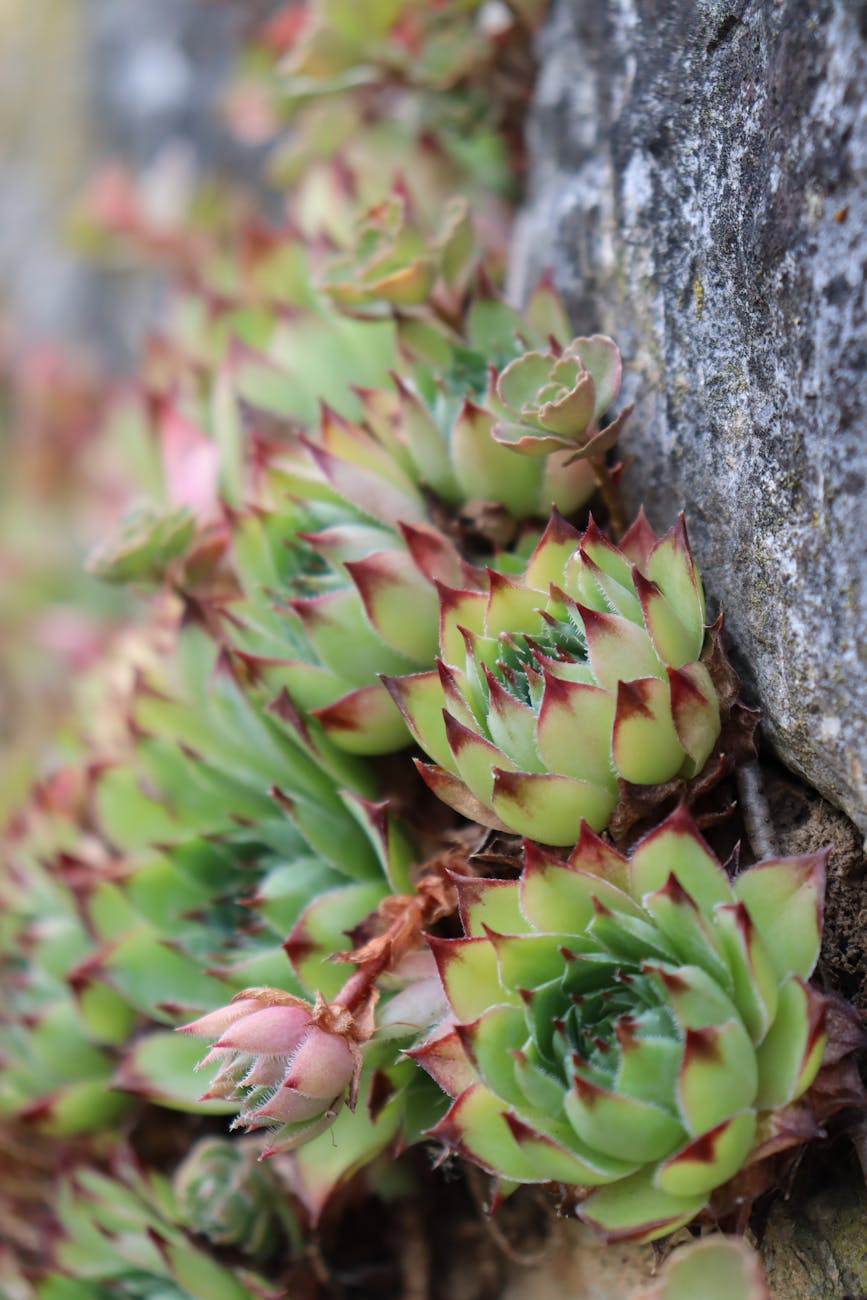
Sempervivums clinging to a rock face.
Photo by Honglei Yue on Pexels.com

The other reason behind it is that Sempervivum can act less as a protector than as an indicator. These plants can thrive in very dry areas, but they still need some moisture to stay plump and green. The presence of healthy hen and chicks plants generally indicates that conditions aren’t conducive to combustion.

Houseleeks are also used to ward off attacks by malevolent magic.

Medicinally, Sempervivum plants are used similarly to Aloe vera. Topically, it is sometimes a treatment for cuts, burns, or warts. This herb was also considered a very useful treatment for diarrhea, while larger doses were a powerful emetic. Traditionally, it’s considered a very cooling herb.

Elementally, Sempervivum is associated with Fire. It is also connected to all thunder deities.

From everything I’ve seen, Sempervivum‘s protective and lucky magical attributes are best employed by simply growing them. Give them a sunny spot and some well-draining soil in the right growing zones, and they’re pretty much good to go. (Of course, if you intend to use your hen and chicks plants in this fashion, it’s good form to ask them for their help.)

While these plants aren’t native to the US, I have noticed that they seem to be a favorite of small native pollinators. So far, I’ve seen three different species of sweat bee. They’re also useful for xeriscaping in especially challenging areas.

As I mentioned previously, you may want to avoid growing them on your roof. Yes, it’s very picturesque and cottagecore, and yes, it’s traditional, but having to pay upwards of five grand to fix or replace a modern shingle roof is none of those things. Plants trap moisture, which roofs need to shed. Their roots can infiltrate minute gaps between shingles, widening them and allowing water in. It may not happen immediately, but growing plants directly on a conventional roof, without any kind of barrier or container between the two, is generally not a good idea.
If you have a flat spot near your roof, like a windowsill, window box, or balcony, stick a couple Sempervivum plants in terracotta pots and put them there instead.

As for using them internally, I don’t recommend it. If you have a minor burn and don’t have a fresh aloe leaf handy, by all means, try applying some Sempervivum goop topically. Using these plants as an anti-diarrheal or purgative has largely dropped off in favor of other remedies, even in alternative medicine.

Hen and chicks plants are adorable, inexpensive, and exceptionally hard to kill. Magically, they’re just cute little protective and luck-drawing charms. If you have the space to devote to one (or a few), they’re well worth their tiny investment of time and money.