art · divination

Death of the (Tarot) Artist

There’s an idea in literary criticism called the “death of the author.”

It’s not a literal death — just a very stark metaphorical distancing. It pretty much means that, when it comes to interpreting a work, the creator’s context and intentions should be ignored in favor of an interpretation of the text as it stands. There are certainly some works that benefit greatly from the inclusion of the author’s context, but there are flaws inherent in binding a work — any work — so tightly to its creator.

The concept was described by a French literary critic and philosopher named Roland Gérard Barthes, who felt strongly that keeping the interpretation of a text tied to the author’s biases was limiting, as well as innately flawed. By contrast, ignoring the author’s intentions freed the text to be analyzed and criticized entirely on its own merits and message, while erasing the issue of putting words in the author’s mouth.

It’s a thing that crosses art forms. Visual arts resist interpretation a bit more strongly than the written word (either fortunately or unfortunately, there is no OED for imagery. Unlike language, pictures don’t need to be mutually intelligible). Freeing an image from the creator means the meaning of a piece is left entirely up to what it is able to communicate to a viewer. At most, the interpretation of a piece in the context of the creator is only one of many facets of it. To (mis)quote Barthes, “a[n image’s] unity lies not in its origins […] but in its destination.”

I remember learning to read tarot. It wasn’t a thing that interested me much, initially — I liked runes, geomancy, Ogham staves, things whose imagery was far simpler, but contained multitudes. (And seemed to involve a hell of a lot less rote learning.)

“Read it like a story,” my teacher urged.

But the trouble with learning to read tarot cards is that it feels like a lot to memorize. You have your deck, which, at first, seems impossibly thick. You have the little soft-cover booklet with its handful of keywords, or a short paragraph for each card. “The Three of Wands,” it helpfully tells you, “Progress, expansion, opportunity. Reversed: Delays, short-sightedness.” You might read this book, using the cards like flash cards to test yourself on the meanings. Finally, one day, you’ve achieved memorization.
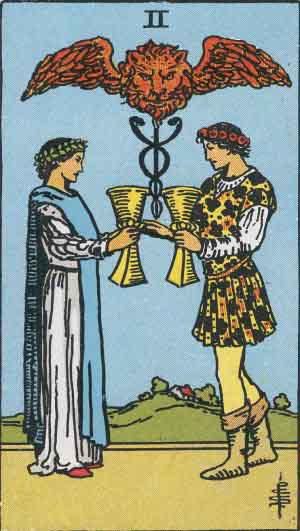
 

2ofcups

And then you get a new deck.

I want to preface this by explaining that I’m not suggesting that the traditional interpretations of tarot cards be thrown out entirely. Part of tarot’s enduring appeal is the universality of it as a means of self-insight, as much as divination. Those meanings endure because… well, they’re meaningful to us.
But there’s something to be said for burning that little book.

My S.O. didn’t read tarot when he met me. If you ask him today, he still probably wouldn’t consider himself a tarot reader, per se. But, between the two of us, we still have six decks — three apiece. One has beautiful imagery surrounding Nuestra Señora de la Santa Muerte, another is based on the works of Klimt, two others are animal-themed, yet another is based on the works of Mucha, one is full of strange, surreal moon-faced figures, and yet another is a joke deck I helped create to raise money for charity. All of them are tarot decks, with their Rider-Waite-Smith-inspired tableaux — The Fool, The Chariot, and so forth. All of them have subtly different meanings for their cards.

Reading tarot intuitively is a means of getting information without memorization, and it works because of the death of the artist. When you set the book aside, you free yourself to receive only what the artwork is giving you. The creation of a tarot deck is a deliberate act — every image is chosen or created with care based on the feelings it evokes, the ideas it conjures up, or its place in the visual language of alchemy. Allowing the artist to “die” frees us from adhering to the interpretations handed to us.


Plants and Herbs

Please don’t eat the oil.

*DEEP BREATH.*

Okay.

As someone with a chronic health condition, I’ve heard a lot about how all I really need are essential oils. This comes from a place of love (usually, though it sometimes comes from a place of “please buy this from me or my upline is going to be pissed”) and from people who mean well, but that doesn’t make it any less grating. I still smile, say thank you, and accept the advice in the spirit in which it was given — a desire to help me be healthy again. As hard as it is to continually hear that I’m only suffering through medication and medical procedures because I haven’t properly tried oils/yoga/meditation/green juice/coffee enemas, I can’t really get mad over it.

Sometimes, though, this advice crosses the line between “well meaning, but misinformed” to “please stop telling people to do this.”
That line is when people begin telling me I should be eating essential oils.

There are a couple of reasons for this. Sure, some oils are routinely used in food — by commercial food operations, who use industrial food-grade oils to flavor batches of food intended to feed hundreds at a time — but this is not what I’m talking about.

You’ve probably experienced this scenario: You’re on Facebook or Instagram, minding your own business, and you get a message. Not just any message, oh no. It’s a friend you haven’t spoken to since high school, and they want to tell you about their wonderful new business opportunity. One look at their profile tells you all you need to know: their feed is hashtagged out the wazoo, and replete with photos featuring crockpots of soup, fresh-baked pies, and water bottles glistening with condensation… All serving as backdrops for tiny, all-too-familiar amber bottles.

My primary gripe with putting essential oils in food comes from two things:

  1. What’s actually in essential oils.
  2. Deceptive marketing tactics (and those who uncritically repeat them).

There’s too much oil in the oil.

Look at it this way. Oil is… well, oil. This is why is needs to be diluted for use — it doesn’t mix with water, and will sit, undiluted, on your skin/in your esophagus/wherever else it touches and burn the living crap out of you if you aren’t careful. Adding a few drops of oil to a meal without a sufficient volume of liquid fat (or an emulsifying agent), for example, may not end up flavoring the meal. It will, however, set up one poor bastard for one hell of a flavor adventure.

Essential oils are also highly concentrated. If a recipe calls for a teaspoon or tablespoon of rosemary, for example, this is not going to be answered by using rosemary essential oil instead. It takes a tremendous amount of plant matter to yield a comparatively tiny amount of essential oil (which is also why they’re not exactly as sustainable or green as many oil sellers would have you believe, but that’s a subject for another day). Not only that, but, by not using the whole herb when it is called for, you’re missing out on the compounds that don’t get released as oil. Anything water-soluble is lost to the hydrosol during distillation, and doesn’t end up in the finished oil at all.

Oils are more expensive, less safe, and don’t even give you all of the flavor or benefits of the whole herb.

That’s not what “purity” means.

Sometimes you’ll hear multi-level marketing reps defending essential oil consumption by saying something like, “My essential oils say they’re safe to use internally!” or “My essential oils are more pure than the competition, therefore they’re safe!” This is a bit of marketing jargon likely passed down to them from their upline that misses one obvious issue: The reason essential oils aren’t safe to eat is that there’s too much essential oil in them. 

I mean, theoretically the less-pure oils might be safer, because at least then you’re slightly less likely to OD on the equivalent of eight pounds of lavender in one sitting. In this context, “pure” does not equal “safe to consume.”

So is it medicine, or not?

One thing that I find fascinating is the discussion about whether essential oils are medicine or not. Sure, they’re required to say they can’t treat, cure, or prevent any disease, but there is still a lot of historical evidence of herbs and herbal distillates used as medicine before isolating, refining, and synthesizing active compounds became the pharmaceutical standard. So, some people who doubt the safety or efficacy of a pharmaceutical approach will reach for an essential oil bottle over a prescription slip.

And then reach for that bottle again when they want to cook a meal. And again for a relaxing bath. And again for an air freshener.

So are essential oils medicine, or aren’t they? If they are effective at treating anything, they are medicine and should at least be treated with the respect you’d afford a bottle of gummy vitamins. Essential oils don’t work through fairy dust, they contain compounds that act on processes in the body just like medicines do. This is why the same oils that can help dry up a blemish or disinfect a cut are outright neurotoxic to animals — differences in the way these compounds are metabolized yield dramatically different results from species to species.

Essential oils work therapeutically because those compounds are concentrated within them. If “the dose makes the poison,” why use a concentrated form of an herb instead of what a recipe actually calls for? I don’t drink Nyquil because I like the way it tastes, so I’m not going to put concentrated plant compounds in my food or water for flavoring.

Less is more.

Overexposure to essential oils is definitely something you want to avoid. Some oils can have unwanted effects if they’re used on a daily basis, and some are known to cause sensitization with repeated exposure.

While sensitization can happen at any time, the risk is increased with certain oils and improper dilution. Most reactions cause localized skin rashes, but some particularly unfortunate people will go into anaphylactic shock. It’s not at all uncommon for aromatherapists, for example, to become sensitized to even the safest oils purely due to daily exposure. This isn’t meant to scare anyone away from using essential oils, but to underline the importance of treating them like what they are — a highly concentrated form of plant-based volatile compounds.

So, why do some people advocate eating essential oils?

I want to make one thing clear — it isn’t doctors or certified health practitioners that I’m taking issue with, here. These are people who know what they’re doing, and are both aware of and prepared to weigh the risks (adverse reactions, sensitization) against the potential benefits to their patients. They also generally don’t push adding essential oils to food. A health practitioner might recommend enteric-coated capsules of peppermint oil to someone with IBS, to ensure that standardized levels of the therapeutic compounds in the oil are delivered where they are needed (instead of just irritating the crap out of the esophagus because lemon oil is literally never going to mix properly with your bottled water, Taylor). Actual medical usage isn’t the problem. I mean, I’ve got a fat stack of FDgard samples from my gastroenterologist, and they’re basically coated caraway oil and menthol.

The thing is, I use essential oils on a consistent basis. I even make things that I give away, trade, or sell to other people. It’s safe to say that I go through more essential oil than your average person, but, even so, a bottle will last me for a while.

That’s bad news for an essential oil rep. The more ways they can find to sell oil, the better. People don’t make new bottles of homemade spray cleaner every day. They don’t take long, luxurious baths every day. They don’t need to make their own herbal salves or cold-process soaps every day.

You know what they do do every day? Eat and drink.

Suddenly, the bottle of lemon oil that could last all year only lasts for two months. Tell people that only X-brand of essential oil is pure enough to eat, and the oil rep can lock in a customer base that will not only keep returning to them for the “purest” oil, but go through it much faster than they otherwise would (and likely end up joining the rep’s downline in order to save money). All of these things add up to more profit for the MLM.

People are fond of essential oils as a “safer,” “greener” alternative to things they mistrust. Big Pharma, spray cleaners, air fresheners, personal care products, all of these are multi-billion dollar industries, and that breeds mistrust. Businesses don’t just rake in billions without considerable effort and a strong profit drive. If they are profit-driven, how often does the safety of their customers take a back seat to money?

In 2016, the global essential oils market was valued at over $6.6B USD. Of that, doTerra alone pulls in over $1B in sales annually.

Please don’t eat essential oils.


divination

The King of Cups

Even with all of the reassurance I had from last week’s cards, I still went into my appointment on edge.

(Okay, so I had a full blown panic attack and had to ask the receptionist if there was somewhere I could lay down and try to relax. Everyone was incredibly chill and understanding about it, though, which was nice.)

The parking garage felt claustrophobic. I had to ride in a hot, stuffy elevator. I had no idea what kind of tests would be required of me, and knew this might be my only chance to have them. What if the doctor asked for twelve tubes of blood again? What if I couldn’t convince them to take my blood pressure at the end of the appointment, instead of the beginning?

As it turns out, I didn’t need to worry. Not only was everyone really kind and reassuring, my nurse practitioner is awesome. I was never made to feel that I was wasting her time. She thoroughly explained everything to me. She took my medical history with no fuss, no sighing, and no muttering. There were no awkward first-visit dives into my parent’s marital history. I left the office feeling empowered, like I knew what was going on. I have hope that, even if the h. pylori test is negative, there are other possibilities. I also have samples of FDgard, which I didn’t even know was a thing before this.
I’m probably fixable, you guys.

(The real kicker, though, was finding out that I shouldn’t’ve had the h. pylori test in the first doctor’s office to begin with. I had no idea that using antacids in the previous two weeks might alter the result — I could’ve ended up with a false negative, wasting more of both his time and mine for nothing.)

So, now I’m pretty much just dealing with the symptoms for another week and a half until I can get a few more tests. I just have to wait.

I’m not good at waiting. I can be patient, but I hate the powerless feeling of sitting on my hands as minutes to become hours and hours to become days. I didn’t even have any good questions for my tarot deck this time — I just wanted to know what kind of energy this week is bringing. What can I focus on to help the time pass?

I drew King of Cups.

Cups is the suit of the emotions, and the King is the master of them. He is relaxed, balanced between the heart and the mind, neither devoid of reason nor incapable of empathy. When he turns up, it’s an invitation to explore the feelings around a situation — are there emotional factors that are making things more difficult than they need to be?

… Yeeeah, kinda.

I’ve spent a lot of time and energy managing my physical symptoms. While I know that they aren’t caused by stress or fear, the anxiety they trigger still needs managing. When I do self-work, I usually focus on panic disorder and finding ways to manage unpreventable panic attack symptoms as they arise. Now, I should probably look more deeply into strategies for managing my medical anxiety, specifically — it’s going to be hard to go through rounds of testing and follow-up visits if I can barely make myself walk through the door.

Besides, I’ve got time to kill.


Environment

Deepening Resilience: Preparation.

Learn more about Deepening Resilience here, or read my previous post in this series here. 

Preparedness looks different from community to community. In some places, it’s ensuring that there will be enough clean food and water. In others, it’s getting ready to battle things like worsening allergy seasons and severe weather phenomena.

In mine, it means pulling up stakes.

To look at my neighborhood, you wouldn’t really think of it as something that’d be that threatened by climate change — the hardest part might be getting supplies in and out of the city, right? When you look at projections of swelling rivers and reshaped coastlines a few years to a few decades from now, though, it’s not that easy. One estimate places the new waterfront at ten feet from my front door. In addition to rather complicated traffic patterns, there are many reasons why this would be really, really bad. Even with time to prepare, how can an entire, already-existing city keep sewage, garbage, vermin, and other vectors of illness out of the rising water? Keeping our potable water from contamination is important, but also not something a small community using city infrastructure can really manage on its own. Even if we set up our own, smaller-scale  means of keeping our drinking and bathing water clean, the mold, rats, and insects will still be there.

Sometimes, preparedness looks a lot like leaving.

Unfortunately, that means it may not be possible to take care of everyone. There are a lot of people here who can’t move on their own, whether due to physical or monetary limitations. Even if we take it for granted that my community would be willing and able to pitch in to uproot every member and move us all to somewhere safer, it still isn’t possible. Some are too old, others are too ill. Even with able-bodied people to help, even if money isn’t an issue, you can’t move everyone.

That doesn’t even take into account the strong ties people feel to their homes. There are still people living in Centralia and outside of Pripyat, and not all of them are there because circumstances force them to be. The ties to home are strong. For some, a life in a strange place — no matter how safe — would be no life at all.

So, how do we prepare our community for climate change here? Is it right for the able-bodied to put themselves and their families at risk for those who either can’t or won’t move to safer ground? Could my community even still function, as our houses flood and crumble and our streets vanish under the water? I don’t have an answer. I wish I did.

Sometimes, preparing means packing up and doing the best you can.


crystals

Natural Citrine vs. Heat-Treated Amethyst — Does it matter?

Note: While I was not originally compensated for the links in this post when I initially wrote it, I have been compensated for some links that have been added. None of the information or opinions offered here have changed.

From what I have seen, citrine is like wasabi or olive oil — it’s entirely possible for someone to love it without ever having actually used it. That’s not to say that a lot of citrine crystals on the market are fake, as in made of resin or glass, just that not everything labeled as citrine is actually what it says it is.

What is citrine, really?

Citrine crystals are best known as a bright, sunny yellow variety of quartz. Nobody is really sure where the color comes from. Some suggest that it’s caused by iron impurities in the crystal’s structure, while others say it’s more likely caused by aluminum or irradiation. From what I’ve been able to gather, there are probably several varieties of yellow quartz created under different conditions, all of which have been lumped together for the gem trade under the name “citrine.”

Metaphysically, citrine is a stone often used for prosperity, luck, and success spells. Its sunny color lends well to everything relating to the yellow, gold, and orange areas of color magic. As a healing stone, it brings positivity and optimism.

How is citrine faked?

Real citrine is pretty rare. It doesn’t seem so when you walk into a crystal shop, though — chances are, there are tons of clusters of bright orange crystals, usually at a very reasonable price. So, what gives?

While citrine is uncommon, amethyst is not. It’s not at all unusual to take amethyst, subject it to heat treating, and get something that can pass for citrine — in the sense that it’s a crystal, and yellowish.

Heat-treated amethyst
Heat-treated amethyst.

How can you tell if a citrine is real or heat-treated?

To put it bluntly, if you’re used to seeing heat-treated amethyst, real citrine is… Well, disappointing. Most of it looks closer to a smoky quartz than the vibrant orange hues of the heated stuff. It’s like looking at a glass of orange juice next to a glass of orange soda. Compared to a glowing yellow heated amethyst cluster, the real stuff looks almost anemic.

There are other ways to tell, too. Real citrine:

  • Does not often have the same growth habit as amethyst. While we’re probably all used to seeing clusters of low-growing amethyst crystals that look almost like grape jelly, citrine usually appears with longer, straight crystals or as individual points, more akin to clear quartz.
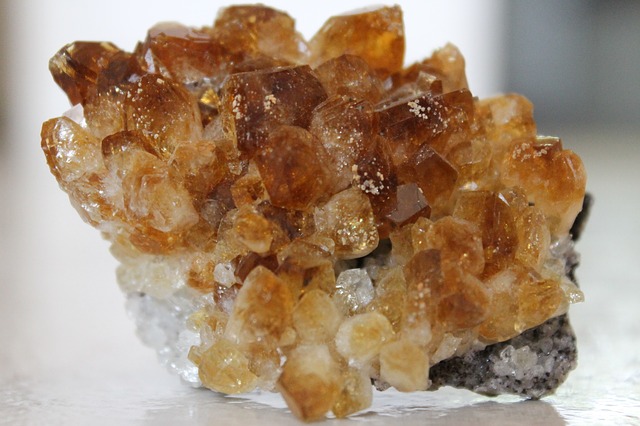
  • Tends to vary between a light yellow, like white Zinfandel, to a smokier, apple juice color. It doesn’t naturally have that bright orange appearance.
  • Tends to be very clear.
  • Is pricier than heated crystals.

By contrast, heat-treated crystals:

  • Tend to have a very milky base, or be cloudy throughout.
  • Often show up as pieces of geodes, usually with a very white base. Individual points usually have a very triangular, almost toothlike appearance.
  • Are extremely brightly colored.
  • Don’t cost much.

There’s one other way to tell a citrine from a baked amethyst — pleochroism. It’s not something the average crystal-buyer can really use to their advantage, but it’s much less subjective than determining how clear a crystal is, or exactly where it falls in the range of natural and artificial colors. Pleochroism describes an optical phenomenon where a mineral appears to change colors when viewed from different angles, particularly when using a polarized light source. Amethyst, citrine, and smoky quartz are all pleochroic. Heating amethyst to alter its color causes it to lose this property, so it is consistently yellow (or orange, or brownish) regardless.

Interestingly, citrines created by heating smoky quartz do continue to exhibit pleochroism. These citrines also become pale when they are heated further, and turn yellow when exposed to radiation.

Citrine.jpg
Yellow citrine crystals.

Does it really matter?

Well, yes and no.

Some argue that heat treating a crystal is just exposing it to the same effects that would happen naturally, so the end product isn’t actually any different from a genuine citrine. Others say that that isn’t the case, and the natural circumstances of a crystal’s formation influence its properties.

If you’re looking for a bright yellow or orange crystal because you want to tap into the magical properties of those colors, it probably doesn’t matter how the crystal was made. If using things in a raw, unadulterated form is important to you, you probably want to shy away from artificially colored crystals. The choice is ultimately up to you.

It matters to me because, under the right conditions, you can tell the difference between a heated amethyst and a citrine. Pleochroism is an empirical way to tell which crystals are baked amethysts, and which are not. I feel like this is an important distinction — magic is transformative. Natural citrine takes in light, and shifts its color based on how its viewed. A crystal that’s supposed to be pleochroic and isn’t wouldn’t be as useful to me as an unaltered stone.

From a practical standpoint, it can also matter because heating a stone affects its durability. High heat can alter the matrix, especially of crystal clusters, making it chalkier and more prone to crumbling.

Color magic is a deep and fully developed magical system of its own. If the color is all that matters to a spell, it doesn’t really matter whether a stone is natural, heated, dyed, or coated. For witches who prefer to work with stones in an unaltered state, the distinction between natural and heat-treated citrine can be an important one.

art · life

Painting What You See

cropped-drawingThe simplest piece of artistic instruction is also the most useful: Draw or paint what you can see.
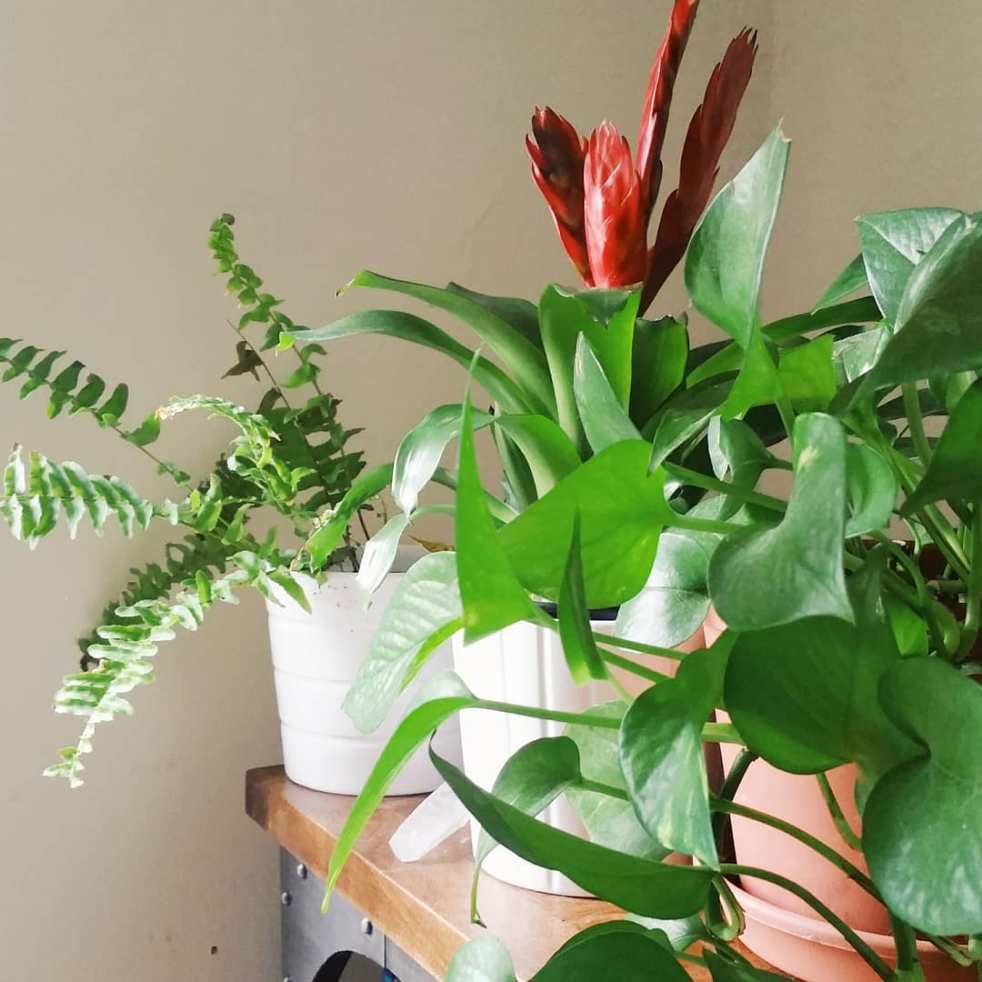
It’s surprisingly difficult to keep our minds from filling in the blanks — we see a cup, and we know the cup is round and three dimensional. Our eyes tell us the mouth of the cup is a flattened oval, but that isn’t what our hands want to make. Our brains know better than what our eyes tell us.

The ability to “know better” and anticipate shape and distance like that is an adaptation that’s probably helped us, in an evolutionary sense, but it isn’t much use when it comes to accurately translating a three dimensional object onto a two dimensional space. That’s when the admonishment to create only what you can see becomes useful.

For me, it’s also a bit ironic.

I’ve mentioned this before, but I was diagnosed with idiopathic intracranial hypertension about seven years ago. It used to be known as “pseudotumor cerebri” — in essence, a brain tumor that isn’t. It mimics all of the symptoms of having a large brain tumor, but without any mass present. One of its hallmarks? Vision changes. As cerebrospinal fluid pressure increases, so does damage to the optic nerves.

I can’t drive, because I can’t see well enough to. I have dead spots in my vision, which are almost impossible to describe. It isn’t really not seeing anything, it’s seeing nothing, in the same way that House of Leaves‘ Zampanò defines uncanny as ‘full of not knowing.’ Lines and space warp and deform around their edges like miniature event horizons, wholly confined to my eyes. Sometimes, I turn my head too quickly and see showers of golden sparks, or scintillations like the sun reflecting on water.

My brain often tries to “help,” by compensating for the strangely existentially horrific idea of seeing nothing, like a kind of neurological horror vacui. It inserts spectacularly mundane things into the places where my eyes don’t work anymore — a spare copy of my laptop stuck in my peripheral vision, or a stack of books I’ve never owned. A poached egg in the middle of the floor. A glass of water that yields only air when I reach for it.
I’m not sure why it does this, but it feels like the bones of a good short story. You would think that having your brain spontaneously insert images into your vision would be the opposite of helpful… Unless hallucinating several bunches of bananas was somehow preferable to what it’s trying to protect you from seeing. Fun!

If I said that coming to terms with the idea of potentially, possibly, let’s-face-it-probably going blind was difficult, I’d be lying, because that’d imply that it was possible to begin with. I don’t know that it’s any harder for me because I work with visual media — who wouldn’t be upset at not being able to see anymore?

I’m at the point where my vision loss has slowed considerably, if not entirely stabilized. With time (and, hopefully, a prolonged remission), some of my vision might come back. A lot of it won’t.

Sometimes, I do paint what I see.

And it’s fucking weird.

Plants and Herbs

New Pitcher Plant Shoots!

I love my little pitcher plant. It’s helpful (especially in summer), weirdly cute, and caring for it has been a really interesting learning experience. All told? 10/10 plantbro.

I’d wanted a Nepenthes ever since one of my exes and I spotted an enormous, stunningly beautiful N. ventricosa at this nursery we used to frequent years ago. (Old Country Gardens, in Delaware. Visiting that place was like going to weird plant zoo, and I loved it. They had a great collection of strange succulents and ornamental plants, as well as the usual fare. But anyway, I digress.) I was immediately drawn to it, but, since we lived in a place with barely any natural light to speak of, it was not to be.

When my S.O. and I saw a pretty little N. ventrata, we jumped on the opportunity. The pitchers didn’t last long after we brought it home, as they’re kind of prone to dropping off — Nepenthes are pretty sensitive to changes in light and humidity, and few homes are able to provide the kind of sun, temperatures, moisture, and tightly-controlled setting that a professional grower can.

Fortunately, N. ventrata is pretty adaptable. It’s a hybrid between N. alata and N. ventricosa (a lowland and highland species, respectively) and its needs are a bit better suited to the typical home environment. Even if the pitchers drop off, they’ll grow back once the plant acclimates as long as its basic needs are met.

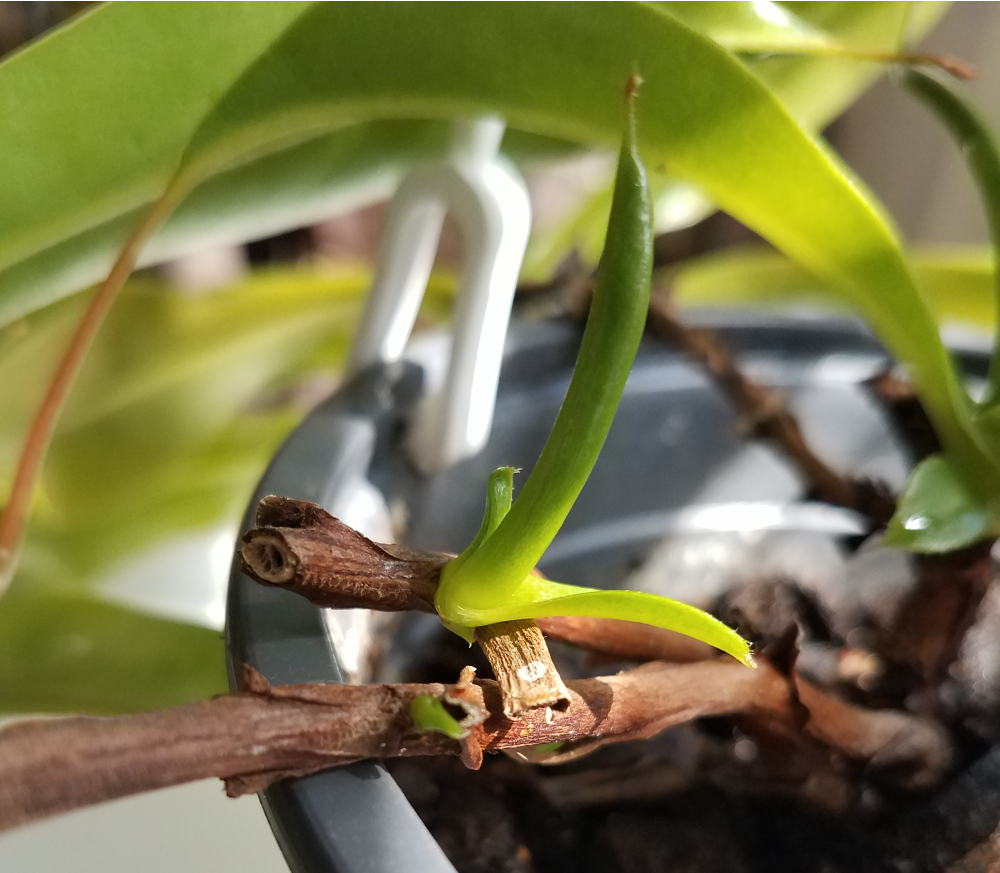
This one grows like a weed. I have to cut it back regularly, and it seems like every spring brings me a fresh batch of these guys:

A nepenthes stem with new, green shoots.
New shoots!

Sometimes, Nepenthes produce basal shoots, which seem to grow out of (or very close to) the soil. They’ll also grow new shoots further along the vine. I’m no carnivorous plant expert, but, as far as I can tell, there isn’t an enormous difference between the two. They don’t develop their own root systems like aloe pups or spider plant offsets, but they can detach and eventually root. Left alone, they’re also a great way for a plant to continue on after it’s gotten a little too long. My plant tends to look scragglier as it vines. I also much prefer its lower pitchers to those that it produces on its upper portions, so I like to prune it back to maintain a more compact shape. (I also don’t really have the room to properly cultivate a vine just yet, so compact it is!)

A tiny nepenthes pitcher.
Plus the rosette has the cutest baby pitcher ever.

Fortunately for me, I’ve got a ton of new shoots to work with this year. This plant’ll be full and leafy in no time.

Environment · life

The World

Does this stranger really expect me to tell him every traumatic event I’ve ever been through? I thought. As I looked at the tiny laptop balanced on the edge of the examination table, I began to doubt it had enough hard drive space to hold this particular interview.

Let me back up.

My S.O. didn’t just manage to get me a doctor’s appointment — he managed to get me one with the doctor I’d originally wanted to see. Someone dedicated to restorative medicine, with rave reviews praising his patience and understanding. So why, now that I was actually in front of him, did I get the distinct impression that I was a waste of his time?

I’d filled out the medical history forms as best as I was able. There was a lot to fit, and not nearly enough space to do it in. I prioritized, skipping over a bout of flu here, or an ear infection there. I fit in everything I could remember. Still, it wasn’t enough. He said he wouldn’t get to examine me, because he had to spend so much time going over my medical history now. He wanted to know everything — why did I move to California? Was the pomegranate orchard there regular, or organic?

“What am I even here for?” He finally asked. I was stunned by it, but, by then, I also wasn’t even sure how to answer him. I was doubled over in pain, to the point where it was hard to walk. I said that I was hoping for help with what I thought was an ulcer. A referral to a specialist, maybe? A recommendation?

He wanted to delve into emotional trauma. His voice was accusatory, his sighs impatient — as if I’d left my parents’ divorce out of my medical history on purpose. (I didn’t know it mattered. I also didn’t find it particularly traumatic. If anything, it was a relief.) I’d also neglected to mention a lot of other things. How traumatic did something have to be to count? How far back did he want me to go? Was evading a kidnapper at age 13 good enough, or did I have to go back to being sexually assaulted at 5? Maybe the time a man I’d briefly dated decided to stalk me at my job? Or should I cut right to finding out that one of my room mates was murdered?

I didn’t think his laptop had the space for me. Judging by his words, he didn’t have it, either. I only told him about the divorce.

I mentioned intracranial hypertension. He said he didn’t “know if that’s even a thing.”  (Trust me — it is.) I felt my stomach drop into my knees. What was I going to do if I needed to go on Diamox again? Or worse, needed a shunt? I don’t have vision loss and brain damage for no reason, dude. 

While I waited to have blood drawn, he patted my shoulder in passing in a manner I think he thought was reassuring. It wasn’t.

I’m not good with blood draws. I always faint, I usually need a butterfly needle, and giving any amount beyond what’s needed for a basic metabolic panel has always made me sick. When I found out he needed twelve tubes of blood, I asked if there was a way to split the requisition — I’ve had to do it before. Most of the blood tests were for thyroid hormones, a CBC, blood lipids, the usual checkup stuff. Maybe I could give some blood that day, then go to the lab on another day to get tested for Lyme disease and the other myriad tests he’d ordered? The phlebotomist (a very kind, patient woman who really seemed to be doing her best) asked if it was possible. A few minutes later, I was given the requisition form for all twelve tubes of blood and orders to go to the lab and make them deal with it instead. At that point, I could almost feel the words “pain in the ass” branded into my skin.

When my S.O. and I got back to the car, I was fighting tears. Not only was I put in a vulnerable position by a stranger who apparently couldn’t care less, I knew it was going to be awhile before I got the help I needed. I’d laid there, curled up like a prawn, in pain, and wasted the doctor’s time because I’d neglected to mention my parents splitting up when I was 4.

I was afraid to tell my S.O. that I had no intention of going back for the actual physical exam. Not because I was afraid of his reaction, but he’d worked so hard to get me in to see this doctor — making phone calls when I couldn’t, rearranging his schedule so he could be there for me. I had a recommendation for a gastroenterologist and a neurologist, did I even need this doctor right now? I could see a specialist, get this problem under control, and worry about preventative care once I was able to… you know, eat and walk properly again.

Undecided, I figured I’d do a reading. I don’t generally let cards make major life decisions for me, but I really didn’t know what to do. My gut was telling me that continuing to see this doctor was not going to do me much good right now… If I wanted to be condescended to by someone who doesn’t know anything about IIH, I could get that at a walk-in clinic for a fraction of the cost.
Then again, my gut has also made me view plain rice and dry toast with intense dread and suspicion, so maybe it’s not always to be trusted.

Should I find a new primary doctor, continue seeing this one, or follow my instincts and just call the gastro?
I drew the Five of Pentacles, the Ten of Pentacles, and the World.

Finding a new doctor would be the economical choice — it’d definitely cost less to see a conventional doctor over an integrative one, even though this guy takes my insurance. Continuing to see this doctor would yield rewards far down the line. Going right to the specialist would be the best option of all.

The World is one of the most positive cards in the deck. It is harmony, fulfillment, and satisfaction. It’s the card of ultimate achievement, of everything finally meshing together. It brings a sense of joyful closure. It’s exactly what I need. As soon as I saw it, I felt a surge of relief — moving on isn’t a mistake, and I should pay attention to my instincts.

I made an appointment with the gastroenterologist. If nothing else, at least this doctor pointed me towards someone who might be able to help me better.


Plants and Herbs

4 Ways to Get Rid of Scale Insects Naturally

Scale has kind of been the bane of my existence. It came in on an aloe plant, and was a total bear to battle. We don’t have any outdoor space here, so all of my plants are somewhat in proximity to one another. As you can probably guess, this makes controlling pests a bit of a challenge.

Lately, I feel like the worst plant parent ever. See, my S.O. and I got this little Norfolk pine as a live Yule tree about two years ago. I love it, like I do all of my plants, and try my best to keep it healthy.

Unfortunately, up until recently, “my best” did not include “knowing what pests it’s susceptible to.” It’s got spikes all over, it has really aromatic sap, it never goes outside… what could possibly want to eat it?

As it turns out, in addition to being spiky and smelling piney, it is also irresistibly delicious to scale insects. I’m not going to lie, I cried a little when I found out. I felt like I failed as a caretaker.

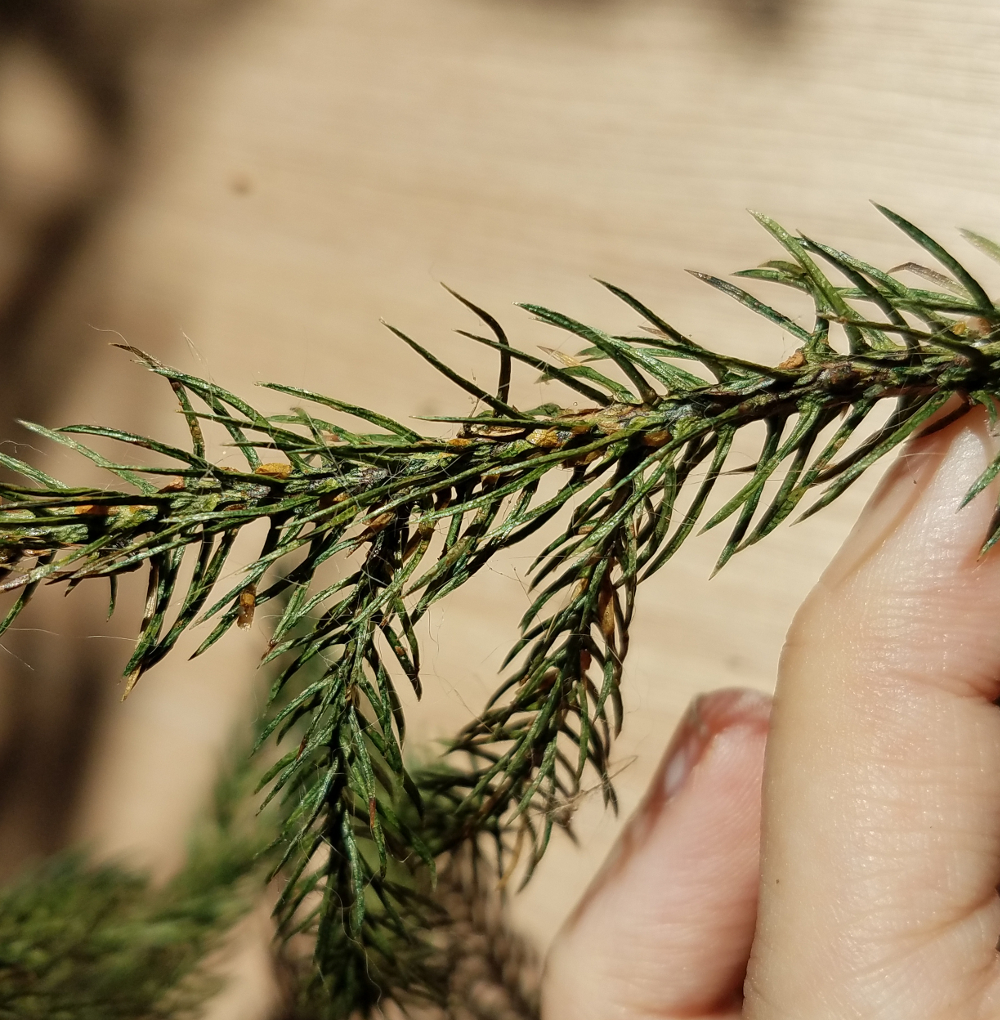
Close up of scale insects.
Notice the dust and cat hair? As scale insects feed, they excrete a very sticky, sugary substance called “honeydew.” This can end up attracting other pests, encouraging mold growth, and, if the plant’s indoors, catching a ton of dust.

What are scale insects?

Scale insects are tormentors sent directly from Satan’s fiery butthole.

… Okay, but for real, they’re awful. They’re insects that latch onto plants and pretty much suck them dry. They’re also flattish, usually brown or beige, and the adults don’t move at all, so they blend in very well with their environment. It’s really easy to mistake them for plant tissue, especially if there aren’t many. Trouble is, their populations can grow pretty fast.

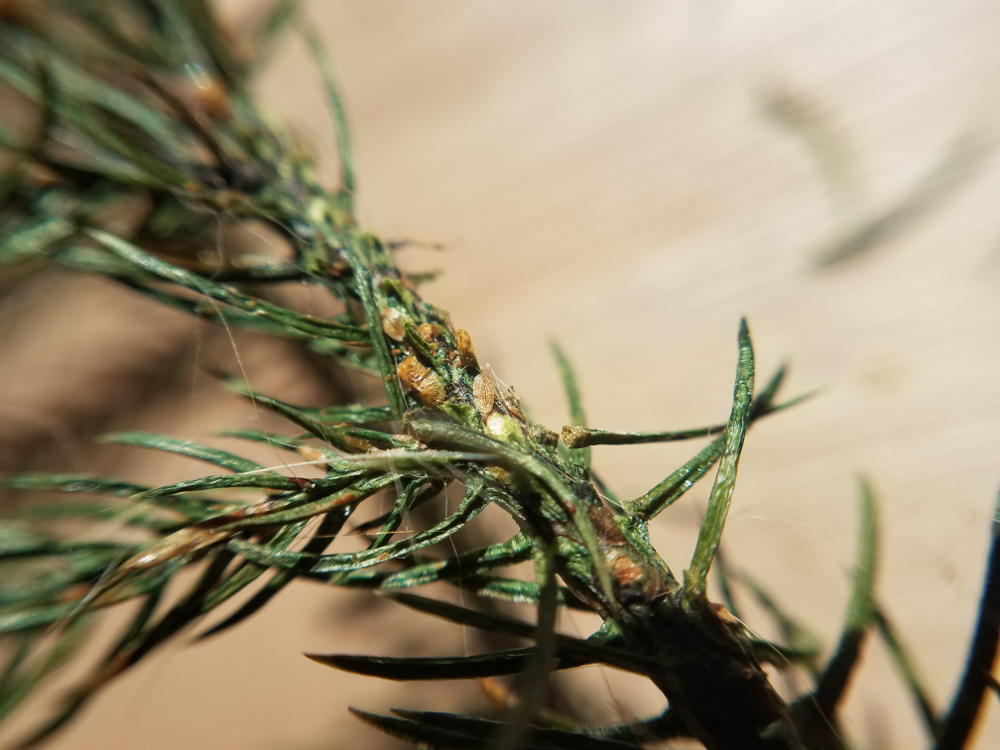
Scale insects on a Norfolk pine twig.
To give you an idea of how small and unobtrusive scale can be, even when there’s a ton of them.

Outdoors, scale insects aren’t usually a huge problem. Sure, they move in, but a healthy plant and a thriving population of predatory insects and birds will keep them from causing serious damage. So, in the wild (or the “wilds” of a garden, at least) they’re much more of an easily ignored nuisance than an actual problem.

For indoor plants, it’s more of an issue. Being otherwise healthy isn’t always enough for a potted plant to keep scale at bay, most homes don’t keep predatory lacewings or ladybugs as pets, and natural Bti pest control only works on bugs that are both in soil and susceptible to Bti bacterial toxins.

So, what do you do when one of your plants turns into a scale bug buffet?

To me, part of being a good steward is doing things that don’t have a negative ripple effect. For this reason, I try my hardest to avoid systemic pesticides, or any pesticides that could potentially harm anything other than the pests I’m trying to target. In a perfect world, I could just relocate unwanted bugs instead of killing them. That’s not this world, though, and I have more of a responsibility toward the plants I’ve taken into my care than I do to the pests attacking them. That’s why, when these critters rear their (nonexistent. Seriously, they are so flat) heads, I:

1. Prune, prune, prune.

A lot of plant tissue that’s been seriously damaged by scale won’t recover. If the bugs have heavily infested a certain branch or leaf, or have dried things out too much, it’s best to just cut it. Pruning away the areas where scale insects have latched on the most will immediately and drastically lower their numbers, making it easier for other measures to work.

Once you’ve identified and removed affected limbs, leaves, and other plant parts, then it’s time to start stage 2.

2. Rub them with alcohol.

Scale insects, like mealybugs, are protected by a waterproof waxy coating. This doesn’t just keep water out, it keeps moisture in. One way to get rid of scale insects is to disrupt this natural coating, which causes them to dehydrate.

Rubbing alcohol is a fast, cheap way to do this. Unfortunately, it can also harm plant tissue, so it has to be applied individually by hand. Fill a jar with alcohol, grab some cotton swabs, and start hunting the bugs down. When you see one, dip the swab in the alcohol, and give it a rub. Most times, the scale insect will come right off. Those that remain will dry out and die.

3. Soap them up.

Soap is another way to tackle the young, mobile stage of scale. It doesn’t take much, either — a few tablespoons in a gallon of water will do the trick.

As with rubbing alcohol, this has to come into contact with the scale to be effective, and will most likely need a couple of reapplications. Too much soap can also harm sensitive plants, so it’s best to start will a relatively low concentration and test it on a small area before going whole-hog.

To start with, I mix:

  • 2.5 T Castile soap
  • 1 gal water
  • 2 T cooking oil (usually grapeseed) — optional

If that doesn’t seem to harm the plant, I might go up to:

  • 5 T Castile soap
  • 1 gal water
  • 2 T cooking oil — optional

Once it’s mixed up, add it to a sprayer or spray bottle and thoroughly spray any areas showing signs of scale. This soap solution also has to come into contact with the insects in order to kill them, so be as thorough as you can without harming your plants. The cooking oil helps smother the bugs, but can easily be left out.

Using actual soap is important here — detergents and some surfactants aren’t great for plants, and their potential for harm may outweigh their scale-killing benefits. I like to use Dr. Bronner’s soap for this, because it’s inexpensive and readily available everywhere from the fancy organic market to the Giant down the block. If that doesn’t work for you, try your regular dish liquid, just test it on a small area to make sure your plants won’t be damaged.

As with anything else of this nature, use the lowest effective concentration of soap. If 2.5 tablespoons seems to be working alright for you, 5 tablespoons won’t necessarily be any more effective.

4. Dust them.

Diatomaceous earth is amazing stuff. I dust it under all of my appliances because, while my particular domicile doesn’t have an ongoing bug problem, we invariably get one or two trying to take refuge when pest control shows up to treat the basement or one of the other units. Such is apartment life.

Diatomaceous earth looks like a white powder. On a microscopic level, though, it is actually made up of needle-sharp splinters of the shells of tiny creatures called diatoms. These splinters are so tiny that they’re incapable of piercing skin, so diatomaceous earth is safe around people and pets. (Just don’t inhale it!) However, while they can’t injure us, they wreak absolute havoc on insects. The tiny splinters pierce and abrade their shells, which causes them to dehydrate.

To use diatomaceous earth, either dust plants with an applicator (the dust is very fine and so tends to clump together a bit, using an applicator gives a nice, light, even coating) after watering, or mix into a solution like the soap mixture given above. Shake it vigorously as you work, because the powder will settle pretty quickly.

As a warning, diatomaceous earth is not selective. Think of it like microscopic barbed wire — it’s going to injure anything that tries to cross it, not just the things you want it to get. So, if your plants spend time outdoors, drape them with a sheet while you’re letting the powder take effect. This will protect bees, ladybugs, lacewings, and other beneficial insects from injury.


Scale insects are an enormous pain. They can hide in tiny spaces and suck your plants dry, and getting rid of them involves vigilance and thoroughness. With these measures, you should be able to control scale on your plants without having to resort to pesticides.

Oh, and… Don’t do what I did. Read up on what pests your plants are susceptible to!


Witchcraft

And so I made a safe travel charm (since the gremlins were already handled).

Note: This post contains some affiliate links to supplies. They allow me to earn a small commission, at no additional cost to you. Thank you for supporting artisans, artists, and this site!

“Hey, mind doing a tarot reading real quick?”

I’m kind of used to this — my S.O. and I swap readings on the regular. If he has a decision he’s unsure about, he asks me to pull a few cards. I do the same if something’s bugging me. It’s a helpful way to get some insight that we can’t really get by reading for ourselves.

See, he’s wanted a motorcycle for basically ever. He’s taken riding classes, shopped around, and kept his eyes open for deals. This time, he was messaging me from a dealership. He’d found a used bike at a decent price, but wanted to know more before making the commitment and dropping the dosh.

I pulled a few cards — strangely enough, one of them reversed itself before I could flip it to see what it was. (I often arrange my deck so it’s all upright, and watching the card slowly spin in place until it was perfectly upside-down was super bonkers.)

Temperance reversed, and The Magician.

Buying the bike wouldn’t be sound judgment or a good monetary decision, but it would be the manifestation of something he’s wanted for a long time. The cards he’d pulled before asking me indicated that buying the bike would take a load off of his mind, but waiting would offer a new, better opportunity.

He decided not to buy. (I was pretty relieved, gotta say. I trust his skills, it’s just everyone else on the road I’m concerned about.)

Sure enough, not long afterward, he was hit with the perfect opportunity to get a great bike. Its last owner bought it new last winter, but now he has to move overseas. So, my S.O. managed to snag a nearly-new bike in fantastic condition, with the exact specs he was looking for.

… Which meant that I had to make a charm for safe travel. He’s got a bell, but there are worse things on the road than gremlins.

Historically, travel was always fraught with peril. If there weren’t highwaymen, there were rough roads, storms, injured animals, broken axles, and worse. Even today, it’s not exactly a breeze — most accidents happen within a few miles of home, and longer journeys have their own set of problems. (Trust me, I know. I managed to get run over less than a block from my house as a kid, and someday I might type out the story of how I got stuck on a stranded train in the Utah salt flats seated behind a guy who was on the lam after shooting a dude.)

Long story short, there are a ton of magical measures to help keep you in one piece on the road. Since this is a bike he’s planning on using to commute in the city — weather permitting, of course — I thought this charm was the best way to help keep him safe. Hopefully, it’ll also keep his bike safe, so we don’t have a repeat of the time our car got hecked apart by bad gas in Mississippi!

travelcharm.jpg


An Amulet for Safe Travel

For this, you’ll need:

I performed this spell on the full moon, during the equinox. Travel doesn’t always leave us room for picking the most auspicious day for spellcasting, so feel free to put this amulet together whenever you need to. Good timing is nice, but not required.

Set up your ritual space as you usually do. Hallow the space, cast a circle, open the gate, call the quarters, you do you.

Combine the herbs, using your projective (dominant) hand. As you do, visualize them filling with energy — enough to extend beyond the amulet itself, to surround whichever vehicle it’s placed within. Place the herbs in the center of the fabric.

Empower the stones as you usually do. If you don’t have a preferred method, hold them in your projective hand. As with the herbs, visualize them filling with warm, protective energy. Place them on the herbs.

Hold your hands over the herbs and stones. Say whatever words are appropriate for your situation — it doesn’t matter if they’re fancy or feel magical, what matters is that they come from the heart. State your intent for this charm. What kind of vehicle do you want to protect? What kind of hazards do you want to protect it from?

Draw the corners of the fabric up, so it forms a bundle. Tie the string or ribbon around the opening (I usually use a miller’s knot) to keep everything in place. If you have any other travel charms, tie them on as well. For this charm, I used a holed stone and a safe travel bindrune (made of raidho and algiz) burned onto a small slice of pine.

Keep the safe travel amulet in the vehicle or, if you’re traveling by public transportation, in a pocket or bag. Before an especially long or risky journey, take a few minutes to hold it in your hands and channel the protective energy.