I think I probably get enough vitamin D, in the sense that I’m not technically deficient, but months spent indoors have given me the preternatural paleness of a consumptive Victorian heroine. On some people, this look works. My skin has naturally beige/green undertones, so I just look like I’m half iguana.
This past weekend promised to be sunny and warmish, so my S.O. and I packed up and went for a drive. Saturday was Lake Accotink, where we walked along the edge of the water, enjoyed the light for a bit, did some people-watching, then took a detour on the way home for cheeseburgers.
(By the bye, Big Buns Damn Good Burgers lives up to the name. If you get the veggie burger, though, get it as a burger bowl. It’s very good, but very soft and probably too skooshy to hold in a bun without it falling apart.)
Even though the trees were leafless and the sand was chilly, the sun was warm and the breeze was gentle.
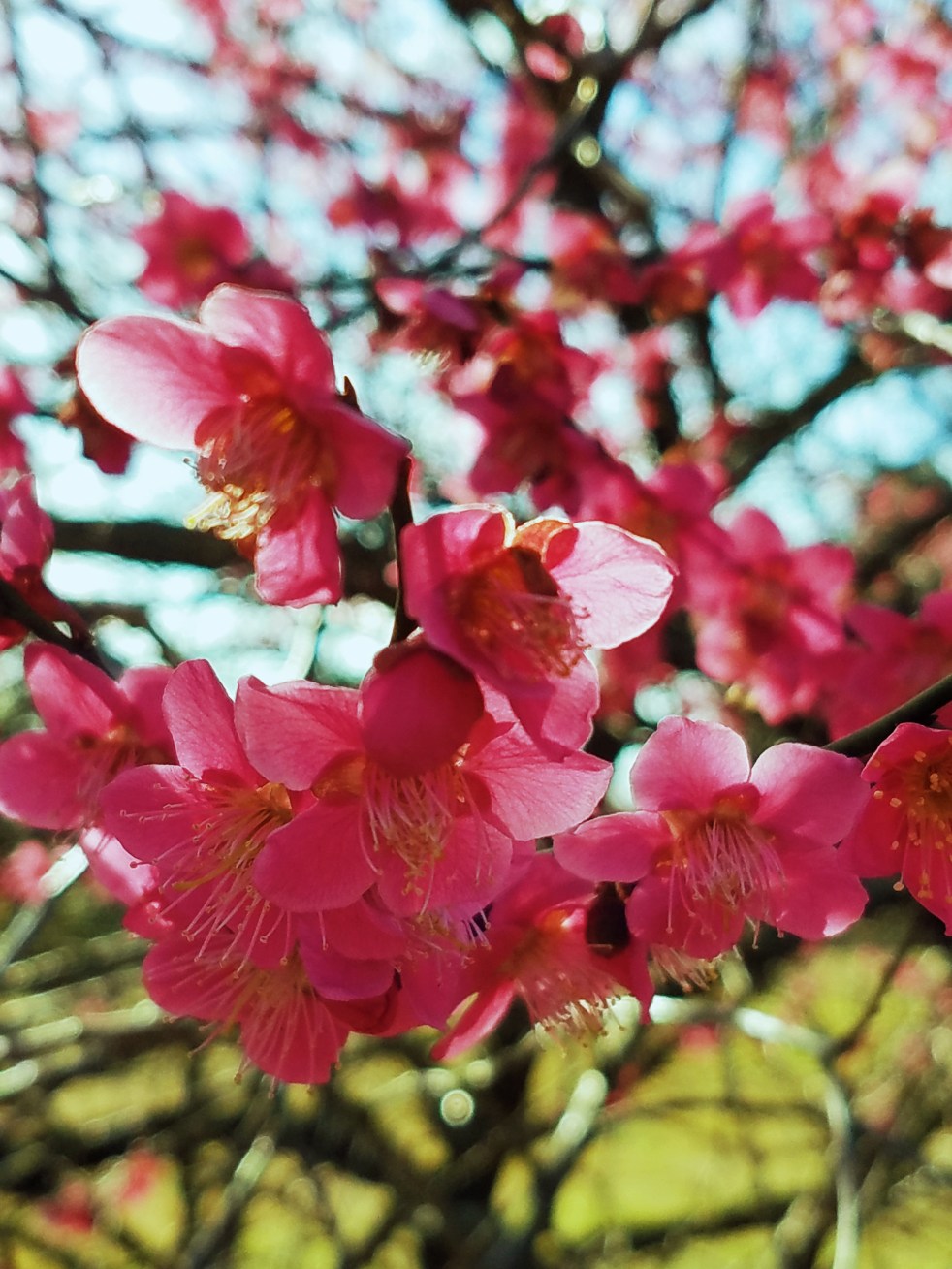
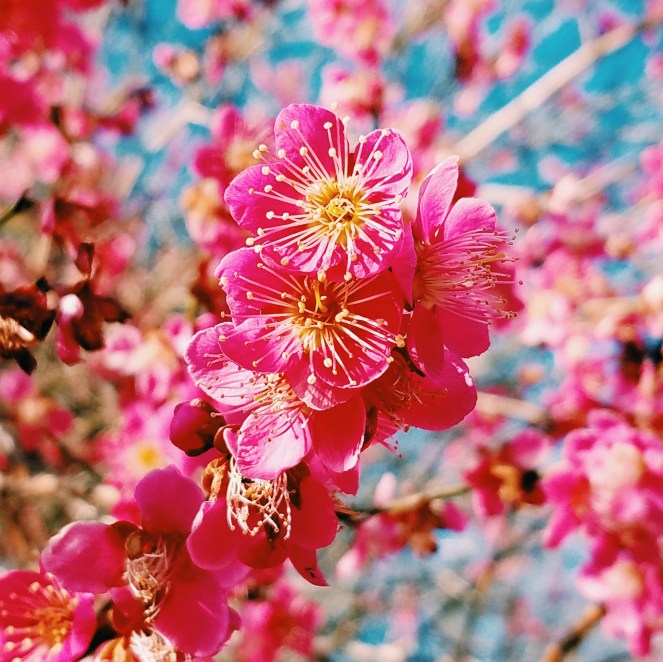
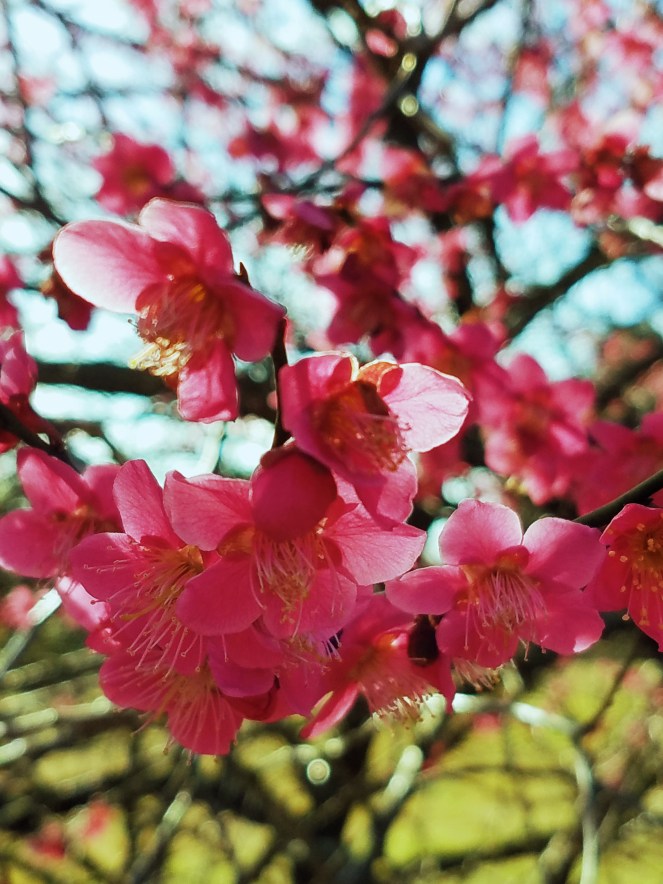
The next day, we decided to drive to the Arboretum. Most of the trees were still leafless, twisted branches scrabbling at the sky, laden with the remains of last year’s bird’s nests. Still, it seems like every time we go, we find something neat that we didn’t spot before — first the dogwood trees, then the path through the conifer specimens. This time, it was this beautiful Prunus mume, branches half-covered in fragrant, pink blooms, humming with honeybees.
It smelled so good.
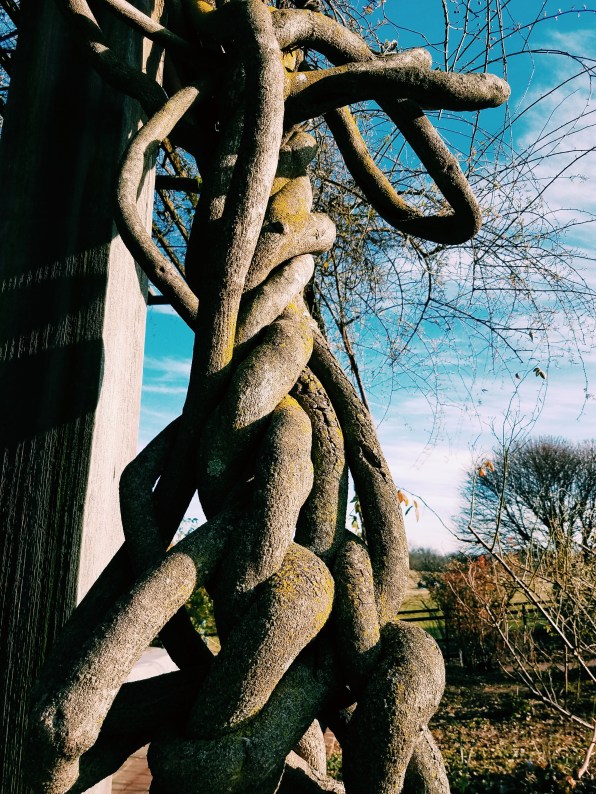
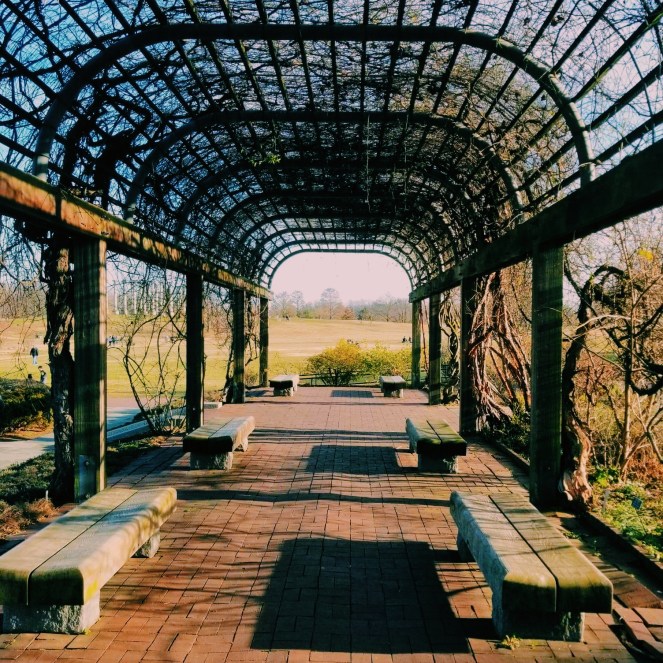
We wandered around until we found a bonsai museum and an herb garden — closed and bare, respectively, but the area was still beautiful enough. We found an arbor to sit under, which had this really cool-looking (albeit one I couldn’t identify) vine braided along one side.
With the sun slanting through the trees, backlighting the few leaves and flowers daring enough to open up this early, it was nice. Relaxing.
… Though maybe I should’ve waited for it to warm up a little before I buzzed my hair again. Whoops.
As we drove through the park, I heard my S.O. huff softly.
“Degenerates,” he groused.
“What?”
“Look.”
I turned my head and squinted in the light.
… I mean, he’s not wrong. I do not like the cobra chickens.
There are a lot of spots in the Arboretum that come alive with color in the warmer months. Bright splashes of orange, pink, and purple nestled into tufts and spikes of foliage, rosemallows the size of dinner plates, the works. There weren’t as many this time of year, but still plenty of color if you didn’t mind hunting for it.
I think these guys are Scilla siberica, wood squill.
… And also looking very strange while laying on your stomach in order to get close enough for a picture.
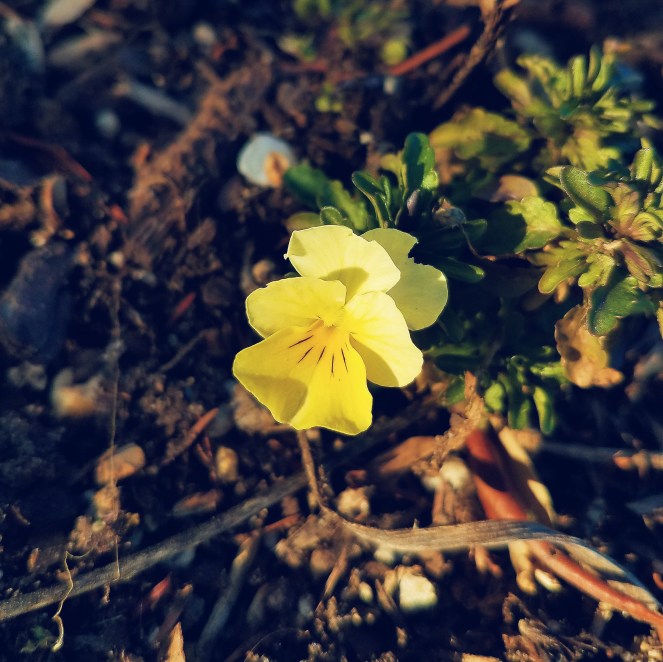
And this appears to be a yellow Viola of some kind.
There were some very pretty crocuses, too, but they were a bit too far off the path for a picture (I’m not about to go trampling sensitive terrain for a pic or two, but, unfortunately, my zoom isn’t quite good enough for a clear shot). Next weekend’s probably going to be too cloudy and cold for more adventures like this, but that’s okay. I’ve got some other plans. Secret ones.
This week’s tarot card’ll be up tomorrow. Have a good Monday!
No, I mean it. I have a devotion to the stuff that borders on fanatical. I am a chamomile evangelist. Spiritual, physical, or mental problem? Chamomile tea will probably at least help. Even if it doesn’t, it might make you take a nap, and those make everything at least a little less crappy. (Unless you’re allergic to it, but I digress.)
Chamomile Magical Properties and Folklore
In Hoodoo, gamblers wash their hands in an infusion of chamomile for luck.
Burning chamomile is said to help bring more money into the household.
The daisy-like flowers with their bright yellow centers are strongly associated with the Sun. Because of this, it’s used to bring positive energy into people and places. Sprinkling a room or washing windows and doorways with an infusion of chamomile chases away negative energy, while inviting in the good stuff.
Chamomile’s relaxant properties make it useful as an herb for dream magic and meditation.
Growing chamomile plants near windows and doors keeps away evil spirits.
Using Chamomile
The easiest way to buy and use the herb is in the form of a teabag — you can steep it in hot or cold water for tea, alcohol for a tincture, oil for an infused oil, or treat the bag itself as a simple herb sachet.
Steeping chamomile in hot bath water, or pouring a fresh cup of tea into bath water, is a fast and easy way to create a spiritual bath for removing negativity.
In medieval times, when strewing floors with fragrant herbs was common, chamomile was a favorite. When crushed, the flowers release a sweet, fruity aroma. With chamomile’s fragrance, coupled with the very solar appearance of the flowers, and its relaxing properties, it’s easy to see where its associations with the Sun and positivity come from.
The fragrance of chamomile might be part of why it’s considered effective against evil spirits. When the miasma theory was still popular, pomanders and pleasant-smelling herbs were credited with keeping disease at bay. It’s not a long jump between foul odors and disease to evil spirits — many of the most powerful negativity-banishing herbs are also the most pungent.
Chamomile is a pretty versatile herb. It keeps bad things at bay, and attracts good. While it’s often used to help gamblers, it can easily be adapted to any situation where you could use a little luck — enchant a tablespoon of chamomile and brew it into a tea before setting out to do anything that could benefit from a helping hand from fate.
Sometimes, the tarot tells you that the energy is right for embarking on a new adventure. Like the Ace of Wands, for example. Sometimes, it uses eight sticks to goad you into doing a thing, instead.
This week, I drew the Eight of Wands. I’ve got to hand it to it — I have been feeling a lot of momentum lately. I don’t know if it’s the warming weather or the appearance of the sun during what’s felt like a very cloudy winter, but I definitely get that sense of motion!
In every respect, the Eight of Wands is progress, and very rapid progress, at that. It’s a wind that picks you up and carries you along. It’s an upswing in energy. It’s a rapid recovery from a low point, It’s infatuation, movement, high energy, and flight. It’s results.
I’m happy to see it.
Positive omens are lining up for beginning another round of studying! I found a new Meetup group! I’ve made a lot of very interesting breakthroughs while meditating and journeying that I don’t really want to get into right here, because they probably won’t make any sense and will alienate literally everyone else! I have so many paintings to photograph and list, my dudes.
As advice, the Eight of Wands can be the harbinger of good news. It’s learning from a positive experience, and letting that confidence carry you to greater heights. It’s finally gaining the understanding that, even if you had to start from zero again, you have what it takes to achieve what you want again and again, as many times as you need to. It’s a thumbs-up from the universe, a pat on the back, and a sign not to quit now.
The Eight of Wands is near the end of the Wands cycle, but it isn’t the ultimate culmination. It’s just a high point, a small success that gives you confidence that the larger success is possible. It might be tempting to take shortcuts, but that isn’t what got you here and it won’t be what gets you to the end.
After finishing the Dedicant Path, I needed to figure out what to do. Continue with the Initiate Path? See what’s required to pursue ordainment? Join a Guild or Kin and follow their path of instruction? I gave myself until the 8th to decide, and I did.
For now, I’m going with the first one. Having read about it, it sounds like it will bring me the closest to where I want to be. The curriculum covers things that I have experience in, and that I know interest me (trancework, divination, ceremonial magic), and covers things that interest me, but which I lack confidence in (liturgy, the bardic arts).
I did apply to join a few Guilds as well, but I think I want to work on them afterward.
It’s funny — it all feels almost like declaring a major in college. (Hopefully it’ll involve less organic chem.)
The only thing standing between me and the Initiate’s Path right now is the Initiate’s letter. It’s the answers to three questions, seemingly designed to figure out why, exactly, the respondent is interested in pursuing initiation, and how they plan to use it when they have it. Knowing I’d spend weeks writing and re-writing if I let myself, I answered and explained myself as best as I could, and fired it off.
Now I just have to wait. I’ll know if it was acceptable within the next few weeks, then I get to jump into another round of reading and writing!
Following the Three of Cups last week, I guess the party isn’t over! The Nine of Cups, upright, is another overwhelmingly positive card. As a Nine, it is near the end of the cycle of pip cards. The only thing after it is the Ten of Cups, so the Nine of Cups is a good indicator that the hard times are in the past (for now) and things are looking up.
In love readings, it’s a sign of emotional fulfillment, pleasure, and satisfaction. In career readings, it points to success and recognition. In a more spiritual context, it points to spiritual fulfillment and a soul that radiates joy and positivity.
Even in terms of advice, the Nine of Cups is a good sign. Looking at the traditional imagery of the Rider-Waite-Smith deck, there’s a man sitting in front of a row of golden chalices, arms crossed and a frankly smug expression on his face. All of the cups are upright, none are spilled. He’s got a ton of resources to back him up. Whatever this guy wants, he is probably going to get.
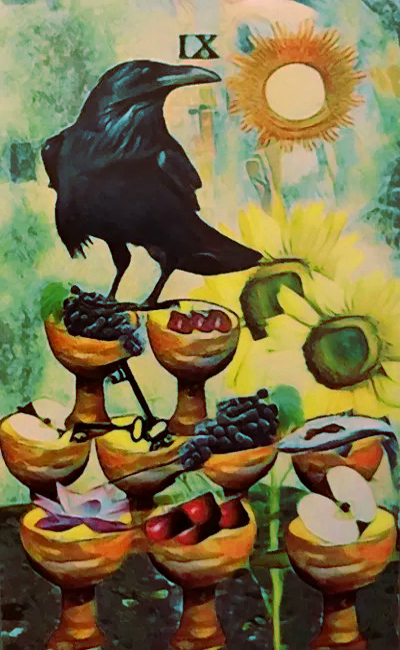
In the Crow Tarot, the imagery is similar:
He sits on top of a pyramid of Cups, filled with fruit, fish, flowers, and the keys to whatever his little bird heart desires. The world’s his oyster.
I could use this energy right now. I’m taking on some things that are pretty new to me, and a few that aren’t — though they are rather high stakes. If I do have the keys to everything I want right now, I plan to use the crap out of them.
Some materials that make it into the gem trade pretend to be something they aren’t. They might even come complete with a list of healing and metaphysical properties, leaving buyers none the wiser.
Wait, fake crystals?
There’s a whole spectrum of things covered by the term “fake crystal.” On one hand, it can mean a gem where the trade name doesn’t reflect the mineral itself (e.g. various types of crackled or dyed quartz). It can also mean a material that’s treated like a gem when it isn’t. It might be made into towers, molded into points, tumbled into nuggets, or even shaped into palm stones and spheres.
How can you tell if a gem is actually a crystal vs a man-made material?
Honestly, the best way I’ve found is to know the various types of art glass that end up in the gem trade. If you’re trying to suss out a man-made crystal masquerading as a natural one, there are certain tells you can look for. That’s a better subject for another post, however, so let’s look at art glass that’s frequently sold as and mistaken for natural gemstones.
Opalite is a type of opalescent glass, sometimes sold as sea opal or opal moonstone. There is a natural stone called “opalite,” but you’re more likely to come across it under the name “common opal” since synthetic opalite is much more prevalent.
Some unscrupulous sellers will try to pass off opalite glass as natural opal or moonstone. Fortunately, opalite is pretty recognizable — it’s smooth, evenly colored, doesn’t exhibit any cracks or inclusions, and may occasionally contain air bubbles.
Crystal healers sometimes credit opalite with the ability to shift energy blockages, improve one’s ability to communicate, and stimulate creativity.
Goldstone
Goldstone photo by GDK. CC BY-SA 3.0. No changes were made.
Goldstone, or aventurine glass (no relation to aventurine), is a stunningly sparkly type of glass made in a low-oxygen environment. It has to be produced in a specific type of environment to allow the copper ions in the mixture to reduce to pure, elemental copper, and within a very narrow temperature range to allow the glass to stay liquid while the copper precipitates out, creating the evenly-distributed gold glitter throughout the glass.
I have seen goldstone marketed as sunstone, as well as sold in ways that obscure the fact that it’s a man-made glass. Goldstone doesn’t really look like natural sunstone, however — the color and distribution of metallic crystals is too even.
Some crystal healers say goldstone promotes energy, confidence, vitality, and ambition.
Blue Goldstone
Blue goldstone looks very similar to regular goldstone, the only difference is the color. Blue or purple goldstones use different metallic elements in their formulations, giving the stones a deep blue or purple color (hence the name) with silver glitter.
Blue goldstone doesn’t really resemble any natural stone, but I have seen it sold as “blue sunstone.”
Like goldstone, blue goldstone is said to help with vitality. It’s also credited with the ability to soothe anxiety and communication.
Fake Quartz
With a cursory visual inspection, molded glass can pass for quartz. There are a few key things to look for to be able to tell regular glass from the real McCoy:
Quartz is probably going to be cold to the touch, colder than glass.
Quartz will probably be slightly heavier — it generally (not accounting for differences in composition of the matrix, inclusions, etc) has a density of 2.65 g/cm3 while borosilicate glass is about 2.2 g/cm3.
Glass is likely to contain air bubbles, and probably won’t have the natural imperfections of quartz.
Glass is softer than quartz — it won’t be able to scratch a glass plate, but quartz will.
Some low-quality quartz crystals are ground up, melted down, and used to create reconstituted quartz. This is frequently used for scrying spheres, since it offers perfect clarity along with the other properties of quartz. The best way to tell reconstituted quartz from naturally-formed quartz is its lack of imperfections, and its price tag. A reconstituted crystal sphere of a given size and clarity is much less expensive than its natural counterpart.
Reconstituted quartz spheres can be as transparent and flawless as glass, but natural quartz very rarely is.
Does it matter?
Eh, maybe.
If you have a piece of opalite, goldstone, or even resin or glass that you get something out of, I’m definitely not going to tell you you’re wrong. I’ll be the first to tell you that something’s origins or how natural it is don’t necessarily dictate its usefulness; I’ve used literal, actual garbage in spellwork before.
That said, it royally sucks to get mislead by an unscrupulous seller. If you enjoy opalite and find that it’s useful for you on your spiritual path, that’s awesome! Just please make sure you know what you’re buying, and don’t let someone overcharge you for their “super rare sea opal.”
It can also be important when you’re looking into making things like gem elixirs. While glass is pretty much inert, you really, really want to make absolutely certain that you’re not working with something that’s going to leach harmful compounds into your elixir. For that reason alone, you absolutely want to make sure that you know exactly what kind of minerals — natural or man-made — you’ve got.
Of course, no man-made material is going to have the exact same physical or metaphysical properties as the gemstone it’s imitating. But (as I mentioned in my post about identifying natural citrine) goldstone, blue goldstone, and opalite can have a legitimate use, even in a very traditional magical system. Color magic is a viable aspect of witchcraft, and goldstone being made in a factory instead of underground doesn’t make it any less orange and sparkly.
If you try to use nature-derived material in your spellwork, you might want to familiarize yourself with the man-made stones that occasionally make their way into the crystal and gemstone market. If you don’t really care, or feel drawn to these stones for their own sake, there’s no reason to avoid them. Opalite, goldstone, blue goldstone, and reconstituted quartz are all beautiful and useful in their own ways. If you find a piece that resonates with you, enjoy it and treasure it — no matter whether it came from the earth, or from a laboratory.
It took me some time, but I submitted my ADF Dedicant Path work, received some feedback, elaborated where I was asked to elaborate, and… I passed!
It’s an enormous relief — perhaps unsurprisingly, some of the feedback I received involved me being “too hard on [myself]” when rituals didn’t go perfectly to plan. I don’t consider myself a type A personality, I don’t really think I’m a perfectionist (well, most of the time), but I can see it. Completing this path work was very important to me. Upholding the virtues and things I’ve learned in the course of doing it is still important to me.
There’s only one problem: where do I go from here?
I’ve considered trying to pursue ordainment. There are also other paths of study within each of the Druidry guilds. With how long it took me to finish my Dedicant Path work to my satisfaction, I’m a little hesitant to jump into another round of studying and writing so soon. I’d be lying if I said it wasn’t calling to me, though.
Do I explore other Druid groups alongside ADF, and see what knowledge they have to offer? Do I choose a guild or two to concentrate on?
I’m giving myself until February 8th. By then, I will have looked at my options and picked a course of action.
I celebrated alone, as I often do — as much as I like having other Pagans to share with, i still really enjoy the headspace of a solitary ritual. It can get much more improvisational. If it feels right to do a ritual in the alley next to the dumpster and pour out my nature offerings right where the birds can get them, I can do that. If I want to honor my ancestors by making and offering of some of the really awesome BBQ pizza I reheated from the night before, I can do that. If the spirits move me and I want to cover my floor in newspaper, smear my body with paint, and express myself by doing the worm across a piece of unstretched canvas, I can do that.
Not that I did, or anything. But I could!
Oddly, being able to get out and about more now has given me more of an appreciation for solo rituals. The difference between having to celebrate alone and choosing to do so is much bigger than I thought.
I don’t generally get much opportunity to decorate for the High Days. Kiko would eat whatever I put out, and Pye would throw it on the floor in a fit of pique if he thought his food bowl didn’t contain the right ratio of freeze dried bits to crunchy bits. I love my cats dearly, but they are kind of jerks.
And so, I had a small Imbolc celebration sitting in the big, comfy chair in my living room, with my coffee table as an altar and a very fancy candle I choose specifically as an offering for Brigid. The Nature Spirits received mung beans, my Ancestors received candy, the Shining Ones received bourbon and incense, and the waters of life were the tail end of a bottle of very excellent cucumber, mint, and geranium lemonade. (I’m a sucker for cucumber and herbal flavors.)
It was peaceful. It was low-key. It was just what it needed to be, in a place where the pavement often keeps me from being able to see the first early flowers make an appearance, on a day when the overcast sky seemed to blanket everything in downy gray and the brightness of spring still feels far away.
I’m not complaining, of course. Cups cards are the cards of emotions, and most of the Cups I end up drawing are all about fulfillment and good times.
This weekend, my S.O. and I had a little cause to celebrate. I’ve been able to get out more now, so we packed the weekend with things we’ve needed to do, and a few that just sounded like fun. The rain dampened our plans a little bit, but that’s alright.
The important thing here is that I’ve got so many plans for stuff I want to do, my dudes. i have a group of tabs open for some local theaters and concert halls, which I’ve been idly refreshing in my spare time to see what’s on offer. It’s a really nice feeling to be able to do that, pick a show that looks like fun, and actually plan to go, instead of feel like I’m tormenting myself with FOMO.
So it feels pretty appropriate to draw the Three of Cups this week. I’ve pulled it before, when he and I were about to move into our new place, and we each had a ton of irons in the fire that we were both very excited about. This time around, I’m continuing existing projects more than starting up new ones, and I don’t really have a major life change on the horizon that I know of. There are always more things that I want to do and see, but both my S.O. and I are in a very good place at the moment. I’m very happy to enjoy my new freedom, though!
Saturday, we’d hoped to go see World in a Box. Unfortunately, the stars didn’t quite align — they were sold out, and the rain made navigating there a bit of a challenge. Still, it prompted me to look at what else Rhizome has coming up, and given me a lot of new ideas.
I love this card. I love the Crow Tarot deck. I love where my life is right now, and I’m excited to see where it’s going.
If you’ve been following the saga of the gas leaks, you can probably guess why I put off doing a full-on apartment cleanse. It’s a good idea to do this as soon as — if not right before — you move in. It is a less-good idea to do this if you plan on burning things, and your kitchen smells like mercaptan.
Anyway! Now that the fire hazards are dealt with, I wanted to talk about apartment cleansing.
You should cleanse anything that’s been used by another person, and any time that thing has seen arguments, illness, death, or other struggles. You also want to cleanse your space whenever things just start to feel gross, heavy, or tense. I don’t support “good vibes only” culture, but it’s definitely important to wipe the energetic slate clean once you’ve experienced something bad and allowed yourself to process the trauma. This is especially true if you perform other spells or rituals in your home — there are some energies you don’t really want to keep around if you don’t have to.
Most house cleansing rituals involve things like candles and incense. These rituals are great, and extremely effective, but not always the best choice — what if your lease prohibits burning things? What if you have artwork, or other special objects that would be damaged by repeated exposure to incense smoke or soot? What if you’re asthmatic and shouldn’t be breathing in burning particulates? What if you might explode your entire block, because your building is very very old and literally everything is leaky?
You get my drift.
So, what does house or apartment cleansing do?
Ideally, cleansing a space gets rid of negative or stagnant energy, and brings in fresh energy. Psychologically, it can help give you closure after you’ve had a rough time, and create a sense of optimism and enthusiasm for the time ahead. It can also mentally prepare you to be the new steward of the place you’re cleansing.
What does it entail?
From my experience, house cleansing and house blessing are usually part of the same ritual. You cleanse the space, then you bless it. Some people roll them into one action by asking their guardian spirits, ancestors, and/or deities to both cleanse and bless.
Generally, cleansing a space involves walking around the area either clockwise or counterclockwise (depending on tradition), performing a cleansing act, and asking that the space be cleared of any bad vibes. A cleansing act can be wafting the smoke of burning herbs or incense over the walls, asperging them with water, sprinkling a perimeter of salt, carrying a white candle dressed with cleansing oil, or even just touching the walls and floor and declaring the intention that they be cleansed.
Incense and candles figure prominently in many popular energy clearing rituals, but they aren’t a necessity. There are plenty of other things you can do if burning things isn’t possible or desirable for you.
1. Lemons. Everywhere.
Lemons have a well-deserved reputation for busting up stagnant or negative energy. Even the scent of lemons is uplifting, and lemon juice is very helpful when it comes to actually physically cleaning your place.
You can use lemons in a variety of ways, from adding sliced lemons or lemon juice to your mop water, to leaving whole lemons in places where people tend to gather. I prefer to use them like this:
Take a whole, fresh lemon, and slice it into rounds.
Take a generous quantity of sea salt, and sprinkle it over the rounds. (Make sure to cover both sides!)
Place them in a dish, and set it wherever you feel needs some cleansing.
Keep an eye on the lemon slices — if they begin to get moldy, discolored, or mushy, discard them and try again with fresh ones. It might take a couple of lemons before everything’s thoroughly cleared up.
2. Asperge with water.
Asperging with blessed or holy water is probably my favorite way to cleanse a space. Depending on your tradition, “blessed” or “holy” might vary. In mine, water gathered from three natural sources is used in ritual. Alternatives include:
Water left to charge in sun- or moonlight.
Water to which has been added a pinch each of frankincense ash and sea salt.
A hydrosol made of a cleansing herb, like rosemary or sage.
Water you have asked your deities to bless.
Asperging involves dipping a bundle of herbs (or your fingers) into the water, and sprinkling it on the object to be cleansed. Sprinkle it on your walls, floor, and ceiling (if you can reach it) as you declare your intention to cleanse the space. Make sure to get the corners!
3. Use your own energy.
You don’t really need anything other than yourself, if you don’t have other tools at your disposal. You can stand in the middle of each room in your home, raise power however you customarily do, and release it into the walls, floors, ceilings, and corners of your space. Visualize it as a bright light that touches every surface of your home, absorbing and disappearing into them, leaving no trace of negativity behind.
4. Make some noise.
I feel like a lot of practitioners underestimate the power of noise (but, I admit, I might just be inordinately fond of raising a ruckus). Coupled with light and fresh air, there are few things as helpful for clearing the energy of a place. Open the windows, get a nice breeze going, let the sunlight in, and turn up the volume — at least, as long as your neighbors won’t complain.
There are a few different ways that you can use sound to help the energy of a place:
Play a set of chimes. Ascending scales are said to purify, and descending scales banish.
Play uplifting music.
Play Solfeggio tones. Each one is said to have a different effect, so it’s best to experiment and find the one that works for you.
Play nature sounds. Running water, insect chirps, and birdsong have their own, special effects. There’s a reason they’re part of so many meditation tracks!
5. Salt.
Sea salt is a quick and easy way to cleanse pretty much anything that won’t be damaged by salt. Personally, I don’t use it that often because I try to do most of my cleansing-of-things outside, and I don’t want it to leach into the soil — but I can vouch that it works.
To use it, sprinkle sea salt in the corners of your rooms while declaring your intention to clear the space. You don’t need very much — just a pinch will do just fine.
Every tradition has their own ways of preparing a home, from cleansing, to blessing, to protecting it and inviting in prosperity for its occupants. If you’re in a place where you can’t turn to candle or incense magic, you still have plenty of tools at your disposal.













 Marble Crow