

Books · life · Neodruidry

Sacred Actions: Yule

This past Sunday, one of my Meetup groups had a meeting to discuss Dana O’Driscoll‘s Sacred Actions: Living the Wheel of the Year through Earth-Centered Sustainable Practices. Luckily for me, I’d picked up a copy several months ago from Three Witches’ Tea Shop. It’d been in my “to read” pile for a bit, so I was very happy to have the extra encouragement to get into it.

We went over the first high day, Yule. For this time of year, Sacred Actions emphasizes learning one’s place in the consumption web of life — observing your consumption patterns, seeing how you can live in a way that’s more regenerative and nurturing for the Earth and other people, and learning to discern between a need and a want so that there are enough resources for everyone to live comfortably.

This chapter also encourages the reader to take a look at their ecological impact using the Footprint Calculator quiz. Mine came out at a 1.8 — meaning that, if everyone in the world lived like I do, it would take 1.8 Earths to sustain us all. Unfortunately, this number is actually at the lower end of the spectrum, but I’ll get to that in a minute.

The discussion was lively and fruitful. It was nice to know that we were all in a similar place — aware of tactics like “greenwashing” and propaganda that emphasizes individual responsibility over corporate abuses, and knowing exactly how difficult it is to engage in ethical consumption within our economic system.

One thing I particularly liked was O’Driscoll’s emphasis on regeneration and nurturing over sustainability. Sustainability is nice, but comes with a pretty heavy subtext. The implication is that we should find a way to do things that allows us to continue to live, consume, and behave in the way to which we’ve become accustomed. This isn’t just impossible, it’s not exactly a noble goal. Instead, we should work toward regeneration — giving back to the planet and exploited people to replace what has already been depleted.

(I could go into a super long and weird discussion about extinct megafauna, human cities, and the importance of poo here, but I will spare you this. Instead, here is a giant gorilla fighting a t-rex:)

The idea that we have a responsibility to more than just the planet was refreshing, too. My ecological footprint is low for someone living in a wealthy, developed nation. I’m not bragging here — the reason it’s low is that disability (and, let’s be real, an at times paralytically rigid sense of ethics) keeps me from engaging much in many aspects of society. The things that make my footprint as large as it is aren’t even things I can control. It’s almost all the snowball effect of having a long, multinational supply chain.

With that in mind, there’s only so much else I can trim. It’s frustrating to look for ways to make your lifestyle more sustainable (read: regenerative), and just get the same bits of advice over and over and over again. Use reusable paper products. (Check.) Use metal straws. (Check.) Compost. (Check.) Instead of this, O’Driscoll’s work provides some other lenses through which to consider sustainability. Even if I can’t change the supply chain that delivers the things I need, I can focus my energy on supporting, regenerating, and nurturing the people involved.

(Incidentally, I think I’ve begun to hate the word “nurturing.” I’ve seen it co-opted so many times by new-agey wellness articles about consumerist self-care strategies, I think they’ve ruined it for me. I will, however, continue to use it here for lack of a better term.)

(The phrase “nurturing the people involved” also gives me mental images of someone breastfeeding a forklift operator, but I’m not sure how else to say it. Your mileage will hopefully vary.)

The next step is to engage with the exercises. This means placing one of three ideas at the forefront of my mind for a week at a time. First, emphasizing care for the Earth and all of its inhabitants. Next, will be emphasizing people. After that, ensuring that there is enough for all.

As I write this, news stations are broadcasting about the deaths of workers in an Amazon warehouse that was hit by a tornado. The tornado wasn’t a surprise. People, driven by desperation, went to work. The company higher-ups didn’t see fit to let them stay home. Jeff Bezos says he’s heartbroken about the tragedy, but has yet to commit any actual money to providing for the families of the dead.

In the meantime, Bezos’ Earth Fund has also committed another $443M (USD) to conservation efforts, or roughly 1/500th of his net worth. A net worth that comprises assets gained through exploiting people and the planet.

His attitude and position is not unique. Remember, while you make adjustments to your lifestyle, that the people serving as conduits for environmental and human exploitation are not gods. They have names and addresses. When living sustainably as an individual only goes so far, there is always direct action.

For more information, I recommend episode 320 of The Dollop, The Wobblies Go to Everett.

Blog · crystals · life

.deirram teg s’teL

What do you do when you end up married, but never actually got engaged or had a ceremony?

I got married backwards.

My partner and I met and moved in together not long afterward. Neither of us wanted to get hitched — both of us come from families affected by pretty acrimonious divorces, which made us as trap shy as a pair of coyotes. Even if we did end up marrying, we didn’t want to have a wedding. Between the divorce thing and the link between wedding spending and marriage length, this seemed like a pretty reasonable decision. Being married wouldn’t impact anything about the way we lived or viewed each other, so it was an unjustifiable expense for something neither of us felt was necessary or desirable.

Then the pandemic came. It was frustrating to see that, since I was classified as a dependent, we’d miss a lot of the economic help offered to other families. That wasn’t my primary worry, though.

No.

That was the next of kin thing.

If something were to happen to me, then my partner, the person who’s been looking out for me and present for all of my medical stuff for years, wouldn’t have any input into my care or burial arrangements. That would go to my legal next of kin, from whom I’ve been estranged for over a decade. My partner also knows exactly how I want my corpse to be disposed of, but my legal next of kin a) has no idea, and b) probably wouldn’t agree to do it even if they knew. The idea of my next of kin making medical and burial decisions for me was terrifying. There are legal ways around this, but they’re not very straightforward when compared to being married. Unfortunately, the more paperwork is involved, the more complicated things get, and the more easily they can be contested.

We lived in DC, so we looked up the laws on common law marriage. After having lived together like a married couple, grocery shopped together, shared health and life insurance, and adopted animals together, we decided to declare ourselves married and filed taxes to demonstrate it.

Because we’re both basically eleven jackdaws apiece crammed into human suits, we also wanted rings. Since we never did the whole engagement and ceremony thing, we had to kind of feel our way through what to do when you want to give someone a ring, but you’ve kind of technically already been married for several years and also didn’t actually have a wedding or engagement.

We chose our rings from independent designers on Etsy. He had a harder time choosing than I did — I picked a few designs I thought he’d like, got his input, then narrowed down my search until we found one that he loved. I knew exactly what I wanted, so we contacted the seller and requested to have it made. When his came, I held onto it in secret until we were somewhere special, then surprised him. When mine came, he did the same.

He gave it to me while I was sitting on his lap, overlooking the Shenandoah Valley, under a sky full of storm gray clouds brilliantly streaked with sunlight. I had on a thrifted flannel shirt and a pair of emergency sweatpants we’d bought at the gift shop because it was colder than I expected. There were a bunch of other people there, but we were too busy kissing to ask anyone if they’d mind taking a picture.

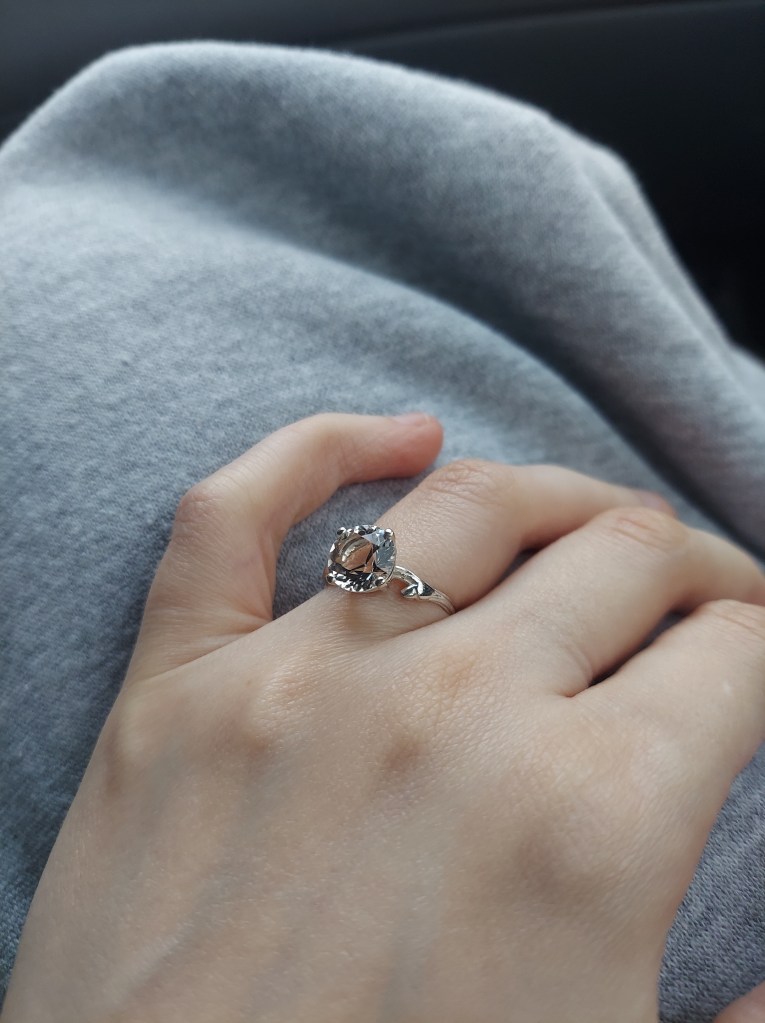
The ring was made by Green Gem. It’s silver (my favorite and most-worn metal) with a round cut Herkimer diamond. I knew I wanted a Herk because I love them, I’m not a fan of carbon diamonds, and this allowed me to get a larger, clearer stone that appeals to my crow-like desire to hoard shiny things. (Plus, if anyone asks me about it, I get to gush about the virtues of domestically sourced crystals over carbon diamonds.) I saw a twig-style ring I loved, set with an uncut Herk. I asked if it was possible for them to swap it for a faceted one, and they agreed. In the end, I got a beautiful, ethical ring that matches my style. You can see more of their rings, faceted stones, and raw crystals on their Instagram. Even if you’re not into Herks, they have a bunch of other beautiful, faceted crystals.

This tree doesn’t symbolize anything, I took a picture of it because I just thought it looked neat.

If you’re going down the path of non-traditional partnership, it can be challenging to figure out how to do it “right.” From the legality of next-of-kin stuff and inheritance laws, partnering without marriage can feel like a minefield. When I was in a same-sex relationship, we didn’t really put much thought into this kind of stuff — hospitals, death, and inheritances seemed ages away, so marriage and legality just never came up. I feel a lot better knowing that someone who knows and understands me has my back, even if we didn’t go through the traditional marriage path to do it.

Blog · divination · Environment · life · Neodruidry

Friday: Black. Hike: Taken. Hams: Strung.

I don’t like Black Friday. Part of it comes from several years of retail work, part of it comes from reading way too many stories of people getting shanked over Elmo dolls and discount TVs. It sucks for workers, it sucks for shoppers, it just sucks all around.

So, when a Meetup group I’m in posted a late afternoon hike this past Friday, I was more than happy to do that. The weather didn’t look promising, but there’s no such thing as bad weather — just the wrong clothes. As long as it kept me from being bombarded with reminders of Black Friday, I would’ve hiked in a storm.

This came right after a Zoom session about the role of walking as a spiritual practice. It was a really enjoyable discussion, and I was intrigued by the number of different roles it seems to occupy for people. I never really gave walking much thought — it’s part of my spiritual practice, but not one I really had to devote brainspace to, if that makes sense. Some talked about entering a kind of flow state, where the walk itself was a way to disconnect from the body. For others, walking was the opposite — a chance to focus on mindful movement, and quiet the mind. It all depends on what you need from it. Will walking be an external practice, or an internal one?

For me, it’s always been a weird form of augury. I don’t want to use the phrase “connect with nature,” because I feel like the wellness movement has worn it pretty thin. Really, it’s a way to make friends, as long as your definition of “friends” is flexible enough to include fungi and holes in the ground. If I meet a lot of new friends, it’s a pleasant walk and a good omen. If I don’t, it isn’t.

It can be a more specific divinatory practice, too. I know it’s not uncommon for people experiencing a lot of synchronicities (angel numbers, and the like) to ask for a sign or some kind of answer. Asking for one, then going out for a walk to see what you get is a useful form of divination. It’s definitely easier than trying to find a haruspex in this day and age.

It’s also a gratitude practice for me. I’m not about to get all gratitude journal on you, but, after spending several years too sick and deconditioned to do much of anything, I feel like the best way to express thanks for still having a mostly-functioning body is to use it for stuff.

We started out by meeting up in a parking area near one of the picnic groves. (There are trails all over this area, so you can pretty much start walking in any direction and end up on one.) It was really good to finally meet some of the people I’d only be able to speak to on Zoom calls, and the hike itself wasn’t too tough — three miles start to finish, through trees that helped cut some of the blustery wind and whose leaves lit up like lanterns once the sun sank below the lead-colored clouds. The air was scented with the vaguely spicy smell of gently decaying leaves, and so cold that I could feel it like a razor every time I reached the top of a hill.

Which is exactly how I ended up having to stop and catch my breath a bunch of times, wrestling with my jacket to pull out the carton of warmish coconut water I’d kept snuggled against my chest like a newborn. Fortunately, I brought a bandana-style mask with me. It helped warm the air before I breathed it in, which made things a bit easier, and also allowed me to pretend to be normal while actually gasping like a malfunctioning Billy Bass.

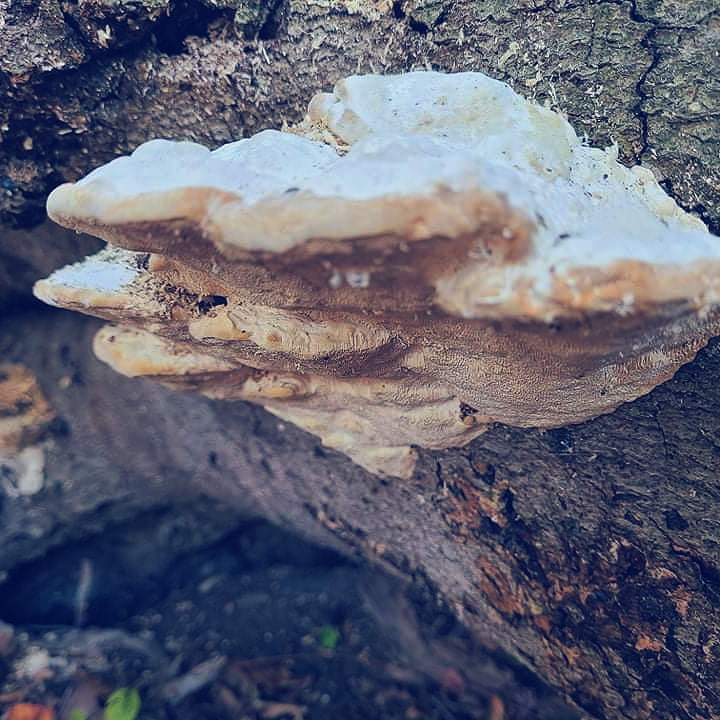
The entire forest is slowed down for the cold seasons, so it wasn’t like hiking earlier in the year. While the moss was still green, it was confined to neat, short little mats without their long, almost eerie-looking spore capsules. There were no eyelash cups or jack-o-lantern mushrooms. I did spot some neat-looking shelf fungi, and scrambled down into a space under a fallen tree for a picture. Another branch held some tiny specimens that were so fine and woody, they almost looked like ruffled feathers.

We all made it to the end, just before sunset. The light had that “golden hour” magic going on, which turned the treetops and patches of sky into a stained-glass canopy and the fallen leaves into a blanket of gold and copper. There was a peaceful moment where we paused before leaving, to make offerings of water and close out the experience. My partner and I picked up tea and dinner, then headed home.

It was the longest uninterrupted hike I’d been able to do in years. It gave me a chance to push my limits a bit more, and feel the edge of where my endurance is now. I get winded and dizzy easier than I did before IH, but I did it, and I’m intensely happy and grateful.

A good walk, and a good sign.

life

Julio, International Man of Mystery

Like many people, my partner’s cell phone number wasn’t always his. Despite how long he’s had this number, he still occasionally gets messages for Julio. Some are in English, others aren’t. After three years (and countless replies of “Lo siento, no soy Julio”), they haven’t seemed to let up.

What happened to Julio?

Why did he change his number and not tell anyone?

Most importantly, why is he still giving out this one?

Most of the messages are work-related. They tell him what to do. They ask him where he is (but never how he is). Lately, we get messages from hotel chains thanking us for choosing them.

We haven’t been to a hotel in a very long time.

Where is Julio? Where is Julio going?

Is he leaving a trail of tiny hotel soaps, broken hearts, and dead drops in his wake?

In my head, he’s a spy. Being a maintenance worker was just one of many covers — an identity to be adopted and discarded, just like his old cell phone number. Maybe he’s a fencing instructor named Serge now, or Edmund, a cardiologist. Maybe he isn’t even Julio anymore. Maybe he never was.

Some of the work messages show the aisles of movie theaters, popcorn scattered like confetti. They want Julio to clean it up. Is it real, or just a euphemism? What is Julio actually cleaning?

Maybe it’s a secret. Messages encoded with a buttery cypher, placed like edible morse code. Destroy after sending.

He still looks like an average blue collar guy in my mind. Maybe shorter than average. Slightly overweight. Balding on top. Good spies don’t need to be conventionally handsome or dashing. Julio’s crooked smile and average appearance are his strengths. They disarm people, allowing him to disappear back into a crowd like a phantom, slipping silently into a black Aston Martin as he discards his false moustache and slides on a pair of sunglasses. All he leaves his marks with is a tiny bar of hotel soap, a false phone number, and the click of a closing door. Nobody suspects Julio.

I think I need to get out more.

art · life

I’m bad at throwing flour at people, my dudes.

It’s one of those things that you don’t usually find out you’re good or bad at until you actually have to do it. Not many skills translate, you know?

Let me back up.

I’ve been in the grip of another bout of what I call ennui, what my psychologist calls cyclothymia, and what some people refer to as “bipolar III.” Maybe it’s the change in seasons, maybe it’s the fact that I’ve gone without one for awhile and my brain realized it’d neglected to kick me squarely in the face lately.

So, when my partner mentioned that he was going to go help a friend with an art project by throwing flour in an abandoned place, I reacted with the kind of excitement typically reserved for golden retrievers with overactive bladders. Art! Abandoned places! Throwing things! Friend! You couldn’t construct a sentence more designed to be catnip to me unless you added banana cream pie and ponies. He asked if it was okay if I tagged along, and the answer was yes. Rad!

We drove out to a neighboring town. Between traffic and an early sunset (4:52 PM, which is a bullshit time for a sunset in my opinion) we ended up skipping the abandoned spot and going to someone’s house. I met his friend (who seemed very cool) and the photographer (also cool), and then we helped set things up for the shoot. She was going to be the model, and my partner and I would be throwing flour from outside of the shot.

The photographer handed us two small bags of flour, and asked if we wanted to practice on a tree in the corner of the yard. I was a bit perplexed by this. You take the flour, you throw it. How hard could it be?

Hard enough for me to fuck it up repeatedly, is how.

I tried tossing a handful of loose flour, which fluttered in the almost nonexistent breeze and never made it to its target. I tried squeezing it together into a little clump, so it’d stay together and be easier to throw. It flopped and fell with a disappointing paff.

Being defeated by a bag of flour was not helping the ennui.

I also realized that I have literally no idea how to socialize anymore. The photographer was the first person I’d shaken hands with in three years. I approached every opportunity to converse like an overeager and terrified college student defending a thesis.

It was actually a lot of fun. The pictures seemed to turn out well, despite my struggle to properly flour the model. The weather was nice — cool and a little breezy, but not cold enough to make shooting outdoors unpleasant (I still felt bad for my partner’s friend, though. I was comfortable in pants, boots, and a jacket, but she couldn’t exactly wear any of that for the photos). The photographer was very helpful and understanding.

Now, I’m eating a homemade chocolate chip Belgian waffle. So I guess you could say that flour and I are even.

crystals

How do you tell if your moldavite is fake?

So, crystals.

They’re a multibillion dollar industry that spans the entire globe. It’s to the point where creating fake crystals (not even necessarily lab-grown ones, sometimes just straight-up fake ones) is a lucrative venture. This is especially true for precious stones and high-dollar mineral specimens. You know, like moldavite.

Moldavite is an attractive stone for collectors for many reasons. For one, they’re found on the surface — no invasive, ecologically-damaging mining operations here. They’re also said to have a very high vibration. Their energy is said to be so high, in fact, that many users think their gems might be bad luck. On top of all that, they look awesome.

Without rehashing my last post about moldavite, I’ll just give a brief synopsis: These crystals are a type of glass formed when a meteorite struck Europe millions upon millions of years ago. The impact and heat liquidized the silica in the area, which was splashed into the air and formed interesting droplets as it cooled and fell to the ground again. Moldavite is varying shades of green, typically has interesting ripples or fernlike patterns on the surface, and shares a lot of properties with glass.

Photo by Moldavite AssociationCC BY-SA 4.0. No changes were made.

While this is a really cool origin story, that last bit is the kicker. Moldavite is mostly glass. That means that it’s very easy to fake using different glass.

Spotting Fake Moldavite #1: The origin.

It’s always best to buy stones direct from the country of origin. If you can get them mine- or harvester-direct, so much the better. That lets you save money by cutting out the middlemen, and means that you can get a better idea of where your stones came from and how they were collected (which is very important).

Moldavite is only naturally found in areas affected by the meteorite that made it (Germany, Austria, and Czechoslovakia). If you’re purchasing it from anywhere outside of these areas, it’s likely either going to be more expensive, or faked.

At the moment, a lot of the fake (and lab-created) crystals on the market come from China, India, Hong Kong, and Thailand. This is chiefly to do with how the world’s economies are structured right now. Some areas profit greatly off of having a manufacturing-based economy, have built an immense manufacturing base, and economically incentivize the production of goods. When a country is doing well for itself by manufacturing stuff, it stands to reason that the majority of manufactured stuff is probably going to come from there — crystals included.

Spotting Fake Moldavite #2: The price.

Real moldavite is expensive. There’s a finite amount of it. It also has to be collected by hand, and the pieces are fairly small. The limited supply and high demand means that even a comparatively tiny specimen can top $100 USD, easily.

This stone comes in different grades, the highest of which is very translucent and has a characteristic fernlike pattern on the outside, and the lowest of which is more opaque and pitted. One way to spot a fake moldavite is to check the price tag and the photo. If it’s a museum-quality piece for a suspiciously low price, it’s highly likely that it’s just molded or pressed glass.

Spotting Fake Moldavite #3: The shape.

Part of moldavite’s appeal is the external pattern. This unique texture is a direct consequence of the molten silica splashing into the air immediately after the meteorite’s impact, and cooling on the way down. It caused intriguing ripples that separate it from any other crystal out there.

In other words, take a very close look at stones that have been faceted or tumbled.

This isn’t to say that any moldavite that’s been polished is automatically fake, but altering the stone’s external texture removes one of its distinguishing features. This can make it more difficult to tell a genuine moldavite from a piece of dyed glass.

Spotting Fake Moldavite #4: The size.

Moldavite isn’t a big stone. The world’s largest is roughly 265 grams (or roughly half a pound). That’s equivalent in weight to about half a can of soup. By contrast, the world’s largest amethyst is 13,000 kg (or about 28,660 lb). That’s a little over seven cars.

If someone is selling a large moldavite specimen, take a look at the price, color, and other characteristics. If it’s opaque, smooth, and inexpensive, it’s probably not a fake crystal — but it definitely isn’t moldavite. Some sellers may try to pass aventurine or other cheaper green stones off as more expensive ones.

Spotting Fake Moldavite #5: The texture.

I’ve already gushed about moldavite’s pitted, swirly, fernlike texture before, but I want to bring it up again. Moldavite isn’t naturally shiny. It was buffeted by air currents and superheated gases as it cooled, and often splashed onto the ground before fully hardening. This means that the texture is naturally going to be kind of messed up, not smooth and shiny.

When moldavite was first gaining popularity on the crystal market, one of the ways to spot a fake was to look for a shiny appearance. Manufacturers weren’t yet able to mimic the matte surface and variety of textures that natural moldavite exhibits, so savvy buyers could pick out which stones came from the ground, and which ones came out of a mold. This is not always the case anymore — better manufacturing methods have allowed factories to turn out simulated moldavite that very closely mimics the texture of the natural stuff. Still, it’s a characteristic that’s worth noting, just in case.

Spotting Fake Moldavite #6: The interior.

Nature is good at a lot of things. Creating perfectly transparent objects is not necessarily one of them.

During the chaos of a meteorite impact, a lot of things happen. Gases heat and expand. Things melt and cool at different temperatures. The liquefied silica comes in contact with other materials, trapping them within its core. All of this leads to the tiny imperfections, bubbles, and inclusions that make crystals unique.

If a piece of moldavite is exceptionally transparent, and doesn’t show any inclusions of lechatelierite or gas bubbles, it’s likely fake.

Spotting Fake Moldavite #7: The adjectives.

Moldavite is just moldavite. It’s green, kind of swirly or pitted outside, and sort of blobby shaped. As with other crystals, beware of adjectives. Some sellers will attach them to their stones to make them sound extra rare and special. (Every crystal is unique and special anyhow, but I digress.) Meanwhile, confused buyers are overpaying for what they think is “ultra-rare” pink or white moldavite, and what they receive isn’t moldavite at all.

Moldavite also only comes from the areas affected by the meteorite that formed it. If it’s labeled as originating in another country, it might still be a tektite, but it isn’t moldavite.

Spotting Fake Moldavite #8: The feel.

This is going to vary from individual to individual, which is why it’s at the end of the list. If you’re highly sensitive to crystal energy, you may be able to tell genuine moldavite from the fake stuff by handling it. As I mentioned earlier, part of this stone’s desirability lies in its high energy. If you’re normally sensitive to crystals, and a moldavite feels like nothing to you, it may be faked. (Of course, even if it isn’t fake, I wouldn’t recommend purchasing a crystal that doesn’t resonate with you anyhow!)

Moldavite is a very cool stone with a distinctive appearance. Some of the simulated moldavite on the market is very accurate, making it hard to tell real from fake. These tips can help you spot manufactured moldavite, so you can experience the effects of working with a genuine stone and don’t end up overpaying for a fake.

divination · life

Reading Lenormand and Tarot — Together.

The end of October marks the beginning of a new year for me, and that means taking stock. I like to do this with something I jokingly call “the whole hog,” a single reading that uses tarot, Lenormand cards, Ogham, and oracle cards to give me as complete a picture as possible. It’s fun, interesting, accurate, and, once you’re used to it, surprisingly easy.

There’s really no reason not to combine whatever forms of cartomancy or sortilege you like best. I’m not suggesting you shuffle all of your cards together, of course (I mean, the differences in size and texture would turn that into a nightmare). There’s only one thing you have to keep in mind:

Each type of card is best suited to a certain type of question.

For example, you wouldn’t want to ask a Lenormand deck what energies you need to focus on for the coming year. (Coffin + Birds + Woman + Lilies + Bear will tell you a lot, but not that.) Similarly, you don’t want to ask an oracle deck what will happen if you make a specific decision, because drawing a card that tells you, “Remember, you are enough” isn’t going to be… well, enough. Combining decks is more of a holistic approach to a question or problem, allowing you to explore it across multiple dimensions.

What’s the difference between tarot reading and reading Lenormand cards?

Lenormand is very specific and concrete. A basic reading might entail asking something like, “What will happen if I accept this job offer?” You then shuffle the deck, then fan it out and look for the signifier relating either to yourself, or the question at hand. (Personally, I usually choose a signifier related to my question.) The two cards in front of it, the card itself, and the two cards behind it are the reply. They’re able to give you very detailed information, like, “A woman will deliver you a message related to your career, which will result in a social engagement and creative opportunity.”

Tarot, I’ve found, is better suited for describing the energies around a situation. If you ask your tarot deck the same question, you may draw cards indicating celebration, growth, female energies, and even communication. It won’t necessarily indicate a specific situation that you may anticipate, but it will tell you how you’ll feel about it.

Tarot also has a lot of psychological and spiritual overtones, where Lenormand is all practical. Many tarot readers would bristle at the idea of tarot reading as fortune telling, but that’s pretty much exactly what Lenormand cards purport to be — a tool for telling fortunes.

This is a mixed blessing. Reading Lenormand is simple, though not necessarily easy. There are only a few spreads, and cards are always read the same way: in pairs, with their own set of grammar, the way one might read a sentence. For people used to the fluidity of tarot, where there are millions of different spreads, multiple interpretations of the same card, reversals, and a heavy emphasis on intuition, Lenormand can feel rigid. On the other hand, for people used to reading Lenormand cards, tarot can feel too vague and subjective.

So how do you put them together?

The trick is to choose your subject matter carefully. Remember, Lenormand is best suited for concrete answers to questions. (Think “What-ifs,” and things of that sort.) Tarot is best for exploring the energies, archetypes, and other less concrete aspects of a situation.

Combining the two goes something like this:

  1. Consider the situation you want answers about. What ways are there to approach it? Do you have a certain approach you favor? What specific steps are you planning to take in order to address it? Keep this in mind, or write it down.
  2. Next, consider how this situation extends beyond the physical world. Imagine that you have questions about a romantic relationship. Outside of this relationship’s impact on your daily life, what kind of effect will it have on your highest good and spiritual growth? What’s do you need to know about what’s happening beneath the surface?
  3. Formulate a set of questions based on this information. One should be a straightforward “What-if” based on the approach you plan to take. Another should be related to how this situation will impact you spiritually and mentally.
  4. Choose a signifier in your Lenormand deck. If you identify as a man or woman, this can be the Man or Lady cards. If you don’t identify as either, feel that another card is more appropriate, or are reading for someone else, choose a signifier that relates to the situation. (For example, the Tree card is often used as a signifier in health-related readings.)
  5. Shuffle the deck. Keep your “What-if” question in mind.
  6. Fan the deck out, face up. Look for the signifier you chose.
  7. Read the two cards in front of it, the card itself, and the two cards behind it. This will describe a chain of events. (Remember: No future is set in stone. This tells you the outcome if all of the people, energies, and other factors remain the same as they are right now.)
  8. Write your interpretation down.
  9. Next, shuffle your tarot deck. Keep your second question in mind.
  10. Read your tarot cards using a spread of your choice (or draw the top card, top three cards, and so on).
  11. Write this interpretation down.

You now have answers that cover two different aspects of your question. One tells you what will happen purely in the physical realm, the other tells you the mental, emotional, and spiritual impact it will have. Put together, you can develop a pretty accurate (and very helpful) picture.

This isn’t limited to Lenormand and tarot cards, either. As I mentioned, I’ve done something similar with Ogham staves, oracle cards, and more. The only thing to keep in mind is that each type of divination has its strengths and weaknesses. None are inherently superior or inferior, they’re just different. Think of them like cardiologists and plumbers — both are professionals in their fields, but you don’t necessarily want them to have to do each other’s jobs!

life · Plants and Herbs

The Sludge of Immortality

I’ve developed a concoction.

I don’t have any of the right letters after my name to do so, or reams of scientific papers to justify this particular blending of ingredients. I can’t even claim to follow the doctrine of signatures — in most cases, I ask a question before sleeping, and wake with the answer in my ear as if whispered there by some helpful spirit who doesn’t really understand personal space.

Either way, I’ve found that this is good enough to take the place of any meal. I have it for breakfast nearly every day, but it’s also stood in for lunch or a light dinner on occasion. Once mixed, it tastes almost like a virgin Bloody Mary. It also makes my various component parts happy.

You will need:

  • 8 ounces of good vegetable juice. Store-bought is fine, but choose one without added salt.
  • 2 tablespoons of chia seeds.
  • 20 grams of hydrolyzed collagen.
  • A heaping quarter teaspoon of ground turmeric root.
  • Several generous dashes of black pepper.
  • Approximately 75 drops of tincture of dandelion leaf.
  • 1 tablespoon of apple cider vinegar.
  • Horseradish, to taste.
  • A glass or jar.
  • A fork.

Put the chia seeds into a cup or jar first. Add the collagen powder, turmeric, and pepper, and stir well with a fork to combine. (This will evenly distribute the seeds through the various powders and keep them from clumping later.) Pour in the vegetable juice, add the vinegar and horseradish (if applicable) and stir very well. The longer you wait, the thicker it’ll become courtesy of the chia seeds. Drink.

It’s filling, high-fiber, and, courtesy of the seeds and collagen, relatively high in amino acids. Collagen supposedly keeps the skin young-looking and elastic, but this depends entirely on what type of collagen you use. Turmeric is said to help with inflammation, while black pepper potentiates the compounds in turmeric. Dandelion leaf is a bitter herb that acts as a mild diuretic and digestive tonic. Vegetable juice is (generally) high in potassium and various anti-inflammatory compounds. Apple cider vinegar is said to help with digestion, blood sugar levels, and inflammation, and all kinds of things. Horseradish is delicious.

It comes out to about $1.99 per serving — this will, of course, vary depending on where you buy your ingredients. (You can save money by preparing your own dandelion tincture, as long as you know the dandelions you use haven’t been sprayed with anything.) Best of all, every calorie in it comes with side benefits. They provide energy, but, unlike “empty calories” from very refined carbohydrates, come with a pile of proteins, vitamins, minerals, phytochemicals, and so forth.

Will this lead to immortality? I can’t be sure, but it does make me feel better. All I can say is: So far, so good.

crystals · Witchcraft

Moldavite: Is it bad luck?

So, moldavite.

These small greenish stones are considered one of the highest-energy crystals you could own or work with. They’re uncommon, occurring in only one area of the world, and carry a high price tag — if they’re real. Because of their reputation, the market has been flooded with fake moldavite. That may change, however, as increasing numbers of people are coming out with their bad experiences using these crystals.

What is moldavite, anyway?

Moldavite (sometimes called vltavin or Bouteille stone) is a type of natural glass. Unlike volcanic obsidian or lightning-made lechatelierite, it formed fifteen million years ago as a result of a meteoric impact. When the meteorite struck the Earth, it instantly liquified the surrounding silica. This splashed up into the air, cooling on the way down. Since it cooled in mid-air, moldavite developed all kinds of cool swirly textured patterns on the surface.

It’s typically a sort of olive or mossy green color, and has a hardness of 5.5-7 according to the Mohs scale. Since these stones are essentially droplets, they’re generally not very large. Faceted or tumbled moldavite is also pretty much unheard-of in the metaphysical market, since this would negate its uniquely beautiful pitted or fernlike patterns.

Photo by Moldavite Association, CC BY-SA 4.0. No changes were made.

What is moldavite used for?

Crystal workers and healers ascribe a lot of metaphysical and healing properties to this stone. It’s used as a focus during meditations to connect to the Higher Self, to aid past life regressions, and to break maladaptive behavioral patterns. It’s a stone for ascension, and some say that the meteorite responsible for its formation was sent here specifically to create moldavite and help the entire planet ascend.

Emotionally, some people use it to cut through world-weariness and cynicism. It’s said to open the mind to new possibilities, and ease worries by helping the user arrive at new, creative solutions to their problems. People who enjoy dreamwork sometimes use moldavite for this purpose, in order to better connect to their Higher Intelligence through dreams and visions.

For people who have a Hindu Tantra-adjacent practice, moldavite is sometimes used for the heart chakra (Anahata) or the crown chakra (Sahasrara). As an ascension stone, it’s considered helpful for connecting the soul to cosmic intelligence. As a green stone, it’s also said to resonate with the heart area.

Sounds pretty good. Why’s it considered bad luck?

It really depends on what you mean by “bad luck.”

As the section above suggests, moldavite’s considered a very high-energy stone. It also breaks through maladaptive patterns and pushes you toward your highest good.

However, your highest good might not be the life you’re currently living. You could have a stable job, a decent relationship, and all kinds of things that you’re comfortable with. “Comfort” doesn’t necessarily mean that they are aligned with your highest good, however. If that job has you earning a comfortable salary, but mentally and spiritually stagnating, or your lifestyle doesn’t exactly set your soul on fire, expect moldavite to shake things up.

And shaking things up doesn’t always feel good. Who likes losing their job or getting dumped?

This is why moldavite is sometimes considered bad luck. When it seems like things aren’t going well, it’s tempting to ascribe this to a hex, curse, or plain old misfortune. Sometimes, it’s what has to happen for you to reach your full potential.

If moldavite were a tarot card, I’d call it The Tower. It stirs things up with a big stick. It’s also important to remember that stones don’t have human ideas about what comfort and success look like — you wanted an ally to help you reach your highest good, and boy howdy are you going to get one. The Tower is the foundation-deep destructive force that allows new growth to take place. The card that immediately follows it is The Star, the card of hope and renewal. Could that hope and renewal take place without The Tower?

In short, moldavite isn’t bad luck or cursed. It’s just a catalyst for changes we may not be fully ready for. I’m not going to be all, “Everything happens for a reason,” but sometimes parts of your life need to burn down for new growth to take place. I’ve been there and experienced it myself, and, while I definitely didn’t enjoy it at the time, I couldn’t be more grateful that it happened.

life

Professional Cat Hazing: $350

I regret to inform you all that Pye is fat.

He’s always been a big cat — one of his paws can fill my palm, and his legs are as big around as my wrist — but he’s also exhibited a lot of anxiety around having food available to him At All Times. (This is a pretty common thing for rescue cats.) Trying to balance his physical needs and mental wellbeing has led to a boy who is, while very tall and weirdly muscular, also kind of a chonk.

He and Kiko had their checkups and booster shots not too long ago. Because of the pandemic, it was all very distanced. My partner dropped them off in the parking lot, a tech took them in, and he waited outside until the visit was over. When both cats were returned to us, we were given the verdict: They were healthy, he needs to lose weight, and he was also a gigantic asshole by the way so here’s a standing prescription for gabapentin, to be given to him a half hour before every future vet visit.

He looks so innocent when he’s sleeping.

“I feel like I just paid almost four hundred dollars for them to tell me he’s fat,” my partner lamented.

“I mean… kind of. But they also pointed out that he’s kind of a dick. And he got booster shots!”

“… Three hundred and fifty dollars for someone to roast my cat.”

And so, Pye has a special robot butler that dispenses special Chunky Boy Cheerios for him at regular intervals. He loves this, because the only thing more dear to his idiot heart than food is machinery. (You should’ve seen how excited he was to “help” the maintenance guy fix the dishwasher in our old place. Or the time he similarly attempted to help my partner repair a printer that Pye had, for some reason, diligently packed full of coconut bark.) Because he is extremely adept at drawing bizarre conclusions about things, he’s decided that, if he whines and flumbuses around in a specific way, the Benevolent Gods of Tasty Food will cause kibble to appear in his bowl with no input from either my partner or me. It has led to several impromptu a capella concerts at 3 AM.

He will sing for you the song of his people.

Kiko, meanwhile, has a special pink teacup and snack plate to eat and drink from, because she refuses to drink out of bowls and demands to be accompanied to her food and I have lost control of my life.

Fortunately, Pye’s managed to stop gaining weight on this regimen, despite his food anxiety. He hasn’t lost anything yet, but, with luck (and monitoring his food and increasing his activity level) he’ll get there. If not, this kid’ll be eating corrugated bran puffs for the rest of his tiny life.