life · Plants and Herbs

Quantity: 15 (or, I will be eating strawberries until I die. Possibly of strawberries.)

We’re officially past our last expected frost date here, so I’ve been having Notions about making the balcony all fancy.

I started with two railing planters od garden sage, calendula, basil, and dill. While our spot doesn’t exactly get full sun, it gets several hours of direct sunlight in the afternoon, so these seemed like a suitable experiment. After all, I figured, if they don’t thrive out on the balcony, I can move them to my south-facing windows.

I also moved my hanging plant stand out there, and festooned it with mosquito plants, snapdragons, and pansies. We even got a small cherry tomato planter, some lettuce, and a raspberry bush.

Oh. And strawberries.

I had an idea that I thought would be neat — I could use a terracotta strawberry pot, plant it all around with strawberry starts, and put a vining plant at the top. I could train it to grow using the balcony as support, and it’ll look neat. I wasn’t really able to find a suitable plant with a vining habit, so I went with some crookneck squash in the end. I was able to find some strawberry starts, so I picked three different varieties and trucked them home, excited and ready to get my hands in some dirt.

The thing is, there are a couple of different ways that plant starts are sold. When we went to Home Depot, they had tons of individual Burpee starts in little dark green pots. When we went to the independent garden store, they had starts in white square packages. They were about the same circumference as the Burpee pots, so I figured the only difference was branding.

I’m going to pause for a moment to mention that I was also wearing a brand-new pair of glasses, which I feel may not be quite the correct prescription.

Anyhow, this is how I ended up with 47 strawberry plants.
I did not need or want 47 strawberry plants.
I have no idea what I’m going to do with 47 plants’ worth of strawberries.

Once I got the starts home and got a better look at the packaging, my stomach dropped into my knees. I pressed every spare container I could into service — old planter liners, spaghetti sauce jars, cartons, some terracotta pots I’d been planning to use for another project, you name it.

A windowsill filled with terracotta pots of tiny strawberry plants.
This is my bedroom windowsill, and also every other horizontal surface that gets basically any sunlight.

My balcony is covered in strawberries. My windows are covered in strawberries. I have strawberries growing in the fancy-pants greenhouse cabinet in my partner’s office. I wake up to strawberry plants. I trip over strawberry plants. I have yet to find anyone who wants spare strawberry plants.

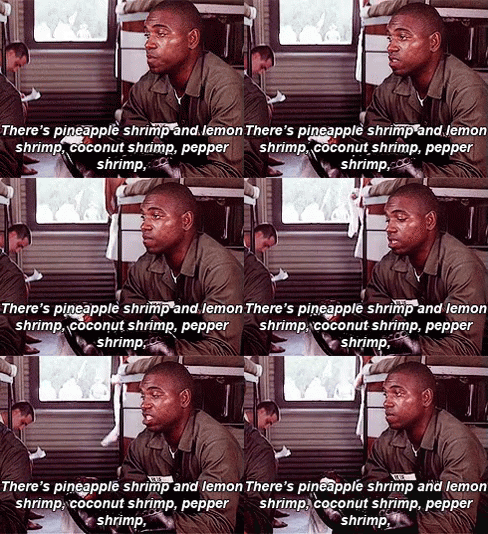
A gif from Forrest Gump. "There's pineapple shrimp and lemon shrimp, coconut shrimp, pepper shrimp..."

They are the first things I see in the morning, and the last I see at night. I’ve been looking up recipes for pies, jams, sauces, salads, and brews. I’ve been hunting for reusable multi-gallon freezer bags. I’ve been researching deities who enjoy strawberries as offerings, in the hopes that I might be able to unload some of them like an overly friendly neighbor with too much zucchini.

It’s been about a week, and they’re flowering and thriving. I don’t know what I’m going to do. I don’t have the heart to just toss them, and, like I said, I don’t know anyone who wants them. I wouldn’t know how to ship them even if I did.

An image entirely filled with strawberries. Nothing else is visible.
An artist’s rendition of my life for the foreseeable future.

I have a sneaking suspicion that I’m going to get very tired of strawberries in the near future.

life · Plants and Herbs

Reskilling: Learning to Brew (and how it almost shot my partner)

Hello!

I haven’t updated in a while — it hasn’t been for lack of material, either. As we move into spring, I’ve been working on planting my balcony, developing new skills, and seeking out more connections. It’s the time of year for planting seeds in the anticipation for growth, and I feel it.

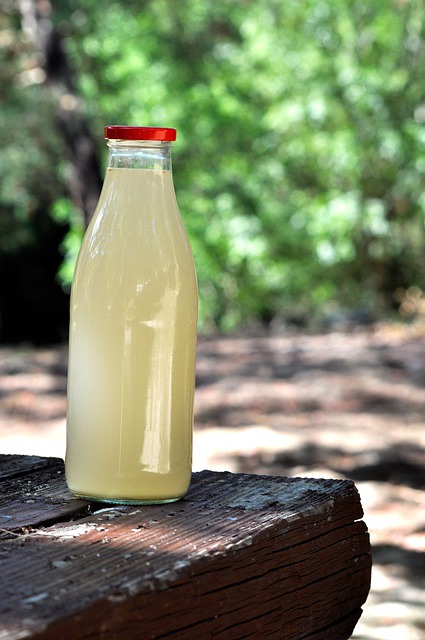
Anyway. You’re probably wondering about the title, so here goes: I’ve been making tibicos, also known as water kefir. This is a kind of probiotic beverage that’s made from granules that naturally develop on Opuntia cacti. These are essentially a SCOBY, kind of like kombucha, in a sort of gummy polysaccharide matrix. The balance of bacteria and yeast is quite a bit different, however, yielding an end product with a very different taste and bouquet of probiotics. Also, unlike kombucha, water kefir grains form little clear to beige squishy lumps instead of a mushroomlike “pancake.”

So, the process of making water kefir goes like this:

  1. Boil some filtered water.
  2. Add sugar. I usually use a half cup or so for a half gallon jar.
  3. Make sure the sugar’s dissolved.
  4. Let it cool.
  5. Add the kefir grains.
  6. Cover the jar with a piece of cloth or loose-fitting lid.
  7. Wait 36-48 hours.
  8. Strain the liquid into a bottle (save the strained-out kefir grains).
  9. Add juice, crushed fruit, spices, or whatever you want the final flavor to be.
  10. Cover the bottle with a cap, or one of those fancy swing-top corky deals.
  11. Let it sit on the counter for another 24 hours. Burp it occasionally.
  12. Put it in the fridge.
  13. Enjoy.

Note the part that says “burp it occasionally” in bold letters. This is extremely important.

I’ve been working with a flavor blend that my partner and I really like. It’s about a half-cup to a cup of tart cherry juice and a cinnamon stick, in a 32-ounce swing-top fermentation bottle. There’s only one problem: It’s been very warm here, and cherry juice has a lot of sugar.

Even if you’re watching your sugar intake, the sugar content of water kefir is kind of the opposite of a problem. The fermentation agents in the grains break almost all of it down and produce CO2, a bit of alcohol, and more of themselves. In the end, you get something that’s fizzy, very slightly alcoholic, and flavorful, without being too sweet. The warmer the environment, the faster the bacteria work.

That is, if you get the ratio of juice to water kefir right for that second fermentation. And if, as I said, you burp the bottles regularly. Otherwise, you’ll get something that’s fizzy, alcoholic enough to peel paint, flavorful, not too sweet, and capable of detonating your entire kitchen and giving anyone in the room with you a traumatic brain injury.

I know this all sounds like hyperbole. I cannot emphasize enough to you how much it is not.

I popped that swing top off, and the force of the gas (from a bottle that I’d already burped a few hours ago) was enough to blow the wired-on top completely off, ricochet it off of the cabinet and into another room, and soak the ceiling in a geyser of cherry and cinnamon water kefir. I stood there in shock, holding the now half-empty bottle, while a sticky red rain fell around me. My partner, who very narrowly avoided having a wire and rubber bottle top embedded in his left temple, was in a similar state. It took a minute for the adrenaline rush to calm down, and I hope the probiotic benefits are enough to make up for the eight years the experience shaved off of our lives.

As it turns out, uncorking things can be way more dangerous than you’d think.

Anyhow, we poured out two glasses of what was left, and it was delicious. I think the fact that it was just this side of moonshine also helped calm us down a bit, which was a plus.

(Fortunately, I’ve gotten my better-ratio-of-juice-and-burping-the-bottles-often together since then, and no longer produce things that could conceivably be used to rob a bank.)

I’ve also made another version, where the water kefir grains feed on brown sugar for their first ferment. I add some lemon juice, ginger, and cinnamon for the second, and the end result is a very tasty ginger ale with just a tiny bit of sweetness. Since I have my process more or less nailed down at this point, I’m also working on adding herbs and fruits for various intentions to make drinkable potions.

Though I’m limited by space, I have a long list of skills I’d like to rediscover and build upon. Hopefully none of the others produce ersatz explosive devices.

life

Hello! I’m full of holes.

So, I had an electromyograph and nerve conduction test done on Tuesday.

When I say this, it sounds like I took a car in to figure out why the dashboard was full of warning lights. (I think. I don’t know how cars do.)

I’ve been through a lot of medical tests in my life, including spinal tapping and having to put my face in a machine that blasted soundwaves into my eyeballs and took pictures of my optic nerves. I have to say, nothing really drives home the point that we’re just perpetually faulty bags of electrified meat like an EMG and NCS.

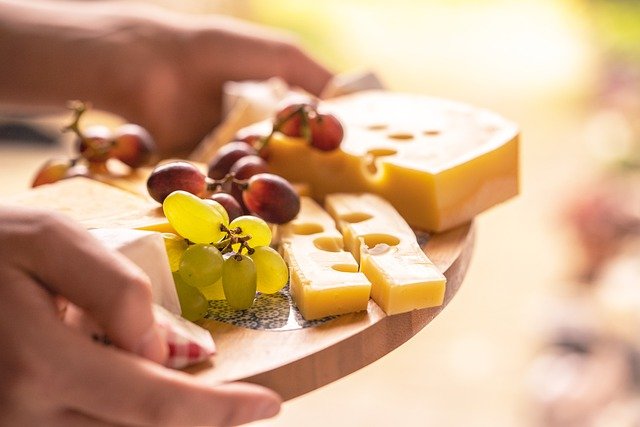
A plate of grapes and Swiss cheese.
It me.

The idea is this: If your nerves or muscles go all fucky, they can’t do electricity right. This is measurable. Like when an electrician uses a multimeter to check for shorts, a neurologist can stick electrodes on you, stimulate your nerves, and see what happens.

Of course, by “stimulate your nerves,” I mean “jab you with a thing that feels like the unholy spawn of a TENS unit and a cattle prod.”

If you’re lucky enough not to know what the hell a TENS unit is, it’s a transcutaneous electrical nerve stimulator. It’s often used in physical therapy. Basically, they place a pair of electrodes on the muscles that need doing, and hook them up to a battery. It makes you all twitchy and feels super weird, but I am assured that it is sometimes necessary and not just an elaborate practical joke created by bored physical therapists.

To be honest, the nerve conduction study wasn’t bad. The only part that actually sucked was when they had to test the nerves as they ran through my elbow. That felt bad, but also took barely any time to do. Afterward was a bit crap, too, since I was there because of a burning nerve pain down my arm. As you can probably surmise, jabbing a burning nerve with a tiny taser doesn’t do much to improve matters.
Hey, it’s diagnostic, not therapeutic.

The next part was the EMG. This, admittedly, made me nervous as hell. I’d never had one, so I looked up what to expect. Five minutes later, I was positive that the entire internet was fucking with me.

The EMG is similar to the NCS, only for muscles instead of nerves. The NCS sees how well your nerves send and receive signals, the EMG figures out what your muscles are doing about them. In more complicated terms, it measures the electrical potential your muscles create when they’re stimulated by either electricity or signals sent by your nerves.

Unfortunately, I made the mistake of reading about people’s experiences with EMGs. (Don’t do this. I was smart enough not to read about spinal taps before getting one, and it helped a lot with my anticipatory anxiety. I didn’t do the same this time around, and it sucked a ton.) Most described it as extremely painful — some to the point where they had to stop the test halfway through. Everyone responds differently to pain, and I have a fairly high threshold at this point, but I still felt really anxious about it.

Fortunately, between a very kind, reassuring neurologist with an excellent bedside manner, and enough tincture of chamomile to sedate multiple kaiju, it wasn’t too bad. After the NCS, the doctor came in, asked a few questions, conducted a physical examination, and then stabbed two inch needles into all of the muscles of my arms, one at a time, and had me try to move them while a machine blared static into my ear.

Surprisingly, it wasn’t nearly as bad as it sounds.

Was the static uncomfortable to listen to? Kind of, but it was also really cool. Needle goes in, static is quiet. Muscle moves, static gets louder. It was neat to actually hear the electrical stuff that goes on in a body. I don’t often go out of my way to remind myself that I’m just a sack of organized seawater and electric meat, so it’s kind of cool in an eldritch-body-horror-biological sense.

Did the needles hurt? Some of them, yeah. Most hurt less than a vaccination, and much less than getting an IV. A few areas, like the heel of my hand, hurt quite a bit. Fortunately, testing each individual muscle doesn’t take long. A few seconds, and the needle was out again. Weirdly, I barely felt the ones stuck into my neck or the back of my forearm. Go figure.

Did I bleed a lot? Not really. I am covered in those tiny little roundyboy band-aids, but that’s probably because I’m on sertraline and it tends to make me bruise and bleed a bit easier. The doctor mostly just put them so I wouldn’t end up with little bloody spots on my clothes and didn’t come out looking like I’d been roughed up by a gang of drunken biker wasps.

I came home, made lunch for my partner and myself, and got some writing work done. I did feel like I needed a nap in the afternoon, but that was probably the burnout from all of the anxiety I was experiencing.

Now, I wait and find out why my nerves are bad at electricity.

Environment · life

Fines don’t matter when you’re rich.

Monetary punishments only work as a deterrent for poor people. For the wealthy, fines are just the cost of doing business.

This happens across the entire legal system, too. To someone living at or below poverty level, parking fines actually work — you think twice about parking illegally if it’s going to get you hit with a $200 fine. For someone who can afford to lose that money, the world looks different. There are no illegal spots, just spots that cost more to park in than others.

If that sounds outlandish, look at this bullshit here:

Developer In Takoma Cuts Protected Heritage Tree, Over Protests From Neighbors

The title buries the lede a bit. This wasn’t a bunch of nosy neighbors protesting the felling of a tree. This was a developer outright breaking the law in a way that impacts an entire community, and that community attempting to stop them.

A pair of very old trees, with their trunks and roots covered in moss.

Looking deeper, you can see where the parking space analogy comes into play:

“‘Get off my property, I’m going to cut this tree down,’’ Giancola recalls him saying. Neighbors told the owner that cutting the tree was illegal, Giancola says.

“He said, ‘I don’t care. Everybody does it, all developers do it. We pay the fines, nobody cares,’” Giancola says.

[…]

Eutsler says the property owner is facing as much as $72,000 in fines for cutting down three protected trees — the heritage oak, and two smaller “special trees.”

It’s the same thing. Only, instead of talking about a $200 parking space, we’re talking about a fine potentially over $72,000.

And it doesn’t matter. Why doesn’t it matter?

“If by removing a protected heritage tree, you can add substantial square footage to a building, you’re probably able to simply recover the cost that the fine imposes,” says Eutsler.

So, in short, wealthy developers are incentivized to break the law, because doing so lets them squeeze another couple hundred square feet out of a property. That allows them to absorb the cost of the fine, and then some.

A gnarled old olive tree.

What’s even more laughable is that this is, at the moment, completely unpreventable. The channels that handle this aren’t empowered to actually stop it from happening. Forestry has to wait for the trees to be felled, and then the fines (the completely pointless fines that developers don’t care about) are levied.

The thing is, bigger fines wouldn’t even necessarily help. Making them proportional to the perpetrator’s income would, as well as keep poor families from being bankrupt by a minor infraction. The angry treehugger in me, however, wishes it was a jailable offense. If Forestry can’t order them to stop work, then they need to be stopped somehow. (I should note that I’m not in favor of the carceral state. However, in the absence of a law that would allow the forestry department to stuff perpetrators into burlap sacks, I figure you need to work with what’s available.)

This isn’t even necessarily about the trees themselves, as much as I hate seeing a 100-year-old oak fall. It could’ve been a street sign instead. It could’ve been a tree that was getting ready to fall over. It could be anything, and the fact that money allows people to break the law with impunity would still be abhorrent. Fines don’t work to deter crime except for at the poorest levels of society, but poor people aren’t the ones going around dumping hazardous materials, lying about safety, or chopping down heritage trees.

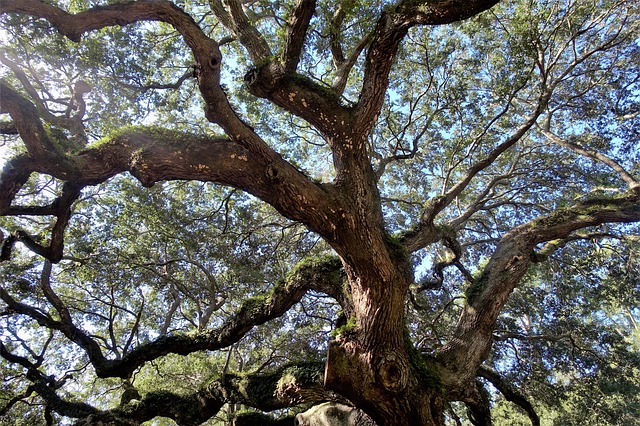
An old oak tree with twisted, spreading branches.

I could get into the urban heat island effect, the importance of old trees as micro-ecosystems unto themselves, the deleterious impact of urban deforestation, or that people of color (especially women) bear the brunt of the impact of poor conservation and climate change, but I don’t think anyone has that much time.

Just remember. Environmental destruction isn’t a faceless, unstoppable phenomenon. It’s perpetrated by people, and they have names.

Environment · life · Neodruidry

Silvering the Well

One practice that’s part of my tradition involves “silvering the well.” This is pretty much exactly what it sounds like — making an offering of silver to the well.

The well, in this case, is a vessel of water (taken from three different natural sources). Outside of a ritual, it’s just a bowl. During a ritual, it becomes something more. It’s a representation of the primordial waters. It’s the healing cauldron, the sacred spring, and the sea of Manannán mac Lir. It’s representative of Water as an element, and the past from which we all spring.

The thing is, silvering the well is more complex than it seems. To people who’re used to ceremonial magic, it probably looks pretty simple. You have a vessel to serve as your well, and you make an offering to it. Silver goes in, boom.

There are also multiple different approaches to making this offering. One involves purchasing (or upcycling) small silver or silver-plated beads, which are then offered to the Earth once the ritual is concluded. Another uses a dedicated silver object which is designated as the offering anew each time, then taken out, dried off, and saved for the next ritual.

I spent a lot of time teasing out what this part of the process means for me. I’ve always understood the word “offering” to be a kind of euphemism for “sacrifice.” When you offer something, you no longer have it. Even if you don’t necessarily get rid of it (like dedicating an altar sculpture to a deity), it isn’t for you to use anymore. In this context, it makes sense to use small offerings of pieces of silver, requiring you to sacrifice the time, money, and energy it takes for you to get more when you run out.

On the other hand, international supply chains make the ethics of buying literally anything incredibly dubious. (I mean, a hobby store got caught trafficking antiquities, for crying out loud.) Even if it wasn’t, making an offering of small pieces of new silver involves mining silver (and possibly other base metals, for silver-plated objects) and then offering them to a place they didn’t come from. In less confusing words, you’re taking valuable material from one part of the Earth, and putting it somewhere else. Sure, silver isn’t exactly blood diamonds, but it’s still something that stuck in my mind like a fishhook. How do I know that the material for these “disposable” pieces of silver didn’t come from child labor, or a mine that dumps poison into the waters of the very people who have to work there? Could I justify offering something to the primordial waters, knowing that it might be poisoning the water?

(The environmental chemistry nerd in me isn’t even going to get into rainwater, leachates, and their effect on the soil, or I will be here all night.)

Eventually, I managed a compromise. I found a coin collector who had a stash of silver Mercury dimes. They weren’t suitable for collecting, since they’d been heavily circulated and were worn nearly smooth by time. I bought one, and this is my offering. I give it to the well, and the letter of the ritual has been fulfilled. The well is silvered.

Fulfilling the spirit of offering comes afterward. The coin itself is almost collateral — it’s a token of a promise, the symbol of an offering rather than the offering itself. Once the coin has been removed from the well and dried off, I make the sacrifice. Each ritual costs a monetary donation to a water charity — from the Water Protector Legal Collective, to Ocean Conservancy, to Jug Bay Wetlands Sanctuary, to one of the many other organizations working to protect people’s access to clean drinking water, remediate water pollution, or preserve vital wetlands. Failing that, it costs an afternoon of cleaning a beach or the banks of one of the smaller local waterways.

What does this mean for other people? Probably nothing. It’s just something that sat in my mind for a while, and a practice that I put in place years ago. Maybe it’ll have value for others, maybe not. Either way, I thought it might be worth writing down.

life · Neodruidry

Imbolc, and einkorn banana bread

Baking is part of my Imbolc ritual. I don’t consume much butter or milk, so baked goods and flowers are my offerings. This is around the time when I first start noticing new growth and buds on many of my houseplants, so I do some spring cleaning, give everyone a healthy dunk and dose of fertilizer, and bake before my more formalized ritual later in the day.

Yesterday, I offered part of a loaf of banana bread. If you’re egg-free, dairy-free, or just looking for some extremely good banana bread, I’ve got you. It might not be a traditional springtime recipe, but it’s comforting, tasty, and I’ve never had any complaints from anyone — mortal or otherwise.

A slice of banana bread with chocolate chunks.

Egg-free, Dairy-free Banana Bread

  • 2 C einkorn flour
  • 1 t ground cinnamon
  • 1 t baking powder
  • 1 t baking soda
  • 1/2 t sea salt
  • 3/4 C dairy-free dark chocolate chips or chunks
  • 2 very ripe bananas, peeled (about 1 C of mashed banana)
  • 1/2 C maple syrup
  • 1/2 C avocado oil
  1. Preheat your oven to 350° F.
  2. In a bowl, whisk together flour, cinnamon, baking powder, baking soda, sea salt, and chocolate chips. Set aside.
  3. In a separate bowl, mix together bananas, maple syrup, and avocado oil.
  4. Pour the wet ingredients into the dry. Mix together until there are no lumps, but don’t over-mix.
  5. Butter a 9″x5″ loaf plan.
  6. Pour batter into pan, and gently tap the bottom against the counter to free any air bubbles.
  7. Bake banana bread for 50-55 minutes, or until a toothpick inserted in the center comes out clean.

Notes:

  • As with any ingredients that aren’t produced domestically, go for chocolate and bananas that are ethically sourced and fair trade.
  • No einkorn? No problem! You can substitute regular flour if you want, just remember that einkorn doesn’t absorb water the same way regular wheat flour does. If you substitute regular wheat flour, you’ll probably need to add another banana or so to the batter for extra moisture.
  • For best results, freeze the bananas first. This will crystallize the water in their cells, rupturing them and giving them a softer, wetter consistency.
  • You can substitute canola, grapeseed, or another neutral-tasting oil for avocado oil, if necessary.

Enjoy, and blessed Imbolc!

life · Neodruidry

The Wheel of… Kind of Whatever at This Point

I’ve never been big on New Year’s resolutions. Honestly, there’re few things more disheartening to me than making big plans, anticipating changes, trying to improve myself and my life, then waking up to… the rest of January. Bleh.

This year is especially weird, because it’s less, “What do I want to do to improve my life this year?” than, “What will my desire to stay out of the ICU let me do?” (I’ve been in one before. I ain’t going back.)

Usually, I make summer resolutions instead. A lot of Wiccans, Neodruids, and other Pagans try to live following the “Wheel of the Year” — that is, living alongside the rhythms of rest, sowing, growth, harvesting, and so forth. My particular rhythms have always precluded that. Summer is my downtime, because I don’t do well in heat, summer storms worsen my intracranial hypertension, and I’m allergic to grass pollen. No thanks. Winter is when I have more energy, though the rest of the hemisphere doesn’t seem to want to follow suit.

So, I’ve been using this New Year energy to time a psychological exercise that my therapist showed to me. It’s fairly simple, and I won’t go too far into details, but the Wheel of Life has been tremendously helpful for visualizing changes I want to make, prioritizing them, and turning vague hopes into actionable plans.

You take a wheel, divided up in the manner of pie. Each slice is part of your life: Finances, Health, Social life, and so forth. You rank your level of satisfaction with each area. You then note where the biggest gaps in your current level of satisfaction, and ideal level of satisfaction lie, and choose areas to prioritize. You figure out where you can conceivably raise your level of satisfaction in one month, three months, six months, and a year. Lastly, you come up with three actions you can take to measurably increase your satisfaction, and set a deadline for them.

Honestly, life is pretty good right now. My creativity’s flowing like a dingdang fire hydrant and, while I haven’t been able to write for myself much, I’ve been getting lots of paid writing assignments (as well as working on a book proposal with my partner, but that’s another story). My home life is harmonious, and I’m surrounded by love. I’ve even managed to socialize more, both online and off, since I’ve increased my physical endurance to the point where I can do more stuff. I’m not wealthy, but I have enough money for what I need, extra for helping people, and enough discretionary income to pay my friends to create the things they love making. It’s pretty rad.

I’d still like to make improvements, because who wouldn’t? I want to sell some of my original art, because I can’t hold onto it forever. I want to resume my language studies. I want to learn how to write poetry that doesn’t make me cringe so hard that I swallow my own face. I want to learn more about regenerative agriculture and landscaping, so I can put it into practice once my partner and I are in a place where we can do so. I want to continue down the path of the Neodruid.

(I also want to set up a way to recycle Styrofoam into usable carbon dioxide for a grow cabinet. I’d like to turn my partner’s old coffee grounds into a useful mushroom substrate, but, so far, all of the mushrooms that seem to do well on coffee grounds are also the ones that make me feel like I’m being beaten up internally by a horde of drunken fairies, so more research is needed.)

Of course, pretty much everything is hijacked by COVID, but there’re ways around that. A lot of the things I want to do don’t involve contact with other people. Even socializing can be done remotely, to an extent, and this distanced socializing helps forge bonds and build anticipation for when we’re all actually able to hang out in person.

Here’s hoping the New Year’s energy helps us all get better at the things that are important to us.

art · life

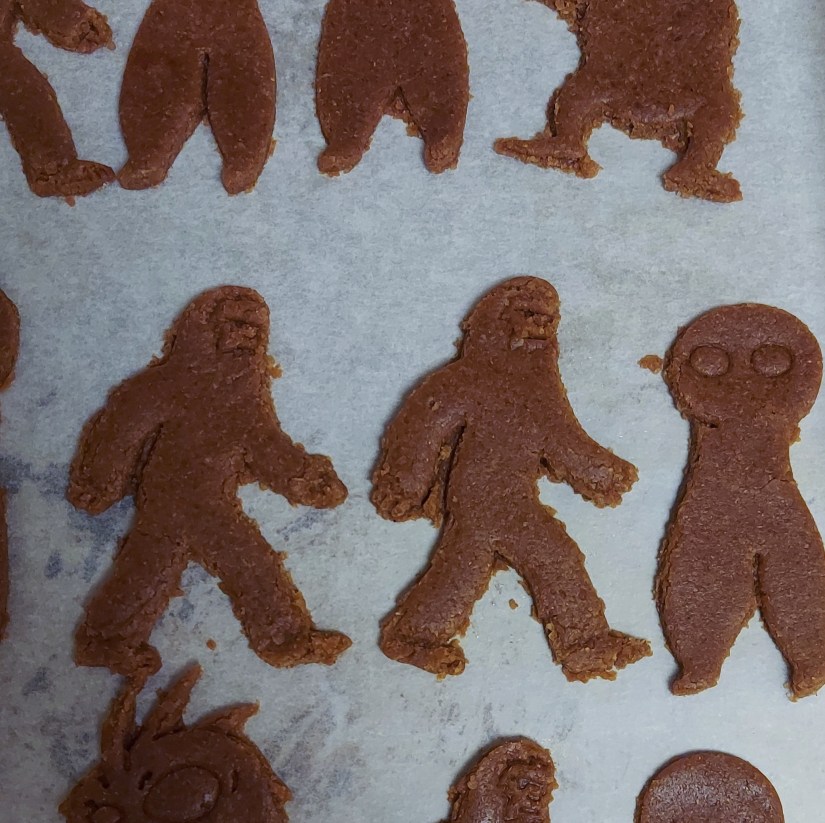
Gingersquatch, Gingercabra, and Fresno Gingercrawlers.

When I was little, my dad (whose cooking repertoire largely consisted of pancakes and frybread) would get these boxes of premade sugar cookies with printed reindeer, Santa, and snowflake designs, and little tubes of icing. We’d spend an afternoon decorating them and, even if the cookies themselves were always kind of stale, it’s a memory I look back on fondly. We also made snowman ornaments out of wire and beads, and all kinds of stuff. My dad was always pretty good at extracurricular tiny child-type activities.

I was pretty surprised to hear that my partner had never decorated cookies for the Yuletide season before. I’d never made a gingerbread cookie from scratch in my life, but I like experimenting. So, armed with Kanan Patel’s eggless gingerbread cookie recipe from Spice Up the Curry, I set out to make us some gingerbread men.

There was only one problem. Seeing as how I’d never baked a gingerbread man before, I didn’t have any people-shaped cookie cutters. I also wasn’t about to individually freehand a troupe of gingerpeople.

So we made gingercryptids instead.

Raw dough, before trimming and chilling.

Honestly, the cookie recipe was perfect. I used einkorn flour, and didn’t have to make any adjustments to get cookies that were crispy outside, chewy inside, and substantial enough to hold up to a whole lot of decorations. The dough started out crumbly, coming together after the butter managed to melt a little. The cookie cutters are from Kato Baking Supplies on Etsy. They’re actually for fondant, but, with the exception of losing an odd chupacabra spike or two, worked out just fine. We chilled the dough, rolled it out, cut the shapes, preheated the oven while we chilled the shapes again, and they didn’t spread at all. Perfect!

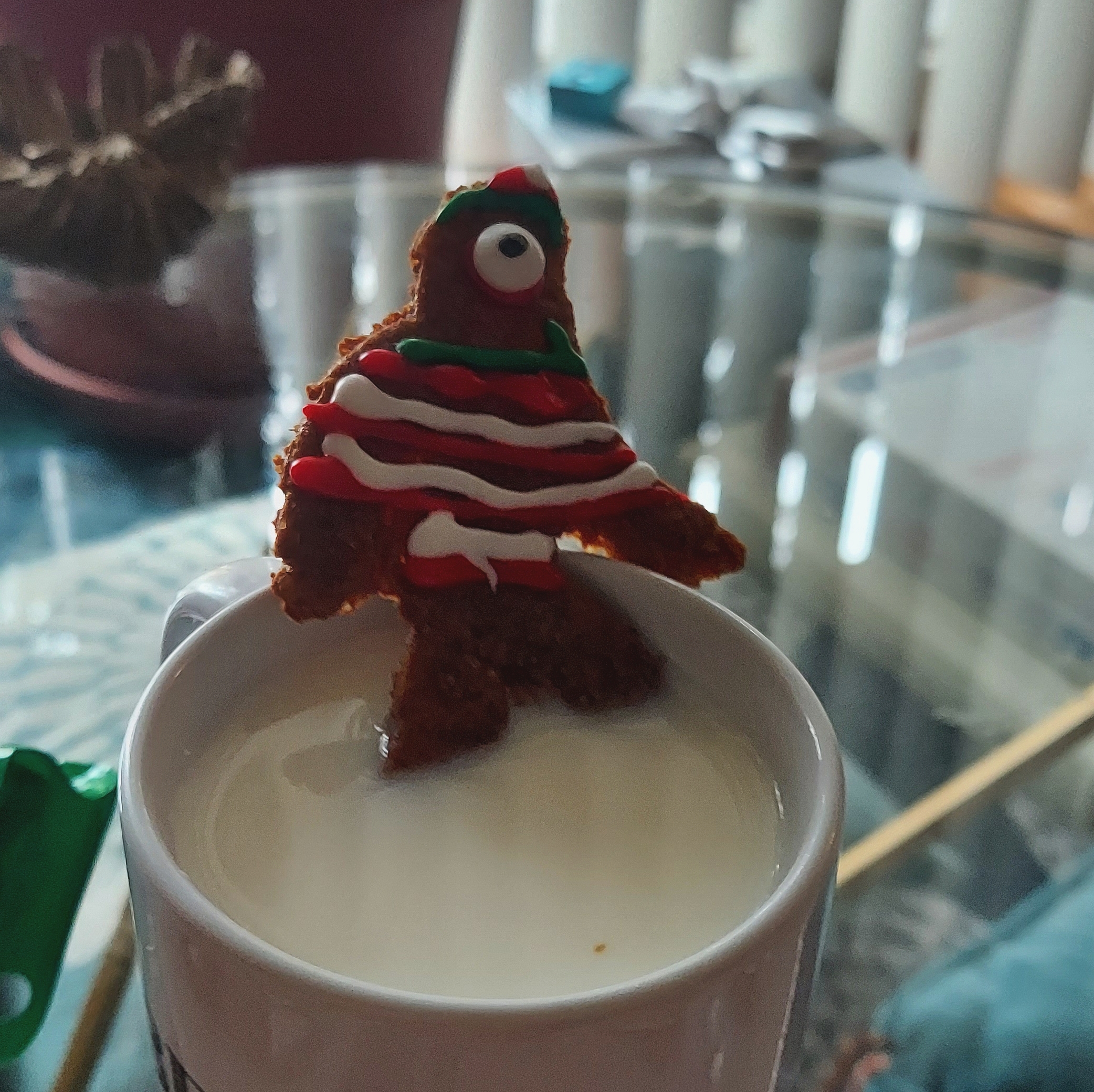
(Featuring Salaryman Chupacabra, Ugly Sweater Nightcrawler, and Sprinkle Hotpants Nightcrawler.)

life

The Benefits of Not Being an Emotional Empath.

Much has been made over the idea of being empathic. This is pretty similar to being empathetic, in that both are based on structures in the brain that fire in response to other people’s behavior. While empathetic people can essentially “feel” the emotions of others, in the sense that they feel happy when others express joy and sad when others grieve, this goes deeper for empathic people.

A lot of articles have been written on the pros of being an empath, and some go so far as to treat it like a kind of superpower. At times, it can get weirdly confusing — some quizzes conflate being empathic with being generally energetically sensitive, when they aren’t the same. I’ve been called an empath because I feel drained after big gatherings and get headaches from floor cleaner, but, even if those are traits that are common to empaths, they aren’t signs of being emotionally empathic.

Anyhow, all of this is to say that being an empath isn’t necessarily optimal. The world needs empaths, but it also needs people whose mirror neurons aren’t doing the equivalent of cutting the brake lines on an F1 car. And so, here’s a list of reasons why it kind of rocks to not be an emotional empath:

Your energy is yours.

Sure, everyone should know how to shield themselves from other people’s energy. For empaths, though, this process is a lot more involved. People whose mirror neurons are more selective don’t have to worry as much about whether the feelings they feel are theirs, or the detritus of someone they came in contact with.

You can provide another kind of emotional support.

Empaths are good at emotional support because they feel what other people feel. Depending on the situation, that’s not always desirable — sometimes, you need someone who has an easier time maintaining distance to provide stability. There are also plenty of emotional situations where it doesn’t actually help to be told, “I understand you.” Some people need a witness to their experience, not someone to be in it with them.

This is a time when sympathy and compassion are helpful, but empathy may become detrimental. Not just detrimental to the empath, either — an empathic response can actually block what the other person needs from you. In the words of Graham Johnston, “using the prefrontal cortex to mentalise […] might be more helpful than using the anterior cingulate cortex to empathise with them.”

You can still be empathetic without being empathic.

Empathy arises in a specific area of the brain. In some people, this is more active than others. There is no hard line between being an empath and being devoid of empathy. It’s a spectrum.

What’s more, even if you’re not able to feel empathy like others do, you can still have sympathy and exhibit compassion. As mentioned above, there are plenty of times when a compassionate response is more helpful than an empathetic one. Even if you can’t empathize with someone’s grief, you can sympathize with their misfortune and treat them with compassion.

Projection is more difficult.

The number of people who consider themselves empaths probably outnumbers the actual empaths in the world. Unfortunately, empathy is often treated like the one good thing it isn’t possible to have too much of, but this is a) not true, and b) something that tempts people to identify with a label that may not actually apply to them.

As a result, there are an awful lot of empaths who don’t so much feel what others feel, as they project their own feelings onto other people. What if you honestly think you’re feeling what someone else is, but your feelings are inaccurate? What happens if you misidentify the source of these emotions?

Even if you are empathic, and you do accurately feel another person’s emotions, these emotions aren’t paired with that person’s personal, mental, and cultural context. You can respond to them in a way that you feel would be helpful, but, even if you’re feeling their feelings, you will always be responding from within your own context. If someone is grieving, and you feel their grief, you might want a hug to help soothe that pain within you. If you project this desire onto the other person, it’s not helpful. In the end, the solution is still to act from a place of sympathy and compassion.

An empathic response can actually increase bias.

This is a bit complicated, but follow me here.

Say you wear a red shirt. All of your friends wear red shirts. Maybe you even go to conventions about red shirts. Red shirts are awesome.

There’s another group of people who wear blue shirts. Maybe you understand why they do this, maybe you don’t. That part doesn’t matter. The red shirted people are your in-group. The blue shirted people are an out-group. Your groups’ experiences differ. They don’t go to your red shirt conventions, and you don’t get invited to their blue shirt parties. Unfortunately, this can lead to bias against people who are in the out-group.

In a 2009 study, some researchers performed experiments to see how to mitigate the effects of in-group/out-group biases. One big thing that helped was contact with members of the out-group. Another was empathy toward the out-group. Both empathy and contact reduced prejudice and biases. Here’s the weird part, though: When put together, they negated each other. Empathy plus contact didn’t improve the situation.

The researchers explained this through the concept of a “meta-stereotype.” This term refers to how a person thinks they are perceived by a member of their out-group. When an in-group member anticipates having contact with an out-group member, this concern is activated. Empathy heightens it. When you’re that preoccupied with feeling what a member of the out-group thinks of you, it becomes much more difficult to have a productive, natural interaction with them.

Worst of all, these findings were backed up by another study by a different group of researchers for years later. In this one, researchers found that attempts to take an empathetic stance toward members of an out-group actually reinforced in-group identity and negative attitudes toward out-group members. Oof.

This doesn’t mean that empaths are more likely to be prejudiced against others, of course. It does mean that, when you’re that sensitive to the feelings of others, it creates a heightened sensitivity in yourself that actually makes it much harder to relate to people in a natural, helpful way. High levels of empathy don’t always lead to better interactions between different groups of people. It’s a double-edged sword.

You take longer to burn out.

Feeling all of the feelings is tough. That’s why there are so many resources out there for empaths to learn to shield themselves, ground themselves, cleanse their energy, and generally cope with the aftermath of being exposed to other people’s heavy duty emotions and energies all of the time. This can be extremely exhausting for them, and some may even get burned out.

Burn out is a (sadly) common hazard of caretaking. People who work in medical fields or veterinary medicine, or even just provide care to young children or elderly relatives, can just become mentally and emotionally exhausted. If you’re not in those fields, don’t have access to professional resources to help you prevent burn out, and are still faced with feeling other people’s emotions, it can be pretty grueling. This is especially true when you’re primarily exposed to other people’s negative experiences (grief, loss, et cetera).

People who are empathetic in an average sense, and not empathic, still suffer from burnout. It’s just not quite as rough when you aren’t literally feeling other people’s feelings on top of everything else.

You can still be sensitive.

Being an empath involves having a deeper-than-average response to another person’s exhibited emotions. That is, your mirror neurons go off like a string of firecrackers when someone else has an emotional response to something, triggering those feelings in you.

This doesn’t really have anything to do with other sensitivities, though. You can still be sensitive to foods, scents, energy, sounds, and all kinds of things that have nothing to do with other people or their emotions. Someone may be an emotional empath, but less perceptive to subtle energies. Others are just Highly Sensitive People. Childhood trauma can even make some people extremely sensitive to displays of sadness or anger in others. This isn’t because their mirror neurons trigger feelings sadness or anger in them — they’re sensitive because they have an anxiety response to displays of negative feelings. Their heightened perception is a survival mechanism.

Empaths are wonderful, caring people, but the internet is literally full of articles praising the virtues of the empathic. Being an empath isn’t automatically an enlightened state of being, however, and can be detrimental to oneself and others. There are numerous benefits to having an average capacity for empathy, and it doesn’t exclude you from being sensitive to things other than emotions. Remember, it takes all types. If everyone was an empath, or everyone had low empathy, we’d be screwed.


Books · life · Neodruidry

Sacred Actions: Yule

This past Sunday, one of my Meetup groups had a meeting to discuss Dana O’Driscoll‘s Sacred Actions: Living the Wheel of the Year through Earth-Centered Sustainable Practices. Luckily for me, I’d picked up a copy several months ago from Three Witches’ Tea Shop. It’d been in my “to read” pile for a bit, so I was very happy to have the extra encouragement to get into it.

We went over the first high day, Yule. For this time of year, Sacred Actions emphasizes learning one’s place in the consumption web of life — observing your consumption patterns, seeing how you can live in a way that’s more regenerative and nurturing for the Earth and other people, and learning to discern between a need and a want so that there are enough resources for everyone to live comfortably.

This chapter also encourages the reader to take a look at their ecological impact using the Footprint Calculator quiz. Mine came out at a 1.8 — meaning that, if everyone in the world lived like I do, it would take 1.8 Earths to sustain us all. Unfortunately, this number is actually at the lower end of the spectrum, but I’ll get to that in a minute.

The discussion was lively and fruitful. It was nice to know that we were all in a similar place — aware of tactics like “greenwashing” and propaganda that emphasizes individual responsibility over corporate abuses, and knowing exactly how difficult it is to engage in ethical consumption within our economic system.

One thing I particularly liked was O’Driscoll’s emphasis on regeneration and nurturing over sustainability. Sustainability is nice, but comes with a pretty heavy subtext. The implication is that we should find a way to do things that allows us to continue to live, consume, and behave in the way to which we’ve become accustomed. This isn’t just impossible, it’s not exactly a noble goal. Instead, we should work toward regeneration — giving back to the planet and exploited people to replace what has already been depleted.

(I could go into a super long and weird discussion about extinct megafauna, human cities, and the importance of poo here, but I will spare you this. Instead, here is a giant gorilla fighting a t-rex:)

The idea that we have a responsibility to more than just the planet was refreshing, too. My ecological footprint is low for someone living in a wealthy, developed nation. I’m not bragging here — the reason it’s low is that disability (and, let’s be real, an at times paralytically rigid sense of ethics) keeps me from engaging much in many aspects of society. The things that make my footprint as large as it is aren’t even things I can control. It’s almost all the snowball effect of having a long, multinational supply chain.

With that in mind, there’s only so much else I can trim. It’s frustrating to look for ways to make your lifestyle more sustainable (read: regenerative), and just get the same bits of advice over and over and over again. Use reusable paper products. (Check.) Use metal straws. (Check.) Compost. (Check.) Instead of this, O’Driscoll’s work provides some other lenses through which to consider sustainability. Even if I can’t change the supply chain that delivers the things I need, I can focus my energy on supporting, regenerating, and nurturing the people involved.

(Incidentally, I think I’ve begun to hate the word “nurturing.” I’ve seen it co-opted so many times by new-agey wellness articles about consumerist self-care strategies, I think they’ve ruined it for me. I will, however, continue to use it here for lack of a better term.)

(The phrase “nurturing the people involved” also gives me mental images of someone breastfeeding a forklift operator, but I’m not sure how else to say it. Your mileage will hopefully vary.)

The next step is to engage with the exercises. This means placing one of three ideas at the forefront of my mind for a week at a time. First, emphasizing care for the Earth and all of its inhabitants. Next, will be emphasizing people. After that, ensuring that there is enough for all.

As I write this, news stations are broadcasting about the deaths of workers in an Amazon warehouse that was hit by a tornado. The tornado wasn’t a surprise. People, driven by desperation, went to work. The company higher-ups didn’t see fit to let them stay home. Jeff Bezos says he’s heartbroken about the tragedy, but has yet to commit any actual money to providing for the families of the dead.

In the meantime, Bezos’ Earth Fund has also committed another $443M (USD) to conservation efforts, or roughly 1/500th of his net worth. A net worth that comprises assets gained through exploiting people and the planet.

His attitude and position is not unique. Remember, while you make adjustments to your lifestyle, that the people serving as conduits for environmental and human exploitation are not gods. They have names and addresses. When living sustainably as an individual only goes so far, there is always direct action.

For more information, I recommend episode 320 of The Dollop, The Wobblies Go to Everett.