Not long ago, I wrote about the family of starlings that had pretty much taken over. A squawping mass of tiny kicks, punches, flung food, and babies that would walk up and demand to be fed by anything that moved (and a few things that didn’t).
While they were fun to watch, they also seemed to drive away a lot of the other birds that visited me — especially the crows. Given how much energy I’d put into building a relationship with my local crows, this bummed me out. Still, I knew that starlings aren’t forever, and it wouldn’t be long before they’d join a migratory murmuration and the yard would be peaceful once again.
At that point, I figured, I could try attracting crows again. They might not bethesamefamily that I’d growntolove, but I knew this area was hospitable to breeding populations of crows and would easily become so again.
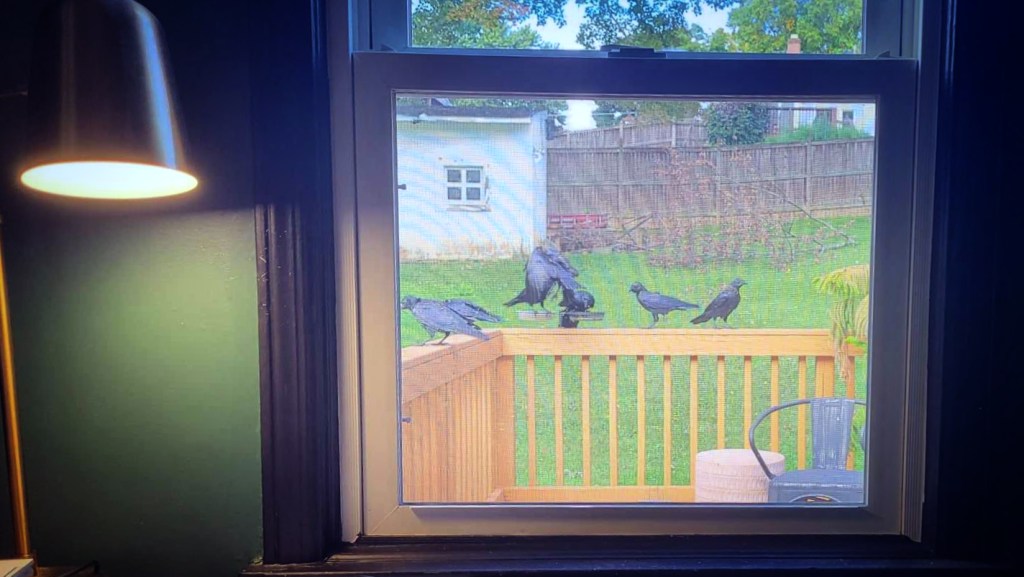
Anyhow, the starlings have gone on their yearly vacation. I discovered this when I woke up the other morning to big, black shadows passing over the skylight. I went to investigate, and what to my wondering eyes should appear but…
The view from my Handsome Assistant’s office. Not shown: The other six crows at the feeder on the other side of the deck.
All of the crows. At the same time.
I knew it was the same group because they have a handful of pretty visually and behaviorally distinct individuals. They scrapped over cat kibble, raisins, nuts, and fancy organic peanut butter cereal (which is apparently a very hot commodity among corvids). I went outside to refill the feeders once they’d nearly wiped them out, and they flew off to the roof, waited for me to finish, and immediately swooped back to resume feeding.
It feels nice. As far-fetched as it seemed, there was always a nagging fear that I’d done something wrong somehow. Something to drive them away. Crows are intelligent, perceptive creatures, and I’ve heard stories of them spurning people for things like imitating the wrong crow calls. It’s good to have some confirmation that it wasn’t me — if anything, it seems like they’d been champing at the bit to get back and hang out.
It was also great to see how much they remembered. In the beginning, they’d fly off when I went outside. Things got to the point where they’d hop to the roof, at most, and wait for me to fill the feeders. Sometimes, if I was sitting down on the deck, they’d land near me to eat anyhow. Despite their hiatus, they still aren’t afraid. A couple flaps to perch on the roof, or the fence, or the shed, and they’re content to wait patiently and watch me put more food down.
I hope everyone had a good autumnal equinox, as rainy and chilly as it may have been!
Friday saw my Handsome Assistant and I hurriedly packing — he’d had to work and wasn’t able to get time off, and I’d spent most of Thursday processing fruits and vegetables and baking things. So, we pretty much grabbed whatever seemed like it’d come in handy for camping, shoved it in the car, and zoomed off.
A few hours later, we were driving down winding roads through the forest during golden hour, looking at the Shenandoah Mountains bathed in that soft orange light and listening to the wind through the trees. I couldn’t help myself — I turned on The Hu, and I turned it up.
We pulled into the campground moments later, windows down and music blaring, and hopped out to use the bathroom before going to find our group. There was a handful of people standing by one of the cabins in the distance, so we cheerfully strode up to them to discover that they were actually complete strangers. Baffled strangers. Slightly disturbed strangers.
“Um. Is this the MeetUp group…?” I asked.
“… No. This is a Lutheran Youth Group.”
“… Oh. Sorry. Mybadgottagobye!”
A few more moments and a short drive later, we found our actual campground.
After this minor slipup, the rest of the weekend passed with feasting (so much feasting), singing, chanting, poems, stories, a bonfire, divination, and rain (so much rain).
We stayed in a cabin affectionately called the Murder Cabin. Oddly enough, this was called the Murder Cabin before I discovered that one of the bunks had what appeared to be a bloodstain (it was not. We discovered this after a friend realized it looked too shiny to be blood and tentatively touched it. It was still wet and slightly oily, and we both jumped back shouting, “Oh God! Oh no! Oh God! Oh God!” One of our other friends woke up in the middle of the night to discover that he was sharing his bunk with a family of fieldmice, and I feel like fieldmice are too cute to just hang out in a Murder Cabin.)
I’d stayed in a cabin just like this as a kid, when I went to summer camp one year. I knew that they fit a twelve-year-old reasonably well but wasn’t entirely sure how well they’d fit one jacked, full grown human man and a smaller, more gremlin-style human at the same time. We’d brought our tent but forgot a second sleeping bag and the air mattress. As a result, we both crammed into a single sleeping bag, in a single bunk, and he ended up with his butt out the window and the beginnings of hypothermia. (I, however, felt fine and toasty where I was, nestled in the sleeping bag with him as a draft blocker.)
I always feel energized by being in the woods with friends. At events like this, I honestly rarely sleep. The first WickerMan I went to, I stayed up for three days then went home and absolutely crashed for a day and a half. This was no different — Handsome Assistant and I stayed up until about threeish every evening, only going back to the cabin once everyone else was ready to go back to theirs, too. (The first night, we accidentally dropped his heavy leather coat from the top bunk and startled one of our bunkmates awake, but they were very good-natured about it.)
I didn’t drink, which was probably good. I’m the kind of drunk who immediately starts complimenting strangers, telling people I love them, and becoming Eternal Best Friends with people whose names I may or may not actually remember in the morning. Also, I get terrible hangovers. I did, however, enjoy some herbal medicine and enough sugar to send a hummingbird into a diabetic coma. (These things are probably connected.)
The Mabon ritual was beautiful. It was originally planned for outdoors, but there was a ton of rain and a big drop in temperature, so we moved it into a pavilion instead. We sang and chanted, taking turns going to a meditation tent for some solitary reflection and relaxation. When we each returned, we took a small wooden lantern as a reminder of the light that we’d each carry within us through the dark months.
Afterward, there was a feast. I’d brought pumpkin bread, strawberry scones, a vegan quiche, and vegan queso and chips, but the only things that had survived the previous day were the scones, so I put them out alongside the other dishes. Handsome Assistant grilled venison and bison burgers and brought homemade blackberry mead, someone had made a gorgeous salad with pecans, apples, greens, and pomegranate, there were black and white cookies (perfect for the equinox), breads, cheeses, fruits, salads, and just so much beautiful food.
One of the completely unironically fun things about this gathering was that it was two separate groups. On one hand, there were the Druids. On the other, there were the pan-Pagans, with more of a Witchy vibe. It was just neat seeing the similarities and differences in cultures and practices. Kind of a “fancy” versus “feral” groove, in the best way. As someone who has identified with both Druids and Witches at various points, I can see why I ended up on the path of Druidry.
After the ritual, the rain stopped for a bit. A friend built a fire, and those of us who didn’t go to bed early went out to stand around it, tell jokes and stories, and get warm and dry again. (An awning had dumped what felt like a cup of water down the back of my neck, so I was turning like a person-shaped pile of döner kebab to make sure I got evenly dry and toasty.)
This same friend remarked that he was sad that the weekend was almost over. I agreed. Even though it’d been cold and rainy, the laughing, the camaraderie, and the connection was just so awesome. I pointed out that, while it was almost over, it was also a day closer to next year’s.
And that’s what it’s about, right? Recognize the turning of the year. We’re heading into the cold days, but that just means that there’s an entire spring and summer ahead in the future. Just like I came home and crashed for seventeen (!) hours straight, I’ll have a restful winter and be ready to run amok again.
(For a useful companion guide, you may also want to read this bit about nutmeg.)
I was never much of a fan of pumpkins growing up, but my experience with them was also limited to cleaning handfuls of cold, stringy, slimy pumpkin guts out of jack-o-lanterns and eating pasty-textured pumpkin pie from the grocery store. This year was my first experience processing fresh pumpkins, and it’s changed my entire outlook.
For as much work as it is to halve them, remove the prickly stems, clean them out, roast them, and puree them, it’s very well worth it. The flavor of a freshly roasted pumpkin is sweet, almost buttery, and nothing like the canned pumpkin pie filling of my youth. (Which is, let’s be honest, mostly made of other types of squash anyhow.)
As I’ve been gradually processing more of my ludicrous pile of pumpkins, I figured it’d be a good time to write a bit about their magical uses and relevant folklore.
The Folklore and Magical Uses of Pumpkins
While pumpkins are the predominant produce for jack-o-lanterns in the US, it wasn’t always this way. The original jack-o-lanterns were carved from turnips, and absolutely terrifying. While they’re a lot smaller than your average carving pumpkin, you can fit a ton of unsettling details into a turnip.
Jack-o-lanterns were originally used to keep confused or malevolent spirits at bay during the autumn months. They’re also connected to the Irish tale of Stingy Jack, a drunkard who managed to get himself barred from entering Heaven or Hell, and was thus condemned to roam the Earth with a candle in a turnip to light his way.
While the origins of the poem “Peter, Peter, Pumpkin-Eater” are unclear, it may have some fairly dark origins. One source claims that “Had a wife, and couldn’t keep her” refers to his wife’s infidelity. Putting her “in a pumpkin shell” was a euphemism for using a chastity belt. Another source claims that putting her in a pumpkin shell was intended more literally — Peter murders his wife, and conceals her body in a large pumpkin. The structure and subject matter of the poem hints that it may have come from an older rhyme from Scotland. While this rhyme doesn’t mention pumpkins (since pumpkins are native to the Americas), it does mention a Peter and an unkeepable wife. However, rather than putting her in a pumpkin shell, he lets her be eaten by rodents:
Peter, my neeper
Had a wife
And he couldn’t keep her
He pats her I the way
And lat a’ the mice eat her.
What the fuck, Peter.
Seeds, in general, are considered useful for beginning or attracting new things. Pumpkin seeds, being large, are easy to mark. This means that pumpkin seeds can be ideal components for any spell that involves making positive changes in your life. (As long as those don’t involve banishing things. You’ll probably want to use cloves or garlic for that instead.)
In religions that sprang from the African diaspora, pumpkins are associated with several major deities, particularly Oshun and Shango. Oshun is a goddess of rivers, love, and fertility, which echoes the connections between pumpkins, the element of Water, and the concepts of fertility and abundance as seen in other cultures and traditions.
To some groups indigenous to Mexico, pumpkins were considered a strengthening, fortifying food that increased endurance and protected against cold.
According to a Huron creation story, pumpkins arose when a divine woman died in childbirth. All of the plants necessary for life sprang up from her body: Beans grew from her legs, corn sprang from her body, and pumpkin vines grew from her head.
Pumpkins are associated with the Moon and the element of Water. They’re generally considered symbols of prosperity, protection, and fertility.
Using Pumpkins
Like muscadines, these are one of the easiest magical ingredients to use. They’re edible, so prepare them with intention and the proper techniques, then eat them. Bingo, bango.
To use the seeds, clean them well and dry them thoroughly. Using a fine, non-toxic, felt-tipped pen, write your desires on a pumpkin seed. (You’ll probably only be able to fit a single word, or a symbol. That’s fine!) Seeds represent the power of infinite possibility. You can plant the seed so your luck grows as the pumpkin vine does, set it outside so your wishes may be carried to the divine by birds or squirrels, or cast it into a body of water.
Pumpkins are traditionally a good offering to water spirits. Depending on the spirit, however, cutting or cooking the pumpkin first may be taboo.
If you decide to carve a jack-o-lantern, empower it to protect your home from evil. Set one or two as guardians at all of the doors leading into your home.
While there’s a ton of pumpkin scented and flavored things around this time of year, most of them don’t actually contain pumpkin. They’re more likely to be a combination of fragrance oils or artificial flavors. Likewise, pumpkin spice doesn’t contain pumpkin — it’s a blend of spices used in pumpkin dishes, like pies and cakes. This spice blend can be used for its own magical purposes, but it isn’t really the same as actual pumpkin.
I’ve still got a lot of pumpkins to go through, but, according to my Handsome Assistant, I’ve also devised a pumpkin bread recipe that knocks it out of the park. (I’ll post it, it just needs a Mabon feast test drive first!) I’ve got a ton of potlucks with like-minded individuals to attend over the next few months, so I’ll be bringing plenty of prosperity and protection magic with me.
See, I thought I’d learn stuff about soil composition and companion planting. I kind of did the former, if by “learning about soil composition” you mean “discovering that this soil is almost entirely hard clay, good luck.” I have developed strong opinions about mulch, however.
If I had to sum up the two biggest lessons that I’ve learned in my first full year of being responsible for an entire yard, they’d go something like this:
1. If I plant native (or near-native) plants, everything pretty much takes care of itself.
As part of my current course of Druid studies, I’m required to plant and tend a tree (or, lacking a tree, another, smaller plant). I began this study pretty much right after my Handsome Assistant and I planted an Eastern redbud in the front (formerly grass) plot. I was given the okay to use that tree, so that’s what I’ve been working with.
The lesson is supposed to involve building a relationship from planting, watering, and helping a young tree become established, to watching it grow. To be honest, I think I’ve watered this tree maybe three times over several months. It’s native to the area. It’s fine with this soil. It’s putting out new branches and beautiful, heart-shaped leaves on a nearly daily basis.
This seemed a bit like cheating, so I thought I’d start a smaller, auxiliary tree. I wasn’t sure what to plant at first, but the birds made that decision for me: There are an abundance of mulberry sprouts, courtesy of the crows and other birds. They didn’t enjoy being moved, but are doing just fine with minimal intervention. My takeaway here if that if I have to carefully nurture a plant, it probably isn’t the right one. Nature, even transplanted nature, doesn’t really need as much intervention as one might assume.
2. It’s not so much a garden as it is a kind of potluck.
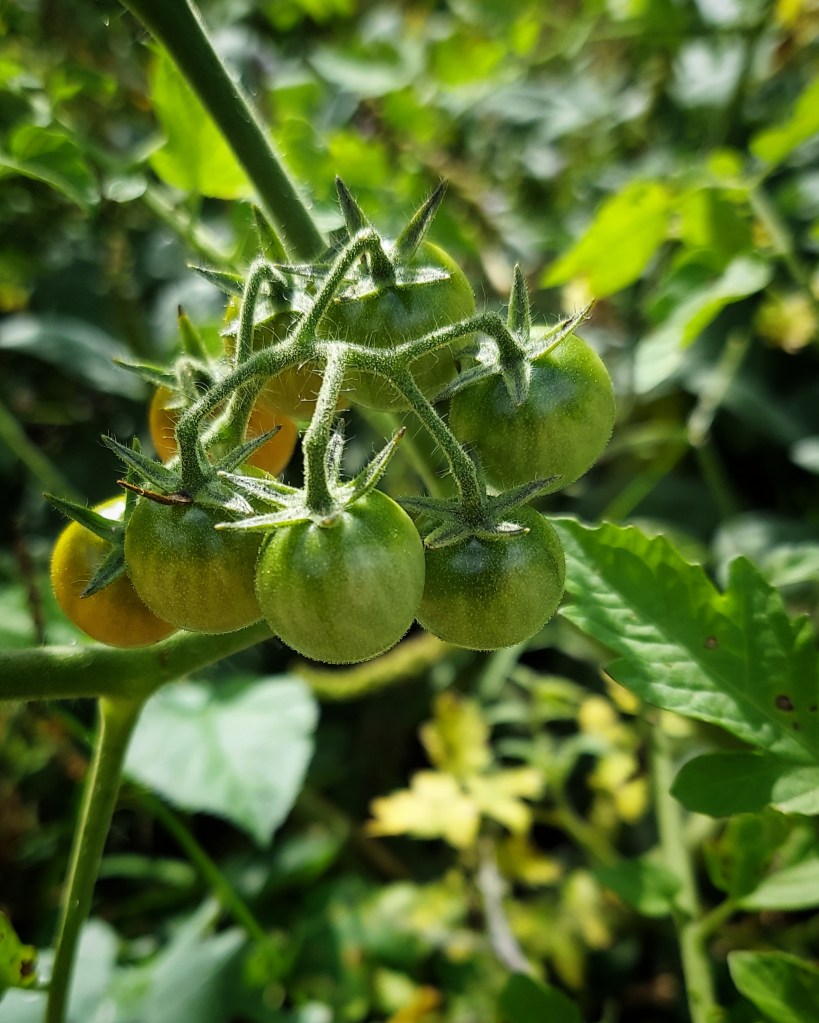
As for the potluck… I’ve mentioned all of the pumpkins in previous entries. (They’ve made for some amazing pumpkin bread.) There’re also sprigs of various kales popping up random places where they were certainly not planted, a thriving bush of bright orange cherry tomatoes, the aforementioned mulberry bushes, and what appears to be a chia plant.
Really, it seems like I don’t actually have to worry about planting fruits and vegetables myself. If I help make this place welcoming enough, tiny guests will show up and bring food. That food may not always show up where I anticipate it, but it flourishes, and I end up with more than enough to share.
The plants here have mostly gone to seed, so the pollinator garden is as full of birds as it is bees and butterflies. I have no idea what horticultural surprises next spring and summer may hold, but I’m excited to find out!
In case you missed the first part of our adventure, you can find it here!
We showed up promptly at 11:10 AM, still unsure of what we were getting into. Once we stepped out of the car, we were almost spoiled for choice — there was a small sculpture garden immediately in front of us, with some very lovely statuary.
Including a very modest David.
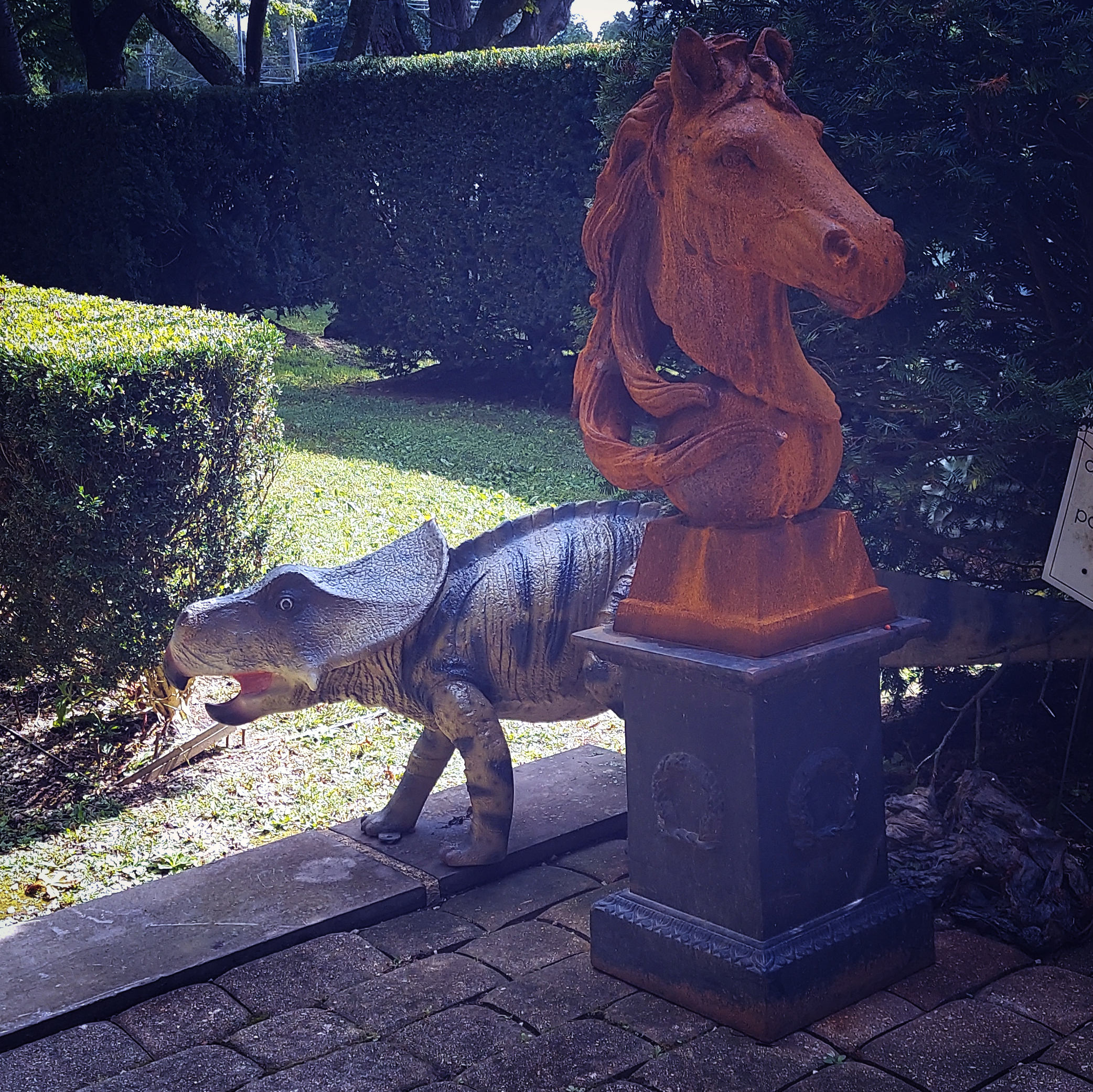
Signs directed us to the Dinosaur Park, which we eagerly followed. They led us past more statuary, into an area populated by large, brightly colored dinosaur statues. They were kept in their own pens made up of neatly trimmed hedges and garden fences, interspersed with large, bright mushrooms, a vintage carousel horse, and a spiraling labyrinth that ended in a gazebo at the center of it all.
Along the edges, the border between “Dinosaur Park” and “Sculpture Garden” got a bit blurry.
Outside of the Dinosaur Park, the grounds were immaculately kept and full of flowers. There were ponds covered in bright pink and white water lilies, and bushes spangled with flowers and butterflies.
Also snail royalty.A closer look at a similar sphinx throne in a different material. I’ll be honest, I kind of want one to put under the maple tree in the back.
Everywhere we walked seem to have something new to look at, to an almost disorienting degree. I know the outdoor area wasn’t that big, but we did manage to get turned around here and there.
There was even a large stand of bamboo guarded by a pair of stone Imperial lions.
What was most interesting, however, was the mix of materials. Some of the more whimsical statuary was made of cast concrete or gaily-painted fiberglass, but many of the larger pieces were carved stone. Take a close look at the pair of busts in the image below — all of the armor, clothing, et cetera is made of carefully fitted-together stone. None of it is painted. There were pieces in alabaster, marble, quartz, and granite, all of them uniquely beautiful.
Once we were done getting lost in labyrinths and jumpscared by the occasional clown statue, we headed inside. The bulk of the antique shop was in a large barn, about half of which was taken up by a workshop.
The first floor was a dinner party set for invisible guests. The walls were hung with heavy curtains in silk and velvet, punctuated with carved stone statues. These, like the busts above, wore outfits of carefully selected and fitted-together stone, cut and carved so their graceful limbs could show through.
Of to the side, there was a selection of brass candelabras, smaller sculptures, and stained glass.
In the center, there was a large, broad staircase. The top was dark — dark enough that I wondered if it was actually off-limits. There didn’t really seem to be anyone there other than us and a handful of employees… did anyone even know we were there?
Eventually, our curiosity got the better of us. We quietly crept up the stairs, though there were no lights and the temperature seemed to grow more oppressive with every step.
I was very glad we had.
The top floor of the barn was absolutely full of treasures. Carved four-poster beds hung with silk brocade. Velvet chaises. Oil paintings the size of my bedroom, framed in gold leafed baroque style. Panels upon panels of stained glass.
Everything in this picture is about two hundred years old and worth more money than I will ever see.
The only light came from a large window at the front. The sunlight streamed down through it onto a grand piano, illuminating dust motes that sparkled like glitter. There was also a pair of life-sized sculptures holding massive, branching lamps of brass and crystal.
This is probably my favorite picture I’ve ever taken of anything.
At one point, I think I saw the owner. He passed through the room swiftly, so I didn’t get a good look — just a glimpse of his back and a faint whiff of oakmoss and vetiver.
My Handsome Assistant attempted to track someone down, and did manage to talk to one of the employees for a bit. According to her, the Vampire and Paranormal Museum is in the process of reopening in one of the houses on the premises. The owner was very secretive about it, however — he was remodeling the whole interior, and hadn’t allowed even his closest friends to see it. It wouldn’t be open until later this year, most likely in October or November.
Even though we didn’t get to speak to the man himself, or see the actual museum, we were satisfied. To be honest, just browsing the antiques felt like looking at a clandestine immortal’s collection of stuff, so I left feeling like I’d been to a vampire museum anyhow.
When we went to leave, a peacock prevented me from getting in the car. It was both completely unexpected, yet entirely appropriate. I guess if you’re going to have a Dinosaur Park, you need one or two alive ones.
All told, 10/10 experience. Would sidequest again.
I’m not really big on the whole Manifestation thing, I’ll be honest. That aside, I have noticed that, when I’m starting to feel like life is a little same-y, the universe is extremely willing to help. And by “help,” I mean send me on some very strange field trips.
I wasn’t the only one who’d been feeling like life was getting routine. My Handsome Assistant works very hard, and very long hours. It’s not a physically laborious job, but it’s the kind of work that’s both mentally demanding and continues to be a whole Thing around the clock. He even has trouble taking time off, so he finally said that enough was enough, blocked off some PTO, and we scheduled a small vacation.
I suggested New Hope, PA, because it’s the kind of thing that we both find fun and relaxing: No itinerary, lots of art and history, lovely architecture, ghosts, nature, and tasty food. It’s immediately adjacent to Lambertville, NJ, too, which is ludicrously packed with antique shops and art galleries. We could wake up whenever, go wherever, and no matter where we decided to walk, there was pretty much guaranteed to be something neat to do, see, or eat.
The vacation part is a lovely and relaxing story for another time.
While Handsome Assistant was in the shower, I was sitting on the floor of the hotel, charging my phone and idly tapping through a map of the area to see what looked like a fun destination for the following day.
That’s when I saw it.
“VAMPA Vampire and Paranormal Museum.”
“Permanently Closed.”
I took a screenshot and sent it to him for shits and giggles. There’s always something darkly funny in simultaneously discovering something cool, and that it has ceased to exist.
He texted back. We laughed it off. I pointed out a neat antique shop we could look at, and my tiny disappointment was forgotten.
Little did I know that VAMPA had continued to live in his mind.
Unbeknownst to me, the antique shop that I’d wanted to go see was located in a very large building — large and filled enough to make Google Maps get a little complicated. Locations were hazy estimates, at best. I didn’t mind, though. Everything was in walking distance, and what was an extra block or two?
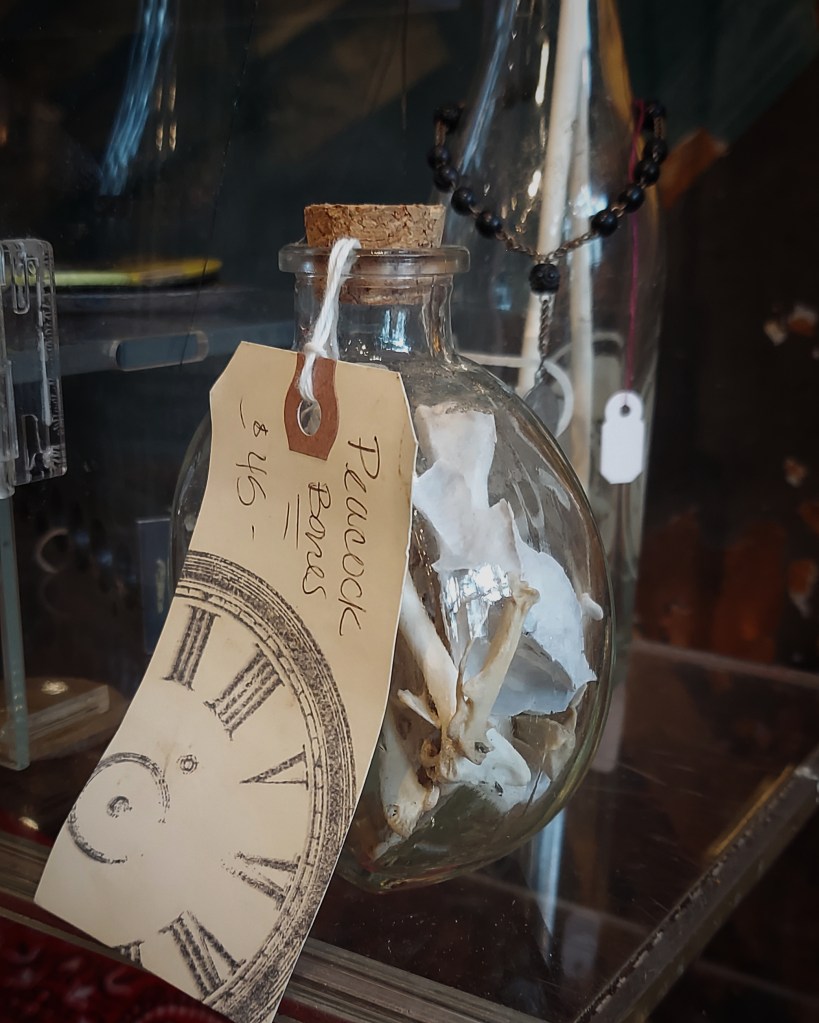
Inside was a veritable treasure house of weird. The air was filled with the vaguely vanilla scent of old books, naphthalene, leather, and straw. I looked through strings of antique snake vertebrae, preserved hornets’ nests, bottles of peacock bones, old containers of patent medicine (some still half-full of highly questionable powders and jellies), and hand-colored German anatomical prints. Handsome Assistant and I got separated at some point, but I wasn’t too worried.
The “shop” was less of a shop than it was a marketplace. Each floor had its own set of vendors, including one guy who’d collected a very varied and impressive selection of crystal specimens. There were lovely slices of amethyst geodes, palm stones of every description, fossil specimens, spheres of every color, and even a large piece of alabaster marked, “Great for sculptors!”
I came away with a polished freeform moss agate and a sunstone palm stone, while Handsome Assistant chose a small sphere of tiger’s and hawk’s eye. (The gold of the tiger’s eye and blue of the hawk’s eye swirl together like the atmosphere of some strange and distant planet, shifting in the light in a way that’s honestly kind of mesmerizing.)
As we left, he turned to me in excitement.
“So,” he began, both handsomely and assistantly, “The vampire museum used to be on the top floor of this place.”
“Really? Huh,” I replied, neither attractively nor helpfully.
“Apparently the guy who owned it closed the museum, sold some of his collection, and moved up the road. He has an antique shop with dinosaurs in the front. You know what that means.”
I did not know what that meant.
“It means,” he continued as we walked, “That there’s more of his collection that he didn’t sell yet.“
After that, there was lunch and ice cream sandwiches. We got patio seating immediately next to a graveyard. I had a long and interesting conversation about veganism with our server. We were attacked by wasps. The whole afternoon got kind of hazy after a certain point.
Anyway, this is how we found ourselves in the car in the late afternoon, on the hunt for a large estate full of Dinosauria. There was only one problem: We had literally nothing else to go on. No names, no street address, nothing.
“Just drive up the road. You’ll see the dinosaurs.” That was basically it.
I think we drove on for about forty-five minutes with no luck. There was a museum, but it was neither vampiric, paranormal, nor paleontological, and thus of little interest to us at that moment. (There was also a really neat mossy green house with black trim. That was mostly interesting because we have to replace our siding soon and house exteriors are the kind of thing we’ve found ourselves starting to care about, largely against our collective will.)
I don’t know what compelled us to take a different route. It was probably just a desire to find a more scenic road back to the hotel. But that was when we saw it.
A very weathered wood sign near the road, simply marked “ANTIQUES.”
And an allosaurus.
We pulled into the gravel driveway cautiously. (I’m not sure why, it just seemed correct.) The door was locked, its hours prominently posted.
“Wednesday, 11 AM.”
Handsome Assistant and I looked at each other. We knew now what we had to do.
Okay, so. There’s a new fruit quest. (If you have been reading here for a while, you might be familiar with the persimmon quest that I force my Handsome Assistant to accompany me on every year.)
A year ago, I tried my first muscadine. It was almost the size of a wild plum, the deep purple of a cloudless night sky, with firm flesh that tasted like a combination of grape jelly and extremely good wine. It was sweet and juicy, in perfect, balanced contrast to the firm, tart, slightly tannin-y skin. I could probably wax rhapsodic about muscadines and scuppernongs for way longer than anyone would be comfortable with.
Anyhow, I saw them pop up at the farmer’s market at about $13 a container and was sad to pass them up. Immediately after that, I saw them at Aldi for about $3.69. (Nice.)
Normally, I’d advocate for buying from farmer’s markets versus a supermarket whenever you’re able to. The thing about muscadines is that their range is very limited, so even the grocery store variety has traveled, at max, a few states away. They’re also seasonal, so they’ll disappear from the shelves as soon as their time is up.
This is why the other evening saw me leaving Aldi with arms full of containers of muscadines and scuppernongs (they’re the same species, but scuppernong is usually used for muscadine grapes that are kind of a light bronzy-green in color). I was also quietly singing a little song about how excited I was to have tasty grapes, and possibly skipping. (I am fortunate that my Handsome Assistant seems to find my goofball-ass qualities endearing.)
So, since it’s muscadine season, I figured I’d write a bit about grapes. Muscadines (Vitis rotundifolia) are strictly an American fruit, so they’re another plant you won’t find in old grimoires or European mythology, but that’s okay! They’re a kind of grape (Vitis species), and grapes in general have had a prominent place in myth and magic everywhere they appear.
Grape Magical Uses and Folklore
Grapes figure heavily in Greek and Roman legend. According to the Greeks, the first grapevine came from a satyr named Ampelos. He caught Dionysus’ eye, and the deity romantically pursued him… at least, until Ampelos mocked the Moon Goddess Selene and got himself gored by a bull. Heartbroken, Dionysus transformed Ampelos’ body into the first grapevine.
(According to Ovid, things panned out a bit differently. In this version, grapes already existed, Ampelos fell while picking them, died, and Dionysus transformed him into a constellation.)
In Christian mythology, grapes are associated with abundance. Moses sent spies into Canaan (the “promised land”), who then returned with a cluster of grapes so large, it required two people to lift it.
On the other hand, some scholars claim that the “forbidden fruit” of the Garden of Eden was also a grape, not an apple as it’s commonly portrayed. Other scholars claim it may even have been wheat, so who knows.
In the ogham alphabet, muin, is often said to be a grape vine. However, grapes aren’t native to Ireland (they showed up with the Romans), and tend not to grow well there anyhow. Grapes also don’t really appear in Celtic legends with significance. Etymologically, connecting muin to the word “vine” is also tricky. For this reason, you’ll find a lot of debate about the actual meaning of this fid, as well as what plant it was even meant to represent in the first place. (Probably originally thorny brambles, like blackberries, though this meaning may have shifted over time.)
Grapes and wine are also generally good offerings for a wide variety of spirits and deities.
Vines, in general, are associated with binding. This isn’t necessarily binding in a negative or protective sense — binding can also be used to hold a favorable situation to you.
Elementally, grapes are associated with Earth and Water. They’re also associated with the Moon.
Using Grapes
They’re… They’re grapes.
All kidding aside, grapes are possibly one of the easiest magical plants to use. Eat, brew, or cook with them while visualizing yourself as prosperous and happy.
If you have the space and ability to do it, plant a grape vine in your yard to bring abundance to your home. (This may work even better than intended. Birds love grapes as a source of both energy and water, and tend to excrete more seeds when they hang out to feed. This is how I ended up with free, thriving tomato and mulberry plants, and possibly even the pumpkin vine. Free food!)
Grape vines make fantastic bases for wreaths. I’d like to devote a longer post to making and empowering magical wreaths, but, in short, take a grapevine wreath, add whatever other magical dried plants or curios you like, and hang it where it’ll do the most good. A protective wreath on the front door, for example, one for prosperity in the kitchen, or one for passion or fertility in the bedroom.
Though it also isn’t one of their traditional meanings, I also associate grapes with protection. Dark grapes make red wine, the color of courage, strength, vitality, and protection. The leaves themselves are covered in trichomes, which are small, pointy, hairlike structures. Covering the floor around your bed with grape leaves is said to be a folk remedy to control and protect against crawling pests like bedbugs.
Whether you’re like me (and do a goofy little happy dance when you’ve gotten special grapes) or your feelings about the fruit are more ambivalent, grapes are worth considering for your magical practice. They’re sweet, tasty, easy to use, and pretty straightforward in their properties and associations.
I’ve spoken in the past about some of the issues that I’ve had with various types of meditation. I don’t really get on with a lot of mindfulness meditation, because anxiety and panic disorder make it so that I’m already detrimentally hyper-aware of my breathing and heartbeat. Being instructed to focus on my breathing is a bit like telling a drowning person to take a relaxing bath.
I was introduced to a different type of meditation through a course of Druid study that I’m working on. It’s discursive meditation, and it involves many of the same key ideas as mindfulness, with one big difference. You’re still training your mind to focus, let irrelevant thoughts pass by, and gently return from wandering. The difference is that you choose a subject for your meditation to focus on. Thoughts and ideas related to this subject are desirable, and you just return to the subject at hand if you find yourself going off on a tangent.
It’s a great way to really let yourself play in a space and do a deep dive into a specific subject. It’s included as part of these studies because so much of ancient Druidry is coded in oral traditions, which means that what the tiny bit that was actually recorded was often through a poetic, mnemonic lens designed to help Druid scholars remember all of the information they were expected to know. The idea is that so many of these ancient ideas require pondering to get their meanings, and discursive meditation is a way to achieve this.
It’s a bit like if the US ceased to exist, and the only historical record of it was that Animaniacs song about state capitals. It’s not a lot of information on the surface, but some deep dives could still give you something to work with.
Consider Bríatharogaim. These are two-word kennings designed to explain the meanings of the names of the letters of the ogham. Like saille, willow, is “pallor of a lifeless one.”
I could see it.
The thing is, brains are characteristically not good at staying on one subject. That’s why, like uncooperative puppies, they need to be led back now and then. Brains are not good at boredom., because boredom feels uncomfortable.
“Profound boredom” is actually an important component of creativity. Forcing oneself to sit with a single subject and exhaust all possible tangents related to it is how breakthroughs happen.
If you’re meditating for the purpose of going within and seeking inner wisdom, thisstate of profound boredom is the nug. It’s the fertile ground where the good stuff comes from. If you think of it in terms of seasons, profound boredom is the fallow period. It’s the late autumn to early spring when the leaves all fall, break down, and enrich the soil. Without profound boredom, your brain dirt gets all bad.
It doesn’t even require a lot of boredom. Thus far, in my experience, thirty minutes of discursive meditation is sufficiently boring to yield about two paintings, some prose, and a few lines of poetry. If I have a specific problem, I get solutions. Everyone should be more bored more often, because being bored on purpose rules.
The difference lies in the difference between the kind of boredom you get in, say, a waiting room, and the kind of boredom you experience when you focus on a single topic. A waiting room’s boredom isn’t helpful because it’s anxiety-provoking. There’s no opportunity to relax and give your mind room to be profoundly bored, because your name might get called at any minute. The freed-up brainspace isn’t focused on creativity, it’s focused on vigilance. Being bored in the comfort of your own home, on your own timetable, though? Chef’s kiss.
To go within is to seek out this fallow period that allows new things to spring forth. Inner wisdom lies in boredom.
It’s just this past Saturday, and my Handsome Assistant and I pull up to the Unitarian Universalist Church in Frederick, MD. The friendly young people attending the lot tell us there aren’t any parking spaces left. We’ll have to go to the lot a mile down the road, they direct us, and take the shuttle.
Personally, I’m shocked. It’s only a quarter past ten, how could the lot be full already?
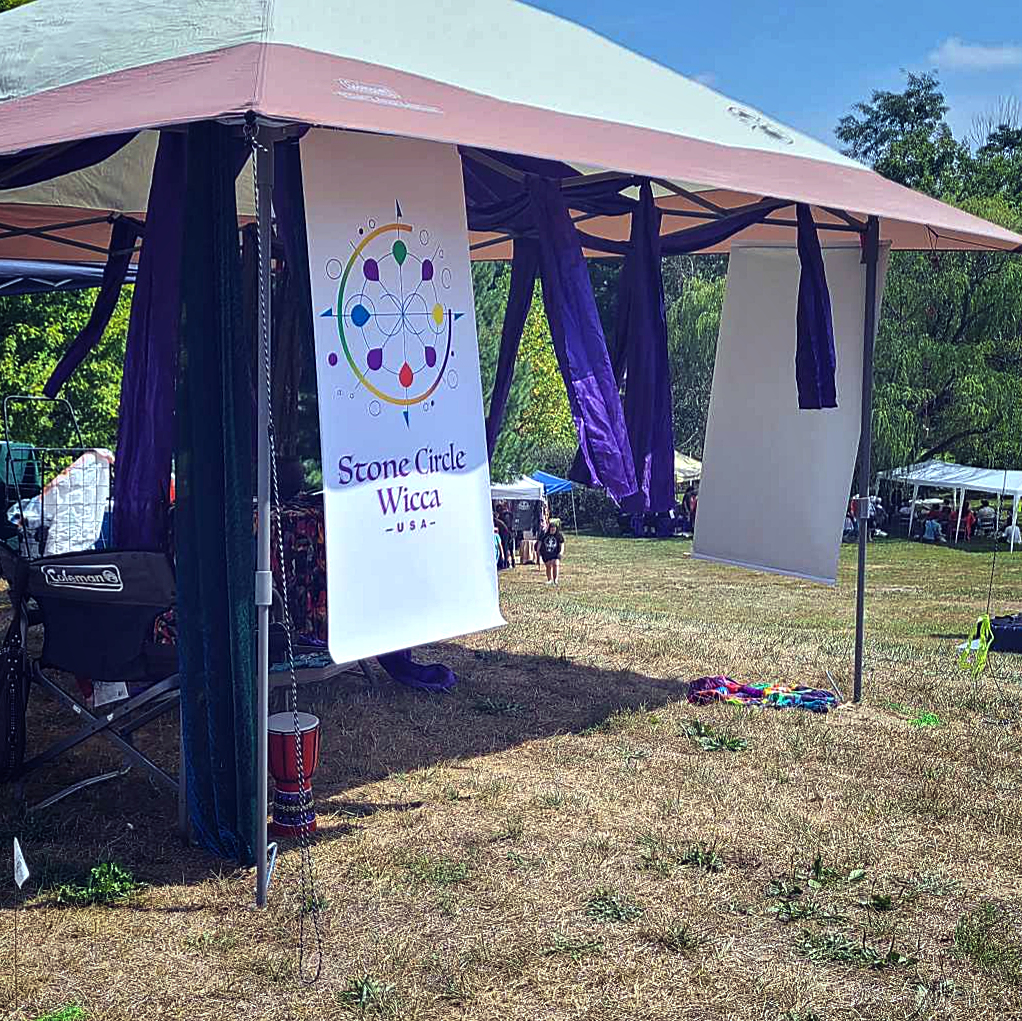
They weren’t kidding, though. Even the other lot was filling up, and the shuttle was almost completely full as we rode back. The grounds themselves were ringed with vendors, information booths, and more — there was Tempered Raven, who hand-forges beautiful blades There were so many booths of jewelry (I bought a beautiful quartz, azurite malachite, and copper necklace from Unclaimed Treasures). There were herbs, incenses, soaps, pottery, handmade brooms and whisks, woodcarvings, altar supplies, and amazing desserts. There was even free coffee, tea, and cold brew from the awesome people at Stone Circle Council (check them out — they do some very cool things).
I also picked up a handmade palette. It’s intended for watercolor, but I’d like to see how it does with casein. Casein paint dries out so fast and softens up with a bit of water, so working with it is a bit more like gouache than acrylic. I’m thinking a glazed surface will be perfect!
There were also loads of workshops and live music. It was busy, it was vibrant, it was great. I always regret not taking more pictures of the event itself, but I always feel a bit odd about snapping pics of people unaware. (Sure, there’s no expectation of privacy in public, but something being legal doesn’t preclude it from being a bit of a dick move, you know?)
The busyness was at once a wonderful sign, and an unfortunate one.
On the one hand, it’s great that events like this are attracting a bigger audience. Aside from vendors of beautiful crafts and delicious food, there are lots of tables for different Pagan, metaphysical, and mystical organizations. If you’re looking for a path to call to you, or people to network with, this is the place to find that thing. In an era where social media has allowed — even encouraged — the proliferation of misinformation that’s unhelpful at best and dangerous at worst (and don’t get me started on AI generated books), it’s really nice that there’s still a wonderful variety of actual organizations dedicated to study and practice.
On the other hand, a big part of the reason for this large audience is that two other Pagan Pride events — the one in DC, and one in Manassas, VA — effectively no longer exist. A friend pointed out that they’d even contacted the coordinators of the DC pride event and hadn’t heard anything back at all. As if the email address was going unchecked. I looked up information on Manassas everywhere I could, but it was pretty scarce. The last event seemed to be in 2019, and the 2022 event was cancelled. According to their Facebook, they weren’t able to hold one in 2023.
A lot of Pagan community organizers seem to be either getting burned out (with everything else going on right now, who can blame them? Add the often-thankless work of organizing to the struggles everyone else is dealing with right now, and it’s completely understandable) or just aging out of their roles. All of the organizations I know, even the ones I’m a part of, operate on budgets that would make a shoestring look luxurious by comparison.
It’s something I’d love to help with, but I’m not really sure where to start. I’ve often said that, if I were handed enough money to live off of for the rest of my life, I’d put it into a small house on a large piece of property. I’d rewild as much as I could and put it under a conservation easement. Some, I’d want to guide into operating as a permaculture food forest (I have tiny fantasies of adopting a rescue donkey or small pony, having them carry a basket, and walking around with them to pick fruits and vegetables). The rest, I’d want to make into an event space for musicians, dancers, and events like Pride. I have no heirs, so, when I died, I’d will it back to whatever Indigenous group formerly held it. In the meantime, I’d want it to be a place for community members to interact — flora, fauna, and human alike.
I mean, I feel like I’m basically describing a two-person commune, but I feel like you get the gist.
I suppose what I’m saying is that it’s a shame that the world has done us up all wretched, and I wish I knew how to take on some of the burden of organizing and setting up events like this with the resources that I already have. (A tiny yard, most of which is steeply uphill, an even tinier bank account, and massive social anxiety).
In the meantime, support your local Pagan organizations and artisans, yeah?
My house is not very large. Really, it’s the perfect size — with just my Handsome Assistant and I, there’s no need for tons of rooms. We were also fortunate that the previous owners really maximized the crap out of the space here. Everywhere that could be finished and turned into living space, has been.
Our attic is a loft with a skylight. Since the ceiling was low, it made sense to make it the room we’d spend the least amount of awake, moving around time in: the bedroom. Since there’s no paint trick or wallpaper in the world that will turn a loft with knee walls into a spacious, cathedral-ceilinged abode, I leaned into the tiny, cozy vibes hard.
Small lanterns with warm lights cast shadows like candle flames. I took the janky, stuck doors off of the built-in storage and replaced them with a curtain rod and soft, light-colored curtains. The bed area itself is separated from the rest of the room by several deliberately mismatched, vintage lace curtains in shades of cream and off-white. The floor is covered in layers of rugs in a variety of textures, to give it more depth and interest. The bed is dressed in satiny black and ivory sheets and a silk-stuffed comforter. It feels almost like glamping, or like a very luxurious treehouse. Like a small, exceedingly comfy nest tucked away at the top of the house.
(We’re having a replacement window put in. Soon as that’s done, I’m definitely posting some pictures!)
Lately, I’ve been treating it more like a sanctuary than purely a sleeping space. I like to go there around sunset, because the small window beside the bed has a very nice view of the west. I light incense, I take out my tarot cards, Lenormand deck, runes, or ogham staves. I put on some Faun or The Moon & The Nightspirit. I soak up the atmosphere, do some divination. It’s really nice.
There’s a limit to how much divination I can usefully do for myself, friends, and family, though. So, to take advantage of the very late summer and early autumn vibes and give me a bit more to do, I’ve put all of the divination in my Etsy shop on sale at twenty percent off. If you see something that calls to you, I’d be happy to make space for your questions.
















 Marble Crow