life · Plants and Herbs · Witchcraft

Relieving Pain by Means Magical and Mundane

Hello! The inside of my face has been replaced with centipedes.

… Okay, fine, but that’s what it feels like.

Friday, I had a minor surgery (which, depending on how things go, may end up being the first of several. Sigh). This would not be a deal for most people, let alone a big deal, but things get complicated afterward when you have a very limited list of pain relievers that you can safely use. So, I figured I’d write this handy-dandy guide for other people in this position.

Why might someone have trouble getting pain relief? A lot of reasons. Some people avoid them because of a personal or family history of addiction. Some medical conditions, like breathing problems, preclude the use of specific types of pain killers. Some medications don’t combine well with them, either. In my case, too many pain meds manage to raise cerebrospinal fluid pressure, have a reduced effect when combined with an SSRI, and increase the risk of serotonin syndrome. This underlines the importance of disclosing everything to your doctors — your past and current medical conditions, every medication you’re taking, the whole lot. They’re not there to judge you, they’re just there to make sure you don’t die.

Anyhow, there are herbal, mineral, and magical means of coping with physical pain when everything else is contraindicated. These shouldn’t take the place of appropriate pharmaceutical pain management when that’s a) available and b) necessary, but can definitely help take the edge off when that isn’t an option. As with any herbs, don’t use them if you’re allergic to other plants in the same family, or if you’re on other medications that might interact with them. A lot of plants that relieve pain are also relaxants, so be mindful that they may make you drowsy or slower than normal. If you have an upcoming surgery, ask your doctor if these herbs are safe to use in the days running up to your operation.

Ah, chamomile. My number one solution to so many of life’s problems. It’s relaxing, it helps me sleep, and it’s surprisingly good at helping with pain.

Here, we’re talking about both German (Matricaria chamomilla, also known as M. recutita) and Roman chamomile (Chamaemelum nobile). One study found that a topical gel of 3% chamomile extract helped with pain from oral mucositis induced by chemotherapy. A clinical trial quoted in this same study showed that chamomile, when inhaled, reduced cesarian pain. Other quoted trials demonstrated a very helpful anti-inflammatory effect, as well.

Chamomile flowers floating in a cup of tea.

When I need chamomile to do more than help me relax, I prefer to use a tincture. It seems to work faster and provide more relief than tea alone (though a nice cup of iced, double-strength chamomile tea certainly has its place). A few drops of chamomile tincture are also great at soothing toothaches and mouth sores.

Chamomile essential oil is also helpful in an aromatherapeutic context (the way it was used in the cesarian surgery pain trial), but isn’t absorbed all that great. Topical applications of chamomile oil were much more effective when they were blended in a nanogel to aid absorption.

Lemon balm, Melissa officinalis, is best known as a relaxant and digestive herb. Some people use it for pain relief, but structured research is limited in this area. Still, if you’ve experienced pain that has kept you up at night, you probably know the value of something that can help you get to sleep.

Lemon balm, like chamomile, is also anti-inflammatory.

As a word of caution, lemon balm can be powerful. I don’t really get sleepy from chamomile, but a cup of lemon balm tea can knock me out. Be cautious when using it with other herbs or medicines, and don’t use it when you need to be alert.

Turmeric is an anti-inflammatory herb that I initially started using for joint pain. Combining it with black pepper, specifically the compound piperine, helps to make turmeric more effective. Piperine isn’t very soluble in water, though, so preparations made with isolated piperine usually involve extraction using solvents like dichloromethane.

Personally, I use turmeric and ginger tea all of the time. I feel a difference when I don’t. (If I’m having a rougher day than usual, it’s often because I’ve been skipping my tea by accident.) These plants are actually related, and they have some overlap in their medicinal effects.

A wooden spoon and glass jar of turmeric powder.

Turmeric and ginger are the kind of herbs that are better for chronic pain, not acute pain. Think of it like this: If you deal with joint pain on the regular, turmeric and ginger may be a big help. If you currently have a headache, you’re better off reaching for something else.

Got a toothache? Clove oil (Syzygium aromaticum) is your buddy… at least, if you’re an adult.

A drop or two of this stuff, diluted in a carrier oil, placed on a cotton bud, and swabbed on the affected tooth, can help halt tooth pain in its tracks with amazing efficiency. It’s effective for making cavities and broken teeth less agonizing until you can get to a dentist. One of the compounds in clove oil, eugenol, is even used to help manage the pain from alveolar osteitis (dry socket).

As a note of caution, clove oil is potent medicine. Use it straight, and it can burn the absolute tits out of your mouth. It can also be toxic in large doses. For children, a “large dose” is not a whole lot, so it should never be used to sooth teething babies. Clove oil can also be bad for people with liver disorders, unstable blood sugar, or who are taking anticoagulants. While a drop or two isn’t going to harm a healthy adult when used properly, it’s worth knowing this stuff and treating cloves with respect.

It’s also important to use real clove oil. Make sure the bottle says that it’s 100% essential oil from the appropriate species of tree. (Don’t worry about qualifiers like “therapeutic grade” — there are no regulatory bodies that determine this, it’s just a marketing term). Avoid products labeled “fragrance oil.”

No clove oil? Mash a little ground clove spice with warm water and apply the paste instead.

If you have a toothache and clove oil isn’t an option, biting down on a piece of raw garlic can help. Chew it until it’s soft, and let it sit on the affected tooth. If you don’t want to chew on raw garlic, mush it into a paste with a spoon or mortar and pestle, or grate it first. The important thing is to let it sit on the aching tooth.

From my experience, garlic doesn’t relieve tooth pain quite as effectively as clove oil, but it can be safer for some people. If you’re really struggling, you’re about at your limit with swabbing clove oil in your mouth, and you don’t have any chamomile tincture, garlic is definitely a solid runner up.

This is all purely anecdotal, but I’d feel remiss not to include it. I have a satin spar wand — nothing fancy, just an unpolished, rectangular hunk of gypsum — which has come in handy time and time again for pain related to intracranial hypertension. As it turns out, a number of pain relievers are associated with increased cerebrospinal fluid pressure, so there’s often not much you can do to deal with the crushing pain.

I get it the worst right at the base of my skull, as do a lot of people. I’ve found that lightly pressing a piece of satin spar to that spot really helps. Oddly enough, other massage wands don’t. Neither do other crystals. Honestly, even ice packs are a bit hit-or-miss.

Should you throw out all of your NSAIDs and stock up on satin spar? No, I don’t think so. But satin spar wands are common enough that, if you’re reading this, it’s likely that you already have one. If so, it may be worth giving a shot. It certainly has been for me!

I have a lovely bit of chlorite quartz that came from Ireland. It’s very clear, save for a bloom of deep green in its heart– like a cluster of fluffy moss.

A lot of guides attribute healing properties to chlorite quartz, but these are pretty vague. “Healing.” “Emotional healing.” “Detoxification.” Interestingly, I haven’t seen it used for relieving pain, though I have seen more than one site make the wildly irresponsible claim that it’s good against serious, potentially lethal health conditions like cancer and heart disease.

I discovered by accident that the particular specimen I mentioned is helpful for headaches. Holding it in my dominant hand has stopped one in its tracks on multiple occasions, to my delighted surprise. As someone who has headaches of varying severity on a daily basis, anything that can put the brakes on one is nothing short of miraculous.

One old remedy for tension headaches involves taking a knife (preferably one with a broad, pointed blade, like a chef’s knife) and holding it against the head. The user is then instructed to take the knife outdoors and stab it into the ground, while declaring that the headache is now sent into the dirt for the Earth to deal with. Even if you don’t necessarily believe in the power of sympathetic magic, the coolness of a piece of metal can help ease a mild headache, and the psychological benefits of this exercise shouldn’t be overlooked.

Other remedies involve transferring illness to objects like candles, then burning them. These are just as valid, but take a bit too long for my taste. If I’m having too much pain to sleep, the last thing I want to do is babysit a burning candle for several hours!

Pretty much everyone knows about using ice and heat to help relieve inflammation and pain, but setting up the right temperature gradient can turn that relief up to eleven.

When it comes to headaches, warming your feet while cooling your head can be a huge help. This helps increase blood flow to your lower extremities, while narrowing vessels in your head. If you have the kind of throbbing headaches that are triggered or made worse by heat, this can really improve things by a surprising amount. A warm footbath and an ice pack on the back of my neck can be an absolute lifesaver sometimes.

It’s really not uncommon for people to end up in a situation where their pain relief options are limited. This list isn’t to suggest that herbs and crystals can substitute for, say, a morphine drip for a terminally ill person, but to hopefully offer some ideas for people who, like me, don’t really have safe, effective options available.
life · Neodruidry · Witchcraft

Mabon 2023 (Or, “And then we accidentally gatecrashed a youth group.”)

I hope everyone had a good autumnal equinox, as rainy and chilly as it may have been!

Friday saw my Handsome Assistant and I hurriedly packing — he’d had to work and wasn’t able to get time off, and I’d spent most of Thursday processing fruits and vegetables and baking things. So, we pretty much grabbed whatever seemed like it’d come in handy for camping, shoved it in the car, and zoomed off.

A few hours later, we were driving down winding roads through the forest during golden hour, looking at the Shenandoah Mountains bathed in that soft orange light and listening to the wind through the trees. I couldn’t help myself — I turned on The Hu, and I turned it up.

We pulled into the campground moments later, windows down and music blaring, and hopped out to use the bathroom before going to find our group. There was a handful of people standing by one of the cabins in the distance, so we cheerfully strode up to them to discover that they were actually complete strangers. Baffled strangers. Slightly disturbed strangers.

“Um. Is this the MeetUp group…?” I asked.

“… No. This is a Lutheran Youth Group.”

“… Oh. Sorry. Mybadgottagobye!”

A few more moments and a short drive later, we found our actual campground.

After this minor slipup, the rest of the weekend passed with feasting (so much feasting), singing, chanting, poems, stories, a bonfire, divination, and rain (so much rain).

We stayed in a cabin affectionately called the Murder Cabin. Oddly enough, this was called the Murder Cabin before I discovered that one of the bunks had what appeared to be a bloodstain (it was not. We discovered this after a friend realized it looked too shiny to be blood and tentatively touched it. It was still wet and slightly oily, and we both jumped back shouting, “Oh God! Oh no! Oh God! Oh God!” One of our other friends woke up in the middle of the night to discover that he was sharing his bunk with a family of fieldmice, and I feel like fieldmice are too cute to just hang out in a Murder Cabin.)

I’d stayed in a cabin just like this as a kid, when I went to summer camp one year. I knew that they fit a twelve-year-old reasonably well but wasn’t entirely sure how well they’d fit one jacked, full grown human man and a smaller, more gremlin-style human at the same time. We’d brought our tent but forgot a second sleeping bag and the air mattress. As a result, we both crammed into a single sleeping bag, in a single bunk, and he ended up with his butt out the window and the beginnings of hypothermia. (I, however, felt fine and toasty where I was, nestled in the sleeping bag with him as a draft blocker.)

I always feel energized by being in the woods with friends. At events like this, I honestly rarely sleep. The first WickerMan I went to, I stayed up for three days then went home and absolutely crashed for a day and a half. This was no different — Handsome Assistant and I stayed up until about threeish every evening, only going back to the cabin once everyone else was ready to go back to theirs, too. (The first night, we accidentally dropped his heavy leather coat from the top bunk and startled one of our bunkmates awake, but they were very good-natured about it.)

I didn’t drink, which was probably good. I’m the kind of drunk who immediately starts complimenting strangers, telling people I love them, and becoming Eternal Best Friends with people whose names I may or may not actually remember in the morning. Also, I get terrible hangovers.
I did, however, enjoy some herbal medicine and enough sugar to send a hummingbird into a diabetic coma. (These things are probably connected.)

The Mabon ritual was beautiful. It was originally planned for outdoors, but there was a ton of rain and a big drop in temperature, so we moved it into a pavilion instead. We sang and chanted, taking turns going to a meditation tent for some solitary reflection and relaxation. When we each returned, we took a small wooden lantern as a reminder of the light that we’d each carry within us through the dark months.

Afterward, there was a feast. I’d brought pumpkin bread, strawberry scones, a vegan quiche, and vegan queso and chips, but the only things that had survived the previous day were the scones, so I put them out alongside the other dishes. Handsome Assistant grilled venison and bison burgers and brought homemade blackberry mead, someone had made a gorgeous salad with pecans, apples, greens, and pomegranate, there were black and white cookies (perfect for the equinox), breads, cheeses, fruits, salads, and just so much beautiful food.

One of the completely unironically fun things about this gathering was that it was two separate groups. On one hand, there were the Druids. On the other, there were the pan-Pagans, with more of a Witchy vibe. It was just neat seeing the similarities and differences in cultures and practices. Kind of a “fancy” versus “feral” groove, in the best way. As someone who has identified with both Druids and Witches at various points, I can see why I ended up on the path of Druidry.

After the ritual, the rain stopped for a bit. A friend built a fire, and those of us who didn’t go to bed early went out to stand around it, tell jokes and stories, and get warm and dry again. (An awning had dumped what felt like a cup of water down the back of my neck, so I was turning like a person-shaped pile of döner kebab to make sure I got evenly dry and toasty.)

This same friend remarked that he was sad that the weekend was almost over. I agreed. Even though it’d been cold and rainy, the laughing, the camaraderie, and the connection was just so awesome. I pointed out that, while it was almost over, it was also a day closer to next year’s.

And that’s what it’s about, right? Recognize the turning of the year. We’re heading into the cold days, but that just means that there’s an entire spring and summer ahead in the future. Just like I came home and crashed for seventeen (!) hours straight, I’ll have a restful winter and be ready to run amok again.

life · Neodruidry · Witchcraft

Frederick Pagan Pride 2023

It’s just this past Saturday, and my Handsome Assistant and I pull up to the Unitarian Universalist Church in Frederick, MD. The friendly young people attending the lot tell us there aren’t any parking spaces left. We’ll have to go to the lot a mile down the road, they direct us, and take the shuttle.

Personally, I’m shocked. It’s only a quarter past ten, how could the lot be full already?

A rustic pendant made of copper, quartz crystall, and azurite malachite on a copper chain.

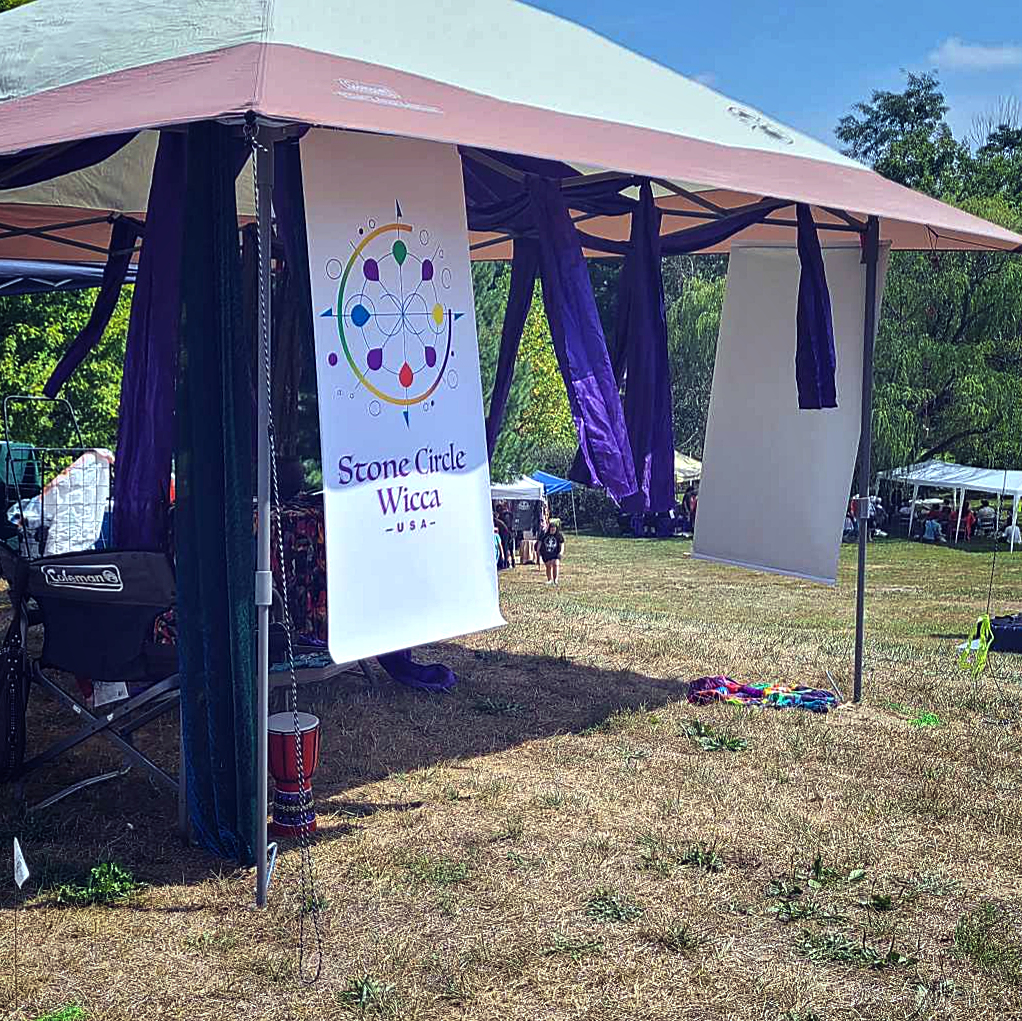
They weren’t kidding, though. Even the other lot was filling up, and the shuttle was almost completely full as we rode back. The grounds themselves were ringed with vendors, information booths, and more — there was Tempered Raven, who hand-forges beautiful blades There were so many booths of jewelry (I bought a beautiful quartz, azurite malachite, and copper necklace from Unclaimed Treasures). There were herbs, incenses, soaps, pottery, handmade brooms and whisks, woodcarvings, altar supplies, and amazing desserts. There was even free coffee, tea, and cold brew from the awesome people at Stone Circle Council (check them out — they do some very cool things).

A handmade ceramic watercolor palette with eight wells.
I also picked up a handmade palette. It’s intended for watercolor, but I’d like to see how it does with casein. Casein paint dries out so fast and softens up with a bit of water, so working with it is a bit more like gouache than acrylic. I’m thinking a glazed surface will be perfect!

There were also loads of workshops and live music. It was busy, it was vibrant, it was great. I always regret not taking more pictures of the event itself, but I always feel a bit odd about snapping pics of people unaware. (Sure, there’s no expectation of privacy in public, but something being legal doesn’t preclude it from being a bit of a dick move, you know?)

The busyness was at once a wonderful sign, and an unfortunate one.

On the one hand, it’s great that events like this are attracting a bigger audience. Aside from vendors of beautiful crafts and delicious food, there are lots of tables for different Pagan, metaphysical, and mystical organizations. If you’re looking for a path to call to you, or people to network with, this is the place to find that thing. In an era where social media has allowed — even encouraged — the proliferation of misinformation that’s unhelpful at best and dangerous at worst (and don’t get me started on AI generated books), it’s really nice that there’s still a wonderful variety of actual organizations dedicated to study and practice.

Last year, I got a little emotional about how events like Pagan Pride make me feel about community, aging, and tradition. It’s a feeling I hope everyone gets to experience at least once.

On the other hand, a big part of the reason for this large audience is that two other Pagan Pride events — the one in DC, and one in Manassas, VA — effectively no longer exist. A friend pointed out that they’d even contacted the coordinators of the DC pride event and hadn’t heard anything back at all. As if the email address was going unchecked. I looked up information on Manassas everywhere I could, but it was pretty scarce. The last event seemed to be in 2019, and the 2022 event was cancelled. According to their Facebook, they weren’t able to hold one in 2023.

A lot of Pagan community organizers seem to be either getting burned out (with everything else going on right now, who can blame them? Add the often-thankless work of organizing to the struggles everyone else is dealing with right now, and it’s completely understandable) or just aging out of their roles. All of the organizations I know, even the ones I’m a part of, operate on budgets that would make a shoestring look luxurious by comparison.

It’s something I’d love to help with, but I’m not really sure where to start. I’ve often said that, if I were handed enough money to live off of for the rest of my life, I’d put it into a small house on a large piece of property. I’d rewild as much as I could and put it under a conservation easement. Some, I’d want to guide into operating as a permaculture food forest (I have tiny fantasies of adopting a rescue donkey or small pony, having them carry a basket, and walking around with them to pick fruits and vegetables). The rest, I’d want to make into an event space for musicians, dancers, and events like Pride. I have no heirs, so, when I died, I’d will it back to whatever Indigenous group formerly held it. In the meantime, I’d want it to be a place for community members to interact — flora, fauna, and human alike.

I mean, I feel like I’m basically describing a two-person commune, but I feel like you get the gist.

I suppose what I’m saying is that it’s a shame that the world has done us up all wretched, and I wish I knew how to take on some of the burden of organizing and setting up events like this with the resources that I already have. (A tiny yard, most of which is steeply uphill, an even tinier bank account, and massive social anxiety).

In the meantime, support your local Pagan organizations and artisans, yeah?

Witchcraft

Let the new moon wipe it away.

I’ve been taking inventory. Thinking of stuff I want to change (well, mostly get rid of) with next week’s new moon.

I have times where I feel like I’m wearing memories like a lead apron. Protective in some ways, perhaps, but ultimately smothering, uncomfortable, and heavy. We don’t yet have ways to erase them, à la Eternal Sunshine of the Spotless Mind, but man do I wish we did.

Sometimes, it almost feels like physically they have hooks in me. Nasty, twisting wires that seem to pull on my limbs, as if some invisible hand were trying to turn me into a marionette. It’s times like this that I can really see the tremendous value in cord cutting.

To that end, here’s a simple ritual for cutting unwanted connections and starting this moon cycle with a clean slate. I’ve written in the past about cord cutting to sever toxic familial ties, but this is a much more general practice that serves just as well as a kind of energy cleanse.

  • A dull knife or knife-shaped object. I have a bone ceremonial knife, but a butter knife, rubber knife, or even a knife shape cut from cardboard will work. The important thing is that it does not have a sharp or serrated edge.
  • A candle. I typically use unaltered beeswax candles (hey, if it’s good enough for the bees, it’s good enough for me), but you can choose whatever wax or color feels correct to you. I’d suggest white (as a neutral color), black (as a neutralizing color), or red (as a strengthening color), myself.

That’s it!

Like I said, this is a very simple ritual.

Take a moment to take an inventory of yourself. Feel your physical body. If you can’t relax, that’s okay. Feel where tension, pressure, or “stuck” feelings seem to reside. Feel where you store stress.

Now consider your energetic body or aura. Feel out any inconsistencies. Are there any energetic cords or tethers?

Take the representation of the knife. Hold it an inch or so above your skin, parallel. Pass it over your entire body, as if you were shaving your aura. Picture this knife paring away whatever unwanted connections you may have.

As you do this, tell these connections goodbye. Affirm that your dealings with them are complete — they are severed from you and you are no longer connected. Continue this until you feel like you’ve removed all of the unwanted energies or tethers that you can.

A burning beeswax candle on a dark background.

Next, wipe the knife on the candle. Whatever energetic residue remains, just wipe it off on the wax. If the candle is in glass, wipe the knife off over the wick portion. Dust your hands off over it, too, for good measure. Anything that’s left that you don’t want, send it into the wax and wick.

Now, light the candle. Picture that energetic residue burning up like dust. There is nothing more for you to worry about, nothing more for you to do. The connections are cut, the slate is clean. You are free.

Allow the candle to burn completely if you wish, or snuff it. When you discard it, you can do so far from your home if you wish. It doesn’t require any special ceremony, as its job is finished — it has burned away the remains of the energy and connections that you don’t want. The less acknowledgement you give these things, the better.

If you use a cardboard representation of a knife, you can even burn that and scatter the ashes, too. Otherwise, just clean and cleanse your knife very well.

If you have any shielding or restorative meditative practices, now is a good time to do them. Removing these unwanted connections frees up energetic space, and it’s a good idea to either protect that space or have something good in mind to fill it up with.

Here’s hoping for a happy, refreshed moon cycle for everyone!

divination · Witchcraft

The Whole Show — Combining Divination Methods

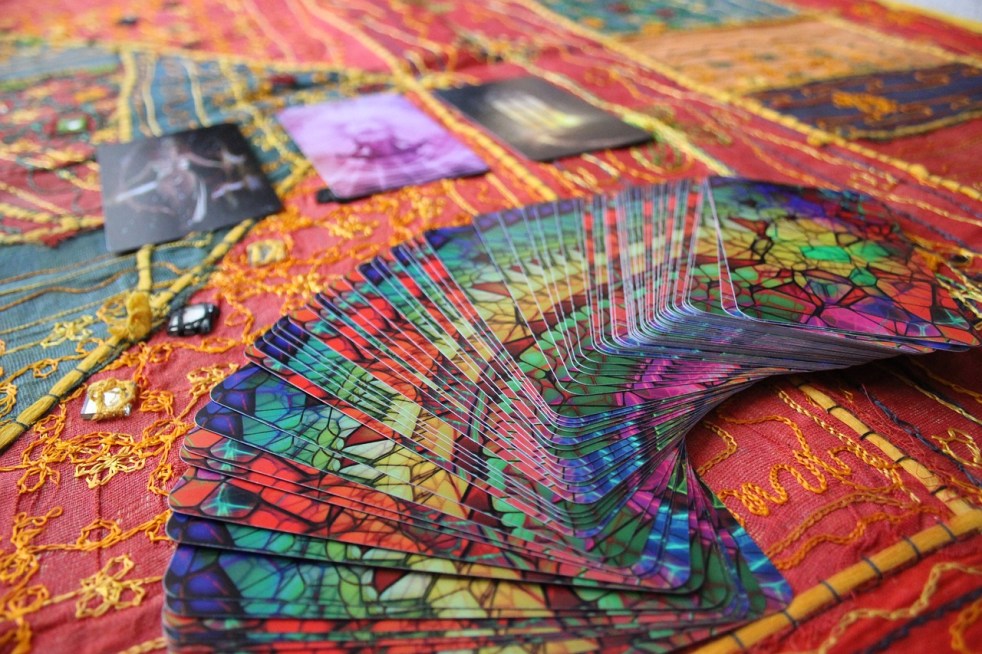
I love divination. Back when I’d just started learning, I knew that divination — more than any other magical skill — was something I wanted to become good at. I have different tarot decks that I use for different purposes, oracle decks, Lenormand cards, a set of ogham staves, a set of runes, a scrying bowl, and multiple stones that I use for crystal scrying. There’s just one problem: What do I use?

I used to get tripped by that a lot. Which method was going to be easier? Which was going to be more explicit? Which would be more accurate?

A set of carved wooden runes.

Why not use them all?

At first, I hesitated. Admittedly, some part of me was afraid that reading multiple divination methods would give me answers that were confusing at best, and contradictory at worst. It seemed like an easy way to end up concluding that divination wasn’t telling me anything useful to begin with.

Nonetheless, I pushed on. It had to be worth a try, right? In retrospect, I’m very glad I did.

When I have a very pressing question, I do a lot. I cast a rune and an ogham stave. I read a tarot spread of my own devising. I draw an oracle card. I scry in a stone or bowl. I go outside and see what the birds’re doing and what the trees have to tell me. I drop into a trance and see what bubbles up to the surface.

And every time, it paints a very clear, coherent picture.

Tarot cards on a purple velvet cloth.

Each method has its own use case and emphasis, so how do you put all of that together?

The trickiest part is viewing each method in their own cultural context. Many guides to runes and ogham, for example, have simplified the meanings to the point where they’re very far removed from their original* interpretation.

(* Or allegedly original. There are large gaps in our historic knowledge of how some divination methods were used, which adds to the confusion. One example of this is the ogham forfeda. Is Mor the beech, Scots pine, or the sea?)

The lack of consensus means that it’s not really doable to just jump into multiple different divination methods and combine them immediately. It’s important to work with each one separately, to learn its limitations and develop a kind of personal interpretation of its meaning. This doesn’t mean that you have to reinvent the wheel by discarding all of their conventional interpretations, but I highly recommend keeping a divination record that allows you to look back and see how each reading turned out. This can show you what cards, runes, symbols, and so forth tend to show up for you, and when.

After that, the only question is what order to put everything in. Personally, I enjoy laying out the tarot spread first, then ogham, then runes, and finally an oracle card. Once I have this story before me, I consult nature and, if need be, scry or enter a trance.

Putting the results together is honestly the easiest part. Here’s how things shake out for me:

  • Tarot tends to show me the “why” of a situation — what feelings, mindsets, energies, and hidden facors are bringing something about.
  • If I use Lenormand, it tells me the “what.” While it might seem like that would be extremely useful, I usually skip Lenormand reading. Believe it or not, knowing what happens is usually a lot less important than knowing all of the other stuff. Think of it like being told the future by a genie who’s a bit of a prick — knowing what isn’t as helpful as knowing why, how you’ll feel about it, and what you need to do to.
  • Runes usually highlight the most important connecting concepts that unify the whole for me.
  • Ogham usually tells me what to do or focus on.
  • Oracle cards generally offer reassurance, or a way to look at the bright side and get through a difficult situation.
  • Nature augury tells me if a situation is generally positive or negative. If something very unusual appears to me, it can give more specific information akin to ogham reading.

If this sounds like a lot of work, it certainly can be! It’s also very rewarding, and even a bit thrilling to see everything come together.

If this interests you, but you don’t want to perform it yourself, that’s totally understandable. This is one of several readings I can do for you, if you like. Just check out my shop!

Plants and Herbs · Witchcraft

Yarrow Folklore and Magical Properties

You know, I never really connected with yarrow. I know it’s kind of a magical herb staple, but I was always more into mugwort and its ilk. For some reason, yarrow just didn’t quite grab me the way that certain other herbs did.

All of that aside, I have lots of it now. When I embarked on my crusade to murder the grass and replace it with useful things (my rules are that they must either feed me or the local fauna, and preferably both), yarrow was a natural fit. It’s a lovely plant that gets tall enough to fill the space in my flower beds, and it’s very aromatic. Working with it in a gardening capacity has given me a new appreciation for it as a magical and medicinal herb, and the bees really seem to enjoy it.

Yarrow Folklore and Magical Uses

Yarrow is one of the oldest medicinal herbs. Like, pre-pre-history old. Archaeologists have identified yarrow among the belongings of a 65,000 year old Neanderthal.

Achillea specimens are found pretty much everywhere, with the exception of Africa and Antarctica. There are Achillea millefolium subspecies found in Europe, Asia, the Arctic, the Himalayas, the Alps, the Carpathians, the western US, Alaska, the US in general, and one particular that’s endemic solely to California. It’s probably not surprising that it’s often considered an aggressive weed, and may be best confined to areas that you either don’t mind having it take over, or allow you to control its spread.

Interestingly, all of these subspecies seem to have different medicinal effects. There’s some overlap, of course, but each subspecies appears to have different ratios of medicinal compounds.

The genus Achillea is named for the Greek hero Achilles. Chiron taught him the plant’s medicinal properties (specifically using it to treat wounds — hence its other common name, woundwort) and carried it into battle. It’s anti-inflammatory and antibacterial, so it’s a good plant to reach for to treat minor cuts, scrapes, and bruises.

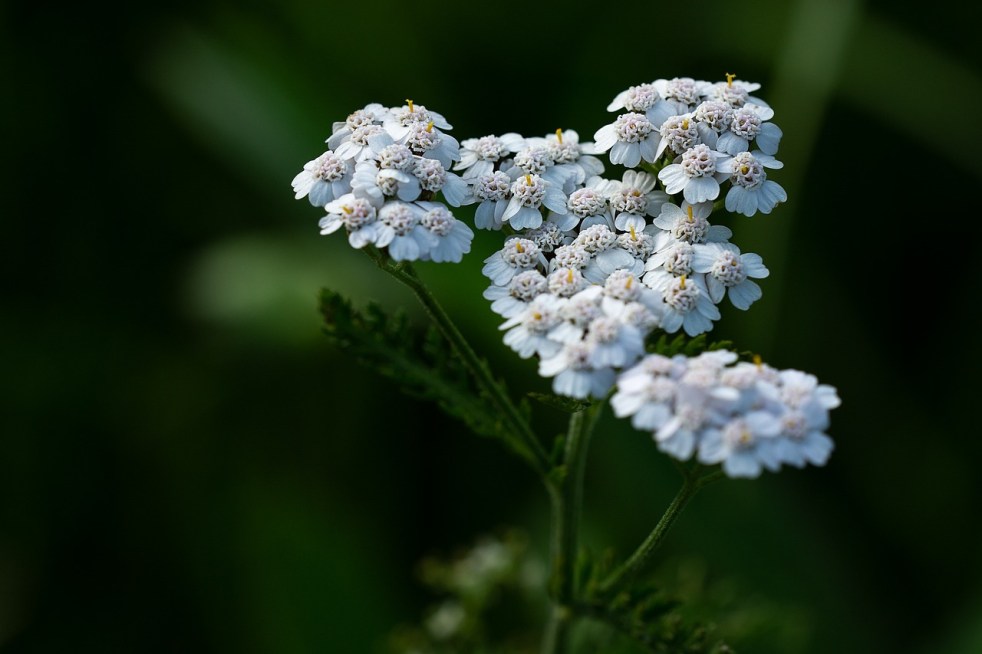
White, yellow, and pink yarrow flowers in a green field at sunset.
Chiron was half-man, half-horse, and a great healer. That makes him the Centaur for Disease Control.

This connection with battle may be why yarrow is also used as an herb for courage.

Yarrow is a protective and purifying herb. Like many herbs used to cleanse and protect, this action is borne out by its ability to repel pests. Experiments with birds using yarrow as a nest lining found that it inhibits the growth of parasites. The connection between repelling pests and magical protection is seen pretty often, as with pennyroyal, or fennel, for example.

In Europe, scattering yarrow across the threshold of a home was believed to keep evil from entering.

Yarrow is historically a divination herb. In China, one way to cast the I Ching involved counting stalks of yarrow. In Europe, it was used for love divination. You’d take a yarrow leaf and stick it up your nose, tickling yourself with it as you said,

Yarroway, yarroway

Bear a white blow.

If my love love me,

Let my nose bleed now.”

Traditional

Another method for love-divination involved placing yarrow under your pillow. If you dreamt of your love, it was a positive omen. If you had a bad dream, or dreamt of other people, it wasn’t.

An old Gaelic incantation for yarrow-picking went thus:

I pluck the smooth yarrow,

That my finger be sweeter,

That my lips be warmer,

That my voice be gladder.”

Yarrow was said to be a sacred plant to the ancient Druids, used for weather divination.

In the Victorian language of flowers, yarrow represented everlasting love.

Yarrow is connected to Venus and the element of Water.

Using Yarrow

Since so many practitioners of witchcraft and Druidry have pets and small children, I probably wouldn’t recommend just strewing your threshold with yarrow. Instead, scatter some of the dried herb under your front doormat, where curious hands or snouts can’t get into it. You can also grow yarrow near your front door — it’ll feed your local pollinators and help keep evil away.

Yarrow hydrosol is another useful way to work with this herb. It’s good for your skin. (For real, an ointment containing yarrow was researched for its ability to help heal episiotomies. Ouch!) It can also have a purifying effect, so it’s a nice way to prepare yourself for rituals. The leaves and hydrosol are also fragrant, so the scent is a nice for getting into a magical mindset.

For divination, you could either learn to cast the I Ching with traditional yarrow stalks, or include it in a spray or sachet to use while reading tarot, runes, or Ogham staves. Including it in a dream pillow is said to lead to prophetic dreams.

A soft, dreamy image of pink yarrow flowers.

As a Venus-ruled herb, it’s also a good choice to include in love jars or sachets. Traditionally, its power was to help the user find their true love, and keep lovers together. That makes it a worthwhile addition to spell to draw in true love and help it last.

Medicinally, yarrow hydrosols, infusions, and ointments are great for topical conditions like stings, bug bites, scrapes, burns, scratches, cuts, and bruises. (Never put anything ointment-y over deep wounds, puncture wounds, or animal bites, however.) Teabags or poultices of yarrow are also nice for easing sore eyes — just be careful not to get yarrow in them! If you’re allergic to yarrow or other members of the Asteraceae family, skip yarrow and use something else.

This herb is also used for treating a ton of internal conditions, from digestive trouble to colds and flu. But, like I mentioned previously, each subspecies seems to have its specialties. Before using yarrow internally, you should consult with a qualified herbal practitioner to choose the safest and most effective herbs for your condition.

life · Witchcraft

Really, if you think about it, I’m just helping them sell their house (in a sense).

I can’t say I’ve ever lived in a very close-knit community. My custodial parent was tired and angry all of the time, so we didn’t really do community activities, either. Now that I’m adult enough to do that kind of thing on my own, I love it. I can’t say that I really have any super close friends in my neighborhood, but I still love things like street fairs, farmers’ markets, and that gem and mineral show we went to not that long ago.

That’s why I approached the sudden appearance of a “For Sale” sign in my neighbor’s front yard with equal excitement and trepidation.

The house belongs to an older couple who have an adult daughter and young grandchild. It’s just like the others on my street — a post-war Cape Cod in a decent-sized yard, but theirs has an addition to give it some more space.

I never really saw the owners much, so I’ve never had the chance to really get to know them. I’m pretty much a golden retriever in a human suit, and my baffling levels of friendliness and desire for connections to other organisms yearn for expression, so this is a regret on my part. Honestly, the people who own the place could’ve moved weeks ago.

But this now raises a question: Who’s gonna buy it and move in? We’re in a walkable location that’s not far from DC, so I could see it going to someone who wants to Airbnb it (which is kind of a huge problem in this area in general). I hope not, though.

Honestly, I just hope whoever chooses to move in doesn’t suck.

Then I figured — if you can use magic to draw love, luck, and friendship into your life, why not cool neighbors?

Two candles, one pink and one yellow, lay sideways under a chunk of rose quartz. They are surrounded by four black Herkimer diamonds, and a stick of cedar incense burns just above them. There's a small quantity of incense ash on the wood near the candles.

This train of thought it what has found me sitting on my deck, fuming a set of candles (pink for platonic good feelings, yellow for friendship) and a bit of rose quartz in cedar incense, all while arguing with Frederick de Bonesby that it is actually very rude to let his gigantic ass take up the entire platform feeder, and there is a line of sparrows squabbling behind him while they wait their turn.

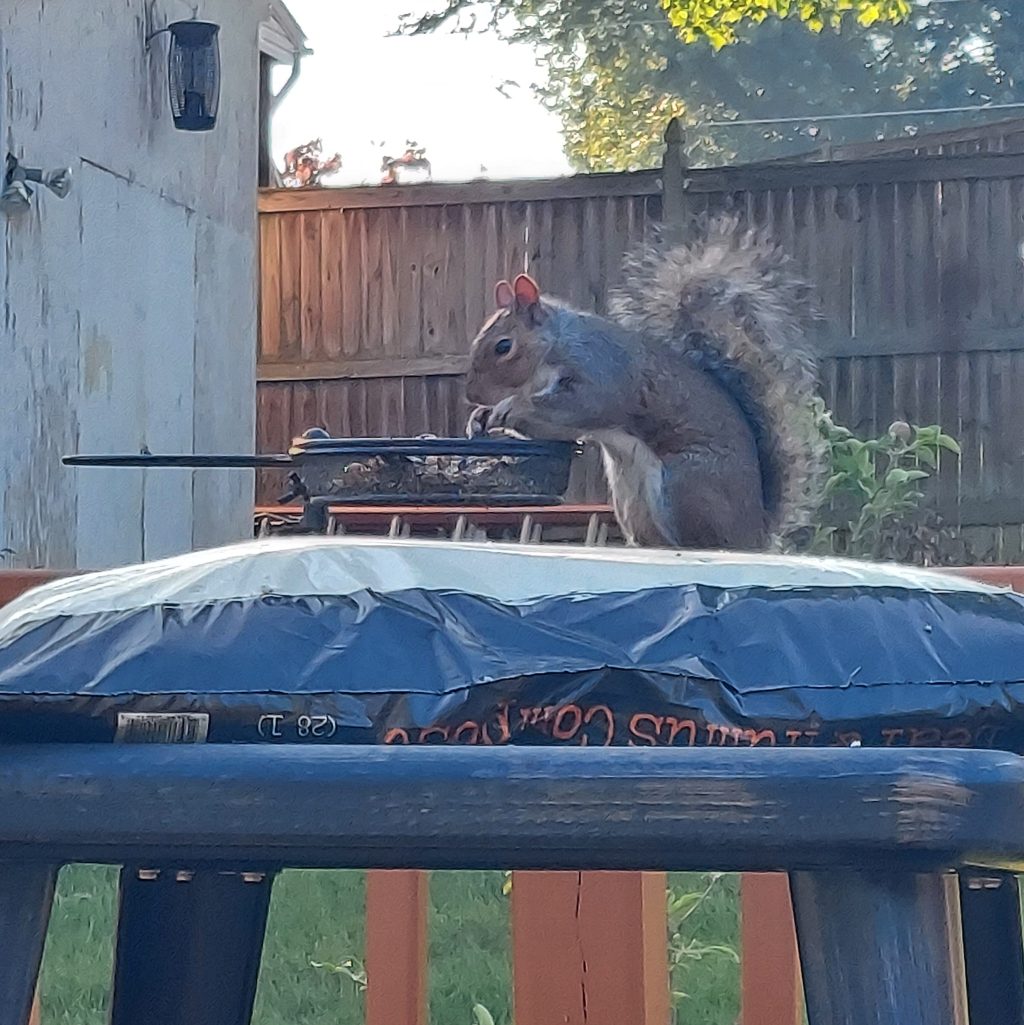
(Frederick de Bonesby does not care. His primary concern is maintaining his skin and his flesh and his fats, even though he is a tubby squirrel and not a powerful 92-year-old lich. He does this chiefly through consuming copious amounts of peanuts and dried corn.)

A squirrel sits on the railing of a deck, paws busily rummaging through a pile of nuts and seeds in a platform feeder.

But I digress.

Really, I’ve been using yard work as a kind of stealth mission. See, there’s a porcelain berry vine (pretty, but invasive) near the driveway that needs to be torn out. It’s right next to the fence dividing the properties, and also right by our gate. According to my calculations, this makes it an excellent spot to conceal a sweetening jar, which I can do by digging up the porcelain berry vine and stealthily burying the jar in its place.

I could fill it with sugar syrup and honey. Cinnamon and petals from the big Virginia rose bush in the front yard. Clover blossoms snuck from the edge where our yards meet.

I could also modify a love spell to attract a good neighbor. There are a bunch of them that involve listing the ideal qualities of a potential lover. But instead of “physically attractive” and “financially independent,” I could put things like, I don’t know, “fond of crows,” and “has strong feelings against lawns,” and “doesn’t think the entire LGBT community is a cadre of secret predators.”
Really, the principle is the same.

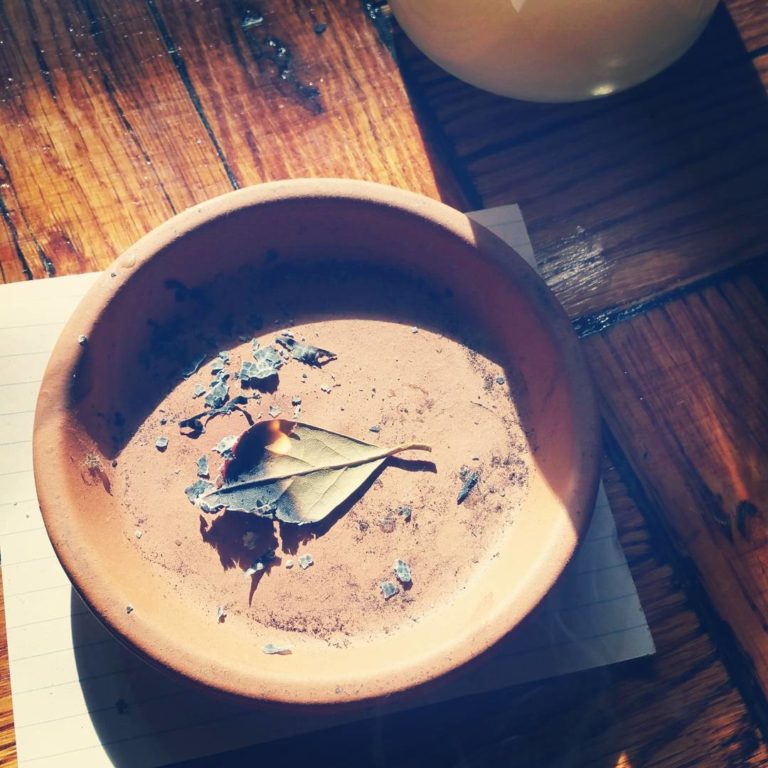
I could fold up the list and put it in a sachet with a magnet and the right herbs and stones. I could take the items on the list, write them on bay leaves, and sit on my deck while I burn them and blow the smoke to the four winds.

A terracotta dish holding a burning bay leaf.

I could whisper my wishes to a handful of birdseed, throw it on the ground, and let the birds carry them where they need to go.

I’m also considering modifying another love spell that involves using human image candles. It’s a kind of sympathetic magic where you take an image candle of the appropriate gender for each person, then move them incrementally closer together over a period of seven days, burning the candles a little bit each night. Once they reach each other, you burn them together and either bury the remains near your front door, or melt the wax together, pour it into a mold with bits of herbs, and make a pretty charm of it.

I could find a candle shaped like a house instead, then mark it with the address. Then I’d just need a general human-shaped image candle (or even a plain white one, in a pinch). The moving and lighting part would be the same. Once all I’ve got is stubs and wicks, I could hide the candles under the sweetening jar where the porcelain berry will… have… used to have been.
(I don’t know how tenses work for situations like this. I feel like I need Douglas Adam’s help.)

Honestly, I just want neighbors like the two ladies whose tend was next to mine during a celebration I attended years ago. One was a Unitarian Minister, one was an experienced mushroom forager, and they were very kind, generous, and friendly (and fabulous cooks). One of the first things they said to us was, “Nice to meet you! Breakfast is at seven.”

A lot of people consider such spells questionably ethical, even if you perform them without the intent to manipulate a specific person’s behavior. If you really think about it, in a way, I’m kind of just helping my neighbors to sell their house. I’m also attracting people who don’t want to exploit the area for its Airbnb potential and prefer native ecological diversity to monoculture lawns.

So really, I’m also kind of in in the right.

I just hope none of my other neighbors see me burying a bunch of jars and candle stubs in the front yard, or it could get awkward.

life · Neodruidry · Plants and Herbs · Witchcraft

Wood Sorrel Folklore and Magical Properties

Take a look at your lawn. Unless you maintain it to putting-green smoothness, you’re likely to see some yellow flowers.

Not the dandelions — look closer.

You might mistake them for buttercups at first, but they’re really quite different. These little yellow five-petaled flowers are yellow wood sorrel (Oxalis stricta). They’re a native wildflower where I live, and vastly superior to the grass that still attempts to poke its way up through their heart-shaped leaves and small yellow flowers.

A plant with heart shaped leaflets and five-petaled yellow flowers.
A tuft of yellow wood sorrel.

As a native herb here, it doesn’t have a long history of use in old European grimoires. There are, however, many other varieties of wood sorrel — some native, some not, and some of questionable origins.

I’m a big proponent of using native alternatives to exotic herbs whenever possible, so I figured I’d give some background on wood sorrel and a few ways to use its magical (and delicious) American cousins.

Wood Sorrel Folklore

The species name Oxalis comes from the Greek word oxus, meaning “acidic” or “sharp.” The leaves of wood sorrel have a very tart flavor which makes them a tasty addition to salads. When dried, wood sorrel can be used to curdle milk for cheesemaking.

These plants are connected to fairies and woodland spirits. In Wales, wood sorrel is called fairy-bells.

A European wood sorrel plant (Oxalis acetosella), with heart-shaped leaflets and white, bell-shaped flowers.
The white flowers of Oxalis acetosella show why this plant’s sometimes known as “fairy bells.”

In herbal medicine, a decoction of the leaves was used for thirst and fever. Applied externally, the crushed leaves have an astringent effect which helps with abscesses, boils, and wounds.

Dried leaves are said to attract luck and, due to the doctrine of signatures, be healing and protective to the heart.

It’s also said that the dried leaf will allow the user to see fairies.

There’s some debate about shamrocks (an Anglicization of the Gaelic seamróg, meaning “little or young clover”). Shamrocks are associated with Saint Patrick, who used a three-leafed plant to explain the idea of the Christian Holy Trinity. Most depictions of the shamrock show it with three heart-shaped leaves. Since clovers have rounded leaves, this indicates that the shamrock may actually be a species of Oxalis and not a clover at all.

The ancient Druids were said to have regarded the shamrock as a sacred plant with the power to drive off evil spirits.

In the Victorian language of flowers, wood sorrel represented joy and motherly affection.

Wood Sorrel Magical Uses

Magically, wood sorrel is used in spells for luck, healing, protection from evil and misfortune, and love.

These plants can also be useful for working with three-part deities, like the Triple Goddess or Brighid. They make good offerings, or even natural representations of the deities themselves in a pinch.

Using Wood Sorrel

Wood sorrel isn’t a substitute for a visit to a doctor, but it can be a helpful herb for minor problems. Be sure you can reliably identify sorrel before attempting to consume it or use it topically.

If you live where wood sorrel naturally grows, you may want to cultivate a native species in your yard or garden space. This is especially true if you have an altar or dedicated space for nature spirits — wood sorrel is strongly connected to these entities. I’m planning to put an offering bowl and some large bull quartz crystals on the edge of the patch of yellow wood sorrel here, for example.

Using wood sorrel as a protective plant is an interesting idea. This protection may stem from the plant’s three-leaved appearance, which is reminiscent of various triple deities. The number three is also regarded as sacred in itself, since it reflects the past, present, and future; youth, adulthood, and old age; birth, life, and death; and the upper, middle, and lower worlds. Wood sorrel may also be considered protective because it’s very sour. Sour things, like lemons and vinegar, are often used to ward off or cleanse away negative energy.

Yellow wood sorrel leaves. The leaves consist of three heart-shaped leaflets, arranged similarly to clover leaves.
This picture shows the heart-shaped leaves and small yellow buds of yellow wood sorrel.

With all of this in mind, I’d brew a tea of wood sorrel and use it to wash doors, windows, and thresholds. Growing wood sorrel could also have a protective and luck-drawing quality.

The dried leaves and flowers would make a very nice addition to jar spells and sachets for love magic. I’d probably combine the flowers with roses, apple blossoms, and other seasonal blooms associated with love-drawing, then use this mixture in a magical bath.

If you’ve never tasted wood sorrel, I highly recommend it. The tart leaves and flowers are a very interesting addition to salads, soups, and sauces. If you’re into kitchen witchery, these edible wildflowers can be a powerful way to work with your local landscape to bring love, protection, and luck into your life.

Books · Witchcraft

The Black Toad: West Country Witchcraft and Magic

It’s been a bit since I’ve sat down to read an entire book from start to finish. To be honest, I just haven’t had the time or attention to spare. I do want to get back into providing reviews and recommendations for books, since I see so many posts on social media asking for resources.

This week, I’ll be looking at Gemma Gary’s The Black Toad. At only 133 pages (not counting the bibliography and index), it’s a slim volume. Though diminutive, it’s definitely not hurting for content!

I’ll be honest, a lot of modern books and websites about witchcraft kind of make my eyes glaze over. Now, in a time where everything just gets boiled down to vibrations, intention, and personal gnosis, all of the advice and explanations sound very samey after a while. (They’re also not terribly helpful, and then people wonder why their craft doesn’t work!)

I really enjoy books on witchcraft that have a more historic bent. When I write about herbs or minerals, I end up looking into folklore, not modern lists of associations or uses. It gets closer to the heart of the matter and keeps me from having to reinvent the wheel through personal gnosis, as it were.

All of this is to say that I really, really like The Black Toad. It covers protection, luck, plant charms, weather witchery, and cursing, broken up into the domains of Old Mother Red-Cap, Green-Cap, and Black-Cap. All of this is presented without apology — for the one with the power to heal and protect must necessarily also have the power to destroy.

A rowan branch laden with red berries.

The spells and charms aren’t written like lists of instructions. Instead, they’re detailed descriptions of historical ways that witches and wise people had for protecting themselves and their animals, improving their luck, healing, and handling their enemies. It’s more than possible to use it as a spell book, but it’s primary value, to me, is as a depiction and explanation of traditional practices.

The only downside is that scientific names aren’t (or possibly can’t be) provided for some of the plants mentioned. Take sage, for example. The mention of sage states that it was drunk for health and longevity. However, there’s a sage native to the area that isn’t a sage at all — wood sage (Teucrium scorodonia). The actual sages, the Salvia species, are native to the Mediterranean. So is this sage an imported garden sage, or native woodland germander? Unfortunately, historic resources often don’t leave us much to go on.

A stack of books, magical seals, and dried herbs. Smoke rises from a bowl of burning herbs.

Some other reviewers pointed to the use of Biblical passages in some of the formulas as a problem. However, this is ahistoric and there are plenty of traditional resources that use passages from the Bible. There’s no reason to believe that witches and wise people, historically, would have reason to look down on doing so. The attitudes of modern people toward organized religion have no bearing on what people were likely to use in the past.

I’d recommend The Black Toad to anyone with an interest in traditional western European witchcraft. It gives a useful picture of the role and domain of wise people, as well as several spells that are still useful today.

Plants and Herbs · Witchcraft

Crocus Folklore & Magical Uses

It’s spring (kind of)!

At least, it’s getting spring-y here. Granted, I think we maybe had about four days of actual “winter,” but it’s been t-shirt weather for the past few days, and looks like it’s going to stay that way for at least another week.

Since things were warming up, I stepped out back to take a look at the yard. The elderberry bushed that I planted last year have some new leaves coming in, the bulbs I planted are starting to poke up through the mulch, and the apples are both looking good.

There’s also a large patch of surprise crocuses that seem to have popped up overnight next to my shed.

These are either Crocus vernus, the spring crocus, or Crocus tommasinianus, the woodland crocus. They’re beautiful, but decidedly not native to this area. (Crocus vernus and C. tommasinianus are related to C. sativus, the saffron crocus. However, these crocuses are definitely not a way to make rice more delicious.) Still, I am determined to enjoy them before it’s time to remove the bulbs and put in some native coralberry bushes. I’ll probably keep the bulbs and move them to somewhere where they’re less likely to spread.

If you’re also experiencing a flush of these tiny colorful flowers, here’s some old folklore and a few ways to make them magically useful.

Crocus Folklore

In ancient Greek legend, Crocus was a human man. The nymph Smilax was in love with him, but, ever the fuckboy, Crocus was dissatisfied with the affair. The gods turned him into a saffron crocus.

Another version of this story claims that Crocus was a companion of Hermes. Unfortunately, he stood up at an inopportune time during a discus throwing match, and Hermes accidentally killed him. As Crocus’ blood fell on the soil, saffron crocuses sprang up.

Spring crocuses are associated with Persephone, Aphrodite, and Venus. Mythology would also appear to tie this flower to Hermes.

A London source claimed that picking crocuses tended to “draw away the strength.” Therefore, only strong men or healthy young women should attempt to.

A field of purple and white crocuses at the base of a mountain.

According to Pliny, wearing crocus around the neck would prevent drunkenness. Interestingly, Swiss parents would place saffron around their children’s necks as a protective charm (presumably not against drunkenness, or else they’ve got some explaining to do).

In the Victorian language of flowers, crocuses represented cheer and youthful gladness.

This flower is associated with the planets Venus and Mercury, and the element of Water.

Crocus Magical Properties

Historic mentions of crocus as a protective charm typically refer to saffron crocus, not the spring crocuses. It can be hard to tease out folklore and uses attributed to spring crocuses, since the autumn-blooming saffron crocuses were generally considered more useful. For our purposes, I’m going to focus on spring crocuses here.

Spring blooming crocuses are used in charms for love, including platonic love or love of the self.

As an early spring-blooming flower, spring crocuses are also useful for spells for new beginnings.

These flowers are common altar decorations for Imbolc and Ostara. However, use caution if you bring spring crocuses indoors — all varieties of crocus other than C. sativus are toxic. Spring-blooming crocuses can cause diarrhea, vomiting, and digestive upset, while autumn-blooming crocuses can cause liver and kidney damage.

Simple Crocus Spells

You can include crocuses in charm bags for love. Add the dried flowers to a pink or red pouch along with rose petals, lavender flowers, and a bit of cinnamon bark. If you like, add a piece of rose quartz. Dress it with your favorite love-drawing oil (in a pinch, infuse some cinnamon, basil, and rose in grapeseed or sunflower seed oil, and use that) and keep it on you.

You can also use crocuses as a form of sympathetic magic. Plant a bulb along with a slip of paper with your name, and the name of your partner. Declare that as the plant grows, your love will flourish with it. When the flower is at its peak, pick it and save it for a love charm.