crystals · Plants and Herbs

The Absolute Worst Crystals for Plants

It’s spring! Kind of!

Yesterday marked the average last frost date for my area (as calculated by the National Arboretum in DC). If you’re like me, you’re probably itching to get your garden started, or at least reclaim some desk space by moving your indoor plants outside for a little bit.

I’ve seen a lot of posts about using crystals and other minerals to help plants. You’ve probably seen the same kind of advice that I have — tuck a quartz point in with your plants to help them grow. Bury four green jades, one at each corner of your garden, to protect your plants and help them flourish.

This got me thinking: What are the absolute worst crystals you could conceivably use for your plants? If some crystals can help, it stands to reason that others can hurt. And hoo boy, can they ever.

While there aren’t many crystals whose metaphysical properties would cause problems in this context, there are definitely plenty that can harm your plants.
Or ruin your life.
Either or.

Halite is salt.
Like, it’s just rock salt.
When people joke about “going to the salt mines,” this is the stuff they’re talking about.

A crystal of halite. It kind of resembles a small pile of snow.

If you’ve ever heard about conquerors razing towns and salting the earth, you probably know that salt and plants don’t mix. (Well, not while they’re growing, anyway. Once harvested, washed, and lightly steamed, it’s a whole other story.)

The reason behind this is that plants’ roots take up water and dissolved nutrients through osmosis. Osmosis works because nature attempts to establish equilibrium. Things move from areas of high concentration to areas of low concentration, until that equilibrium is achieved. It’s much easier for cell membranes to allow water to pass into and out of the cell than to try to move minerals around, and this works out okay because soil almost always has less dissolved solutes in it than the plants’ cells do. The plants’ roothair cells let more water in, osmosis balances the concentration of solutes vs water on either side of the cell membranes, and everything’s good.

Since salt is very soluble, adding salt and water to soil can make it so that there’s more dissolved solutes in the soil than there are in the roothairs. Taking up more water won’t fix things, and so the roots end up losing water to their surroundings.

Some types of soil (specifically heavy clays) can also form compounds that are impermeable to water when they’re exposed to salt. All plants also depend heavily on soilborne bacteria and fungi, which tend to be much less resilient when exposed to sudden changes in their environment. (Like, say, adding a bunch of salt to it.) Kill off these crucial microorganisms, and the plants will soon follow suit.

Selenite, satin spar, and desert roses are all forms of gypsum. Gypsum is a calcium sulfate mineral. It’s also soft and somewhat soluble in water. This means that, when you go to water your plants, you’re likely melting these crystals at the same time. This not only damages the stones, it also deposits all of that calcium sulfate in the soil, altering its pH and potentially negatively impacting plant growth.

Interestingly, gypsum is one of the few materials that exhibits something called “retrograde solubility.” This means that it’s actually more soluble at lower temperatures than it is at higher ones. That’s not great news for anyone who may want to place a selenite specimen in their garden — as soon as a chilly rain hits, they may end up with a disappearing crystal and a whole bunch of dead plants.

Calcite is a calcium carbonate mineral. It’s not really soluble in regular water, but it is in dilute acids. It’s also pretty soft.

A lovely piece of orange calcite.

This means that calcite can easily be scratched by other minerals present in soil. Rainwater also tends to be on the acidic side, so placing it in your garden or watering your plants with saved rainwater can cause it to dissolve over time. This will alter the pH and level of solutes in the soil, which can be detrimental to your plants. While that’s less likely to be catastrophic in a whole garden, it can definitely cause problems for the small volume of soil in the average plant pot.

Hematite is an ore of iron. When it’s found in nature, it often doesn’t look like the smooth, mirrorlike, silvery-black pieces commonly seen in stores. In fact, it usually looks closer to a hunk of vaguely rusty metal. Some massively crystal specimens can exhibit that shiny silver-black appearance, but a lot of inexpensive hematite is rough and rusty and gets polished up before sale.

Hematite is fine to occasionally clean with fresh water, as long as it’s dried soon afterward. It isn’t great to put in with plants or outdoors, though, because this creates the right conditions for it to rust. That’ll damage the stone and leach all kinds of iron oxides into the soil. While natural soil is often pretty high in iron oxides already (like the red clay in my garden), it’s definitely not something you want to introduce if you can avoid it.

While hematite is a form of iron oxide, pyrite is an iron sulfide. The concern here isn’t rust, however. The “sulfide” portion of pyrite’s chemical formula is a bigger problem than the “iron” bit.

A close-up of a chunk of pyrite.

Pyrite is considered insoluble in water, but there’s a lot more than just water going on where plants grow. When pyrite is exposed to both moisture and oxygen, it oxidizes. This produces iron ions (specifically Fe2+) and sulfuric acid. In fact, the oxidation of pyrite and the resulting acid has been responsible for a number of ecological disasters.

This isn’t to say that putting a piece of tumbled pyrite in your yard is instantly going to turn it into a Superfund site, but it’s still best avoided whenever practicable. At best, you’ll end up with damaged pyrite. At worst, a lot of dead plants and possibly a stern letter from the city.

Okay, so. Cinnabar is divisive. On one hand, some mineral enthusiasts act like it might as well be plutonium. On the other, some claim it’s absolutely no big deal.

Here’s the thing: Cinnabar is an ore of mercury, and mercury is toxic. However, mercury is at its least toxic when it’s in its elemental (aka, scoodly silver liquid) form. Metallic mercury isn’t all that well absorbed through your skin during brief, incidental contact — it’s much more dangerous when it’s in its organic form, or as a salt. This is not to say that cinnabar or mercury is safe to handle, I just want to avoid engaging in too much hyperbole.

Mercury vapor, on the other hand, can be readily absorbed by lung tissue. While it takes temperatures of about 674 °F (357 °C) to boil mercury, mercury doesn’t need to boil to evaporate and contaminate the air. Even just breaking an old fashioned thermometer can contaminate indoor air for a significant amount of time if it isn’t appropriately cleaned up.

While it’s true that cinnabar is traditionally roasted to liberate liquid mercury, some specimens do exhibit beads of pure mercury on their surfaces.

Anyhow, all of this is to say that the question of “how safe is cinnabar for plants” is too complicated for me to say that it’s safe. Cinnabar was used as a decoration (and even cosmetic) in antiquity, but buildings also weren’t nearly as air-tight as they are now. (Also, a lot of people lost their minds, went into convulsions, and died back then, while doctors blamed things like “eating cherries and milk,” “riding too fast,” and “wearing lace.”)

In the interest of safety, maybe just keep cinnabar away from heat, water, soil, your plants, your lungs, small children, et cetera. It might be safe, but it might not, and you might not find out how unsafe until it’s too late.

“But J,” you might be saying, “Everything says that quartz is perfectly safe in water. It’s not going to dissolve, leach anything weird, kill my plants, or turn my yard into an acidic death pit. What gives?” And you’re absolutely right!

It can, however, burn your house down.

The issue here isn’t so much the quartz itself as it is the refractive quality of crystal spheres. If the sun hits a clear glass or crystal sphere in just the right way, it can produce an effect similar to the sun shining through a magnifying glass. Crystal spheres have the ability to concentrate sunlight into a laser, and this laser can burn stuff.

So, while other crystals are mostly a problem if they get wet, crystal spheres are a problem if they’re sitting in a window. Like, say, where one might place a sun-loving potted plant.

This issue doesn’t just end at your front door, either. While I haven’t read reports of crystal balls starting fires when placed outdoors, the combination of intense sunlight, dry vegetation, and a clear sphere can definitely cause some trouble. If you have vinyl siding, the reflection of the sun just off of a neighbor’s windows can be enough to damage your home’s exterior.

Assuming you’re not in the mood to ruin your horticulture (or your life) with an ill-placed stone, the solution is pretty easy.

You can opt for different crystals instead. Any variety of silica-based mineral will work, as long as it isn’t able to concentrate sunlight. Moss agate, while not a “true” agate, is a lovely green type of cryptocrystalline silica. Jades are silicates, too.

For stones that shouldn’t get wet, like your gypsums and sulfides and such, you can always place them near indoor plants. Just avoid putting them in places where they’ll come in contact with water or the soil.

For quartz spheres, it’s best to keep them covered when they aren’t actively in use. (That’s a big part of where the custom of covering one’s scrying ball comes from.) If you have to put them in with your plants, either bury them entirely in soil or place them in a small, opaque bag first. Just keep them out of the sunlight.

That’s pretty much it. Do your homework on the chemical composition of your crystals, avoid stones that will actively turn into acid or poison when exposed to water, and be careful with the ones that’ll burn your house down.
Happy growing!

crystals

Lemon Quartz vs Citrine vs Tangerine Quartz vs Golden Healers — FIGHT!

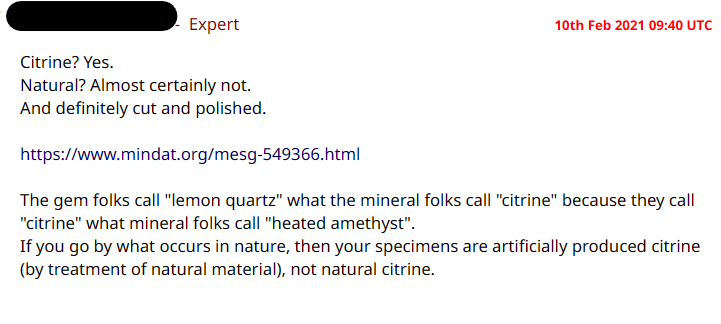
Before I get into this, there’s a quote on a Mindat thread that I think sums it up pretty well:

The discussion was on lemon quartz versus citrine, with one poster attempting to discern if their specimens were natural, untreated citrine. If it seems kind of confusing… it probably should, to be honest.

I’ve written about citrine in the past, and I think I did an alright job of covering the chemical and physical properties of natural citrine and heat-treated amethyst. This time, I’d like to look at a couple of other semi-related mineral specimens.

Lemon quartz is a variety of quartz that presents with a light yellow color. It’s unmistakably yellow, too — not the toasty orange of heated amethyst, or the smoky yellow, apple juice hue of a lot of natural citrine.

So, is it dyed? Irradiated? Cooked? What’s the difference between one type of yellow quartz, and another type of yellow quartz? While it does certainly seem like some lemon quartz is just light, very yellow citrine, this isn’t always the case.

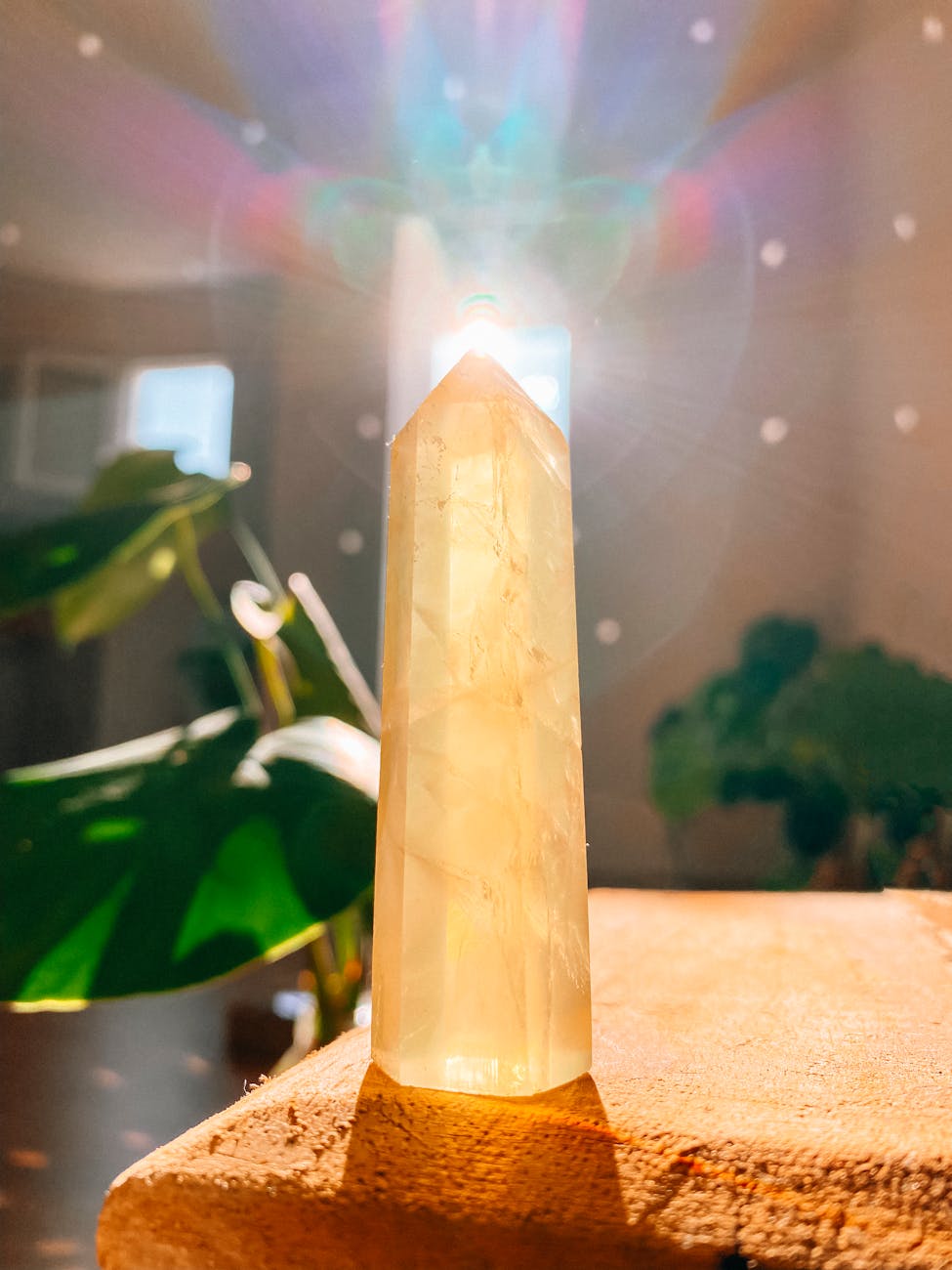
A tower of a translucent, honey-colored mineral sits on a wooden table. In the background, there are several houseplants and a rainbowy lens flare.
Pexels assures me that this is citrine, but it honestly looks more like a faceted and polished honey calcite to me. Photo by Alina Vilchenko on Pexels.com

Ouro Verde quartz, which is also called lemon quartz, is a treated gemstone with a greenish yellow color. These are made by heating irradiated, very dark smoky quartz. (There’s a very interesting explanation of the treatment and discovery of this quartz here.)

To sum up: Specimens sold as lemon quartz may be either particularly yellow citrines, or a bright greenish yellow quartz produced by irradiation and heat treatment.

With all of the above in mind, how do you know if you have natural lemon quartz?

As I briefly explained in my post about citrine and heat-treated amethyst, the best way to tell is to observe how the stone behaves in light. Hold it up to a polarized light source and turn it from side to side. Does the color seem to shift a bit from one angle to the other? The stone is exhibiting pleochroism, a hallmark of natural citrine. If the stone is very yellow, that citrine can also be considered a lemon quartz. Heated amethyst doesn’t exhibit this phenomenon, and neither would irradiated and heated clear quartz.

It should also be noted that, in their natural forms, crystals don’t often exhibit the kind of bright hues you can get from heating and irradiating stuff. If it’s really bright yellow — bright, sunny, lemon-candy-highlighters-and-pineapple-Fanta yellow — it’s likely had some help getting there.

Look, you pick a fruit, and there’s probably someone online selling quartz named after it. It’s like when people were posting about “strawberry makeup” and “latte makeup,” when what they really meant was “pink blush and eyeshadow” or “different shades of tan eyeshadow and also maybe some bronzer.”

Gem folks and mineral folks very often don’t use the same names for things. In the gem trade, having something that sounds new, unique, and exotic helps you stand out and improves the marketability of your stones. Mineral folks are more concerned with identification, so interesting new names are more of a hindrance than a help. Neither is necessarily better, they’re just two ways of approaching vastly different goals.

The trade names that stones are given don’t need to have any real meaning or relation to the stone’s actual composition. They don’t even have to relate to each other. While they’re both citrus-y, natural lemon quartz is yellow citrine and tangerine quartz is quartz with a coating of iron oxide.

You’ve probably seen or heard of aura quartz before. This is quartz that is colored by vapor deposition, in which the stone is coated with a micro thin layer of vaporized metal ions. This thin layer of metal gives it a shiny, brightly colored finish, and the specific metal ions you use determine the final color.

Sometimes, a process similar to this can occur in nature. Tangerine quartz is quartz that has received a blanket of iron oxide particles at some point during its formation, giving it an orange color. Depending on when this happens, the iron oxide may be present as phantoms or inclusions within the stone. Sometimes, it’s just a surface coating.

When nature throws quartz and various metal oxides together, you can get some really funky-looking crystals. I saw a tiny double-terminated quartz the other day that had so much iron oxide in/on it, it looked like red jasper. Wild.

Quartz and iron oxide. It’s just that sometimes iron oxide is yellow instead of orange or red.

Golden healers are often the color of citrine, but they get their color by the same mechanism that tangerine quartz does. Quartz grows, a coating of metal particles happens to it, et voilà — you get a golden yellow crystal.

Arkansas, in particular, is home to a beautiful variety of naturally occurring quartz sometimes sold as “solaris quartz.” As these stones form, they receive a layer of iron and titanium. It gives them an interesting golden yellow-orange color (and sometimes a bit of iridescence, too).

Any type of quartz can be a golden healer, as long as the right conditions are met. I have a few Herkimer quartz specimens that are totally or partially covered in golden yellow iron oxide. I’ve even seen amethysts with the typical golden healer coating.

As an aside, golden healers are unrelated to wounded healers, though you can have a crystal that’s both a golden and wounded healer. In metaphysical circles, wounded healers are crystals that have either been damaged at some point or have broken and self-healed during their formation. I’m told that these are considered some of the best crystals for crystal healing, as they have experienced what it’s like to be “injured.”

This is a bit of a tricky question to answer. The closest I can come is probably, “what do colors mean in your tradition?”

Lemon quartz can be used the same way as citrine, because it is — it’s just on the yellower end of the spectrum. Ouro Verde quartz, as a treated quartz, is still perfectly fine any situation in which you’d choose a yellow or green stone.

Golden healers and tangerine quartz aren’t super different. Golden healers sometimes include titanium ions, and sometimes are just coated with yellow iron oxide. Tangerine quartz is more orange. Use golden healers in situations that call for the color yellow or gold, and tangerine for those that call for the color orange.

In a lot of guides to color magic, yellow is associated with the element of Air, the intellect, friendship, and joy. Orange is associated with the element of Fire, creativity, willpower, and optimism. Green is connected to the element of Earth, prosperity, and fertility. However, all stones are innately connected to the element of Earth because they’re stones. Where the line falls between “yellow” and “green” or “yellow” and “orange” is also highly subjective.

For this reason, I’m hesitant to point to a specific metaphysical use for these minerals. Use the one that seems to volunteer to you. I guarantee, even if you pick the “wrong” kind, nobody is going to explode. Consider it a helpful exercise for your intuition!

The fact is that nature abhors absolutes. Everything — and I do mean everything — exists on a kind of gradient. At what point does a citrine become a lemon quartz, or a golden healer become a tangerine quartz? The only answer I can really give you is, “when it seems like it.” Trade names shouldn’t influence how much you enjoy your stones (or how you use them). It’s fine to be curious about how things get the names they do, but don’t give your power away to what is, a lot of the time, just a marketing gimmick.

crystals · life

The GLMSMC Gem, Mineral, and Fossil Show (or, Why I Have a Small Quantity of Uranium Now)

This past weekend was the 58th annual GLMSMC Gem, Mineral, and Fossil Show. It fell at a slightly weird time for us — I’m still in an ennui, and my Handsome Assistant has Dungeons & Dragons Hot Boy Activities every other weekend — but it A) it only comes once a year, 2) we’d been looking forward to it before realizing it happened at such a bad time, and III) it’s pretty easy to control how much time you spend there. Most of the time.

This year, to save some time and our limited energy, we skipped most of the displays on the first floor. If you’ve never been to the show, don’t miss these. They’re local minerals, geology displays, some really neat insect taxidermy, activities for kids, and a really cool blacklight tent of wild-looking fluorescent minerals.

The second floor is the vendors. When I say “vendors,” I mean sellers of stones of every description. Tumbled minerals like pieces of brightly colored candy. High-end faceted jewels of every color. Opal cabochons like fragments of rainbows. Fossilized creatures that seem to come from an alien world. Fist-sized geodes promising worlds of never-seen minerals within. Ropes upon ropes of artisan crafted beads.

What I’m saying is, it’s really cool and you should see it. It is an excellent place to go if you want to look through trays upon trays of precious minerals (many of which are domestically sourced, like some beautiful Herkimer quartz and uncommon minerals from Pennsylvania) and feel very fancy.

Last year, we “rolled the geode gacha” as my Assistant says, and ended up with a beautiful specimen of smoky quartz with sharp, clear calcite blades growing within. This year, we picked a small, reddish stone with some interesting globular formations outside that I thought might mean some botryoidal or mammillary formations inside.

Sure enough, the inside was filled with beautiful, rounded mounds of a soft gray, druzy mist, like little hillsides under snow. That’s not the most interesting part, though. That’d be this:

A blacklight shines on a pair of geodes, displaying small areas of bright green.

It’s a bit difficult to make out with the ambient lighting and the way my phone tends to handle such things, but these geodes showed several bright (and I mean bright) green specks and areas. You can really see one on the small rounded globule at the bottom of the first geode, and at the top of the second.

“Those are uranium inclusions,” the seller helpfully explained.

“Oh! Neat!” We replied.

And this is how we came into possession of a very small quantity of radioactive material. It’s really pretty in person — my plan is to find a small blacklight that I can mount in my mineral cabinet, and give this specimen a home that’ll show it to its best advantage.

(I’m not too concerned about radioactivity. This mineral appears to be chalcedony, in which uranyl ions can appear as a natural contaminant. These ions mostly emit alpha particles and weak gamma rays, and I wouldn’t honestly expect a specimen with only a few inclusions to emit much detectable radiation at all. I cleaned it well to remove inhalable dust. In a cabinet, in a well-ventilated room, located a few feet from where people sit, this geode is probably safer than my kitchen’s granite countertops.)

This is also a great place to go if you enjoy collecting fossils. This year, there were some really excellent specimens from a cave bear, Ursus spelaeus, including a bunch of jaws and fully-intact paw!

Some fossilized jaws, with teeth, from cave bears. In the foreground, there's a whole fossilized paw with five wicked-looking claws.

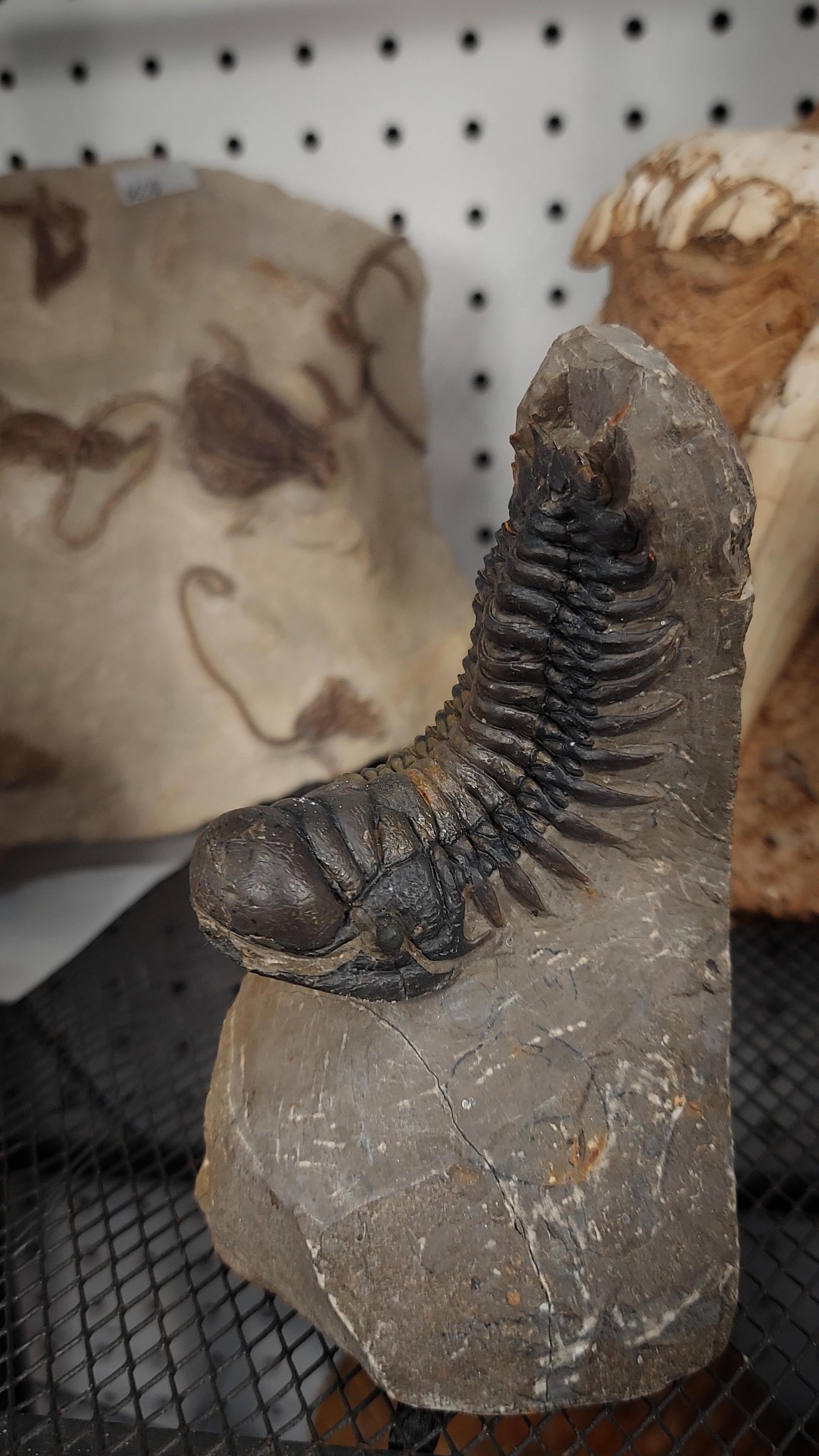
There were also fascinating specimens of smaller guys, too. Last year, we brought home a trilobite. This year, we just took pictures. Several specimens were loose, like little armored cabochon jewels. Others were still embedded in ancient silt, like tiny aliens traversing an undiscovered moon.

Also, there was a facehugger.

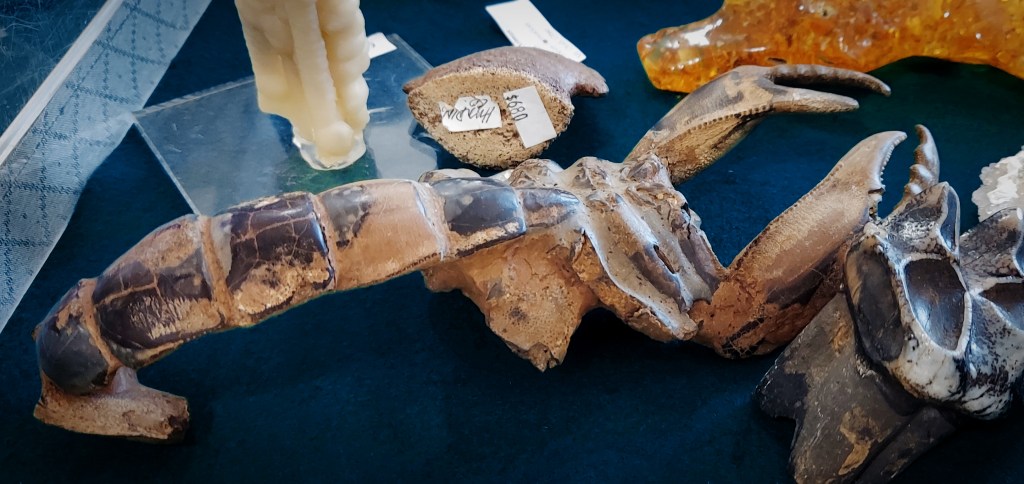
Some sort of prehistoric scorpion (possibly Pulmonoscorpius kirktonensis). It's roughly a foot long, with its tail arched beneath it and its massive claws upraised.

Some tables held rare specimens in combination. Giant dogtooth calcites growing on beds of glittery chalcopyrite. Tiny, fine threads of stibnite jutting up from barite and quartz. Really pretty stuff worthy of a museum (or the display of someone with a much bigger cabinet than I have). As beautiful as they were, they were some of the most challenging to photograph — each one was like a tiny ecosystem of its own, and their depth and complexity made it difficult to choose a spot to focus on!

We came home with some interesting crystal carvings, our geode, a particularly lovely amethyst specimen, and a small bit of amber (I like to offer them to Freya when I can).

Admission to the show is only six dollars, and you can save a buck by downloading and printing out the coupon on their website. Even if you didn’t get to attend this year’s show, mark your calendar for next year — it’s always a good time, and there are tons of beautiful things to see!

crystals · Neodruidry · Plants and Herbs · Witchcraft

Working with the elements (when everything’s been paved).

They paved paradise, and put up a parking lot.
Or office blocks, apartments, and retail space, as it were.

A lot of, though certainly not all, magic involves working with all of the elements. Some people do this in absolutely every spell, some only invoke them in longer, more formalized rituals. Some keep representations of all of them on their altars, some have specific, strategically placed altars dedicated to each. Point being, Earth, Air, Fire, and Water will probably come into play at some point.

But what do you do if your daily contact with nature is limited to a window box, a weedy alley, or a grassy strip of median?

For a lot of people in urban areas, working with the elements takes a little ingenuity. You have to branch out from the idea of the sea as crashing waves and be able to see it in the azure blue of a stone, or the briny scent of a vial of seawater. You probably can’t build a bonfire, but you can smell its power in the warm spice of cinnamon incense.

Every element has its own correspondences. Each has its respective colors, crystals, herbs, and symbols. Bringing them into your home or your altar space is as good a beginning as any when it comes to working with natural energies you may not fully experience in your usual environment. You can follow your intuition here, or use some herbs, stones, or other objects usually associated with each element:

Earth

Herbs: Vetiver, potato, turnip, ivy, mushrooms, alfalfa, myrrh, patchouli, sandalwood.
Crystals: Jade, onyx, salt.
Tools: Dishes of salt, crystals or other stones.
Animals: Turtles, bulls, wolves, bears.

Generally, brown, black, or green things, root vegetables, and autumnal herbs are associated with Earth.

Air

Herbs: Anise, fennel, lavender, mint, lemon.
Crystals: Celestite, citrine.
Tools: Incense, wands, fans, feathers.
Animals: Eagles and other birds.

Generally, yellow or blue things, pastel colors, and “bright” flavors are associated with Air.

A person holds a handful of lit incense sticks. Smoke wafts from their glowing, ash-covered tips.

Fire

Herbs: Ginger, rosemary, chili pepper, sunflower, dragon’s blood, cinnamon, clove.
Crystals: Amber, citrine, carnelian, ruby, fire agate, fire opal, red tourmaline, sunstone.
Tools: Blades, wands, candles, burned things.
Animals: Deer, dragons, salamanders.

Generally, red or orange things, things that thrive in sunlight, stinging things, and things that are warm or spicy correspond to the element of Fire.

Water

Herbs: Benzoin, clary sage, Irish moss, water lily, buckthorn, lotus, aloe vera, cacti.
Crystals: Aquamarine, coral, pearl, opal.
Tools: Cups or chalices, cauldrons.
Animals: Salmons and other fish, sea mammals, frogs.

Generally, blue, green, or black things, things that grow in water, things with a high water content, and things that are cool and moist correspond to the element of Water.

A big part of Druidry is the idea of reciprocity. It’s the idea that building a relationship with something — anything, whether it’s a person, a community, or the spirits of the land — requires a conscious effort to give back. Nobody waters dead flowers, and relationships that are one-sided quickly fade.

Cities provide ample opportunities to engage in reciprocity. I remember laying in bed once, in a studio apartment in Washington DC, and seeing a black and white hummingbird hover just outside the window. It was a wonderful little surprise, and a reminder that, once natural sources of food, water, and shelter are taken away, it’s up to us to make up for the loss.
Pavement and metal don’t kill the spirits of the land, just muffle them for a while.

If you work with plants, cities can provide a surprisingly diverse biome. Bricks are a substrate for multiple species of moss. Concrete is no match for the plants that push themselves up through the cracks. Climbing vines, native and otherwise, cling on to rain gutters and windowsills with an admirable tenacity.

Moss growing on and around pavement at the base of a brick wall.

Urban areas are really good for some elemental work, though. The element of Earth is present in the bones of a city, from the steel beams of buildings to the ubiquitous concrete underfoot. Tall buildings give great access to working with Air — few things are as invigorating as a good energy cleanse by standing on a balcony in a strong breeze.

Living in an urban environment doesn’t always make it more difficult to work with the elements. It just takes a little digging.

crystals

Selenite vs. Satin Spar: What’s the difference, and does it matter?

Oh, gypsum. You’re fertilizer, walls are made of you, you make tofu tofu, and you’re also some of the most coveted minerals on the crystal market.

If you like collecting or working with crystals, you’ve almost definitely seen it. It’s usually marketed as selenite (though it also frequently appears in flowerlike forms called desert roses).

There’s only one problem — like olive oil, wasabi, and citrine crystals, the selenite you know and love may not actually be selenite at all. This is another situation where mineral names and trade names collide, like you see with white turquoise.

Selenite is a very common name for gypsum in the crystal trade. It’s usually used to describe the fibrous, silky, silvery-looking form of gypsum sold as rough wands, polished wands, palm stones, or heart shapes. These stones have a silvery sheen and a decidedly lunar feel, so the name selenite makes sense, right?

Unfortunately, it’s a bit more complicated than that.

Okay, so. Selenite and satin spar are both the same mineral: gypsum. Gypsum is a variety of calcium sulfate, so it’s pretty common. There’s a good chance you live in it, and an even better one that you’ve eaten it before. No big deal.

The difference between selenite and satin spar lies entirely in how they form.

A hand holding a thin satin spar wand. The satin spar is slightly translucent and exhibits a silvery-white color overall.
A “selenite wand” (that’s actually satin spar), showing satin spar’s characteristic fibrous, satiny appearance.

Satin spar forms as thin, fibrous crystals. If you’ve ever seen it crumble (which isn’t uncommon to observe — gypsum is soft), you might have noticed that the remnants look more like small splinters. This gives this mineral a silky, translucent appearance with a silvery sheen. It usually exhibits chatoyancy, or a “cat’s eye” effect. Because of how it forms, this is the mineral that you usually see sold as “selenite wands,” palm stones, or charging bowls.

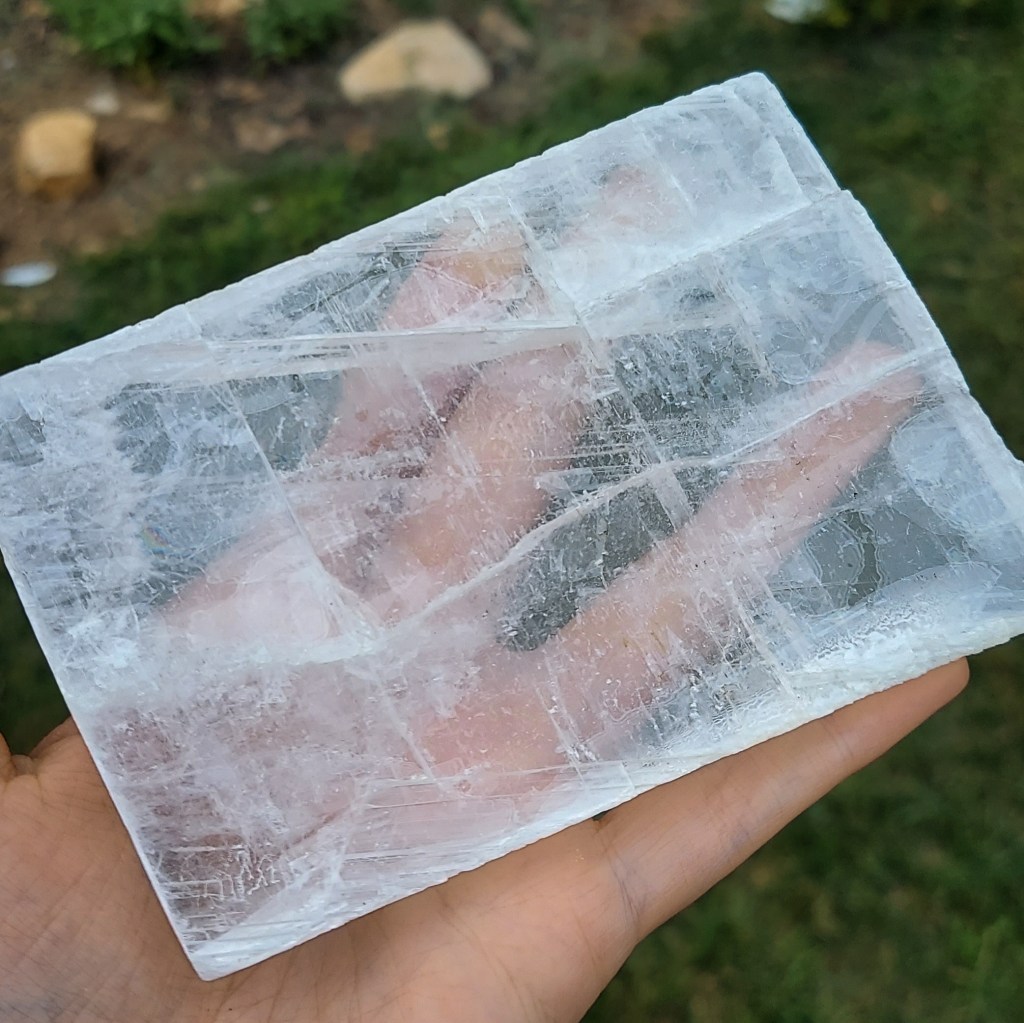
A roughly rectangular selenite plate balanced on a hand. The hand is visible through the selenite, save for a few areas where healed fractures or inclusions give the stone a slightly cloudy appearance.
A selenite plate, displaying its transparency.

Actual selenite forms as sheets. It’s usually transparent and colorless, though it may have impurities that give it a cloudy appearance. It’s much rarer than satin spar and is usually sold as flat specimens. The way it fractures means that it isn’t a good choice for carving into wands. Its unique crystal form is best exhibited as-is, though you may see it sold as charging plates.

Nope. The chemical composition, hardness, solubility, and everything else is completely the same. The only differences are clarity, fracture planes, and formation.

Satin spar and selenite are used identically. They’re both considered very high-energy crystals that are used to cleanse rooms, people, and objects, or even cleanse and charge other crystals. If you have a selenite that you’ve suddenly realized is actually satin spar, that’s okay. There’s virtually no metaphysical difference between the two.

If you work with crystals in a magical or metaphysical sense, then no. The usage, properties, and care instructions for satin spar and selenite are exactly the same.

If you collect minerals or have some specimens that you plan to sell to gem collectors, then yes. Selenite is rarer than satin spar. It forms and looks differently. If you have satin spar in your collection, and you want to find a piece of actual selenite, you’d be pretty disappointed to find that all of the “selenite” on the market is just more satin spar!

I’m all for accuracy, so I prefer to call selenite selenite, and satin spar satin spar. However, I also get that “selenite” has been a trade name for satin spar for a long time now, and me taking a pedantic stand isn’t likely to change that.

Like I said, it might be a good idea to remember that there is a difference. In magical and metaphysical circles, nobody’s that likely to care much. In gem collecting circles, people are more likely to use the term that’s more technically correct.

If you want to split the difference, you could call satin spar “satin spar selenite.” This isn’t really right, but it probably has the best shot at ensuring that the person you’re talking to knows what you mean.

Or just call them all gypsum and let everyone else figure it out.

crystals

Andara Crystals — What are they, and what’s their deal?

There are a number of stones in the gemstone trade that are referred to as crystals, when they really aren’t. Some, like art glass, don’t have a crystalline structure. Others might be mineraloids, which also lack a crystalline structure. All of this is to say that a fair amount of “crystals” aren’t really crystals at all.

With that out of the way, let’s look at Andara crystals. These are often brightly colored, very fancy-looking clear stones that are purported to have a ton of healing and metaphysical properties (and fetch correspondingly high prices). But what are they, and why are they controversial?

What are Andara crystals?

Andara crystals are said to be natural glass which comes from a handful of specific sites in northern California and Nevada, which are the foci of particularly high-energy vortices. These crystals come in every shade of the rainbow, and fans say that they can heal, balance the chakras, raise vibrations, and more. Some even claim that they’re the philosopher’s stone of legend, or an ancient healing tool used in Atlantis.

These stones are said to contain etherium, which is a blend of 70 different minerals. Some are listed as monatomic, which refers to substances made up of elements that naturally exist as a single atom.

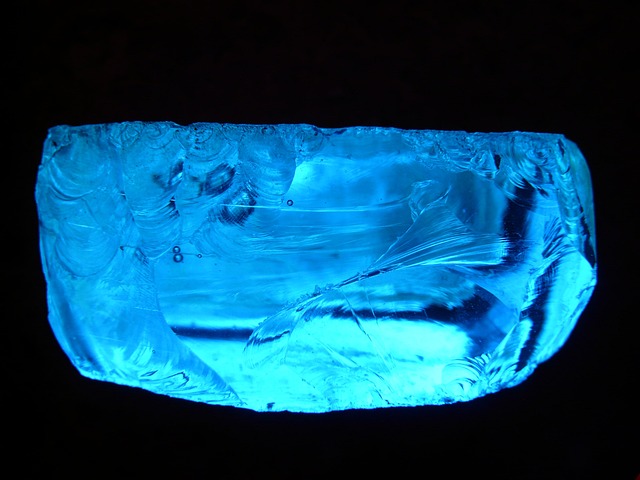
A chunk of blue glass on a black background.

Okay, so why are they controversial?

Andara crystals are controversial for a few reasons. For one, they’re not crystals. They’re a type of glass.

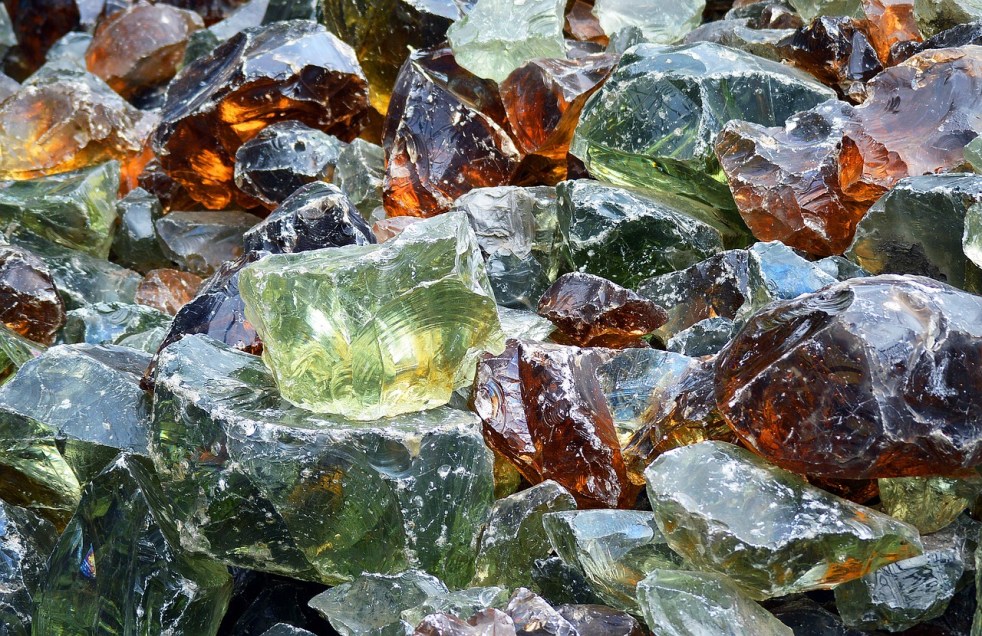
For two, they’re not natural (as in, formed by nature). Andara crystal deposits correspond to land dumps of slag glass from manufacturing. They look like slag, and their chemical composition correlates to soda lime glass, of the type used to make bottles. It doesn’t resemble other forms of natural glass, like obsidian or moldavite. The chart in this post gives a pretty thorough breakdown.

The funny thing is that some sellers extol the virtues of Andara crystal and claim that part of its specialness lies in its dissimilarity to other natural glasses. Yes, of course it’s not similar to them — because it’s soda lime glass.

Selling Andara crystals as a natural product is a bit like selling beach glass and claiming it was formed by nature. It may have been shaped and influenced by it, but it’s a man-made material at its heart.

The controversy doesn’t like in Andara crystal’s man-made origins, however — it’s because it’s literally a manufacturing byproduct. Chunks of slag glass get dug up, cleaned off, labeled with a lot of healing and metaphysical properties, then sold for sometimes hundreds to thousands of dollars.

This has caused trouble with not only buyers, but also dealers. When you’re selling something indistinguishable from a chunk of broken bottle, it becomes a race against “counterfeiters.” (I use “counterfeiters” here because the counterfeits are, again, indistinguishable from the alleged genuine articles.) This has led to dealers claiming that their glass is the only true Andara crystal, and dealers selling specimens back and forth to each other — accompanied by certificates of authenticity.

The Emperor’s New Crystal

Is it bad to use a man-made material for metaphysical, spiritual, or even energetic healing purposes? Not necessarily. I honestly love the idea of using slag glass this way, because it removes manufacturing waste from the environment and gives it a second life.

(A crystal — any crystal — isn’t going to take the place of the services of a competent medical professional. If you need insulin or to have a tumor removed, there is no stone that will make that not be the case anymore. I’ve used crystals to get relief alongside conventional treatment and complementary therapies, but I’m not out here trying to cure pseudotumor cerebri by rubbing rocks on my head.)

But here’s where we get into what I think of as the Barmicide Feast of crystals — or, if you prefer, the Emperor’s New Crystal.

It’s true that developing your own personal associations is important for any magical or spiritual tool. I have stones I work with that I love, but other people don’t get anything from. Other people have crystals or herbs that they love, but I get nothing from. These relationships shift and evolve over time, and that’s good and fine.

Unfortunately, some proponents of Andara crystal have used this as a selling point in a way that’s, frankly, kind of gross. They attach long lists of metaphysical attributes to this glass, then claim that only the special and spiritually evolved can feel or access them. If you see the slag for what it is — slag — then you need to get on their level.
See? Nasty.

The biggest problem here is that they’re exploiting a grain of truth to build up the cachet of a manufacturing byproduct in order to charge exorbitant amounts of money for it. They’re not wrong when they say that not everyone can experience the energy of a stone — even glass. The shitty part comes from using this exclusionary tactic to get money from people who want to be part of the in-group. Vulnerable people who want to feel that special energy, to feel elevated and included, and are willing to pay for it.

The underlying message is that when you compliment the Emperor’s gorgeous robes and rave about Barmicide’s pistachio-fed lamb cutlets, you, too, can be spiritually evolved.

Again, the shady part isn’t using (or even selling) soda lime glass as a magical or spiritual tool. The shady part is overcharging for a common, inexpensive material.

If you have and use Andara glass, that’s wonderful. My only advice here is, if you feel drawn to it, use this as a starting point to unpack your relationship with crystals. What’s different about that soda glass versus other materials that are around you? If it’s its place of origin, consider visiting this energy vortex and experiencing it for yourself — you might find a piece of regular quartz or some other mineral that gives you just as much, but you won’t have to overpay for it. If it’s the metaphysical claims and the experience of buying the stone from a dealer, then that may be something worth exploring further.

Blog · crystals · life

“Fine, but I’m not getting any more rocks.”

I knew it was probably a lie the moment the words left his lips.
Still, I didn’t really intend to buy anything, I just wanted to go to the local mineralogical society’s mineral and gem show for kicks. We didn’t have any other plans, it was close by, and tickets were like six bucks. Why not?

I’ve also wanted to learn more about our local geology. Maryland has an interesting state mineral called Patuxent River stone, which is a form of agate that I think is a lovely, almost luminous color. I really want to find some in the wild, but the minerals I’m most likely to encounter where I am are white quartz, mica, beryl, and serpentine.

With all of this in mind, spending an hour or so at a local rock show seemed like a nice way to pass some of the afternoon. Also, sometimes there are interesting bony boys to look at.

This was before my partner saw the big geode cracking machine. I also think they’re very cool — I was used to getting tiny geodes as a kid and cracking them open with hammers like a tiny caveman, but all I’d get from that is a lot of small, shattered pieces. These machines use a large metal chain, shaped like a bike chain, that applies even pressure to a small area around the geode. They’re similar to soil pipe cutters but have a wheel that allows you to tighten the chain a bit more easily. The end result is a geode that cracks much more cleanly, usually in two halves that follow the natural features of the stone, so you preserve a lot more of that beautiful internal structure.

We talked to the owners of the machine for a bit, asking about the origins of their geodes (remember, always know where your crystals come from) and their mineral composition. That’s the nice thing about shows like this: The people there are super stoked to talk about crystals.

In the end, we decided on two geodes — one large one that was filled with tiny, sparkly, sugary-looking white quartz crystals (and a few double-terminated ones, too!) and a smaller one that seemed to be smoky quartz and blades of either calcite or selenite. They’re gorgeous!

A geode made of layers of opaque brown and transparent black crystal. In the very center, there are flat blades of clear, sparkling crystal.

The show also had some fascinating displays of fluorescent minerals, insects, fossils, and really nice specimens of minerals that had been collected locally (or semi-locally, within a few states or so). Upstairs, where the dealer’s tables were, there were beads, handmade jewelry, carvings, and several gorgeous and very high-end specimens for sale.

A wooden case of preserved moths. They're shades of brown, cream, and orange, and many of them have large spots on their wings that look eerily like eyes.

In addition to the two geodes, we came away with a trilobite from Ohio. I have named him Tobie.

If you’re into geology, like fossils or minerals, or are even into crystal healing, I can’t recommend local gem shows enough. In Michael Gienger’s book Crystal Power, Crystal Healing, he talks about the role that your local geology can play. For example, the effect that living in areas with specific minerals can have. If you’re not learning about what’s around you, you’re doing yourself a disservice.

It’s also just really nice to talk rocks with people who are super into it. Even if you’re not necessarily so, it’s just cool to listen to someone who’s both knowledgeable and passionate about something.

If you’re a collector or crystal enthusiast who’s concerned about the environmental and ethical considerations of your hobby, then local shows are also a huge help. Most of the specimens we saw were clearly labeled with their place of origin. A lot of them were domestically collected, usually by the people selling them. There was a transparency that’s hard to get in a lot of (though certainly not all) conventional crystal shops. Some of the people there have brick-and-mortar stores, too.

These events also often support local hobbyist groups, and are a great way to meet other people in your community. Now that we’re actually setting down some roots here, it just feels good to be involved in stuff like this, even if it’s just as a spectator.

So yes. Support your local mineral people. They rock.

crystals

Howlite, Magnesite, and White Buffalo Turquoise: Are you being scammed?

Sometimes I feel like howlite and magnesite have a bit of a bad rap. They’re kind of like the flour of the gemstone world — pretty basic, of no offense to anyone, and able to be turned into all kinds of things that most people think are much more interesting. White howlite and magnesite get dyed and turned into imitation “turquoise,” “sodalite,” “lapis,” and just about any other opaque stone you can imagine.

It’s particularly good at imitating turquoise, to the point that there are standard operating procedures used for telling genuine turquoise from the faked howlite and magnesite stuff.

Unfortunately, that’s what makes it easy to pass off as rare, beautiful white buffalo turquoise to an unwary observer.

When a Turquoise Isn’t a Turquoise

This part might get a little confusing but hear me out: Howlite isn’t the same as white buffalo turquoise. Neither is magnesite. However, white buffalo turquoise also isn’t actually turquoise. For this reason, people prefer the term “white buffalo stone.”

A necklace made of blue-green turquoise nuggets.
Photo by Mahmoud Alaydi on Pexels.com

Turquoise is a phosphate of copper and aluminum (CuAl6(PO4)4(OH)8·4H2O). It’s usually a robin’s egg blue to blue green, but can also tend toward a more yellowish green color. Many specimens also exhibit spots, flecks, or spider web-like patterns of black, gray, or brown matrix material.

True turquoise has a pale bluish- or greenish-white streak when subjected to a streak test. It’s also about a 5-6 on the Mohs hardness scale, but it’s a fairly porous stone. Expensive, high-quality specimens are usually at the harder end of the scale, but softer, cheaper specimens are typically stabilized to improve durability. This stone has some other unique physical characteristics, but these are the ones that are most relevant to this subject.

A polished howlite stone showing gray veining.
Ra’ike (see also: de:Benutzer:Ra’ike), CC BY 3.0 https://creativecommons.org/licenses/by/3.0, via Wikimedia Commons

Howlite is a borate mineral, specifically a calcium borosilicate hydroxide (Ca2B5SiO9(OH)5). It’s a white, cream, or pale gray color, with dark gray to black veins that somewhat resemble matrix inclusions in turquoise. Rarely, howlite forms beautiful flowerlike formations of translucent crystals.

Howlite produces a white streak. It’s about a 3.5 on the Mohs scale, so it’s much softer than turquoise.

A dyed magnesite heart surrounded by a string of dyed magnesite beads.
Becritical, CC BY-SA 3.0 https://creativecommons.org/licenses/by-sa/3.0, via Wikimedia Commons

Magnesite is a magnesium carbonate mineral (MgCO3). It’s typically white, grayish, yellowish, or brownish, with gray veining.

Magnesite produces a white streak. It has a hardness of 3.5-5.0 on the Mohs scale.

White buffalo stone is a calcite mineral, akin to dolomite, with quartz. It’s found near turquoise and forms under similar conditions. The term “white buffalo” is actually a trade name and refers specifically to stones sourced from the Tonopah, Nevada mine owned by the Otteson family. This type of stone is also sometimes sold as white turquoise or sacred buffalo stone.

This stone is a cream to white color with black or brown veins of chert. Some specimens may show faint hints of blue or green from the iron and copper content of the surrounding rock. It’s a pretty soft stone at about 3.5 on the Mohs scale, and also exhibits a white streak.

How Do You Tell Them Apart?

So, we’ve got three white minerals that all exhibit a white streak when you rub them on an unglazed ceramic plate. How do you tell which is which?

It’s not easy, especially since white buffalo stone is pretty rare. The trade name refers to stone that’s found in only one mine in the world, so it’s not like a lot of samples have undergone the kind of testing that would simplify the identification process. (Honestly, I had a hard time even finding images of it because looking for “white buffalo stone” or “white turquoise” tends to return either nothing, or page after page of howlite!) In most cases, you’ll probably have to use a process of elimination.

The most reliable way is to go by hardness. While all of these stones are pretty soft, white buffalo stone is generally the softest.

You can also perform a visual comparison. Howlite and magnesite usually don’t polish up as well as turquoise or white buffalo stone, so they won’t look as shiny.

Magnesite also tends to have more diffuse veining that makes it resemble marble. The veining in howlite and white buffalo stone is more distinct.

If you have a black light, you can look at the stone’s fluorescence. Howlite gives off a sort of brownish yellow color, while magnesite gives off a bluish green.

If you’re willing to invest in a bit of equipment, you may want to pick up a refractometer. Refractive index testing is a reliable way to tell the difference between very similar minerals. Magnesite has a refractive index of 1.509 to 1.700, while howlite is 1.586 to 1.605. Turquoise falls between 1.610 – 1.650, but I have not found any measurements for white buffalo stone itself.

For most people, the easiest way to tell if they’ve duped is the price and location of the stone they’re buying. The cheaper it is, and the farther it is from Nevada, the more likely it is to be howlite or magnesite instead of genuine white buffalo stone. I always recommend that people buy mine- or miner-direct if at all possible, because it reduces the likelihood that you’ll be stuck dealing with unscrupulous middlemen and mislabeled stones.

Blog · crystals · life

.deirram teg s’teL

What do you do when you end up married, but never actually got engaged or had a ceremony?

I got married backwards.

My partner and I met and moved in together not long afterward. Neither of us wanted to get hitched — both of us come from families affected by pretty acrimonious divorces, which made us as trap shy as a pair of coyotes. Even if we did end up marrying, we didn’t want to have a wedding. Between the divorce thing and the link between wedding spending and marriage length, this seemed like a pretty reasonable decision. Being married wouldn’t impact anything about the way we lived or viewed each other, so it was an unjustifiable expense for something neither of us felt was necessary or desirable.

Then the pandemic came. It was frustrating to see that, since I was classified as a dependent, we’d miss a lot of the economic help offered to other families. That wasn’t my primary worry, though.

No.

That was the next of kin thing.

If something were to happen to me, then my partner, the person who’s been looking out for me and present for all of my medical stuff for years, wouldn’t have any input into my care or burial arrangements. That would go to my legal next of kin, from whom I’ve been estranged for over a decade. My partner also knows exactly how I want my corpse to be disposed of, but my legal next of kin a) has no idea, and b) probably wouldn’t agree to do it even if they knew. The idea of my next of kin making medical and burial decisions for me was terrifying. There are legal ways around this, but they’re not very straightforward when compared to being married. Unfortunately, the more paperwork is involved, the more complicated things get, and the more easily they can be contested.

We lived in DC, so we looked up the laws on common law marriage. After having lived together like a married couple, grocery shopped together, shared health and life insurance, and adopted animals together, we decided to declare ourselves married and filed taxes to demonstrate it.

Because we’re both basically eleven jackdaws apiece crammed into human suits, we also wanted rings. Since we never did the whole engagement and ceremony thing, we had to kind of feel our way through what to do when you want to give someone a ring, but you’ve kind of technically already been married for several years and also didn’t actually have a wedding or engagement.

We chose our rings from independent designers on Etsy. He had a harder time choosing than I did — I picked a few designs I thought he’d like, got his input, then narrowed down my search until we found one that he loved. I knew exactly what I wanted, so we contacted the seller and requested to have it made. When his came, I held onto it in secret until we were somewhere special, then surprised him. When mine came, he did the same.

He gave it to me while I was sitting on his lap, overlooking the Shenandoah Valley, under a sky full of storm gray clouds brilliantly streaked with sunlight. I had on a thrifted flannel shirt and a pair of emergency sweatpants we’d bought at the gift shop because it was colder than I expected. There were a bunch of other people there, but we were too busy kissing to ask anyone if they’d mind taking a picture.

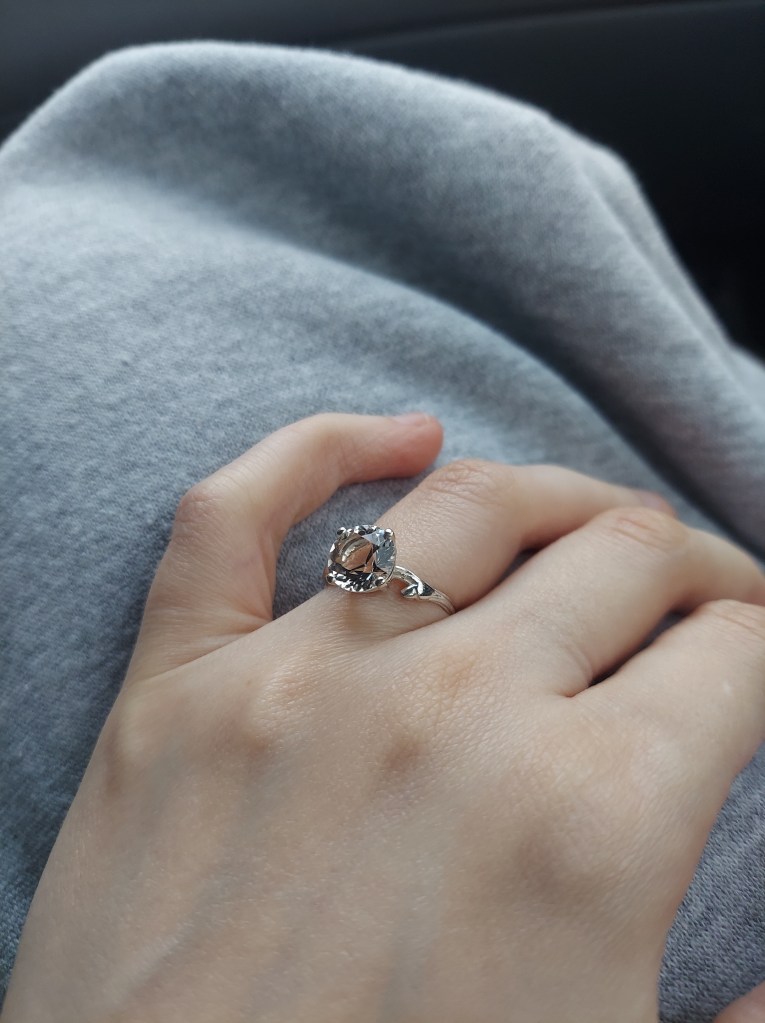
The ring was made by Green Gem. It’s silver (my favorite and most-worn metal) with a round cut Herkimer diamond. I knew I wanted a Herk because I love them, I’m not a fan of carbon diamonds, and this allowed me to get a larger, clearer stone that appeals to my crow-like desire to hoard shiny things. (Plus, if anyone asks me about it, I get to gush about the virtues of domestically sourced crystals over carbon diamonds.) I saw a twig-style ring I loved, set with an uncut Herk. I asked if it was possible for them to swap it for a faceted one, and they agreed. In the end, I got a beautiful, ethical ring that matches my style. You can see more of their rings, faceted stones, and raw crystals on their Instagram. Even if you’re not into Herks, they have a bunch of other beautiful, faceted crystals.

This tree doesn’t symbolize anything, I took a picture of it because I just thought it looked neat.

If you’re going down the path of non-traditional partnership, it can be challenging to figure out how to do it “right.” From the legality of next-of-kin stuff and inheritance laws, partnering without marriage can feel like a minefield. When I was in a same-sex relationship, we didn’t really put much thought into this kind of stuff — hospitals, death, and inheritances seemed ages away, so marriage and legality just never came up. I feel a lot better knowing that someone who knows and understands me has my back, even if we didn’t go through the traditional marriage path to do it.

crystals

How do you tell if your moldavite is fake?

So, crystals.

They’re a multibillion dollar industry that spans the entire globe. It’s to the point where creating fake crystals (not even necessarily lab-grown ones, sometimes just straight-up fake ones) is a lucrative venture. This is especially true for precious stones and high-dollar mineral specimens. You know, like moldavite.

Moldavite is an attractive stone for collectors for many reasons. For one, they’re found on the surface — no invasive, ecologically-damaging mining operations here. They’re also said to have a very high vibration. Their energy is said to be so high, in fact, that many users think their gems might be bad luck. On top of all that, they look awesome.

Without rehashing my last post about moldavite, I’ll just give a brief synopsis: These crystals are a type of glass formed when a meteorite struck Europe millions upon millions of years ago. The impact and heat liquidized the silica in the area, which was splashed into the air and formed interesting droplets as it cooled and fell to the ground again. Moldavite is varying shades of green, typically has interesting ripples or fernlike patterns on the surface, and shares a lot of properties with glass.

Photo by Moldavite AssociationCC BY-SA 4.0. No changes were made.

While this is a really cool origin story, that last bit is the kicker. Moldavite is mostly glass. That means that it’s very easy to fake using different glass.

Spotting Fake Moldavite #1: The origin.

It’s always best to buy stones direct from the country of origin. If you can get them mine- or harvester-direct, so much the better. That lets you save money by cutting out the middlemen, and means that you can get a better idea of where your stones came from and how they were collected (which is very important).

Moldavite is only naturally found in areas affected by the meteorite that made it (Germany, Austria, and Czechoslovakia). If you’re purchasing it from anywhere outside of these areas, it’s likely either going to be more expensive, or faked.

At the moment, a lot of the fake (and lab-created) crystals on the market come from China, India, Hong Kong, and Thailand. This is chiefly to do with how the world’s economies are structured right now. Some areas profit greatly off of having a manufacturing-based economy, have built an immense manufacturing base, and economically incentivize the production of goods. When a country is doing well for itself by manufacturing stuff, it stands to reason that the majority of manufactured stuff is probably going to come from there — crystals included.

Spotting Fake Moldavite #2: The price.

Real moldavite is expensive. There’s a finite amount of it. It also has to be collected by hand, and the pieces are fairly small. The limited supply and high demand means that even a comparatively tiny specimen can top $100 USD, easily.

This stone comes in different grades, the highest of which is very translucent and has a characteristic fernlike pattern on the outside, and the lowest of which is more opaque and pitted. One way to spot a fake moldavite is to check the price tag and the photo. If it’s a museum-quality piece for a suspiciously low price, it’s highly likely that it’s just molded or pressed glass.

Spotting Fake Moldavite #3: The shape.

Part of moldavite’s appeal is the external pattern. This unique texture is a direct consequence of the molten silica splashing into the air immediately after the meteorite’s impact, and cooling on the way down. It caused intriguing ripples that separate it from any other crystal out there.

In other words, take a very close look at stones that have been faceted or tumbled.

This isn’t to say that any moldavite that’s been polished is automatically fake, but altering the stone’s external texture removes one of its distinguishing features. This can make it more difficult to tell a genuine moldavite from a piece of dyed glass.

Spotting Fake Moldavite #4: The size.

Moldavite isn’t a big stone. The world’s largest is roughly 265 grams (or roughly half a pound). That’s equivalent in weight to about half a can of soup. By contrast, the world’s largest amethyst is 13,000 kg (or about 28,660 lb). That’s a little over seven cars.

If someone is selling a large moldavite specimen, take a look at the price, color, and other characteristics. If it’s opaque, smooth, and inexpensive, it’s probably not a fake crystal — but it definitely isn’t moldavite. Some sellers may try to pass aventurine or other cheaper green stones off as more expensive ones.

Spotting Fake Moldavite #5: The texture.

I’ve already gushed about moldavite’s pitted, swirly, fernlike texture before, but I want to bring it up again. Moldavite isn’t naturally shiny. It was buffeted by air currents and superheated gases as it cooled, and often splashed onto the ground before fully hardening. This means that the texture is naturally going to be kind of messed up, not smooth and shiny.

When moldavite was first gaining popularity on the crystal market, one of the ways to spot a fake was to look for a shiny appearance. Manufacturers weren’t yet able to mimic the matte surface and variety of textures that natural moldavite exhibits, so savvy buyers could pick out which stones came from the ground, and which ones came out of a mold. This is not always the case anymore — better manufacturing methods have allowed factories to turn out simulated moldavite that very closely mimics the texture of the natural stuff. Still, it’s a characteristic that’s worth noting, just in case.

Spotting Fake Moldavite #6: The interior.

Nature is good at a lot of things. Creating perfectly transparent objects is not necessarily one of them.

During the chaos of a meteorite impact, a lot of things happen. Gases heat and expand. Things melt and cool at different temperatures. The liquefied silica comes in contact with other materials, trapping them within its core. All of this leads to the tiny imperfections, bubbles, and inclusions that make crystals unique.

If a piece of moldavite is exceptionally transparent, and doesn’t show any inclusions of lechatelierite or gas bubbles, it’s likely fake.

Spotting Fake Moldavite #7: The adjectives.

Moldavite is just moldavite. It’s green, kind of swirly or pitted outside, and sort of blobby shaped. As with other crystals, beware of adjectives. Some sellers will attach them to their stones to make them sound extra rare and special. (Every crystal is unique and special anyhow, but I digress.) Meanwhile, confused buyers are overpaying for what they think is “ultra-rare” pink or white moldavite, and what they receive isn’t moldavite at all.

Moldavite also only comes from the areas affected by the meteorite that formed it. If it’s labeled as originating in another country, it might still be a tektite, but it isn’t moldavite.

Spotting Fake Moldavite #8: The feel.

This is going to vary from individual to individual, which is why it’s at the end of the list. If you’re highly sensitive to crystal energy, you may be able to tell genuine moldavite from the fake stuff by handling it. As I mentioned earlier, part of this stone’s desirability lies in its high energy. If you’re normally sensitive to crystals, and a moldavite feels like nothing to you, it may be faked. (Of course, even if it isn’t fake, I wouldn’t recommend purchasing a crystal that doesn’t resonate with you anyhow!)

Moldavite is a very cool stone with a distinctive appearance. Some of the simulated moldavite on the market is very accurate, making it hard to tell real from fake. These tips can help you spot manufactured moldavite, so you can experience the effects of working with a genuine stone and don’t end up overpaying for a fake.