
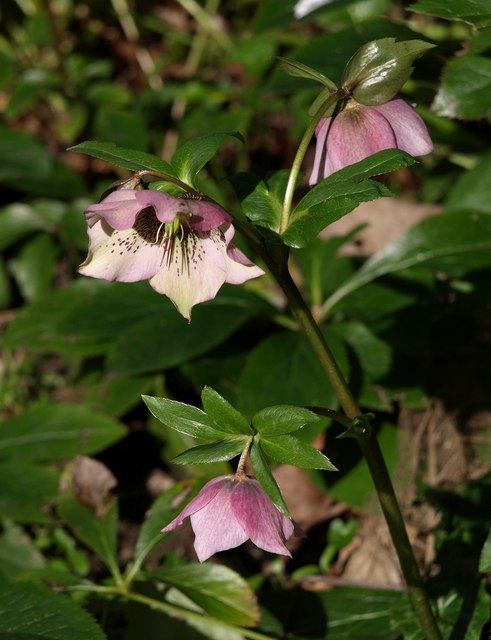
Hellebore is a plant of contrasts. This can even be seen in its name — the word “hellebore” translates to both “food,” and “to harm.” They flower early and herald spring, but their nodding habit makes them look almost mournful about the whole thing. They’re beautiful flowers, but they can be dangerous poison.
Hellebore Magical Uses and Folklore
Hellebores are sometimes called “Christmas roses” or “Lenten roses.” Despite this, they aren’t at all related to members of the rose family. Instead, they’re closer to buttercups — another lovely little poisonous flower.
The name “hellebore” most likely comes from two Greek words: Helein, meaning “to injure,” and boros, meaning “food.” Or, more accurately, “if you eat this it will hurt you.” Another theory holds that “hellebore” references food for Helle, the goddess of a connecting body of water between the Black and Aegean seas.

The name “Christmas rose” comes from a bit of Christian folklore. In it, a little girl cries because she has no gift to bring to the infant Jesus Christ. Where her tears fell, a hellebore sprang up. (It’s like The Little Drummer Boy, but more horticultural. One might also question the wisdom of connecting a highly toxic flower with giving gifts to babies, but that’s another story.)
In the past, hellebore has been used to treat various forms of mental illness, seizures, paralysis, and other maladies of the brain and nervous system. All parts of the plant are toxic, though this can vary somewhat between species — Helleborus orientalis, for example, contains the usual toxic hellebore compounds as well as some interesting cardiac glycosides that aren’t present in some other varieties. The dose makes the poison, and some toxic compounds can be useful in the face of a malady that opposes them. For example, curare is a paralyzing poison that’s also an effective antidote for strychnine, a deadly poison that causes spasms. Go figure.
In fact, hellebore is so effectively poisonous that it was used during the Cirraean War between Kirrha and Delphi during the 6th century BCE. This was the first recorded use of chemical warfare: the poisoning of Kirrha’s water supply with hellebore.
Hellebore is also toxic on contact. Despite its many dangers, you can often find it referenced in old texts as a cure for madness. In the Victorian language of flowers, it’s associated with scandal or delirium.
(Here, it’s important to note that saying an herb is “associated with” or “connected to” something can mean many different things. A plant may be associated with a concept, but not necessarily in a positive way. Hellebore is referenced more as a cure for delirium than a cause of it. In the Victorian language of flowers, offering hellebore is more likely to be a reference to scandal caused by madness madness, or to the giver or recipient needing a cure for delirium.)

As far as magical uses go, hellebore is often considered a protective, purifying, or banishing herb. (Though certainly not the kind you’d want to smoke cleanse your home with.) This is most likely a direct reference to its toxicity — not only does it have poisonous compounds in it, most of them also taste and feel awful. This is effective at keeping deer, rabbits, and other nibbling animals away. Ergo, it’s also good for getting rid of or guarding against unwanted spiritual influences.
This is something you see a lot with purifying or protective herbs. Almost all of them have a history of use as a way to repel or kill pests.
Some also use it for love or divination magic, but I don’t have much experience with this side of hellebore and haven’t been able to find a lot of sources for this. If anything, I would think hellebore is associated more with clearing one’s head rather than clouding it with romance. Still, the flowers are very pretty and frequently come in the pinks and purples we associated with the domains of love and divination.
Using Hellebore
Even though they aren’t native to this area, I love them. With care and conscientious planting, they can be a good addition to a garden. (You just need a good container, moist-yet-well-draining soil, and an area that gets shade from the summer sun and lots of sun during winter. They’re a bit picky that way.)
You’ll also want to remove the seed heads before they can scatter. If they do, you’ll be pulling up baby hellebores for ages.
Despite the “food” in their name, I strongly recommend against eating them. Even though various species of hellebore have been used medicinally in the past, they’re one of those remedies for which the line between “cure” and “kill” is very thin.
I don’t recommend handling hellebore without gloves. You may find that it helps you best as a boundary herb, either judiciously planted at the edges of a property or dried and sprinkled along it.
Unfortunately, despite its power and beauty, its uses are somewhat limited by its toxicity. It’s not an herb to use in teas, baths, anointing oils, or incense, or even to roll a candle in.
Hellebore is a lovely, mysterious flower with a dark past. While it looks unassuming enough, it holds the power to heal, and the power to raze an entire town. As a baneful herb, it requires respect and a very careful hand.


I have four different hellebores in the Concrete Jungle. They are beautiful…aphid magnets!! LOL. Seriously, I grow them because they ARE so beautiful.
LikeLike
I love them, I’m just also worried about derping into them and giving myself a reaction, lol. My aphid magnets are the broccoli and roses… luckily, a few days after the aphids move in, the ladybugs and lacewings follow ’em.
LikeLike