divination · Witchcraft

The Whole Show — Combining Divination Methods

I love divination. Back when I’d just started learning, I knew that divination — more than any other magical skill — was something I wanted to become good at. I have different tarot decks that I use for different purposes, oracle decks, Lenormand cards, a set of ogham staves, a set of runes, a scrying bowl, and multiple stones that I use for crystal scrying. There’s just one problem: What do I use?

I used to get tripped by that a lot. Which method was going to be easier? Which was going to be more explicit? Which would be more accurate?

A set of carved wooden runes.

Why not use them all?

At first, I hesitated. Admittedly, some part of me was afraid that reading multiple divination methods would give me answers that were confusing at best, and contradictory at worst. It seemed like an easy way to end up concluding that divination wasn’t telling me anything useful to begin with.

Nonetheless, I pushed on. It had to be worth a try, right? In retrospect, I’m very glad I did.

When I have a very pressing question, I do a lot. I cast a rune and an ogham stave. I read a tarot spread of my own devising. I draw an oracle card. I scry in a stone or bowl. I go outside and see what the birds’re doing and what the trees have to tell me. I drop into a trance and see what bubbles up to the surface.

And every time, it paints a very clear, coherent picture.

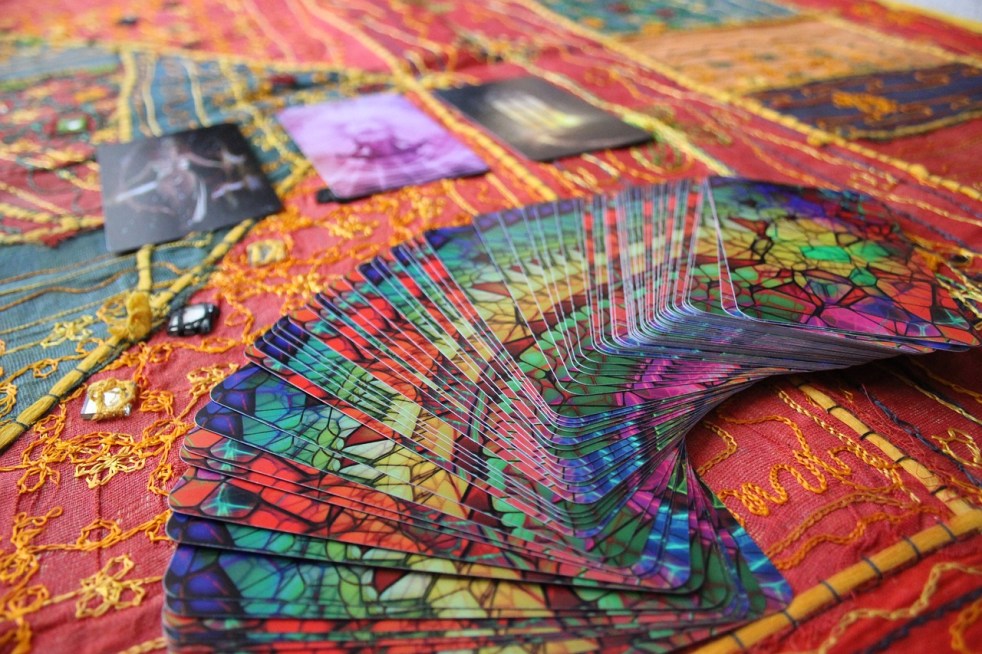
Tarot cards on a purple velvet cloth.

Each method has its own use case and emphasis, so how do you put all of that together?

The trickiest part is viewing each method in their own cultural context. Many guides to runes and ogham, for example, have simplified the meanings to the point where they’re very far removed from their original* interpretation.

(* Or allegedly original. There are large gaps in our historic knowledge of how some divination methods were used, which adds to the confusion. One example of this is the ogham forfeda. Is Mor the beech, Scots pine, or the sea?)

The lack of consensus means that it’s not really doable to just jump into multiple different divination methods and combine them immediately. It’s important to work with each one separately, to learn its limitations and develop a kind of personal interpretation of its meaning. This doesn’t mean that you have to reinvent the wheel by discarding all of their conventional interpretations, but I highly recommend keeping a divination record that allows you to look back and see how each reading turned out. This can show you what cards, runes, symbols, and so forth tend to show up for you, and when.

After that, the only question is what order to put everything in. Personally, I enjoy laying out the tarot spread first, then ogham, then runes, and finally an oracle card. Once I have this story before me, I consult nature and, if need be, scry or enter a trance.

Putting the results together is honestly the easiest part. Here’s how things shake out for me:

  • Tarot tends to show me the “why” of a situation — what feelings, mindsets, energies, and hidden facors are bringing something about.
  • If I use Lenormand, it tells me the “what.” While it might seem like that would be extremely useful, I usually skip Lenormand reading. Believe it or not, knowing what happens is usually a lot less important than knowing all of the other stuff. Think of it like being told the future by a genie who’s a bit of a prick — knowing what isn’t as helpful as knowing why, how you’ll feel about it, and what you need to do to.
  • Runes usually highlight the most important connecting concepts that unify the whole for me.
  • Ogham usually tells me what to do or focus on.
  • Oracle cards generally offer reassurance, or a way to look at the bright side and get through a difficult situation.
  • Nature augury tells me if a situation is generally positive or negative. If something very unusual appears to me, it can give more specific information akin to ogham reading.

If this sounds like a lot of work, it certainly can be! It’s also very rewarding, and even a bit thrilling to see everything come together.

If this interests you, but you don’t want to perform it yourself, that’s totally understandable. This is one of several readings I can do for you, if you like. Just check out my shop!

Plants and Herbs

Hyssop Folklore and Magical Properties

The anise hyssop in my little pollinator garden is putting of spikes of beautiful purple flowers, so I thought I’d write a bit about the magical uses and folklore of hyssop.

A fun fact first, though — anise hyssop (Agastache foeniculum) is not that closely related to actual hyssop (Hyssopus officinalis). Both of them are members of the mint family, Lamiaceae, but so are teak, rosemary, and chia. Anise hyssop is native to Central and North America, while hyssop is from the Mediterranean eastward to Asia.

Anise hyssop is definitely a useful plant, but I figured I’d cover hyssop-hyssop first. If you practice one of the many branches of European-based witchcraft or folk magic, you’re more likely to encounter Hyssopus in old texts.

Hyssop Folklore and Magical Uses

A lot of the modern lore about hyssop comes from its mention in the Bible. It’s indicated numerous times as a cleansing and protective herb. For example:

Cleanse me with hyssop, and I will be clean; wash me, and I will be whiter than snow.

Psalm 51:7

Take a bunch of hyssop, dip it into the blood in the basin and put some of the blood on the top and on both sides of the doorframe. None of you shall go out of the door of your house until morning.

Exodus 12:22

To purify the house he is to take two birds and some cedar wood, scarlet yarn and hyssop.

Leviticus 14:49

When Moses had proclaimed every command of the law to all the people, he took the blood of calves, together with water, scarlet wool and branches of hyssop, and sprinkled the scroll and all the people.

Hebrews 9:19

There’s more, but you probably get the idea. However, this runs into the same problem as anise hyssop versus hyssop. The hyssop mentioned in the Bible is not H. officinalis. (Biblical hyssop is more likely to be Capporis spinosa or Origanum syriacum.) Nonetheless, I figured the Biblical references to hyssop were worth including because they inform quite a bit of the body of lore about H. officinalis.

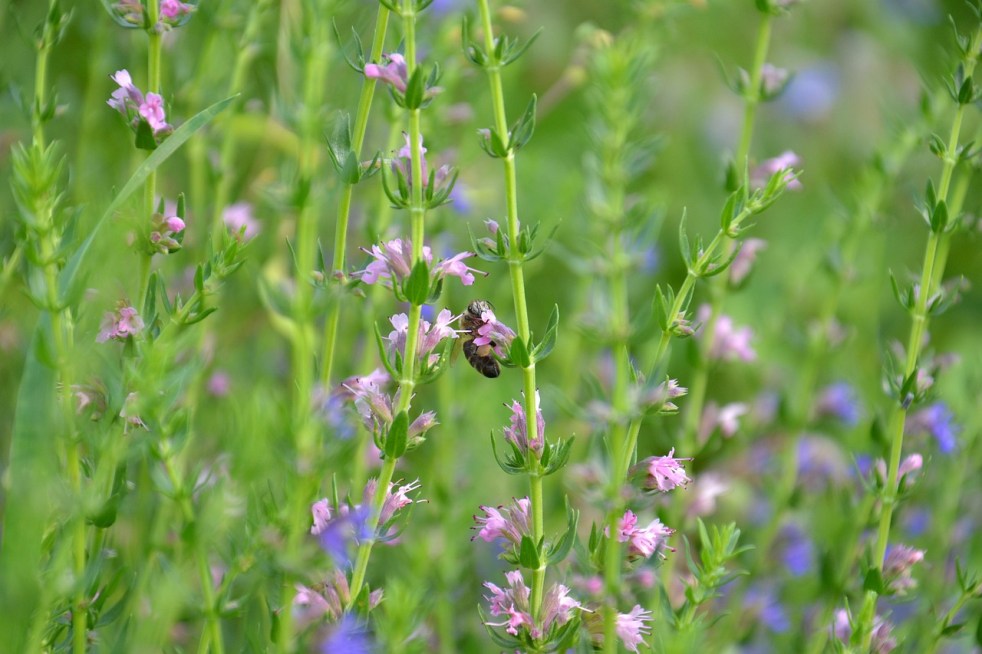
A spike of bright violet-blue hyssop flowers.

The name “hyssop” derives from the Greek word hyssopos, which derives in turn from ezov or azob, the sacred hyssop mentioned in the Bible.

In Egypt, Priests used hyssop as an additive to purify food. This was necessary to make certain foods acceptable for their restricted diet.

Magically, hyssop corresponds to the element of Fire and the planet Jupiter. Following the uses of Biblical hyssop, it’s most commonly employed as a purification and protection herb.

Medicinally, a decoction of hyssop was used topically for treating head lice. It was also used a topical remedy for minor wounds.

In Europe, hyssop was used as a strewing herb. It’s fragrant and seems to have had some action against pests (like head lice, as mentioned above). This may have made it an effective way to keep fleas and other unwanted guests away!

This last bit is particularly interesting to me. In my herb lore reading, I’ve found that the Venn diagram between “herbs used magically for protection” and “herbs that keep bugs out” is almost, but not quite, a circle. Since the Biblical hyssop probably wasn’t hyssop at all, it’s interesting to me that the purposes of Biblical hyssop and European hyssop are so close. It raises a kind of chicken-and-egg scenario — was H. officinalis named for the Biblical hyssop because its pest repellent action “purified” spaces?

Using Hyssop

Sprigs of hyssop make lovely aspergilla. Dip them in water, and use them to asperge sacred spaces, rooms, people, or objects.

Brew hyssop as a tea, strain out the spent leaves, and add the water to ritual baths for purification, cleansing, and hex-breaking. Prepare hyssop the same way, then add to a bucket of fresh water and use it for washing floors, windows, and doors for the same purpose.

A fritillary butterfly on a spike of hyssop flowers.

Add dried hyssop to charm bags for protection, particularly against the evil eye.

Hyssop is sometimes used to season food, and that’s fine. It’s even sometimes used internally in a medical context, and that’s okay too (as long as it’s under the supervision of a qualified herbalist). Otherwise, avoid eating or drinking hyssop. Large doses can cause seizures and cause miscarriages. It’s not known how much of hyssop’s active constituents may pass through breastmilk, and the threshold for hyssop toxicity is much lower for children, so it’s best avoided while breastfeeding.

Uncategorized

Wild Bergamot/Bee Balm Folklore and Magical Properties

Monarda species, also known as bee balm, Oswego tea, and wild bergamot, is one of my favorite native flowers. The blooms themselves are striking, the leaves are fragrant, they spread very easily, and they thrive where other plants falter. They’re fantastic additions to permaculture guilds, since they’re good at attracting oft-neglected native US pollinators like the raspberry pyrausta moth. It’s also tolerant of juglone, a natural herbicide produced by black walnut trees.

Bright pink Monarda flowers, growing in a bed of maroon Coreopsis.
Some bright pink Monarda didyma flowers in my garden, planted along with some deep maroon-pink lance leaf Coreopsis.

The name “wild bergamot” is a bit misleading — these plants aren’t related to bergamot at all. Monarda is part of the mint family, while actual bergamot is a citrus fruit. I haven’t been able to find an explanation for why this group of plants is called wild bergamot, so I can only venture that it’s because of the fragrance of the leaves. They’ve a sort of minty-citrusy-herbal scent, very reminiscent of Earl Grey tea.

Wild Bergamot Magical Properties and Folklore

Monarda plants are native to the US and have a very important place in the medicinal lore of indigenous American people. The leaves soothe stomach aches when used internally, treat wounds externally, and ease headaches when used as a poultice. The name “bee balm” comes from the plants ability to calm bee stings.

After the Townshend Revenue Act of 1767, colonist American people began boycotting imported British tea. Instead, Monarda leaves provided a suitable substitute.

Bright pink Monarda flowers, of a cultivar called "Marshall's Delight."

Since Monarda is native to the US, you won’t find it in ancient herb lore or medieval European grimoires. It still has a pretty long history of use as a magical ingredient, however, as people have adapted to using what’s around them over the centuries.

Some magical resources claim that lemon balm and bee balm are synonymous. Though they’re both members of Lamiaceae, the mint family, they aren’t the same plants. Lemon balm is Melissa officinalis, native to Europe, and pretty sedating when drunk as a tea. Bee balms are Monarda species, native to the US, and gently stimulating.

Due to its associations with medicine, it’s considered a healing herb.

Monarda can also be used as a purifying and cleansing herb.

It is generally considered to be ruled by Mercury and the element of Air. Due to these planetary associations, it’s sometimes used in spells for money or success in business/academic endeavors.

Using Wild Bergamot

You’ll be pleased to know that, unlike a lot of the magical herbs I talk about, wild bergamot is edible. The whole thing. Stems, flowers, and leaves. The flowers can be used to add color and interest to salads, and the leaves make a wonderful tea. You can also use the leaves to flavor pork or poultry dishes. If you do want to eat your Monarda leaves, treat them like most other herbs: Harvest the leaves before the plant flowers, when they’re sweeter and more tender. They tend to get a bit tough and bitter after the plant matures and flowers appear.

Personally, I find wild bergamot leaves and flowers to be a very nice addition to drinkable/edible brews. Use it in place of Camellia sinensis leaves as a base for magical teas. Historically, it has been drunk to ease flatulence and as a gentle, general stimulant.

One thing I enjoy doing is making simple sugar cookies and decorating the tops with magical sigils. Candied flowers, chosen for their properties, can both decorate and empower these edible spells.

For purifying, pack some fresh leaves into a large muslin tea bag and place it under your bath faucet. You can also brew Monarda leaves into a tea, strain out the plant matter, add the liquid to a bath, and fully submerge yourself.

To purify spaces or groups of people, bundle fresh Monarda stems together, dip them in salt water, and use them to asperge.

Monarda is known to attract bees, as well as ease their stings. Since it’s connected to Mercury and Air, it’s also used as a success herb. Brew a strong tea from the leaves and use it to wash your front door and steps to attract success to your door like bees to a flower. You can also add this tea to floor washes, if you wish.

A prickly-looking Monarda seed head. Its rounded, comprising many small tubes formed by the base of the flowers.
A Monarda seed head. Each of those little “tubes” houses a single loose seed, which will be picked up by birds or scattered by the wind.

In general, Monarda is a very nice herb that plays well with others. In my experience, it acts as a general attractant — magically drawing in your desires the same way that the flowers call to hummingbirds, moths, and bees. Its flavor and scent are delicious and intriguing without being overpowering, so it’s an excellent addition to brews, kitchen witchery, and spell jars. (Most members of the mint family smell pretty acrid when burned, however, so I’d avoid putting it in incense.)

If you’re in the US, Monarda is a delightful addition to the garden. It’s easy to grow, thrives on neglect, and produces an abundance of seeds and rhizomes. You’ll have plenty to harvest and share, but, unlike non-native mints, it’s not considered invasive.

Plants and Herbs · Witchcraft

Yarrow Folklore and Magical Properties

You know, I never really connected with yarrow. I know it’s kind of a magical herb staple, but I was always more into mugwort and its ilk. For some reason, yarrow just didn’t quite grab me the way that certain other herbs did.

All of that aside, I have lots of it now. When I embarked on my crusade to murder the grass and replace it with useful things (my rules are that they must either feed me or the local fauna, and preferably both), yarrow was a natural fit. It’s a lovely plant that gets tall enough to fill the space in my flower beds, and it’s very aromatic. Working with it in a gardening capacity has given me a new appreciation for it as a magical and medicinal herb, and the bees really seem to enjoy it.

Yarrow Folklore and Magical Uses

Yarrow is one of the oldest medicinal herbs. Like, pre-pre-history old. Archaeologists have identified yarrow among the belongings of a 65,000 year old Neanderthal.

Achillea specimens are found pretty much everywhere, with the exception of Africa and Antarctica. There are Achillea millefolium subspecies found in Europe, Asia, the Arctic, the Himalayas, the Alps, the Carpathians, the western US, Alaska, the US in general, and one particular that’s endemic solely to California. It’s probably not surprising that it’s often considered an aggressive weed, and may be best confined to areas that you either don’t mind having it take over, or allow you to control its spread.

Interestingly, all of these subspecies seem to have different medicinal effects. There’s some overlap, of course, but each subspecies appears to have different ratios of medicinal compounds.

The genus Achillea is named for the Greek hero Achilles. Chiron taught him the plant’s medicinal properties (specifically using it to treat wounds — hence its other common name, woundwort) and carried it into battle. It’s anti-inflammatory and antibacterial, so it’s a good plant to reach for to treat minor cuts, scrapes, and bruises.

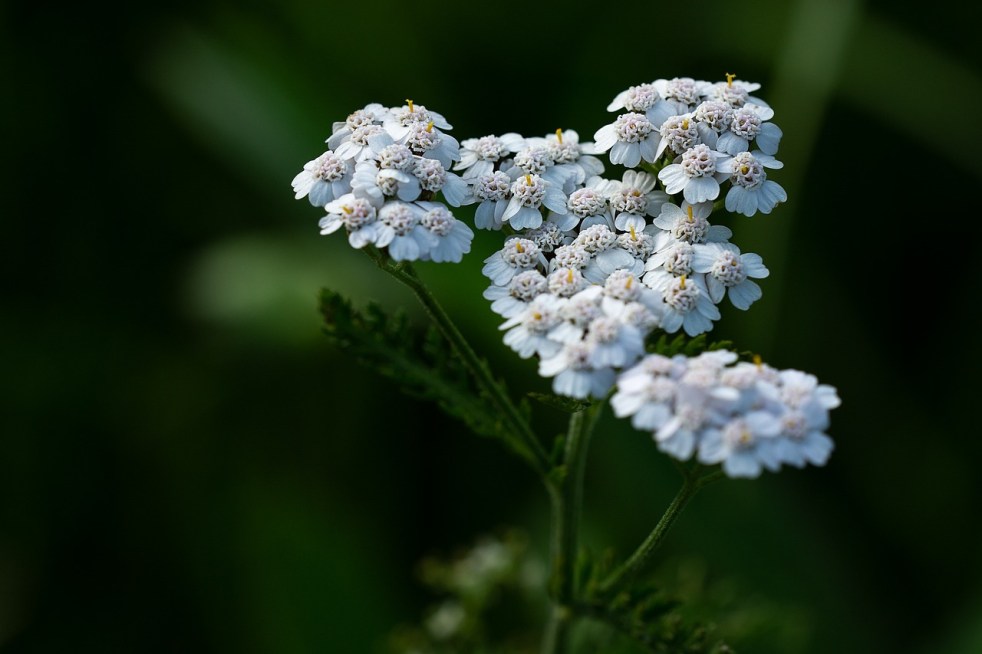
White, yellow, and pink yarrow flowers in a green field at sunset.
Chiron was half-man, half-horse, and a great healer. That makes him the Centaur for Disease Control.

This connection with battle may be why yarrow is also used as an herb for courage.

Yarrow is a protective and purifying herb. Like many herbs used to cleanse and protect, this action is borne out by its ability to repel pests. Experiments with birds using yarrow as a nest lining found that it inhibits the growth of parasites. The connection between repelling pests and magical protection is seen pretty often, as with pennyroyal, or fennel, for example.

In Europe, scattering yarrow across the threshold of a home was believed to keep evil from entering.

Yarrow is historically a divination herb. In China, one way to cast the I Ching involved counting stalks of yarrow. In Europe, it was used for love divination. You’d take a yarrow leaf and stick it up your nose, tickling yourself with it as you said,

Yarroway, yarroway

Bear a white blow.

If my love love me,

Let my nose bleed now.”

Traditional

Another method for love-divination involved placing yarrow under your pillow. If you dreamt of your love, it was a positive omen. If you had a bad dream, or dreamt of other people, it wasn’t.

An old Gaelic incantation for yarrow-picking went thus:

I pluck the smooth yarrow,

That my finger be sweeter,

That my lips be warmer,

That my voice be gladder.”

Yarrow was said to be a sacred plant to the ancient Druids, used for weather divination.

In the Victorian language of flowers, yarrow represented everlasting love.

Yarrow is connected to Venus and the element of Water.

Using Yarrow

Since so many practitioners of witchcraft and Druidry have pets and small children, I probably wouldn’t recommend just strewing your threshold with yarrow. Instead, scatter some of the dried herb under your front doormat, where curious hands or snouts can’t get into it. You can also grow yarrow near your front door — it’ll feed your local pollinators and help keep evil away.

Yarrow hydrosol is another useful way to work with this herb. It’s good for your skin. (For real, an ointment containing yarrow was researched for its ability to help heal episiotomies. Ouch!) It can also have a purifying effect, so it’s a nice way to prepare yourself for rituals. The leaves and hydrosol are also fragrant, so the scent is a nice for getting into a magical mindset.

For divination, you could either learn to cast the I Ching with traditional yarrow stalks, or include it in a spray or sachet to use while reading tarot, runes, or Ogham staves. Including it in a dream pillow is said to lead to prophetic dreams.

A soft, dreamy image of pink yarrow flowers.

As a Venus-ruled herb, it’s also a good choice to include in love jars or sachets. Traditionally, its power was to help the user find their true love, and keep lovers together. That makes it a worthwhile addition to spell to draw in true love and help it last.

Medicinally, yarrow hydrosols, infusions, and ointments are great for topical conditions like stings, bug bites, scrapes, burns, scratches, cuts, and bruises. (Never put anything ointment-y over deep wounds, puncture wounds, or animal bites, however.) Teabags or poultices of yarrow are also nice for easing sore eyes — just be careful not to get yarrow in them! If you’re allergic to yarrow or other members of the Asteraceae family, skip yarrow and use something else.

This herb is also used for treating a ton of internal conditions, from digestive trouble to colds and flu. But, like I mentioned previously, each subspecies seems to have its specialties. Before using yarrow internally, you should consult with a qualified herbal practitioner to choose the safest and most effective herbs for your condition.

Uncategorized

Blueberry (and Bilberry) Folklore and Magical Properties

I love blueberries. Few things are as delightful as a fat slice of warm blueberry pie or cobbler, with a generous dollop of ice cream (or non-dairy ice cream equivalent, as it were).

I was very excited to find that the previous occupants of this house had planted some blueberry bushes in the back yard. Unfortunately, these bushes weren’t exactly thriving — they’d been planted in an area that’s under trees. It gets plenty of light during the late autumn to early spring, but very little in the warm months. Our soil is also hard clay, and it didn’t appear that the area had been given much organic matter.

So, as much as it worried me to do it, my spouse and I uprooted these bushes and moved them into a much sunnier spot, blended well with a generous amount of shredded bark and leaf compost. We also planted two more bushes of a different variety, to fill out the tree guild we’re building around the Chehalis apple tree I talked about two weeks ago.

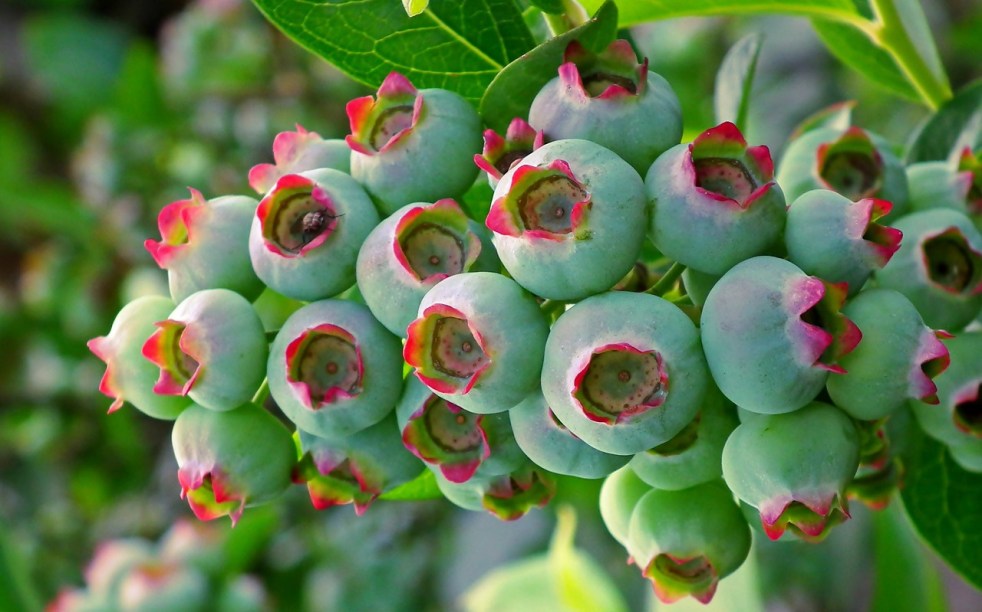
A cluster of ripening blueberries on a bush.
Some lovely little unripe blueberries on one of the bushes in the back yard.

This post isn’t about soil composition and permaculture, though I could definitely go on for volumes if it was.

No. Today, I want to get into some of the folklore and magical uses of these wonderful little balls of deliciousness.

It should be noted that blueberries (Vaccinium angustifolium, V. corymbosum, et al) are a strictly New World fruit. There’s a European relative called the bilberry (or European blueberry, Vaccinium myrtillus) that’s very similar, and the magical properties of these fruits are virtually interchangeable. If you live in an area where bilberries are native, use bilberries. If you live where blueberries grow, use those instead.

Blueberry and Bilberry Folklore

While blueberries are named for their deep purplish-blue color, the name “bilberry” is likely of Scandinavian origin. The Danish word bølle means “whortleberry,” which is another word for certain members of Vaccinium including the bilberry.

You can tell blue- and bilberries apart by their fruits. Blueberries grow in clusters, are a purplish-blue, and have a blossom end that looks a bit like a pentagon with five pointed flaps. Bilberries grow alone or in pairs, are almost black, and have a circular, smoother blossom end.

A bilberry on a bilberry shrub. The blossom end is facing upward, showing a distinct lack of the pointed flaps found on blueberries.
As you can see from this bilberry’s “butt,” they have rounder blossom ends and lack the pointy flappy bits of American blueberries. Compare it to the unripe blueberries in the photo above this one.

In Ireland, bilberries (fraochán or fraughan) are traditionally gathered during the last Sunday in July and the first of August. The first of August is Lughnasadh, a festival marking the beginning of the harvest season. Bilberries and blueberries are a traditional addition to Lughnasadh festivities all around the world.

Since gathering bilberries was traditional for the beginning of the harvest season, they were treated as a kind of oracle. If the crop was abundant, other crops would similarly flourish. If the bilberries did poorly, everything else would, too.

In ancient Greece, bilberries came from Herme’s son Myrtillus. King Oenomaus of Pisa had been given a prophecy: He would one day be killed by a son-in-law. Seeking to avoid this fate, Oenomaus decided to prevent his daughter, Hippodamia, from ever marrying by challenging every one of her would-be suitors to a chariot race on the Isthmus of Corinth. If the suitor won, he’d get Hippodamia. If he lost, Oenomaus would kill him. Since Oenomaus’ chariot was pulled by horses given to him by the god Ares, there was no way he could ever lose.

Then came Pelops. Hippodamia fell for him immediately, and went to her father’s servant, Myrtillus, for a favor. She wanted him to sabotage her father’s chariot so he’d lose the race, and Myrtillus, full of unrequited love for Hippodamia, agreed. On the day of the race, Myrtillus switched the metal linchpins of Oenomaus’ chariot with ones made of beeswax. Oenomaus’ chariot flipped, and Pelops beat him easily.

Some versions of the story say that Oenomaus, with his dying breath, asked to be avenged. Pelops then threw Myrtillus into the sea, and Hermes turned him into a bilberry shrub when he washed to shore. Another version says that Pelops, Hippodamia, and Myrtillus were traveling, when they stopped at an island so Pelops could fetch his new bride some water. When he returned, Hippodamia was in tears. Myrtillus had tried to sleep with her, she cried, while Myrtillus protested that she had promised to do so in exchange for sabotaging Oenomaus’ chariot. The enraged Pelops then killed Myrtillus.

In the folklore of some of the people indigenous to blueberry’s native range, blueberries are called “star berries” for the star-shaped blossom end.

In the Victorian language of flowers, bilberry represents treachery. This symbolism is likely borrowed from the Greek story of Myrtillus.

Blueberry and Bilberry Magical Uses

Blue- and bilberries are associated with protection and luck in European witchcraft.

Dried bilberry leaves are used in protective powders but can also be used whole for prosperity and luck.

The fruit is similarly used for protection and hex-breaking.

(Considering bilberry’s associations with treachery and crop divination, I wonder if their protective properties stem from their connection to physical danger and starvation. Today, we know that fruits like blueberry and bilberry can protect against oxidative cellular damage due to their antioxidant content, but their traditional connection to protection goes back much farther.)

Using Blueberries and Bilberries

Blueberries and bilberries couldn’t be simpler to use. For kitchen witches, include them in recipes for protection and the removal of malevolent enchantments.

Crushing the fresh berries can yield a pigment suitable for drawing protective sigils on paper talismans, the skin, and anywhere else you might need them. Just bear in mind — both of these berries are sweet, and your talismans may be sticky and likely to attract bees this way!

To protect your property, dry bilberry or blueberry leaves. Powder them well, then sprinkle the powder around the perimeter of your home or yard.

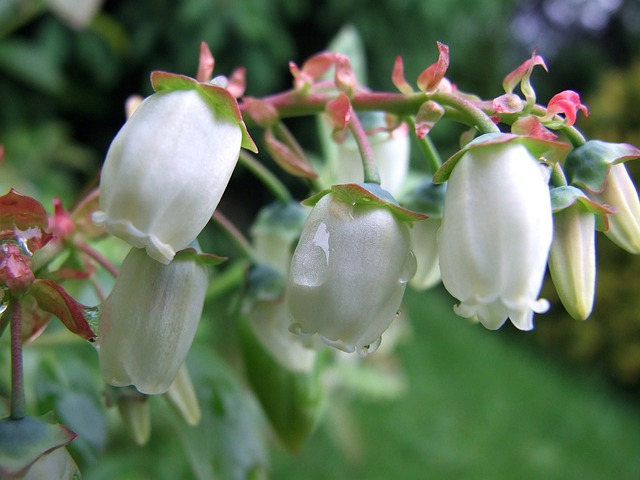
White, bell-shaped blueberry blossoms.

To break a hex, jinx, or run of bad luck, burn dried blue- or bilberry leaves. Use the smoke to fumigate the same way you’d use incense smoke.

Blueberry and bilberry don’t appear to be reversing herbs. That is, they don’t return treachery or malevolent magic to the sender. They just keep it from affecting you.

Since bil- and blueberry seems to predominantly be a protective herb, I would hesitate to use it solely for drawing luck. It appears that it’s virtue in luck drawing lies in its ability to get rid of jinxes and other things that hold you back. For luck spells, then, I’d pair blueberry or bilberry leaves with an ingredient used more specifically for attracting good luck. The berry leaves can clean up the things standing the way of your luck, and the other ingredients can draw it in. Allspice, chamomile, and fenugreek are all good options to consider here.

Interestingly, strawberries are sometimes used in small amounts for luck drawing. You could then theoretically make a jam, smoothie, or pie with both blueberries and strawberries, and, when appropriately made and empowered, use it to attract good luck to you.

It remains to be seen how my poor transplanted blueberries do, but the newer ones seem to be thriving. When the time is right, I’ll harvest the fruits and some of the leaves, and hopefully have enough protection and hex-breaking to last me all year!

life · Witchcraft

Really, if you think about it, I’m just helping them sell their house (in a sense).

I can’t say I’ve ever lived in a very close-knit community. My custodial parent was tired and angry all of the time, so we didn’t really do community activities, either. Now that I’m adult enough to do that kind of thing on my own, I love it. I can’t say that I really have any super close friends in my neighborhood, but I still love things like street fairs, farmers’ markets, and that gem and mineral show we went to not that long ago.

That’s why I approached the sudden appearance of a “For Sale” sign in my neighbor’s front yard with equal excitement and trepidation.

The house belongs to an older couple who have an adult daughter and young grandchild. It’s just like the others on my street — a post-war Cape Cod in a decent-sized yard, but theirs has an addition to give it some more space.

I never really saw the owners much, so I’ve never had the chance to really get to know them. I’m pretty much a golden retriever in a human suit, and my baffling levels of friendliness and desire for connections to other organisms yearn for expression, so this is a regret on my part. Honestly, the people who own the place could’ve moved weeks ago.

But this now raises a question: Who’s gonna buy it and move in? We’re in a walkable location that’s not far from DC, so I could see it going to someone who wants to Airbnb it (which is kind of a huge problem in this area in general). I hope not, though.

Honestly, I just hope whoever chooses to move in doesn’t suck.

Then I figured — if you can use magic to draw love, luck, and friendship into your life, why not cool neighbors?

Two candles, one pink and one yellow, lay sideways under a chunk of rose quartz. They are surrounded by four black Herkimer diamonds, and a stick of cedar incense burns just above them. There's a small quantity of incense ash on the wood near the candles.

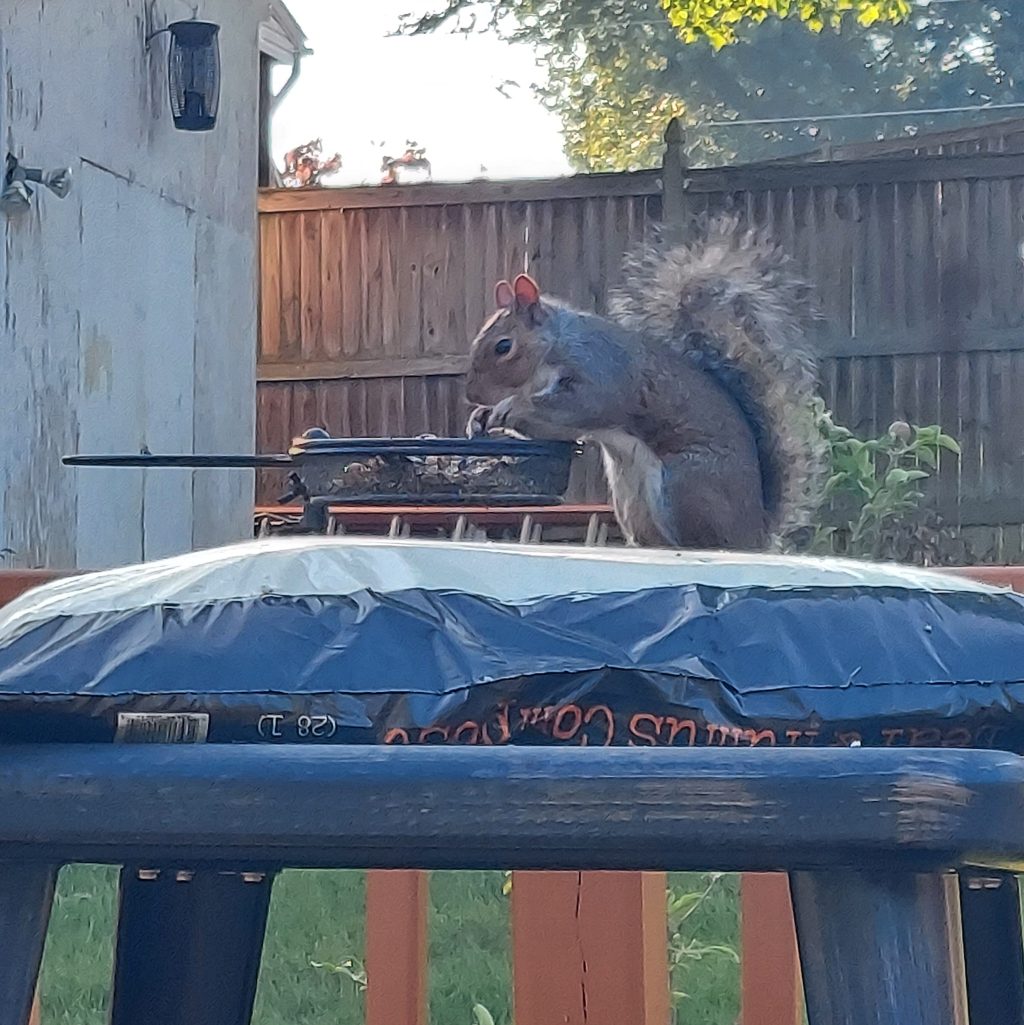
This train of thought it what has found me sitting on my deck, fuming a set of candles (pink for platonic good feelings, yellow for friendship) and a bit of rose quartz in cedar incense, all while arguing with Frederick de Bonesby that it is actually very rude to let his gigantic ass take up the entire platform feeder, and there is a line of sparrows squabbling behind him while they wait their turn.

(Frederick de Bonesby does not care. His primary concern is maintaining his skin and his flesh and his fats, even though he is a tubby squirrel and not a powerful 92-year-old lich. He does this chiefly through consuming copious amounts of peanuts and dried corn.)

A squirrel sits on the railing of a deck, paws busily rummaging through a pile of nuts and seeds in a platform feeder.

But I digress.

Really, I’ve been using yard work as a kind of stealth mission. See, there’s a porcelain berry vine (pretty, but invasive) near the driveway that needs to be torn out. It’s right next to the fence dividing the properties, and also right by our gate. According to my calculations, this makes it an excellent spot to conceal a sweetening jar, which I can do by digging up the porcelain berry vine and stealthily burying the jar in its place.

I could fill it with sugar syrup and honey. Cinnamon and petals from the big Virginia rose bush in the front yard. Clover blossoms snuck from the edge where our yards meet.

I could also modify a love spell to attract a good neighbor. There are a bunch of them that involve listing the ideal qualities of a potential lover. But instead of “physically attractive” and “financially independent,” I could put things like, I don’t know, “fond of crows,” and “has strong feelings against lawns,” and “doesn’t think the entire LGBT community is a cadre of secret predators.”
Really, the principle is the same.

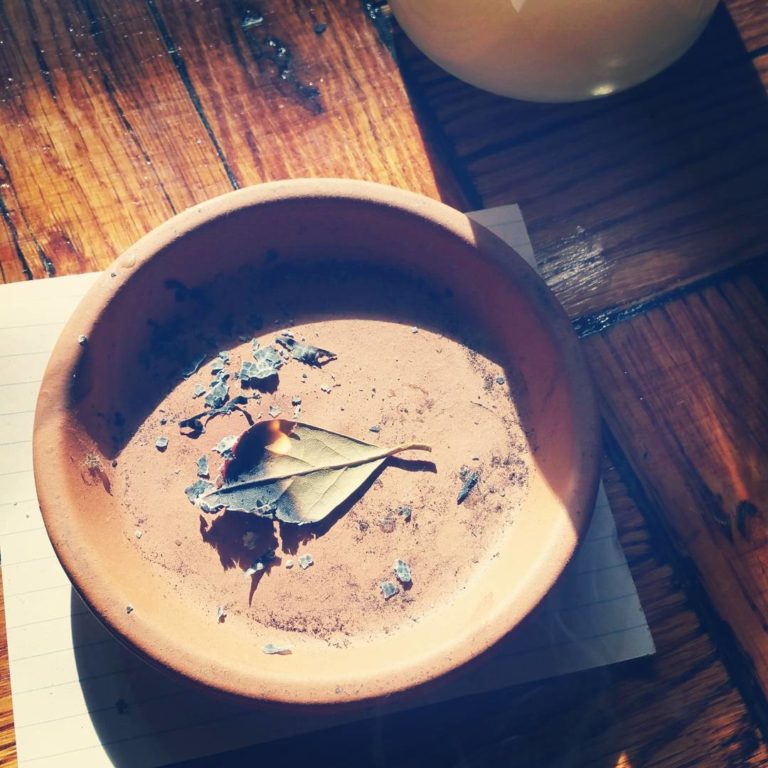
I could fold up the list and put it in a sachet with a magnet and the right herbs and stones. I could take the items on the list, write them on bay leaves, and sit on my deck while I burn them and blow the smoke to the four winds.

A terracotta dish holding a burning bay leaf.

I could whisper my wishes to a handful of birdseed, throw it on the ground, and let the birds carry them where they need to go.

I’m also considering modifying another love spell that involves using human image candles. It’s a kind of sympathetic magic where you take an image candle of the appropriate gender for each person, then move them incrementally closer together over a period of seven days, burning the candles a little bit each night. Once they reach each other, you burn them together and either bury the remains near your front door, or melt the wax together, pour it into a mold with bits of herbs, and make a pretty charm of it.

I could find a candle shaped like a house instead, then mark it with the address. Then I’d just need a general human-shaped image candle (or even a plain white one, in a pinch). The moving and lighting part would be the same. Once all I’ve got is stubs and wicks, I could hide the candles under the sweetening jar where the porcelain berry will… have… used to have been.
(I don’t know how tenses work for situations like this. I feel like I need Douglas Adam’s help.)

Honestly, I just want neighbors like the two ladies whose tend was next to mine during a celebration I attended years ago. One was a Unitarian Minister, one was an experienced mushroom forager, and they were very kind, generous, and friendly (and fabulous cooks). One of the first things they said to us was, “Nice to meet you! Breakfast is at seven.”

A lot of people consider such spells questionably ethical, even if you perform them without the intent to manipulate a specific person’s behavior. If you really think about it, in a way, I’m kind of just helping my neighbors to sell their house. I’m also attracting people who don’t want to exploit the area for its Airbnb potential and prefer native ecological diversity to monoculture lawns.

So really, I’m also kind of in in the right.

I just hope none of my other neighbors see me burying a bunch of jars and candle stubs in the front yard, or it could get awkward.

Books · Witchcraft

The Black Toad: West Country Witchcraft and Magic

It’s been a bit since I’ve sat down to read an entire book from start to finish. To be honest, I just haven’t had the time or attention to spare. I do want to get back into providing reviews and recommendations for books, since I see so many posts on social media asking for resources.

This week, I’ll be looking at Gemma Gary’s The Black Toad. At only 133 pages (not counting the bibliography and index), it’s a slim volume. Though diminutive, it’s definitely not hurting for content!

I’ll be honest, a lot of modern books and websites about witchcraft kind of make my eyes glaze over. Now, in a time where everything just gets boiled down to vibrations, intention, and personal gnosis, all of the advice and explanations sound very samey after a while. (They’re also not terribly helpful, and then people wonder why their craft doesn’t work!)

I really enjoy books on witchcraft that have a more historic bent. When I write about herbs or minerals, I end up looking into folklore, not modern lists of associations or uses. It gets closer to the heart of the matter and keeps me from having to reinvent the wheel through personal gnosis, as it were.

All of this is to say that I really, really like The Black Toad. It covers protection, luck, plant charms, weather witchery, and cursing, broken up into the domains of Old Mother Red-Cap, Green-Cap, and Black-Cap. All of this is presented without apology — for the one with the power to heal and protect must necessarily also have the power to destroy.

A rowan branch laden with red berries.

The spells and charms aren’t written like lists of instructions. Instead, they’re detailed descriptions of historical ways that witches and wise people had for protecting themselves and their animals, improving their luck, healing, and handling their enemies. It’s more than possible to use it as a spell book, but it’s primary value, to me, is as a depiction and explanation of traditional practices.

The only downside is that scientific names aren’t (or possibly can’t be) provided for some of the plants mentioned. Take sage, for example. The mention of sage states that it was drunk for health and longevity. However, there’s a sage native to the area that isn’t a sage at all — wood sage (Teucrium scorodonia). The actual sages, the Salvia species, are native to the Mediterranean. So is this sage an imported garden sage, or native woodland germander? Unfortunately, historic resources often don’t leave us much to go on.

A stack of books, magical seals, and dried herbs. Smoke rises from a bowl of burning herbs.

Some other reviewers pointed to the use of Biblical passages in some of the formulas as a problem. However, this is ahistoric and there are plenty of traditional resources that use passages from the Bible. There’s no reason to believe that witches and wise people, historically, would have reason to look down on doing so. The attitudes of modern people toward organized religion have no bearing on what people were likely to use in the past.

I’d recommend The Black Toad to anyone with an interest in traditional western European witchcraft. It gives a useful picture of the role and domain of wise people, as well as several spells that are still useful today.

crystals

Andara Crystals — What are they, and what’s their deal?

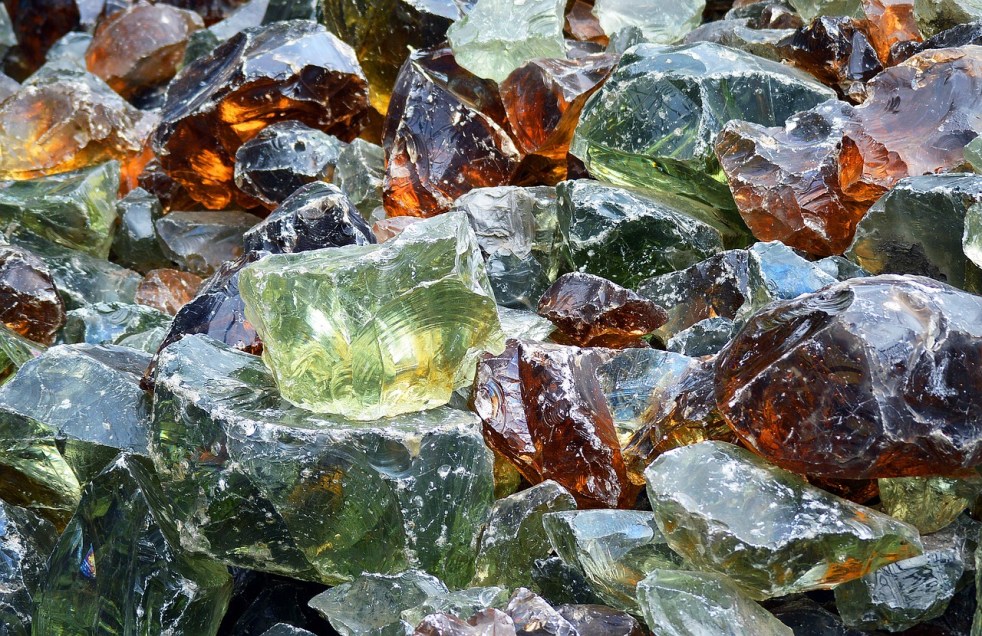
There are a number of stones in the gemstone trade that are referred to as crystals, when they really aren’t. Some, like art glass, don’t have a crystalline structure. Others might be mineraloids, which also lack a crystalline structure. All of this is to say that a fair amount of “crystals” aren’t really crystals at all.

With that out of the way, let’s look at Andara crystals. These are often brightly colored, very fancy-looking clear stones that are purported to have a ton of healing and metaphysical properties (and fetch correspondingly high prices). But what are they, and why are they controversial?

What are Andara crystals?

Andara crystals are said to be natural glass which comes from a handful of specific sites in northern California and Nevada, which are the foci of particularly high-energy vortices. These crystals come in every shade of the rainbow, and fans say that they can heal, balance the chakras, raise vibrations, and more. Some even claim that they’re the philosopher’s stone of legend, or an ancient healing tool used in Atlantis.

These stones are said to contain etherium, which is a blend of 70 different minerals. Some are listed as monatomic, which refers to substances made up of elements that naturally exist as a single atom.

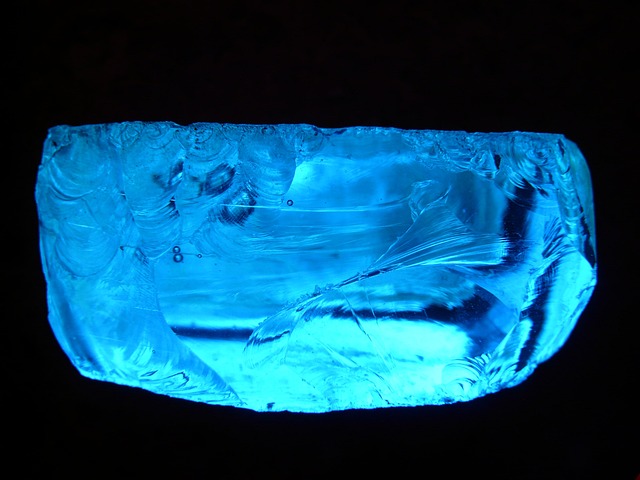
A chunk of blue glass on a black background.

Okay, so why are they controversial?

Andara crystals are controversial for a few reasons. For one, they’re not crystals. They’re a type of glass.

For two, they’re not natural (as in, formed by nature). Andara crystal deposits correspond to land dumps of slag glass from manufacturing. They look like slag, and their chemical composition correlates to soda lime glass, of the type used to make bottles. It doesn’t resemble other forms of natural glass, like obsidian or moldavite. The chart in this post gives a pretty thorough breakdown.

The funny thing is that some sellers extol the virtues of Andara crystal and claim that part of its specialness lies in its dissimilarity to other natural glasses. Yes, of course it’s not similar to them — because it’s soda lime glass.

Selling Andara crystals as a natural product is a bit like selling beach glass and claiming it was formed by nature. It may have been shaped and influenced by it, but it’s a man-made material at its heart.

The controversy doesn’t like in Andara crystal’s man-made origins, however — it’s because it’s literally a manufacturing byproduct. Chunks of slag glass get dug up, cleaned off, labeled with a lot of healing and metaphysical properties, then sold for sometimes hundreds to thousands of dollars.

This has caused trouble with not only buyers, but also dealers. When you’re selling something indistinguishable from a chunk of broken bottle, it becomes a race against “counterfeiters.” (I use “counterfeiters” here because the counterfeits are, again, indistinguishable from the alleged genuine articles.) This has led to dealers claiming that their glass is the only true Andara crystal, and dealers selling specimens back and forth to each other — accompanied by certificates of authenticity.

The Emperor’s New Crystal

Is it bad to use a man-made material for metaphysical, spiritual, or even energetic healing purposes? Not necessarily. I honestly love the idea of using slag glass this way, because it removes manufacturing waste from the environment and gives it a second life.

(A crystal — any crystal — isn’t going to take the place of the services of a competent medical professional. If you need insulin or to have a tumor removed, there is no stone that will make that not be the case anymore. I’ve used crystals to get relief alongside conventional treatment and complementary therapies, but I’m not out here trying to cure pseudotumor cerebri by rubbing rocks on my head.)

But here’s where we get into what I think of as the Barmicide Feast of crystals — or, if you prefer, the Emperor’s New Crystal.

It’s true that developing your own personal associations is important for any magical or spiritual tool. I have stones I work with that I love, but other people don’t get anything from. Other people have crystals or herbs that they love, but I get nothing from. These relationships shift and evolve over time, and that’s good and fine.

Unfortunately, some proponents of Andara crystal have used this as a selling point in a way that’s, frankly, kind of gross. They attach long lists of metaphysical attributes to this glass, then claim that only the special and spiritually evolved can feel or access them. If you see the slag for what it is — slag — then you need to get on their level.
See? Nasty.

The biggest problem here is that they’re exploiting a grain of truth to build up the cachet of a manufacturing byproduct in order to charge exorbitant amounts of money for it. They’re not wrong when they say that not everyone can experience the energy of a stone — even glass. The shitty part comes from using this exclusionary tactic to get money from people who want to be part of the in-group. Vulnerable people who want to feel that special energy, to feel elevated and included, and are willing to pay for it.

The underlying message is that when you compliment the Emperor’s gorgeous robes and rave about Barmicide’s pistachio-fed lamb cutlets, you, too, can be spiritually evolved.

Again, the shady part isn’t using (or even selling) soda lime glass as a magical or spiritual tool. The shady part is overcharging for a common, inexpensive material.

If you have and use Andara glass, that’s wonderful. My only advice here is, if you feel drawn to it, use this as a starting point to unpack your relationship with crystals. What’s different about that soda glass versus other materials that are around you? If it’s its place of origin, consider visiting this energy vortex and experiencing it for yourself — you might find a piece of regular quartz or some other mineral that gives you just as much, but you won’t have to overpay for it. If it’s the metaphysical claims and the experience of buying the stone from a dealer, then that may be something worth exploring further.

Environment · Plants and Herbs

Dead Nettle Folklore and Magical Properties

’tis the season for deadnettles!

If you have any semi-neglected patches of ground in your life, you may have seen them — short plants with heart-shaped leaves, arranged like low towers accented by tiny flowers. Though they’re not native to this area, they’re pretty abundant. If you’re into controlling invasive plants, you’ll probably be happy to know that they’re also delicious edibles!

Don’t let the name fool you. Dead nettles aren’t poisonous, and they’re not nettles. They’re called “dead nettle” because they look an awful lot like stinging nettle, but their leaves are stingless. In reality, they’re part of the mint family (which probably explains their prolific growth and ability to thrive pretty much anywhere).

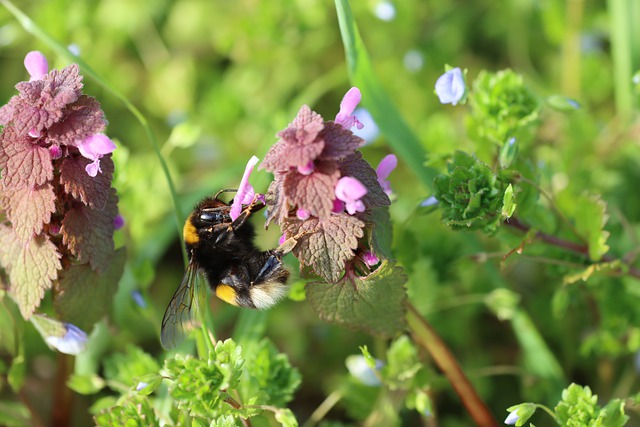
A bee enjoying some soft pink dead nettle flowers.

One of the best things about these nutritious plants? They’re easy to identify and don’t have any poisonous lookalikes. They’re also useful in all kinds of other ways.

Dead Nettle Folklore

Medically, purple dead nettle is used for allergies. It’s rich in quercetin, and has anti-inflammatory properties that make it useful for people with spring hay fever.

Some areas call it purple archangel, because it appears there around the Feast of the Apparition (May 8th). This was when the archangel Michael was said to have appeared on Mount Gargano, Italy, in the sixth century.

White dead nettle is sometimes called bee nettle. This is because it provides an early source of pollen and nectar, so it’s very popular with bees (and children! Kids sometimes suck the nectar from white dead nettle flowers, kind of like how kids used to suck the honeysuckle flowers that grew on the elementary school’s fence when I was little).

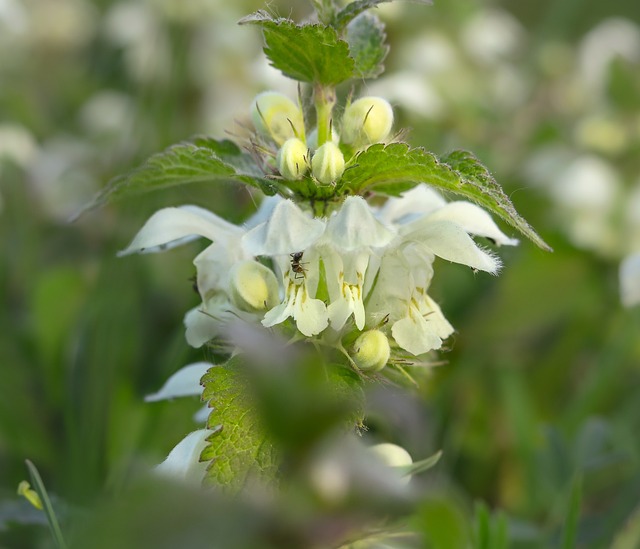
Some white dead nettle flowers. A small ant is crawling inside of one of them.

In Lancashire, it was said that white dead nettle flowers always come in twos, because they’re actually pixie shoes that have been left outside. These flowers also have two black spots inside, which are sometimes called “Cinderella’s slippers.”

White, spotted, and purple dead nettles are all used to treat stings from actual nettles. Mash the plant, squeeze out the juice, and apply it to the stung area. You can also chew some of the leaves and apply the resulting paste.

Magical Properties of Dead Nettle

Dead nettle is associated with determination, due to its ability to grow pretty much anywhere. (I’ve been harvesting it from cracks in the concrete, here.) It’s also connected to happiness, optimism, and relief.

Bright pink dead nettle flowers.

Like other members of the mint family, it dries well. Harvest some, hang it upside-down, and put a paper bag around it to keep off dust and catch any dropped leaves or flowers. Once you have some dried dead nettle, you can use it in teas, incense blends, sachets, poppets, jar spells, or pretty much anything else. This small, unassuming herb is fantastic any time you need a hit of joy and motivation.

Dead nettle is also useful in kitchen witchery. Add it to soups, salads, or even pesto to benefit from its magical and anti-inflammatory properties.

This plant also works wonderfully in tinctures, salves, and oils. This is a great way to preserve it well beyond its season.

For now, I’m pulling it out of my raised beds to prepare them for other things. Some will be left for the birds (chickens, especially, seem to love the stuff), and the rest will be brewed into tea, blended into smoothies, eaten fresh, dried, and pureed and frozen in ice cube trays to add to soup or fill out pesto!

Plants and Herbs · Witchcraft

Crocus Folklore & Magical Uses

It’s spring (kind of)!

At least, it’s getting spring-y here. Granted, I think we maybe had about four days of actual “winter,” but it’s been t-shirt weather for the past few days, and looks like it’s going to stay that way for at least another week.

Since things were warming up, I stepped out back to take a look at the yard. The elderberry bushed that I planted last year have some new leaves coming in, the bulbs I planted are starting to poke up through the mulch, and the apples are both looking good.

There’s also a large patch of surprise crocuses that seem to have popped up overnight next to my shed.

These are either Crocus vernus, the spring crocus, or Crocus tommasinianus, the woodland crocus. They’re beautiful, but decidedly not native to this area. (Crocus vernus and C. tommasinianus are related to C. sativus, the saffron crocus. However, these crocuses are definitely not a way to make rice more delicious.) Still, I am determined to enjoy them before it’s time to remove the bulbs and put in some native coralberry bushes. I’ll probably keep the bulbs and move them to somewhere where they’re less likely to spread.

If you’re also experiencing a flush of these tiny colorful flowers, here’s some old folklore and a few ways to make them magically useful.

Crocus Folklore

In ancient Greek legend, Crocus was a human man. The nymph Smilax was in love with him, but, ever the fuckboy, Crocus was dissatisfied with the affair. The gods turned him into a saffron crocus.

Another version of this story claims that Crocus was a companion of Hermes. Unfortunately, he stood up at an inopportune time during a discus throwing match, and Hermes accidentally killed him. As Crocus’ blood fell on the soil, saffron crocuses sprang up.

Spring crocuses are associated with Persephone, Aphrodite, and Venus. Mythology would also appear to tie this flower to Hermes.

A London source claimed that picking crocuses tended to “draw away the strength.” Therefore, only strong men or healthy young women should attempt to.

A field of purple and white crocuses at the base of a mountain.

According to Pliny, wearing crocus around the neck would prevent drunkenness. Interestingly, Swiss parents would place saffron around their children’s necks as a protective charm (presumably not against drunkenness, or else they’ve got some explaining to do).

In the Victorian language of flowers, crocuses represented cheer and youthful gladness.

This flower is associated with the planets Venus and Mercury, and the element of Water.

Crocus Magical Properties

Historic mentions of crocus as a protective charm typically refer to saffron crocus, not the spring crocuses. It can be hard to tease out folklore and uses attributed to spring crocuses, since the autumn-blooming saffron crocuses were generally considered more useful. For our purposes, I’m going to focus on spring crocuses here.

Spring blooming crocuses are used in charms for love, including platonic love or love of the self.

As an early spring-blooming flower, spring crocuses are also useful for spells for new beginnings.

These flowers are common altar decorations for Imbolc and Ostara. However, use caution if you bring spring crocuses indoors — all varieties of crocus other than C. sativus are toxic. Spring-blooming crocuses can cause diarrhea, vomiting, and digestive upset, while autumn-blooming crocuses can cause liver and kidney damage.

Simple Crocus Spells

You can include crocuses in charm bags for love. Add the dried flowers to a pink or red pouch along with rose petals, lavender flowers, and a bit of cinnamon bark. If you like, add a piece of rose quartz. Dress it with your favorite love-drawing oil (in a pinch, infuse some cinnamon, basil, and rose in grapeseed or sunflower seed oil, and use that) and keep it on you.

You can also use crocuses as a form of sympathetic magic. Plant a bulb along with a slip of paper with your name, and the name of your partner. Declare that as the plant grows, your love will flourish with it. When the flower is at its peak, pick it and save it for a love charm.