animals · life

Pagan Pride 2024! (In which I meet some very handsome lads.)

This past Saturday was Pagan Pride at the Unitarian Universalist Congregation of Frederick. If you’ve never been, I highly recommend it — there’s live music, workshops on a variety of subjects, food, and tons of vendors of all kinds of cool stuff!

(I, personally, came away with a mug, some artwork, a mushroom-shaped incense holder, a pin, a set of earrings, dried organic lavender, magnesium butter, a really cool jar shaped like a skull, a hand-dyed and block printed bandana, and a display of a mossy log set with three corked test tubes. The stump in the front yard has been putting out a ton of interesting mushrooms lately, and I’ve been dehydrating what I can identify. I’m looking forward to displaying them once they’re done!)

This year, I decided to skip the workshops in favor of hanging out with friends (actually, many of the friends that I just saw at the Mabon celebration), listening to music, and eating delicious sorbet. The Street Cow‘s Cowabunga sorbet pop is non-dairy, real fruit puree, and awesome.

An image of a series of moon-shaped suncatchers. They're all made of copper wire, decorated with gemstones, brass charms, and crystals.

Also, I met some very handsome lads.

This is Spectre.

An image of a snowy owl, with his beak agape.
Spectre is fine, it was just toasty out and he is a young boy who is very excited to see new things.

He was part of Avian Encounters, a group of falconers who provide people with the chance to learn about and see raptors close up. These are all trained birds, kept by licensed professionals who know how to properly feed, care for, and mentally engage them. Getting to see birds like this up close is a rare and fascinating experience.

They also had a little screech owl, an American kestrel…

And (oh, be still my heart) a gorgeous African pied crow.

A close up of an African pied crow, showing their distinctive white chests and backs. They look like black crows that are constantly wearing little white sweater vests.

“May I take a picture of him?” I asked, barely able to contain my excitement.

“Sure! If you make a donation, you can also hold him and take a picture.”

!!!!

A photo of the author with the pied crow perched on their arm.

Needless to say, I did. He sat still for a short video (the picture to the right is a still), before hopping back to his handler. The whole time, I gushed to him (like a starstruck dork) about how pretty he is.

Human celebrities are all well and good (I saw one of my favorite musicians not long ago and managed to be surprisingly normal about it). A really cool bird or bug, though? I will absolutely lose my mind.

Pagan Pride is delightful every year, but this year was particularly special. I really hope Avian Encounters is there next year, too — the birds are all beautiful, alert, and well cared-for, and it’s a great opportunity to learn more about them and get some close-up reference photos for paintings.

Plants and Herbs

Nepenthes (Pitcher Plant) Folklore and Magical Properties

Now that I’m home, I’ve been spending the day unpacking, straightening up the house, taking care of my cats and plants, and eating pho. It didn’t take me long to notice some new… uh, additions.

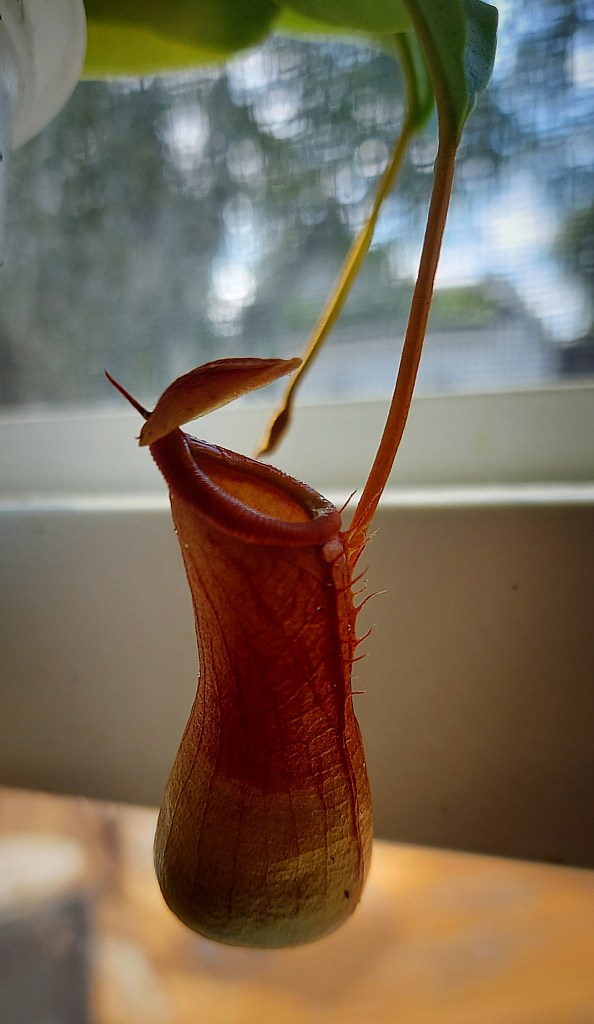
A close-up of an N. ventrata pitcher.
Audrey’s newest pitcher.

This is Audrey. Every so often, especially if she’s gotten plenty of humidity, she puts out gorgeous little pitchers. I reward her by hand-feeding her dried black soldier fly larvae.

A close-up of another pitcher on the same plant.
Another pitcher on the opposite side.

Since she seemed to be in particularly good humor when I came home, I thought now might be a good time to take a deeper look at the folklore and magical properties of the beautiful, unique, profoundly strange Nepenthes.

The plant genus Nepenthes is named for nepenthe, an ancient medicine said to heal sorrow and induce forgetfulness. It’s mentioned in ancient Greek literature, and is typically depicted as originating in Egypt.
It also appears in the Edgar Allan Poe poem “The Raven”:

Respite—respite and nepenthe, from thy memories of Lenore;
Quaff, oh quaff this kind nepenthe and forget this lost Lenore!”
Quoth the Raven, “Nevermore.”

An image of an open pitcher plant, displaying the "lid," slender neck, and round belly of the pitcher.
Photo by Phoebeud83dudc1f on Pexels.com

Nepenthes consists of numerous species. In garden centers and plant nurseries, you’re most likely to encounter N. x ventrata — a hybrid of a N. ventricosa and N. alata.

Pitcher plants prey on insects by providing sugar and water to lure them into their pitchers. Their leaves have nectaries — special glands that secrete sweet nectar — and their pitchers contain water and digestive enzymes. Insects are attracted to the presence of food and water, and end up caught in the pitchers where they eventually drown and get digested.
(They’re pretty much Hotel California for bugs.)

However, not all pitcher plants feed on insects. N. lowii, a species native to Borneo, is known for its… rather unique shape.
Toilets.
The pitchers look like toilets.
Not only do they look like toilets, they are toilets.
N. lowii has an interesting relationship with a local shrew species. As with insects, the shrews are attracted to the pitcher plant’s nectar. While they’re there, they generally end up crapping directly into the conveniently toilet-shaped pitchers. The shrews get free nectar, and N. lowii gets free nutrient rich shrew leavings.

A close up of the mouth of N. bicalcarata, showing the pitcher's "lid" and two pointy "teeth."
Nepenthes bicalcarata, known for its two pointy “teeth.” It has a mutualistic relationship with a species of carpenter ant that makes nests in the plant’s tendrils. The plant benefits by receiving nutrients in the form of dead ants and ant feces. Photo by Yufan Jiang on Pexels.com

Other pitcher plants have symbiotic relationships with frogs. The frogs hang out in the pitchers, just under their “lids.” They eat insects that are attracted to the plant, and, as with the shrews, leave their nutritious little doots behind. They help dispose of pest insects that are more likely to harm the pitcher plant than to feed it, and the plant still gets a boost of nutrients.

One other pitcher plant species, N. rajah, has pitchers large enough to snare rats. It’s a particularly visually striking species.

In pitcher plants’ native areas, they’re often used as a source of clean water. When the pitchers initially form, they come complete with a little bit of water in their bellies to dilute the plant’s digestive enzymes to a usable level. People will sometimes crack open a fresh pitcher and drink the water inside. The trick is to use a very fresh, young pitcher — once the pitcher has opened itself, and its “lid” is raised, it may be contaminated and is no longer safe to drink.

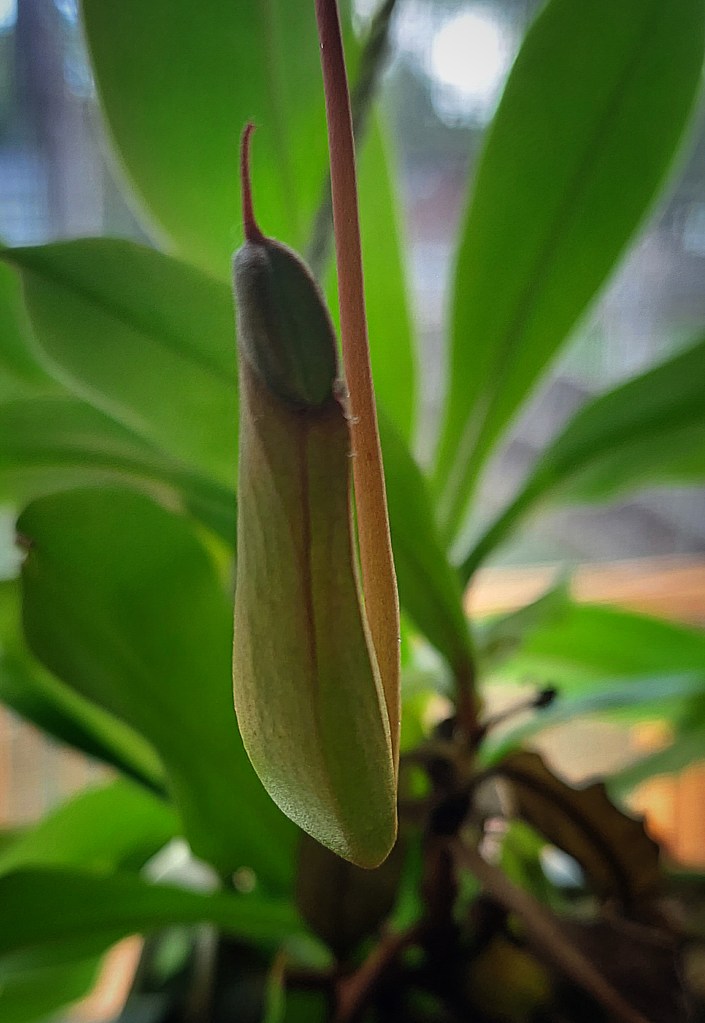
A close up of a young pitcher, with its "lid" still sealed.
This is an earlier image of the first pitcher pictured in this post. Notice how it’s greener, slimmer, and its “lid” hasn’t opened yet. Even in this state, it has a generous amount of liquid in the belly of the pitcher. At this stage, the pitcher hasn’t yet come into contact with any insects.

Interestingly, this water is more than just a refreshing drink on a hot day. It’s also used as medicine. Nepenthes water has been used to treat digestive issues and constipation (which makes sense, considering it’s just water and stuff that helps digest things), as well as urinary tract infections.
An extract of the plant is also used to prevent scar formation.

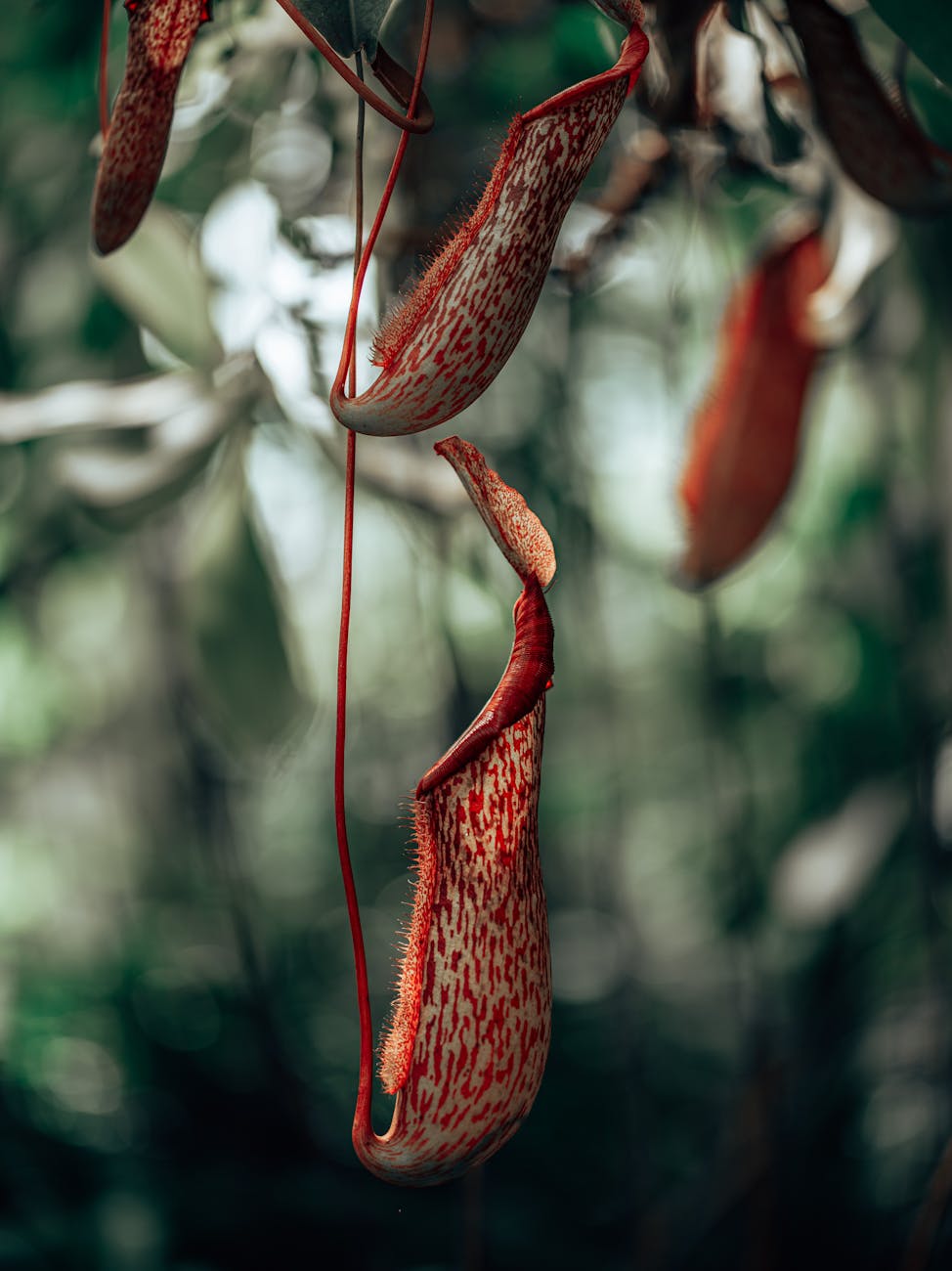
A view of particularly striking Nepenthes pitchers, with bright red hairs and streaks on their otherwise-green pitchers.
Photo by Egor Komarov on Pexels.com

There aren’t a whole lot of resources for those looking for typical European-based magical uses for Nepenthes species. From my own experience, these plants seem to be very useful for attraction. Just be warned — while they’re effective, they aren’t quite as docile and well-intentioned as something like rose or lavender. (All things considered, this probably isn’t too surprising for a carnivorous plant!)
They’re also helpful for defense and healing.
Lastly, Considering the enormous crossover between “plants that repel or get rid of pests” and “plants historically used for purification,” it may be worth experimenting with pitcher plants as a potential purification herb.

Elementally, pitcher plants are associated with Water.

If you have access to fresh pitchers, you can add the water to a ritual bath or window, door, and floor wash for attraction. Just make sure that these are fresh, unopened pitchers. You really don’t want to be dumping partially decayed bug soup into your bath.

If you don’t have access to them, then you can also use dried pitchers. Like any other part of a plant, they don’t last forever — the pitchers have a lifespan and naturally dry up and fall off after a while. Just make sure that whatever pitchers you use are cleaned up, free of insect parts, and completely dried.

Dried pitchers are suitable for container magic like jars, sachets, or spell bottles. They also look really cool when they’re pressed in a book or between glass.

I love carnivorous plants, but it’s not always easy to find resources for using them in western magic. Since I’ve begun keeping them and developing a close relationship with them, I’ve found that they have a wonderful variety of potential magical (and even medicinal) uses. Pitcher plants don’t just help keep homes bug-free, they’re also incredibly interesting and versatile friends to have!

Plants and Herbs

Ivy Folklore and Magical Properties

Ah, ivy.

In the US, few outdoor plants are as divisive. There’s the very romantic ideal of an old, ivy-covered brick building in the Northeastern US, but also English ivy is invasive here. It’s a low-maintenance ground cover, but will also crowd out just about everything.

I wrote about vines in general a little bit ago. As I write this, I’ve just come back indoors from taking a walk around the yard and checking on how my plants’re doing. I was scoping out the raspberry canes when what to my wondering eyes should appear by a sneaky tendril of English ivy, creeping its way under the deck. With those two things in mind, I figured now might be a good time to do a deeper dive into one very specific vine: Ivy.

The ivies make up the genus Hedera. There are 12-15 distinct species within this genus, all native to Europe, eastward to Asia, and southward to northern Africa. The one that most English-speaking people think of when they hear the word “ivy” is common or English ivy, Hedera helix. (Pothos, Epipremnum aureum, is sometimes called “devil’s ivy” but is not related to Hedera. Neither is poison ivy, genus Toxicodendron.)

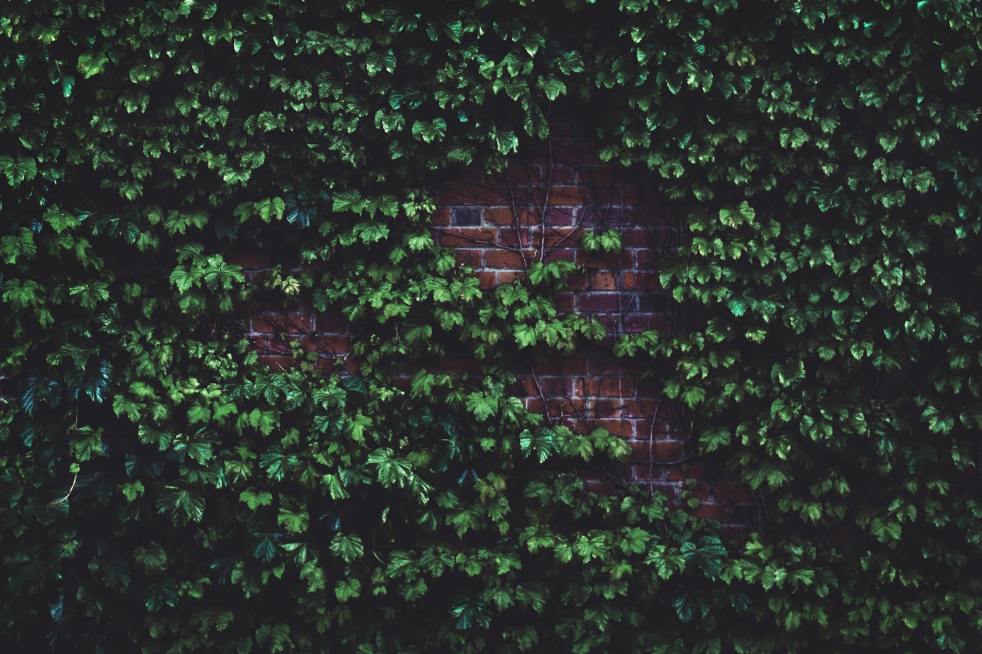
A dense growth of ivy covers a wall, surrounding a green door.
Photo by Pixabay on Pexels.com

In the Ogham alphabet, the few ᚌ (gort) is said to represent ivy. The Bríatharogaim for gort is “sweetest grass,” “suitable place for cows,” and “sating of multitudes.” The word “gort” also stems from a Proto-Indo-European root meaning “enclosure.” Some Ogham readers interpret gort as “field,” rather than “ivy,” which seems to be closer to its traditional sense. When the Ogham is conceptualized as a purely tree alphabet, gort becomes ivy. This few is associated with growth, prosperity, and the winding path toward enlightenment. On the flip side, it’s also connected to the word “gorta,” meaning “hunger” or “famine.”

In Irish folk stories, ivy is often described as surrounding the entrances of caves or secret doorways. Interestingly, in this context ivy is concealing these entrances from the outside world — either as a narrative flourish to give the text some more flavor, or as a deliberate guardian and barrier between the Otherworld and this one. In some tales, ivy is a protective plant against the fae.

In ancient Greece, ivy was connected to the God of wine, frenzy, and agriculture, Dionysus. He’s often pictured with a crown of ivy as a representation of his exalted and immortal status. In one tale, it’s said that he wore an ivy wreath to curb the effects of drinking wine — while grapes are a summer vine, ivy is a cooling, wintery evergreen. Thalia, the muse of comedy, was also depicted as wearing an ivy crown.

In Egypt, ivy was a sacred plant to Osiris. Similarly to Dionysus, ivy was connected to the concepts of immortality and rebirth.

The idea of buildings covered in ivy comes from the belief that this plant could protect one’s home and family from evil, as well as bring in good luck. This belief is also where ivy door wreaths come from.

While people often overstate the effectiveness of using indoor plants to remove pollutants from the air, research has shown that ivy may help reduce numbers of airborne mold spores. More study is needed to determine how effective this would be in the average home, as well as how many plants it’d take to cause an appreciable drop in mold spores.

English ivy is considered toxic, and consumption can cause gastric upset, pain, and vomiting. Some people are allergic to ivy, and may experience severe reactions. That said, this plant has historically been used medicinally to treat respiratory issues and extracts can still be found in some modern cold and cough remedies.

As an evergreen, ivy is often used for decoration during the winter holidays. It has a perpetual connection to the sun and springtime since it never loses its color, even during the depths of winter.

Magically, this plant is associated with fertility, abundance, protection, and good fortune. Some also use it to enhance divination or improve psychic abilities.

If you’re in the US, do not grow English ivy outdoors. If you’re going to grow it, pot it and keep it inside. While English ivy can be controlled with careful pruning, it can easily get out of hand and grow prolifically enough to starve and weaken trees by weighing down their limbs and blocking sunlight from reaching their leaves. It also has a habit of escaping and ending up where there isn’t anyone around to keep it pruned, damaging native forests. IWithin its native range, ivy provides food, shelter, and an increase in the biodiversity of forests. Outside of that range, it is mainly a way to slowly kill trees and turn every available surface into more ivy.

Ivy growing on a tree trunk.

If you really, really want to grow ivy in your garden, look for varieties that are considered non-invasive where you live.

Historically, the easiest ways to use ivy have been to have it near or on your front door, or even just to wear or carry a sprig. You could do this by tucking a fresh sprig in a pocket, a buttonhole, or even a hair clip whenever you go to do something that requires some extra luck and protection.

Traditionally, ivy was used to protect against supernatural entities and malevolent witchcraft. This makes it a good candidate for including in any spells, jars, or sachets intended to break or protect against hexes, jinxes, or curses.

If you do decide to keep English ivy in your home, whether live and potted or fashioned into a wreath or garland, keep it away from pets. While it does have medicinal properties, this is only when properly prepared by a skilled herbal practitioner. Otherwise, it’s considered toxic to dogs, cats, and humans.

Ivy is a beautiful little plant with a long history of symbolism behind it. As with many plants of considerable power, it needs to be treated responsibly — stay mindful of ivy’s place in (or outside of) your local environment and build a relationship with it accordingly. Whether you’re able to safely grow ivy outside, or must keep it confined to a pot indoors, this plant is a very handy and capable magical ally.

life · Witchcraft

Visiting Sticks & Stones Circle

There’s a delightful metaphysical shop called Sticks & Stones Circle in Fairfax, Virginia, that my Handsome Assistant and I visit occasionally. They moved locations about a year ago, so we figured we were due for another trip. Neither of us have been out of the house much lately — him, because he’s still recovering, and I, because I’ve been busy with various tiny projects. A gentle walk around a metaphysical shop, however? Yes, please.

They used to be located in the same building, but around the back by the larger parking lot. Now, they’re out in front, by a Sherwin Williams. They don’t have a sign yet, but their distinctive front window display makes them pretty unmistakable.

A photo of a store's front window, featuring flowers, crystals, a large drum, and stained glass.
Photo by the owner of Sticks & Stones Circle.

We weren’t here for anything in particular — in fact, I’ve been on a mission to destash and declutter things. If I haven’t worn it, used it, or at least remembered it fondly for a year, out it goes.

So, this was pretty much a trip to restock some herbs and incenses that are challenging to find in our regular herb shop (Smile Herb Shop, which stocks a wonderful variety of medicinal and culinary herbs).

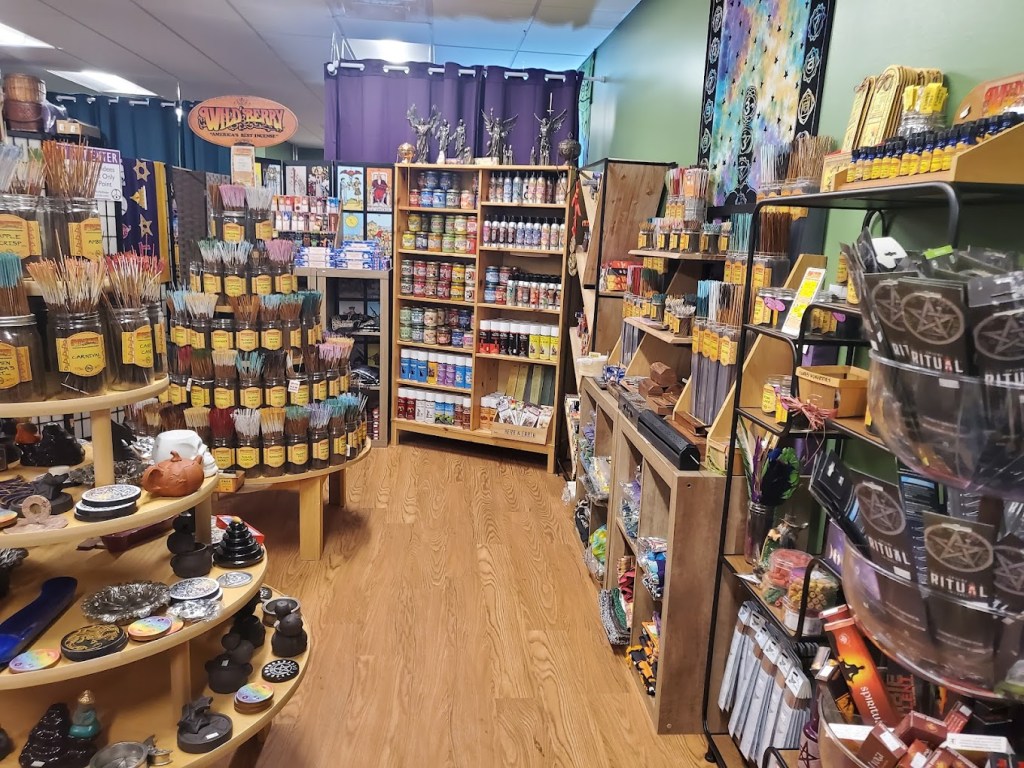
If you are on the lookout for other supplies, however, they have them in abundance — candles, sprays, oils, statuary, books, crystals, jewelry, pouches, pendulums, and altar cloths galore.

A photo of store displays, showing incense, statues, sprays, and candles.
Photo by the owner of Sticks & Stones Circle.

We left with two packs of incense (Soul Sticks Celtic Summer and Wild Wood, a very inexpensive but decent-quality natural incense), some copal resin, a small tiger’s eye owl, and a piece of golden healer quartz.
I’m a bit of a sucker for golden healers, but more on that another time.

After that, we stopped at a place called Midnight Treats. Neither of us were familiar with it but were delighted to find out that it’s a vegan bakery with the most massive (seriously, they’re 1/3 of a pound and feed two people each) cookies we’d ever seen. They have all kinds of flavors, so we picked up a small assortment: Oreo cake, cinnamon roll, birthday cake, and chocolate brownie. They didn’t disappoint either — they were warm, chewy, delicious, and have satisfied my cookie cravings for a good long while.

They also have new flavors every week. This week, they’ve added iced red velvet and blueberry lemon (and I’d be lying if I said I wasn’t tempted to order some).

All in all, it was a nice little shopping date. In the face of so many metaphysical shops closing, it’s nice to see one that seems to be thriving. If you’re ever up in that area, give Sticks & Stones Circle a visit. Like many other shops of this nature, they’re more than a store — they’re also a hub of classes, celebrations, and other Pagan and witchy activities.

Plants and Herbs

Angelica Root Folklore and Magical Uses

Recently, my Handsome Assistant experienced a minor vehicular mishap. He was on a motorcycle, so things could’ve been a lot worse, but his injuries weren’t too serious and he’s recovering well.

When he first got his bike, I made him a safe travel charm that he’s kept with him everywhere he rides. He’s dodged the “serious motorcycle accident” bullet, and it could use a refresh. This got me thinking about protective charms in general, which, naturally, led me to what’s probably one of the strongest of them all: angelica root.

Seriously. It’s probably a little too good at what it does, but more on that below.

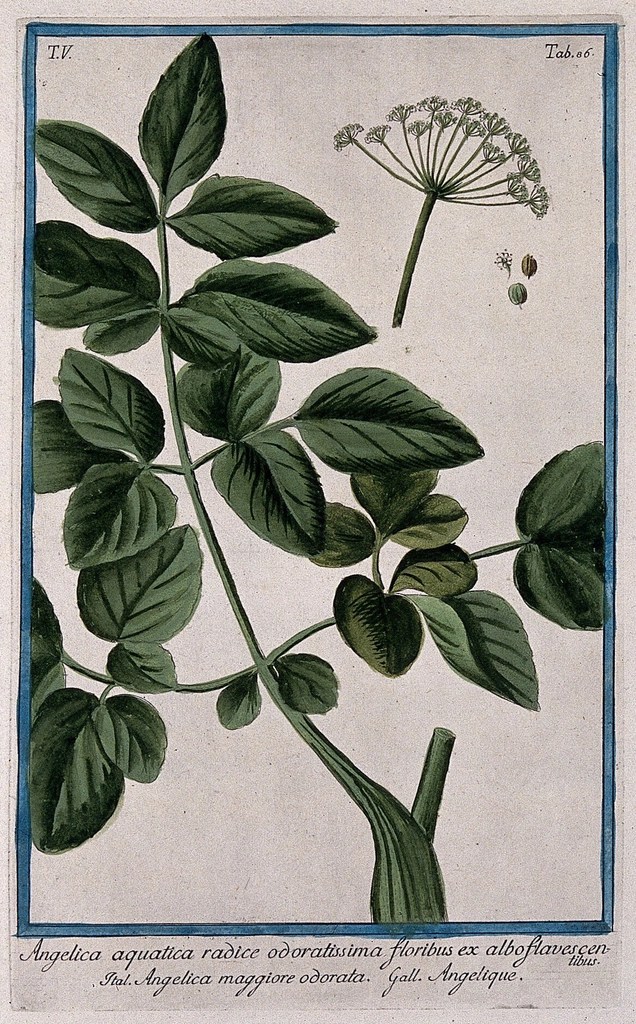
An old botanical illustration of angelica. The caption at the bottom reads, "Angelica aquatica radice odoratissima floribus ex alboflavescentibus. Ital. Angelica maggiore odorata. Gall. Angelique."

Also known as wild celery, masterwort, and archangel, angelica (Angelica archangelica) and celery are related as members of the family Apiaceae. Angelica archangelica is native to far northern Europe and Russia. Another species known as angelica, masterwort, or purple-stemmed angelica (Angelica atropurpurea) is native to wet areas in the eastern US.

The name angelica derives from the plant’s blooming period. Its flowers typically appear around Michaelmas, the feast of the Christian Archangel Michael.

In both Western European folklore and the Hoodoo tradition, angelica is associated with protection, particularly from evil spirits. It’s also occasionally used to break hexes, jinxes, or curses, depending on their nature.

Purple-stemmed angelica (A. atropurpurea) has a long history of use as both a sacred and medicinal plant by Indigenous people of the southeastern US. It could calm anxiety, ease back pains, soothe stomach trouble, and treat parasites in children. It’s also used in healing ceremonies and as a purification herb. This puts purple-stemmed angelica in the same group as many other purification herbs the world over — namely, herbs that both drive off evil or unwanted energy, and get rid of physical parasites or pests.

Angelica is also sometimes associated with luck, love, and psychic abilities. This may be because it’s so good at keeping unwanted interference at bay — combined with other herbs more directly suited to these purposes, it can keep one’s magical path clear.

On the other hand, angelica also has a reputation for being a bit too good at what it does. According to the (no longer extant) Pooka Pages’ “Concerning the Magical Properties of Herbs & Oils,” angelica may also keep away some things that you do want. If you’re attempting to use it to help you attract something into your life, it’s a good idea to keep this in mind — sometimes, those things aren’t without risk, so angelica may not be the best choice.

An angelica relative, A. sinensis, is also known as lady ginseng or dong quai. It grows in cool, mountainous areas of east Asia, and has a long history of use in Chinese medicine.

Honestly, there are few protective charms more convenient than a whole angelica root. They’re sort of lumpy and oblong, but firm, compact, and easy to stash in a pocket, bag, sachet, or any other container. I’ve never had one that was crumbly or messy, either.

Hold it in your dominant hand, tell it what you’d like it to do, project this thought, request, or energy into the root, thank it for its help, and you’re good to go. You can also anoint it with an oil, if you’d like.

You can hang a whole angelica root over your front and back doors to keep unwanted forces out or bury a root at each corner of your property.

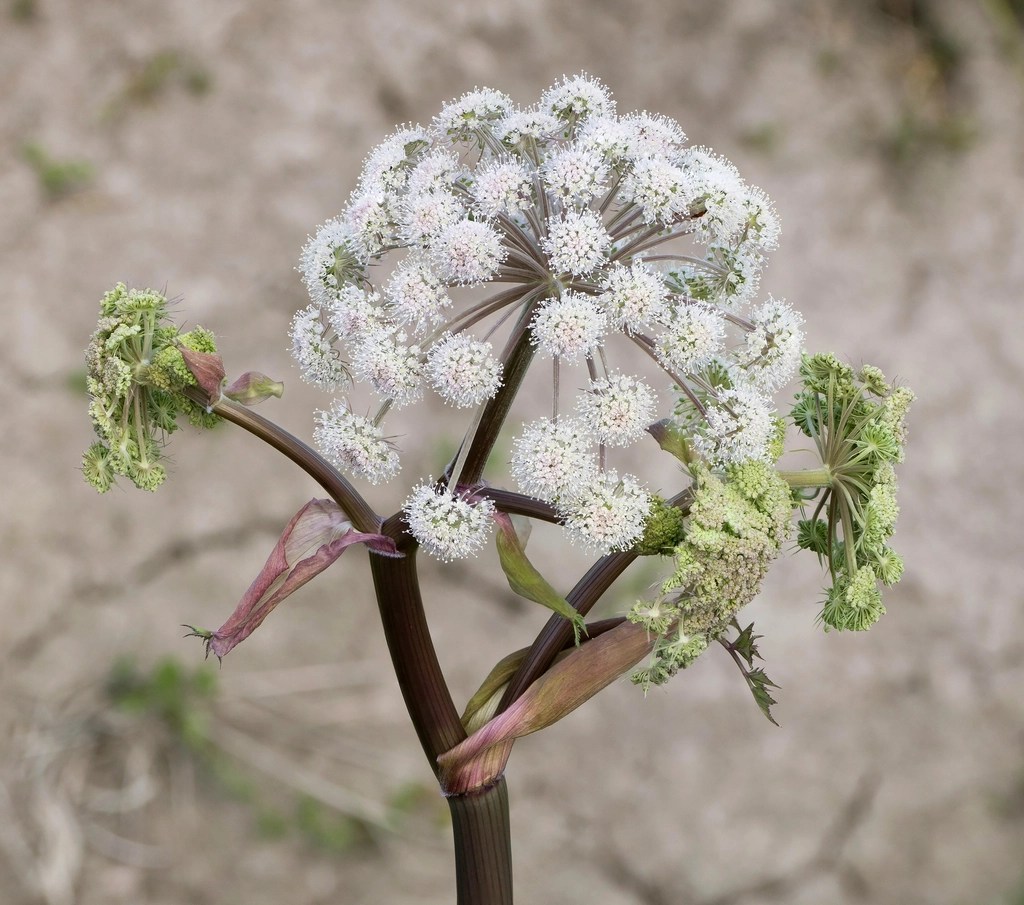
A budding wild angelica plant (Angelica sylvestris).

Soak an angelica root in water, then add the water to a floor or door wash, sprinkle it in corners of a room, or pour it along the borders of your property to ward off evil and strengthen magical boundaries.

Angelica roots also make lovely additions to protective oils themselves. Put it in a neutral carrier oil and let it infuse in a cool, dark, dry area, shaking it regularly. If you want a stronger fragrance, add essential oils just before you bottle the finished product. For this, you might want angelica root pieces rather than the whole root — it’ll have an easier time transferring its fragrance to the oil if it has more surface area.

Since the roots are fragrant themselves, and hold other fragrances well, they’re great additions to potpourri or other scented herb mixtures.

You can also eat A. archangelica stems and roots. However, you may not be able to find them in your local grocery store, and they can be challenging to identify in the wild. They have several poisonous lookalikes, so you should never consume anything that you’ve only tentatively identified as angelica. Unless you’re an expert forager yourself, get an expert forager’s opinion first. As the saying goes, you should be as confident identifying a wild edible as you would be identifying it in a grocery store. Otherwise, don’t eat it.

Angelica may not be the most versatile magical plant, but it’s one worth knowing. It’s one of the best at what it does, sometimes to the point of being too effective. It’s one of those herbs that I find it’s better to have on hand and not need, than to need and not have on hand. Whole roots aren’t too expensive, and you can use them to steep in water for magical baths, washes, or asperging, infuse them in oil, or use them whole as protective talismans.

Neodruidry · Plants and Herbs · Witchcraft

Mushroom Folklore and Magical Uses

I like mushrooms. Not so much culinarily, but aesthetically and conceptually.

There are thousands of identified mushroom species, but experts estimate that the number of actual species out there is anywhere from two to three times what we’ve managed to identify. Others say it could be in the millions.

Mushrooms have a long history of use in spiritual and magical practices around the world. Giving the folklore and uses of every known species is outside of the scope of this post, but I thought it’d be interesting to give an overview of some of the most unique, recognizable, and significant kinds.

People typically consider mushrooms and toadstools two different things, but there isn’t really a hard line between them since these are folk names. According to various sources, mushrooms are edible, and toadstools are inedible. Or else mushrooms are edible and umbrella-shaped, while toadstools are inedible and have round caps. Or toadstools are inedible and large-capped, etc.
This can be particularly confusing because there are several species of variable edibility — some are considered edible only when cooked. Some need to be leached with water to be edible. Some are only poisonous if consumed with alcohol. Some aren’t considered edible, but aren’t really poisonous either.

Amanita muscaria, the iconic red- (or tan- or yellow-) capped, white-spotted mushroom, is also called “fly agaric.” This is because it was sprinkled in milk and used as a poisonous bait for flies and gnats.

A small Amanita muscaria growing in some leaf litter.
Photo by Guy Dwelly on Pexels.com

Sami shamans traditionally have a unique way of processing A. muscaria. The mushrooms are fed to reindeer, and the psychoactive components are passed in their urine. Instead of the potentially dangerous mushrooms, the shamans use the urine to access fly agaric’s powerful qualities.

While it’s natural to associate psychoactive fungi with the spirit world, they aren’t the only mushrooms said to serve as a gateway. The famous fairy rings of Western European stories are circles or arcs of fungi (with or without visible mushrooms) that, were you to enter one, could bring you either good luck or incredible danger.

In Egypt, mushrooms were associated with immortality. In Japan and China, they have similar connotations due to their use as medicinal foods for increasing strength and longevity.

In Slavic mythology, the guardian deity of forests, Leshy, can appear as a fully vegetation-based entity. He may appear as anything from a sacred tree to a mushroom. Mushrooms are also associated with the earth, water, cattle, and underworld deity, Veles.

In Lithuania, mushrooms were said to be the fingers of Velnias, a deity of the dead. He would reach up from the underworld, beneath the soil, to feed the poor.

This isn’t the only association of mushrooms with charity, either. In one Christian myth, God and Saint Peter walk in a rye field. Peter takes a handful of rye and begins to eat it, but God scolds him for taking food that isn’t meant for him. Peter spits the chewed rye out, and God says that a mushroom will grow there as food for the poor.

Interestingly, the dead and the underworld seem to have the strongest connection to mushrooms around the world. The Sidhe of the Celts and the Alfar of the Germanic people were both associated with burial sites, and the beliefs surrounding them may be the last vestiges of ancient, indigenous ancestor worship. This would immediately associate fungal phenomena like fairy rings with the dead.

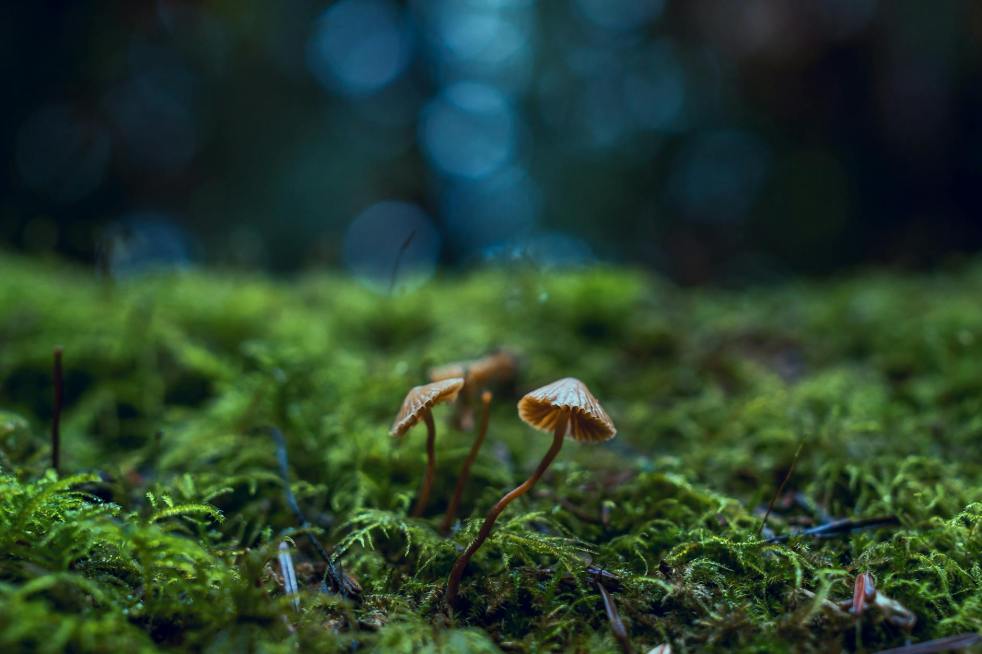
A trio of small brown mushrooms growing from a tuft of moss.
Photo by Johannes Havn on Pexels.com

So, on one hand, edible mushrooms are gifts from the dead to feed the living. On the other, the inedible ones will allow you to meet the dead!

This connection continues with the crane bag of Manannán mac Lir. In addition to being a God of the Sea, Manannán is also a guardian of the underworld. The crane bag is a bag he fashioned from a crane skin that contains several magical tools. According to many Ogham readers, these tools are indicated in the forfeda — the four additional letters at the end of the Ogham alphabet. Iphin (ᚘ) is the crossed “bones of Assail’s swine.” These were pigs that could be slaughtered and eaten and would regenerate again.
Robert Graves theorized that these swine were metaphorical, and the bones were not bones at all — they were the stems of mushrooms, discarded once the caps had been eaten or used in ritual. Since mushrooms are just fungal fruiting bodies, and picking them doesn’t harm the actual organism in the soil, it made perfect sense that they would “regenerate” so they could be consumed again.

Because mushrooms seem to spring up out of nowhere after a rain, they’re also thought to represent fertility.

Mushrooms in general are associated with the element of Earth. Planetarily, they’re associated with the Moon. The fly agaric, specifically, is associated with the element of Air and the planet Mercury.

First, I want to say that “there are old mushroom foragers, and there are bold mushroom foragers, but there are no old, bold mushroom foragers.”

If you aren’t an experienced mushroom hunter yourself, and don’t have access to one willing to take you in the field and help you positively ID mushrooms, do not attempt to harvest them yourself. There are way too many poisonous lookalikes out there, some of which can only be differentiated by spore prints or tiny, easily missed differences in appearance.

A cluster of small, thin, white mushrooms of uncertain type.
Photo by Chris G on Pexels.com

That said, simply touching a poisonous mushroom is unlikely to elicit a toxic response. However, it can still give you an allergic reaction, so you should still probably not do that.

Now, with that out of the way…

Unless you have access to a reindeer or a shaman, you should probably stick to the non-entheogenic varieties. I would also avoid commercially produced edibles intended for microdosing muscimol (a psychoactive compound). While not all brands are suspect, it seems some haven’t quite got the science figured out yet and several people have become extremely ill (and possibly even died) from using them. I wouldn’t use them myself and I don’t want bad things to happen to people, so I can’t recommend you do, either.

Also, if you drink alcohol, be careful which mushroom species you work with. Some are considered edible — delicious, even — but contain a compound that reacts with alcohol to cause some very unpleasant symptoms.

Otherwise, mushrooms are a suitable offering for deities of the dead and of forests. They’re also a good ritual food for workings relating to these deities or concepts.

You can place dried mushrooms in objects like charm bags, sachets, or spell jars, but with a bit of caution — they’re basically like sponges and will pretty readily absorb moisture and get gross if you aren’t careful to keep them dry. Other than that, go to town.

Whether you enjoy eating fungi or not, they’re fascinating organisms that form the foundation of life on Earth. Without them, other plants couldn’t grow. They’re a gift to the living from dead and decayed things, and, as such, are deserving of reverence.

Neodruidry · Plants and Herbs · Witchcraft

Vervain Folklore and Magical Uses

Vervain (Verbena officinalis) is a prominent herb in European folk and ceremonial magic. Its roots also extend to American Hoodoo.

Though most old grimoires mean V. officinalis when they refer to vervain, there are actually about 80 species in the genus Verbena. In my area (and all of the continental US, and fair bit of Canada) we have Verbena hastata, also known as blue vervain. While it’s not the same plant, you’ll often find V. hastata labeled simply as “vervain” in metaphysical contexts.

Lemon verbena, Aloysia citrodora, is also a member of the Verbenaceae family. However, since it’s a somewhat more distant relative, I wanted to limit this post to V. officinalis and V. hastata.

Vervain is sometimes called “the enchanter’s plant,” since it’s one of the most versatile herbs in European magic. Even outside of Europe, it was (and continues to be) considered a plant of considerable medicinal and spiritual significance.

As John Gerard wrote in 1597,

Many odd old wives’ tales are written of Vervain tending to witchcraft and sorcery, which you may read elsewhere, for I am not willing to trouble your ears with supporting such trifles as honest ears abhor to hear.

Magically, it’s used for purification, protection, divination, peace, luck, love, and wealth. It’s a pretty solid all-purpose herb that is often added to formulas to increase their power.

The name vervain comes from the Latin “verbena,” which refers to leaves or twigs of plants used in religious ceremonies. This, in turn, came from the Proto-Indo-European root “werbh,” meaning to turn or bend.
I have also seen the origins of the word vervain given as a Celtic word “ferfaen,” meaning to drive stones away. However, I haven’t found strong evidence for this origin — all attempts to look up “ferfaen” only yield articles claiming it as the word origin of “vervain,” and most of them only give “Celtic” as the language of origin. One source did cite the Cymric words “ferri” and “maen” as a possible origin, with the word “maen” mutating over time into “faen” to eventually yield “ferfaen.” (Upon further searching, I was not able to find the word “ferri,” though I did find “fferi,” meaning “ferry.” This would give the word “ferfaen” a meaning closer to “ferry away stone(s).”)
Nonetheless, the etymological sources I looked at gave “verbena” as the origin of vervain, not “ferfaen.”

A close-up of vervain flowers.
Photo by Tom Fisk on Pexels.com

Pliny the Elder credited vervain with quite a lot of magical properties. According to him, it was used to cleanse and purify homes and altars. He claimed the Gaulish people used it in a form of divination, and that Magi said that people rubbed with vervain would have their wishes granted, fevers cooled, friends won, and diseases cured.
Interestingly, he also pointed out that vervain was considered a bit of a party plant, for when dining-couches were sprinkled with water infused with vervain “the entertainment becomes merrier.”

While vervain is strongly associated with the Druids, they didn’t leave a whole lot of records of their activities behind. What we do know is largely through sources like Pliny, and it’s likely because of writers like him that vervain became strongly connected to the ancient Druids.

For the best potency, vervain should be gathered in a specific fashion. It’s best cut between the hours of sunset and sunrise, during the dark moon. Like many other herbs harvested for their leaves, it’s best to cut the leaves before the flowers open. After cutting, it’s best to offer some fresh milk or honey to the plant.

Vervain is thought to be the origin of the name “Van van oil.” While the van van oil recipes I’ve seen don’t include vervain or vervain oil, it’s possible that the Verbena family loaned its name, nonetheless. (In that case, it was most likely lemon verbena, vervain’s citrus-scented South American cousin.)

Vervain is also one of those contradictory herbs that is simultaneously said to be used by witches, but also effective against witchcraft.

In the very distant past, bards would use brews of vervain to enhance their creativity and draw inspiration.

Medicinally, vervain is an emetic, diuretic, astringent, alterative, diaphoretic, nervine, and antispasmodic. According to Hildegard of Bingen, a poultice of vervain tea was good for drawing out “putridness” from flesh.

Soak some vervain in water, then use the stems to asperge an area, person, or object that you wish to cleanse. It’s also an excellent addition to ritual baths for this purpose.

A cup filled with dried herbs.
Photo by lil artsy on Pexels.com

Sprigs of vervain are also worn as protective amulets, specifically against malevolent magic. Tie a bit with some string, put it in a sachet, and carry it with you. Tuck a sprig of it in the band of a hat. Use a small bud vase necklace and wear a bit of vervain like jewelry.

Planting vervain around your property is said to ward off evil and guard against damage from bad weather. If you choose to do this, please select a variety of vervain native to your area — in most of the US, V. hastata is a safe bet.

V. officinalis is often used medicinally, V. hastata is considered both medicinal and edible, but avoid consuming it if you’re pregnant, trying to become pregnant, or are breastfeeding. Talk to a qualified herbalist if you have any chronic conditions, or routinely take any medications. Avoid consuming a lot of it, since it is an emetic. It’s also important to be sure that the herb you’re working with is really V. hastata or V. officinalis — there are plenty of Verbena species that don’t offer the same benefits.

Vervain is a powerful plant, as long as you know which member of Verbenaceae you’re looking at. If you have the ability to grow a native vervain, by all means do so — these plants are tall, with interesting-looking flower spikes. They’re also easy to dry and store, ensuring that you’ll always have a stockpile of this powerfully magical plant.

animals

The Magical Meaning of Black Squirrels

The other day, I was on the deck having breakfast with my local crowbros. (It’s funny — as soon as I go outside, I hear their calls pick up speed and intensity. Then they start to swoop around and gather in the big maple tree. Once some of the braver members of the family are present, they’ll start making forays to the feeders. Gradually, once they’ve proven its safe, the timid members follow suit.) This day was different, though.

This day had squirrels.
Not just the usual suspects (Freddy de Bonesby and the pruno-making delinquents), either.
Today, there was a black squirrel.

A photo of a black squirrel on a clover-covered hillside. He looks like he's just realized he left his stove on.

Black squirrels are a naturally occurring melanistic variation of grey or fox squirrels. They’re fairly rare under normal circumstances, appearing at a rate of about one for every 10,000. This is overall, however — black squirrels do occur more commonly in specific areas. They’re generally seen more often in urban places (theoretically because they blend in better there than they do elsewhere) and at the northernmost portions of their ranges (theoretically because they absorb sunlight more efficiently, keeping them warm and extending their active, foraging times during the cooler months).

Melanism in squirrels doesn’t occur with the same beautiful variety as human skin colors, and isn’t even the same as melanism in other animals. In most other animals, melanism is a recessive gene and an individual must inherit it from both parents. In humans, coloration is controlled by multiple genes that come in a variety of alleles that show incomplete dominance, resulting in an incredible variety of hair, eye, and skin colors. In squirrels, melanism is associated with the is associated with the MC1R-Δ24 E B allele EB and is incompletely dominant with the “wild” coloration allele E+. So, a squirrel that inherits two wild coloration alleles will be the color of the average gray squirrel (E+ + E+). A squirrel that inherits one copy of the melanistic allele will exhibit a dark brownish, nearly black coloration (EB + E+). A squirrel that inherits two copies will be a deep, shiny, inky black (EB + EB).

Even rarer than melanistic squirrels are leucistic squirrels — white squirrels with black eyes. These are not the same as albino squirrels, which typically have pink and blue eyes. Albino squirrels typically have poor eyesight. Leucistic squirrels have normal eyesight. Both stick out like sore thumbs to predators and generally don’t survive long in the wild.

Where I live, melanistic squirrels more common because it’s a) by a major city, where b) a bunch of them escaped from a zoo this one time.

I had seen a few here and there in the past, but I’d never seen one in the yard before. Out of curiosity, I decided to look up the magical and folkloric significance of these adorable weirdos.

Remember that bit about escaped zoo squirrels? Well, the tale goes like this: As far back as 1900, Frank Baker (superintendent of the National Zoo) repeatedly requested rare, beautiful black squirrels from several locations in Ontario, Canada. Two years later, Thomas W. Gibson (Ontario’s former commissioner of Crown lands) sent the National Zoo eight black squirrels. Canada is in the northernmost portion of the eastern gray squirrel’s (Sciurus carolinensis) range, so melanistic individuals are far more common there.
In 1906, eighteen of the black squirrels were released onto the zoo’s grounds. For some reason, people okayed this decision because they literally didn’t think they’d get out. However, being squirrels, that’s exactly what they did. As a result, DC has an exceptionally high population of melanistic squirrels.

A close-up of a black squirrel in autumn leaves.
Photo by Lauren Hedges on Pexels.com

Remember when I wrote about solar eclipses a bit ago? I briefly mentioned the Choctaw legend about greedy squirrels coming to eat the Sun. These weren’t just any squirrels, though — they were particularly hungry and mischievous black squirrels.

In Ireland and the UK, black squirrels were viewed similarly to black cats: as signs of good luck or prosperity. Rare as they are, they were also thought to have connections to the fae realm. While they don’t appear to have the “messenger” connotations of animals like crows, they are no less connected to occult knowledge.

Given squirrels’ propensity for burying things, black squirrels were associated with finding hidden treasure.

Of course, as has often happened throughout history, the spread of various forms of Christianity during the medieval period turned what were once good luck symbols into something sinister. Black animals, like cats, crows, ravens, and even squirrels, were then associated with misfortune and evil. They were often accused of being witches’ familiars.

In general, black squirrels are associated with good luck. English coal miners would keep them around for luck, and it was considered very unlucky to ever harm one.

Even in cultures where melanistic squirrels are viewed as troublesome, they were typically seen more as eccentric trickster figures than something expressly evil.

Today, places that are fortunate enough to be blessed with lots of black squirrels often take pride in it. Some of them are jokingly called “squirrel towns,” and feature black squirrels on their signs, as the subject of annual festivals, and represented on souvenirs in gift shops.

In a divinatory sense, the appearance of a black squirrel heralds a positive change of some sort.

While they may not be super rare here, black squirrels are still delightful to see. From what I’ve noticed, they seem jumpier and more skittish than other eastern gray squirrels, so being able to get a photo of one (or even a clear look at one) is a treat.

life

On the importance of the Third Place.

There’s a concept called the “third place.”

This is a place where people congregate, distinct from their homes and workplaces (first and second place, respectively). This can be a pub, or a community center, or a church, or salons and barber shops.

For much of the Pagan community, metaphysical shops hold the distinction of “third place.” They’re more than a place to buy candles and incense. They’re where you attend events. Classes. Opportunities to socialize with and learn from other people like you. A place to find community.

A picture of a tranquil stream wending through a forest.
I’m fortunate in that, as part of a group of Druids, many of my community meeting spaces are forests. Even so, natural meeting spaces can be taken away, too. Photo by Ian Turnell on Pexels.com

Not long ago, I found out about the closing of a metaphysical shop near me which I loved dearly. A week or two ago, I found out about the closing of another. The owners had been looking to retire and sell their business, but the ownership of their location changed hands. The new owner opted not to renew their lease, leaving them without much choice other than to close the business.

A lot of metaphysical business owners and event coordinators are older, and there haven’t yet been enough people to take their place. I wish I could, but money is often the obstacle to doing so. I’ve donated money to ongoing efforts, supported businesses, reached out to figure out what I could do as far as vending, teaching, or anything else, but the problem is usually much, much bigger than I am.
Every time we lose a shop, a group, or a festival, it’s like losing a friend.

Whether you’re Pagan or not, the third place is important. For many people, it’s life- and mental health-sustaining. Don’t take your third place for granted — there are a lot of things that can take it from you. Support the local businesses that matter to you, even if they’re more expensive than big box stores. Attend community events. If you have a skill or craft to share, see what you can do to become a part of things. If you have the means, consider creating or contributing to a third place for your people.

Sacred Circle, in Alexandria, VA, will be closing at the end of the month. In the meantime, they’re having a sale with deep discounts on everything. Books, journals, candles, herbs, crystals, musical instruments, you name it.

Plants and Herbs

Hen and Chicks Folklore and Magical Uses

Do you have little to no success with plants?
Do you want to get into gardening, but lack confidence?
Hoo boy, are hen and chicks succulents made for you.

Members of the genus Sempervivum, these succulents are also known as “live forever” or “houseleek.” They have the plump leaves of your average succulent but can thrive in growing zones 9-4. I have one that I stuck in a pot on my deck and did literally nothing for — not even water — and it’s filled the pot, put out tons of little green pups, and is flowering like there’s no tomorrow.

A top-down view of a Sempervivum plant in a pink pot. In the center of the photo, several pink flowers and buds are visible.
A close up of that plant’s first flowers. In the background, you can kind of see other buds emerging on their talk stalks.

Along with their easygoing nature, hen and chicks plants have some interesting folklore and usages in magical disciplines.

Let’s look at their common names first. “Hen and chicks” derives from their most notable method of reproduction — in addition to producing seeds, they send off little offsets in the form of round rosettes which give the impression of a large mother “hen” plant surrounded by baby “chicks.” They’re called “live forever” because they’re evergreen and very difficult to kill. Lastly, the name “houseleek” has no relation to the other plants known as leeks. Instead, the word “leek” comes from the Anglo-Saxon word “leac,” meaning “plant.”

As for why they’re called something that literally translates to “house plant,” there’s an excellent reason for this. Hen and chicks plants were (and are) frequently grown on houses. (When I lived in California, the house I stayed in had some lovely Sempervivum growing on the roof.) This practice originated with the belief that these plants helped to ward off fire and lightning strikes.

These plants are also associated with prosperity, health, and luck. Possibly as an extension of their fire- and lightning-protective connections, some cultures grew Sempervivum on roofs as a way to ensure the health and wealth of a house’s occupants. In Wales, these plants are still sometimes grown on roofs for luck.

(Of course, if you live in the US and have an average modern shingle roof, you may not want to grow plants there. Excess moisture could cause problems, and using your roof as an ersatz garden could void your warranty. Sempervivum are great for green roofs, however.)

As for warding off fire and lightning strikes, there are a few reasons for this. Some species of Sempervivum grow fine, snow-white hairs on them, that look a bit like fine wool or thick cobwebs, and their growth habit can make them resemble a jutting, sculpted beard. This is reflected in the German name “Donnerbart,” or “Thunder beard.” These plants are connected to various thunder deities, like Thor and Zeus.

Sempervivums clinging to a rock face.
Photo by Honglei Yue on Pexels.com

The other reason behind it is that Sempervivum can act less as a protector than as an indicator. These plants can thrive in very dry areas, but they still need some moisture to stay plump and green. The presence of healthy hen and chicks plants generally indicates that conditions aren’t conducive to combustion.

Houseleeks are also used to ward off attacks by malevolent magic.

Medicinally, Sempervivum plants are used similarly to Aloe vera. Topically, it is sometimes a treatment for cuts, burns, or warts. This herb was also considered a very useful treatment for diarrhea, while larger doses were a powerful emetic. Traditionally, it’s considered a very cooling herb.

Elementally, Sempervivum is associated with Fire. It is also connected to all thunder deities.

From everything I’ve seen, Sempervivum‘s protective and lucky magical attributes are best employed by simply growing them. Give them a sunny spot and some well-draining soil in the right growing zones, and they’re pretty much good to go. (Of course, if you intend to use your hen and chicks plants in this fashion, it’s good form to ask them for their help.)

While these plants aren’t native to the US, I have noticed that they seem to be a favorite of small native pollinators. So far, I’ve seen three different species of sweat bee. They’re also useful for xeriscaping in especially challenging areas.

As I mentioned previously, you may want to avoid growing them on your roof. Yes, it’s very picturesque and cottagecore, and yes, it’s traditional, but having to pay upwards of five grand to fix or replace a modern shingle roof is none of those things. Plants trap moisture, which roofs need to shed. Their roots can infiltrate minute gaps between shingles, widening them and allowing water in. It may not happen immediately, but growing plants directly on a conventional roof, without any kind of barrier or container between the two, is generally not a good idea.
If you have a flat spot near your roof, like a windowsill, window box, or balcony, stick a couple Sempervivum plants in terracotta pots and put them there instead.

As for using them internally, I don’t recommend it. If you have a minor burn and don’t have a fresh aloe leaf handy, by all means, try applying some Sempervivum goop topically. Using these plants as an anti-diarrheal or purgative has largely dropped off in favor of other remedies, even in alternative medicine.

Hen and chicks plants are adorable, inexpensive, and exceptionally hard to kill. Magically, they’re just cute little protective and luck-drawing charms. If you have the space to devote to one (or a few), they’re well worth their tiny investment of time and money.