
divination · Witchcraft

The Tom Waits Oracle

“When you are writing, you’re conjuring. It’s a ritual, and you need to be brave and respectful and sometimes get out of the way of whatever it is that you’re inviting into the room.” ― Tom Waits

Ever use shufflemancy? It’s a type of technomancy that relies on shuffling through a collection of music. It could be an album, it could be a playlist of your favorite songs, any sufficiently large number of tunes will do.

Tom Waits has been described as a lot of things: avant-garde, gravelly, whiskey-soaked, experimental, a raconteur. John Hodgman said that “[w]e all hear our own stories in our favorite songs (that is why Tom Waits sings in werewolf language—you can pretend it is about anything you want!),” and I’m inclined to agree.

And so, I tacked together a shufflemancy playlist made up entirely of Tom Waits tracks.

It’s pretty self-explanatory. Clear your head, ask your question, hit shuffle, and listen. (Or, if you’re not using the Spotify app, shut your eyes, scroll, click, and listen.) Do any lyrics leap out at you? What impressions do you get? Let the werewolf troubadour sing(/play/beat the bathroom door with a 2×4) you a divination.

crystals · Environment

Choosing Crystals Consciously

So, I’ve made no secret of the fact that stones occupy a place of honor in my practice. When I first started learning, I was drawn to the magic of gemstones above anything else. I think I got it from my dad — he made jewelry, beautiful things of silver, bone, and stone. From a young age, I was surrounded by bright lapis lazuli, soothing rose quartz, and shimmering tiger’s eye.

I like gemstones because they resonate with me. I’ve learned how to choose stones that make me feel uplifted and energetic, pieces that are as functional as they are beautiful.

quartz

But not everything crystal-related is all sweetness and light.

Diamonds are notorious for their controversy — pulled out of the earth in places stricken by war, sold to finance warlords and dictators. Unfortunately, they aren’t the only stones that are sometimes paid for in blood.

Most witches and other magic practitioners know that, when you get a new tool — or bring anything into your home, really — it’s a good idea to cleanse it to remove the energy of everyone and everything it’s come in contact with before you. What cleansing is good enough to ease the pain of a nine year old child laborer?
(And all of that’s before you even consider the environmental impact of gemstones.)

The picture isn’t entirely bleak, though. For those who aren’t willing or able to give up gemstones entirely, there’s one easy way to fight back: Know where your crystals come from, and choose wisely.

When I collect a stone or make a wand, I make an effort to find out as much as I can about where the components came from and how they were gathered. I’m not at all against hunting (it beats factory farming), but I use naturally-shed antlers. I know the areas the crystals came from, and try to source as much as I can from mines within the U.S., since it makes transparency a little easier.

There’s only one problem — this really isn’t as easy as it sounds. Most metaphysical shops and gemstone suppliers don’t provide information on their stones’ origins, if they were ever even given it in the first place. The places that do may also charge a premium, because cheap stones come at the expense of things like environmental protections and worker safety. So, if you can find ethical sources of gemstones, support them! Money talks, and the best way individuals have to end the trade in unethical crystals is to create an economic disincentive. It’s a slow, imperfect process, but it’s what we’ve got right now.

heart-3243179_1280

Estate sales are another option for those who don’t want to directly contribute to the trade in unethical stones. While they may have been mined under poor conditions, there’s really no undoing that. Keeping estate sale stones in circulation is a way to help reduce our dependence on mining.

Using local stones is another option. Crystals are pretty, and their properties are helpful, but quartz is incredibly abundant. Some of my favorite stones to work with are simple river rocks I picked up on a vacation with my boyfriend, or holey stones found in a creek.

Mining is dangerous and labor-intensive for workers at the best of times, and stones are sensitive things. While crystals may be longer-lived and more durable than animals or plants, they are no less affected by their environment, and these effects are passed on. Take the time to know where your stones come from, appreciate the tremendous amount of energy, effort, and danger involved in mining them, and contribute to reducing the burden on the people and places that bring them to you.


Books

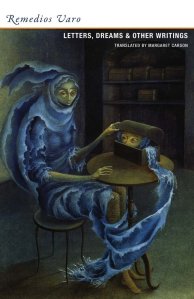
Let’s Read: Remedios Varo’s Letters, Dreams & Other Writings

Note: This post contains affiliate links to the book(s) I mention. These allow me to earn a small finder’s fee from Wordery.com, at no cost to you. Thank you for helping to support writers, publishers, and this site!

varoI don’t know if I can express how much I wanted this book using actual, intelligible language words, as opposed to some kind of excited dolphin noise.
Saying “I love Remedios Varo” would be a little… not actually disingenuous, but small. I find her work inspiring. I love plumbing the depth of detail in her paintings. I’m fascinated by her life. If we had lived around the same time, in the same place, and there wasn’t a language barrier, I like to think we would have been friends (assuming she could get past my overly-eager fanning, but whatever). We could’ve had sleepovers, written letters to people we picked out of the phone book, and rearranged crocodile skulls, pipes, and armchairs together.

Incidentally, she was absolutely weird and I could not be more here for it.

See, what excited me about this book is that my Spanish is execrable, and her letters, notes, and other private writings aren’t widely translated. And by “not widely,” I mean that I’m pretty sure this is the only time they have been.

Letters, Dreams & Other Writings is short, but understandably so — it’s not as if she set out to have her notes compiled into a full-length book. It’s also extremely intimate, including details from several of her dreams. The first section comprises her letters to others (Gerald Gardner, who popularized Wicca, among them). Some of the recipients were complete strangers, and the letters were signed with fake names.

Anyway, this is pretty much all just preamble to my favorite bit: “The Observers of the Interdependence of Household Objects and of Their Influence Over Everyday Life.” I’ll let her describe it:

“This group, active for quite a long time now, has already made important verifications that make life easier from a practical point of view. For instance: I move a can of green paint some five centimeters to the right, I stick in a thumbtack next to a comb and, if Mr. A… (an adept who works in tandem with me) at that same moment places his book on beekeeping next to the pattern for cutting out a vest, I’m sure there will come about, on Avenida Madero, the encounter with a woman who interests me and whose origin I’ve been unable to determine[.]”

There are more descriptions of the private “solar systems” of the members of this esteemed (and, as far as I’ve been able to determine, imaginary) group. Armchairs, velvet shoes, skulls, a pipe inlaid with fake diamonds… All of them are described as laid out in a ritualistic arrangement, though it’s never explained exactly why each particular object has significance.

The Surrealist movement has some very strong ties to witchcraft and the occult (a topic I’d like to get into more deeply with a book focused on the subject). So, it’s unsurprising that Varo had her witchy tendencies, as well. The aspect of the practices of T.O.o.t.I.o.H.O.a.o.T.I.O.E.L. that surprised and intrigued me the most was their interdependence. Varo explains that new members of the group are limited in the objects they may use, and the manner in which they may move them. She goes on to describe committing an infraction:

“I permitted myself to add […] a dried hummingbird stuffed with magnetic dust, all of it well tied with cord, just as mummies are wrapped, using red silk thread. I did so without warning my colleagues, a very serious transgression according to the regulations of the group. Only our leader, with his long experience and his high degree of knowledge, can do something like that without bringing on grave consequences. What’s more, I intentionally put the can of green paint under a beam of red light that was coming through the stained glass pane of my window[.]”

She blames this course of action for a change in her paintings (the sudden, irrepressible desire to paint otherwise placid sheep with staircases coming out of their backs, for one), the ruining of a shirt, and the sudden appearance of a large deposit of salt in her bedroom.

Despite existing in discrete systems of their own, under the care of each member, the objects are all interrelated. Moving one affects things in the homes of other members, and doing so without warning is a serious thing. It put me in mind of crystal grids, and the way they (like all magic) can be used to influence something very far away — you don’t need the patient in front of you to work a healing spell, for example. Only, in Varo’s case, the movement and placement of ritual objects in other homes influences the ritual objects in hers, which, in turn, influences her everyday life.

Only two of her letters discuss this practice at all, which is a shame, because I find it fascinating. Even if she made it up entirely, even if there never was a group of Observers, the description of these magical tableaux conjure up a captivating mental image. The rest of the book is a collection of dreams, a pretend archaeological resource on Homo rodans, a few recipes for inducing specific types of dreams (erotic dreams require, among other things, “1 kilo horseradish, 4 kilos honey, and hats to taste”), and notes on her paintings. It’s a short read, like I said, but was a wonderful way to spend an afternoon that’s left my imagination invigorated.


life · Witchcraft

5-Minute Energy Cleanses

Ever have a day when you just feel off? You’re not getting sick, nothing really caused it, you just have a sort of wrong feeling. Maybe you’ve been around someone who left you feeling drained, overheard something that made you uncomfortable, or even just had to listen to an annoying, insipid muzak soundtrack in line at the grocery store. You’re left feeling bogged down, maybe even annoyed.

You need a five minute pick-me-up.

A landscape emerging from a very large book.
This picture has nothing to do with anything, I just thought it was cool.

These short rituals are designed to be able to be done whenever you have the time for them — there’s not a lot of ceremony involved, just simple, effective rituals to help get you back on an even keel.

1. Use a Sponge

For this, you’ll need:

  • A clean sponge
  • A bowl (preferably glass or china)
  • Water
  • Sliced lemons, or a few drops of your favorite essential oil

Add the lemons or oil to the water, and stir in a clockwise direction with your dominant hand. As you stir, picture the bowl filling with warm, bright, effervescent energy.

Take the bowl somewhere peaceful — maybe in your garden, or your favorite chair. Hold it on your lap, and inhale the uplifting scent of the water.

Hold the dry sponge in your hand, and visualize all of the stress, tension, and negativity in you pouring into it. Dip the sponge in the water, hold it over the bowl, and squeeze it as hard as you can. Let the sponge soak up your negative energy, and let the clean, empowered water wash it away.

Repeat this as many times as necessary — really crush that sponge like a soggy stress ball, and let your tension fall away. When you are through, pour the water on the earth with thanks.

2. Try the Cloud Meditation

Find somewhere where you can sit quietly and comfortably. If you have trouble focusing on your breath or meditating with your eyes closed (me too!), don’t worry. Just imagine a soft, fluffy cloud directly over your head. It glows with a bright light, the color of a sunset, and smells like fresh rain.

Sunset cloud over a calm field.
Tree’s about to get cleansed like whoa.

When you have a solid mental image of the cloud, visualize it beginning to rain down on you. The rain is bright, just like the cloud, tinged with golden light. Everywhere it touches, it washes away the stress, tension, and negativity in your energy field. Imagine the gentle caress of the gleaming water trailing down your skin, carrying away all of the negative energy with it. Keep this up for as long as you need to, then allow the cloud to dissipate.

3. Use a Selenite Wand

I love selenite. Not only is it helpful for pain (for me, anyway), it’s widely used to help cleanse energy fields. If you have access to a selenite wand, no matter how small or unpolished it may be, you can use it to quickly sweep negative energy away from you.

Hold one end in your dominant hand, the way you’d hold a lint roller, or the handle of a portable vacuum. Sweep the wand over yourself, about 3-4″ from your skin, from head to toe. At the end of each stroke, give the wand a shake. If you prefer, you can also point the end of the wand at yourself, and twirl it the way you’d twirl a cotton candy stick. Visualize the negative, stagnant energy catching on the end of the wand, then shake it off, move the wand to a new area, and repeat.

4. Hold a Stone

For this, you’ll need:

  • Stone
  • A body of water

To do this, take a stone in your dominant hand. Hold it tightly, as you visualize all of your stress and negative energy filling it. Let the stone take your tension and worries from you. when you are ready, toss it into a moving body of water with your thanks. The water will rinse away the negativity, and return the stone to a place where it can help someone else.

5. Feel the Sun and Wind

The weather can be a powerful ally when it comes to energy cleansing. If it’s a windy day, stand in the wind and feel it carrying the negative energy away from you. If it’s a warm, sunny day, close your eyes, turn your face up to the sun, and feel the warmth and brightness burning away whatever negativity clings to you. Say your thanks, and continue your day feeling lighter, safer, and more relaxed.

Sun rising over mountains.
Picturesque mountains optional.

It’s hard to avoid negative energy entirely. Depending on what you do, it may not be a good idea to try — it’d be hard to be a trauma counselor or ER doctor if you consciously distance yourself from negativity! If you’re feeling bogged down by the people, places, and things you’ve come in contact with, taking a few minute for an energy cleansing ritual can help you relax and return to normal.


Books

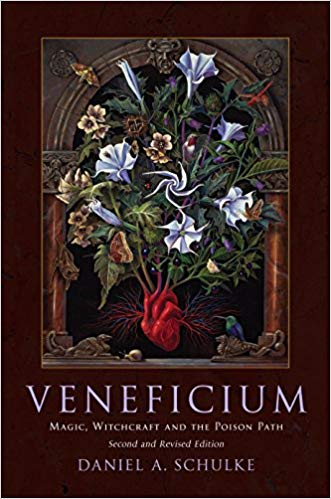
Let’s Read: Veneficium: Magic, Witchcraft, and the Poison Path.

Note: This post contains affiliate links to the book(s) I mention. These allow me to earn a small finder’s fee from Wordery.com, at no cost to you. Thank you for helping to support writers, publishers, and this site!

veneficiumEven if I don’t currently include entheogens in my practice, the ideas and practices of the poison path fascinate me. It takes a tremendous amount of bravery, considerable knowledge, and a firm devotion to the idea of expanding consciousness over bodily safety. It relies on the concept that the dose makes the poison, and growth lies on the thin line between curative and deadly.

The concepts of the poisoner and the witch are inextricable. Just look at the reasons people fear “evil” witches: they were said to cause sickness in people and cattle, wither crops, and bewitch others into nonordinary states of consciousness. Just look at the Evil Queen who sends Snow White into a deep slumber with a poisoned apple, or the Sea Witch who glamours herself and tricks the Prince into falling in love with her. (And what is desire, if not an altered state of consciousness?)

Even in the Bible, the lines between magic and poison are blurred, at best. The words “Thou shalt not suffer a witch to live”  (Exodus 22:18) appear, but may not mean what  they seem to mean. The original Hebrew word, mekhashepha, is of uncertain meaning. Does its root, kashaph, mean “to cut” or “herb using”? A prohibition against magic in its entirety seems unlikely, given the historical context. Other sources later translated the word to mean those who used magic for evil — in other words, witches who “poisoned” by magical means. Could the Bible be warning its readers against poisoners here, instead?

Daniel A. Schulke’s Veneficium: Magic, Witchcraft, and the Poison Path explores the use of mind-altering substances, but it’s emphatically not a “how to” guide. A History of Pagan Europe followed the development and spread of Pagan practices across Europe, and this is in a similar vein — a resource for the history and cultural spread of the spiritual use of entheogens.

One bit I found particularly interesting was the chapter on The Spirit Meadow, particularly the description of bread made of black millet. There’s a sort of folkloric figure called the Black Miller. He’s a powerful, fearsome, shape-changing sorcerer, who makes an appearance in a song by Faun (Die Wilde Jagd), and in “The Black Mill” by Jurij Brezan. It’s unclear exactly where the moniker “Black Miller” came from. In context, it’s unlikely to refer to his appearance or ethnicity — much like the “black” in “blacksmith” refers to the material, not the smith themselves. In Veneficium, some of the information presented by Schulke adds an interesting dimension here, in a section about darnel (Lolium temulentum):

Darnel may well have been present in the notorious ‘black breads’ served at the Sabbat, as documented by DeLancre*, either as a deliberate inclusion or in the bread for its deliriant qualities, or simply as a by-product of the agricultural practices of the time. It is plausible that a toxic stew of deliriant grains, serving as the component basis of the Sabbat-bread, had synergetic effects operating between psychoactive components, if indeed darnel formed a part of witchcraft rites. This idea has been proposed in relation to the everyday bread eaten in medieval Europe[.]

*According to DeLancre, “… their bread is some horrible black cake made of black millet and some other drug…” which ‘confuses the senses’ of those who eat it, and likewise binds them to Satan.

Die Wilde Jadg tells the story of a pair of shapeshifters: one pursuer, one pursued. Based on the connotations of black millet, bread, and hallucinogenic fungi, it’s pretty easy to picture the eponymous “Black Miller” grinding away at the psychoactive raw materials of the “speculative ‘Black Bread of the Sabbat'” — a pretty spot-on occupation for a shapeshifting sorceror.

It would be easy for a book like Veneficium to fall into the trap of being dry and tedious, but it never does. The language is as poetic and striking as it is informative, and the subject matter is absolutely fascinating. If you have any interest in the spiritual use of entheogens and aren’t looking for a guide book, I highly recommend it.

Witchcraft

How to Completely @&#$ up a Spell

Many, many people who will attempt spells or rituals will bomb one at some point. I’ve done it. Everyone I’ve known has. There’s no shame in it, it’s all part of a lifelong process of experimentation. The only shameful thing is not using it as a learning experience!

Before I go into this, let me preface it by saying that I’m of two minds about the concept of a spell “backfiring.” Some schools of thought hold that backfiring isn’t really a thing — if you’re treating your ancestors, deities, and spirit guides like you ought to be, they’re not going to let that happen to you. Others hold that you absolutely can screw yourself over despite their best intentions — spirits are there to guide and help you, but self-sabotage is absolutely possible. In my practice, this plane is where things really manifest, so it is entirely possible to willfully mess yourself up if you try hard enough. By that same token, I also think that it takes a lot to do that. (I have seen it happen, though.)

So! If most witches are more or less guaranteed to experience a failed spell at one time or another, why does this happen?

Continue reading “How to Completely @&#$ up a Spell”

life

The Buzzcut: One Year(ish) Later

The New Year’s day before last, I shaved my head. The whole thing, right down to the skin. I did it for a variety of reasons — some magical, most mundane. Now, after a year (and change), how does it feel?

17952710_10211841750497007_6599383343916337071_n
Not shown: the picked-over patches hidden by that ridiculous part.

I’ve gotta be honest, I don’t regret it. I only regret not having done it sooner.

I don’t keep my hair as (non-existently) short as that first cut. Most of the time, it hovers between a #3 and a #5. I’ve debated allowing it to grow out again, but, every time, I hit about an inch in length and get the urge to buzz it again.

26240277_10214210989086491_5780526394462620721_o
Bald af.

It was a little tough to get used to, at first. I’ve almost always had very long hair. It was part of how I mentally pictured myself. Even in dreams, I had long hair. A big part of why I cut it was trichotillomania — after two decades of feeling through my hair, looking for all of the strands that were too thick, to coarse, too curly, or otherwise too different, and then pulling them out, I was ready to stop. I also knew I didn’t want to go the route of buying hair fiber sprays or putting in expensive extensions that’d only end up damaging what hair I had left. Unfortunately, like a lot of things on the obsessive-compulsive spectrum, it’s not that easy to just up and quit trich. Buzzing it short removes not only the temptation, but the ability to grasp hairs and pull them. As a “fix,” it’s a bit hardcore… but it works.

Sometimes I struggle with the idea of keeping my hair short. Most of the people — men, women, or otherwise — who informed my standard of beauty growing up had long hair. The typical image of the witch in popular imagination is a woman with long, wild hair. Some spells even call for unbinding and shaking out hair, using hair as a taglock, braiding hair together with other objects, or wearing items in hair. Some traditions call for keeping hair bound or covered. I have never been a part of one that did, but I kept my hair bound anyway — I shed like a golden retriever, so it helped keep my hair off of things. (It also helped keep it out of other people’s hands. No sense in giving someone an easy way to focus a jinx on you, you know?)

On the flip side, a large component of magic is embracing change and releasing what no longer serves you. Honoring sunk costs or holding on to things that do nothing for you only serves as an energy sink that detracts from your ability to grow, create, and bring in things that don’t suck the joy out of living. With that in mind, and considering how much mental energy it took to go through the hair-pulling process, obsess about it afterward, try to hide the evidence, and keep my hair in decent shape, I don’t at all regret shaving it.

Will I let my hair grow out again? I don’t think so. I like how it looks short. I love how little care it requires. I like that I can make bars of shampoo last much longer now. I love that I never have to worry about it being dull, or limp, or frizzy, or unmanageable. Not having long hair has taken a tremendous load off of me.

Strangely enough for someone who’s had long hair pretty much her whole life, I feel more like myself with little-to-no hair at all.

40535922_10216173871437323_8889769613303218176_o
I still like to wear hats, though.
crystals · Witchcraft

5 Ways to Cleanse “Difficult” Crystals

So, the bog-standard crystal cleanse is pretty simple: immerse it in salt water, hold it under running water, cover it in dry salt, or stick it in the sun. Easy, right?

There’s only one problem: those are very efficient ways to accidentally destroy a lot of different minerals. Your stones might come out energetically cleansed, but they also might be much worse for wear. (Cleansing selenite, for example, definitely shouldn’t involve water.)

It’s important to remember that, beneath that shiny surface, there’s a ton going on in a crystal in a molecular sense. Some crystals’ color and structure depends on water molecules bound up in their matrix, like opals. Some contain soluble material, like selenite. Some might leach toxic compounds into water when soaked, like pyrite. Some might just end up fading on you — especially translucent crystals, like amethyst or rose quartz.

So, how do you cleanse crystals that won’t survive regular cleansing methods?

Continue reading “5 Ways to Cleanse “Difficult” Crystals”

Witchcraft

“But why are so many witches poor?”

You’d think that, if magic really had the ability to bring you the things you want, you’d never see a witch who was poor, or sick, or wanting for anything. They’d just be a moon phase and a candle away from getting their heart’s desire, right? Google the words “prosperity spell,” and you’ll get — no joke — over 11 million results. If these spells really worked, wouldn’t you only need one? If they were really worthwhile, wouldn’t we have a lot more lottery winners walking around?

Unfortunately, it’s more complicated than that.

There are a lot of reasons why magic doesn’t really work as a “burn candle, ????, profit” kind of deal. Like:

Continue reading ““But why are so many witches poor?””

life · Neodruidry

Winter Things Yule Love

Note: This post contains some affiliate links to things I like, and thought you might enjoy too. They allow me to earn a small commission at no extra cost to you. All product photos belong to their respective owners, and appear here with permission. Thank you for helping to support this site, and the artists and artisans who make awesome stuff!
(Also, that Yule pun was terrible and I’m not even a little sorry about it.)

Now that November’s almost through, I feel like I can talk about Yule. I confess, Yule isn’t my favorite holiday — like a lot of other witches, Samhain’s more my jam. Still, there’s a lot to love about winter, from bundling up with my partner, my cats, a cup of star anise tea, and a fuzzy blanket, to visiting the National Arboretum and Rock Creek Park to take in all of the things nature hides under the greens of spring and summer. (I’m a sucker for watching fluffy little titmice puffing themselves up in red-berried hawthorn boughs. They’re so freaking cute, they’re basically alive Pokémon.)

winterthings
Click the image to Pin it!

As a Pagan, it can be tricky to find ways to make Yule feel special when so much of U.S. culture revolves around Christmas this time of year. So, I put together a short list of things that, to me, help make this season a little extra sweet.

Continue reading “Winter Things Yule Love”