My Handsome Assistant and I like to go cabin camping in winter. Rates are usually lower, things are less crowded, he’s got PTO to use up (or else lose), and there isn’t usually much else to do. A change of scenery does us both good, even if it’s only for a couple of days. It’s also nice to experience the time around the solstice like this.
(We half-jokingly say it’s glamping, because there’s a shower, sheets, heating, and a mini-fridge. Either way, it’s nice and I much prefer it to most of the hotels I’ve been to.) (Even the fancy ones.)
However, while we anticipated a possibly-snowy getaway/creative retreat to work on music, fiction writing, and so on, what we got was… 60° F (15.5° C) and a meteor shower.
Did any of yas know there was a meteor shower? I didn’t. The only ones I usually pay attention to are the ones that occur over the summer here, like your Delta Aquarids and Perseids, and I have been Missing. Out.
I only realized when I was sitting in bed one night, drinking tea and looking out at the forest through the window, all cozy and idyllic and junk. An object, about as large and bright as the brightest star in the sky, flared to life, moved across the sky, and disappeared. I was, of course, surprised — a shooting star without a tail? A “drone” with an oddly predictable flight pattern and only one light? A hallucination?
As it turns out, it was most likely part of the Quaternid meteor shower. This one is, apparently, often overlooked. It has a short period of peak activity and happens in late December/early January, so most people miss it. Also, the Quaternid meteors usually don’t have long tails. They do, however, produce some very bright, striking fireballs. So that was neat.
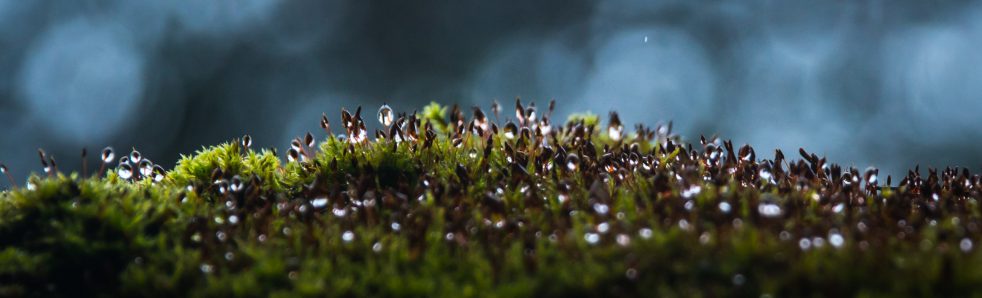
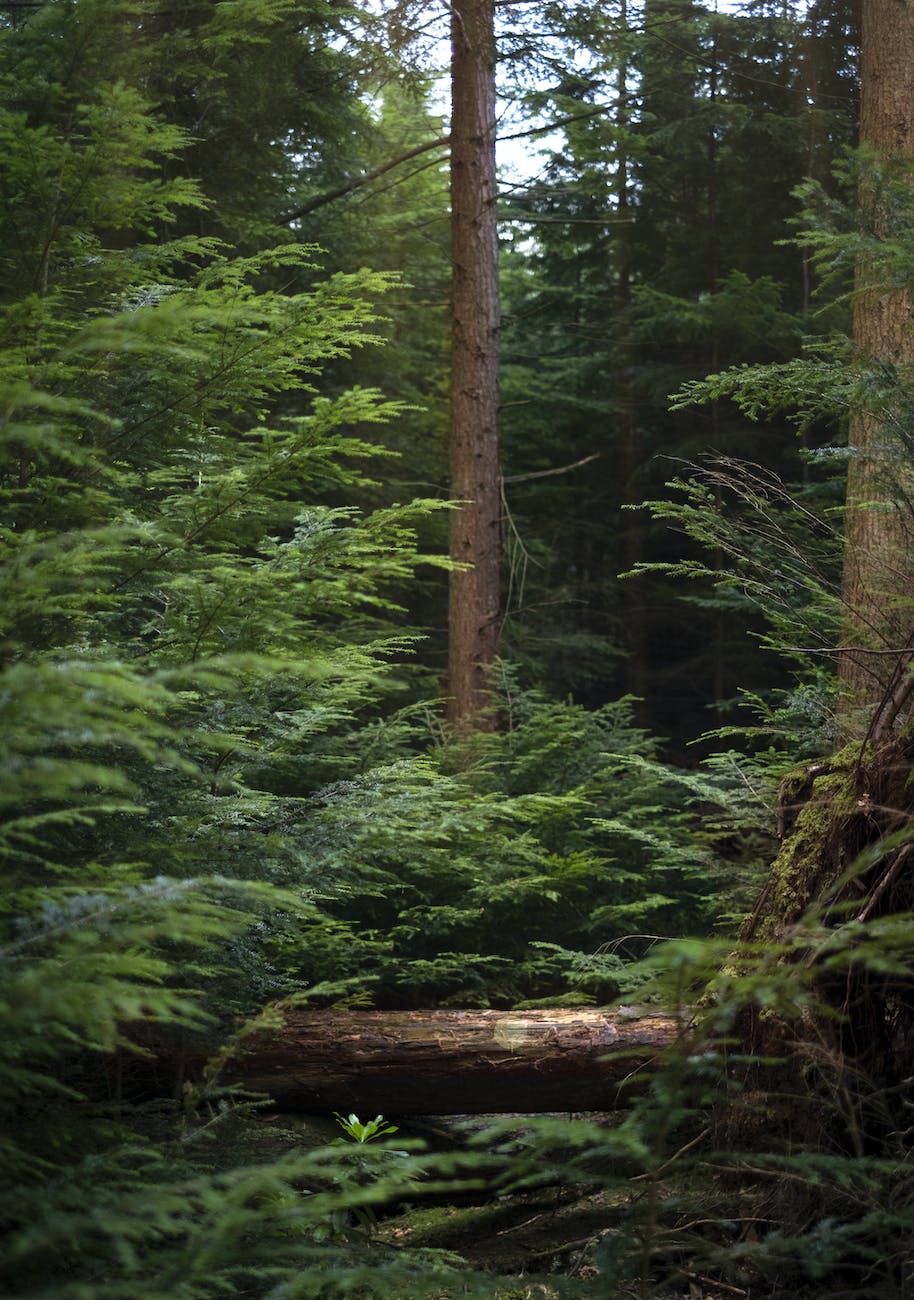
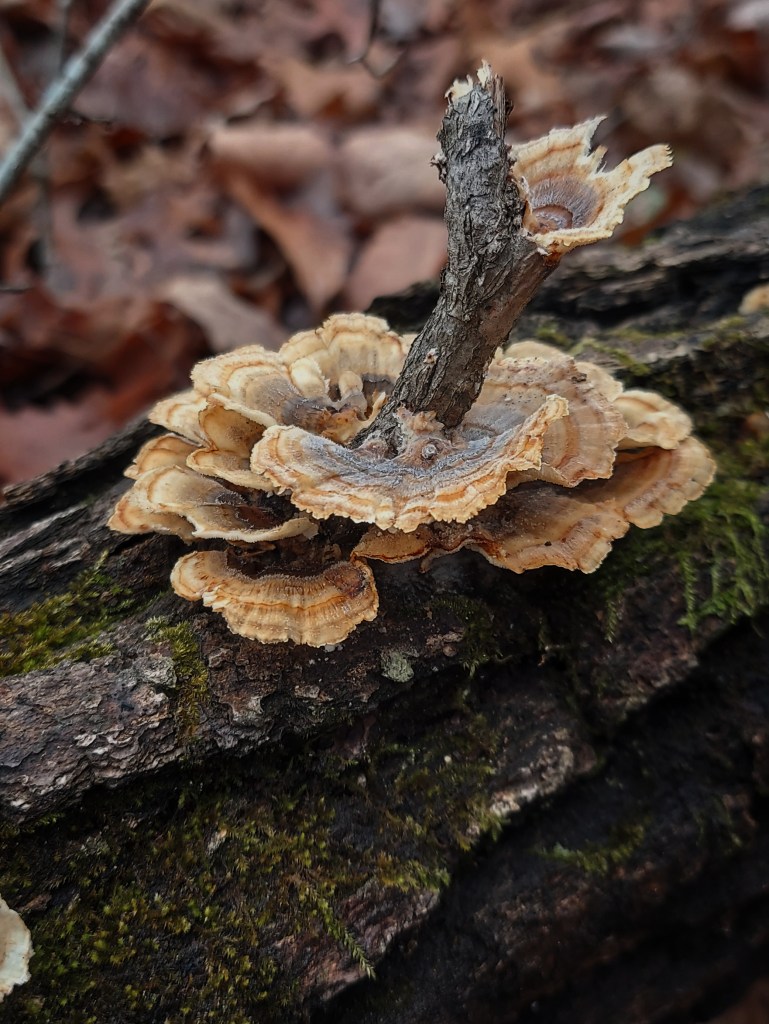
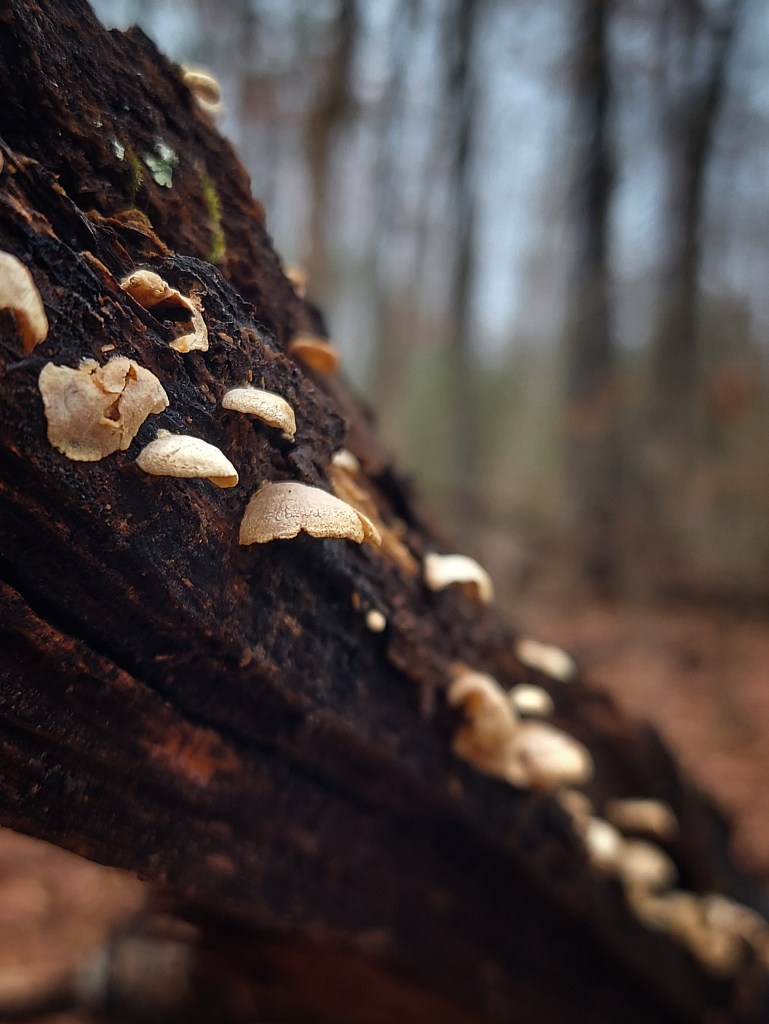
The next day, we spent the late morning going for a walk. With the weather as strangely warm as it was, it turned out to be ideal conditions for finding some very interesting specimens of fungi and beautiful colonies of lichen and moss.
Unfortunately for me, most common culinary species of mushrooms and boletes make me very ill. (Oyster mushrooms, why won’t you let me love you?!) I also have only a passing interest in identifying them, since my interest is primarily visual.
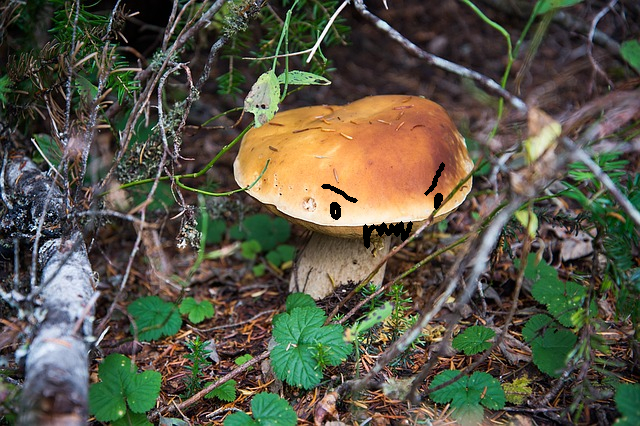
It has been years, but I am still inordinately proud of this very, very silly picture.
I’m what you might call an amateur “catch and release” forager. I love looking at them. I love their folklore. I love finding them. I love taking pictures of them. Sometimes, I’m even able to identify them. I get really stoked when I find ones that a) I recognize, b) are useful, and c) won’t try to make me yakk everything I’ve eaten since fourth grade. But that’s neither here nor there.
Look! We found cool mushrooms and assorted other little forest buddies!
I don’t care how common moss, lichen, and little beige mushrooms are, I will be excited about them absolutely every time. Like a person calling their spouse over every time their cat does something adorable, I will never not be endlessly delighted by them whenever I see them.
A cluster of what are most likely stump puffballs (Lycoperdon pyriforme).Likely white cheese polypore (Tyromyces chioneus).A cluster of what’s most likely one of the Stereum species.No idea what these are, but I love this photo.
I don’t even need to know what kind they are, I’m just happy to have them around.
Here’s hoping your days are similarly filled with interesting small things.
As I write this, it’s snowing. It’s a good snow, too — big, dry, puffy flakes. Kids have a snow day, and the hill in the back yard is covered in a good six inches of fluffy powder.
JJ has never seen snow before, so we tried bringing her outside to explore. She was curious, but also did not seem to enjoy the feeling of cold, wet paws. So, I brought her her own plate of snow, because we’ve got a washable rug and I’m full of bad ideas.
A small, adorable gray tabby cat paws at a pile of snow on a plate.
All of the plants are covered, branches bent under the weight of snow. Even the evergreens and the bright magenta beautyberries are hidden from view. So, I thought today might be a good time to talk about the tales, legends, myths, and magical properties of snow!
Predicting Snow
While not strictly related to snow, one of my favorite weather omens deals with cold winters: “Onion skin very thin, mild winter coming in. Onion skin thick and tough, coming winter long and rough.” The same is said of apple peels. Of course, this works best with local onions and apples — an onion grown in another country probably can’t tell you much about the weather in yours!
No onions? No problem. You can also foretell a cold winter by looking at walnuts and acorns. A heavy crop means a harsh winter. Similarly, thick shells on walnuts also warn of a cold winter.
The seeds of American persimmons are also used to predict winter weather. If they’re shaped like spoons, you’ll have lots of snow to shovel!
Leaves that fall early predict a mild winter. Leaves that fall late (or worse — wither on the branch and don’t fall at all) predict a cold one.
Animals can also warn you about a cold, snowy winter. If their fur is thicker than usual, winter is likely to be a doozy. If squirrels stash their nuts up high, then you’re likely to see a lot of snow. If you live in an area with a wild turkey population, watch where they decide to rest. If they perch in trees and won’t come down, snow is coming.
If you see a woolly bear caterpillar, take note of the width of its bands. Caterpillars with especially wide middle bands predict a mild winter.
Mushrooms are yet another way to predict snowfall. If you see abundant mushrooms in autumn, then you’re likely to get a lot of snow. If mushrooms are scarce, your winter will probably be dry. This makes a lot of sense — mushrooms need humidity. If you have a lot of humidity in the cold months, you’re likely to get a lot of precipitation, too.
Supposedly, the date of the first snowfall can help you predict more. Whatever date the first snowfall falls on will tell you how many more snowfalls you’ll get that winter. (For example, following this logic, we’d be looking at fifteen more snows!) Another variation calculates the number of snowfalls a slightly different way: However many days past Christmas the first snow falls, that’s how many you’ll have that winter. (Using this method, we’d be looking at twentyone.) Yet another variation calculates the number of snowfalls using the date of the new moon. The date of the first snowfall, plus the number of days since the new moon, will tell you how many snowfalls to expect. (According to this, we’d be looking at twenty.)
Snow’s Magical Uses and Folklore
In Japanese folklore, there’s a snow spirit known as yuki-onna, or some variant thereof. This translates to “snow woman,” but she may also call herself “snow daughter,” “snow granny,” “snow hag, “snow girl,” or even “icicle woman,” depending on the region. There are many stories about the origins of these spirits, ranging from otherworldly princesses trapped on Earth, women born from snow drifts, or the vengeful spirits of murdered women. Yuki-onna is also associated with children, as multiple tales describe one holding a child, accompanied by a child, or stealing children.
Frau Holle, or Old Mother Frost, is a figure from German folktales. She is related to the Germanic goddess Perchta, and it was said that the souls of those who died in infancy went to her. She also causes snowfalls when she shakes out her bedspread and beats her pillows.
Cultures all around the world have personified winter and snow. These include figures like the Cailleach in Ireland, Beira in Scotland, Despoina and Khione in Greece, Itztlacoliuhqui in Mesoamerica, Skadi in Norway, and Tengliu in China.
When it comes to the magical properties of snow, the most important thing to remember is that it’s water. It shares the same magical uses, it’s just in a more convenient, semi-solid format. You can draw runes or sigils. Snow is useful for beauty, purification, and healing, particularly emotional healing. Because of its ephemeral nature, snow is also helpful for banishing.
Using Snow
You can use snow in the same ways that you’d use water. If you like cleaning crystals or ritual objects in rain, collect some snow and use that instead. It works every bit as well!
Snow is also a great vehicle for sympathetic magic. If you’d like to banish something (or someone) from your life, collect some snow in a bowl or on a plate. Draw a representation of this thing (or, if it’s a person, write their name) in the snow. Put it in the sun, let it melt, and pour the water out far from your home.
If someone you know is creating problems for you, you can also use snow to get them to knock it off. (Assuming, of course, that pelting them with snowballs and shouting at them isn’t an option.) Write the person’s name on a slip of paper and place it in a jar or other lidded container. Pack the jar with snow, while you demand that this person piss off and stop troubling you. Put the jar in your freezer and leave it there until they go away. If you like, you can also ask the frost giants, spirits of frost, or your tradition’s frost deities to sit on them.
With the (sometimes radical) shifts in this region’s weather, my local area has experienced droughts. This makes an inconvenient amount of snow a very welcome sight, since that’s what’s going to replenish everything and help nurture new life come spring. Here’s hoping for a fruitful, abundant spring and summer this year!
We’re at the halfway point between the winter solstice and the spring equinox, when things often paradoxically feel even colder and grayer than they did in the middle of winter. So why not have a holiday?
Celebrating Imbolc in a city doesn’t really have much of a resemblance to how it’s done traditionally, especially now. There is no lambing season here, and nobody’s gathering. There’s no well here to pray around, nowhere to offer coins or clooties.
I had a small ADF-style ritual, with a glass prep bowl for the well, a small cauldron for a hearth, and my cypress knee for a tree. I offered a bit of blackberry cobbler, fresh from the oven. to Brigid. I put on some Ani DiFranco and read aloud from Jarod K. Anderson’s Field Guide to the Haunted Forest.
When you were born, your enthusiasm was a red flame atop a mountain of fuel. As you age, the fuel burns low. No one warns you. Yet, with intention, you can learn to feed that warming fire long after the fuel you were born with is ash on the wind. Be kind to yourself. Learn this.
They say cut all the wood you think you will need for the night, then double it. Cut it during the daylight when fuel seems irrelevant. Dead limbs hanging low, sun-dried, hungry for fire. The night can be longer than we expect. The wind can be colder than we predict. The dark beneath the trees is absolute. Gather the fuel. Double it.
“The Wood,” Jarod K. Anderson
I’ve never been much for poetry — writing it, I mean. I recently read an article on creativity whose title I forget. (I was one of the ones that calls everything a “hack” and measures it in terms of boosting productivity.) It was mostly forgettable, but there was one bit that stood out: the idea of creating within limits.
Humans build at right angles. We have a sense of geometry, of corners, walls, inside, and outside. If we have rules to play within, we can create amazing things. Strangely, this gets harder when those limits are removed.
I know poetry has rules, I remember spending days on iambic pentameter, sonnets, and rhyming couplets in school. I remember cutting pieces of construction paper into diamonds, to enforce the structure of a diamante poem, lines meant to swell and taper from top, to middle, to bottom. I think I have a harder time with it, though.
Visual art is easy. I can grasp the limits of color mixing, knowing how to blend things so they don’t become muddy, to work wet-on-dry or wet-on-wet, to layer fat and lean. I can see the underpinning geometric shapes. It’s simpler to perceive. I don’t really get poetry the same way.
So, I offered my baking, played someone else’s songs, and read someone else’s poems.
My offerings were accepted. In exchange, the spirits of nature offered me the things symbolized by The Magician (confidence, creativity, manifestation). My ancestors offered my the things symbolized by Justice (cause and effect, balance, fairness). The Shining Ones offered me… also Justice. It looks like I need a lot of it.
Sometimes, they know me better than I know myself. I know my life hasn’t been balanced lately. I let this lack of balance serve as an excuse for not creating things, largely because I find the prospect intimidating. I haven’t been writing as much. I haven’t been painting as much. I haven’t even been taking as many pictures.
I cracked open a root beer and hallowed the waters of life. I asked the Kindred to bless and imbue it with their blessings and advice, so I might be able to internalize and benefit from it as much as possible.
It’s hard to really find the impetus to kick myself in the ass. To tip the scales and rebalance things. To tap into the confidence to keep from making excuses for myself. Hopefully this helps.
As it turns out, there’s a buttload more to working from home than setting up a desk.
I think neither my partner nor I would’ve been able to predict the effects it had: worse sleep hygiene, confused cats, a general air of unease, a much harder time separating work and life, working an extra three hours or so a day. The trouble is, if you have to work from home, you don’t get much choice in the matter — you either have a separate space for an office and the kind of mental walls that help you keep your work life and home life separate, or you’re kind of boned.
So we engineered a way to take a vacation in the most low-risk, isolated way possible.
Getaway offers tiny cabins a little less than two hours outside of D.C. It worked out perfect for us — we booked and paid for the cabin online a few months in advance (they fill up quick), picked up some extra provisions during our last grocery trip, filled up on gas when we normally would anyhow, and made the trip without having to stop. Checking in was completely contactless, too. We received a text with the lock code, keyed it in to the number pad on the door, and stepped into a very comfy, charming one-room cabin.
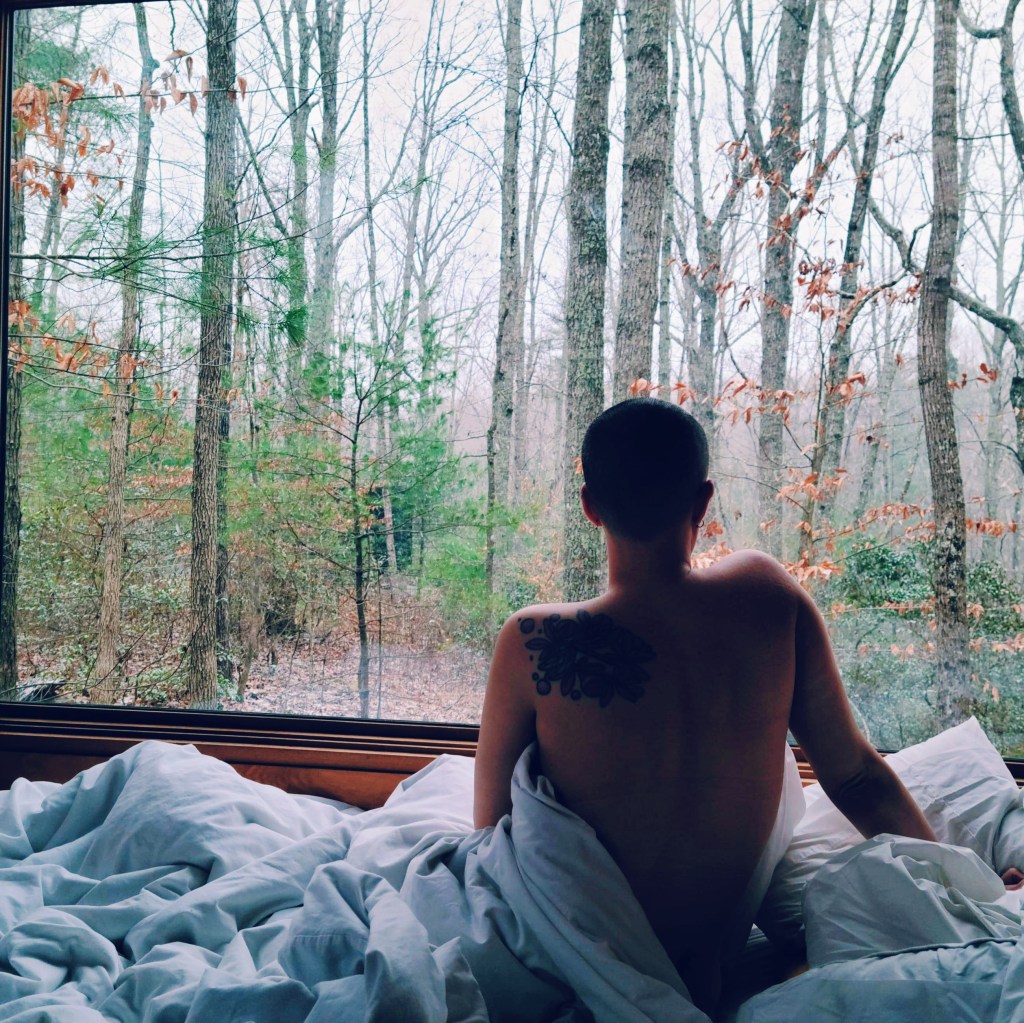
It was pretty much perfect. There was a spacious bathroom at one end, with a large shower and accessibility bars. At the other, there was a big, marshmallowy queen sized bed under an enormous window that looked out onto the woods. The cabin also had a pretty well-equipped kitchen, with a two burner stove, sink, pots, pans, silverware, and dishes. (There was even a bowl for traveling dogs.)
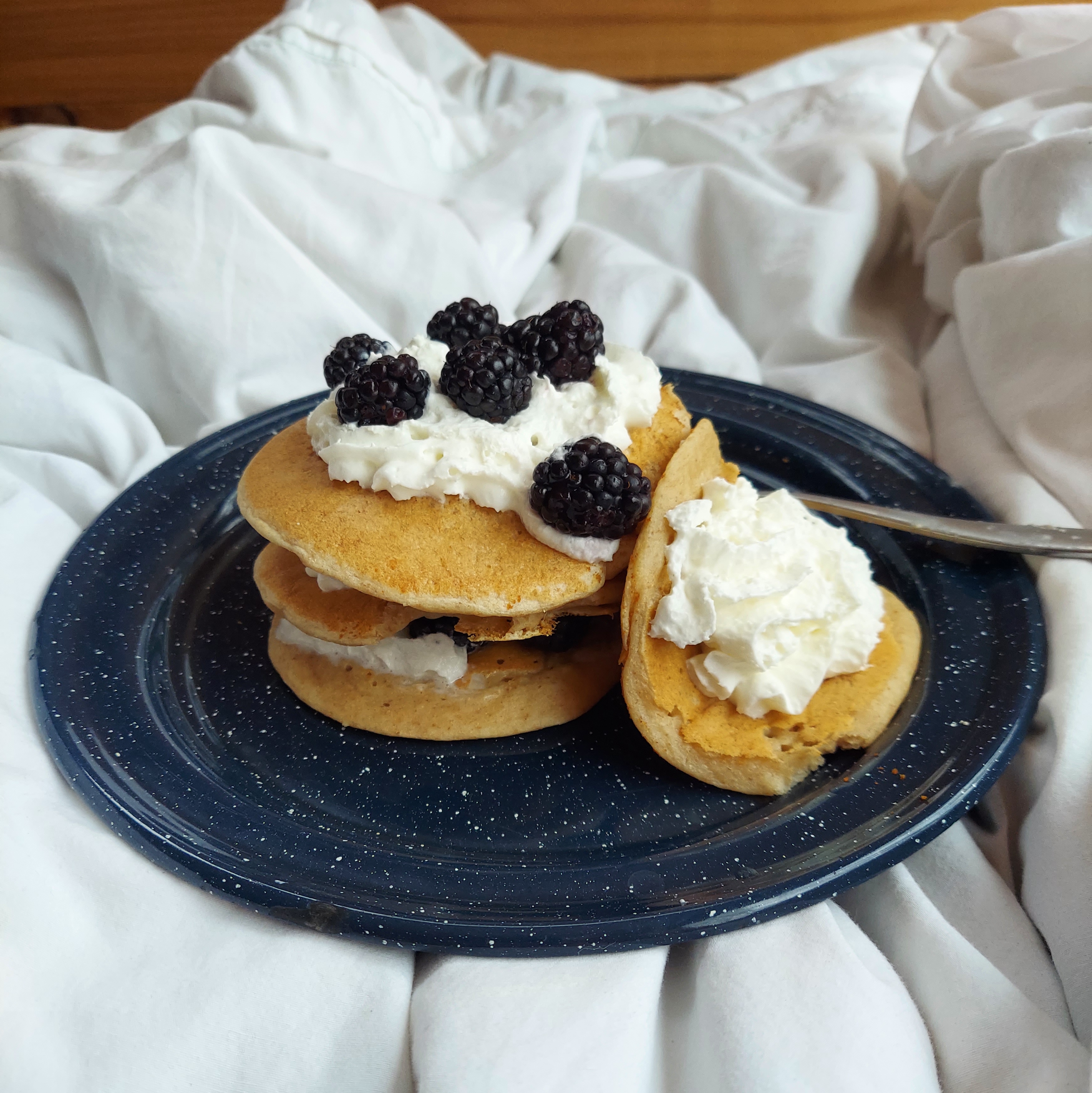
It snowed pretty heavily, which kept us from really taking advantage of the trails or the fire pit. Even so, it was really wonderful being able to snuggle up in bed with a cup of tea and some pancakes, under that huge window, and watch the snow through the trees. The night sky was gorgeous, too — I stayed up late both nights to stargaze.
It was just cozy, you know? Peaceful. Idyllic. No work emails, no calls, no wifi to answer them even if we wanted to. Just the creaking of the trees in the wind, snow, and the stars at night.
It turned out to be a great atmosphere for brainstorming, too. My S.O. and I did some storyboarding, and he wrote a really awesome short story (that will hopefully go up somewhere in the future). I had about a thousand ideas, but didn’t really get into writing or making art while I was there — I took a few notes and made some sketches, but I didn’t want to lose too much time trancing out in a creativity fugue like usual.
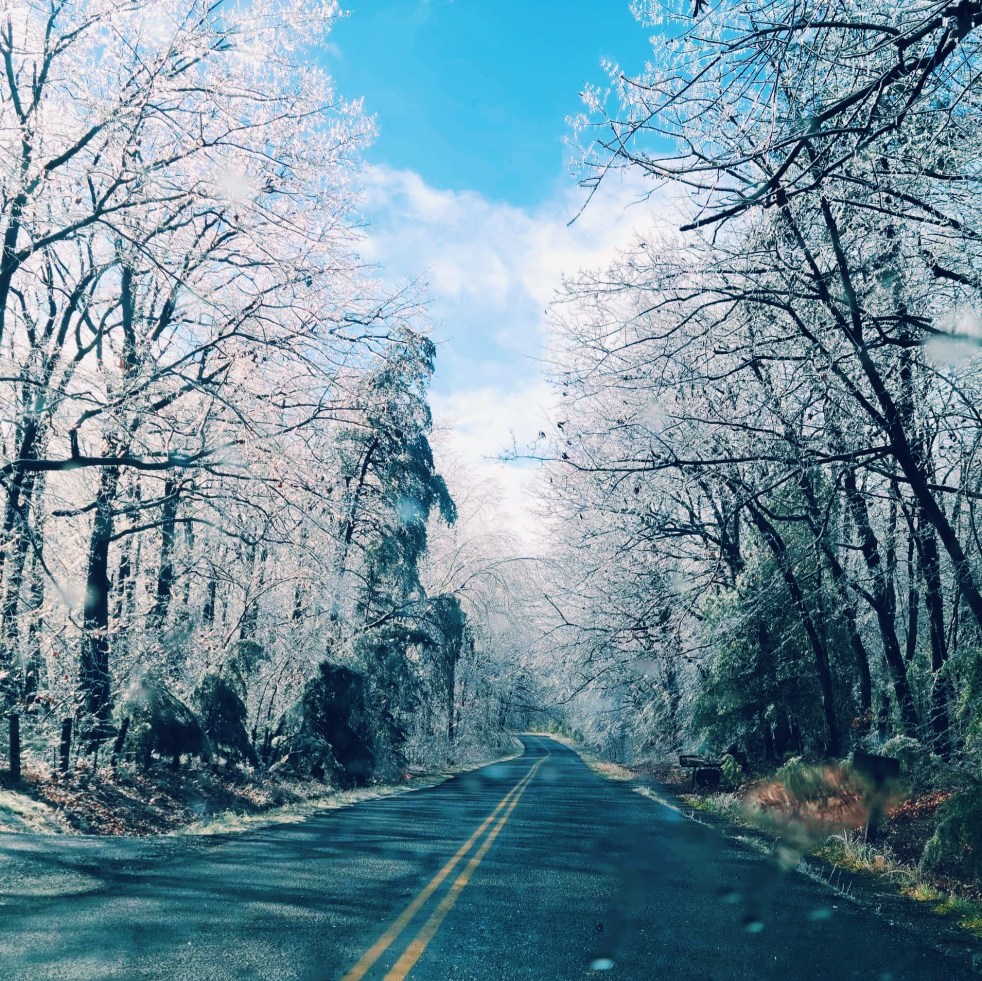
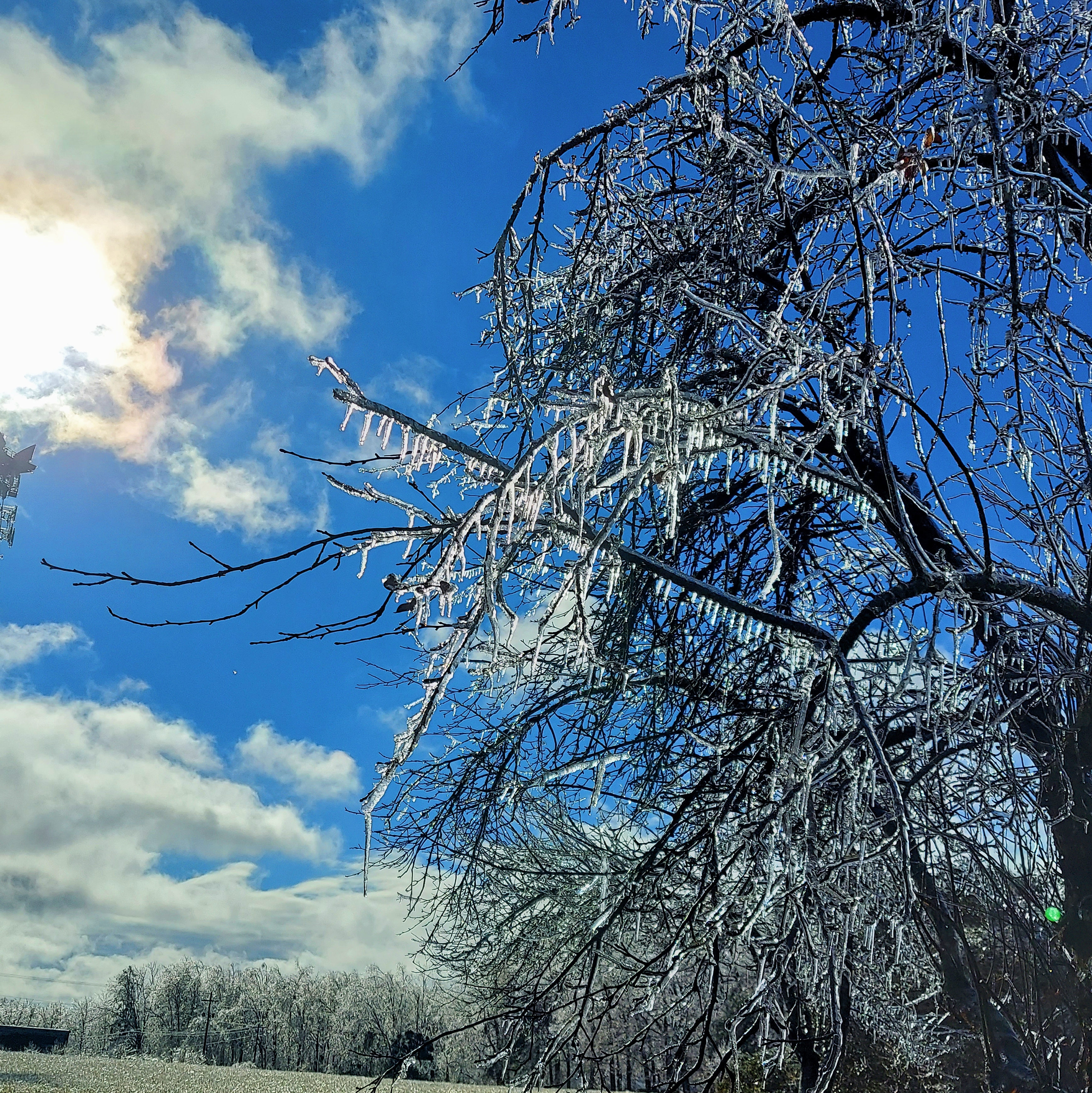
Even the way home was pretty. It rained after it snowed, and the nighttime temperature drop made the water freeze around all of the bare trees until it looked like they were covered in diamonds. The sky was blue, and the sun glittered through the trees’ ice-covered claws until even an ordinary road next to a set of power lines looked like something out of Narnia.
Everything was so bright and pretty, in fact, and we felt so refreshed, that we didn’t really want to go home right away. Stopping somewhere populated wasn’t really an option, but that’s okay.
There’re always roadside attractions.
We’re both kind of suckers for them (by which I mean that, if there’s a World’s Largest Something between here and California, we’ve probably stopped by). The biggest windchime? Been there, rang it, had a slice of pie. My S.O. had barely opened his mouth to say he wished there was something cool on the way home before I had a list of things that were a) large, b) unpopulated, and c) at least slightly ridiculous.
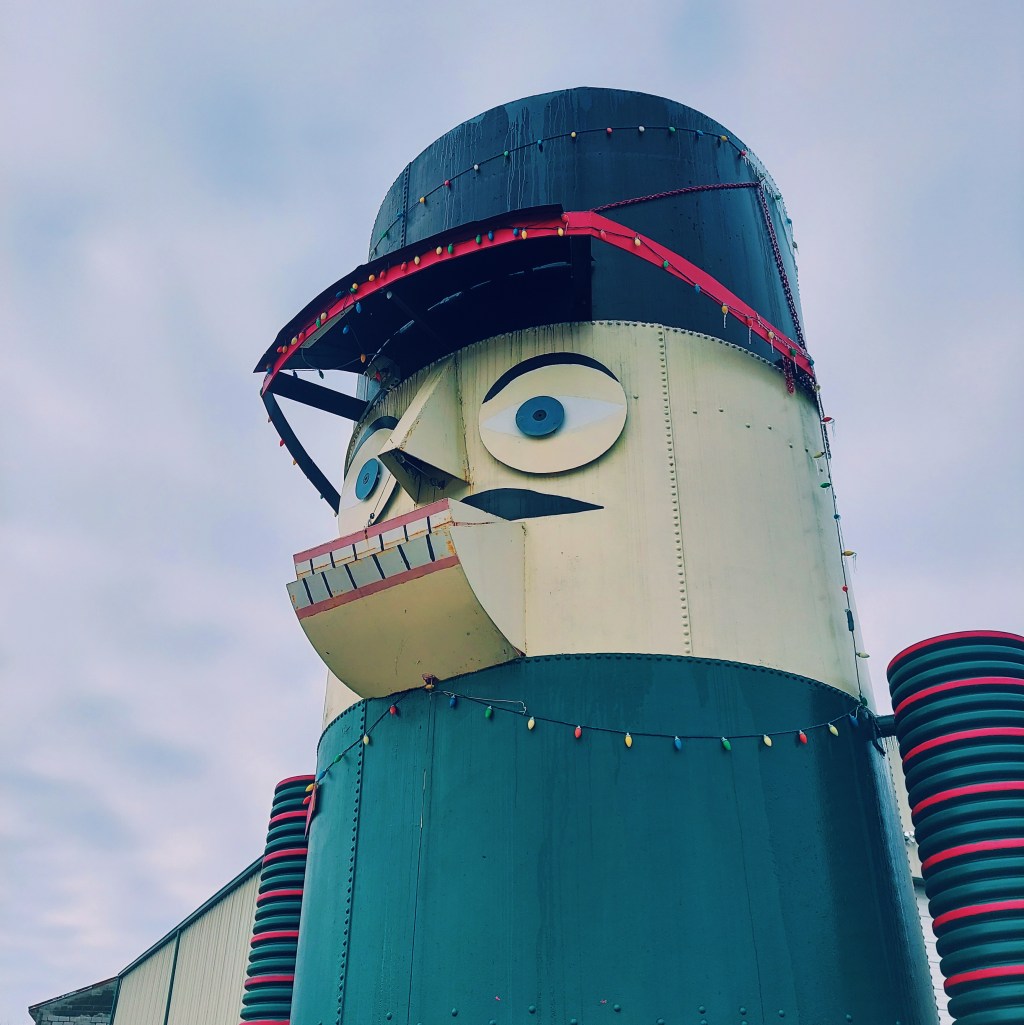
And that’s how we found a giant nutcracker. (Well, mostly the head.)
He used to be a paving company’s tar silo. When a paint company bought the property, they painted it and converted it to this fellow. Honestly, the setting had a pretty unique sense of melancholy — there he was, with the approaching clouds just beginning to gray the sky, strewn with unlit Christmas lights, staring unblinkingly out at a McDonald’s across the street. It felt very Lynchian, though I’ll be damned if I can explain how.
Our appetites whetted by the urge to see more huge things, we next drove back to D.C. to find an actual giant.
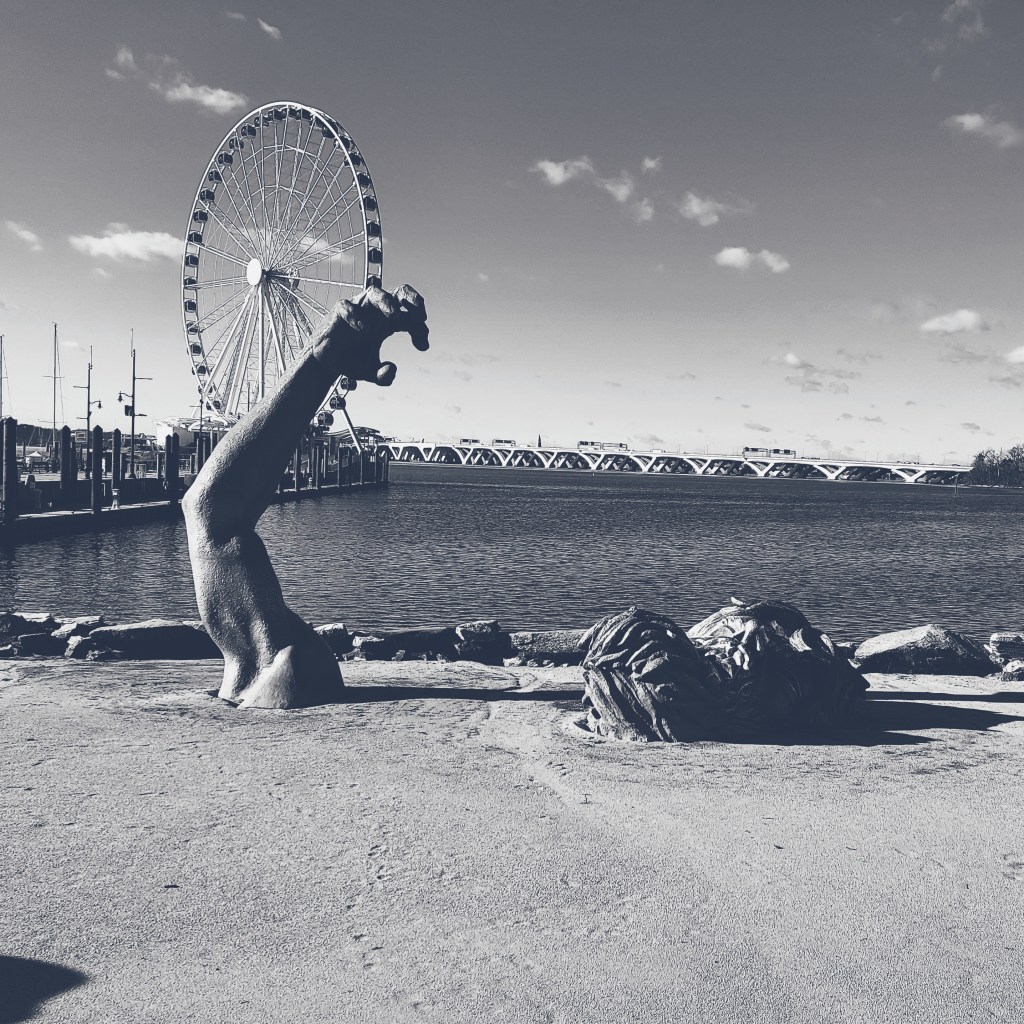
Fortunately, it being the middle of the week, during a pandemic, and also December, the place was pretty much deserted. Several areas were closed off, so I wasn’t able to get closer to the sculptures themselves, but the image was still very striking. There he was, this metal titan struggling up from the beach sand, face twisted in anguished effort. Then, in the background, a lazily turning Ferris wheel.
I don’t know if any of you have played Kenshi, but there’s one particular area that gives me a similar feeling. There’s just something about massive metal hands clawing vainly at the sky that’s so damn eerie. When it’s juxtaposed against a beach and a carnival ride, it’s surreal as hell. I love it.
Now we’re home, snuggled up with two cats who had Many Things to Say about our absence. If you’re reading this the day it was posted, it’s the winter solstice. Keep your eyes peeled tonight for the conjunction of Jupiter and Saturn, and have a happy Yule.
I have a lovely pair of Schlumbergera. They used to live on the windowsill in my bathroom, where they gave me pretty, bright white blooms with hot pink pistils every winter. I looked forward to seeing them every year — individually, the flowers themselves don’t last very long (only about a week per bloom), so it was a little window of beauty in the middle of the cold, gray winter season.
Schlumbergera bridgesii are better known as Christmas cacti, and for good reason — they flower in December. It’s always exciting, watching the little buds pop out of the end of the flat, spiky-edged leaves, growing and lengthening until the flowers finally burst forth. December rolls around, everything else is in the midst of dormancy, but these cacti happily put out flowers anyhow.
Yep.
Every December.
You know, when Christmas happens.
If you notice the leaves don’t really resemble the smooth, round leaves of other Christmas cacti, that’s because holiday cacti nomenclature and labeling makes no sense. This one was labeled as S. bridgesii, which is actually S. buckleyi, and doesn’t look anything like most other S. buckleyi cultivars I’ve seen. ¯\_(ツ)_/¯
So, someone tell me what’s up with this nerd.
See, not long ago, I moved both of my plants into a warmer, brighter window, on the top shelf of my new plant shelves. Now, I’m not sure what triggers S. bridgesii to flower, exactly — shortening daylight hours? Cooler weather? I don’t know. There are ways to force it into dormancy and trigger flowering, but I didn’t do anything out of the ordinary before moving it. I didn’t even restrict light or water.
I’m not complaining, of course — this little plant’s putting out more flowers now than it did two months ago. It looks healthy and vibrant. The cactus right next to it doesn’t have a single bud on it, but it’s also not really supposed to.
Is it possible for S. bridgesii to flower late, if it didn’t flower during Christmas? I’d say so. Is it possible for one to flower more than once a year? Apparently! Unfortunately, I don’t know exactly what triggered this one to start putting out blooms now, but I’m going to keep an eye on both of them and see if the other decides to put out more buds. Maybe take a few cuttings and try some experiments.
Note: This post contains some affiliate links to things I like, and thought you might enjoy too. They allow me to earn a small commission at no extra cost to you. All product photos belong to their respective owners, and appear here with permission. Thank you for helping to support this site, and the artists and artisans who make awesome stuff! (Also, that Yule pun was terrible and I’m not even a little sorry about it.)
Now that November’s almost through, I feel like I can talk about Yule. I confess, Yule isn’t my favorite holiday — like a lot of other witches, Samhain’s more my jam. Still, there’s a lot to love about winter, from bundling up with my partner, my cats, a cup of star anise tea, and a fuzzy blanket, to visiting the National Arboretum and Rock Creek Park to take in all of the things nature hides under the greens of spring and summer. (I’m a sucker for watching fluffy little titmice puffing themselves up in red-berried hawthorn boughs. They’re so freaking cute, they’re basically alive Pokémon.)
Click the image to Pin it!
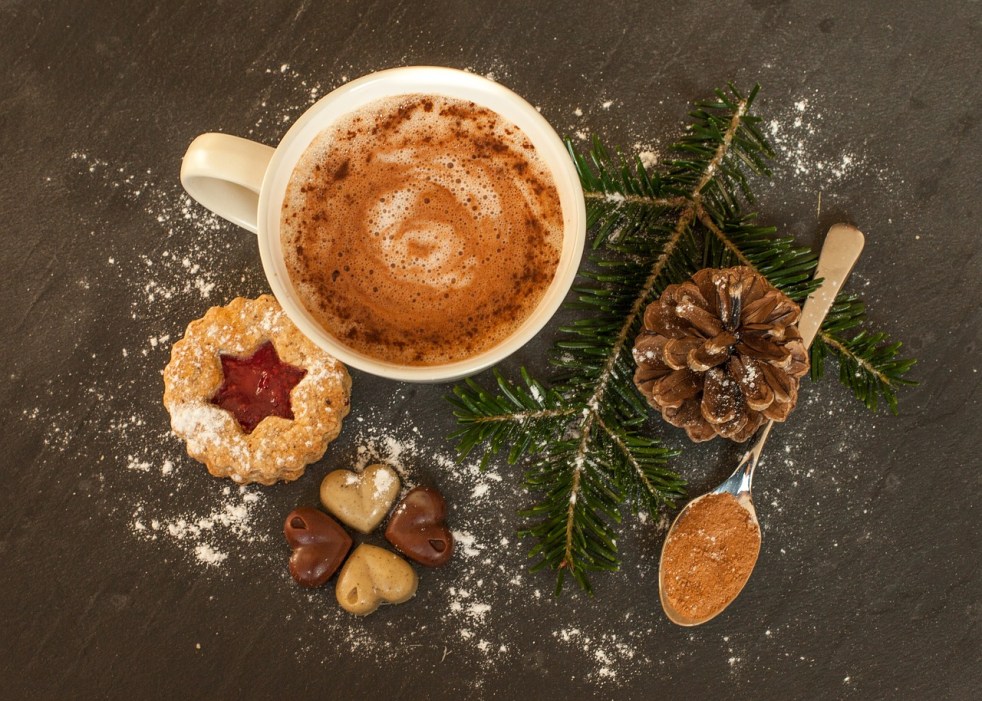
As a Pagan, it can be tricky to find ways to make Yule feel special when so much of U.S. culture revolves around Christmas this time of year. So, I put together a short list of things that, to me, help make this season a little extra sweet.










 Marble Crow