
animals · Uncategorized

The Magical Meaning of Opossums

We have a marsupial!

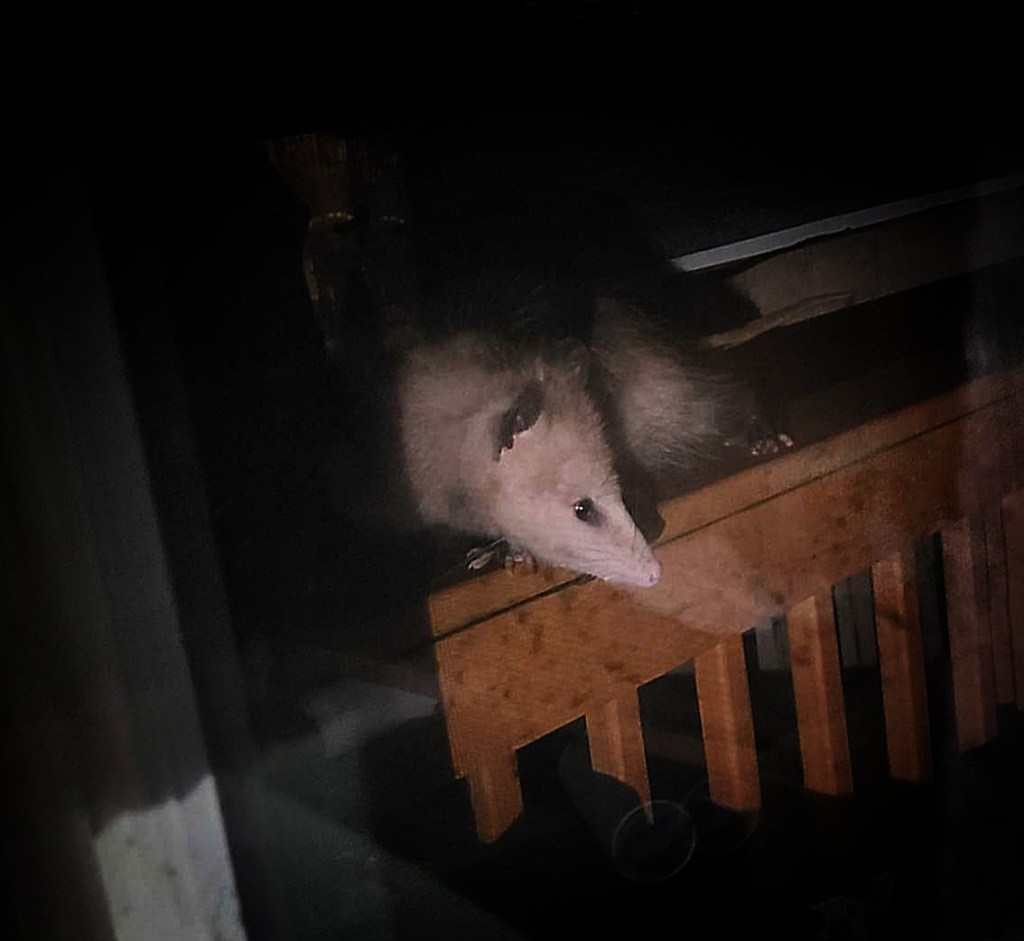
He appeared on the deck railing at 3 AM a few weeks ago, trundling along like one of the ROUS from The Princess Bride. (Which is to say, he moved like a very small man in an opossum suit.) I was so excited I almost shook my Handsome Assistant awake.

When he returned the next day to snuffle around the platform feeders, I actually went outside to offer him a small quantity of the kibble and dried bugs I use to feed the crows. He seemed pretty relaxed about the whole thing — just kind of leaned back and gave me a look that distinctly said, “Are you @#$% serious right now?

It was when my Handsome Assistant and I were watching Hellier a few days later that I realized that I’d never survive a monster movie. If I lived in Kelly, KY, and encountered the Kentucky Goblins, I would 100% have tried to give them Capri Suns and crackers and ended up 1000% dismembered inside an abandoned coal mine.

But my impending mortality at the hands of something I’m trying to give snackies to is neither here nor there. Since there is an opossum, I thought I would explore the magical meaning of these creatures.

The Virginia opossum is the source of the name “opossum.” It comes from a Powhatan word meaning “white animal,” which derives from a Proto-Algonquian word meaning “white dog.” The Spanish words for opossum, tlacuache and zarigüeya, derive from the Nahuatl tlaquatzin and Guarani sarigweya.

There is a large difference between opossums and possums (and Possum). Opossums live in the Americas, have skinny tails, and are grayish with white faces. Brush-tailed possums are from Australia, have fluffy tails, and are brownish. They are unrelated. The kind we have where I live, the Virginia opossum, is a member of Didelphimorphia (specifically, Didelphis virginiana).
Some say that, due to a colossal mix-up, we ended up with Australia’s possum and they ended up with ours. For the purposes of this post, I’m going to focus on the American opossums.

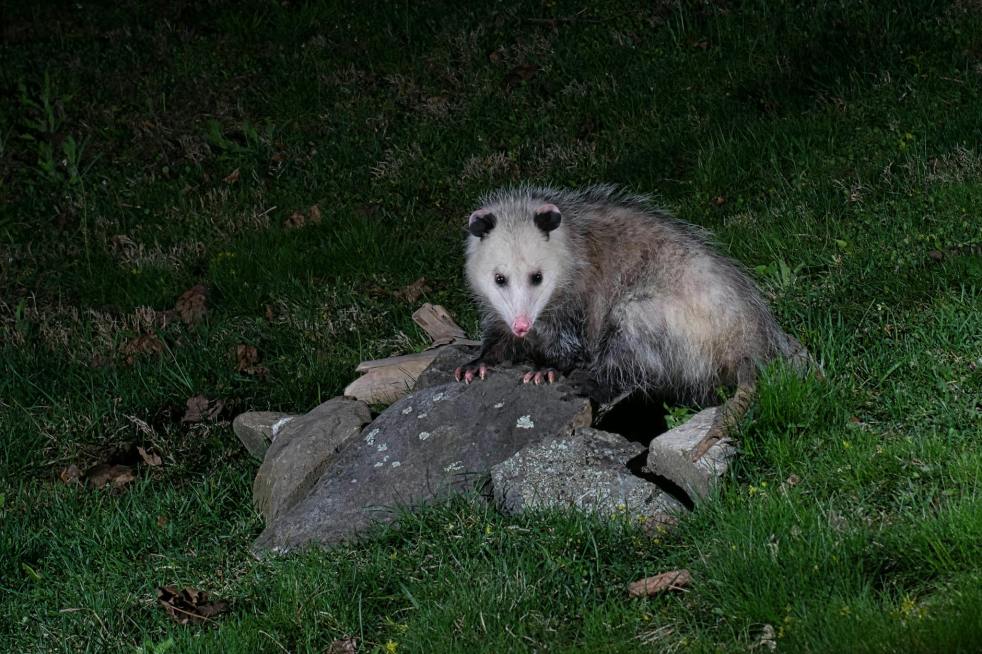
The Virginia opossum. Photo by Skyler Ewing on Pexels.com
The Australian brush tailed possum. Photo by Charles J. Sharp, CC BY-SA 4.0 https://creativecommons.org/licenses/by-sa/4.0, via Wikimedia Commons.

It’s often said that opossums “play dead” when confronted with a threat. In reality, they have a few different responses. They’re more likely to attempt to flee, or puff themselves up, hiss, and try to appear more threatening. In some situations, an automatic anxiety response may cause them to feign death, during which their heart rate and breathing slow, they lie motionless, and they emit a foul-smelling fluid from their butts.

It’s also often said that opossums are voracious tick eaters. This is not true. They are opportunistic omnivores, and they do eat a ton of insects, but the study that gave rise to this myth involved opossums in a laboratory setting during which they didn’t have much other choice. (It’d be like covering a human in peanut butter, locking them in a room for several days, and then saying that their diet primarily consists of nut spreads.) When the stomach contents of wild opossums were analyzed, there actually weren’t any ticks in there.
Still! Even though they’re not the tick-decimating forces of nature folklore paints them to be, they’re a vital part of the ecosystem that helps control numerous other problem species. They’re basically organic garden pest control that screams at their own butts.

Interestingly, opossums aren’t often found in indigenous American folklore. When they appear in North American lore, they’re usually buffoonish characters. (In fact, their feigning death is often portrayed as stemming from embarrassment!)
In South America, however, opossums are clever tricksters. Some groups even regard Opossum as a Prometheus-like figure.

In modern symbolism, opossums are seen to represent cleverness. This may come from the belief that they deliberately choose to “play dead.” (They also have really weirdly dexterous little paws and opposable thumbs on their feet.)

They’re also widely regarded as symbols of patience, perseverance, and survival against the odds. They’re slow-moving and very deliberate animals, and, when in a “feigning death” state, can remain motionless for hours to wait out predators.

Sometimes, opossums are viewed as symbols of rebirth since they seem to come alive after playing dead.

Dreaming of an opossum is believed to represent an illusion. Something may not be what it appears to be. It can be a sign from your subconscious that a situation isn’t right, and you need to look closer to find the truth.

Opossums are commonly associated with the Moon and lunar magic. They’re nocturnal, and their silvery fur and pale faces connect them to these energies.

Personally, I don’t care if Francis (by the way, I named the opossum Francis) never eats a single tick. I’m very happy to share this garden space with him. He is my precious garbage son and I love him very much.
animals

The Magical Meaning of Black Squirrels

The other day, I was on the deck having breakfast with my local crowbros. (It’s funny — as soon as I go outside, I hear their calls pick up speed and intensity. Then they start to swoop around and gather in the big maple tree. Once some of the braver members of the family are present, they’ll start making forays to the feeders. Gradually, once they’ve proven its safe, the timid members follow suit.) This day was different, though.

This day had squirrels.
Not just the usual suspects (Freddy de Bonesby and the pruno-making delinquents), either.
Today, there was a black squirrel.

A photo of a black squirrel on a clover-covered hillside. He looks like he's just realized he left his stove on.

Black squirrels are a naturally occurring melanistic variation of grey or fox squirrels. They’re fairly rare under normal circumstances, appearing at a rate of about one for every 10,000. This is overall, however — black squirrels do occur more commonly in specific areas. They’re generally seen more often in urban places (theoretically because they blend in better there than they do elsewhere) and at the northernmost portions of their ranges (theoretically because they absorb sunlight more efficiently, keeping them warm and extending their active, foraging times during the cooler months).

Melanism in squirrels doesn’t occur with the same beautiful variety as human skin colors, and isn’t even the same as melanism in other animals. In most other animals, melanism is a recessive gene and an individual must inherit it from both parents. In humans, coloration is controlled by multiple genes that come in a variety of alleles that show incomplete dominance, resulting in an incredible variety of hair, eye, and skin colors. In squirrels, melanism is associated with the is associated with the MC1R-Δ24 E B allele EB and is incompletely dominant with the “wild” coloration allele E+. So, a squirrel that inherits two wild coloration alleles will be the color of the average gray squirrel (E+ + E+). A squirrel that inherits one copy of the melanistic allele will exhibit a dark brownish, nearly black coloration (EB + E+). A squirrel that inherits two copies will be a deep, shiny, inky black (EB + EB).

Even rarer than melanistic squirrels are leucistic squirrels — white squirrels with black eyes. These are not the same as albino squirrels, which typically have pink and blue eyes. Albino squirrels typically have poor eyesight. Leucistic squirrels have normal eyesight. Both stick out like sore thumbs to predators and generally don’t survive long in the wild.

Where I live, melanistic squirrels more common because it’s a) by a major city, where b) a bunch of them escaped from a zoo this one time.

I had seen a few here and there in the past, but I’d never seen one in the yard before. Out of curiosity, I decided to look up the magical and folkloric significance of these adorable weirdos.

Remember that bit about escaped zoo squirrels? Well, the tale goes like this: As far back as 1900, Frank Baker (superintendent of the National Zoo) repeatedly requested rare, beautiful black squirrels from several locations in Ontario, Canada. Two years later, Thomas W. Gibson (Ontario’s former commissioner of Crown lands) sent the National Zoo eight black squirrels. Canada is in the northernmost portion of the eastern gray squirrel’s (Sciurus carolinensis) range, so melanistic individuals are far more common there.
In 1906, eighteen of the black squirrels were released onto the zoo’s grounds. For some reason, people okayed this decision because they literally didn’t think they’d get out. However, being squirrels, that’s exactly what they did. As a result, DC has an exceptionally high population of melanistic squirrels.

A close-up of a black squirrel in autumn leaves.
Photo by Lauren Hedges on Pexels.com

Remember when I wrote about solar eclipses a bit ago? I briefly mentioned the Choctaw legend about greedy squirrels coming to eat the Sun. These weren’t just any squirrels, though — they were particularly hungry and mischievous black squirrels.

In Ireland and the UK, black squirrels were viewed similarly to black cats: as signs of good luck or prosperity. Rare as they are, they were also thought to have connections to the fae realm. While they don’t appear to have the “messenger” connotations of animals like crows, they are no less connected to occult knowledge.

Given squirrels’ propensity for burying things, black squirrels were associated with finding hidden treasure.

Of course, as has often happened throughout history, the spread of various forms of Christianity during the medieval period turned what were once good luck symbols into something sinister. Black animals, like cats, crows, ravens, and even squirrels, were then associated with misfortune and evil. They were often accused of being witches’ familiars.

In general, black squirrels are associated with good luck. English coal miners would keep them around for luck, and it was considered very unlucky to ever harm one.

Even in cultures where melanistic squirrels are viewed as troublesome, they were typically seen more as eccentric trickster figures than something expressly evil.

Today, places that are fortunate enough to be blessed with lots of black squirrels often take pride in it. Some of them are jokingly called “squirrel towns,” and feature black squirrels on their signs, as the subject of annual festivals, and represented on souvenirs in gift shops.

In a divinatory sense, the appearance of a black squirrel heralds a positive change of some sort.

While they may not be super rare here, black squirrels are still delightful to see. From what I’ve noticed, they seem jumpier and more skittish than other eastern gray squirrels, so being able to get a photo of one (or even a clear look at one) is a treat.