animals · life

We found a bunch of little guys in the woods.

Saturday, part of the Druidry group took a walk in the woods. It was a silent, contemplative walking meditation, initially meant to observe and enjoy the first frost. However, since this area hasn’t really had a legit frost yet, it was mostly about observing the changes that autumn has brought.

It was a little disheartening to have such good weather. It should be cooler this time of year. I shouldn’t be comfortable in a tank top and a thin jacket in November. I found a woolly bear caterpillar the other day, and its stripes forecast a mild winter, too. Winter precipitation is so important for avoiding droughts later in the year, and I worry about it. There was a serious drought when I lived in California, and I don’t want to go through that again.

Still, part of a walking meditation is about being present. Not to worry about next summer, but to appreciate this autumn as it is. There hasn’t been much rain, but the early evening sky is beautiful, and the bare, dark branches and golden leaves make it look like stained glass. There’s the sweet smell of decomposing leaves, and their satisfying rustle and crunch underfoot. The leaves aren’t all brown yet, so the entire trail is carpeted in gold, deep crimson, and salmon pink. Some of the leaves are multicolored, like they’ve been ice-dyed in shades of red and green.

Also, we found a bunch of little guys.

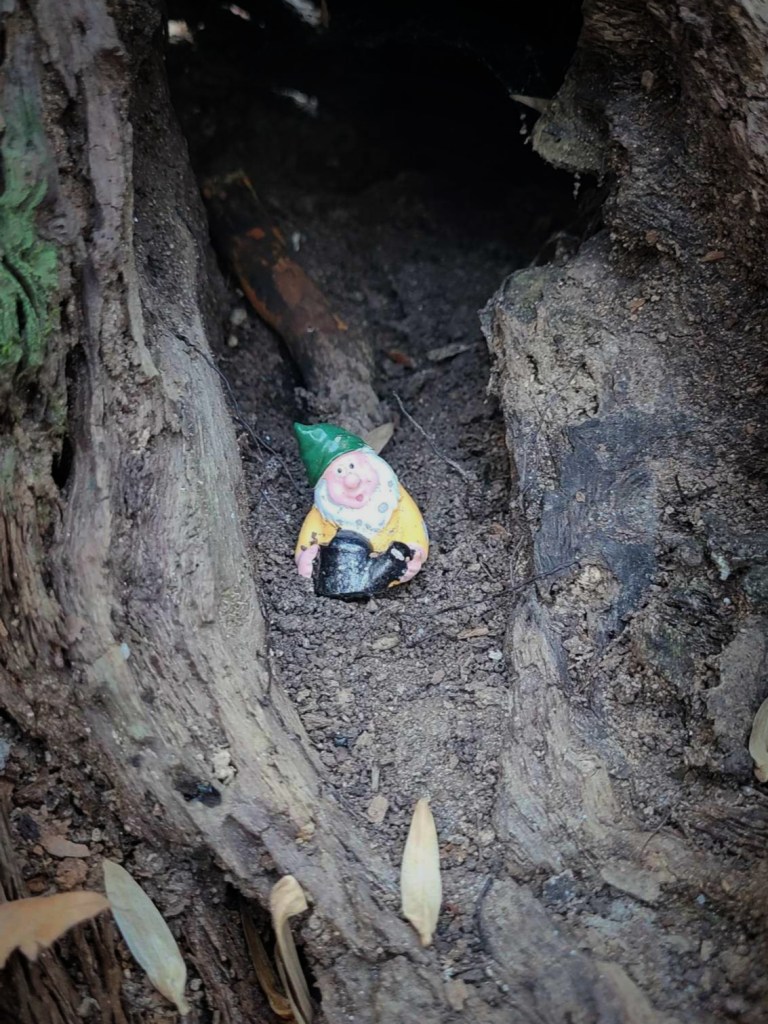
The first one, I found under a small pile of debris in a crevice of a fallen tree. (I always look in gaps and holes in trees — I found some really amazing eyelash mushrooms in one once, so now I check every time I see one.) It looked like a child’s discarded toy, covered in debris and with chipping paint. I felt bad about leaving him, so I picked him up.

A small gnome figuring with a yellow shirt, red pants, and blue hat, sitting in a crevice of a tree.

Then I found a broken bottle. I didn’t have gloves or a bag for trash picking, so I initially left it where it was… but I only made it about twenty feet before I felt too badly and had to go back for it. I piled the pieces into a sort of avant-garde trash sculpture and continued on, gnome in one hand and broken bottle pile in the other.

A little further onward, we found a red woodpecker with a sheriff’s badge. His placement was intentional and whimsical, so I left him where he was to be a surprise to another trail-goer. (And kept my eyes peeled for other little guys.)
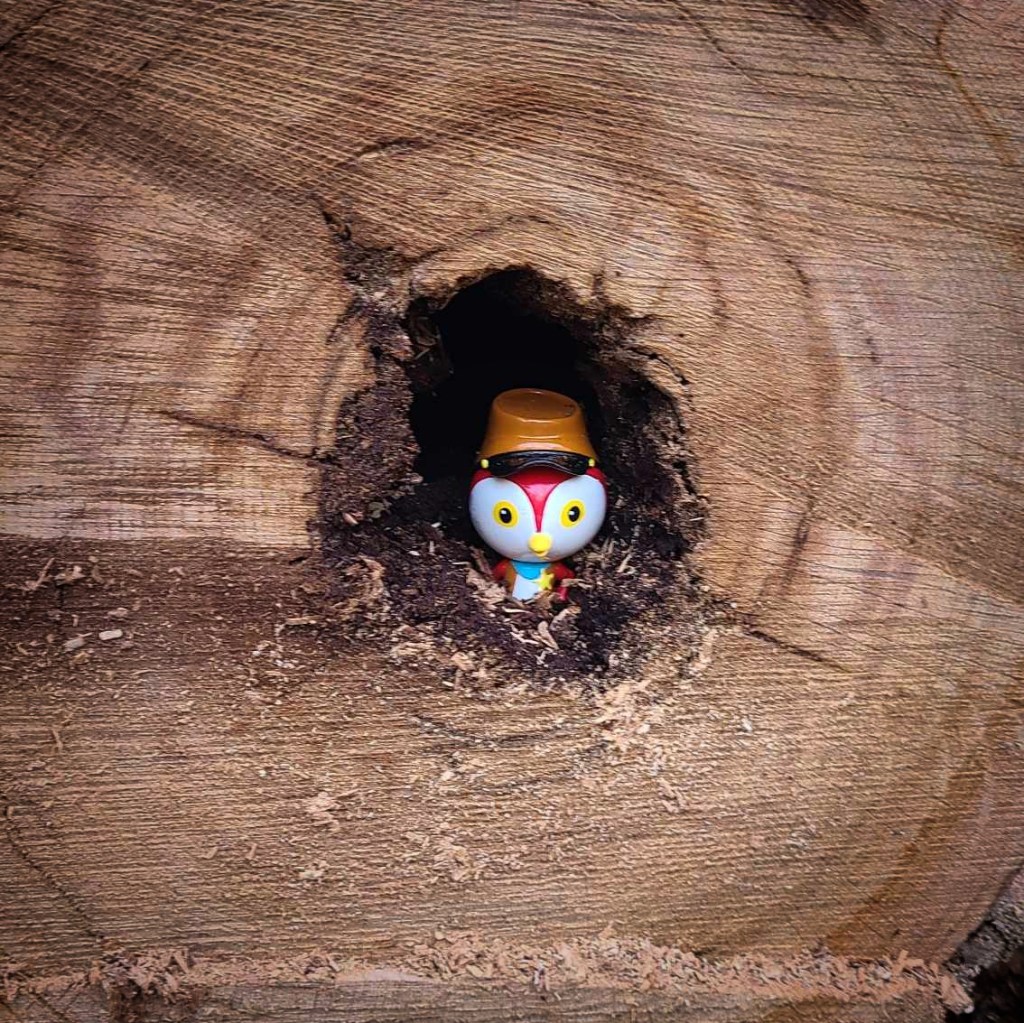
A toy red woodpecker with a brown cap, blue bandanna, and yellow sheriff's badge., tucked into a hole in a felled tree.

Then there was a blue elephant. Since we were walking in silence, my Handsome Assistant and I have a series of hand gestures we use when we want to point out things to each other. Mushrooms, particularly interesting sticks, small blue elephants…

A goggle-eyed blue elephant keychain, tucked into a hole in a tree.

And then there was another gnome.

A toy gnome with a yellow shirt, green cap, and black watering can, sitting in a hole in the base of a tree stump.

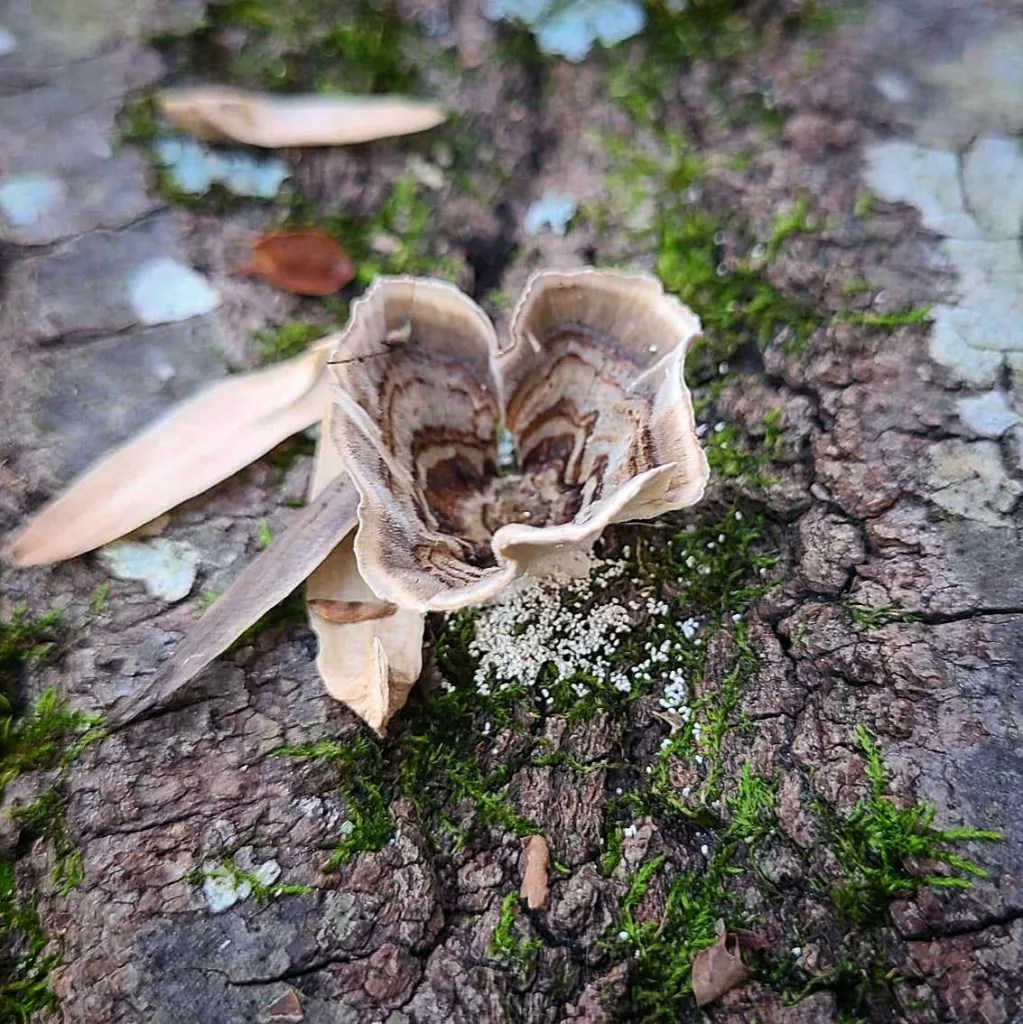
Despite the lack of rain, there were also loads of mushrooms. Striped turkey tails, unfolding like flower petals. Round puffballs like dollops of meringue. Clusters of other fungi, nestled amid fallen leaves, ferns, and small groundcover plants.

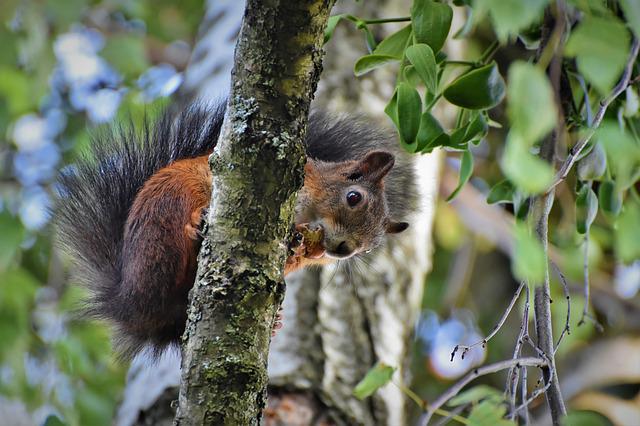
As we said our goodbyes to each other and left, we also spotted a chubbly little squirrel absolutely gruffling some gourds. Occasionally, he’d dart away from the sidewalk as people passed, but he’d always go back and resume snacking — thoroughly engrossed, thoroughly enjoying himself, absolutely without a fuck to give.

I could say I want to be more like this squirrel, but I don’t really. I don’t think I really can stop worrying about the future. I like to think this makes me conscientious, but maybe I’m just more anxious than I need to be. Either way, I hope the snow comes soon. In the meantime, I also hope all of the squirrels get their fill of gourds.

animals

The Magical Meaning of Black Squirrels

The other day, I was on the deck having breakfast with my local crowbros. (It’s funny — as soon as I go outside, I hear their calls pick up speed and intensity. Then they start to swoop around and gather in the big maple tree. Once some of the braver members of the family are present, they’ll start making forays to the feeders. Gradually, once they’ve proven its safe, the timid members follow suit.) This day was different, though.

This day had squirrels.
Not just the usual suspects (Freddy de Bonesby and the pruno-making delinquents), either.
Today, there was a black squirrel.

A photo of a black squirrel on a clover-covered hillside. He looks like he's just realized he left his stove on.

Black squirrels are a naturally occurring melanistic variation of grey or fox squirrels. They’re fairly rare under normal circumstances, appearing at a rate of about one for every 10,000. This is overall, however — black squirrels do occur more commonly in specific areas. They’re generally seen more often in urban places (theoretically because they blend in better there than they do elsewhere) and at the northernmost portions of their ranges (theoretically because they absorb sunlight more efficiently, keeping them warm and extending their active, foraging times during the cooler months).

Melanism in squirrels doesn’t occur with the same beautiful variety as human skin colors, and isn’t even the same as melanism in other animals. In most other animals, melanism is a recessive gene and an individual must inherit it from both parents. In humans, coloration is controlled by multiple genes that come in a variety of alleles that show incomplete dominance, resulting in an incredible variety of hair, eye, and skin colors. In squirrels, melanism is associated with the is associated with the MC1R-Δ24 E B allele EB and is incompletely dominant with the “wild” coloration allele E+. So, a squirrel that inherits two wild coloration alleles will be the color of the average gray squirrel (E+ + E+). A squirrel that inherits one copy of the melanistic allele will exhibit a dark brownish, nearly black coloration (EB + E+). A squirrel that inherits two copies will be a deep, shiny, inky black (EB + EB).

Even rarer than melanistic squirrels are leucistic squirrels — white squirrels with black eyes. These are not the same as albino squirrels, which typically have pink and blue eyes. Albino squirrels typically have poor eyesight. Leucistic squirrels have normal eyesight. Both stick out like sore thumbs to predators and generally don’t survive long in the wild.

Where I live, melanistic squirrels more common because it’s a) by a major city, where b) a bunch of them escaped from a zoo this one time.

I had seen a few here and there in the past, but I’d never seen one in the yard before. Out of curiosity, I decided to look up the magical and folkloric significance of these adorable weirdos.

Remember that bit about escaped zoo squirrels? Well, the tale goes like this: As far back as 1900, Frank Baker (superintendent of the National Zoo) repeatedly requested rare, beautiful black squirrels from several locations in Ontario, Canada. Two years later, Thomas W. Gibson (Ontario’s former commissioner of Crown lands) sent the National Zoo eight black squirrels. Canada is in the northernmost portion of the eastern gray squirrel’s (Sciurus carolinensis) range, so melanistic individuals are far more common there.
In 1906, eighteen of the black squirrels were released onto the zoo’s grounds. For some reason, people okayed this decision because they literally didn’t think they’d get out. However, being squirrels, that’s exactly what they did. As a result, DC has an exceptionally high population of melanistic squirrels.

A close-up of a black squirrel in autumn leaves.
Photo by Lauren Hedges on Pexels.com

Remember when I wrote about solar eclipses a bit ago? I briefly mentioned the Choctaw legend about greedy squirrels coming to eat the Sun. These weren’t just any squirrels, though — they were particularly hungry and mischievous black squirrels.

In Ireland and the UK, black squirrels were viewed similarly to black cats: as signs of good luck or prosperity. Rare as they are, they were also thought to have connections to the fae realm. While they don’t appear to have the “messenger” connotations of animals like crows, they are no less connected to occult knowledge.

Given squirrels’ propensity for burying things, black squirrels were associated with finding hidden treasure.

Of course, as has often happened throughout history, the spread of various forms of Christianity during the medieval period turned what were once good luck symbols into something sinister. Black animals, like cats, crows, ravens, and even squirrels, were then associated with misfortune and evil. They were often accused of being witches’ familiars.

In general, black squirrels are associated with good luck. English coal miners would keep them around for luck, and it was considered very unlucky to ever harm one.

Even in cultures where melanistic squirrels are viewed as troublesome, they were typically seen more as eccentric trickster figures than something expressly evil.

Today, places that are fortunate enough to be blessed with lots of black squirrels often take pride in it. Some of them are jokingly called “squirrel towns,” and feature black squirrels on their signs, as the subject of annual festivals, and represented on souvenirs in gift shops.

In a divinatory sense, the appearance of a black squirrel heralds a positive change of some sort.

While they may not be super rare here, black squirrels are still delightful to see. From what I’ve noticed, they seem jumpier and more skittish than other eastern gray squirrels, so being able to get a photo of one (or even a clear look at one) is a treat.

life · Plants and Herbs

This is either going to be awesome, or the sequel to The Color Out of Space.

One of the benefits of encouraging wildlife to hang out is that, if things go right, it’ll basically do your gardening for you. I’ve had so many volunteer plants courtesy of the birds and squirrels, it’s bonkers. Since I’m still working on re-wilding things, I’m grateful for whatever additions the local creatures want to make — I get to see what grows well and what doesn’t, and it’s all for free.

Like that time that all those delinquent squirrels paid their bar tab with a ton of tomato plants.

This is all just preamble to explain that I’ve been watching the progress of some kind of plant in the front plot. The front yard is divided into two squarish plots by a walkway. In one, we’ve finally managed to kill off the grass and replace it with a redbud tree, oakleaf hydrangea, coreopsis, strawberries, moss phlox, and echinacea. Then this thing happened.

A small plant, some member of Cucurbitaceae, just beginning to vine.

Cute, right? It seemed to appear overnight, springing up out of the ground without warning. No sprout, nothing. Just bam! This.

Out of curiosity, I left it. It was in a bare spot, and I was honestly pretty excited to see what it’d turn out to be. I tried identifying it to make sure it wasn’t something invasive or poisonous, but plant apps were stumped. It was almost definitely a member of Cucurbitaceae, but what? Pumpkin? Melon? Squash? Cucumber? Even Reddit’s gardening subs were mostly baffled. Some posters who recognized it even admitted that it looked like “some kind of weird hybrid.”

Anyhow, I figured it’d probably end up being some kind of vegetable, so I left well enough alone. I didn’t even bother watering it. I figured that it was a volunteer, it was doing fine without my interference, so it was just sink or swim from h-

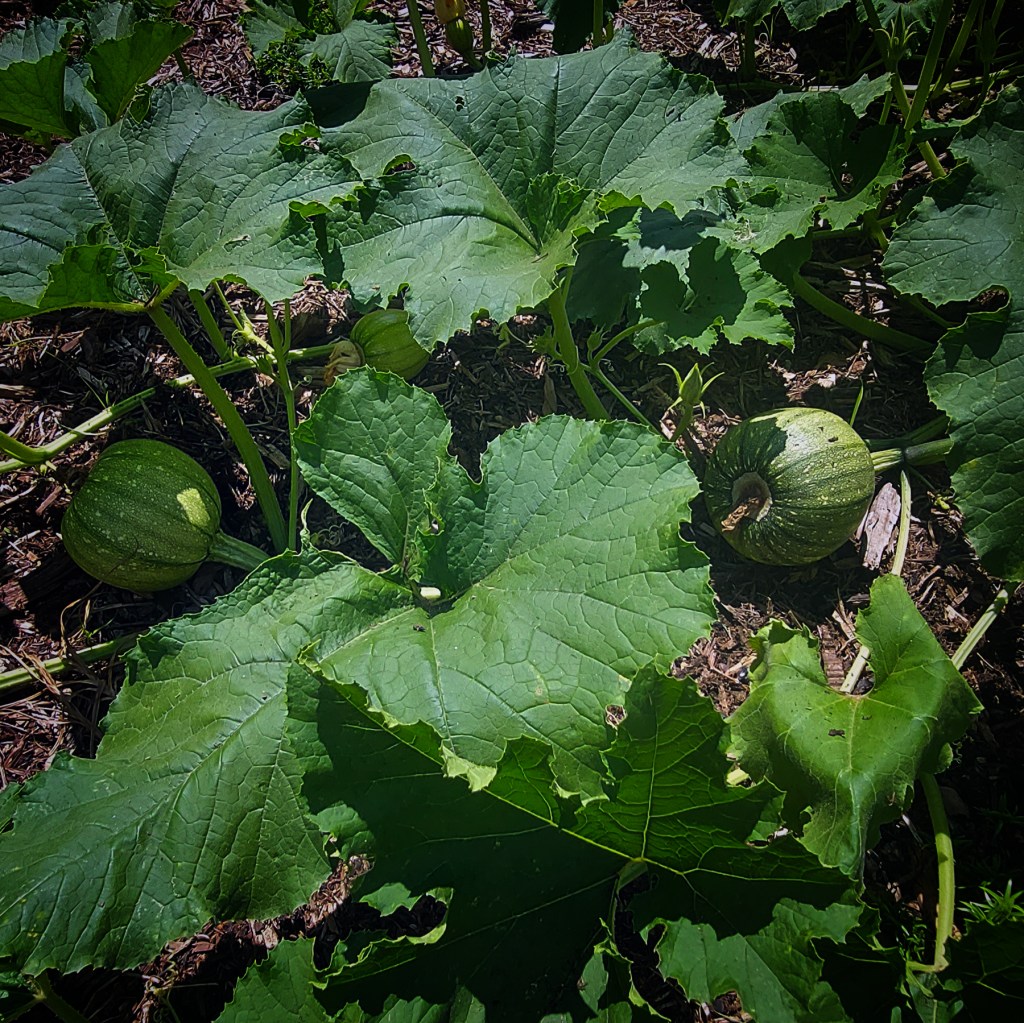
The same plant as above, but now disturbingly massive.

Like something out of a weird fairytale (or Annihilation, or The Color Out of Space), it… expanded. It didn’t get any taller, but it sent out yards of thick, powerful vines across the ground. By the time you read this, it’ll probably have doubled in size.

It also started putting out flowers. Big, bright yellow ones. Each one had a firm, round base. Before long, we had a ton of these.

The same plant, now with round, speckled, green, pumpkin-like fruits.

So, not cucumbers. Not melons. Some kind of pumpkin? A squash?

This guy who sometimes cuts the (remaining) grass for us said he recognized it as an ayote. He said it’s tasty when cut up and stewed with beef ribs and vegetables. I don’t do beef ribs, but I have some lovely brisket-style tempeh that could maybe work.

The trouble with volunteer Cucurbits is that there’s a risk of poisoning. If you find a wild squash in your yard, or grow one from seeds that you’ve saved yourself, taste a little bit of the raw fruit before you cook it or serve it to anyone else. Some wild Cucurbits have a lot of a toxic compound called cucurbitacin. It tastes very, very bitter, and enough of it can absolutely kill you. Tl;dr: Do not eat bitter squash, or any other members of Cucurbitaceae that taste weirdly bad.

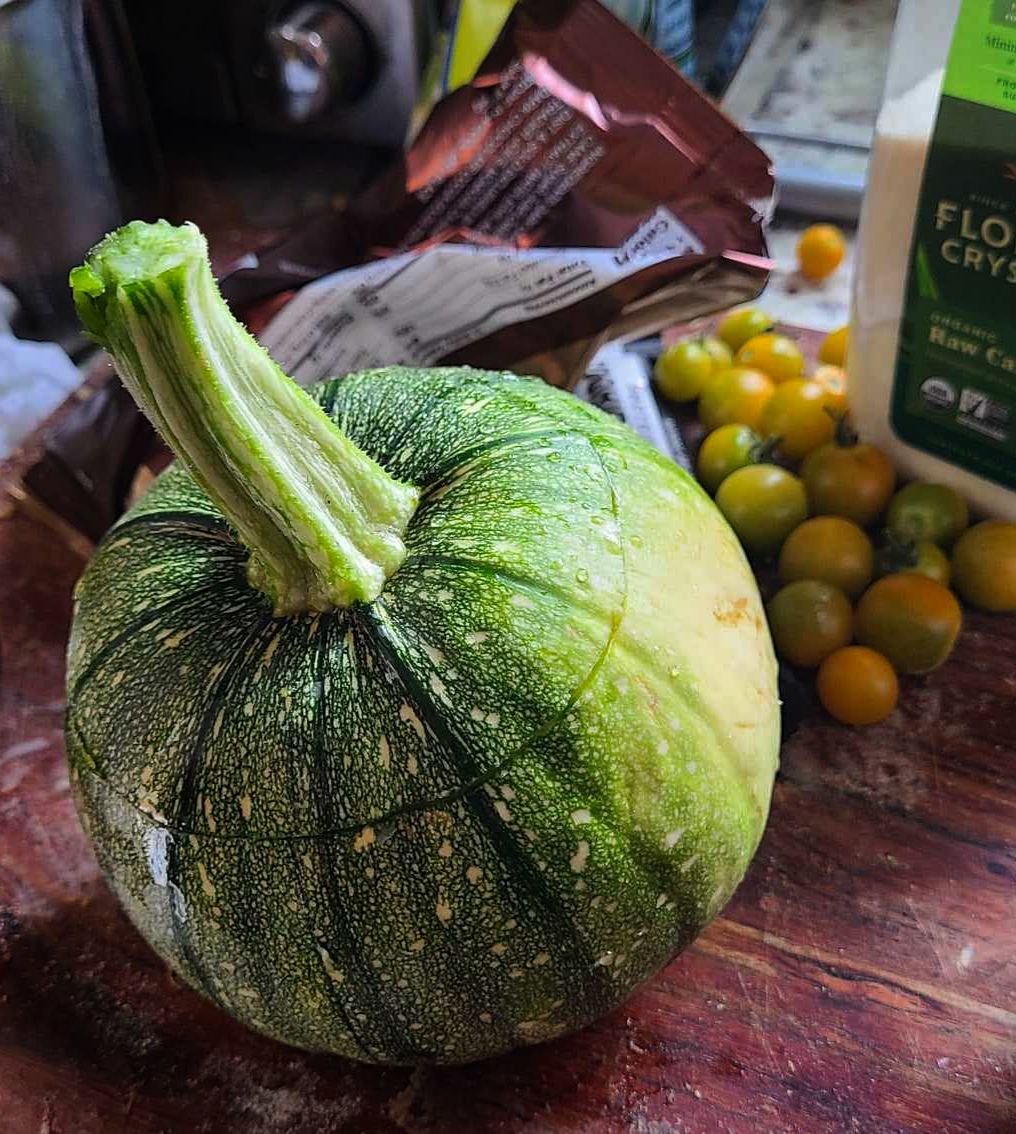
They’re nowhere near ripe yet, but I noticed that the stem of one had broken. I brough it inside for Experiments.

It looked inoffensive enough.
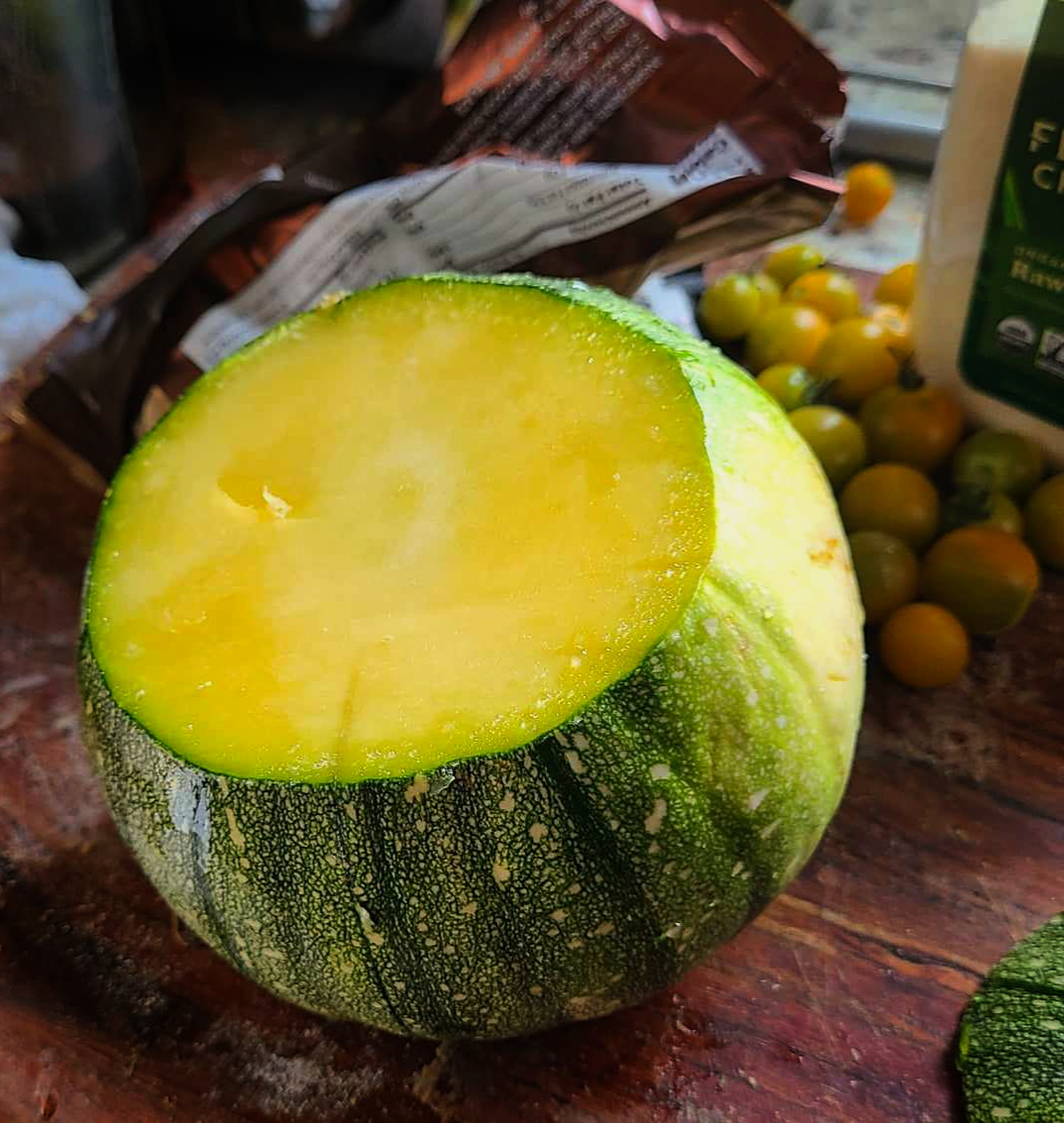
I took a little taste.

Surprisingly, it was pretty good! There was no trace of bitterness, just a mild, sweetish flavor. It’s not as strongly flavored as it’ll probably be once it’s completely mature, but definitely not bad.

I haven’t decided what to do with this specific one just yet. Ayote en miel? Squash soup? Roasted squash?

Whatever I decide to make from this squash, I hope I like it. I’ll definitely have plenty.

Thanks, local animals!

Environment · life

In which the squirrels pay their tab.

So, remember how I accidentally got a bunch of squirrels hammered a bit ago?

They paid their tab.

Like I mentioned in that previous post, permaculture requires a lot of fallow time, at least initially. There are a few things I could plant, but otherwise it’s mostly observing, identifying what’s already there, and tending to the raised beds in the front yard. In this process, I’ve decided on a few plants that I think will do very well.

So, imagine my surprise when I went out and noticed a bunch of seedlings of these same plants, newly growing adjacent to the squirrel kegger.

A squirrel peers down from a branch.

Seriously. My delinquents planted tomatoes (so many tomatoes), beans, and a whole host of other plants I’m excited about. It’s late in the season, so I don’t know how well they’re going to do right now, but still. I’m basically feeling like the hillbilly trash Snow White of gardening right now.

It was slightly annoying to have a band of rowdy rodents making and chugging bathtub squirrel gin in my platform feeders, but I’m not even mad.
Well done, my dudes.

(I’m still not buying you more cranberries, though.)

Environment · life

I made a rodent speakeasy.

I’ve tried to be conscientious in the way I take care of this yard. Permaculture isn’t achieved overnight — it can take up to a year of just observation to understand what should actually go in a space, and what arises naturally. While I’ve been on a crusade to get rid of a lot of the less-useful, non-native plants that were introduced here, I’ve tried to balance this with working slowly, patch-by-patch, and providing more sources of food, water, and habitat to replace what I’ve removed, and then some. (I even found and transported a yellow woolly bear caterpillar from a soon-to-be-doomed spot in the front yard, to a thriving bee balm plant in the back.)

Still, until I’m able to provide more food plants and water sources, I figured I’d put out some simple platform feeders. I’d already noticed bees descending on my yard after I watered the raised bed there — even when nothing had been planted yet, they were attracted to the water. Thirsty little buzzy people bobbed from tiny puddle to tiny puddle, eagerly drinking it up and trying to beat the heat. A platform feeder, I figured, would allow me to provide some water sources and a little bit of food for the larger guys out there.

I started fairly simply. I threw in a handful or so of sunflower seeds and some sulphite-free dried cranberries that I’d had laying around for a while, and put a bit of fresh water in the water dish.

Then I forgot about it. I mean, I had a lot of other things to contend with, like my war against lawns as a concept (and this lawn specifically). It was after a few days of rain and a bit of a hot spell that my partner called me into his office.

“Those feeders are really busy!”

“Yeah?” I asked, leaning in to peer out of the window overlooking the deck.

“Yeah! There’ve been a bunch of squirrels there all day!”

“Huh. Weird, they weren’t paying any attention to it befo-”

I squinted at the squirrels as it all clicked.
Fruit. Water. Heat.
The feeders didn’t collect rainwater, but it had rained enough to make those dried cranberries plump and juicy. The warmth just helped the sugar, water, and natural yeast along.

“Oh, shit,” I muttered.

Those hairy little delinquents were doing shots of fermented cranberry on my deck.

There was an excellent reason why these fruits, long ignored and forgotten about, were suddenly teeming with squirrels.
Glassy-eyed squirrels.
Glassy-eyed squirrels with burgeoning alcoholism.

Through my own negligence, I had managed to create some kind of speakeasy for squirrels. And they were having a fantastic time. Fantastic enough that I hesitated to rush out and try to chase them away from their ersatz kegger. (I mean, I don’t know how many drunken squirrels it’d take to kick my ass, but I knew how many they had on their side.)

I haven’t yet found any of them nursing tiny hangovers or passed out in the grass, but I still discarded the old fruit and put out fresh cranberries. If they liked dried fruit, they could have those.

Then I noticed that they were putting them in the water dish next to the feeder, presumably to create some kind of backyard rodent pruno.

I’m a little worried about what’s going to happen when I run out of cranberries, to be honest.