Plants and Herbs

Echinacea Folklore and Magical Properties

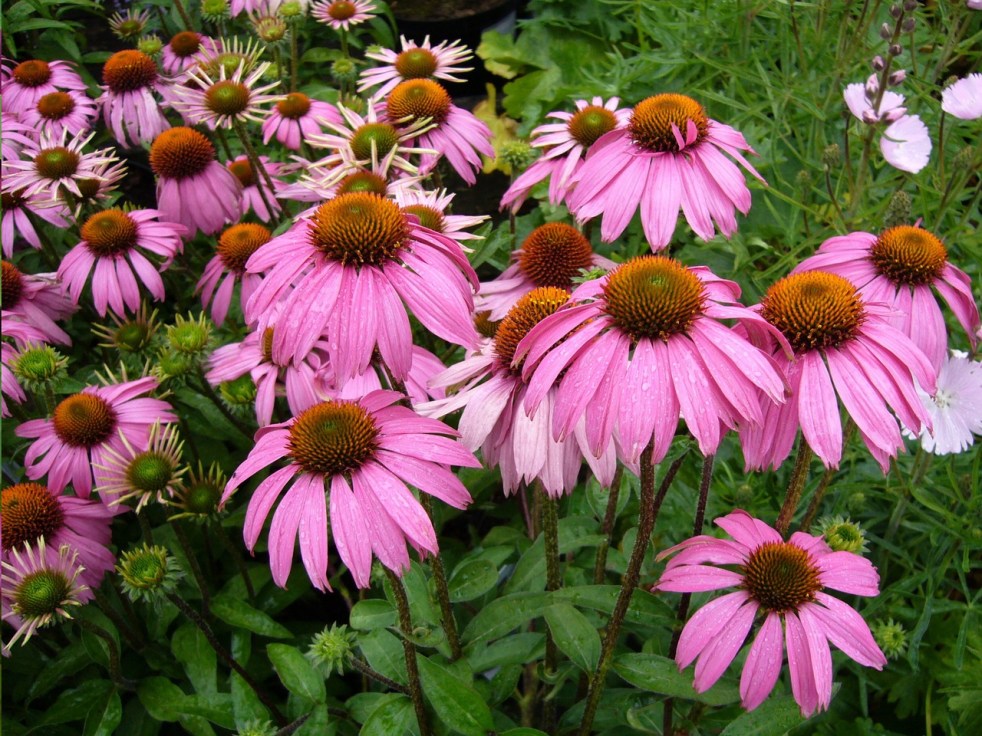
Echinacea, or coneflower, is a genus of flowering plants found solely in parts of the US. They’re native to where I currently live, so I’ve added several different wild type and nativar plants to the front and back yards here. They’re a unique addition to the landscape, and help bring in even more pollinators than the bee balm and anise hyssop already do!

These flowers are probably best known for their medicinal qualities. The first time I’d ever heard of echinacea was from my father’s former significant other. She had some echinacea tea, and I overheard her talking about how she used it medicinally. (Though they’ve since split up, I’m still friends with her — she went on to become a bodywork therapist who specializes in sound healing and craniosacral therapy, and is one of the founders of the nonprofit Columbia Resilience Integrated Health Community Project. She’s a pretty cool lady.)

Unfortunately, the popularity of echinacea means that wild populations are suffering from overharvesting (two species, E. tennesseensis and E. laevigata, have only recently recovered from being on the endangered species list). If you want to use these plants, it’s best to grow your own. Fortunately, that’s really easy to do — they self-seed super easily and will grow pretty much anywhere there’s sun. They’re also great for helping populations of native pollinators.

Since these are American plants, they’re not found in European-based grimoires. They’re still very valuable to develop a relationship with, even if they don’t show up in old world folk or ceremonial magic.

To the Ute people, echinacea’s traditionally called “elk root” due to the belief that injured elk sought out these plants to use medicinally.

Echinacea roots are used as a physical and spiritual medicine. They’re a traditional healing herb for burns, pain, and inflammation, and some peoples have chewed them as part of their ritual purification ceremonies.

The name “echinacea” comes from the Greek word for hedgehog, “ekhinos.” This is because the center of the flowers is round and spiky, like a hedgehog.

Today, echinacea is often touted as a way to help prevent or eliminate respiratory viruses like the common cold. Research doesn’t really bear out assertions that coneflower can significantly help with the common cold, but there’s evidence to suggest that coneflower’s immune activity may have a lot to do with the bacterial populations within the plant itself. These studies are on isolated cells in vitro, however, not on humans. Overall, it seems like echinacea isn’t really a great remedy for upper respiratory viruses.

Topically, infusions of echinacea are helpful for soothing the skin. Prepare a strong brew of the root (and any other soothing herbs you like, like chamomile or marshmallow), filter out the plant matter, and add the liquid to a bath.

Some green witches use echinacea as a way to increase the power of their spells. It’s best employed when attempting to overcome a problem that doesn’t respond to other measures, but adding a little of the root or seeds to any spell will help increase its effectiveness.

Hanging a sachet of echinacea over the bed is said to act as a fertility charm.
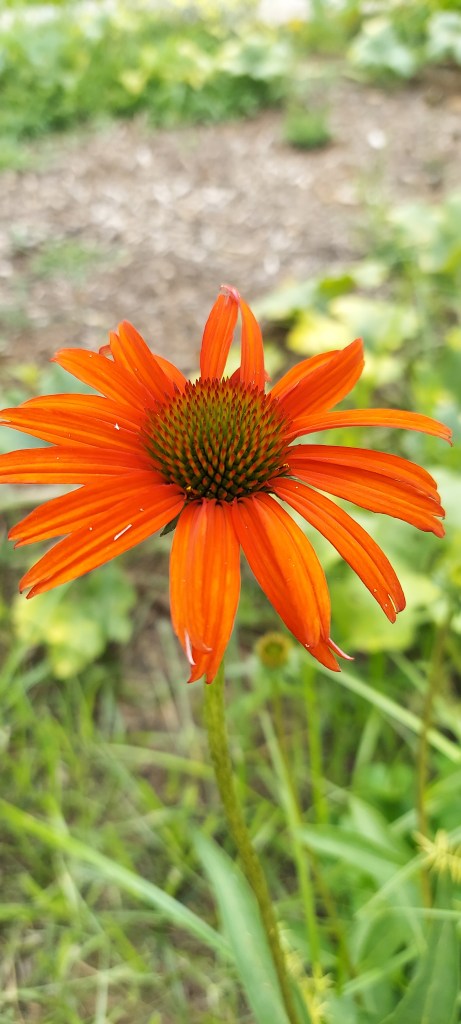
A bright red cultivar of echinacea, showing the characteristic spiky center surrounded by a ring of bright, daisy-like petals.
One of the bright scarlet echinacea cultivars in the front yard. You can see a bit of the mysterious pumpkin vine in the background.

Coneflowers are also associated with strength and vitality. Sprinkling powdered echinacea root in one’s shoes is said to increase physical vitality and endurance. This is particularly interesting to me, since the same is said of mugwort. Both echinacea and mugwort are pretty opportunistic plants that will tolerate poor soils. The plants’ own resilience could be why they’re connected to the idea of endurance and strength.

Some sources also claim that placing a single echinacea flower on one’s brow can enhance psychic abilities. Interestingly, mugwort is also used to enhance psychic abilities.

When cut and kept in a vase, it’s believed to bring prosperity into the home.

The large, brightly colored flowers are frequently used as natural offerings to the spirits of a place.

Coneflowers are also part of an herbal formula to attract same-sex love, particularly by men. Combine deerstongue herb (which has a lovely vanilla aroma), echinacea, and imitation musk, ambergris, and civet.

Echinacea is associated with the planet Mars and element of Earth.

In general, it seems like the flowers are used for offerings and laying on the body, and the roots and seeds are used for everything else. The roots and seeds are also said to have the most magical power. I can definitely see that — seeds, in particular, are symbols of infinite potential. If you want to start something new, include some seeds in your spell.

The easiest way to use echinacea magically is to include a bit of the whole seeds or ground root in sachets, jars, or herbal spell blends. There doesn’t seem to really be a limit to what this plant can empower.

You can also steep some larger bits of root in a carrier oil and use it as a protective or empowering anointing oil.

Personally, I plan to experiment with using echinacea alongside and in place of mugwort. There seems to be a fair amount of crossover in both their ecological and magical uses, though their planetary and astrological correspondences differ. Echinacea is native and grows like nobody’s business here, while mugwort is invasive. I’ll definitely harvest invasive wild populations of mugwort when I have the chance, but I’d like to see how far I can get with the herbs that I grow myself.

Medicinally, echinacea tea may be made from the flowers, leaves, or roots of Echinacea purpurea. This can be taken internally or used topically. Traditionally, it’s a remedy for inflammation and pain. Nowadays, it’s often touted as a treatment or preventative for respiratory viruses, but research shows that it probably isn’t very good at that last bit.

Overall, this herb is pretty safe, but people who are allergic to members of the daisy family will definitely want to avoid it. It isn’t known how safe this is for people who are pregnant or nursing, so ask your doctor if you have any concerns.

life · Plants and Herbs

Maypops!

Passiflora incarnata is a weird plant.

I bought three root cuttings last year, but they turned crispy and died shortly afterward.

Disappointed, I decided to try again with two more. Those died back to the ground late that autumn, and that seemed to be it. There was no sign of them this past spring, so I figured that particular experiment was also a failure.

Undaunted, I decided to try again. I purchased two more baby vines and planted them in roughly the same spot.

And then one (and only one) of the previous vines shot up out of the ground like it had something to prove. Like I’d committed some terrible affrontery by daring to try to replace it. Vining with a vengeance.

Not only did it reappear, it’s also about twice as big as the other two, and all three of them seem to be trying to outdo each other by putting out more and more buds.

A passionflower with bright bluish-purple, fringe-like petals and a white center.
My very first passionflower.

The only thing is that, while Passiflora species are generally considered self-fertile (the flowers contain both male and female parts, and they are positioned in a way that makes it very easy for pollen to just kind of end up where it needs to go), I’ve read a lot of sources that claim that P. incarnata is self-incompatible. In other words, the flowers are built in a way that should facilitate self-fertilization, but it’s just not into that.

Since the flowers also only last for a day, that means that there needs to be some very timely coordination between pollinators and the plant itself. Pumpkins are the same way, really — they have separate male and female flowers, but the flowers don’t last long. If a bug or hummingbird doesn’t show up at the right time, the flowers close up and that’s that.

Anyway, all of this is to say that, after my disastrous experiences trying to grow passionflower, I wasn’t expecting much. That’s why I was really surprised to go out on the porch and see these guys:

A close-up of a vine with a pair of small, green, vaguely egg-shaped fruit.

Maypops! (Aka, passionfruit!)

These aren’t anywhere near ripe yet. You have to wait for them to get really soft and wrinkly, or even to just drop off of the vine. (I probably won’t let them get that far, because I doubt I’d find them again once they fell.) In this way, they’re kind of like pawpaws and American persimmons — once they seem like they’re way overripe and on the way to the compost bin, they’re perfect.

I’d like to try harvesting the rest of the plant for medicinal purposes, too. (I talked about some of these in my post about the folklore and magical uses of passionflower.) My handsome assistant and I go through a ton of chamomile, to the point where I’m starting to wonder if it’s possible to build up a tolerance. I’d like to try augmenting some of that with other relaxants. If I can grow them myself, so much the better.

Passionflower fruit are apparently much like pomegranates, in that the edible portion is little bags of juice around seeds. I’m not much for making jams or jellies, so that’s out. I don’t think they’d be conducive to drying, though I may try combining their juice with a more solid, neutral-tasting fruit (like pears) to make fruit leather. We’ve also been using our excess strawberries and pumpkins to flavor mead, so I could see using a batch to experiment with maypop juice.

So many possibilities!

life

And about twenty seven gallons of pumpkin bisque.

So, I’ve been picking pumpkins.

Well, that’s kind of an understatement — I’ve been attempting to gather and process pumpkins quickly enough to actually make a dent in the sheer number of them. It takes about an hour to cut and bake two of them, then I need to let them cool, then puree and freeze them. Each pumpkin seems to yield a little over 16 ounces of puree. That’s enough for either one pie, one batch of pumpkin cream sauce, or one pot of pumpkin soup.

In other words, this is basically a replay of when my spouse and I went strawberry picking. This last time, we sprung for the big cardboard flat. I still have a whole loaf of strawberry bread in the freezer, two gallon bags of whole berries, and two trays of frozen strawberry puree.

I’m either going to run out of space in the freezer for pureed pumpkin, or be completely sick of pumpkin and pumpkin-adjacent things by the time October rolls around.

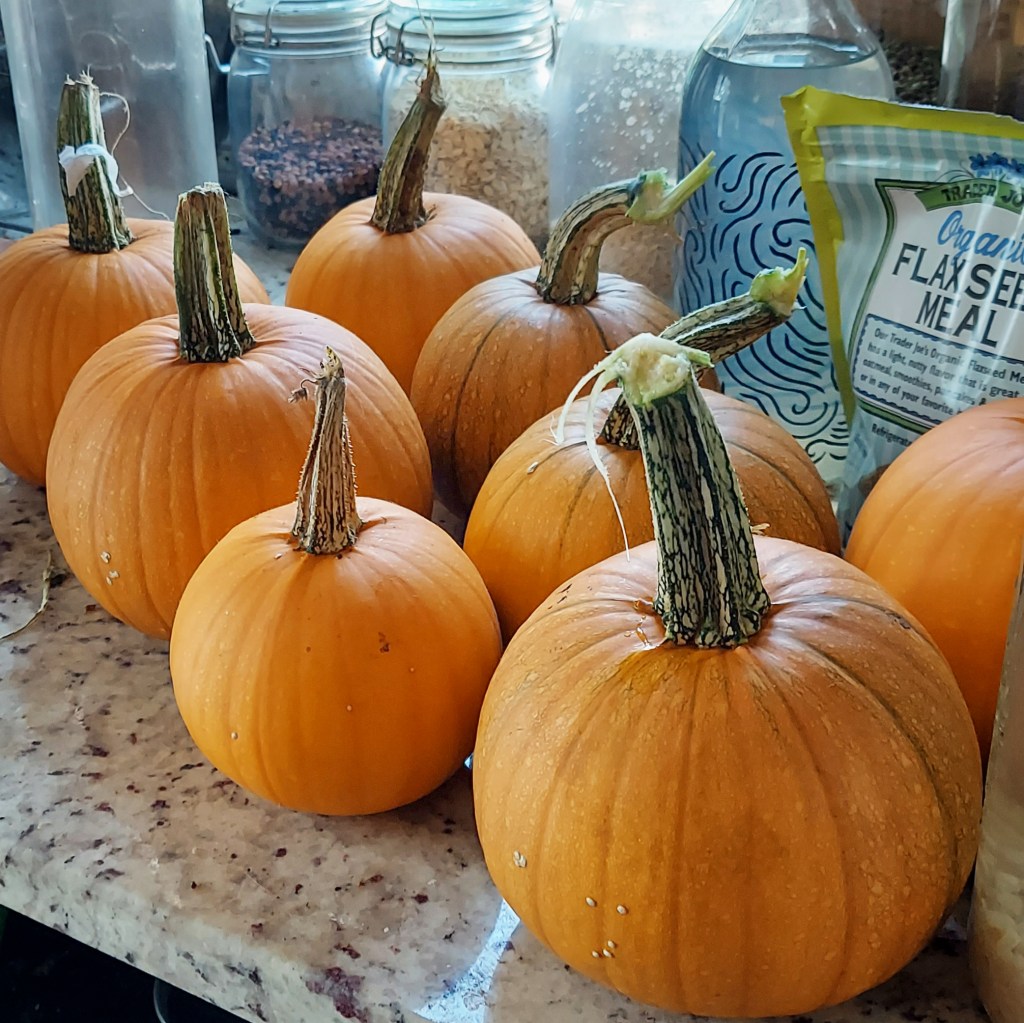
Eight pumpkins, sitting on a granite countertop. There's a bag of flaxseed meal and some glass canisters of rice, beans, and oats in the background.
Some of the pumpkins that still need to ripen a bit.

Fortunately, pumpkin seems to keep well. Once it’s turned to pumpkin mush, I pack it into a one cup Souper Cube tray and freeze it. After it’s frozen, I can pop it out and stick it in a reusable freezer bag. I wish I had a chest freezer (but I also know that I’d just fill it up with nonsense if I did).

In the meantime, I’m amassing pumpkin recipes. So far, I’m looking at egg- and dairy-free pumpkin pie, pumpkin cream sauce, and pumpkin bread with chocolate chunks. I hope everything turns out well, but I’m also slightly concerned that I’ll end up having to sneak around and drop off piles of excess pies and breads on my neighbors’ porches in the middle of the night.

I didn’t even plant these pumpkins. I’ve watered them maybe twice ever. I have the feeling they wouldn’t be nearly this prolific if I’d actually put effort into them.

Plants and Herbs

Passionflower Folklore and Magical Properties

As we kill off our grass, we’re working hard to replace it with plants that serve multiple purposes. Ideally, they should be native (or at least semi-local), attract pollinators, provide food for both humans and animals, and either return or self-seed. One of the plants that passed muster is this area’s native species of passionflower, Passiflora incarnata.

Also known as maypop, true passionflower, purple passionflower, and wild apricot, P. incarnata is a really pretty, fast-growing vine that provides both wild-looking purplish blue flowers and edible fruits. The flowers don’t last long, but they’re very striking!

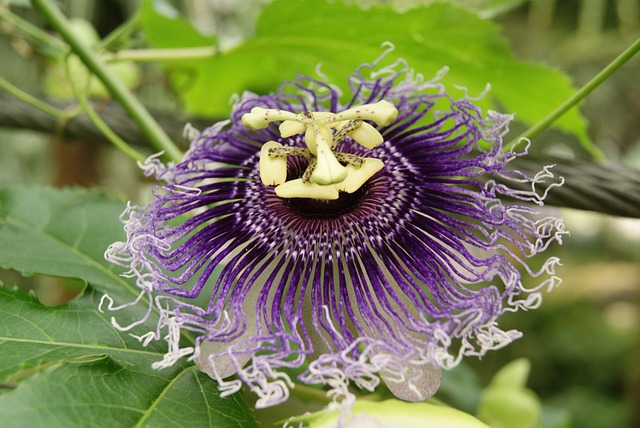
A fringy, bright purple Passiflora incarnata flower.
A flower of P. incarnata.

Unfortunately for me, I didn’t heed the old adage, “the first year they sleep, the second year they creep, the third year they leap.” As a result, I planted way too many passion vines. They’re going to eat my porch.
Help.

Anyway, as I watch my yard speedily being consumed by passion and pumpkin vines, I figured I’d write a bit on the magical uses and folklore of the passionflower.

Passionflower Folklore and Magical Uses

Despite the name, I’ve mostly seen passionflower used as an herb to dampen passions, not stoke them. They’re said to be useful for calming libido, cooling relationships, and cultivating platonic or romantic rather than erotic love.

This could be because the word “passion” has a number of very different and contradictory meanings. As Mark Z. Danielewski wrote in House of Leaves, “Like patience, passion comes from the same Latin root: pati. It does not mean to flow with exuberance. It means to suffer.”

As a new world herb, passionflower was a novel plant to the Spanish missionaries who arrived in Peru in the 1500s. Giacomo Bosio, a monk and historian, referred to passionflower as “La Flor de las cinco Llagas” (“the flower with the five wounds”). This refers to the five wounds the Christian figure Jesus Christ is said to have endured at his crucifixion. The Biblical usage of passion equates to suffering, so, to missionaries, the passionflower represented divine suffering.

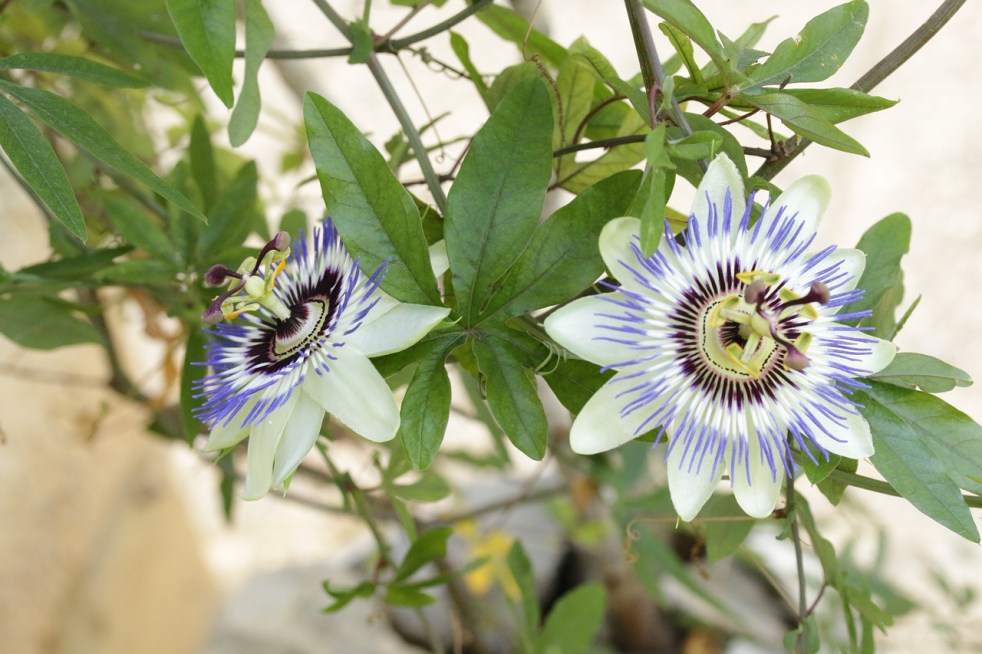
A blue and white flower of P. caerulea.
P. caerulea, a passionflower native to South America.

One tale from Brazil says that the passionflower grew from the tears of a woman who was separated from her lover.

Medicinally, passionflower is used as a calming herb. Evidence suggests that it’s safe to use internally, but there’s been some controversy as supplement manufacturers didn’t meet FDA requirements for safety data. It may interact with sedatives, monoamine oxidase inhibitors (MAOIs), and drugs to prevent blood clots, and is contraindicated in pregnancy.

In traditional indigenous herbal medicine, passionflower is used as a poultice to reduce inflammation and soothe pain.

In the garden, passionflower is irresistibly delicious to Japanese beetles. They’ll eat the leaves and flowers like there’s no tomorrow, which is bad news if you actually want to harvest any fruit!

Taken together, this paints the picture of passionflower as an herb to ease suffering. Since it was said to represent the five wounds endured by Jesus Christ, you could look at it as a “wounded healer.” This isn’t a plant that flows with exuberance, it’s one that knows suffering and eases it in others.

In Victorian flower language, passionflower was said to represent religious fervor or superstition.

Passionflower corresponds with the element of Water and the planet Venus.

Using Passionflower

If passionflower both represents and alleviates suffering, how do you use it? Since it’s native to North and South America, there isn’t really any information about it in ancient magical texts. Nonetheless, there are many ways to work with this unique plant.

As a vine, passionflower grows and clings (hence the whole porch thing.) This makes it useful in workings to bind something to yourself. Since it’s also a plant for relieving suffering, I’d use it specifically in situations where you’d like to bind a solution to a problem — for example, using passionflower to tie yourself to a stable, fulfilling job or enjoyable living situation.

Passionflower is also sometimes used in pillows or sachets for restful sleep and dream magic. Be careful with this, however, as placing passionflower under one’s pillow is also said to be a remedy to dampen libido.

This herb is also used in love magic. Bathing in an infusion is said to attract a potential partner to you, and it’s an often-seen ingredient in sachets, jars, and other charms for love. It works well for this purpose, as long as you know what kind of love you’re looking for. (If you’re after a passionate fling, skip it and go for cinnamon or ginger instead.)

Infuse the flowers in a carrier oil and use this to help ease worries and sooth the heart and mind. Anoint the temples and heart area whenever relief is needed.

All told, passionflower is a delightful herb. It’s beautiful, feeds bees and hummingbirds, and provides valuable medicine. As long as you don’t let its name fool you, it can help you with an array of spells and charms.

Plants and Herbs

Hyssop Folklore and Magical Properties

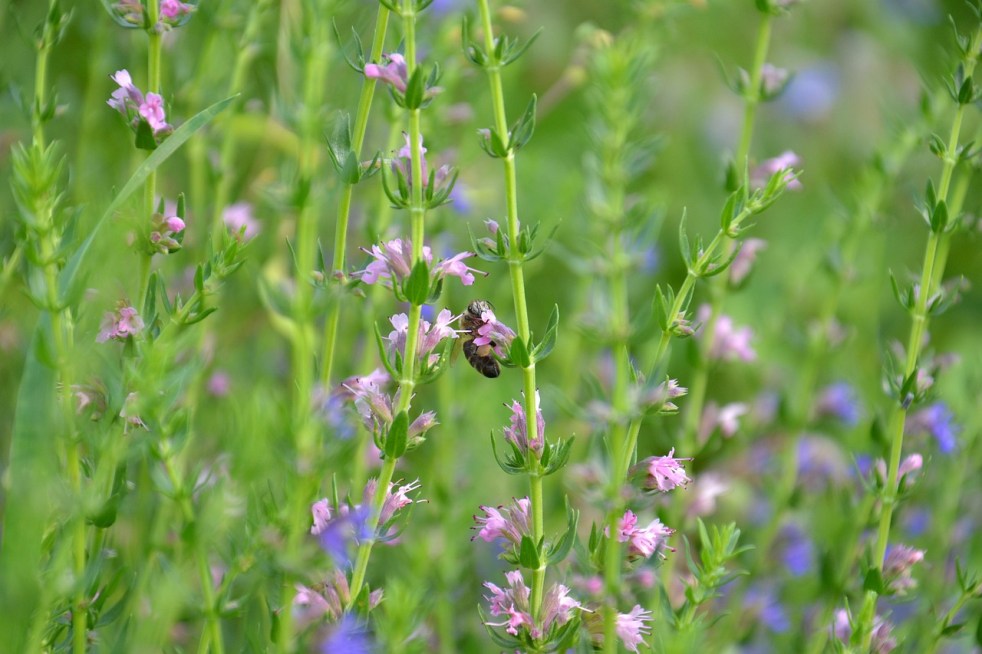
The anise hyssop in my little pollinator garden is putting of spikes of beautiful purple flowers, so I thought I’d write a bit about the magical uses and folklore of hyssop.

A fun fact first, though — anise hyssop (Agastache foeniculum) is not that closely related to actual hyssop (Hyssopus officinalis). Both of them are members of the mint family, Lamiaceae, but so are teak, rosemary, and chia. Anise hyssop is native to Central and North America, while hyssop is from the Mediterranean eastward to Asia.

Anise hyssop is definitely a useful plant, but I figured I’d cover hyssop-hyssop first. If you practice one of the many branches of European-based witchcraft or folk magic, you’re more likely to encounter Hyssopus in old texts.

Hyssop Folklore and Magical Uses

A lot of the modern lore about hyssop comes from its mention in the Bible. It’s indicated numerous times as a cleansing and protective herb. For example:

Cleanse me with hyssop, and I will be clean; wash me, and I will be whiter than snow.

Psalm 51:7

Take a bunch of hyssop, dip it into the blood in the basin and put some of the blood on the top and on both sides of the doorframe. None of you shall go out of the door of your house until morning.

Exodus 12:22

To purify the house he is to take two birds and some cedar wood, scarlet yarn and hyssop.

Leviticus 14:49

When Moses had proclaimed every command of the law to all the people, he took the blood of calves, together with water, scarlet wool and branches of hyssop, and sprinkled the scroll and all the people.

Hebrews 9:19

There’s more, but you probably get the idea. However, this runs into the same problem as anise hyssop versus hyssop. The hyssop mentioned in the Bible is not H. officinalis. (Biblical hyssop is more likely to be Capporis spinosa or Origanum syriacum.) Nonetheless, I figured the Biblical references to hyssop were worth including because they inform quite a bit of the body of lore about H. officinalis.

A spike of bright violet-blue hyssop flowers.

The name “hyssop” derives from the Greek word hyssopos, which derives in turn from ezov or azob, the sacred hyssop mentioned in the Bible.

In Egypt, Priests used hyssop as an additive to purify food. This was necessary to make certain foods acceptable for their restricted diet.

Magically, hyssop corresponds to the element of Fire and the planet Jupiter. Following the uses of Biblical hyssop, it’s most commonly employed as a purification and protection herb.

Medicinally, a decoction of hyssop was used topically for treating head lice. It was also used a topical remedy for minor wounds.

In Europe, hyssop was used as a strewing herb. It’s fragrant and seems to have had some action against pests (like head lice, as mentioned above). This may have made it an effective way to keep fleas and other unwanted guests away!

This last bit is particularly interesting to me. In my herb lore reading, I’ve found that the Venn diagram between “herbs used magically for protection” and “herbs that keep bugs out” is almost, but not quite, a circle. Since the Biblical hyssop probably wasn’t hyssop at all, it’s interesting to me that the purposes of Biblical hyssop and European hyssop are so close. It raises a kind of chicken-and-egg scenario — was H. officinalis named for the Biblical hyssop because its pest repellent action “purified” spaces?

Using Hyssop

Sprigs of hyssop make lovely aspergilla. Dip them in water, and use them to asperge sacred spaces, rooms, people, or objects.

Brew hyssop as a tea, strain out the spent leaves, and add the water to ritual baths for purification, cleansing, and hex-breaking. Prepare hyssop the same way, then add to a bucket of fresh water and use it for washing floors, windows, and doors for the same purpose.

A fritillary butterfly on a spike of hyssop flowers.

Add dried hyssop to charm bags for protection, particularly against the evil eye.

Hyssop is sometimes used to season food, and that’s fine. It’s even sometimes used internally in a medical context, and that’s okay too (as long as it’s under the supervision of a qualified herbalist). Otherwise, avoid eating or drinking hyssop. Large doses can cause seizures and cause miscarriages. It’s not known how much of hyssop’s active constituents may pass through breastmilk, and the threshold for hyssop toxicity is much lower for children, so it’s best avoided while breastfeeding.

life · Plants and Herbs

This is either going to be awesome, or the sequel to The Color Out of Space.

One of the benefits of encouraging wildlife to hang out is that, if things go right, it’ll basically do your gardening for you. I’ve had so many volunteer plants courtesy of the birds and squirrels, it’s bonkers. Since I’m still working on re-wilding things, I’m grateful for whatever additions the local creatures want to make — I get to see what grows well and what doesn’t, and it’s all for free.

Like that time that all those delinquent squirrels paid their bar tab with a ton of tomato plants.

This is all just preamble to explain that I’ve been watching the progress of some kind of plant in the front plot. The front yard is divided into two squarish plots by a walkway. In one, we’ve finally managed to kill off the grass and replace it with a redbud tree, oakleaf hydrangea, coreopsis, strawberries, moss phlox, and echinacea. Then this thing happened.

A small plant, some member of Cucurbitaceae, just beginning to vine.

Cute, right? It seemed to appear overnight, springing up out of the ground without warning. No sprout, nothing. Just bam! This.

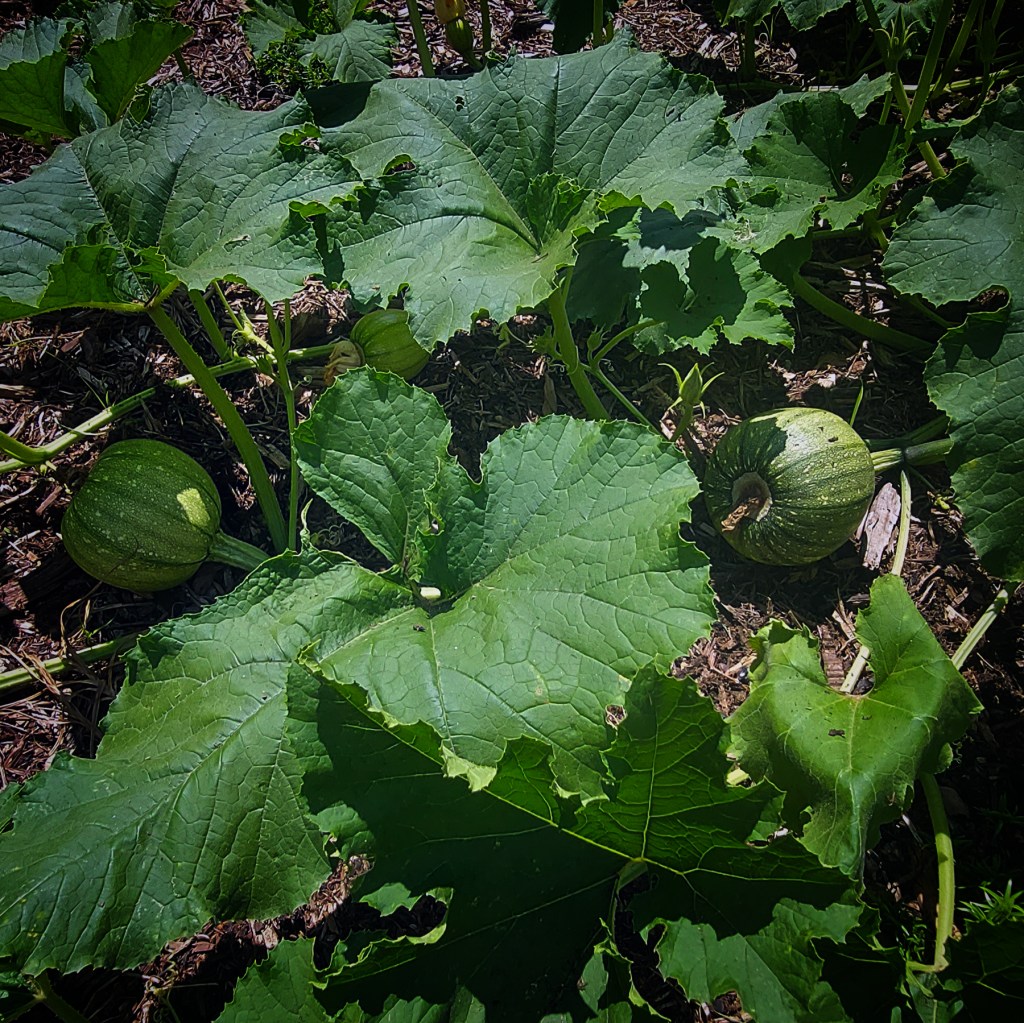
Out of curiosity, I left it. It was in a bare spot, and I was honestly pretty excited to see what it’d turn out to be. I tried identifying it to make sure it wasn’t something invasive or poisonous, but plant apps were stumped. It was almost definitely a member of Cucurbitaceae, but what? Pumpkin? Melon? Squash? Cucumber? Even Reddit’s gardening subs were mostly baffled. Some posters who recognized it even admitted that it looked like “some kind of weird hybrid.”

Anyhow, I figured it’d probably end up being some kind of vegetable, so I left well enough alone. I didn’t even bother watering it. I figured that it was a volunteer, it was doing fine without my interference, so it was just sink or swim from h-

The same plant as above, but now disturbingly massive.

Like something out of a weird fairytale (or Annihilation, or The Color Out of Space), it… expanded. It didn’t get any taller, but it sent out yards of thick, powerful vines across the ground. By the time you read this, it’ll probably have doubled in size.

It also started putting out flowers. Big, bright yellow ones. Each one had a firm, round base. Before long, we had a ton of these.

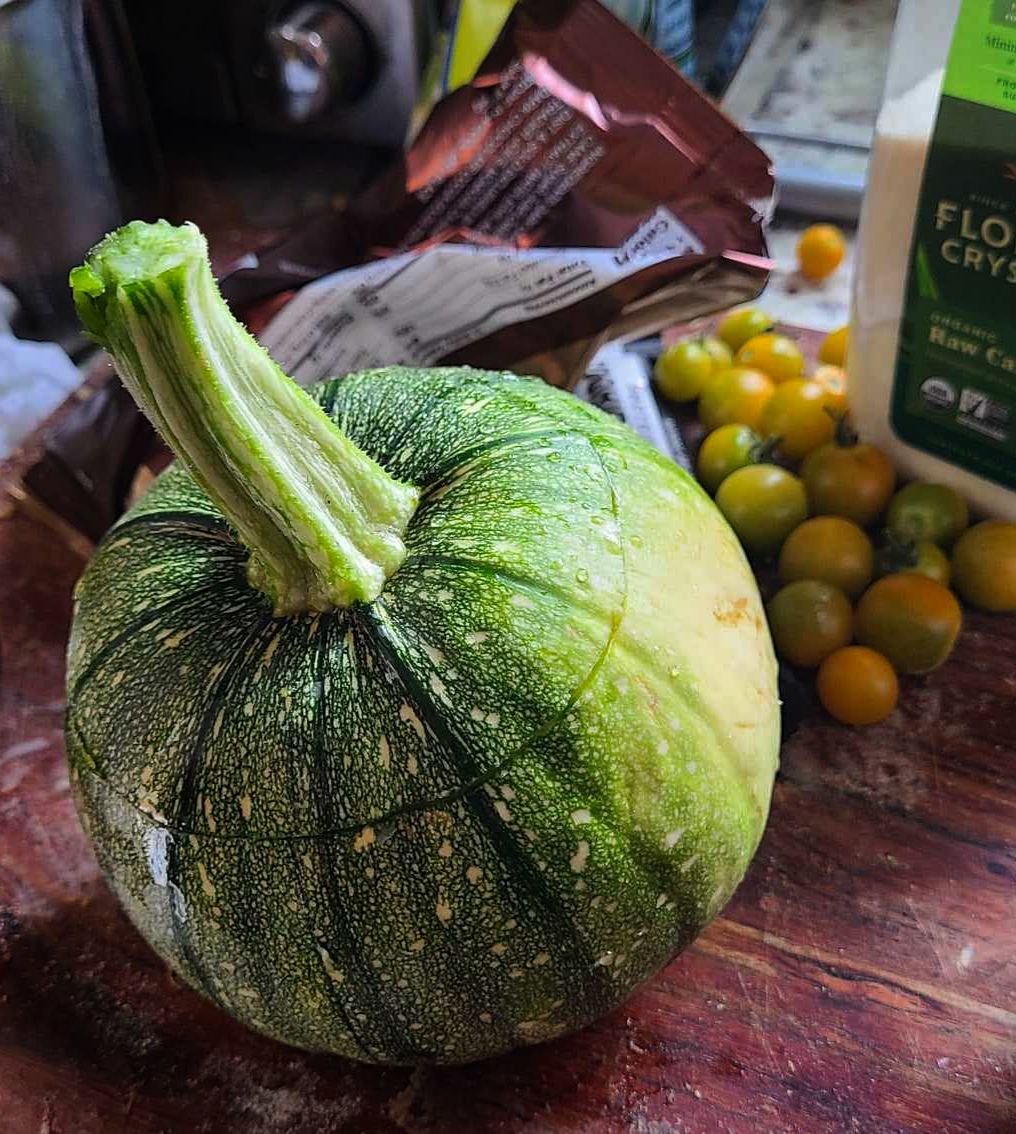
The same plant, now with round, speckled, green, pumpkin-like fruits.

So, not cucumbers. Not melons. Some kind of pumpkin? A squash?

This guy who sometimes cuts the (remaining) grass for us said he recognized it as an ayote. He said it’s tasty when cut up and stewed with beef ribs and vegetables. I don’t do beef ribs, but I have some lovely brisket-style tempeh that could maybe work.

The trouble with volunteer Cucurbits is that there’s a risk of poisoning. If you find a wild squash in your yard, or grow one from seeds that you’ve saved yourself, taste a little bit of the raw fruit before you cook it or serve it to anyone else. Some wild Cucurbits have a lot of a toxic compound called cucurbitacin. It tastes very, very bitter, and enough of it can absolutely kill you. Tl;dr: Do not eat bitter squash, or any other members of Cucurbitaceae that taste weirdly bad.

They’re nowhere near ripe yet, but I noticed that the stem of one had broken. I brough it inside for Experiments.

It looked inoffensive enough.
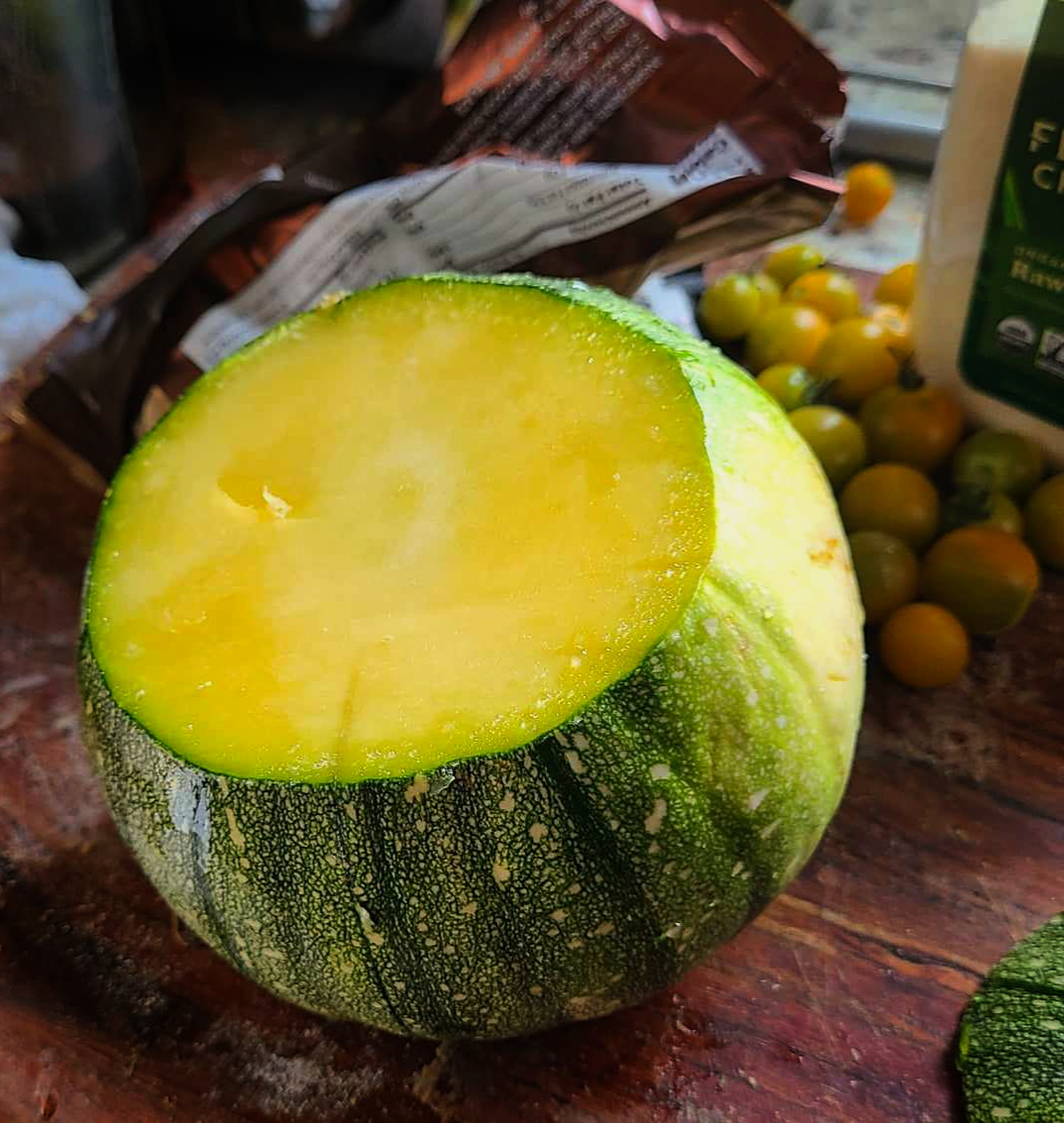
I took a little taste.

Surprisingly, it was pretty good! There was no trace of bitterness, just a mild, sweetish flavor. It’s not as strongly flavored as it’ll probably be once it’s completely mature, but definitely not bad.

I haven’t decided what to do with this specific one just yet. Ayote en miel? Squash soup? Roasted squash?

Whatever I decide to make from this squash, I hope I like it. I’ll definitely have plenty.

Thanks, local animals!

Uncategorized

Wild Bergamot/Bee Balm Folklore and Magical Properties

Monarda species, also known as bee balm, Oswego tea, and wild bergamot, is one of my favorite native flowers. The blooms themselves are striking, the leaves are fragrant, they spread very easily, and they thrive where other plants falter. They’re fantastic additions to permaculture guilds, since they’re good at attracting oft-neglected native US pollinators like the raspberry pyrausta moth. It’s also tolerant of juglone, a natural herbicide produced by black walnut trees.

Bright pink Monarda flowers, growing in a bed of maroon Coreopsis.
Some bright pink Monarda didyma flowers in my garden, planted along with some deep maroon-pink lance leaf Coreopsis.

The name “wild bergamot” is a bit misleading — these plants aren’t related to bergamot at all. Monarda is part of the mint family, while actual bergamot is a citrus fruit. I haven’t been able to find an explanation for why this group of plants is called wild bergamot, so I can only venture that it’s because of the fragrance of the leaves. They’ve a sort of minty-citrusy-herbal scent, very reminiscent of Earl Grey tea.

Wild Bergamot Magical Properties and Folklore

Monarda plants are native to the US and have a very important place in the medicinal lore of indigenous American people. The leaves soothe stomach aches when used internally, treat wounds externally, and ease headaches when used as a poultice. The name “bee balm” comes from the plants ability to calm bee stings.

After the Townshend Revenue Act of 1767, colonist American people began boycotting imported British tea. Instead, Monarda leaves provided a suitable substitute.

Bright pink Monarda flowers, of a cultivar called "Marshall's Delight."

Since Monarda is native to the US, you won’t find it in ancient herb lore or medieval European grimoires. It still has a pretty long history of use as a magical ingredient, however, as people have adapted to using what’s around them over the centuries.

Some magical resources claim that lemon balm and bee balm are synonymous. Though they’re both members of Lamiaceae, the mint family, they aren’t the same plants. Lemon balm is Melissa officinalis, native to Europe, and pretty sedating when drunk as a tea. Bee balms are Monarda species, native to the US, and gently stimulating.

Due to its associations with medicine, it’s considered a healing herb.

Monarda can also be used as a purifying and cleansing herb.

It is generally considered to be ruled by Mercury and the element of Air. Due to these planetary associations, it’s sometimes used in spells for money or success in business/academic endeavors.

Using Wild Bergamot

You’ll be pleased to know that, unlike a lot of the magical herbs I talk about, wild bergamot is edible. The whole thing. Stems, flowers, and leaves. The flowers can be used to add color and interest to salads, and the leaves make a wonderful tea. You can also use the leaves to flavor pork or poultry dishes. If you do want to eat your Monarda leaves, treat them like most other herbs: Harvest the leaves before the plant flowers, when they’re sweeter and more tender. They tend to get a bit tough and bitter after the plant matures and flowers appear.

Personally, I find wild bergamot leaves and flowers to be a very nice addition to drinkable/edible brews. Use it in place of Camellia sinensis leaves as a base for magical teas. Historically, it has been drunk to ease flatulence and as a gentle, general stimulant.

One thing I enjoy doing is making simple sugar cookies and decorating the tops with magical sigils. Candied flowers, chosen for their properties, can both decorate and empower these edible spells.

For purifying, pack some fresh leaves into a large muslin tea bag and place it under your bath faucet. You can also brew Monarda leaves into a tea, strain out the plant matter, add the liquid to a bath, and fully submerge yourself.

To purify spaces or groups of people, bundle fresh Monarda stems together, dip them in salt water, and use them to asperge.

Monarda is known to attract bees, as well as ease their stings. Since it’s connected to Mercury and Air, it’s also used as a success herb. Brew a strong tea from the leaves and use it to wash your front door and steps to attract success to your door like bees to a flower. You can also add this tea to floor washes, if you wish.

A prickly-looking Monarda seed head. Its rounded, comprising many small tubes formed by the base of the flowers.
A Monarda seed head. Each of those little “tubes” houses a single loose seed, which will be picked up by birds or scattered by the wind.

In general, Monarda is a very nice herb that plays well with others. In my experience, it acts as a general attractant — magically drawing in your desires the same way that the flowers call to hummingbirds, moths, and bees. Its flavor and scent are delicious and intriguing without being overpowering, so it’s an excellent addition to brews, kitchen witchery, and spell jars. (Most members of the mint family smell pretty acrid when burned, however, so I’d avoid putting it in incense.)

If you’re in the US, Monarda is a delightful addition to the garden. It’s easy to grow, thrives on neglect, and produces an abundance of seeds and rhizomes. You’ll have plenty to harvest and share, but, unlike non-native mints, it’s not considered invasive.

Plants and Herbs · Witchcraft

Yarrow Folklore and Magical Properties

You know, I never really connected with yarrow. I know it’s kind of a magical herb staple, but I was always more into mugwort and its ilk. For some reason, yarrow just didn’t quite grab me the way that certain other herbs did.

All of that aside, I have lots of it now. When I embarked on my crusade to murder the grass and replace it with useful things (my rules are that they must either feed me or the local fauna, and preferably both), yarrow was a natural fit. It’s a lovely plant that gets tall enough to fill the space in my flower beds, and it’s very aromatic. Working with it in a gardening capacity has given me a new appreciation for it as a magical and medicinal herb, and the bees really seem to enjoy it.

Yarrow Folklore and Magical Uses

Yarrow is one of the oldest medicinal herbs. Like, pre-pre-history old. Archaeologists have identified yarrow among the belongings of a 65,000 year old Neanderthal.

Achillea specimens are found pretty much everywhere, with the exception of Africa and Antarctica. There are Achillea millefolium subspecies found in Europe, Asia, the Arctic, the Himalayas, the Alps, the Carpathians, the western US, Alaska, the US in general, and one particular that’s endemic solely to California. It’s probably not surprising that it’s often considered an aggressive weed, and may be best confined to areas that you either don’t mind having it take over, or allow you to control its spread.

Interestingly, all of these subspecies seem to have different medicinal effects. There’s some overlap, of course, but each subspecies appears to have different ratios of medicinal compounds.

The genus Achillea is named for the Greek hero Achilles. Chiron taught him the plant’s medicinal properties (specifically using it to treat wounds — hence its other common name, woundwort) and carried it into battle. It’s anti-inflammatory and antibacterial, so it’s a good plant to reach for to treat minor cuts, scrapes, and bruises.

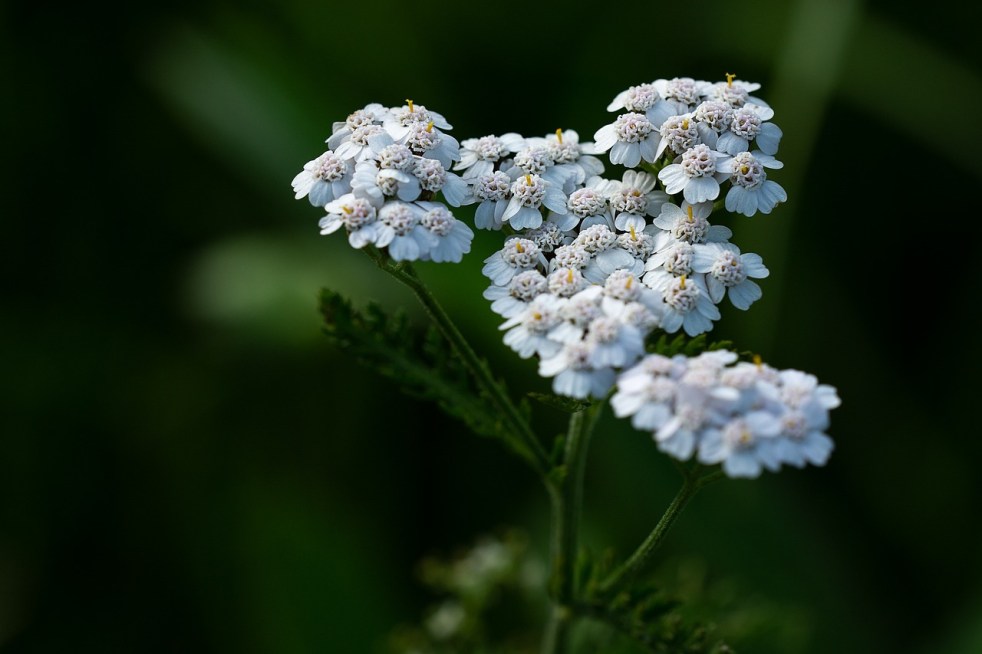
White, yellow, and pink yarrow flowers in a green field at sunset.
Chiron was half-man, half-horse, and a great healer. That makes him the Centaur for Disease Control.

This connection with battle may be why yarrow is also used as an herb for courage.

Yarrow is a protective and purifying herb. Like many herbs used to cleanse and protect, this action is borne out by its ability to repel pests. Experiments with birds using yarrow as a nest lining found that it inhibits the growth of parasites. The connection between repelling pests and magical protection is seen pretty often, as with pennyroyal, or fennel, for example.

In Europe, scattering yarrow across the threshold of a home was believed to keep evil from entering.

Yarrow is historically a divination herb. In China, one way to cast the I Ching involved counting stalks of yarrow. In Europe, it was used for love divination. You’d take a yarrow leaf and stick it up your nose, tickling yourself with it as you said,

Yarroway, yarroway

Bear a white blow.

If my love love me,

Let my nose bleed now.”

Traditional

Another method for love-divination involved placing yarrow under your pillow. If you dreamt of your love, it was a positive omen. If you had a bad dream, or dreamt of other people, it wasn’t.

An old Gaelic incantation for yarrow-picking went thus:

I pluck the smooth yarrow,

That my finger be sweeter,

That my lips be warmer,

That my voice be gladder.”

Yarrow was said to be a sacred plant to the ancient Druids, used for weather divination.

In the Victorian language of flowers, yarrow represented everlasting love.

Yarrow is connected to Venus and the element of Water.

Using Yarrow

Since so many practitioners of witchcraft and Druidry have pets and small children, I probably wouldn’t recommend just strewing your threshold with yarrow. Instead, scatter some of the dried herb under your front doormat, where curious hands or snouts can’t get into it. You can also grow yarrow near your front door — it’ll feed your local pollinators and help keep evil away.

Yarrow hydrosol is another useful way to work with this herb. It’s good for your skin. (For real, an ointment containing yarrow was researched for its ability to help heal episiotomies. Ouch!) It can also have a purifying effect, so it’s a nice way to prepare yourself for rituals. The leaves and hydrosol are also fragrant, so the scent is a nice for getting into a magical mindset.

For divination, you could either learn to cast the I Ching with traditional yarrow stalks, or include it in a spray or sachet to use while reading tarot, runes, or Ogham staves. Including it in a dream pillow is said to lead to prophetic dreams.

A soft, dreamy image of pink yarrow flowers.

As a Venus-ruled herb, it’s also a good choice to include in love jars or sachets. Traditionally, its power was to help the user find their true love, and keep lovers together. That makes it a worthwhile addition to spell to draw in true love and help it last.

Medicinally, yarrow hydrosols, infusions, and ointments are great for topical conditions like stings, bug bites, scrapes, burns, scratches, cuts, and bruises. (Never put anything ointment-y over deep wounds, puncture wounds, or animal bites, however.) Teabags or poultices of yarrow are also nice for easing sore eyes — just be careful not to get yarrow in them! If you’re allergic to yarrow or other members of the Asteraceae family, skip yarrow and use something else.

This herb is also used for treating a ton of internal conditions, from digestive trouble to colds and flu. But, like I mentioned previously, each subspecies seems to have its specialties. Before using yarrow internally, you should consult with a qualified herbal practitioner to choose the safest and most effective herbs for your condition.

Uncategorized

Blueberry (and Bilberry) Folklore and Magical Properties

I love blueberries. Few things are as delightful as a fat slice of warm blueberry pie or cobbler, with a generous dollop of ice cream (or non-dairy ice cream equivalent, as it were).

I was very excited to find that the previous occupants of this house had planted some blueberry bushes in the back yard. Unfortunately, these bushes weren’t exactly thriving — they’d been planted in an area that’s under trees. It gets plenty of light during the late autumn to early spring, but very little in the warm months. Our soil is also hard clay, and it didn’t appear that the area had been given much organic matter.

So, as much as it worried me to do it, my spouse and I uprooted these bushes and moved them into a much sunnier spot, blended well with a generous amount of shredded bark and leaf compost. We also planted two more bushes of a different variety, to fill out the tree guild we’re building around the Chehalis apple tree I talked about two weeks ago.

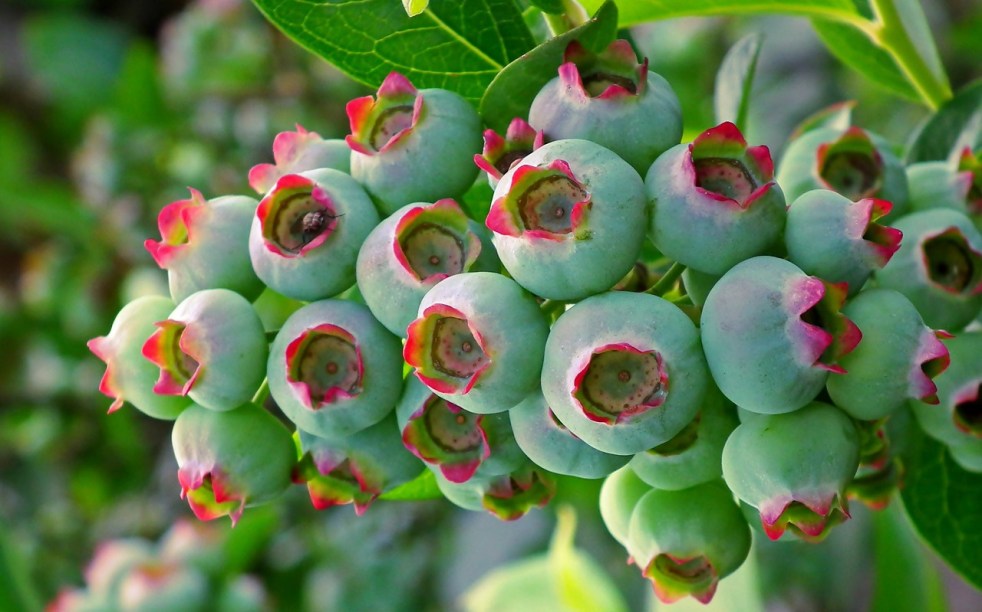
A cluster of ripening blueberries on a bush.
Some lovely little unripe blueberries on one of the bushes in the back yard.

This post isn’t about soil composition and permaculture, though I could definitely go on for volumes if it was.

No. Today, I want to get into some of the folklore and magical uses of these wonderful little balls of deliciousness.

It should be noted that blueberries (Vaccinium angustifolium, V. corymbosum, et al) are a strictly New World fruit. There’s a European relative called the bilberry (or European blueberry, Vaccinium myrtillus) that’s very similar, and the magical properties of these fruits are virtually interchangeable. If you live in an area where bilberries are native, use bilberries. If you live where blueberries grow, use those instead.

Blueberry and Bilberry Folklore

While blueberries are named for their deep purplish-blue color, the name “bilberry” is likely of Scandinavian origin. The Danish word bølle means “whortleberry,” which is another word for certain members of Vaccinium including the bilberry.

You can tell blue- and bilberries apart by their fruits. Blueberries grow in clusters, are a purplish-blue, and have a blossom end that looks a bit like a pentagon with five pointed flaps. Bilberries grow alone or in pairs, are almost black, and have a circular, smoother blossom end.

A bilberry on a bilberry shrub. The blossom end is facing upward, showing a distinct lack of the pointed flaps found on blueberries.
As you can see from this bilberry’s “butt,” they have rounder blossom ends and lack the pointy flappy bits of American blueberries. Compare it to the unripe blueberries in the photo above this one.

In Ireland, bilberries (fraochán or fraughan) are traditionally gathered during the last Sunday in July and the first of August. The first of August is Lughnasadh, a festival marking the beginning of the harvest season. Bilberries and blueberries are a traditional addition to Lughnasadh festivities all around the world.

Since gathering bilberries was traditional for the beginning of the harvest season, they were treated as a kind of oracle. If the crop was abundant, other crops would similarly flourish. If the bilberries did poorly, everything else would, too.

In ancient Greece, bilberries came from Herme’s son Myrtillus. King Oenomaus of Pisa had been given a prophecy: He would one day be killed by a son-in-law. Seeking to avoid this fate, Oenomaus decided to prevent his daughter, Hippodamia, from ever marrying by challenging every one of her would-be suitors to a chariot race on the Isthmus of Corinth. If the suitor won, he’d get Hippodamia. If he lost, Oenomaus would kill him. Since Oenomaus’ chariot was pulled by horses given to him by the god Ares, there was no way he could ever lose.

Then came Pelops. Hippodamia fell for him immediately, and went to her father’s servant, Myrtillus, for a favor. She wanted him to sabotage her father’s chariot so he’d lose the race, and Myrtillus, full of unrequited love for Hippodamia, agreed. On the day of the race, Myrtillus switched the metal linchpins of Oenomaus’ chariot with ones made of beeswax. Oenomaus’ chariot flipped, and Pelops beat him easily.

Some versions of the story say that Oenomaus, with his dying breath, asked to be avenged. Pelops then threw Myrtillus into the sea, and Hermes turned him into a bilberry shrub when he washed to shore. Another version says that Pelops, Hippodamia, and Myrtillus were traveling, when they stopped at an island so Pelops could fetch his new bride some water. When he returned, Hippodamia was in tears. Myrtillus had tried to sleep with her, she cried, while Myrtillus protested that she had promised to do so in exchange for sabotaging Oenomaus’ chariot. The enraged Pelops then killed Myrtillus.

In the folklore of some of the people indigenous to blueberry’s native range, blueberries are called “star berries” for the star-shaped blossom end.

In the Victorian language of flowers, bilberry represents treachery. This symbolism is likely borrowed from the Greek story of Myrtillus.

Blueberry and Bilberry Magical Uses

Blue- and bilberries are associated with protection and luck in European witchcraft.

Dried bilberry leaves are used in protective powders but can also be used whole for prosperity and luck.

The fruit is similarly used for protection and hex-breaking.

(Considering bilberry’s associations with treachery and crop divination, I wonder if their protective properties stem from their connection to physical danger and starvation. Today, we know that fruits like blueberry and bilberry can protect against oxidative cellular damage due to their antioxidant content, but their traditional connection to protection goes back much farther.)

Using Blueberries and Bilberries

Blueberries and bilberries couldn’t be simpler to use. For kitchen witches, include them in recipes for protection and the removal of malevolent enchantments.

Crushing the fresh berries can yield a pigment suitable for drawing protective sigils on paper talismans, the skin, and anywhere else you might need them. Just bear in mind — both of these berries are sweet, and your talismans may be sticky and likely to attract bees this way!

To protect your property, dry bilberry or blueberry leaves. Powder them well, then sprinkle the powder around the perimeter of your home or yard.

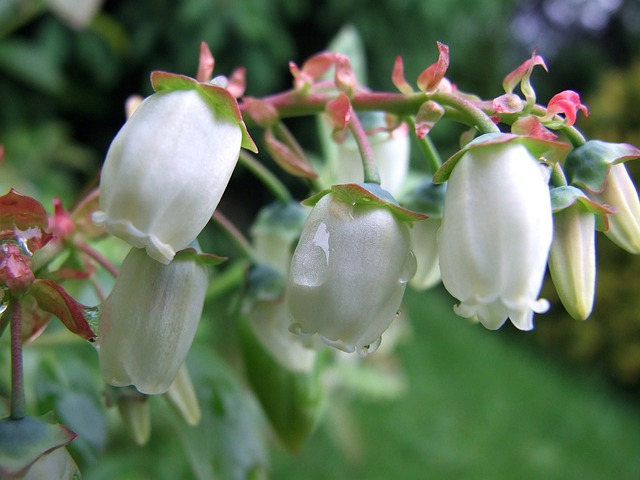
White, bell-shaped blueberry blossoms.

To break a hex, jinx, or run of bad luck, burn dried blue- or bilberry leaves. Use the smoke to fumigate the same way you’d use incense smoke.

Blueberry and bilberry don’t appear to be reversing herbs. That is, they don’t return treachery or malevolent magic to the sender. They just keep it from affecting you.

Since bil- and blueberry seems to predominantly be a protective herb, I would hesitate to use it solely for drawing luck. It appears that it’s virtue in luck drawing lies in its ability to get rid of jinxes and other things that hold you back. For luck spells, then, I’d pair blueberry or bilberry leaves with an ingredient used more specifically for attracting good luck. The berry leaves can clean up the things standing the way of your luck, and the other ingredients can draw it in. Allspice, chamomile, and fenugreek are all good options to consider here.

Interestingly, strawberries are sometimes used in small amounts for luck drawing. You could then theoretically make a jam, smoothie, or pie with both blueberries and strawberries, and, when appropriately made and empowered, use it to attract good luck to you.

It remains to be seen how my poor transplanted blueberries do, but the newer ones seem to be thriving. When the time is right, I’ll harvest the fruits and some of the leaves, and hopefully have enough protection and hex-breaking to last me all year!

life · Plants and Herbs

It’s basically like some kind of artery loofah.

Hi. I have high cholesterol.

Well, “borderline high,” according to the internet.

My doctor gave me the disheartening news that it’s genetic. I think it’s more likely to be a product of falling too easily into the temptation of getting takeout in a place with so many awesome places to eat.

Either way, I’m avoiding statins if I can. For now, I’m trying a different protocol:

  • Taking vitamin K2, on my doctor’s recommendation.
  • Taking vitamin D, because I tested low.
  • Eating 35+ grams of fiber per day. Oat fiber is supposed to be the best for maintaining a healthy blood lipid ratio, but I can’t have oats. So, psyllium, chia, and other fibers it is.
  • Going plant-based.
  • Eating more avocado. The thing is, I already cook almost exclusively with avocado oil because it has a higher smoke point than other oils, so I’m not sure how much of an impact this’ll have.
  • Increasing my physical activity. I’ve started with a round of sun salutations each morning, and a set minimum of any kind of other physical activity throughout the day. I get bored easily, so I won’t stick to a routine. Telling myself that it doesn’t matter what I do, as long as I do a half hour of it, seems to be the best way to ensure that it actually happens.

I was vegan years ago, but I say “plant-based” now. This is mostly because veganism isn’t really a possibility — I wear vintage leather, because it is better and less harmful than either new leather or vinyl alternatives. I use collagen to keep my joints functioning, and there is no vegan equivalent. I eat honey, because bees are unionized. I feed my kefir grains with plain sugar, which is sometimes whitened with bone char. There are some things for which there is either no less destructive alternative, or no actual replacement.

I’m also using complementary measures. This is mostly because fixing my blood lipids is mostly a matter of changing things and waiting — there isn’t really a whole lot to do. I have an aventurine and serpentine bracelet that I wear on my left wrist, so putting it on and noticing it throughout the day helps me a) feel like I’m actively doing something, and b) draw my attention back to getting my blood back out of whack.

I’ve also been using meditation. I meditate routinely as it is, but I’ve shifted my focus to very specific imagery, sounds, et cetera. Even if this doesn’t lower my cholesterol, meditation has enough other cardiovascular and general health benefits to make it worthwhile.

It’s going to take a bit for these things to have an effect. My cholesterol didn’t raise itself overnight, and it won’t lower itself that quickly either. Hopefully, in a few months, I’ll be able to have my blood drawn again and see that I’m back in a healthy range.

Have you lowered your cholesterol without statins? If so, what’d you do?