Plants and Herbs

Rooting Spider Plant Pups

Let me preface this by saying that I love my cat.

He’s a huge, sweet, orange doofus, albeit a surprisingly bright doofus. He’s learned a number of verbal commands, like “sit,” “up,” and “off” (even if he thinks “off” means “stop what you’re doing and run over to flop your gigantic butt on me”). There is one thing he hasn’t learned, and, at this point, I’m not sure he’s ever going to.

Don’t eat plants.

I don’t have poisonous plants. The only toxic ones I have are those that contain calcium oxalate crystals, and are more accurately described as “really irritating.” I also keep my plants well out of his way.

… Or so I thought, until I walked into the bathroom and spotted one of my lovely spider plant pups laying in the bathtub. Fortunately, they’re neither toxic nor irritating, because this pup was also very chewed.

This spider plant has a ton of offsets, so one isn’t really a great loss. Still, I managed to find it soon enough, and the roots were more or less unscathed, so I figured I’d see if I could save it. Luckily, spider plants are like goldfish plants, ghost plants, and pothos in that they’ll root with a snap of your fingers.
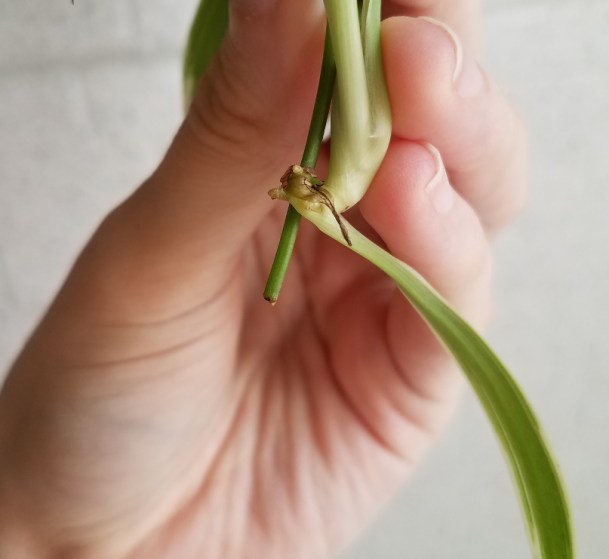
Close-up of spider plant pup root nodes.
These little nubs at the base of the offset will develop into roots.

Continue reading “Rooting Spider Plant Pups”

Plants and Herbs

Twice-Blooming Christmas Cacti?

I have a lovely pair of Schlumbergera. They used to live on the windowsill in my bathroom, where they gave me pretty, bright white blooms with hot pink pistils every winter. I looked forward to seeing them every year — individually, the flowers themselves don’t last very long (only about a week per bloom), so it was a little window of beauty in the middle of the cold, gray winter season.

Schlumbergera bridgesii are better known as Christmas cacti, and for good reason — they flower in December. It’s always exciting, watching the little buds pop out of the end of the flat, spiky-edged leaves, growing and lengthening until the flowers finally burst forth. December rolls around, everything else is in the midst of dormancy, but these cacti happily put out flowers anyhow.

Yep.

Every December.

You know, when Christmas happens.

cactusflur
If you notice the leaves don’t really resemble the smooth, round leaves of other Christmas cacti, that’s because holiday cacti nomenclature and labeling makes no sense. This one was labeled as S. bridgesii, which is actually S. buckleyi, and doesn’t look anything like most other S. buckleyi cultivars I’ve seen. ¯\_(ツ)_/¯

So, someone tell me what’s up with this nerd. 

See, not long ago, I moved both of my plants into a warmer, brighter window, on the top shelf of my new plant shelves. Now, I’m not sure what triggers S. bridgesii to flower, exactly — shortening daylight hours? Cooler weather? I don’t know. There are ways to force it into dormancy and trigger flowering, but I didn’t do anything out of the ordinary before moving it. I didn’t even restrict light or water.

I’m not complaining, of course — this little plant’s putting out more flowers now than it did two months ago. It looks healthy and vibrant. The cactus right next to it doesn’t have a single bud on it, but it’s also not really supposed to.

Is it possible for S. bridgesii to flower late, if it didn’t flower during Christmas? I’d say so. Is it possible for one to flower more than once a year? Apparently! Unfortunately, I don’t know exactly what triggered this one to start putting out blooms now, but I’m going to keep an eye on both of them and see if the other decides to put out more buds. Maybe take a few cuttings and try some experiments.


Plants and Herbs

Fixing Etiolated Succulents

It’s almost spring, and the unseasonably warm weather has my plants all confused. I’ve got a new basal shoot on my nepenthes, my cacti are putting out new growth, my pothos and aloe are threatening to take over my apartment… So, even though it’s a bit early still, I figured now was a good time to take inventory and see who’s going to need some pruning and re-potting. Unfortunately, it looks like the lack of winter sunlight has left some of my younger plants in a bit of a state, and they’re going to need some “fixing.”

Why is fixing in scare quotes? Well, unfortunately, once a plant is etiolated, there’s really no going back. A stretched-out echeveria is not going to become a neat, compact rosette again, no matter what you do for it.

That doesn’t mean all hope is lost, though.

Let me start from the beginning.

Continue reading “Fixing Etiolated Succulents”

Environment · Plants and Herbs

Is Bti water safe to drink? Or, Natural Pest Control for Paranoid Plant Keepers.

So, plants.

I have a lot of them. What witch hasn’t kept a pot of something on a windowsill somewhere, you know? In a previous incarnation of this blog, I talked about everything from trying to grow a rosemary bush, to collecting cacti, to that time my aloe plant absolutely would not stop reproducing. In short, I really like plants.

Unfortunately, my place doesn’t have any outdoor space to speak of. (None that I can use, anyway.) As a result, I have roughly one plant per 20 ft², and counting. The trouble is, not all of them are cacti — I also have a number of tropical plants that become really, really unhappy if they aren’t kept moist. I live in a very humid area, which they seem to enjoy, but…

Fungus gnats, though.

plant.jpg
My poor, bedraggled fern…

Fungus gnats like moist soil. They deposit their eggs in it, and, before you know it, you’ve got masses of annoying, tiny gnats swarming around all of your plants. They’re not the only bugs that really dig on some wet dirt, either. When you combine plants that need to be kept moist with high humidity, it’s pretty much the ideal breeding ground for all kinds of tiny, annoying pests that are super enthusiastic about living in your pots.

Gross.

I try to use natural pest control. My space is small, so I have to minimize my ability to inadvertently come in contact with pesticide. I also have two cats, so I really, really need to keep their exposure risk as low as possible. Since I don’t really have an outdoor hose/spigot I can use, any watering or diluting I do has to be done in either my kitchen or bathroom sink. Also, I try to avoid releasing any more pesticide/fungicide/herbicide into the sewer system than I absolutely have to.

Continue reading “Is Bti water safe to drink? Or, Natural Pest Control for Paranoid Plant Keepers.”