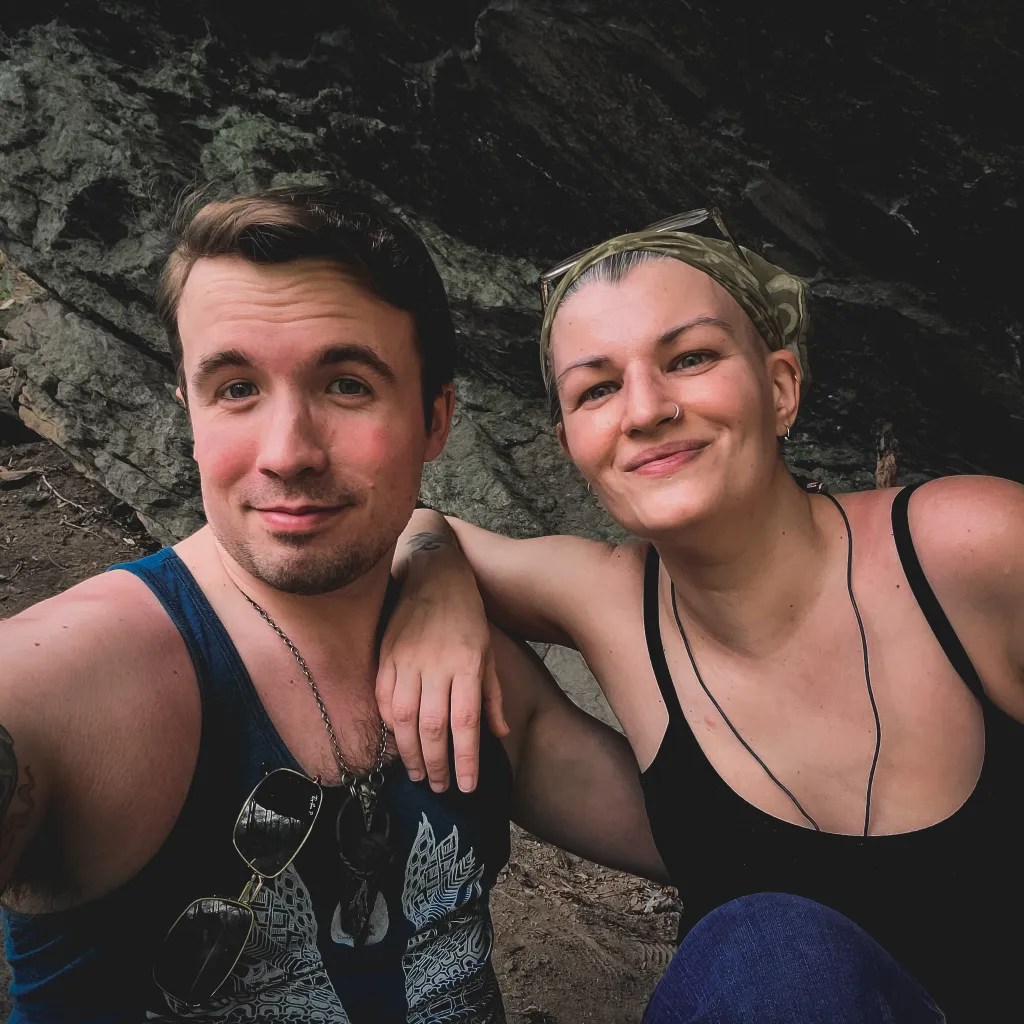
This past weekend, my Handsome Assistant and I packed a small picnic and went for a bit of a walk. This particular area is beside the northwest branch of the Anacostia River, near an abandoned mica mine. There are some really cool mineral specimens here — the usual bull quartz, but also tons of mica-bearing rocks and golden beryl.
That’s not all it has, though.
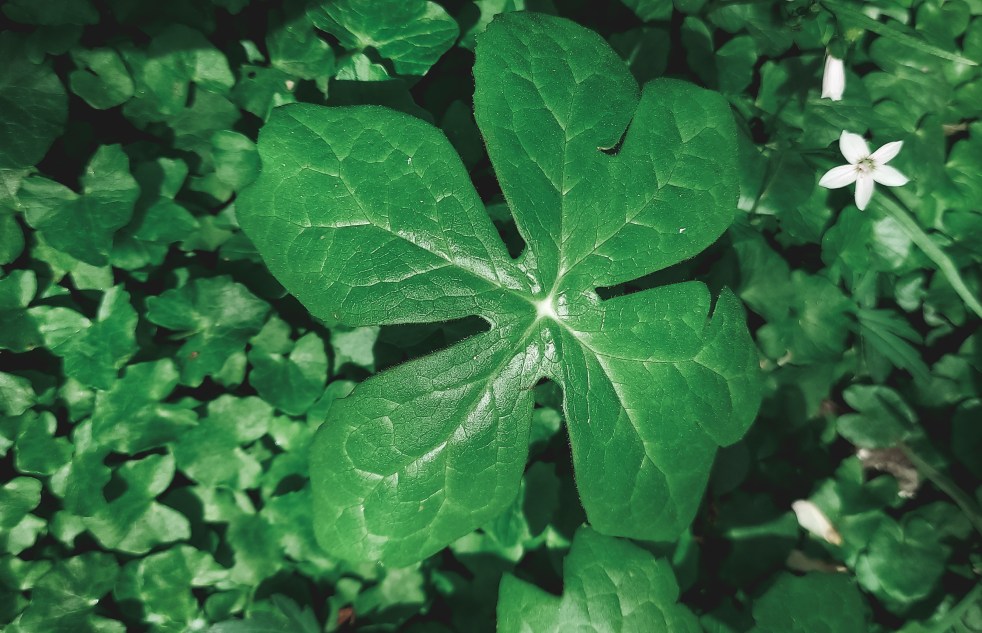
The trail is mostly shaded by trees, so it stays fairly cool even when the weather’s warm. Lesser celandine (lush, but invasive) covers the ground between the trees, creating a dense carpet that reflects the sunlight and further cools the ground. It’s poisonous to eat, though the tubers are said to be edible, and has a long history of use as a topical medicine for hemorrhoids and scrofula.
“That’s a really bad idea, you know.” “I know, but it looks so soft.” “There’s probably poison ivy in it.” “Worth it.” “You’re going to get eaten by snakes. Or ticks. Probably both.” “It’s so soft, though!”
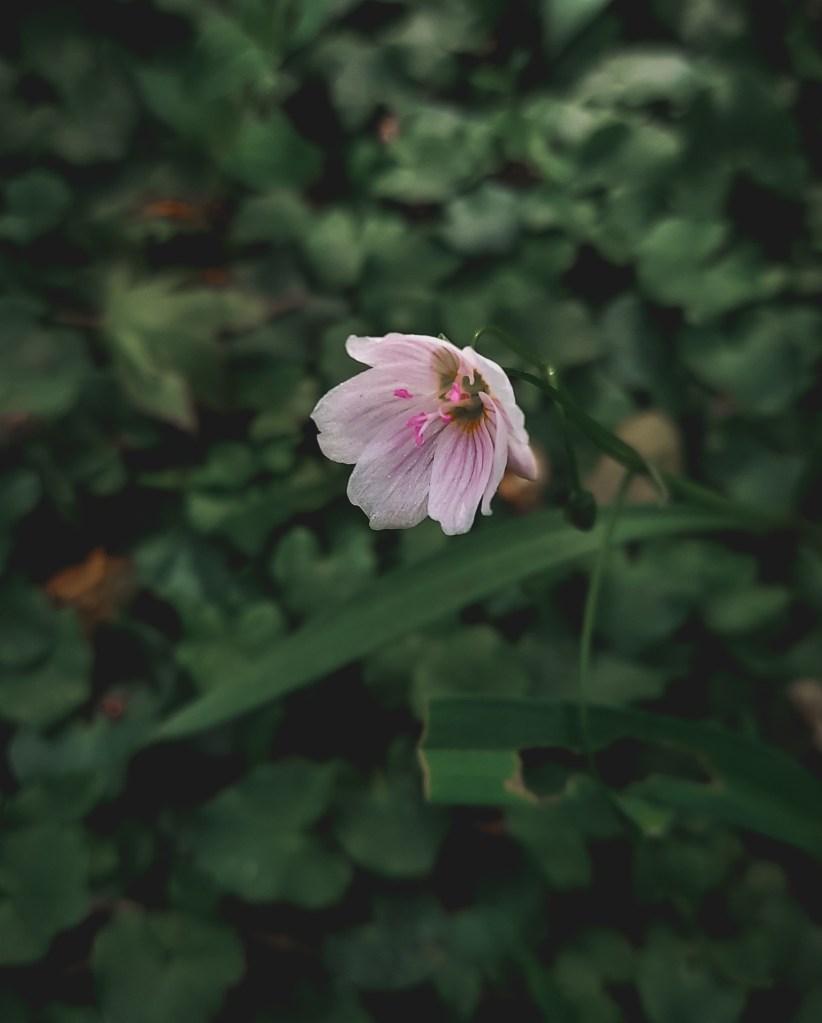
Springbeauty (Claytonia virginica)
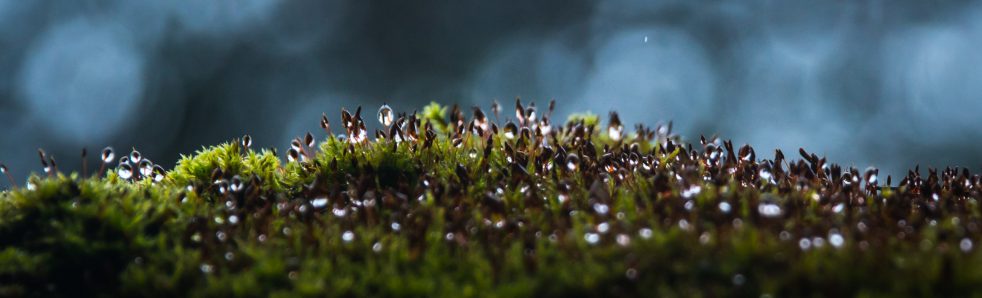
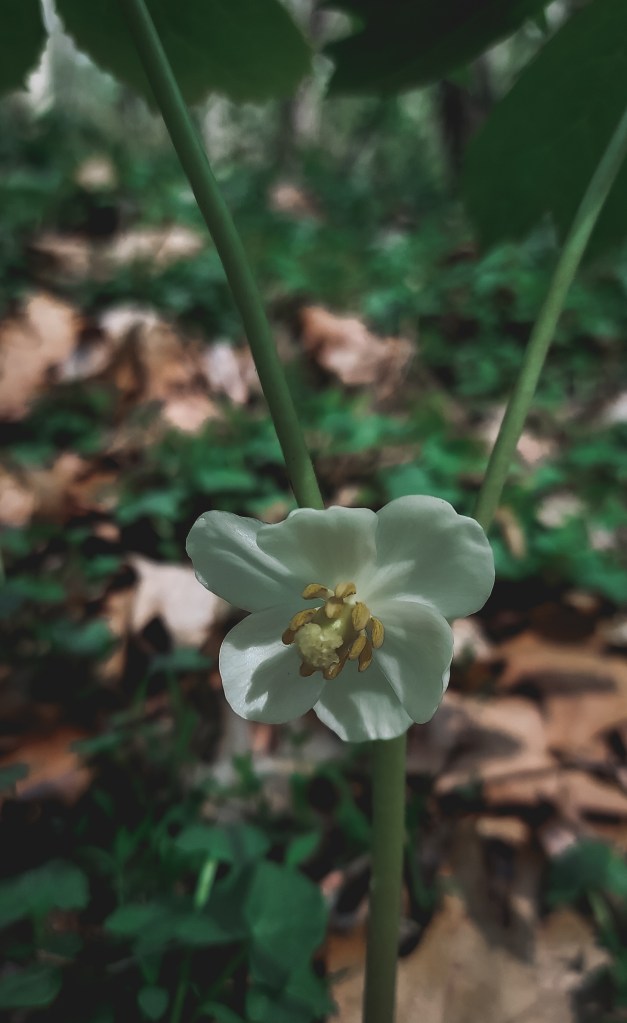
Fortunately, there was more to see than just lesser celandine. There were tiny pink blossoms of springbeauty, dense pillows of moss, fern fiddleheads, and some of the lushest skunk cabbage I’ve ever seen. We also spotted some mayapples, a few of which were even mature enough to flower. I don’t know if I’m brave enough to go back and see if there’s any fruit later this summer, but it was lovely to see regardless! (I snapped a few pics of the ones we saw, which you can find in my post on mayapple folklore and magical properties.)
Seriously, just look at that skunk cabbage (Symplocarpus foetidus).
We passed next to the water, eyes peeled for sparkly mica-bearing stones, when I heard a soft “bloop.” I turned my head just in time to see a startled common watersnake (Nerodia sipedon) slipping away across to the opposite bank, gracefully undulating and occasionally poking its head up like a snorkel to take a breath. I apologized for spooking it as I fumbled for my phone but wasn’t able to snap a picture before it had swum away and camouflaged itself in the mud and fallen leaves.
They’re one of the species of snakes that are often vilified for no reason. They’re perfectly harmless but can bear a passing resemblance to a venomous copperhead (Agkistrodon contortrix). Admittedly, I made the same mistake myself at first glance — not that I would’ve behaved any differently, as both the snake and I seemed pretty chill about the whole situation. Like black racers and ratsnakes, they’re guys you actually want to have around if you don’t want to have to deal with pest animals. Also, they’re one of the few reptile species that gives birth to live young, and that’s really neat!
(Also, copperheads are pretty chill, too. They might be venomous, but they’re not aggressive. Their first defensive instinct is to freeze up and rely on their natural camouflage. Bites typically occur when that either fails, or people don’t see them, step too close, and the snake gets desperate.)
Young ferns.
A little further up the trail, we were navigating over a large fallen tree. Another tree lay across it, forming a kind of steep natural bridge. As I investigated it to see if it’d be safe to cross, I heard a silky rasping sound. There, nestled in the root ball of the fallen tree, I saw the shiny black coil and pointed tail of a black racer (Coluber constrictor priapus) vanishing deeper into the tangled roots.
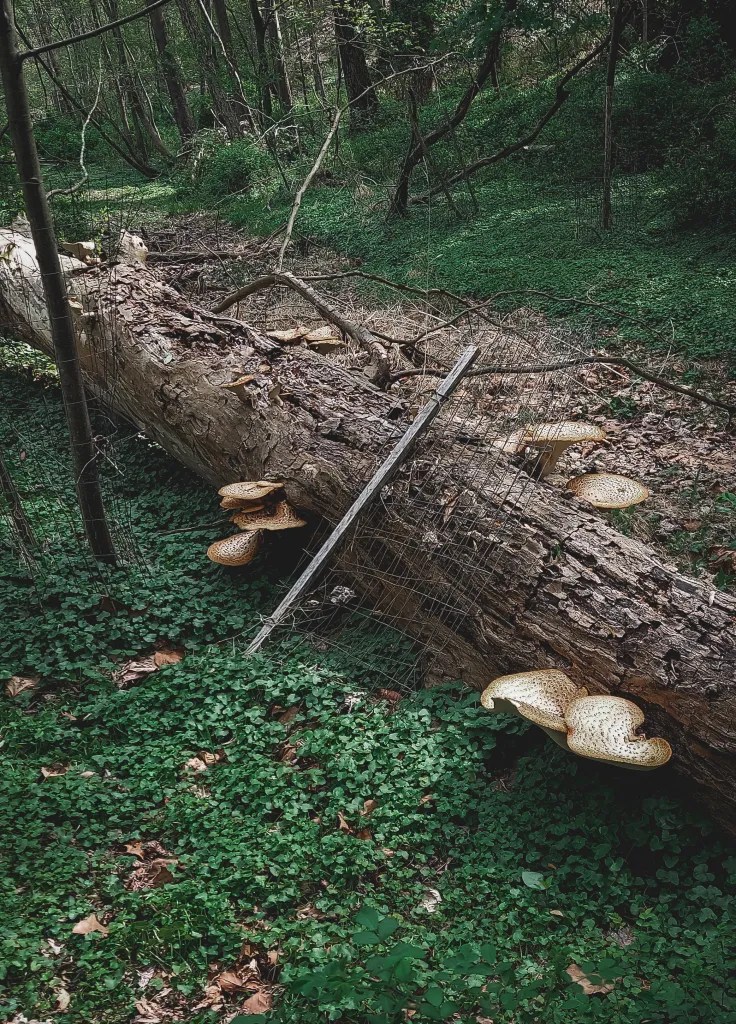
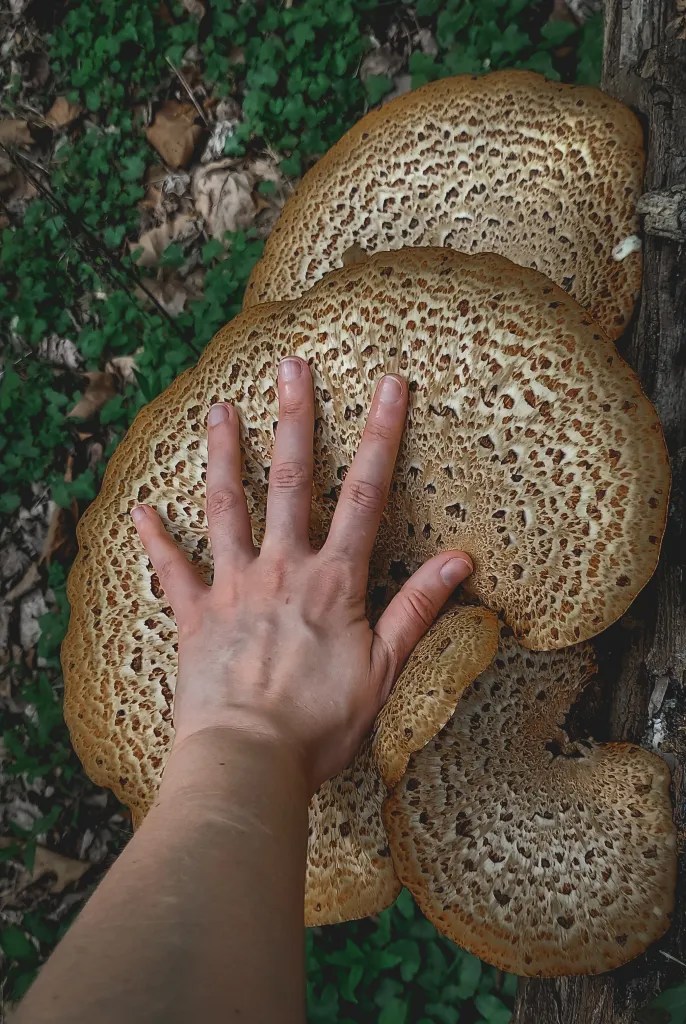
My favorite part, however, was running into a colony of dryad’s saddle (Cerioporus squamosus) growing from a dead tree. These are edible, fairly easy to identify, and don’t really have poisonous lookalikes. They also smell exactly like watermelon rinds, which is honestly very weird. Kind of a green, watery, fruity smell, of decidedly not the type you’d expect from a scaly tan mushroom growing out of a dead tree. I wasn’t 100% positive that that’s what I was looking at, at first. Fortunately, a combination of a quick-and-dirty ID app and friends with much more foraging experience were able to reassure me.
Also?
Dryad’s saddles get enormous.
Like, far larger than I felt was reasonable for a mushroom. Much bigger than the reishi and armillaria that grow in my front yard, at any rate.
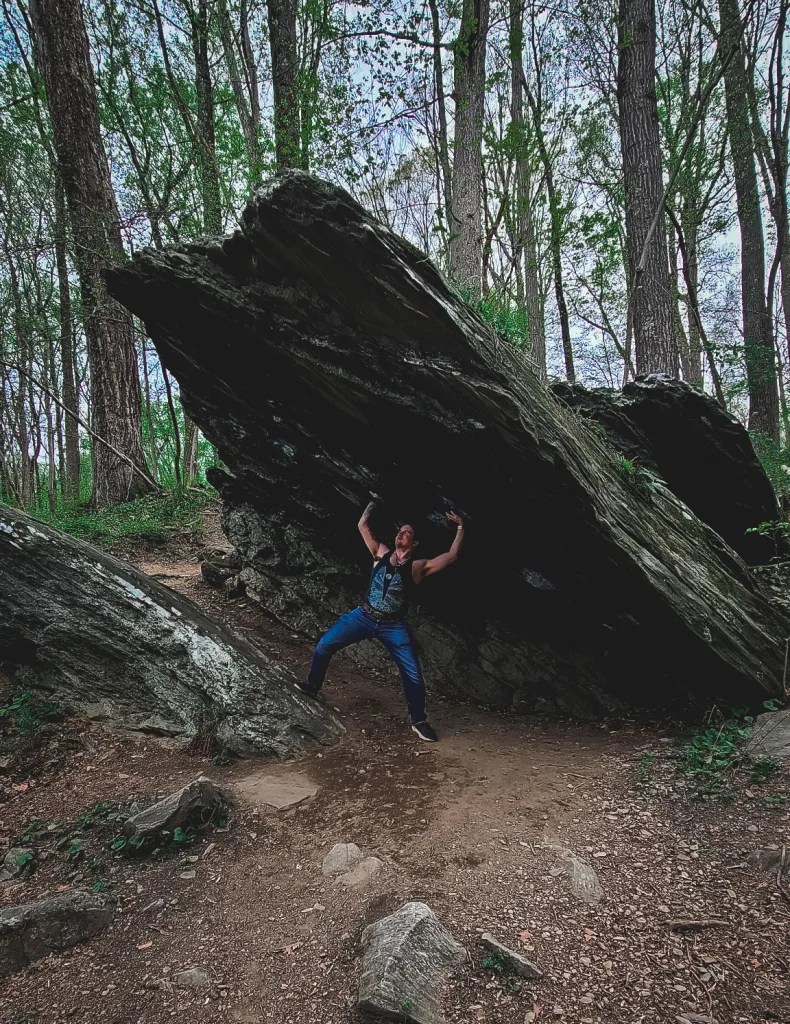
This area has another cool feature, labeled on the map as “prehistoric rock shelter.” I haven’t found any other information about it, but it’s a nice, cool, shaded spot to sit and rest for a bit. The area underneath is at a bit of a slope, but it’s still a comfortable place to take a break.
I also found a tree that was shaped kind of like a sad skull, and a very neat feather — most likely from a hawk.
All told, it was an eventful walk and a lovely picnic. Everything was vibrant and green, and we saw (and heard!) a lot of cool wildlife.
Here’s hoping you’re also finding cool things wherever your adventures take you.
I love mayapples. They look like a prank. Like someone picked a bunch of leaves off of something bigger and stuck them in the ground so they could trick people into thinking that that’s how a mayapple grows. They’re patently ridiculous and fantastic.
I remember the first time I encountered them. Though I don’t remember when, or where, I do remember seeing a bunch of sprouts that looked like folded beach umbrellas for fairies. I wasn’t sure if they were plants or mushrooms at first — before the leaves fully open, they almost look more like fungi than anything planty.
The other day, my handsome assistant and I were on a walk and ran into a whole patch of them. Even better, some of them had flowers, which also look like some kind of prank. The only thing better is when they fruit, which I, personally, find hilarious. Just one leaf with a big old fruit hanging off of it. It looks like a video game monster. Like you’re supposed to get close, then find out the fruit is actually full of teeth and now you’re out of extra lives.
Anyway. Mayapples are interesting for more than their bizarre looks. They can also be a very useful plant.
Mayapple Magical Uses and Folklore
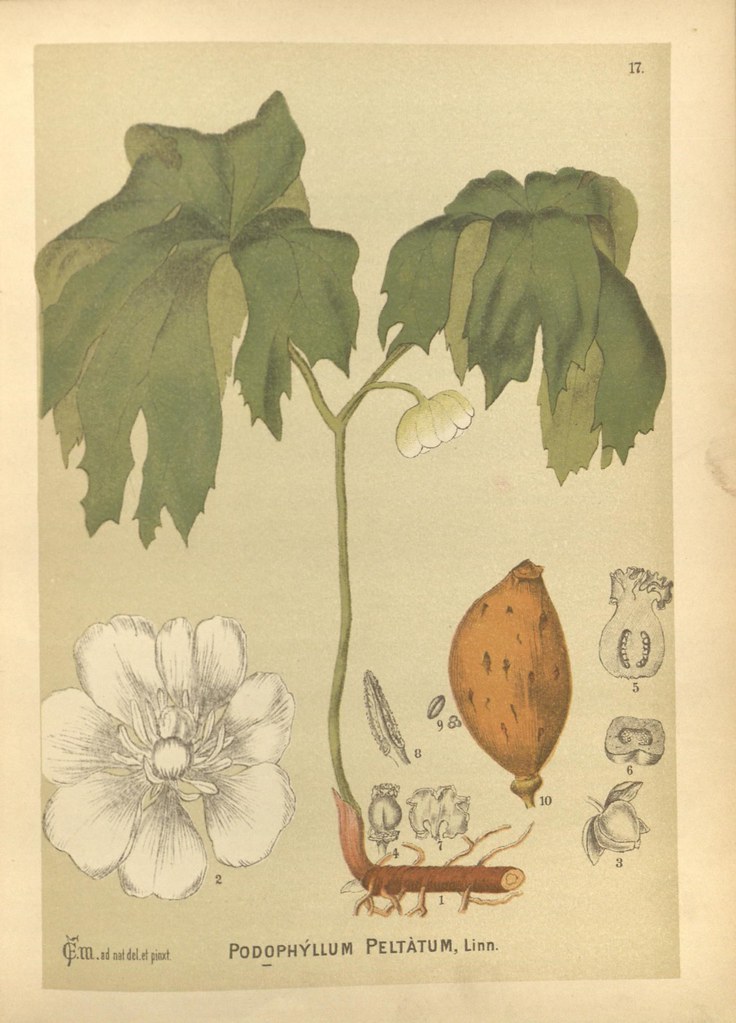
Mayapple (Podophyllum peltatum) is sometimes called “American mandrake,” and the name is apt. Like mandrake (Mandragora species), it’s poisonous. It also has a pretty large root that often branches similarly to that of a mandrake.
The name Podophyllum peltatum comes from the Greek words podo, meaning “foot,” and phyllum, meaning “leaf,” as well as peltatum, meaning “shield.” It’s a pretty apt name when you look at their slender stems shielded by broad leaves.
While the entirety of the mayapple is poisonous, the fruit (with the seeds removed) can be eaten only when it is completely ripe1.
Most commonly, mayapple is used as a substitute for mandrake. While the plants are unrelated, their qualities are similar enough to make such a substitution work.
That means that mayapple is an excellent ingredient in protective or banishing formulas. Some people use it as an ingredient in formulas for renewal, rebirth, or new beginnings, largely because of the fact that the plant appears in spring, produces fruit, and go dormant shortly after the fruit ripens in mid-summer.
Interestingly, mayapples have a unique relationship with turtles. While the foliage is bitter and deadly enough for herbivores to avoid it, the smaller guys will happily go after the ripe fruits. Box turtles are actually the primary distributors of mayapple seeds2,3. The fruits grow at just the right height for the turtles to reach them, and the seeds are more likely to germinate after being exposed to the turtle’s acidic digestive environment.
While the mayapple is extremely poisonous, it does have a history of use as a medicinal plant. In the past, it was used as an emetic, anthelminthic, and treatment for skin conditions like warts. Podophyllotoxin, one of its primary toxic constituents, is actually the active ingredient in a topical treatment named Podofilox that’s used to treat some viral skin conditions like genital warts and molluscum contagiosum. It works by inhibiting the replication of cellular and viral DNA as it binds to key enzymes4.
Using Mayapples
If you’re going to use mayapple, do it carefully. Wear gloves. Don’t put it in anything that you’re going to ingest, or even anything that could potentially come in contact with your skin. While the ability to keep DNA from replicating is helpful when you’re trying to kill a skin virus, it’s very much not okay when it’s working on your cells instead.
Whole dried mayapple roots could be used to make an alraun. This is a dried tormentil or false mandrake root (Bryonia alba) used in German folk magic, carved and decorated into a kind of spirit doll. Keeping and properly maintaining one is said to bring good fortune to the household. The alraun (or alraune) would also be bathed in red wine, which could then be sprinkled around the household for protective purposes.
Caring for an alraun is pretty intensive. Once prepared, it needs to be wrapped in a red and white silk cloth, put in a special case, and bathed in red wine every Friday. On each new moon, it should be given a new shirt. These dolls were also passed down through families, though they must be inherited in a particular way: When the father of a family dies, his eldest son may inherit the alraun by placing a piece of bread and a coin in his father’s coffin. If the eldest son dies, his eldest son (or younger brother, if he has no sons) may likewise inherit the alraun by the same method5.
If creating and caring for an alraun seems a bit intense, you can also use dried mayapple in container spells. Just make sure to wear gloves while handling it, and don’t place it anywhere where children or animals may come in contact with it.
Rinse the dried root in water or alcohol and sprinkle it around anywhere you wish to protect. Again, be cautious not to get it on your skin.
The seeds would be useful in formulas for rebirth or renewal. However, as mayapple has never particularly called to me as a “renewal” herb, I can’t offer any more in-depth suggestions here.
Mayapples are beautiful, unusual little plants. They pop up in spring in all of their bizarre glory, flower, fruit, and are gone by late summer. Treated with respect, they can be very useful — even heirloom-worthy — magical tools.
Braun, J., & Brooks, G. R. (1987). Box Turtles (Terrapene carolina) as Potential Agents for Seed Dispersal. American Midland Naturalist, 117(2), 312. doi:10.2307/2425973.
Rust RW, Roth RR. Seed Production and Seedling Establishment in the Mayapple, Podophyllum peltatum L. The American Midland Naturalist. 1981;105(1):51. doi:10.2307/2425009
The other day, I posted a video of foraging and processing kudzu roots to a group I’m a part of. A few friends seemed interested — one messaged me that they knew of a potential patch. That weekend, armed with trowels, bags, and gloves, we set out to track us down some kudzu.
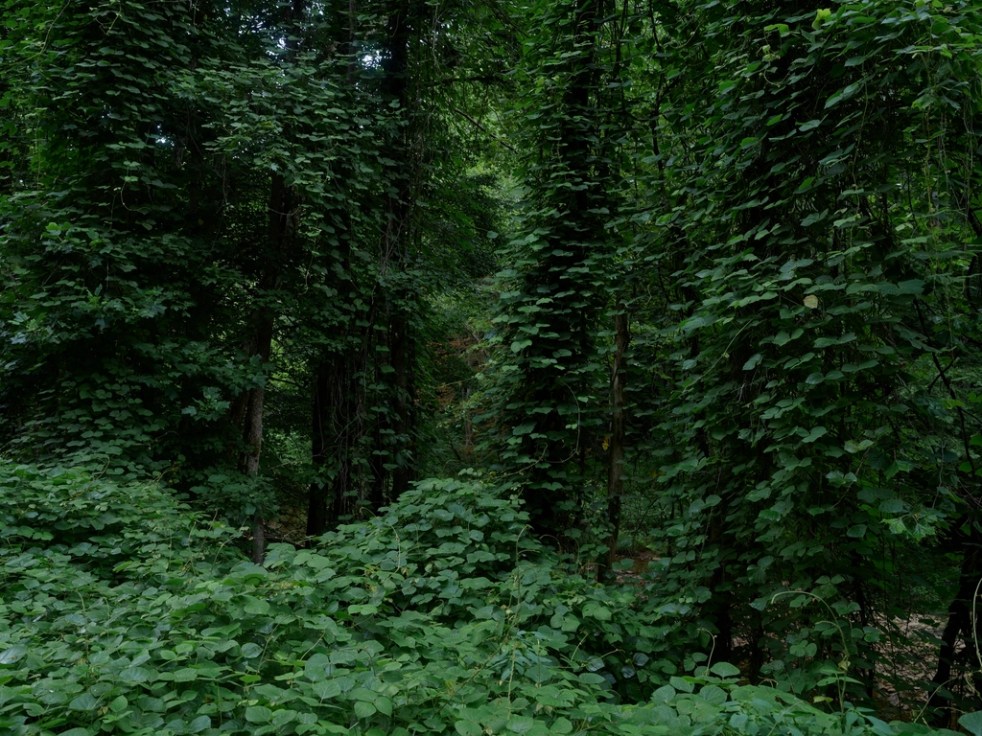
If you’re in the southeastern US and you do any kind of gardening, the word “kudzu” may well strike fear into your heart. As Nature.org‘s “Kudzu: The Invasive Vine that Ate the South” puts it, “kudzu is quite a killer, overtaking and growing over anything in its path.” Drive down a highway, and it’s not uncommon to see it choking out trees, climbing over fences, and dragging down powerlines.
In short, we were more than happy to learn how to eat some.
In its native range, kudzu is still an aggressive grower. It’s not invasive, of course, because a native plant by definition can’t be invasive. One of the things that helps keep kudzu in balance is the fact that it’s useful as a food and medicinal plant. People regularly harvest it to eat as a root vegetable and process into starch.
There’s only one problem: It was very early spring. There were no leaves on anything. Identifying it meant looking for a specific kind of brown twig in a mass of other brown twigs, then trying to follow it back to the ground, dig there for a while, and hope it had led to something resembling a kudzu root. Fortunately, kudzu doesn’t have many lookalikes, and its hairy stems and growth habit help to differentiate it.
Also, kudzu roots get enormous.
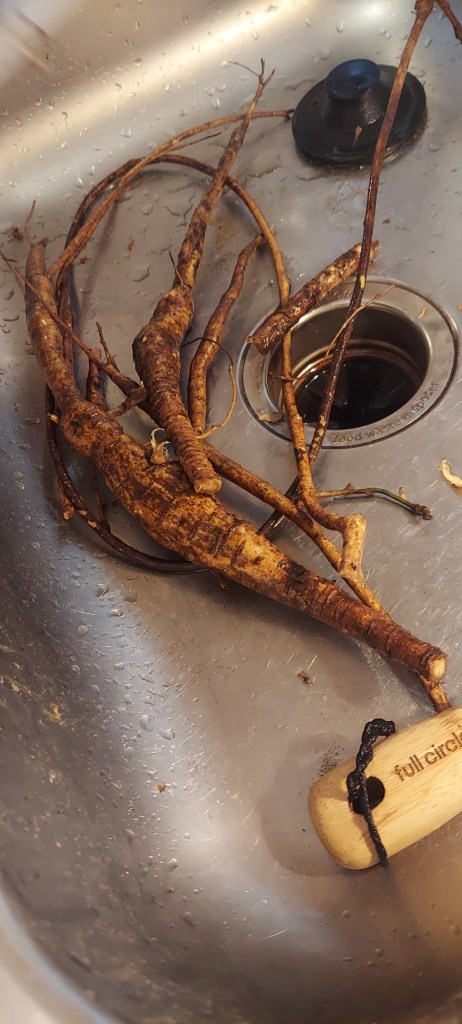
My Handsome Assistant is a powerlifter. Even with him pulling and our friend and me digging, it still took a lot of time to liberate several fairly small roots. Still, it was a success and, I figured, I decent amount for a first attempt. Nothing we’d have to bust out a table saw to cut through. Just enough to hopefully end up with some starch (and give us the opportunity to decide if it was worth the effort).
Some of the kudzu roots, trimmed from a larger one.
Tl;dr, I’m probably just going to make them into a stew next time. Maybe paper.
Processing the kudzu roots involved scrubbing them well, peeling away their tougher, fibrous outsides, cutting them into chunks, and pureeing them well with plenty of water. Once pureed, we strained the pulp, squeezed it out, rinsed it, squeezed it out again, and poured the liquid into large jars to let the starch settle to the bottom.
It was that last bit that proved the most problematic.
See, we’d hoped to get the roots before they used their stored energy (in other words, starch) to put out a flush of new spring growth. However, the roots we got were small and fairly skinny (which is probably for the best — we might’ve needed a backhoe for big ones). The little bit of starch that settled out ended up lost during the refinement and decanting process.
Still! It was an interesting learning experience. I’d definitely change how we did some things (like I mentioned, I’d love to try preparing the smaller roots in other ways, like roasting or stewing). I also have a mold and deckle and, considering that starch is used as sizing for papermaking, I’d like to try using the pulp to extract most of the starch and, rather than discarding/composting the pulp, see how it works in paper.
This weekend, my Handsome Assistant and I attended an educational picnic to save Rock Creek, which is currently at risk from the continued expansion of a golf course. Construction has already begun, parts of the forest are being turned into mulch as we speak. Over 1,200 trees are slated to be cut down, including some that would otherwise be considered special or heritage trees under DC law.
This deforestation is part of an effort to expand multiple golf courses throughout the DC area.
Yeah, I know.
Even without further examination, I mean — who is building golf courses right now, of all things? The answer is the National Links Trust. While people worry about paying rent and getting their next meal, the National Links Trust apparently thinks that the public yearns for more golf courses. It’s something that sounds almost moustache-twirlingly villainous. Like the plot of an after school special where the heroes are a band of plucky cartoon kittens. Unfortunately, this is actually happening.
What’s the deal with the National Links Trust?
The NLT’s stated intention is “positively impacting our community and changing lives through affordable and accessible municipal golf.”
This is something that doesn’t sound… terrible, barring the whole “people-can’t-afford-food-right-now-you-rich-weirdoes” aspect. However, here’s what the NLT isn’t saying:
Lem Smith, NLT board member, International & Federal Government Affairs Manager for Chevron, and Former VP, Federal Government Relations for the American Petroleum Institute.
While they claim that they’re attempting to mitigate the harm done by the deforestation of Rock Creek (harm that is, once again, completely unnecessary and unasked for), they are not adhering to the best practices for doing so. There are multiple ways to mitigate the damage of both removing old growth trees and the presence of invasive plants, but their policy seems to be to mulch everything and call it good.
They’re not actually accountable to anyone. They can make half-hearted promises to plant meadows and maintain the forest all they want, but there is no incentive for them to keep them and nothing to stop them from doing whatever they want.
They claim that they’re willing to dedicate unused golf courses to being replanted as meadows. This is not a suitable compromise for multiple reasons:
For two, if there are already unused golf courses, they don’t need to cut down old growth trees in Rock Creek in order to make new ones. WT-actual-F?
There’s also the fact that it doesn’t seem like anybody actually asked for this. When asked, local golfers appear to be ambivalent at best. The NLT was able to scrape together some who are in favor of it to make a public appearance, but these don’t appear to reflect the opinion of the majority of the new course’s ostensible user base. They are absolutely not reflective of the larger population of DC and the adjacent area.
Here’s why it matters (no matter where or who you are).
So the NLT is attempting to build a golf course. Like I said, this is a huge deal and will have far-reaching effects even if you don’t live anywhere near DC. Here’s why:
Old growth areas are carbon sinks.
It is generally thought that old forests cease to accumulate carbon, but this isn’t the case. Research shows that in forests between 15-800 years of age, “net ecosystem productivity (the net carbon balance of the forest including soils) is usually positive.” What’s more, carbon doesn’t cease to exist once it’s taken up. When these areas are disturbed, that carbon is liberated as plant matter decays or is burned. Rather than trees dying naturally over time, breaking down, and having their nutrients (including carbon) absorbed into the mature forest, deforestation disrupts this natural cycle.
Rock Creek is part of the Potomac watershed.
Trees support healthy watersheds. Rock Creek itself connects to the Potomac River, and eventually drains into the Atlantic Ocean via the Chesapeake Bay. Trees contribute to healthy waterways by anchoring soil in place, preventing erosion. Their root systems (including the mycorrhizae within the soil that surrounds their roots) help capture nutrients. Without these systems in place, they would otherwise flow into the water to encourage algal blooms and fish kills, a process known as eutrophication. Removing these trees and replacing them with grass that requires a regimen of fertilizers and treatments to maintain is a terrible idea.
The last thing anyone needs is golf course runoff oozing into our local waterways.
Golf courses need a lot of water.
I already mentioned supplemental irrigation, but I’ll say it again: Golf courses need a lot of water. They are generally watered with sprinkler systems that lead to a lot of waste and loss through evaporation. This also puts strain on existing systems, reducing the availability of water for other uses and increasing scarcity issues. Only about 12% of golf courses surveyed use recycled water, and even with more efficient irrigation methods, turf grass remains a very wasteful use of land and water.
We’ve already had droughts here. We’re already told not to use any more water than necessary during the summer because of scarcity issues. Why are they building a golf course?
This could increase the transmission of avian flu.
I’m not being hyperbolic when I say this. Destruction of wildlife habitats drive populations of wild animals into greater contact with humans. If old growth trees are destroyed, the thousands of birds that they house and feed get pushed elsewhere. That “elsewhere” is going to be people’s back yards.
How does that relate to the H5N1 virus? More displaced birds mean more contact between wild birds and flocks of backyard fowl. It means more indoor-outdoor cats that come in contact with potentially infected birds. It means more bird feces on cars, decks, and feeders. A higher overall population of birds congregating in the same feeding and shelter areas means a higher risk of potentially zoonotic H5N1 moving through that population.
Birds aren’t the only ones that’re going to be displaced, either. Look for more conflicts with foxes, raccoons, rodents, and coyotes, too.
If it was living in that part of Rock Creek, it’s gonna need a new place to go. In an area as densely populated as DC and the surrounding suburbs, there aren’t many other options.
This further undermines Washington, DC, as a political entity.
Washington, DC, has been pushing for statehood for some time now. (A significant part of the reason why it keeps getting struck down is that DC would be a majority blue state, so it benefits the Conservative party to avoid allowing it to have any more representation than it already does.) While it isn’t a state, DC does still have home rule in some aspects. For example, DC’s tree law provides numerous protections specifically for heritage trees. Removal of a tree that qualifies as a “special tree” requires a permit. Healthy heritage trees cannot be removed, period.
Rock Creek is part of the National Park System. As such, even though a significant portion is within DC, DC isn’t able to enforce its tree laws to protect it. This inability to protect trees within its area further undermines DC as a legal and political entity.
The National Park Service is part of the problem.
Rock Creek is a national park, but it hasn’t been maintained as one. Invasive plants are a significant issue, and one that the National Park Service hasn’t adequately remedied. There are local people who are trained as Weed Warriors, who are able to legally remove invasive plants. However, there’s only so much they can do.
Part of the inception of the National Park Service was to push Indigenous Americans off of their ancestral land, with the claim that the land must be “preserved.” (Madison Grant helped launch the national parks movement — he also wrote The Passing of the Great Race, which gave a very detailed account of his negative views of Indigenous people, Black people, and immigrants.) In reality, the land in the National Park System was being preserved just fine while its original stewards were living there.
The neglect of Rock Creek shows that this land is not being protected or preserved. Furthermore, its current state has incentivized the NPS to sell part of Rock Creek in order to have it cut down and turned into a golf course. The idea is, I guess, that the National Links Trust would do the preserving instead, by… cutting the trees down and turning the land into a putting green.
It’s all so, so ridiculous, and it’s a terrible omen of things to come. Nothing good will come of the NPS being allowed to neglect public lands, then sell them off.
Light pollution is going to be a problem, too.
In addition to the loss of exceptionally old trees, biodiversity, and wildlife habitat, the presence of a golf course will increase light pollution in the area. The plans call for a driving range that will be lit through the night hours. This will disrupt nocturnal animals, including (especially) insects. We’re already experiencing a dramatic drop in insect populations. We don’t need a @#$%ing driving rangethat nobody asked for to begin with.
The land is removed from public use.
Right now, you can just go to Rock Creek. You can walk around. Picnic. Bird watch. Have a grand old time.
Already, the area of the forest that is earmarked for cutting has been removed from public use. You can’t just go there — people who have have been told to leave.
Meadows aren’t forests.
Even if the NTL carries out their plan to turn unused golf courses into meadows, meadows do not provide the same benefits as forests. I’ve been very vocal here about my efforts to remediate the immature, hard clay soil and turn it into mature soil. Cultivating turf grass is terrible for soil and doesn’t allow it to mature.
So here’s a bunch of immature soil that’ll be used to grow some (one can hope, but certainly not assume) native flowers and grasses. This will take over a hundred years become anything like the area that’s currently being cut down, in a process known as forest succession. While meadows are certainly better than the sterile monoculture of a putting green, they do not play the same role or have the same benefits as a century old forest.
This effort to turn part of Rock Creek into a golf course is just a continuation of Chevron’s ongoing pattern of land acquisition and destruction. They are promoting this destruction via the National Links Trust. If you are interested in helping to put a stop to this, please visit Defend Rock Creek’s Linktree for further steps that you can take.
As I write this, it’s the first day of spring. There’s an Ostara celebration this weekend, things are coming up in the garden, and the crows have returned from their winter perambulations. Happy spring equinox!
Sadly, I probably won’t be able to make it to the big ritual and feast this weekend — it’s a bit of a hike for my Handsome Assistant and me, and it’s been a rough week. (He’s had stress from his not-being-my-assistant-job, I started my meds for my seasonal allergic asthma again, and we’re both tired of the constant stress of the news cycle. We’re pretty much wiped out and a long drive, sadly, probably isn’t in the cards.)
All that aside, I’m excited about the changes I’m seeing in the garden. I’m going to go through and do a bit of a bigger inventory soon, but, for now, I’ve been noticing buds on the persimmon, apple, and plum trees, the return of the raspberries, buds on the roses and blueberries, and new growth in the yarrow and sage plants. The tulips and daffodils I planted are also returning, and they’re looking really good so far.
Unfortunately, there’s some bad news. The big maple tree seems to be infested with a native species of oak borer. It’s dropping more limbs at an accelerated rate, and there are tons of larvae under the bark. (The woodpeckers, on the other hand, think this is a wonderful development.) The trouble is, even assuming the tree isn’t too far gone to be saved, the treatment of choice is injection with a neonicotinoid pesticide. Neonicotinoids are controversial, and for good reason — while they’re very effective, they’re also nonspecific and terrible for non-target species. They’re notorious for killing bees, but bees aren’t the only ones that they harm. As much as I want to save this tree, I can’t do it at the expense of the insects that I’ve been working so hard to attract, feed, and shelter here. We’re losing too many bugs as it is.
Since this is a native species of borer, the fact that an infestation has progressed like this so quickly means that there’s an underlying problem. Treatment with pesticide would, therefore, be a bandaid solution at best. I don’t know how old this tree is, just that it’s mature. I know that the yard is (still, mostly) immature, hard, heavy clay soil, stemming from years of cultivating turf grass. We haven’t lived here that long, and I don’t know all of the stressors that the tree has experienced. I only know what it’s told me and what I’ve witnessed in the brief period of its rapid decline. I really, really don’t want to lose it, but I don’t know what to do that wouldn’t just be a temporary solution that would end up making so many other things worse. It’s a sucky situation to be in for everyone — and everything — involved.
Plus… As annoyed with them as I am, the native borers belong here, too. Unlike invasive borer species, they evolved to have a place in the local environment and are a food source for several important species of parasitoid insects and insect-eating birds. They wouldn’t even be a problem if there weren’t something else already wrong.
The spring equinox is a balance point. The word “equinox” means “equal night,” and stems from the fact that this is the time when the length of daylight and night hours is equal. From now until the autumnal equinox, the daylight hours will continue to lengthen.
Balance means taking the good with the bad. It’s life and death. It’s the decay of autumn’s leaves that feed the soil and make way for new growth. As much as I don’t want to lose this tree, I know the end might be coming and I’m grateful for all it’s done in its life.
Things leave, things return, and new things arise. The important thing is not to dwell on the loss, but to build on it and sow the seeds of things to come.
March 12th is Plant a Flower Day. While the idea of dedicating a day to planting seeds goes back pretty far, this is a fairly recent innovation that likely originated in the US. A lot of the seasonal celebrations that I follow revolve around things like seed swaps, observing wild plants as they exit dormancy, and planting seeds as a form of sympathetic magic, but I also like observing days like this.
Of course, the best way to observe Plant a Flower Day is to select a native (or carefully-selected nativar) flower variety for your area, choose a spot in your yard, and conscientiously plant it. You’ll increase your local area’s biodiversity and provide a source of food and shelter for native insects (who really, really need it) and birds.
If your garden is dedicated toward food rather than flowers, consider planting an edible species. Nasturtiums, for example, are beautiful, easy to grow, and taste nice. (You can even pickle the seeds and use them as a substitute for capers!) As far as native edible flowers go, violets are lovely, a very nice groundcover, edible, and there are a number of varieties native to various parts of North America. White wood sorrel produces very pretty little white flowers, and both the flowers and leaves have a tart taste that’s very nice in salads. Wherever you live, I can pretty much guarantee that there’s a native flower that can feed the birds, bees, butterflies, and you.
And, just because this is a secular observance doesn’t mean that you can’t work some magic into it. Planting seeds is a very common and easy type of sympathetic magic — as the seeds grow and flourish, so, too, should the intention with which you planted them. Get together with a partner, hold a handful of seeds, and visualize yourselves having a happy, peaceful relationship. Choose seeds of herbs associated with prosperity, picture your bank account growing, and plant them. The only real trick here is that you need to keep the seeds tended. If they die from neglect, you may soon find your intention following suit!
Even if you don’t have the space to dedicate to a flower garden, consider planting some seeds in a pot on a windowsill. It’s good for your mental and physical health, and it can help you bring the energy of spring into your home. Plus, if you choose an edible variety, it’s pretty much close-to-free food and decor in one.
This past Saturday, my Handsome Assistant, some friends, and I went on a bone walk. This was organized by a friend in the Druidry group of which I’m a part, and it’s pretty much exactly what it sounds like — a walk through an area where it’s common to find bones.
Late winter/early spring is the best time for this, because winter is harsh on wild things and this is when the snow melts and uncovers the earth again. It’s a meditation on mortality and privilege; we are fortunate to have access to the things we need to easily survive winter, but this isn’t universally true. And, regardless of how true it is, none of us will live forever. It’s kind of an antidote to modern western society’s extreme refusal to acknowledge the more visceral aspects of our own mortality.
(I’ll give you an example. When my grandmother passed away, she was sleeping in bed beside my grandfather. Her body was picked up, cleaned, preserved, and covered in makeup and a wig. Her cheeks were stuffed with cotton to hide the way cancer had eaten her away. Her eyelids were pulled over barbed plastic forms to make her look like she was sleeping. We filed in during the wake to see her, and she was carted off to her grave by unseen hands. Only, it wasn’t her grave exactly — she was brought to a kind of staging area, with her coffin set atop a white rectangular platform. There was a eulogy, the press of a button, and a mechanical whirr as the coffin descended into the platform. It was all very neat and methodical, with as little involvement from the bereaved as possible. Just lots of preservatives, makeup, and little tricks to maintain the illusion of life, and a closed casket gently lowering into a sterile, white box.
If this is the closest we come to experiencing mortality before going through our own, no wonder we’re so fucking weird about it.)
The bone walk itself was a lot of fun. We didn’t find many bones, mostly some vacant snail shells. The area we walked was a very diverse meadow, with horse nettle, lobelia (I even snuck some leftover lobelia seeds), native grasses, and more plants than I could possibly identify, so there were signs from an abundance of wild things. Shed feathers. Coyote scat, packed with rodent and rabbit fur until it looked almost like owl pellets. Tufts of winter coat from horses, where they’d rubbed against a fence. The stumps of trees, whittled to a pencil point by beaver teeth. Droppings from rabbits, deer, and horses. It was the traces of a healthy, vibrant population.
We chatted about all kinds of things, mortality-adjacent and non. Books. Music. The population of crows that visits here. The plants we saw. I haven’t been able to see anyone since late autumn, so it was nice to just catch up and spend time together.
We also talked about the idea of a burial forest, where everyone could be buried beneath a tree. One friend said they wanted to be buried beneath an apple tree, which would continue to feed people in a somewhat macabre fashion. I said I wanted to be buried under a bald cypress, so it’d grow cypress knees. Then I could continue to be a pain in the ass in death as I am in life.
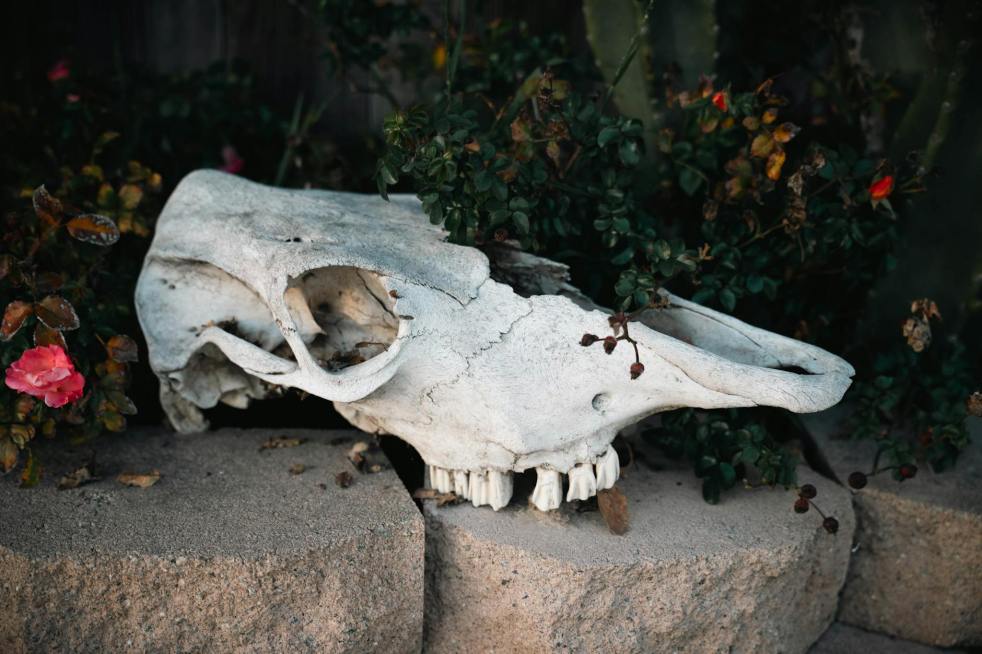
(Alternatively, I want to go to a body farm. Then I want my picked-clean skeleton recovered, well-scrubbed, and adorned with thrift store junk jewelry. Then I want to be propped up on a marble throne in a mausoleum to confuse the shit out of anthropologists far into the future.)
Once we’d finished the bone walk, my Handsome Assistant and I had to go. (We had a rather long drive back, and I was in a hurry to get to my favorite stationery store before it closed because it would probably be my only opportunity to pick up Colorverse’s exceeding gorgeous 2025 ink, Blue Green Snake, without having to order it online.)
(I got the one with blue purple shimmer.)
We stopped at a placed called Kelley Farm Kitchen on the way back. We’d never been — didn’t know anything about it, really, but it said it was “100% Vegan.” I had some doubts when I looked at the creamy sauces and cheesy dishes on their menu, but they were not kidding.
My Handsome Assistant got a seitan cheesesteak and a little bit of macaroni and cheese (well, “cheese”), which were both delicious. I was debating getting the same, but I went with the pinto bean and avocado tacos instead, and you guys.
They were amazing. Just a little heat. Flavorful. Satisfying. The tortillas were soft, but with just a bit of crispiness on the outside. The grated carrots were a cool, sweet counterpoint to the salt and heat of the other ingredients. And the sauce!
For serious, I’d gladly make the trip just to get more tacos.
This was a small adventure, but delightful. I’m glad that the thought of mortality doesn’t strike the same fear in me that it did years ago. I’m grateful that I got to see and socialize with my friends. I’m happy to spend time in a beautiful, biodiverse place. I’m glad for delicious food, good conversation, and beautiful ink.
So, we watched Hereditary not long ago. When I was reading various social media posts about it afterward, one person mentioned that the herb placed in Charlie’s baby bottle and in Peter’s joint was dittany of Crete. And herb, they said, that is “known for making the body more susceptible to demonic possession.”
“Huh,” I said to myself, “I’ve got a whole bag of that in the kitchen cabinet.”
(It’s true. It smells like pizza.)
Seeing as how I have used it to facilitate demonic possession exactly zero times, I thought now might be an opportune time to talk about the actual folklore and magical uses of dittany of Crete.
Dittany of Crete Magical Uses and Folklore
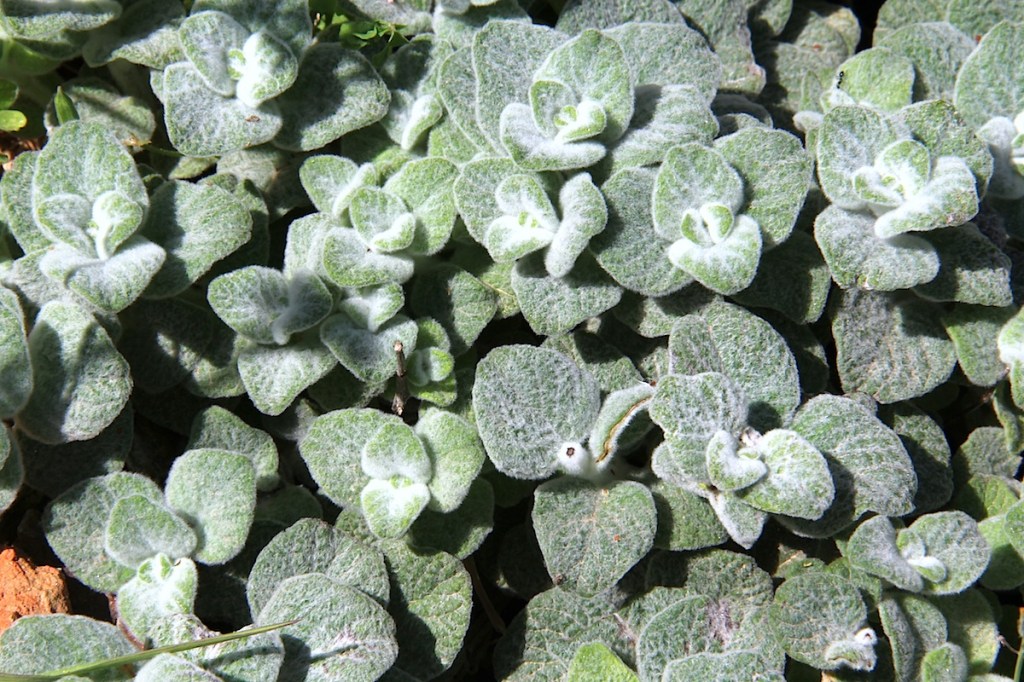
Dittany of Crete (Origanum dictamnus) is a perennial herb with velvety leaves, native to the mountainsides of Crete. It’s related to oregano and marjoram, which becomes immediately apparent the moment you smell it — it has that same kind of aroma.
In the past, it was used to decorate temples, as a kind of tonic and panacea, and as an aphrodisiac. It was also used to soothe stomachs, bring on late menstruation, and encourage wounds to heal. According to Aristotle, wounded goats would seek out dittany of Crete and consume it as medicine. (While this may be true, he also said that dittany helped them eject arrows from their bodies, which is… less credible.)
Really, dittany of Crete is mainly known for healing, not inviting in demons. Not only does it have a long history of use as a medicinal herb for specific maladies and general ill health, but it has also been referenced over and over again in fiction. In the Aeneid, Venus uses it to heal Aeneas. Beaudelaire references this in his poem Tout entière, where he proclaims that his lover is “entirely dittany” and therefore able to heal his wounded soul.
Even outside of Beaudelaire, dittany of Crete is also strongly connected to love. In the Cretan dialect, the herb is called erontas (έρωντας) which means “love.” Dittany-harvesters were called “love seekers,” and considered very brave and passion-driven. They’d have to be, in order to climb the tall, treacherous places dittany calls home!
In European folk magic, feeding a person dittany of Crete was said to make them fall in love with you.
In other esoteric arts, dittany is said to help spirits manifest (primarily by burning it to allow them to show themselves in the smoke) and to facilitate trancework and astral projection. Both Crowley and Blavatsky considered it a powerful magical herb.
A number of Greek dishes from Crete include dittany. Martini Rosso, red vermouth, includes it as a flavoring agent alongside many other herbs and fruits.
In fact, I was unable to find a single recorded instance of someone using dittany of Crete as a way to make someone susceptible to possession. The closest I could come was a rather large leap from its use as a way to help spirits manifest, and as an aphrodisiac. The thing is, dittany is said to help spirits manifest, not occupy people. But, if one were to generously interpret “aphrodisiac” and “love-inducing” as “increased suggestibility,” then one could see where a horror movie might get the idea that an herb that a) makes you horny, b) helps spirits appear in its smoke, and c) facilitates trancework could be a suitable fictitious catalyst for demonic shenanigans.
Using Dittany of Crete
An illustration of “false dittany,” Ballota acetabulosa.
Be careful when you try to purchase dittany of Crete — the herb is classed as rare, and there are measures in place to protect it. As a result, the real stuff can be kind of expensive and not super easy to come by. Some shops will sell Dictamnus alba (fraxinella, gas plant, or burning bush), or even plain marjoram or oregano as dittany of Crete. Remember: Look for the fuzzy oval leaves and distinctive oregano-like smell.
I’ve only found this herb in its dried form and find that using it is much like using any other herb. Personally, I infuse it into a base of jojoba alongside other ingredients for a special oil that I make once a year for meditation and trance work. Otherwise, I don’t really have much use for it outside of this specific recipe. A tiny bit goes rather a long way.
Dried dittany of Crete is suitable for using in handmade incense. Mix it with other loose herbs and resins and spoon it over a lit block of charcoal. As mentioned above, it has been used in this way to help spirits manifest in the smoke.
You can also roll a candle in it. Anoint the wax with oil first, then give it a few rolls back and forth in some finely ground dried dittany. When you feel it’s ready, light it. Use a pink candle, anoint it with rose and jasmine oil, then roll it in ground rose petals, dittany of Crete, and a pinch (just a pinch) of cinnamon, then light it to get your romantic energies burning high.
Dittany of Crete is also suitable for jar spells, sachets, and other forms of container magic. It’s honestly a very nice herb with a delightful fragrance.
Really, Dittany of Crete is not nearly as dangerous as Hereditary makes it seem. I have a feeling they chose a somewhat obscure herb with an intriguing name, tangentially related to the goal of the movie’s antagonist, rather than inventing one whole cloth. It’s related to oregano. It smells like pizza. It’s a nice addition to a dream/vision oil. That’s really about it.
My Handsome Assistant and I like to go cabin camping in winter. Rates are usually lower, things are less crowded, he’s got PTO to use up (or else lose), and there isn’t usually much else to do. A change of scenery does us both good, even if it’s only for a couple of days. It’s also nice to experience the time around the solstice like this.
(We half-jokingly say it’s glamping, because there’s a shower, sheets, heating, and a mini-fridge. Either way, it’s nice and I much prefer it to most of the hotels I’ve been to.) (Even the fancy ones.)
However, while we anticipated a possibly-snowy getaway/creative retreat to work on music, fiction writing, and so on, what we got was… 60° F (15.5° C) and a meteor shower.
Did any of yas know there was a meteor shower? I didn’t. The only ones I usually pay attention to are the ones that occur over the summer here, like your Delta Aquarids and Perseids, and I have been Missing. Out.
I only realized when I was sitting in bed one night, drinking tea and looking out at the forest through the window, all cozy and idyllic and junk. An object, about as large and bright as the brightest star in the sky, flared to life, moved across the sky, and disappeared. I was, of course, surprised — a shooting star without a tail? A “drone” with an oddly predictable flight pattern and only one light? A hallucination?
As it turns out, it was most likely part of the Quaternid meteor shower. This one is, apparently, often overlooked. It has a short period of peak activity and happens in late December/early January, so most people miss it. Also, the Quaternid meteors usually don’t have long tails. They do, however, produce some very bright, striking fireballs. So that was neat.
The next day, we spent the late morning going for a walk. With the weather as strangely warm as it was, it turned out to be ideal conditions for finding some very interesting specimens of fungi and beautiful colonies of lichen and moss.
Unfortunately for me, most common culinary species of mushrooms and boletes make me very ill. (Oyster mushrooms, why won’t you let me love you?!) I also have only a passing interest in identifying them, since my interest is primarily visual.
It has been years, but I am still inordinately proud of this very, very silly picture.
I’m what you might call an amateur “catch and release” forager. I love looking at them. I love their folklore. I love finding them. I love taking pictures of them. Sometimes, I’m even able to identify them. I get really stoked when I find ones that a) I recognize, b) are useful, and c) won’t try to make me yakk everything I’ve eaten since fourth grade. But that’s neither here nor there.
Look! We found cool mushrooms and assorted other little forest buddies!
I don’t care how common moss, lichen, and little beige mushrooms are, I will be excited about them absolutely every time. Like a person calling their spouse over every time their cat does something adorable, I will never not be endlessly delighted by them whenever I see them.
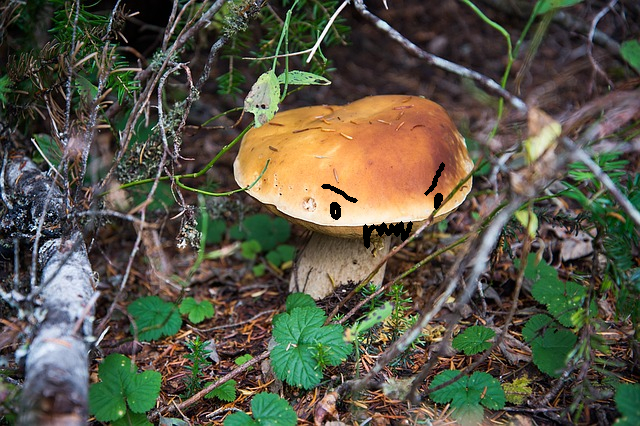
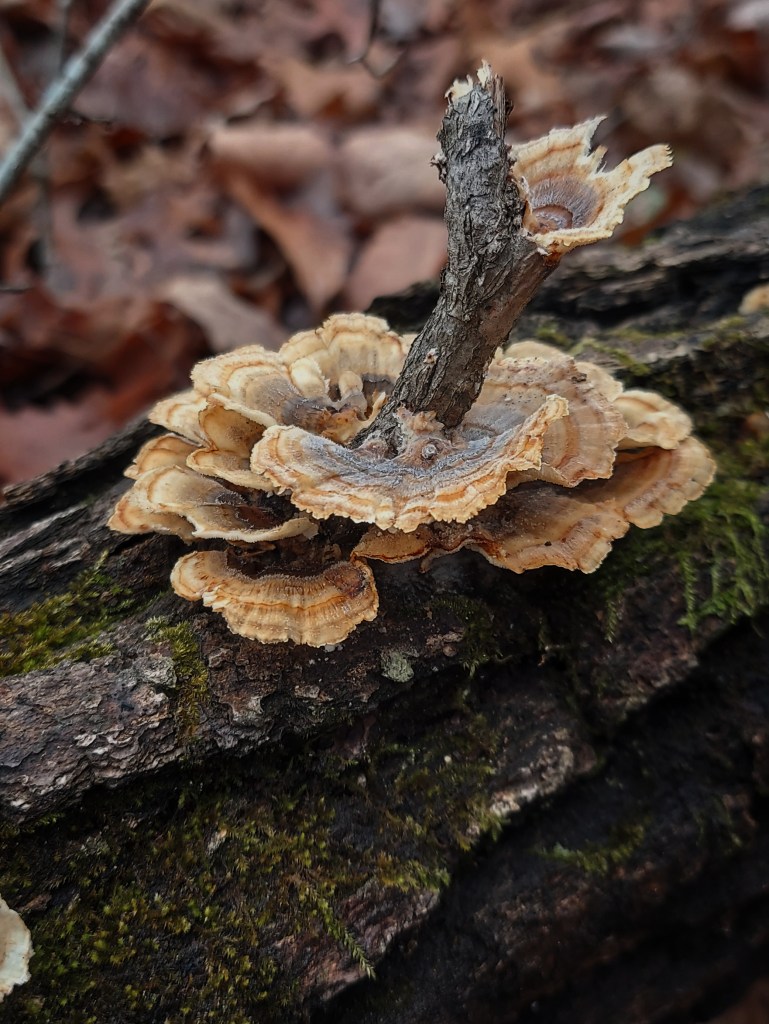
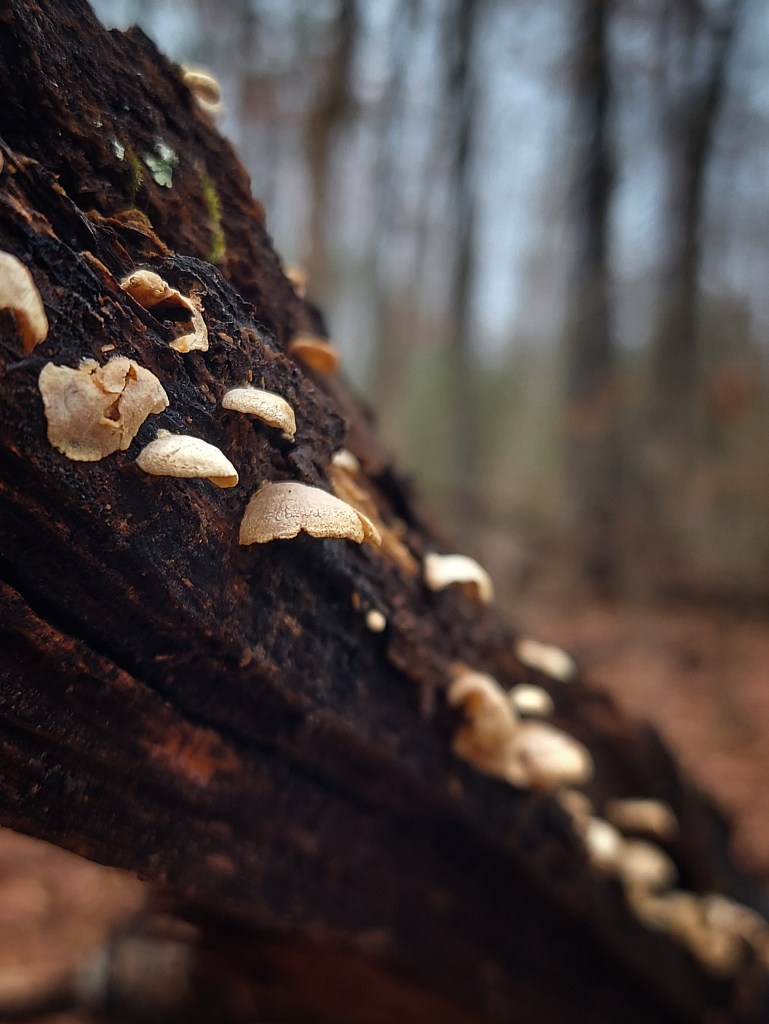
A cluster of what are most likely stump puffballs (Lycoperdon pyriforme).Likely white cheese polypore (Tyromyces chioneus).A cluster of what’s most likely one of the Stereum species.No idea what these are, but I love this photo.
I don’t even need to know what kind they are, I’m just happy to have them around.
Here’s hoping your days are similarly filled with interesting small things.
The desire to do things correctly, by the letter, is something that I think plagues everyone who’s new to witchcraft (or, really, any type of magical work). I’ve seen it said that there’s no one way to do magic, but there are infinite ways to do it ineffectively, and I wholeheartedly agree with this sentiment. That said, it’s not always that important to have the exact ingredients that a spell, charm, or formula calls for. As long as you know what they’re doing in there, you can usually figure out workable substitutions.
That’s why I wanted to write a post about sharp stuff. Not any sharp stuff in particular. Just… you know. Sharp things. Pokey bits.
Pokey Thing Folklore
Where do I even begin?
Think of every story you’ve ever heard about a sword, or a needle, or a thorn. Think about idioms like “to needle someone.”
Arthur receives Excalibur, and it confers kingship upon him. Swords are a symbol of sovereignty here because they represent force: both the force needed to maintain one’s position as ruler, and the force needed to defend a country.
A lion receives the business end of a thorn in his paw, and it weakens him to the point where he needs a mouse’s help. Here, the lion — a strong, symbolically dominant figure — is brought down by the pain of something as small as a thorn. A mouse pulls it free, and the lion is in his debt.
It can be as large as a scythe, or as tiny as the hairs on a spider’s belly. Regardless of the pokey thing in question, the message is clear: As long as you’re on the right end of it, you’re at an advantage.
Roses, holly leaves, hawthorns, and blackthorns are pokey to discourage herbivores. (Interestingly, holly leaves don’t really start out all spiney-looking. They re-grow that way as a response to browsing animals, in order to keep from losing any more leaves than strictly necessary.)
Even the thin, needlelike leaves of conifers and cacti are a defensive mechanism, albeit one that protects them against the elements. Cacti leaves are needles to keep them from losing precious moisture to the dry desert air. Conifer needles keep them from losing moisture, holding on to too much heavy snow, or being blown over in harsh winter winds.
Needles and pins are used in magic to “pinpoint” the effect of a spell or charm. Jab them in a poppet, and you can send healing into an arthritic joint, or inflict pain and debility instead.
Athames and swords are used in some traditions as a way to direct energy from their points. This is in contrast to ritual knives, which are generally working tools used for mundane tasks like harvesting herbs, cutting offerings, and bloodletting. Even though they’re not strictly “magical,” these working tools still have the same symbolism — these tools are what allows the user to obtain what they need, whether it’s a leaf, a slice of cake, or blood.
Blackthorn spines, porcupine quills, sewing needles, and old nails are all used in defensive and offensive magic alike, generally in various forms of sympathetic magic. Jab a representation of your target, and the idea is that the target themselves will feel the effects. Fill a jar with sharp things, hair, and urine, and the idea is that your hair and urine will attract malevolent energy sent your way, while the sharp things ensnare and poke at it.
When sharp things are involved, it usually doesn’t matter exactly what that thing is — the important aspects are a) the size, and b) that they’re sharp. A protection jar spell that calls for straight pins can use sewing needles, rose thorns, or even the itchy hairs from rosehips instead. A spell that calls for a pin with which to inscribe a candle will work just as well with a knife, or even the tip of a sharp stone. A poppet spell that needs pins and needles will work just as well with porcupine quills.
Pokey Thing Symbolism
As I mentioned above, the symbolism of sharp objects is pretty straightforward. Ideally the pointy end should (symbolically) go in the other guy, for good or ill.
When it comes to directing energy, they are an aid to visualization — an extension of the index finger, commanding and pointing and saying, “This is my will, so it will be done.”
When it comes to apotropaic magic, they are a trap. Like the quills on a hedgehog, the stinger of a hornet, or the studs on a leather jacket. They represent the fate of someone (or something) that decides to cross you. This is why they’re employed in various magical decoys, like witches’ bottles.
When it comes to offensive magic, they are weapons. Not in a literal sense, but they represent a sharp, decisive action, or even a physical or emotional pain. They’re the needles poked into a poppet, or the shaken spell jar filled with hot peppers, broken glass, and a photo of an enemy.
In various online magical circles, people joke that we’re all hoarders. We save jars, lids, corks, scraps of fabric, old nails, ribbons, and assorted junk, because there’s immense potential in everything and you never know when it’ll make itself useful. I might dispute the “hoarder” label myself, but I’d also be lying if I said I didn’t have a drawer full of junk-that-I-might-need-for-a-spell-some-day.
Sharp things are symbolic of polarity. The safe and the unsafe. The sharp and the dull. The defensive and the offensive. The sword that cuts, and the scalpel that heals. They’re a pretty simple symbol, but it’s this simplicity that makes them versatile, powerful tools.

















 Marble Crow