Plants and Herbs

Mayapple Folklore and Magical Properties

I love mayapples. They look like a prank. Like someone picked a bunch of leaves off of something bigger and stuck them in the ground so they could trick people into thinking that that’s how a mayapple grows. They’re patently ridiculous and fantastic.

I remember the first time I encountered them. Though I don’t remember when, or where, I do remember seeing a bunch of sprouts that looked like folded beach umbrellas for fairies. I wasn’t sure if they were plants or mushrooms at first — before the leaves fully open, they almost look more like fungi than anything planty.

The other day, my handsome assistant and I were on a walk and ran into a whole patch of them. Even better, some of them had flowers, which also look like some kind of prank. The only thing better is when they fruit, which I, personally, find hilarious. Just one leaf with a big old fruit hanging off of it. It looks like a video game monster. Like you’re supposed to get close, then find out the fruit is actually full of teeth and now you’re out of extra lives.

Anyway. Mayapples are interesting for more than their bizarre looks. They can also be a very useful plant.

Mayapple (Podophyllum peltatum) is sometimes called “American mandrake,” and the name is apt. Like mandrake (Mandragora species), it’s poisonous. It also has a pretty large root that often branches similarly to that of a mandrake.

The name Podophyllum peltatum comes from the Greek words podo, meaning “foot,” and phyllum, meaning “leaf,” as well as peltatum, meaning “shield.” It’s a pretty apt name when you look at their slender stems shielded by broad leaves.

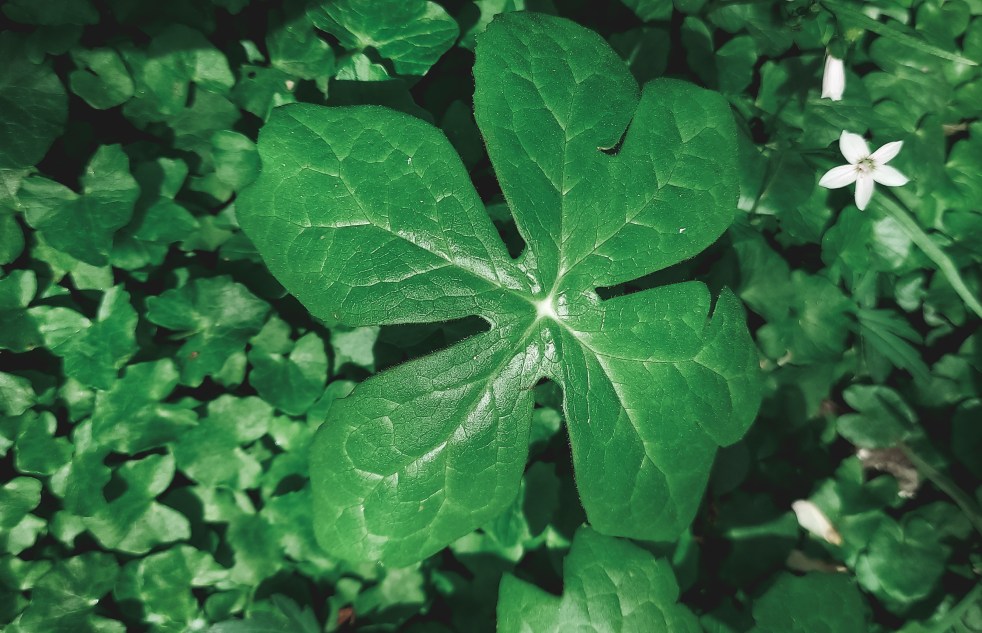
A top-down view of a mayapple leaf, surrounded by lesser celandine.

While the entirety of the mayapple is poisonous, the fruit (with the seeds removed) can be eaten only when it is completely ripe1.

Most commonly, mayapple is used as a substitute for mandrake. While the plants are unrelated, their qualities are similar enough to make such a substitution work.

That means that mayapple is an excellent ingredient in protective or banishing formulas. Some people use it as an ingredient in formulas for renewal, rebirth, or new beginnings, largely because of the fact that the plant appears in spring, produces fruit, and go dormant shortly after the fruit ripens in mid-summer.
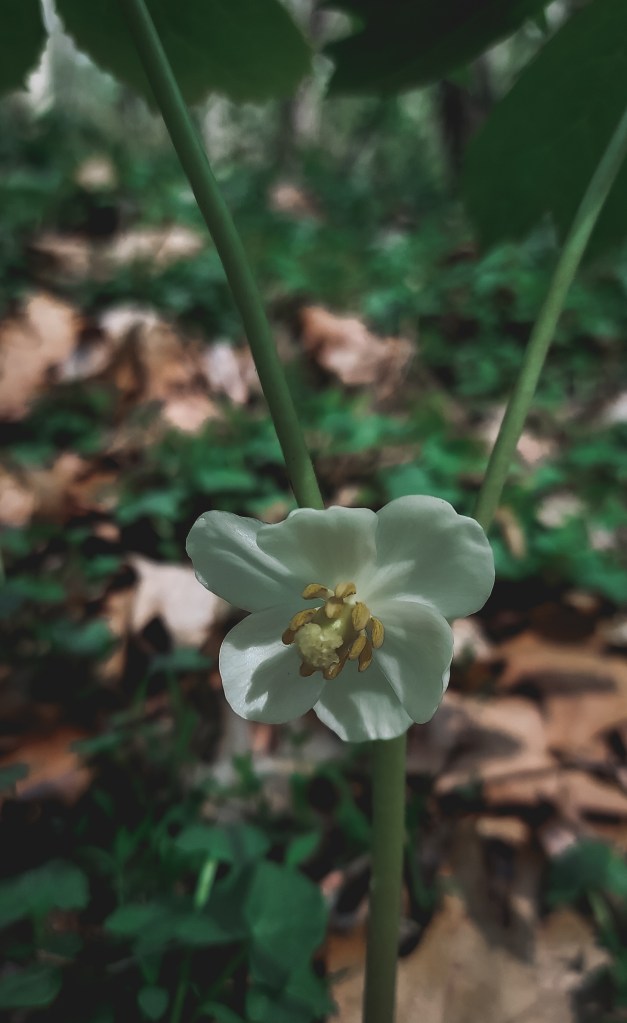
A close-up view of a mayapple flower. It appears at the fork between the two leaves of a mature mayapple and has five white petals with a yellow center.

Interestingly, mayapples have a unique relationship with turtles. While the foliage is bitter and deadly enough for herbivores to avoid it, the smaller guys will happily go after the ripe fruits. Box turtles are actually the primary distributors of mayapple seeds2,3. The fruits grow at just the right height for the turtles to reach them, and the seeds are more likely to germinate after being exposed to the turtle’s acidic digestive environment.

While the mayapple is extremely poisonous, it does have a history of use as a medicinal plant. In the past, it was used as an emetic, anthelminthic, and treatment for skin conditions like warts. Podophyllotoxin, one of its primary toxic constituents, is actually the active ingredient in a topical treatment named Podofilox that’s used to treat some viral skin conditions like genital warts and molluscum contagiosum. It works by inhibiting the replication of cellular and viral DNA as it binds to key enzymes4.

If you’re going to use mayapple, do it carefully. Wear gloves. Don’t put it in anything that you’re going to ingest, or even anything that could potentially come in contact with your skin. While the ability to keep DNA from replicating is helpful when you’re trying to kill a skin virus, it’s very much not okay when it’s working on your cells instead.

For real. Be careful.
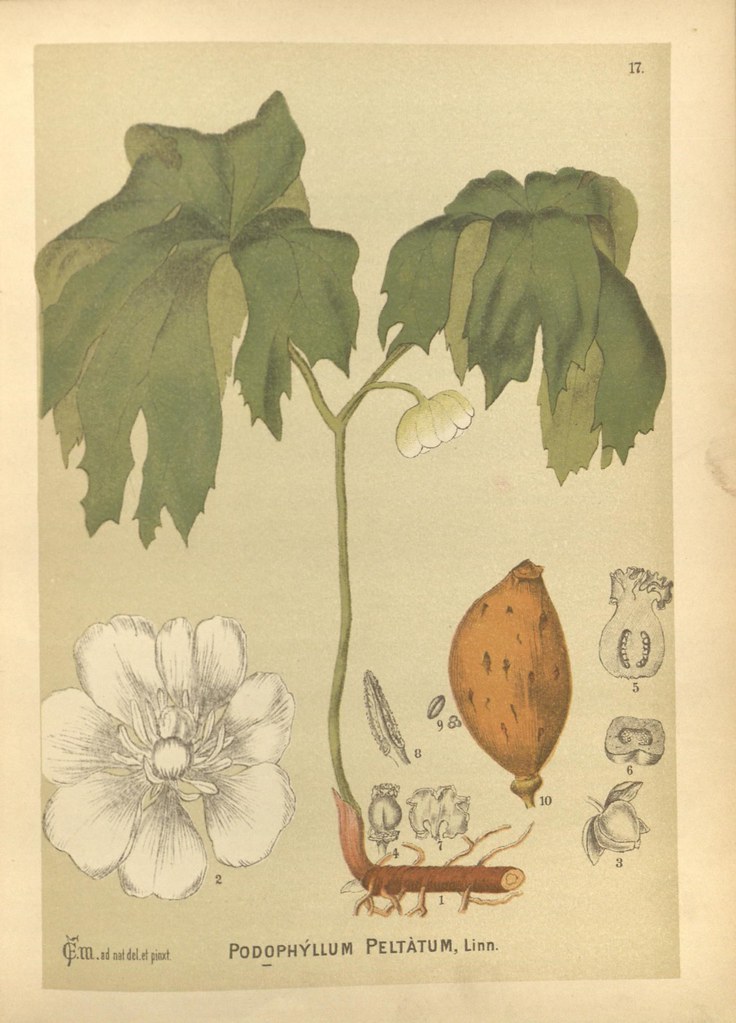
A botanical illustration of a complete mayapple plant, showing the pair of leaves, white flower, and large root.
n71_w1150 by BioDivLibrary is licensed under CC-PDM 1.0

Whole dried mayapple roots could be used to make an alraun. This is a dried tormentil or false mandrake root (Bryonia alba) used in German folk magic, carved and decorated into a kind of spirit doll. Keeping and properly maintaining one is said to bring good fortune to the household. The alraun (or alraune) would also be bathed in red wine, which could then be sprinkled around the household for protective purposes.

Caring for an alraun is pretty intensive. Once prepared, it needs to be wrapped in a red and white silk cloth, put in a special case, and bathed in red wine every Friday. On each new moon, it should be given a new shirt. These dolls were also passed down through families, though they must be inherited in a particular way: When the father of a family dies, his eldest son may inherit the alraun by placing a piece of bread and a coin in his father’s coffin. If the eldest son dies, his eldest son (or younger brother, if he has no sons) may likewise inherit the alraun by the same method5.

If creating and caring for an alraun seems a bit intense, you can also use dried mayapple in container spells. Just make sure to wear gloves while handling it, and don’t place it anywhere where children or animals may come in contact with it.

Rinse the dried root in water or alcohol and sprinkle it around anywhere you wish to protect. Again, be cautious not to get it on your skin.

The seeds would be useful in formulas for rebirth or renewal. However, as mayapple has never particularly called to me as a “renewal” herb, I can’t offer any more in-depth suggestions here.

Mayapples are beautiful, unusual little plants. They pop up in spring in all of their bizarre glory, flower, fruit, and are gone by late summer. Treated with respect, they can be very useful — even heirloom-worthy — magical tools.

  1. Mayapple: Pictures, Flowers, Leaves & Identification | Podophyllum peltatum. https://www.ediblewildfood.com/mayapple.aspx.
  2. Braun, J., & Brooks, G. R. (1987). Box Turtles (Terrapene carolina) as Potential Agents for Seed Dispersal. American Midland Naturalist, 117(2), 312. doi:10.2307/2425973.
  3. Rust RW, Roth RR. Seed Production and Seedling Establishment in the Mayapple, Podophyllum peltatum L. The American Midland Naturalist. 1981;105(1):51. doi:10.2307/2425009
  4. Podofilox (topical) monograph for professionals. Drugs.com. (n.d.). https://www.drugs.com/monograph/podofilox-topical.html
  5. Deutsche Sagen, herausg. von den Brüdern Grimm. Google Books. https://books.google.com/books?id=SRcFAAAAQAAJ&pg=PA135. (In German.)

Plants and Herbs

Blackthorn Folklore and Magical Properties

Few trees are as divisive as the blackthorn (Prunus spinosa). When you look at it from a distance, this may be hard to believe — these trees, with their dark bark and frothy white flowers, are honestly very pretty. They also produce sloes, which are excellent in preserves and a crucial ingredient in sloe gin.

A blackthorn sloe.
Photo by Marek Kupiec on Pexels.com

So we’ve got a lovely tree with pretty white flowers and useful, equally attractive dark blue-purple fruits. How could a plant like that be divisive?

The answer lies deep in its fascinating folklore.

The blackthorn tree appears in the Irish ogham, an ancient writing system often erroneously called a “tree alphabet.” (In reality, it encompasses a variety of concepts and objects that were only connected to trees much later on.)
This ogham few, straif (ᚎ), is frequently associated with misfortune, struggle, and ill omens. It’s regarded as a few of great power, but also the negative or malicious side of magic and the capricious nature of the fae. Blackthorn trees were said to be guarded by the Leanan Sidhe, and it was terribly bad luck to cut one down.

Interestingly, straif’s original meaning likely did not have any connection to the blackthorn at all and may have been a reference to sulfur. The Bríatharogam are, unfortunately, not much help here. We get “strongest reddening” (tressam rúamnai), “increase of secrets” (mórad rún), and “seeking of clouds” (saigid nél).

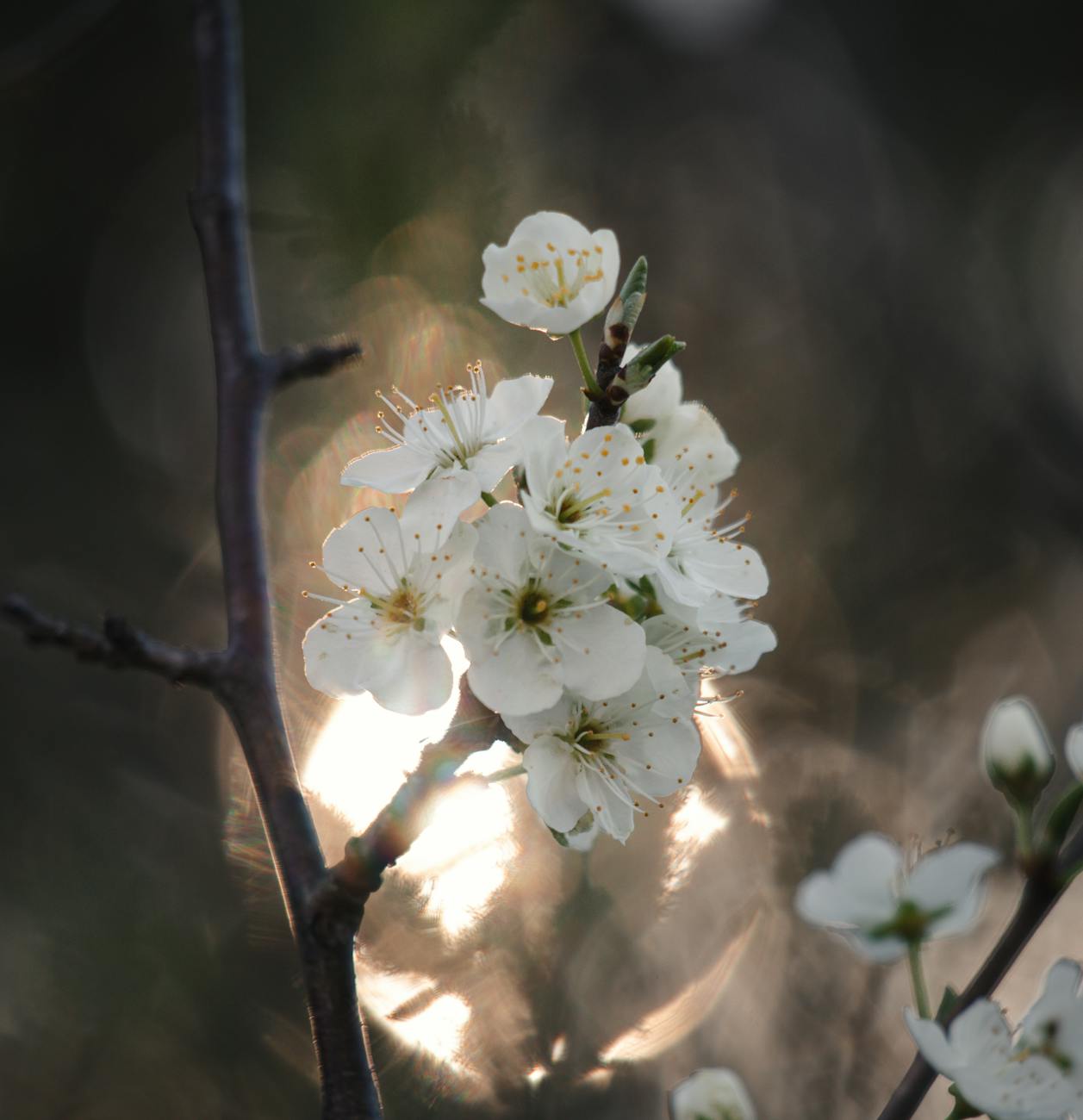
Blackthorn flowers.
Photo by Atif Bangash on Pexels.com

Blackthorn trees are so named for their sharp thorns. There are a variety of ways one may use these thorns in magic, but blackthorn’s thorns seem to have gotten a bad rap. They tend to be associated chiefly with negative or malevolent workings, and old witch-lore claims both that the Devil used one of these thorns to prick a would-be witch’s finger before they signed his infernal contract, and that witches would jab blackthorn thorns into poppets to harm people.

In Christian mythology, the blackthorn is also one of the trees said to have “betrayed Jesus” at the Crucifixion.

Since blackthorn isn’t a very big tree — in fact, it’s more often seen as a big bush — it’s very useful as a hedge plant. The thorns mean that it isn’t heavily browsed or easily damaged by cattle and deer, and it grows densely.
This use may be part of its connection to the fae, since blackthorn is quite literally a plant that marks a boundary from one place to the next. It’s a plant that protects itself, as well as whatever may lay beyond it.

In fact, blackthorn occasionally crops up in old hero stories and fairy tales. The hero, pursued by a giant, throws a blackthorn sprig behind him. The sprig immediately roots and grows into an impenetrable hedge, holding back the giant and allowing the hero to escape.

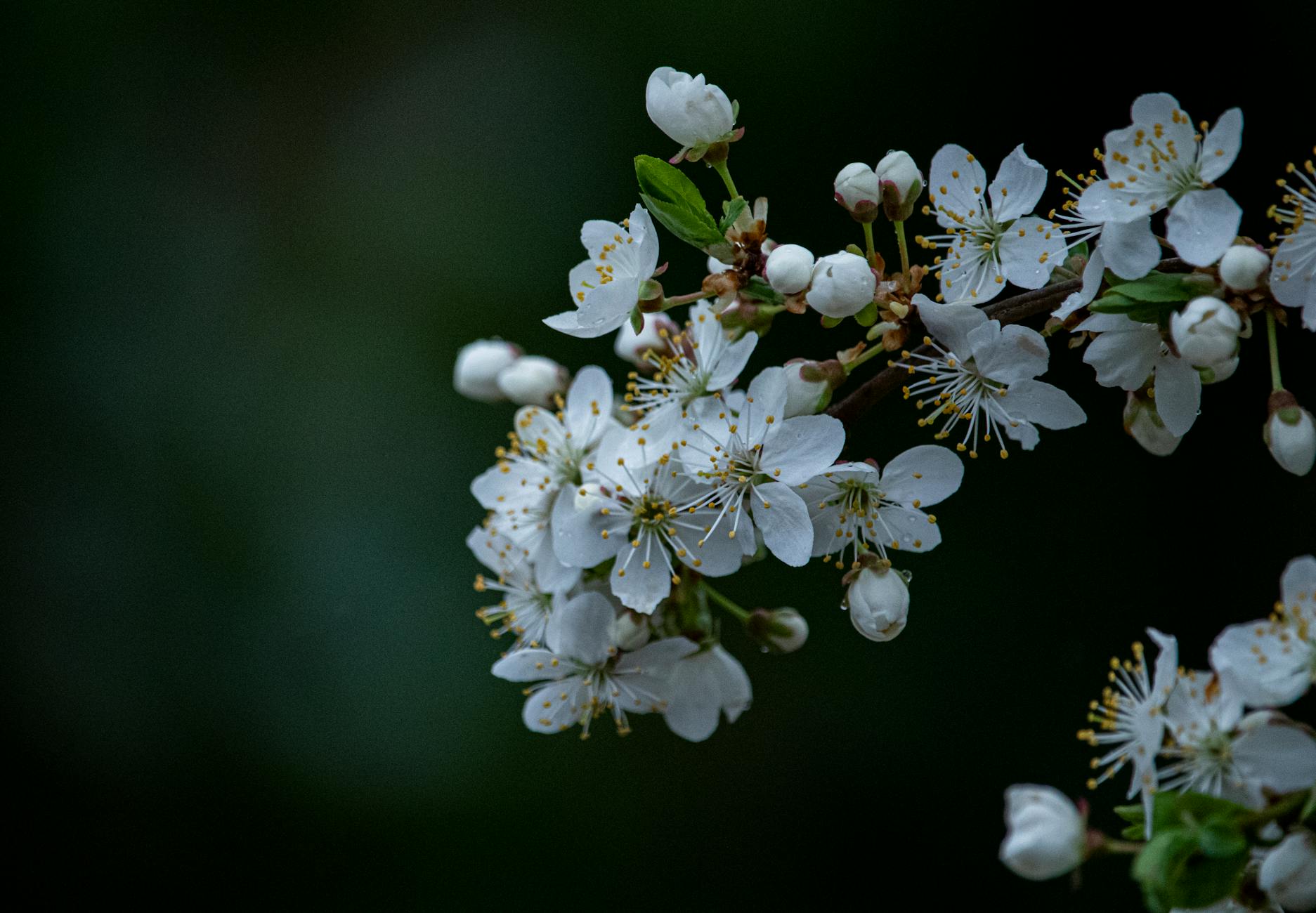
White blackthorn flowers on branches.
Photo by Ellie Burgin on Pexels.com

This protection extends beyond hedges, too. Blackthorn wood is hard and dense, and the traditional material for a bata or shillelagh. They’re part club, part walking stick, and similar in shape to the rungu used in some parts of East Africa or the iwisa, induku, or molamu of South Africa (though usually a bit longer). Shillelaghs were used in structured duels, as other cultures might use rapiers, and there’s a martial art that focuses on shillelagh training to this day.

Shillelaghs were traditionally made using the roots of the blackthorn, where they kind of naturally form a knobby end. This made them less prone to cracking, but some people would still hollow out the knob of their shillelaghs and fill them with lead — a bit like Bugs Bunny dumping horseshoes into a boxing glove.

The process of making a shillelagh took time, but not many resources. If you had access to a blackthorn bush, as well as a chimney or a dung heap, you could make a perfectly serviceable weapon. The blackthorn tree was a social equalizer that allowed even the poorest people a useful tool and a means to defend themselves.

Blackthorns aren’t easy to come by in the Americas. They aren’t native here, though they have been naturalized in parts of the Eastern US. So, if you want to work with any blackthorn-derived ingredients, you may have to get creative.

Kitchen witches or potion crafters may have an easier time. They can incorporate some sloe preserves, sloe chutney, dried sloes, sloe gin, or any of the very excellent sloe or blackthorn shoot-based liqueurs into their work.

Other than that, it is sometimes possible to find small numbers of blackthorn thorns available for sale online. When I can get them, I love using them for defensive workings. Write a name on a slip of paper or parchment, skewer it with a blackthorn thorn, and toss it into a jar or box of suitable ingredients. It’s easy, it’s poignant, and it’s perfect.

Close up of blackthorn flowers.
Photo by Nagy Richard on Pexels.com

Failing all of that, you may have to see what blackthorn characteristics you want to tap into and find a good workaround. For thorns, look for stickers from other thorny plants. (Berry canes are often a great source of these.) For working with the fae, you may have an easier time finding a rowan or hawthorn tree. For protection, you’re pretty much spoiled for choice — there are tons of other herbs used for all forms of protection, from securing your home and keeping malevolent entities away to driving out unwanted housemates.
Seriously. There are so many, this post would be a novella were I try to list them all.

Sadly, many of us outside of Europe won’t have the opportunity to work with this beautiful, useful, folklorically-rich tree firsthand, but that’s okay. The blackthorn is a plant with history and power that’s worth understanding, even if we may never have the privilege to meet one.