Plants and Herbs

Mayapple Folklore and Magical Properties

I love mayapples. They look like a prank. Like someone picked a bunch of leaves off of something bigger and stuck them in the ground so they could trick people into thinking that that’s how a mayapple grows. They’re patently ridiculous and fantastic.

I remember the first time I encountered them. Though I don’t remember when, or where, I do remember seeing a bunch of sprouts that looked like folded beach umbrellas for fairies. I wasn’t sure if they were plants or mushrooms at first — before the leaves fully open, they almost look more like fungi than anything planty.

The other day, my handsome assistant and I were on a walk and ran into a whole patch of them. Even better, some of them had flowers, which also look like some kind of prank. The only thing better is when they fruit, which I, personally, find hilarious. Just one leaf with a big old fruit hanging off of it. It looks like a video game monster. Like you’re supposed to get close, then find out the fruit is actually full of teeth and now you’re out of extra lives.

Anyway. Mayapples are interesting for more than their bizarre looks. They can also be a very useful plant.

Mayapple (Podophyllum peltatum) is sometimes called “American mandrake,” and the name is apt. Like mandrake (Mandragora species), it’s poisonous. It also has a pretty large root that often branches similarly to that of a mandrake.

The name Podophyllum peltatum comes from the Greek words podo, meaning “foot,” and phyllum, meaning “leaf,” as well as peltatum, meaning “shield.” It’s a pretty apt name when you look at their slender stems shielded by broad leaves.

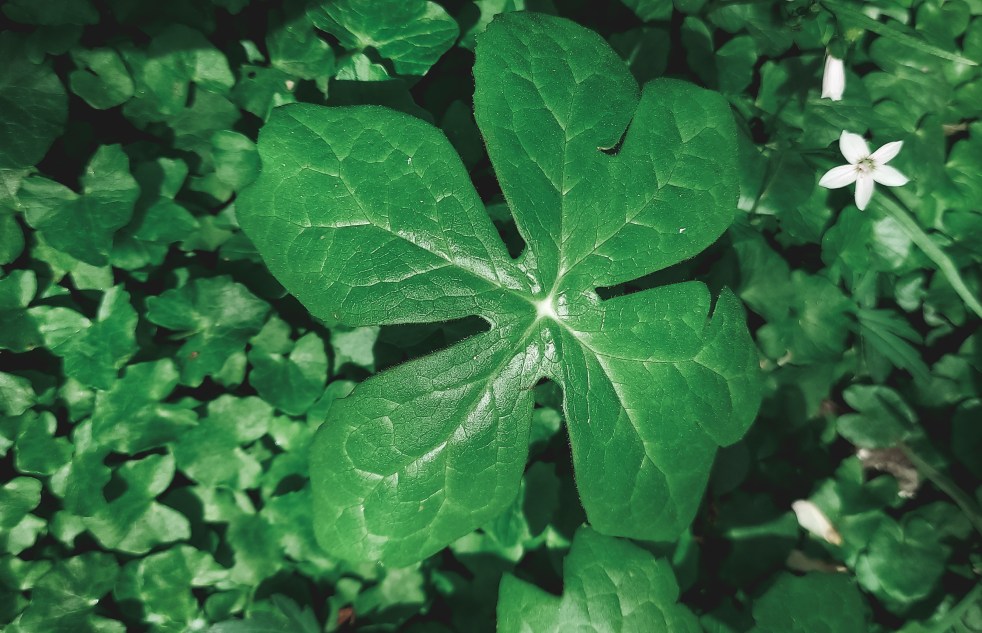
A top-down view of a mayapple leaf, surrounded by lesser celandine.

While the entirety of the mayapple is poisonous, the fruit (with the seeds removed) can be eaten only when it is completely ripe1.

Most commonly, mayapple is used as a substitute for mandrake. While the plants are unrelated, their qualities are similar enough to make such a substitution work.

That means that mayapple is an excellent ingredient in protective or banishing formulas. Some people use it as an ingredient in formulas for renewal, rebirth, or new beginnings, largely because of the fact that the plant appears in spring, produces fruit, and go dormant shortly after the fruit ripens in mid-summer.
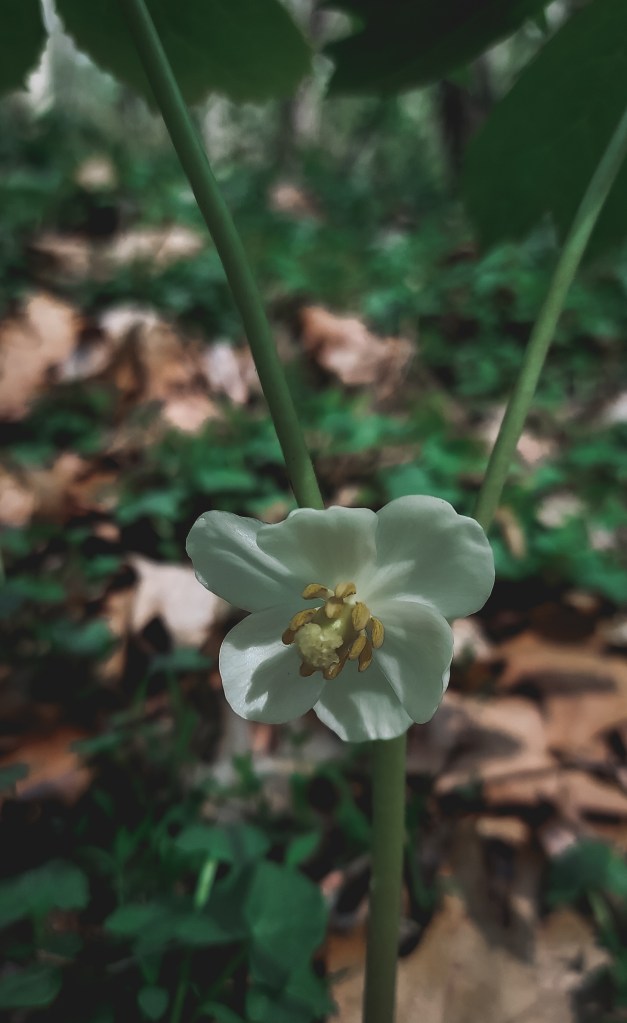
A close-up view of a mayapple flower. It appears at the fork between the two leaves of a mature mayapple and has five white petals with a yellow center.

Interestingly, mayapples have a unique relationship with turtles. While the foliage is bitter and deadly enough for herbivores to avoid it, the smaller guys will happily go after the ripe fruits. Box turtles are actually the primary distributors of mayapple seeds2,3. The fruits grow at just the right height for the turtles to reach them, and the seeds are more likely to germinate after being exposed to the turtle’s acidic digestive environment.

While the mayapple is extremely poisonous, it does have a history of use as a medicinal plant. In the past, it was used as an emetic, anthelminthic, and treatment for skin conditions like warts. Podophyllotoxin, one of its primary toxic constituents, is actually the active ingredient in a topical treatment named Podofilox that’s used to treat some viral skin conditions like genital warts and molluscum contagiosum. It works by inhibiting the replication of cellular and viral DNA as it binds to key enzymes4.

If you’re going to use mayapple, do it carefully. Wear gloves. Don’t put it in anything that you’re going to ingest, or even anything that could potentially come in contact with your skin. While the ability to keep DNA from replicating is helpful when you’re trying to kill a skin virus, it’s very much not okay when it’s working on your cells instead.

For real. Be careful.
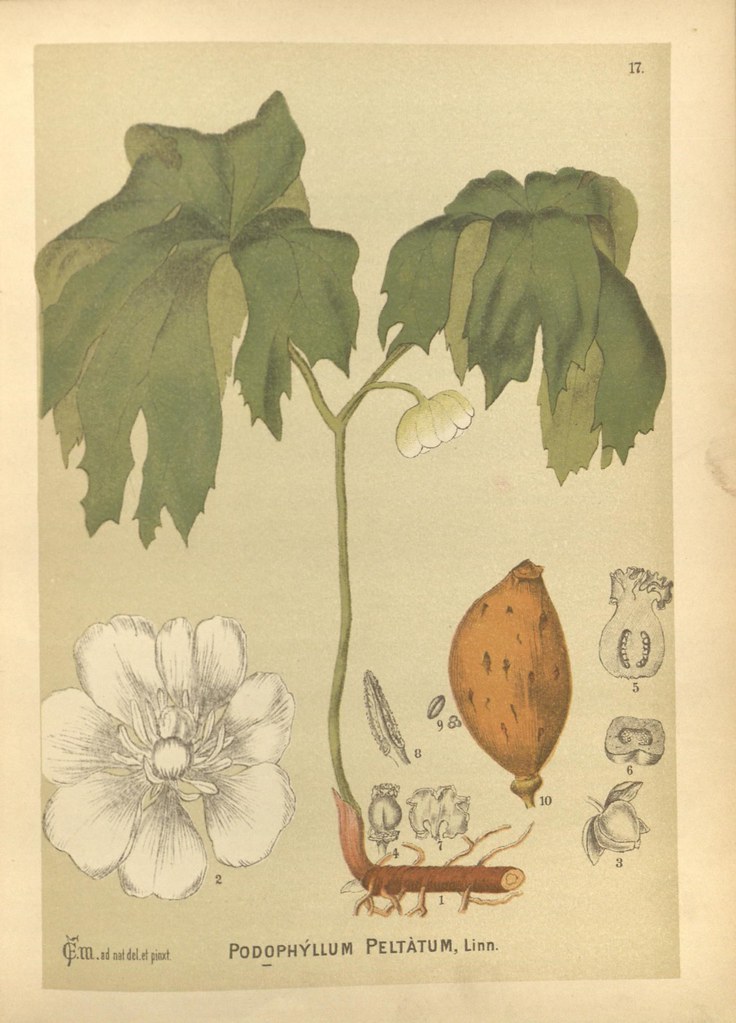
A botanical illustration of a complete mayapple plant, showing the pair of leaves, white flower, and large root.
n71_w1150 by BioDivLibrary is licensed under CC-PDM 1.0

Whole dried mayapple roots could be used to make an alraun. This is a dried tormentil or false mandrake root (Bryonia alba) used in German folk magic, carved and decorated into a kind of spirit doll. Keeping and properly maintaining one is said to bring good fortune to the household. The alraun (or alraune) would also be bathed in red wine, which could then be sprinkled around the household for protective purposes.

Caring for an alraun is pretty intensive. Once prepared, it needs to be wrapped in a red and white silk cloth, put in a special case, and bathed in red wine every Friday. On each new moon, it should be given a new shirt. These dolls were also passed down through families, though they must be inherited in a particular way: When the father of a family dies, his eldest son may inherit the alraun by placing a piece of bread and a coin in his father’s coffin. If the eldest son dies, his eldest son (or younger brother, if he has no sons) may likewise inherit the alraun by the same method5.

If creating and caring for an alraun seems a bit intense, you can also use dried mayapple in container spells. Just make sure to wear gloves while handling it, and don’t place it anywhere where children or animals may come in contact with it.

Rinse the dried root in water or alcohol and sprinkle it around anywhere you wish to protect. Again, be cautious not to get it on your skin.

The seeds would be useful in formulas for rebirth or renewal. However, as mayapple has never particularly called to me as a “renewal” herb, I can’t offer any more in-depth suggestions here.

Mayapples are beautiful, unusual little plants. They pop up in spring in all of their bizarre glory, flower, fruit, and are gone by late summer. Treated with respect, they can be very useful — even heirloom-worthy — magical tools.

  1. Mayapple: Pictures, Flowers, Leaves & Identification | Podophyllum peltatum. https://www.ediblewildfood.com/mayapple.aspx.
  2. Braun, J., & Brooks, G. R. (1987). Box Turtles (Terrapene carolina) as Potential Agents for Seed Dispersal. American Midland Naturalist, 117(2), 312. doi:10.2307/2425973.
  3. Rust RW, Roth RR. Seed Production and Seedling Establishment in the Mayapple, Podophyllum peltatum L. The American Midland Naturalist. 1981;105(1):51. doi:10.2307/2425009
  4. Podofilox (topical) monograph for professionals. Drugs.com. (n.d.). https://www.drugs.com/monograph/podofilox-topical.html
  5. Deutsche Sagen, herausg. von den Brüdern Grimm. Google Books. https://books.google.com/books?id=SRcFAAAAQAAJ&pg=PA135. (In German.)
Plants and Herbs

Garlic Folklore and Magical Properties

Have you planted any garlic yet? I’ll admit it — I haven’t. The weather has been so weird here lately that I wasn’t sure if it was a great time to do it. (For real, we currently have one very lonely and confused violet in the front yard.)

Still, it’s good to get garlic in the ground in autumn in temperate areas. This ensures that it’ll be one of the first things to pop up in spring and will be mature and ready for harvest in summer. Since its garlic planting time, I figured it’d also be a good time to explore the magical and folkloric uses of garlic.

Garlic is probably best known as a way to repel vampires. Some believe that eating it can also help keep mosquitoes, ticks, and other blood suckers at bay. However, research has shown that it actually seems to attract leeches.

In China, garlic was one of the ways to repel the jiangshi (僵尸), a kind of undead, vampiric creature that moves primarily by hopping.

This herb is also well known for its medicinal properties. It has naturally occurring antibacterial, antifungal, and antioxidant compounds. It’s sometimes used to treat various types of infection, high blood pressure, arterial plaque formation, and as part of a general health tonic. However, taking medicinal quantities of it can be contraindicated in some instances, so it’s important to discuss using supplements with your doctor.
(True story: I used to habitually eat so much garlic that, when combined with some very necessary medications, I ended up with bleeding/bruising problems.
It was a truly bonkers amount of it, though.)

Garlic on white ceramic plate decorated with cats.
Photo by Cats Coming on Pexels.com

Garlic was very important in Egypt. This herb was a key part of the rations given to pyramid builders. When they threatened to abandon the project, they were given more garlic.
Pliny claimed that people in parts of Egypt invoked alliums as deities. He’s an outside source, so this should be viewed with some skepticism, but he also had a high opinion of garlic’s virtues. In Natural History, he offers a very long list of situations that call for it as a remedy.

Alexander Neckam, a 12th century English poet, theologian, and writer, recommended garlic as a remedy for the heat of the sun during hard labor.

In some traditions, garlic is considered an aphrodisiac and a charm for a happy wedding night. In India, it’s highly praised in the texts of the Ayurveda. However, those following ascetic paths avoid it, since it’s a food that increases sexual desire.
(Interestingly, some of the main causes of penile erectile dysfunction are high blood pressure, narrowed arteries, and high cholesterol. The clitoral bulbs also have erectile tissue. As an herb with cardiovascular benefits, the idea of garlic promoting/improving sexual desire and performance has credence.)

The Hindu texts Ashtanga Hridaya and Ashtanga Sangraha talk about how a rakshasa (essentially a demon) took a seat among the gods and received a sip of nectar from Vishnu. When Vishnu saw this, he cut off the demon’s head. The head fell to the ground, mouth open, spilling the nectar the demon had taken. From this spot, garlic sprang up. Since it comes from sacred nectar, it is a powerful remedy. However, since it also came from the mouth of a demon, some (especially Brahmin people) choose not to eat it.
On the other hand, the Bhavprakash nighantu, verse 217-220, says that garlic was created when Garuda stole the nectar of immortality from Indra. As he fled, some drops spilled on the soil and grew into garlic.
I think the most interesting aspect here is that, despite their very different origins and viewpoints about this plant, both of these stories acknowledge its sacred and powerful origins. In one, the plant is “defiled” by being tainted by the mouth of a demon. In the other, it isn’t. However, both see garlic as arising from a sacred source.

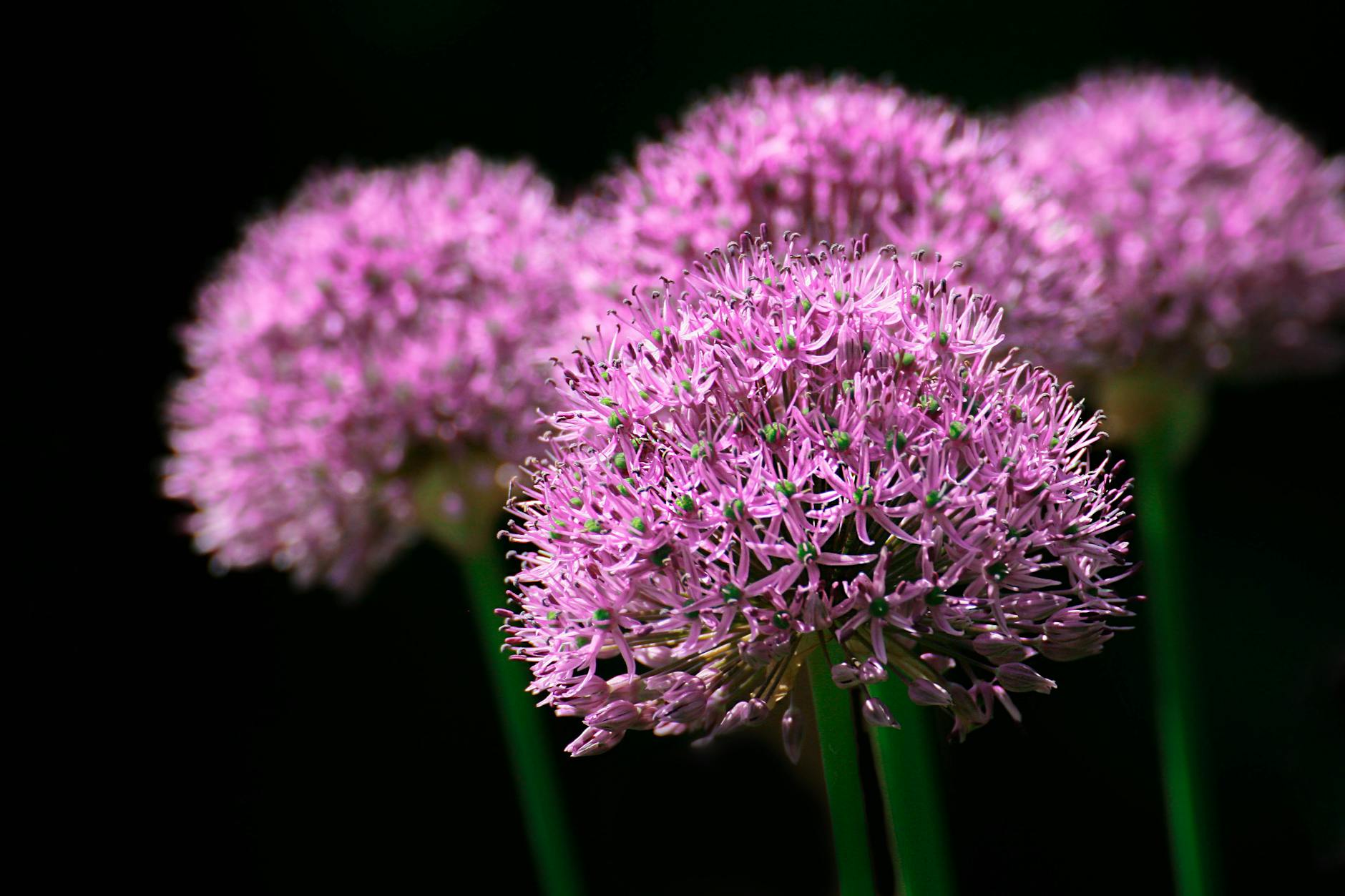
Selective focus photo of purple allium flowers.
Photo by Pixabay on Pexels.com

In The Schools’ Collection, an archival record of folk remedies, garlic is mentioned as a cure for multiple ailments. However, most of these are respiratory in nature. There are methods for treating tuberculosis, asthma, influenza, and the common cold, among many others. These range from boiling it in donkey’s milk, to keeping a piece in your shoe.
In China and Japan, it was used for digestive and intestinal complaints, as well as as an antiparasitic.

In central and western Europe, garlic is typically regarded as an herb for protection. The bulbs or flowers could be worn, hung in the home, or placed/rubbed on doors and windows to keep out malevolent spirits or repel the effects of the Evil Eye.

Though garlic is native to northeastern Iran and Central and South Asia, Roman armies were responsible for spreading the plants everywhere they went. Soldiers would eat it before battle, believing that it filled them with courage. They also planted it everywhere, so they’d always have access to it and that courage would be symbolically transferred to the battlefield.

In modern witchcraft, which is typically derived from European traditions, garlic is a protective and banishing herb.
In Hoodoo, which arose from the African diaspora, it is used to ward off evil and protect.

According to Culpepper, garlic is ruled by Mars. It’s considered an herb of Fire.

The easiest way to use garlic is in kitchen witchery. Before chopping, mashing, or otherwise adding it to foods, hold a clove in your dominant hand and ask the garlic to assist you. Include it in dishes when you need a little extra courage or protection from malevolent energies or envy.

You can also tap into garlic’s banishing properties with little more than a whole clove of it, a pot of soil, a slip of paper, and a windowsill. Write down the name of a bad habit that you wish to be rid of (nail biting, smoking, et cetera). Dig a small hole in the pot of soil, and place the slip of paper at the bottom. Plant the garlic clove over it and tend to it the way you would any other plant. As the garlic sprouts and grows, it’s said to help you overcome the habit.
This is a pretty old charm that uses both the herb’s reputation as a banishing and purification plant, and a bit of sympathetic magic. As the garlic grows, so, too, does the planter’s resolve and distance from their bad habit.

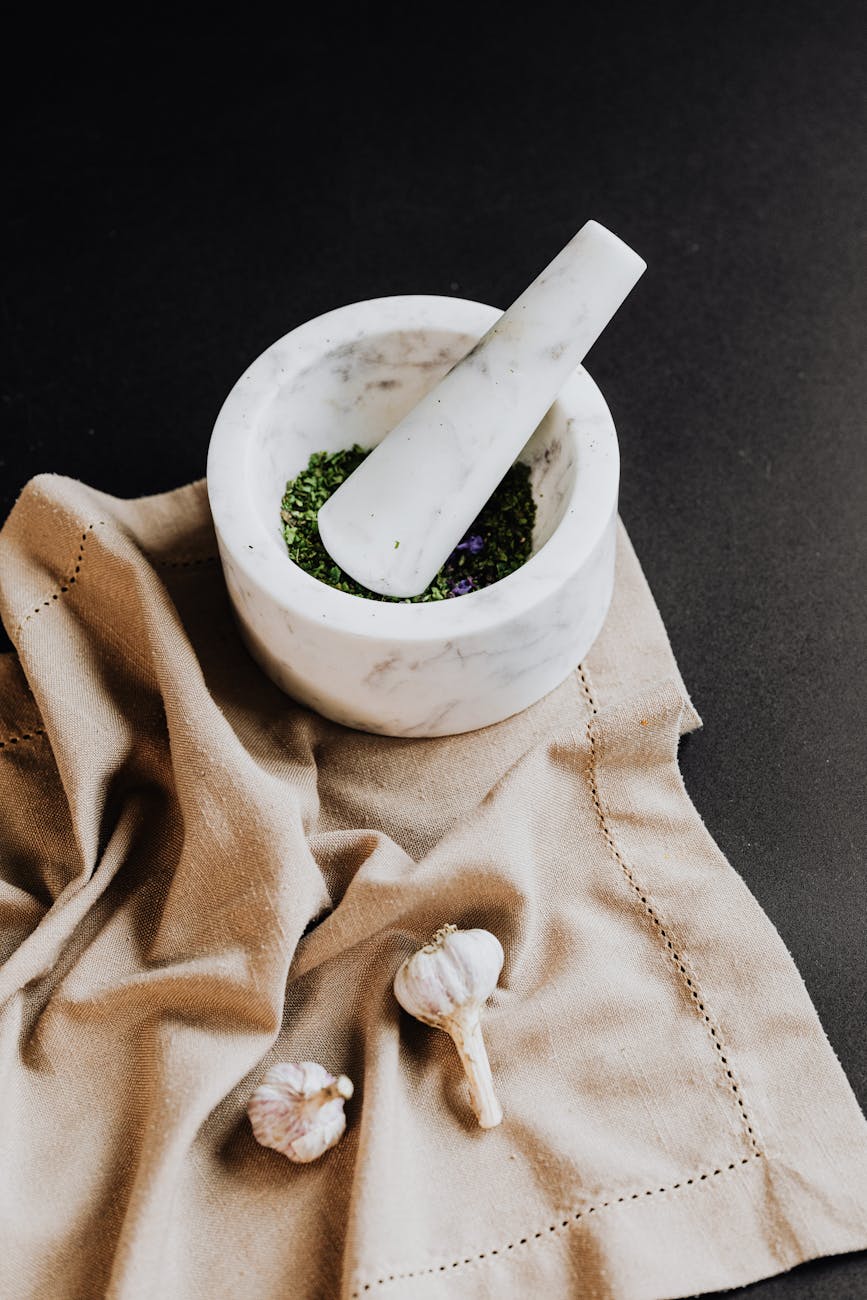
Close up shot of mortar and pestle near garlics.
Photo by Photo By: Kaboompics.com on Pexels.com

It’s also useful in salts or powders to protect an area. Mix dried, powdered garlic in black salt (or regular table salt) and sprinkle it in the corners of a room you wish to ward. If you want to use it outdoors, skip the salt and combine it with other protective herbs.
If you have pets, be aware that too much garlic can cause a condition called Heinz body hemolytic anemia. If you’re trying to ward a room that cats or dogs frequent, either skip the garlic and salt and go for pet-safe herbs or keep the animals out until you feel the herbs and salt have done their job and then sweep and vacuum the area thoroughly.

You can also decorate with garlic bulb wreaths/ropes, or even vases of the fresh flowers. Place them in any room you wish to keep clear of bad vibes. (Kitchens are typically considered the “heart” of a home, so they’re the perfect place for this. Also, you can pull off a fresh bulb to use whenever you need one).

Garlic is more than delicious — it’s healthful and powerfully protective. It’s also surprisingly easy to grow and harvest, making it a very useful addition to any magical or mundane home garden.

Plants and Herbs

Hen and Chicks Folklore and Magical Uses

Do you have little to no success with plants?
Do you want to get into gardening, but lack confidence?
Hoo boy, are hen and chicks succulents made for you.

Members of the genus Sempervivum, these succulents are also known as “live forever” or “houseleek.” They have the plump leaves of your average succulent but can thrive in growing zones 9-4. I have one that I stuck in a pot on my deck and did literally nothing for — not even water — and it’s filled the pot, put out tons of little green pups, and is flowering like there’s no tomorrow.

A top-down view of a Sempervivum plant in a pink pot. In the center of the photo, several pink flowers and buds are visible.
A close up of that plant’s first flowers. In the background, you can kind of see other buds emerging on their talk stalks.

Along with their easygoing nature, hen and chicks plants have some interesting folklore and usages in magical disciplines.

Let’s look at their common names first. “Hen and chicks” derives from their most notable method of reproduction — in addition to producing seeds, they send off little offsets in the form of round rosettes which give the impression of a large mother “hen” plant surrounded by baby “chicks.” They’re called “live forever” because they’re evergreen and very difficult to kill. Lastly, the name “houseleek” has no relation to the other plants known as leeks. Instead, the word “leek” comes from the Anglo-Saxon word “leac,” meaning “plant.”

As for why they’re called something that literally translates to “house plant,” there’s an excellent reason for this. Hen and chicks plants were (and are) frequently grown on houses. (When I lived in California, the house I stayed in had some lovely Sempervivum growing on the roof.) This practice originated with the belief that these plants helped to ward off fire and lightning strikes.

These plants are also associated with prosperity, health, and luck. Possibly as an extension of their fire- and lightning-protective connections, some cultures grew Sempervivum on roofs as a way to ensure the health and wealth of a house’s occupants. In Wales, these plants are still sometimes grown on roofs for luck.

(Of course, if you live in the US and have an average modern shingle roof, you may not want to grow plants there. Excess moisture could cause problems, and using your roof as an ersatz garden could void your warranty. Sempervivum are great for green roofs, however.)

As for warding off fire and lightning strikes, there are a few reasons for this. Some species of Sempervivum grow fine, snow-white hairs on them, that look a bit like fine wool or thick cobwebs, and their growth habit can make them resemble a jutting, sculpted beard. This is reflected in the German name “Donnerbart,” or “Thunder beard.” These plants are connected to various thunder deities, like Thor and Zeus.

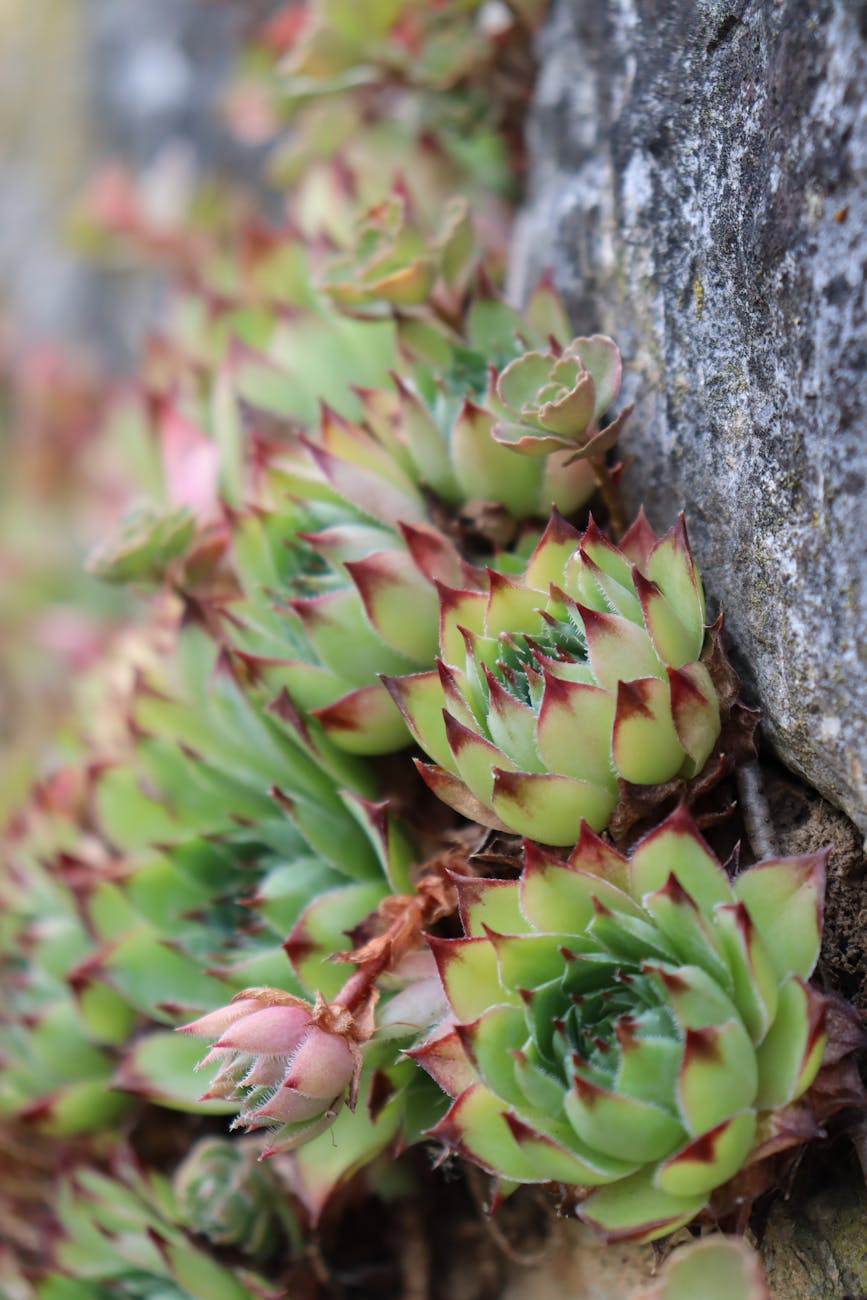
Sempervivums clinging to a rock face.
Photo by Honglei Yue on Pexels.com

The other reason behind it is that Sempervivum can act less as a protector than as an indicator. These plants can thrive in very dry areas, but they still need some moisture to stay plump and green. The presence of healthy hen and chicks plants generally indicates that conditions aren’t conducive to combustion.

Houseleeks are also used to ward off attacks by malevolent magic.

Medicinally, Sempervivum plants are used similarly to Aloe vera. Topically, it is sometimes a treatment for cuts, burns, or warts. This herb was also considered a very useful treatment for diarrhea, while larger doses were a powerful emetic. Traditionally, it’s considered a very cooling herb.

Elementally, Sempervivum is associated with Fire. It is also connected to all thunder deities.

From everything I’ve seen, Sempervivum‘s protective and lucky magical attributes are best employed by simply growing them. Give them a sunny spot and some well-draining soil in the right growing zones, and they’re pretty much good to go. (Of course, if you intend to use your hen and chicks plants in this fashion, it’s good form to ask them for their help.)

While these plants aren’t native to the US, I have noticed that they seem to be a favorite of small native pollinators. So far, I’ve seen three different species of sweat bee. They’re also useful for xeriscaping in especially challenging areas.

As I mentioned previously, you may want to avoid growing them on your roof. Yes, it’s very picturesque and cottagecore, and yes, it’s traditional, but having to pay upwards of five grand to fix or replace a modern shingle roof is none of those things. Plants trap moisture, which roofs need to shed. Their roots can infiltrate minute gaps between shingles, widening them and allowing water in. It may not happen immediately, but growing plants directly on a conventional roof, without any kind of barrier or container between the two, is generally not a good idea.
If you have a flat spot near your roof, like a windowsill, window box, or balcony, stick a couple Sempervivum plants in terracotta pots and put them there instead.

As for using them internally, I don’t recommend it. If you have a minor burn and don’t have a fresh aloe leaf handy, by all means, try applying some Sempervivum goop topically. Using these plants as an anti-diarrheal or purgative has largely dropped off in favor of other remedies, even in alternative medicine.

Hen and chicks plants are adorable, inexpensive, and exceptionally hard to kill. Magically, they’re just cute little protective and luck-drawing charms. If you have the space to devote to one (or a few), they’re well worth their tiny investment of time and money.

Plants and Herbs

Moss Folklore and Magical Uses

In honor of the adorable little clump of moss that I found when hiking last weekend, I thought that I’d write about the different folk tales, cultural significance, and magical properties of these awesome little plants.

Before I do, I do want to point out one thing that’s pretty funny: A lot of the plants we consider/call “moss” aren’t actually moss at all. Some of them aren’t even the same kind of organism. Oakmoss (Evernia prunastri), for example, is a source of fragrance and often considered to be a grounding ingredient that’s associated with the element of Earth. However, it’s a lichen — a composite organism of fungi and cyanobacteria or algae species — that spends its entire life in trees. Reindeer moss (Cladonia rangiferina)? Also a lichen. Spanish moss (Tillandsia usneoides) is neither lichen nor moss — it’s a flowering plant related to those spiky little air plant guys you find glued to magnets at gift shops. Irish moss (Chondrus crispus) is algae. The other Irish moss (Sagina subulata) is actually part of the carnation family. You probably get the idea.

A close-up of moss-covered tree roots.
Photo by mali maeder on Pexels.com

So, for this post, I’m limiting myself to the “true” mosses. These short, spongy little members of Bryophyta occupy a unique place in magical traditions and folklore.

In a Cree legend, Wisagatcak the Trickster attempts to catch the Great Beaver. His attempt backfires when the Great Beaver gets muskrat to bite Wisagatcak in the backside. Seeking revenge, the Great Beaver begins to flood the whole planet. In response, Wisagatcak made a great raft to wait out the flood waters. Moss began to grow on the raft’s damp wood. As it grew, a wolf on the raft ran around and around, working magic to expand the moss and cover the Earth in land once again.

A Salish story tells about a Chief with a very beautiful daughter. When she came of age, he wanted to make sure that she married well, so he held a race: The man who had the strongest legs could marry his daughter. Many creatures showed off their physical prowess. Coyote was swift and cunning, Deer was strong and graceful, and Bear was powerful.
And then there was Blue Jay, with his twiggy little bird legs. He thought this whole competition wasn’t fair, so he hid behind a tree and covered his legs in moss and clay. He sculpted false muscles into the moss and clay, so, when he came out of his hiding place, he looked like he had the most powerful legs of all. (He also brought gifts of beautiful feathers, which certainly helped.)
Blue Jay won the girl, scooped her up, and carried her to his home across the river. Unfortunately for him, the river water washed away his fancy moss-and-clay legs. When he emerged from the water with his little skinny bird legs, everyone laughed.

A close-up of a snail crawling on some bright green moss.
Photo by PhotoMIX Company on Pexels.com

German folklore talks about the moss people, or Moosleute. These are a kind of forest fae that are said to be about the size of human children, but gray, old-looking, and clad in moss. In some tales, they’re said to be taller and beautiful.
These creatures are similar to the Irish sidhe, in that they can be capricious — on one hand, they may ask for help from humans and reward them generously for giving it. On the other, they’re really easy to anger by either scorning them or their gifts, or trying to give them caraway bread.
Moss people are often, though not always, the objectives of the Wild Hunt.

Lada (also known as Ladona or Lelja), is widely regarded as a Baltic and Slavic Goddess of spring, harvests, love, marriage, and fertility. She’s a deity akin to Freyja, Venus, or Aphrodite. She’s sometimes said to scatter moss as she passes, bringing new life and fertility to the soil. (Interestingly, she may have been invented by medieval Christian scholars in an attempt to malign local folk beliefs and Pagan practices, but opinions on this are divided.)

One common bit of modern myth involves painting with moss. It’s said that you can get moss to grow anywhere you want by putting it in a blender with buttermilk, then painting the slurry on fences, walls, et cetera. In fact, the buttermilk isn’t necessary — it doesn’t feed the moss in any way, because moss doesn’t take up nutrients from its substrate. Moss doesn’t even have roots. It has rhizoids, which allow it to draw moisture and nutrients from its surface. Give moss moisture and a flat place to grow, meet its lighting needs, and it’ll happen.

A fallen tree completely overgrown with moss.
Photo by Pixabay on Pexels.com

It’s often said that you can navigate with moss, because it only grows on the north side of trees. While this can be true in specific circumstances, it’s not true often enough to be useful. In the northern hemisphere, the north side of anything generally receives the least sun. This means that the north side of a tree is likely to be the dampest, coolest, and shadiest side. However, if there’s anything around the tree to provide shade (like buildings, other plants, or even just the tree’s own leaves and branches), then moss will grow wherever it pleases.

Traditionally, moss is associated with healing, resilience, persistence, and rejuvenation. It’s not a fussy plant and will grow in places many other things can’t. Even when it’s removed, as long as conditions are right, it’ll come right back.

The hardest part about working with moss is figuring out what’s actually moss. The first step, then, should be to learn to identify local moss species. Avoid going by common names, as these can be misleading. This isn’t to say that the plants-that-are-called-moss-but-aren’t-actually-moss don’t have their own special properties, but there’re quite a few differences between a terrestrial, non-vascular, spore-producing plant, and a tree-growing colony of fungus and algae!

A glass jar terrarium planted with moss and orchids.
Photo by Katarzyna Modrzejewska on Pexels.com

You can include bits of dried moss in sachets or amulets for protection and stability.

Beds of moss are great decorations for outdoor altars. They’re soft, beautiful, and provide an effective and tactile way to connect with Earth energy.

Moss is also a good offering for faeries and nature spirits. In some cultures, moss is considered a source of their power. Some members of the faerie realm are also said to use moss to camouflage themselves from human eyes.

If you do practice moss painting, you can use it to place protective sigils around your property.

Moss is a beautiful, unique, and resilient little plant. It survives where other things give up, and doesn’t really need much to thrive. Whether you use it as a magical ingredient, or just view it as a source of inspiration, it’s a really lovely thing to work with.