life · Plants and Herbs

Maypops!

Passiflora incarnata is a weird plant.

I bought three root cuttings last year, but they turned crispy and died shortly afterward.

Disappointed, I decided to try again with two more. Those died back to the ground late that autumn, and that seemed to be it. There was no sign of them this past spring, so I figured that particular experiment was also a failure.

Undaunted, I decided to try again. I purchased two more baby vines and planted them in roughly the same spot.

And then one (and only one) of the previous vines shot up out of the ground like it had something to prove. Like I’d committed some terrible affrontery by daring to try to replace it. Vining with a vengeance.

Not only did it reappear, it’s also about twice as big as the other two, and all three of them seem to be trying to outdo each other by putting out more and more buds.

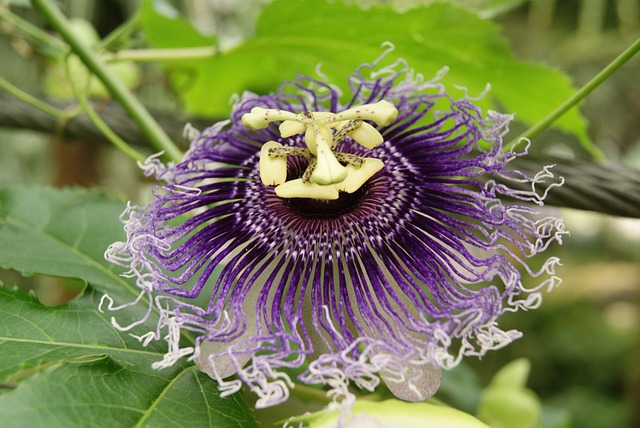
A passionflower with bright bluish-purple, fringe-like petals and a white center.
My very first passionflower.

The only thing is that, while Passiflora species are generally considered self-fertile (the flowers contain both male and female parts, and they are positioned in a way that makes it very easy for pollen to just kind of end up where it needs to go), I’ve read a lot of sources that claim that P. incarnata is self-incompatible. In other words, the flowers are built in a way that should facilitate self-fertilization, but it’s just not into that.

Since the flowers also only last for a day, that means that there needs to be some very timely coordination between pollinators and the plant itself. Pumpkins are the same way, really — they have separate male and female flowers, but the flowers don’t last long. If a bug or hummingbird doesn’t show up at the right time, the flowers close up and that’s that.

Anyway, all of this is to say that, after my disastrous experiences trying to grow passionflower, I wasn’t expecting much. That’s why I was really surprised to go out on the porch and see these guys:

A close-up of a vine with a pair of small, green, vaguely egg-shaped fruit.

Maypops! (Aka, passionfruit!)

These aren’t anywhere near ripe yet. You have to wait for them to get really soft and wrinkly, or even to just drop off of the vine. (I probably won’t let them get that far, because I doubt I’d find them again once they fell.) In this way, they’re kind of like pawpaws and American persimmons — once they seem like they’re way overripe and on the way to the compost bin, they’re perfect.

I’d like to try harvesting the rest of the plant for medicinal purposes, too. (I talked about some of these in my post about the folklore and magical uses of passionflower.) My handsome assistant and I go through a ton of chamomile, to the point where I’m starting to wonder if it’s possible to build up a tolerance. I’d like to try augmenting some of that with other relaxants. If I can grow them myself, so much the better.

Passionflower fruit are apparently much like pomegranates, in that the edible portion is little bags of juice around seeds. I’m not much for making jams or jellies, so that’s out. I don’t think they’d be conducive to drying, though I may try combining their juice with a more solid, neutral-tasting fruit (like pears) to make fruit leather. We’ve also been using our excess strawberries and pumpkins to flavor mead, so I could see using a batch to experiment with maypop juice.

So many possibilities!
Plants and Herbs

Passionflower Folklore and Magical Properties

As we kill off our grass, we’re working hard to replace it with plants that serve multiple purposes. Ideally, they should be native (or at least semi-local), attract pollinators, provide food for both humans and animals, and either return or self-seed. One of the plants that passed muster is this area’s native species of passionflower, Passiflora incarnata.

Also known as maypop, true passionflower, purple passionflower, and wild apricot, P. incarnata is a really pretty, fast-growing vine that provides both wild-looking purplish blue flowers and edible fruits. The flowers don’t last long, but they’re very striking!

A fringy, bright purple Passiflora incarnata flower.
A flower of P. incarnata.

Unfortunately for me, I didn’t heed the old adage, “the first year they sleep, the second year they creep, the third year they leap.” As a result, I planted way too many passion vines. They’re going to eat my porch.
Help.

Anyway, as I watch my yard speedily being consumed by passion and pumpkin vines, I figured I’d write a bit on the magical uses and folklore of the passionflower.

Passionflower Folklore and Magical Uses

Despite the name, I’ve mostly seen passionflower used as an herb to dampen passions, not stoke them. They’re said to be useful for calming libido, cooling relationships, and cultivating platonic or romantic rather than erotic love.

This could be because the word “passion” has a number of very different and contradictory meanings. As Mark Z. Danielewski wrote in House of Leaves, “Like patience, passion comes from the same Latin root: pati. It does not mean to flow with exuberance. It means to suffer.”

As a new world herb, passionflower was a novel plant to the Spanish missionaries who arrived in Peru in the 1500s. Giacomo Bosio, a monk and historian, referred to passionflower as “La Flor de las cinco Llagas” (“the flower with the five wounds”). This refers to the five wounds the Christian figure Jesus Christ is said to have endured at his crucifixion. The Biblical usage of passion equates to suffering, so, to missionaries, the passionflower represented divine suffering.

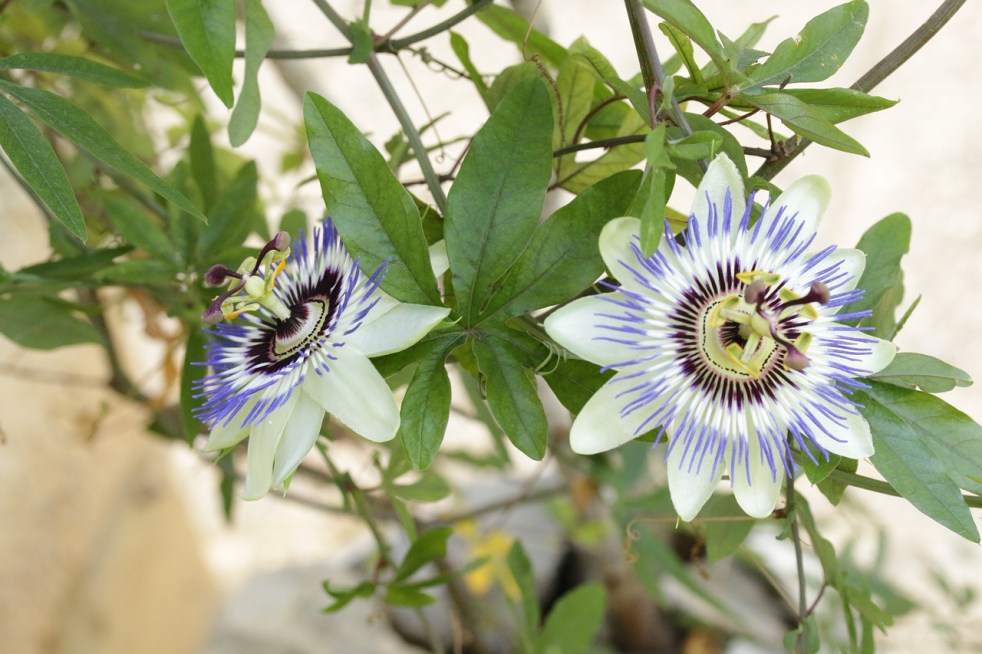
A blue and white flower of P. caerulea.
P. caerulea, a passionflower native to South America.

One tale from Brazil says that the passionflower grew from the tears of a woman who was separated from her lover.

Medicinally, passionflower is used as a calming herb. Evidence suggests that it’s safe to use internally, but there’s been some controversy as supplement manufacturers didn’t meet FDA requirements for safety data. It may interact with sedatives, monoamine oxidase inhibitors (MAOIs), and drugs to prevent blood clots, and is contraindicated in pregnancy.

In traditional indigenous herbal medicine, passionflower is used as a poultice to reduce inflammation and soothe pain.

In the garden, passionflower is irresistibly delicious to Japanese beetles. They’ll eat the leaves and flowers like there’s no tomorrow, which is bad news if you actually want to harvest any fruit!

Taken together, this paints the picture of passionflower as an herb to ease suffering. Since it was said to represent the five wounds endured by Jesus Christ, you could look at it as a “wounded healer.” This isn’t a plant that flows with exuberance, it’s one that knows suffering and eases it in others.

In Victorian flower language, passionflower was said to represent religious fervor or superstition.

Passionflower corresponds with the element of Water and the planet Venus.

Using Passionflower

If passionflower both represents and alleviates suffering, how do you use it? Since it’s native to North and South America, there isn’t really any information about it in ancient magical texts. Nonetheless, there are many ways to work with this unique plant.

As a vine, passionflower grows and clings (hence the whole porch thing.) This makes it useful in workings to bind something to yourself. Since it’s also a plant for relieving suffering, I’d use it specifically in situations where you’d like to bind a solution to a problem — for example, using passionflower to tie yourself to a stable, fulfilling job or enjoyable living situation.

Passionflower is also sometimes used in pillows or sachets for restful sleep and dream magic. Be careful with this, however, as placing passionflower under one’s pillow is also said to be a remedy to dampen libido.

This herb is also used in love magic. Bathing in an infusion is said to attract a potential partner to you, and it’s an often-seen ingredient in sachets, jars, and other charms for love. It works well for this purpose, as long as you know what kind of love you’re looking for. (If you’re after a passionate fling, skip it and go for cinnamon or ginger instead.)

Infuse the flowers in a carrier oil and use this to help ease worries and sooth the heart and mind. Anoint the temples and heart area whenever relief is needed.

All told, passionflower is a delightful herb. It’s beautiful, feeds bees and hummingbirds, and provides valuable medicine. As long as you don’t let its name fool you, it can help you with an array of spells and charms.