Blog · life · Uncategorized

A riverside hike (with *giant* mushrooms!)

This past weekend, my Handsome Assistant and I packed a small picnic and went for a bit of a walk. This particular area is beside the northwest branch of the Anacostia River, near an abandoned mica mine. There are some really cool mineral specimens here — the usual bull quartz, but also tons of mica-bearing rocks and golden beryl.

That’s not all it has, though.

The trail is mostly shaded by trees, so it stays fairly cool even when the weather’s warm. Lesser celandine (lush, but invasive) covers the ground between the trees, creating a dense carpet that reflects the sunlight and further cools the ground. It’s poisonous to eat, though the tubers are said to be edible, and has a long history of use as a topical medicine for hemorrhoids and scrofula.

A brown haired, caucasian man in a dark blue and white tanktop reclines on a bed of lesser celandine. His eyes are closed and his expression is peaceful.
“That’s a really bad idea, you know.”
“I know, but it looks so soft.”
“There’s probably poison ivy in it.”
“Worth it.”
“You’re going to get eaten by snakes. Or ticks. Probably both.”
“It’s so soft, though!”
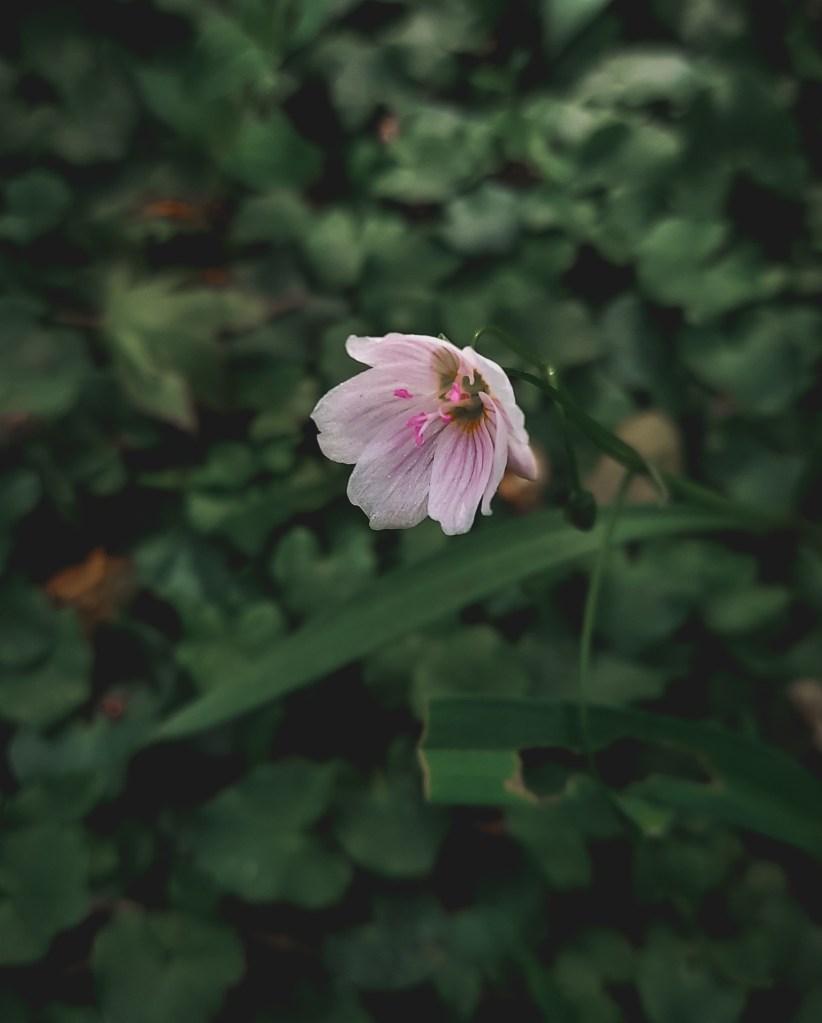
A close up of a small pink springbeauty flower.
Springbeauty (Claytonia virginica)

Fortunately, there was more to see than just lesser celandine. There were tiny pink blossoms of springbeauty, dense pillows of moss, fern fiddleheads, and some of the lushest skunk cabbage I’ve ever seen. We also spotted some mayapples, a few of which were even mature enough to flower. I don’t know if I’m brave enough to go back and see if there’s any fruit later this summer, but it was lovely to see regardless! (I snapped a few pics of the ones we saw, which you can find in my post on mayapple folklore and magical properties.)

Large skunk cabbage plants growing up out of a dense mat of lesser celandine.
Seriously, just look at that skunk cabbage (Symplocarpus foetidus).

We passed next to the water, eyes peeled for sparkly mica-bearing stones, when I heard a soft “bloop.” I turned my head just in time to see a startled common watersnake (Nerodia sipedon) slipping away across to the opposite bank, gracefully undulating and occasionally poking its head up like a snorkel to take a breath. I apologized for spooking it as I fumbled for my phone but wasn’t able to snap a picture before it had swum away and camouflaged itself in the mud and fallen leaves.

They’re one of the species of snakes that are often vilified for no reason. They’re perfectly harmless but can bear a passing resemblance to a venomous copperhead (Agkistrodon contortrix). Admittedly, I made the same mistake myself at first glance — not that I would’ve behaved any differently, as both the snake and I seemed pretty chill about the whole situation. Like black racers and ratsnakes, they’re guys you actually want to have around if you don’t want to have to deal with pest animals. Also, they’re one of the few reptile species that gives birth to live young, and that’s really neat!

(Also, copperheads are pretty chill, too. They might be venomous, but they’re not aggressive. Their first defensive instinct is to freeze up and rely on their natural camouflage. Bites typically occur when that either fails, or people don’t see them, step too close, and the snake gets desperate.)

A pair of young fern fronds, still curled into a "fiddlehead" shape.
Young ferns.

A little further up the trail, we were navigating over a large fallen tree. Another tree lay across it, forming a kind of steep natural bridge. As I investigated it to see if it’d be safe to cross, I heard a silky rasping sound. There, nestled in the root ball of the fallen tree, I saw the shiny black coil and pointed tail of a black racer (Coluber constrictor priapus) vanishing deeper into the tangled roots.

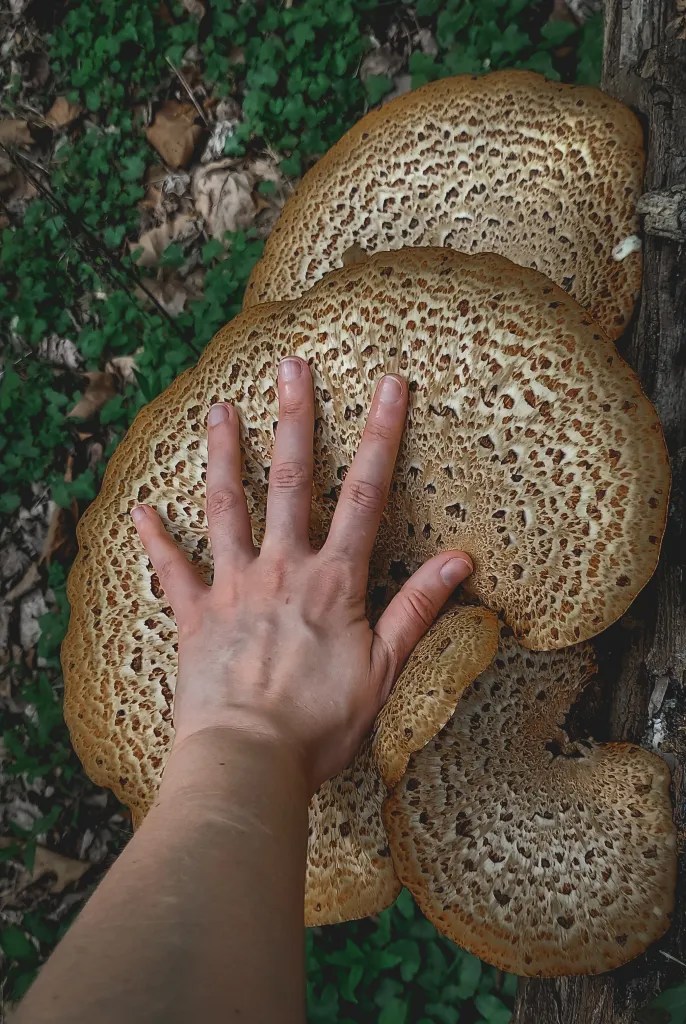
My favorite part, however, was running into a colony of dryad’s saddle (Cerioporus squamosus) growing from a dead tree. These are edible, fairly easy to identify, and don’t really have poisonous lookalikes. They also smell exactly like watermelon rinds, which is honestly very weird. Kind of a green, watery, fruity smell, of decidedly not the type you’d expect from a scaly tan mushroom growing out of a dead tree. I wasn’t 100% positive that that’s what I was looking at, at first. Fortunately, a combination of a quick-and-dirty ID app and friends with much more foraging experience were able to reassure me.

Also?

Dryad’s saddles get enormous.
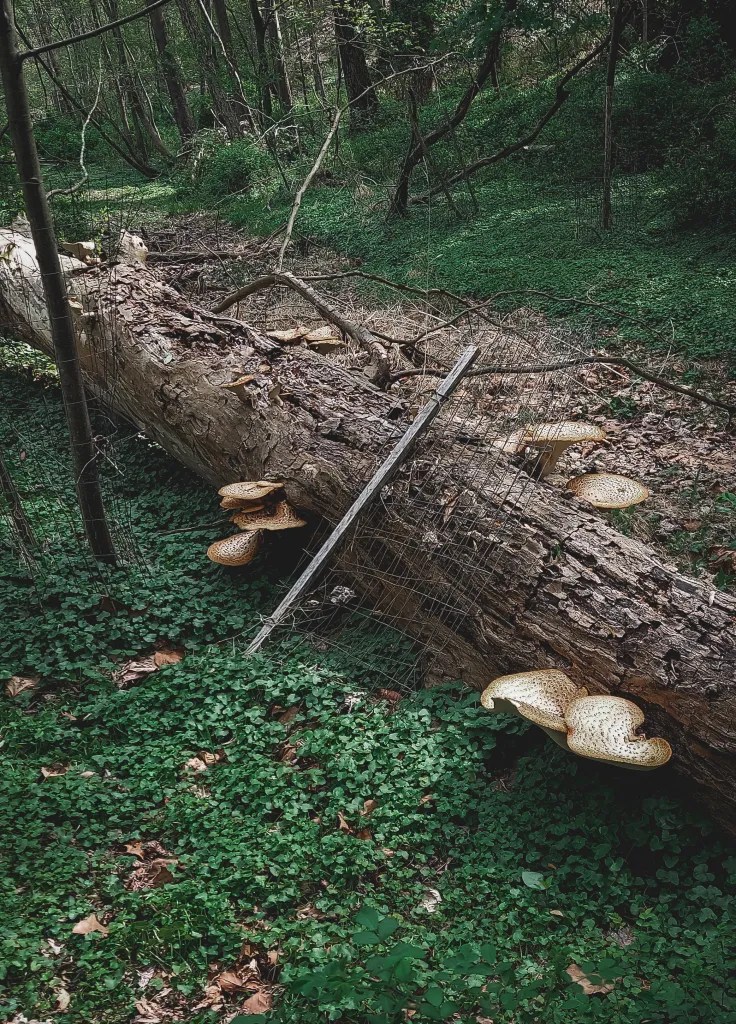
Like, far larger than I felt was reasonable for a mushroom. Much bigger than the reishi and armillaria that grow in my front yard, at any rate.

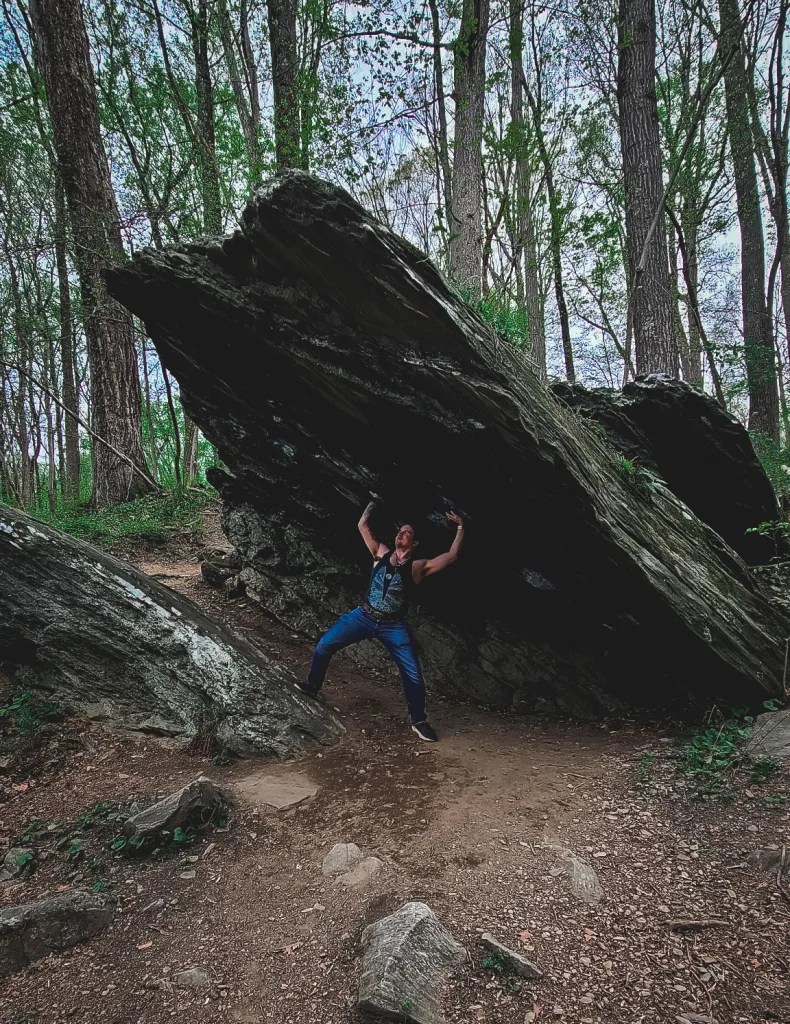
This area has another cool feature, labeled on the map as “prehistoric rock shelter.” I haven’t found any other information about it, but it’s a nice, cool, shaded spot to sit and rest for a bit. The area underneath is at a bit of a slope, but it’s still a comfortable place to take a break.


I also found a tree that was shaped kind of like a sad skull, and a very neat feather — most likely from a hawk.

All told, it was an eventful walk and a lovely picnic. Everything was vibrant and green, and we saw (and heard!) a lot of cool wildlife.

Here’s hoping you’re also finding cool things wherever your adventures take you.

Plants and Herbs

Mayapple Folklore and Magical Properties

I love mayapples. They look like a prank. Like someone picked a bunch of leaves off of something bigger and stuck them in the ground so they could trick people into thinking that that’s how a mayapple grows. They’re patently ridiculous and fantastic.

I remember the first time I encountered them. Though I don’t remember when, or where, I do remember seeing a bunch of sprouts that looked like folded beach umbrellas for fairies. I wasn’t sure if they were plants or mushrooms at first — before the leaves fully open, they almost look more like fungi than anything planty.

The other day, my handsome assistant and I were on a walk and ran into a whole patch of them. Even better, some of them had flowers, which also look like some kind of prank. The only thing better is when they fruit, which I, personally, find hilarious. Just one leaf with a big old fruit hanging off of it. It looks like a video game monster. Like you’re supposed to get close, then find out the fruit is actually full of teeth and now you’re out of extra lives.

Anyway. Mayapples are interesting for more than their bizarre looks. They can also be a very useful plant.

Mayapple (Podophyllum peltatum) is sometimes called “American mandrake,” and the name is apt. Like mandrake (Mandragora species), it’s poisonous. It also has a pretty large root that often branches similarly to that of a mandrake.

The name Podophyllum peltatum comes from the Greek words podo, meaning “foot,” and phyllum, meaning “leaf,” as well as peltatum, meaning “shield.” It’s a pretty apt name when you look at their slender stems shielded by broad leaves.

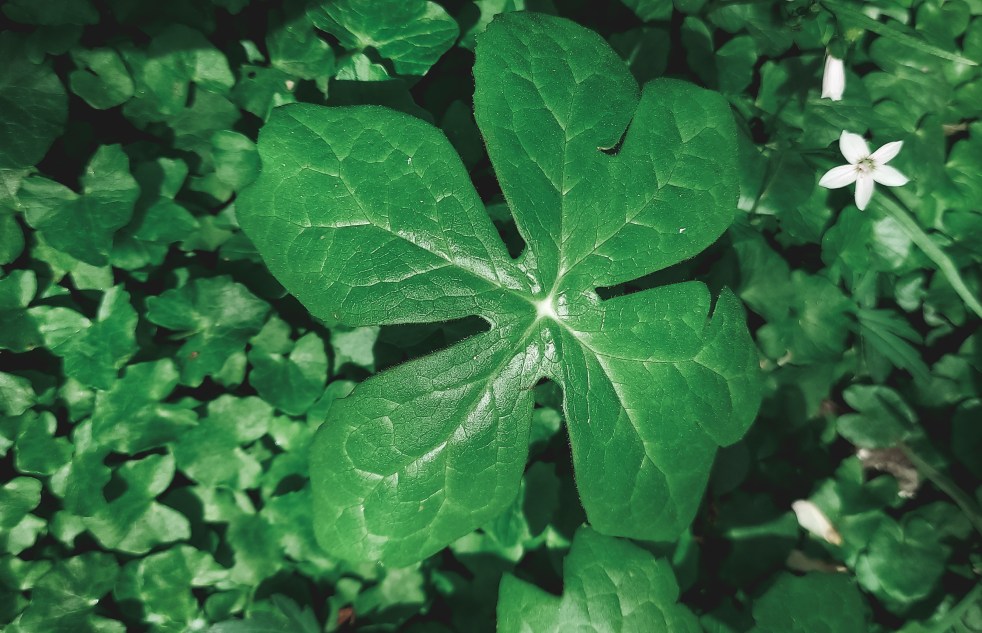
A top-down view of a mayapple leaf, surrounded by lesser celandine.

While the entirety of the mayapple is poisonous, the fruit (with the seeds removed) can be eaten only when it is completely ripe1.

Most commonly, mayapple is used as a substitute for mandrake. While the plants are unrelated, their qualities are similar enough to make such a substitution work.

That means that mayapple is an excellent ingredient in protective or banishing formulas. Some people use it as an ingredient in formulas for renewal, rebirth, or new beginnings, largely because of the fact that the plant appears in spring, produces fruit, and go dormant shortly after the fruit ripens in mid-summer.

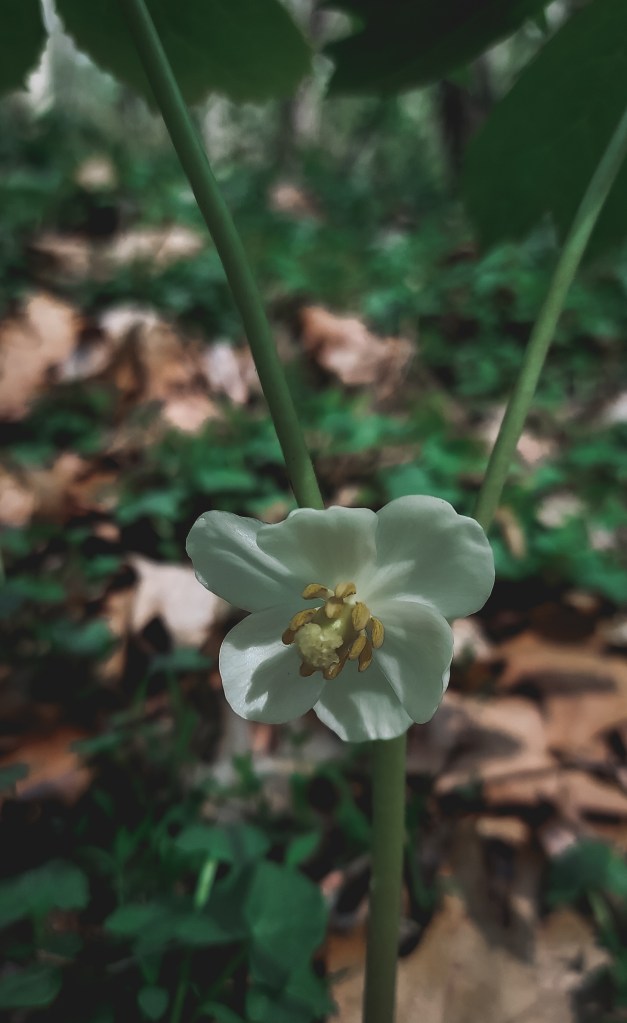
A close-up view of a mayapple flower. It appears at the fork between the two leaves of a mature mayapple and has five white petals with a yellow center.

Interestingly, mayapples have a unique relationship with turtles. While the foliage is bitter and deadly enough for herbivores to avoid it, the smaller guys will happily go after the ripe fruits. Box turtles are actually the primary distributors of mayapple seeds2,3. The fruits grow at just the right height for the turtles to reach them, and the seeds are more likely to germinate after being exposed to the turtle’s acidic digestive environment.

While the mayapple is extremely poisonous, it does have a history of use as a medicinal plant. In the past, it was used as an emetic, anthelminthic, and treatment for skin conditions like warts. Podophyllotoxin, one of its primary toxic constituents, is actually the active ingredient in a topical treatment named Podofilox that’s used to treat some viral skin conditions like genital warts and molluscum contagiosum. It works by inhibiting the replication of cellular and viral DNA as it binds to key enzymes4.

If you’re going to use mayapple, do it carefully. Wear gloves. Don’t put it in anything that you’re going to ingest, or even anything that could potentially come in contact with your skin. While the ability to keep DNA from replicating is helpful when you’re trying to kill a skin virus, it’s very much not okay when it’s working on your cells instead.

For real. Be careful.

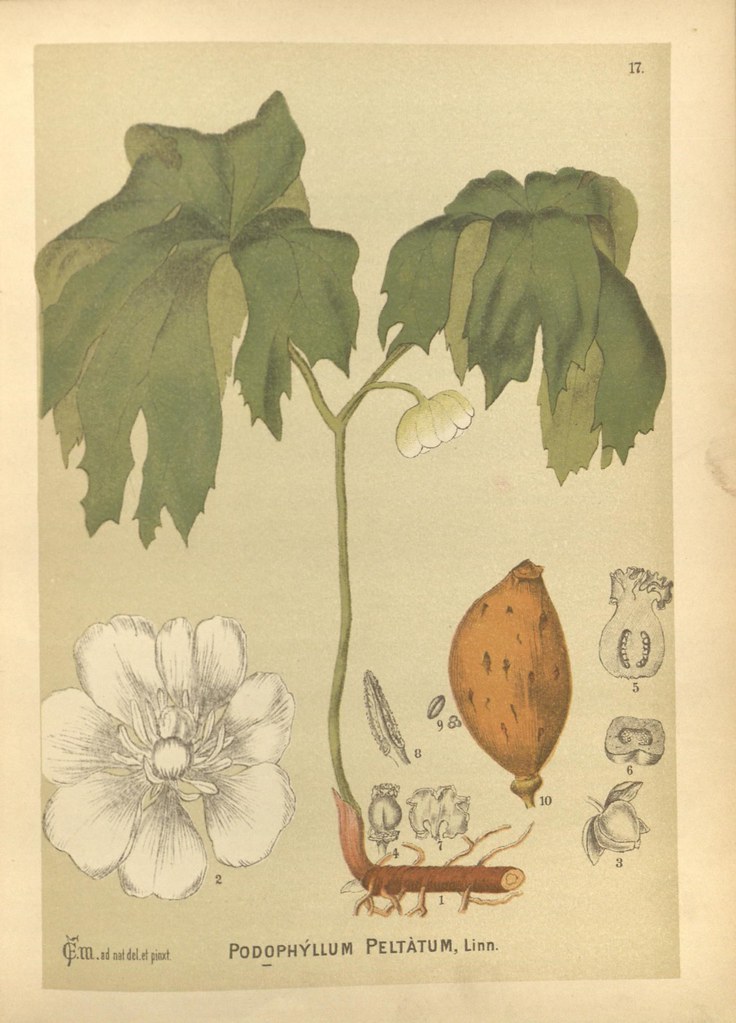
A botanical illustration of a complete mayapple plant, showing the pair of leaves, white flower, and large root.
n71_w1150 by BioDivLibrary is licensed under CC-PDM 1.0

Whole dried mayapple roots could be used to make an alraun. This is a dried tormentil or false mandrake root (Bryonia alba) used in German folk magic, carved and decorated into a kind of spirit doll. Keeping and properly maintaining one is said to bring good fortune to the household. The alraun (or alraune) would also be bathed in red wine, which could then be sprinkled around the household for protective purposes.

Caring for an alraun is pretty intensive. Once prepared, it needs to be wrapped in a red and white silk cloth, put in a special case, and bathed in red wine every Friday. On each new moon, it should be given a new shirt. These dolls were also passed down through families, though they must be inherited in a particular way: When the father of a family dies, his eldest son may inherit the alraun by placing a piece of bread and a coin in his father’s coffin. If the eldest son dies, his eldest son (or younger brother, if he has no sons) may likewise inherit the alraun by the same method5.

If creating and caring for an alraun seems a bit intense, you can also use dried mayapple in container spells. Just make sure to wear gloves while handling it, and don’t place it anywhere where children or animals may come in contact with it.

Rinse the dried root in water or alcohol and sprinkle it around anywhere you wish to protect. Again, be cautious not to get it on your skin.

The seeds would be useful in formulas for rebirth or renewal. However, as mayapple has never particularly called to me as a “renewal” herb, I can’t offer any more in-depth suggestions here.

Mayapples are beautiful, unusual little plants. They pop up in spring in all of their bizarre glory, flower, fruit, and are gone by late summer. Treated with respect, they can be very useful — even heirloom-worthy — magical tools.

  1. Mayapple: Pictures, Flowers, Leaves & Identification | Podophyllum peltatum. https://www.ediblewildfood.com/mayapple.aspx.
  2. Braun, J., & Brooks, G. R. (1987). Box Turtles (Terrapene carolina) as Potential Agents for Seed Dispersal. American Midland Naturalist, 117(2), 312. doi:10.2307/2425973.
  3. Rust RW, Roth RR. Seed Production and Seedling Establishment in the Mayapple, Podophyllum peltatum L. The American Midland Naturalist. 1981;105(1):51. doi:10.2307/2425009
  4. Podofilox (topical) monograph for professionals. Drugs.com. (n.d.). https://www.drugs.com/monograph/podofilox-topical.html
  5. Deutsche Sagen, herausg. von den Brüdern Grimm. Google Books. https://books.google.com/books?id=SRcFAAAAQAAJ&pg=PA135. (In German.)

life

Bones, Beavers, and Vegan Tacos.

This past Saturday, my Handsome Assistant, some friends, and I went on a bone walk. This was organized by a friend in the Druidry group of which I’m a part, and it’s pretty much exactly what it sounds like — a walk through an area where it’s common to find bones.

Late winter/early spring is the best time for this, because winter is harsh on wild things and this is when the snow melts and uncovers the earth again. It’s a meditation on mortality and privilege; we are fortunate to have access to the things we need to easily survive winter, but this isn’t universally true. And, regardless of how true it is, none of us will live forever. It’s kind of an antidote to modern western society’s extreme refusal to acknowledge the more visceral aspects of our own mortality.

(I’ll give you an example. When my grandmother passed away, she was sleeping in bed beside my grandfather. Her body was picked up, cleaned, preserved, and covered in makeup and a wig. Her cheeks were stuffed with cotton to hide the way cancer had eaten her away. Her eyelids were pulled over barbed plastic forms to make her look like she was sleeping. We filed in during the wake to see her, and she was carted off to her grave by unseen hands. Only, it wasn’t her grave exactly — she was brought to a kind of staging area, with her coffin set atop a white rectangular platform. There was a eulogy, the press of a button, and a mechanical whirr as the coffin descended into the platform. It was all very neat and methodical, with as little involvement from the bereaved as possible. Just lots of preservatives, makeup, and little tricks to maintain the illusion of life, and a closed casket gently lowering into a sterile, white box.

If this is the closest we come to experiencing mortality before going through our own, no wonder we’re so fucking weird about it.)

The bone walk itself was a lot of fun. We didn’t find many bones, mostly some vacant snail shells. The area we walked was a very diverse meadow, with horse nettle, lobelia (I even snuck some leftover lobelia seeds), native grasses, and more plants than I could possibly identify, so there were signs from an abundance of wild things. Shed feathers. Coyote scat, packed with rodent and rabbit fur until it looked almost like owl pellets. Tufts of winter coat from horses, where they’d rubbed against a fence. The stumps of trees, whittled to a pencil point by beaver teeth. Droppings from rabbits, deer, and horses. It was the traces of a healthy, vibrant population.

We chatted about all kinds of things, mortality-adjacent and non. Books. Music. The population of crows that visits here. The plants we saw. I haven’t been able to see anyone since late autumn, so it was nice to just catch up and spend time together.

We also talked about the idea of a burial forest, where everyone could be buried beneath a tree. One friend said they wanted to be buried beneath an apple tree, which would continue to feed people in a somewhat macabre fashion. I said I wanted to be buried under a bald cypress, so it’d grow cypress knees. Then I could continue to be a pain in the ass in death as I am in life.

(Alternatively, I want to go to a body farm. Then I want my picked-clean skeleton recovered, well-scrubbed, and adorned with thrift store junk jewelry. Then I want to be propped up on a marble throne in a mausoleum to confuse the shit out of anthropologists far into the future.)

Once we’d finished the bone walk, my Handsome Assistant and I had to go. (We had a rather long drive back, and I was in a hurry to get to my favorite stationery store before it closed because it would probably be my only opportunity to pick up Colorverse’s exceeding gorgeous 2025 ink, Blue Green Snake, without having to order it online.)

(I got the one with blue purple shimmer.)

We stopped at a placed called Kelley Farm Kitchen on the way back. We’d never been — didn’t know anything about it, really, but it said it was “100% Vegan.” I had some doubts when I looked at the creamy sauces and cheesy dishes on their menu, but they were not kidding.

My Handsome Assistant got a seitan cheesesteak and a little bit of macaroni and cheese (well, “cheese”), which were both delicious. I was debating getting the same, but I went with the pinto bean and avocado tacos instead, and you guys.

They were amazing. Just a little heat. Flavorful. Satisfying. The tortillas were soft, but with just a bit of crispiness on the outside. The grated carrots were a cool, sweet counterpoint to the salt and heat of the other ingredients. And the sauce!

For serious, I’d gladly make the trip just to get more tacos.

This was a small adventure, but delightful. I’m glad that the thought of mortality doesn’t strike the same fear in me that it did years ago. I’m grateful that I got to see and socialize with my friends. I’m happy to spend time in a beautiful, biodiverse place. I’m glad for delicious food, good conversation, and beautiful ink.

(Seriously, it’s so pretty.)

Neodruidry · Plants and Herbs · Witchcraft

Vervain Folklore and Magical Uses

Vervain (Verbena officinalis) is a prominent herb in European folk and ceremonial magic. Its roots also extend to American Hoodoo.

Though most old grimoires mean V. officinalis when they refer to vervain, there are actually about 80 species in the genus Verbena. In my area (and all of the continental US, and fair bit of Canada) we have Verbena hastata, also known as blue vervain. While it’s not the same plant, you’ll often find V. hastata labeled simply as “vervain” in metaphysical contexts.

Lemon verbena, Aloysia citrodora, is also a member of the Verbenaceae family. However, since it’s a somewhat more distant relative, I wanted to limit this post to V. officinalis and V. hastata.

Vervain is sometimes called “the enchanter’s plant,” since it’s one of the most versatile herbs in European magic. Even outside of Europe, it was (and continues to be) considered a plant of considerable medicinal and spiritual significance.

As John Gerard wrote in 1597,

Many odd old wives’ tales are written of Vervain tending to witchcraft and sorcery, which you may read elsewhere, for I am not willing to trouble your ears with supporting such trifles as honest ears abhor to hear.

Magically, it’s used for purification, protection, divination, peace, luck, love, and wealth. It’s a pretty solid all-purpose herb that is often added to formulas to increase their power.

The name vervain comes from the Latin “verbena,” which refers to leaves or twigs of plants used in religious ceremonies. This, in turn, came from the Proto-Indo-European root “werbh,” meaning to turn or bend.
I have also seen the origins of the word vervain given as a Celtic word “ferfaen,” meaning to drive stones away. However, I haven’t found strong evidence for this origin — all attempts to look up “ferfaen” only yield articles claiming it as the word origin of “vervain,” and most of them only give “Celtic” as the language of origin. One source did cite the Cymric words “ferri” and “maen” as a possible origin, with the word “maen” mutating over time into “faen” to eventually yield “ferfaen.” (Upon further searching, I was not able to find the word “ferri,” though I did find “fferi,” meaning “ferry.” This would give the word “ferfaen” a meaning closer to “ferry away stone(s).”)
Nonetheless, the etymological sources I looked at gave “verbena” as the origin of vervain, not “ferfaen.”

A close-up of vervain flowers.
Photo by Tom Fisk on Pexels.com

Pliny the Elder credited vervain with quite a lot of magical properties. According to him, it was used to cleanse and purify homes and altars. He claimed the Gaulish people used it in a form of divination, and that Magi said that people rubbed with vervain would have their wishes granted, fevers cooled, friends won, and diseases cured.
Interestingly, he also pointed out that vervain was considered a bit of a party plant, for when dining-couches were sprinkled with water infused with vervain “the entertainment becomes merrier.”

While vervain is strongly associated with the Druids, they didn’t leave a whole lot of records of their activities behind. What we do know is largely through sources like Pliny, and it’s likely because of writers like him that vervain became strongly connected to the ancient Druids.

For the best potency, vervain should be gathered in a specific fashion. It’s best cut between the hours of sunset and sunrise, during the dark moon. Like many other herbs harvested for their leaves, it’s best to cut the leaves before the flowers open. After cutting, it’s best to offer some fresh milk or honey to the plant.

Vervain is thought to be the origin of the name “Van van oil.” While the van van oil recipes I’ve seen don’t include vervain or vervain oil, it’s possible that the Verbena family loaned its name, nonetheless. (In that case, it was most likely lemon verbena, vervain’s citrus-scented South American cousin.)

Vervain is also one of those contradictory herbs that is simultaneously said to be used by witches, but also effective against witchcraft.

In the very distant past, bards would use brews of vervain to enhance their creativity and draw inspiration.

Medicinally, vervain is an emetic, diuretic, astringent, alterative, diaphoretic, nervine, and antispasmodic. According to Hildegard of Bingen, a poultice of vervain tea was good for drawing out “putridness” from flesh.

Soak some vervain in water, then use the stems to asperge an area, person, or object that you wish to cleanse. It’s also an excellent addition to ritual baths for this purpose.

A cup filled with dried herbs.
Photo by lil artsy on Pexels.com

Sprigs of vervain are also worn as protective amulets, specifically against malevolent magic. Tie a bit with some string, put it in a sachet, and carry it with you. Tuck a sprig of it in the band of a hat. Use a small bud vase necklace and wear a bit of vervain like jewelry.

Planting vervain around your property is said to ward off evil and guard against damage from bad weather. If you choose to do this, please select a variety of vervain native to your area — in most of the US, V. hastata is a safe bet.

V. officinalis is often used medicinally, V. hastata is considered both medicinal and edible, but avoid consuming it if you’re pregnant, trying to become pregnant, or are breastfeeding. Talk to a qualified herbalist if you have any chronic conditions, or routinely take any medications. Avoid consuming a lot of it, since it is an emetic. It’s also important to be sure that the herb you’re working with is really V. hastata or V. officinalis — there are plenty of Verbena species that don’t offer the same benefits.

Vervain is a powerful plant, as long as you know which member of Verbenaceae you’re looking at. If you have the ability to grow a native vervain, by all means do so — these plants are tall, with interesting-looking flower spikes. They’re also easy to dry and store, ensuring that you’ll always have a stockpile of this powerfully magical plant.

life · Plants and Herbs

Grassassination, a Year and a Half Later.

It’s been a while since I’ve written about my ongoing battle against the lawn. It started with a tarp, then went on to solarizing, then sheet mulching, then replacing the unwanted turf grass with native groundcovers, to discovering some kind of gigantic alien mystery plant we didn’t plant that accidentally ended up being delicious.

So, since it’s been about a year and a half, how’s it going?

The grass hasn’t come back. Instead, the area is made up of (mostly) mulch, interspersed with some slow-growing moss phlox (Phlox subulata), bee balm (Monarda fistulosa), violets (Viola sororia), and echinacea (Echinacea purpurea) plants. Occasionally, I’ll find a patch of native wild onion (Allium canadense). The border closest to the house is made up of non-native strawberries, which the birds, squirrels, carpenter bees, and also I seem to enjoy. Along the front path, there’s thread leaf coreopsis (Coreopsis verticillata). In the center, there’s the little redbud tree (Cercis canadensis).

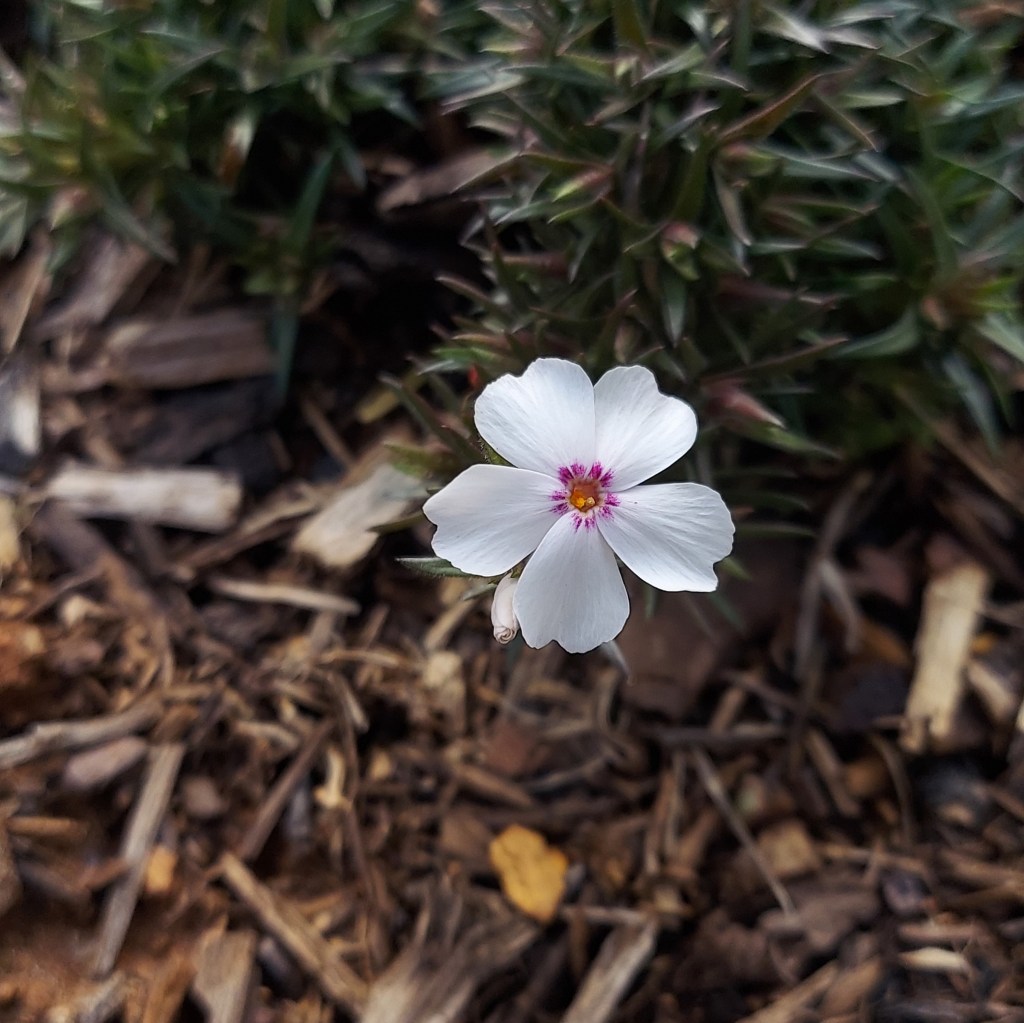
A white Phlox subulata flower.
A flower from one of the white Phlox subulata plants. These guys actually flowered pretty much all through winter!

There are also small mats of non-native “weeds,” like chickweed, purple deadnettle, and speedwell. These aren’t exactly what I was going for, but they do have several advantages over grass:

  1. I’m not allergic to them. Flowering plants like these are typically pollinated by insects. Grasses are wind pollinated. Wind pollinated plants are much more likely to be responsible for allergies, because their pollen ends up in the air (and eventually your eyes, nose, and lungs). This is also why bee pollen is generally not a great way to desensitize oneself to hay fever — it’s primarily made up of sticky, heavier flower pollens, rather than the wind-carried pollens that people with hay fever most commonly react to.
  2. They’re edible. Chickweed is actually pretty nutritious, and so is purple deadnettle. I’m not up on all of the nutrition facts and medicinal uses of speedwell, but I am assured that it is also edible.
  3. They’re not invasive enough to be restricted. While these three plants aren’t native species, they typically have pretty shallow root systems and aren’t super competitive.
  4. They require no effort. Unlike lawn grasses, they don’t need fertilizing, pesticide, weed treatment, or supplemental irrigation. While they’re not as beneficial as native groundcovers, they’re at least not a net negative like turf grass.
  5. They’re an early food source for pollinators and small herbivores. Since they’re not native to the US, they haven’t evolved alongside our native pollinators and thus aren’t really an ideal source of nectar. They do, however, provide more food that a mowed monoculture lawn does.
  6. Honestly, it looks better. I’m not a fan of the manicured look of suburban lawns. This spot has a ways to go still, but tiny blue, purple, and white flowers and multi-hued foliage beat grass any day.

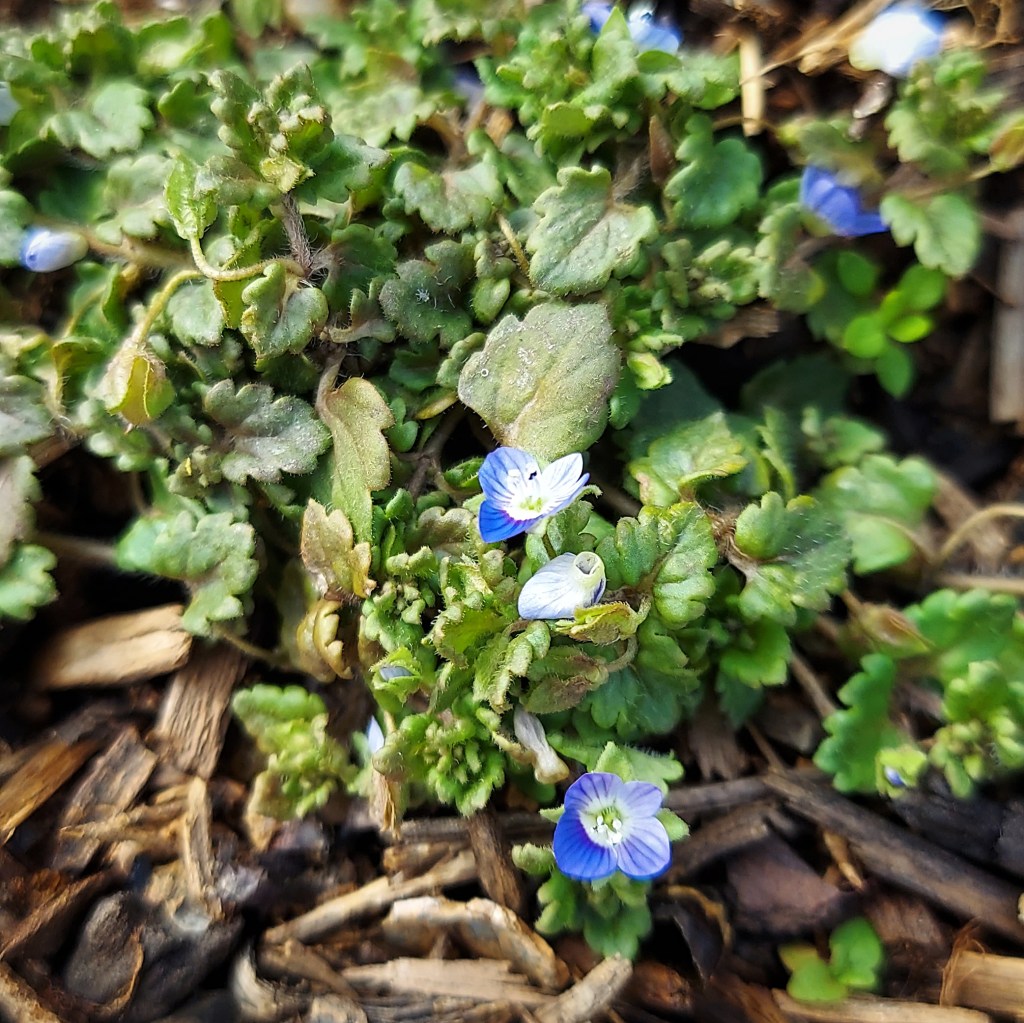
Tiny blue speedwell flowers.
Itty bitty speedwell.

Should anyone run out and sow a speedwell, deadnettle, or chickweed lawn? No, not in the US. (Non-native clover lawns aren’t really a great idea, either.) Nonetheless, I’m in less of a hurry to eradicate these plants than I was to get rid of the grass. It’s reassuring to see other plants moving into an area that was once a mowed, lifeless monoculture.

And, if you’re an invasivore, you can always eat them.

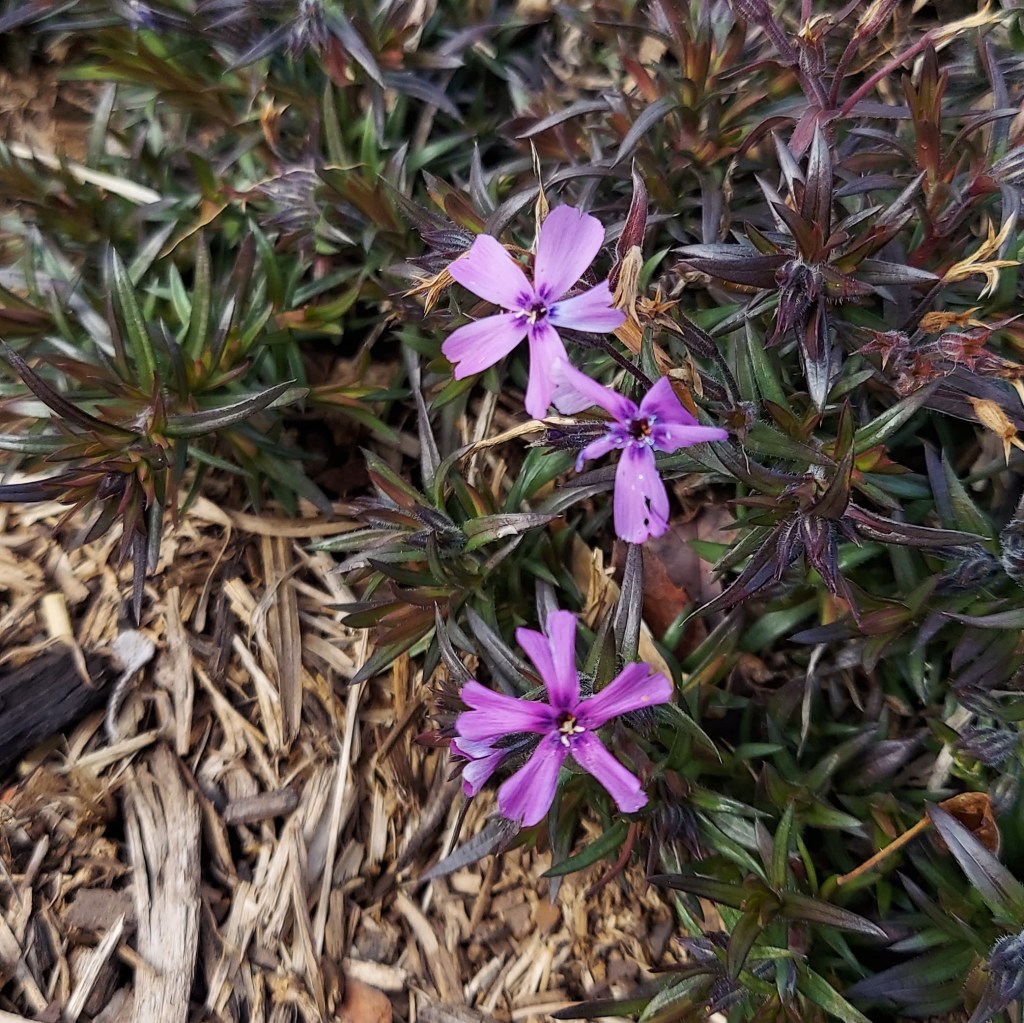
Bright purple Phlox subulata flowers.
Some of the purple moss phlox. Oddly, these guys didn’t flower as resiliently as the white did. They’re putting out more flowers now, though!

This year, the plan is to plant more moss phlox and bee balm, and maybe another coreopsis or two. I’d also like to find a source for native strawberries. These grow in slightly different conditions to the cultivated strawberries you usually see in garden stores and groceries and are a good addition to “edible landscaping” plans. For now, I’m pretty happy with the progress this little patch of dirt has made!

Neodruidry · Plants and Herbs · Witchcraft

Hydrangea Folklore and Magical Uses

I’ve written a bit about the hydrangeas we planted here. We’ve got two oakleaf and one bigleaf hydrangea, all of whom did pretty well after planting. (Well, until an incident with some botanical mosquito control, but that’s another story and everyone is fine.) It was interesting to see how the sunlight and shade seemed to affect them — the oakleaf hydrangea who got the most sun exhibited some signs of stress in the beginning, where the one planted in partial shade seemed to settle right in. Once it had time to acclimate, however, the sunny oakleaf hydrangea rapidly outgrew its compatriot!

It’s going to be a little while before I can see how my guys fared through the winter, but I’m confident that they’ll do okay and very excited to see them put out new flowers this year. In the meantime, I thought I’d soothe some of my impatience by writing about the various traditions, folklore, magical uses, and fun sciency things surrounding hydrangea.

(Also, as you read this, my Handsome Assistant is obtaining the Replacement Car. It has more cargo space than the Hyundai did, so you know what that means: I can convince him to haul home even more bushes, because I’ve got coupons to American Plant and a head full of weird ideas.)

The name “hydrangea” translates almost perfectly into “water jar.” It comes from the Greek words angeion, for vessel or capsule, and hydr-, for water. It makes sense, too — the seeds look like little amphorae, and these plants like water.

A blue cluster of hydrangea flowers against a backdrop of dark green leaves.
Photo by Rifqi Ramadhan on Pexels.com

In Victorian floriography, the cryptic language of flowers, hydrangeas have a somewhat contradictory meaning. On one hand, they represent gratitude. On the other, they represent heartlessness. This kind of makes sense if you consider them as a response to a would-be suitor. Very “thanks… but nah.”

In China, hydrangeas are associated with heartfelt apologies. These flowers are sometimes poetically called “the flowers of the Eight Immortals.” The Eight Immortals are legendary figures revered in Taoism. In one tale, the forces of the Immortals and the Dragon King clash. To apologize, the Dragon King offers seven of the Immortals beautiful hydrangea flowers.

Different colored hydrangeas can represent different things. Blue hydrangeas are the ones most commonly associated with regret and apology. White ones represent grace, purity, and vanity. Pink are for appreciation and gratitude. Yellow are for joy and friendship. Green hydrangeas are for rebirth, prosperity, abundance, and renewal. (This rather closely follows the meanings attributed to different colored roses, with the notable exception of blue. Roses do not produce blue pigment, so any “blue” roses are either actually lilac in color, artificially colored, or photo edited.)

It should be noted that a hydrangea’s colors can be variable. Unlike other plants, the things that give them their colors aren’t different pigments. Pink hydrangeas, for example, aren’t actually any different from blue ones. Hydrangeas act as giant, living masses of litmus paper. When they grow in acidic soil, their growing conditions cause their pigment to exhibit a blue color. If the soil is more basic, then it will exhibit a pinker color.

Here’s where it gets a bit more complicated. The soil pH itself isn’t actually what influences the hydrangeas’ color. It’s the naturally occurring aluminum ions in the soil. When soil is acidic, these aluminum ions are free to do their thing, hook up with other ions, have a gap year, go clubbing, get tiny little asymmetric haircuts, etc. They’re also easily taken up by the hydrangea plant, where they get all up in the hydrangea’s reddish pigment and turn it blue. In basic soil, aluminum ions connect with hydroxide ions, settle down, buy property, and get tiny little purse dogs. Aluminum hydroxide isn’t easily taken up by hydrangea plants, so the blooms stay pink. You can force a hydrangea’s blooms to change color, but it’s a whole Thing involving a lot of chemistry, soil amendments, and time.

Also, hydrangea flowers aren’t flowers at all — like flowering dogwoods, their “petals” are really modified leaves. The actual flowery bits (the tiny fertile parts in the center) aren’t super noticeable, so these jazzed-up leaves provide support and protection for the flowers, and help pollinators figure out what’s what.

Pink hydrangeas, the product of basic soil.
If you look closely at the center of each “flower,” you can see the actual hydrangea flower. You can also see the leafy veining pattern in each “petal.” Photo by Alena Yanovich on Pexels.com

From what I’ve seen, at least three online sources indicate that hydrangeas were once used to break curses. If a malevolent witch put a curse on someone, hydrangea flowers could get rid of it. However, I haven’t seen this attributed to any specific culture or tradition, nor have I found exactly how to use hydrangeas as hex-breakers.

A great many herbs with magical and folkloric significance have also historically been known for their medicinal properties. Hydrangeas are poisonous overall, but their roots and rhizomes do have some medicinal virtues. Both traditional medicine and modern research demonstrate some potential effectiveness against inflammation and problems with the bladder and kidneys, as well as a diuretic effect.

Hydrangeas aren’t just a little poisonous, either. They contain amygdalin, the same cyanide-producing compound in bitter almonds. It’s also related to the one that was rebranded as “laetrile” and “vitamin B17” and sold to unsuspecting and desperate cancer patients. That said, a completely different compound called hydrangenol may inhibit bladder cancer, and that’s neat!

Astrologically, hydrangeas are connected to Libra. Elementally, they’re associated with Water. (Which makes a lot of sense, considering their preferred growing conditions and the whole diuretic thing.)

Though I wasn’t able to find a source for breaking curses with hydrangeas, they can be useful to grow as boundary plants. In most cases, a plant’s magical function follows its mundane form and use. Hydrangeas are dense, lush, and also poisonous. () A nice, healthy hedge of hydrangeas is a wonderful boundary. Just shoot for native varieties — they’ll thrive more easily, require less intervention, and you’ll be helping out your local pollinators and combating habitat loss!

A cluster of light blue hydrangea flowers against a dark background.
Photo by Sonny Sixteen on Pexels.com

Hydrangeas also make beautiful, very easy bouquets, offerings, and altar decorations. Each head is pretty much a bouquet on its own. Choose a bloom that’s the right color for your intention — for money or fertility spells, for example, choose green ones. For purification, pick white. Just make sure to keep them away from children and pets.

Hydrangeas also dry beautifully, though they lose some of their color in the process. Still, the “flowers” have a structural beauty. They’re good for wreaths and basket arrangements. Consider making a dried hydrangea wreath and empowering it to energetically protect your home’s entryway.

I still have some time before these hydrangeas bloom, but I can hardly wait. Here’s hoping they’ve settled in enough to fill out and flower abundantly this year!

Plants and Herbs

Wintergreen Folklore and Magical Uses

Winter’s rapidly coming to an end — we still have a day or so of snow and cold temperatures here and there, but there are signs of the plants and soil waking up all over. On one particularly nice day, I was sipping a root beer on the back deck when a memory came to me out of the blue.

Two glasses of soda, with ice and straws.
Photo by PhotoMIX Company on Pexels.com

“I could never stand that stuff,” a friend of mine once said.

“What, root beer? It’s like the most basic beverage of no offense to anyone.”

“It tastes like mouthwash,” he replied.

“… You’ve got to be kidding me.”

He wasn’t exactly wrong, though. Some of your fancier, gourmet root beers do contain derivatives of wintergreen, perhaps best known for playing a starring role in chewing gum, breath mints, those white Lifesavers candies, and yes, toothpaste and mouthwash. Even the artificially flavored ones have echoes of this flavor.

Wintergreen is a fun ingredient. It has a ton of uses industrially, medicinally, magically, and in food. It also has one of those names that can get you in a bit of trouble if you’re not careful.

(and a bunch of chemistry stuff)

There are a lot of plants named “wintergreen.” Members of the genus Gaultheria are native to Asia, Australasia, and the Americas. Pyrola is distributed temperate and arctic North America, Europe, and Asia. Chimaphila used to be a whole separate thing, but is now in the same family as the other wintergreens. (Don’t get me started on one-flowered wintergreen.) All of these genera fall under the family Ericaceae. Some members of Lysimachia are sometimes called “wintergreen” even though they’re all pimpernels and loosestrifes (loosestrives?) and aren’t related at all. As if that weren’t confusing enough, the term “wintergreen” also used to be applied to any plant that remained green through the winter, the way we now use the word “evergreen.”

While there are a ton of different wintergreens out there, the classic oil of wintergreen flavor is primarily either derived from Gaultheria wintergreens or synthesized.

A bit of modern folklore says that, if you bite a wintergreen candy in the dark, it’ll spark. Wintergreen candies can create sparks under the right conditions. This is due to triboluminescence, which occurs when energy is put into atoms by friction, heat, et cetera. When those atoms return to their normal state, that energy is released as a brief spark. Chomping on regular old sucrose is enough to generate a little triboluminescence, but the brightness of wintergreen candy sparks comes from a neat synergy between the sugar and the wintergreen oil. The oil’s most notable aromatic compound, methyl salicylate, is fluorescent. When the sugar grinds against itself when you bite it, it emits a bit of dim triboluminescence that’s mostly outside of the visible spectrum. The fluorescent methyl salicylate absorbs this energy and releases it as much more visible blue light. Put it all together and voilà, sparks!

Red wintergreen berries and green leaves.
Photo by Mike Serfas.

Speaking of methyl salicylate, you might recognize the “salicyl” in there. (Methyl salicylate is an ester of salicylic acid — in fact, artificial wintergreen flavor is synthesized from straight-up salicylic acid and methanol.)

Traditionally, Indigenous people prepared the leaves as a tea to ease symptoms of rheumatism and other joint pains. In the body, methyl salicylate gets metabolized into salicylic acid, the same pain reliever derived from white willow bark (Salix alba). However, wintergreen oil is pretty potent stuff. A single teaspoon of it is about equivalent to 20 300mg aspirin tablets!

Another member of the Ericaceae family, Chimaphila maculata, is known as “spotted pipsissewa.” This is derived from the word pipsisikweu, meaning “breaks into small pieces,” since it was traditionally used to treat gall, kidney, and bladder stones.

Though the oil is highly potent, teaberry is edible. The berries can be made into pies, and the leaves eaten as a potherb.

Because of its evergreen properties, wintergreen is used for money drawing. In Hoodoo formulas, for example, it often finds its way into gambler’s incense. Nothing like an herb that stays green to help keep you rolling in green, right?

In other traditions, this herb is used for clarity, focus, and healing. It is sometimes included in anointing oils for meditation, in the belief that it’ll help the user focus and heighten the meditative experience.

Carrying a sprig of wintergreen is said to keep evil away and attract luck to the bearer. It’s often used as an herb for general protection. (Oil of wintergreen is also an ingredient in some lubricants used for weapons, for entirely unrelated reasons.)

Wintergreen is sometimes used as a love-drawing ingredient, though I haven’t often seen it included in recipes for this purpose. It makes sense, though, considering the ways it’s used to attract other good things.

Wintergreen is associated with Saturn (as a protective herb) and the Moon (as a healing and love-drawing herb). It’s also connected to the astrological sign Capricorn.

Man, I really wish I had more to point to here.

The thing is, I’m one of those people who’re unfortunate enough to be “salicylate sensitive.” It doesn’t take all that much for me to experience salicylate poisoning. (Pepto Bismol made me deaf for a week, with the exception of a constant, maddening, high-pitched whine.)

Sure, other herbs contain various salicylate-related compounds. I mean, even rosemary is pretty high in them. Wintergreen oil has a bit of a reputation, however, and it isn’t entirely undeserved. So even anointing with an oil containing wintergreen is A Lot for me.

(Just gonna pause here to let everyone get all the “wintergreen repels evil” jokes out of the way. Aaand… okay.)

This is by no means to scare you away from this herb — far from it. It has a long history of use as medicine because it has an effect on the body. For some, that’s relieving pain. For people like me, it’s less pleasant.

As a result, I don’t really work with wintergreen much myself. When I do, it’s usually through consuming food or beverages flavored with it, rather than using the oil or herb directly. I essentially treat them as pre-made potions, which I empower and enchant for whatever I need them to do. Usually that’s using a cold herbal root beer to ease a headache or a sour stomach.

Wintergreens are also wonderful plants to grow. Under the right conditions, they can even replace non-native lawn grasses. They’re low-growing understory plants and an abundant source of food for wildlife. Growing them near your home can help repel bad energy, attract good energy, reduce the environmental and monetary burdens of pesticides, chemical fertilizers, and extra irrigation, and bring you many small bird friends.

Should you use wintergreen? If you’re not allergic or sensitive to it or any of its components, then there’s no reason to avoid this beautiful, versatile herb. Treat it responsibly and respectfully, and keep wintergreen preparations well out of the way of pets and children.

Neodruidry · Plants and Herbs · Uncategorized

Cedar Tree Folklore & Magical Properties

I’m not a fan of fake greenery. While it can definitely amp up a room’s decor when it’s judiciously combined with real plants, I always end up forgetting to maintain it until it’s faded, dusty, and doing the exact opposite of helping things look fresh and natural. Blegh.

Anyway, when it comes to decorating for Yule, my Handsome Assistant and I go for fresh greens. There’s a florist nearby who sells trimmed branches of various evergreens pretty cheaply. Combine a few of them with some wired ribbon, and you can make a very pretty swag or garland without spending much money at all.

A close up of fanlike American cedar branches.
Photo by Abdul Zreika on Pexels.com

This year, we picked up the cutest little potted Alberta spruce tree. We’re keeping it indoors until spring, at which point I’m going to repot it and set it outdoors. Next winter, it’ll probably still be small enough to fit in the living room and be next Yule’s tree, too. Once it’s outgrown its pot, we’ll plant it in the front yard.

We also picked up some trimmed branches from an incense cedar tree (Calocedrus decurrens), which I used to decorate table tops and the top of our curiosity cabinet.

Since we’ve been taking down our Yule decorations and cleaning up the shed bits of greenery, I thought now might be a good time to look into the folk tales and magical associations of cedar trees.

First things first: “Cedar” isn’t a very exact term. True cedars are chiefly found in the Mediterranean, but there are also quite a few unrelated American species referred to as “cedar.” True cedars have needles, while American species have flat leaves, like scales, that form delicate fernlike or fingerlike structures (as seen in the photo above). There are only four species of “true” cedar: cedar of Lebanon (Cedrus libani), Atlas cedar (C. atlantica), Cyprus cedar (C. brevifolia), and deodar cedar (C. deodara). American cedar species are actually members of the cypress family, Cupressaceae!

The needles of an Atlas cedar, one of the "true cedars."
Photo by Feyza Dau015ftan on Pexels.com, showing the needles of a “true cedar.”

American cedars are culturally significant to the people indigenous to the trees’ native ranges. Indigenous people used (and continue to use) cedar as a sacred incense and purifying herb. Cedar trunks were used to make boats, the branches were used to filter sand from water and when leaching acorns for acorn flour, and the fibrous roots are still used to make beautiful baskets.

Cedar smoke was also used to prevent illness, which mirrors the old Scottish practice of fumigating one’s home with juniper for the same purpose. This is particularly interesting since the eastern red cedar, Juniperus virginiana, is actually a juniper. Junipers are also members of the cypress family, like other American cedars are.

Many Salish groups had special rituals for the felling of cedar trees. These trees are considered symbols of providence, abundance, and generosity.

A Mi’kmaq tale warns you to be careful what you wish for. A man went to the legendary Glooskap and asked if it was true that Glooskap gave people whatever they asked him for. Glooskap demurred, saying that he couldn’t always answer people’s requests, but he helped however he could. The man asked Glooskap for immortality, but he refused — all things must die. Once everything has died, even Death would probably die. Disappointed, the man asked to live longer than any man has ever lived. In return, Glooskap turned the man into a tall cedar tree.

A Potawatomi tale tells of a group of men who visited the Sun to ask for help. One desired to see the future, two desired immortality, another desired a blessing associated with water, and yet another had gone along just to help the others. The man who wished to see the future was set down in the west, where the Sun goes to end the day. One of the men who wanted to be immortal became a boulder. The man who wanted a water blessing became a half-man, half-fish. The other man who wished for immortality became a cedar tree. This is how people received the stones and cedar used in sweat lodge ceremonies.

In Judeo-Christian stories, cedar represents protection and strength. Its wood was used to build Solomon’s temple. According to Medieval Christian tradition, the cross used during the crucifixion was made of cedar. For this reason, it was considered bad luck to burn cedar wood. Planting a cedar in your yard was also believed to bring misfortune and poverty, but a cedar growing naturally was considered fortunate.

In Irish folklore, cedars were associated with strength and durability. Their wood is extremely rot-resistant, and the trees live for a very long time.

Like a lot of other magical ingredients used for protection and banishing, all types of cedar repel pests. The aromatic compounds in their essential oils are a deterrent for moths and all kinds of biting insects. All around the world, there’s a very strong connection between “plants that keep bugs out” and “plants that keep evil away.”

Depending on your needs, you may or may not be able to substitute juniper-family cedars for “true” cedars. There is quite a bit of overlap, however — no matter which species you’re working with, these trees are connected to purification, protection, longevity, and strength.

Since we’re talking about some very distinct groups of trees that use the same common name, I won’t go into cedar’s medicinal properties here. This underlines the importance of using standardized nomenclature — each of these species has its own bouquet of medicinal compounds (and some potentially dangerous ones, like thujone), so it’s important to know exactly what you’re using. Never go by a plant’s common name when you’re looking for medicinal ingredients, because there’s a ton of common name overlap between completely unrelated species.

The most important thing to recognize when working with cedar is that this is a plant that should be respected. The famous cedars of Lebanon (Cedrus libani) were highly regarded — the oldest among them were considered sacred, and anyone who harmed them would be overtaken by misfortune. In the Potawatomi tale above, the man who became a cedar says that one should “call the cedar tree your nephew when you speak of it.” Folklore all around the world warns against cutting down a cedar without performing the proper ceremonies.

With that in mind, there are multiple ways to work with cedar. Cedar essential oil is frequently used in magical aromatherapy (though a little bit goes a very long way). Cedar twigs can be burned as incense and used in smoke cleaning. Since the wood and needles are so strongly aromatic, you can also infuse them in oil.

Dried conifers are easy to crumble, so they’re an easy ingredient to include in magical powders or incenses. Grind dried cedar leaves fine and sprinkle the powder in the corner of your rooms or around the border of your property while asking for protection against malevolent forces.

If you or anyone in your household has been sick. use cedar smoke to drive the illness out. Give the sickroom (in modern homes, the sick person’s bedroom and bathroom) a thorough physical cleaning, air it out well, and fumigate it with cedar smoke.

Right now, I have some dried cedar branches waiting to be used. These didn’t require a tree to be felled — instead, they’re trimmings. My plan right now is to grind the leaves fine, mix them with a binder, and form them into incense cones. The branches have blessed and protected my home when they were fresh, and they can continue to do so once they’re processed into incense.

I love the warm, earthy, spicy smell of cedar. In my tradition, it’s connected to the sun and the element of Fire. During these dark, cold months, inviting the power of cedar into your home can bring some much-needed heat, light, cleanliness, and protection.

Plants and Herbs

Cypress Folklore and Magical Properties

I first started this post in January… of 2020.

A bald cypress in autumn. The needles are a vibrant read and very close to falling.

The reason it took so long was because I wanted to do the subject justice. Cypress trees are my favorite trees. I feel closer to them, and more power from them, than I do other trees. They’re sacred to me. I even have a glass pendant filled with slivers of lightning-struck bald cypress wood, and a pendulum made of a naturally fallen bald cypress’ knee.

Since the local bald cypresses have lived up to their names and done their trademark needle-shedding, I thought now would be a good time to dust this post off and finally finish it.

To the ancient Greeks, cypress trees had a tragic origin. Kyparissos was a youth who was beloved by Apollo. Apollo gave Kyparissos a beautiful tamed stag who accompanied the boy everywhere. Unfortunately, the stag was slumbering in the forest when the boy was out hunting, and he accidentally killed his stag with a hunting spear. Heartbroken, Kyparissos grieved so deeply that he transformed into a cypress tree.

The staff of Asklepios, the Greek God of Healing, was made of cypress wood. Though cypress does have some medicinal qualities, it’s likely that his staff used cypress less for its healing attributes, and more for its connections to immortality.

Sacrifices to Hades and Persephone were made under groves of cypress trees. Asklepios’ staff may have been a symbolic placation of the deities of the Underworld, so that they would not take his patients.

One of Athena’s names was “Lady of the Cypress.”

Bald cypresses are so named because they are deciduous. Every year, they shed their needles during the winter months.

Bald cypresses (Taxodium distichum, in the Cupressaceae family) are also unique in that they form “knees” — tall, knobbly growths that spring straight up from the trees’ roots. Nobody’s really sure why this happens, as the knees don’t appear to serve a particular purpose and removing them doesn’t seem to affect the trees negatively. They just kind of… happen. Some theories for cypress knees describe them as an adaptation for living in very wet environments, by helping to aerate the roots, provide an additional means of preventing erosion, or helping to stiffen and strengthen the root system.

Some cypress knees get pretty big. While they’re mostly conical in shape, they can be really irregular and knobby. It wasn’t uncommon for travelers, particularly those walking at night, to mistake them for other people or even monsters.

In general, cypresses are guardians of boundaries. Members of Cupressaceae are symbols of death, immortality, the afterlife, and liminal spaces. Their typically upright growth habit connects the earth to the sky, and they’re commonly planted on the borders of cemeteries. Kyparissos’ legend further associates these trees with death and grieving. Since these trees are evergreen, they are identified with the concepts of immortality and the afterlife as well.

I wasn’t able to find much information about Chinese cypress species, but the bit I did find suggests that cypress seeds were eaten to preserve longevity. In Japan, hinoki cypresses have a prominent place in Shinto rituals. Hinoki wood is used to start ritual fires, as well as to make the priests’ scepters.

A close up of a cluster of green cypress cones.

Though bald cypresses are native to America, they still connect to similar concepts as their Middle Eastern, European, and Asian counterparts. Though they resemble evergreen conifers, they shed their needles every year — a symbolic death and rebirth. They also grow where the water meets the land, which is another liminal space.

According to Persian legend, a cypress tree was the first tree to grow in Paradise. It’s evergreen leaves and extremely durable and rot-resistant wood made it a fitting symbol for immortality.

Cypress motifs are frequently used to decorate graves and tombs. You can see this on Christian graves, and in abstract depictions on Turkish Muslim tombs as well.

Some sources claim that Indigenous American peoples believed that cypress trees had a connection to the spirit world. This claim is vague, however, and since I couldn’t find any specific references to which tribes and nations believed this, it should be taken with a grain of salt.

Cypress wood, when used in wands, is said to have a calm and soothing energy. This follows cypress’ use as a symbol of, and remedy for, grief.

Medicinally, cypress oil is used to soothe coughs, treat warts, ease hemorrhoids, treat cuts and broken skin, relieve pain from muscle aches and varicose veins, and ease symptoms of anxiety and depression.

Personally, I love cypress and get a lot out of its connection to the other worlds. Bald cypresses, in particular, are excellent emblems of the thin border between the material plane and the spirit worlds. I’ve used cypress to ease thanatophobia, and as part of an excellent oil for trancework.

If you don’t have access to cypress trees or wood, the easiest way to work with them is probably through their oil. Cypress trees are fragrant and produce a lovely essential oil. If you avoid using essential oils due to safety or sustainability concerns, you can also try purchasing some cypress needles and infusing your own oils. I’m fortunate that bald cypresses are native to this area, so there are plenty around when I need to gather twigs, needles, or cones.

If you work with grief, or as part of the counseling or deathcare industries, it may be worthwhile to explore the properties of cypress wood or oil. Even if you don’t choose to use incorporate this into your work, the aromatherapeutic and energetic properties may help ease the stress of confronting death and grief on a daily basis.

A close up of the base of a bald cypress trunk, showing four distinct knees. A pond and more trees are visible right behind them.

I have several bald cypress knees around my house. Some are altar pieces, some are floor sculptures, some are cabinet specimens. It doesn’t hurt bald cypress trees to have their knees removed, and many homeowners do so in order to make their yards a little safer and easier to maintain. You can often find cypress knees for sale on Etsy or eBay.

Cypress trees are great. If you live in an area with a native cypress species, plant one. They’re beautiful, they’re useful, and they’re powerful.

Plants and Herbs

Maple Folklore & Magical Properties

This past weekend, my Handsome Assistant and I took a small drive down Falls Road (alias Scenic Route 25). This was recently dubbed the second-best route in the country for seeing fall colors, and, while the leaves haven’t quite reached their peak just yet, it was a really lovely drive.

Red maples (Acer rubrum) are one of my favorite trees to see in autumn, and I’m lucky to share a home with one. Their leaves turn a vibrant scarlet every autumn, hence the name.

Bright red maple leaves on a branch.

Honestly, I just love maples in general. As a little kid, I used to pick up their samaras (we called them “pollynoses”) from the sidewalk, open the seed capsules, and stick them on the end of my nose. I bake primarily with maple syrup. I’m trying to convince my Handsome Assistant to make his next back of mead a batch of acerglyn (a similar beverage made of half honey, half maple syrup) instead.

I probably don’t need to say that trees have featured prominently in Pagan practices probably ever since the first Pagan. Each one has its own traits and associations, and, when it comes to working with the wood, leaves, or fruits, its own magical properties.

To be honest, maples were so ubiquitous where I grew up that I didn’t know they weren’t more widely harvested from. When I was thirteen, I was a foreign exchange student, which resulted in a brief stay in the Netherlands before going to Sweden. My student group (jetlagged and exhausted) stopped at a cafe on our first day there, where I happily ordered a plate of silver dollar pancakes and syrup.

But it was not syrup.
It was stroop.

Stroop (rhymes with “rope”) is often made of boiled-down fruit, water, and sugar, but can also be made with molasses and brown sugar. While it isn’t bad by any means, the latter variety is kind of an unpleasant surprise when you’re a kid who’s used to maple syrup with pancakes, hates molasses, and also desperately needs a nap. Not knowing any better, I drenched my pancakes in stroop and made myself a very avoidable struggleplate.

Anyway, all of this is to say that maples rock, maple syrup is the food of the Gods and should absolutely never be taken for granted, and I may still carry some molasses-induced trauma.

Maple’s genus, Acer, is Latin for “sharp.” This is due to their very unique, pointy leaves.

An Abenaki story tells how maple syrup once flowed freely from trees. It came so easily, people would lay on their backs and just let the syrup run right into their mouths. The legendary figure Glooskap saw how lazy people had become, so he turned the thick, sweet syrup into runny sap. From then on, if people wanted to eat maple syrup, they would have to work for it!

Another story, said to be of Haudenosaunee origin, tells of a man who watched a red squirrel nibble the end of a maple branch. The sap flowed until the sugars dried, hardened, and crystallized. The squirrel then came back to lick the sweet maple sugar.

In European-based magical systems, maple syrup is often used as an ingredient in love spells.

Maple sugar or syrup is also a useful ingredient in sweetening jars.

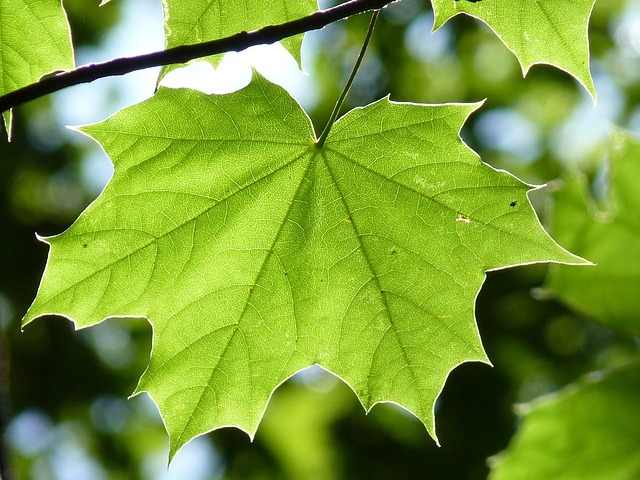
A bright green maple leaf.

By contrast, maple wood is considered very protective. It was sometimes incorporated into doorframes for this purpose.

Some sources consider maple to be good for prosperity and abundance in general.

As wand wood, maple is known for having a somewhat erratic energy. It also helps dispel negative energy, center oneself, and reveal paths and options one may not have considered.

Maples, particularly silver maple (Acer saccharinum) are considered Moon plants. They’re also associated with the element of Water.

Working with maple can be as simple as using magical tools made from the wood. Every tree — and thus every wood — has its own energy. I haven’t personally found maple to be erratic, but, to be totally honest with you, I’m erratic enough myself. (I think it also helps to have sourced the wood from a tree that I know pretty well!)

If you’re in the eastern US, you’re probably located near a maple tree. If that maple tree is anything like the one here, it probably drops plenty of sticks and smallish branches every time there’s a storm. Should you be of a mind to make your own magical tools, deadfall maple wood is honestly really easy to come by.

I can only vouch for red maple, but, once the bark and cambium are stripped off, the wood itself is light and silky-feeling. Sanded well, it takes on an almost metallic sheen. I love it.

The next easiest way to work with maple is to use maple syrup. You’ll need the real stuff for this, unfortunately — the fake stuff is cheaper, but also doesn’t really bear any resemblance to the genuine article. (There’s a good reason for that, too. Maple sap is chemically very complex, and we still don’t really understand all of the different compounds and reactions that give boiled sap its flavor. That makes it pretty much impossible to make a decent imitation syrup.)

If you’re looking to make a sweetening jar, artificial syrup is probably fine if you can’t get your hands on the real stuff. That said, plain sugar and tap water will make you a perfectly fine simple syrup that’ll a) be cheaper, b) let you add your intention or energy during the syrup-making process, and c) let you bypass the artificial flavors, colors, and other ingredients that don’t really add anything to the magic-making.

Otherwise, add maple syrup to your favorite edible magical recipes. Like I mentioned above, I bake with it almost exclusively — it’s pricey, but I love what it does for the flavor and texture of desserts. Seriously. It makes amazing breads and cakes, and is fantastic in chocolate chip cookies. Add the maple syrup, thank the tree for its sacrifice, tell the syrup what you want it to do for you, and stir your concoction clockwise using your dominant hand. Easy peasy.

Maple samaras (aka, pollynoses) can also be helpful additions to a charm bag. They end up all over the place in late spring to early autumn, so, if there’s a maple anywhere near you, you probably won’t have any trouble finding some. Add them to bags for prosperity, love, or protection.