Plants and Herbs

Moss Folklore and Magical Uses

In honor of the adorable little clump of moss that I found when hiking last weekend, I thought that I’d write about the different folk tales, cultural significance, and magical properties of these awesome little plants.

Before I do, I do want to point out one thing that’s pretty funny: A lot of the plants we consider/call “moss” aren’t actually moss at all. Some of them aren’t even the same kind of organism. Oakmoss (Evernia prunastri), for example, is a source of fragrance and often considered to be a grounding ingredient that’s associated with the element of Earth. However, it’s a lichen — a composite organism of fungi and cyanobacteria or algae species — that spends its entire life in trees. Reindeer moss (Cladonia rangiferina)? Also a lichen. Spanish moss (Tillandsia usneoides) is neither lichen nor moss — it’s a flowering plant related to those spiky little air plant guys you find glued to magnets at gift shops. Irish moss (Chondrus crispus) is algae. The other Irish moss (Sagina subulata) is actually part of the carnation family. You probably get the idea.

A close-up of moss-covered tree roots.
Photo by mali maeder on Pexels.com

So, for this post, I’m limiting myself to the “true” mosses. These short, spongy little members of Bryophyta occupy a unique place in magical traditions and folklore.

In a Cree legend, Wisagatcak the Trickster attempts to catch the Great Beaver. His attempt backfires when the Great Beaver gets muskrat to bite Wisagatcak in the backside. Seeking revenge, the Great Beaver begins to flood the whole planet. In response, Wisagatcak made a great raft to wait out the flood waters. Moss began to grow on the raft’s damp wood. As it grew, a wolf on the raft ran around and around, working magic to expand the moss and cover the Earth in land once again.

A Salish story tells about a Chief with a very beautiful daughter. When she came of age, he wanted to make sure that she married well, so he held a race: The man who had the strongest legs could marry his daughter. Many creatures showed off their physical prowess. Coyote was swift and cunning, Deer was strong and graceful, and Bear was powerful.
And then there was Blue Jay, with his twiggy little bird legs. He thought this whole competition wasn’t fair, so he hid behind a tree and covered his legs in moss and clay. He sculpted false muscles into the moss and clay, so, when he came out of his hiding place, he looked like he had the most powerful legs of all. (He also brought gifts of beautiful feathers, which certainly helped.)
Blue Jay won the girl, scooped her up, and carried her to his home across the river. Unfortunately for him, the river water washed away his fancy moss-and-clay legs. When he emerged from the water with his little skinny bird legs, everyone laughed.

A close-up of a snail crawling on some bright green moss.
Photo by PhotoMIX Company on Pexels.com

German folklore talks about the moss people, or Moosleute. These are a kind of forest fae that are said to be about the size of human children, but gray, old-looking, and clad in moss. In some tales, they’re said to be taller and beautiful.
These creatures are similar to the Irish sidhe, in that they can be capricious — on one hand, they may ask for help from humans and reward them generously for giving it. On the other, they’re really easy to anger by either scorning them or their gifts, or trying to give them caraway bread.
Moss people are often, though not always, the objectives of the Wild Hunt.

Lada (also known as Ladona or Lelja), is widely regarded as a Baltic and Slavic Goddess of spring, harvests, love, marriage, and fertility. She’s a deity akin to Freyja, Venus, or Aphrodite. She’s sometimes said to scatter moss as she passes, bringing new life and fertility to the soil. (Interestingly, she may have been invented by medieval Christian scholars in an attempt to malign local folk beliefs and Pagan practices, but opinions on this are divided.)

One common bit of modern myth involves painting with moss. It’s said that you can get moss to grow anywhere you want by putting it in a blender with buttermilk, then painting the slurry on fences, walls, et cetera. In fact, the buttermilk isn’t necessary — it doesn’t feed the moss in any way, because moss doesn’t take up nutrients from its substrate. Moss doesn’t even have roots. It has rhizoids, which allow it to draw moisture and nutrients from its surface. Give moss moisture and a flat place to grow, meet its lighting needs, and it’ll happen.

A fallen tree completely overgrown with moss.
Photo by Pixabay on Pexels.com

It’s often said that you can navigate with moss, because it only grows on the north side of trees. While this can be true in specific circumstances, it’s not true often enough to be useful. In the northern hemisphere, the north side of anything generally receives the least sun. This means that the north side of a tree is likely to be the dampest, coolest, and shadiest side. However, if there’s anything around the tree to provide shade (like buildings, other plants, or even just the tree’s own leaves and branches), then moss will grow wherever it pleases.

Traditionally, moss is associated with healing, resilience, persistence, and rejuvenation. It’s not a fussy plant and will grow in places many other things can’t. Even when it’s removed, as long as conditions are right, it’ll come right back.

The hardest part about working with moss is figuring out what’s actually moss. The first step, then, should be to learn to identify local moss species. Avoid going by common names, as these can be misleading. This isn’t to say that the plants-that-are-called-moss-but-aren’t-actually-moss don’t have their own special properties, but there’re quite a few differences between a terrestrial, non-vascular, spore-producing plant, and a tree-growing colony of fungus and algae!

A glass jar terrarium planted with moss and orchids.
Photo by Katarzyna Modrzejewska on Pexels.com

You can include bits of dried moss in sachets or amulets for protection and stability.

Beds of moss are great decorations for outdoor altars. They’re soft, beautiful, and provide an effective and tactile way to connect with Earth energy.

Moss is also a good offering for faeries and nature spirits. In some cultures, moss is considered a source of their power. Some members of the faerie realm are also said to use moss to camouflage themselves from human eyes.

If you do practice moss painting, you can use it to place protective sigils around your property.

Moss is a beautiful, unique, and resilient little plant. It survives where other things give up, and doesn’t really need much to thrive. Whether you use it as a magical ingredient, or just view it as a source of inspiration, it’s a really lovely thing to work with.
Environment · life · Plants and Herbs

Sharks’ Eyes and Poison Orange

Some parts of DC are weird.

I mean, some parts of everywhere are weird, don’t get me wrong. Where I grew up, our favorite activity was spelunking in the sewers (I found a stray femur and was almost eaten by geese). When I lived in Delaware, it took me a bit to get used to the way the landscape was broken up — apartment complex, forest, strip mall, pasture, wetlands, wetlands, wetlands, city. In California, the neighborhood was a very tiny island in the middle of fields and pastures. Sometimes, you’d wake up and see all of the puddles shimmering strangely with whatever the crop dusters were spraying the day before. At night, even without seeing any cows for miles, you’d hear their eldritch moos as if they were right in the yard. The songs of coyotes carried for untold distances. Uncanny-valley strangers would come and knock on your door, ask to borrow things, and disappear. It had a very Southern Gothic atmosphere, especially for a place that was emphatically neither.

DC is weird in its own way. I love it here, and there are some extremely cool places and people. The architecture is gorgeous, and you can find some very lovely Victorian-style houses and unexpected details. Still, there are plenty of other areas here that I try to avoid if there’s any way to help it.

This was one of those.

My partner and I were picking up food at this place we found at the beginning of COVID — a little pricey, but they’ve got the best damned catfish po’boy and blackberry shortcake I’ve ever had. (I’d drop the name, but the location is called four different things depending on whether you go there on foot, find it via Google Maps, read their bags, or try to order through a delivery app. Like I said, weird.)

It’s situated in an area that, not unlike the rest of the city, combines historical architecture with modern touches. The thing is, where other areas of DC seem to give the impression that this is done out of necessity, or to fulfill actual human needs, this seems almost malicious. Concrete angel faces stare mutely out over doorways to imposing office and municipal buildings, expressions framed in equally-stony olive branches. At street level, there are stores — jewelers, Nordstrom Rack, a seemingly impossible number of Starbucks cafés — with large, thoroughly modern plate glass windows with the dead, flat gleam of sharks’ eyes.

There’s something about it that strikes me as very calculated. There’s a cultivated air of diversity here, but the kind of diversity that wouldn’t welcome anything that wasn’t a high-end department store, a Starbucks, or an eatery capable of suiting a very narrowly defined sensibility. Some of it is very pretty, but stifling, almost.

On the sidewalks, people sit too close together at outdoor tables. A maskless couple walk by, pushing a leather-clad baby carriage that mommyblogs say could pay a month of my neighbors’ rent.

People live here, too, but everything feels aggressively tailored to those who work here instead. I don’t think they’re the same population. Thinking about it too much makes my teeth itch.

I need to get the fuck out of here,” I whisper-hiss to my partner, “Because I’ve got maybe ten minutes before this place turns me into an anprim.”

I wonder if this is how fireflies feel when you put them in a mason jar with a stick and a leaf.

Fortunately, getting elsewhere only takes about ten minutes. It might be a strange byproduct of this one self-hypnosis program I sort-of-kind-of-maybe did wrong a few years ago, but the sight of the color green makes my nerves finally start to unknot themselves.

We park and walk a ways. I know my food’s getting cold, but I don’t really care. I take big breaths — there’s smoke coming from somewhere, and it tinges the smell of soil, gently decaying leaves, and damp wood with an earthy sweetness.

We find a picnic table. I always eat fast, but today I manage to finish before my partner’s done unpacking.

“Okay! Gonna go climb on that tree and look for friends!”

He’s grown used to this. I think you kind of have to, after awhile — it’s something that seems pretty firmly baked-in to me. I’m told that when I was very little, maybe four, we had some kind of family function at a beach. My dad says he heard me walking around making tiny proclamations: “Anyone who wants to go find bentures, follow me!” (Then I disappeared into some trees for awhile and he had to peel me off of a sheer clay cliff face, but that’s another story.)

When I was dating one ex-partner, it was a near-constant bone of contention that he never wanted to go exploring with me. I ended up having a lot of adventures with my dog, including finding a broken wooden footbridge that led to nowhere, covered in graffiti that dated back to the ’40s. (I’m almost positive it was Extremely Haunted.)

After that, another ex-partner used to give me survival equipment for every holiday. They figured the odds were pretty good that I’d end up disappearing into the woods some day, and they wanted to hedge their bets on me coming back alive eventually.

In short, I think most of my loved ones throughout history have adapted to the idea of probably seeing me show up on the internet after being mistaken for some kind of pygmy sasquatch.

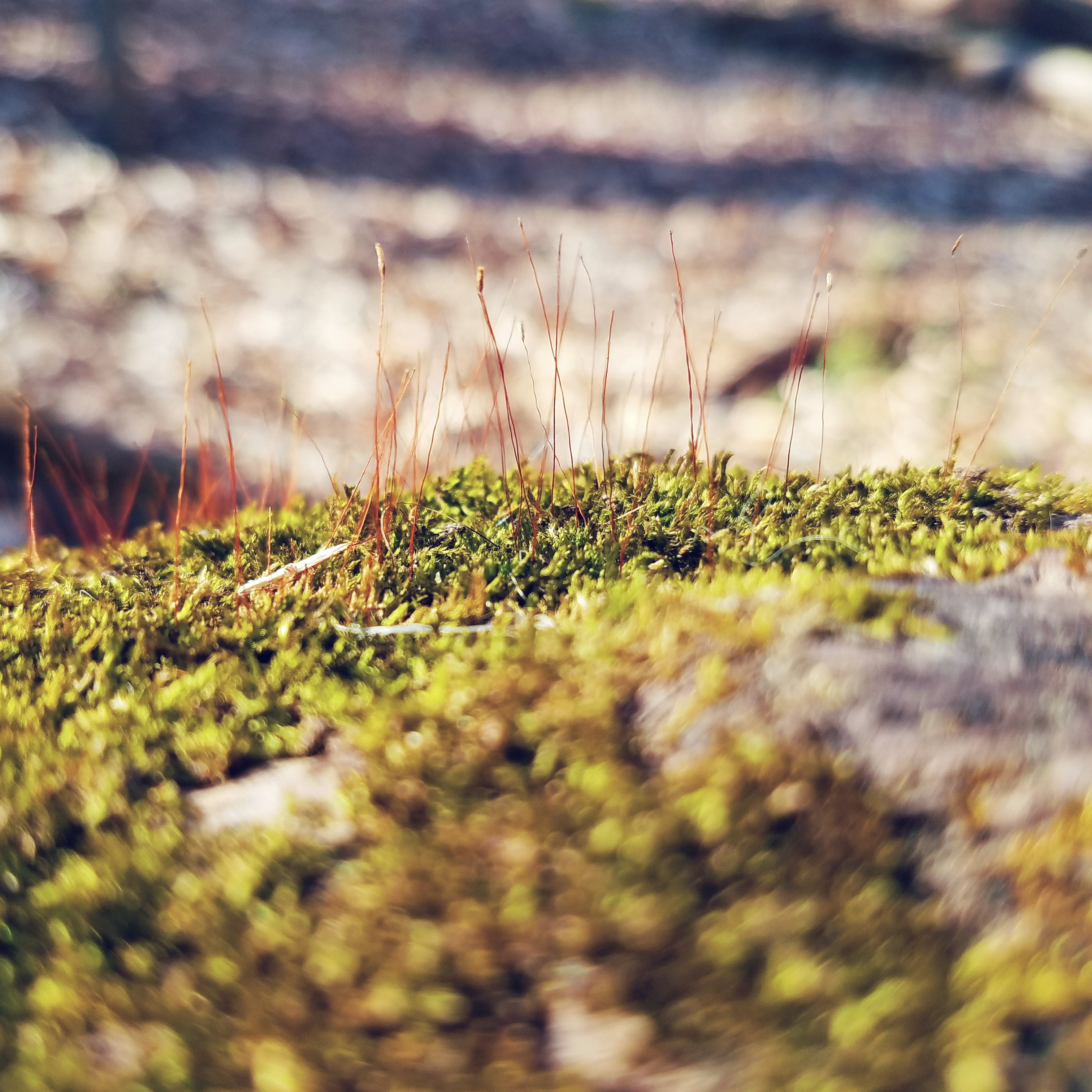
There’s so much moss. Damp and feathery, sporophytes reaching up on stalks like delicate red threads. I could probably photograph it all day, to be honest — the structures are so beautifully complex when you get close enough.

My partner comes to join me, so we can look for mushy boys.

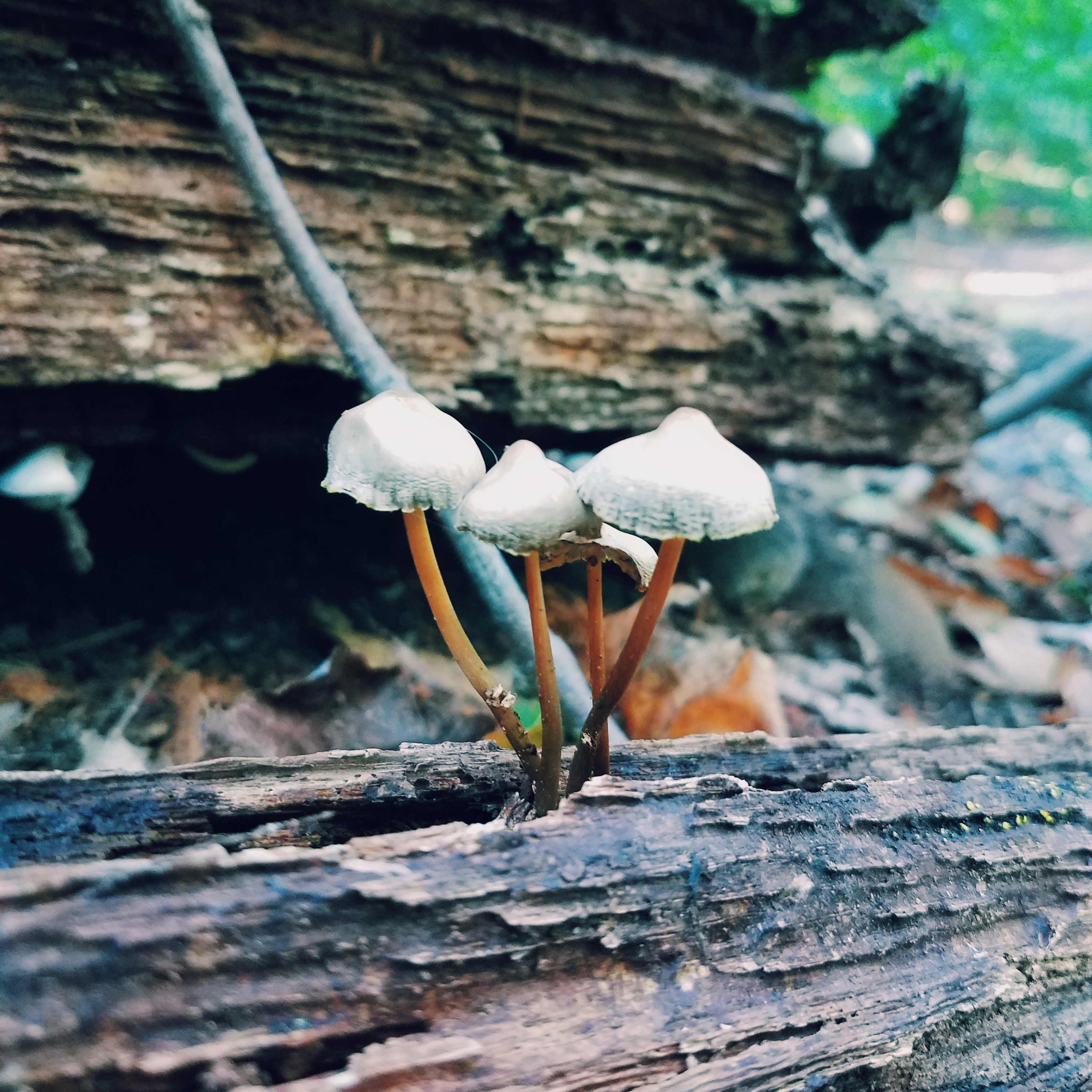
Some type of Mycena builds a tiny cathedral in a fallen tree. I find another type growing from a separate tree, its cap an almost ghostly translucent white. It’s the only one there, and I don’t have the heart to touch it, see what color it bruises, or try to take a specimen for a spore print.

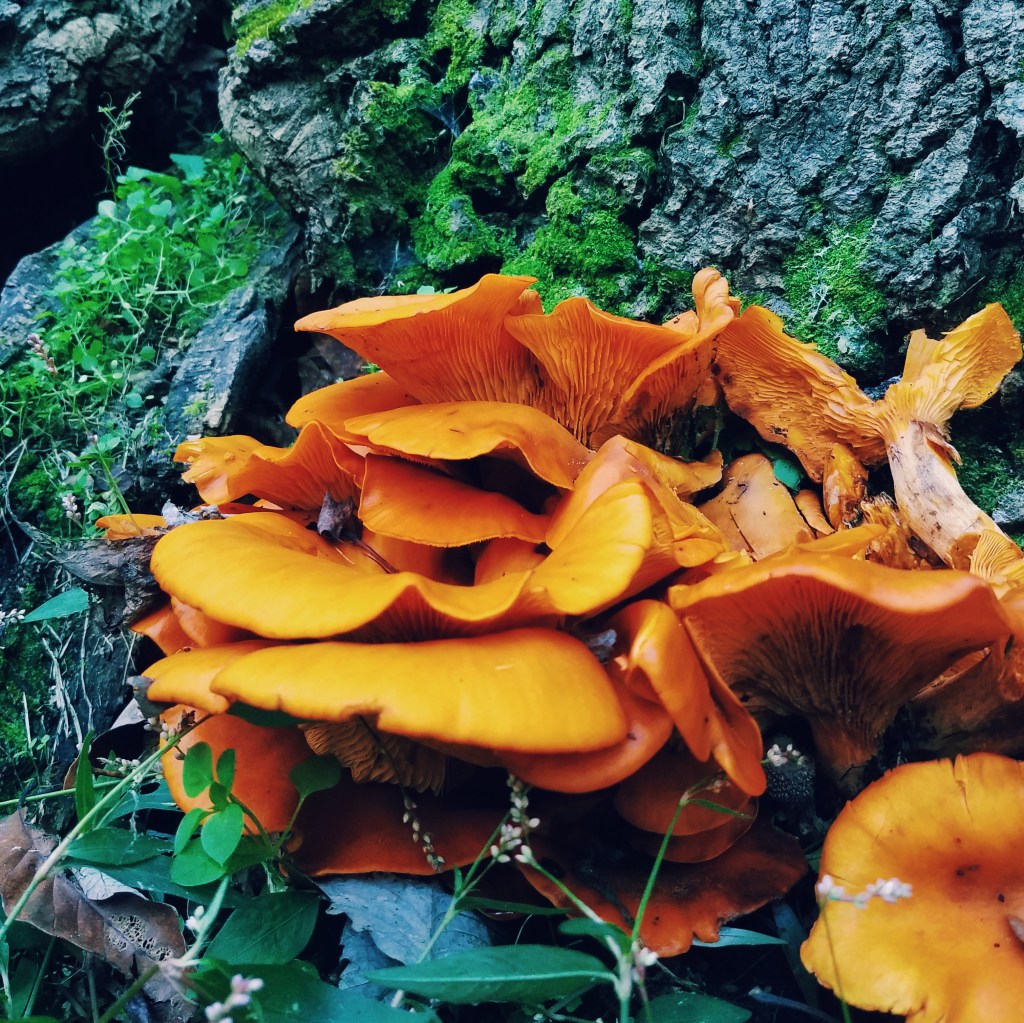
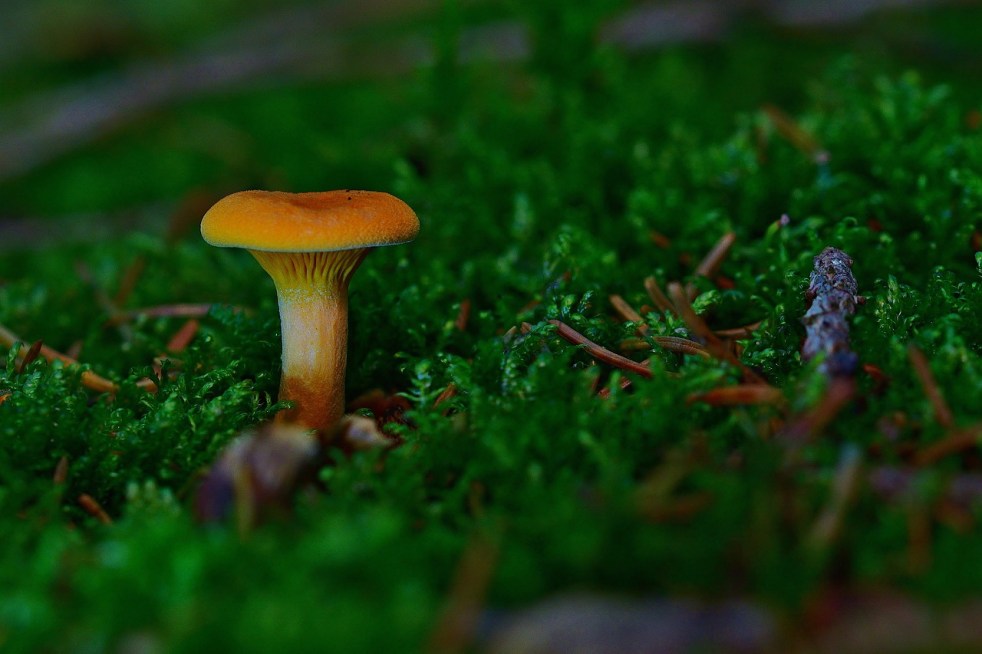
“Oh, hey,” my partner points to a dead stump. I make a kind of excited pterodactyl noise and get on my stomach for pictures. I haven’t seen jack-o-lantern mushrooms before, but their intense “fuck off” orange and fine, deeply-ridged gills are weirdly, poisonously beautiful.

I can see why they’re often mistaken for chanterelles, though it makes me wonder what came first. Did the chanterelle grow to resemble the false chanterelle and jack-o-lantern mushrooms because it kept it from being eaten, or was it a case of convergent evolution?

It strikes me with some irony that I feel better about poisonous mushrooms than I do about the “Welcome” sign in a shop. Warning orange is easier to look at than shark-eyed windows, I guess.

Blog · life · Plants and Herbs

The end; no morel.

(That pun’s pretty bad. Sorry, readers. Sorry, internet. Sorry, college.)

I don’t really know as much as I’d like about mushrooms. I mean, I know enough to know that I don’t know enough to trust myself to eat one I pick myself. (Every mushroom is edible. Many of them are only edible once.)

I still like looking for them, though. My S.O. and I find some very neat ones sometimes — a massive chicken-of-the-woods, honey fungus, bird’s next fungus, eyelash mushrooms, all kinds. I know it’s still early to find any here (probably? I’m mean, I’m assuming), but I was still stoked to go looking for some. It’s only barely March, and things like morels and dryad’s saddles probably won’t be around for weeks yet. After being cooped up all winter, I would’ve been happy to find some of last year’s dried-out bracket fungi.

Alas, there were no mushrooms.

I did find some really neat moss, though. Complete with seed heads!

Processed with VSCO with  preset


We sat on a fallen tree to have a picnic. It was really beautiful out — chilly, but not cold. Bright, with the sun slanting through the trees and not a cloud in the sky.

“Are you taking a pic of me eating a sandwich?”

“Yeah. The sun looks neat. Besides, you’re one of my favorite subjects to photograph.”

“Aww…”

“… Y’know, I’m glad you took that as a compliment. I just realized that my dumb ass came out here unreasonably excited to see, like, fungus and moss and shit, so there were a lot of ways that could’ve gone.”

88347064_548801162510141_7133673119373328384_n

He’s pretty cool about indulging my whims. Even when those whims mean crawling around in dirt and leaves to get pictures of extremely tiny things.

Or when they mean me dragging him through the art supply store and spending twenty minutes deliberating between cotton and linen canvas, which I did on the way home.

Next weekend, I might take him hunting for cryptids. We’ll see.