Plants and Herbs

Garlic Folklore and Magical Properties

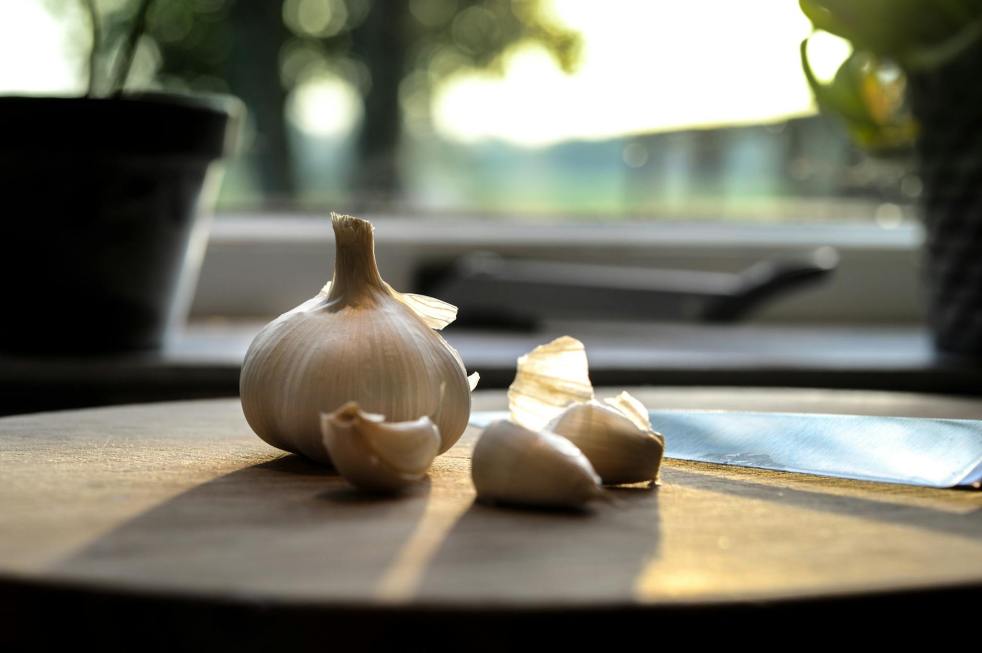
Have you planted any garlic yet? I’ll admit it — I haven’t. The weather has been so weird here lately that I wasn’t sure if it was a great time to do it. (For real, we currently have one very lonely and confused violet in the front yard.)

Still, it’s good to get garlic in the ground in autumn in temperate areas. This ensures that it’ll be one of the first things to pop up in spring and will be mature and ready for harvest in summer. Since its garlic planting time, I figured it’d also be a good time to explore the magical and folkloric uses of garlic.

Garlic is probably best known as a way to repel vampires. Some believe that eating it can also help keep mosquitoes, ticks, and other blood suckers at bay. However, research has shown that it actually seems to attract leeches.

In China, garlic was one of the ways to repel the jiangshi (僵尸), a kind of undead, vampiric creature that moves primarily by hopping.

This herb is also well known for its medicinal properties. It has naturally occurring antibacterial, antifungal, and antioxidant compounds. It’s sometimes used to treat various types of infection, high blood pressure, arterial plaque formation, and as part of a general health tonic. However, taking medicinal quantities of it can be contraindicated in some instances, so it’s important to discuss using supplements with your doctor.
(True story: I used to habitually eat so much garlic that, when combined with some very necessary medications, I ended up with bleeding/bruising problems.
It was a truly bonkers amount of it, though.)

Garlic on white ceramic plate decorated with cats.
Photo by Cats Coming on Pexels.com

Garlic was very important in Egypt. This herb was a key part of the rations given to pyramid builders. When they threatened to abandon the project, they were given more garlic.
Pliny claimed that people in parts of Egypt invoked alliums as deities. He’s an outside source, so this should be viewed with some skepticism, but he also had a high opinion of garlic’s virtues. In Natural History, he offers a very long list of situations that call for it as a remedy.

Alexander Neckam, a 12th century English poet, theologian, and writer, recommended garlic as a remedy for the heat of the sun during hard labor.

In some traditions, garlic is considered an aphrodisiac and a charm for a happy wedding night. In India, it’s highly praised in the texts of the Ayurveda. However, those following ascetic paths avoid it, since it’s a food that increases sexual desire.
(Interestingly, some of the main causes of penile erectile dysfunction are high blood pressure, narrowed arteries, and high cholesterol. The clitoral bulbs also have erectile tissue. As an herb with cardiovascular benefits, the idea of garlic promoting/improving sexual desire and performance has credence.)

The Hindu texts Ashtanga Hridaya and Ashtanga Sangraha talk about how a rakshasa (essentially a demon) took a seat among the gods and received a sip of nectar from Vishnu. When Vishnu saw this, he cut off the demon’s head. The head fell to the ground, mouth open, spilling the nectar the demon had taken. From this spot, garlic sprang up. Since it comes from sacred nectar, it is a powerful remedy. However, since it also came from the mouth of a demon, some (especially Brahmin people) choose not to eat it.
On the other hand, the Bhavprakash nighantu, verse 217-220, says that garlic was created when Garuda stole the nectar of immortality from Indra. As he fled, some drops spilled on the soil and grew into garlic.
I think the most interesting aspect here is that, despite their very different origins and viewpoints about this plant, both of these stories acknowledge its sacred and powerful origins. In one, the plant is “defiled” by being tainted by the mouth of a demon. In the other, it isn’t. However, both see garlic as arising from a sacred source.
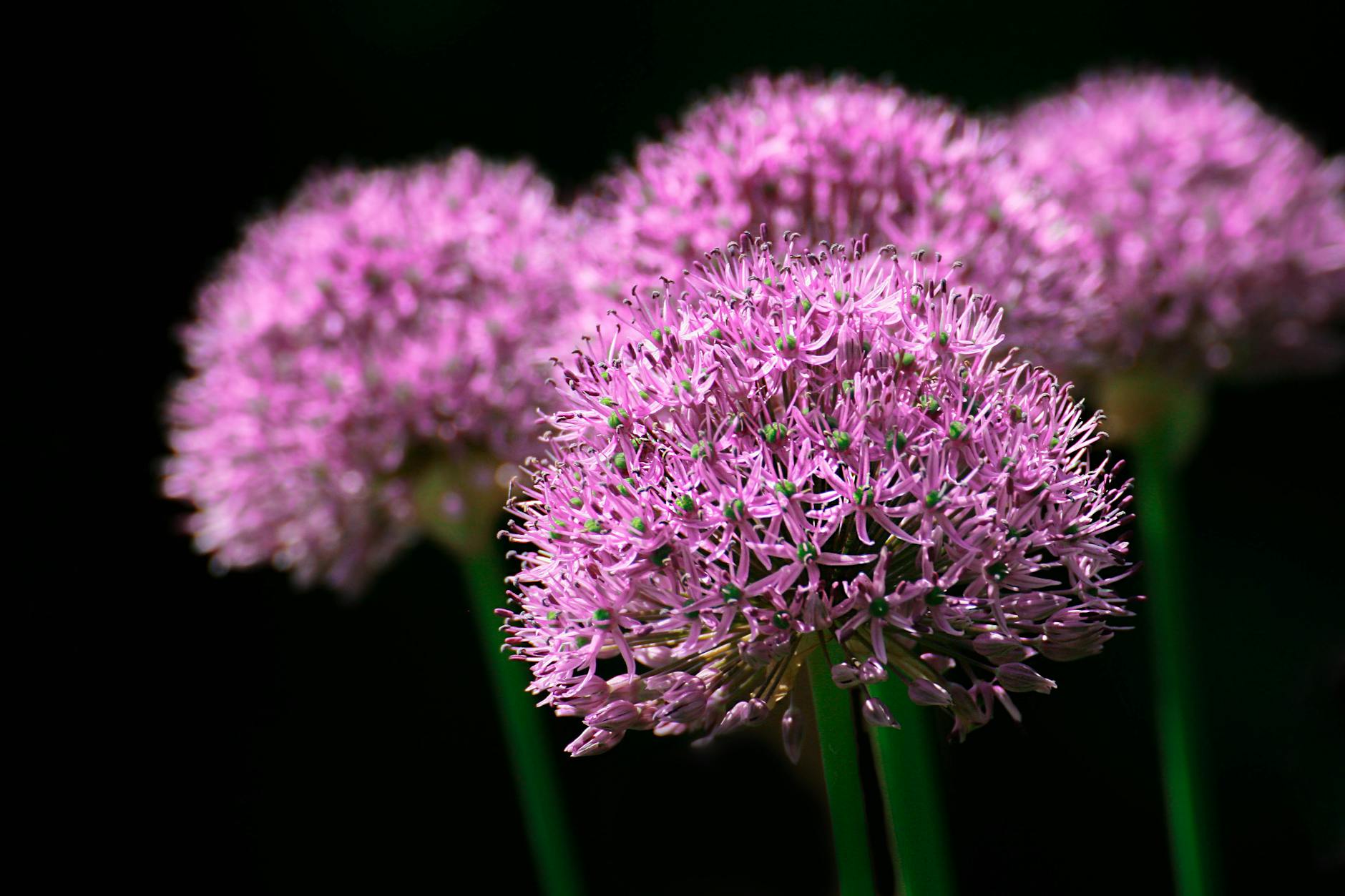
Selective focus photo of purple allium flowers.
Photo by Pixabay on Pexels.com

In The Schools’ Collection, an archival record of folk remedies, garlic is mentioned as a cure for multiple ailments. However, most of these are respiratory in nature. There are methods for treating tuberculosis, asthma, influenza, and the common cold, among many others. These range from boiling it in donkey’s milk, to keeping a piece in your shoe.
In China and Japan, it was used for digestive and intestinal complaints, as well as as an antiparasitic.

In central and western Europe, garlic is typically regarded as an herb for protection. The bulbs or flowers could be worn, hung in the home, or placed/rubbed on doors and windows to keep out malevolent spirits or repel the effects of the Evil Eye.

Though garlic is native to northeastern Iran and Central and South Asia, Roman armies were responsible for spreading the plants everywhere they went. Soldiers would eat it before battle, believing that it filled them with courage. They also planted it everywhere, so they’d always have access to it and that courage would be symbolically transferred to the battlefield.

In modern witchcraft, which is typically derived from European traditions, garlic is a protective and banishing herb.
In Hoodoo, which arose from the African diaspora, it is used to ward off evil and protect.

According to Culpepper, garlic is ruled by Mars. It’s considered an herb of Fire.

The easiest way to use garlic is in kitchen witchery. Before chopping, mashing, or otherwise adding it to foods, hold a clove in your dominant hand and ask the garlic to assist you. Include it in dishes when you need a little extra courage or protection from malevolent energies or envy.

You can also tap into garlic’s banishing properties with little more than a whole clove of it, a pot of soil, a slip of paper, and a windowsill. Write down the name of a bad habit that you wish to be rid of (nail biting, smoking, et cetera). Dig a small hole in the pot of soil, and place the slip of paper at the bottom. Plant the garlic clove over it and tend to it the way you would any other plant. As the garlic sprouts and grows, it’s said to help you overcome the habit.
This is a pretty old charm that uses both the herb’s reputation as a banishing and purification plant, and a bit of sympathetic magic. As the garlic grows, so, too, does the planter’s resolve and distance from their bad habit.
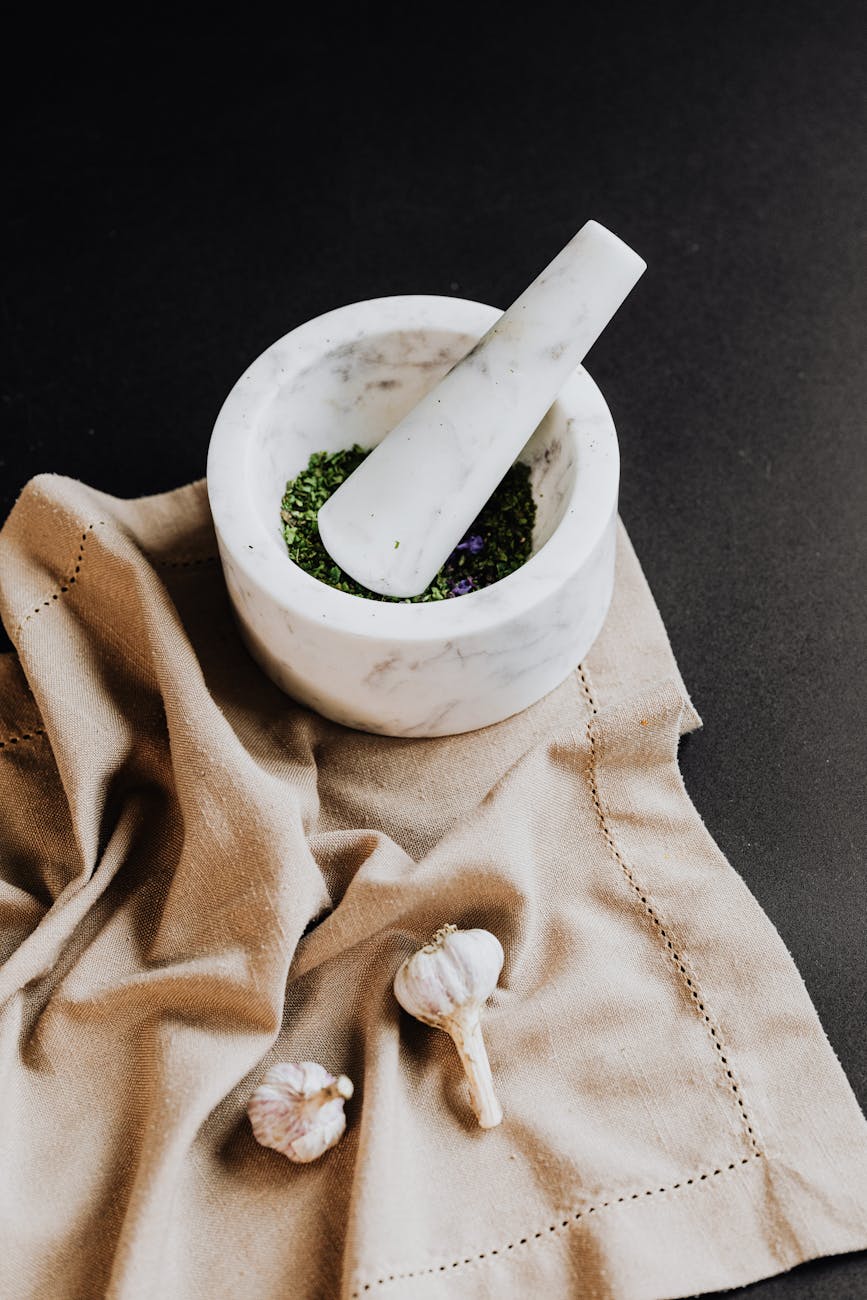
Close up shot of mortar and pestle near garlics.
Photo by Photo By: Kaboompics.com on Pexels.com

It’s also useful in salts or powders to protect an area. Mix dried, powdered garlic in black salt (or regular table salt) and sprinkle it in the corners of a room you wish to ward. If you want to use it outdoors, skip the salt and combine it with other protective herbs.
If you have pets, be aware that too much garlic can cause a condition called Heinz body hemolytic anemia. If you’re trying to ward a room that cats or dogs frequent, either skip the garlic and salt and go for pet-safe herbs or keep the animals out until you feel the herbs and salt have done their job and then sweep and vacuum the area thoroughly.

You can also decorate with garlic bulb wreaths/ropes, or even vases of the fresh flowers. Place them in any room you wish to keep clear of bad vibes. (Kitchens are typically considered the “heart” of a home, so they’re the perfect place for this. Also, you can pull off a fresh bulb to use whenever you need one).

Garlic is more than delicious — it’s healthful and powerfully protective. It’s also surprisingly easy to grow and harvest, making it a very useful addition to any magical or mundane home garden.

life · Plants and Herbs · Witchcraft

Relieving Pain by Means Magical and Mundane

Hello! The inside of my face has been replaced with centipedes.

… Okay, fine, but that’s what it feels like.

Friday, I had a minor surgery (which, depending on how things go, may end up being the first of several. Sigh). This would not be a deal for most people, let alone a big deal, but things get complicated afterward when you have a very limited list of pain relievers that you can safely use. So, I figured I’d write this handy-dandy guide for other people in this position.

Why might someone have trouble getting pain relief? A lot of reasons. Some people avoid them because of a personal or family history of addiction. Some medical conditions, like breathing problems, preclude the use of specific types of pain killers. Some medications don’t combine well with them, either. In my case, too many pain meds manage to raise cerebrospinal fluid pressure, have a reduced effect when combined with an SSRI, and increase the risk of serotonin syndrome. This underlines the importance of disclosing everything to your doctors — your past and current medical conditions, every medication you’re taking, the whole lot. They’re not there to judge you, they’re just there to make sure you don’t die.

Anyhow, there are herbal, mineral, and magical means of coping with physical pain when everything else is contraindicated. These shouldn’t take the place of appropriate pharmaceutical pain management when that’s a) available and b) necessary, but can definitely help take the edge off when that isn’t an option. As with any herbs, don’t use them if you’re allergic to other plants in the same family, or if you’re on other medications that might interact with them. A lot of plants that relieve pain are also relaxants, so be mindful that they may make you drowsy or slower than normal. If you have an upcoming surgery, ask your doctor if these herbs are safe to use in the days running up to your operation.

Ah, chamomile. My number one solution to so many of life’s problems. It’s relaxing, it helps me sleep, and it’s surprisingly good at helping with pain.

Here, we’re talking about both German (Matricaria chamomilla, also known as M. recutita) and Roman chamomile (Chamaemelum nobile). One study found that a topical gel of 3% chamomile extract helped with pain from oral mucositis induced by chemotherapy. A clinical trial quoted in this same study showed that chamomile, when inhaled, reduced cesarian pain. Other quoted trials demonstrated a very helpful anti-inflammatory effect, as well.

Chamomile flowers floating in a cup of tea.

When I need chamomile to do more than help me relax, I prefer to use a tincture. It seems to work faster and provide more relief than tea alone (though a nice cup of iced, double-strength chamomile tea certainly has its place). A few drops of chamomile tincture are also great at soothing toothaches and mouth sores.

Chamomile essential oil is also helpful in an aromatherapeutic context (the way it was used in the cesarian surgery pain trial), but isn’t absorbed all that great. Topical applications of chamomile oil were much more effective when they were blended in a nanogel to aid absorption.

Lemon balm, Melissa officinalis, is best known as a relaxant and digestive herb. Some people use it for pain relief, but structured research is limited in this area. Still, if you’ve experienced pain that has kept you up at night, you probably know the value of something that can help you get to sleep.

Lemon balm, like chamomile, is also anti-inflammatory.

As a word of caution, lemon balm can be powerful. I don’t really get sleepy from chamomile, but a cup of lemon balm tea can knock me out. Be cautious when using it with other herbs or medicines, and don’t use it when you need to be alert.

Turmeric is an anti-inflammatory herb that I initially started using for joint pain. Combining it with black pepper, specifically the compound piperine, helps to make turmeric more effective. Piperine isn’t very soluble in water, though, so preparations made with isolated piperine usually involve extraction using solvents like dichloromethane.

Personally, I use turmeric and ginger tea all of the time. I feel a difference when I don’t. (If I’m having a rougher day than usual, it’s often because I’ve been skipping my tea by accident.) These plants are actually related, and they have some overlap in their medicinal effects.

A wooden spoon and glass jar of turmeric powder.

Turmeric and ginger are the kind of herbs that are better for chronic pain, not acute pain. Think of it like this: If you deal with joint pain on the regular, turmeric and ginger may be a big help. If you currently have a headache, you’re better off reaching for something else.

Got a toothache? Clove oil (Syzygium aromaticum) is your buddy… at least, if you’re an adult.

A drop or two of this stuff, diluted in a carrier oil, placed on a cotton bud, and swabbed on the affected tooth, can help halt tooth pain in its tracks with amazing efficiency. It’s effective for making cavities and broken teeth less agonizing until you can get to a dentist. One of the compounds in clove oil, eugenol, is even used to help manage the pain from alveolar osteitis (dry socket).

As a note of caution, clove oil is potent medicine. Use it straight, and it can burn the absolute tits out of your mouth. It can also be toxic in large doses. For children, a “large dose” is not a whole lot, so it should never be used to sooth teething babies. Clove oil can also be bad for people with liver disorders, unstable blood sugar, or who are taking anticoagulants. While a drop or two isn’t going to harm a healthy adult when used properly, it’s worth knowing this stuff and treating cloves with respect.

It’s also important to use real clove oil. Make sure the bottle says that it’s 100% essential oil from the appropriate species of tree. (Don’t worry about qualifiers like “therapeutic grade” — there are no regulatory bodies that determine this, it’s just a marketing term). Avoid products labeled “fragrance oil.”

No clove oil? Mash a little ground clove spice with warm water and apply the paste instead.

If you have a toothache and clove oil isn’t an option, biting down on a piece of raw garlic can help. Chew it until it’s soft, and let it sit on the affected tooth. If you don’t want to chew on raw garlic, mush it into a paste with a spoon or mortar and pestle, or grate it first. The important thing is to let it sit on the aching tooth.

From my experience, garlic doesn’t relieve tooth pain quite as effectively as clove oil, but it can be safer for some people. If you’re really struggling, you’re about at your limit with swabbing clove oil in your mouth, and you don’t have any chamomile tincture, garlic is definitely a solid runner up.

This is all purely anecdotal, but I’d feel remiss not to include it. I have a satin spar wand — nothing fancy, just an unpolished, rectangular hunk of gypsum — which has come in handy time and time again for pain related to intracranial hypertension. As it turns out, a number of pain relievers are associated with increased cerebrospinal fluid pressure, so there’s often not much you can do to deal with the crushing pain.

I get it the worst right at the base of my skull, as do a lot of people. I’ve found that lightly pressing a piece of satin spar to that spot really helps. Oddly enough, other massage wands don’t. Neither do other crystals. Honestly, even ice packs are a bit hit-or-miss.

Should you throw out all of your NSAIDs and stock up on satin spar? No, I don’t think so. But satin spar wands are common enough that, if you’re reading this, it’s likely that you already have one. If so, it may be worth giving a shot. It certainly has been for me!

I have a lovely bit of chlorite quartz that came from Ireland. It’s very clear, save for a bloom of deep green in its heart– like a cluster of fluffy moss.

A lot of guides attribute healing properties to chlorite quartz, but these are pretty vague. “Healing.” “Emotional healing.” “Detoxification.” Interestingly, I haven’t seen it used for relieving pain, though I have seen more than one site make the wildly irresponsible claim that it’s good against serious, potentially lethal health conditions like cancer and heart disease.

I discovered by accident that the particular specimen I mentioned is helpful for headaches. Holding it in my dominant hand has stopped one in its tracks on multiple occasions, to my delighted surprise. As someone who has headaches of varying severity on a daily basis, anything that can put the brakes on one is nothing short of miraculous.

One old remedy for tension headaches involves taking a knife (preferably one with a broad, pointed blade, like a chef’s knife) and holding it against the head. The user is then instructed to take the knife outdoors and stab it into the ground, while declaring that the headache is now sent into the dirt for the Earth to deal with. Even if you don’t necessarily believe in the power of sympathetic magic, the coolness of a piece of metal can help ease a mild headache, and the psychological benefits of this exercise shouldn’t be overlooked.

Other remedies involve transferring illness to objects like candles, then burning them. These are just as valid, but take a bit too long for my taste. If I’m having too much pain to sleep, the last thing I want to do is babysit a burning candle for several hours!

Pretty much everyone knows about using ice and heat to help relieve inflammation and pain, but setting up the right temperature gradient can turn that relief up to eleven.

When it comes to headaches, warming your feet while cooling your head can be a huge help. This helps increase blood flow to your lower extremities, while narrowing vessels in your head. If you have the kind of throbbing headaches that are triggered or made worse by heat, this can really improve things by a surprising amount. A warm footbath and an ice pack on the back of my neck can be an absolute lifesaver sometimes.

It’s really not uncommon for people to end up in a situation where their pain relief options are limited. This list isn’t to suggest that herbs and crystals can substitute for, say, a morphine drip for a terminally ill person, but to hopefully offer some ideas for people who, like me, don’t really have safe, effective options available.

Plants and Herbs

The robot uprising is here, and they’re trying to kill us with bad foraging advice.

When foraging, it’s said that you should be as confident identifying edible plants in the wild as you are in a grocery store. Foragers also say that the best way to learn is to have an experienced person to guide you. Not everyone has access to someone like that, though. Enter: Books about foraging.

Ripe wineberries. They are shiny, red raspberry-like fruit on a stem covered in red hairs.

Now, gathering and eating wild plants based entirely on the photos and descriptions in a book can be a bit intimidating. For some plants, this isn’t a big deal — wineberries, for example, are an invasive edible that’s really easy to pick out. Garlic mustard and wild onions, too. Some plants don’t really have poisonous lookalikes, so the odds of making a dangerous mistake are pretty slim. Others, not so much.

All of this is to say that books about foraging aren’t all bad. At least, they weren’t.

Here’s where shit gets weird.

People looking to make a quick buck have turned to artificial intelligence and Amazon’s publishing platform to pump out a lot of barely-concealed drivel. A lot of this is in the form of children’s books, I guess because they seem easier to make than a full-length novel. This is far from harmless, because children’s books play a role in the development of literacy and empathy that you don’t really want to hand off to a computer.

This attempt to cash out isn’t limited to children’s books, either. Amazon and other online book sellers have become the proud purveyors of foraging books written by AI. This isn’t really a new phenomenon, but, on the off chance any of you out there’re in the market for foraging guides, I figured I’d give you a heads up.

To be fair, a lot of these are simply useless and the worst they’ll do is waste your money. The books in this category claim to be foraging guides, but end up being about why foraging is good, listicles on the benefits of eating more fruits and vegetables, and recipe ideas. Pretty harmless overall.

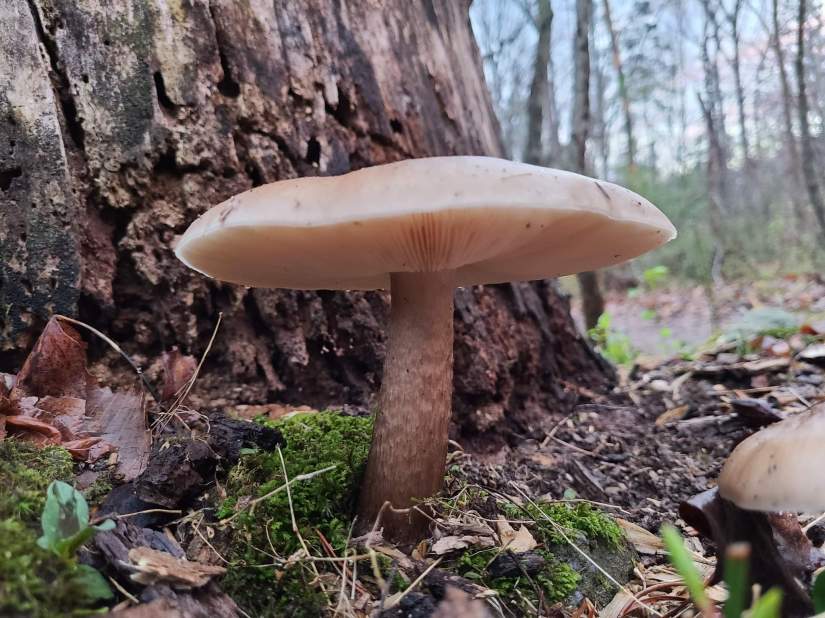
An underside view of the gills of a cream-colored mushroom.

On the other hand, there are books offering actual descriptions of “edible” plants and mushrooms(!). Some of them even list “taste” as an identifying feature of plants and fungi, which could encourage inexperienced foragers to taste things they haven’t positively identified. Since many extremely poisonous mushrooms are visually similar to harmless ones, this could get someone killed. Hell, plenty of people already mistake poisonous mushrooms for edible ones even without books encouraging them to taste them.

It’s not always easy to pick out which books are written by actual human people, and which aren’t. There are a couple of things that you can look for:

  • Publishing dates. Books written before the rise of AI generated content are a safer bet here.
  • The author’s web presence. Even if they have a photo, that doesn’t necessarily mean that they’re a person. The photo could be stolen (just see any of the fake identities on Scamfish), or made up by a different AI. Look for a blog. A Facebook page. A TikTok. An Instagram. Something to indicate an existence beyond the cover of a dodgy book.
    As this article from 404 Media states, “‘Edwin J. Smith’”’ is the author listed on two books[,] but doesn’t have any other books, or an online presence otherwise. The only Edwin J. Smith I could find was a Professor Emeritus of medicine at Indiana University from a staff list that’s more than a decade old.”
  • The author’s credentials. They should be actual, and not completely made up. Beware of author bios that offer vague, unrelated information.
  • A sample of the prose. A lot of bots pull from very varied sources, so you’ll get bits that sounds like they’re cut from a recipe blog, a florist’s website, an actual foraging manual, and so forth. These are also likely to be thrown together without much thought, because no actual humans looked at it to make sure it’d make any damn sense at all.
  • The editing. Bad, AI generated foraging guides often have mistakes that any human editor (or writer, for that matter) would pick up on right away.
  • A bad score from an AI-detection tool, like Scribbr or GPTZero. Get a sample of the text, paste it in a detection tool, and see what it says. While you’re at it, paste the author’s bio in there, too.

Again, if you’re able to, connect with an experienced foraging expert before going out in the field on your own. Your local university may be able to help you. You might even be able to find a group of foraging enthusiasts on sites like Meetup. Even if you can’t go out with a foraging expert, they may be able to recommend actual, useful guides, videos, and other resources for you.

Plants and Herbs

Passionflower Folklore and Magical Properties

As we kill off our grass, we’re working hard to replace it with plants that serve multiple purposes. Ideally, they should be native (or at least semi-local), attract pollinators, provide food for both humans and animals, and either return or self-seed. One of the plants that passed muster is this area’s native species of passionflower, Passiflora incarnata.

Also known as maypop, true passionflower, purple passionflower, and wild apricot, P. incarnata is a really pretty, fast-growing vine that provides both wild-looking purplish blue flowers and edible fruits. The flowers don’t last long, but they’re very striking!

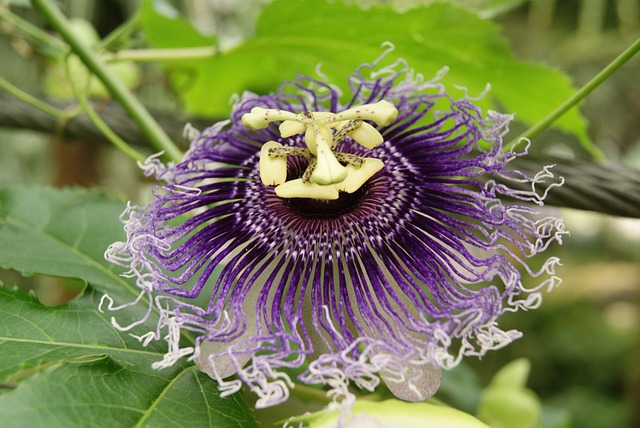
A fringy, bright purple Passiflora incarnata flower.
A flower of P. incarnata.

Unfortunately for me, I didn’t heed the old adage, “the first year they sleep, the second year they creep, the third year they leap.” As a result, I planted way too many passion vines. They’re going to eat my porch.
Help.

Anyway, as I watch my yard speedily being consumed by passion and pumpkin vines, I figured I’d write a bit on the magical uses and folklore of the passionflower.

Passionflower Folklore and Magical Uses

Despite the name, I’ve mostly seen passionflower used as an herb to dampen passions, not stoke them. They’re said to be useful for calming libido, cooling relationships, and cultivating platonic or romantic rather than erotic love.

This could be because the word “passion” has a number of very different and contradictory meanings. As Mark Z. Danielewski wrote in House of Leaves, “Like patience, passion comes from the same Latin root: pati. It does not mean to flow with exuberance. It means to suffer.”

As a new world herb, passionflower was a novel plant to the Spanish missionaries who arrived in Peru in the 1500s. Giacomo Bosio, a monk and historian, referred to passionflower as “La Flor de las cinco Llagas” (“the flower with the five wounds”). This refers to the five wounds the Christian figure Jesus Christ is said to have endured at his crucifixion. The Biblical usage of passion equates to suffering, so, to missionaries, the passionflower represented divine suffering.

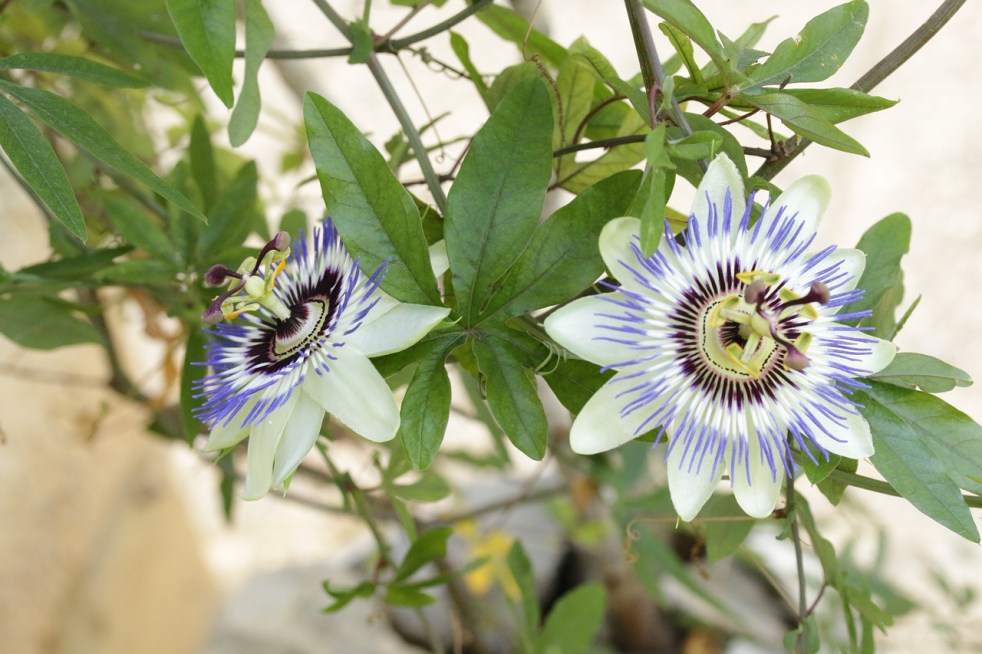
A blue and white flower of P. caerulea.
P. caerulea, a passionflower native to South America.

One tale from Brazil says that the passionflower grew from the tears of a woman who was separated from her lover.

Medicinally, passionflower is used as a calming herb. Evidence suggests that it’s safe to use internally, but there’s been some controversy as supplement manufacturers didn’t meet FDA requirements for safety data. It may interact with sedatives, monoamine oxidase inhibitors (MAOIs), and drugs to prevent blood clots, and is contraindicated in pregnancy.

In traditional indigenous herbal medicine, passionflower is used as a poultice to reduce inflammation and soothe pain.

In the garden, passionflower is irresistibly delicious to Japanese beetles. They’ll eat the leaves and flowers like there’s no tomorrow, which is bad news if you actually want to harvest any fruit!

Taken together, this paints the picture of passionflower as an herb to ease suffering. Since it was said to represent the five wounds endured by Jesus Christ, you could look at it as a “wounded healer.” This isn’t a plant that flows with exuberance, it’s one that knows suffering and eases it in others.

In Victorian flower language, passionflower was said to represent religious fervor or superstition.

Passionflower corresponds with the element of Water and the planet Venus.

Using Passionflower

If passionflower both represents and alleviates suffering, how do you use it? Since it’s native to North and South America, there isn’t really any information about it in ancient magical texts. Nonetheless, there are many ways to work with this unique plant.

As a vine, passionflower grows and clings (hence the whole porch thing.) This makes it useful in workings to bind something to yourself. Since it’s also a plant for relieving suffering, I’d use it specifically in situations where you’d like to bind a solution to a problem — for example, using passionflower to tie yourself to a stable, fulfilling job or enjoyable living situation.

Passionflower is also sometimes used in pillows or sachets for restful sleep and dream magic. Be careful with this, however, as placing passionflower under one’s pillow is also said to be a remedy to dampen libido.

This herb is also used in love magic. Bathing in an infusion is said to attract a potential partner to you, and it’s an often-seen ingredient in sachets, jars, and other charms for love. It works well for this purpose, as long as you know what kind of love you’re looking for. (If you’re after a passionate fling, skip it and go for cinnamon or ginger instead.)

Infuse the flowers in a carrier oil and use this to help ease worries and sooth the heart and mind. Anoint the temples and heart area whenever relief is needed.

All told, passionflower is a delightful herb. It’s beautiful, feeds bees and hummingbirds, and provides valuable medicine. As long as you don’t let its name fool you, it can help you with an array of spells and charms.

Plants and Herbs

Hyssop Folklore and Magical Properties

The anise hyssop in my little pollinator garden is putting of spikes of beautiful purple flowers, so I thought I’d write a bit about the magical uses and folklore of hyssop.

A fun fact first, though — anise hyssop (Agastache foeniculum) is not that closely related to actual hyssop (Hyssopus officinalis). Both of them are members of the mint family, Lamiaceae, but so are teak, rosemary, and chia. Anise hyssop is native to Central and North America, while hyssop is from the Mediterranean eastward to Asia.

Anise hyssop is definitely a useful plant, but I figured I’d cover hyssop-hyssop first. If you practice one of the many branches of European-based witchcraft or folk magic, you’re more likely to encounter Hyssopus in old texts.

Hyssop Folklore and Magical Uses

A lot of the modern lore about hyssop comes from its mention in the Bible. It’s indicated numerous times as a cleansing and protective herb. For example:

Cleanse me with hyssop, and I will be clean; wash me, and I will be whiter than snow.

Psalm 51:7

Take a bunch of hyssop, dip it into the blood in the basin and put some of the blood on the top and on both sides of the doorframe. None of you shall go out of the door of your house until morning.

Exodus 12:22

To purify the house he is to take two birds and some cedar wood, scarlet yarn and hyssop.

Leviticus 14:49

When Moses had proclaimed every command of the law to all the people, he took the blood of calves, together with water, scarlet wool and branches of hyssop, and sprinkled the scroll and all the people.

Hebrews 9:19

There’s more, but you probably get the idea. However, this runs into the same problem as anise hyssop versus hyssop. The hyssop mentioned in the Bible is not H. officinalis. (Biblical hyssop is more likely to be Capporis spinosa or Origanum syriacum.) Nonetheless, I figured the Biblical references to hyssop were worth including because they inform quite a bit of the body of lore about H. officinalis.

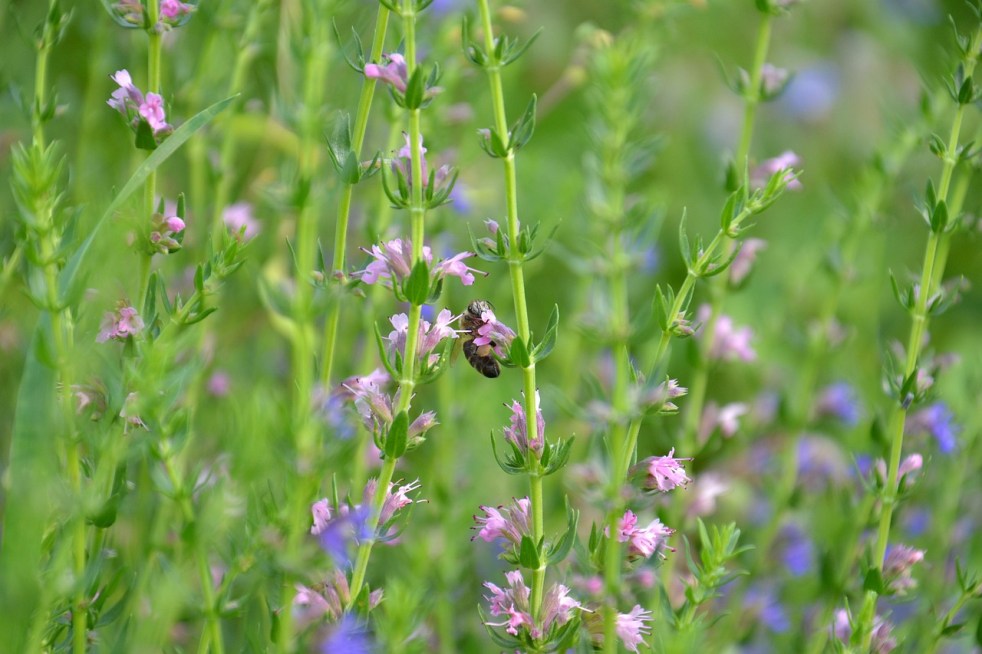
A spike of bright violet-blue hyssop flowers.

The name “hyssop” derives from the Greek word hyssopos, which derives in turn from ezov or azob, the sacred hyssop mentioned in the Bible.

In Egypt, Priests used hyssop as an additive to purify food. This was necessary to make certain foods acceptable for their restricted diet.

Magically, hyssop corresponds to the element of Fire and the planet Jupiter. Following the uses of Biblical hyssop, it’s most commonly employed as a purification and protection herb.

Medicinally, a decoction of hyssop was used topically for treating head lice. It was also used a topical remedy for minor wounds.

In Europe, hyssop was used as a strewing herb. It’s fragrant and seems to have had some action against pests (like head lice, as mentioned above). This may have made it an effective way to keep fleas and other unwanted guests away!

This last bit is particularly interesting to me. In my herb lore reading, I’ve found that the Venn diagram between “herbs used magically for protection” and “herbs that keep bugs out” is almost, but not quite, a circle. Since the Biblical hyssop probably wasn’t hyssop at all, it’s interesting to me that the purposes of Biblical hyssop and European hyssop are so close. It raises a kind of chicken-and-egg scenario — was H. officinalis named for the Biblical hyssop because its pest repellent action “purified” spaces?

Using Hyssop

Sprigs of hyssop make lovely aspergilla. Dip them in water, and use them to asperge sacred spaces, rooms, people, or objects.

Brew hyssop as a tea, strain out the spent leaves, and add the water to ritual baths for purification, cleansing, and hex-breaking. Prepare hyssop the same way, then add to a bucket of fresh water and use it for washing floors, windows, and doors for the same purpose.

A fritillary butterfly on a spike of hyssop flowers.

Add dried hyssop to charm bags for protection, particularly against the evil eye.

Hyssop is sometimes used to season food, and that’s fine. It’s even sometimes used internally in a medical context, and that’s okay too (as long as it’s under the supervision of a qualified herbalist). Otherwise, avoid eating or drinking hyssop. Large doses can cause seizures and cause miscarriages. It’s not known how much of hyssop’s active constituents may pass through breastmilk, and the threshold for hyssop toxicity is much lower for children, so it’s best avoided while breastfeeding.

Environment · Plants and Herbs

Dead Nettle Folklore and Magical Properties

’tis the season for deadnettles!

If you have any semi-neglected patches of ground in your life, you may have seen them — short plants with heart-shaped leaves, arranged like low towers accented by tiny flowers. Though they’re not native to this area, they’re pretty abundant. If you’re into controlling invasive plants, you’ll probably be happy to know that they’re also delicious edibles!

Don’t let the name fool you. Dead nettles aren’t poisonous, and they’re not nettles. They’re called “dead nettle” because they look an awful lot like stinging nettle, but their leaves are stingless. In reality, they’re part of the mint family (which probably explains their prolific growth and ability to thrive pretty much anywhere).

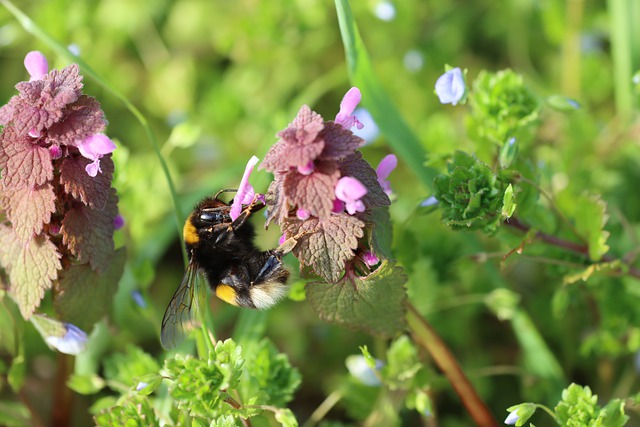
A bee enjoying some soft pink dead nettle flowers.

One of the best things about these nutritious plants? They’re easy to identify and don’t have any poisonous lookalikes. They’re also useful in all kinds of other ways.

Dead Nettle Folklore

Medically, purple dead nettle is used for allergies. It’s rich in quercetin, and has anti-inflammatory properties that make it useful for people with spring hay fever.

Some areas call it purple archangel, because it appears there around the Feast of the Apparition (May 8th). This was when the archangel Michael was said to have appeared on Mount Gargano, Italy, in the sixth century.

White dead nettle is sometimes called bee nettle. This is because it provides an early source of pollen and nectar, so it’s very popular with bees (and children! Kids sometimes suck the nectar from white dead nettle flowers, kind of like how kids used to suck the honeysuckle flowers that grew on the elementary school’s fence when I was little).

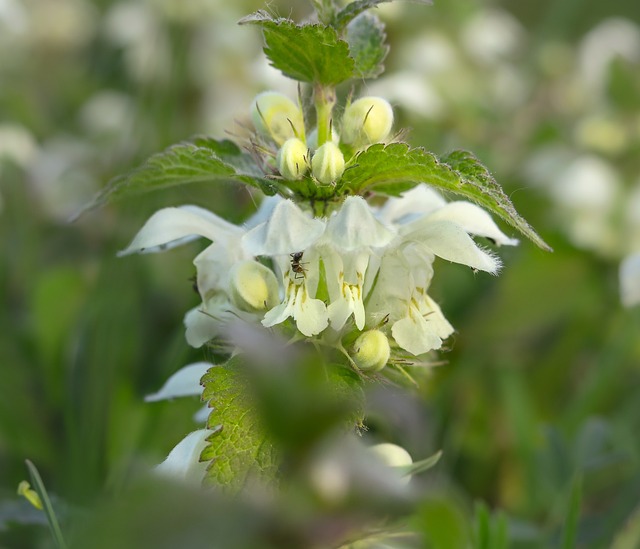
Some white dead nettle flowers. A small ant is crawling inside of one of them.

In Lancashire, it was said that white dead nettle flowers always come in twos, because they’re actually pixie shoes that have been left outside. These flowers also have two black spots inside, which are sometimes called “Cinderella’s slippers.”

White, spotted, and purple dead nettles are all used to treat stings from actual nettles. Mash the plant, squeeze out the juice, and apply it to the stung area. You can also chew some of the leaves and apply the resulting paste.

Magical Properties of Dead Nettle

Dead nettle is associated with determination, due to its ability to grow pretty much anywhere. (I’ve been harvesting it from cracks in the concrete, here.) It’s also connected to happiness, optimism, and relief.

Bright pink dead nettle flowers.

Like other members of the mint family, it dries well. Harvest some, hang it upside-down, and put a paper bag around it to keep off dust and catch any dropped leaves or flowers. Once you have some dried dead nettle, you can use it in teas, incense blends, sachets, poppets, jar spells, or pretty much anything else. This small, unassuming herb is fantastic any time you need a hit of joy and motivation.

Dead nettle is also useful in kitchen witchery. Add it to soups, salads, or even pesto to benefit from its magical and anti-inflammatory properties.

This plant also works wonderfully in tinctures, salves, and oils. This is a great way to preserve it well beyond its season.

For now, I’m pulling it out of my raised beds to prepare them for other things. Some will be left for the birds (chickens, especially, seem to love the stuff), and the rest will be brewed into tea, blended into smoothies, eaten fresh, dried, and pureed and frozen in ice cube trays to add to soup or fill out pesto!

Plants and Herbs · Witchcraft

Nutmeg Folklore & Magical Uses

It’s the time of year when Trader Joes brings out their Wassail Punch. I don’t really drink fruit juices straight, but I like ’em for flavoring water kefir. This one’s blend of fruit and spices makes the end result taste like cola, which is pretty neat.

(Cola is one of those flavors that isn’t really meant to taste like anything in particular. It’s spices. It’s citrus. It’s all kinds of things that add up to one immediately recognizable taste.)

Anyhow, one of the key flavors in Wassail Punch (and probably cola, to be honest), is nutmeg. It’s one of those things that I can immediately recognize when I taste it but am completely unable to remember on its own. It’s like… a clove- and cinnamon-less pumpkin pie? I guess?

It was also one of those most precious substances in the world for a while, and a nearly invaluable magical ingredient.

Nutmeg Magical Properties and Folklore

Nutmeg is a spice that comes from an evergreen tree, Myristica fragrans, native to Indonesia. It’s a weird seed, too — it grows inside of a fruit similar to an apricot, surrounded by an aril that looks kind of like a flat, fleshy spider or extremely underachieving facehugger. The dried aril is the source of the spice mace. The seed itself is the nutmeg.

An image of a ripe nutmeg fruit. The outside resembles an apricot, which has split to reveal the mace-covered nutmeg inside.

It takes a long time for nutmeg trees to bear fruit, though they can do so for several decades after that. Since the spice is native to such a small geographic area, an absolutely horrific amount of bloodshed happened in the name of obtaining it, farming it, and keeping anyone else from getting a hold of it. The Dutch tortured and killed the native people of Indonesia in order to control the nutmeg trade. They also tried their damnedest to keep the English and French from sneaking any viable seeds out of the country, by dipping the nutmegs in lime to keep them from sprouting.

People used to joke (inaccurately) about Manhattan being traded for glass beads. The Dutch really did trade Manhattan to the English for some sugar and nutmeg. For real, nutmegs were so valuable that traders would mix a handful of wooden replica nutmegs in with the real ones in order to dupe their customers.

A whole nutmeg, hollowed and filled with mercury, sealed with wax, and wrapped in a green cloth, is considered a powerful charm for luck in games of chance. (You can skip the mercury poisoning by just carrying a whole nutmeg. It’s fine. Really.)

Wrap a whole nutmeg in purple cloth, and it’s said to help you win court cases.

All forms of nutmeg are considered useful for money magic. Nutmeg oil is a common ingredient in money oils, while the powdered stuff is helpful in sachet and sprinkling powders.

Money and luck aren’t nutmeg’s only properties, however. An old spell from Louisiana involves sprinkling nutmeg in a woman’s shoe to get her to fall for you. Food and drinks flavored with nutmeg were also used as love potions.

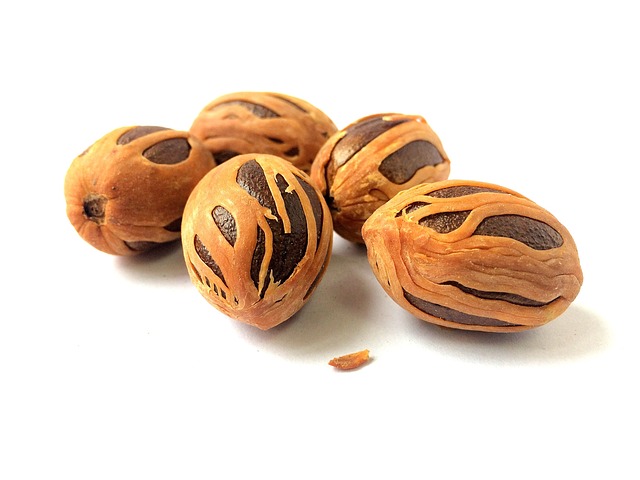
Whole nutmegs covered in mace.

Ground nutmeg was used as incense in ancient Rome.

One old remedy for rheumatism involved boiling nutmegs and cooling the resulting liquid. The nutmegs’ natural fats rise to the surface and cool, forming a solid layer. This is skimmed off and used as a topical balm. Nutmeg is a warming spice, so this would help encourage circulation and relieve some of the pain caused by cold weather aches.

Nutmeg can make you trip balls. This is not code language.
This spice is a hallucinogen, courtesy of a compound known as myristicin. Unfortunately, you have to consume a lot to feel the effects, at which point you’re putting yourself at risk of nutmeg poisoning. “A lot” is relative here — about 10 grams (two or so teaspoons) of ground nutmeg is about to trigger symptoms of toxicity. It’s not that much, but still way more than you’d typically use in cooking. Nutmeg poisoning is pretty awful, too. While I wasn’t able to find any stories of nutmeg-based fatalities, the cases I did find mentioned nausea, dizziness, heart palpitations, fatigue, confusion, and seizures. Yikes.

Nutmeg is associated with the element of Air, the suit of Swords in tarot, and the planets Jupiter and Mercury.

Using Nutmeg

The easiest way to use nutmeg is to make your favorite autumn or winter recipe that uses this spice for flavoring. Use a wooden or metal spoon to prepare it and stir it with your dominant hand. As you do this, picture energy coming up from the Earth, down from the sky, and running through your arm, down your hand, into the spoon, and finally into the food or beverage itself. Ask the nutmeg for help with whatever you want it to do, whether that’s getting laid or making some money. Pretty easy, bog-standard kitchen witchery, really.

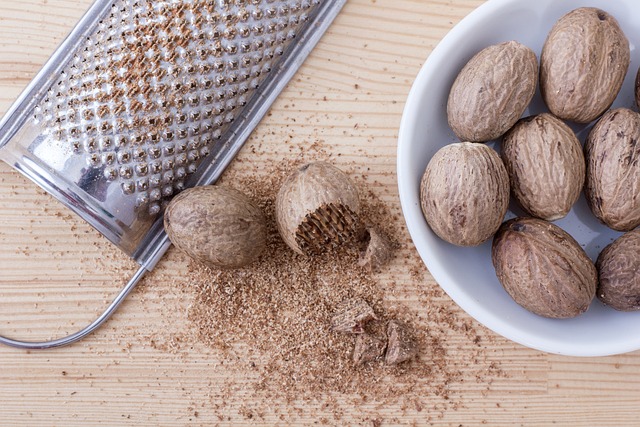
Whole nutmeg seeds, a nutmeg grater, and a little pile of ground nutmeg.

You can also use nutmeg by just… carrying it. As mentioned previously, whole nutmegs are a charm for luck and money. Wrap them in an appropriately colored cloth, anoint them with a suitable magical oil, ask them for their assistance, then keep them on you. When they get old and lose their potency, retire them by burying them in the soil and make a new charm with a fresh nutmeg.

You can also use nutmeg for meditation. I wouldn’t rely on it to induce a trance state, but drinking some warm milk flavored with honey and nutmeg can be a pleasant way to begin some meditative or journeying work. Just don’t use too much — the vast majority of nutmeg poisonings are from kids who eat it to get high and end up spending the night dizzy and throwing up instead.

Nutmegs are also good additions to charm bags or jar spells for money or luck. They’re very nice, potent, self-contained magical ingredients. If you have an assemblage of herbs, curios, and other tools, why not throw in a nutmeg? If you can’t afford a whole one, sprinkle in some of the ground stuff instead.

Nutmeg is a spice with a dark history (I mean, most of them have dark histories. Thanks, colonialism!). It’s preciousness as an incense and culinary ingredient has tied it to the concepts of luck and money, so you’ll most commonly see it in spells for financial abundance and good fortune. If you’re not a kitchen witch, a sprinkle of nutmeg can be a good place to start. If you need to practice magic discreetly, you really can’t go wrong with tucking a whole nutmeg in your bag or pocket.

Environment · Plants and Herbs

Aloeswood Folklore and Magical Properties

I always have a tough time writing this time of year — there’s just not much going on. This is especially true this year, for reasons I probably don’t have to elaborate on.

So, I did what I often do. Before I went to sleep, I asked for inspiration. Something to write about. Anything.

I had a dream of holding a piece of wood that wept golden tears. I held a flame to the raw, jagged edge of the wood, and it released a fragrance that I have trouble describing — woody, of course, but indescribably sweet, floral, and fruity. A mélange of beautiful scents that seemed to come together and complement each other in a way that even the most expert perfumer couldn’t hope to achieve. The dream was so vivid, I could almost feel the textures and scents still lingering in my senses when I woke up.

So today I’m gonna write a thing about aloeswood.

First, Aloeswood vs. Aloe

Aloeswood, also called agarwood, wood aloes, gharuwood, oud, or any number of other names, is not related to aloe vera. Aloe vera is a succulent in the Aloe genus. Aloeswood comes from trees of the Aquilaria genus. It also doesn’t have anything to do with agar, despite the name agarwood. Agar is the jelly stuff used in petri dishes, and is extracted from algae. (It might have sheep or horse’s blood added depending on what microorganisms are being cultured, but no Aquilaria.) Their similar names are just one of those quirks of etymology.

Aquilaria wood does not automatically equate to aloeswood. For the wood of an Aquilaria tree to become aloeswood, it needs to be injured somehow — usually by a boring beetle that digs into its roots or trunk. This injury allows the tree to become infected by Phialophora parasitica, a parasitic fungus. In response, the tree produces a fragrant resin and darker, denser wood. This dark, dense, resin-saturated wood is aloeswood.

Needless to say, there’s a lot of dominoes that have to fall perfectly in place for wood to become aloeswood. First, you need the right kind of tree. Then it needs to get all bit up by a beetle. Then it has to get infected. Then the infection has to be serious enough to warrant a large-scale immune response by the tree. Trees can’t produce aloeswood on a continuous basis, either — it comes from plants that are infected and dying.

It’s probably not hugely surprising that aloeswood is extremely rare. It’s also incredibly expensive. Part of this rarity is due to overharvesting (which is also not surprising), but habitat loss is also a contributing factor. Some varieties of aloeswood are illegal to sell because they come from endangered trees, which has increased the rarity — and therefore desirability — of the stuff that does make it to market.

Sometimes, you can find less expensive aloeswood. This is usually a product of deliberately injuring and infecting trees with fungus. It is also generally not as fragrant or desirable as the naturally-formed variety, and is given a different grade. Natural aloeswood is designated with a #1. Cultures aloeswood is designated with a #2.

Aloeswood Magical Uses and Folklore

Aloeswood is so precious, particular specimens have actually achieved fame. The Ranjatai is the most notable. Its full history is a bit long to get into here, but this particular piece of aloeswood has even shown up in popular culture. Two episodes of the anime series Mononoke (which is visually gorgeous and definitely worth watching) focus on it.

This incense is referred to in ancient Vedic texts for its physical and mental healing properties. Some Ayurvedic medicine for cough and difficulty breathing calls for blending agar powder with honey. When the wood is distilled into oil, the resulting hydrosol is an antacid. A tea made from the leaves — not the wood itself — is said to be very nutritious, relaxing, and helpful for managing blood sugar.

Aloeswood’s scent is said to be an aphrodisiac, and it is included in traditional sexual tonics. Burning a tiny bit on charcoal during sex is believed to improve performance for everyone involved.

In Islam, oud is traditional. It has also been used in Buddhist practices, Christian meditation, and Zoroastrian rituals. It is a spiritually uplifting aroma that releases negativity, soothes stress, raises vibrations, and brings healing.

In ancient Egyptian and Semitic practices, it was used to prepare bodies for burial.

Aloeswood is considered to be ruled by Mars or Jupiter, depending on whom you ask. In western magic practice, it’s generally held to be akin to a “power herb” (like many herbs of Jupiter) and used for boosting the power of any working in which it is used. In the Key of Solomon, is it used to summon good spirits.

Using Aloeswood

Considering its history and primary virtues, using aloeswood in any way that doesn’t allow the practitioner to experience its scent would be a waste. High-grade aloeswood can even release its fragrance through indirect heating, and doesn’t need to be burned completely.

If I were in possession of aloeswood, I wouldn’t add it to anything. As part of an incense burning ritual, I would place a small amount on charcoal, by itself, prior to burning any other incense. Only when the scent has dissipated would I burn anything else. This allows the aloeswood’s full potential to be released, and lets you take advantage of its space-clearing and energy-enhancing powers.

Some modern perfumes contain aloeswood, like Tom Ford’s Oud Wood. These could make a suitable scent for anointing during ritual or meditation.

Aloeswood is a rare, treasured thing, more valuable than gold. It has been regarded as sacred by virtually every civilization that experienced its fragrance — out of a sick, dying tree comes a precious, fragrant wood.

Like sandalwood, this sacred wood is in danger. Ethically-harvested, regulated sources of aloeswood command high prices, but they’re worth it. It would be wrong to obtain a sacred scent through environmentally harmful means. Just like crystals, bones, sandalwood, or any other magical ingredient, make sure your aloeswood comes from ethical sources.

Plants and Herbs · Witchcraft

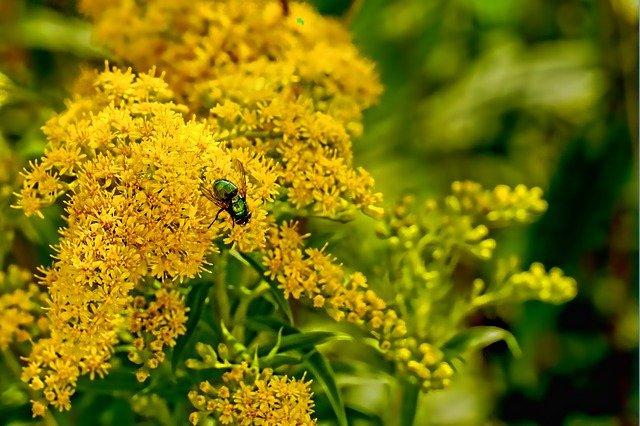
Goldenrod Folklore and Magical Properties

Ah, goldenrod. To some, it’s an essential part of their herbal medicine cabinet. To others, it’s a source of misery. I love seeing the bright yellow flowers on their drooping, swaying stems, but I’m also not one of the people suffering from goldenrod allergies. (Allergies to plenty of other pollens, yes. Goldenrod specifically, no.)

Interestingly, though many people blame goldenrod for late summer and autumn allergies, that blame may be displaced. Without an allergy test, there’s really no way to tell — ragweed blooms at the same time, and it’s a very common allergen. Most pollen allergies are triggered by wind-pollinated plants, but goldenrod is pollinated by insects. Ragweed, however, is not.

(This is also why raw honey and bee pollen aren’t actually great ways to desensitize yourself to pollen. The pollen that makes it into the hive isn’t likely to be the same kind that’s making you sneeze.)

Goldenrod is a bit of a misnomer. It isn’t a single plant, it comprises 120 different members of the aster family. It’s scientific name is Solidago, via the Medieval Latin “soldago,” via a somewhat circuitous rout from the Latin “solidus.” It’s a name that references strength and solidity, the ability to make something (or someone) whole again. With goldenrod’s traditional medical and magical properties, it’s a very apt name.

Goldenrod Magical Uses and Folklore

Various legends tie goldenrod to the presence of wealth. One source said that, wherever goldenrod grows, gold is buried. (But, were that the case, I can guarantee that DC wouldn’t be nearly as economically stratified as it is. Just saying.) Another says that to find goldenrod growing near your home portends a spell of good luck.

Goldenrod is also tied to water. Folklore holds that, wherever it grows, a spring must be nearby. The plants were also used as effective, if temperamental, divining rods — they were said to only work in the hands of the right person.

One legend tells the story of how goldenrod received its bright yellow flowers. An old woman, traveling through the forest, was growing weary. She asked all of the trees around her for a walking stick, but they refused. She found a small stick on the ground, and asked it for help instead. The stick agreed, and she used it as a walking stick until she was out of the woods. As soon as she stepped beyond the tree line, she shed her disguise — revealing herself as a powerful fairy. In return for the stick’s help, she sprinkled it with gold.

Another story speaks of two little girls who went to an old witch for help. One girl, tall and blonde haired, asked the witch to grant her wish. She wanted to be admired by everyone. Her friend, short and blue-eyed, wished that she and the blonde girl would never have to grow apart. The girls were never seen again after that day, but it’s said that, wherever they walked, there sprung up the yellow goldenrod and the blue aster.

This isn’t folklore so much, but the tires on the Model T Ford that Henry Ford gave Thomas Edison were made of goldenrod. The plant naturally contains a decent amount of rubber — through experimentation, Thomas Edison managed to produce a taller goldenrod that was up to 12% rubber. He partnered with Henry Ford, George Washington Carver, and Henry Firestone to put these tires into mass production, but synthetic rubber arrived on the scene before goldenrod tires ever made it out of the experimental stage.

Goldenrod is one of those plants that seems to be an herbal pharmacy in itself. In America, indigenous people used the leaves externally for skin conditions, and internally for ulcers and lung or kidney problems. After colonists dumped tea into the Boston Harbor in protest, they used goldenrod as a tea substitute. One of Solidago virgaurea’s names is “woundwort,” and it was used in Europe to stop bleeding from wounds. Studies in Germany have found that it’s an effective treatment for kidney stones. It contains compounds that encourage urination, reduce inflammation, soothe pain, and kill pathogens, and the whole plant is edible (though easily confused with toxic Haplopappus heterophyllus, so be careful).

Of course, don’t take my word for this — if you have a medical condition, seek treatment from an expert..

Using Goldenrod

Keep your eyes peeled, since the appearance of goldenrod near your house means good luck is on the way. Of course, if you want to influence fate a little bit, you can plant goldenrod or keep a vase full of it in your home. If you practice feng shui, put it in the money areas of your home. If you don’t, put it near your front door to draw wealth in.

If money’s not your thing, you can also use it to bring in love. Wear or carry it, and you’ll soon cross paths with your true love. Add the dried leaves and flowers to sachets, herbal mixes, incense, or potions for love-drawing.

To dowse with goldenrod, hold a stem in your hand, and watch the flowers. They will nod in the direction of what you seek.

You can turn goldenrod into a useful yellow dye, paint, or magical ink:

  1. Collect the young flowers when they’re about to open, and their concentration of pigment is at its highest.
  2. Let the flowers dry completely.
  3. Simmer in a cup of hot water with a teaspoon of alum for twenty minutes. (Alternatively, grind the flowers fine with a mortar and pestle, add just enough boiling water and alum to cover, and sit in a sunny spot for a full day.)
  4. Filter out the flowers, and add about a half teaspoon of gum arabic if you’d like a thicker consistency. This part is mostly helpful for ink, since it makes it flow and adhere to the paper more nicely.
  5. If you don’t anticipate using all of your dye/ink/paint right away, add two or three drops of essential oil to inhibit mold. Thyme or oregano work well for this.
  6. Bottle, label, and store in a cool, dark place.

Goldenrod is a beautiful, magical plant with a bad rap. It’s showier than ragweed, so its bright yellow flowers are often erroneously blamed for symptoms actually caused by wind-pollinated plants. It’s abundant this time of year, so, if you find yourself in need of a little love or money magic, consider making an offering to the goldenrod plant and harvesting no more than 25% of its leaves and blooms. Even better, sow a local variety in your garden so you can enjoy its presence and provide a valuable food source to butterflies, moths, bees, and other pollinators at the same time!

Plants and Herbs · Witchcraft

Fern Folklore and Magical Properties

Ferns!

Fern fronds in sunlight.

FERNS!

Curling fern fronds.

I love ferns. If you want to feel like you live in some kind of magical woodland glade, get some ferns, a pack of Triloka Enchanted Forest, and cue up a couple tracks from The Moon and the Nightspirit. For real.

Ferns have a reputation for being fussy, and it’s not entirely undeserved. They’re not like most plants — their reproduction is weird, their lighting and humidity needs are weird, and some of them will die if you ever have the audacity to subject them to tap water, dirt, or a sidelong glance.

Still. Ferns.

One of my favorites is a little $4.99 “assorted fern” that makes frequent appearances on my Instagram. I put it the window, watered it often, and, to my surprise, it turned out to be a very robust staghorn fern. This was doubly astonishing to me, because a) I originally thought it was some kind of bird’s nest fern, and b) I once bought a staghorn on purpose, followed all of the care instructions to the letter, and it died within two weeks.

Ferns are weird. They’re also very magical plants that occupy a significant role in the folklore and esoteric practices of cultures everywhere they grow.

Fern Magical Uses and Folklore

In Slavic folklore, ferns produce a magic blossom once a year, on the eve of the Summer Solstice. Whoever is lucky enough to find a fern flower will receive good luck, prosperity, and the ability to understand the speech of animals. Baltic, Swedish, and Estonian culture has a similar tradition — in every case, the flower is believed to be protected by evil spirits. In some folklore, the Devil was said to appear and snatch the flowers for himself.

Unfortunately for the possessors of a fern flower, the story goes that any wealth granted to them would vanish if they ever shared it. To keep the riches of the fern flower, they would have to become cold-hearted, stingy, and isolated. In one tale, a boy who obtains the magical flower ends up losing all of his friends and loved ones because of it — eventually wishing for death to release him.

Ferns don’t actually flower, though. They have no need to. They are indescribably ancient plants, old enough to predate seeds. They do produce “fertile fronds,” which can appear as vaguely flowerlike clusters. These stories may refer to fertile fronds, a different flowering species that resembles a true fern, or the difficulty of attaining wealth and fortune.

Fern seeds were believed to be invisible, and only able to be found on Midsummer Eve. Possessing these seeds could make one invisible, help them understand birdsong, tell them where to find buried treasure, or grant them the strength of forty men.

In one Russian folktale, a farmer who lost his cattle was instantly granted knowledge of their whereabouts when a fern seed fell in his shoe.

In England, it was believed that you could catch the elusive fern seed by placing a stack of twelve pewter plates in a field of ferns. When the seeds appeared, they would fall through the first eleven plates and come to rest on the last.

Nicolas Culpepper claimed that, if a horse were to step on moonwort, it would cause them to throw a shoe. This could be because of its purported effect on iron — stuffing it into a lock was said to cause it to open.

In Hawai’ian folklore, the deity Kamapuaʻa occasionally took the form of a fern. The earth goddess Haumea also had a species of tree fern as a kino lau (body form).

Ferns are tied to weather magic. Burning them was said to cause a storm, as could pulling one up by the roots. On the Devonshire Moors, it’s still customary to burn growing bracken to bring rain.

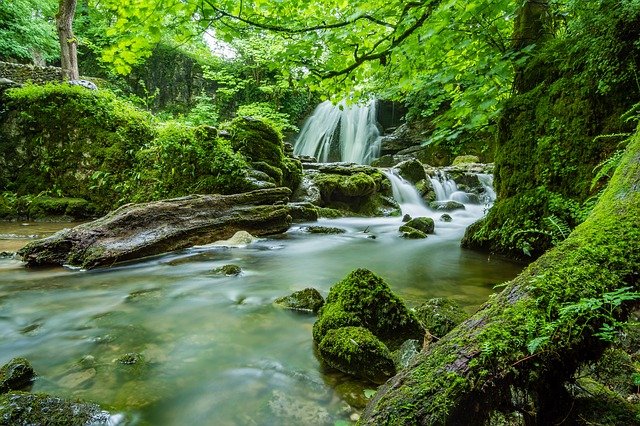
Ferns and mosses growing along a small waterfall.
I can see where the rain thing comes from, tbh.

Tying fern fronds to the ears of horses was said to protect them from the Devil.

In modern magic, ferns are used for rain-making, money spells, and protection. Adding the fronds to spells or arrangements of fresh flowers helps boost the magical properties of whatever they are placed with.

Last, but certainly not least, there’s the delightfully weird tale of the vegetable lamb of Tartary.

Using Ferns

There are so many species of fern with so many different medical uses, I can’t possibly cover them all here. While not all ferns (or all life stages of fern) are medicinal or edible, different fern species have been used for everything from stomach aches to snakebite. From what I have read and observed, they are most often used for skin afflictions — spores are said to reduce pain from stinging nettle, and ointments or pastes made of various fern species are used to tread cuts, bruises, and skin ulcers. In Scottish lore, ferns were mixed with egg and used as an ointment to restore sight or reduce redness in bloodshot eyes!
(Please don’t do this just because you read it here, though. I don’t want anybody getting some kind of raw egg eye infection.)

For protection, plant or place potted ferns near windows and doors. (Just make sure they have the right levels of sunlight and humidity!) Llewellyn has a spell using ferns to banish evil, which may piggyback on its use for rain-bringing. Rain is cleansing, ferns are protective, so these two properties could drive evil out of a place.

If you’re lucky enough to come across fern spores (those black dots along the backs of fronds), carry them when you want to go unnoticed.

In hoodoo, ferns seem to be largely for protective magic. Among other uses, sprinkling crushed fern leaves along windowsills is said to keep intruders away, and adding it to a floor wash with black snake root clears away jinxes.

That said, some spells may refer to specific ferns using secret names. Maiden’s hair is the maidenhair fern, for example, while horse’s tongue is the hart’s tongue.

Magically, your best bet is one of two things: purchasing fern fronds, or growing some of the easier-care varieties in pots. While older sources cited specific plants in their folklore, the modern herbals I consulted for this post didn’t — they just said “ferns.” In my opinion, I don’t think it matters much what type of fern you choose to work with. When it comes to spending my time tending a growing plant versus tracking down the exact species used in a spell, I’ve found I’m pretty much always better off using a plant I’ve developed a relationship with (or, at the very least, one that’s abundant where I live). They have an affinity for water, which explains their use in rain magic. They all have spores, not seeds, which explains their use in invisibility (and, to a lesser extent, protection) spells. Find a fern that will grow happily for you, and see what magical secrets it holds.