Books · Witchcraft

The Black Toad: West Country Witchcraft and Magic

It’s been a bit since I’ve sat down to read an entire book from start to finish. To be honest, I just haven’t had the time or attention to spare. I do want to get back into providing reviews and recommendations for books, since I see so many posts on social media asking for resources.

This week, I’ll be looking at Gemma Gary’s The Black Toad. At only 133 pages (not counting the bibliography and index), it’s a slim volume. Though diminutive, it’s definitely not hurting for content!

I’ll be honest, a lot of modern books and websites about witchcraft kind of make my eyes glaze over. Now, in a time where everything just gets boiled down to vibrations, intention, and personal gnosis, all of the advice and explanations sound very samey after a while. (They’re also not terribly helpful, and then people wonder why their craft doesn’t work!)

I really enjoy books on witchcraft that have a more historic bent. When I write about herbs or minerals, I end up looking into folklore, not modern lists of associations or uses. It gets closer to the heart of the matter and keeps me from having to reinvent the wheel through personal gnosis, as it were.

All of this is to say that I really, really like The Black Toad. It covers protection, luck, plant charms, weather witchery, and cursing, broken up into the domains of Old Mother Red-Cap, Green-Cap, and Black-Cap. All of this is presented without apology — for the one with the power to heal and protect must necessarily also have the power to destroy.

A rowan branch laden with red berries.

The spells and charms aren’t written like lists of instructions. Instead, they’re detailed descriptions of historical ways that witches and wise people had for protecting themselves and their animals, improving their luck, healing, and handling their enemies. It’s more than possible to use it as a spell book, but it’s primary value, to me, is as a depiction and explanation of traditional practices.

The only downside is that scientific names aren’t (or possibly can’t be) provided for some of the plants mentioned. Take sage, for example. The mention of sage states that it was drunk for health and longevity. However, there’s a sage native to the area that isn’t a sage at all — wood sage (Teucrium scorodonia). The actual sages, the Salvia species, are native to the Mediterranean. So is this sage an imported garden sage, or native woodland germander? Unfortunately, historic resources often don’t leave us much to go on.

A stack of books, magical seals, and dried herbs. Smoke rises from a bowl of burning herbs.

Some other reviewers pointed to the use of Biblical passages in some of the formulas as a problem. However, this is ahistoric and there are plenty of traditional resources that use passages from the Bible. There’s no reason to believe that witches and wise people, historically, would have reason to look down on doing so. The attitudes of modern people toward organized religion have no bearing on what people were likely to use in the past.

I’d recommend The Black Toad to anyone with an interest in traditional western European witchcraft. It gives a useful picture of the role and domain of wise people, as well as several spells that are still useful today.

Environment · Plants and Herbs

Dead Nettle Folklore and Magical Properties

’tis the season for deadnettles!

If you have any semi-neglected patches of ground in your life, you may have seen them — short plants with heart-shaped leaves, arranged like low towers accented by tiny flowers. Though they’re not native to this area, they’re pretty abundant. If you’re into controlling invasive plants, you’ll probably be happy to know that they’re also delicious edibles!

Don’t let the name fool you. Dead nettles aren’t poisonous, and they’re not nettles. They’re called “dead nettle” because they look an awful lot like stinging nettle, but their leaves are stingless. In reality, they’re part of the mint family (which probably explains their prolific growth and ability to thrive pretty much anywhere).

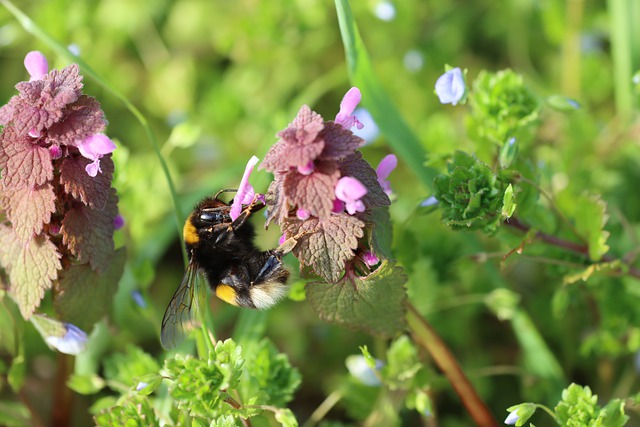
A bee enjoying some soft pink dead nettle flowers.

One of the best things about these nutritious plants? They’re easy to identify and don’t have any poisonous lookalikes. They’re also useful in all kinds of other ways.

Dead Nettle Folklore

Medically, purple dead nettle is used for allergies. It’s rich in quercetin, and has anti-inflammatory properties that make it useful for people with spring hay fever.

Some areas call it purple archangel, because it appears there around the Feast of the Apparition (May 8th). This was when the archangel Michael was said to have appeared on Mount Gargano, Italy, in the sixth century.

White dead nettle is sometimes called bee nettle. This is because it provides an early source of pollen and nectar, so it’s very popular with bees (and children! Kids sometimes suck the nectar from white dead nettle flowers, kind of like how kids used to suck the honeysuckle flowers that grew on the elementary school’s fence when I was little).

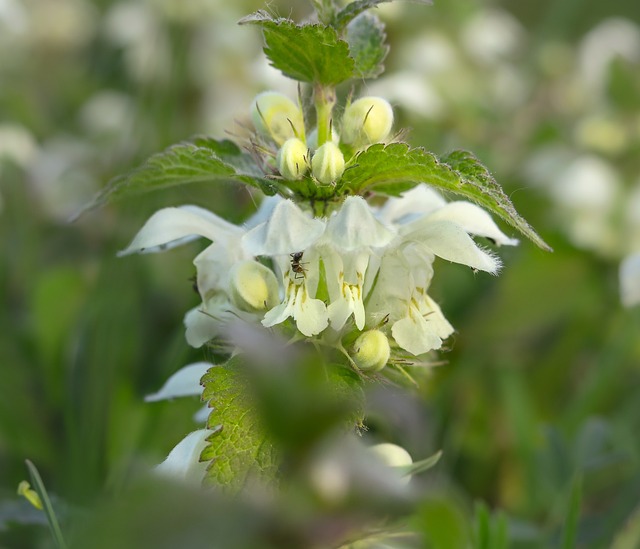
Some white dead nettle flowers. A small ant is crawling inside of one of them.

In Lancashire, it was said that white dead nettle flowers always come in twos, because they’re actually pixie shoes that have been left outside. These flowers also have two black spots inside, which are sometimes called “Cinderella’s slippers.”

White, spotted, and purple dead nettles are all used to treat stings from actual nettles. Mash the plant, squeeze out the juice, and apply it to the stung area. You can also chew some of the leaves and apply the resulting paste.

Magical Properties of Dead Nettle

Dead nettle is associated with determination, due to its ability to grow pretty much anywhere. (I’ve been harvesting it from cracks in the concrete, here.) It’s also connected to happiness, optimism, and relief.

Bright pink dead nettle flowers.

Like other members of the mint family, it dries well. Harvest some, hang it upside-down, and put a paper bag around it to keep off dust and catch any dropped leaves or flowers. Once you have some dried dead nettle, you can use it in teas, incense blends, sachets, poppets, jar spells, or pretty much anything else. This small, unassuming herb is fantastic any time you need a hit of joy and motivation.

Dead nettle is also useful in kitchen witchery. Add it to soups, salads, or even pesto to benefit from its magical and anti-inflammatory properties.

This plant also works wonderfully in tinctures, salves, and oils. This is a great way to preserve it well beyond its season.

For now, I’m pulling it out of my raised beds to prepare them for other things. Some will be left for the birds (chickens, especially, seem to love the stuff), and the rest will be brewed into tea, blended into smoothies, eaten fresh, dried, and pureed and frozen in ice cube trays to add to soup or fill out pesto!

Plants and Herbs · Witchcraft

Crocus Folklore & Magical Uses

It’s spring (kind of)!

At least, it’s getting spring-y here. Granted, I think we maybe had about four days of actual “winter,” but it’s been t-shirt weather for the past few days, and looks like it’s going to stay that way for at least another week.

Since things were warming up, I stepped out back to take a look at the yard. The elderberry bushed that I planted last year have some new leaves coming in, the bulbs I planted are starting to poke up through the mulch, and the apples are both looking good.

There’s also a large patch of surprise crocuses that seem to have popped up overnight next to my shed.

These are either Crocus vernus, the spring crocus, or Crocus tommasinianus, the woodland crocus. They’re beautiful, but decidedly not native to this area. (Crocus vernus and C. tommasinianus are related to C. sativus, the saffron crocus. However, these crocuses are definitely not a way to make rice more delicious.) Still, I am determined to enjoy them before it’s time to remove the bulbs and put in some native coralberry bushes. I’ll probably keep the bulbs and move them to somewhere where they’re less likely to spread.

If you’re also experiencing a flush of these tiny colorful flowers, here’s some old folklore and a few ways to make them magically useful.

Crocus Folklore

In ancient Greek legend, Crocus was a human man. The nymph Smilax was in love with him, but, ever the fuckboy, Crocus was dissatisfied with the affair. The gods turned him into a saffron crocus.

Another version of this story claims that Crocus was a companion of Hermes. Unfortunately, he stood up at an inopportune time during a discus throwing match, and Hermes accidentally killed him. As Crocus’ blood fell on the soil, saffron crocuses sprang up.

Spring crocuses are associated with Persephone, Aphrodite, and Venus. Mythology would also appear to tie this flower to Hermes.

A London source claimed that picking crocuses tended to “draw away the strength.” Therefore, only strong men or healthy young women should attempt to.

A field of purple and white crocuses at the base of a mountain.

According to Pliny, wearing crocus around the neck would prevent drunkenness. Interestingly, Swiss parents would place saffron around their children’s necks as a protective charm (presumably not against drunkenness, or else they’ve got some explaining to do).

In the Victorian language of flowers, crocuses represented cheer and youthful gladness.

This flower is associated with the planets Venus and Mercury, and the element of Water.

Crocus Magical Properties

Historic mentions of crocus as a protective charm typically refer to saffron crocus, not the spring crocuses. It can be hard to tease out folklore and uses attributed to spring crocuses, since the autumn-blooming saffron crocuses were generally considered more useful. For our purposes, I’m going to focus on spring crocuses here.

Spring blooming crocuses are used in charms for love, including platonic love or love of the self.

As an early spring-blooming flower, spring crocuses are also useful for spells for new beginnings.

These flowers are common altar decorations for Imbolc and Ostara. However, use caution if you bring spring crocuses indoors — all varieties of crocus other than C. sativus are toxic. Spring-blooming crocuses can cause diarrhea, vomiting, and digestive upset, while autumn-blooming crocuses can cause liver and kidney damage.

Simple Crocus Spells

You can include crocuses in charm bags for love. Add the dried flowers to a pink or red pouch along with rose petals, lavender flowers, and a bit of cinnamon bark. If you like, add a piece of rose quartz. Dress it with your favorite love-drawing oil (in a pinch, infuse some cinnamon, basil, and rose in grapeseed or sunflower seed oil, and use that) and keep it on you.

You can also use crocuses as a form of sympathetic magic. Plant a bulb along with a slip of paper with your name, and the name of your partner. Declare that as the plant grows, your love will flourish with it. When the flower is at its peak, pick it and save it for a love charm.

Plants and Herbs · Witchcraft

Nutmeg Folklore & Magical Uses

It’s the time of year when Trader Joes brings out their Wassail Punch. I don’t really drink fruit juices straight, but I like ’em for flavoring water kefir. This one’s blend of fruit and spices makes the end result taste like cola, which is pretty neat.

(Cola is one of those flavors that isn’t really meant to taste like anything in particular. It’s spices. It’s citrus. It’s all kinds of things that add up to one immediately recognizable taste.)

Anyhow, one of the key flavors in Wassail Punch (and probably cola, to be honest), is nutmeg. It’s one of those things that I can immediately recognize when I taste it but am completely unable to remember on its own. It’s like… a clove- and cinnamon-less pumpkin pie? I guess?

It was also one of those most precious substances in the world for a while, and a nearly invaluable magical ingredient.

Nutmeg Magical Properties and Folklore

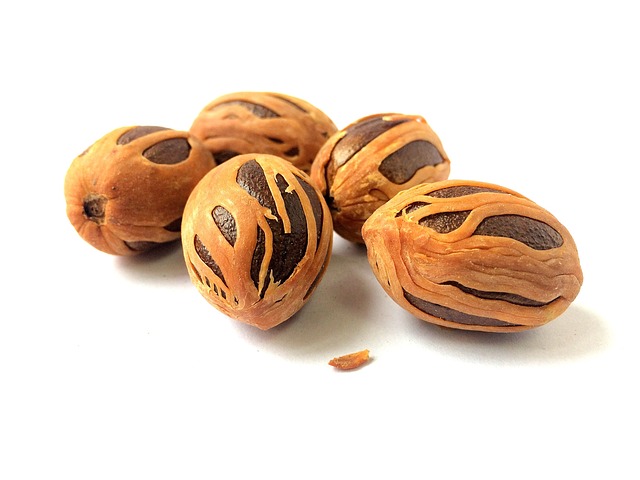
Nutmeg is a spice that comes from an evergreen tree, Myristica fragrans, native to Indonesia. It’s a weird seed, too — it grows inside of a fruit similar to an apricot, surrounded by an aril that looks kind of like a flat, fleshy spider or extremely underachieving facehugger. The dried aril is the source of the spice mace. The seed itself is the nutmeg.

An image of a ripe nutmeg fruit. The outside resembles an apricot, which has split to reveal the mace-covered nutmeg inside.

It takes a long time for nutmeg trees to bear fruit, though they can do so for several decades after that. Since the spice is native to such a small geographic area, an absolutely horrific amount of bloodshed happened in the name of obtaining it, farming it, and keeping anyone else from getting a hold of it. The Dutch tortured and killed the native people of Indonesia in order to control the nutmeg trade. They also tried their damnedest to keep the English and French from sneaking any viable seeds out of the country, by dipping the nutmegs in lime to keep them from sprouting.

People used to joke (inaccurately) about Manhattan being traded for glass beads. The Dutch really did trade Manhattan to the English for some sugar and nutmeg. For real, nutmegs were so valuable that traders would mix a handful of wooden replica nutmegs in with the real ones in order to dupe their customers.

A whole nutmeg, hollowed and filled with mercury, sealed with wax, and wrapped in a green cloth, is considered a powerful charm for luck in games of chance. (You can skip the mercury poisoning by just carrying a whole nutmeg. It’s fine. Really.)

Wrap a whole nutmeg in purple cloth, and it’s said to help you win court cases.

All forms of nutmeg are considered useful for money magic. Nutmeg oil is a common ingredient in money oils, while the powdered stuff is helpful in sachet and sprinkling powders.

Money and luck aren’t nutmeg’s only properties, however. An old spell from Louisiana involves sprinkling nutmeg in a woman’s shoe to get her to fall for you. Food and drinks flavored with nutmeg were also used as love potions.

Whole nutmegs covered in mace.

Ground nutmeg was used as incense in ancient Rome.

One old remedy for rheumatism involved boiling nutmegs and cooling the resulting liquid. The nutmegs’ natural fats rise to the surface and cool, forming a solid layer. This is skimmed off and used as a topical balm. Nutmeg is a warming spice, so this would help encourage circulation and relieve some of the pain caused by cold weather aches.

Nutmeg can make you trip balls. This is not code language.
This spice is a hallucinogen, courtesy of a compound known as myristicin. Unfortunately, you have to consume a lot to feel the effects, at which point you’re putting yourself at risk of nutmeg poisoning. “A lot” is relative here — about 10 grams (two or so teaspoons) of ground nutmeg is about to trigger symptoms of toxicity. It’s not that much, but still way more than you’d typically use in cooking. Nutmeg poisoning is pretty awful, too. While I wasn’t able to find any stories of nutmeg-based fatalities, the cases I did find mentioned nausea, dizziness, heart palpitations, fatigue, confusion, and seizures. Yikes.

Nutmeg is associated with the element of Air, the suit of Swords in tarot, and the planets Jupiter and Mercury.

Using Nutmeg

The easiest way to use nutmeg is to make your favorite autumn or winter recipe that uses this spice for flavoring. Use a wooden or metal spoon to prepare it and stir it with your dominant hand. As you do this, picture energy coming up from the Earth, down from the sky, and running through your arm, down your hand, into the spoon, and finally into the food or beverage itself. Ask the nutmeg for help with whatever you want it to do, whether that’s getting laid or making some money. Pretty easy, bog-standard kitchen witchery, really.

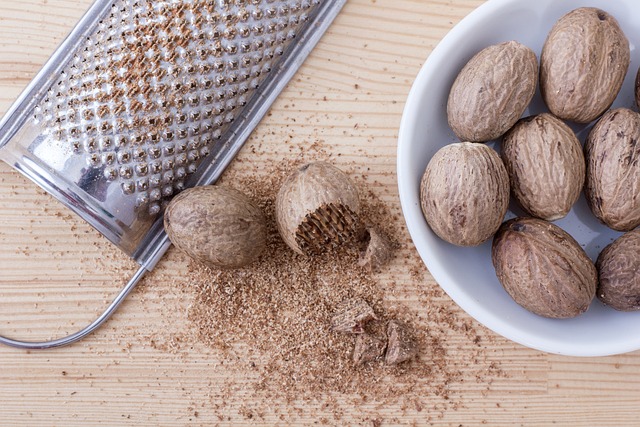
Whole nutmeg seeds, a nutmeg grater, and a little pile of ground nutmeg.

You can also use nutmeg by just… carrying it. As mentioned previously, whole nutmegs are a charm for luck and money. Wrap them in an appropriately colored cloth, anoint them with a suitable magical oil, ask them for their assistance, then keep them on you. When they get old and lose their potency, retire them by burying them in the soil and make a new charm with a fresh nutmeg.

You can also use nutmeg for meditation. I wouldn’t rely on it to induce a trance state, but drinking some warm milk flavored with honey and nutmeg can be a pleasant way to begin some meditative or journeying work. Just don’t use too much — the vast majority of nutmeg poisonings are from kids who eat it to get high and end up spending the night dizzy and throwing up instead.

Nutmegs are also good additions to charm bags or jar spells for money or luck. They’re very nice, potent, self-contained magical ingredients. If you have an assemblage of herbs, curios, and other tools, why not throw in a nutmeg? If you can’t afford a whole one, sprinkle in some of the ground stuff instead.

Nutmeg is a spice with a dark history (I mean, most of them have dark histories. Thanks, colonialism!). It’s preciousness as an incense and culinary ingredient has tied it to the concepts of luck and money, so you’ll most commonly see it in spells for financial abundance and good fortune. If you’re not a kitchen witch, a sprinkle of nutmeg can be a good place to start. If you need to practice magic discreetly, you really can’t go wrong with tucking a whole nutmeg in your bag or pocket.

Uncategorized

Preseli Bluestone Folklore & Magical Properties

The minerals that I’m drawn to shift over time. For a long time, it was smoky quartz. I read all I could about it and discovered that the properties that it’s said to possess were exactly what I’d needed at that time. Next it was Herkimer diamonds, especially the black ones. Same thing. Recently, I’ve been exploring the stones that come from the areas that a significant portion of my ancestors hailed from, which is how I came upon Preseli bluestone.

Preseli bluestone is best known as the stone used to make the inner ring of Stonehenge.

To be fair, the Druids didn’t actually make Stonehenge — it’s way older than that. While the did use Stonehenge, they didn’t drag the stones there. Stonehenge was actually an evolving project, contributed to by various tribes over a very long period of time until it became what we see today.

Preseli bluestone originates in a specific area of Wales, a staggering 160 miles from Stonehenge itself. Now imagine doing it by walking, and also you’re pushing gigantic rocks. There had to be something special about these stones for them to be considered worth the trouble.

Stonehenge and Preseli Bluestone Lore

One theory is that people indigenous to the Preseli area migrated, taking the stones with them due to their religious or cultural significance or as a means of establishing an ancestral authority over their new homeland.

The ages of Stonehenge’s stones vary widely. One is over two and a half billion years old, while another is a relative youngster at only 800 million. If we were to shorten these years to mere seconds, the younger stone would be about 25 years old. The older would be over 79.

Parts of Stonehenge have been standing since roughly 2500 BCE. The site itself seems to have been abandoned around 1000 BCE.

Some of the stones have carvings on the surface — these are only visible using either lasers, or sunlight at a very specific angle.

The techniques used to create Stonehenge are pretty sophisticated. The lintels (the long stones on top) are locked to their supporting stones with a mortice and tenon joints, slightly smoothed, and connected to their neighbors with tongue and groove joints. Their supporting stones were leveled on the top to account for the changes in elevation of the ground, so everything sits very evenly. When all of the stones were intact, they would have looked like a continuous ring.

A close-up image of Stonehenge, showing two lintel stones balanced on four sarsen stones. The end of one of the lintels demonstrates the "tongue" portion of a tongue and groove joint. Some of the sarsens in the rear of the photo show nubby projections, which would've helped to lock their lintels in place.
If you look carefully at the end of the lintel on the left, you can see the tongue end of a tongue and groove joint. Look at the sarsens in the back, and you can see the nubby bits that would’ve held their lintels in place.
Photo by Kris Schulze on Pexels.com

One stone, the Slaughter Stone, probably wasn’t actually used to kill anything. It gets its name from the bloody appearance of water that collects on its surface — the water reacts with iron compounds in the stone, oxidizing them and turning the water a rusty color.

Preseli bluestone was said to be transported by Merlin, using magic.

The Ethicality of Preseli Bluestone

The original place where bluestone is found is Carn Meyne. This is a protected area, and is off limits to mining and rock collecting alike.

The Preseli bluestone on the market today ostensibly comes from a nearby farm, where a deposit of the stone was found. Others may come from specimens collected from Carn Meyne before it was legally protected.

With this in mind, there’s some concern that Preseli bluestone trafficking might be a thing. If the Pagan and new age communities’ demand for bluestone outstrips the supply, then it could incentivize the smuggling of bluestone or other unethical practices. It can already be challenging to find genuine bluestone, since green dolerite is sometimes re-labeled and sold as bluestone for a higher price.

As always, it’s up to you to decide whether or not to acquire bluestone. If you do, do so from a reputable dealer. If you find that you may be succumbing to some of the consumerist habits that lurk in aspects of the new age movement, consider whether a different, ethically sourced, local stone will better meet your needs.

Preseli Bluestone Magical Properties

The significance of bluestone to Stonehenge’s creators has been lost with time. The most we have now is what modern crystal users have deduced. For the most part, it’s used to tap into one’s ancient origins — connecting with the spirit of the peoples for whom bluestone was important. Some authorities believe that the bluestones of Stonehenge may have been used as healing tools. While the larger, outer sandstones marked a boundary, the smaller interior ring of bluestone may have been used to heal the sick and injured.

It’s also sometimes used in variants of shamanism to strengthen one’s connection to the spirits of the lower world, those of plants, animals, and the elements.

Some use bluestone as a kind of spiritual anchor. This may be due to its connection to ancestral workings. When you feel unfocused or adrift in life, working with Preseli bluestone is said to help re-instill feelings of connection and direction.

It’s important to note that Stonehenge also, at least at once point, served as a burial site. I feel this gives Preseli bluestone a connection to death and the dead, not necessarily in a purely ancestral way. Stonehenge was also designed to align with the movement of the sun. This, plus Preseli bluestone’s green color (when polished — the rough stone is blue) further connect it to the energy of growth and abundance. When you combine these concepts, it’s a stone for understanding the cycles of life, death, and the recycling of energy and nutrients.

I find Preseli bluestone to be uniquely beautiful, even beyond its magical and historical pedigree. It’s a beautiful mottled green and white, almost like a dendritic agate without the branching. As someone who will likely never get to experience Stonehenge in person, I love that it’s still possible to forge a connection to the ancient people who created it.

Link round up

Good News Round Up: 6.17.2022

Hello! Have you ever wondered what your dog’s thinking? As it turns out, scientists might have an answer for you — sort of. This is a collection of posts and articles that I thought were interesting, funny, or just made me feel a little better about the state of things. I hope they can do the same for you.

A Glimpse Into the Dog’s Mind: A New Study Reveals How Dogs Think of Their Toys. Apparently, dogs have a “multi-modal mental image” when it comes to their favorite playthings. That means that they most likely focus on what is, to them, an object’s most significant sensory features — like its smell. Scientists discovered this by having dogs search for their toys under varying conditions, and observing which senses they seemed to rely on the most for specific objects.

Plants Appear to Be Breaking Biochemistry Rules by Making ‘Secret Decisions.’ As it turns out, plants make decisions about their respiration in ways that we didn’t anticipate. They can actually choose how much carbon they release, by deciding how much they retain for building more biomass. This all happens via a molecule called pyruvate. Most interestingly, plants can actually track what sources their pyruvate comes from, and factor that into their decision making process.

This DIYer Made the Coolest Boho Bookends for Only $1.75 , and They Look Straight Out of a CB2 Catalog. Are you into biophilic design? This is a design philosophy that uses natural materials, like wood and stone, which have beneficial impacts on our mental well-being. This super cheap, easy DIY uses a scrap of travertine limestone, and there’s no perfectionism allowed — the perfectly imperfect, organic shape of the material is part of the appeal.

Binding and Burying the Forces of Evil: The Defensive Use of “Voodoo Dolls” in Ancient Greece. The popular image of the “Voodoo doll” has little to do with the practice of Voodoo. The classic image of a human-shaped object that you stick pins in to cause harm is much closer to the concept of the poppet, a vehicle for sympathetic magic. This paper discusses the use of effigies as a means of binding and suppressing evil in ancient Greece, as well as similar binding rituals in Egypt and Assyria. It’s a long read, but an interesting one.

Researchers identify the origins of the Black Death. We all know that the bubonic plague came from fleas that carried Yersinia pestis, but how did the fleas get it to begin with? One popular theory held that it came from wild rodents in East Asia, but archaeological evidence and ancient plague genomes tell a different story.

Project: SigilPen. I often have to explain that Neodruidry is my religion, but witchcraft is a method. I use modern Druid magic, and I use witchcraft, though the two are very different. Either way, I love magical alphabets, sigils, and the concept of language and symbols as a form of magic on their own. SigilPen is a way of creating neat, accurate sigils using a magic square (kamea).

A lot of online sources for sigil magic fall into the trap of using a single magical square — usually the Square of Saturn — rather than choosing the kamea that’s aligned with what you’re actually trying to do. SigilPen allows you to choose whatever square you want to work with, and helps you translate your word, phrase, or name into a sigil. The site has several other very interesting tools for modern magic, aside from the SigilPen.

Pretend I folded this up and passed it to you under a desk.
– j.

Neodruidry · Plants and Herbs · Witchcraft

Fennel Folklore and Magical Properties

Fennel (Foeniculum vulgare) is a Mediterranean herb related to carrots. The type you see in supermarkets is bred for its large bulb, which is eaten as a vegetable. You can also find the dried leaves in teas and herb blends. It has a flavor very reminiscent of anise or licorice that becomes mild and sweet during cooking. It’s also related to silphium, a plant that was both considered a delicacy and included in formulas to cause miscarriage.

Flowering fennel tops.

One of the most interesting things about fennel is its action on the endocrine and reproductive systems. While it isn’t true that the ancient Romans harvested a relative of fennel to extinction for to use for herbal abortions, alcohol extracts of a relative of giant fennel (the source of the spice asafoetida) have been found to prevent egg fertilization and induce miscarriages in rats.

Fennel Magical Uses and Folklore

While fennel isn’t exactly the same plant as asafoetida, fennel seeds do act as a uterine stimulant. Part of this is due to an estrogenic effect, possibly courtesy of the compounds anethole, dianethole and photoanethole. Fennel also contains an enzyme that effects the body’s ability to process certain drugs. In the 3rd century, a doctor named Metrodora included a species of fennel in a compound of herbs to cause miscarriage.

Fennel is one of the plants in the Anglo-Saxon Nine Herbs Charm. To wit:

[C]hervil and fennel

very mighty these two plants created the wise leader holy in heaven

when he hung set and sent into the 7 worlds

for wretched and rich all to remedy

stands she against pain

stands she against poison.

Who is mighty against 3 and against 30

against fiends hand

against spells

against enchantment by wicked wights.

An excerpt from the Nine Herbs Charm, from the Lacnunga

Interestingly, Pliny the Elder claimed that silphium (the much-desired fennel of ancient Greece and Rome) had a powerful purgative effect when initially consumed. It was said that the plant purged the body of undesirable “humors,” effectively causing a kind of physical purification. However, Pliny also thought that snakes ate fennel to improve their eyesight, so maybe don’t take everything he says at face value.

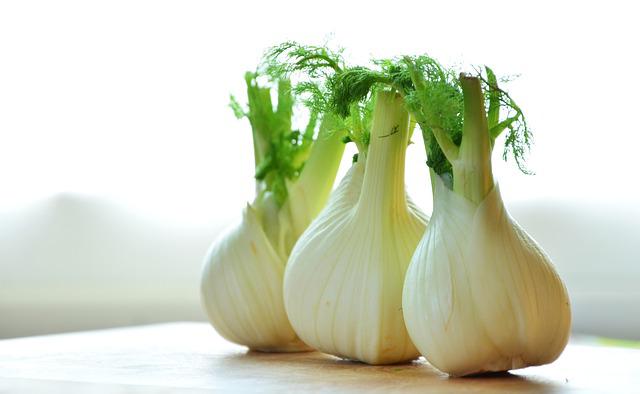
A trio of fennel bulbs.

When planted around the home, fennel acts as a magical ward. This may be based in part on its use as an insect repellant — the idea being that it repels evil just as well as it does bugs. As an extension of this idea, medieval households would hang fennel above the door and fill their locks with fennel seeds to keep wandering, unsettled ghosts away.

Fennel seeds are burned to purify spaces. You can also dress a candle with fennel seeds to break streaks of bad luck and crossed conditions in your life.

Fennel’s estrogenic effects were sometimes relied on to improve libido. By extension, the flowers and seeds are often used in sachets and charms to enhance one’s love life.

Planting fennel and dill together can result in hybrid plants that look like a cross between the two and taste like neither.

Followers of Dionysus carried wands made of fennel stalks.

Fennel is used for courage. Chew the seeds or drink fennel tea before you have to do something scary or difficult.

Using Fennel

Consume the seeds or drink the tea to help trigger a late menstrual period. The maximum dosage of fennel seeds for an adult human is about 6 grams. More than that may cause unwanted effects.

You can use pretty much any part of the fennel plant — chew the seeds, put them in tea, eat the bulb and stalk as a vegetable, you name it. This means that you’re pretty much free to choose whichever part of the plant resonates best with you, and use it however it suits your purposes. If you plan to consume it, be sure to do your research to make sure it won’t interact with any other herbs or medications you’re currently using. It’s generally safe in food amounts, but the risk of adverse side effects increases with the dose.

Fennel seeds are great additions to sachets, powders, and potions.

Growing fennel is fairly easy. It can grow in zones 5-10, and is a perennial in zones 6 and up. Nonetheless, it’s usually treated as an annual — it self-sows prolifically, and you’re likely to harvest and use the whole plant once its mature anyhow.

Sow fennel in early spring, about 16-18″ apart in an area that receives full sun and has enough headroom for the plant to reach its full 5′ adult height. (It’s best to direct sow, because fennel isn’t very receptive to transplanting.) Avoid planting it near other plants, since it secretes a compound that prevents competition. Coupled with its sun-blocking height, and you may find that its neighbors really struggle. Fennel also hybridizes readily with some other plants, so you may find that the seeds you get from it aren’t true to the parent plant at all.

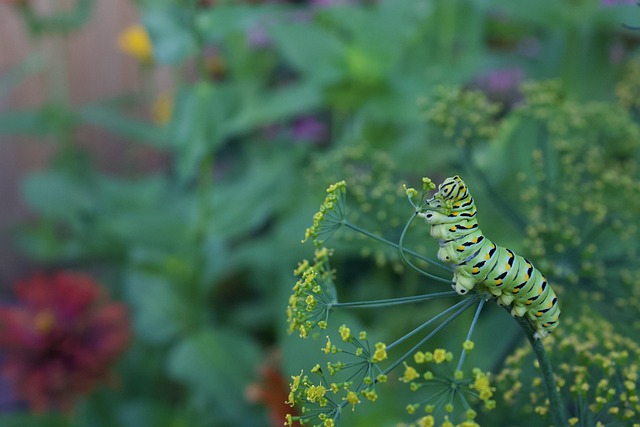
A swallowtail caterpillar crawling on a fennel flower.

Water fennel regularly until its well established. The plant generally doesn’t experience many problems, though you might find swallowtail butterfly caterpillars chewing on the leaves!

Harvest fennel after about two months, once its mature. Cut off the flowers as they appear, unless you want to gather the seeds (or would like the plant to self-sow).

Burn the seeds or stalks for purification or protection. Blend with rose petals, cinnamon, and other love and lust herbs for use in aphrodisiac formulas.

life

The Benefits of Not Being an Emotional Empath.

Much has been made over the idea of being empathic. This is pretty similar to being empathetic, in that both are based on structures in the brain that fire in response to other people’s behavior. While empathetic people can essentially “feel” the emotions of others, in the sense that they feel happy when others express joy and sad when others grieve, this goes deeper for empathic people.

A lot of articles have been written on the pros of being an empath, and some go so far as to treat it like a kind of superpower. At times, it can get weirdly confusing — some quizzes conflate being empathic with being generally energetically sensitive, when they aren’t the same. I’ve been called an empath because I feel drained after big gatherings and get headaches from floor cleaner, but, even if those are traits that are common to empaths, they aren’t signs of being emotionally empathic.

Anyhow, all of this is to say that being an empath isn’t necessarily optimal. The world needs empaths, but it also needs people whose mirror neurons aren’t doing the equivalent of cutting the brake lines on an F1 car. And so, here’s a list of reasons why it kind of rocks to not be an emotional empath:

Your energy is yours.

Sure, everyone should know how to shield themselves from other people’s energy. For empaths, though, this process is a lot more involved. People whose mirror neurons are more selective don’t have to worry as much about whether the feelings they feel are theirs, or the detritus of someone they came in contact with.

You can provide another kind of emotional support.

Empaths are good at emotional support because they feel what other people feel. Depending on the situation, that’s not always desirable — sometimes, you need someone who has an easier time maintaining distance to provide stability. There are also plenty of emotional situations where it doesn’t actually help to be told, “I understand you.” Some people need a witness to their experience, not someone to be in it with them.

This is a time when sympathy and compassion are helpful, but empathy may become detrimental. Not just detrimental to the empath, either — an empathic response can actually block what the other person needs from you. In the words of Graham Johnston, “using the prefrontal cortex to mentalise […] might be more helpful than using the anterior cingulate cortex to empathise with them.”

You can still be empathetic without being empathic.

Empathy arises in a specific area of the brain. In some people, this is more active than others. There is no hard line between being an empath and being devoid of empathy. It’s a spectrum.

What’s more, even if you’re not able to feel empathy like others do, you can still have sympathy and exhibit compassion. As mentioned above, there are plenty of times when a compassionate response is more helpful than an empathetic one. Even if you can’t empathize with someone’s grief, you can sympathize with their misfortune and treat them with compassion.

Projection is more difficult.

The number of people who consider themselves empaths probably outnumbers the actual empaths in the world. Unfortunately, empathy is often treated like the one good thing it isn’t possible to have too much of, but this is a) not true, and b) something that tempts people to identify with a label that may not actually apply to them.

As a result, there are an awful lot of empaths who don’t so much feel what others feel, as they project their own feelings onto other people. What if you honestly think you’re feeling what someone else is, but your feelings are inaccurate? What happens if you misidentify the source of these emotions?

Even if you are empathic, and you do accurately feel another person’s emotions, these emotions aren’t paired with that person’s personal, mental, and cultural context. You can respond to them in a way that you feel would be helpful, but, even if you’re feeling their feelings, you will always be responding from within your own context. If someone is grieving, and you feel their grief, you might want a hug to help soothe that pain within you. If you project this desire onto the other person, it’s not helpful. In the end, the solution is still to act from a place of sympathy and compassion.

An empathic response can actually increase bias.

This is a bit complicated, but follow me here.

Say you wear a red shirt. All of your friends wear red shirts. Maybe you even go to conventions about red shirts. Red shirts are awesome.

There’s another group of people who wear blue shirts. Maybe you understand why they do this, maybe you don’t. That part doesn’t matter. The red shirted people are your in-group. The blue shirted people are an out-group. Your groups’ experiences differ. They don’t go to your red shirt conventions, and you don’t get invited to their blue shirt parties. Unfortunately, this can lead to bias against people who are in the out-group.

In a 2009 study, some researchers performed experiments to see how to mitigate the effects of in-group/out-group biases. One big thing that helped was contact with members of the out-group. Another was empathy toward the out-group. Both empathy and contact reduced prejudice and biases. Here’s the weird part, though: When put together, they negated each other. Empathy plus contact didn’t improve the situation.

The researchers explained this through the concept of a “meta-stereotype.” This term refers to how a person thinks they are perceived by a member of their out-group. When an in-group member anticipates having contact with an out-group member, this concern is activated. Empathy heightens it. When you’re that preoccupied with feeling what a member of the out-group thinks of you, it becomes much more difficult to have a productive, natural interaction with them.

Worst of all, these findings were backed up by another study by a different group of researchers for years later. In this one, researchers found that attempts to take an empathetic stance toward members of an out-group actually reinforced in-group identity and negative attitudes toward out-group members. Oof.

This doesn’t mean that empaths are more likely to be prejudiced against others, of course. It does mean that, when you’re that sensitive to the feelings of others, it creates a heightened sensitivity in yourself that actually makes it much harder to relate to people in a natural, helpful way. High levels of empathy don’t always lead to better interactions between different groups of people. It’s a double-edged sword.

You take longer to burn out.

Feeling all of the feelings is tough. That’s why there are so many resources out there for empaths to learn to shield themselves, ground themselves, cleanse their energy, and generally cope with the aftermath of being exposed to other people’s heavy duty emotions and energies all of the time. This can be extremely exhausting for them, and some may even get burned out.

Burn out is a (sadly) common hazard of caretaking. People who work in medical fields or veterinary medicine, or even just provide care to young children or elderly relatives, can just become mentally and emotionally exhausted. If you’re not in those fields, don’t have access to professional resources to help you prevent burn out, and are still faced with feeling other people’s emotions, it can be pretty grueling. This is especially true when you’re primarily exposed to other people’s negative experiences (grief, loss, et cetera).

People who are empathetic in an average sense, and not empathic, still suffer from burnout. It’s just not quite as rough when you aren’t literally feeling other people’s feelings on top of everything else.

You can still be sensitive.

Being an empath involves having a deeper-than-average response to another person’s exhibited emotions. That is, your mirror neurons go off like a string of firecrackers when someone else has an emotional response to something, triggering those feelings in you.

This doesn’t really have anything to do with other sensitivities, though. You can still be sensitive to foods, scents, energy, sounds, and all kinds of things that have nothing to do with other people or their emotions. Someone may be an emotional empath, but less perceptive to subtle energies. Others are just Highly Sensitive People. Childhood trauma can even make some people extremely sensitive to displays of sadness or anger in others. This isn’t because their mirror neurons trigger feelings sadness or anger in them — they’re sensitive because they have an anxiety response to displays of negative feelings. Their heightened perception is a survival mechanism.

Empaths are wonderful, caring people, but the internet is literally full of articles praising the virtues of the empathic. Being an empath isn’t automatically an enlightened state of being, however, and can be detrimental to oneself and others. There are numerous benefits to having an average capacity for empathy, and it doesn’t exclude you from being sensitive to things other than emotions. Remember, it takes all types. If everyone was an empath, or everyone had low empathy, we’d be screwed.

Neodruidry · Plants and Herbs · Witchcraft

Spruce Folklore and Magical Properties

I’m finally moved, and luckily settled in to a place that my partner and I absolutely love. Seriously — we decided against buying a house right now (it’s very much a seller’s market), and it’s going to take a very special house to get me out of here once we are ready to buy. There are lots of very lovely trees around, from neighborhoods full of crape myrtle and magnolias, to a Kousa dogwood whose fruits tempt me every time I walk past it. (I always have to tell myself no, it’s part of the landscaping, not really owned by anyone in particular, and there’s no way to tell what it’s been treated with.)

My favorite, however, is a big blue spruce.

It has a weeping growth habit, so its massive branches of smoky blue needles hang dramatically. It has a really cool energy, too — not necessarily the “loving, supportive, enlightened” feeling a lot of herbal energy guides point to, more like a very old and wise thing who is also very curious about the tiny things around it. I get a gentle amusement from it. It even has a natural face in the bark. I love it.

How to Tell a Spruce vs. Pine vs. Fir

First, the big question: What kind of tree are you looking at? All of these species fall under the general category of conifers, meaning that they are cone-bearing seed plants. Spruce, pine, and fir all produce needles, too, which can make identification tricky from afar. Fortunately, there’s a pretty easy way to tell.

Pine

Are the needles long, thin, and sprout from a single spot in groups? You’re looking at a pine.

Fir

Are the needles short and flat? Pick one up (there’ll probably be plenty shed on the ground) and pinch it between your index finger and thumb. Does it roll easily? If the answer’s no, then you’ve got yourself a fir.

Spruce

Are the needles similar to fir needles, but have a square cross-section instead of a flat one? Try rolling them between your index finger and thumb. If they roll, that’s a spruce.

Spruce Magical Uses and Folklore

In western Sweden, researchers have found a spruce that may be the world’s oldest living tree. It’s nearly ten thousand years old, and has survived by cloning itself via layering.

According to the Hopi people, the spruce was once a medicine man who turned himself into a tree. It’s a sacred plant.

To the A’â’tam, the father and mother of humanity escaped a flood by floating in a ball of spruce pitch.

Northern Algonquian people used it to prevent illness.

One source indicates that blue spruce is a symbol of pure intentions, while, in a more general sense, spruces represent generosity, enlightenment, protection, healing, and intuition.

Using Spruce

Just befriend one. It’s both easier and more difficult than it sounds.

Trees are individuals, so the easiest way to tell if you’re barking up the wrong tree (ha ha) is by sitting near one. They have natural ways to mount a defense against creatures they don’t want around them, so see if you end up covered in ants, breaking out in a rash, or otherwise having a bad time. That’s a sign that this tree doesn’t want to be friends — at least not yet.

On the other hand, if you’re sitting by a tree and smell a sweet fragrance, maybe feel a gentle breeze and the sun on your face, hear the birds singing, get a sense of comfort and acceptance, and otherwise generally feel good, this tree might want to get to know you.

Once you’ve found a tree to be friends with, look at it. Look at it from afar, and examine the bark close up. Let your pareidolia take over, and see what features you can see in the bark. The tree might choose to show you its face to make it easier for the two of you to connect. After all, it’s easier to converse when you can see the other party’s face, right?

Talk to the tree. It doesn’t have to be out loud. Hang out. Make it little offerings, like fresh water or an interesting (and plant-safe) rock. Remember, this is a friendship — do small things to show you’re thinking of it, and don’t forget that, sometimes, the best gift you can give is your time.

The relationships you forge in the natural world are part of the foundation of magic. You’ve gotta learn to speak the language if you’re going to try to ask for help.

You can also consume spruce buds, as long as you’re sure the tree hasn’t been exposed to a systemic pesticide, industrial runoff, or car exhaust. Spruce buds are high in vitamin C, and have been used for tea, in syrup, and even to make a beer to sustain sailors over long voyages. You can also eat the young buds directly, if you’re into that.

Spruce trees are beautiful things native to the northern regions of the world. I can’t speak for all of them, but the ones I’ve known have been very nice to work with, even if that “work” is just sitting and exchanging energy for a time. If you don’t live in an area with native spruce trees, and you’d like to work with them, consider using spruce bud tea or syrup to experience some of their power.

Witchcraft

Is energy manipulation necessary for magic?

Funnily enough, I got the idea for this post a long time ago — when I was reading up on reasons why cognitive behavioral therapy might fail. That, coupled with a lot of books and papers on traditional and folk magic, raised an interesting question in my mind:

Is energy manipulation requisite for magic?

I’ve seen some experienced witches who poke fun at the spells created and posted by younger ones. I’ve even written about raising and directing power myself. Here’s the thing though — none of that shows up in the really old stuff.

Seriously. I can point you to a hundred different old bits of magical folklore and formulae, and not a one will mention anything about raising, directing, or releasing power. Nonetheless, these spells were important enough for the practitioners to pass them down.

If you look at modern spells and rituals, though, some manner of energy manipulation is considered absolutely requisite. If you skip it, or somehow do it wrong, you won’t achieve your goal. You could argue that the old wise women and cunning men raised and directed power without doing so in so many words, or even worked old magic without realizing that that’s what they were doing. If that’s the case, then who’s to say that this power-raising has to be done on a conscious level?

I have a theory that I find pretty interesting. It’s similar to one posed by Phil Hine in Condensed Chaos, when he talks about Spirit, versus Energy, versus Cybernetic models.
I don’t think magic changed. I think we did.

The Guardian posted an article a couple of years ago on the apparent decline in effectiveness of CBT. Oddly enough, this decline might be due to nothing more than CBT’s reputation. When it was first developed, it was lauded as a marvel of modern psychology. This perception may have influenced how effective it was for people who tried it — believing they were learning a miracle cure for their problems, they experienced one. As more and more people went through CBT with less than stellar results, this perception shifted. It’s declining in effectiveness because it no longer benefits from a reputation as a miracle.

This isn’t to say that all magic is a product of the placebo effect (though there are certainly branches of mental magic that rely on it to a degree). I’ve had experiences I definitely can’t attribute solely to that. But, as the article above mentions, a 1958 book by psychoanalyst Allen Wheelis stated that Freudian psychology no longer worked because people had changed. Modern humans were better at self-understanding. They now needed different tools.

The old techniques weren’t completely wrong; they’d just outlived their usefulness.

Oliver Burkeman

Modern humans are better at understanding the physical underpinnings of the world (arguably at the expense of our metaphysical understanding and psychic sensitivity). We have knowledge that would’ve been unthinkable to our ancestors. Learning changes us. We interact with energy — and therefore magic — differently. One of my ex-partners’ grandmothers cured people of worms by snapping a handful of straw over their stomachs. My ancestors did things that, if I posted them to an online grimoire, would have experienced witches laughing and poking fun at them for being ineffective “baby witch” spells.

The act of observing changes the observer as well as the observed, and we’ve done a lot of observing.

Does this mean that one way is better, more legitimate, more powerful? I really don’t think so. As Burkeman says, old tools outlive their usefulness. We’ve changed. Ten thousand years ago, nobody could digest milk in adulthood. (And don’t even get me started on what we’ve done to our jaws.) We occupy and interact with our environment differently — including the unseen world. It’s entirely possible we need to consciously manipulate energy because that’s what we’ve adapted to.

I’m curious to see what shape the future takes.