animals

The Magical Meaning of Black Squirrels

The other day, I was on the deck having breakfast with my local crowbros. (It’s funny — as soon as I go outside, I hear their calls pick up speed and intensity. Then they start to swoop around and gather in the big maple tree. Once some of the braver members of the family are present, they’ll start making forays to the feeders. Gradually, once they’ve proven its safe, the timid members follow suit.) This day was different, though.

This day had squirrels.
Not just the usual suspects (Freddy de Bonesby and the pruno-making delinquents), either.
Today, there was a black squirrel.

A photo of a black squirrel on a clover-covered hillside. He looks like he's just realized he left his stove on.

Black squirrels are a naturally occurring melanistic variation of grey or fox squirrels. They’re fairly rare under normal circumstances, appearing at a rate of about one for every 10,000. This is overall, however — black squirrels do occur more commonly in specific areas. They’re generally seen more often in urban places (theoretically because they blend in better there than they do elsewhere) and at the northernmost portions of their ranges (theoretically because they absorb sunlight more efficiently, keeping them warm and extending their active, foraging times during the cooler months).

Melanism in squirrels doesn’t occur with the same beautiful variety as human skin colors, and isn’t even the same as melanism in other animals. In most other animals, melanism is a recessive gene and an individual must inherit it from both parents. In humans, coloration is controlled by multiple genes that come in a variety of alleles that show incomplete dominance, resulting in an incredible variety of hair, eye, and skin colors. In squirrels, melanism is associated with the is associated with the MC1R-Δ24 E B allele EB and is incompletely dominant with the “wild” coloration allele E+. So, a squirrel that inherits two wild coloration alleles will be the color of the average gray squirrel (E+ + E+). A squirrel that inherits one copy of the melanistic allele will exhibit a dark brownish, nearly black coloration (EB + E+). A squirrel that inherits two copies will be a deep, shiny, inky black (EB + EB).

Even rarer than melanistic squirrels are leucistic squirrels — white squirrels with black eyes. These are not the same as albino squirrels, which typically have pink and blue eyes. Albino squirrels typically have poor eyesight. Leucistic squirrels have normal eyesight. Both stick out like sore thumbs to predators and generally don’t survive long in the wild.

Where I live, melanistic squirrels more common because it’s a) by a major city, where b) a bunch of them escaped from a zoo this one time.

I had seen a few here and there in the past, but I’d never seen one in the yard before. Out of curiosity, I decided to look up the magical and folkloric significance of these adorable weirdos.

Remember that bit about escaped zoo squirrels? Well, the tale goes like this: As far back as 1900, Frank Baker (superintendent of the National Zoo) repeatedly requested rare, beautiful black squirrels from several locations in Ontario, Canada. Two years later, Thomas W. Gibson (Ontario’s former commissioner of Crown lands) sent the National Zoo eight black squirrels. Canada is in the northernmost portion of the eastern gray squirrel’s (Sciurus carolinensis) range, so melanistic individuals are far more common there.
In 1906, eighteen of the black squirrels were released onto the zoo’s grounds. For some reason, people okayed this decision because they literally didn’t think they’d get out. However, being squirrels, that’s exactly what they did. As a result, DC has an exceptionally high population of melanistic squirrels.

A close-up of a black squirrel in autumn leaves.
Photo by Lauren Hedges on Pexels.com

Remember when I wrote about solar eclipses a bit ago? I briefly mentioned the Choctaw legend about greedy squirrels coming to eat the Sun. These weren’t just any squirrels, though — they were particularly hungry and mischievous black squirrels.

In Ireland and the UK, black squirrels were viewed similarly to black cats: as signs of good luck or prosperity. Rare as they are, they were also thought to have connections to the fae realm. While they don’t appear to have the “messenger” connotations of animals like crows, they are no less connected to occult knowledge.

Given squirrels’ propensity for burying things, black squirrels were associated with finding hidden treasure.

Of course, as has often happened throughout history, the spread of various forms of Christianity during the medieval period turned what were once good luck symbols into something sinister. Black animals, like cats, crows, ravens, and even squirrels, were then associated with misfortune and evil. They were often accused of being witches’ familiars.

In general, black squirrels are associated with good luck. English coal miners would keep them around for luck, and it was considered very unlucky to ever harm one.

Even in cultures where melanistic squirrels are viewed as troublesome, they were typically seen more as eccentric trickster figures than something expressly evil.

Today, places that are fortunate enough to be blessed with lots of black squirrels often take pride in it. Some of them are jokingly called “squirrel towns,” and feature black squirrels on their signs, as the subject of annual festivals, and represented on souvenirs in gift shops.

In a divinatory sense, the appearance of a black squirrel heralds a positive change of some sort.

While they may not be super rare here, black squirrels are still delightful to see. From what I’ve noticed, they seem jumpier and more skittish than other eastern gray squirrels, so being able to get a photo of one (or even a clear look at one) is a treat.

Plants and Herbs

Mustard Folklore and Magical Uses

I swear, mustard is immortal. At least, the kind I scattered in one of my raised beds is.

I had a packet of giant red mustard seeds that were initially intended for microgreens. When I cleared out a neglected spot in the front yard and turned it into a slightly raised bed, I didn’t really have anything to plant in it. So, I chucked a handful of the mustard seeds in there figuring that, at worst, I’d get some sprouts that would die back and essentially act as “green manure.” At best, I’d get some tasty mustard greens.

This was two summers ago. I have not sown mustard since. I am still harvesting tons of huge, fresh mustard leaves.

A close-up of red mustard leaves.
Photo by Alfo Medeiros on Pexels.com

Right before sitting down to write this, I went out to grab some leaves to use on sandwiches and as salad for my bearded dragon, Cecil. (His salads use collards, turnip tops, kale, or mustard as a base, with various other vegetables, limited fruits, a dusting of calcium and/or vitamin powder, and a sprinkle of dried black soldier fly larvae. I swear, I put more effort into his nutrition than I do my own.) That got me thinking — I’m familiar with the spell uses of mustard, and I’ve heard the bit of Christian folklore about “having faith as small as a mustard seed” before, but what else is out there? What more does mustard have to offer?

Mustard, as a condiment, is old. Very old. In ancient Rome, people would grind mustard seeds with wine and use the resulting paste just like we use mustard today.

A close-up of mustard seeds.
Photo by Eva Bronzini on Pexels.com

(Believe it or not, the easiest way to temper the heat of mustard is to change the liquid component. Mustard seeds, on their own, don’t really taste like much when compared to mustard as a condiment. They need to be crushed and mixed with a liquid to really express their full flavor. Using water to make a mustard paste creates a very hot mustard. Acids, like wine or vinegar, temper the heat by altering the enzymatic reactions within the crushed mustard.)

Mustard is a member of the Brassica family. That means that it’s related to broccoli, kale, cabbage, turnip, Brussels sprouts, cauliflower, and kohlrabi.

In traditional Chinese medicine, mustard is used for respiratory problems, skin conditions, and pain in the joints or muscles. Mustard is actually pretty useful for muscle or joint pain, as it’s a counterirritant that encourages blood flow to an area — similarly to the way that we use capsaicin cream today.

In early Western medicine, mustard seeds were crushed, placed in a protective dressing (usually flannel), and applied to the body to warm it, improve blood flow, and speed healing. This was most commonly used for issues like joint pain, muscle strains, and chest congestion. While it has since become less popular than standardized preparations of compounds like capsaicin or menthol, it is still sometimes used as a home remedy for aches, pains, or colds.

A bit of German folklore advises that new brides should sew mustard seeds into the hems of their wedding gowns. This helps ensure that they don’t get bossed around in their new households. It also helps ensure good luck.

Mustard is, like many hot or irritating spices, used to repel things. In both Denmark and India, scattering mustard seeds around the outside of a property was believed to keep evil away.

This is something we see time and time again — the vast majority of evil-repelling plants that I’ve encountered are also good at repelling physical pests, as well. Mustard is no exception. The leaves have a spicy, subtly bitter flavor that makes them pretty unpalatable for a lot of pests. (I got to see this in action when I was cleaning cabbage loopers off of my kale and broccoli. The mustard was untouched.)

In general, mustard is considered a useful magical herb for any workings that deal with healing, repelling evil, or attracting good luck.

Mustard is associated, probably unsurprisingly, with the element of Fire.

Looking at its historical uses, mustard is one of those interesting herbs that can be a bit misleading. There are a lot of charts and tables out there that’ll tell you basic information — for luck, use x, y, or z. For love, use a, b, or c — but don’t go any further than that.

Here’s the thing: Mustard acts, in all ways, as a repellent. Medicinally, it inflames tissues, bringing in more blood flow to flush out whatever the problem is. Horticulturally, the heat and flavor in the leaves repel insects and sensitive herbivores. In folk magic, it repels evil.

While mustard is an effective herb for attracting good things, this appears to be because, traditionally, it chases away the bad. Once evil is repelled, good fortune and healing can come in.

For this reason, I don’t really recommend using mustard on its own. If you really want to dial in a working for good luck or healing, combine it with herbs that focus on those things. Mustard will help clear away the bad, and they will help bring in the good.

Since mustard is typically available as seeds, it’s also a useful tool for sympathetic magic. To increase one’s luck, combine fresh, untreated mustard seeds with luck-drawing herbs like alfalfa (another herb that’s generally better to not use alone), fenugreek, dried chamomile, or crushed allspice berries. Scatter the mixture outside declaring that your luck will grow as the mustard seeds grow.

On the other hand, if your goal is to purify or banish, then mustard is fine on its own. Scatter the seeds outside, across the area in front of your front and back doors, etc. Sprinkle bits of ground mustard powder in the corners of your rooms and under your door mat. Tell the seeds that you want them to repel evil, and thank them for their help.

Mustard is a delightful, delicious, and nutrient-dense addition to any meal. It also packs quite a metaphysical wallop — while its hot and bitter compounds are great at keeping garden pests away, it’s equally good at repelling evil. It’s a very useful addition to spells to attract good things, as it’ll help keep away the bad and make room for more blessings in your life.

life

… And then, somehow, we came out ahead.

Remember when my Handsome Assistant’s car got stolen? And we found it because of a pair of sunglasses? And it came with free Takis?

Anyhow, we went through the whole rigamarole. Talked to the insurance. Talked to police. Had it towed to a place. Had it towed to another place. Had it checked out, then towed to another place for Reasons, I guess.

Long story short, the cost of fixing the damages exceeds the value of the car. It’s totaled.

Even longer story short, this is possibly the best thing that could have happened.

Look, we’re cheap frugal people. We try to live below our means. He doesn’t take out loans or buy new cars because the way that car valuation works is bad and silly. I don’t take out loans or buy any cars because my eyes are mostly decorative at this point. We make it work.

This is how he was able to haggle a really good price on his last car. Couple that with trading in the car that got poisoned in Mississippi, and the total that he’d paid is actually significantly less than its value. Like, it would cost more to replace the car at its current book value than he originally paid for it.
And, depending on how the law shakes out, we might still be able to trade in or sell the totaled car (for parts, but still).

“But Jec,” you may be saying, “You guys’re still out a car, and that sucks.” And yes, you are correct. It is less than optimally convenient.

However, after the Mabon celebration (where we accidentally gatecrashed a youth group, my Handsome Assistant almost got hypothermia, and we ended up sleeping in the trunk), we came to the conclusion that it might not be a completely terrible idea to look at other models of car once this one bit the dust. I suggested a wagon, because we could use the extra cargo space. He wanted a hybrid or EV. We kind of shrugged it off for the time being, because his current car was working fine and we weren’t in any rush.

Now, not only do we have a reason to look at cars that better fit our needs, but we also have some extra dosh to do it with.

I don’t know how we ended up benefitting from what is, objectively, a really sucky situation, but I’m happy. ᕕ ( ᐛ )ᕗ

I should get some Takis to celebrate.

Uncategorized

Blueberry (and Bilberry) Folklore and Magical Properties

I love blueberries. Few things are as delightful as a fat slice of warm blueberry pie or cobbler, with a generous dollop of ice cream (or non-dairy ice cream equivalent, as it were).

I was very excited to find that the previous occupants of this house had planted some blueberry bushes in the back yard. Unfortunately, these bushes weren’t exactly thriving — they’d been planted in an area that’s under trees. It gets plenty of light during the late autumn to early spring, but very little in the warm months. Our soil is also hard clay, and it didn’t appear that the area had been given much organic matter.

So, as much as it worried me to do it, my spouse and I uprooted these bushes and moved them into a much sunnier spot, blended well with a generous amount of shredded bark and leaf compost. We also planted two more bushes of a different variety, to fill out the tree guild we’re building around the Chehalis apple tree I talked about two weeks ago.

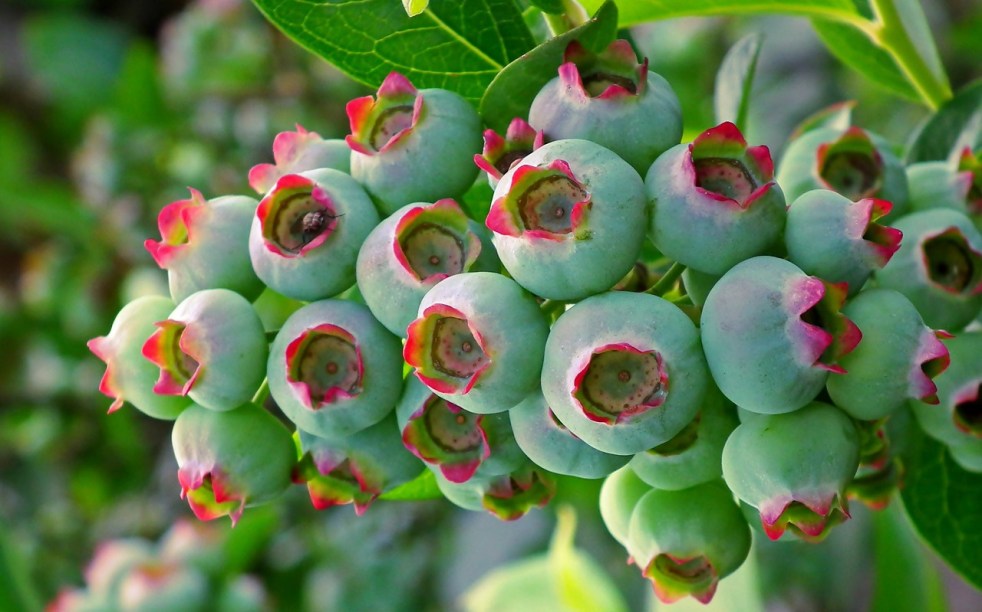
A cluster of ripening blueberries on a bush.
Some lovely little unripe blueberries on one of the bushes in the back yard.

This post isn’t about soil composition and permaculture, though I could definitely go on for volumes if it was.

No. Today, I want to get into some of the folklore and magical uses of these wonderful little balls of deliciousness.

It should be noted that blueberries (Vaccinium angustifolium, V. corymbosum, et al) are a strictly New World fruit. There’s a European relative called the bilberry (or European blueberry, Vaccinium myrtillus) that’s very similar, and the magical properties of these fruits are virtually interchangeable. If you live in an area where bilberries are native, use bilberries. If you live where blueberries grow, use those instead.

Blueberry and Bilberry Folklore

While blueberries are named for their deep purplish-blue color, the name “bilberry” is likely of Scandinavian origin. The Danish word bølle means “whortleberry,” which is another word for certain members of Vaccinium including the bilberry.

You can tell blue- and bilberries apart by their fruits. Blueberries grow in clusters, are a purplish-blue, and have a blossom end that looks a bit like a pentagon with five pointed flaps. Bilberries grow alone or in pairs, are almost black, and have a circular, smoother blossom end.

A bilberry on a bilberry shrub. The blossom end is facing upward, showing a distinct lack of the pointed flaps found on blueberries.
As you can see from this bilberry’s “butt,” they have rounder blossom ends and lack the pointy flappy bits of American blueberries. Compare it to the unripe blueberries in the photo above this one.

In Ireland, bilberries (fraochán or fraughan) are traditionally gathered during the last Sunday in July and the first of August. The first of August is Lughnasadh, a festival marking the beginning of the harvest season. Bilberries and blueberries are a traditional addition to Lughnasadh festivities all around the world.

Since gathering bilberries was traditional for the beginning of the harvest season, they were treated as a kind of oracle. If the crop was abundant, other crops would similarly flourish. If the bilberries did poorly, everything else would, too.

In ancient Greece, bilberries came from Herme’s son Myrtillus. King Oenomaus of Pisa had been given a prophecy: He would one day be killed by a son-in-law. Seeking to avoid this fate, Oenomaus decided to prevent his daughter, Hippodamia, from ever marrying by challenging every one of her would-be suitors to a chariot race on the Isthmus of Corinth. If the suitor won, he’d get Hippodamia. If he lost, Oenomaus would kill him. Since Oenomaus’ chariot was pulled by horses given to him by the god Ares, there was no way he could ever lose.

Then came Pelops. Hippodamia fell for him immediately, and went to her father’s servant, Myrtillus, for a favor. She wanted him to sabotage her father’s chariot so he’d lose the race, and Myrtillus, full of unrequited love for Hippodamia, agreed. On the day of the race, Myrtillus switched the metal linchpins of Oenomaus’ chariot with ones made of beeswax. Oenomaus’ chariot flipped, and Pelops beat him easily.

Some versions of the story say that Oenomaus, with his dying breath, asked to be avenged. Pelops then threw Myrtillus into the sea, and Hermes turned him into a bilberry shrub when he washed to shore. Another version says that Pelops, Hippodamia, and Myrtillus were traveling, when they stopped at an island so Pelops could fetch his new bride some water. When he returned, Hippodamia was in tears. Myrtillus had tried to sleep with her, she cried, while Myrtillus protested that she had promised to do so in exchange for sabotaging Oenomaus’ chariot. The enraged Pelops then killed Myrtillus.

In the folklore of some of the people indigenous to blueberry’s native range, blueberries are called “star berries” for the star-shaped blossom end.

In the Victorian language of flowers, bilberry represents treachery. This symbolism is likely borrowed from the Greek story of Myrtillus.

Blueberry and Bilberry Magical Uses

Blue- and bilberries are associated with protection and luck in European witchcraft.

Dried bilberry leaves are used in protective powders but can also be used whole for prosperity and luck.

The fruit is similarly used for protection and hex-breaking.

(Considering bilberry’s associations with treachery and crop divination, I wonder if their protective properties stem from their connection to physical danger and starvation. Today, we know that fruits like blueberry and bilberry can protect against oxidative cellular damage due to their antioxidant content, but their traditional connection to protection goes back much farther.)

Using Blueberries and Bilberries

Blueberries and bilberries couldn’t be simpler to use. For kitchen witches, include them in recipes for protection and the removal of malevolent enchantments.

Crushing the fresh berries can yield a pigment suitable for drawing protective sigils on paper talismans, the skin, and anywhere else you might need them. Just bear in mind — both of these berries are sweet, and your talismans may be sticky and likely to attract bees this way!

To protect your property, dry bilberry or blueberry leaves. Powder them well, then sprinkle the powder around the perimeter of your home or yard.

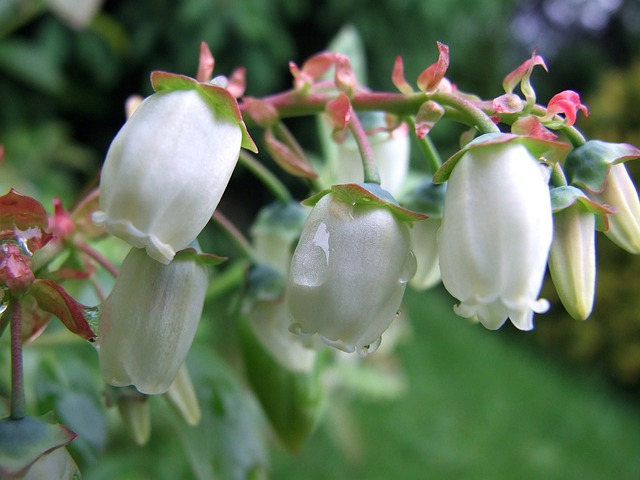
White, bell-shaped blueberry blossoms.

To break a hex, jinx, or run of bad luck, burn dried blue- or bilberry leaves. Use the smoke to fumigate the same way you’d use incense smoke.

Blueberry and bilberry don’t appear to be reversing herbs. That is, they don’t return treachery or malevolent magic to the sender. They just keep it from affecting you.

Since bil- and blueberry seems to predominantly be a protective herb, I would hesitate to use it solely for drawing luck. It appears that it’s virtue in luck drawing lies in its ability to get rid of jinxes and other things that hold you back. For luck spells, then, I’d pair blueberry or bilberry leaves with an ingredient used more specifically for attracting good luck. The berry leaves can clean up the things standing the way of your luck, and the other ingredients can draw it in. Allspice, chamomile, and fenugreek are all good options to consider here.

Interestingly, strawberries are sometimes used in small amounts for luck drawing. You could then theoretically make a jam, smoothie, or pie with both blueberries and strawberries, and, when appropriately made and empowered, use it to attract good luck to you.

It remains to be seen how my poor transplanted blueberries do, but the newer ones seem to be thriving. When the time is right, I’ll harvest the fruits and some of the leaves, and hopefully have enough protection and hex-breaking to last me all year!

life · Neodruidry · Plants and Herbs · Witchcraft

Wood Sorrel Folklore and Magical Properties

Take a look at your lawn. Unless you maintain it to putting-green smoothness, you’re likely to see some yellow flowers.

Not the dandelions — look closer.

You might mistake them for buttercups at first, but they’re really quite different. These little yellow five-petaled flowers are yellow wood sorrel (Oxalis stricta). They’re a native wildflower where I live, and vastly superior to the grass that still attempts to poke its way up through their heart-shaped leaves and small yellow flowers.

A plant with heart shaped leaflets and five-petaled yellow flowers.
A tuft of yellow wood sorrel.

As a native herb here, it doesn’t have a long history of use in old European grimoires. There are, however, many other varieties of wood sorrel — some native, some not, and some of questionable origins.

I’m a big proponent of using native alternatives to exotic herbs whenever possible, so I figured I’d give some background on wood sorrel and a few ways to use its magical (and delicious) American cousins.

Wood Sorrel Folklore

The species name Oxalis comes from the Greek word oxus, meaning “acidic” or “sharp.” The leaves of wood sorrel have a very tart flavor which makes them a tasty addition to salads. When dried, wood sorrel can be used to curdle milk for cheesemaking.

These plants are connected to fairies and woodland spirits. In Wales, wood sorrel is called fairy-bells.

A European wood sorrel plant (Oxalis acetosella), with heart-shaped leaflets and white, bell-shaped flowers.
The white flowers of Oxalis acetosella show why this plant’s sometimes known as “fairy bells.”

In herbal medicine, a decoction of the leaves was used for thirst and fever. Applied externally, the crushed leaves have an astringent effect which helps with abscesses, boils, and wounds.

Dried leaves are said to attract luck and, due to the doctrine of signatures, be healing and protective to the heart.

It’s also said that the dried leaf will allow the user to see fairies.

There’s some debate about shamrocks (an Anglicization of the Gaelic seamróg, meaning “little or young clover”). Shamrocks are associated with Saint Patrick, who used a three-leafed plant to explain the idea of the Christian Holy Trinity. Most depictions of the shamrock show it with three heart-shaped leaves. Since clovers have rounded leaves, this indicates that the shamrock may actually be a species of Oxalis and not a clover at all.

The ancient Druids were said to have regarded the shamrock as a sacred plant with the power to drive off evil spirits.

In the Victorian language of flowers, wood sorrel represented joy and motherly affection.

Wood Sorrel Magical Uses

Magically, wood sorrel is used in spells for luck, healing, protection from evil and misfortune, and love.

These plants can also be useful for working with three-part deities, like the Triple Goddess or Brighid. They make good offerings, or even natural representations of the deities themselves in a pinch.

Using Wood Sorrel

Wood sorrel isn’t a substitute for a visit to a doctor, but it can be a helpful herb for minor problems. Be sure you can reliably identify sorrel before attempting to consume it or use it topically.

If you live where wood sorrel naturally grows, you may want to cultivate a native species in your yard or garden space. This is especially true if you have an altar or dedicated space for nature spirits — wood sorrel is strongly connected to these entities. I’m planning to put an offering bowl and some large bull quartz crystals on the edge of the patch of yellow wood sorrel here, for example.

Using wood sorrel as a protective plant is an interesting idea. This protection may stem from the plant’s three-leaved appearance, which is reminiscent of various triple deities. The number three is also regarded as sacred in itself, since it reflects the past, present, and future; youth, adulthood, and old age; birth, life, and death; and the upper, middle, and lower worlds. Wood sorrel may also be considered protective because it’s very sour. Sour things, like lemons and vinegar, are often used to ward off or cleanse away negative energy.

Yellow wood sorrel leaves. The leaves consist of three heart-shaped leaflets, arranged similarly to clover leaves.
This picture shows the heart-shaped leaves and small yellow buds of yellow wood sorrel.

With all of this in mind, I’d brew a tea of wood sorrel and use it to wash doors, windows, and thresholds. Growing wood sorrel could also have a protective and luck-drawing quality.

The dried leaves and flowers would make a very nice addition to jar spells and sachets for love magic. I’d probably combine the flowers with roses, apple blossoms, and other seasonal blooms associated with love-drawing, then use this mixture in a magical bath.

If you’ve never tasted wood sorrel, I highly recommend it. The tart leaves and flowers are a very interesting addition to salads, soups, and sauces. If you’re into kitchen witchery, these edible wildflowers can be a powerful way to work with your local landscape to bring love, protection, and luck into your life.

Plants and Herbs · Witchcraft

Nutmeg Folklore & Magical Uses

It’s the time of year when Trader Joes brings out their Wassail Punch. I don’t really drink fruit juices straight, but I like ’em for flavoring water kefir. This one’s blend of fruit and spices makes the end result taste like cola, which is pretty neat.

(Cola is one of those flavors that isn’t really meant to taste like anything in particular. It’s spices. It’s citrus. It’s all kinds of things that add up to one immediately recognizable taste.)

Anyhow, one of the key flavors in Wassail Punch (and probably cola, to be honest), is nutmeg. It’s one of those things that I can immediately recognize when I taste it but am completely unable to remember on its own. It’s like… a clove- and cinnamon-less pumpkin pie? I guess?

It was also one of those most precious substances in the world for a while, and a nearly invaluable magical ingredient.

Nutmeg Magical Properties and Folklore

Nutmeg is a spice that comes from an evergreen tree, Myristica fragrans, native to Indonesia. It’s a weird seed, too — it grows inside of a fruit similar to an apricot, surrounded by an aril that looks kind of like a flat, fleshy spider or extremely underachieving facehugger. The dried aril is the source of the spice mace. The seed itself is the nutmeg.

An image of a ripe nutmeg fruit. The outside resembles an apricot, which has split to reveal the mace-covered nutmeg inside.

It takes a long time for nutmeg trees to bear fruit, though they can do so for several decades after that. Since the spice is native to such a small geographic area, an absolutely horrific amount of bloodshed happened in the name of obtaining it, farming it, and keeping anyone else from getting a hold of it. The Dutch tortured and killed the native people of Indonesia in order to control the nutmeg trade. They also tried their damnedest to keep the English and French from sneaking any viable seeds out of the country, by dipping the nutmegs in lime to keep them from sprouting.

People used to joke (inaccurately) about Manhattan being traded for glass beads. The Dutch really did trade Manhattan to the English for some sugar and nutmeg. For real, nutmegs were so valuable that traders would mix a handful of wooden replica nutmegs in with the real ones in order to dupe their customers.

A whole nutmeg, hollowed and filled with mercury, sealed with wax, and wrapped in a green cloth, is considered a powerful charm for luck in games of chance. (You can skip the mercury poisoning by just carrying a whole nutmeg. It’s fine. Really.)

Wrap a whole nutmeg in purple cloth, and it’s said to help you win court cases.

All forms of nutmeg are considered useful for money magic. Nutmeg oil is a common ingredient in money oils, while the powdered stuff is helpful in sachet and sprinkling powders.

Money and luck aren’t nutmeg’s only properties, however. An old spell from Louisiana involves sprinkling nutmeg in a woman’s shoe to get her to fall for you. Food and drinks flavored with nutmeg were also used as love potions.

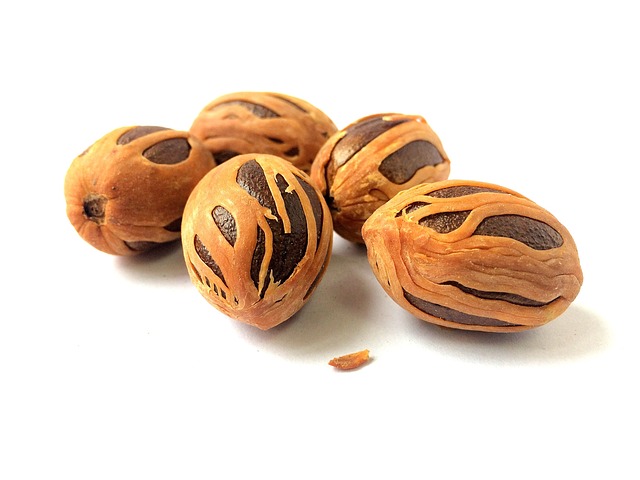
Whole nutmegs covered in mace.

Ground nutmeg was used as incense in ancient Rome.

One old remedy for rheumatism involved boiling nutmegs and cooling the resulting liquid. The nutmegs’ natural fats rise to the surface and cool, forming a solid layer. This is skimmed off and used as a topical balm. Nutmeg is a warming spice, so this would help encourage circulation and relieve some of the pain caused by cold weather aches.

Nutmeg can make you trip balls. This is not code language.
This spice is a hallucinogen, courtesy of a compound known as myristicin. Unfortunately, you have to consume a lot to feel the effects, at which point you’re putting yourself at risk of nutmeg poisoning. “A lot” is relative here — about 10 grams (two or so teaspoons) of ground nutmeg is about to trigger symptoms of toxicity. It’s not that much, but still way more than you’d typically use in cooking. Nutmeg poisoning is pretty awful, too. While I wasn’t able to find any stories of nutmeg-based fatalities, the cases I did find mentioned nausea, dizziness, heart palpitations, fatigue, confusion, and seizures. Yikes.

Nutmeg is associated with the element of Air, the suit of Swords in tarot, and the planets Jupiter and Mercury.

Using Nutmeg

The easiest way to use nutmeg is to make your favorite autumn or winter recipe that uses this spice for flavoring. Use a wooden or metal spoon to prepare it and stir it with your dominant hand. As you do this, picture energy coming up from the Earth, down from the sky, and running through your arm, down your hand, into the spoon, and finally into the food or beverage itself. Ask the nutmeg for help with whatever you want it to do, whether that’s getting laid or making some money. Pretty easy, bog-standard kitchen witchery, really.

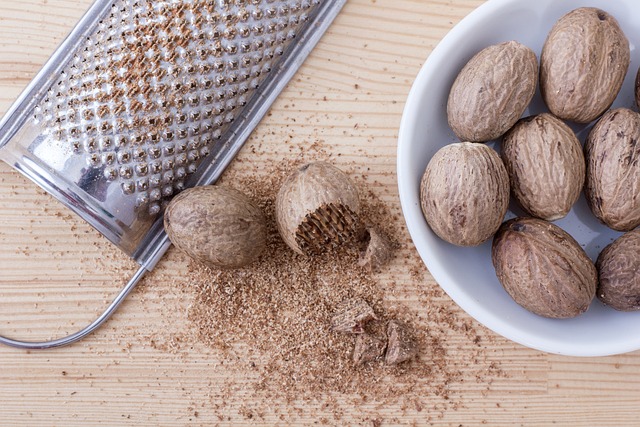
Whole nutmeg seeds, a nutmeg grater, and a little pile of ground nutmeg.

You can also use nutmeg by just… carrying it. As mentioned previously, whole nutmegs are a charm for luck and money. Wrap them in an appropriately colored cloth, anoint them with a suitable magical oil, ask them for their assistance, then keep them on you. When they get old and lose their potency, retire them by burying them in the soil and make a new charm with a fresh nutmeg.

You can also use nutmeg for meditation. I wouldn’t rely on it to induce a trance state, but drinking some warm milk flavored with honey and nutmeg can be a pleasant way to begin some meditative or journeying work. Just don’t use too much — the vast majority of nutmeg poisonings are from kids who eat it to get high and end up spending the night dizzy and throwing up instead.

Nutmegs are also good additions to charm bags or jar spells for money or luck. They’re very nice, potent, self-contained magical ingredients. If you have an assemblage of herbs, curios, and other tools, why not throw in a nutmeg? If you can’t afford a whole one, sprinkle in some of the ground stuff instead.

Nutmeg is a spice with a dark history (I mean, most of them have dark histories. Thanks, colonialism!). It’s preciousness as an incense and culinary ingredient has tied it to the concepts of luck and money, so you’ll most commonly see it in spells for financial abundance and good fortune. If you’re not a kitchen witch, a sprinkle of nutmeg can be a good place to start. If you need to practice magic discreetly, you really can’t go wrong with tucking a whole nutmeg in your bag or pocket.