Plants and Herbs

Apple Folklore and Magical Properties

As I write this, the results of the US presidential election are being calculated. I’m trying to do anything other than be uselessly anxious about that all night, so I figured I’d write about a cozier topic to get my mind off of it.
Hence: Apples.

Apples are a traditional food for Samhain. This year, I had originally hoped to save at least an apple or two for us. I went out, covered about half of the young fruits with organza bags I had left over from gifts, and thought I was good to go. There were some for me, some for the local fauna, and everyone should’ve been fine. Then there was a spell of dry weather.
Anyhow, I got no apples, and also the squirrels stole all of my bags.

Then, at Mabon, we were working on masks and costumes for the Council of All Beings. Someone found a dropped googly eye, and I made a joke about them not having natural predators. That’s when it hit me — what if I put googly eyes on the apples?

“They might just attack the apples from the side without eyes,” a friend of mine said.

“I’d put them all around,” I explained. “Biblically accurate apples.”

Anyhow, as the time for various delightful apple dishes approaches (like my favorite, cornbread stuffing with sage, onions, and apples), I figured it’d be a good time to look at their folklore, mythology, and metaphysical aspects.

Jokes about Biblically accurate apples aside, the forbidden fruit of Christian mythology most likely wasn’t a member of Malus domestica. While apples are cultivated all over the world, they originate from Central Asia. The Bible also doesn’t mention the fruit by name — it’s just commonly depicted as an apple as a kind of visual shorthand.
(It’s also a fun bit of wordplay. In Latin, the worlds for both “an apple” and “an evil” are written as malum. Pronounced with a long a, it’s apple. With a short a, it’s evil.)

Photo of an apple and a knife on a blue cloth.
Photo by Ylanite Koppens on Pexels.com

In China, apples are also a source of a bit of wordplay. The funny thing is, it’s almost exactly the opposite to Latin. The word for apple (苹果) and peace (平安) both start with the same sound in Cantonese and Mandarin. As a result, apples are associated with peace.

Apples have a long and varied history in Germanic Paganism. The Norse goddess Iðunn is the keeper of golden apples that give the gods eternal youth. The Poetic Edda details eleven golden apples given to the jötunn Gerðr, as a gift from the god Freyr. In the Völsunga saga, the goddess Frigg sends King Rerir an apple as he prays for a child. Rerir’s wife eats the apple and conceives Völsung. This demonstrates a connection between apples, youth, fertility, and life.
Interestingly, the skald Thorbiorn Brúnarson also mentions “apples of Hel.” Scholar H.R. Ellis Davidson points out that this may indicate that apples were considered the “life-giving fruit of the other world.”

Three striped apples on a branch.
Photo by Julian Kirschner on Pexels.com

There is a similar connection between apples and the Otherworld in Celtic mythology, as well. Manannán mac Lir’s domain, Emhain Abhlach, translates to Isle of Apple Trees and is said to be a place where there is nothing but truth and disease and decay are absent. (Emhain Abhlach may also be where Avalon ultimately derives from.)
In the tale Echtra Cormaic, Manannán gives Cormac mac Airt gifts including a silver branch with apples of gold. This branch made magical music that was said to lull anyone suffering from sickness, injury, or childbirth to sleep.
Another tale tells of Connla, the son of Queen Aife and King Connaught. A fairy woman gives him an apple that, once eaten, becomes whole again. Infatuated with the fairy woman, Connla allows her to take him to the Otherworld where the fruit grows. The otherworldly apples give him everlasting youth, but for a great price: Connla can’t return to the land of the living.

Apples also have a lot of representation in Greek and Roman legend. The most infamous example is probably the Apple of Discord. When the Goddess of Strife, Eris, wasn’t invited to the wedding of Peleus and Thetis, she decided to start some trouble. She threw a golden apple inscribed “For the most beautiful” into the wedding party. Hera, Aphrodite, and Athena all claimed the prize, so Paris of Troy was tasked with selecting a winner. Each goddess offered him a bribe to choose her, but only Aphrodite’s bribe appealed to him — she’d give him the most beautiful woman in the world for a wife.
There was only one problem.
That woman was Helen of Sparta.
And she was married.
Whoops.
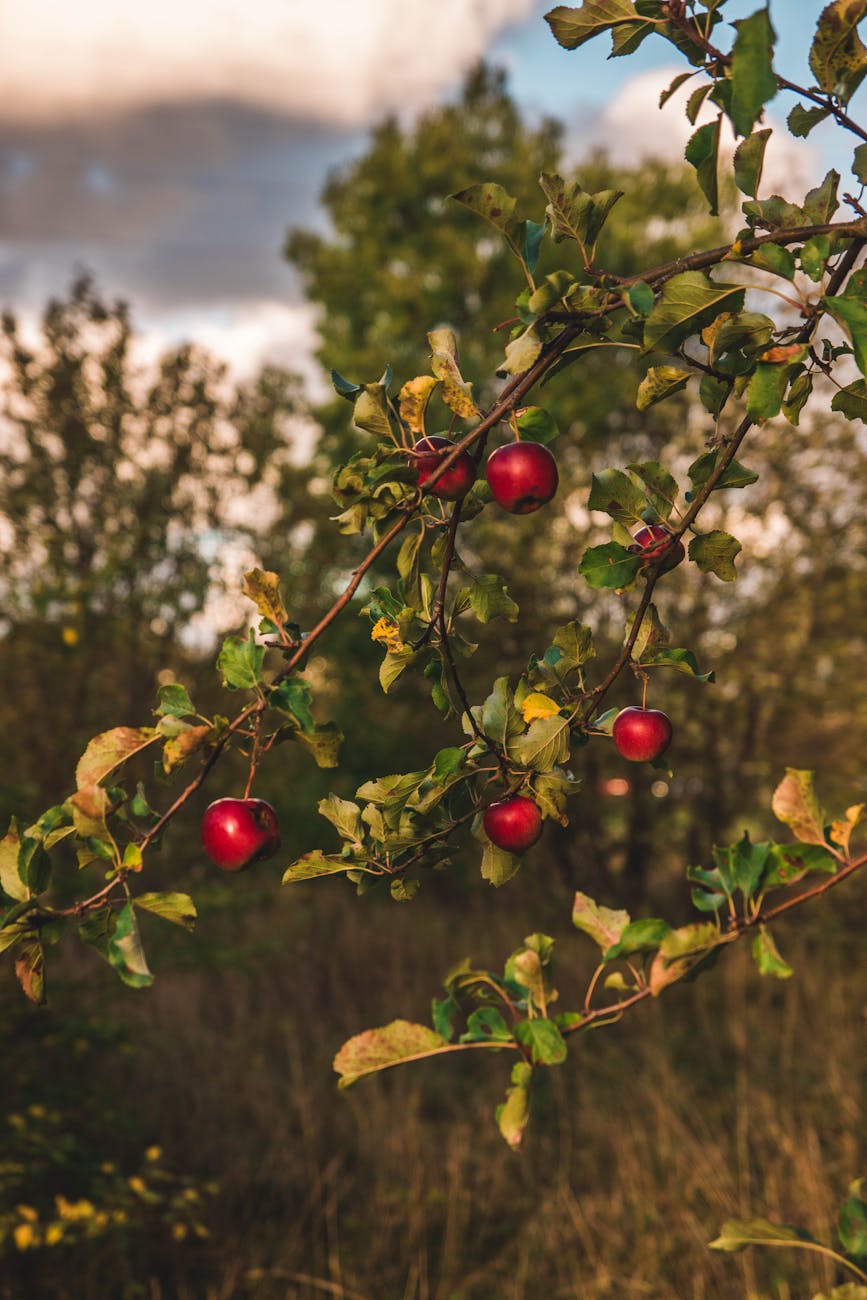
close up photography of apple tree
Photo by Kristina Paukshtite on Pexels.com

Apples were then considered sacred to Aphrodite and were even used as declarations of love. In the story of Atalanta and Hippomenes, Atalanta challenged all of her prospective suitors to races. If they could beat her, she’d marry them. (Since she was unbeatable, this seemed like a safe bet for her.) Hippomenes knew he’d never be able to outrun her, so he distracted her with three golden apples. With both his speed and his cunning, he barely managed to beat Atalanta and win her hand in marriage.
One of the labors of Hercules also involved retrieving golden apples from the Tree of Life in the Garden of the Hesperides, which creates another link between apples and life.

So, why are these fruits so deeply connected with life? Why do they come from the gods or Otherworld? Part of this might be because they literally came from afar — the ancestor of most of our modern apples came from Central Asia, so it would’ve traveled a great distance to reach the Mediterranean and Northern and Western Europe.
They may be deeply connected with life because they’re honestly pretty durable. They’ve got firm flesh and can last a long time when properly harvested and stored. That makes them an important staple in areas that experience cold winters — you could grow a bunch of apples, keep them in a cold, humid area with good air circulation, and they could last you all winter. Having a source of fresh fruit during the depths of winter could be the difference between life and death.
This may also be part of their connection with fertility. The fruit remains good in storage all through winter, when everything else withers. As a source of food when food is at its most scarce, those who have access to apples would likely experience better fertility than those who didn’t.

If you slice the fruit in half horizontally, the seeds form a pentagram.

Apple wood is considered a good material for tools for working with the fae and the Otherworld.

In modern European-based witchcraft, apples are used for fertility, healing, divination, wisdom, and knowledge. In some traditions, they are used for ancestor veneration and workings related to the dead.

They are said to be associated with the element of Water.

The simplest way to use these fruits is to eat or cook with them, first asking their help with whatever your goal or intention may be. Make your favorite sauce or pie recipe, tell each of the ingredients what you’d like them to do, thank them, and add them to your dish. Stir it clockwise with your dominant hand, serve, and enjoy.

Pies over wooden boards on the ground.
Photo by KATRIN BOLOVTSOVA on Pexels.com

You can also bury apples or place them on an ancestor altar as an offering.

Apples are frequently used for love divination. One old method involves peeling an apple in one continuous piece, then tossing the peel over your shoulder while saying, “Saint Simon and Saint Jude, on your I intrude, with this paring to discover, the first letter of my own true lover.” Look at the shape of the peel when it falls to see your true love’s initial.
Another love divination involves cutting an apple into nine equal pieces and eating them while mirror-gazing. Pierce the last piece with a knife and hold it over your shoulder, and an apparition of your true love may just appear in the mirror to take it.

When it comes to using apples for love magic, the blossoms are usually the best. (They have an amazing fragrance.) They’re seductive, but not overtly so — think of it as a sensual invitation rather than a command. They’re a great addition to a love-drawing bath, as well as baths for success, peace, and relaxation.

Apples aren’t just delicious; they have a lot of magical tradition behind them. They’re the food of the Otherworld, sustenance through the cold of winter, and a fruit of boundless fertility, youth, and eternal life.

Plants and Herbs

Lemon Balm Folklore and Magical Uses

Et tu, lemon balm?

I have tried so hard to love it. It’s relaxing. It’s delicious. You can make it into tea or syrup or use it to flavor anything from sugar to fish. If you have anxiety, it’s touted as a virtually ideal way to calm down — the closest thing to an herbal benzo out there.

However, I can also tell you that, from personal experience, that it can also leave you waking up from a nap that leaves you like Robin Williams in Jumanji.

Fortunately, even if you are sensitive lemon balm’s very relaxing properties, there are other things you can use it for. It’s still very tasty in less-than-therapeutic doses and has an abundance of interesting uses in folk magic.

Lemon balm’s official name is Melissa officinalis. “Melissa” is Greek for “honey bee,” since the plant is a favorite of bees and was often planted to help attract them. Beekeepers would also pinch off fresh sprigs of the plant and rub them on the entrances of beehives to entice them to move in and stay.

(“Officinalis” (or “officinale”) just denotes organisms that are useful in medicine or cooking. Kind of like how “sativa,” “sativum,” and “sativus” just mean “cultivated,” and denotes crops grown from seed.
Cannabis sativa and Avena sativa are not closely related, to put it mildly.
Melissa officinalis, the lemon balm, and Sepia officinalis, the cuttlefish, are also not related.)

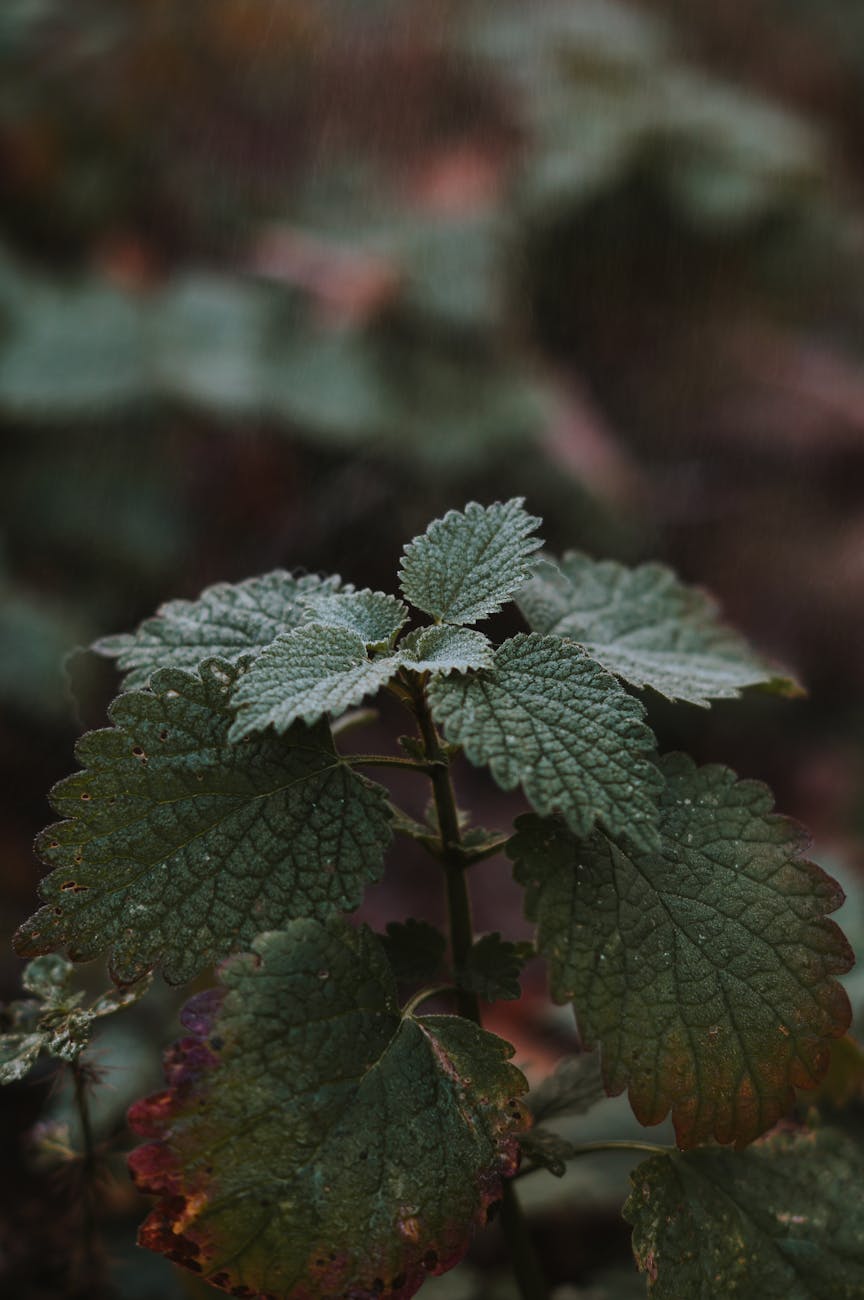
A sprig of lemon balm against a dark background.
Photo by Oksana Abramova on Pexels.com

Lemon balm is good for attracting more than just bees, though. Magically, it’s frequently used as an herb for good luck and general positivity. Tons of recipes feature it for love, fertility, and money.

To a somewhat lesser extent, lemon balm is also used for repelling evil and attracting good spirits. Since it’s so fragrant, it was used to strew the floors of Christian churches. In Abruzzi, Italy, women who happened on wild lemon balm would crush a sprig between their fingers in hopes that the scent would ensure that Jesus Christ would guide them to Heaven.

Lemon balm is considered a sacred herb of Hecate. It’s said that she gave the knowledge of lemon balm and other “witches’ herbs” to her daughters, Medea and Circe.

As well as being a mild sedative, lemon balm is used to soothe digestive issues. However, while it’s a tasty and relaxing herb, it’s best avoided by people with thyroid issues. It can interfere with thyroid hormone replacement therapy.

In the past, lemon balm was also applied to scorpion stings, bites from rabid dogs, and the venom of serpents. Since this herb isn’t an antivenom or protective against rabies transmission, this practice likely met with very limited success.

Nobody seems able to agree on lemon balm’s planetary or astrological associations. Nicholas Culpeper called it an herb of Jupiter and the sign Cancer. Other authorities say it’s an herb of Venus, Neptune, or the Moon. It is considered a generally “Water”-y herb, which makes sense when you consider its ability to relax the mind and soothe the emotions.

I know I usually advocate for growing your own herbs whenever possible, but planting lemon balm is one of those situations where you really want to exercise caution. Lemon balm requires next to no maintenance. Like other members of the mint family, it spreads aggressively outside of its native habitat. Absolutely do not plant it in the ground unless you want the entire area to be lemon balm. Keep it in window boxes, pots, or even containers indoors. If you do grow it in a container outside, avoid placing that container directly on the soil. When I say this stuff spreads, I’m not messing around.

Photo by Alesia Kozik on Pexels.com

In my experience, mints do not smell very good when burned straight. Instead of making lemon balm into incense, consider using it to infuse alcohol for making sprays, or oils for anointing or making balms.

The easiest way to use lemon balm is just to sprinkle some of the dried leaves across your front doorstep. The second easiest is to brew it into a tea and either drink it, use it for washing crystals or other curios, or use it to wash the doors of your home. As you do this, visualize good fortune coming in, and back luck or malevolent spirits turning away.

Lemon balm is one of those herbs that’s readily available fresh, dried, or as an oil. You can try it in a tea, or, depending on how fancy your local shops are, in a gourmet syrup. Its flavor is refreshing, citrusy, and herbal, while also tasting quite unlike anything else. As far as magical ingredients go, it’s also hard to go wrong with lemon balm — it’s a useful herb for attracting good things (also bees) and keeping out the bad. All of that aside, I wouldn’t rely on this as a protective herb on its own, but it’s great for filling up an empty space with useful, positive energy.

Neodruidry · Plants and Herbs · Witchcraft

Chickweed Folklore and Magical Uses

Recently, we had a tiny burst of warm weather (by which I mean an extremely unseasonable 76° F/24° C). It was nice! Also very concerning, but nice!

This little bit of heat seems to have kicked the yard into overdrive — while the bigger plants haven’t started leafing out yet, we’ve had a lot of spring ephemerals suddenly make an appearance. Following the grassassination, most of our ground covers are various types of chickweed and violet while the moss phlox and other guys establish themselves. Right now, we’ve got lesser chickweed (Stellaria apetala) and regular chickweed (Stellaria media).

Some plucked sprigs of Stellaria media.
Photo of Stellaria media by kokokara on Pexels.com. If you look closely, you can see the row of tiny white hairs.

While neither of these species are native (lesser chickweed is European, while regular chickweed hails from Eurasia), they’re still a valuable herb in early spring. They’re full of minerals and vitamin C, and one of the first edible springtime greens to appear. It isn’t a good idea to eat a ton of them — not raw, anyway — but they provide nutrients that are often in short supply for winter foragers.

So, with that in mind, I figured I’d take a look at the various folklore and magical uses for these humble little groundcover plants.

Chickweed has a few poisonous lookalikes, but is also pretty easy to identify. Two of its unique characteristics are the presents of a row of white hairs (like a cock’s comb) and a firm, green stem-inside-a-stem. Pull a chickweed’s stem apart, and you’ll uncover a green “chicken bone!”

When I say that chickweed is high in vitamin C, I really mean it — sailors used chickweed steeped in vinegar to prevent scurvy during times when citrus fruits weren’t available.

Chickweed is associated with love and fidelity. This idea may stem (no pun intended) from its growth habit. Chickweed grows in groups, with spreading tendrils reaching out from the center. It’s a powerful visual metaphor for the importance of community, as each chickweed stem grows out from this connected center in order to reach its full potential.

This plant is also very tenacious. It’s hard to get rid of, and often springs right back up after being cut or pulled out. While chickweed favors moist soil with a good pH and abundant nutrients, you can also find it growing in cracks in sidewalks. This makes it useful for situations that you want to exhibit this same resilience — for example, a long-term relationship.

Some green magic practitioners also associate this plant with abundance. It produces a lot of very long-lived seeds, which connect it to fertility and prosperity.

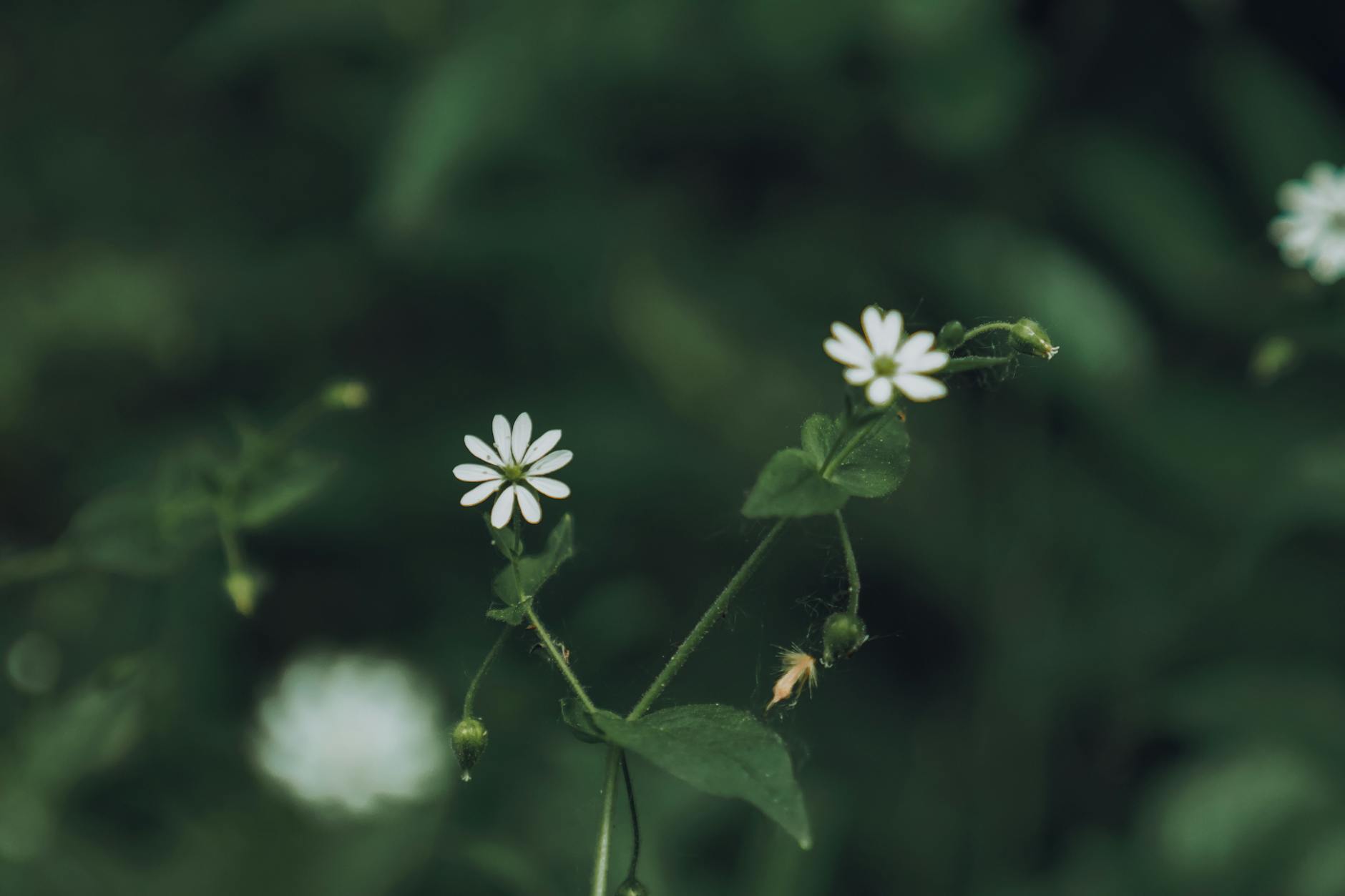
Tiny white chickweed flowers.
Photo by Imad Clicks on Pexels.com

The name “chickweed” comes from chicken and weed. Since these plants are pretty nutrient-dense and come up in early spring, they’re eagerly fed on by poultry and are particularly good for growing chicks.

Chickweed is very easy to find. Look for moist (but not soggy) soil, in early spring, just about anywhere and you can probably pick some. It’s stubborn, it’s prolific, and it’s not super fussy. Use a good plant identification app and research chickweed’s poisonous lookalikes, or, even better, go with a seasoned forager who can show you what to look for.

Once you have your chickweed, you can use it fresh or dried. Dried, it mixes well with jasmine, rose petals, lavender, and other love-drawing ingredients. Blend these dried herbs together with equal parts Epsom and sea salts, add a few drops of patchouli and rose oil, and use the resulting mixture for a love-drawing bath.

To attract a partner, wear a sprig of chickweed. These unassuming greens can be easily tucked into a boutonniere, vase necklace, flower crown, hairclip, or fascinator without too much trouble. As with the bath salt recipe above, combine them with other love-drawing plants for best effect.

To ensure the fidelity of a partner, it’s said that you should feed them chickweed. (If you do this, you should probably ensure that you have their consent, and that you’ve properly identified your chickweed or purchased it from a reputable source. Otherwise, you’re going to end up with an angry and/or poisoned partner.) Caraway seeds are used in a similar fashion.

If you have access to a yard, or even just an open field, you most likely have access to chickweed. This plant is subtle, but powerful. Whether you choose to use it as food, medicine, or a magical ingredient, this tenacious little herb can be a great friend to make.

life · Neodruidry · Plants and Herbs · Witchcraft

Wood Sorrel Folklore and Magical Properties

Take a look at your lawn. Unless you maintain it to putting-green smoothness, you’re likely to see some yellow flowers.

Not the dandelions — look closer.

You might mistake them for buttercups at first, but they’re really quite different. These little yellow five-petaled flowers are yellow wood sorrel (Oxalis stricta). They’re a native wildflower where I live, and vastly superior to the grass that still attempts to poke its way up through their heart-shaped leaves and small yellow flowers.

A plant with heart shaped leaflets and five-petaled yellow flowers.
A tuft of yellow wood sorrel.

As a native herb here, it doesn’t have a long history of use in old European grimoires. There are, however, many other varieties of wood sorrel — some native, some not, and some of questionable origins.

I’m a big proponent of using native alternatives to exotic herbs whenever possible, so I figured I’d give some background on wood sorrel and a few ways to use its magical (and delicious) American cousins.

Wood Sorrel Folklore

The species name Oxalis comes from the Greek word oxus, meaning “acidic” or “sharp.” The leaves of wood sorrel have a very tart flavor which makes them a tasty addition to salads. When dried, wood sorrel can be used to curdle milk for cheesemaking.

These plants are connected to fairies and woodland spirits. In Wales, wood sorrel is called fairy-bells.

A European wood sorrel plant (Oxalis acetosella), with heart-shaped leaflets and white, bell-shaped flowers.
The white flowers of Oxalis acetosella show why this plant’s sometimes known as “fairy bells.”

In herbal medicine, a decoction of the leaves was used for thirst and fever. Applied externally, the crushed leaves have an astringent effect which helps with abscesses, boils, and wounds.

Dried leaves are said to attract luck and, due to the doctrine of signatures, be healing and protective to the heart.

It’s also said that the dried leaf will allow the user to see fairies.

There’s some debate about shamrocks (an Anglicization of the Gaelic seamróg, meaning “little or young clover”). Shamrocks are associated with Saint Patrick, who used a three-leafed plant to explain the idea of the Christian Holy Trinity. Most depictions of the shamrock show it with three heart-shaped leaves. Since clovers have rounded leaves, this indicates that the shamrock may actually be a species of Oxalis and not a clover at all.

The ancient Druids were said to have regarded the shamrock as a sacred plant with the power to drive off evil spirits.

In the Victorian language of flowers, wood sorrel represented joy and motherly affection.

Wood Sorrel Magical Uses

Magically, wood sorrel is used in spells for luck, healing, protection from evil and misfortune, and love.

These plants can also be useful for working with three-part deities, like the Triple Goddess or Brighid. They make good offerings, or even natural representations of the deities themselves in a pinch.

Using Wood Sorrel

Wood sorrel isn’t a substitute for a visit to a doctor, but it can be a helpful herb for minor problems. Be sure you can reliably identify sorrel before attempting to consume it or use it topically.

If you live where wood sorrel naturally grows, you may want to cultivate a native species in your yard or garden space. This is especially true if you have an altar or dedicated space for nature spirits — wood sorrel is strongly connected to these entities. I’m planning to put an offering bowl and some large bull quartz crystals on the edge of the patch of yellow wood sorrel here, for example.

Using wood sorrel as a protective plant is an interesting idea. This protection may stem from the plant’s three-leaved appearance, which is reminiscent of various triple deities. The number three is also regarded as sacred in itself, since it reflects the past, present, and future; youth, adulthood, and old age; birth, life, and death; and the upper, middle, and lower worlds. Wood sorrel may also be considered protective because it’s very sour. Sour things, like lemons and vinegar, are often used to ward off or cleanse away negative energy.

Yellow wood sorrel leaves. The leaves consist of three heart-shaped leaflets, arranged similarly to clover leaves.
This picture shows the heart-shaped leaves and small yellow buds of yellow wood sorrel.

With all of this in mind, I’d brew a tea of wood sorrel and use it to wash doors, windows, and thresholds. Growing wood sorrel could also have a protective and luck-drawing quality.

The dried leaves and flowers would make a very nice addition to jar spells and sachets for love magic. I’d probably combine the flowers with roses, apple blossoms, and other seasonal blooms associated with love-drawing, then use this mixture in a magical bath.

If you’ve never tasted wood sorrel, I highly recommend it. The tart leaves and flowers are a very interesting addition to salads, soups, and sauces. If you’re into kitchen witchery, these edible wildflowers can be a powerful way to work with your local landscape to bring love, protection, and luck into your life.

life · Neodruidry · Plants and Herbs

Apple Folklore and Magical Properties

So, apples.

They’re versatile, inexpensive, and delicious. You can use them to carve stamps, prepare stuffing, or make a pie. Got an apple core? Feed it to worms or toss it in compost. They’re a delightful package of deliciousness, nutrition, and fiber.

They’re also pretty prominent in the religions of the areas from which they come. Eris tossed a golden apple and started the Trojan war. Iðunn’s golden apples give the gods youth, immortality, and vigor. Manannán mac Lir tempted Cormac mac Airt with a branch covered in nine apples of red gold. Emain, the otherworldly Plain of White Silver, had silver boughs with white apple blossoms.

We don’t have magic apples here, though I feel like Chehalis apples come close. I was drawn to their colors, ranging from emerald green, to golden yellow, to a pale, almost ethereal shade somewhere between the two. (I’ll just be happy if I get to eat one of these apples without the birds and wasps getting to them first!)

An apple ripening on a tree.
One of the little Chehalis apples on the tree in the back yard.

But apples are more than just magical symbols of the Otherworld, anyway. They’re also an indispensable ingredient in kitchen witchery, and even herbal healing.

Apple Folklore

Teasing out the folkloric significance of apples is more challenging than it might seem. Up until the 1800s, the word “apple” was used not just for apples, but also for as a generic term for fruits other than berries. This is why we have “oak apples” (a plant deformity caused by gall wasps), “earth apples” (cucumbers or potatoes, depending on who you ask), “love apples” (tomatoes), or “May apples” (a low-growing relative of barberry).

Ethnobotanists have made some compelling arguments for apples being used as a symbolic substitution for fly agaric mushrooms (Amanita muscaria), an entheogenic fungus. This is an interesting bit of information to keep in mind as you read through the rest of the folkloric and symbolic significance of apples.

The fruit eaten by Adam and Eve in the garden of Eden in Christian mythology is often said to be an apple. This is particularly interesting when you consider the effect of that apple and Terence McKenna’s “Stoned Ape” theory of humanity’s development. This widely-criticized theory holds that entheogens (specifically Psilocybe cubensis) are responsible for much of the progress of humankind. If Adam and Eve’s apple could be viewed as an entheogenic fungi, then the Christian story of the fall of man would be an allegory for entheogens leading to the development of clothing, agriculture, and more.

The larynx, which is usually (though certainly not always) more prominent in male humans, is called an “Adam’s apple” because of a bit of folklore that claimed that the prominence was created by the fruit sticking in Adam’s throat.

In later Christian mythology, Jesus Christ is portrayed as holding an apple. Here, the apple transforms from a sign of the fall of humanity, into a sign of redemption. Considering that this redemption leads to eternal life, this apple is somewhat akin to the apples of Iðunn.

In the Norse Prose Edda, the goddess Iðunn is said to carry an ash wood box in which she keeps golden apples. When the Norse gods begin to grow old, they eat her apples and become young again. The gods, then, depend very heavily on Iðunn’s presence and good will in order to maintain their youth and strength.

Apples weren’t always associated with youth and life, however. In the Heiðarvíga saga, the poet speaks of the “apples of Hel.” These appear to be the antithesis of Iðunn’s apples — the food of the dead.

In Greek mythology, Eris felt insulted when she wasn’t invited to the wedding of Peleus and Thetis like the other gods were. As revenge, she tossed a golden apple inscribed with the words “to the fairest” in between Hera, Athena, and Aphrodite. They immediately began arguing over who deserved it, and asked Paris to mediate. Aphrodite promised him the hand of the most beautiful woman in the world if he chose her, so he did. Unfortunately for everyone, that woman was Helen of Troy, and Paris’ decision kicked off the Trojan War.

The island of Avalon, the mythical, mystical place of Arthurian legend, is the Island of Apples. The name “Avalon” is thought to stem from the Welsh word “afal.”

In Cornwall, Kalan Gwav (Allentide) is a time for giving shiny, bright red apples to friends and family as tokens of luck.

In the Irish Echtra The Voyage of Bran, Bran mac Febail sets out on his adventure when he receives a silver apple bough brought from Emain, the Plain of White Silver.

The Irish sea god Manannán mac Lir’s golden apples emitted a kind of magic lullaby. This could soothe people afflicted with injuries or illnesses to a healing sleep. The name of his paradisical home, Emain Abhlach, comes from the Old Irish “Ablach” (“of the fruits” or “of the apples”).

Apples, fresh flowers, and sheet music on a wooden table. One of the apples has been cut in half to expose the seeds. An ornate knife sits nearby.

In the mythology of the people from the North Caucasus, there is a tree that groows magic apples capable of guaranteeing a child to whoever eats them.

During the Jewish holiday Rosh Hashanah, people dip apples in honey and eat them to bring in a sweet year ahead.

Wiccan lore views apples as a sacred symbol. This is because, when cut in half horizontally, their seeds and core form a pentagram.

An old bit of boat builder’s lore holds that it’s bad luck to make a boat from apple wood, since apple wood was used to make coffins. Doing so was believed to doom the sailors to an early grave.

A common bit of marriage folklore says that, if an unmarried woman peels an apple in one long, continuous piece, then throws it over her shoulder, the peel will fall in the shape of the first letter of her future spouse’s name.

Wassailing is an old English folk practice performed to bless the trees and bring in a big crop in the next harvest season. (I went to a wassail ceremony earlier this year, and it was a ton of fun!)

The Magical Uses of Apples

Apples are a common autumn food and addition to altars for autumn and winter holidays. This is because they’re in season during autumn, and tend to keep very well if they’re stored properly. Apple sauce, apple cider, dried apples, and carefully-stored fresh apples were vital additions to the western European diet during the cold months.

An apple bough with buds, flowers, ripe fruit, and unripe fruit is said to mark a door to the Otherworld.

In general, apples are magically associated with love, fertility, protection, and prosperity. The flowers are excellent additions to charm bags, the fruit is great for kitchen witchery, and the leaves can bring fertility and prosperity to one’s home or garden.

Using Apples in Magic

Apples are possibly one of the easiest and most convenient magical ingredients. Since apples are pretty sturdy and edible when raw, they’re often used as a kind of edible “package” for magical intentions. Hold an apple in your hands, visualize it filling with your intention, whisper your intention to it, and eat.

If you have access to apple leaves (either pruned or fallen — please don’t pick fresh leaves from the tree), bury thirteen of them in your garden. This is said to increase its productivity for the next year. I’d argue that you could also add these leaves to compost, or bury pruned or fallen apple wood in your hügelkultur mounds.

Apple blossoms are great ingredient for love magic. Their action is said to be gently seductive. They are also used for peace, contentment, and success. This suggests that they’d be a useful addition to any spell for attracting happiness into one’s life.

Apples are also said to be protective. Apple cider vinegar can be a useful (and pungent) addition to jars and bottle spells for protection against both one’s enemies and malevolent energy.

Another small Chehalis apple ripening on a tree.
Another little Chehalis apple.

I can’t tell you how excited I am for apples this year. The springtime apple blossoms were incredible, and I check on the ripening fruits with excitement every day. Here’s hoping you can find ways to incorporate these magical fruits into your meals, rituals, and daily practices.

Plants and Herbs · Witchcraft

Crocus Folklore & Magical Uses

It’s spring (kind of)!

At least, it’s getting spring-y here. Granted, I think we maybe had about four days of actual “winter,” but it’s been t-shirt weather for the past few days, and looks like it’s going to stay that way for at least another week.

Since things were warming up, I stepped out back to take a look at the yard. The elderberry bushed that I planted last year have some new leaves coming in, the bulbs I planted are starting to poke up through the mulch, and the apples are both looking good.

There’s also a large patch of surprise crocuses that seem to have popped up overnight next to my shed.

These are either Crocus vernus, the spring crocus, or Crocus tommasinianus, the woodland crocus. They’re beautiful, but decidedly not native to this area. (Crocus vernus and C. tommasinianus are related to C. sativus, the saffron crocus. However, these crocuses are definitely not a way to make rice more delicious.) Still, I am determined to enjoy them before it’s time to remove the bulbs and put in some native coralberry bushes. I’ll probably keep the bulbs and move them to somewhere where they’re less likely to spread.

If you’re also experiencing a flush of these tiny colorful flowers, here’s some old folklore and a few ways to make them magically useful.

Crocus Folklore

In ancient Greek legend, Crocus was a human man. The nymph Smilax was in love with him, but, ever the fuckboy, Crocus was dissatisfied with the affair. The gods turned him into a saffron crocus.

Another version of this story claims that Crocus was a companion of Hermes. Unfortunately, he stood up at an inopportune time during a discus throwing match, and Hermes accidentally killed him. As Crocus’ blood fell on the soil, saffron crocuses sprang up.

Spring crocuses are associated with Persephone, Aphrodite, and Venus. Mythology would also appear to tie this flower to Hermes.

A London source claimed that picking crocuses tended to “draw away the strength.” Therefore, only strong men or healthy young women should attempt to.

A field of purple and white crocuses at the base of a mountain.

According to Pliny, wearing crocus around the neck would prevent drunkenness. Interestingly, Swiss parents would place saffron around their children’s necks as a protective charm (presumably not against drunkenness, or else they’ve got some explaining to do).

In the Victorian language of flowers, crocuses represented cheer and youthful gladness.

This flower is associated with the planets Venus and Mercury, and the element of Water.

Crocus Magical Properties

Historic mentions of crocus as a protective charm typically refer to saffron crocus, not the spring crocuses. It can be hard to tease out folklore and uses attributed to spring crocuses, since the autumn-blooming saffron crocuses were generally considered more useful. For our purposes, I’m going to focus on spring crocuses here.

Spring blooming crocuses are used in charms for love, including platonic love or love of the self.

As an early spring-blooming flower, spring crocuses are also useful for spells for new beginnings.

These flowers are common altar decorations for Imbolc and Ostara. However, use caution if you bring spring crocuses indoors — all varieties of crocus other than C. sativus are toxic. Spring-blooming crocuses can cause diarrhea, vomiting, and digestive upset, while autumn-blooming crocuses can cause liver and kidney damage.

Simple Crocus Spells

You can include crocuses in charm bags for love. Add the dried flowers to a pink or red pouch along with rose petals, lavender flowers, and a bit of cinnamon bark. If you like, add a piece of rose quartz. Dress it with your favorite love-drawing oil (in a pinch, infuse some cinnamon, basil, and rose in grapeseed or sunflower seed oil, and use that) and keep it on you.

You can also use crocuses as a form of sympathetic magic. Plant a bulb along with a slip of paper with your name, and the name of your partner. Declare that as the plant grows, your love will flourish with it. When the flower is at its peak, pick it and save it for a love charm.

divination · life

Heart-Anchor-Birds.

You know that meme that’s been going around, about how if you don’t come out of social distancing with a new hobby, hustle, etc., you never lacked the time, you lacked the discipline? That’s absolute hot trash, but I am trying to use the time I have between bouts of ennui, existential despair, and anxiety to learn new things. It’s a small thing, but it helps me keep sane.

Right now, I’m trying to teach myself Lenormand readings.

It’s a very useful kind of divination. I don’t think it really replaces tarot, but, when used in combination with it, it can give you a really complete picture of a situation. Tarot’s great for giving you an energetic, mental, and emotional snapshot, while Lenormand focuses more on actions. If tarot is the “what,” Lenormand is the “how.”

It’s a bit outside of the scope of this post to dive into the history of divination using the Petit Lenormand, but there’re already a number of very good posts out there on the subject. Instead, I wanted to see how well this kind of divination would work for my usual weekly readings.

Recently, my therapist recommended doing something to add some joy to every day. It’s harder to do with everything that’s going on, but that’s exactly why it’s so important — in the absence of taking pictures of moss and mushrooms, birding, and identifying wildflowers, I have to make more of an effort to find and do things that bring me joy at home.

I asked a simple question: How?

I drew the Heart, Anchor, and Bird using the Seventh Sphere Lenormand app.

I can’t pretend to be an expert at this, since I’ve only just started. What was interesting here is how neatly the advice overlapped with what I’ve been told via tarot: One of the biggest helps for easing my anxiety is to lean more on my relationship. It provides care, stability, and happiness, but, like I talked about yesterday, I’ve also had some trouble with the reciprocal aspect of being a disabled person in a long-term relationship.

petitjeu_heartanchorbirds

In this kind of divination, the meanings of the cards are read literally, the way one might read a sentence. Each symbol has a meaning, akin to a pictogram. The Heart, unsurprisingly, stands for love and relationships. The anchor is stability and resiliency. Birds are chatter, according to some sources, and nervousness according to others. Cards are read in pairs, with the first card acting as the subject of the “sentence,” and the second as the modifier.

Read this way, heart and anchor are a long-term relationship. Anchor and birds are life=long partners, or deep discussions. It’s a deep discussion with a long-term romantic partner.

Admittedly, I don’t really like talking about what’s going on in my brain with my partner. I feel like I create enough of a burden by existing, like I don’t have a “right” to his emotional labor. We don’t really have any friction in our relationship, but there are definitely times when I have too much going on in my mind to be really present. I encourage him to be open with me, though I have trouble doing the same with him. I know that’s something that I need to get past — it looks like doing so is the best way for me to figure out how to be happy on a day-to-day basis.

Sometimes the only way out is through.

divination · life

The Ace of Wands Comes Back.

I like Aces. They stand for a new beginning, and there’s nothing quite like that feeling of untapped potential — where everything is still possible, and nothing’s happened to screw it all up (yet). Getting an Ace in a reading feels pretty awesome.

If you’ve been reading my navel-gazey ruminations for awhile, you’ve probably seen that I draw Aces and Wands pretty frequently. It makes sense, in its own strange way: I’m at a point in my life where I have a lot of opportunities open to me, but not a lot of resources that allow me to take advantage of them. I feel like this is a bit different, though. Though Wands generally represent creativity, I feel like I’ve got a pretty good handle on the direction my creative endeavors are going in at this point.

On the other hand, this week I’ve got a new lease to sign, my S.O. doing new job things, and my first appointment with a psychologist.
My dance card’s pretty packed, and it’s all brand new.

So, knowing I had a ton of utter upheaval (good upheaval!) and turmoil (beneficial turmoil!) coming up, I drew this week’s card with that in mind. I’m already more anxious than I’m comfortable handling with the tools currently at my disposal, so a little reassurance than I’m not putting myself in a worse position by making these changes could go a long way.

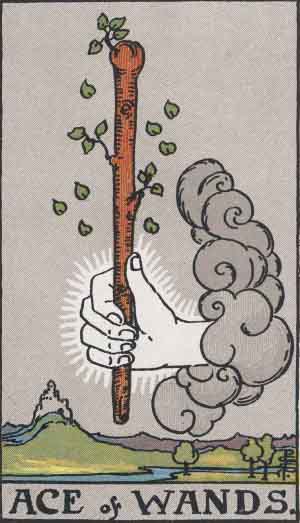
The Ace of Wands card from the Rider-Waite deck.
From the Rider-Waite deck, illustrated by Pamela Coleman Smith.

I drew the Ace of Wands again. Before, it came at a time when I was seeking out help from another new doctor, and practically bursting with ideas. This time around, I’m seeking help from another new doctor (albeit of a very different kind), and making some significant changes to other areas of my life. This card is good news and a new beginning, and I could certainly use both!

So much of what’s happening with, to, and around me right now has a lot to do with my partner. In the context of love, the Ace of Wands represents a “next move” in a relationship — often one that breathes new life into it. It can be something like an engagement, marriage, pregnancy, or other move that feels like a step “forward.” I like to think my S.O. and I aren’t tired of each other yet, but I definitely agree that having more space and a change of scenery will make things more pleasant for the both of us.

Tomorrow’s a pretty big day. What do I do if I have anxiety about talking to a new doctor about my anxiety? It’s basically the worst kind of brainception.


divination · life

The Ten of Cups

Hello! It’s been a month(ish) since I last posted. I’m sorry about that.

I do have a pretty good reason for dropping off of the face of the earth, though — sort of a combination of managing my health and that thing where you’re not supposed to tell people you’re doing a thing, because you’ll get the same emotional high from talking about it as you would from actually doing it and then end up never actually finishing it.

Anyway, in my time away I finished two paintings and one book, written collaboratively with my awesome and creative S.O. So that’s neat.

He and I have no idea how and if it will ever be published, but, thus far, beta readers have received it well. After getting the first round of feedback, we’ll have to seek out an editor, and then decide how we want to progress.

(It is a very long, drawn out, complicated process, and I am glad he has elected to handle most of it. I got to compile everything, make the initial edits, and format it all into a readable manuscript.)

Even if no publisher wants it and nothing comes of it, it’s certainly a good feeling to look at your writing and be able to say you’ve finished a full-length novel.

So, I wasn’t that surprised when I pulled the Ten of Cups this week.

Cups10
Ten of Cups from the Rider-Waite tarot, artwork by Pamela Coleman Smith.

The suit of Cups speaks of emotional fulfillment, and Tens are the completion of a cycle. They’re the ultimate culmination, So, it’s probably unsurprising that the Ten of Cups, then, speaks of joy, peace, and happiness. It’s contentment, emotional security, and an abundance of love. Though the artwork varies from deck to deck, it usually depicts a couple joyfully surveying a landscape replete with signs of luck and happiness — a rainbow, flowers, sunshine, rolling hills, a neat little house, you name it. It’s one of the most positive cards in the deck.

Working with my S.O. on what has ultimately been a labor of love for the both of us has been a trip. We started writing collaboratively as a way to roleplay — acting out little scenes between the two of us when distance, money, time, or health didn’t let us go on many adventures. This practice evolved into a setting with deep lore, eons of history, its own cosmology, and a tremendously varied cast of characters. To be honest, last we counted, we’d written enough for several novels and two or three anthologies of short stories, but this is the first we’ve felt confident enough to put through the process of turning it into something actual.

I feel like it’s a bit like having a baby, only nobody had to throw up for months, we still get to sleep afterward, and everyone’s perinea stayed intact. So probably not actually much like having a baby.

Hopefully, when all the hurly-burly’s done, I’ll be able to share it with you, too.

life · Plants and Herbs · Witchcraft

DIY Bath Bomb Magic

Remember when I mentioned taking some magic bath bombs on the road?

Seeing as how they worked extremely well for my purposes, I figured I’d drop how I made ’em. Though they’re not exactly something I’d display in a fancy basket next to my Lush Perles de Sel, they smell fantastic and leave my skin soft (and, more importantly, magic af).

Bath bombs, the easy way

A basic recipe for bath bombs calls for three ingredients:

  1. 1 part acid
  2. 2 parts base
  3. Enough binder to get it to stick together

For most purposes, these are answered by vitamin C, baking soda, and water or oil. Put those together, and you’ll get a basic bomb that will fizz when it gets wet (and help remove the chlorine from your tap water at the same time). From there, you can play with additives, colorants, glitter, and any other ingredients that suit your purpose. You can also add one part of your choice of dry ingredients — dried herbs, epsom salt, arrowroot powder, or what have you — and enough skin-safe essential oil to fragrance the lot.

herb

So, for example, a sample love bomb recipe might look like this:

Continue reading “DIY Bath Bomb Magic”