
life · Plants and Herbs

Strawbin’.

Okay! Hear me out.

We… went strawberry picking.

If you’ve been following this blog, I know what you’re probably going to say.

“J. You already accidentally bought 47 strawberry starts. You were concerned about what you’d do with up to 140 pounds of basically-almost-free strawberries. Why did you go pay to pick strawberries somewhere else?”

You’re right. This was part of a meetup with one of my Druidry groups, and, to be honest, I wanted to go hang out. Besides, my own strawberry plants aren’t pumping fruit out just yet, so I figure this’d give me some tasty fruits for the meanwhile.

We went to Larriland Farm about an hour after the fields opened. You pay for your container in the beginning, take it to a designated area in the field, and fill it up as much as you can. Since you’re not paying by weight, the more you can fit, the better. My partner was initially going to get us two of those little blue molded fiber baskets, but we soon decided a larger flat box was a better idea.

J. crouched in a strawberry field, filling a flat cardboard tray with fruit.
To think, I thought the box was getting full here.
J.'s partner standing in a strawberry field, holding a flat box filled with berries.
To his credit, he did.

A little less than an hour later, we had pounds upon pounds upon pounds of juicy, very ripe berries. I kept warning him that the box was full, but he was determined to heap them as high as possible. “Nah,” he said, “I can totally Tetris more in.”

All of us paused for meditation (and to eat a few berries) before leaving. Then, after tucking the box of strawberries in the back seat like it was a newborn baby, we carefully trucked them home.

At home, I pureed a bunch of the fruit with spinach, then poured it into an ice cube tray to freeze. Once frozen, it’ll be an easy, space-saving way to keep smoothie ingredients. Some of the fruit will be for salads, frozen for later use, used to flavor water kefir, or macerated in sugar for waffles and shortcake. I sliced a whole bunch, layered it with caramel and pastry, and made a tarte Tatin. Even with all of that in mind, there are still so many strawberries.

A very gooey strawberry tart, with vanilla ice cream.
I hadn’t counted on how juicy the berries would be, so I ended up with a bit too much liquid. Neither of us complained, though!

It’s kind of funny. The blue paper pulp boxes wouldn’t’ve been nearly enough. The next size up, I feel like I’m drowning in berries. It is a problem I enjoy.

I also discovered that it’s possible to break out in a rash from touching strawberry plants, even if you’re not at all allergic to the fruit. Strawberry leaves have trichomes, which are possibly best known as the little hairs on cannabis plants. Strawberry trichomes come in two types: glandular and non-glandular. The non-glandular ones are just little poky hairs that are kind of physically irritating, and help keep bugs at bay. The glandular ones, on the other hand, are attached to glands. These trichomes can inject tiny amounts of defensive compounds.

Imagine if, to protect yourself from bears and muggers, you never left the house without putting on a special anti-bear-and-bandit coat covered in hypodermic needles filled with acid.

The end result was one mother of a rash from the back of my hands to my elbows. This probably isn’t a true allergy, and more a product of spending like an hour accidentally injecting myself with tiny amounts of liquid “fuck off” in strawberry language. I even tested this idea by taking a fresh berry, eating a tiny bit, and rubbing the bitten portion on the inside of my elbow. Aside from a red stain, there was no rash, no itching, no welts, nada. So I’m pretty much free to gorge myself on as many strawberries as I desire.

Here until the ocean wears rubber pants to keep its bottom dry,
j.

art · Just for fun · life

Curséd/haunted objects I saw this weekend, ranked.

My partner and I go antiquing pretty frequently. This isn’t necessarily out of any real desire to collect antiques, so much as it is the desire to support the local economy and also own furniture that isn’t particleboard. Some antique shops are very curated and fancy, while others are more… eclectic, shall we say.

Anyhow, if you’ve ever spent enough time in an antique shop, you’ve probably passed by at least one thing that you could absolutely picture holding the soul of a tubercular Victorian child. These are those things, ranked in order of how likely I think the potential ghost inside is likely to go all Annabelle on someone:

5. The Blinded Bride.

A chicken wire sculpture with a blindfolded silver face and silk roses.

This is actually just a rad piece of outdoor sculpture, to be honest. It’s eerie, it’s evocative, and I love it. The artist who makes them, Shara Banisadr, is very cool. She was neatening up the area around the sculptures, and talked to us briefly about her work. Their faces are made of old vinyl records!

This wire lady also has friends:

A similar sculpture, of a silver-faced woman holding a wire child on her lap.

I could probably see this particular piece in a setting like Bloodborne or Elden Ring, but I really think she’s more likely to be kind of sad versus actively murderous. Unless you try to hurt her or steal her blindfold, then she would absolutely wreck you like a Mike Tyson made of fishhooks. Truly the luxury model of potentially haunted object. I’m absolutely going to invest in one of these ladies once I have sufficient outdoor space (or a window that directly faces my neighbors, either or). I feel like they’d be good companions for all of the Isabellas.

Murderghost probability: 10%

4. The Courteous Wig Stand.

A wig stand with large eyes and painted flowers.

There’s something about her I dig. She reminds me of the women in 50s ads for housewares. The small, vague smile and wide eyes speaks of a kind of brittle, exhausted politeness. It’s the same expression and energy I had back when I worked retail, and I can appreciate that.

She’s probably not malevolent. You’re much more likely to turn around in a darkened hallway and see her hovering four feet in the air behind you, glowing faintly and slowly rotating. Somewhere, a distant, echoey voice like wind over an open grave will whisper, “Do you need help finding anything?”

There’s no saving you if she runs out of Valium, though.

Murderghost probability: 30%

3. The Fading Child.

A drawing of a child in reddish-brown conte crayon.

There’s a certain sad-yet-focused intensity in this kid. The level of detail in their face, coupled with the strokes almost the exact color of dried blood, creates an image that’s at once aesthetically pleasing and extremely unsettling. They look vaguely displeased about something, and I’m pretty sure they think that’s my fault.

This is basically the exact kind of picture you see as a haunted object in movies. A mansion burns down, or cracks and crumbles like the House of Usher, and all that’s left is this kid. Staring. Subtly frowning. Lightning cracks the sky, and their brow furrows ever so slightly.

I don’t think the child is likely to murder anyone directly, but I refuse to believe that they haven’t been associated with a series of “accidents.”

Murderghost probability: 50%

2. The Tragic Hound.

A painting of a sad looking dog on a pink background. The picture is placed behind a basket, several large spools, and a wooden box.

Don’t let the puppy eyes fool you. This is absolutely haunted, and absolutely just waiting for you to let your guard down.

See the hints of red in the eyes? The way they seem to follow you around the room?

This painting absolutely houses some kind of Shadow Hearts-style monster. Like, I don’t know, an evil mailman. Notice how even the shop owner placed him behind several objects. It’s because they know. Do not gaze upon the full glory of the tragic hound, lest it pursue you for an eternity.

Murderghost probability: 70%

1. The Dapper Man.

A painting of a man in a jaunty blue uniform. The background and frame are both bright pink. The man's large, round eyes seem to bore into one's soul.

HE’S SEEN YOU.

Murderghost probability: Run.

art · Blog · life

This is Isabella, Isabella, Isabella, Isabella, Isabella, Isabella, Isabella, and Isabella.

Saturday, my partner and I went antiquing. Though I keep a short running tab of vintage/antique objects I’m looking for (brass candlesticks, salesman’s cases, small wall mirrors, picture frames), we shop like magpies. Our collective style could best be described as “maximalist,” but I feel like that implies a level of cohesion and intention that your average corvid probably isn’t capable of. The only unifying theme is “stuff we like.”

Usually, it goes like this: One of us sees a thing. They point it out to the other. We name it and freewrite an entire backstory for it. If it evokes enough emotion, we’re probably going to try to bring it home. We’ve done this with everything from live plants to… Well, I’ll get to that in a minute.

There’s a spot in Kensington, MD, that’s antique shop upon antique shop. It’s one of the places we like to hit up periodically, just to walk around and browse. Sometimes we find some neat stuff, sometimes we just end up making up stories about the people in old portraits. It’s always a lot of fun either way.

When we walked out of one shop, we passed through a small alleyway between two buildings.

“Stopstopstop. Don’t move,” my partner said.

“What?”

“There’s a boy,” he pointed to a little huddled mass of feathers. It took me a bit to spot him: a house sparrow, sitting in the middle of the pavement. Something looked off, so I approached him cautiously. When he didn’t try to fly away, my heart sank.

“I… don’t think he’s gonna care if I move.” I bent down and held my hand out. He startled a little, but still didn’t fly. I gently stroked the patch of black on his chest and looked him over — ruffled and broken feathers, one eye squinched shut, a skinned patch on the top of his head, and a dazed expression.

We crouched near him as we called wildlife rescues, though I had my doubts. Sparrows aren’t native here; they’re even considered invasive agricultural pests. Would a rescue even take him in? If they did, was there anything they could do? Nobody picked up at the various numbers we called. I also knew it’d be a bad idea to try to take him home and nurse him back to health, especially without a way to keep him secluded away from both of the cats.

Carefully, I scooped him up in my hands and carried him to the shade of a bush. It wasn’t much, but there were bugs to eat there and he’d be out of the noon sun.

A bit later, when we were eating at deliCLUB, I jumped up. I had a water bottle and a small quantity of yellow cake with buttercream… Not ideal, but maybe it’d do.

“I have an idea,” I said.

A few minutes saw us on our hands and knees under the bush, carefully pouring out some water into a bottlecap and breaking off tiny bits of cake. I knew it wasn’t the optimal diet for an animal that’s doing poorly, but I know I also probably shouldn’t’ve eaten my weight in lime gelatin when I was in the hospital, either. We nestled the bottlecap in the mulch around the bush’s roots, and made a little pile of cake crumbs (sans frosting) beside it. I didn’t see him try to eat or drink, but I didn’t want us to hang around too long, either. He’s a wild animal, scared, vulnerable, and possibly in pain. No matter what we did, our presence was going to cause more stress to an already highly-stressed creature. Without a better way to care for him, we left him in the safest place we could find with a little food and water.

Torn about the decision to leave him behind, we finished up and headed home. This time around, we’d picked up a silk top, a floor-length silk robe, ornate chopsticks, a typesetter’s drawer, and a folding screen.

I mean, I guess it’s a folding screen, though the words “folding screen” don’t really do it justice. It’s a hand-carved, painted screen made to look like medieval art. We don’t know if the artist intended to depict a specific person or just generally evoke the feel of medieval-to-Renaissance period portraiture, but they repeated her carved portrait eight times. I call the woman Isabella, because she just looks like one to me. In some, Isabella looks amused. In others, bemused. In one, vaguely sad. In a couple, angry. These don’t seem to be intentional on the artist’s part, just the product of subtle differences in the grain of the wood. The natural texture produces a furrow in a brow, the subtle downturn of a lip, or the course of a tear down a carved cheek.

In the corner of the antique shop.

My partner spotted the screen in a corner and pointed it out to me. I was immediately intrigued. (Baffled, also, but mostly intrigued.) I’d never seen anything like it before and doubted I would again. It gave me flashbacks to this fantastic couch I’d spotted in a thrift shop once years ago– a Neo Rococo-style chaise longue in polished mahogany, upholstered in ochre crushed velvet with silk fringe. It was the most beautifully bonkers piece of furniture I’d ever seen, and I’ve always regretted not buying it when I could. I didn’t want that to happen here.

A little haggling and a few minutes of rearranging things and figuring out how to fold seats down (why are the levers in the trunk?), and we were headed home with the screen in the back.

When it comes to objects I own that are potentially haunted, I feel like this has the highest probability. As soon as we got it/her/them home, I immediately lit some incense and fumigated everything we brought in.

“If this object houses a malevolent spirit, you need to get the fuck out. If you’re cool, you can stay. Repeat: No evil spirits. If you’re neutral or benevolent, you can hang. If not, leave my house now!”

I keep hearing footsteps and the rustle of taffeta, but I’m sure it’s nothing.

More pictures once I’ve placed their majesties in a suitable spot.

life · Plants and Herbs

Pennyroyal Folklore and Magical Properties

There’s been a lot of buzz about pennyroyal on the interbutts. Even if you don’t fall in the demographic of people likely to ever have to worry about pregnancy, you might know what large doses of pennyroyal can do just through cultural osmosis.

Photo from Gardenology.com.

Unfortunately, this lovely herb’s use is controversial for good reason.

Pennyroyal Magical Uses and Folklore

Pennyroyal is either feminine and ruled by the planet Venus, or else it’s masculine and ruled by Mars. While this is confusing, I feel like it illustrates the dualistic nature of this herb very well — it’s an objectively beautiful plant, with its lush, creeping growth and clusters of purple flowers invariably covered in bees and butterflies, but it’s also a deadly poison.

As an herb for travelers, a few leaves placed in each shoe was believed to offer protection and guard against tired feet.

Because of the herb’s use as an emmenagogue, it’s sometimes used as an ingredient in sachets and jars for blood magic and protection (especially for sex workers).

Interestingly, this herb is also used for peace. When carried or hung in a space, it helps keep tempers from flaring. (Be very cautious to avoid hanging it where pets or children might ingest it!) This might be an extension of its use as protection against the evil eye. If you think about it, it makes sense — it’s a soft, fuzzy, flowery herb with an unassuming appearance, but it hides a potent poison. Pennyroyal is pretty much the embodiment of an iron fist in a velvet glove.

Pennyroyal is also used to break hexes and curses.

The botanical name, Mentha pulegium, stems from its ability to repel fleas. This might also be the source of its protective powers — it chases fleas and negative or malevolent energies away.

Image by Alex Lockton, used under CC BY-SA 4.0.

In ancient Greece and Rome, wearing a crown of pennyroyal was believed to relieve headaches. The herb was also used to flavor savory foods.

Pennyroyal is still used in North African cuisine to this day. The US Food and Drug administration allows naturally-derived pulegone, a compound found in pennyroyal, as a flavoring agent.

Pennyroyal as Medicine

Pennyroyal is a mint. Members of the mint family contain a naturally-occurring compound called pulegone, which appears to be the primary source of this herb’s toxicity. Even when it isn’t acutely toxic, pulegone has been found to cause pre-cancerous changes in the organs of rodents. The thing is, while herbs like catnip and peppermint have much less pulegone, pennyroyal has a lot.

With that in mind, let’s talk about something called the “therapeutic window.” Put briefly, this is the range where you get the benefits of a medicine, without significant adverse effects. Some medications have a pretty broad therapeutic window. Some do not. Some therapeutic windows are so narrow, they’re not worth considering as treatment.

Pennyroyal falls squarely into that last category.

The thing is, pennyroyal does have some medicinal benefits. Traditionally, it was used as an ingredient in teas. It’s said to be good for flatulence and stomach cramps, like many other members of the mint family.

This is all in very low doses, however, and the beneficial effects of pennyroyal can be found in other, much safer herbs. Flatulence? Try a carminative like caraway seed. Indigestion? Regular peppermint will probably do you just fine.

Pennyroyal also has a reputation as an abortifacient and emmenagogue, meaning that it can trigger an abortion or bring on a period that’s been delayed. The dosage required to do this is pretty much at the far end of the therapeutic window, and the variability in strength of herbal medicine makes it impossible to figure out the difference between “safe and effective” and “deadly.”

Think of it this way — plants aren’t inert. They respond to their environment. If there’s heat stress and a lot of pests, they produce more of the volatile compounds that help them survive. If they’re in a relatively low-stress area, or pampered in a greenhouse, they’ll likely be less intense. This means that, if you’re trying to figure out your own dosage of pennyroyal, you’re pretty much flying blind. You have no way of knowing how much pulegone a given dosage of pennyroyal might contain.

That means that not only might you not actually trigger an abortion, you could end up destroying your liver, kidneys, and lungs instead. Worst case scenario, you will die and it will hurt the entire time. Just like everything else, there are much safer herbs that can help bring about a late period.

I have only one piece of advice when it comes to using pennyroyal medicinally: Don’t, unless you’re doing so under the guidance of a doctor. Unfortunately, we don’t yet have an antidote for pennyroyal poisoning.

Using Pennyroyal

While it’s still used in dishes like batata bel fliou, if you don’t have experience cooking with pennyroyal, it’s best to err on the side of caution and avoid putting it in brews, potions, or foods.

Oil of pennyroyal is the most toxic form of the plant, so you may wish to find an oil with comparable magical uses instead — especially for anointing.

Other than that, pennyroyal is fine to use in jars, sachets, and spells that don’t involve taking the herb internally. Since it’s been shown that it can cause pre-cancerous changes in the lung cells of rats, I’d probably avoid putting it in incense. (Members of the mint family tend to smell awful when burned, anyhow.)

If you’re a sex worker (or just someone who enjoys sex and wants to protect themselves), you might want to include it in a jar for attraction and sensuality as a sex-specific protection herb. Combine it with ingredients like rose petals, jasmine, and sugar, seal with the wax of a red candle, and keep it under your bed.

For protection, fill a jar with pennyroyal, cactus spines, garlic, and hawthorn. Keep it under your porch, or bury it near/under your front steps.

For peace, mix pennyroyal with lavender and thyme and put it in a jar. Seal it with the wax of a white candle, and keep it in a safe place near the heart of your home.

Pennyroyal isn’t immediately and intensely poisonous like some herbs can be, but the people most likely to look for it for medicinal purposes are at the most risk. If you’re experiencing menstrual irregularities or a late period, there are other treatments out there that are much safer for you.

life · Neodruidry

Could 15th century poetry have an antidote for toxic positivity?

So, toxic positivity. If you haven’t personally encountered it, you might be thinking, “J, you absolute drill bit, how could positivity be toxic?” Just roll with me on this.

What’s toxic positivity?

Eat a healthful diet and exercise regularly, and that’s healthy. Obsessively count calories and jog for hours to burn off every meal, and that’s an eating disorder. Play video games to relax, and that’s good and fun. Play video games for hours on end, to the point where you’re eating at your desk and your room looks like a Superfund site, and that’s unhealthy escapism. Looking on the bright side of things is healthy. Police your thoughts to avoid having an iota of negativity sneak in, and that’s toxic positivity.

Toxic positivity shows up in a wide variety of ways. In this context, I want to talk about the stay-positive-at-all-times-to-attract-a-better-life-for-yourself that still seems to pervade the internet and new age thought in general.

In some sects of fundamentalist Christianity, women are told to “keep sweet.” Despite what they may feel, they must be “joyfully available” to their husbands. No matter what, that positive facade must be upheld.

This happens in new age circles, too. Concepts like the Law of Attraction tell people that negativity begets negativity. That means that you should fill your life and thoughts with positivity, so your life gets better. If things are bad, you’ve clearly brought it on yourself by being negative.

Positivity becomes toxic when it’s rigidly enforced in the face of all sense and reason. When you’re told that your negative thoughts and feelings attract bad things to you, thereby holding you responsible for all of the slings and arrows of outrageous fortune, that’s not healthy. It’s natural to feel bad — and even act on that feeling — when bad things happen. People who are born into poverty, become disabled or very ill, or experience other misfortunes don’t manifest these things for themselves.

Toxic positivity happens in a climate that enforces a status quo. When you’re made to feel responsible for misfortune in your life, and, above all, not to ever let on that you’re unhappy, you’re less likely to agitate for necessary changes in your life and the world around you.

It wasn’t always like this.

It’s also not uncommon to see new age gurus misappropriating very spiritual concepts in order to push this modified version of the prosperity gospel. You can see this in the idea that ever having or expressing a “negative” emotion could block one’s chakras, disrupting one’s internal energy flow (at least, until you pay a guru for a class, video, tool, or treatment to fix it).

The thing is, while this idea isn’t exactly new, it’s relatively recent. It’s also something that crops up as a means of control — tell people that their negative emotions will harm them, and it saves you from the inconvenient work of having to care about other people. Get enough people to believe that their misery is their own fault, and the rich and powerful get to stay rich, powerful, and beyond criticism.

The Three Cauldrons as a Remedy for Toxic Positivity

Amergin was a Druid and bard in the Irish mythological cycle. The idea of the Three Cauldrons is attributed to him, taken from a collection of poetry and prose that dates back to the fifteenth century CE. While these writings come from that period, the ideas within them may hearken back as far as the eighth century.

In these writings, humans are regarded as having three cauldrons within them: Coire Goiriath, the Cauldron of Warmth; Coire Ernmae, the Cauldron of Motion (or Vocation); and Coire Sois, the Cauldron of Wisdom. These should not be conflated with the energy centers found in other spiritual writings and systems — the Three Cauldrons aren’t simply a European equivalent to chakras. The writings don’t actually specify where, exactly, the cauldrons are. Are they in the body, the soul, both, or neither? Despite this, it’s generally accepted that Coire Goiriath resides in the lower belly, Coire Ermae in the chest, and Coire Sois in the head.

With this in mind, people are generally considered to be born with their Cauldron of Warmth upright, filled with vitality and the capacity for physical growth. Their Cauldron of Motion/Vocation is on its side, and turns upright only after growing, learning, and experiencing things. The Cauldron of Wisdom is upside-down. It should be noted that not everyone’s cauldrons are oriented the same way — some people have differing talents, levels of physical vitality, and so forth. There is no ideal way for your cauldrons to be, they simply are. It’s your job to do the work to maximize the potential of what you’ve been given.

My own existence springs forth from the Cauldron of Poesy,
Which was created by the gods from the dúile;
Enlightened is each inspiration
That streams forth in my speech and from my center of being.
I am Amergin White Knee,
Ancient in years and gray of hair.
My inspirations are found within
The many forms of poetry
That are born within my Cauldron of Warming.
The Gods do not orient each person’s Cauldrons equally
Or fill them with the same talents and abilities:
Some are formed upside down, some tilted or upright.
Some are empty, while others are half full,
Some are filled with knowledge like Eber and Donn,
Capable of creating chants of life and death,
Through a skillful combination of words
In the power of three genders: masculine, feminine, and neuter,
And possessing the strength of three measures: double letters,
Long vowels and short vowels.
My Cauldron of Vocation is trained
Through a study of the arts of poetry
And sustains me through proper composition.
I sing also of the Cauldron of Knowledge
That allocates the gifts of wisdom
According to the laws of each art
And the work of each artist in general.

Amergin, The Cauldron of Poesy

The Cauldron of Motion

While people can be born with their cauldrons oriented in different ways, they don’t need to stay like that. For people who wear blinders throughout their lives, their Cauldron of Motion may be upside down. Those who practice the arts may have their cauldron on its side. Those who go through the depths of sorrow and heights of ecstasy may turn their cauldron upright.

I want to highlight that last part: the depths of sorrow and heights of ecstasy. Eighth century poetry acknowledged that, in order to write, sing, and create art, you needed to experience things. Not just one kind of thing. Sorrow is as integral to the process as joy is.

The writings get more specific here, too. Longing, grief, envy, and the search for the divine are all acknowledged forms of sorrow. Good health, marriage, and accomplishment are some of the acknowledged forms of joy. The concept of balance — not just between joy and sorrow — is further emphasized:

The Cauldron of Vocation
Fills and is filled,
Grants gifts and is enriched,
Nourishes and is enlivened,
Sings praises and is praised,
Chants invocations and is enchanted,
Creates harmonies and is harmoniously created,
Defends and is strongly defended,
Orients and is aligned,
Upholds and is upheld.

Good is the wellspring of measured speech.
Good is the home of the well of speech.
Good is the joining of their powers:
Strength is made durable.

It endures longer than any fortress.
It is better than any tradition.
It is our guide to wisdom,
As we free ourselves from ignorance.

Amergin, excerpt from The Cauldron of Vocation

This power comes not from upholding positivity in the hopes of attracting a better life. It comes from the work of experiencing both joy and sorrow, devoting yourself to a greater pursuit, and acting and speaking with honesty and integrity. This is the origin of strength, endurance, and freedom. This is what lets us change things not only for ourselves, but for the world.

life

I will become… Five Punch Man.

Studying Neodruidry has given me a lot of exercise for mental discipline, but didn’t really come with a physical side. Plogging is something that follows that mindset, but is also something I’ve been doing for ages and don’t really consider an additional physical activity. I wanted another way to make myself stronger, enforce physical discipline, and burn off some of the extra ADHD energy.

Even if you aren’t a degenerate weeb (just kidding — ily degenerate weebs) you’ve probably seen/read/heard of One Punch Man. Even if you haven’t done any of that, you’ve probably seen a meme or two based on it.

Anyway, at one point, someone asks Saitama how he became One Punch Man. His answer?

100 Push-ups, 100 sit-ups, 100 squats, and 10km running EVERY SINGLE DAY!!!

It’s not bullshit, either. There are tons of breakdowns of (and testimonials about) the One Punch Man Workout all over the internet at this point.

My only problem is that, while I covet the muscular limbs of a Percheron, my own are noodly and disappointing. Shovelglove has absolutely helped my upper body and my endurance, but I need something for my most-of-me.

So, for now, I’m adding in what I call the Five Punch Man workout. It is basically the same as Saitama’s, just… one fifth of it for now. Twenty push-ups, twenty sit-ups, twenty squats, and about a mile and a half’s worth. I’ll work my way up to a hundred, assuming my knees don’t come apart in the process.

Wish me luck!

life

Good music transcends time and language.

I’ll let one of the The Hu’s frontmen say it.

Music transcends any language. Even when we were growing up and listening to Western rock bands, to this day I still don’t understand some of my favorite songs. But [through] the music, the rhythm and the tune and the way it’s delivered… It’s something special. You’re able to ‘understand’ everything because you feel it. 

Gala (Galbadrakh Tsendbaatar), in an interview with Louder

I don’t remember how I first learned about The Hu. When I write or paint, I often end up putting a song on, then letting whatever algorithm is currently spying on me keep recommending things. I remember being captivated by Wolf Totem, and put their songs on heavy rotation afterward.

This past Monday, my partner and I finally got to see them in concert. It was at Warren Theater, which isn’t quite what you’d picture when you think of a metal show (think lots of seats, chandeliers, ceiling medallions, you get the picture). I thought the seats might get in the way of moving around. I did not allow them to.

The band was fantastic. The energy was contagious. The crowd was enthusiastic and friendly. (The guy sitting behind us photobombed us in a hilarious way, and I almost regret laughing so hard because the shot ended up blurry.) And the music. It’s hard to describe the fusion of traditional Mongolian instruments and throat singing with metal in a way that does it justice. I could write about it for what feels like forever, but, as the old quote goes, “writing about music is like dancing about architecture.”

This is what modern bardic tradition should feel like. It feels like the kind of power old stories talk about when they speak of bards that could strike a person down with a verse.

I barely know a few words in Mongolian. If a song interests me, I need to look up a translation, and a romanization so I can at least try to approximate the pronunciation. It doesn’t matter, I still try. My lack of linguistic skills meant that I couldn’t know any of Jaya’s between-song banter. It didn’t matter, I cheered with my fists in the air anyway.

This was easily one of the most fun shows I’ve been to in ages. If you have the opportunity to see The Hu, take it.

life

Warren and his Harding.

After years of listening and watching live streams, my partner and I finally got the chance to see one of The Dollop‘s live shows. (If you’re not familiar, The Dollop is an American history podcast by Dave Anthony and Gareth Reynolds.) Not only does it go into all of the stuff history class just kind of ignores or glosses over, it’s funny as hell.

“But,” you might be asking, “What does this have to do with witchcraft or Druidry?” Historically, Druids were top-level advisors, doctors, and military strategists to leaders, and most leaders are, as it turns out, so staggeringly, bafflingly weird and incompetent that the fact that they manage to leave the house each day without accidentally choking on their own pants beggars belief. It also helps to see the origins of the absolutely bonkers way that the US deals with minorities, religion, minority religions, human rights, and conservation.

Last Saturday, we got to learn some… things about former President Warren G. Harding.
Especially about his best friend, “Jerry.”

His dick.
Harding named his dick.
He named it Jerry.
I’m not even going to get into who/what “Mrs. Pouterson” was.

Apparently, Wa-wa-warren Harding, Ohio’s Greatest Fuck Machine, wasn’t just a sex addict. He was also addicted to writing letters about sex. Often on official letterheads. Prolifically.
It should be unsurprising how many scandals this nearly led to. Harding ended up having to pay secret child support not only to a woman less than half his age (who he started grooming when she was a teenager), but also hush money to the friend of his wife (and wife of his friend) who threatened to expose all of the James Joyce-level pervert letters Harding had sent her over the years. All 1,000 pages of them.

By the way, Harding was married the whole time. His wife, Florence, suffered greatly from kidney trouble, has historically been described as “severe” and “dour” (read: firm and competent), and was arguably the only influence in Harding’s life that let him be a halfway functioning human being.

She also regularly found out about her husband’s indiscretions. Like when he was getting his bone on in an anteroom/cloakroom of the oval office, and had a member of the secret service stand at one entrance. This was so he could knock if Harding’s wife showed up. Harding could then tuck Jerry away in his pants and dash out of the other door, and pretend he’d actually been Presidenting the whole time. No word on what Harding’s sex partner was supposed to do, other than hide among the coats.

I could go on, but I honestly would like to stop thinking about Warren Harding’s junk and never have to remember it again. You should probably just listen to The Dollop. It’s educational, it’s funny, and it shows that even if history doesn’t always repeat itself, it absolutely rhymes.

Environment · life · Plants and Herbs

Foraging for Flowers and Ramps

The more I think about it, the less sure I am that alien invaders would be able to set up shop here for an appreciable amount of time. They’d probably get eaten. (Even the really weird-looking ones. Especially the weird-looking ones. Maybe in an etouffee, like crawfish.)

A garlic mustard plant.

I like to consider myself an invasivore. If it’s here, causing harm, and tasty, I will find a way to eat it. This is why I was very happy to learn how to identify garlic mustard on a recent foraging walk with some friends. (A lot of invasives are valuable as medicine or food — they wouldn’t’ve been brought here if someone didn’t think they were useful for something.)

Of course, not all tasty things are invasive, which is why it’s important to be conscientious. In general, it’s best to take as little of a plant as you can, and avoid taking the roots unless absolutely necessary. One of the nice things about eating invasive plants is that you don’t need to be particularly careful about damaging their population, but this isn’t true for native species. Like ramps, for example.

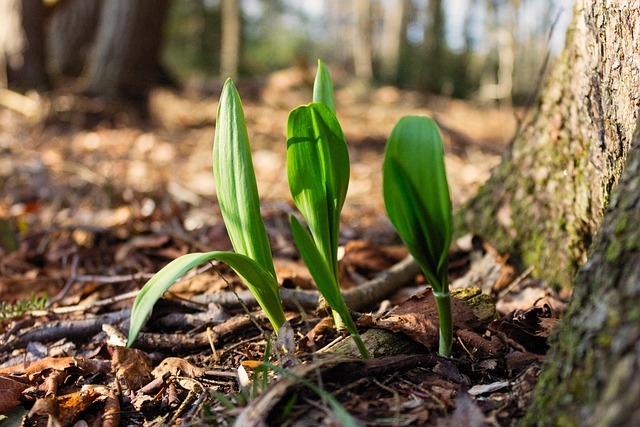
A cluster of wild leeks at the base of a tree.

Ramps are wild leeks, and sadly trendy in the culinary world. In some areas, they’re delicacies that have been harvested to endangerment. They’re a spring vegetable very similar to a leek you’d get from the grocery store, which means they’ve got an onion-like bulb topped by flat leaves. The whole plant is edible, but it’s not uncommon for a nice patch of ramps (which can take years just for the seeds to germinate, then another seven years for the plants to mature) to get harvested to oblivion for the bulbs.

Fortunately, since the leaves are also delicious, this isn’t necessary. You can enjoy ramps and still leave the live plants behind. All it takes is harvesting one leaf and moving on, rather than digging up the entire plant. (I’m planning to chiffonade the leaves for potato soup. I’ve got some new potatoes from the farmers’ market, creamline milk, and a whole bunch of home made vegetable broth!)

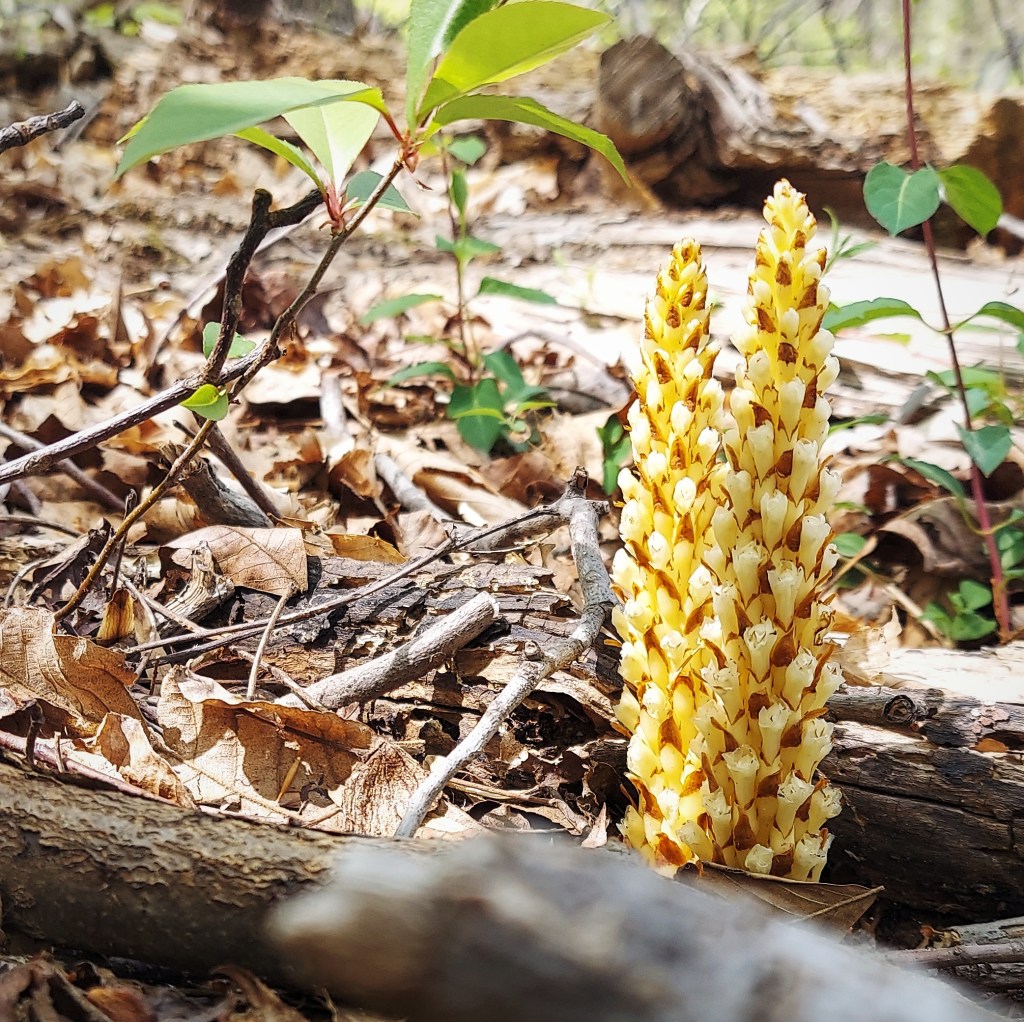
A cone-shaped inflorescence of bear corn.

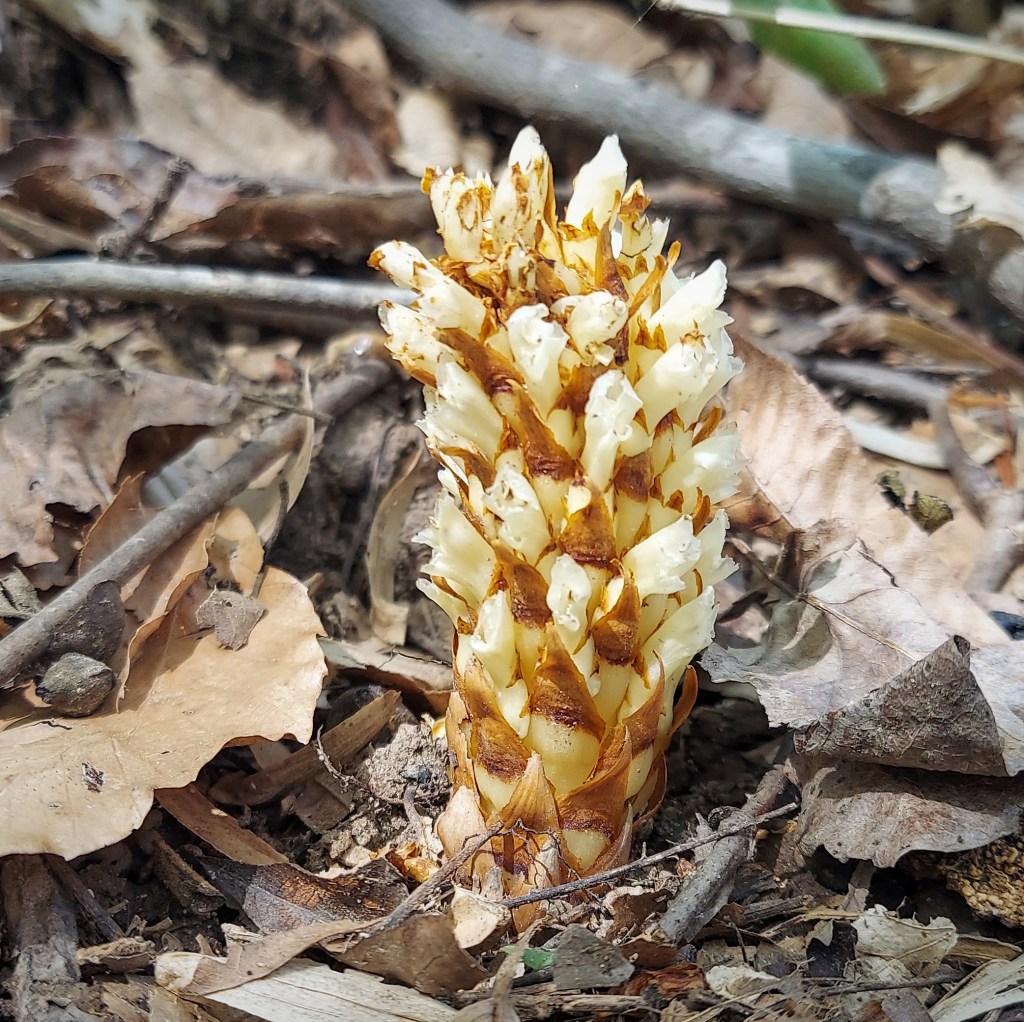
One of the neatest things I saw recently wasn’t something I was looking for — in fact, I’d never encountered it in my life, and had no idea it existed. Conopholis americana, also called cancer root, bear corn, or bumeh, is a profoundly odd-looking parasitic plant that lives near oak and beech trees. At first resembling an upright corn cob or the cap of a fungus, closer inspection revealed cream-colored flowers.

Despite the name cancer root, it doesn’t appear to actually fight cancer. However, it does have some pretty powerful astringents that help with wound clotting. This plant was also used to help induce and progress labor (which gave rise to another, more offensive name that has largely fallen into disuse). It’s also a diuretic and laxative, which is what gave it the name “bear corn.” After months of hibernation, bears need to “unplug,” as it were. They’re attracted to the springtime blooms of bear corn, and eating it seems to help get things moving.
This idea is plausible enough, though I have chosen not to test it myself.

We also spotted a black squirrel, though nearly missed it. He skittered quickly along a fallen tree, and was far out of sight by the time I managed to try to get a picture. Still, even without photo evidence, it was pretty neat to spot two very rare things. (Melanistic squirrels only occur in about 1 out of every 10,000 eastern gray squirrels!)

Here ’til the day breaks and night falls,
J.

Blog · life · Neodruidry · Plants and Herbs · Witchcraft

Back into the woods.

it’s a rly good deal tho, I texted.

My phone buzzed a second later.
I’m literally about to get on a plane right now, he’d sent back.

This back and forth happened a few more times, before he finally agreed that a couple hundred dollars off a four-day vacation was, in fact, a very good deal.

This all started when my partner realized how much vacation time he had left over at the end of last year. It doesn’t roll over and he can’t cash it in, so it was pretty much just kind of wasted. Ever the supportive devil on his shoulder, I urged him to make sure he takes all of the paid time off he could this year, especially if it was just going to evaporate if he didn’t.

“Your job’s able to offer you this because of the value created by your labor. It’s not a free perk or a fun bonus, it’s literally something you’ve earned. If you can’t get the equivalent value in your paycheck, you should take whatever you’re offered. You’re basically giving up part of your salary otherwise.”

(I also have the same attitude toward expensed meals, fitness equipment, and other benefits. Just because it isn’t money doesn’t mean it isn’t compensation, friends!)

And this is how, on a shuttle immediately before boarding a plane, my partner prayed that his phone’s battery and internet would hold out long enough for him to book a four day stay in a Getaway cabin. It was a scramble to schedule everything before the sale ended or his phone gave out, and he succeeded with almost no time to spare.

A sign on a cabin that says "Getaway Shirley."

We’ve stayed in a Getaway tiny cabin before, so I knew this’d be a good deal for us. Last time was during winter, so I was pretty excited to experience the area when it was a bit warmer and greener. That part of Virginia isn’t exactly in full bloom just yet, but was still beautiful — especially if you’re a weirdo like me who experiences aesthetic arrest from the sight of, like, an extremely good mossy log.

Interior of an apothecary shop, with shelves full of incense, candles, herbs, and remedies.
Image from Visit Waynesboro.

When we weren’t walking in the woods, taking pictures, trying to identify plants, or “catch and release” mushroom hunting, we were reading or writing. One day was a bit too chilly and rainy to do much outside, so we went for a drive down Skyline to Waynesboro, VA. There’s a fantastic apothecary there called PYRAMID, with some really wonderful locally made candles, incense, artwork, jewelry, herbs, teas, remedies, and curios.

A close-up of violet flowers.

The environment of the cabin was just as relaxing as last time. There was a very beautiful patch of violets right near our fire pit (I picked a few for pressing), and we were tucked far enough away in the trees to have privacy but just close enough to other cabins to not feel completely isolated. Along the stream in the woods, Christmas ferns were sending up tons of spiraling fiddleheads. The moss was verdant and bright green, and the lack of leaves on the trees was more than made up for by the abundance of lichen and mushrooms on the ground. The weather was cool, alternating between sun and a light, silky drizzle that made everything seem fresher and brighter. Though the trail we took was relatively short, it took us a while as we kept stopping to get down, snap pictures, sketch, or identify something.

We packed well this time around, though we brought way too much food for the two of us. Pasta, salmon, shrimp, steak, cinnamon rolls, ingredients for s’mores… He cooked the meat and fish over the fire, and made some of the most amazing, crispy salmon I’d ever had. It was simple — just fish cooked in the cabin-provided olive oil, salt, and pepper — but the texture and subtly smoky flavor were perfect. We had it with lentil pasta all’arrabiata, and I’ve been craving campfire cooked salmon and pasta ever since.

A close-up view of the inside of a violet flower.

(We did run out of salad greens at one point, which got me wondering how I’d scrape together some from the surrounding landscape if I had to — there were violets, dandelion greens, and the pink flowers of redbud trees… Christmas ferns can be eaten the same as ostrich ferns, so fiddleheads too. Fortunately, I did not become responsible for foraging for our vegetables, because I did not want to play “Fuck Around and Find Out: Salad Edition.”)

Coming back took a bit, mostly because we’d scheduled things so we still had a day or so between going home and going back to work. It meant that we were able to visit all of the pottery shops, antique stores, and farm stands that we passed along the way. We ended up coming home with coffee beans, copper sculptures, and a cypress knee(!!!) that we hadn’t originally intended to, so I’d say our sidequesting was a success.

Here ’til the crow flies and the flies crow,

J.