life · Neodruidry · Plants and Herbs

So I says to the maple tree, I says…

A big part of permaculture is observation.

You don’t just test your soil, see where the sun hits, then plant a bunch of things. It’s a slow progression during which you watch the land to see what grows where, how it thrives, and who visits it. You let the dirt tell you what it wants and meet it in the middle, so everyone gets to eat and thrive.

I figured one way to help this process would be to just… well, ask. I took myself, an offering, and some incense, and climbed up the hill to the big red maple in the back yard. There’s a perfectly butt-shaped arrangement of some of its roots near its base, so I settled myself in, rested my back against the trunk, and let myself kind of fall into it.

It’s a process that’s hard to describe — if pressed, I’d say I “breathe” along with the tree. This is probably a bit hard to conceptualize since trees don’t breathe the way we do, but gentle breathing and just feeling things out for a while seems to put me into a very comfortable looping sensation. I feel the water moving up the xylem, sap flowing through the phloem, waste moving back down to excrete into the soil through the roots. I feel a sympathetic flow from my feet to my head, then back down and into the soil. Sometimes, this is just a way to relax and get out of my own head (and into a consciousness that’s very alien to my own). Sometimes, it’s a helpful way to get information.

In this case, I got a lot of messages about water.

I wasn’t really surprised — red maples have shallow, spreading root systems and produce “dry shade” under their canopies. The soil here is heavy clay, and there’s a fairly steep hill. There’s also a ton of non-native grass and not much biodiversity. The angle, hard, slick soil, a tree that blocks rainfall to the ground, and thirsty, high-maintenance grass made the water messages make sense. It doesn’t look like a desert, but it’s a place that just feels subtly thirsty.

I left the experience resolved to put in more ways to catch rainwater — barrels, a stock tank, something. I wasn’t sure what else to do. What else could this water-hunger mean?

Flash forward to Pagan Pride Day. At one point, I sat for a tarot reading. It was full of “wild hares” — cards that seem to leap from the deck unbidden, as if demanding to be part of the reading, without anyone having to draw them. The resulting message was one of herbs, plants, and a figure that would help me realize my vision.

“Neato,” I figured, and didn’t think much of it.

Flash forward a bit further. My partner and I are at a hardware store to return a defective trowel and buy more mulch with which to murder the front yard. While he gets it, I browse the shrubs outside. There’s a triangular gap between the house, porch, potted rose bush, and rue plant that I’d like to fill with something tall and fairly thin. A voice asks me how I’m doing, and if I need help with anything. I look up to see an older man in a purple shirt. He’s the plant supplier for the stores in this area, he says. We end up having a long conversation about plants, soil, pH, sunlight, tattoos, and taxes. He tells me that the heavy clay is trouble. Without organic matter, it’s too compact for roots to penetrate and doesn’t absorb water well.

What I need, he says, is leaf compost.

And there it was again. The way to get more water isn’t just to trap it, it’s to undo years of raked leaves and monoculture. Layers of compost (good thing I have a big tumbler), paper, yard waste, and shredded wood. Part of the reason the red maple’s roots jut up through the grass is because the clay makes it difficult to exist otherwise. There’s no softness, no air space, no absorbency, no acid.

We’re layering rotted leaves and shredded wood over the clay now. Sprinkling it with mushroom spores and seeds that will sleep in the cold until spring. Eventually, we’ll get there.

Uncategorized

Delicious. Finally some good f***ing direct action.

Following the controversial decision to throw foodstuffs on artwork, it looks like Just Stop Oil’s stepped up their game.

Good!

I was critical of the action that involved throwing soup on a Van Gogh, and I stand by my initial impression. Fortunately, Just Stop Oil’s more recent actions seem to be more efficient and on-target.

Protests that block traffic are enraging to motorists, but they should be. Inconveniencing people is an effective way to cause change — if nothing else, someone may think twice about taking their car if they’re going to be stuck in a protest-triggered gridlock for hours. There are other advantages to this kind of action over the museum stuff, too. For one, you don’t have security seconds away, so you have more time to get your message across. Second, there’s a direct connection to cars, car-centric city planning, and the fossil fuel industry, so it makes it easier to get your point across efficiently. The medium does at least a little bit of communicating for you.

One article pointed out that a woman with a sick child screamed at the protesters to let her through, and I can’t imagine how scared and angry she and her child must have been. I wish I had a better solution that would get people the care they need during an emergency, while still allowing protesters to demonstrate effectively. The truth is that the protesters probably aren’t the root of the problem here — protesters blocking roads get out of the way for ambulances and emergencies. The primary issue is all of the other cars creating the traffic that’s being blocked in the first place.

Two members of Uprising of the Last Generation also staged an interesting protest that, in my opinion, seems to bridge the gap between effective communication and attention-getting. They glued themselves to the metal poles supporting a dinosaur skeleton (don’t worry — most of the skeletons actually on display in museums are plaster models made to look like fossilized bone. Actual fossils are delicate, heavy, and usually incomplete). The message was that dinosaurs didn’t survive a climate catastrophe, and neither would humanity. It still runs into some of the same issues as other museum-based protests, but there aren’t a ton of layers between their target and their objective that could cause parts of their message to be lost.

This isn’t to say that I necessarily trust some of the financial backers of these efforts. While it’s true that a rich person can inherit a large sum of money and use that in order to fight against the thing that gave them the money in the first place, this feels disingenuous when they choose to, for example, retain enough to “buy and sell high-end properties the way the rest of us buy shoes.” This isn’t to say that oil heirs should have their wealth confiscated and automatically be consigned to cardboard boxes, but maybe living in one, regular house and throwing more monetary weight behind the causes they purport to care about would be a good start. Go big or go home.

The news cares about the wealthy and recognizable0. Hunger strike until you get to talk to a head of state. Handcuff yourself to something. Spraypaint the facade of an oil company’s corporate office. The rich and famous could attract more attention through direct action than a hundred members of the general public. If you’re gonna go to town, might as well go in style. As long as members of hoi polloi are the ones sacrificing their safety and freedom, it’s too easy for the media and social networks to paint them as melodramatic and delusional.

Environment · life

In which the squirrels pay their tab.

So, remember how I accidentally got a bunch of squirrels hammered a bit ago?

They paid their tab.

Like I mentioned in that previous post, permaculture requires a lot of fallow time, at least initially. There are a few things I could plant, but otherwise it’s mostly observing, identifying what’s already there, and tending to the raised beds in the front yard. In this process, I’ve decided on a few plants that I think will do very well.

So, imagine my surprise when I went out and noticed a bunch of seedlings of these same plants, newly growing adjacent to the squirrel kegger.

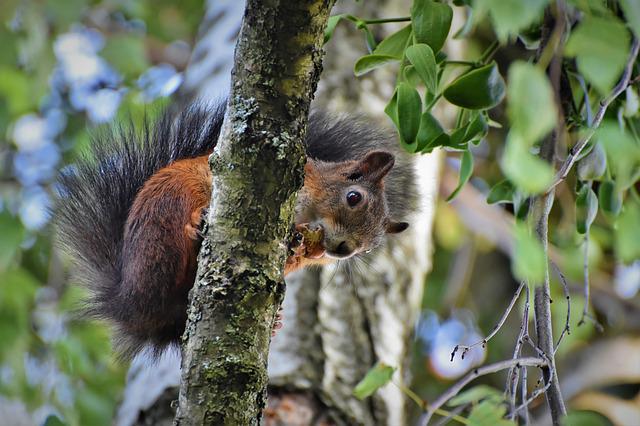
A squirrel peers down from a branch.

Seriously. My delinquents planted tomatoes (so many tomatoes), beans, and a whole host of other plants I’m excited about. It’s late in the season, so I don’t know how well they’re going to do right now, but still. I’m basically feeling like the hillbilly trash Snow White of gardening right now.

It was slightly annoying to have a band of rowdy rodents making and chugging bathtub squirrel gin in my platform feeders, but I’m not even mad.
Well done, my dudes.

(I’m still not buying you more cranberries, though.)

life · Neodruidry

Letting my mind and spirit free.

I’m writing the after a soak in loads of epsom salt. My muscles are sore and tired, but the kind of “vacation” sore and tired you get from a day of activities you’ve long looked forward to.

Can I tell you how much I love Pagan Pride Day? In the past, it was just nice to go to a place where I felt less isolated. This year, my partner and I were able to go, hang out, and just enjoy the company of good people from the Druid group I’m involved in.

We sat under the spread of an oak tree that occasionally dropped a gentle rain of acorns on us when the wind blew right, eating fruit, shaved ice, and very good Filipino food (provided by Rollz On Wheelz). There was music and dancing, and friends and acquaintances who passed by, stopped for a chat or an introduction, then drifted back into the crowd. My partner and I walked by all of the vendors, secretly pointing out what we’d bring home that afternoon and what we’d hope to see next year.

I picked up handmade soap, Florida water, supplies for offerings, a beautiful devotional bracelet to my patron deity, and a horseshoe for the front door. I also obtained a large, crocheted axolotl, and the seller and I laughed about his adorably wonky eye — as it turns out, we’re both people who gravitate toward things that are slightly off. Not always things in need of repair, but things that are a little out of the norm and likely to get overlooked. He was the last one of his kind, and I knew that leaving him behind was going to eat at me. He’s also made of very, very soft chenille, is delightful to hug, and I apologize to no one for my strange sympathies for inanimate objects.

Admittedly, the event had a strange kind of melancholy for me, too. I was talking to two people about the generational differences between witches and Pagans, open and closed practices, gatekeeping, “Witchtok,” and the seemingly shrinking role of elders in the ever-expanding online community. The internet has provided more interaction and connectivity than ever seen in history, but at a cost — the wisdom of experienced people is easily drowned out by teachings that can be inaccurate at best, and dangerous at worst.

I say it was melancholy for two reasons: For one, I feel a pain in my heart for people looking for a place for themselves. I was one for a long time. I was happy with an eclectic practice, but opportunities to learn from experienced practitioners were few and far between. I kludged together what scraps of information I could get but becoming part of a more organized tradition gave me something that eclecticism and patchwork internet teachings didn’t. This won’t be the case for everybody, but damn do I wish that people had access and opportunities that would let them discover and decide for themselves rather than feeling like their only options are books and social media. I know I would’ve loved to have had that opportunity years ago, even if I might’ve turned it down at the time. At the very least, I wish I had been free to make that choice for myself when I was young.

For two, I feel melancholy because it was a bit of a memento mori. Every day brings me closer to being an elder, or a spiritual ancestor. The idea of mortality isn’t really what bothers me — I more than made peace with that a long time ago — but the feeling of ever-plodding obsolescence is. It’s like a sense of loss for something that isn’t gone yet. I don’t really know how to describe it.

So I guess all of this is to say that I love feeling like I’m in a place I belong. It reminds me of the warm, vibrant, thrumming dance of life, with all of its sweetness and bitterness and joy and sorrow and love and loss. I love the drums and the hum of insects. I love the smells of incense and late summer wind through oak leaves. I love the candy sweetness of syrupy ices and the coolness of Florida water on my temples. I love the warmth of tree-dappled sunlight and the smooth coolness of polished bone.

Arright, I’m gonna go before I get more emotional. I need to get the cabbage butterflies off my broccoli anyhow.

Here ’til the lettuce peeks to see the salad dressing,

j.

Environment · life

I made a rodent speakeasy.

I’ve tried to be conscientious in the way I take care of this yard. Permaculture isn’t achieved overnight — it can take up to a year of just observation to understand what should actually go in a space, and what arises naturally. While I’ve been on a crusade to get rid of a lot of the less-useful, non-native plants that were introduced here, I’ve tried to balance this with working slowly, patch-by-patch, and providing more sources of food, water, and habitat to replace what I’ve removed, and then some. (I even found and transported a yellow woolly bear caterpillar from a soon-to-be-doomed spot in the front yard, to a thriving bee balm plant in the back.)

Still, until I’m able to provide more food plants and water sources, I figured I’d put out some simple platform feeders. I’d already noticed bees descending on my yard after I watered the raised bed there — even when nothing had been planted yet, they were attracted to the water. Thirsty little buzzy people bobbed from tiny puddle to tiny puddle, eagerly drinking it up and trying to beat the heat. A platform feeder, I figured, would allow me to provide some water sources and a little bit of food for the larger guys out there.

I started fairly simply. I threw in a handful or so of sunflower seeds and some sulphite-free dried cranberries that I’d had laying around for a while, and put a bit of fresh water in the water dish.

Then I forgot about it. I mean, I had a lot of other things to contend with, like my war against lawns as a concept (and this lawn specifically). It was after a few days of rain and a bit of a hot spell that my partner called me into his office.

“Those feeders are really busy!”

“Yeah?” I asked, leaning in to peer out of the window overlooking the deck.

“Yeah! There’ve been a bunch of squirrels there all day!”

“Huh. Weird, they weren’t paying any attention to it befo-”

I squinted at the squirrels as it all clicked.
Fruit. Water. Heat.
The feeders didn’t collect rainwater, but it had rained enough to make those dried cranberries plump and juicy. The warmth just helped the sugar, water, and natural yeast along.

“Oh, shit,” I muttered.

Those hairy little delinquents were doing shots of fermented cranberry on my deck.

There was an excellent reason why these fruits, long ignored and forgotten about, were suddenly teeming with squirrels.
Glassy-eyed squirrels.
Glassy-eyed squirrels with burgeoning alcoholism.

Through my own negligence, I had managed to create some kind of speakeasy for squirrels. And they were having a fantastic time. Fantastic enough that I hesitated to rush out and try to chase them away from their ersatz kegger. (I mean, I don’t know how many drunken squirrels it’d take to kick my ass, but I knew how many they had on their side.)

I haven’t yet found any of them nursing tiny hangovers or passed out in the grass, but I still discarded the old fruit and put out fresh cranberries. If they liked dried fruit, they could have those.

Then I noticed that they were putting them in the water dish next to the feeder, presumably to create some kind of backyard rodent pruno.

I’m a little worried about what’s going to happen when I run out of cranberries, to be honest.

life · Plants and Herbs

Grassassination II: Revengeance.

If you go on an allergy diet, you do it by eliminating common allergens, then re-introducing them one at a time over a period of weeks. This lets you figure out exactly what you’re reacting to, and how.

If you have sensitive skin, you probably also know not to add a lot of new products to your routine all at once. You add them one at a time, with space in between, so you can see how your skin responds.

If you have environmental allergies, it’s a bit trickier. When you move to a new place, you can’t really add in new allergens one at a time — your neighbors have flowers, and grass, and trees, and there are even new microorganisms to contend with.

So, when my partner was sniffling, sneezing, and miserable, it was hard to figure out what was causing it. He’d had an allergy test years ago, but no longer had the results. With so many new trees (and far more of them), there was no way to really tell what was making him feel so bad.

“Hey,” he called out to me, “What’s ‘Alternaria’?”

Alternaria. It sounded familiar.

“It rings a bell, but I’m not sure. Why, what’s up?”

“I found my old allergy test, and I was off the charts for that.”

Huh. It certainly seemed worth looking up, so I did. Fortunately, Microscope Master had some useful inf-

Wait.

Alternaria is a large genus that belongs to phylum Ascomycota (Sac fungi). A majority of Alternaria species are saprobic, which means that they are largely involved in the decomposition of various organic matter. As such, a good majority of these species can be found in environments with organic material and water (or moisture).
involved in the decomposition of various organic matter. As such, a good majority of these species can be found in environments with organic material and water (or moisture).
decomposition of various organic matter.
decomposition

FFFFFFFFFffffffffffffffffjkglhlrughjkfhvm,nmb

Okay.

So, the same measures we were taking to help tamp down the grass allergens and get rid of the invasive plants were also creating a gigantic allergenic cesspool. I mean, I knew that there would be fungi. At least 90% of the point of smothering the lawn with a tarp was so it’d die and break down, thereby enriching the soil, and you need fungi to do that. I did not exactly count on the fact that the grass would fight back by mounting an assassination attempt of its own.

Well played, lawn.

But that’s okay. I have another weapon up my sleeve. One they’ll never see coming.

Clear sheets.

I’m very much against using plastic where it isn’t absolutely necessary. Part of the reason we initially chose to use a tarp was because we could use it for other things afterward, so it wouldn’t be single use. Fortunately, we were able to find some heavy-duty clear plastic sheeting that, while absolutely not ideal, I will use elsewhere after pressing it into service for grassassination. Glass would be better, of course, but is in no way practical. We considered layering the whole yard in paper, cardboard, and compost, but that wasn’t practical either (and a lot of soil amendments contain ingredients that aren’t sustainably harvested, like peat). Renting a sod cutter, or calling out a service to peel off the grass for us, was too expensive. We’d also probably have to replace the topsoil that’d be stripped away by the grass’ roots, which would be expensive and require many single use plastic bags.

I mean, I already feel like I’m being The Worst Druid by killing this lawn in the first place. The end result will be worth it, but the whole series of events feels very, I don’t know… Machiavellian. Still, a grass lawn represents a lot of waste (and wasted potential). I console myself with pictures of lush violets, wild ginger, and partridgeberries.

Anyhow. Clear coverings inhibit the growth of fungi by allowing more light to pass through. They still inhibit photosynthesis to a degree, and don’t trap quite as much heat as dark-colored ones do, but they work. They just take a little longer. And so, by the time you read this, I’ll be out wielding a mallet like Mjolnir, pounding giant staples into my lawn while cursing at the sludgy, dank mass of what used to be grass.

The lawn may have won the battle, but I shall win the war.

Environment · life · Plants and Herbs

Grassassination.

I’m not lawn people.

I mean, I can appreciate a carpet of grass from an aesthetic perspective, but only because I find its unnatural smoothness and homogeneity both pleasing and unsettling. If the Uncanny Valley has plants, they are all putting green grass.

When we purchased this place, we also become responsible for several thousand square feet of lawn. I should probably put lawn in scare quotes, because it’s less “lawn” than it is an amalgamation of grasses and weeds that look just enough like grass from a distance. The “Hello, fellow kids” of grass, if you will.

Grass is also a major drain on the local environment here. While its vital to areas like the African savannah, keeping it lawn-perfect requires too much water, fertilizer, pesticide, and either gas or electricity to mow. I say “too much,” because grass gives virtually nothing back when it’s confined to a postage-stamp of lawn. You can’t eat it, it’s too short to weave into anything useful, and mown grass is too tiny and insubstantial to make decent fuel. Lawns aren’t even good at feeding wildlife. If grass were allowed to go to seed, it could feed birds, but maintaining a lawn means cutting it short long it before it gets to that point. All lawns do is take, take, take. In a place where droughts are likely to become both more severe and commonplace, and habitat loss drives away native species, lawns can suck it.

A cocker spaniel puppy, sprawled on a lawn, looks up at the camera.
Shown: The only useful purpose for a lawn.

Besides, all grass lawns are are socio-economic symbols. The ability to use a property for aesthetics and leisure alone signifies a certain level of economic security, which, back in History Times, was pretty much a form of rich people gloating. Turning the land around your fancy estate into an immaculate green carpet meant that everyone could see and marvel at your fancy estate. Having a grass lawn around your house, as a concept, is pretty new.

“But j,” you might be saying, “Flowers are grown for aesthetics, too!” This is true, but not entirely. Flowers are pretty, but they also feed pollinators. Grass is wind-pollinated, so it barely even feeds bugs. Flowers are also often the precursor to edible fruit. Even roses fruit, and they’re good for you!

I have a patch of soil at my disposal, so it feels more responsible to use it for the production of either food (if not for humans, than for wildlife) or native habitat. I don’t have a homeowner’s association, so nobody can tell me what to do with the dirt and I am free to create the habitat my wretched little goblin heart desires.

I also have very specific feelings regarding the stewardship of a yard. It’s land that was taken, carved into a suburb, had all of the native flora scrubbed off of it, and made to grow a boring, repetitive lawn. It just feels more respectful to the people, plants, and animals who once called it home to turn it back into something… I don’t know. More nourishing. Less sterile. More diverse. Abundant. Comfier. Sustainable, and sustaining in turn. Even if I live here until I die, this place will outlast me. I gotta do right by it.

I’m fortunate that not everything here is grass, though. On the margins of the property, you can see where the people who lived here before made a mark. There’s a rose bush, rue, a potted sedum, crape myrtle, and azaleas. Tucked away, there are some blueberries, an apple tree, a young persimmon, and a red maple. Like islands in squares of lawn, there are two tiny, tiny Japanese maples.

All of this is to explain why most of my front yard is currently a black tarp. Even if we’d needed to have a grass lawn for some reason, the front yard is about 50% actual grass, and 50% other kinds of plants (mostly invasives) that just kind of moved in when the intense light and heat killed off patches of the grass. Doing anything useful with the grassy areas pretty much involves going scorched earth — literally.

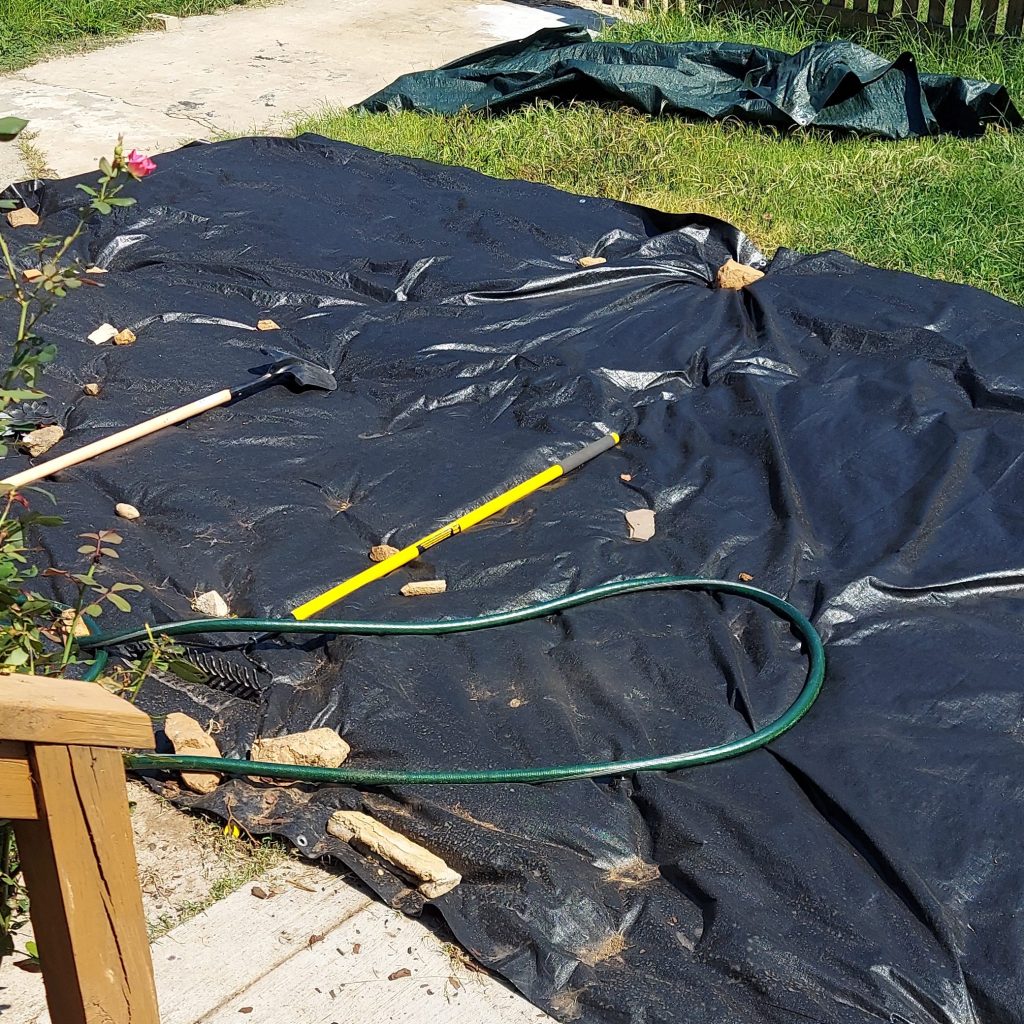
A large black tarp, held down with rocks and a metal rake, covers a rectangular patch of grass.
This is the gardening equivalent of having a rusted-out truck up on blocks in your driveway.

I spent a lot of time researching different ways to get rid of — and subsequently replace — an entire lawn, and this is the solution that seemed to be the best for our situation. A black tarp, when placed over closely cropped grass, captures a lot of heat. This, coupled with the deprivation of moisture and sunlight, kills the plants under it. They break down over a period of weeks, and you get a nice, nutritious patch of soil for growing better plants on. Right now, the plan is to replace everything with a mixture of sun-loving local groundcovers and plants that can pull double-duty as ornamentals and sources of food — Passiflora incarnata, for example, which produces these amazingly alien-looking blooms followed by tasty fruit. I’d also like to adopt the custom of growing edible plants near front gates and fences for passers-by. Even if people don’t want them, the birds will.

The tarp thing is just one method of grass assassination (or grassassination, if you would). We’re also using the “lasagna method” in other areas, which entails mowing the grass short, covering it in layers of paper and cardboard, and smothering that in compost, mulch, and soil. The grass dies, it and the paper break down, and you’ve got the foundation for a very fancy raised bed. (So far, this method is working very well for some bee balm and elderberry plants I put down in one corner of the yard, but more on that another time.)

So, if you’ve been reading here and wondering why I haven’t been posting, it is not because I’ve been kept busy with paid writing or have abandoned society and gone on a bender in a forest. I have been battling one of my greatest foes: LAWNS.

This is for that summer you made me spend on prednisone, you little green S.O.Bs.

life

And slowly, with great gravitas, I took a bite from the banana in my backpack.

Hello!

I was updating pretty frequently, until I wasn’t. This is because we bought a house.
(For real.)

It was kind of funny — I’d done a ton of divination on the subject, but kept getting the same advice: Wait. Be content where you are right now. Enjoy what you already have. I figured this sounded pretty solid, so I started to do that. We bought some new furniture, I converted our vertical blinds to a curtain rod, and before I even got to hang the curtains, things changed. The summer solstice came, I did my usual summer solstice ritual, and the ritual divination changed its tune. Now it was “New start.” “Competition.” “Strength.”

I figured that sounded pretty rad, but didn’t think too much of it. I tapped through some real estate websites out of boredom, and noticed something interesting: There were more houses. A bunch of estate sales. Many of the ones that were in the 500s and above were now… not.

I spotted this little midcentury ranch house on a nice sized plot of land. I called it the “John Waters House,” because all of the room colors felt like the palette of Pink Flamingos. I kind of fell hard for it, to be honest.

Alas, it suffered from an absolutely eyewatering smell of dog pee, and so we didn’t put in an offer.

Discouraged, I wasn’t even in the mood to look at the next house, but we’d already agreed to tour it. It’s a good thing we did, too, because that tour completely sold us.

Which is a good thing, because I’m not sure if I would’ve been as keen if I’d waited until the inspection to see it. Not that there was anything wrong with the house, mind.

Our inspector was an older guy. Affable, in an avuncular way, and clearly knowledgeable about his job. Great!

What was less great was the- Okay, I’m basically impossible to misgender. I have been called everything, I identify with none of it, and I legitimately do not care. The first time the inspector joked, saying that, “By the end of the inspection, you’ll be happy,” he pointed to me, “and you’ll hate me,” he pointed to my partner.

“Why?” My partner asked.

“Because there’s gonna be a whole list of things you’ll have to fix!”

“Uh, I’m the one who does the fixing,” I said.

The inspector brushed it off, and so did I. My partner’s taller than me, more jacked, and is generally pretty masculine. People usually assume he’s the one doing things with power tools. It’s whatever.

Then, at the end of the inspection, the inspector steps into the living room and looks at me.

“Are you gonna let him have any closet space?”

I didn’t really know how to answer. It was a pretty weird question, and my brain was already trying to figure out whatever closet-related anomalies the house might have. Then it clicked.

“I work from home. I don’t have clothes I can’t sleep, paint, and garden in. He’s the one who goes to an office and has a spare closet full of fancy suits.”

At that point, I was mildly annoyed. Not at his assumption about my gender, because I don’t see anything negative about being/being compared to a woman. It was his assumptions about my relationship.

My partner and I are pretty good at playing to each other’s strengths. This is especially the case when those strengths fall outside of traditional gender lines. It’s nice not having to feign competency at things I don’t care about, just because I’m “supposed” to. It’s also nice having my interests and aptitudes supported by someone willing to ply me with brewing bottles, paintbrushes, and power tools.

It is not nice having to hear “women and clothes, amirite.”

Besides, even if that was the case… so what? You don’t get to benefit from a culture that demands that women be decorative, then complain about the things they require in order to do so. It’s like the people who deride “unskilled” jobs, but still want their burgers cooked and their bathrooms cleaned.

I didn’t say this. I just wanted things signed, sealed, and done with. Besides, I didn’t think it’d get very far if I did. I stayed as the one doing the eye rolling, rather than getting eyerolled at.

We managed to close on the house about a week later, and it was the longest week of my life. The night before, I couldn’t sleep at all. I stumbled into the Redfin office barely able to see. One of the agents (this really nice lady who toured a house with us once before that) offered us tea, coffee, and snacks. Not thinking, I took a banana and a cup of tea.

Unfortunately, that meant that I had to figure out what to do with an opened banana while we signed an inch high stack of paperwork. I didn’t want to put it on the table to leave a bunch of banana guts everywhere. And so, slowly and with great gravitas, I placed the half-eaten banana in my backpack and took bites of it in between initialing things.

Here ’til the banana splits,
j.

Link round up

Good News Round Up: 6.17.2022

Hello! Have you ever wondered what your dog’s thinking? As it turns out, scientists might have an answer for you — sort of. This is a collection of posts and articles that I thought were interesting, funny, or just made me feel a little better about the state of things. I hope they can do the same for you.

A Glimpse Into the Dog’s Mind: A New Study Reveals How Dogs Think of Their Toys. Apparently, dogs have a “multi-modal mental image” when it comes to their favorite playthings. That means that they most likely focus on what is, to them, an object’s most significant sensory features — like its smell. Scientists discovered this by having dogs search for their toys under varying conditions, and observing which senses they seemed to rely on the most for specific objects.

Plants Appear to Be Breaking Biochemistry Rules by Making ‘Secret Decisions.’ As it turns out, plants make decisions about their respiration in ways that we didn’t anticipate. They can actually choose how much carbon they release, by deciding how much they retain for building more biomass. This all happens via a molecule called pyruvate. Most interestingly, plants can actually track what sources their pyruvate comes from, and factor that into their decision making process.

This DIYer Made the Coolest Boho Bookends for Only $1.75 , and They Look Straight Out of a CB2 Catalog. Are you into biophilic design? This is a design philosophy that uses natural materials, like wood and stone, which have beneficial impacts on our mental well-being. This super cheap, easy DIY uses a scrap of travertine limestone, and there’s no perfectionism allowed — the perfectly imperfect, organic shape of the material is part of the appeal.

Binding and Burying the Forces of Evil: The Defensive Use of “Voodoo Dolls” in Ancient Greece. The popular image of the “Voodoo doll” has little to do with the practice of Voodoo. The classic image of a human-shaped object that you stick pins in to cause harm is much closer to the concept of the poppet, a vehicle for sympathetic magic. This paper discusses the use of effigies as a means of binding and suppressing evil in ancient Greece, as well as similar binding rituals in Egypt and Assyria. It’s a long read, but an interesting one.

Researchers identify the origins of the Black Death. We all know that the bubonic plague came from fleas that carried Yersinia pestis, but how did the fleas get it to begin with? One popular theory held that it came from wild rodents in East Asia, but archaeological evidence and ancient plague genomes tell a different story.

Project: SigilPen. I often have to explain that Neodruidry is my religion, but witchcraft is a method. I use modern Druid magic, and I use witchcraft, though the two are very different. Either way, I love magical alphabets, sigils, and the concept of language and symbols as a form of magic on their own. SigilPen is a way of creating neat, accurate sigils using a magic square (kamea).

A lot of online sources for sigil magic fall into the trap of using a single magical square — usually the Square of Saturn — rather than choosing the kamea that’s aligned with what you’re actually trying to do. SigilPen allows you to choose whatever square you want to work with, and helps you translate your word, phrase, or name into a sigil. The site has several other very interesting tools for modern magic, aside from the SigilPen.

Pretend I folded this up and passed it to you under a desk.
– j.

life

One more day above the roses.

I had a psychiatry appointment on Sunday. This happens once every six to nine months or so, and would totally unremarkable were it not for the fact that I had it it in the vestibule of The Birchmere. I’d screwed up my scheduling, and didn’t realize it before it was too late to reschedule or cancel my doctor’s appointment. Fortunately, it was telehealth, so the entire thing pretty much went like, “Hi! I’msosorryIhaveaschedulingconflictIdidn’tmeantoeverything’sgoodandalsoIincreasedmydosageofsertraline!” Fortunately, my psychiatrist saw the physical evidence of my being out of the house as an additional sign that my panic disorder was still under control, and the call didn’t need to take long.

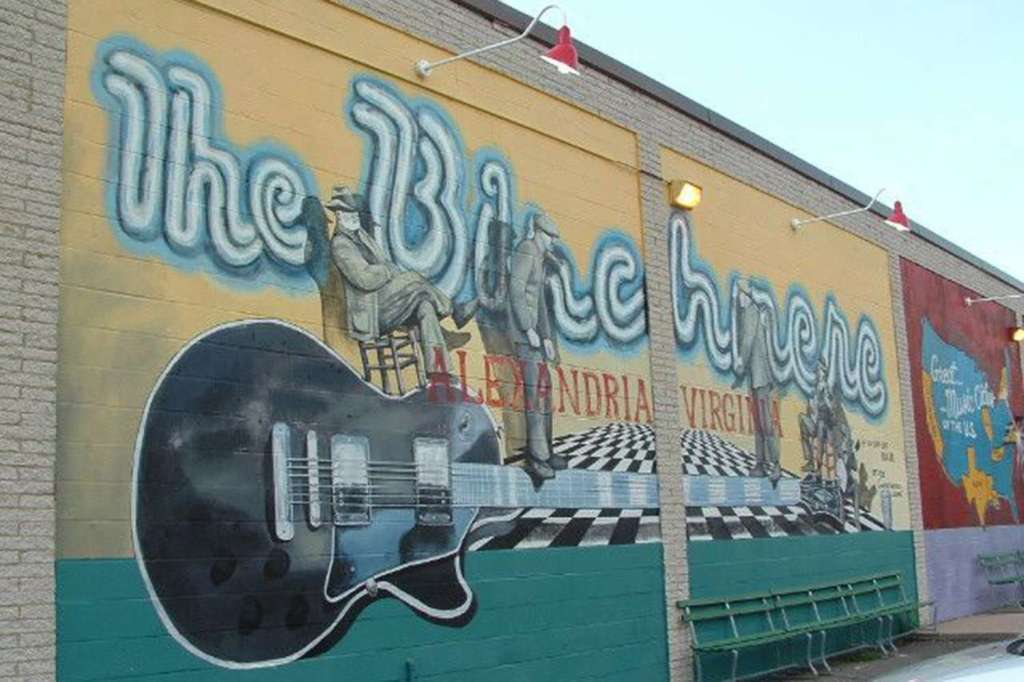
A mural of a guitar and the words "The Birchmere."

And so, luckily, I was done with the appointment and able to dash back into my seat before Gaelic Storm took the stage.

I knew they’d be fun to see, but I had no idea just how fun. The songs, the banter between them, even the images on the screen behind the stage (especially the donkey race) — it all came together in an atmosphere of warmth, laughter, clapping, and glass-raising.

This was also the exit of their extremely talented fiddle player, Katie Grennan, and the introduction of the also very talented Natalia (or Natalya, I haven’t been able to find her full name). The band switched fiddle players in mid song, then the fiddle player switched fiddles, as smoothly as you please.

Honestly, as much as I love Gaelic Storm’s recorded songs, I was blown away listening to them live. Pretty much every band member is a multi-instrumentalist (their percussionist, Ryan Lacey, was incredible). Their whole set was energetic, and every song was filled with complex melodies that interwove even as the musicians traded one instrument for another.

A photo of (most of) the band.

(And no, they did not play the one about Russel Crowe.)

If you ever have the chance to see Gaelic Storm, take it, even if you’re not familiar with their work. It’ll be a good time.