Blog · life · Uncategorized

A riverside hike (with *giant* mushrooms!)

This past weekend, my Handsome Assistant and I packed a small picnic and went for a bit of a walk. This particular area is beside the northwest branch of the Anacostia River, near an abandoned mica mine. There are some really cool mineral specimens here — the usual bull quartz, but also tons of mica-bearing rocks and golden beryl.

That’s not all it has, though.

The trail is mostly shaded by trees, so it stays fairly cool even when the weather’s warm. Lesser celandine (lush, but invasive) covers the ground between the trees, creating a dense carpet that reflects the sunlight and further cools the ground. It’s poisonous to eat, though the tubers are said to be edible, and has a long history of use as a topical medicine for hemorrhoids and scrofula.

A brown haired, caucasian man in a dark blue and white tanktop reclines on a bed of lesser celandine. His eyes are closed and his expression is peaceful.
“That’s a really bad idea, you know.”
“I know, but it looks so soft.”
“There’s probably poison ivy in it.”
“Worth it.”
“You’re going to get eaten by snakes. Or ticks. Probably both.”
“It’s so soft, though!”
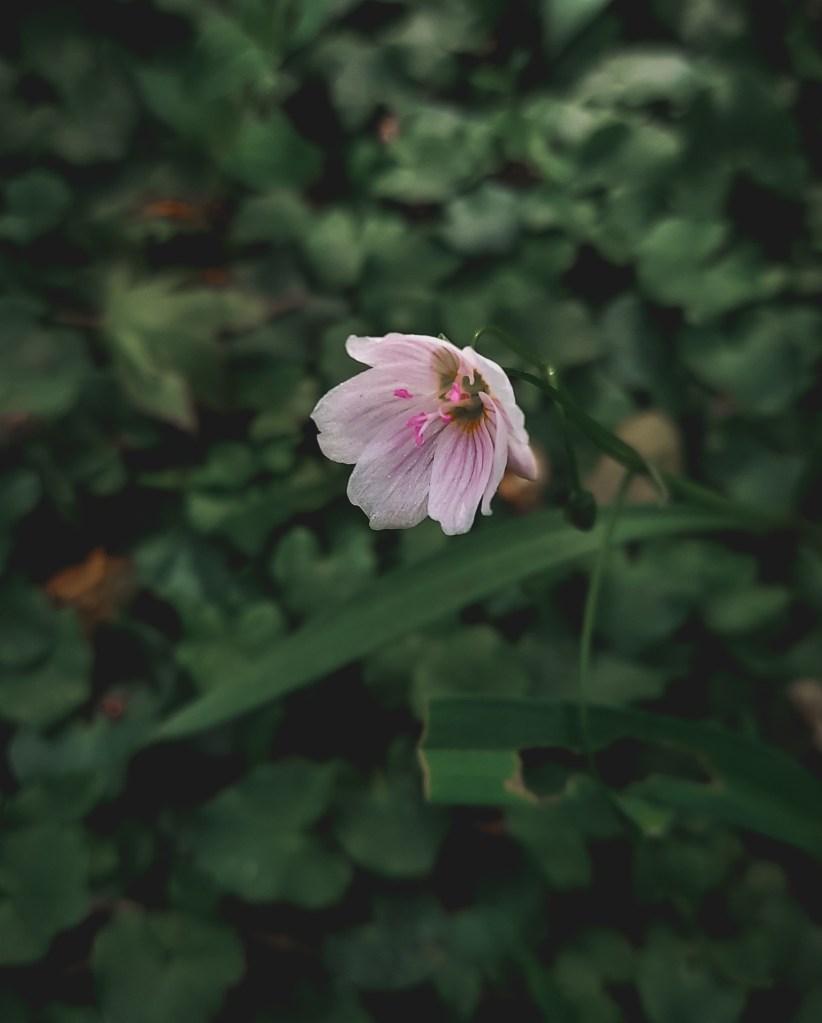
A close up of a small pink springbeauty flower.
Springbeauty (Claytonia virginica)

Fortunately, there was more to see than just lesser celandine. There were tiny pink blossoms of springbeauty, dense pillows of moss, fern fiddleheads, and some of the lushest skunk cabbage I’ve ever seen. We also spotted some mayapples, a few of which were even mature enough to flower. I don’t know if I’m brave enough to go back and see if there’s any fruit later this summer, but it was lovely to see regardless! (I snapped a few pics of the ones we saw, which you can find in my post on mayapple folklore and magical properties.)

Large skunk cabbage plants growing up out of a dense mat of lesser celandine.
Seriously, just look at that skunk cabbage (Symplocarpus foetidus).

We passed next to the water, eyes peeled for sparkly mica-bearing stones, when I heard a soft “bloop.” I turned my head just in time to see a startled common watersnake (Nerodia sipedon) slipping away across to the opposite bank, gracefully undulating and occasionally poking its head up like a snorkel to take a breath. I apologized for spooking it as I fumbled for my phone but wasn’t able to snap a picture before it had swum away and camouflaged itself in the mud and fallen leaves.

They’re one of the species of snakes that are often vilified for no reason. They’re perfectly harmless but can bear a passing resemblance to a venomous copperhead (Agkistrodon contortrix). Admittedly, I made the same mistake myself at first glance — not that I would’ve behaved any differently, as both the snake and I seemed pretty chill about the whole situation. Like black racers and ratsnakes, they’re guys you actually want to have around if you don’t want to have to deal with pest animals. Also, they’re one of the few reptile species that gives birth to live young, and that’s really neat!

(Also, copperheads are pretty chill, too. They might be venomous, but they’re not aggressive. Their first defensive instinct is to freeze up and rely on their natural camouflage. Bites typically occur when that either fails, or people don’t see them, step too close, and the snake gets desperate.)

A pair of young fern fronds, still curled into a "fiddlehead" shape.
Young ferns.

A little further up the trail, we were navigating over a large fallen tree. Another tree lay across it, forming a kind of steep natural bridge. As I investigated it to see if it’d be safe to cross, I heard a silky rasping sound. There, nestled in the root ball of the fallen tree, I saw the shiny black coil and pointed tail of a black racer (Coluber constrictor priapus) vanishing deeper into the tangled roots.

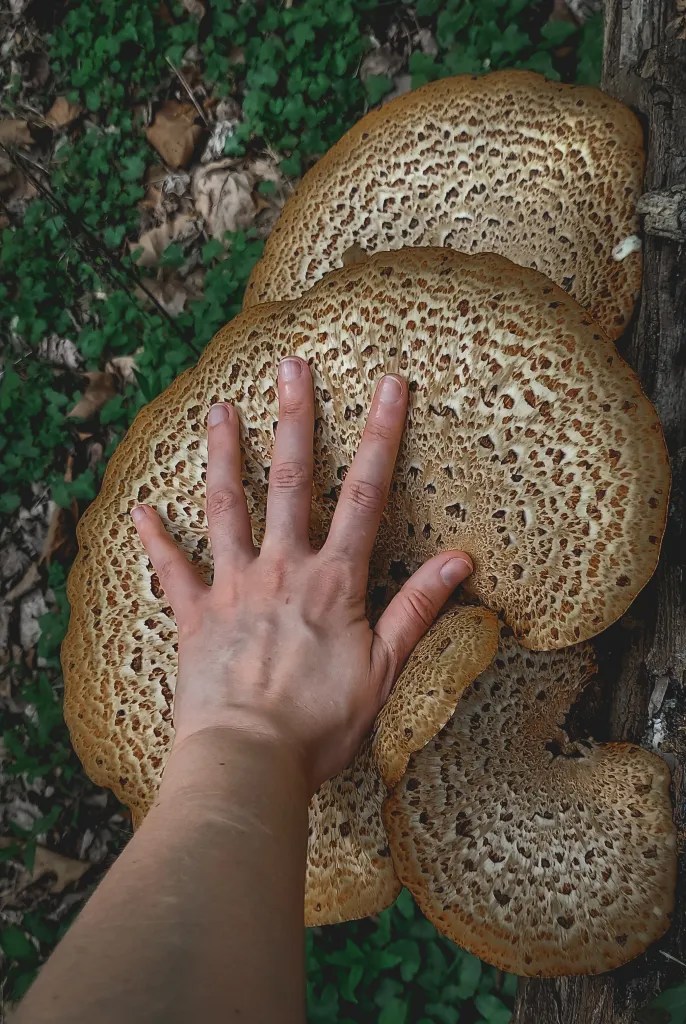
My favorite part, however, was running into a colony of dryad’s saddle (Cerioporus squamosus) growing from a dead tree. These are edible, fairly easy to identify, and don’t really have poisonous lookalikes. They also smell exactly like watermelon rinds, which is honestly very weird. Kind of a green, watery, fruity smell, of decidedly not the type you’d expect from a scaly tan mushroom growing out of a dead tree. I wasn’t 100% positive that that’s what I was looking at, at first. Fortunately, a combination of a quick-and-dirty ID app and friends with much more foraging experience were able to reassure me.

Also?

Dryad’s saddles get enormous.
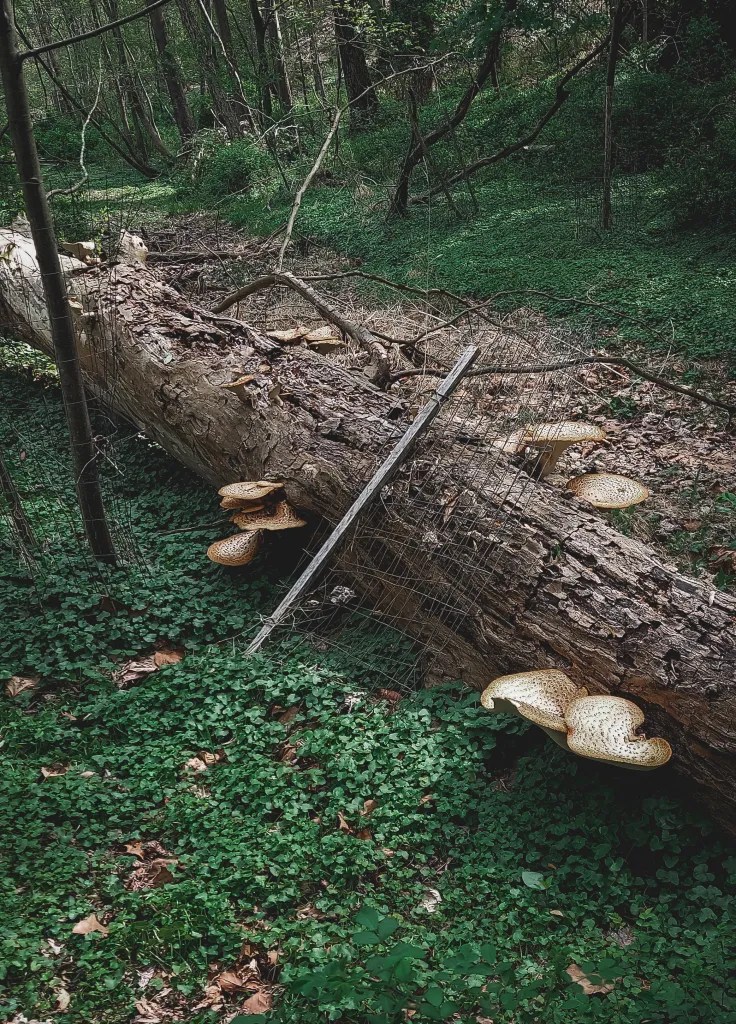
Like, far larger than I felt was reasonable for a mushroom. Much bigger than the reishi and armillaria that grow in my front yard, at any rate.

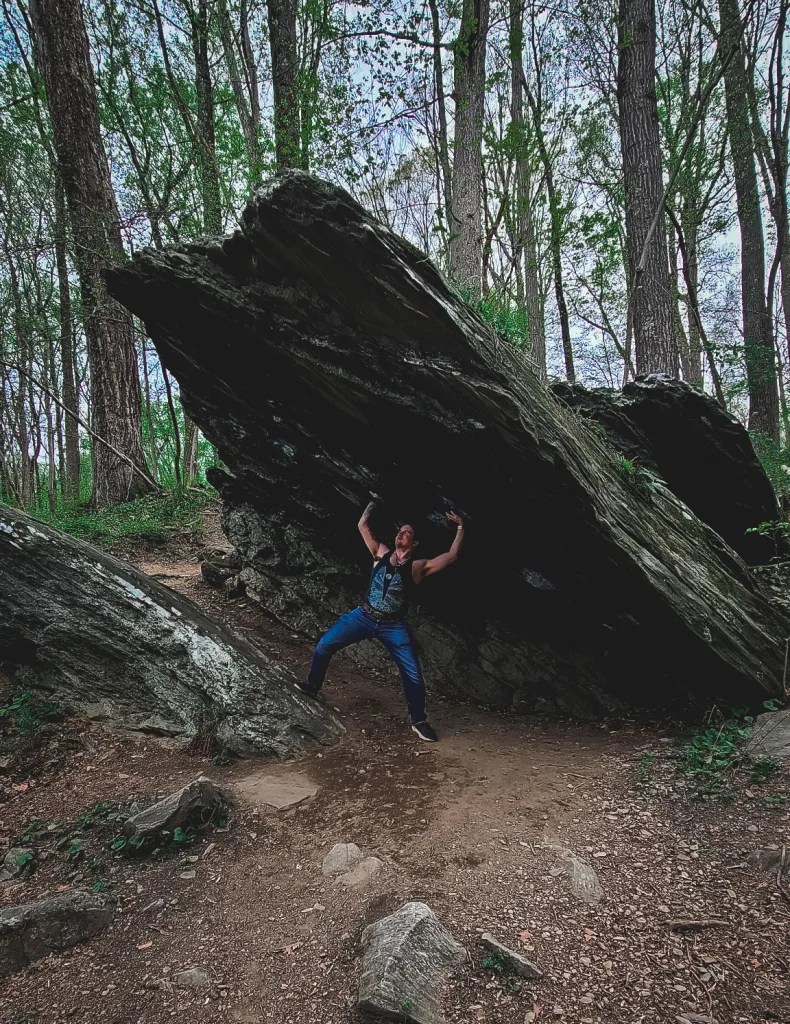
This area has another cool feature, labeled on the map as “prehistoric rock shelter.” I haven’t found any other information about it, but it’s a nice, cool, shaded spot to sit and rest for a bit. The area underneath is at a bit of a slope, but it’s still a comfortable place to take a break.


I also found a tree that was shaped kind of like a sad skull, and a very neat feather — most likely from a hawk.

All told, it was an eventful walk and a lovely picnic. Everything was vibrant and green, and we saw (and heard!) a lot of cool wildlife.

Here’s hoping you’re also finding cool things wherever your adventures take you.

Plants and Herbs

The solution to kudzu: Eat it.

The other day, I posted a video of foraging and processing kudzu roots to a group I’m a part of. A few friends seemed interested — one messaged me that they knew of a potential patch. That weekend, armed with trowels, bags, and gloves, we set out to track us down some kudzu.

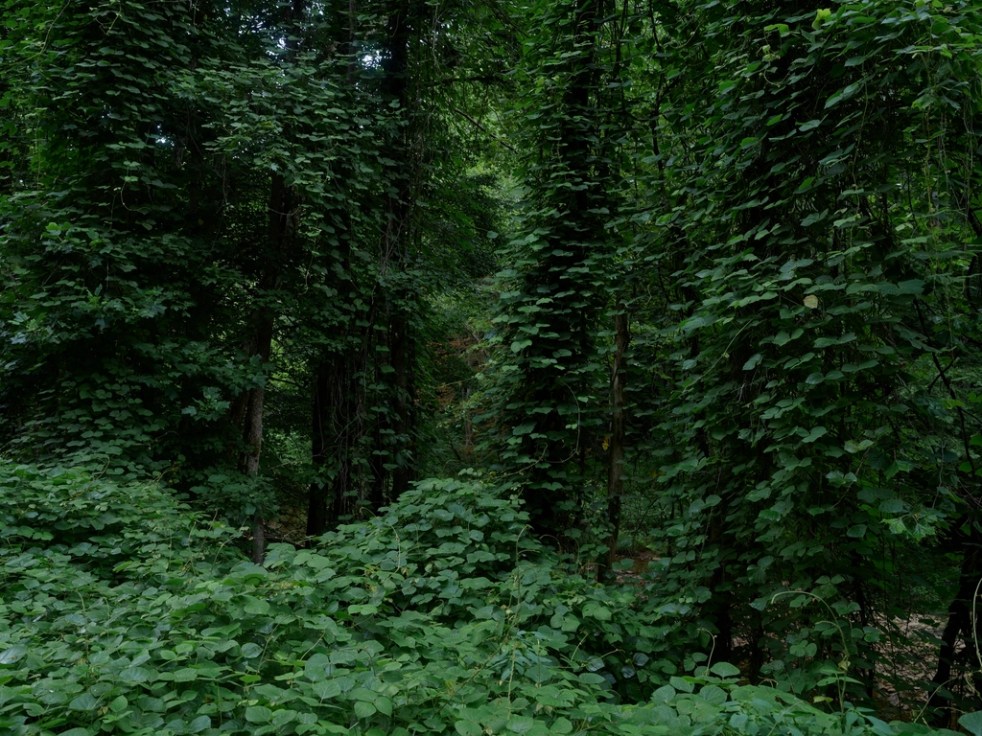
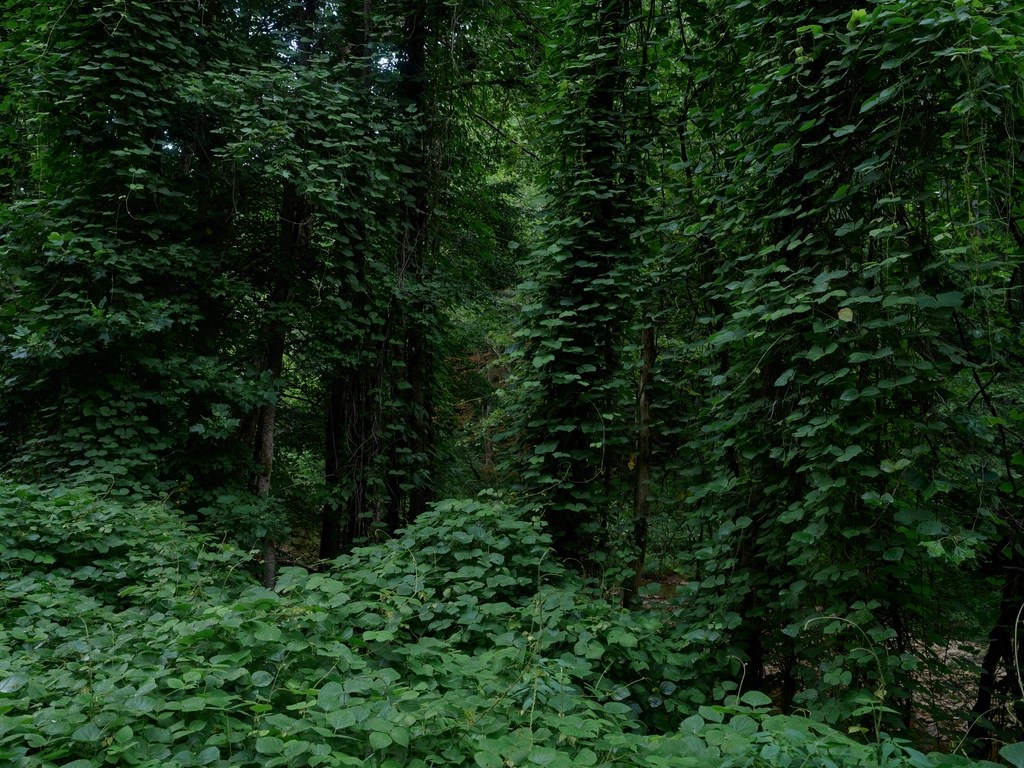
If you’re in the southeastern US and you do any kind of gardening, the word “kudzu” may well strike fear into your heart. As Nature.org‘s “Kudzu: The Invasive Vine that Ate the South” puts it, “kudzu is quite a killer, overtaking and growing over anything in its path.” Drive down a highway, and it’s not uncommon to see it choking out trees, climbing over fences, and dragging down powerlines.

In short, we were more than happy to learn how to eat some.

In its native range, kudzu is still an aggressive grower. It’s not invasive, of course, because a native plant by definition can’t be invasive. One of the things that helps keep kudzu in balance is the fact that it’s useful as a food and medicinal plant. People regularly harvest it to eat as a root vegetable and process into starch.

There’s only one problem: It was very early spring. There were no leaves on anything. Identifying it meant looking for a specific kind of brown twig in a mass of other brown twigs, then trying to follow it back to the ground, dig there for a while, and hope it had led to something resembling a kudzu root. Fortunately, kudzu doesn’t have many lookalikes, and its hairy stems and growth habit help to differentiate it.

Also, kudzu roots get enormous.

My Handsome Assistant is a powerlifter. Even with him pulling and our friend and me digging, it still took a lot of time to liberate several fairly small roots. Still, it was a success and, I figured, I decent amount for a first attempt. Nothing we’d have to bust out a table saw to cut through. Just enough to hopefully end up with some starch (and give us the opportunity to decide if it was worth the effort).

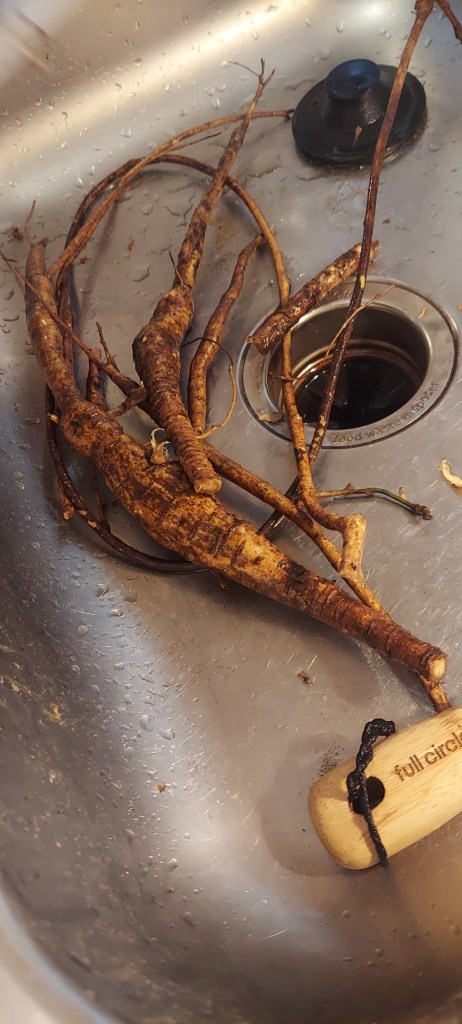
A small clump of kudzu roots in a stainless steel sink.
Some of the kudzu roots, trimmed from a larger one.

Tl;dr, I’m probably just going to make them into a stew next time. Maybe paper.

Processing the kudzu roots involved scrubbing them well, peeling away their tougher, fibrous outsides, cutting them into chunks, and pureeing them well with plenty of water. Once pureed, we strained the pulp, squeezed it out, rinsed it, squeezed it out again, and poured the liquid into large jars to let the starch settle to the bottom.

It was that last bit that proved the most problematic.

See, we’d hoped to get the roots before they used their stored energy (in other words, starch) to put out a flush of new spring growth. However, the roots we got were small and fairly skinny (which is probably for the best — we might’ve needed a backhoe for big ones). The little bit of starch that settled out ended up lost during the refinement and decanting process.

Still! It was an interesting learning experience. I’d definitely change how we did some things (like I mentioned, I’d love to try preparing the smaller roots in other ways, like roasting or stewing). I also have a mold and deckle and, considering that starch is used as sizing for papermaking, I’d like to try using the pulp to extract most of the starch and, rather than discarding/composting the pulp, see how it works in paper.

I’ve also heard that the flowers smell like grape candy and can make a jam that tastes like something between apple and peach. Since I’ve had really good results making rose petal confiture, I’m excited to try making some with kudzu flowers.

So, obtaining some kudzu starch may have been a bust this time, but I have ideas!

life

Happy Spring Equinox!

As I write this, it’s the first day of spring. There’s an Ostara celebration this weekend, things are coming up in the garden, and the crows have returned from their winter perambulations. Happy spring equinox!

Sadly, I probably won’t be able to make it to the big ritual and feast this weekend — it’s a bit of a hike for my Handsome Assistant and me, and it’s been a rough week. (He’s had stress from his not-being-my-assistant-job, I started my meds for my seasonal allergic asthma again, and we’re both tired of the constant stress of the news cycle. We’re pretty much wiped out and a long drive, sadly, probably isn’t in the cards.)

All that aside, I’m excited about the changes I’m seeing in the garden. I’m going to go through and do a bit of a bigger inventory soon, but, for now, I’ve been noticing buds on the persimmon, apple, and plum trees, the return of the raspberries, buds on the roses and blueberries, and new growth in the yarrow and sage plants. The tulips and daffodils I planted are also returning, and they’re looking really good so far.

Unfortunately, there’s some bad news. The big maple tree seems to be infested with a native species of oak borer. It’s dropping more limbs at an accelerated rate, and there are tons of larvae under the bark. (The woodpeckers, on the other hand, think this is a wonderful development.) The trouble is, even assuming the tree isn’t too far gone to be saved, the treatment of choice is injection with a neonicotinoid pesticide. Neonicotinoids are controversial, and for good reason — while they’re very effective, they’re also nonspecific and terrible for non-target species. They’re notorious for killing bees, but bees aren’t the only ones that they harm. As much as I want to save this tree, I can’t do it at the expense of the insects that I’ve been working so hard to attract, feed, and shelter here. We’re losing too many bugs as it is.

Close-up of a maple leaf.

Since this is a native species of borer, the fact that an infestation has progressed like this so quickly means that there’s an underlying problem. Treatment with pesticide would, therefore, be a bandaid solution at best. I don’t know how old this tree is, just that it’s mature. I know that the yard is (still, mostly) immature, hard, heavy clay soil, stemming from years of cultivating turf grass. We haven’t lived here that long, and I don’t know all of the stressors that the tree has experienced. I only know what it’s told me and what I’ve witnessed in the brief period of its rapid decline. I really, really don’t want to lose it, but I don’t know what to do that wouldn’t just be a temporary solution that would end up making so many other things worse. It’s a sucky situation to be in for everyone — and everything — involved.

Plus… As annoyed with them as I am, the native borers belong here, too. Unlike invasive borer species, they evolved to have a place in the local environment and are a food source for several important species of parasitoid insects and insect-eating birds. They wouldn’t even be a problem if there weren’t something else already wrong.

The spring equinox is a balance point. The word “equinox” means “equal night,” and stems from the fact that this is the time when the length of daylight and night hours is equal. From now until the autumnal equinox, the daylight hours will continue to lengthen.

Balance means taking the good with the bad. It’s life and death. It’s the decay of autumn’s leaves that feed the soil and make way for new growth. As much as I don’t want to lose this tree, I know the end might be coming and I’m grateful for all it’s done in its life.

Things leave, things return, and new things arise. The important thing is not to dwell on the loss, but to build on it and sow the seeds of things to come.

Neodruidry · Witchcraft

Does AI have a place in witchcraft?

I discovered a YouTuber fairly recently, GrumpyOldCrone. I find her videos delightful — she’s talented and funny, and it’s refreshing to hear someone else complain about the same minor things that I find annoying, but don’t really have anyone else with which to gripe about them. She’s fun. I like her. You might, too.

Two months ago, she posted a video about AI’s increasing presence in witchcraft circles:

I watched it when it first came out, I agreed with it, and it recently popped up again for me. So, I thought I’d reiterate it here: I wholeheartedly agree that artificial intelligence doesn’t have a place in witchcraft.

Like, literally anywhere.

When it comes to spellcraft, why would the Universe heed something that nobody could be bothered to actually make? The process of performing a spell starts long before you’ve lit the candles, said the chants, et cetera. On top of that, a lot of thought, research, and history goes into developing a good magical working. A generative AI that pulls concepts from various internet spells (some of which are already highly questionable on their own) and mashes them together isn’t doing that. If it has any results at all, they’re likely to be unpredictable at best.

When it comes to herb lore, it’s a bad idea to trust a web-based hallucination machine to give advice. There are already problems with computer-generated foraging guides allegedly “written” by authors that have never existed. Of course, human error is also a thing. (As evidenced by that crystal worker who put an ore of mercury in a fire, and that lifestyle blogger who put out a cookbook that included a recipe for raw, chocolate-dipped morels.) This is why it’s important to read multiple sources, and to both vet and question what you read. This is getting increasingly difficult as it is as AI models begin to poison the well of their own information — if kludging together flawed information was a problem to begin with, it’s one that’s only getting worse as more computer-generated “guides” enter the info pool.
Have you ever seen the movie Multiplicity?
It’s like that, but with more poison.

Obtaining this information doesn’t have to be expensive or challenging, either. There are tons of Pagan, witchcraft, foraging, and nature crafting communities online, and in real life via Meetup groups. A library card and an app like Libby can give you access to tons of e-books. Scribd offers a free trial, during which you can straight-up download your choice of 3 books in PDF form. I have read some fascinating research on historical magical artifacts and techniques through Academia, for free. If you’re looking for instruction in a specific technique, Udemy often has sales where their courses are as low as $10 a pop.
The only challenge is that the seeker actually has to consume it and absorb this information themselves. It isn’t as easy as asking ChatGPT for instructions, then following them. Few worthwhile pursuits are.

I also want to take a second to bitch about the uptick in AI generated Pagan “art.” My objections here are twofold: For one, I hate that artists are having their actual work taken, mashed up, and squirted out of the digital equivalent of a Play-Doh Fun Factory as something with too many fingers and its legs on backward. I also hate that so much of it is legitimately ugly and bad. I’ve gone to marketplaces and seen a lot of Pagan-flavored AI slop, and it’s honestly really disheartening. I’m not exactly stoked about the proliferation of the same handful of resin mold and 3D printed designs either, but at least they require a modicum of effort (and have the right number of limbs).

Some things take time and work, and there isn’t really a way around that. The “industry disruption” phenomenon doesn’t work in every context, and this is one of them. AI is not making witchcraft more accessible; it’s providing something that poorly apes it. Even if it were to improve, it isn’t a substitute for learning from a human, or for community, or tradition, or genuine artfulness.

While there are some things that modern AI models can do and do much better than humans (accurately diagnosing certain medical conditions, for one, or processing phenomenally large amounts of data into a useful form and suggesting a course of action), witchcraft isn’t it.

Uncategorized

Today’s Plant a Flower Day!

March 12th is Plant a Flower Day. While the idea of dedicating a day to planting seeds goes back pretty far, this is a fairly recent innovation that likely originated in the US. A lot of the seasonal celebrations that I follow revolve around things like seed swaps, observing wild plants as they exit dormancy, and planting seeds as a form of sympathetic magic, but I also like observing days like this.

Of course, the best way to observe Plant a Flower Day is to select a native (or carefully-selected nativar) flower variety for your area, choose a spot in your yard, and conscientiously plant it. You’ll increase your local area’s biodiversity and provide a source of food and shelter for native insects (who really, really need it) and birds.

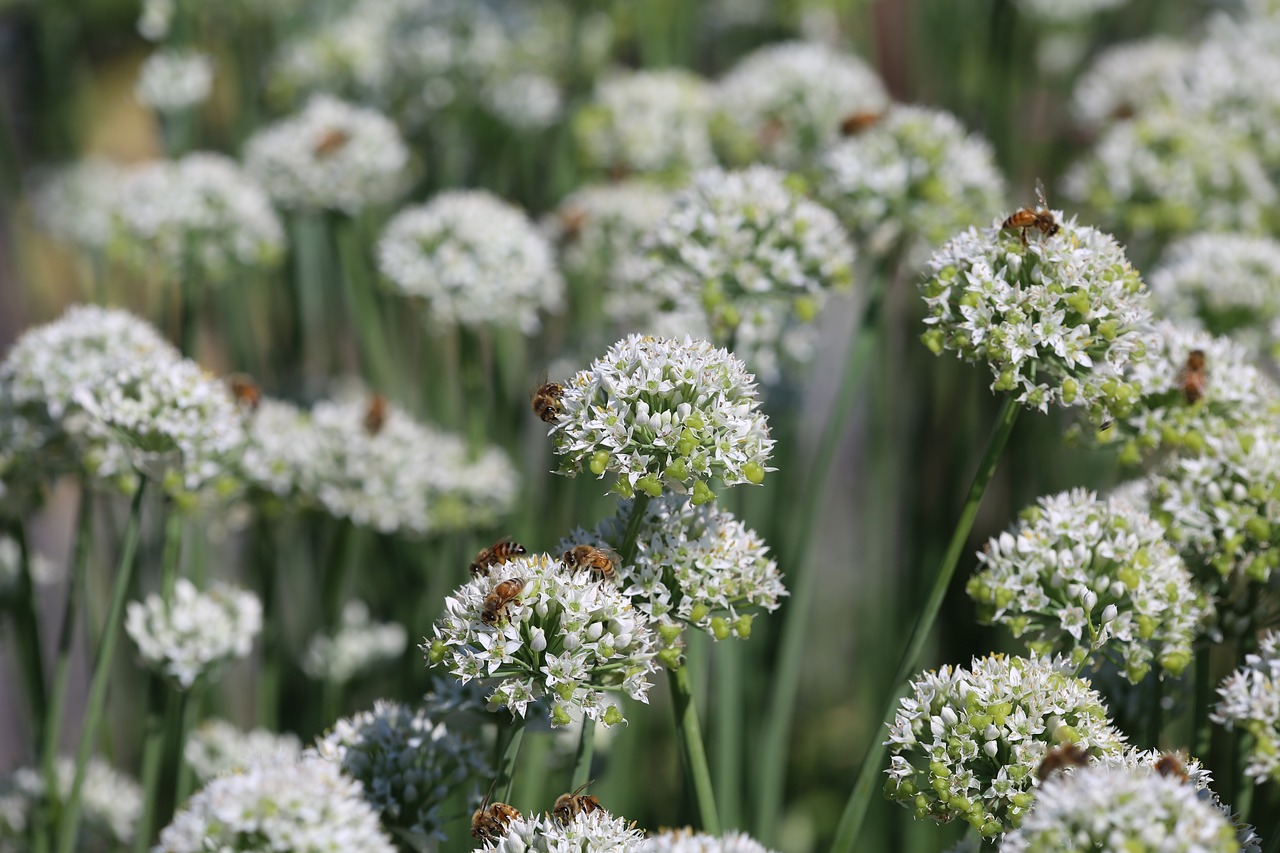
Bees on ornamental allium flowers.

If your garden is dedicated toward food rather than flowers, consider planting an edible species. Nasturtiums, for example, are beautiful, easy to grow, and taste nice. (You can even pickle the seeds and use them as a substitute for capers!) As far as native edible flowers go, violets are lovely, a very nice groundcover, edible, and there are a number of varieties native to various parts of North America. White wood sorrel produces very pretty little white flowers, and both the flowers and leaves have a tart taste that’s very nice in salads. Wherever you live, I can pretty much guarantee that there’s a native flower that can feed the birds, bees, butterflies, and you.
And, just because this is a secular observance doesn’t mean that you can’t work some magic into it. Planting seeds is a very common and easy type of sympathetic magic — as the seeds grow and flourish, so, too, should the intention with which you planted them. Get together with a partner, hold a handful of seeds, and visualize yourselves having a happy, peaceful relationship. Choose seeds of herbs associated with prosperity, picture your bank account growing, and plant them. The only real trick here is that you need to keep the seeds tended. If they die from neglect, you may soon find your intention following suit!

Even if you don’t have the space to dedicate to a flower garden, consider planting some seeds in a pot on a windowsill. It’s good for your mental and physical health, and it can help you bring the energy of spring into your home. Plus, if you choose an edible variety, it’s pretty much close-to-free food and decor in one.

Plants and Herbs

Blackthorn Folklore and Magical Properties

Few trees are as divisive as the blackthorn (Prunus spinosa). When you look at it from a distance, this may be hard to believe — these trees, with their dark bark and frothy white flowers, are honestly very pretty. They also produce sloes, which are excellent in preserves and a crucial ingredient in sloe gin.

A blackthorn sloe.
Photo by Marek Kupiec on Pexels.com

So we’ve got a lovely tree with pretty white flowers and useful, equally attractive dark blue-purple fruits. How could a plant like that be divisive?

The answer lies deep in its fascinating folklore.

The blackthorn tree appears in the Irish ogham, an ancient writing system often erroneously called a “tree alphabet.” (In reality, it encompasses a variety of concepts and objects that were only connected to trees much later on.)
This ogham few, straif (ᚎ), is frequently associated with misfortune, struggle, and ill omens. It’s regarded as a few of great power, but also the negative or malicious side of magic and the capricious nature of the fae. Blackthorn trees were said to be guarded by the Leanan Sidhe, and it was terribly bad luck to cut one down.

Interestingly, straif’s original meaning likely did not have any connection to the blackthorn at all and may have been a reference to sulfur. The Bríatharogam are, unfortunately, not much help here. We get “strongest reddening” (tressam rúamnai), “increase of secrets” (mórad rún), and “seeking of clouds” (saigid nél).

Blackthorn flowers.
Photo by Atif Bangash on Pexels.com

Blackthorn trees are so named for their sharp thorns. There are a variety of ways one may use these thorns in magic, but blackthorn’s thorns seem to have gotten a bad rap. They tend to be associated chiefly with negative or malevolent workings, and old witch-lore claims both that the Devil used one of these thorns to prick a would-be witch’s finger before they signed his infernal contract, and that witches would jab blackthorn thorns into poppets to harm people.

In Christian mythology, the blackthorn is also one of the trees said to have “betrayed Jesus” at the Crucifixion.

Since blackthorn isn’t a very big tree — in fact, it’s more often seen as a big bush — it’s very useful as a hedge plant. The thorns mean that it isn’t heavily browsed or easily damaged by cattle and deer, and it grows densely.
This use may be part of its connection to the fae, since blackthorn is quite literally a plant that marks a boundary from one place to the next. It’s a plant that protects itself, as well as whatever may lay beyond it.

In fact, blackthorn occasionally crops up in old hero stories and fairy tales. The hero, pursued by a giant, throws a blackthorn sprig behind him. The sprig immediately roots and grows into an impenetrable hedge, holding back the giant and allowing the hero to escape.

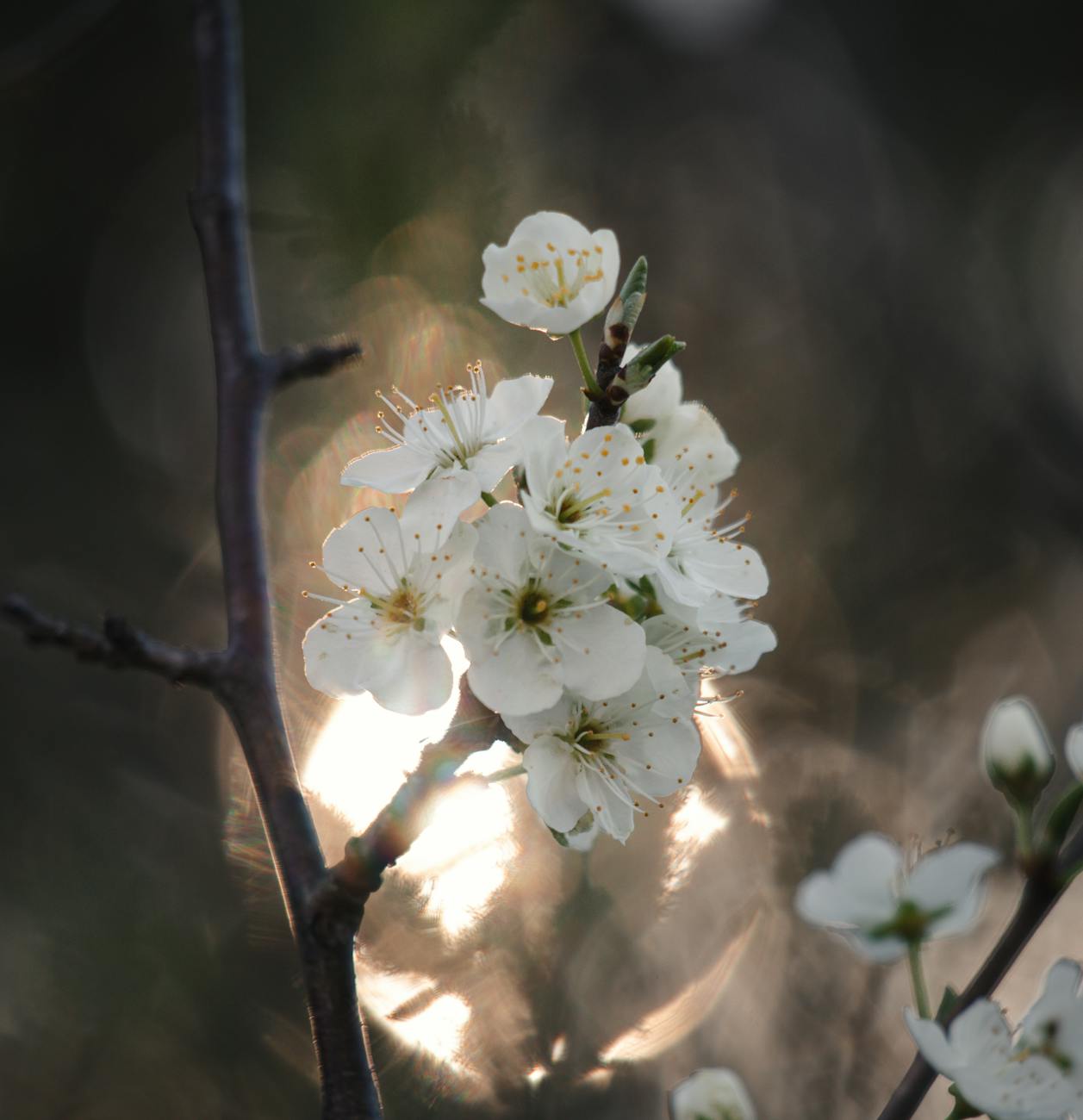
White blackthorn flowers on branches.
Photo by Ellie Burgin on Pexels.com

This protection extends beyond hedges, too. Blackthorn wood is hard and dense, and the traditional material for a bata or shillelagh. They’re part club, part walking stick, and similar in shape to the rungu used in some parts of East Africa or the iwisa, induku, or molamu of South Africa (though usually a bit longer). Shillelaghs were used in structured duels, as other cultures might use rapiers, and there’s a martial art that focuses on shillelagh training to this day.

Shillelaghs were traditionally made using the roots of the blackthorn, where they kind of naturally form a knobby end. This made them less prone to cracking, but some people would still hollow out the knob of their shillelaghs and fill them with lead — a bit like Bugs Bunny dumping horseshoes into a boxing glove.

The process of making a shillelagh took time, but not many resources. If you had access to a blackthorn bush, as well as a chimney or a dung heap, you could make a perfectly serviceable weapon. The blackthorn tree was a social equalizer that allowed even the poorest people a useful tool and a means to defend themselves.

Blackthorns aren’t easy to come by in the Americas. They aren’t native here, though they have been naturalized in parts of the Eastern US. So, if you want to work with any blackthorn-derived ingredients, you may have to get creative.

Kitchen witches or potion crafters may have an easier time. They can incorporate some sloe preserves, sloe chutney, dried sloes, sloe gin, or any of the very excellent sloe or blackthorn shoot-based liqueurs into their work.

Other than that, it is sometimes possible to find small numbers of blackthorn thorns available for sale online. When I can get them, I love using them for defensive workings. Write a name on a slip of paper or parchment, skewer it with a blackthorn thorn, and toss it into a jar or box of suitable ingredients. It’s easy, it’s poignant, and it’s perfect.

Close up of blackthorn flowers.
Photo by Nagy Richard on Pexels.com

Failing all of that, you may have to see what blackthorn characteristics you want to tap into and find a good workaround. For thorns, look for stickers from other thorny plants. (Berry canes are often a great source of these.) For working with the fae, you may have an easier time finding a rowan or hawthorn tree. For protection, you’re pretty much spoiled for choice — there are tons of other herbs used for all forms of protection, from securing your home and keeping malevolent entities away to driving out unwanted housemates.
Seriously. There are so many, this post would be a novella were I try to list them all.

Sadly, many of us outside of Europe won’t have the opportunity to work with this beautiful, useful, folklorically-rich tree firsthand, but that’s okay. The blackthorn is a plant with history and power that’s worth understanding, even if we may never have the privilege to meet one.

Just for fun · life · Plants and Herbs

Meteors and Mushroom Hunting in (*checks notes*) December.

My Handsome Assistant and I like to go cabin camping in winter. Rates are usually lower, things are less crowded, he’s got PTO to use up (or else lose), and there isn’t usually much else to do. A change of scenery does us both good, even if it’s only for a couple of days. It’s also nice to experience the time around the solstice like this.

(We half-jokingly say it’s glamping, because there’s a shower, sheets, heating, and a mini-fridge. Either way, it’s nice and I much prefer it to most of the hotels I’ve been to.)
(Even the fancy ones.)

However, while we anticipated a possibly-snowy getaway/creative retreat to work on music, fiction writing, and so on, what we got was… 60° F (15.5° C) and a meteor shower.

Did any of yas know there was a meteor shower? I didn’t. The only ones I usually pay attention to are the ones that occur over the summer here, like your Delta Aquarids and Perseids, and I have been Missing. Out.

I only realized when I was sitting in bed one night, drinking tea and looking out at the forest through the window, all cozy and idyllic and junk. An object, about as large and bright as the brightest star in the sky, flared to life, moved across the sky, and disappeared. I was, of course, surprised — a shooting star without a tail? A “drone” with an oddly predictable flight pattern and only one light? A hallucination?

As it turns out, it was most likely part of the Quaternid meteor shower. This one is, apparently, often overlooked. It has a short period of peak activity and happens in late December/early January, so most people miss it. Also, the Quaternid meteors usually don’t have long tails. They do, however, produce some very bright, striking fireballs. So that was neat.

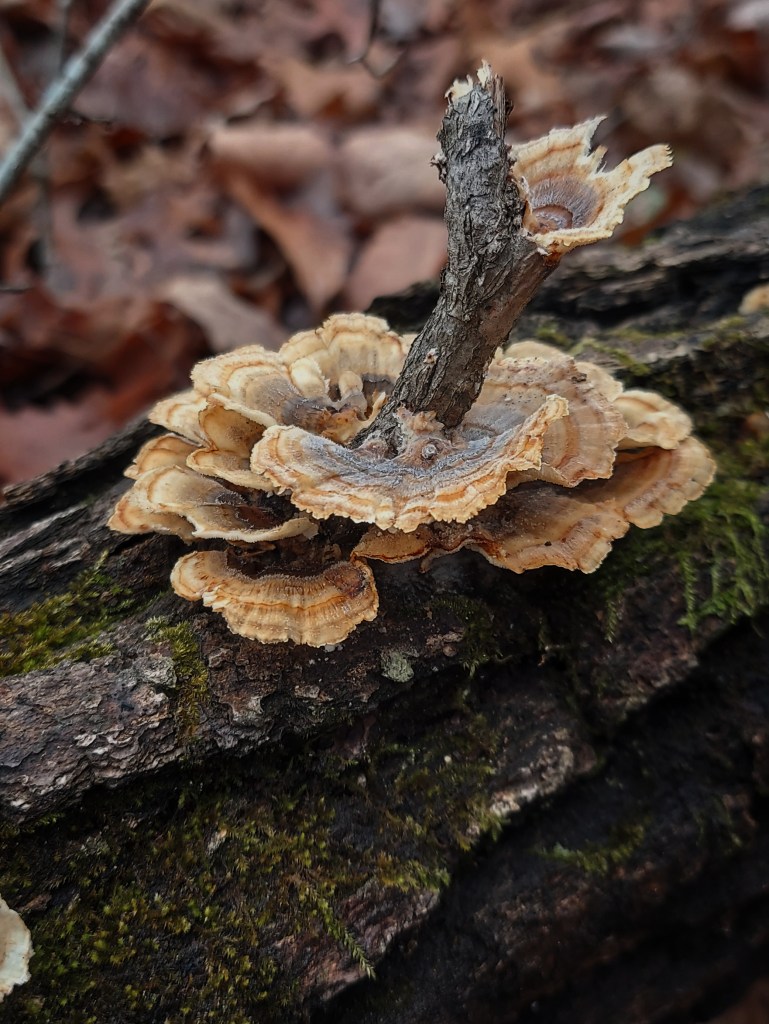
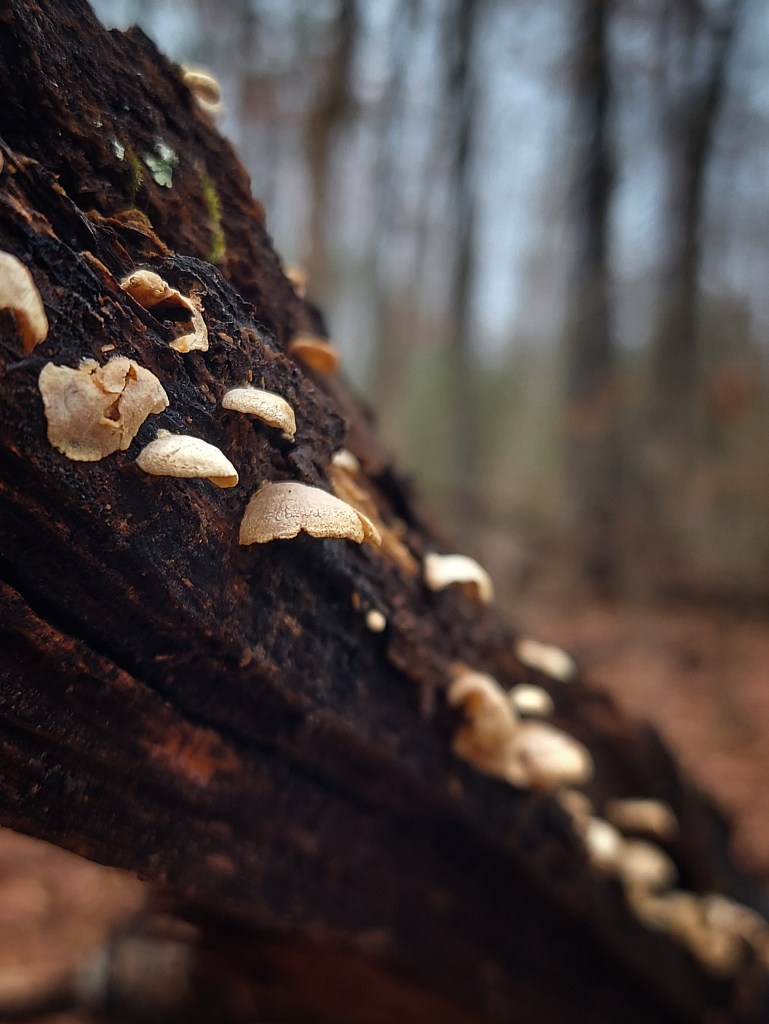
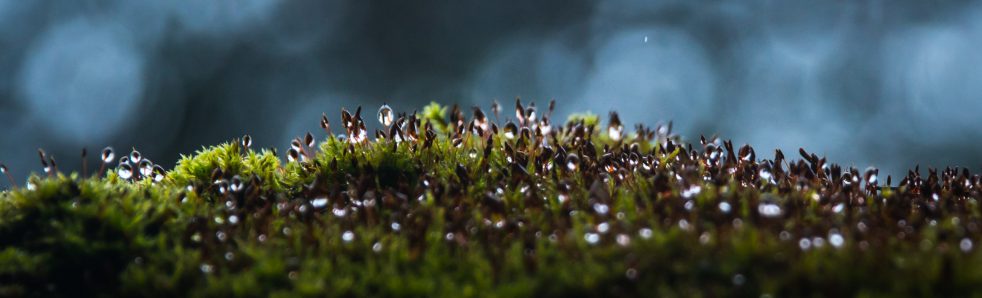
The next day, we spent the late morning going for a walk. With the weather as strangely warm as it was, it turned out to be ideal conditions for finding some very interesting specimens of fungi and beautiful colonies of lichen and moss.

Unfortunately for me, most common culinary species of mushrooms and boletes make me very ill. (Oyster mushrooms, why won’t you let me love you?!) I also have only a passing interest in identifying them, since my interest is primarily visual.

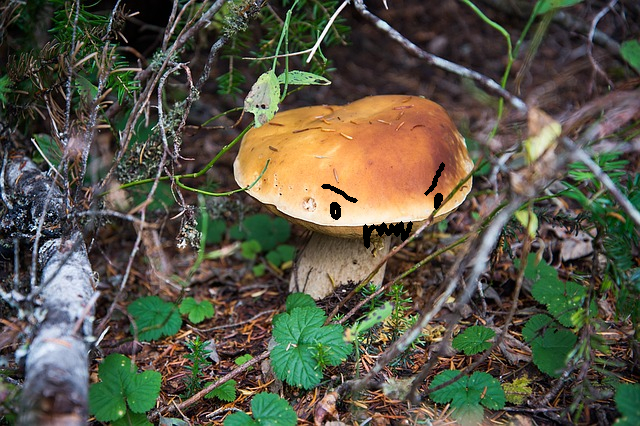
A photo of a small brown bolete, with angry eyes and fang-y teeth clumsily drawn on.
It has been years, but I am still inordinately proud of this very, very silly picture.

I’m what you might call an amateur “catch and release” forager. I love looking at them. I love their folklore. I love finding them. I love taking pictures of them. Sometimes, I’m even able to identify them. I get really stoked when I find ones that a) I recognize, b) are useful, and c) won’t try to make me yakk everything I’ve eaten since fourth grade. But that’s neither here nor there.

Look! We found cool mushrooms and assorted other little forest buddies!

I don’t care how common moss, lichen, and little beige mushrooms are, I will be excited about them absolutely every time. Like a person calling their spouse over every time their cat does something adorable, I will never not be endlessly delighted by them whenever I see them.

I don’t even need to know what kind they are, I’m just happy to have them around.

Here’s hoping your days are similarly filled with interesting small things.

Plants and Herbs · Witchcraft

Soap Folklore and Magical Properties

I came across a rather strange argument the other day. One person mentioned “solid body wash,” which prompted another to go “so, soap?” This was followed by several people who either a) vehemently swore up and down that it was a marketing gimmick and there was no difference, or b) vehemently swore up and down that there was an enormous difference, but both c) could not explain why.

Focus photography of a bubble.
Photo by Pixabay on Pexels.com

I didn’t want to Kool-Aid Man in, all, “HELLO YES LET ME TELL YOU SOAP,” so I didn’t. Nonetheless, it gave me the idea to write this post — soap is a very important part of many magical traditions, and something most readers of this blog probably come in contact with every day. Sacred bathing, magical housekeeping, magical soap-making, herb craft, it all ties in together to create a vibrant, powerful, and useful set of magical techniques.

Okay, so. Just to get this out of the way — there’s an enormous difference between “soap” and “body wash.” Soap is specifically made of saponified fat. This is oil (or another fat) that has reacted with lye to produce salts that act to reduce the surface tension of water or reduce the tension where two substances interface. Like, for example, dirt or oil on your skin. Its molecules have a polar end that binds to water, and a non-polar end binds to other stuff.
Body wash is a detergent. Detergents are also made of surfactant salts, but their chemistry is very different. Detergents may be made of petroleum byproducts but are also often plant-based. While the polar end of soap is usually tipped with a carboxyl group, the polar end of detergent molecules is tipped with sulfonates.
Ultimately, as the end user, the biggest difference is this: If you have hard water, soap sucks. It reacts with the minerals in your water to produce soap scum (stearates) a waxy residue that sits on your tiles, your clothes, and your skin.
Detergents don’t produce soap scum the way soap does because they don’t react as readily with hard water minerals and have a higher pH than soap, so they tend to work better and have fewer issues in water that has a high mineral content.
Body wash isn’t really a chemical term — a body wash can be soap based but is usually a detergent because soap tends to strip and dry out skin. They also often contain ingredients designed to benefit the skin beyond cleansing, like moisturizers or exfoliants.
Does this make a difference in a magical sense? Not really, though the ingredients that make up a soap or detergent can be invoked for their own properties. Olive trees, sunflowers, and so forth all have their own energy to contribute.

A close-up of rows of wrapped bars of soap.
Photo by Polina Tankilevitch on Pexels.com

(Also, it should be noted that you can make soap less reactive in hard water. The addition of chelating agents or various forms of vitamin C can help prevent some of the formation of soap scum. It just requires some recipe tinkering.)

One bit of folklore surrounds the origins of the word “soap.” “Soap” is said to come from Mount Sapo, in Italy. In ancient Rome, there was a bend in a river at the base of the mountain. People would gather to do their laundry there because their clothes got cleaner than they did elsewhere.
Interestingly, this mountain is also where people conducted animal sacrifices. The liquefied fat, combined with the pyre ashes, reacted and ran/was washed by the rain down into the Tiber River. This fresh water, combined with unintentional soap, led to much cleaner togas.

This wasn’t the first soap, however. There are recorded mentions of using soap to wash wool going back as far as 2800-2500 BCE. Some Sumerian cylinders from 2200 BCE specifically mentions “fats boiled with ashes” — an old recipe for soap.

Bath with lemon slices in water and lit pillar candles on the floor.
Photo by Monstera Production on Pexels.com

Magically, bathing is used to both banish and attract. There are magical bath recipes for everything from breaking curses to getting a raise. They usually involve making a decoction of herbs in water, straining out the herbs, and adding the liquid to the bathwater.
Magical soaps are formulated with herbs and oils that align with specific intentions. They provide a somewhat more portable and less labor-intensive way to take a magical bath. A shop owner or salesperson, for example, may carry a bar of soap formulated to attract prosperity so they can wash their hands with it throughout the day.

This idea carries through to housekeeping. Floor, window, and door washes work the same way — by using a decoction of herbs or dilution of oils to either bring something into or get something out of a home. Back in the day, people in various cultures had other ways of achieving this goal. For example, smoke cleansing a house with juniper in order to banish sickness, or bringing in fresh sweet-smelling strewing herbs to cover a floor. Now, there are hard floors and glass windows that get washed.

Soap isn’t always associated with positive things, though. Soap Sally, an Appalachian and Southern villain figure, is said to wait with her basket for children who try to slack off when doing chores. She shapeshifts and convinces the children to follow her back to her cottage, where they gorge on candy and fall asleep.
Once asleep, Soap Sally would render the children in her stewpot. Their melted fat would be formed into hand-shaped candles or soaps, which she’d send back to their families. The families would end up burning or washing up with the remains of their own children.
Soap Sally appears to have roots in stories like Baba Yaga or Hansel and Gretel, as well as being a kind of “morality villain” to put the fear in children who’d rather play and goof off than do household chores.

Yes, yes, I know.
Who needs to be told how to use soap?
But this isn’t about just washing up — it’s about using soap for a specific purpose.

In the section above, I mention sacred bathing to attract or banish things. The process usually goes something like this:

  1. Take a regular bath or shower to physically clean yourself.
  2. Drain the tub or basin, and refill with fresh water.
  3. Add a decoction of herbs that match your intention.
  4. Declare your intention as you add the strained decoction. (Some traditions add that you should stir it into the bathwater in a clockwise direction, using your dominant hand.)
  5. Get into the bath and fully immerse yourself.
  6. Remain in the bath until you feel it’s had the intended effects.
  7. Get out of the bath. In some cases, you may be instructed to allow yourself to air dry so you don’t “wipe off” the effects.
  8. Dispose of the bathwater. In some traditions, this means taking a basin outside and throwing it over your left shoulder, toward the rising sun.

Whether the washing is “attracting” or “banishing” depends on your intention and the ingredients you add. Want to attract a lover? Rose petals, vanilla, basil, and jasmine are nice. As you bathe, you’ll be absorbing the sweet scents and loving energies from these plants. Want to banish unwanted things? Salt, rosemary, rue, and hyssop. As you bathe, you’ll be washing away whatever you don’t want.

Small bars of natural soap on linen dishcloths
Photo by Vie Studio on Pexels.com

Having a specially formulated magical soap can make this process easier. You still take a regular bath first, in order to clean yourself, but from there you just have to get into a fresh tub of water, soap yourself thoroughly with the magical soap, then rinse off.

Add a bit of magical soap to a bucket of mop water, then wash your doors, windowsills (maybe not the glass, if you’re hoping for a streak-free shine), and floors. Go from front to back to bring things into your home, and back to front to banish or push things out.
Specially compounded magical floor washes and soaps are largely found in the Hoodoo tradition, but just adding decoctions of herbs (or acids, like vinegar or lemon) is a bit more widespread.

The most basic “washing up” recipe I know of involves adding salt and lemon juice to a bucket of water, then mopping/washing walls, doors, and windows with it to help clear out old, unwanted, or stagnant energy. Pretty simple.

Whether soap originated from the accidental combination of animal sacrifices and a river, or the work of ancient Sumerian scientists, the idea of washing with soap or detergent has become ubiquitous in modern societies. When you couple the act of washing with herb lore and magical techniques, it can become much more than the sum of its parts.

(Also! I’ve gotten a few messages through the site’s Contact form lately, but they don’t include valid email addresses. If you’d like a reply, please, please double-check and make sure that your email address is correct. I’m not going to save it or sell it or put you on an email list or anything, it’s just important if you’d like me to email you back. Thank you!)

Plants and Herbs

Needle and Pin (and Other Sharp Object) Folklore and Magical Properties

The desire to do things correctly, by the letter, is something that I think plagues everyone who’s new to witchcraft (or, really, any type of magical work). I’ve seen it said that there’s no one way to do magic, but there are infinite ways to do it ineffectively, and I wholeheartedly agree with this sentiment. That said, it’s not always that important to have the exact ingredients that a spell, charm, or formula calls for. As long as you know what they’re doing in there, you can usually figure out workable substitutions.

That’s why I wanted to write a post about sharp stuff. Not any sharp stuff in particular. Just… you know. Sharp things. Pokey bits.

Where do I even begin?

Think of every story you’ve ever heard about a sword, or a needle, or a thorn. Think about idioms like “to needle someone.”

closeup photo of cactus plants
Photo by Madison Inouye on Pexels.com

Arthur receives Excalibur, and it confers kingship upon him. Swords are a symbol of sovereignty here because they represent force: both the force needed to maintain one’s position as ruler, and the force needed to defend a country.

A lion receives the business end of a thorn in his paw, and it weakens him to the point where he needs a mouse’s help. Here, the lion — a strong, symbolically dominant figure — is brought down by the pain of something as small as a thorn. A mouse pulls it free, and the lion is in his debt.

It can be as large as a scythe, or as tiny as the hairs on a spider’s belly. Regardless of the pokey thing in question, the message is clear: As long as you’re on the right end of it, you’re at an advantage.

Roses, holly leaves, hawthorns, and blackthorns are pokey to discourage herbivores. (Interestingly, holly leaves don’t really start out all spiney-looking. They re-grow that way as a response to browsing animals, in order to keep from losing any more leaves than strictly necessary.)

Even the thin, needlelike leaves of conifers and cacti are a defensive mechanism, albeit one that protects them against the elements. Cacti leaves are needles to keep them from losing precious moisture to the dry desert air. Conifer needles keep them from losing moisture, holding on to too much heavy snow, or being blown over in harsh winter winds.

Needles and pins are used in magic to “pinpoint” the effect of a spell or charm. Jab them in a poppet, and you can send healing into an arthritic joint, or inflict pain and debility instead.

Sharp tacks in brown round container
Photo by cottonbro studio on Pexels.com

Athames and swords are used in some traditions as a way to direct energy from their points. This is in contrast to ritual knives, which are generally working tools used for mundane tasks like harvesting herbs, cutting offerings, and bloodletting. Even though they’re not strictly “magical,” these working tools still have the same symbolism — these tools are what allows the user to obtain what they need, whether it’s a leaf, a slice of cake, or blood.

Blackthorn spines, porcupine quills, sewing needles, and old nails are all used in defensive and offensive magic alike, generally in various forms of sympathetic magic. Jab a representation of your target, and the idea is that the target themselves will feel the effects. Fill a jar with sharp things, hair, and urine, and the idea is that your hair and urine will attract malevolent energy sent your way, while the sharp things ensnare and poke at it.

When sharp things are involved, it usually doesn’t matter exactly what that thing is — the important aspects are a) the size, and b) that they’re sharp. A protection jar spell that calls for straight pins can use sewing needles, rose thorns, or even the itchy hairs from rosehips instead. A spell that calls for a pin with which to inscribe a candle will work just as well with a knife, or even the tip of a sharp stone. A poppet spell that needs pins and needles will work just as well with porcupine quills.

As I mentioned above, the symbolism of sharp objects is pretty straightforward. Ideally the pointy end should (symbolically) go in the other guy, for good or ill.

When it comes to directing energy, they are an aid to visualization — an extension of the index finger, commanding and pointing and saying, “This is my will, so it will be done.”

When it comes to apotropaic magic, they are a trap. Like the quills on a hedgehog, the stinger of a hornet, or the studs on a leather jacket. They represent the fate of someone (or something) that decides to cross you. This is why they’re employed in various magical decoys, like witches’ bottles.

When it comes to offensive magic, they are weapons. Not in a literal sense, but they represent a sharp, decisive action, or even a physical or emotional pain. They’re the needles poked into a poppet, or the shaken spell jar filled with hot peppers, broken glass, and a photo of an enemy.

Broken glass bottle in a gutter
Photo by Suzy Hazelwood on Pexels.com

In various online magical circles, people joke that we’re all hoarders. We save jars, lids, corks, scraps of fabric, old nails, ribbons, and assorted junk, because there’s immense potential in everything and you never know when it’ll make itself useful. I might dispute the “hoarder” label myself, but I’d also be lying if I said I didn’t have a drawer full of junk-that-I-might-need-for-a-spell-some-day.

Sharp things are symbolic of polarity. The safe and the unsafe. The sharp and the dull. The defensive and the offensive. The sword that cuts, and the scalpel that heals. They’re a pretty simple symbol, but it’s this simplicity that makes them versatile, powerful tools.

Plants and Herbs

Apple Folklore and Magical Properties

As I write this, the results of the US presidential election are being calculated. I’m trying to do anything other than be uselessly anxious about that all night, so I figured I’d write about a cozier topic to get my mind off of it.
Hence: Apples.

Apples are a traditional food for Samhain. This year, I had originally hoped to save at least an apple or two for us. I went out, covered about half of the young fruits with organza bags I had left over from gifts, and thought I was good to go. There were some for me, some for the local fauna, and everyone should’ve been fine. Then there was a spell of dry weather.
Anyhow, I got no apples, and also the squirrels stole all of my bags.

Then, at Mabon, we were working on masks and costumes for the Council of All Beings. Someone found a dropped googly eye, and I made a joke about them not having natural predators. That’s when it hit me — what if I put googly eyes on the apples?

“They might just attack the apples from the side without eyes,” a friend of mine said.

“I’d put them all around,” I explained. “Biblically accurate apples.”

Anyhow, as the time for various delightful apple dishes approaches (like my favorite, cornbread stuffing with sage, onions, and apples), I figured it’d be a good time to look at their folklore, mythology, and metaphysical aspects.

Jokes about Biblically accurate apples aside, the forbidden fruit of Christian mythology most likely wasn’t a member of Malus domestica. While apples are cultivated all over the world, they originate from Central Asia. The Bible also doesn’t mention the fruit by name — it’s just commonly depicted as an apple as a kind of visual shorthand.
(It’s also a fun bit of wordplay. In Latin, the worlds for both “an apple” and “an evil” are written as malum. Pronounced with a long a, it’s apple. With a short a, it’s evil.)

Photo of an apple and a knife on a blue cloth.
Photo by Ylanite Koppens on Pexels.com

In China, apples are also a source of a bit of wordplay. The funny thing is, it’s almost exactly the opposite to Latin. The word for apple (苹果) and peace (平安) both start with the same sound in Cantonese and Mandarin. As a result, apples are associated with peace.

Apples have a long and varied history in Germanic Paganism. The Norse goddess Iðunn is the keeper of golden apples that give the gods eternal youth. The Poetic Edda details eleven golden apples given to the jötunn Gerðr, as a gift from the god Freyr. In the Völsunga saga, the goddess Frigg sends King Rerir an apple as he prays for a child. Rerir’s wife eats the apple and conceives Völsung. This demonstrates a connection between apples, youth, fertility, and life.
Interestingly, the skald Thorbiorn Brúnarson also mentions “apples of Hel.” Scholar H.R. Ellis Davidson points out that this may indicate that apples were considered the “life-giving fruit of the other world.”

Three striped apples on a branch.
Photo by Julian Kirschner on Pexels.com

There is a similar connection between apples and the Otherworld in Celtic mythology, as well. Manannán mac Lir’s domain, Emhain Abhlach, translates to Isle of Apple Trees and is said to be a place where there is nothing but truth and disease and decay are absent. (Emhain Abhlach may also be where Avalon ultimately derives from.)
In the tale Echtra Cormaic, Manannán gives Cormac mac Airt gifts including a silver branch with apples of gold. This branch made magical music that was said to lull anyone suffering from sickness, injury, or childbirth to sleep.
Another tale tells of Connla, the son of Queen Aife and King Connaught. A fairy woman gives him an apple that, once eaten, becomes whole again. Infatuated with the fairy woman, Connla allows her to take him to the Otherworld where the fruit grows. The otherworldly apples give him everlasting youth, but for a great price: Connla can’t return to the land of the living.

Apples also have a lot of representation in Greek and Roman legend. The most infamous example is probably the Apple of Discord. When the Goddess of Strife, Eris, wasn’t invited to the wedding of Peleus and Thetis, she decided to start some trouble. She threw a golden apple inscribed “For the most beautiful” into the wedding party. Hera, Aphrodite, and Athena all claimed the prize, so Paris of Troy was tasked with selecting a winner. Each goddess offered him a bribe to choose her, but only Aphrodite’s bribe appealed to him — she’d give him the most beautiful woman in the world for a wife.
There was only one problem.
That woman was Helen of Sparta.
And she was married.
Whoops.

close up photography of apple tree
Photo by Kristina Paukshtite on Pexels.com

Apples were then considered sacred to Aphrodite and were even used as declarations of love. In the story of Atalanta and Hippomenes, Atalanta challenged all of her prospective suitors to races. If they could beat her, she’d marry them. (Since she was unbeatable, this seemed like a safe bet for her.) Hippomenes knew he’d never be able to outrun her, so he distracted her with three golden apples. With both his speed and his cunning, he barely managed to beat Atalanta and win her hand in marriage.
One of the labors of Hercules also involved retrieving golden apples from the Tree of Life in the Garden of the Hesperides, which creates another link between apples and life.

So, why are these fruits so deeply connected with life? Why do they come from the gods or Otherworld? Part of this might be because they literally came from afar — the ancestor of most of our modern apples came from Central Asia, so it would’ve traveled a great distance to reach the Mediterranean and Northern and Western Europe.
They may be deeply connected with life because they’re honestly pretty durable. They’ve got firm flesh and can last a long time when properly harvested and stored. That makes them an important staple in areas that experience cold winters — you could grow a bunch of apples, keep them in a cold, humid area with good air circulation, and they could last you all winter. Having a source of fresh fruit during the depths of winter could be the difference between life and death.
This may also be part of their connection with fertility. The fruit remains good in storage all through winter, when everything else withers. As a source of food when food is at its most scarce, those who have access to apples would likely experience better fertility than those who didn’t.

If you slice the fruit in half horizontally, the seeds form a pentagram.

Apple wood is considered a good material for tools for working with the fae and the Otherworld.

In modern European-based witchcraft, apples are used for fertility, healing, divination, wisdom, and knowledge. In some traditions, they are used for ancestor veneration and workings related to the dead.

They are said to be associated with the element of Water.

The simplest way to use these fruits is to eat or cook with them, first asking their help with whatever your goal or intention may be. Make your favorite sauce or pie recipe, tell each of the ingredients what you’d like them to do, thank them, and add them to your dish. Stir it clockwise with your dominant hand, serve, and enjoy.

Pies over wooden boards on the ground.
Photo by KATRIN BOLOVTSOVA on Pexels.com

You can also bury apples or place them on an ancestor altar as an offering.

Apples are frequently used for love divination. One old method involves peeling an apple in one continuous piece, then tossing the peel over your shoulder while saying, “Saint Simon and Saint Jude, on your I intrude, with this paring to discover, the first letter of my own true lover.” Look at the shape of the peel when it falls to see your true love’s initial.
Another love divination involves cutting an apple into nine equal pieces and eating them while mirror-gazing. Pierce the last piece with a knife and hold it over your shoulder, and an apparition of your true love may just appear in the mirror to take it.

When it comes to using apples for love magic, the blossoms are usually the best. (They have an amazing fragrance.) They’re seductive, but not overtly so — think of it as a sensual invitation rather than a command. They’re a great addition to a love-drawing bath, as well as baths for success, peace, and relaxation.

Apples aren’t just delicious; they have a lot of magical tradition behind them. They’re the food of the Otherworld, sustenance through the cold of winter, and a fruit of boundless fertility, youth, and eternal life.