Plants and Herbs

Mayapple Folklore and Magical Properties

I love mayapples. They look like a prank. Like someone picked a bunch of leaves off of something bigger and stuck them in the ground so they could trick people into thinking that that’s how a mayapple grows. They’re patently ridiculous and fantastic.

I remember the first time I encountered them. Though I don’t remember when, or where, I do remember seeing a bunch of sprouts that looked like folded beach umbrellas for fairies. I wasn’t sure if they were plants or mushrooms at first — before the leaves fully open, they almost look more like fungi than anything planty.

The other day, my handsome assistant and I were on a walk and ran into a whole patch of them. Even better, some of them had flowers, which also look like some kind of prank. The only thing better is when they fruit, which I, personally, find hilarious. Just one leaf with a big old fruit hanging off of it. It looks like a video game monster. Like you’re supposed to get close, then find out the fruit is actually full of teeth and now you’re out of extra lives.

Anyway. Mayapples are interesting for more than their bizarre looks. They can also be a very useful plant.

Mayapple (Podophyllum peltatum) is sometimes called “American mandrake,” and the name is apt. Like mandrake (Mandragora species), it’s poisonous. It also has a pretty large root that often branches similarly to that of a mandrake.

The name Podophyllum peltatum comes from the Greek words podo, meaning “foot,” and phyllum, meaning “leaf,” as well as peltatum, meaning “shield.” It’s a pretty apt name when you look at their slender stems shielded by broad leaves.

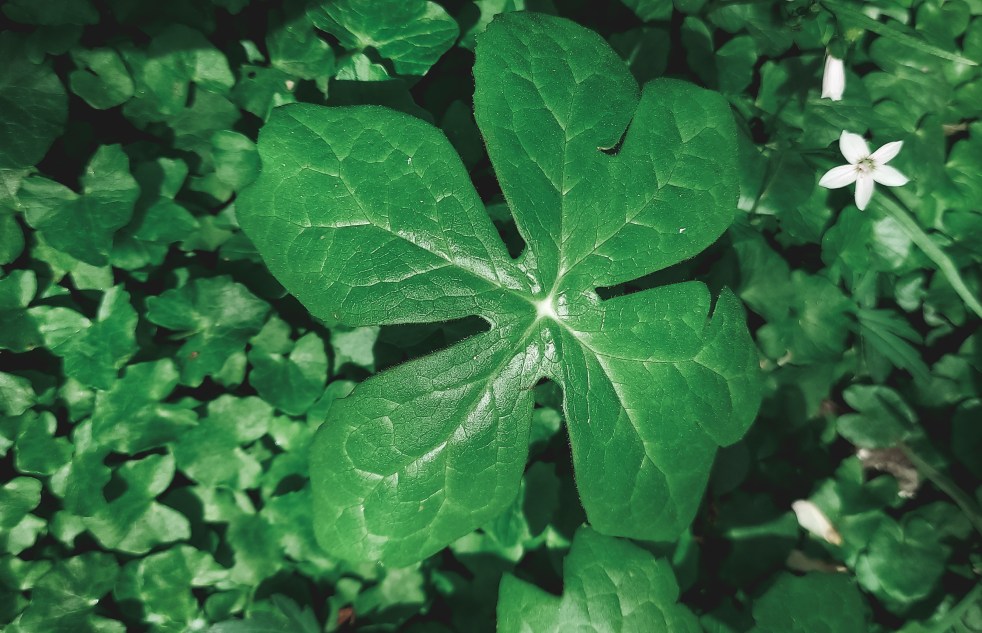
A top-down view of a mayapple leaf, surrounded by lesser celandine.

While the entirety of the mayapple is poisonous, the fruit (with the seeds removed) can be eaten only when it is completely ripe1.

Most commonly, mayapple is used as a substitute for mandrake. While the plants are unrelated, their qualities are similar enough to make such a substitution work.

That means that mayapple is an excellent ingredient in protective or banishing formulas. Some people use it as an ingredient in formulas for renewal, rebirth, or new beginnings, largely because of the fact that the plant appears in spring, produces fruit, and go dormant shortly after the fruit ripens in mid-summer.
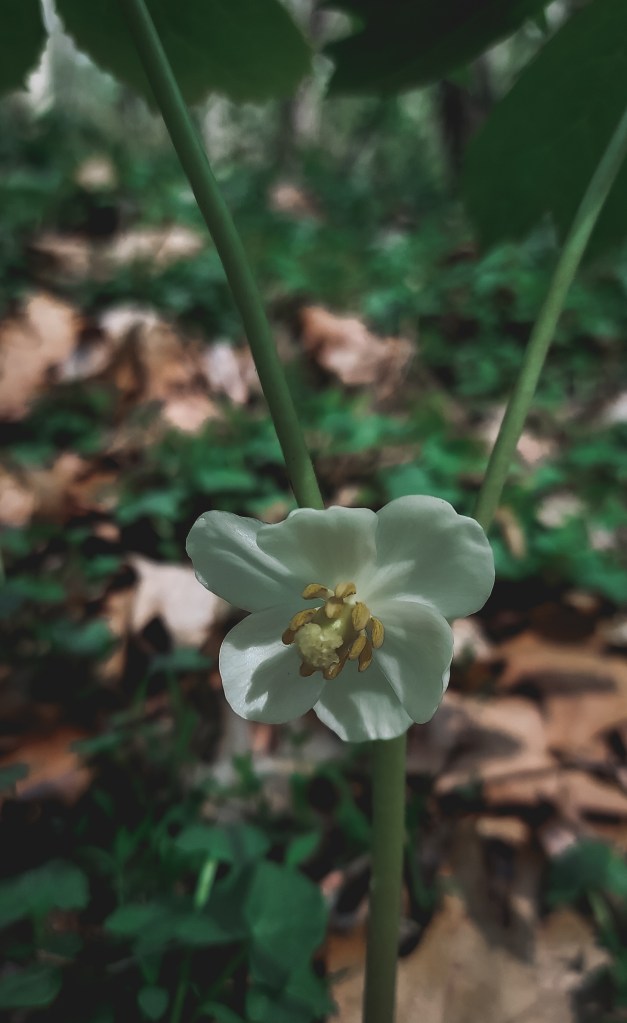
A close-up view of a mayapple flower. It appears at the fork between the two leaves of a mature mayapple and has five white petals with a yellow center.

Interestingly, mayapples have a unique relationship with turtles. While the foliage is bitter and deadly enough for herbivores to avoid it, the smaller guys will happily go after the ripe fruits. Box turtles are actually the primary distributors of mayapple seeds2,3. The fruits grow at just the right height for the turtles to reach them, and the seeds are more likely to germinate after being exposed to the turtle’s acidic digestive environment.

While the mayapple is extremely poisonous, it does have a history of use as a medicinal plant. In the past, it was used as an emetic, anthelminthic, and treatment for skin conditions like warts. Podophyllotoxin, one of its primary toxic constituents, is actually the active ingredient in a topical treatment named Podofilox that’s used to treat some viral skin conditions like genital warts and molluscum contagiosum. It works by inhibiting the replication of cellular and viral DNA as it binds to key enzymes4.

If you’re going to use mayapple, do it carefully. Wear gloves. Don’t put it in anything that you’re going to ingest, or even anything that could potentially come in contact with your skin. While the ability to keep DNA from replicating is helpful when you’re trying to kill a skin virus, it’s very much not okay when it’s working on your cells instead.

For real. Be careful.
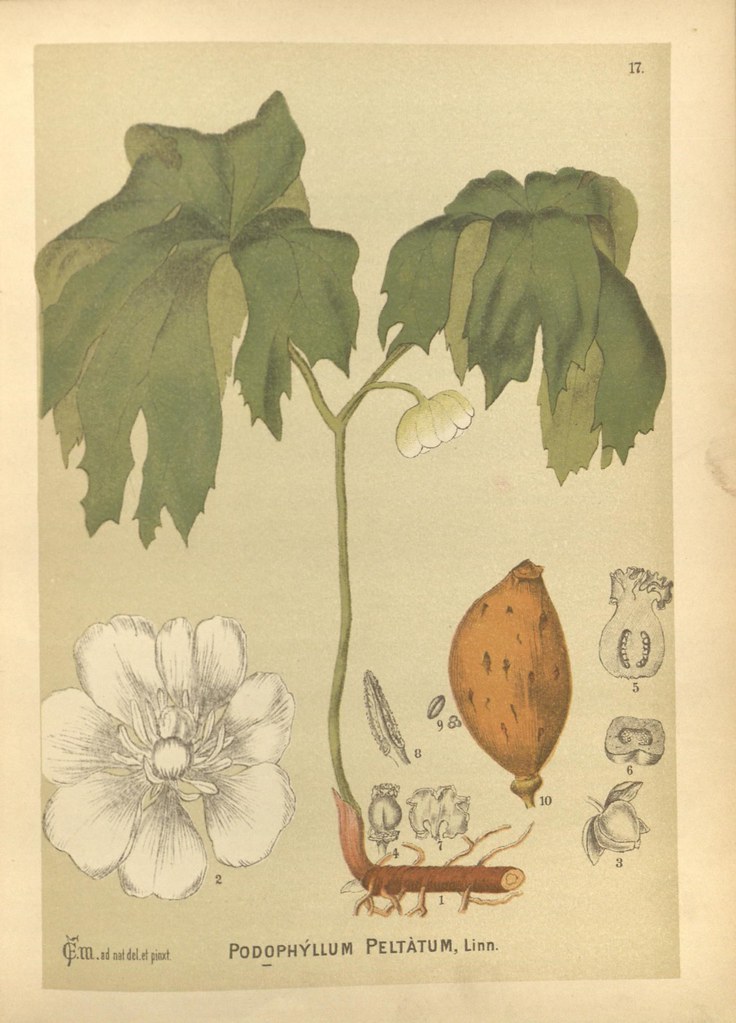
A botanical illustration of a complete mayapple plant, showing the pair of leaves, white flower, and large root.
n71_w1150 by BioDivLibrary is licensed under CC-PDM 1.0

Whole dried mayapple roots could be used to make an alraun. This is a dried tormentil or false mandrake root (Bryonia alba) used in German folk magic, carved and decorated into a kind of spirit doll. Keeping and properly maintaining one is said to bring good fortune to the household. The alraun (or alraune) would also be bathed in red wine, which could then be sprinkled around the household for protective purposes.

Caring for an alraun is pretty intensive. Once prepared, it needs to be wrapped in a red and white silk cloth, put in a special case, and bathed in red wine every Friday. On each new moon, it should be given a new shirt. These dolls were also passed down through families, though they must be inherited in a particular way: When the father of a family dies, his eldest son may inherit the alraun by placing a piece of bread and a coin in his father’s coffin. If the eldest son dies, his eldest son (or younger brother, if he has no sons) may likewise inherit the alraun by the same method5.

If creating and caring for an alraun seems a bit intense, you can also use dried mayapple in container spells. Just make sure to wear gloves while handling it, and don’t place it anywhere where children or animals may come in contact with it.

Rinse the dried root in water or alcohol and sprinkle it around anywhere you wish to protect. Again, be cautious not to get it on your skin.

The seeds would be useful in formulas for rebirth or renewal. However, as mayapple has never particularly called to me as a “renewal” herb, I can’t offer any more in-depth suggestions here.

Mayapples are beautiful, unusual little plants. They pop up in spring in all of their bizarre glory, flower, fruit, and are gone by late summer. Treated with respect, they can be very useful — even heirloom-worthy — magical tools.

  1. Mayapple: Pictures, Flowers, Leaves & Identification | Podophyllum peltatum. https://www.ediblewildfood.com/mayapple.aspx.
  2. Braun, J., & Brooks, G. R. (1987). Box Turtles (Terrapene carolina) as Potential Agents for Seed Dispersal. American Midland Naturalist, 117(2), 312. doi:10.2307/2425973.
  3. Rust RW, Roth RR. Seed Production and Seedling Establishment in the Mayapple, Podophyllum peltatum L. The American Midland Naturalist. 1981;105(1):51. doi:10.2307/2425009
  4. Podofilox (topical) monograph for professionals. Drugs.com. (n.d.). https://www.drugs.com/monograph/podofilox-topical.html
  5. Deutsche Sagen, herausg. von den Brüdern Grimm. Google Books. https://books.google.com/books?id=SRcFAAAAQAAJ&pg=PA135. (In German.)

Plants and Herbs

Dittany of Crete Folklore and Magical Properties

So, we watched Hereditary not long ago. When I was reading various social media posts about it afterward, one person mentioned that the herb placed in Charlie’s baby bottle and in Peter’s joint was dittany of Crete. And herb, they said, that is “known for making the body more susceptible to demonic possession.”

“Huh,” I said to myself, “I’ve got a whole bag of that in the kitchen cabinet.”

(It’s true. It smells like pizza.)

Seeing as how I have used it to facilitate demonic possession exactly zero times, I thought now might be an opportune time to talk about the actual folklore and magical uses of dittany of Crete.

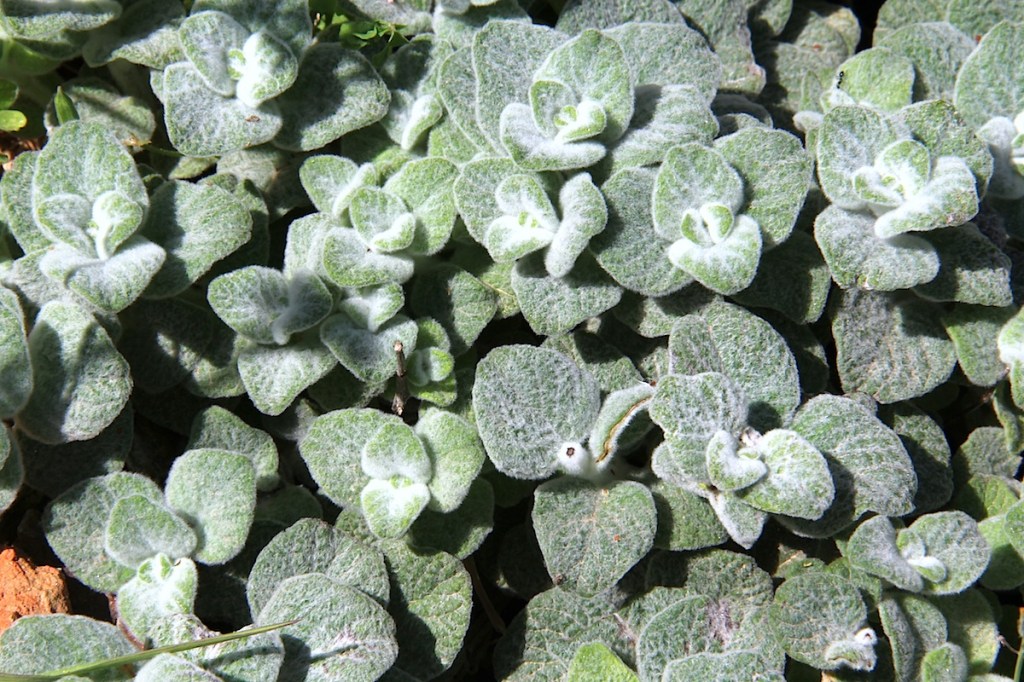
Dittany of Crete (Origanum dictamnus) is a perennial herb with velvety leaves, native to the mountainsides of Crete. It’s related to oregano and marjoram, which becomes immediately apparent the moment you smell it — it has that same kind of aroma.

A close-up of dittany of Crete leaves.
Photo by Peter Mansfeld.

In the past, it was used to decorate temples, as a kind of tonic and panacea, and as an aphrodisiac. It was also used to soothe stomachs, bring on late menstruation, and encourage wounds to heal. According to Aristotle, wounded goats would seek out dittany of Crete and consume it as medicine. (While this may be true, he also said that dittany helped them eject arrows from their bodies, which is… less credible.)

Really, dittany of Crete is mainly known for healing, not inviting in demons. Not only does it have a long history of use as a medicinal herb for specific maladies and general ill health, but it has also been referenced over and over again in fiction. In the Aeneid, Venus uses it to heal Aeneas. Beaudelaire references this in his poem Tout entière, where he proclaims that his lover is “entirely dittany” and therefore able to heal his wounded soul.

Even outside of Beaudelaire, dittany of Crete is also strongly connected to love. In the Cretan dialect, the herb is called erontas (έρωντας) which means “love.” Dittany-harvesters were called “love seekers,” and considered very brave and passion-driven. They’d have to be, in order to climb the tall, treacherous places dittany calls home!

In European folk magic, feeding a person dittany of Crete was said to make them fall in love with you.

Dittany (Origanum dictamnus): flowering plant.

In other esoteric arts, dittany is said to help spirits manifest (primarily by burning it to allow them to show themselves in the smoke) and to facilitate trancework and astral projection. Both Crowley and Blavatsky considered it a powerful magical herb.

A number of Greek dishes from Crete include dittany. Martini Rosso, red vermouth, includes it as a flavoring agent alongside many other herbs and fruits.

In fact, I was unable to find a single recorded instance of someone using dittany of Crete as a way to make someone susceptible to possession. The closest I could come was a rather large leap from its use as a way to help spirits manifest, and as an aphrodisiac. The thing is, dittany is said to help spirits manifest, not occupy people. But, if one were to generously interpret “aphrodisiac” and “love-inducing” as “increased suggestibility,” then one could see where a horror movie might get the idea that an herb that a) makes you horny, b) helps spirits appear in its smoke, and c) facilitates trancework could be a suitable fictitious catalyst for demonic shenanigans.

False dittany (Ballota acetabulosa (L.)
An illustration of “false dittany,” Ballota acetabulosa.

Be careful when you try to purchase dittany of Crete — the herb is classed as rare, and there are measures in place to protect it. As a result, the real stuff can be kind of expensive and not super easy to come by. Some shops will sell Dictamnus alba (fraxinella, gas plant, or burning bush), or even plain marjoram or oregano as dittany of Crete. Remember: Look for the fuzzy oval leaves and distinctive oregano-like smell.

I’ve only found this herb in its dried form and find that using it is much like using any other herb. Personally, I infuse it into a base of jojoba alongside other ingredients for a special oil that I make once a year for meditation and trance work. Otherwise, I don’t really have much use for it outside of this specific recipe. A tiny bit goes rather a long way.

Dried dittany of Crete is suitable for using in handmade incense. Mix it with other loose herbs and resins and spoon it over a lit block of charcoal. As mentioned above, it has been used in this way to help spirits manifest in the smoke.

You can also roll a candle in it. Anoint the wax with oil first, then give it a few rolls back and forth in some finely ground dried dittany. When you feel it’s ready, light it. Use a pink candle, anoint it with rose and jasmine oil, then roll it in ground rose petals, dittany of Crete, and a pinch (just a pinch) of cinnamon, then light it to get your romantic energies burning high.

Dittany of Crete is also suitable for jar spells, sachets, and other forms of container magic. It’s honestly a very nice herb with a delightful fragrance.

Really, Dittany of Crete is not nearly as dangerous as Hereditary makes it seem. I have a feeling they chose a somewhat obscure herb with an intriguing name, tangentially related to the goal of the movie’s antagonist, rather than inventing one whole cloth. It’s related to oregano. It smells like pizza. It’s a nice addition to a dream/vision oil. That’s really about it.

Plants and Herbs

Blackthorn Folklore and Magical Properties

Few trees are as divisive as the blackthorn (Prunus spinosa). When you look at it from a distance, this may be hard to believe — these trees, with their dark bark and frothy white flowers, are honestly very pretty. They also produce sloes, which are excellent in preserves and a crucial ingredient in sloe gin.

A blackthorn sloe.
Photo by Marek Kupiec on Pexels.com

So we’ve got a lovely tree with pretty white flowers and useful, equally attractive dark blue-purple fruits. How could a plant like that be divisive?

The answer lies deep in its fascinating folklore.

The blackthorn tree appears in the Irish ogham, an ancient writing system often erroneously called a “tree alphabet.” (In reality, it encompasses a variety of concepts and objects that were only connected to trees much later on.)
This ogham few, straif (ᚎ), is frequently associated with misfortune, struggle, and ill omens. It’s regarded as a few of great power, but also the negative or malicious side of magic and the capricious nature of the fae. Blackthorn trees were said to be guarded by the Leanan Sidhe, and it was terribly bad luck to cut one down.

Interestingly, straif’s original meaning likely did not have any connection to the blackthorn at all and may have been a reference to sulfur. The Bríatharogam are, unfortunately, not much help here. We get “strongest reddening” (tressam rúamnai), “increase of secrets” (mórad rún), and “seeking of clouds” (saigid nél).

Blackthorn flowers.
Photo by Atif Bangash on Pexels.com

Blackthorn trees are so named for their sharp thorns. There are a variety of ways one may use these thorns in magic, but blackthorn’s thorns seem to have gotten a bad rap. They tend to be associated chiefly with negative or malevolent workings, and old witch-lore claims both that the Devil used one of these thorns to prick a would-be witch’s finger before they signed his infernal contract, and that witches would jab blackthorn thorns into poppets to harm people.

In Christian mythology, the blackthorn is also one of the trees said to have “betrayed Jesus” at the Crucifixion.

Since blackthorn isn’t a very big tree — in fact, it’s more often seen as a big bush — it’s very useful as a hedge plant. The thorns mean that it isn’t heavily browsed or easily damaged by cattle and deer, and it grows densely.
This use may be part of its connection to the fae, since blackthorn is quite literally a plant that marks a boundary from one place to the next. It’s a plant that protects itself, as well as whatever may lay beyond it.

In fact, blackthorn occasionally crops up in old hero stories and fairy tales. The hero, pursued by a giant, throws a blackthorn sprig behind him. The sprig immediately roots and grows into an impenetrable hedge, holding back the giant and allowing the hero to escape.

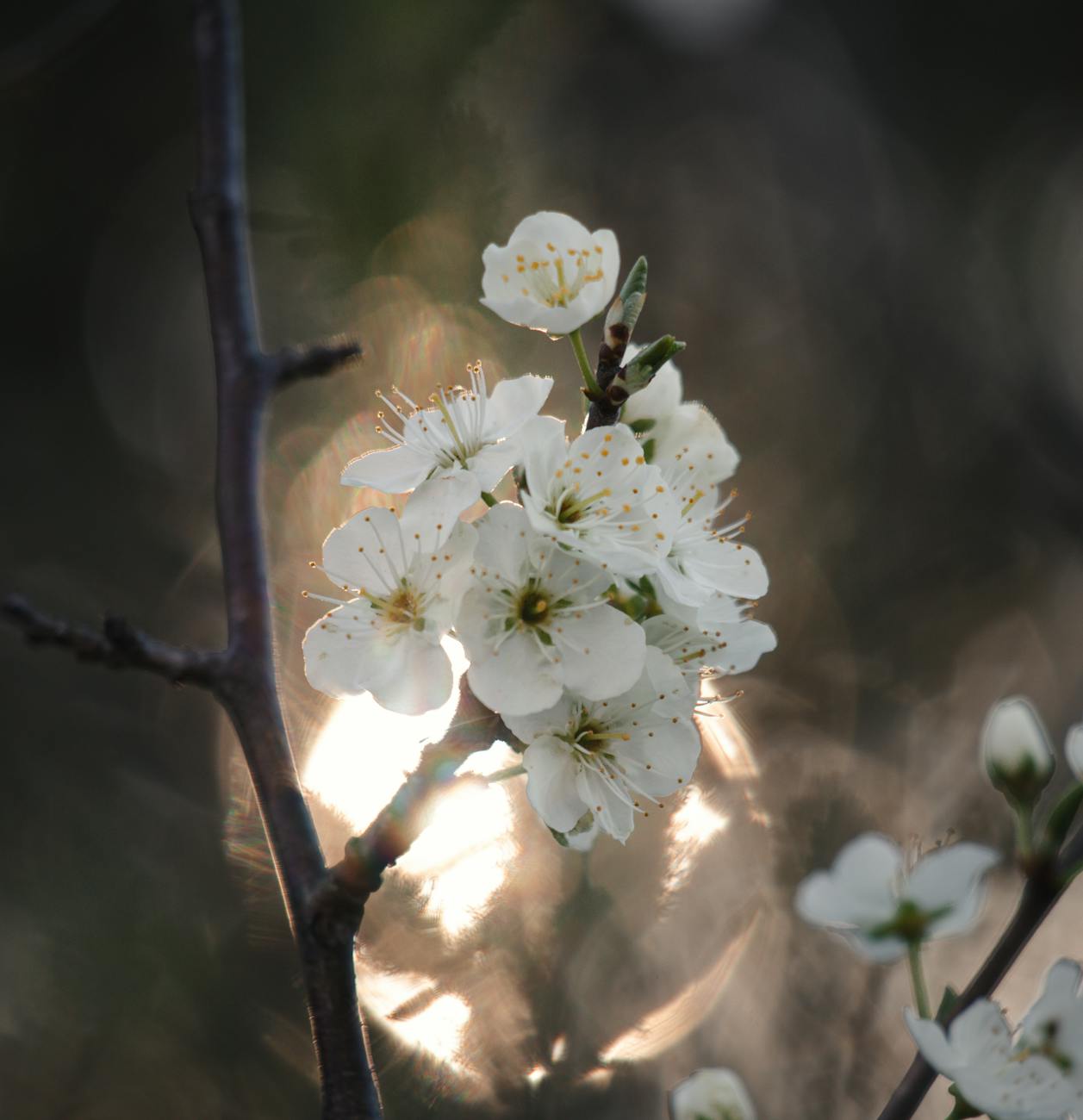
White blackthorn flowers on branches.
Photo by Ellie Burgin on Pexels.com

This protection extends beyond hedges, too. Blackthorn wood is hard and dense, and the traditional material for a bata or shillelagh. They’re part club, part walking stick, and similar in shape to the rungu used in some parts of East Africa or the iwisa, induku, or molamu of South Africa (though usually a bit longer). Shillelaghs were used in structured duels, as other cultures might use rapiers, and there’s a martial art that focuses on shillelagh training to this day.

Shillelaghs were traditionally made using the roots of the blackthorn, where they kind of naturally form a knobby end. This made them less prone to cracking, but some people would still hollow out the knob of their shillelaghs and fill them with lead — a bit like Bugs Bunny dumping horseshoes into a boxing glove.

The process of making a shillelagh took time, but not many resources. If you had access to a blackthorn bush, as well as a chimney or a dung heap, you could make a perfectly serviceable weapon. The blackthorn tree was a social equalizer that allowed even the poorest people a useful tool and a means to defend themselves.

Blackthorns aren’t easy to come by in the Americas. They aren’t native here, though they have been naturalized in parts of the Eastern US. So, if you want to work with any blackthorn-derived ingredients, you may have to get creative.

Kitchen witches or potion crafters may have an easier time. They can incorporate some sloe preserves, sloe chutney, dried sloes, sloe gin, or any of the very excellent sloe or blackthorn shoot-based liqueurs into their work.

Other than that, it is sometimes possible to find small numbers of blackthorn thorns available for sale online. When I can get them, I love using them for defensive workings. Write a name on a slip of paper or parchment, skewer it with a blackthorn thorn, and toss it into a jar or box of suitable ingredients. It’s easy, it’s poignant, and it’s perfect.

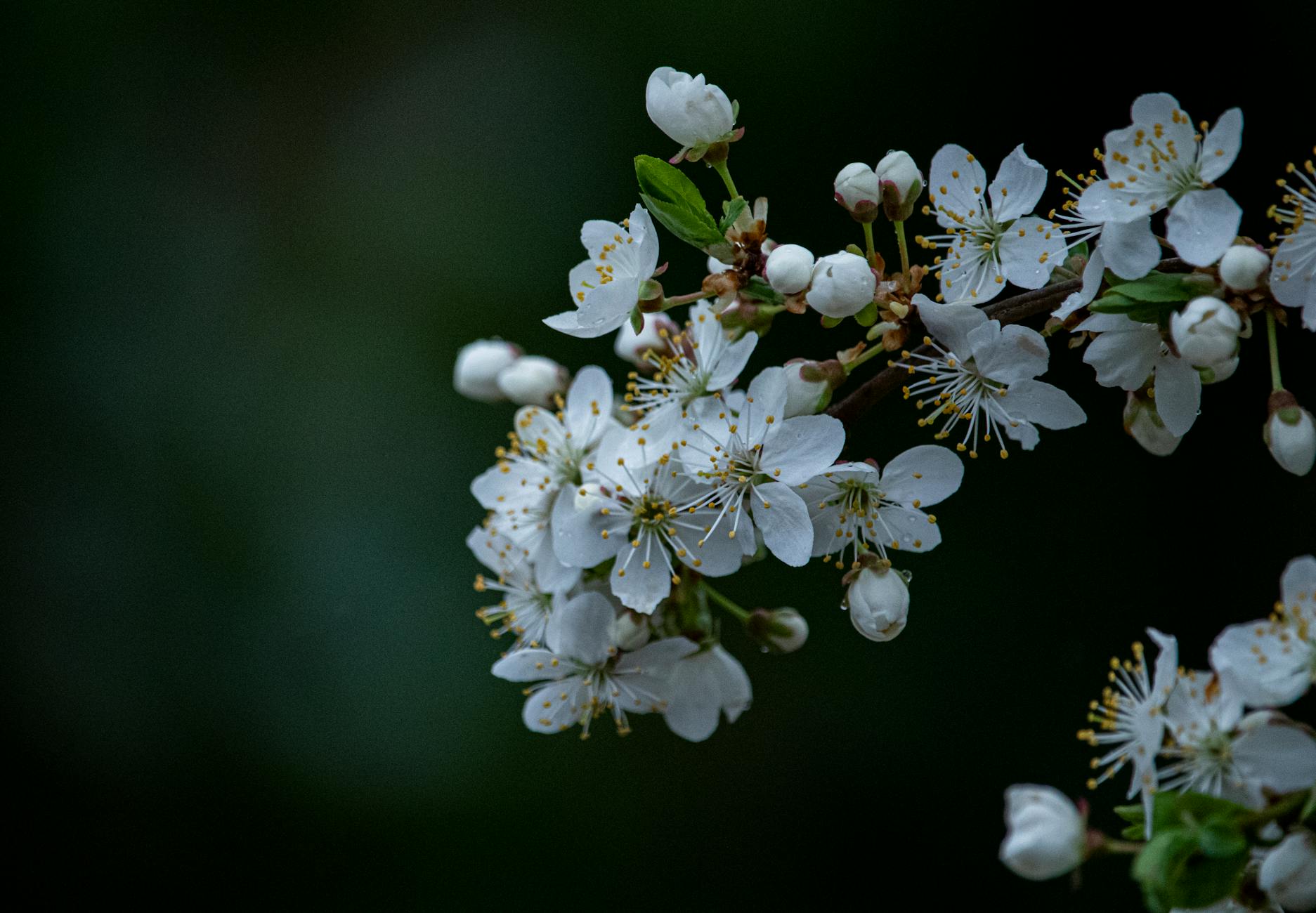
Close up of blackthorn flowers.
Photo by Nagy Richard on Pexels.com

Failing all of that, you may have to see what blackthorn characteristics you want to tap into and find a good workaround. For thorns, look for stickers from other thorny plants. (Berry canes are often a great source of these.) For working with the fae, you may have an easier time finding a rowan or hawthorn tree. For protection, you’re pretty much spoiled for choice — there are tons of other herbs used for all forms of protection, from securing your home and keeping malevolent entities away to driving out unwanted housemates.
Seriously. There are so many, this post would be a novella were I try to list them all.

Sadly, many of us outside of Europe won’t have the opportunity to work with this beautiful, useful, folklorically-rich tree firsthand, but that’s okay. The blackthorn is a plant with history and power that’s worth understanding, even if we may never have the privilege to meet one.

Plants and Herbs · Witchcraft

Soap Folklore and Magical Properties

I came across a rather strange argument the other day. One person mentioned “solid body wash,” which prompted another to go “so, soap?” This was followed by several people who either a) vehemently swore up and down that it was a marketing gimmick and there was no difference, or b) vehemently swore up and down that there was an enormous difference, but both c) could not explain why.

Focus photography of a bubble.
Photo by Pixabay on Pexels.com

I didn’t want to Kool-Aid Man in, all, “HELLO YES LET ME TELL YOU SOAP,” so I didn’t. Nonetheless, it gave me the idea to write this post — soap is a very important part of many magical traditions, and something most readers of this blog probably come in contact with every day. Sacred bathing, magical housekeeping, magical soap-making, herb craft, it all ties in together to create a vibrant, powerful, and useful set of magical techniques.

Okay, so. Just to get this out of the way — there’s an enormous difference between “soap” and “body wash.” Soap is specifically made of saponified fat. This is oil (or another fat) that has reacted with lye to produce salts that act to reduce the surface tension of water or reduce the tension where two substances interface. Like, for example, dirt or oil on your skin. Its molecules have a polar end that binds to water, and a non-polar end binds to other stuff.
Body wash is a detergent. Detergents are also made of surfactant salts, but their chemistry is very different. Detergents may be made of petroleum byproducts but are also often plant-based. While the polar end of soap is usually tipped with a carboxyl group, the polar end of detergent molecules is tipped with sulfonates.
Ultimately, as the end user, the biggest difference is this: If you have hard water, soap sucks. It reacts with the minerals in your water to produce soap scum (stearates) a waxy residue that sits on your tiles, your clothes, and your skin.
Detergents don’t produce soap scum the way soap does because they don’t react as readily with hard water minerals and have a higher pH than soap, so they tend to work better and have fewer issues in water that has a high mineral content.
Body wash isn’t really a chemical term — a body wash can be soap based but is usually a detergent because soap tends to strip and dry out skin. They also often contain ingredients designed to benefit the skin beyond cleansing, like moisturizers or exfoliants.
Does this make a difference in a magical sense? Not really, though the ingredients that make up a soap or detergent can be invoked for their own properties. Olive trees, sunflowers, and so forth all have their own energy to contribute.

A close-up of rows of wrapped bars of soap.
Photo by Polina Tankilevitch on Pexels.com

(Also, it should be noted that you can make soap less reactive in hard water. The addition of chelating agents or various forms of vitamin C can help prevent some of the formation of soap scum. It just requires some recipe tinkering.)

One bit of folklore surrounds the origins of the word “soap.” “Soap” is said to come from Mount Sapo, in Italy. In ancient Rome, there was a bend in a river at the base of the mountain. People would gather to do their laundry there because their clothes got cleaner than they did elsewhere.
Interestingly, this mountain is also where people conducted animal sacrifices. The liquefied fat, combined with the pyre ashes, reacted and ran/was washed by the rain down into the Tiber River. This fresh water, combined with unintentional soap, led to much cleaner togas.

This wasn’t the first soap, however. There are recorded mentions of using soap to wash wool going back as far as 2800-2500 BCE. Some Sumerian cylinders from 2200 BCE specifically mentions “fats boiled with ashes” — an old recipe for soap.

Bath with lemon slices in water and lit pillar candles on the floor.
Photo by Monstera Production on Pexels.com

Magically, bathing is used to both banish and attract. There are magical bath recipes for everything from breaking curses to getting a raise. They usually involve making a decoction of herbs in water, straining out the herbs, and adding the liquid to the bathwater.
Magical soaps are formulated with herbs and oils that align with specific intentions. They provide a somewhat more portable and less labor-intensive way to take a magical bath. A shop owner or salesperson, for example, may carry a bar of soap formulated to attract prosperity so they can wash their hands with it throughout the day.

This idea carries through to housekeeping. Floor, window, and door washes work the same way — by using a decoction of herbs or dilution of oils to either bring something into or get something out of a home. Back in the day, people in various cultures had other ways of achieving this goal. For example, smoke cleansing a house with juniper in order to banish sickness, or bringing in fresh sweet-smelling strewing herbs to cover a floor. Now, there are hard floors and glass windows that get washed.

Soap isn’t always associated with positive things, though. Soap Sally, an Appalachian and Southern villain figure, is said to wait with her basket for children who try to slack off when doing chores. She shapeshifts and convinces the children to follow her back to her cottage, where they gorge on candy and fall asleep.
Once asleep, Soap Sally would render the children in her stewpot. Their melted fat would be formed into hand-shaped candles or soaps, which she’d send back to their families. The families would end up burning or washing up with the remains of their own children.
Soap Sally appears to have roots in stories like Baba Yaga or Hansel and Gretel, as well as being a kind of “morality villain” to put the fear in children who’d rather play and goof off than do household chores.

Yes, yes, I know.
Who needs to be told how to use soap?
But this isn’t about just washing up — it’s about using soap for a specific purpose.

In the section above, I mention sacred bathing to attract or banish things. The process usually goes something like this:

  1. Take a regular bath or shower to physically clean yourself.
  2. Drain the tub or basin, and refill with fresh water.
  3. Add a decoction of herbs that match your intention.
  4. Declare your intention as you add the strained decoction. (Some traditions add that you should stir it into the bathwater in a clockwise direction, using your dominant hand.)
  5. Get into the bath and fully immerse yourself.
  6. Remain in the bath until you feel it’s had the intended effects.
  7. Get out of the bath. In some cases, you may be instructed to allow yourself to air dry so you don’t “wipe off” the effects.
  8. Dispose of the bathwater. In some traditions, this means taking a basin outside and throwing it over your left shoulder, toward the rising sun.

Whether the washing is “attracting” or “banishing” depends on your intention and the ingredients you add. Want to attract a lover? Rose petals, vanilla, basil, and jasmine are nice. As you bathe, you’ll be absorbing the sweet scents and loving energies from these plants. Want to banish unwanted things? Salt, rosemary, rue, and hyssop. As you bathe, you’ll be washing away whatever you don’t want.

Small bars of natural soap on linen dishcloths
Photo by Vie Studio on Pexels.com

Having a specially formulated magical soap can make this process easier. You still take a regular bath first, in order to clean yourself, but from there you just have to get into a fresh tub of water, soap yourself thoroughly with the magical soap, then rinse off.

Add a bit of magical soap to a bucket of mop water, then wash your doors, windowsills (maybe not the glass, if you’re hoping for a streak-free shine), and floors. Go from front to back to bring things into your home, and back to front to banish or push things out.
Specially compounded magical floor washes and soaps are largely found in the Hoodoo tradition, but just adding decoctions of herbs (or acids, like vinegar or lemon) is a bit more widespread.

The most basic “washing up” recipe I know of involves adding salt and lemon juice to a bucket of water, then mopping/washing walls, doors, and windows with it to help clear out old, unwanted, or stagnant energy. Pretty simple.

Whether soap originated from the accidental combination of animal sacrifices and a river, or the work of ancient Sumerian scientists, the idea of washing with soap or detergent has become ubiquitous in modern societies. When you couple the act of washing with herb lore and magical techniques, it can become much more than the sum of its parts.

(Also! I’ve gotten a few messages through the site’s Contact form lately, but they don’t include valid email addresses. If you’d like a reply, please, please double-check and make sure that your email address is correct. I’m not going to save it or sell it or put you on an email list or anything, it’s just important if you’d like me to email you back. Thank you!)

Plants and Herbs

Needle and Pin (and Other Sharp Object) Folklore and Magical Properties

The desire to do things correctly, by the letter, is something that I think plagues everyone who’s new to witchcraft (or, really, any type of magical work). I’ve seen it said that there’s no one way to do magic, but there are infinite ways to do it ineffectively, and I wholeheartedly agree with this sentiment. That said, it’s not always that important to have the exact ingredients that a spell, charm, or formula calls for. As long as you know what they’re doing in there, you can usually figure out workable substitutions.

That’s why I wanted to write a post about sharp stuff. Not any sharp stuff in particular. Just… you know. Sharp things. Pokey bits.

Where do I even begin?

Think of every story you’ve ever heard about a sword, or a needle, or a thorn. Think about idioms like “to needle someone.”

closeup photo of cactus plants
Photo by Madison Inouye on Pexels.com

Arthur receives Excalibur, and it confers kingship upon him. Swords are a symbol of sovereignty here because they represent force: both the force needed to maintain one’s position as ruler, and the force needed to defend a country.

A lion receives the business end of a thorn in his paw, and it weakens him to the point where he needs a mouse’s help. Here, the lion — a strong, symbolically dominant figure — is brought down by the pain of something as small as a thorn. A mouse pulls it free, and the lion is in his debt.

It can be as large as a scythe, or as tiny as the hairs on a spider’s belly. Regardless of the pokey thing in question, the message is clear: As long as you’re on the right end of it, you’re at an advantage.

Roses, holly leaves, hawthorns, and blackthorns are pokey to discourage herbivores. (Interestingly, holly leaves don’t really start out all spiney-looking. They re-grow that way as a response to browsing animals, in order to keep from losing any more leaves than strictly necessary.)

Even the thin, needlelike leaves of conifers and cacti are a defensive mechanism, albeit one that protects them against the elements. Cacti leaves are needles to keep them from losing precious moisture to the dry desert air. Conifer needles keep them from losing moisture, holding on to too much heavy snow, or being blown over in harsh winter winds.

Needles and pins are used in magic to “pinpoint” the effect of a spell or charm. Jab them in a poppet, and you can send healing into an arthritic joint, or inflict pain and debility instead.

Sharp tacks in brown round container
Photo by cottonbro studio on Pexels.com

Athames and swords are used in some traditions as a way to direct energy from their points. This is in contrast to ritual knives, which are generally working tools used for mundane tasks like harvesting herbs, cutting offerings, and bloodletting. Even though they’re not strictly “magical,” these working tools still have the same symbolism — these tools are what allows the user to obtain what they need, whether it’s a leaf, a slice of cake, or blood.

Blackthorn spines, porcupine quills, sewing needles, and old nails are all used in defensive and offensive magic alike, generally in various forms of sympathetic magic. Jab a representation of your target, and the idea is that the target themselves will feel the effects. Fill a jar with sharp things, hair, and urine, and the idea is that your hair and urine will attract malevolent energy sent your way, while the sharp things ensnare and poke at it.

When sharp things are involved, it usually doesn’t matter exactly what that thing is — the important aspects are a) the size, and b) that they’re sharp. A protection jar spell that calls for straight pins can use sewing needles, rose thorns, or even the itchy hairs from rosehips instead. A spell that calls for a pin with which to inscribe a candle will work just as well with a knife, or even the tip of a sharp stone. A poppet spell that needs pins and needles will work just as well with porcupine quills.

As I mentioned above, the symbolism of sharp objects is pretty straightforward. Ideally the pointy end should (symbolically) go in the other guy, for good or ill.

When it comes to directing energy, they are an aid to visualization — an extension of the index finger, commanding and pointing and saying, “This is my will, so it will be done.”

When it comes to apotropaic magic, they are a trap. Like the quills on a hedgehog, the stinger of a hornet, or the studs on a leather jacket. They represent the fate of someone (or something) that decides to cross you. This is why they’re employed in various magical decoys, like witches’ bottles.

When it comes to offensive magic, they are weapons. Not in a literal sense, but they represent a sharp, decisive action, or even a physical or emotional pain. They’re the needles poked into a poppet, or the shaken spell jar filled with hot peppers, broken glass, and a photo of an enemy.

Broken glass bottle in a gutter
Photo by Suzy Hazelwood on Pexels.com

In various online magical circles, people joke that we’re all hoarders. We save jars, lids, corks, scraps of fabric, old nails, ribbons, and assorted junk, because there’s immense potential in everything and you never know when it’ll make itself useful. I might dispute the “hoarder” label myself, but I’d also be lying if I said I didn’t have a drawer full of junk-that-I-might-need-for-a-spell-some-day.

Sharp things are symbolic of polarity. The safe and the unsafe. The sharp and the dull. The defensive and the offensive. The sword that cuts, and the scalpel that heals. They’re a pretty simple symbol, but it’s this simplicity that makes them versatile, powerful tools.

Plants and Herbs

Apple Folklore and Magical Properties

As I write this, the results of the US presidential election are being calculated. I’m trying to do anything other than be uselessly anxious about that all night, so I figured I’d write about a cozier topic to get my mind off of it.
Hence: Apples.

Apples are a traditional food for Samhain. This year, I had originally hoped to save at least an apple or two for us. I went out, covered about half of the young fruits with organza bags I had left over from gifts, and thought I was good to go. There were some for me, some for the local fauna, and everyone should’ve been fine. Then there was a spell of dry weather.
Anyhow, I got no apples, and also the squirrels stole all of my bags.

Then, at Mabon, we were working on masks and costumes for the Council of All Beings. Someone found a dropped googly eye, and I made a joke about them not having natural predators. That’s when it hit me — what if I put googly eyes on the apples?

“They might just attack the apples from the side without eyes,” a friend of mine said.

“I’d put them all around,” I explained. “Biblically accurate apples.”

Anyhow, as the time for various delightful apple dishes approaches (like my favorite, cornbread stuffing with sage, onions, and apples), I figured it’d be a good time to look at their folklore, mythology, and metaphysical aspects.

Jokes about Biblically accurate apples aside, the forbidden fruit of Christian mythology most likely wasn’t a member of Malus domestica. While apples are cultivated all over the world, they originate from Central Asia. The Bible also doesn’t mention the fruit by name — it’s just commonly depicted as an apple as a kind of visual shorthand.
(It’s also a fun bit of wordplay. In Latin, the worlds for both “an apple” and “an evil” are written as malum. Pronounced with a long a, it’s apple. With a short a, it’s evil.)

Photo of an apple and a knife on a blue cloth.
Photo by Ylanite Koppens on Pexels.com

In China, apples are also a source of a bit of wordplay. The funny thing is, it’s almost exactly the opposite to Latin. The word for apple (苹果) and peace (平安) both start with the same sound in Cantonese and Mandarin. As a result, apples are associated with peace.

Apples have a long and varied history in Germanic Paganism. The Norse goddess Iðunn is the keeper of golden apples that give the gods eternal youth. The Poetic Edda details eleven golden apples given to the jötunn Gerðr, as a gift from the god Freyr. In the Völsunga saga, the goddess Frigg sends King Rerir an apple as he prays for a child. Rerir’s wife eats the apple and conceives Völsung. This demonstrates a connection between apples, youth, fertility, and life.
Interestingly, the skald Thorbiorn Brúnarson also mentions “apples of Hel.” Scholar H.R. Ellis Davidson points out that this may indicate that apples were considered the “life-giving fruit of the other world.”

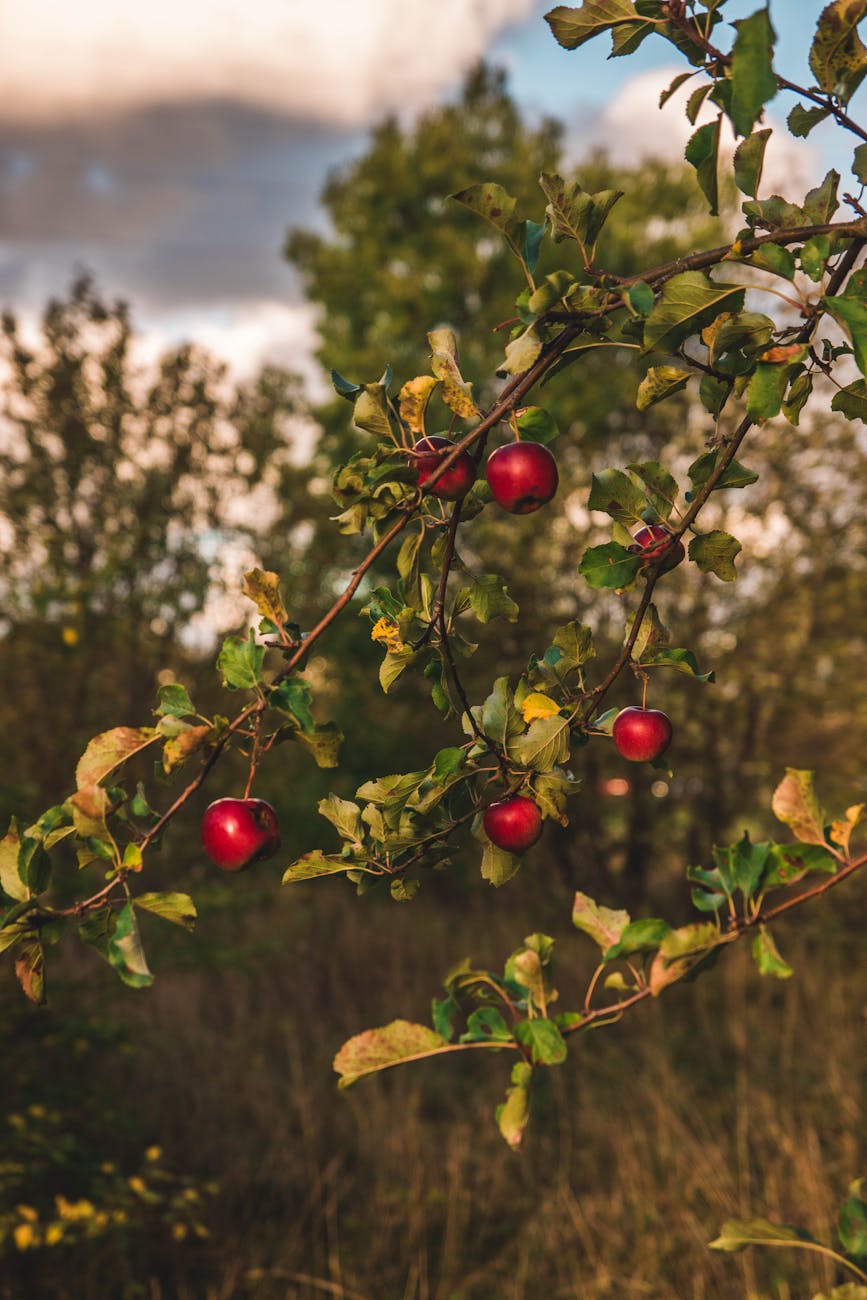
Three striped apples on a branch.
Photo by Julian Kirschner on Pexels.com

There is a similar connection between apples and the Otherworld in Celtic mythology, as well. Manannán mac Lir’s domain, Emhain Abhlach, translates to Isle of Apple Trees and is said to be a place where there is nothing but truth and disease and decay are absent. (Emhain Abhlach may also be where Avalon ultimately derives from.)
In the tale Echtra Cormaic, Manannán gives Cormac mac Airt gifts including a silver branch with apples of gold. This branch made magical music that was said to lull anyone suffering from sickness, injury, or childbirth to sleep.
Another tale tells of Connla, the son of Queen Aife and King Connaught. A fairy woman gives him an apple that, once eaten, becomes whole again. Infatuated with the fairy woman, Connla allows her to take him to the Otherworld where the fruit grows. The otherworldly apples give him everlasting youth, but for a great price: Connla can’t return to the land of the living.

Apples also have a lot of representation in Greek and Roman legend. The most infamous example is probably the Apple of Discord. When the Goddess of Strife, Eris, wasn’t invited to the wedding of Peleus and Thetis, she decided to start some trouble. She threw a golden apple inscribed “For the most beautiful” into the wedding party. Hera, Aphrodite, and Athena all claimed the prize, so Paris of Troy was tasked with selecting a winner. Each goddess offered him a bribe to choose her, but only Aphrodite’s bribe appealed to him — she’d give him the most beautiful woman in the world for a wife.
There was only one problem.
That woman was Helen of Sparta.
And she was married.
Whoops.

close up photography of apple tree
Photo by Kristina Paukshtite on Pexels.com

Apples were then considered sacred to Aphrodite and were even used as declarations of love. In the story of Atalanta and Hippomenes, Atalanta challenged all of her prospective suitors to races. If they could beat her, she’d marry them. (Since she was unbeatable, this seemed like a safe bet for her.) Hippomenes knew he’d never be able to outrun her, so he distracted her with three golden apples. With both his speed and his cunning, he barely managed to beat Atalanta and win her hand in marriage.
One of the labors of Hercules also involved retrieving golden apples from the Tree of Life in the Garden of the Hesperides, which creates another link between apples and life.

So, why are these fruits so deeply connected with life? Why do they come from the gods or Otherworld? Part of this might be because they literally came from afar — the ancestor of most of our modern apples came from Central Asia, so it would’ve traveled a great distance to reach the Mediterranean and Northern and Western Europe.
They may be deeply connected with life because they’re honestly pretty durable. They’ve got firm flesh and can last a long time when properly harvested and stored. That makes them an important staple in areas that experience cold winters — you could grow a bunch of apples, keep them in a cold, humid area with good air circulation, and they could last you all winter. Having a source of fresh fruit during the depths of winter could be the difference between life and death.
This may also be part of their connection with fertility. The fruit remains good in storage all through winter, when everything else withers. As a source of food when food is at its most scarce, those who have access to apples would likely experience better fertility than those who didn’t.

If you slice the fruit in half horizontally, the seeds form a pentagram.

Apple wood is considered a good material for tools for working with the fae and the Otherworld.

In modern European-based witchcraft, apples are used for fertility, healing, divination, wisdom, and knowledge. In some traditions, they are used for ancestor veneration and workings related to the dead.

They are said to be associated with the element of Water.

The simplest way to use these fruits is to eat or cook with them, first asking their help with whatever your goal or intention may be. Make your favorite sauce or pie recipe, tell each of the ingredients what you’d like them to do, thank them, and add them to your dish. Stir it clockwise with your dominant hand, serve, and enjoy.

Pies over wooden boards on the ground.
Photo by KATRIN BOLOVTSOVA on Pexels.com

You can also bury apples or place them on an ancestor altar as an offering.

Apples are frequently used for love divination. One old method involves peeling an apple in one continuous piece, then tossing the peel over your shoulder while saying, “Saint Simon and Saint Jude, on your I intrude, with this paring to discover, the first letter of my own true lover.” Look at the shape of the peel when it falls to see your true love’s initial.
Another love divination involves cutting an apple into nine equal pieces and eating them while mirror-gazing. Pierce the last piece with a knife and hold it over your shoulder, and an apparition of your true love may just appear in the mirror to take it.

When it comes to using apples for love magic, the blossoms are usually the best. (They have an amazing fragrance.) They’re seductive, but not overtly so — think of it as a sensual invitation rather than a command. They’re a great addition to a love-drawing bath, as well as baths for success, peace, and relaxation.

Apples aren’t just delicious; they have a lot of magical tradition behind them. They’re the food of the Otherworld, sustenance through the cold of winter, and a fruit of boundless fertility, youth, and eternal life.

Plants and Herbs

Garlic Folklore and Magical Properties

Have you planted any garlic yet? I’ll admit it — I haven’t. The weather has been so weird here lately that I wasn’t sure if it was a great time to do it. (For real, we currently have one very lonely and confused violet in the front yard.)

Still, it’s good to get garlic in the ground in autumn in temperate areas. This ensures that it’ll be one of the first things to pop up in spring and will be mature and ready for harvest in summer. Since its garlic planting time, I figured it’d also be a good time to explore the magical and folkloric uses of garlic.

Garlic is probably best known as a way to repel vampires. Some believe that eating it can also help keep mosquitoes, ticks, and other blood suckers at bay. However, research has shown that it actually seems to attract leeches.

In China, garlic was one of the ways to repel the jiangshi (僵尸), a kind of undead, vampiric creature that moves primarily by hopping.

This herb is also well known for its medicinal properties. It has naturally occurring antibacterial, antifungal, and antioxidant compounds. It’s sometimes used to treat various types of infection, high blood pressure, arterial plaque formation, and as part of a general health tonic. However, taking medicinal quantities of it can be contraindicated in some instances, so it’s important to discuss using supplements with your doctor.
(True story: I used to habitually eat so much garlic that, when combined with some very necessary medications, I ended up with bleeding/bruising problems.
It was a truly bonkers amount of it, though.)

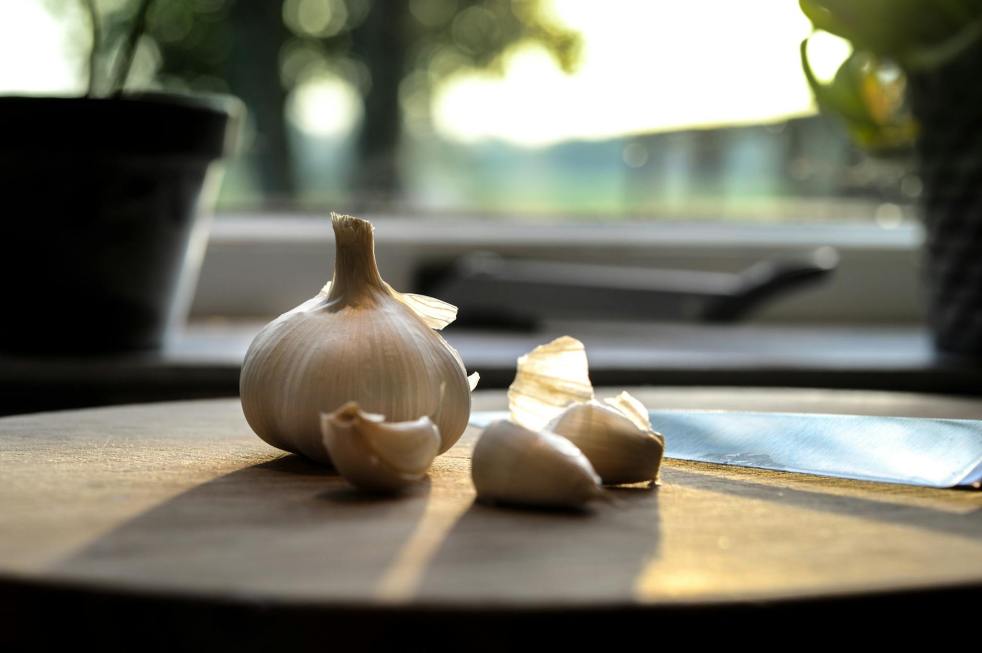
Garlic on white ceramic plate decorated with cats.
Photo by Cats Coming on Pexels.com

Garlic was very important in Egypt. This herb was a key part of the rations given to pyramid builders. When they threatened to abandon the project, they were given more garlic.
Pliny claimed that people in parts of Egypt invoked alliums as deities. He’s an outside source, so this should be viewed with some skepticism, but he also had a high opinion of garlic’s virtues. In Natural History, he offers a very long list of situations that call for it as a remedy.

Alexander Neckam, a 12th century English poet, theologian, and writer, recommended garlic as a remedy for the heat of the sun during hard labor.

In some traditions, garlic is considered an aphrodisiac and a charm for a happy wedding night. In India, it’s highly praised in the texts of the Ayurveda. However, those following ascetic paths avoid it, since it’s a food that increases sexual desire.
(Interestingly, some of the main causes of penile erectile dysfunction are high blood pressure, narrowed arteries, and high cholesterol. The clitoral bulbs also have erectile tissue. As an herb with cardiovascular benefits, the idea of garlic promoting/improving sexual desire and performance has credence.)

The Hindu texts Ashtanga Hridaya and Ashtanga Sangraha talk about how a rakshasa (essentially a demon) took a seat among the gods and received a sip of nectar from Vishnu. When Vishnu saw this, he cut off the demon’s head. The head fell to the ground, mouth open, spilling the nectar the demon had taken. From this spot, garlic sprang up. Since it comes from sacred nectar, it is a powerful remedy. However, since it also came from the mouth of a demon, some (especially Brahmin people) choose not to eat it.
On the other hand, the Bhavprakash nighantu, verse 217-220, says that garlic was created when Garuda stole the nectar of immortality from Indra. As he fled, some drops spilled on the soil and grew into garlic.
I think the most interesting aspect here is that, despite their very different origins and viewpoints about this plant, both of these stories acknowledge its sacred and powerful origins. In one, the plant is “defiled” by being tainted by the mouth of a demon. In the other, it isn’t. However, both see garlic as arising from a sacred source.

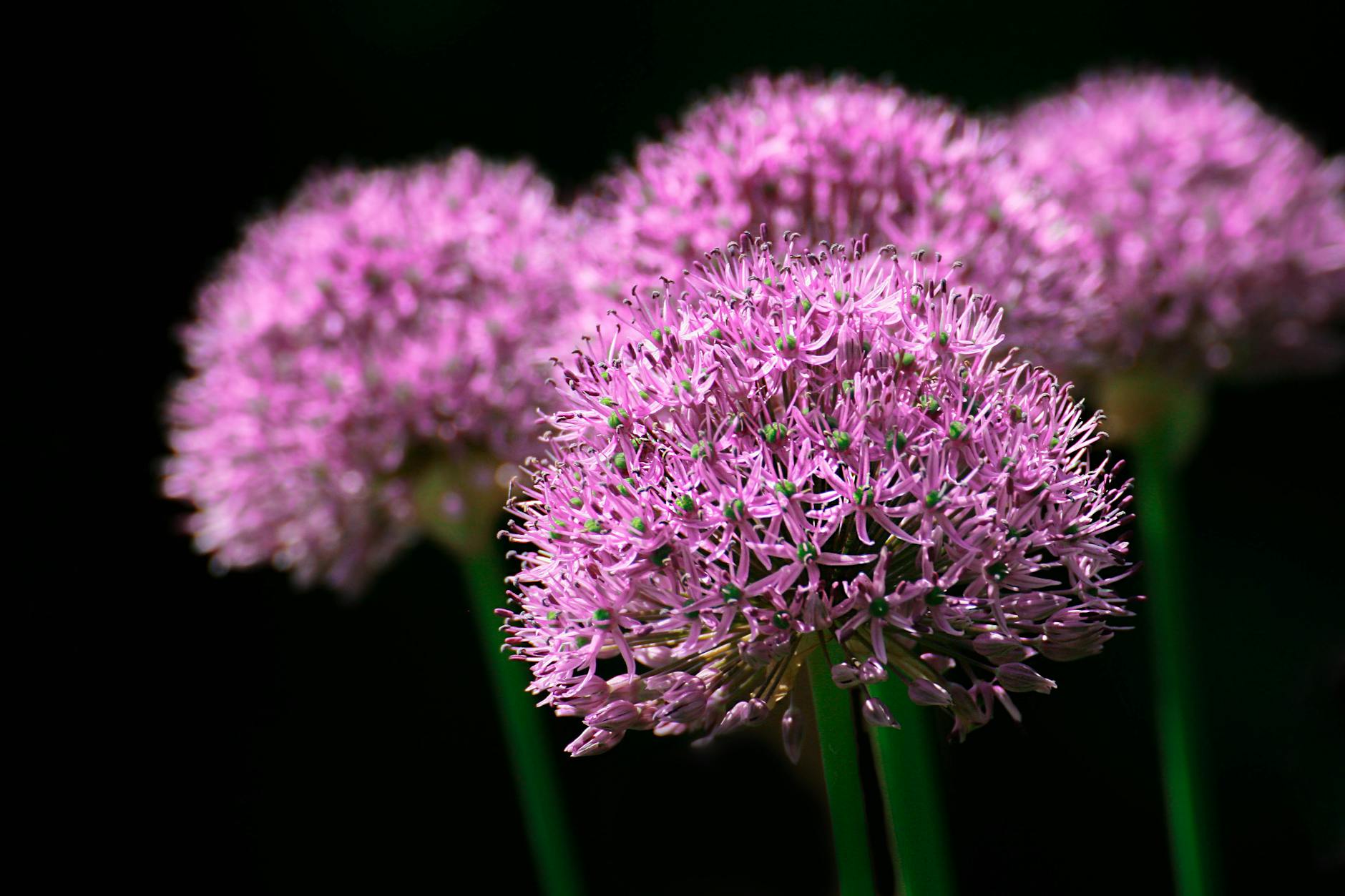
Selective focus photo of purple allium flowers.
Photo by Pixabay on Pexels.com

In The Schools’ Collection, an archival record of folk remedies, garlic is mentioned as a cure for multiple ailments. However, most of these are respiratory in nature. There are methods for treating tuberculosis, asthma, influenza, and the common cold, among many others. These range from boiling it in donkey’s milk, to keeping a piece in your shoe.
In China and Japan, it was used for digestive and intestinal complaints, as well as as an antiparasitic.

In central and western Europe, garlic is typically regarded as an herb for protection. The bulbs or flowers could be worn, hung in the home, or placed/rubbed on doors and windows to keep out malevolent spirits or repel the effects of the Evil Eye.

Though garlic is native to northeastern Iran and Central and South Asia, Roman armies were responsible for spreading the plants everywhere they went. Soldiers would eat it before battle, believing that it filled them with courage. They also planted it everywhere, so they’d always have access to it and that courage would be symbolically transferred to the battlefield.

In modern witchcraft, which is typically derived from European traditions, garlic is a protective and banishing herb.
In Hoodoo, which arose from the African diaspora, it is used to ward off evil and protect.

According to Culpepper, garlic is ruled by Mars. It’s considered an herb of Fire.

The easiest way to use garlic is in kitchen witchery. Before chopping, mashing, or otherwise adding it to foods, hold a clove in your dominant hand and ask the garlic to assist you. Include it in dishes when you need a little extra courage or protection from malevolent energies or envy.

You can also tap into garlic’s banishing properties with little more than a whole clove of it, a pot of soil, a slip of paper, and a windowsill. Write down the name of a bad habit that you wish to be rid of (nail biting, smoking, et cetera). Dig a small hole in the pot of soil, and place the slip of paper at the bottom. Plant the garlic clove over it and tend to it the way you would any other plant. As the garlic sprouts and grows, it’s said to help you overcome the habit.
This is a pretty old charm that uses both the herb’s reputation as a banishing and purification plant, and a bit of sympathetic magic. As the garlic grows, so, too, does the planter’s resolve and distance from their bad habit.

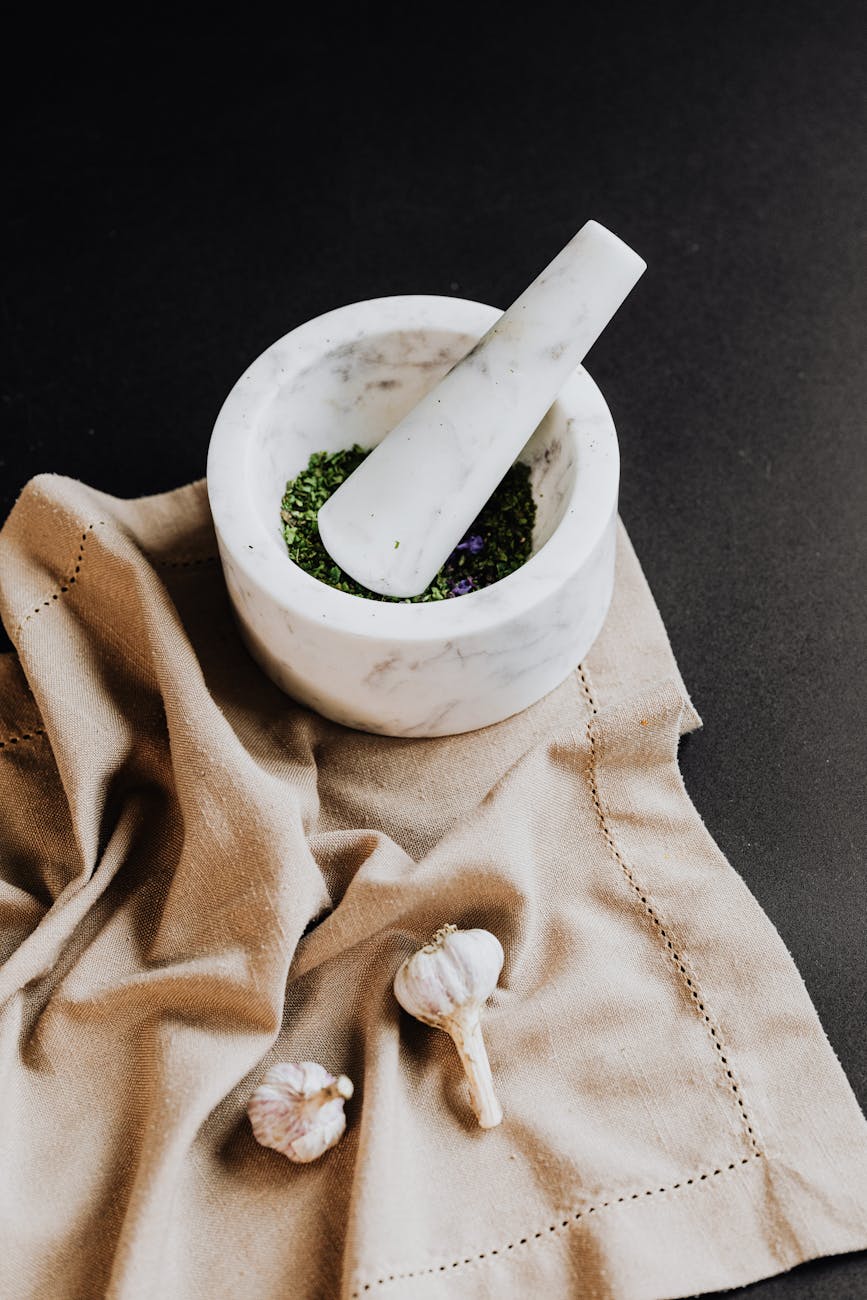
Close up shot of mortar and pestle near garlics.
Photo by Photo By: Kaboompics.com on Pexels.com

It’s also useful in salts or powders to protect an area. Mix dried, powdered garlic in black salt (or regular table salt) and sprinkle it in the corners of a room you wish to ward. If you want to use it outdoors, skip the salt and combine it with other protective herbs.
If you have pets, be aware that too much garlic can cause a condition called Heinz body hemolytic anemia. If you’re trying to ward a room that cats or dogs frequent, either skip the garlic and salt and go for pet-safe herbs or keep the animals out until you feel the herbs and salt have done their job and then sweep and vacuum the area thoroughly.

You can also decorate with garlic bulb wreaths/ropes, or even vases of the fresh flowers. Place them in any room you wish to keep clear of bad vibes. (Kitchens are typically considered the “heart” of a home, so they’re the perfect place for this. Also, you can pull off a fresh bulb to use whenever you need one).

Garlic is more than delicious — it’s healthful and powerfully protective. It’s also surprisingly easy to grow and harvest, making it a very useful addition to any magical or mundane home garden.

Plants and Herbs · Witchcraft

Wormwood Folklore and Magical Properties

Wormwood (Artemisia absinthum) is an African/Eurasian herb and relative of mugwort that’s widely grown in Canada and the US for its ornamental, medicinal, and even magical uses. It’s also a key ingredient in genuine absinthe, and is purportedly why the drink was rumored to cause hallucinations (but more on that in a bit). While the medicinal properties of A. absinthum have since been superseded by other herbs and pharmaceuticals, it’s still a powerful magical ingredient and a beautiful ornamental plant.

Wormwood is a very bitter herb, so much so that it’s been used over and over again in literature as a metaphor for bitterness. Shakespeare mentioned it. The Bible mentioned it.
This bitterness may, in part, be a source of its hepatoprotective properties: Bitter herbs are said to trigger the release of gastric juices, including bile from the liver, which helps sort of flush things out. This is why herbal digestifs and digestive bitters became a thing. There’s not a lot of peer-reviewed research on the subject, but bitters have a very long history of safe use as digestive aids.

Wormwood is also one of those magical plants that doubles as a pest repellent. This is something we see pop up over and over. There’s a logical progression from “herb that keeps disease-carrying pests away,” to “herb that keeps all unwanted influences at bay.” This makes wormwood valuable for protection and purification.
Interestingly, I have also seen wormwood listed as an ingredient for spirit calling. I don’t know if I’d use wormwood alone for this, but it certainly seems like it’d be a useful ingredient to make sure you’re calling the right spirits.
(I see parsley mentioned with wormwood pretty frequently, which is funny because it’s another weird one for spirit work. It is listed both as a spirit attractant and repellent, go figure.)

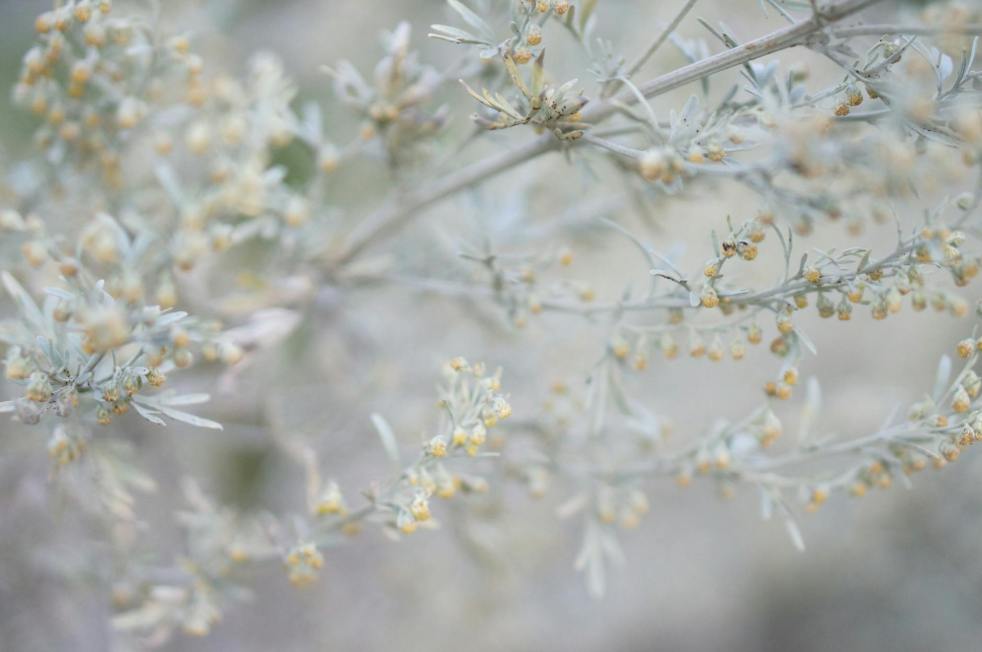
Leaves of a wormwood plant in close up photography.
Photo by Veronica on Pexels.com

This herb also plays a protective role in Slavic lore. The rusalka is an entity, said to be the spirit of a young woman who died by drowning, who is associated with life-giving rain… and, after the 19th century, with madness, death, and trickery.
Carrying wormwood was a way to guard against rusalki. They are said to target young men, so guys were told to carry a sprig of wormwood with them wherever they went. A rusalka would inevitably ask if they were carrying wormwood, or parsley. Say “wormwood,” and she’ll scream and try to flee, at which point you must throw the herb at her eyes. Say “parsley,” and she’ll ensnare, drown, and/or tickle you to death.
(As someone who is a) ticklish, b) hates it, and c) was frequently tickled against my will as a child, I think I’d rather drown.)

Wormwood is also connected to divination. It’s a relative of mugwort and has many similar properties. The two aren’t entirely interchangeable, but you can often substitute one for the other in certain situations. Wormwood’s focus seems to be more connected to protection and purification, while mugwort is more psychic and divinatory.
This herb is sometimes used in love magic, but not as an attractant — its main virtue seems to lie in love divination. There are multiple recipes and instructions for tying wormwood leaves to one’s forehead, placing them under a pillow, or brewing them with other herbs and honey and anointing oneself in order to get a vision of one’s future spouse.

Wormwood is tenuously connected to the Greek goddess Artemis (and Roman goddess Diana) through its name. However, the genus name Artemisia may be a reference to Artemisia II of Caria, and not Artemis directly.
In practice, this herb is considered to be ruled by Mars and Mercury, while Artemis and Diana are Lunar deities.

Wormwood is associated with Fire (which I can certainly see, as it’s a Mars-ruled herb that likes sunny spots and dry ground), but I’ve also seen it listed as an Air plant.

Contrary to popular depictions, absinthe wasn’t some kind of magic hallucination juice. Genuine absinthe does use wormwood, which contains the compound thujone. Thujone can, in concentrated form and large doses, cause hallucinations, convulsions, and death, but is present in absinthe in such tiny amounts that it doesn’t really do a whole lot. (Ironically, the compound absinthin is an anti-inflammatory and doesn’t have much to do with any of that.)
Absinthe’s hallucinatory effects have more to do with its high alcohol content (the stuff is about 50-75% ABV), the power of suggestion, and the fact that unscrupulous absinthe makers started adding copper salts as an artificial green coloring around the late 19th century.

Assorted liquor bottles.
Photo by Chris F on Pexels.com

During its heyday, absinthe was also much enjoyed by counterculture movements. This led to it being vilified by social conservatives, who had every motivation to hype up its “dangerous, toxic, and hallucinatory properties.”
So, what do you get when you mix an herb that might, potentially be toxic in specific circumstances, a buttload of alcohol, a bunch of bohemians, cheap absinthe full of poisonous colorants, and a bunch of social conservatives? You get a liquor with a legendary reputation as a toxic hallucinogen, and an unfair ban.

You can grow Artemisia absinthum fairly easily. Like mugwort, it grows in bright, dry, disturbed soil. It also self-seeds readily, so be prepared to either keep it confined to an area where it can’t do that (like a pot on a patio), deadhead the flowers, or keep up with rigorously removing new baby wormwoods as they pop up.

While wormwood isn’t as dangerous as popular depictions would have you think, it’s still a plant with toxic components that should be treated with respect.

Close up of common wormwood.
Photo by Jeffry Surianto on Pexels.com

Wormwood has historically been used as a flavoring herb. If you want to use wormwood internally, do so under the guidance of a qualified herbalist. There are multiple health and pharmacological contraindications at play here, so it’s important to be careful.

Otherwise, dried wormwood makes a wonderful addition to protective bottles, sachets, and other charms. You can:

  • Grind it into a fine powder and sprinkle it on or around anything you wish to protect.
  • Burn it and waft the smoke around an object or area you wish to purify.
  • Keep some dried wormwood (perhaps with its cousin, mugwort) with divination tools to keep them cleansed and ready for use.
  • Soak it in water and asperge spaces, objects, or people to cleanse them.
  • Soak or steep it in water and use the resulting “tea” to wash your front and back doors for protection.
  • Grow wormwood near doors for protection against malevolent energies, entities, or bugs. (For real, a lot of what we consider pest insects really don’t seem to like it.)

These aren’t the only uses for this herb, of course, but they’re probably the ones most in wormwood’s wheelhouse. You can also use it for love divination or spirit work, but this may depend heavily on your specific tradition, techniques, and situation.

Wormwood is a beautiful, interesting, complex, and contradictory herb. It’s a poisonous healer, a repeller and attractor of spirits, and an invaluable addition to a magical herb collection.


Plants and Herbs

Nepenthes (Pitcher Plant) Folklore and Magical Properties

Now that I’m home, I’ve been spending the day unpacking, straightening up the house, taking care of my cats and plants, and eating pho. It didn’t take me long to notice some new… uh, additions.

A close-up of an N. ventrata pitcher.
Audrey’s newest pitcher.

This is Audrey. Every so often, especially if she’s gotten plenty of humidity, she puts out gorgeous little pitchers. I reward her by hand-feeding her dried black soldier fly larvae.

A close-up of another pitcher on the same plant.
Another pitcher on the opposite side.

Since she seemed to be in particularly good humor when I came home, I thought now might be a good time to take a deeper look at the folklore and magical properties of the beautiful, unique, profoundly strange Nepenthes.

The plant genus Nepenthes is named for nepenthe, an ancient medicine said to heal sorrow and induce forgetfulness. It’s mentioned in ancient Greek literature, and is typically depicted as originating in Egypt.
It also appears in the Edgar Allan Poe poem “The Raven”:

Respite—respite and nepenthe, from thy memories of Lenore;
Quaff, oh quaff this kind nepenthe and forget this lost Lenore!”
Quoth the Raven, “Nevermore.”

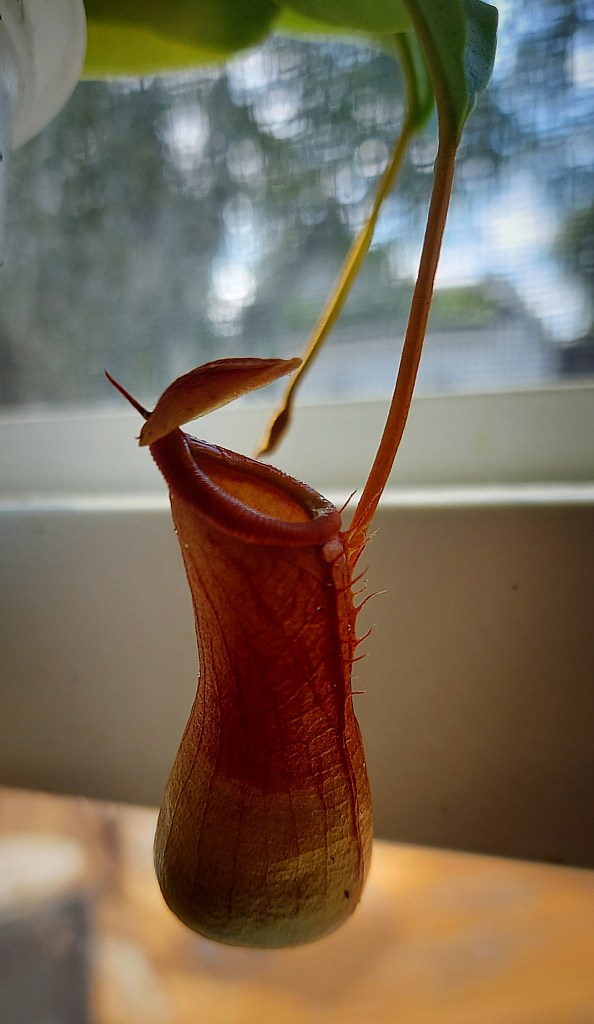
An image of an open pitcher plant, displaying the "lid," slender neck, and round belly of the pitcher.
Photo by Phoebeud83dudc1f on Pexels.com

Nepenthes consists of numerous species. In garden centers and plant nurseries, you’re most likely to encounter N. x ventrata — a hybrid of a N. ventricosa and N. alata.

Pitcher plants prey on insects by providing sugar and water to lure them into their pitchers. Their leaves have nectaries — special glands that secrete sweet nectar — and their pitchers contain water and digestive enzymes. Insects are attracted to the presence of food and water, and end up caught in the pitchers where they eventually drown and get digested.
(They’re pretty much Hotel California for bugs.)

However, not all pitcher plants feed on insects. N. lowii, a species native to Borneo, is known for its… rather unique shape.
Toilets.
The pitchers look like toilets.
Not only do they look like toilets, they are toilets.
N. lowii has an interesting relationship with a local shrew species. As with insects, the shrews are attracted to the pitcher plant’s nectar. While they’re there, they generally end up crapping directly into the conveniently toilet-shaped pitchers. The shrews get free nectar, and N. lowii gets free nutrient rich shrew leavings.

A close up of the mouth of N. bicalcarata, showing the pitcher's "lid" and two pointy "teeth."
Nepenthes bicalcarata, known for its two pointy “teeth.” It has a mutualistic relationship with a species of carpenter ant that makes nests in the plant’s tendrils. The plant benefits by receiving nutrients in the form of dead ants and ant feces. Photo by Yufan Jiang on Pexels.com

Other pitcher plants have symbiotic relationships with frogs. The frogs hang out in the pitchers, just under their “lids.” They eat insects that are attracted to the plant, and, as with the shrews, leave their nutritious little doots behind. They help dispose of pest insects that are more likely to harm the pitcher plant than to feed it, and the plant still gets a boost of nutrients.

One other pitcher plant species, N. rajah, has pitchers large enough to snare rats. It’s a particularly visually striking species.

In pitcher plants’ native areas, they’re often used as a source of clean water. When the pitchers initially form, they come complete with a little bit of water in their bellies to dilute the plant’s digestive enzymes to a usable level. People will sometimes crack open a fresh pitcher and drink the water inside. The trick is to use a very fresh, young pitcher — once the pitcher has opened itself, and its “lid” is raised, it may be contaminated and is no longer safe to drink.

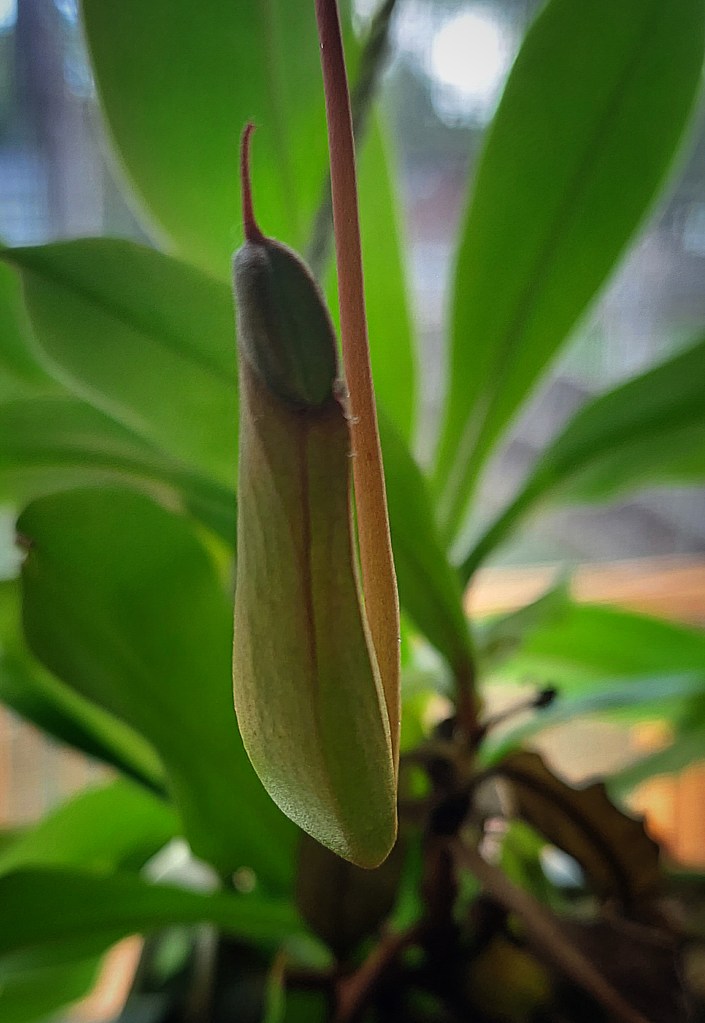
A close up of a young pitcher, with its "lid" still sealed.
This is an earlier image of the first pitcher pictured in this post. Notice how it’s greener, slimmer, and its “lid” hasn’t opened yet. Even in this state, it has a generous amount of liquid in the belly of the pitcher. At this stage, the pitcher hasn’t yet come into contact with any insects.

Interestingly, this water is more than just a refreshing drink on a hot day. It’s also used as medicine. Nepenthes water has been used to treat digestive issues and constipation (which makes sense, considering it’s just water and stuff that helps digest things), as well as urinary tract infections.
An extract of the plant is also used to prevent scar formation.

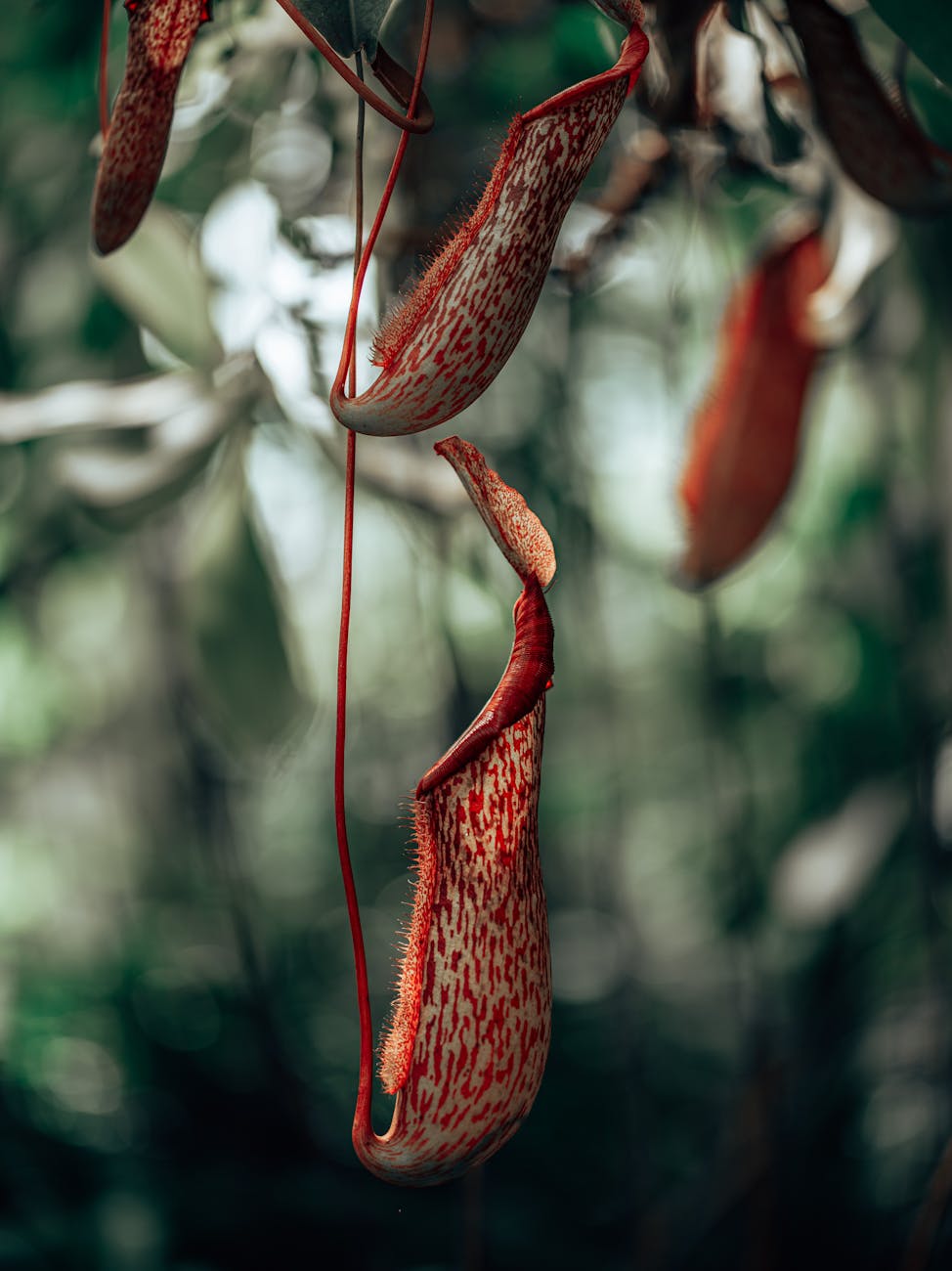
A view of particularly striking Nepenthes pitchers, with bright red hairs and streaks on their otherwise-green pitchers.
Photo by Egor Komarov on Pexels.com

There aren’t a whole lot of resources for those looking for typical European-based magical uses for Nepenthes species. From my own experience, these plants seem to be very useful for attraction. Just be warned — while they’re effective, they aren’t quite as docile and well-intentioned as something like rose or lavender. (All things considered, this probably isn’t too surprising for a carnivorous plant!)
They’re also helpful for defense and healing.
Lastly, Considering the enormous crossover between “plants that repel or get rid of pests” and “plants historically used for purification,” it may be worth experimenting with pitcher plants as a potential purification herb.

Elementally, pitcher plants are associated with Water.

If you have access to fresh pitchers, you can add the water to a ritual bath or window, door, and floor wash for attraction. Just make sure that these are fresh, unopened pitchers. You really don’t want to be dumping partially decayed bug soup into your bath.

If you don’t have access to them, then you can also use dried pitchers. Like any other part of a plant, they don’t last forever — the pitchers have a lifespan and naturally dry up and fall off after a while. Just make sure that whatever pitchers you use are cleaned up, free of insect parts, and completely dried.

Dried pitchers are suitable for container magic like jars, sachets, or spell bottles. They also look really cool when they’re pressed in a book or between glass.

I love carnivorous plants, but it’s not always easy to find resources for using them in western magic. Since I’ve begun keeping them and developing a close relationship with them, I’ve found that they have a wonderful variety of potential magical (and even medicinal) uses. Pitcher plants don’t just help keep homes bug-free, they’re also incredibly interesting and versatile friends to have!

Plants and Herbs

Lemon Verbena Folklore and Magical Properties

I wrote a post about vervain a while ago, which I chose to limit to Verbena officinalis and V. hastata. Today, I wanted to revisit this subject with a post on a vervain relative: Aloysia citrodora, lemon verbena.

Lemon verbena is native to South America, and was introduced to Europe in the 17th century. It’s a member of family Verbenaceae with a bright, citrusy odor (hence it’s name, citrodora). It has a long history of use in cooking and, while it was only introduced to Europe fairly recently, it has made a name for itself in various systems of European-based folk and ceremonial magic.

Within its native range, lemon verbena seems to be primarily used as a medicinal and food ingredient.

Medicinally, lemon verbena appears to boost sleep quality. Lemon verbena is also used as a digestive aid, and has demonstrated very interesting antioxidant and antitumor properties. There are mixed messages about its toxicity — while it’s generally regarded as safe for humans, some sources say that it’s toxic to animals.

Historically, lemon verbena was used to treat gout, as a diuretic, and to treat inflammation of the spleen or liver.

A blend of dried herbs in a teacup, against a white background scattered with more herbs.
Photo by lil artsy on Pexels.com

Putting a sachet of lemon verbena under one’s pillow is said to keep away bad dreams.

Lemon verbena is a pretty traditional luck herb. It’s said to convert misfortune to good luck, and is useful for cleansing, protecting, uncrossing, love magic, and attracting what you want. It also acts as a strengthening herb, meaning that it adds power to anything to which it is added, so it’s a good addition to herbal formulas for positive effects.

Interestingly, lemon verbena is yet another cleansing/protecting type herb that crosses over into a natural pest repellent. It’s often grown and used to keep mosquitoes away (possibly because its strong, lemony aroma covers up the natural scent of carbon dioxide that female mosquitoes use to detect people).

Lemon verbena is typically associated with the planet Mercury.

The easiest way to use lemon verbena is by steeping it. Get some of the dried herb and brew it like you would a tea. Strain out the plant matter, and use the liquid as an offering, drink it, add it to floor, door, or window wash water, you name it. Brew it with intention, stir it clockwise using your dominant hand, and visualize it filling with energy as you do.

While this herb has a very pleasant, citrusy scent and has been used in perfumes in the past, this is no longer advised. Natural components of lemon verbena essential oil are photosensitizing. So, if you’re looking for something to add to, say, an anointing oil, maybe give lemon verbena oil a miss. It’s fine for aromatherapy uses, but shouldn’t be placed on skin. If you have sensitive skin, I’d avoid adding lemon verbena tea to ritual baths, too.

Bottles of oils on a wooden tray, set on a wooden counter in a very modern-looking bathroom.
Photo by Pixabay on Pexels.com

As a tropical plant, lemon verbena isn’t the easiest to grow outside of that zone. It seems to have limited invasive potential in most of the US because it doesn’t get very large here, doesn’t proliferate very readily, and dies at the first sign of a freeze. In warm, moist areas (like Florida, for example), lemon verbena has an easier time self-seeding and expanding via root suckers. Plant with caution.

Lemon verbena is a beautiful, interesting herb with some fascinating properties. It’s easy to come by anywhere teas or dried herbs are sold, and very easy to use. (Just don’t get the oil on your skin and then go in the sun!) For many modern magic practitioners and herbalists, it’s a staple ingredient that it always pays to have on hand.