


Hello! I recently (roughly a month ago) received a review copy of Oracle Hekataios’ Strix Craft: Ancient Greek Magic for the Modern Witch which Crossed Crow Books sent to me, heartily enjoyed it, and started to write this review. Then I lost a fight with a loaf of sourdough bread, gave myself nerve damage in one hand, and got the flu. All of this is to say that this is a somewhat belated, but still pertinent, post about what is, in my inexpert opinion, a very good read.
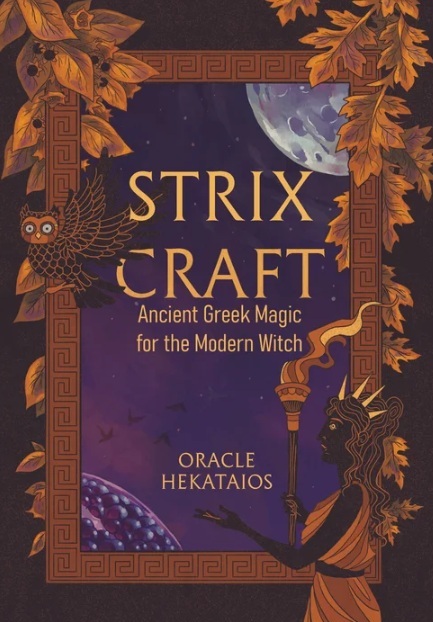
Strix Craft: Ancient Greek Magic for the Modern Witch is a discussion specifically of Ancient Greek ritual and magic. This is a subject that I, admittedly, don’t know much about. While I’m well-versed in Greek mythology and the pantheon, the traditions I have experience with all hail from elsewhere. Parts of my practice do draw from Mediterranean traditions, but the lion’s share doesn’t. That means that I came away from this book feeling like I’d learned a lot, but also that I’m not really knowledgeable enough on the subject to gauge its accuracy as a source of information for beginning Hellenic witches.
So! With all of that said, I did genuinely like this book. It’s well-written and, as I said, a very interesting look into a practice I don’t really know much about.
Particular highlights include the discussion of “miasma” in chapter one. Miasma is not sin or corruption as we might otherwise interpret it – it’s treated more as the residue of the human experience. Birth, death, funerals, all of the things that mark us as mortal. Or, in other words, all of the things that separate us from the divine. Strix craft involves mitigating this miasma, blurring the line between the mortal and the divine so change can take place. It’s essentially a kind of ritual etiquette that also alters consciousness and gets the practitioner into a magical frame of mind.
Another particularly interesting bit involved “Drawing Down the Moon.” If you’ve ever even brushed up against Wiccan practice (or read Margot Adler’s Drawing Down the Moon as part of your ADF studies, as I did), you’ve heard the phrase. But, while drawing down the moon is treated as a regular lunar practice in Wicca, its usage among ancient Thessalonian witches was very different. In that context, it was one of the most powerful and dangerous abilities they had. It’s phrased almost like a literal drawing down of the moon, as if they were able to pull it from the heavens (or at least appear to). In Claudian’s First Book Against Rufinus, an Erinye named Megaera says:
I have learned the incantations wherewith Thessalian witches pull down the bright moon, I know the meaning of the wise Egyptians’ runes, the art whereby the Chaldeans impose their will upon the subject gods, the various saps that flow within trees and the power of deadly herbs; all those that grow on Caucasus rich in poisonous plants, or, to man’s bane, clothe the crags of Scythia; herbs such as cruel Medea gathered and curious Circe.
The phrasing “pull down the bright moon” makes it sound less like an invocation of a lunar Goddess, and more like a celestial event that’d be dramatic, disorienting, and frankly terrifying to observers. Sort of The Color Out of Space meets The Legend of Zelda: Majora’s Mask. Neat!
Chapter four begins a discussion of the ethics of Strix craft, including four key virtues:
- Arete, or excellence. This is, much as it sounds, the virtue of striving to be the best in any endeavor you undertake.
- Xenia, or hospitality. This is in line with arete – striving to be as welcoming as possible, to be the best host possible, to strangers. There are loads of stories of deities and powerful beings visiting the homes of mortals… and what happens if their hospitality falls short.
- Eusebia, or piety. This is the idea of honoring the contract between mortals and the divine by acting correctly and embodying the other virtues. It is, in essence, a way to demonstrate that one is worthy of positive divine attention.
- And Sophia, or wisdom. This is, much as arete is striving to be the best in all things you attempt, striving to approach everything with awe and curiosity in order to learn as much as possible.
It was interesting to see how these ethics compare to the Druidic Virtues as taught by ADF: Wisdom, Piety, Vision, Courage, Integrity, Perseverance, Hospitality, Moderation, and (metaphorical) Fertility. Wisdom, of course, aligns with Sophia, as does Vision. Courage, Integrity, Perseverance, and Fertility align most closely with Arete, though they’re more specific areas and methods for achieving excellence. Hospitality aligns with Xenia, and Piety with Eusebia (though the idea of Piety in this context differs somewhat from Eusebia – while both involve honoring sacred contracts, the Druidic Virtue of Piety overlaps with Hospitality because honoring these sacred contracts also shapes our dealings with those around us).
Now for my favorite part: tools, altars, and practice. Chapter five contains a chant for awakening a sacred blade which I found succinct and elegant:
Blade of Sun,
Blade of Power,
Blade of Fire,
Awake Desire.
Living Spirit,
Underworld Being,
Dwell Within.
It’s one that I also think would be fairly adaptable for the awakening of other ritual tools, even outside of Strix craft. I like the structure, and I like that it doesn’t involve calling upon a specific deity. It’s actually somewhat reminiscent of a chant that I use for conducting ritual feasts, so the flow of it feels comfortable, in a way.
A few pages later, Oracle Hekataios discusses a particularly fascinating ritual tool: The Green Cube. This is a representation of Earth, made of wood or clay, painted green and with sides measuring four by four inches. This awakens naturally upon its completion, and acts a home for a familiar spirit, or daimon. This is the Strix’s connection to land spirits. The process for making the cube is unique, as is the method for attracting a daimon to dwell within it by planting and “feeding” the cube. (Honestly, the attraction method is something I’d like to try within my own practice – making vessels for spirits to choose to dwell within is a particular interest of mine, though I would likely choose an oak burl for a land spirit vessel in my own practice.)
The rest of the book is a compilation of well-organized herb lore and specific rituals. I won’t get into these here, with the exception of one specific part: On page 138, there’s a section on the Cult of the House Snake. The cult of the House Snake is an extension of the veneration of Hestia. Snakes are welcomed and even tended to with offerings, in the hopes that they’ll choose to stay to keep rodents at bay. This keeps food stores cleaner and diseases away.
It honestly reminded me a lot of the discussion of making offerings to spirits in The Spell of the Sensuous: Perception and Language in a More-Than-Human World by David Abram. In it, Abram recounts a specific experience of a woman bringing offerings of rice out to the edges of the property. Later, ants come to take the rice. This small offering keeps them away from the house itself. While the Cult of the House Snake invites a predator to repel pests, making offerings to the pests themselves — away from the house — also serves the same function of protecting food stores and preventing pest-borne diseases.
If I have one criticism, there were some bits that I wish were a bit more clearly worded. For example, the section on miasma describes it as “not ‘sin’ or ‘pollution,’ but a type of energy that makes mortals, well, mortal.” In the next sentence, it’s described as “a ritual borne of separating the unclean from cleanliness.” I had to read this section over again, because the line between “not pollution” and “also unclean, though” seemed a bit fuzzy, as was the idea of miasma as both an energy and a ritual for mitigating that energy. Ultimately, I feel like the core concept was still conveyed, it just could’ve been a bit clearer.
Is Strix Craft an accurate basis for a Hellenic reconstructionist path? I honestly don’t have enough knowledge to say. Is it an interesting, worthwhile read for people interested in a Hellenic path or witchcraft in general? Absolutely! It’s fascinating, it’s informative, and it introduced me to some ideas that I feel have immense value, even outside of this specific tradition.
 Marble Crow