Well, “borderline high,” according to the internet.
My doctor gave me the disheartening news that it’s genetic. I think it’s more likely to be a product of falling too easily into the temptation of getting takeout in a place with so many awesome places to eat.
Either way, I’m avoiding statins if I can. For now, I’m trying a different protocol:
Taking vitamin K2, on my doctor’s recommendation.
Taking vitamin D, because I tested low.
Eating 35+ grams of fiber per day. Oat fiber is supposed to be the best for maintaining a healthy blood lipid ratio, but I can’t have oats. So, psyllium, chia, and other fibers it is.
Going plant-based.
Eating more avocado. The thing is, I already cook almost exclusively with avocado oil because it has a higher smoke point than other oils, so I’m not sure how much of an impact this’ll have.
Increasing my physical activity. I’ve started with a round of sun salutations each morning, and a set minimum of any kind of other physical activity throughout the day. I get bored easily, so I won’t stick to a routine. Telling myself that it doesn’t matter what I do, as long as I do a half hour of it, seems to be the best way to ensure that it actually happens.
I was vegan years ago, but I say “plant-based” now. This is mostly because veganism isn’t really a possibility — I wear vintage leather, because it is better and less harmful than either new leather or vinyl alternatives. I use collagen to keep my joints functioning, and there is no vegan equivalent. I eat honey, because bees are unionized. I feed my kefir grains with plain sugar, which is sometimes whitened with bone char. There are some things for which there is either no less destructive alternative, or no actual replacement.
I’m also using complementary measures. This is mostly because fixing my blood lipids is mostly a matter of changing things and waiting — there isn’t really a whole lot to do. I have an aventurine and serpentine bracelet that I wear on my left wrist, so putting it on and noticing it throughout the day helps me a) feel like I’m actively doing something, and b) draw my attention back to getting my blood back out of whack.
I’ve also been using meditation. I meditate routinely as it is, but I’ve shifted my focus to very specific imagery, sounds, et cetera. Even if this doesn’t lower my cholesterol, meditation has enough other cardiovascular and general health benefits to make it worthwhile.
It’s going to take a bit for these things to have an effect. My cholesterol didn’t raise itself overnight, and it won’t lower itself that quickly either. Hopefully, in a few months, I’ll be able to have my blood drawn again and see that I’m back in a healthy range.
Have you lowered your cholesterol without statins? If so, what’d you do?
They’re versatile, inexpensive, and delicious. You can use them to carve stamps, prepare stuffing, or make a pie. Got an apple core? Feed it to worms or toss it in compost. They’re a delightful package of deliciousness, nutrition, and fiber.
They’re also pretty prominent in the religions of the areas from which they come. Eris tossed a golden apple and started the Trojan war. Iðunn’s golden apples give the gods youth, immortality, and vigor. Manannán mac Lir tempted Cormac mac Airt with a branch covered in nine apples of red gold. Emain, the otherworldly Plain of White Silver, had silver boughs with white apple blossoms.
We don’t have magic apples here, though I feel like Chehalis apples come close. I was drawn to their colors, ranging from emerald green, to golden yellow, to a pale, almost ethereal shade somewhere between the two. (I’ll just be happy if I get to eat one of these apples without the birds and wasps getting to them first!)
One of the little Chehalis apples on the tree in the back yard.
But apples are more than just magical symbols of the Otherworld, anyway. They’re also an indispensable ingredient in kitchen witchery, and even herbal healing.
Apple Folklore
Teasing out the folkloric significance of apples is more challenging than it might seem. Up until the 1800s, the word “apple” was used not just for apples, but also for as a generic term for fruits other than berries. This is why we have “oak apples” (a plant deformity caused by gall wasps), “earth apples” (cucumbers or potatoes, depending on who you ask), “love apples” (tomatoes), or “May apples” (a low-growing relative of barberry).
Ethnobotanists have made some compelling arguments for apples being used as a symbolic substitution for fly agaric mushrooms (Amanita muscaria), an entheogenic fungus. This is an interesting bit of information to keep in mind as you read through the rest of the folkloric and symbolic significance of apples.
The fruit eaten by Adam and Eve in the garden of Eden in Christian mythology is often said to be an apple. This is particularly interesting when you consider the effect of that apple and Terence McKenna’s “Stoned Ape” theory of humanity’s development. This widely-criticized theory holds that entheogens (specifically Psilocybe cubensis) are responsible for much of the progress of humankind. If Adam and Eve’s apple could be viewed as an entheogenic fungi, then the Christian story of the fall of man would be an allegory for entheogens leading to the development of clothing, agriculture, and more.
The larynx, which is usually (though certainly not always) more prominent in male humans, is called an “Adam’s apple” because of a bit of folklore that claimed that the prominence was created by the fruit sticking in Adam’s throat.
In later Christian mythology, Jesus Christ is portrayed as holding an apple. Here, the apple transforms from a sign of the fall of humanity, into a sign of redemption. Considering that this redemption leads to eternal life, this apple is somewhat akin to the apples of Iðunn.
In the Norse Prose Edda, the goddess Iðunn is said to carry an ash wood box in which she keeps golden apples. When the Norse gods begin to grow old, they eat her apples and become young again. The gods, then, depend very heavily on Iðunn’s presence and good will in order to maintain their youth and strength.
Apples weren’t always associated with youth and life, however. In the Heiðarvíga saga, the poet speaks of the “apples of Hel.” These appear to be the antithesis of Iðunn’s apples — the food of the dead.
In Greek mythology, Eris felt insulted when she wasn’t invited to the wedding of Peleus and Thetis like the other gods were. As revenge, she tossed a golden apple inscribed with the words “to the fairest” in between Hera, Athena, and Aphrodite. They immediately began arguing over who deserved it, and asked Paris to mediate. Aphrodite promised him the hand of the most beautiful woman in the world if he chose her, so he did. Unfortunately for everyone, that woman was Helen of Troy, and Paris’ decision kicked off the Trojan War.
The island of Avalon, the mythical, mystical place of Arthurian legend, is the Island of Apples. The name “Avalon” is thought to stem from the Welsh word “afal.”
In Cornwall, Kalan Gwav (Allentide) is a time for giving shiny, bright red apples to friends and family as tokens of luck.
In the Irish EchtraThe Voyage of Bran, Bran mac Febail sets out on his adventure when he receives a silver apple bough brought from Emain, the Plain of White Silver.
The Irish sea god Manannán mac Lir’s golden apples emitted a kind of magic lullaby. This could soothe people afflicted with injuries or illnesses to a healing sleep. The name of his paradisical home, Emain Abhlach, comes from the Old Irish “Ablach” (“of the fruits” or “of the apples”).
In the mythology of the people from the North Caucasus, there is a tree that groows magic apples capable of guaranteeing a child to whoever eats them.
During the Jewish holiday Rosh Hashanah, people dip apples in honey and eat them to bring in a sweet year ahead.
Wiccan lore views apples as a sacred symbol. This is because, when cut in half horizontally, their seeds and core form a pentagram.
An old bit of boat builder’s lore holds that it’s bad luck to make a boat from apple wood, since apple wood was used to make coffins. Doing so was believed to doom the sailors to an early grave.
A common bit of marriage folklore says that, if an unmarried woman peels an apple in one long, continuous piece, then throws it over her shoulder, the peel will fall in the shape of the first letter of her future spouse’s name.
Wassailing is an old English folk practice performed to bless the trees and bring in a big crop in the next harvest season. (I went to a wassail ceremony earlier this year, and it was a ton of fun!)
The Magical Uses of Apples
Apples are a common autumn food and addition to altars for autumn and winter holidays. This is because they’re in season during autumn, and tend to keep very well if they’re stored properly. Apple sauce, apple cider, dried apples, and carefully-stored fresh apples were vital additions to the western European diet during the cold months.
An apple bough with buds, flowers, ripe fruit, and unripe fruit is said to mark a door to the Otherworld.
In general, apples are magically associated with love, fertility, protection, and prosperity. The flowers are excellent additions to charm bags, the fruit is great for kitchen witchery, and the leaves can bring fertility and prosperity to one’s home or garden.
Using Apples in Magic
Apples are possibly one of the easiest and most convenient magical ingredients. Since apples are pretty sturdy and edible when raw, they’re often used as a kind of edible “package” for magical intentions. Hold an apple in your hands, visualize it filling with your intention, whisper your intention to it, and eat.
If you have access to apple leaves (either pruned or fallen — please don’t pick fresh leaves from the tree), bury thirteen of them in your garden. This is said to increase its productivity for the next year. I’d argue that you could also add these leaves to compost, or bury pruned or fallen apple wood in your hügelkultur mounds.
Apple blossoms are great ingredient for love magic. Their action is said to be gently seductive. They are also used for peace, contentment, and success. This suggests that they’d be a useful addition to any spell for attracting happiness into one’s life.
Apples are also said to be protective. Apple cider vinegar can be a useful (and pungent) addition to jars and bottle spells for protection against both one’s enemies and malevolent energy.
Another little Chehalis apple.
I can’t tell you how excited I am for apples this year. The springtime apple blossoms were incredible, and I check on the ripening fruits with excitement every day. Here’s hoping you can find ways to incorporate these magical fruits into your meals, rituals, and daily practices.
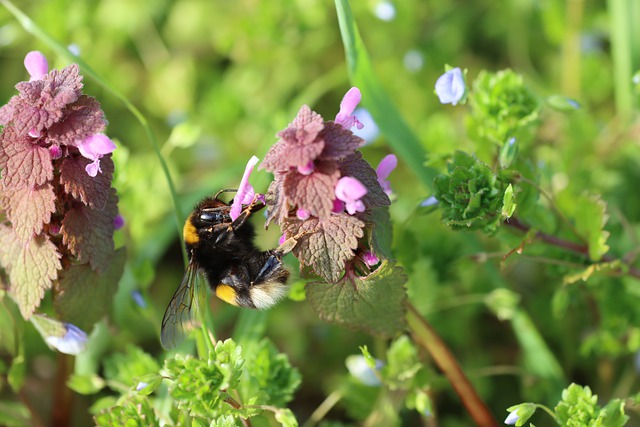
If you have any semi-neglected patches of ground in your life, you may have seen them — short plants with heart-shaped leaves, arranged like low towers accented by tiny flowers. Though they’re not native to this area, they’re pretty abundant. If you’re into controlling invasive plants, you’ll probably be happy to know that they’re also delicious edibles!
Don’t let the name fool you. Dead nettles aren’t poisonous, and they’re not nettles. They’re called “dead nettle” because they look an awful lot like stinging nettle, but their leaves are stingless. In reality, they’re part of the mint family (which probably explains their prolific growth and ability to thrive pretty much anywhere).
One of the best things about these nutritious plants? They’re easy to identify and don’t have any poisonous lookalikes. They’re also useful in all kinds of other ways.
Dead Nettle Folklore
Medically, purple dead nettle is used for allergies. It’s rich in quercetin, and has anti-inflammatory properties that make it useful for people with spring hay fever.
Some areas call it purple archangel, because it appears there around the Feast of the Apparition (May 8th). This was when the archangel Michael was said to have appeared on Mount Gargano, Italy, in the sixth century.
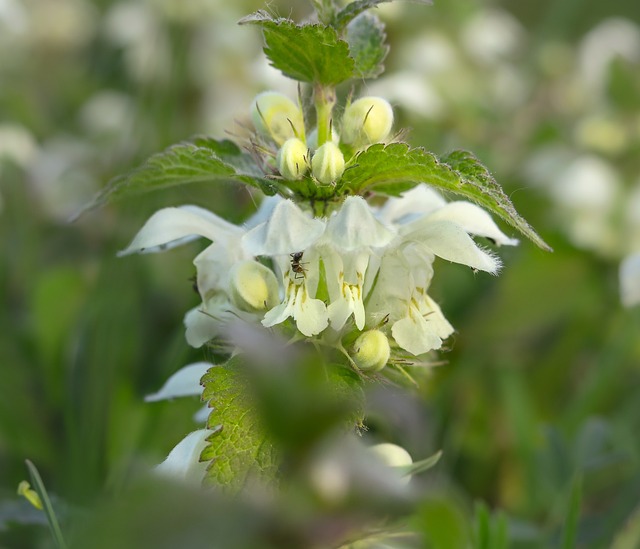
White dead nettle is sometimes called bee nettle. This is because it provides an early source of pollen and nectar, so it’s very popular with bees (and children! Kids sometimes suck the nectar from white dead nettle flowers, kind of like how kids used to suck the honeysuckle flowers that grew on the elementary school’s fence when I was little).
In Lancashire, it was said that white dead nettle flowers always come in twos, because they’re actually pixie shoes that have been left outside. These flowers also have two black spots inside, which are sometimes called “Cinderella’s slippers.”
White, spotted, and purple dead nettles are all used to treat stings from actual nettles. Mash the plant, squeeze out the juice, and apply it to the stung area. You can also chew some of the leaves and apply the resulting paste.
Magical Properties of Dead Nettle
Dead nettle is associated with determination, due to its ability to grow pretty much anywhere. (I’ve been harvesting it from cracks in the concrete, here.) It’s also connected to happiness, optimism, and relief.
Like other members of the mint family, it dries well. Harvest some, hang it upside-down, and put a paper bag around it to keep off dust and catch any dropped leaves or flowers. Once you have some dried dead nettle, you can use it in teas, incense blends, sachets, poppets, jar spells, or pretty much anything else. This small, unassuming herb is fantastic any time you need a hit of joy and motivation.
Dead nettle is also useful in kitchen witchery. Add it to soups, salads, or even pesto to benefit from its magical and anti-inflammatory properties.
This plant also works wonderfully in tinctures, salves, and oils. This is a great way to preserve it well beyond its season.
For now, I’m pulling it out of my raised beds to prepare them for other things. Some will be left for the birds (chickens, especially, seem to love the stuff), and the rest will be brewed into tea, blended into smoothies, eaten fresh, dried, and pureed and frozen in ice cube trays to add to soup or fill out pesto!
If you go on an allergy diet, you do it by eliminating common allergens, then re-introducing them one at a time over a period of weeks. This lets you figure out exactly what you’re reacting to, and how.
If you have sensitive skin, you probably also know not to add a lot of new products to your routine all at once. You add them one at a time, with space in between, so you can see how your skin responds.
If you have environmental allergies, it’s a bit trickier. When you move to a new place, you can’t really add in new allergens one at a time — your neighbors have flowers, and grass, and trees, and there are even new microorganisms to contend with.
So, when my partner was sniffling, sneezing, and miserable, it was hard to figure out what was causing it. He’d had an allergy test years ago, but no longer had the results. With so many new trees (and far more of them), there was no way to really tell what was making him feel so bad.
“Hey,” he called out to me, “What’s ‘Alternaria’?”
Alternaria. It sounded familiar.
“It rings a bell, but I’m not sure. Why, what’s up?”
“I found my old allergy test, and I was off the charts for that.”
Huh. It certainly seemed worth looking up, so I did. Fortunately, Microscope Master had some useful inf-
Wait.
FFFFFFFFFffffffffffffffffjkglhlrughjkfhvm,nmb–
Okay.
So, the same measures we were taking to help tamp down the grass allergens and get rid of the invasive plants were also creating a gigantic allergenic cesspool. I mean, I knew that there would be fungi. At least 90% of the point of smothering the lawn with a tarp was so it’d die and break down, thereby enriching the soil, and you need fungi to do that. I did not exactly count on the fact that the grass would fight back by mounting an assassination attempt of its own.
Well played, lawn.
But that’s okay. I have another weapon up my sleeve. One they’ll never see coming.
Clear sheets.
I’m very much against using plastic where it isn’t absolutely necessary. Part of the reason we initially chose to use a tarp was because we could use it for other things afterward, so it wouldn’t be single use. Fortunately, we were able to find some heavy-duty clear plastic sheeting that, while absolutely not ideal, I will use elsewhere after pressing it into service for grassassination. Glass would be better, of course, but is in no way practical. We considered layering the whole yard in paper, cardboard, and compost, but that wasn’t practical either (and a lot of soil amendments contain ingredients that aren’t sustainably harvested, like peat). Renting a sod cutter, or calling out a service to peel off the grass for us, was too expensive. We’d also probably have to replace the topsoil that’d be stripped away by the grass’ roots, which would be expensive and require many single use plastic bags.
I mean, I already feel like I’m being The Worst Druid by killing this lawn in the first place. The end result will be worth it, but the whole series of events feels very, I don’t know… Machiavellian. Still, a grass lawn represents a lot of waste (and wasted potential). I console myself with pictures of lush violets, wild ginger, and partridgeberries.
Anyhow. Clear coverings inhibit the growth of fungi by allowing more light to pass through. They still inhibit photosynthesis to a degree, and don’t trap quite as much heat as dark-colored ones do, but they work. They just take a little longer. And so, by the time you read this, I’ll be out wielding a mallet like Mjolnir, pounding giant staples into my lawn while cursing at the sludgy, dank mass of what used to be grass.
The lawn may have won the battle, but I shall win the war.
I mean, I can appreciate a carpet of grass from an aesthetic perspective, but only because I find its unnatural smoothness and homogeneity both pleasing and unsettling. If the Uncanny Valley has plants, they are all putting green grass.
When we purchased this place, we also become responsible for several thousand square feet of lawn. I should probably put lawn in scare quotes, because it’s less “lawn” than it is an amalgamation of grasses and weeds that look just enough like grass from a distance. The “Hello, fellow kids” of grass, if you will.
Grass is also a major drain on the local environment here. While its vital to areas like the African savannah, keeping it lawn-perfect requires too much water, fertilizer, pesticide, and either gas or electricity to mow. I say “too much,” because grass gives virtually nothing back when it’s confined to a postage-stamp of lawn. You can’t eat it, it’s too short to weave into anything useful, and mown grass is too tiny and insubstantial to make decent fuel. Lawns aren’t even good at feeding wildlife. If grass were allowed to go to seed, it could feed birds, but maintaining a lawn means cutting it short long it before it gets to that point. All lawns do is take, take, take. In a place where droughts are likely to become both more severe and commonplace, and habitat loss drives away native species, lawns can suck it.
Shown: The only useful purpose for a lawn.
Besides, all grass lawns are are socio-economic symbols. The ability to use a property for aesthetics and leisure alone signifies a certain level of economic security, which, back in History Times, was pretty much a form of rich people gloating. Turning the land around your fancy estate into an immaculate green carpet meant that everyone could see and marvel at your fancy estate. Having a grass lawn around your house, as a concept, is pretty new.
“But j,” you might be saying, “Flowers are grown for aesthetics, too!” This is true, but not entirely. Flowers are pretty, but they also feed pollinators. Grass is wind-pollinated, so it barely even feeds bugs. Flowers are also often the precursor to edible fruit. Even roses fruit, and they’re good for you!
I have a patch of soil at my disposal, so it feels more responsible to use it for the production of either food (if not for humans, than for wildlife) or native habitat. I don’t have a homeowner’s association, so nobody can tell me what to do with the dirt and I am free to create the habitat my wretched little goblin heart desires.
I also have very specific feelings regarding the stewardship of a yard. It’s land that was taken, carved into a suburb, had all of the native flora scrubbed off of it, and made to grow a boring, repetitive lawn. It just feels more respectful to the people, plants, and animals who once called it home to turn it back into something… I don’t know. More nourishing. Less sterile. More diverse. Abundant. Comfier. Sustainable, and sustaining in turn. Even if I live here until I die, this place will outlast me. I gotta do right by it.
I’m fortunate that not everything here is grass, though. On the margins of the property, you can see where the people who lived here before made a mark. There’s a rose bush, rue, a potted sedum, crape myrtle, and azaleas. Tucked away, there are some blueberries, an apple tree, a young persimmon, and a red maple. Like islands in squares of lawn, there are two tiny, tiny Japanese maples.
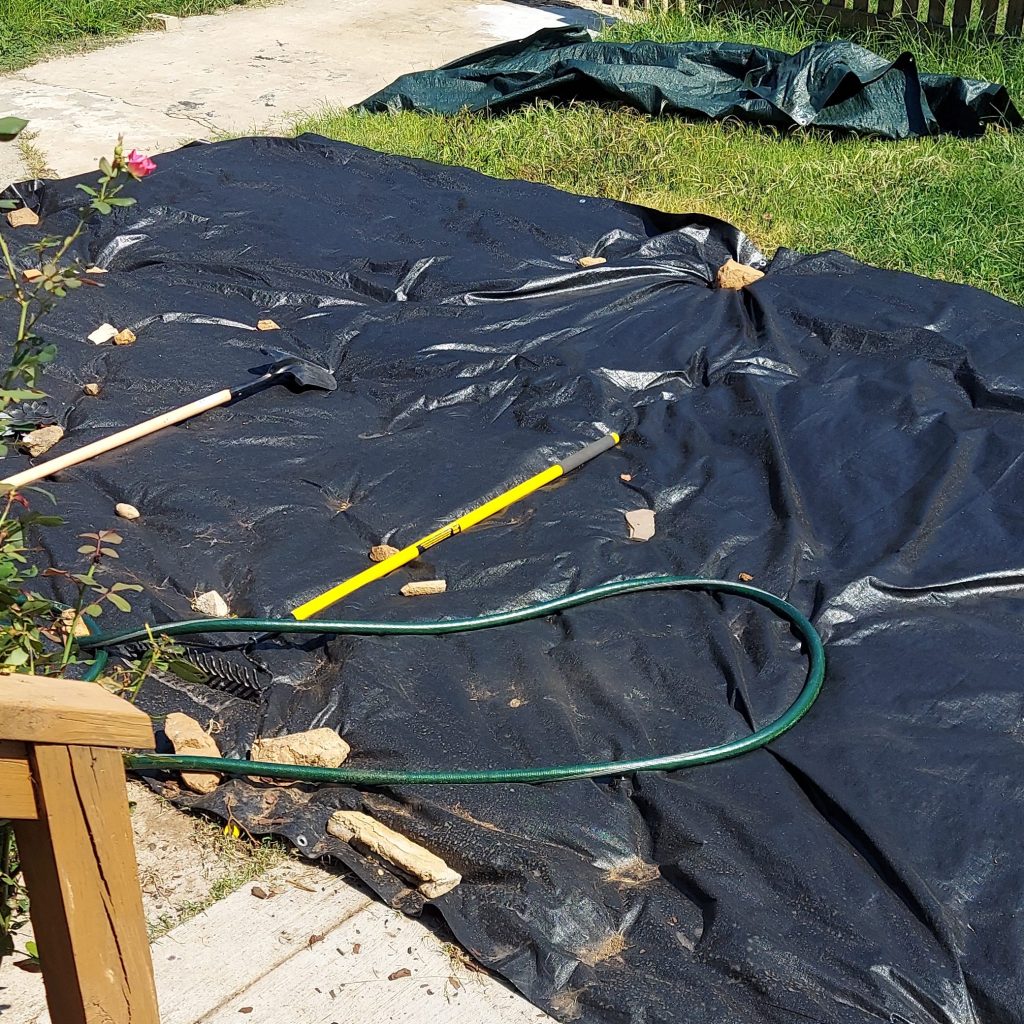
All of this is to explain why most of my front yard is currently a black tarp. Even if we’d needed to have a grass lawn for some reason, the front yard is about 50% actual grass, and 50% other kinds of plants (mostly invasives) that just kind of moved in when the intense light and heat killed off patches of the grass. Doing anything useful with the grassy areas pretty much involves going scorched earth — literally.
This is the gardening equivalent of having a rusted-out truck up on blocks in your driveway.
I spent a lot of time researching different ways to get rid of — and subsequently replace — an entire lawn, and this is the solution that seemed to be the best for our situation. A black tarp, when placed over closely cropped grass, captures a lot of heat. This, coupled with the deprivation of moisture and sunlight, kills the plants under it. They break down over a period of weeks, and you get a nice, nutritious patch of soil for growing better plants on. Right now, the plan is to replace everything with a mixture of sun-loving local groundcovers and plants that can pull double-duty as ornamentals and sources of food — Passiflora incarnata, for example, which produces these amazingly alien-looking blooms followed by tasty fruit. I’d also like to adopt the custom of growing edible plants near front gates and fences for passers-by. Even if people don’t want them, the birds will.
The tarp thing is just one method of grass assassination (or grassassination, if you would). We’re also using the “lasagna method” in other areas, which entails mowing the grass short, covering it in layers of paper and cardboard, and smothering that in compost, mulch, and soil. The grass dies, it and the paper break down, and you’ve got the foundation for a very fancy raised bed. (So far, this method is working very well for some bee balm and elderberry plants I put down in one corner of the yard, but more on that another time.)
So, if you’ve been reading here and wondering why I haven’t been posting, it is not because I’ve been kept busy with paid writing or have abandoned society and gone on a bender in a forest. I have been battling one of my greatest foes: LAWNS.
This is for that summer you made me spend on prednisone, you little green S.O.Bs.
If you’ve been following this blog, I know what you’re probably going to say.
“J. You already accidentally bought 47 strawberry starts. You were concerned about what you’d do with up to 140 pounds of basically-almost-free strawberries. Why did you go pay to pick strawberries somewhere else?”
You’re right. This was part of a meetup with one of my Druidry groups, and, to be honest, I wanted to go hang out. Besides, my own strawberry plants aren’t pumping fruit out just yet, so I figure this’d give me some tasty fruits for the meanwhile.
We went to Larriland Farm about an hour after the fields opened. You pay for your container in the beginning, take it to a designated area in the field, and fill it up as much as you can. Since you’re not paying by weight, the more you can fit, the better. My partner was initially going to get us two of those little blue molded fiber baskets, but we soon decided a larger flat box was a better idea.
To think, I thought the box was getting full here.
To his credit, he did.
A little less than an hour later, we had pounds upon pounds upon pounds of juicy, very ripe berries. I kept warning him that the box was full, but he was determined to heap them as high as possible. “Nah,” he said, “I can totally Tetris more in.”
All of us paused for meditation (and to eat a few berries) before leaving. Then, after tucking the box of strawberries in the back seat like it was a newborn baby, we carefully trucked them home.
At home, I pureed a bunch of the fruit with spinach, then poured it into an ice cube tray to freeze. Once frozen, it’ll be an easy, space-saving way to keep smoothie ingredients. Some of the fruit will be for salads, frozen for later use, used to flavor water kefir, or macerated in sugar for waffles and shortcake. I sliced a whole bunch, layered it with caramel and pastry, and made a tarte Tatin. Even with all of that in mind, there are still so many strawberries.
I hadn’t counted on how juicy the berries would be, so I ended up with a bit too much liquid. Neither of us complained, though!
It’s kind of funny. The blue paper pulp boxes wouldn’t’ve been nearly enough. The next size up, I feel like I’m drowning in berries. It is a problem I enjoy.
I also discovered that it’s possible to break out in a rash from touching strawberry plants, even if you’re not at all allergic to the fruit. Strawberry leaves have trichomes, which are possibly best known as the little hairs on cannabis plants. Strawberry trichomes come in two types: glandular and non-glandular. The non-glandular ones are just little poky hairs that are kind of physically irritating, and help keep bugs at bay. The glandular ones, on the other hand, are attached to glands. These trichomes can inject tiny amounts of defensive compounds.
Imagine if, to protect yourself from bears and muggers, you never left the house without putting on a special anti-bear-and-bandit coat covered in hypodermic needles filled with acid.
The end result was one mother of a rash from the back of my hands to my elbows. This probably isn’t a true allergy, and more a product of spending like an hour accidentally injecting myself with tiny amounts of liquid “fuck off” in strawberry language. I even tested this idea by taking a fresh berry, eating a tiny bit, and rubbing the bitten portion on the inside of my elbow. Aside from a red stain, there was no rash, no itching, no welts, nada. So I’m pretty much free to gorge myself on as many strawberries as I desire.
Here until the ocean wears rubber pants to keep its bottom dry, j.
There’s been a lot of buzz about pennyroyal on the interbutts. Even if you don’t fall in the demographic of people likely to ever have to worry about pregnancy, you might know what large doses of pennyroyal can do just through cultural osmosis.
Unfortunately, this lovely herb’s use is controversial for good reason.
Pennyroyal Magical Uses and Folklore
Pennyroyal is either feminine and ruled by the planet Venus, or else it’s masculine and ruled by Mars. While this is confusing, I feel like it illustrates the dualistic nature of this herb very well — it’s an objectively beautiful plant, with its lush, creeping growth and clusters of purple flowers invariably covered in bees and butterflies, but it’s also a deadly poison.
As an herb for travelers, a few leaves placed in each shoe was believed to offer protection and guard against tired feet.
Because of the herb’s use as an emmenagogue, it’s sometimes used as an ingredient in sachets and jars for blood magic and protection (especially for sex workers).
Interestingly, this herb is also used for peace. When carried or hung in a space, it helps keep tempers from flaring. (Be very cautious to avoid hanging it where pets or children might ingest it!) This might be an extension of its use as protection against the evil eye. If you think about it, it makes sense — it’s a soft, fuzzy, flowery herb with an unassuming appearance, but it hides a potent poison. Pennyroyal is pretty much the embodiment of an iron fist in a velvet glove.
Pennyroyal is also used to break hexes and curses.
The botanical name, Mentha pulegium, stems from its ability to repel fleas. This might also be the source of its protective powers — it chases fleas and negative or malevolent energies away.
In ancient Greece and Rome, wearing a crown of pennyroyal was believed to relieve headaches. The herb was also used to flavor savory foods.
Pennyroyal is still used in North African cuisine to this day. The US Food and Drug administration allows naturally-derived pulegone, a compound found in pennyroyal, as a flavoring agent.
Pennyroyal as Medicine
Pennyroyal is a mint. Members of the mint family contain a naturally-occurring compound called pulegone, which appears to be the primary source of this herb’s toxicity. Even when it isn’t acutely toxic, pulegone has been found to cause pre-cancerous changes in the organs of rodents. The thing is, while herbs like catnip and peppermint have much less pulegone, pennyroyal has a lot.
With that in mind, let’s talk about something called the “therapeutic window.” Put briefly, this is the range where you get the benefits of a medicine, without significant adverse effects. Some medications have a pretty broad therapeutic window. Some do not. Some therapeutic windows are so narrow, they’re not worth considering as treatment.
Pennyroyal falls squarely into that last category.
The thing is, pennyroyal does have some medicinal benefits. Traditionally, it was used as an ingredient in teas. It’s said to be good for flatulence and stomach cramps, like many other members of the mint family.
This is all in very low doses, however, and the beneficial effects of pennyroyal can be found in other, much safer herbs. Flatulence? Try a carminative like caraway seed. Indigestion? Regular peppermint will probably do you just fine.
Pennyroyal also has a reputation as an abortifacient and emmenagogue, meaning that it can trigger an abortion or bring on a period that’s been delayed. The dosage required to do this is pretty much at the far end of the therapeutic window, and the variability in strength of herbal medicine makes it impossible to figure out the difference between “safe and effective” and “deadly.”
Think of it this way — plants aren’t inert. They respond to their environment. If there’s heat stress and a lot of pests, they produce more of the volatile compounds that help them survive. If they’re in a relatively low-stress area, or pampered in a greenhouse, they’ll likely be less intense. This means that, if you’re trying to figure out your own dosage of pennyroyal, you’re pretty much flying blind. You have no way of knowing how much pulegone a given dosage of pennyroyal might contain.
That means that not only might you not actually trigger an abortion, you could end up destroying your liver, kidneys, and lungs instead. Worst case scenario, you will die and it will hurt the entire time. Just like everything else, there are much safer herbs that can help bring about a late period.
I have only one piece of advice when it comes to using pennyroyal medicinally: Don’t, unless you’re doing so under the guidance of a doctor. Unfortunately, we don’t yet have an antidote for pennyroyal poisoning.
Using Pennyroyal
While it’s still used in dishes like batata bel fliou, if you don’t have experience cooking with pennyroyal, it’s best to err on the side of caution and avoid putting it in brews, potions, or foods.
Oil of pennyroyal is the most toxic form of the plant, so you may wish to find an oil with comparable magical uses instead — especially for anointing.
Other than that, pennyroyal is fine to use in jars, sachets, and spells that don’t involve taking the herb internally. Since it’s been shown that it can cause pre-cancerous changes in the lung cells of rats, I’d probably avoid putting it in incense. (Members of the mint family tend to smell awful when burned, anyhow.)
If you’re a sex worker (or just someone who enjoys sex and wants to protect themselves), you might want to include it in a jar for attraction and sensuality as a sex-specific protection herb. Combine it with ingredients like rose petals, jasmine, and sugar, seal with the wax of a red candle, and keep it under your bed.
For protection, fill a jar with pennyroyal, cactus spines, garlic, and hawthorn. Keep it under your porch, or bury it near/under your front steps.
For peace, mix pennyroyal with lavender and thyme and put it in a jar. Seal it with the wax of a white candle, and keep it in a safe place near the heart of your home.
Pennyroyal isn’t immediately and intensely poisonous like some herbs can be, but the people most likely to look for it for medicinal purposes are at the most risk. If you’re experiencing menstrual irregularities or a late period, there are other treatments out there that are much safer for you.
So, toxic positivity. If you haven’t personally encountered it, you might be thinking, “J, you absolute drill bit, how could positivity be toxic?” Just roll with me on this.
What’s toxic positivity?
Eat a healthful diet and exercise regularly, and that’s healthy. Obsessively count calories and jog for hours to burn off every meal, and that’s an eating disorder. Play video games to relax, and that’s good and fun. Play video games for hours on end, to the point where you’re eating at your desk and your room looks like a Superfund site, and that’s unhealthy escapism. Looking on the bright side of things is healthy. Police your thoughts to avoid having an iota of negativity sneak in, and that’s toxic positivity.
Toxic positivity shows up in a wide variety of ways. In this context, I want to talk about the stay-positive-at-all-times-to-attract-a-better-life-for-yourself that still seems to pervade the internet and new age thought in general.
In some sects of fundamentalist Christianity, women are told to “keep sweet.” Despite what they may feel, they must be “joyfully available” to their husbands. No matter what, that positive facade must be upheld.
This happens in new age circles, too. Concepts like the Law of Attraction tell people that negativity begets negativity. That means that you should fill your life and thoughts with positivity, so your life gets better. If things are bad, you’ve clearly brought it on yourself by being negative.
Positivity becomes toxic when it’s rigidly enforced in the face of all sense and reason. When you’re told that your negative thoughts and feelings attract bad things to you, thereby holding you responsible for all of the slings and arrows of outrageous fortune, that’s not healthy. It’s natural to feel bad — and even act on that feeling — when bad things happen. People who are born into poverty, become disabled or very ill, or experience other misfortunes don’t manifest these things for themselves.
Toxic positivity happens in a climate that enforces a status quo. When you’re made to feel responsible for misfortune in your life, and, above all, not to ever let on that you’re unhappy, you’re less likely to agitate for necessary changes in your life and the world around you.
It wasn’t always like this.
It’s also not uncommon to see new age gurus misappropriating very spiritual concepts in order to push this modified version of the prosperity gospel. You can see this in the idea that ever having or expressing a “negative” emotion could block one’s chakras, disrupting one’s internal energy flow (at least, until you pay a guru for a class, video, tool, or treatment to fix it).
The thing is, while this idea isn’t exactly new, it’s relatively recent. It’s also something that crops up as a means of control — tell people that their negative emotions will harm them, and it saves you from the inconvenient work of having to care about other people. Get enough people to believe that their misery is their own fault, and the rich and powerful get to stay rich, powerful, and beyond criticism.
The Three Cauldrons as a Remedy for Toxic Positivity
Amergin was a Druid and bard in the Irish mythological cycle. The idea of the Three Cauldrons is attributed to him, taken from a collection of poetry and prose that dates back to the fifteenth century CE. While these writings come from that period, the ideas within them may hearken back as far as the eighth century.
In these writings, humans are regarded as having three cauldrons within them: Coire Goiriath, the Cauldron of Warmth; Coire Ernmae, the Cauldron of Motion (or Vocation); and Coire Sois, the Cauldron of Wisdom. These should not be conflated with the energy centers found in other spiritual writings and systems — the Three Cauldrons aren’t simply a European equivalent to chakras. The writings don’t actually specify where, exactly, the cauldrons are. Are they in the body, the soul, both, or neither? Despite this, it’s generally accepted that Coire Goiriath resides in the lower belly, Coire Ermae in the chest, and Coire Sois in the head.
With this in mind, people are generally considered to be born with their Cauldron of Warmth upright, filled with vitality and the capacity for physical growth. Their Cauldron of Motion/Vocation is on its side, and turns upright only after growing, learning, and experiencing things. The Cauldron of Wisdom is upside-down. It should be noted that not everyone’s cauldrons are oriented the same way — some people have differing talents, levels of physical vitality, and so forth. There is no ideal way for your cauldrons to be, they simply are. It’s your job to do the work to maximize the potential of what you’ve been given.
My own existence springs forth from the Cauldron of Poesy, Which was created by the gods from the dúile; Enlightened is each inspiration That streams forth in my speech and from my center of being. I am Amergin White Knee, Ancient in years and gray of hair. My inspirations are found within The many forms of poetry That are born within my Cauldron of Warming. The Gods do not orient each person’s Cauldrons equally Or fill them with the same talents and abilities: Some are formed upside down, some tilted or upright. Some are empty, while others are half full, Some are filled with knowledge like Eber and Donn, Capable of creating chants of life and death, Through a skillful combination of words In the power of three genders: masculine, feminine, and neuter, And possessing the strength of three measures: double letters, Long vowels and short vowels. My Cauldron of Vocation is trained Through a study of the arts of poetry And sustains me through proper composition. I sing also of the Cauldron of Knowledge That allocates the gifts of wisdom According to the laws of each art And the work of each artist in general.
Amergin, TheCauldron of Poesy
The Cauldron of Motion
While people can be born with their cauldrons oriented in different ways, they don’t need to stay like that. For people who wear blinders throughout their lives, their Cauldron of Motion may be upside down. Those who practice the arts may have their cauldron on its side. Those who go through the depths of sorrow and heights of ecstasy may turn their cauldron upright.
I want to highlight that last part: the depths of sorrow and heights of ecstasy. Eighth century poetry acknowledged that, in order to write, sing, and create art, you needed to experience things. Not just one kind of thing. Sorrow is as integral to the process as joy is.
The writings get more specific here, too. Longing, grief, envy, and the search for the divine are all acknowledged forms of sorrow. Good health, marriage, and accomplishment are some of the acknowledged forms of joy. The concept of balance — not just between joy and sorrow — is further emphasized:
The Cauldron of Vocation Fills and is filled, Grants gifts and is enriched, Nourishes and is enlivened, Sings praises and is praised, Chants invocations and is enchanted, Creates harmonies and is harmoniously created, Defends and is strongly defended, Orients and is aligned, Upholds and is upheld.
Good is the wellspring of measured speech. Good is the home of the well of speech. Good is the joining of their powers: Strength is made durable.
It endures longer than any fortress. It is better than any tradition. It is our guide to wisdom, As we free ourselves from ignorance.
Amergin, excerpt from The Cauldron of Vocation
This power comes not from upholding positivity in the hopes of attracting a better life. It comes from the work of experiencing both joy and sorrow, devoting yourself to a greater pursuit, and acting and speaking with honesty and integrity. This is the origin of strength, endurance, and freedom. This is what lets us change things not only for ourselves, but for the world.
Studying Neodruidry has given me a lot of exercise for mental discipline, but didn’t really come with a physical side. Plogging is something that follows that mindset, but is also something I’ve been doing for ages and don’t really consider an additional physical activity. I wanted another way to make myself stronger, enforce physical discipline, and burn off some of the extra ADHD energy.
Even if you aren’t a degenerate weeb (just kidding — ily degenerate weebs) you’ve probably seen/read/heard of One Punch Man. Even if you haven’t done any of that, you’ve probably seen a meme or two based on it.
Anyway, at one point, someone asks Saitama how he became One Punch Man. His answer?
It’s not bullshit, either. There are tons of breakdowns of (and testimonials about) the One Punch Man Workout all over the internet at this point.
My only problem is that, while I covet the muscular limbs of a Percheron, my own are noodly and disappointing. Shovelglove has absolutely helped my upper body and my endurance, but I need something for my most-of-me.
So, for now, I’m adding in what I call the Five Punch Man workout. It is basically the same as Saitama’s, just… one fifth of it for now. Twenty push-ups, twenty sit-ups, twenty squats, and about a mile and a half’s worth. I’ll work my way up to a hundred, assuming my knees don’t come apart in the process.
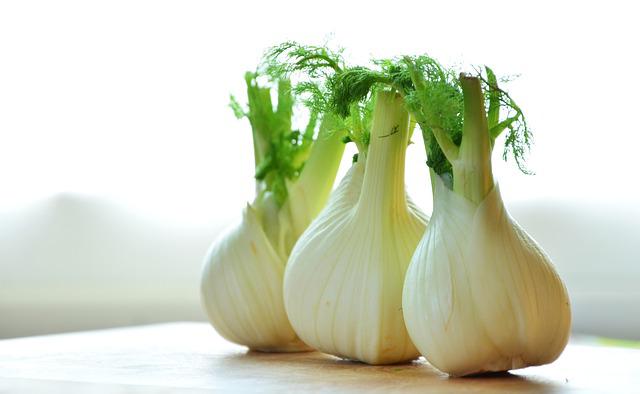
Fennel (Foeniculum vulgare) is a Mediterranean herb related to carrots. The type you see in supermarkets is bred for its large bulb, which is eaten as a vegetable. You can also find the dried leaves in teas and herb blends. It has a flavor very reminiscent of anise or licorice that becomes mild and sweet during cooking. It’s also related to silphium, a plant that was both considered a delicacy and included in formulas to cause miscarriage.
One of the most interesting things about fennel is its action on the endocrine and reproductive systems. While it isn’t true that the ancient Romans harvested a relative of fennel to extinction for to use for herbal abortions, alcohol extracts of a relative of giant fennel (the source of the spice asafoetida) have been found to prevent egg fertilization and induce miscarriages in rats.
Fennel Magical Uses and Folklore
While fennel isn’t exactly the same plant as asafoetida, fennel seeds do act as a uterine stimulant. Part of this is due to an estrogenic effect, possibly courtesy of the compounds anethole, dianethole and photoanethole. Fennel also contains an enzyme that effects the body’s ability to process certain drugs. In the 3rd century, a doctor named Metrodora included a species of fennel in a compound of herbs to cause miscarriage.
Fennel is one of the plants in the Anglo-Saxon Nine Herbs Charm. To wit:
[C]hervil and fennel
very mighty these two plants created the wise leader holy in heaven
when he hung set and sent into the 7 worlds
for wretched and rich all to remedy
stands she against pain
stands she against poison.
Who is mighty against 3 and against 30
against fiends hand
against spells
against enchantment by wicked wights.
An excerpt from the Nine Herbs Charm, from the Lacnunga
Interestingly, Pliny the Elder claimed that silphium (the much-desired fennel of ancient Greece and Rome) had a powerful purgative effect when initially consumed. It was said that the plant purged the body of undesirable “humors,” effectively causing a kind of physical purification. However, Pliny also thought that snakes ate fennel to improve their eyesight, so maybe don’t take everything he says at face value.
When planted around the home, fennel acts as a magical ward. This may be based in part on its use as an insect repellant — the idea being that it repels evil just as well as it does bugs. As an extension of this idea, medieval households would hang fennel above the door and fill their locks with fennel seeds to keep wandering, unsettled ghosts away.
Fennel seeds are burned to purify spaces. You can also dress a candle with fennel seeds to break streaks of bad luck and crossed conditions in your life.
Fennel’s estrogenic effects were sometimes relied on to improve libido. By extension, the flowers and seeds are often used in sachets and charms to enhance one’s love life.
Planting fennel and dill together can result in hybrid plants that look like a cross between the two and taste like neither.
Followers of Dionysus carried wands made of fennel stalks.
Fennel is used for courage. Chew the seeds or drink fennel tea before you have to do something scary or difficult.
Using Fennel
Consume the seeds or drink the tea to help trigger a late menstrual period. The maximum dosage of fennel seeds for an adult human is about 6 grams. More than that may cause unwanted effects.
You can use pretty much any part of the fennel plant — chew the seeds, put them in tea, eat the bulb and stalk as a vegetable, you name it. This means that you’re pretty much free to choose whichever part of the plant resonates best with you, and use it however it suits your purposes. If you plan to consume it, be sure to do your research to make sure it won’t interact with any other herbs or medications you’re currently using. It’s generally safe in food amounts, but the risk of adverse side effects increases with the dose.
Fennel seeds are great additions to sachets, powders, and potions.
Growing fennel is fairly easy. It can grow in zones 5-10, and is a perennial in zones 6 and up. Nonetheless, it’s usually treated as an annual — it self-sows prolifically, and you’re likely to harvest and use the whole plant once its mature anyhow.
Sow fennel in early spring, about 16-18″ apart in an area that receives full sun and has enough headroom for the plant to reach its full 5′ adult height. (It’s best to direct sow, because fennel isn’t very receptive to transplanting.) Avoid planting it near other plants, since it secretes a compound that prevents competition. Coupled with its sun-blocking height, and you may find that its neighbors really struggle. Fennel also hybridizes readily with some other plants, so you may find that the seeds you get from it aren’t true to the parent plant at all.
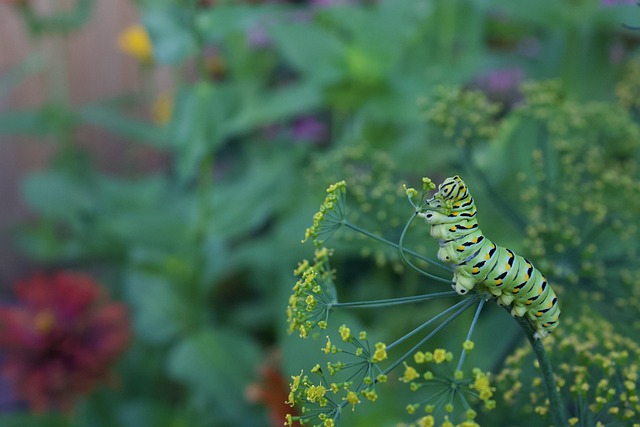
Water fennel regularly until its well established. The plant generally doesn’t experience many problems, though you might find swallowtail butterfly caterpillars chewing on the leaves!
Harvest fennel after about two months, once its mature. Cut off the flowers as they appear, unless you want to gather the seeds (or would like the plant to self-sow).
Burn the seeds or stalks for purification or protection. Blend with rose petals, cinnamon, and other love and lust herbs for use in aphrodisiac formulas.














 Marble Crow