crystals

Lemon Quartz vs Citrine vs Tangerine Quartz vs Golden Healers — FIGHT!

Before I get into this, there’s a quote on a Mindat thread that I think sums it up pretty well:
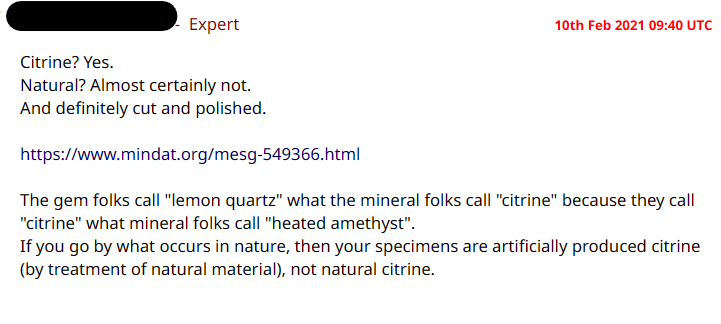
The discussion was on lemon quartz versus citrine, with one poster attempting to discern if their specimens were natural, untreated citrine. If it seems kind of confusing… it probably should, to be honest.

I’ve written about citrine in the past, and I think I did an alright job of covering the chemical and physical properties of natural citrine and heat-treated amethyst. This time, I’d like to look at a couple of other semi-related mineral specimens.

Lemon quartz is a variety of quartz that presents with a light yellow color. It’s unmistakably yellow, too — not the toasty orange of heated amethyst, or the smoky yellow, apple juice hue of a lot of natural citrine.

So, is it dyed? Irradiated? Cooked? What’s the difference between one type of yellow quartz, and another type of yellow quartz? While it does certainly seem like some lemon quartz is just light, very yellow citrine, this isn’t always the case.
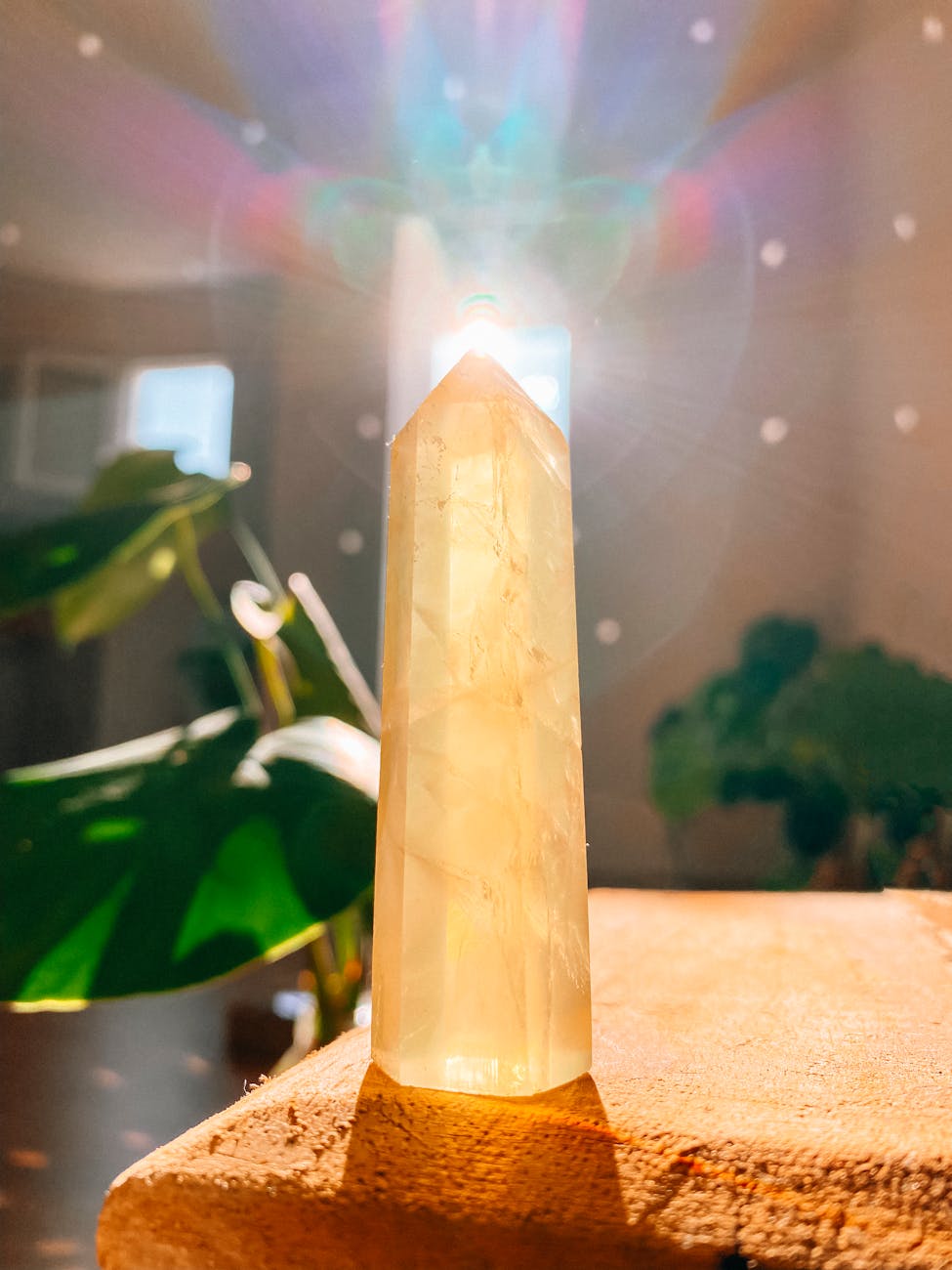
A tower of a translucent, honey-colored mineral sits on a wooden table. In the background, there are several houseplants and a rainbowy lens flare.
Pexels assures me that this is citrine, but it honestly looks more like a faceted and polished honey calcite to me. Photo by Alina Vilchenko on Pexels.com

Ouro Verde quartz, which is also called lemon quartz, is a treated gemstone with a greenish yellow color. These are made by heating irradiated, very dark smoky quartz. (There’s a very interesting explanation of the treatment and discovery of this quartz here.)

To sum up: Specimens sold as lemon quartz may be either particularly yellow citrines, or a bright greenish yellow quartz produced by irradiation and heat treatment.

With all of the above in mind, how do you know if you have natural lemon quartz?

As I briefly explained in my post about citrine and heat-treated amethyst, the best way to tell is to observe how the stone behaves in light. Hold it up to a polarized light source and turn it from side to side. Does the color seem to shift a bit from one angle to the other? The stone is exhibiting pleochroism, a hallmark of natural citrine. If the stone is very yellow, that citrine can also be considered a lemon quartz. Heated amethyst doesn’t exhibit this phenomenon, and neither would irradiated and heated clear quartz.

It should also be noted that, in their natural forms, crystals don’t often exhibit the kind of bright hues you can get from heating and irradiating stuff. If it’s really bright yellow — bright, sunny, lemon-candy-highlighters-and-pineapple-Fanta yellow — it’s likely had some help getting there.

Look, you pick a fruit, and there’s probably someone online selling quartz named after it. It’s like when people were posting about “strawberry makeup” and “latte makeup,” when what they really meant was “pink blush and eyeshadow” or “different shades of tan eyeshadow and also maybe some bronzer.”

Gem folks and mineral folks very often don’t use the same names for things. In the gem trade, having something that sounds new, unique, and exotic helps you stand out and improves the marketability of your stones. Mineral folks are more concerned with identification, so interesting new names are more of a hindrance than a help. Neither is necessarily better, they’re just two ways of approaching vastly different goals.

The trade names that stones are given don’t need to have any real meaning or relation to the stone’s actual composition. They don’t even have to relate to each other. While they’re both citrus-y, natural lemon quartz is yellow citrine and tangerine quartz is quartz with a coating of iron oxide.

You’ve probably seen or heard of aura quartz before. This is quartz that is colored by vapor deposition, in which the stone is coated with a micro thin layer of vaporized metal ions. This thin layer of metal gives it a shiny, brightly colored finish, and the specific metal ions you use determine the final color.

Sometimes, a process similar to this can occur in nature. Tangerine quartz is quartz that has received a blanket of iron oxide particles at some point during its formation, giving it an orange color. Depending on when this happens, the iron oxide may be present as phantoms or inclusions within the stone. Sometimes, it’s just a surface coating.

When nature throws quartz and various metal oxides together, you can get some really funky-looking crystals. I saw a tiny double-terminated quartz the other day that had so much iron oxide in/on it, it looked like red jasper. Wild.

Quartz and iron oxide. It’s just that sometimes iron oxide is yellow instead of orange or red.

Golden healers are often the color of citrine, but they get their color by the same mechanism that tangerine quartz does. Quartz grows, a coating of metal particles happens to it, et voilà — you get a golden yellow crystal.

Arkansas, in particular, is home to a beautiful variety of naturally occurring quartz sometimes sold as “solaris quartz.” As these stones form, they receive a layer of iron and titanium. It gives them an interesting golden yellow-orange color (and sometimes a bit of iridescence, too).

Any type of quartz can be a golden healer, as long as the right conditions are met. I have a few Herkimer quartz specimens that are totally or partially covered in golden yellow iron oxide. I’ve even seen amethysts with the typical golden healer coating.

As an aside, golden healers are unrelated to wounded healers, though you can have a crystal that’s both a golden and wounded healer. In metaphysical circles, wounded healers are crystals that have either been damaged at some point or have broken and self-healed during their formation. I’m told that these are considered some of the best crystals for crystal healing, as they have experienced what it’s like to be “injured.”

This is a bit of a tricky question to answer. The closest I can come is probably, “what do colors mean in your tradition?”

Lemon quartz can be used the same way as citrine, because it is — it’s just on the yellower end of the spectrum. Ouro Verde quartz, as a treated quartz, is still perfectly fine any situation in which you’d choose a yellow or green stone.

Golden healers and tangerine quartz aren’t super different. Golden healers sometimes include titanium ions, and sometimes are just coated with yellow iron oxide. Tangerine quartz is more orange. Use golden healers in situations that call for the color yellow or gold, and tangerine for those that call for the color orange.

In a lot of guides to color magic, yellow is associated with the element of Air, the intellect, friendship, and joy. Orange is associated with the element of Fire, creativity, willpower, and optimism. Green is connected to the element of Earth, prosperity, and fertility. However, all stones are innately connected to the element of Earth because they’re stones. Where the line falls between “yellow” and “green” or “yellow” and “orange” is also highly subjective.

For this reason, I’m hesitant to point to a specific metaphysical use for these minerals. Use the one that seems to volunteer to you. I guarantee, even if you pick the “wrong” kind, nobody is going to explode. Consider it a helpful exercise for your intuition!

The fact is that nature abhors absolutes. Everything — and I do mean everything — exists on a kind of gradient. At what point does a citrine become a lemon quartz, or a golden healer become a tangerine quartz? The only answer I can really give you is, “when it seems like it.” Trade names shouldn’t influence how much you enjoy your stones (or how you use them). It’s fine to be curious about how things get the names they do, but don’t give your power away to what is, a lot of the time, just a marketing gimmick.
crystals

Selenite vs. Satin Spar: What’s the difference, and does it matter?

Oh, gypsum. You’re fertilizer, walls are made of you, you make tofu tofu, and you’re also some of the most coveted minerals on the crystal market.

If you like collecting or working with crystals, you’ve almost definitely seen it. It’s usually marketed as selenite (though it also frequently appears in flowerlike forms called desert roses).

There’s only one problem — like olive oil, wasabi, and citrine crystals, the selenite you know and love may not actually be selenite at all. This is another situation where mineral names and trade names collide, like you see with white turquoise.

Selenite is a very common name for gypsum in the crystal trade. It’s usually used to describe the fibrous, silky, silvery-looking form of gypsum sold as rough wands, polished wands, palm stones, or heart shapes. These stones have a silvery sheen and a decidedly lunar feel, so the name selenite makes sense, right?

Unfortunately, it’s a bit more complicated than that.

Okay, so. Selenite and satin spar are both the same mineral: gypsum. Gypsum is a variety of calcium sulfate, so it’s pretty common. There’s a good chance you live in it, and an even better one that you’ve eaten it before. No big deal.

The difference between selenite and satin spar lies entirely in how they form.

A hand holding a thin satin spar wand. The satin spar is slightly translucent and exhibits a silvery-white color overall.
A “selenite wand” (that’s actually satin spar), showing satin spar’s characteristic fibrous, satiny appearance.

Satin spar forms as thin, fibrous crystals. If you’ve ever seen it crumble (which isn’t uncommon to observe — gypsum is soft), you might have noticed that the remnants look more like small splinters. This gives this mineral a silky, translucent appearance with a silvery sheen. It usually exhibits chatoyancy, or a “cat’s eye” effect. Because of how it forms, this is the mineral that you usually see sold as “selenite wands,” palm stones, or charging bowls.

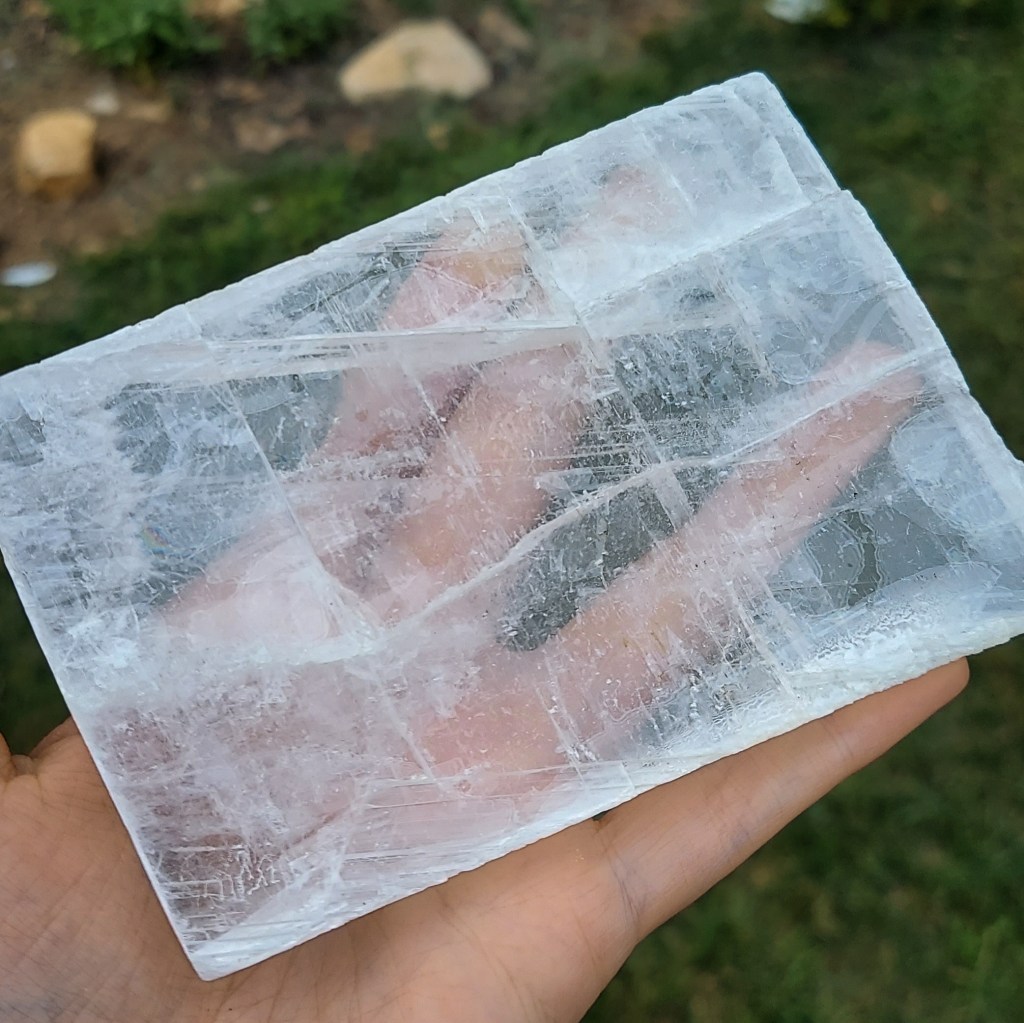
A roughly rectangular selenite plate balanced on a hand. The hand is visible through the selenite, save for a few areas where healed fractures or inclusions give the stone a slightly cloudy appearance.
A selenite plate, displaying its transparency.

Actual selenite forms as sheets. It’s usually transparent and colorless, though it may have impurities that give it a cloudy appearance. It’s much rarer than satin spar and is usually sold as flat specimens. The way it fractures means that it isn’t a good choice for carving into wands. Its unique crystal form is best exhibited as-is, though you may see it sold as charging plates.

Nope. The chemical composition, hardness, solubility, and everything else is completely the same. The only differences are clarity, fracture planes, and formation.

Satin spar and selenite are used identically. They’re both considered very high-energy crystals that are used to cleanse rooms, people, and objects, or even cleanse and charge other crystals. If you have a selenite that you’ve suddenly realized is actually satin spar, that’s okay. There’s virtually no metaphysical difference between the two.

If you work with crystals in a magical or metaphysical sense, then no. The usage, properties, and care instructions for satin spar and selenite are exactly the same.

If you collect minerals or have some specimens that you plan to sell to gem collectors, then yes. Selenite is rarer than satin spar. It forms and looks differently. If you have satin spar in your collection, and you want to find a piece of actual selenite, you’d be pretty disappointed to find that all of the “selenite” on the market is just more satin spar!

I’m all for accuracy, so I prefer to call selenite selenite, and satin spar satin spar. However, I also get that “selenite” has been a trade name for satin spar for a long time now, and me taking a pedantic stand isn’t likely to change that.

Like I said, it might be a good idea to remember that there is a difference. In magical and metaphysical circles, nobody’s that likely to care much. In gem collecting circles, people are more likely to use the term that’s more technically correct.

If you want to split the difference, you could call satin spar “satin spar selenite.” This isn’t really right, but it probably has the best shot at ensuring that the person you’re talking to knows what you mean.

Or just call them all gypsum and let everyone else figure it out.

crystals

Andara Crystals — What are they, and what’s their deal?

There are a number of stones in the gemstone trade that are referred to as crystals, when they really aren’t. Some, like art glass, don’t have a crystalline structure. Others might be mineraloids, which also lack a crystalline structure. All of this is to say that a fair amount of “crystals” aren’t really crystals at all.

With that out of the way, let’s look at Andara crystals. These are often brightly colored, very fancy-looking clear stones that are purported to have a ton of healing and metaphysical properties (and fetch correspondingly high prices). But what are they, and why are they controversial?

What are Andara crystals?

Andara crystals are said to be natural glass which comes from a handful of specific sites in northern California and Nevada, which are the foci of particularly high-energy vortices. These crystals come in every shade of the rainbow, and fans say that they can heal, balance the chakras, raise vibrations, and more. Some even claim that they’re the philosopher’s stone of legend, or an ancient healing tool used in Atlantis.

These stones are said to contain etherium, which is a blend of 70 different minerals. Some are listed as monatomic, which refers to substances made up of elements that naturally exist as a single atom.

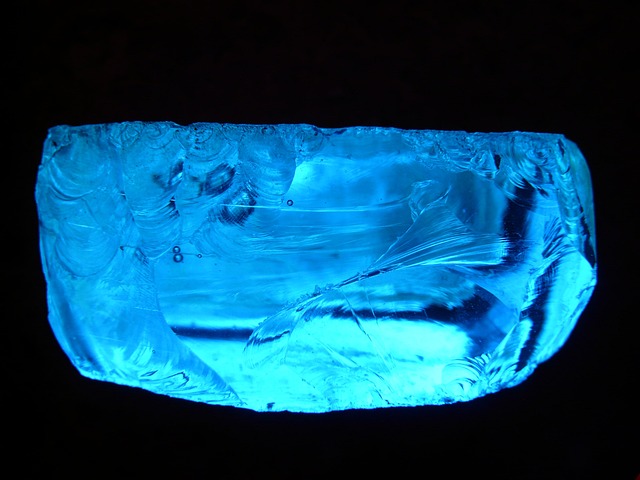
A chunk of blue glass on a black background.

Okay, so why are they controversial?

Andara crystals are controversial for a few reasons. For one, they’re not crystals. They’re a type of glass.

For two, they’re not natural (as in, formed by nature). Andara crystal deposits correspond to land dumps of slag glass from manufacturing. They look like slag, and their chemical composition correlates to soda lime glass, of the type used to make bottles. It doesn’t resemble other forms of natural glass, like obsidian or moldavite. The chart in this post gives a pretty thorough breakdown.

The funny thing is that some sellers extol the virtues of Andara crystal and claim that part of its specialness lies in its dissimilarity to other natural glasses. Yes, of course it’s not similar to them — because it’s soda lime glass.

Selling Andara crystals as a natural product is a bit like selling beach glass and claiming it was formed by nature. It may have been shaped and influenced by it, but it’s a man-made material at its heart.

The controversy doesn’t like in Andara crystal’s man-made origins, however — it’s because it’s literally a manufacturing byproduct. Chunks of slag glass get dug up, cleaned off, labeled with a lot of healing and metaphysical properties, then sold for sometimes hundreds to thousands of dollars.

This has caused trouble with not only buyers, but also dealers. When you’re selling something indistinguishable from a chunk of broken bottle, it becomes a race against “counterfeiters.” (I use “counterfeiters” here because the counterfeits are, again, indistinguishable from the alleged genuine articles.) This has led to dealers claiming that their glass is the only true Andara crystal, and dealers selling specimens back and forth to each other — accompanied by certificates of authenticity.

The Emperor’s New Crystal

Is it bad to use a man-made material for metaphysical, spiritual, or even energetic healing purposes? Not necessarily. I honestly love the idea of using slag glass this way, because it removes manufacturing waste from the environment and gives it a second life.

(A crystal — any crystal — isn’t going to take the place of the services of a competent medical professional. If you need insulin or to have a tumor removed, there is no stone that will make that not be the case anymore. I’ve used crystals to get relief alongside conventional treatment and complementary therapies, but I’m not out here trying to cure pseudotumor cerebri by rubbing rocks on my head.)

But here’s where we get into what I think of as the Barmicide Feast of crystals — or, if you prefer, the Emperor’s New Crystal.

It’s true that developing your own personal associations is important for any magical or spiritual tool. I have stones I work with that I love, but other people don’t get anything from. Other people have crystals or herbs that they love, but I get nothing from. These relationships shift and evolve over time, and that’s good and fine.

Unfortunately, some proponents of Andara crystal have used this as a selling point in a way that’s, frankly, kind of gross. They attach long lists of metaphysical attributes to this glass, then claim that only the special and spiritually evolved can feel or access them. If you see the slag for what it is — slag — then you need to get on their level.
See? Nasty.

The biggest problem here is that they’re exploiting a grain of truth to build up the cachet of a manufacturing byproduct in order to charge exorbitant amounts of money for it. They’re not wrong when they say that not everyone can experience the energy of a stone — even glass. The shitty part comes from using this exclusionary tactic to get money from people who want to be part of the in-group. Vulnerable people who want to feel that special energy, to feel elevated and included, and are willing to pay for it.

The underlying message is that when you compliment the Emperor’s gorgeous robes and rave about Barmicide’s pistachio-fed lamb cutlets, you, too, can be spiritually evolved.

Again, the shady part isn’t using (or even selling) soda lime glass as a magical or spiritual tool. The shady part is overcharging for a common, inexpensive material.

If you have and use Andara glass, that’s wonderful. My only advice here is, if you feel drawn to it, use this as a starting point to unpack your relationship with crystals. What’s different about that soda glass versus other materials that are around you? If it’s its place of origin, consider visiting this energy vortex and experiencing it for yourself — you might find a piece of regular quartz or some other mineral that gives you just as much, but you won’t have to overpay for it. If it’s the metaphysical claims and the experience of buying the stone from a dealer, then that may be something worth exploring further.

Blog · crystals · life

“Fine, but I’m not getting any more rocks.”

I knew it was probably a lie the moment the words left his lips.
Still, I didn’t really intend to buy anything, I just wanted to go to the local mineralogical society’s mineral and gem show for kicks. We didn’t have any other plans, it was close by, and tickets were like six bucks. Why not?

I’ve also wanted to learn more about our local geology. Maryland has an interesting state mineral called Patuxent River stone, which is a form of agate that I think is a lovely, almost luminous color. I really want to find some in the wild, but the minerals I’m most likely to encounter where I am are white quartz, mica, beryl, and serpentine.

With all of this in mind, spending an hour or so at a local rock show seemed like a nice way to pass some of the afternoon. Also, sometimes there are interesting bony boys to look at.

This was before my partner saw the big geode cracking machine. I also think they’re very cool — I was used to getting tiny geodes as a kid and cracking them open with hammers like a tiny caveman, but all I’d get from that is a lot of small, shattered pieces. These machines use a large metal chain, shaped like a bike chain, that applies even pressure to a small area around the geode. They’re similar to soil pipe cutters but have a wheel that allows you to tighten the chain a bit more easily. The end result is a geode that cracks much more cleanly, usually in two halves that follow the natural features of the stone, so you preserve a lot more of that beautiful internal structure.

We talked to the owners of the machine for a bit, asking about the origins of their geodes (remember, always know where your crystals come from) and their mineral composition. That’s the nice thing about shows like this: The people there are super stoked to talk about crystals.

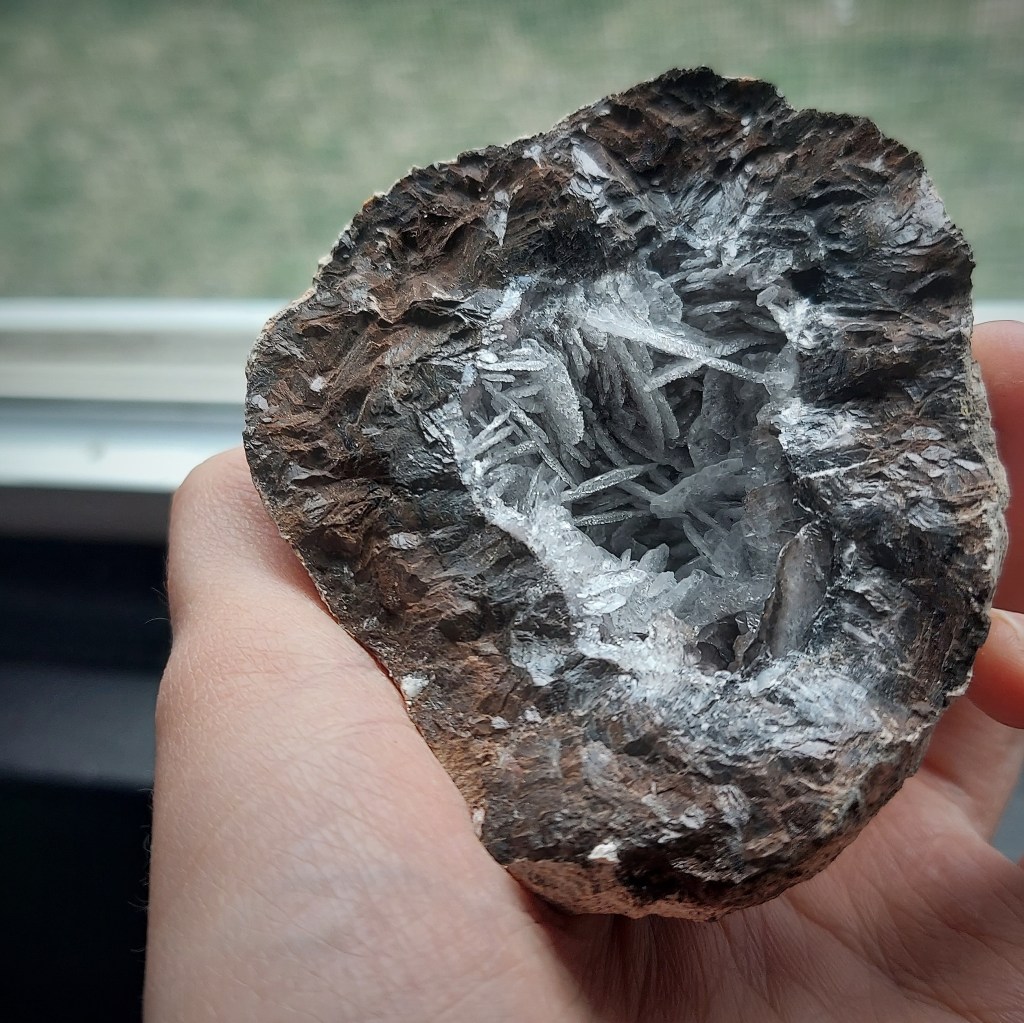
In the end, we decided on two geodes — one large one that was filled with tiny, sparkly, sugary-looking white quartz crystals (and a few double-terminated ones, too!) and a smaller one that seemed to be smoky quartz and blades of either calcite or selenite. They’re gorgeous!

A geode made of layers of opaque brown and transparent black crystal. In the very center, there are flat blades of clear, sparkling crystal.

The show also had some fascinating displays of fluorescent minerals, insects, fossils, and really nice specimens of minerals that had been collected locally (or semi-locally, within a few states or so). Upstairs, where the dealer’s tables were, there were beads, handmade jewelry, carvings, and several gorgeous and very high-end specimens for sale.

A wooden case of preserved moths. They're shades of brown, cream, and orange, and many of them have large spots on their wings that look eerily like eyes.

In addition to the two geodes, we came away with a trilobite from Ohio. I have named him Tobie.

If you’re into geology, like fossils or minerals, or are even into crystal healing, I can’t recommend local gem shows enough. In Michael Gienger’s book Crystal Power, Crystal Healing, he talks about the role that your local geology can play. For example, the effect that living in areas with specific minerals can have. If you’re not learning about what’s around you, you’re doing yourself a disservice.

It’s also just really nice to talk rocks with people who are super into it. Even if you’re not necessarily so, it’s just cool to listen to someone who’s both knowledgeable and passionate about something.

If you’re a collector or crystal enthusiast who’s concerned about the environmental and ethical considerations of your hobby, then local shows are also a huge help. Most of the specimens we saw were clearly labeled with their place of origin. A lot of them were domestically collected, usually by the people selling them. There was a transparency that’s hard to get in a lot of (though certainly not all) conventional crystal shops. Some of the people there have brick-and-mortar stores, too.

These events also often support local hobbyist groups, and are a great way to meet other people in your community. Now that we’re actually setting down some roots here, it just feels good to be involved in stuff like this, even if it’s just as a spectator.

So yes. Support your local mineral people. They rock.

Uncategorized

Preseli Bluestone Folklore & Magical Properties

The minerals that I’m drawn to shift over time. For a long time, it was smoky quartz. I read all I could about it and discovered that the properties that it’s said to possess were exactly what I’d needed at that time. Next it was Herkimer diamonds, especially the black ones. Same thing. Recently, I’ve been exploring the stones that come from the areas that a significant portion of my ancestors hailed from, which is how I came upon Preseli bluestone.

Preseli bluestone is best known as the stone used to make the inner ring of Stonehenge.

To be fair, the Druids didn’t actually make Stonehenge — it’s way older than that. While the did use Stonehenge, they didn’t drag the stones there. Stonehenge was actually an evolving project, contributed to by various tribes over a very long period of time until it became what we see today.

Preseli bluestone originates in a specific area of Wales, a staggering 160 miles from Stonehenge itself. Now imagine doing it by walking, and also you’re pushing gigantic rocks. There had to be something special about these stones for them to be considered worth the trouble.

Stonehenge and Preseli Bluestone Lore

One theory is that people indigenous to the Preseli area migrated, taking the stones with them due to their religious or cultural significance or as a means of establishing an ancestral authority over their new homeland.

The ages of Stonehenge’s stones vary widely. One is over two and a half billion years old, while another is a relative youngster at only 800 million. If we were to shorten these years to mere seconds, the younger stone would be about 25 years old. The older would be over 79.

Parts of Stonehenge have been standing since roughly 2500 BCE. The site itself seems to have been abandoned around 1000 BCE.

Some of the stones have carvings on the surface — these are only visible using either lasers, or sunlight at a very specific angle.

The techniques used to create Stonehenge are pretty sophisticated. The lintels (the long stones on top) are locked to their supporting stones with a mortice and tenon joints, slightly smoothed, and connected to their neighbors with tongue and groove joints. Their supporting stones were leveled on the top to account for the changes in elevation of the ground, so everything sits very evenly. When all of the stones were intact, they would have looked like a continuous ring.

A close-up image of Stonehenge, showing two lintel stones balanced on four sarsen stones. The end of one of the lintels demonstrates the "tongue" portion of a tongue and groove joint. Some of the sarsens in the rear of the photo show nubby projections, which would've helped to lock their lintels in place.
If you look carefully at the end of the lintel on the left, you can see the tongue end of a tongue and groove joint. Look at the sarsens in the back, and you can see the nubby bits that would’ve held their lintels in place.
Photo by Kris Schulze on Pexels.com

One stone, the Slaughter Stone, probably wasn’t actually used to kill anything. It gets its name from the bloody appearance of water that collects on its surface — the water reacts with iron compounds in the stone, oxidizing them and turning the water a rusty color.

Preseli bluestone was said to be transported by Merlin, using magic.

The Ethicality of Preseli Bluestone

The original place where bluestone is found is Carn Meyne. This is a protected area, and is off limits to mining and rock collecting alike.

The Preseli bluestone on the market today ostensibly comes from a nearby farm, where a deposit of the stone was found. Others may come from specimens collected from Carn Meyne before it was legally protected.

With this in mind, there’s some concern that Preseli bluestone trafficking might be a thing. If the Pagan and new age communities’ demand for bluestone outstrips the supply, then it could incentivize the smuggling of bluestone or other unethical practices. It can already be challenging to find genuine bluestone, since green dolerite is sometimes re-labeled and sold as bluestone for a higher price.

As always, it’s up to you to decide whether or not to acquire bluestone. If you do, do so from a reputable dealer. If you find that you may be succumbing to some of the consumerist habits that lurk in aspects of the new age movement, consider whether a different, ethically sourced, local stone will better meet your needs.

Preseli Bluestone Magical Properties

The significance of bluestone to Stonehenge’s creators has been lost with time. The most we have now is what modern crystal users have deduced. For the most part, it’s used to tap into one’s ancient origins — connecting with the spirit of the peoples for whom bluestone was important. Some authorities believe that the bluestones of Stonehenge may have been used as healing tools. While the larger, outer sandstones marked a boundary, the smaller interior ring of bluestone may have been used to heal the sick and injured.

It’s also sometimes used in variants of shamanism to strengthen one’s connection to the spirits of the lower world, those of plants, animals, and the elements.

Some use bluestone as a kind of spiritual anchor. This may be due to its connection to ancestral workings. When you feel unfocused or adrift in life, working with Preseli bluestone is said to help re-instill feelings of connection and direction.

It’s important to note that Stonehenge also, at least at once point, served as a burial site. I feel this gives Preseli bluestone a connection to death and the dead, not necessarily in a purely ancestral way. Stonehenge was also designed to align with the movement of the sun. This, plus Preseli bluestone’s green color (when polished — the rough stone is blue) further connect it to the energy of growth and abundance. When you combine these concepts, it’s a stone for understanding the cycles of life, death, and the recycling of energy and nutrients.

I find Preseli bluestone to be uniquely beautiful, even beyond its magical and historical pedigree. It’s a beautiful mottled green and white, almost like a dendritic agate without the branching. As someone who will likely never get to experience Stonehenge in person, I love that it’s still possible to forge a connection to the ancient people who created it.

crystals

How do you tell if your moldavite is fake?

So, crystals.

They’re a multibillion dollar industry that spans the entire globe. It’s to the point where creating fake crystals (not even necessarily lab-grown ones, sometimes just straight-up fake ones) is a lucrative venture. This is especially true for precious stones and high-dollar mineral specimens. You know, like moldavite.

Moldavite is an attractive stone for collectors for many reasons. For one, they’re found on the surface — no invasive, ecologically-damaging mining operations here. They’re also said to have a very high vibration. Their energy is said to be so high, in fact, that many users think their gems might be bad luck. On top of all that, they look awesome.

Without rehashing my last post about moldavite, I’ll just give a brief synopsis: These crystals are a type of glass formed when a meteorite struck Europe millions upon millions of years ago. The impact and heat liquidized the silica in the area, which was splashed into the air and formed interesting droplets as it cooled and fell to the ground again. Moldavite is varying shades of green, typically has interesting ripples or fernlike patterns on the surface, and shares a lot of properties with glass.

Photo by Moldavite AssociationCC BY-SA 4.0. No changes were made.

While this is a really cool origin story, that last bit is the kicker. Moldavite is mostly glass. That means that it’s very easy to fake using different glass.

Spotting Fake Moldavite #1: The origin.

It’s always best to buy stones direct from the country of origin. If you can get them mine- or harvester-direct, so much the better. That lets you save money by cutting out the middlemen, and means that you can get a better idea of where your stones came from and how they were collected (which is very important).

Moldavite is only naturally found in areas affected by the meteorite that made it (Germany, Austria, and Czechoslovakia). If you’re purchasing it from anywhere outside of these areas, it’s likely either going to be more expensive, or faked.

At the moment, a lot of the fake (and lab-created) crystals on the market come from China, India, Hong Kong, and Thailand. This is chiefly to do with how the world’s economies are structured right now. Some areas profit greatly off of having a manufacturing-based economy, have built an immense manufacturing base, and economically incentivize the production of goods. When a country is doing well for itself by manufacturing stuff, it stands to reason that the majority of manufactured stuff is probably going to come from there — crystals included.

Spotting Fake Moldavite #2: The price.

Real moldavite is expensive. There’s a finite amount of it. It also has to be collected by hand, and the pieces are fairly small. The limited supply and high demand means that even a comparatively tiny specimen can top $100 USD, easily.

This stone comes in different grades, the highest of which is very translucent and has a characteristic fernlike pattern on the outside, and the lowest of which is more opaque and pitted. One way to spot a fake moldavite is to check the price tag and the photo. If it’s a museum-quality piece for a suspiciously low price, it’s highly likely that it’s just molded or pressed glass.

Spotting Fake Moldavite #3: The shape.

Part of moldavite’s appeal is the external pattern. This unique texture is a direct consequence of the molten silica splashing into the air immediately after the meteorite’s impact, and cooling on the way down. It caused intriguing ripples that separate it from any other crystal out there.

In other words, take a very close look at stones that have been faceted or tumbled.

This isn’t to say that any moldavite that’s been polished is automatically fake, but altering the stone’s external texture removes one of its distinguishing features. This can make it more difficult to tell a genuine moldavite from a piece of dyed glass.

Spotting Fake Moldavite #4: The size.

Moldavite isn’t a big stone. The world’s largest is roughly 265 grams (or roughly half a pound). That’s equivalent in weight to about half a can of soup. By contrast, the world’s largest amethyst is 13,000 kg (or about 28,660 lb). That’s a little over seven cars.

If someone is selling a large moldavite specimen, take a look at the price, color, and other characteristics. If it’s opaque, smooth, and inexpensive, it’s probably not a fake crystal — but it definitely isn’t moldavite. Some sellers may try to pass aventurine or other cheaper green stones off as more expensive ones.

Spotting Fake Moldavite #5: The texture.

I’ve already gushed about moldavite’s pitted, swirly, fernlike texture before, but I want to bring it up again. Moldavite isn’t naturally shiny. It was buffeted by air currents and superheated gases as it cooled, and often splashed onto the ground before fully hardening. This means that the texture is naturally going to be kind of messed up, not smooth and shiny.

When moldavite was first gaining popularity on the crystal market, one of the ways to spot a fake was to look for a shiny appearance. Manufacturers weren’t yet able to mimic the matte surface and variety of textures that natural moldavite exhibits, so savvy buyers could pick out which stones came from the ground, and which ones came out of a mold. This is not always the case anymore — better manufacturing methods have allowed factories to turn out simulated moldavite that very closely mimics the texture of the natural stuff. Still, it’s a characteristic that’s worth noting, just in case.

Spotting Fake Moldavite #6: The interior.

Nature is good at a lot of things. Creating perfectly transparent objects is not necessarily one of them.

During the chaos of a meteorite impact, a lot of things happen. Gases heat and expand. Things melt and cool at different temperatures. The liquefied silica comes in contact with other materials, trapping them within its core. All of this leads to the tiny imperfections, bubbles, and inclusions that make crystals unique.

If a piece of moldavite is exceptionally transparent, and doesn’t show any inclusions of lechatelierite or gas bubbles, it’s likely fake.

Spotting Fake Moldavite #7: The adjectives.

Moldavite is just moldavite. It’s green, kind of swirly or pitted outside, and sort of blobby shaped. As with other crystals, beware of adjectives. Some sellers will attach them to their stones to make them sound extra rare and special. (Every crystal is unique and special anyhow, but I digress.) Meanwhile, confused buyers are overpaying for what they think is “ultra-rare” pink or white moldavite, and what they receive isn’t moldavite at all.

Moldavite also only comes from the areas affected by the meteorite that formed it. If it’s labeled as originating in another country, it might still be a tektite, but it isn’t moldavite.

Spotting Fake Moldavite #8: The feel.

This is going to vary from individual to individual, which is why it’s at the end of the list. If you’re highly sensitive to crystal energy, you may be able to tell genuine moldavite from the fake stuff by handling it. As I mentioned earlier, part of this stone’s desirability lies in its high energy. If you’re normally sensitive to crystals, and a moldavite feels like nothing to you, it may be faked. (Of course, even if it isn’t fake, I wouldn’t recommend purchasing a crystal that doesn’t resonate with you anyhow!)

Moldavite is a very cool stone with a distinctive appearance. Some of the simulated moldavite on the market is very accurate, making it hard to tell real from fake. These tips can help you spot manufactured moldavite, so you can experience the effects of working with a genuine stone and don’t end up overpaying for a fake.

crystals · Witchcraft

Moldavite: Is it bad luck?

So, moldavite.

These small greenish stones are considered one of the highest-energy crystals you could own or work with. They’re uncommon, occurring in only one area of the world, and carry a high price tag — if they’re real. Because of their reputation, the market has been flooded with fake moldavite. That may change, however, as increasing numbers of people are coming out with their bad experiences using these crystals.

What is moldavite, anyway?

Moldavite (sometimes called vltavin or Bouteille stone) is a type of natural glass. Unlike volcanic obsidian or lightning-made lechatelierite, it formed fifteen million years ago as a result of a meteoric impact. When the meteorite struck the Earth, it instantly liquified the surrounding silica. This splashed up into the air, cooling on the way down. Since it cooled in mid-air, moldavite developed all kinds of cool swirly textured patterns on the surface.

It’s typically a sort of olive or mossy green color, and has a hardness of 5.5-7 according to the Mohs scale. Since these stones are essentially droplets, they’re generally not very large. Faceted or tumbled moldavite is also pretty much unheard-of in the metaphysical market, since this would negate its uniquely beautiful pitted or fernlike patterns.

Photo by Moldavite Association, CC BY-SA 4.0. No changes were made.

What is moldavite used for?

Crystal workers and healers ascribe a lot of metaphysical and healing properties to this stone. It’s used as a focus during meditations to connect to the Higher Self, to aid past life regressions, and to break maladaptive behavioral patterns. It’s a stone for ascension, and some say that the meteorite responsible for its formation was sent here specifically to create moldavite and help the entire planet ascend.

Emotionally, some people use it to cut through world-weariness and cynicism. It’s said to open the mind to new possibilities, and ease worries by helping the user arrive at new, creative solutions to their problems. People who enjoy dreamwork sometimes use moldavite for this purpose, in order to better connect to their Higher Intelligence through dreams and visions.

For people who have a Hindu Tantra-adjacent practice, moldavite is sometimes used for the heart chakra (Anahata) or the crown chakra (Sahasrara). As an ascension stone, it’s considered helpful for connecting the soul to cosmic intelligence. As a green stone, it’s also said to resonate with the heart area.

Sounds pretty good. Why’s it considered bad luck?

It really depends on what you mean by “bad luck.”

As the section above suggests, moldavite’s considered a very high-energy stone. It also breaks through maladaptive patterns and pushes you toward your highest good.

However, your highest good might not be the life you’re currently living. You could have a stable job, a decent relationship, and all kinds of things that you’re comfortable with. “Comfort” doesn’t necessarily mean that they are aligned with your highest good, however. If that job has you earning a comfortable salary, but mentally and spiritually stagnating, or your lifestyle doesn’t exactly set your soul on fire, expect moldavite to shake things up.

And shaking things up doesn’t always feel good. Who likes losing their job or getting dumped?

This is why moldavite is sometimes considered bad luck. When it seems like things aren’t going well, it’s tempting to ascribe this to a hex, curse, or plain old misfortune. Sometimes, it’s what has to happen for you to reach your full potential.

If moldavite were a tarot card, I’d call it The Tower. It stirs things up with a big stick. It’s also important to remember that stones don’t have human ideas about what comfort and success look like — you wanted an ally to help you reach your highest good, and boy howdy are you going to get one. The Tower is the foundation-deep destructive force that allows new growth to take place. The card that immediately follows it is The Star, the card of hope and renewal. Could that hope and renewal take place without The Tower?

In short, moldavite isn’t bad luck or cursed. It’s just a catalyst for changes we may not be fully ready for. I’m not going to be all, “Everything happens for a reason,” but sometimes parts of your life need to burn down for new growth to take place. I’ve been there and experienced it myself, and, while I definitely didn’t enjoy it at the time, I couldn’t be more grateful that it happened.

crystals · life · Witchcraft

Top 7 Crystals to Hide in Your Relatives’ Homes So They Stop Falling for Weird Toxic Bull@#$%

Good morning!

If you’re like most people, you have at least one person close to you who will occasionally come out with some completely bonkers, destructive nonsense. Unproven conspiracy ideas like, “vaccines are a conspiracy to implant tracking chips in everyone (posted from iPhone)” or “Jewish people caused the oil crisis by always getting their groceries double-bagged at King Kullen.”

(I have heard both of these unironically from actual human people.)

You might think this person is mostly cool, save for one or two beliefs that you’d swear were the byproduct of some kind of brain worm. You might also just be obligated to spend time around them, because you’re a dependent and they’re related to you. Maybe you just hold out hope that they’ll someday become the people they were before they got wrapped up in the fringe. If trying to talk to them or send them actual empirical data doesn’t work, here are the best crystals you can strategically plant wherever you’re forced to interact with them:

Lapis lazuli

Lapis has a hell of a reputation. For one, it’s been used in everything from cosmetics to artistic masterpieces, so it has some strong associations with creativity and expression. It’s also blue, which people who work with chakras will recognize as the color of Vishuddha, the throat chakra. (It rules expression and communication.) This means that it’s a pretty rad stone to have on you when you’re forced to defend yourself against accusations of being a NWO shill or secret lizard person from space.

Lapis has another talent, though. It’s often called the “Stone of Truth.” Its energy is said to help the user uncover hidden truths, both about themselves and the people and things around them. Most of us wouldn’t necessarily consider the idea that multi-level marketing schemes are a scam designed to profit off of people’s desperation to be a “hidden” truth, but you’ve got to meet people where they are.

Emerald

Now, I’m not suggesting that you drop a bunch of dosh on a fancy table-cut emerald to cram under your uncle’s recliner this Thanksgiving. You can get tumbled emeralds that aren’t gem quality, but are still emeralds and will still work for our well-intentioned-yet-nefarious purposes.

The idea here is that emeralds are tied to the heart. People who work with chakras consider them a stone for Anahata, the heart chakra. Even if Hindu tantrism isn’t your jam, emerald has a reputation as a stone for love and compassion. (Like instilling more compassion in the hearts of those around you who have notions about a super secret “gay agenda,” for example.)

According to color magic, green is also associated with growth. This is typically taken to mean increase, as in an increase in prosperity, fertility, and so forth. But green is associated with growth because of its connection to plants and nature — a lush, green plant is a successful, healthy, thriving one. You can empower a tumbled emerald to help your family grow and develop as people before you hide it behind the TV.

Amethyst

I don’t think I’ve ever seen a list of calming, meditative crystals that didn’t include amethyst somewhere. There’s a reason for that. This stone is associated with things like divination and meditation, sure, but it’s also very relaxing and enhances a person’s connection to their intuition. (That means that it might be able to amplify the tiny voice inside your grandpa that says that maybe Democratic Socialists aren’t coming to take his toothbrush.)

Amethyst is also credited with increasing the user’s spiritual awareness and guarding against psychic attacks.

Smoky Quartz

Smoky quartz is pretty much clear quartz that, like Bruce Banner, was exposed to radiation and came away with some extra powers. It’s said to be helpful for grounding, as well as filtering energy and transmuting the negative into the positive. This means that it can help keep things on a smooth, even keel when Aunt Karen gets a couple of glasses of eggnog in her and starts ranting about immigration.

Rose Quartz

Ah, rose quartz. Any love-drawing crystal spell or list of stones for heart-related matters is basically guaranteed to include this pink stone. The thing is, it’s good for a lot more than just flowery, hearts-and-chunky-angel-babies romantic love. It’s also very rad for compassion, friendship, and familial love.

Like emerald, it can be helpful for getting people to meet you where you are. It can encourage the opening of hearts and minds. While lapis is a better choice for getting people to see the truth, rose quartz is better for getting them to see people as people, with the same pain, fear, hope, and aspirations as they have.

Black tourmaline

Like smoky quartz, black tourmaline is a weapon against negativity. It’s a very powerful energy filter, and can help neutralize bad vibes. Large specimens (especially ones intermingled with spangles of golden mica) look extremely cool, which means they’re great for keeping in your own living spaces to ensure that nobody’s bullshit sticks around to bother you. Smaller stones are good for keeping on you as a protective amulet, or, as the title suggests, stashing around anywhere you’re forced to be.

As an FYI, crystals that act as energy filters need regular, thorough cleansing. Think of them like vacuums — they can suck negativity up, or even transmute it into positive energy, but that canister’s gotta get emptied sometime. The more crap they come in contact with, the sooner they’ll need to be recalibrated with a cleansing.

Spirit Quartz

Spirit quartz also goes by the names cactus quartz and fairy quartz. These are quartz points (usually amethyst or citrine) that are entirely covered in tiny, druzy points. This makes them all spiky, like cacti.

Spirit quartz help in a number of ways. Amethyst is a stone for introspection and harmony, as was mentioned above. All of those tiny points effectively amplify this energy and send it out everywhere. The druse also symbolizes many tiny units working together in a cohesive whole, so it’s great for fostering feelings of community and cooperation.

Amethyst spirit quartz is also said to be particularly helpful for getting rid of negative attachments or entities. It can’t get rid of the weird radicalizing podcasts your cousin insists you check out, but it can help pull their hooks out of him.

As with anything involving crystals, make sure yours come from an ethical source. Sadly, much of the mining trade (not even just the crystal trade — a lot of crystals are byproducts of mining for gold, platinum, lithium, and other materials used by the electronics industry) relies on exploited labor and environmentally damaging methods. Always know where your stones came from, and how they got to you.

Many, if not most, sources say that it’s unethical to perform magic or energy work on someone without their consent. While it’s nice to abide by the rules, sometimes you have to do the wrong thing to get the right thing done. The energetic toll of trying to get someone to be less hateful, or less absorbed in destructive conspiracy theories and hoaxes, is going to be way less than, say, casting a love spell on an unwilling target. Use your own judgment. If you belong to a marginalized group and need to do something to keep yourself safe and sane, do it.

crystals · Witchcraft

What is Devic Temple Quartz?

Lemurian. Elestial. Devic. Lightbrary.

Buying quartz can be complicated.

Sigil. Starbrary. Garden.

The truth is, most of these terms are just names for physical features of the crystal itself. Some claim that these physical traits line up with the stones abilities or affinities, but this isn’t always the case. One of these terms is “Devic Temple Quartz.”

So, what’s a Devic Temple quartz?

In simple terms, a Devic Temple quartz is a quartz crystal that has internal fractures that resemble seats or shelves. These usually also have some visible foggy wisps produced by trapped gasses or water, often called “fairy frost.”

If the water inclusions are large enough, it might also be called “enhydro.” If it appears to have the outline of another crystal inside, it might be called “phantom.” If it contains inclusions of hematite, chlorite, or other minerals, it might be called “lodolite.” As a word of caution, while lodolite is a common term among gem enthusiasts, it’s not actually a real name. It pretty much just means “stone that has some mud inside.” You might also see these called garden or shaman quartz.

Like I said, there are a lot of words involved. Try not to sweat it too much.

What can it do?

Devic Temple quartz is purported to house light beings, nature spirits, or other allies. Sometimes, if you look at the internal fractures, rainbows, fairy frost, and other features, you can see what appear to be faces, dancing bodies, or humanoid/animal shapes.

Since these crystals are said to act as “houses” for spiritual entities, they’re considered a way to communicate with them in meditation, healing, and so forth. Having one of these guys is pretty much like a direct line to the spirit in the crystal. Some also consider them a way to communicate with faeries and/or angels.

Here’s where my opinion differs…

Honestly, from my experience, all crystals have their own presence. Sometimes, you can perceive it as a kind of electric feeling in your fingers — like the feeling you’d get if you were holding a bird, a firefly, or some other tiny life, afraid of squeezing too hard. This isn’t to say that a crystal is alive the way we typically conceptualize life, but it’s in there. In this respect, Devic Temple crystals aren’t unique.

That said, they can make it easier to access that presence. It’s kind of like the difference between trying to find a hermit in the woods, and walking up to a numbered address with a brightly-painted front door and a sign that says “Free pies, inquire within.”

Sometimes, you can see the physical appearance of a crystal’s presence in the fairy frost, even if it isn’t a Devic Temple crystal. One of my favorite meditative activities is to sit with a a crystal, a macro lens, and a good light source, and look for tiny buddies.

If you look on the left, you might see a faint image that looks like a side-on view of a human skull. What else do you see?

Do you need a Devic Temple quartz? I wouldn’t say that they’re essential — but I wouldn’t say that about any crystal. Ultimately, if a stone resonates with you and is responsibly sourced, pick it up. Don’t buy it because of the names attached to it. Choose what you’re drawn to and discover its unique features afterward, when you have a chance to sit with it.

crystals

Working with Herkimer Diamonds

Note: This post contains affiliate links. These allow me to earn a small commission, at no additional cost to you. Thank you for supporting small retailers and this site!

I like crystals. Even if I didn’t work with them, I’d probably collect them.

I received my first one when I was very little — about five or so, I think. It was a piece of dyed hot pink agate, shaped into an egg about as long as my thumb. I didn’t know anything about geology or crystal properties, but I knew I liked it and so, like a corvid, I kept it with the rest of my treasures.

(Most of those “treasures” were dead swamp cicadas that I’d pick up on the sidewalk in late summer. I had — okay, have — a Thing for iridescent colors.)

I still collect crystals, though now they actually get used for things. Unfortunately, the reality of the crystal market means I can’t just buy whatever I like. There’s a vetting process. Since I’m also lazy, this means that, for the past couple of years, I’ve only picked up Arkansas quartz, Herkimer diamonds, and piece or two from Brazil after making a nuisance of myself to the seller.

All of this is to say that Herkimer diamonds kick ass and they’re very easy to obtain ethically. If I could only use one crystal for the rest of my life, it’d be one of these.

What are Herkimer diamonds?

Well, for one, they’re not diamonds. They earn their name because they come from Herkimer county, New York, and are an exceptionally hard, clear variety of (usually double-terminated) quartz.

Herkimer is known for these stones, so there are a bunch of mines you can visit to get your own from the source. There’s no child labor involved, and the process of mining is pretty much you, some hand tools, and a bucket, so these crystals are also lower on the social and environmental impact scale than many others. A bunch of Etsy merchants make a point to visit Herkimer once a year or so, dig for some, then sell them, so they’re also pretty easy to obtain even if you aren’t interested in making the trip yourself. (Two of my favorite sellers are Luminous Harvest and Greengem. Bonus, Greengem is also a source of beautiful, conflict-free rings — even some really fancy alternative engagement rings.)

How are Herkimer diamonds used for spiritual healing?

Herkimer diamonds have a reputation as extremely high-vibration crystals. They’re supposedly good for purifying the physical and astral body, attuning you to another person, group, or place, removing energy blocks, and increasing the “oomph” of the other stones they’re used with.

According to Michael Gienger’s Healing Crystals, they can be used for awareness, clarity, dream recall, heightened awareness and consciousness, and pain relief. It’s also trigonal and secondary, which makes it particularly helpful for people with “trigonal personalities,” and who wish to unlearn negative behavioral patterns and live in greater harmony with their external environment. For more information, read Gienger’s Crystal Power, Crystal Healing. It’s a very interesting read that outlines his really unique approach to the subject.

(Of course, I don’t endorse the use of crystals in place of conventional medicine. They’re great as a complementary therapy, but please consult a doctor first.)

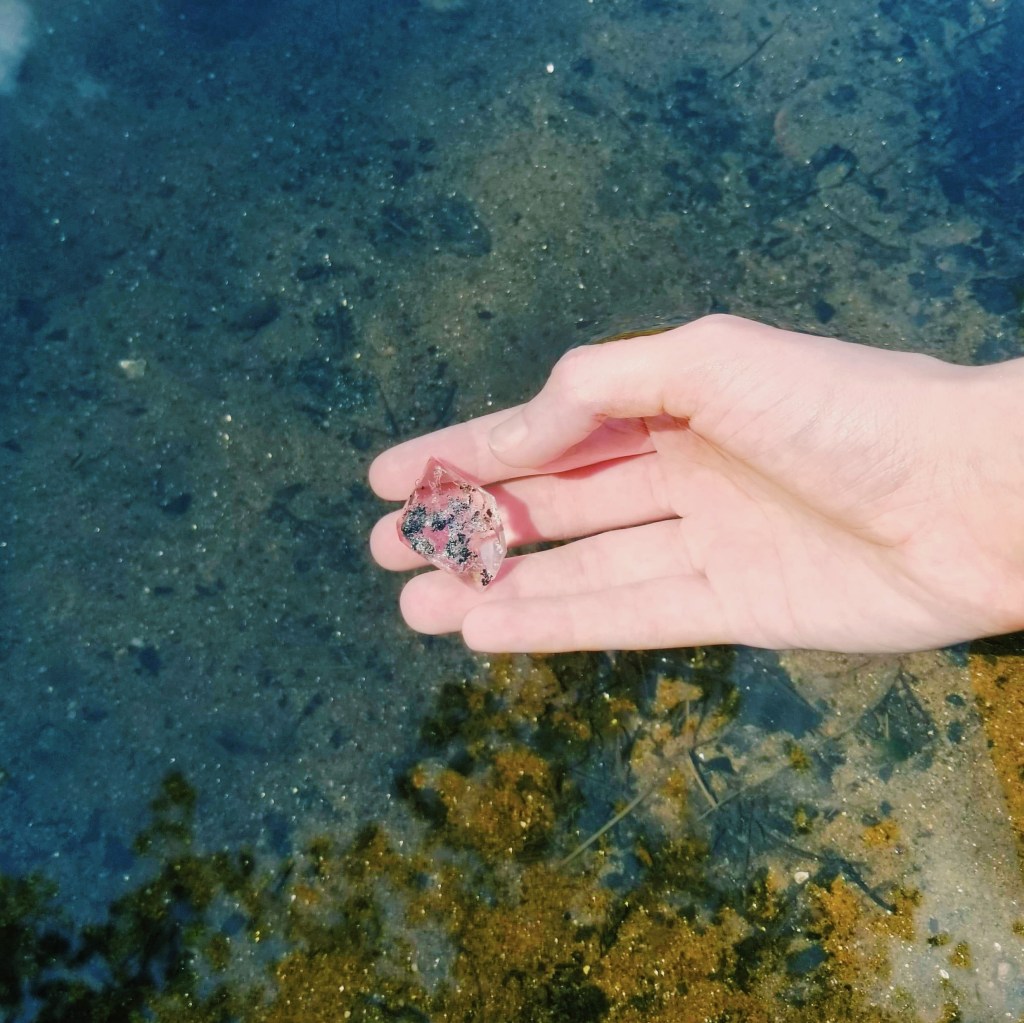
A hand holds a Herkimer diamond in clear river water.
Cleaning a Herkimer diamond in the river. Look at all of those hydrocarbon inclusions!

What are the magical properties of Herkimer diamonds?

Since they’re clear quartz, they are pretty efficient “all purpose” stones. They do often come with some neat, unique features that make them particularly useful, in a magical sense:

  • Many of them contain hydrocarbons, visible as black lines, dots, or flecks within the crystal. These bits of incredibly ancient vegetable matter connect us to our ancestors, all the way back to our pre-human family tree. For this reason, they can be very helpful for ancestor work.
  • Most of them are double terminated, which makes them helpful for simultaneously sending and receiving energy.
  • A lucky few contain deposits of water, too! “Enhydro” crystals are strongly connected to the water element, as well as earth. This makes them useful for rituals for purification and emotional healing.
  • Some of the rainbow fractures and water or hydrocarbon inclusions give them a character that’s similar to garden quartz (or shaman quartz). The inclusions and “flaws” can create beautifully complex scenes inside the crystal that are lots of fun to fall into. This makes them great as a meditative focus, or an aid to trance or journeying work.
  • They’re generally not huge. To be honest, most of the ones you’ll find in metaphysical shops are downright tiny. This makes them great for including in pouches, sachets, bottles, or whatever else your witchy heart desires.

Herkimer Diamond Clearing Spray Recipe

This is a recipe for something I whip up when I’m in a situation where salt, smoke, or other methods of clearing energy aren’t advisable. Plus, it smells really good.

You’ll need:

  1. First, make sure your ingredients are good to go — tell them what you’re using them for, and what you’d like them to do for you. Bergamot protects from evil, cuts off interference, and functions as a “power” herb. Lavender cleanses and promotes peace. Ylang ylang is calming and uplifting. Rosemary is cleansing and protecting. Vervain purifies, gets rid of negative energy, and enhances the action of other herbs in the mixture. Frankincense is purifying and energy raising.
  2. Add the dried herbs and oils first. You can go with your preference here, one is no more powerful than the other. You don’t need much — a drop or two of oil, a pinch or two of herbs.
  3. Swirl the mixture when you’re through, and speak your intention again. This can be simple. Start with, “With this mixture, I[…]” and state your intent.
  4. If you plan to keep this for a long time, fill the bottle two thirds of the way with high proof grain alcohol, like Everclear. (The Tisserand Institute has more information on preservation here.)
  5. Fill the bottle the rest of the way with lavender hydrosol or distilled water. Swirl to mix.
  6. Add the Herkimer diamond.
  7. Screw the top on the bottle and label it. You’re done!

While the sun is great for empowering things, it’s also not super great for scents. If you want to charge this mixture, do so either under moonlight, or very briefly under sunlight. To use it, simply mist the object, person, or space in need of some energy clearing.