
Plants and Herbs · Witchcraft

Myrtle Folklore and Magical Properties

So, something funny happened.

Two years ago, I purchased a set of three elderberry starts. (Not quite saplings, since they were still very tiny.) I planted them, looked after them, and then pretty much let them do their thing once they got established. When I noticed buds on one, I was very excited — it was a little early for a baby elderberry to put out flowers, but so what? Elderberry flowers!

Except…

A close-up of a cluster of hot pink crepe myrtle/crape myrtle flowers.

Don’t get me wrong. They’re beautiful and vibrant. They’re just also extremely not elderberries.

Couldn’t be farther from elderberries, actually. This small tree is a stunning example of a Lagerstroemia — also known as the crape (or crepe, or crêpe) myrtle.

While I was looking forward to experiencing my first home-grown elderberries this year, I am willing to settle for a very pretty crape myrtle. This tree isn’t native to this area (in fact, there are no Lagerstroemia species native to the US), but it’s very common in the southeast and the seeds have become a food source for birds like goldfinches, cardinals, and dark-eyed juncos, among others. While I’m far more in favor of planting native plants, the fact that many native species of birds have shifted to using crape myrtle seeds as a winter food source is a very big (and legitimately fascinating) deal. If left unchecked, crape myrtles can produce a lot of seeds and will multiply prolifically. If native bird species are taking to crape myrtle seeds as a winter food source — and even seemingly preferring them to commercial bird seeds — that’s a good thing. It allows these birds to take the place of their natural predators and may keep volunteer crape myrtles from becoming a problem.

But enough about my myrtle problems. Here’s some more neat stuff about myrtles in general.

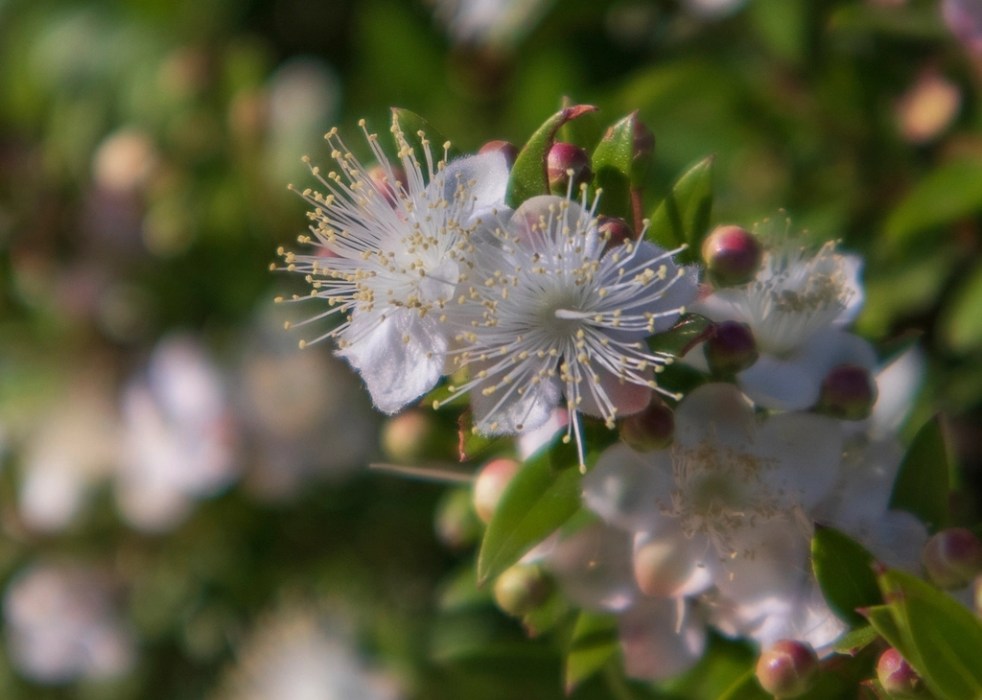
Crape myrtles (Lagerstroemia) are native to parts of Asia, Australia, and the Indian subcontinent, and they’re somewhat distantly related to what we usually consider myrtles (Myrtus). Same with lemon myrtles (Backhousia citriodora), which are found in Australia.
Myrtus species can be found in the Mediterranean, western Asia, India, and northern Africa. Lagerstroemia, Backhousia, and Myrtus are genera in the order Myrtales.

There are also bog myrtles (Myrica gale), which are found pretty much anywhere in the northern hemisphere where you can find bogs, and bayberries (like Myrica pensylvanica, M. carolinensis, M. californica, and a whole bunch of others). These are wax myrtles, part of the order Fagales, and are actually more closely related to beech trees.
(Vinca, also known as “creeping myrtle” or “lesser periwinkle,” is not related to myrtles. It’s also a bit of an invasive nightmare here.)

For the purpose of this post, I’m going to focus on members of Myrtaceae.
(Wax myrtles, you’ll get your turn. Promise.)
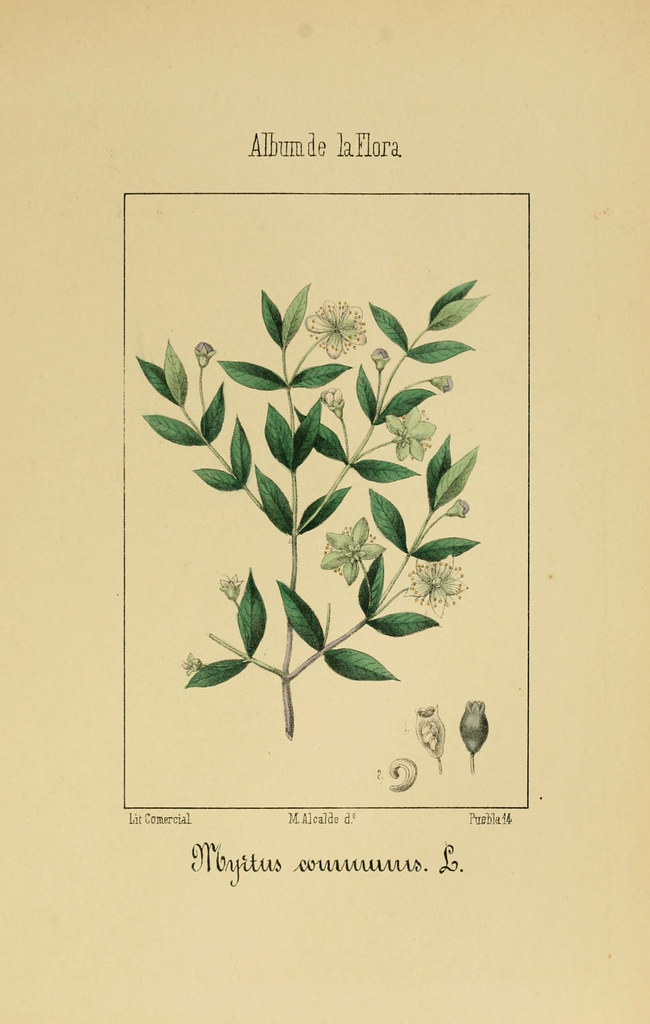
A botanical illustration of Myrtus communis, the common myrtle.
n208_w1150 by BioDivLibrary is licensed under CC-PDM 1.0

Common myrtle (Myrtus communis) is used as a culinary herb and medicinal plant. Figs, threated onto a myrtle skewer and roasted, acquire a unique flavor from the essential oils present in the wood. The seeds, dried and ground, have an interesting, peppery flavor often used in sausages. As a medicinal plant, it’s been used to treat scalp and skin conditions, to stop bleeding, and to treat sinus problems. (Unfortunately, there’s limited evidence that myrtle really does much for that last one.)

Lemon myrtle (Backhousia citriodora) is also a culinary and medicinal plant. As a culinary herb, it’s used to flavor any dish you might flavor with lemon: desserts, fish, poultry, or pasta. It’s especially useful for flavoring dairy-based dishes, since the acidity of actual lemon juice tends to ruin the texture of milk products.
Medicinally, the oil has some pretty significant antimicrobial activity. The leaves themselves are also very relaxing.
(I’ve had the dried leaves in tea, where I find it really shines — it’s got a delightful citrusy flavor with a bright, subtly sweet taste, and it absolutely knocks me out.)

In ancient Greece, the myrtle tree was a sacred tree for Aphrodite and Demeter. Seeing one in a dream or vision was considered good luck if you were either a farmer or a woman. It was also connected to the minor deity Iacchus, for whom there isn’t really much information — he was often syncretized with Dionysus, and Dionysus was all about wreaths and garlands. He could also have been a son of Dionysus, a son of Demeter, or a son of Persephone.

There are also three ancient Greek origin stories for the common myrtle. In one, an athlete named Myrsine outdid all of her rivals. In retaliation, they killed her and the goddess Athena turned her into a beautiful myrtle tree. In another, a priestess of Aphrodite broke her vows to get married (either willingly or unwillingly, depending on the version). Aphrodite then turned her into a myrtle tree, either as a punishment (for willingly breaking her vows) or as protection (against the husband who abducted her to marry). In the third version, a nymph turned herself into a myrtle tree in order to avoid Apollo’s unwanted advances.

Pink crape myrtle flowers on the branch.
Photo by Griffin Wooldridge on Pexels.com

In Japan, crape myrtles are known as sarusuberi (百日紅). Their striking flowers are often found in traditional artwork and make very striking bonsai.

Crape myrtles don’t have much history in old grimoires or European magical systems, purely because they weren’t really around centuries ago. When you’re reading about largely European folk magic, ceremonial magic, mythologies, or herbal medicine, they’re going to be talking about Myrtus species, not Lagerstroemia. That said, crape myrtle flowers are associated with general positivity, love, and romance.

Lemon myrtles don’t have much history in European magical systems, either. Like crape myrtles, this doesn’t mean that they don’t have value. In modern western magic, lemon myrtle is usually considered a solar herb and all of its attributes: purification, positivity, luck, and protection.

As a plant of Aphrodite and Demeter, common myrtle makes a good offering for either of these deities. (This isn’t always the case — sometimes, when a plant is sacred to a god, it means don’t touch that plant.) Since these goddesses are shown wearing wreaths of myrtle, it’s not a terrible idea to weave a myrtle wreath and either wear it while doing devotional work, or place it as an offering to one of them.

A hand holding a sprig of myrtle, showing the plant's leaves and berries.
Photo by Furkan Films on Pexels.com

Common myrtle is also very strongly associated with love and marriage. In Eastern Europe, myrtle wreaths were held over the heads of a marrying couple (now, people use crowns instead). All the way across the sea, in Appalachia, one method of love divination involves throwing a sprig of myrtle into a fire. If you watch the smoke closely, it’s said to form the shape of your true love’s face.

Myrtle is more than a love and marriage herb, however. It’s also considered protective. As mentioned in myrtle’s Greek origin stories, two of them describe women turning (or being turned) into myrtle trees in order to escape men. In England, it was also thought that blackbirds used myrtle trees to protect themselves against malevolent sorcery.

Common myrtle is associated with Venus and the Moon. Lemon myrtle is associated with the Sun.

If you have access to dried common or lemon myrtle as a culinary spice, you’re in luck — these are ideal ingredients for kitchen witchery. Combine them with other ingredients that match your intention (for example, make a delectable chamomile and lemon myrtle tea for luck, just be ready for a nap first), ask the herbs for their help, and you’re good to go.

Lemon and common myrtles have a high concentration of essential oils, so they’re good for infusing. Place some of the dried leaves in a carrier oil, like sweet almond or jojoba, and allow them to sit in a warm, dark area. Shake them regularly, and decant or strain the oil after a month or so. You’ve made an oil you can use for anointing, dressing candles, you name it.

If you want to use common myrtle for love divination, brew a cup of myrtle tea and read the leaves. You can also toss a branch of fresh myrtle into a fire and read the smoke.

I wouldn’t recommend planting myrtle trees if you live outside of their native range, but, if you’re in the southeastern US like me, you probably have access to loads of them anyway. You can find lemon myrtle in tea and spice shops. Same with common myrtle. Crape myrtle grows by the roadsides here as a landscaping plant. (If you’re me, you might even think you’re planting an elderberry start and end up with a crape myrtle instead!)

Even if you can’t grow myrtles yourself, I recommend experiencing their delightful colors, flavors, and aromas at least once. Each myrtle species and relative has their own fascinating folklore and history of use,
Plants and Herbs · Uncategorized

Vine Folklore and Magical Uses

Hello!

Close up of a purple passionflower.
Photo by kiwiicat on Pexels.com

My passionflower is loving this weather, though the rest of the plants here seem less than enthused about the whole thing. It’s not only encompassed half the porch, it’s climbed nearly up to the roof and sent out several tendrils along the lawn. If it didn’t also put out beautiful flowers and a ton of fruit, and act as a cozy little haven for sleepy bees, I’d be tempted to cut a bunch of it down.

That got me thinking — if I did, what would I do with that much passionflower? I can only tincture so much of it. Could I weave it into baskets? Turn it into rope?

Vines, in general, have a long history as religious symbols, the subject of legend and folklore, and magical ingredients. If you, too, are experiencing a sudden flush of viny plants that you don’t know what to do with, folklore may have some ideas for you.

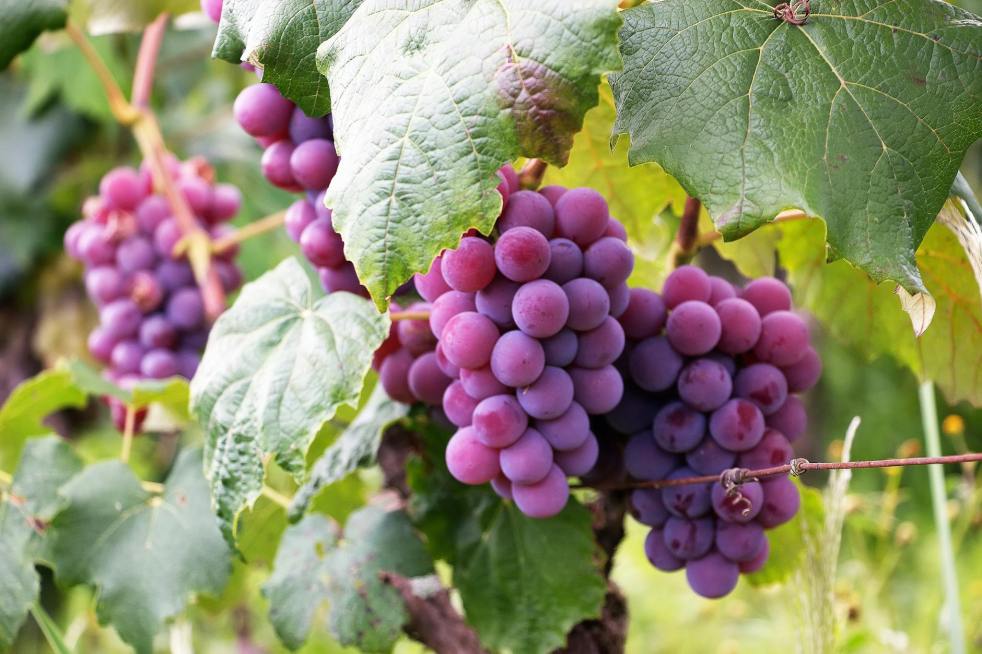
In the Ogham writing and divination system, the letter muin (ᚋ) is commonly interpreted as “vine,” and usually portrayed as either grape or ivy. However, grapes are not native to Ireland and, even when they were introduced, they never really took root there (pun intended — Ireland is not a great place to try to grow grape vines). The word “muin” also doesn’t have anything to do with vines. Instead, it refers to a thorny thicket. This has made muin one of the most controversial and seldom-agreed-upon parts of the Ogham.

The ancient Greek deity of wine, orchards, frenzy, fertility, and religious ecstasy, Dionysus, is also intimately connected to vines. (And I do mean intimately.) Not only are grape vines his domain, he is also regularly portrayed as wreathed in ivy vines. Here, the evergreen nature of ivy represents the gods’ immortality. It’s also connected to fertility and sex.

Dionysus isn’t the only one to wear an ivy crown, either. Thalia, Muse of Comedy, is also portrayed as wearing one.

In Egyptian legend, Osiris is associated with the ivy, again, because of the plant’s connection to immortality and rebirth.

There’s a Persian (now modern day Iranian) legend that tells of the origin of wine. Long, long ago, a bird dropped some seeds by a King’s feet. Intrigued, the King had the seeds planted and cared for. The seeds became sprouts, the sprouts became vines, and the vines grew heavy with grapes. Overjoyed, he had the delicious grapes picked and stored in his royal vaults.

However, grapes don’t stay fresh forever. The vault was too damp for them to dry into raisins, and too warm to chill them. Instead, the grapes began producing a dark liquid which everyone assumed was likely a deadly poison. Before the old grapes could be cleaned up and thrown away, one of the King’s wives attempted to end her life by drinking some of the grape “poison.” When the King found her later, she was far from deceased — in fact, she was dancing, singing happily, and apparently thoroughly enjoying being the first person in recorded history to ever get absolutely rocked off her tits on wine. With this evidence that the liquid was not poison and, in fact, seemed to make people quite happy, the King named it “Darou ē Shah” — The King’s Remedy.

No word on what happened to his wife, however. Therapy being in short supply thousands of years ago, one can assume she either eventually found some actual poison or developed an absolutely staggering drinking habit.

English ivy climbing a white wall.
Photo by Madison Inouye on Pexels.com

Ivy is about more than ecstasy, wine, sex, and living forever, though. One look at the growing behavior of many vines can show you exactly what else they’re good at: binding things. Even the beautiful, gentle passionflower vines climbing my front porch do so due to grasping tendrils of surprising strength and tenacity. Some vines, English ivy in particular, also get a reputation here for damaging property and killing native trees.
Depending on the context, vines are then equally as restrictive as they are freeing. Sometimes, vines are heavy with grapes and the promise of wine, intoxication, inspiration, sexual desire, and ecstasy. Sometimes, they’re ivy vines, evergreen and symbolizing enduring life and lush greenery during the winter months. Other times, they are the vines that grow around things, binding and restricting them like ropes.

Ivy is also associated with protection and healing. This may be due to its connections to immortality and rebirth. Grapes, on the other hand, are associated with fertility, money, and all things connected to the concept of abundance. Briony, on the other hand, is both money and protection. Placing money near a briony vine is said to cause it to increase.

In the tale of Sleeping Beauty, vines (sometimes) play a key role. In the Disney version, Aurora is cursed, pricks her finger, falls asleep, yadda yadda yadda, vines grow and cover everything. In an older telling, it was a dense hedge of climbing roses. One yet older version of the story (Sole, Luna, e Talia) also has Sleeping Beauty-
You know, I’ll just let Giambattista Basile tell it.

“crying aloud, he beheld her charms and felt his blood course hotly through his veins. He lifted her in his arms, and carried her to a bed, where he gathered the first fruits of love.”

Yeah. When that fails to wake her, he pulls his pants up and rides off to his castle and his already existing wife, the Queen. Sleeping Beauty only awakens again when one of the twins she subsequently births tries to nurse and accidentally sucks the splinter from her finger.
(As if that weren’t enough, the Queen gets fed up with the King’s infidelity and tries to have the children cooked and fed to her husband.)
Interestingly, vines aren’t prominent in the assault version of Sleeping Beauty — they become more important the further you get from that version, and the closer you get to Disney’s much more sanitized telling. It’s as if the presence of the vines in the story both bind Sleeping Beauty in her castle and protect her from the King.
No vines? Not even a climbing rose? You’re in for a bad time.

Vines make beautiful decorations for the home and altar. Evergreen ivy is commonly brought indoors during the winter months as a decoration, tied with swathes of ribbon, hung with bells or other ornaments, you name it.

Vines can also be used to bind things. Hollywood has portrayed magical bindings in some… interesting ways. For example, “binding” a witch à la The Craft.
This, however, is silly.

Bindings can go one of two ways: a person, thing, or situation may be bound (in the sense of binding someone with rope) to keep them/it from causing harm or otherwise interfering with you. You can also bind something to yourself. For example, a really great job that you just got, happen to enjoy, and want to make sure that you keep.

In this case, the binding is a form of sympathetic magic. You take a representation of the thing you wish to bind, and effectively tie it up with what you have on hand. (This may be vines, if you want to enlist the vine’s help and magical associations, but can also just be household twine in a pinch.) There are plenty of chants and incantations you can recite while doing so, but I find that it’s most effective if you speak from the heart — inform the subject why they are being bound, and what you hope will come of it. Put it in a jar or box, close it tightly, and keep it somewhere safe so you can undo the binding when the time comes.

To bind something to yourself, you’d use a representation of yourself (like a photo or lock of hair) and a representation of what you wish to bind to you. Wrap both objects together with the vines or string, again speaking from the heart while you do so. Place the objects in a jar or box and keep them somewhere safe.

Bindings aren’t the only type of sympathetic magic that vines are good at, though. Plant a vine (preferably not an invasive species — there are loads of native vines) along with a representation of something you wish to grow. Ask for the vine’s help, and declare that, as the vine grows, so shall grow the thing you desire. Take good care of that vine, and keep an eye on its growth.

While every species of plant has its own magical uses and depictions in legend and folklore, vines are in a class of their own. Each one has their own unique properties, but vining plants also have plenty of common ground.

animals · Neodruidry · Witchcraft

The Magical Meaning of Feathers

Right about now, several species of birds have turned the area around my house into a kind of avian daycare. Again.

There are birds of every distinction turning up, kids in tow. Most of these kids look almost exactly like the adults — the starlings, for example, are fully the size of their parents and the only difference is that some still have their brown feathers. The baby crows look just like their parents, save for being a little smaller and still having pink corners on their beaks.

Since these babies are rapidly transitioning from their juvenile plumage to their full adult feathers, that means that they’re molting. You can find feathers everywhere — mostly fluffy white down, but the occasional primary feather, too. That’s why I thought that it might be a good idea to write a bit about the magical meaning of feathers.

A barred feather caught on a leaf of a tree.
Photo by Eftodii Aurelia on Pexels.com

Before I do, though, there’s one important caveat: All parts of native birds, including shed feathers, are protected by the Migratory Bird Treaty Act of 1918. This is to protect them from poaching by ensuring that there isn’t a legal market for their feathers, bones, etc. If you see a shed feather outside and you aren’t sure if it’s from a native species, invasive species, or domesticated species, leave it right where it is.

Feather pillows can also be a source of ominous omens. In Appalachia, death crowns or angel crowns are complex, crownlike whorls of feathers found in the pillows of the deceased. Usually, they’re only found after the person has died — it’s unlikely that anyone would go probing their pillow for death crowns otherwise. However, it is said that, if you find and break up a death crown in someone’s pillow, you can prevent their death.

In Celtic legend, feathers are commonly associated with the Otherworld. Some fairies are said to wear cloaks trimmed with red feathers, and The Morrigan wears a cloak of black ones.

The Morrigan isn’t the only goddess to have a feather cloak. Freyja, the Norse Goddess of love, war, sex, and magic, is said to have a cloak of gray falcon feathers (fjaðrhamr). This cloak grants her the ability to shape-shift into a falcon at will.

In Egyptian legend, Ma’at is associated with the Feather of Truth. She is the personification of truth, justice, and balance, and this feather is a representation of her. When a person dies, their heart is placed on a scale and weighed against this feather. The hearts of virtuous people are lighter than this feather, and they are allowed to pass on to Aaru, the Field of Reeds. The hearts of the wicked are heavy, and they are devoured by the goddess Ammit.

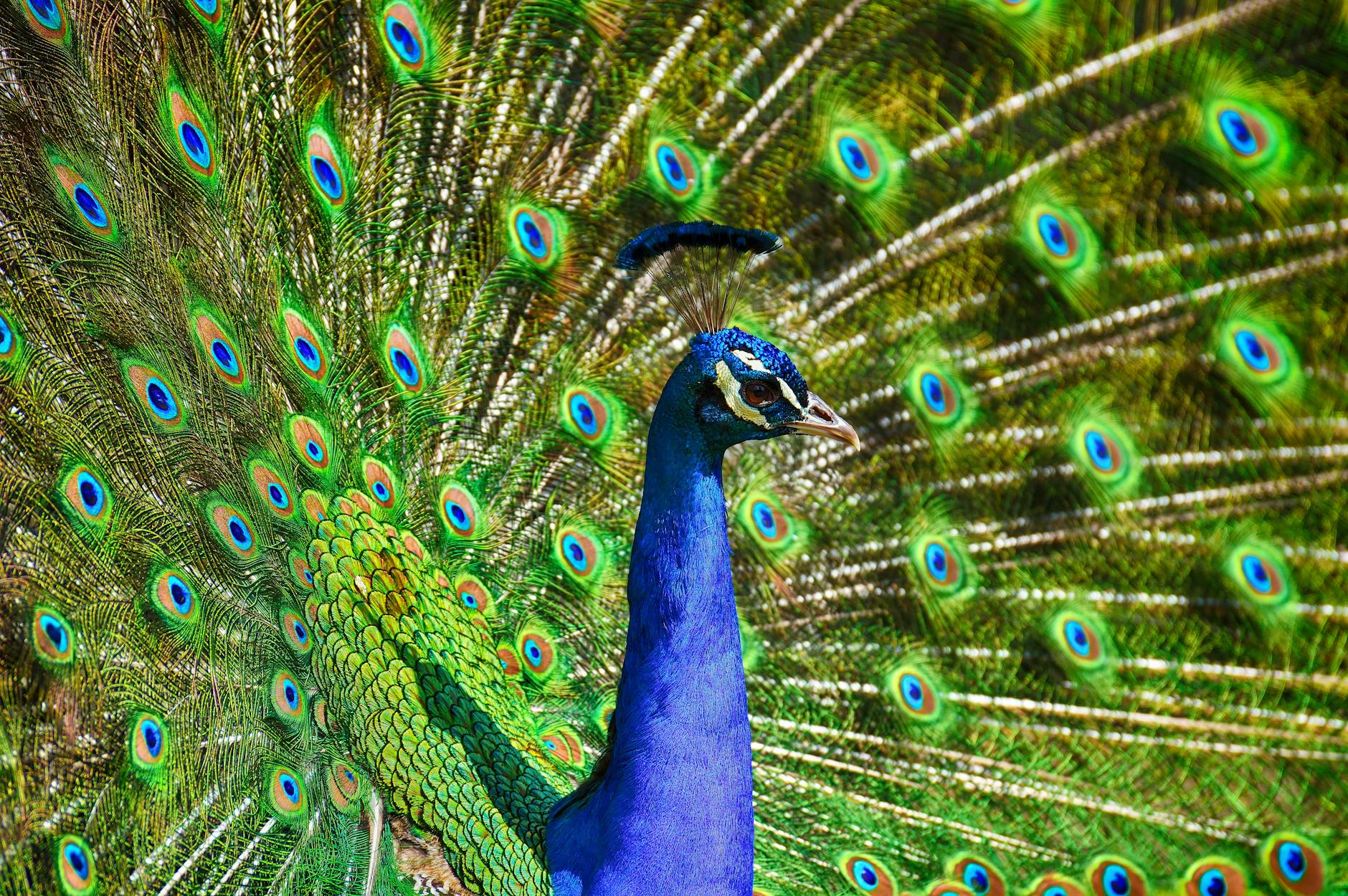
In Greek legend, Hera, the Goddess of marriage, family, and women, took the peacock as her sacred animal. She’s also the one responsible for the male peafowl’s beautiful, unusual plumage.
When Zeus seduced Io, he knew his wife would be jealous. He either turned Io into a white cow (another one of Hera’s sacred animals) to protect her from his wife, or Hera transformed her herself. Either way, Hera set the many-eyed giant, Argus Panoptes, to watch over her new prized cow. Having many eyes, he only needed to close a few at a time in order to sleep. This made him the perfect watchman… until Hermes came along.
Zeus asked Hermes to free Io. Hermes, in turn, disguised himself as a shepherd and used charms to put all of Argus’ many eyes to sleep at once, then killed him. Having lost her watchman, Hera immortalized him by placing his many eyes on the tailfeathers of the peacock.

A male peacock, tailfeathers spread to show their distinctive eye-spots.
Photo by Alexas Fotos on Pexels.com

In North America, Indigenous people have also attached significance to feathers for ages. Eagle feathers, in particular. (I remember being at a Powwow where another dancer I knew had dropped an eagle feather. It was retrieved from the ground with ceremony, treated as a fallen warrior. It was a very emotional experience, especially for her.)
Indigenous textile artists have also woven feathers into warm blankets and beautiful garments (sometimes called match-coats).

In modern witchcraft, feathers are commonly used as representations of the East or element of Air.

In addition to representing the East, Air, multiple deities, and various concepts of the Otherworld, feathers are also considered an “angel sign.” These “angel signs” are a collection of circumstances that are said to indicate that one’s guardian angels, spirit guides, or ancestor spirits are nearby. They include finding white feathers or shiny coins, hearing mysterious music, or smelling sweet, unexplainable smells.
It’s important to be careful with angel signs, however, since so many of them have mundane explanations. It’s very easy to get caught up in looking for signs, start interpreting everything as some kind of “angel sign,” and end up in spiritual psychosis, where the desire for significance blurs the line between reality and delusion.
Sometimes, an angel number is an angel number. Sometimes, it means you spend too much time looking at the clock. Similarly, sometimes, finding a feather is an “angel sign.” Sometimes, it means your neighborhood has stray cats.

Feathers are also subject to color symbolism. Finding a feather of a specific color is said to have a specific meaning. For example:

  • White feathers are positive omens, or indicate the presence of benevolent beings.
  • Black feathers symbolize protection.
  • Red feathers can represent protection, passion, or good fortune.
  • Blue feathers represent peace.
  • Green feathers symbolize abundance or fertility.
  • Yellow feathers represent joy.
  • Orange feathers symbolize creativity.
  • Ground feathers are omens of stability and groundedness.
  • Gray feathers, like blue ones, represent peace.

Of course, all of this is highly contextual. If you’re at a duck pond, the presence of white or gray feathers is unremarkable and not likely to represent anything but the presence of ducks.
On the other hand, finding a bright green feather in your yard, when you don’t have an abundance of green birds in your area, may be a bit more significant.

Feathers represent all kinds of things, but their primary association is with the fine line between this world and the others. They are tools of shapeshifters and symbols of creatures capable of traveling between worlds. If you find a feather outside, appreciate it for its beauty, see if you can identify what species it came from, and leave it be to return to the soil. If you work with feathers in your practice, source them from pets or well-treated backyard fowl.

animals · life

The Magical Meaning of Grackles

The first time I saw a grackle, I mistook it for a crow for a split second. It was only when I noticed its long tail and absolutely furious facial expression that I was like, “Oh.”

While grackles are typically pretty gregarious birds, we have a single male boat-tailed grackle (Quiscalus major) that visits the back yard here. He’s very pretty — black at first blush, but iridescent shades of peacock blue, bronze, and violet when the sun hits just right. Unlike crows, he also has light eyes. (Which, I think, lends to the whole expression thing.)

A grackle, with a classic irritated expression.
A male grackle. Photo by Gabriel Espinoza on Pexels.com

He’s usually very difficult to get a picture of, since he’s nothing if not wary and easy to startle. Lately, he’s been coming closer to the kitchen window and displaying more curiosity. I thought it might be a good time to write a post dedicated to these beautiful, interesting birds.

Most grackles move in large groups, called “plagues” or “annoyances.” This might seem unfair — worse than a murder of crows, even, or an unkindness of ravens — but it likely comes from their ability to decimate corn harvests. They’ll show up to follow behind plows in order to grab the turned-up worms, insects, and mice that wind up in the furrows (which isn’t really a bad thing, if you’re a farmer) but they’ll also descend on ripe corn to feast on the grain.

Grackles can be a bit of a problem for bird feeders, too. Smaller than crows, they’re quite happy to avoid the work of digging up worms and bugs and instead go for the nice, nutritious seed in a feeder. Where a crow or other, larger bird will ignore things like thistle and millet, grackles will dive right in. This can end up leaving nothing for seed-eating songbirds, so many people aren’t too stoked about seeing a crowd of grackles turn up in their yards.

Nonetheless, these birds have an important role. Unlike many small songbirds, which primarily feed on seeds and don’t dig up burrowing insects, grackles help control pests like invasive grubs and worms. During the time of year when seeds are the most abundant and make up a larger portion of their diet, they also help propagate them in their feces.

Not everyone finds these birds to be nuisances, either. In the late 1400s to early 1500s, the Aztec Emperor Ahuitztol purposefully introduced great-tailed grackles (Quiscalus mexicanus) into the capital Tenochtitlan and the Valley of Mexico. These birds were taken from the Aztec provinces of Totonacapan and Cuextlan in the Totonac and Huastec regions of Mexico, and received plenty of human intervention to help them establish themselves and grow their numbers in their new home. They were well protected and well fed, which allowed their population to take root.
These birds were named teotzanatl, which roughly translates to “divine” or “marvelous grackle.” Certainly a far cry from calling them a plague or annoyance!

(This is far from the only case of something like this happening. Aztec emperors kind of had a thing for bringing in exotic plant and bird species, and even importing special gardening staff to help their new acquisitions thrive.)

Interestingly, these grackles were protected — not only by guards, but also by public shaming. It’s uncertain why this was so necessary, unless attempts to hunt the birds were legitimately an issue. This could have been because they’d become pests, or because their feathers were considered very valuable. Probably both.

A grackle, showing its light yellow eyes and brilliantly iridescent feathers. Its mouth is open and it looks genuinely offended.
A male grackle. Photo by Tina Nord on Pexels.com

Grackles are also the subject of an ancient legend. In it, Zapate the great-tailed grackle was unable to sing. Being a very clever, tricky bird, he stole songs from the sea turtle. This left the turtle without a voice, and the grackle filled with… well, all kinds of noises.

While they aren’t members of the corvid family, they share crow, raven, and magpie’s intelligence. They’re able to solve puzzles, catch fish, and will even clean the grills of cars in order to get at the tasty, tasty smushed bugs.

Grackles also seem to be uniquely equipped to detect the Earth’s magnetic field due to natural deposits of magnetite in their little heads. This may be helpful for navigation and migration.

In general, these birds are said to represent caution, resourcefulness, and community support. Be cautious, however — the appearance of a grackle is also considered a symbol of misfortune.

As with a lot of birds, you often have to pay attention to what they’re doing when you see them since their behavior can color their meaning.

For example, a bunch of grackles can represent friendship, community, and support. A single grackle, not so much.

A grackle foraging or stealing food can be a sign that you need to be resourceful. You may be entering a time when you’ll have to survive by your wits.

These birds also engage in a behavior called “anting.” There, they crouch and spread their wings over anthills. As the tiny insects scurry over them, they pick off mites and release formic acid, which helps repel pests. These birds will also fumigate themselves with everything from stolen moth balls to discarded cigarette butts — whatever keeps the feather mites away.
If you see a grackle anting or fumigating themselves, it may be a sign that it’s time for some reflection, spiritual cleansing, or actual decluttering. You might need to schedule some time to take inventory, clear some of the chaos from yourself or your environment, and make a fresh start.

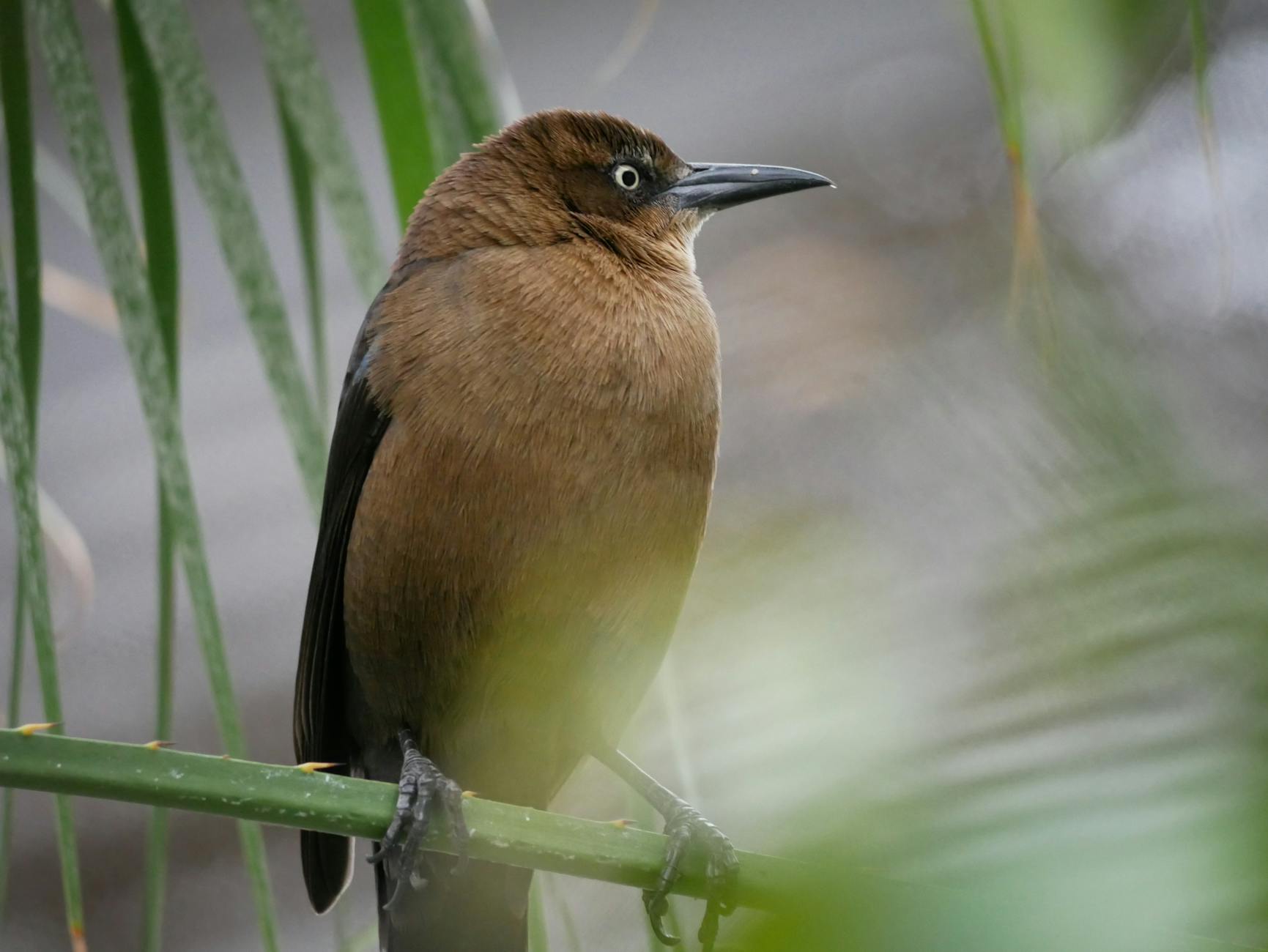
A female grackle, displaying soft reddish brown plumage.
A female grackle. They lack the dark, iridescent feathers of the males, instead displaying beautiful shades of a rich brown. Photo by Connor kane on Pexels.com

No matter whether grackles are a welcome sight to you or not, these are brilliant, beautiful birds with a fascinating history. From dumpster scavengers to the protected birds of an imperial house, they have lived closely with humans and fulfilled many roles for ages.

Neodruidry · Witchcraft

Snake and Lizard Skin Folklore and Magical Uses

To be upfront, I do not have a snake. I have had snakes in the past, and I live in in an area frequented by them, and I do have a large male bearded dragon I adopted from a classified ad.

Being a healthy, full-grown bearded dragon, he occasionally goes through periods of shedding skin while being a very sulky boy. A lot of the time, he eats it in order to reclaim the protein and minerals that would otherwise be lost. Sometimes, I find pieces just kind of around, like tiny laundry.

The skins of animals have been used in ceremonies for… about as long as humans have existed, most likely, and they’re still used today. Each animal has its own power and domain, including lizards and snakes. To be honest, serpents alone have so much symbolism and mythology behind them that it’s far too much to get into here. Instead, I want to focus specifically on the folklore and magical properties of shed reptile skin.

Perhaps one of the most prevalent and enduring qualities attached to snakes is the concept of renewal or rebirth. It makes sense — unlike a lot of lizards, snakes shed their skin all at once. In a pretty short span of time, they go from appearing dull and milky-eyed, to bright, smooth, and rejuvenated.
By extension, this has also made snakes a symbol of fertility, healing, and transformation.

Snakes are also associated with protection. This is particularly true of venomous snakes.

In the Danish tale King Lindworm, an infertile queen wishes to bear a child. She follows the advice of a crone and eventually gives birth to twins: one healthy boy, and one boy who’s a half-human, half-serpent lindworm.
When the time comes for the lindworm to marry, his bride is horrified on their wedding night. The lindworm eats her. This continues over and over, until a shepherd’s daughter is brought to marry him. The clever girl wears every dress she owns on their wedding night and, when her lindworm husband insists she get undressed, she demands that he shed a layer of skin for every dress she removes. Finally, as he removes his last skin, he reveals his fully human body and is cured.
By mimicking layers of snakeskin with her clothing, the girl tricks the lindworm-prince into shedding until he is effectively “reborn” as his human self.

In some forms of American folk magic, snakeskin is carried for luck. Some people also rub it on their hands to help them “hold onto” things.

If you find a shed snakeskin on your property, it’s said to be a sign of spiritual protection. This can also be interpreted quite literally — snakes are vulnerable mid- and post-shed, so they try to do it in places where they feel safe. If a snake feels safe on your property, rats, mice, and other potential pests won’t.

A leopard gecko eyeing a mealworm.
Leopard geckos frequently eat their sheds. Before they do, though, they can end up wearing them like little lizard hoodies. Photo by Pixabay on Pexels.com

Snakes are also sometimes used as a symbol of initiation, as an extension of them as a metaphor for rebirth. In this context, they represent the death of the old self, and birth of the new. This may be part of why they’re considered symbols of wisdom — with each shed, a snake metaphorically moves into a new incarnation of itself. It’s certainly a potent metaphor for becoming wise enough to realize how little we know!

Lizards carry many of the same connections and magical associations as snakes, since they go through the same shedding and renewal process. However, since reptiles very often “recycle” their sheds while snakes don’t, there isn’t as much lore on using shed lizard skin. (After all, even if you find an uneaten one, it’s unlikely to be a very large piece.)

In general, snakes and reptiles are associated with the element of Earth.

Reptile skin is pretty delicate (and becomes more so the more it dries out), which is good to keep in mind. A freshly shed skin may seem like great material for a poppet or spell bag, but you’re likely to be disappointed once it’s fully dry and crumbly!

Shed skin from prickly, aggressive, or venomous reptiles is good for enemy work. Grind it into dust, combine it with banishing or protective herbs, and sprinkle it around the border of your home, in front of your front door, or in the footprints of an enemy in order to keep unwanted people or entities from darkening your doorstep.

A very handsome bearded dragon on a moss pole in the middle of a Monstera deliciosa.
A very handsome boy.

You can also put shed reptile skin in spell jars, bottles, or sachets for protection. I prefer jars or bottles for spells that you want to keep at home (for example, keeping a protection spell bottle near your front door), and sachets for carrying. Since they’re made of fabric, they’re soft. If you’ve got a protection sachet stuck in a purse or backpack, it’s unlikely to break and get herb dust and bits of skin on things.

You don’t have to use an entire shed skin per working. If you have access to a full snake or lizard shed, you can use pieces. Consider ways to incorporate them in workings for change (like finding a new job or home), renewal, initiation, or healing spells.

Shed reptile skins also make for powerful altar pieces. Place them in a fancy bottle, make sure they’re completely dry, cork or cap them to keep the contents protected, and place them on your altar when you have need to tap into snake or lizard energy or work with deities associated with snakes.

Avoid putting shed reptile skin in anything that’s intended to be ingested. While the risk of danger is small, reptiles can carry zoonotic pathogens like Salmonella or E. coli. If any fecal matter remains on the shed, there could be a risk of infection.

Reptiles shed their skins naturally and, if all goes well, safely and painlessly. If they aren’t eaten, these shed skins are a powerful and ethical way to work with the energies of these powerful animals.

animals

The Magical Meaning of Black Squirrels

The other day, I was on the deck having breakfast with my local crowbros. (It’s funny — as soon as I go outside, I hear their calls pick up speed and intensity. Then they start to swoop around and gather in the big maple tree. Once some of the braver members of the family are present, they’ll start making forays to the feeders. Gradually, once they’ve proven its safe, the timid members follow suit.) This day was different, though.

This day had squirrels.
Not just the usual suspects (Freddy de Bonesby and the pruno-making delinquents), either.
Today, there was a black squirrel.

A photo of a black squirrel on a clover-covered hillside. He looks like he's just realized he left his stove on.

Black squirrels are a naturally occurring melanistic variation of grey or fox squirrels. They’re fairly rare under normal circumstances, appearing at a rate of about one for every 10,000. This is overall, however — black squirrels do occur more commonly in specific areas. They’re generally seen more often in urban places (theoretically because they blend in better there than they do elsewhere) and at the northernmost portions of their ranges (theoretically because they absorb sunlight more efficiently, keeping them warm and extending their active, foraging times during the cooler months).

Melanism in squirrels doesn’t occur with the same beautiful variety as human skin colors, and isn’t even the same as melanism in other animals. In most other animals, melanism is a recessive gene and an individual must inherit it from both parents. In humans, coloration is controlled by multiple genes that come in a variety of alleles that show incomplete dominance, resulting in an incredible variety of hair, eye, and skin colors. In squirrels, melanism is associated with the is associated with the MC1R-Δ24 E B allele EB and is incompletely dominant with the “wild” coloration allele E+. So, a squirrel that inherits two wild coloration alleles will be the color of the average gray squirrel (E+ + E+). A squirrel that inherits one copy of the melanistic allele will exhibit a dark brownish, nearly black coloration (EB + E+). A squirrel that inherits two copies will be a deep, shiny, inky black (EB + EB).

Even rarer than melanistic squirrels are leucistic squirrels — white squirrels with black eyes. These are not the same as albino squirrels, which typically have pink and blue eyes. Albino squirrels typically have poor eyesight. Leucistic squirrels have normal eyesight. Both stick out like sore thumbs to predators and generally don’t survive long in the wild.

Where I live, melanistic squirrels more common because it’s a) by a major city, where b) a bunch of them escaped from a zoo this one time.

I had seen a few here and there in the past, but I’d never seen one in the yard before. Out of curiosity, I decided to look up the magical and folkloric significance of these adorable weirdos.

Remember that bit about escaped zoo squirrels? Well, the tale goes like this: As far back as 1900, Frank Baker (superintendent of the National Zoo) repeatedly requested rare, beautiful black squirrels from several locations in Ontario, Canada. Two years later, Thomas W. Gibson (Ontario’s former commissioner of Crown lands) sent the National Zoo eight black squirrels. Canada is in the northernmost portion of the eastern gray squirrel’s (Sciurus carolinensis) range, so melanistic individuals are far more common there.
In 1906, eighteen of the black squirrels were released onto the zoo’s grounds. For some reason, people okayed this decision because they literally didn’t think they’d get out. However, being squirrels, that’s exactly what they did. As a result, DC has an exceptionally high population of melanistic squirrels.

A close-up of a black squirrel in autumn leaves.
Photo by Lauren Hedges on Pexels.com

Remember when I wrote about solar eclipses a bit ago? I briefly mentioned the Choctaw legend about greedy squirrels coming to eat the Sun. These weren’t just any squirrels, though — they were particularly hungry and mischievous black squirrels.

In Ireland and the UK, black squirrels were viewed similarly to black cats: as signs of good luck or prosperity. Rare as they are, they were also thought to have connections to the fae realm. While they don’t appear to have the “messenger” connotations of animals like crows, they are no less connected to occult knowledge.

Given squirrels’ propensity for burying things, black squirrels were associated with finding hidden treasure.

Of course, as has often happened throughout history, the spread of various forms of Christianity during the medieval period turned what were once good luck symbols into something sinister. Black animals, like cats, crows, ravens, and even squirrels, were then associated with misfortune and evil. They were often accused of being witches’ familiars.

In general, black squirrels are associated with good luck. English coal miners would keep them around for luck, and it was considered very unlucky to ever harm one.

Even in cultures where melanistic squirrels are viewed as troublesome, they were typically seen more as eccentric trickster figures than something expressly evil.

Today, places that are fortunate enough to be blessed with lots of black squirrels often take pride in it. Some of them are jokingly called “squirrel towns,” and feature black squirrels on their signs, as the subject of annual festivals, and represented on souvenirs in gift shops.

In a divinatory sense, the appearance of a black squirrel heralds a positive change of some sort.

While they may not be super rare here, black squirrels are still delightful to see. From what I’ve noticed, they seem jumpier and more skittish than other eastern gray squirrels, so being able to get a photo of one (or even a clear look at one) is a treat.

animals · Neodruidry · Witchcraft

Egg Folklore and Magical Uses

Hello! If you’re in the US, hopefully you enjoyed the eclipse on Monday. I spent most of it enjoying the lovely weather, painting my porch, and experiencing the very surreal feeling of an eclipse-dimmed sun.

The family of crows who hangs out here all came to rest in the maple tree in the backyard. (I read that zoos had noted that the eclipse affected animal behavior, and some birds seemed to be agitated by this bit of celestial disruption. I’m guessing these guys figured it wouldn’t be a terrible idea to spend the eclipse in a place they knew came with food, water, and safety.) So, once the porch was finished, I spent the rest of the time relaxing, reflecting, and feeding them hardboiled eggs.

This, and the recent Spring Equinox, got me thinking about the folklore and magical properties of eggs. I don’t eat them, myself, but they’re rich with symbolism and certainly deserve a look.

In ancient Greek Orphism, there was the Orphic Egg. This was an egg, usually depicted with a serpent coiled around it, from which hatched the primordial deity Phanes.

Ancient Egypt had their own concept of a cosmic egg not unlike the Orphic Egg. There was a cosmic goose called the Great Honker (Gengen-Wer) who laid a world egg, from which the Sun and Earth hatched.

In Hinduism, there are multiple mentions of eggs. The Hiranyagarbha is similar in concept the world/cosmic egg. In one tradition, the creator deity Brahma emerged from the egg and created the world. The Shatapatha Brahmana mentions another creation story, in which the Prajapati reproduces himself, releases the waters of the world, transforms into an egg to enter the waters, then emerges from the egg to make the Earth, sky, and middle regions. In Garuda Purana, Vishnu was born from a golden egg.

A small dish of spotted quail eggs on a checkered tablecloth.
Photo by Mikhail Nilov on Pexels.com

Eggs are a strong recurring theme and metaphor for creation across cultures, and they’re also associated with the Sun. In Egypt, the Sun was sometimes conceptualized as an egg. In Australia, some Indigenous Australian peoples held that the Sun was produced during a fight between birds. Brolga the dancing crane and Dinewan the emu quarreled, and Brolga grabbed one of Dinewan’s eggs and tossed it from its nest. The egg struck a piece of wood, freeing the yolk from the shell and catching it aflame. This flaming yolk stayed in the heavens as the Sun.

In Europe, eggs were also a symbol of creation, birth, and fertility. French brides would break eggs to ensure a swift pregnancy. German farmers would rub egg yolks on their ploughs to transfer the egg’s fertility to their fields.

As in Australia and Egypt, eggs were also associated with the Sun in much of Europe. This, however, seems largely to do with the fact that both return at the same time. Most of Australia and Egypt have milder winters, but winters in much of Europe can be pretty harsh. The Spring Equinox marks the beginning of spring and longer, warmer days, which is also when birds start laying again. Even modern chickens, who’ve been selectively bred to produce far more eggs far more often, will take a break in winter if they aren’t “tricked” with supplemental lighting. Chickens literally need the Sun or eggs don’t happen!

A paperboard container of pastel-colored eggs.
Photo by ROMAN ODINTSOV on Pexels.com

Slavic egg decorating further connects eggs with the Sun, and is the source of modern Easter egg traditions. Slavic Paganism has a Sun deity named Dabog (or Dazibogu, Dazhbog, Dazhboh, Daždźboh…). Birds were his chosen creatures, for only they could get close to him. Eggs, therefore, are intimately connected to both the Sun deity, and the return of warmer weather and the fertility of animals and the land in spring. Decorating eggs was a way to honor this. The simplest form of decorated eggs, a single solid color, are to be blessed and eaten, conferring the blessing to the consumer. More elaborate designs are for ritual or amuletic purposes.

Eggs are frequently used for cleansing. In Brujeria, they’re a key component of huevo limpia — egg cleansing. Egg cleanses are also a part of Hoodoo. Sometimes, these eggs have certain restrictions imposed on them by the practitioner. For example, the egg may need to come from a specific color of hen, and be laid before noon.

Using eggs can be as simple as boiling, blessing, and eating them. They’re a traditional food for spring festivals. Though I don’t eat them myself, when I end up with some, I offer them to the birds during their breeding season. The extra protein and calcium seem to be very much appreciated.

Eggs can also be a vehicle for container magic, albeit a delicate one. To do this, make a small hole at both ends of the eggshell without shattering it. Blow through the hole to push the yolk and albumen into a separate container. Use the now-hollow egg to hold dried herbs, petition papers, or other spell materials. Hang the egg from a tree branch with a bit of twine or ribbon. When the egg eventually breaks, the spell will be released.

As with Slavic decorated eggs, you can also decorate egg shells for ritual or amuletic purposes. (For this, you may actually want to use a ceramic or wooden egg instead of a real one — whole eggs will rot, and hollowed-out eggs are very fragile.) Decorate it with wax and dye, decoupage, beadwork, painting, or, if you use wood eggs, pyrography. Choose symbols that relate to the egg’s significance to your practice — creation, fertility, birth, abundance, and so forth. Carry one with you as an amulet, or use them as altar decorations or ritual power objects.

You don’t need to buy or eat eggs to be able to work with their powerful symbolism. Purchase ones made of ceramic or wood, or you can make your own using air-dry clay or papier-mâché. They represent the earliest, oldest magic — the creation of the world, the cosmos, and everything that is. Eggs are the infinite seed of creation, and a very worthy addition to any spiritual path.

Neodruidry · Witchcraft

The Magical Meaning of a Solar Eclipse

Picture it. A group of early humans look up to the sky as it grows dark. A black orb moves into view, blocking the light of the light-giving Sun. The people shout in fear — will the Sun return? Will it be able to fight off the invader? After a few moments, the light returns. The Sun is safe.

If this sounds like a case of cavepeople being foolish and unadvanced, imagine this instead:

You walk outside to your car, travel mug of cold brew in hand. Your eyes are still bleary from sleep. You pat your pockets — wallet, phone, keys.
Suddenly, the sky flares into an indescribable bright green color. Angry clouds of magenta move in, obscuring everything from view. It seems as if the heavens themselves overturn, pouring down a rain of tiny, glowing meteors. Confused, and probably afraid your skin is going to be stripped from your bones, you duck back into the house to wait out this bizarre phenomenon.
Then, about three minutes later, the glowing meteor shower stops, the clouds part, the meteors sublimate into vapor, and it’s as if nothing ever happened.

And, lightyears away, peering through some kind of very advanced telescope, a bunch of aliens laugh their multiple asses off at the primitive Earth people who don’t even understand that glowing tiny meteor season is a perfectly normal and harmless phenomenon that happens naturally every twenty thousand years.

An image of Grogu, "Baby Yoda," pointing. He's wearing a brown robe and blue sneakers.
“lol, newbs.”
Photo by Erik Mclean on Pexels.com

Sure, eclipses aren’t that rare. Eclipse season happens every six months or so, after all, and even total solar eclipses occur somewhere about every year and a half. But total solar eclipses are also a whole other animal when compared to a partial solar eclipse.

Things need to line up just right (pun only slightly intended) for a total solar eclipse to happen. When they do, the total obscuration of the Sun is only visible across a narrow band of the planet. This very rarely happens in the same place twice. Like, you’re looking at about every 360-410 years or so, or a one-in-every-fourteen-generations kind of thing. You’ll most likely experience several partial eclipses in your lifetime, but what’re the odds you’ll ever be in the path of a total solar eclipse?

Back when people didn’t travel with the kind of swiftness and ease with which they do now, a total solar eclipse was a Very Big Deal. As a result, this phenomenon has accumulated a lot of folklore and metaphysical connections over time. Since we’re about to have one in the US on April 8th, I thought now might be a good time to look at some of the folktales, traditions, and magical practices surrounding solar eclipses of all forms.

In Chinese, the word for eclipse is 日食 (Rì Shí). It includes the word 食 (Shí), meaning edible, food, or to eat. It was once thought that a solar eclipse occurred when sun-eating dogs (in some interpretations, dragons or demons) would attack the Sun. People would fire arrows and bang pots and pans to drive them off and ensure the Sun’s survival.

The Choctaw people saw eclipses in a similar way. Instead of dogs or dragons, greedy squirrels would come to eat the sun. And, just like in China, people would make noise and fire arrows to shoo them away.

The belief that an eclipse was the Sun being eaten (or nearly being eaten) is or was very common all around the world. In Vietnam, it was a giant frog. In the Andes, a puma. In Java, the God of Darkness. In Indonesia, it’s Rahu… but the Sun burns his tongue, so he spits it out.

In ancient Greece, a lot of things were omens. A bolt of lightning flashed from left to right? Omen. You saw a bird flying a bit weird? Omen. Bad dream? Omen. Solar eclipse? Omen. Eclipses were thought to happen as a punishment when mortals displeased the Gods in some way. This is actually reflected in the English word “eclipse,” which comes from the Greek ekleipsis, meaning “abandonment,” or “to forsake a usual place.”

This is somewhat akin to Transylvanian folklore. There, it was said that solar eclipses happened because the Sun, displeased by people’s actions, turned away from the Earth.

The corona around a total solar eclipse.
Photo by melissa mayes on Pexels.com

The idea of a solar eclipse as a bad omen took a rather funny angle in ancient Babylon. There, kings would hire a temp to stand-in for them for the day. This way, they reasoned, any harm or bad luck that might come to them as a result of the eclipse would happen to the other guy instead.

In Australia, things are a bit different. Australian Aboriginal culture has a long tradition of astronomy, passed down orally, through artwork, and in ceremony, and many different tales about the Sun and the Moon. The Warlpiri and Wirangu people say that eclipses happen when the Sun-woman and Moon-man make love — his body covers hers from view, darkening the sky.

The Diné people of North America also see eclipses differently. Rather than a thing to be feared, they’re a time for peace and reflection. People still observe traditional eclipse ceremonies, and schools and businesses close for the day.

While nobody knows what the people of ancient Ireland thought about eclipses, we do know that they recorded them. The oldest known marking of an eclipse was made over 5,000 years ago. Images of it were carved into a stone cairn at Loughcrew, in Meath. (This doesn’t mean that other cultures didn’t bother recording eclipses, but these recordings either may not have survived, or were done in a symbolic form that has since been interpreted as something else by modern eyes.)

Some harmful solar eclipse superstitions are weirdly persistent. One bit of very stubborn folklore warns that, if you’re pregnant, you should stay indoors during an eclipse. This belief holds that eclipses create radiation which can harm a developing fetus. The thing is, the Sun’s solar radiation doesn’t change during an eclipse. The sometimes weirdly colored corona you see around the Moon’s silhouette during a total solar eclipse is an optical illusion. It’s caused by the interaction between the light at the sun’s edge, the atmosphere, and your perception, not unlike the green flash you can sometimes see on the beach at sunset.

This idea also sounds an awful lot like the idea of maternal impression, an obsolete theory that holds that certain mental or physical influences can affect a developing fetus. It’s the same school of thought that claimed that Joseph Carey Merrick, the “Elephant Man,” developed Proteus syndrome because his mother was frightened by an elephant while she was pregnant, or that pregnancy cravings will give a baby a birthmark in the shape of that specific food.

Speaking of food, another bit of modern-ish folklore holds that food prepared or left out during an eclipse will be poisoned by the same mysterious baby-mutating radiation mentioned above. The thing is, were this true, all of the food growing in the fields or being picked or transported during the eclipse would need to be thrown away. Also, what kind of radiation are we talking, here? Is aluminum foil enough to keep it out? A cabinet door? A fridge? The vague mention of “radiation” is like the vague mention of “toxins” — if it doesn’t ever get more specific than that, it’s probably a fake idea.

(I’ll be real with you, we’re probably better off believing that eclipses are the Sun being eaten. At least nobody wastes food that way, and pregnancy’s stressful enough as it is without having to worry about baby-mutating sky radiation. Besides, then you get to make some noise and have a party afterward to celebrate the Sun not becoming a snack!)

In general, eclipses were (and still are) very often viewed as an omen of some kind. One persistent belief holds that an eclipse within six months of your birthday foretells bad health. Many cultures, like the ancient Greeks mentioned above, saw eclipses as a bad omen and sign of divine disfavor. In the Czech Republic, on the other hand, Bohemian miners saw solar eclipses as a good omen for finding gold.

So, with such a long history of folklore and mythology behind it, what does the solar eclipse mean for magical practitioners today? That depends on a couple of things.

For one, many people still observe ancient eclipse traditions. If your cultural, religious, or magical tradition has a particular way of observing the eclipse, that can give it meaning for you.

For two, there isn’t really a guide for more modern traditions. In very modern magical circles, particularly those that are heavily shaped by astrology, eclipses are sometimes viewed as a very chaotic time during which people absolutely should not use magic. Others see it as an ideal time for manifestation, during which people definitely should use magic.
Social media has made everything weird and confusing.

For people whose traditions don’t have a specific eclipse ceremony or belief, solar eclipses are often viewed as times of change, transformation, and renewal. This is closest to my personal feelings. My path is largely informed by what information I’ve been able to find on ancient Celtic practices. Objects like the carvings at Loughcrew seem to indicate that solar eclipses were important events, but not a thing to be feared or hidden from. Seeing it as a quiet (literally quiet — in the path of totality, the darkness causes birds and insects to fall silent and its super eerie) time of renewal makes the most sense to me. I may use this time to charge some water, and I’ll celebrate once the Sun’s back doing its thing again, but that’s about it.

No matter what you decide to do, do it safely. Does this mean shielding yourself from negative energy? I guess, if you feel that it’s appropriate to do so. I mainly mean following NASA safety guidelines so you don’t burn your retinas out, though. Retinas are really important.

animals · life · Witchcraft

The Magical Meaning of Mockingbirds

I’ve been filling the little raised bed next to the house. It isn’t much, just a long, sturdy box made of cedar planks, but I didn’t want it to sit fallow for too long. I built it last autumn, a bit too late in the season to plant anything, but that’s okay — my objective was mainly to set it up and observe how it interacted with its surroundings. Would it get enough rainfall, or accumulate too much? Would the sun fall on it in the right way, or would it be too shady all day long?

Anyhow, gardening angsting aside, I returned from filling the bed with soil and compost to see a mockingbird eating on the deck. They eyed me curiously, but not warily, and didn’t seem to care much about what I did or how close I came. I said, “Hello.” They went about their business. It was all very chill. It was also interesting, because I’ve never seen a mockingbird back here before. There’ve been plenty of crows, starlings, a blue jay, juncos, house sparrows, a pair of cardinals, and absolute loads of morning derps, but no mockingbirds.

A close up of a gray mockingbird in green grass.
Photo by Tessa Riley on Pexels.com

That got me thinking: What kind of omen is a single, friendly mockingbird?

Mockingbird, known as Yapa or Yaupa, is a spirit that figures in Hopi Katsina ceremonies. Mockingbird is credited as the spirit being who first taught mankind to speak.

The Shasta people, a linguistic group of Indigenous peoples from the Klamath Mountains area of the Pacific Northwest, Mockingbird was a protector of the dead. (Considering their very protective tendencies, this makes a lot of sense.)

To people of the Southeastern US, mockingbirds were considered not only very intelligent, but capable of passing on this intelligence. Some even ate them in the hopes that they would then acquire the bird’s cleverness.

A mockingbird perched on a railing.
Photo by Connor kane on Pexels.com

In O’odham folklore, mockingbirds feature as mediators in two speeches used for rain ceremonies. In one, mockingbirds use their calls to calm a heaving Earth and bring gentle rains. In another, they carry the raucous shouts and laughter of intoxicated people to the home of the winds. The winds then send forth clouds and rain.

Across all of these Indigenous folktales and traditions, mockingbirds are known for their intelligence, ability to mimic sounds, and desire to protect.

In Harper Lee’s novel To Kill a Mockingbird, the titular bird represents innocence. It’s said that the mockingbird sings only for the pleasure of others, not for its own enjoyment — therefore, it’s a sin to kill one. In nature, they’re mostly harmless birds. They eat insects, fruit, seeds, and occasionally small reptiles or crustaceans.

They can, however, be very aggressive when it comes to defending their territory. I remember when a mockingbird built a nest just outside a hospital I was in. (It definitely made things more complicated when my Handsome Assistant came to visit me!) For this reason, they’re also associated with protection.

A mockingbird perched atop a bird feeder.
Photo by A. G. Rosales on Pexels.com

Mockingbirds are also highly intelligent. The name mockingbird comes from the birds’ talent for imitation, as does the scientific name of the northern mockingbird — Mimus polyglottos, which roughly translates to “many-tongued mimic.” They’ve been found to mimic the calls of other birds, insects, and amphibians, human voices, and even cellphones and landscaping equipment. All birds are considered messengers across various traditions, but mockingbirds are especially associated with communication and messages.

It’s said that mockingbirds can answer any question that’s asked of them. While that’s probably a lot of responsibility to pin on one bird, you can ask a mockingbird a pressing question and then observe its behavior for signs. Divination by the behavior of birds is called ornithomancy or augury, which is an ancient art that is or was practiced all around the world.

In light of all of this, I think my small gray visitor was a positive omen. I hope to see him or her many more times in the future… Just maybe not during nesting season. That could be complicated.

Books

Let’s Read: Folklore and Symbolism of Flowers, Plants and Trees

I admit, when I first got my copy of Ernst and Johanna Lehner’s Folklore and Symbolism of Flowers, Plants and Trees, I was slightly disappointed at the size. I’d been hoping for a longer volume, while this one comes in at just 128 pages. However, despite my initial misgivings, I did enjoy this book.

For starters, it’s well organized. The first chapter covers sacred plants from Middle Eastern, Chinese, Norse, and other cultures/religions around the world. The next is a neatly alphabetized collection of folklore about flowers. From there, it goes on to cover strange and wondrous plants, and plant calendars from various cultures. The last section is a list of the floriographic meanings of each plant.

That said, this is a somewhat old book, and the majority of its sources have a Euro- or Christocentric lens. Some spellings that appear as typographical errors (Batatosk for Ratatoskr, for example) seem to be artifacts of old printing methods. Some of the wording is also outdated, like the usage of Mohammedan (an archaic term for Muslim or Islamic that’s now regarded as a misnomer at best, or offensive at worst). Some of the common names they chose to use also may be a bit strange to an English reader, like Bo Tree for Bodhi Tree. You get the idea.

While it isn’t long, the pages are large enough to hold beautiful antique illustrations and a lot of information. The entries also include the scientific name of each species (where known), which is very helpful. Relying on common names can be misleading — feverwort, also known as common centaury (Centaurium erythraea) is not the same as feverfew (Tanacetum parthenium). There are also a bunch of plants in the Gyrandra, Schenkia, and Zeltnera genera also referred to as centaury.

All told, this isn’t necessarily a book for deep dives or long reads. However, it’s a very useful quick reference for floriography, and a decent jumping off point for research into mythology and folklore. Would I say it’s indispensable? Not necessarily, but it’s been very useful to me and is really nice to have on hand. It’s best, I think, when paired with a book detailing each plant’s magical or medicinal uses. It’s a nice jumping off point for further research into folklore and mythology, but it shouldn’t be treated as the final authority.

If you’re looking for a quick mythological or floriographic reference for a wide variety of trees, herbs, and flowers, Folklore and Symbolism of Flowers, Plants and Trees is a good book to have. If you’re looking for more comprehensive information, magical uses, folk medicine, or a deeper analysis, you’ll probably want to look elsewhere.