
Witchcraft

The Magical Properties of Wax

Candles are a cornerstone of some of the most simple — and powerful — magic there is. Pretty much everyone’s first spell is some form of candle spell, because they’re inexpensive, easy to come by, and effective (once you know how to use them). A lot of care and thought goes into the selection of a candle’s size, color, and even shape. This got me thinking… What about the wax?

candle-397965_640.jpgCandles made from the wax of the bayberry plant are traditionally burned on new year’s in order to bring prosperity into the home. We’re also way past the days when all we had were bulk paraffin chime candles. There’s some history behind using specific wax candles for specific purposes, and a lot of options out there. It made me to do some experimenting.

Bayberry wax is typically, but not always, green. I’ve also seen plenty of bayberry candles that have turned out beige, brown, or even a grayish color. So, assuming that it isn’t the color of the wax alone that gives it its associations with prosperity, that gives me a jumping off point.


Looking at the metaphysical properties of the origins of each wax and my own experience, here’s what I’ve found:

Palm wood is said to be associated with transformation and transitions, but also peace and relaxation. Wands made of palm conduct energies around them and stimulate intuition. While not at all analogous to the living wood, petrified palm wood is protective and grounding. While those are typical traits of petrified wood in general, they seem to go hand-in-hand with palm’s ability to help us navigate transitions and upheaval.

Palm is one of the waxes I don’t have much experience with, in a magical sense. Based on its other properties, I’d use candles made of palm wax for stability and protection, particularly when it comes to weathering major life changes.

Beeswax is a bit different. Honey is frequently used in sweetening jars, to anoint other candles, and so on, because it’s sweet and sticky. It’s an attraction ingredient par excellence, and its inviting golden color certainly doesn’t hurt.

I predominantly use beeswax candles in my practice, but they’re especially good for spells that involve drawing things to you — like love, money, friendship, and so on. Good beeswax even has a warm honey smell that’s absolutely wonderful while it burns.

Another nice thing about beeswax is that it’s fairly firm. So, if you use it in a spell to bring something to you, and you want to dispose of the candle’s remains, it’s really easy to melt the candle stub down and form it into a love-, money-, or whatever-drawing amulet. Soften the wax, flatten it, and inscribe it with a rune, symbol, sigil, or even just a word expressing your intent, then use it however you please.

Paraffin is where things get a little strange. It’s a byproduct of the petroleum industry, which leads a lot of people to view it as less natural than the alternatives out there. It does release compounds like toluene into the air, which keeps it from being the best choice for anywhere that isn’t well-ventilated. I haven’t found any sources for magical properties of paraffin itself, other than as a base for candles. I was able to find a few for petroleum jelly, which is often used as a base for herbal salves, but they primarily touted its ease of use as an ointment.

Some sources cite petroleum’s origins as a good basis for ancestor magic — even going back to our non-human ancestors.

It seems that few people have really delved into the magical properties of paraffin, which I can understand. If your practice relies on using materials that are as close to nature as possible, it’s hardly going to be your first choice! Paraffin’s history of use seems to indicate that it’s like a white candle — while it might have properties of its own, it’s also a neutral, all-purpose stand-in for other waxes. Its associations with the ancient dead also make it useful for death-related or ancestor work.
candles-2681068_640.jpg

Soy is another option for candle wax. Traditionally, soybeans are associated with prosperity and luck. Soy milk is used in recipes for employment and business success. In magical cooking, soy ingredients are said to promote psychic awareness and spirituality. As the seed of the soy plant, soybeans also have obvious connotations of growth.

Soy wax is a great choice for spells and rituals for financial gain and abundance of any kind. (I like it when I’m looking to grow my bank account!) I have a fantastic soy-based candle by Enchanted Botanicals that I light before spells to establish a sacred space — that soy-seed-growth energy is an excellent foundation for spellwork.

Tallow is a bit hard to come by now, because it’s made from rendered animal fat, sticky, and not quite as appealing as other waxes for candle crafting. Since it’s sticky, it made for an excellent vehicle for magical herbs — all you had to do was roll it in fresh or dried herbs, and you were good to go. Raymond Buckland recommends against using tallow for candle magic in Advanced Candle Magic, but this seems to be a purely practical concern (tallow can be smelly and messy).

As animal fat, tallow has connotations of wealth and sacrifice. It’s a food, so, by burning it, you’re giving up something you could use for your own sustenance. This would make it a worthwhile choice for an offertory candle — as long as who- or whatever you’re offering it to doesn’t have any taboos against the animals used in making it!

For more specific magical properties, you’d have to look at its origins. Pigs are associated with abundance, prosperity, and fertility. Cows are associated with nurturing, protection, and fertility. Sheep are associated with peace, harmony, and tranquility.

There are other options for candle wax out there, including clear gel (which is probably closest to paraffin). I’d like to experiment with them and see how I can expand this list.

 

crystals

Natural Citrine vs. Heat-Treated Amethyst — Does it matter?

Note: While I was not originally compensated for the links in this post when I initially wrote it, I have been compensated for some links that have been added. None of the information or opinions offered here have changed.

From what I have seen, citrine is like wasabi or olive oil — it’s entirely possible for someone to love it without ever having actually used it. That’s not to say that a lot of citrine crystals on the market are fake, as in made of resin or glass, just that not everything labeled as citrine is actually what it says it is.

What is citrine, really?

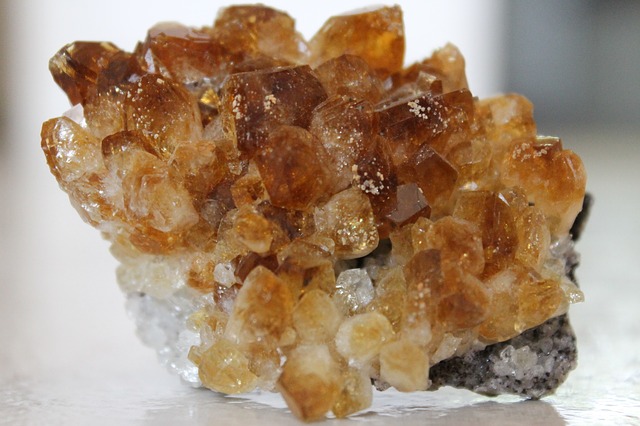
Citrine crystals are best known as a bright, sunny yellow variety of quartz. Nobody is really sure where the color comes from. Some suggest that it’s caused by iron impurities in the crystal’s structure, while others say it’s more likely caused by aluminum or irradiation. From what I’ve been able to gather, there are probably several varieties of yellow quartz created under different conditions, all of which have been lumped together for the gem trade under the name “citrine.”

Metaphysically, citrine is a stone often used for prosperity, luck, and success spells. Its sunny color lends well to everything relating to the yellow, gold, and orange areas of color magic. As a healing stone, it brings positivity and optimism.

How is citrine faked?

Real citrine is pretty rare. It doesn’t seem so when you walk into a crystal shop, though — chances are, there are tons of clusters of bright orange crystals, usually at a very reasonable price. So, what gives?

While citrine is uncommon, amethyst is not. It’s not at all unusual to take amethyst, subject it to heat treating, and get something that can pass for citrine — in the sense that it’s a crystal, and yellowish.

Heat-treated amethyst
Heat-treated amethyst.

How can you tell if a citrine is real or heat-treated?

To put it bluntly, if you’re used to seeing heat-treated amethyst, real citrine is… Well, disappointing. Most of it looks closer to a smoky quartz than the vibrant orange hues of the heated stuff. It’s like looking at a glass of orange juice next to a glass of orange soda. Compared to a glowing yellow heated amethyst cluster, the real stuff looks almost anemic.

There are other ways to tell, too. Real citrine:

  • Does not often have the same growth habit as amethyst. While we’re probably all used to seeing clusters of low-growing amethyst crystals that look almost like grape jelly, citrine usually appears with longer, straight crystals or as individual points, more akin to clear quartz.
  • Tends to vary between a light yellow, like white Zinfandel, to a smokier, apple juice color. It doesn’t naturally have that bright orange appearance.
  • Tends to be very clear.
  • Is pricier than heated crystals.

By contrast, heat-treated crystals:

  • Tend to have a very milky base, or be cloudy throughout.
  • Often show up as pieces of geodes, usually with a very white base. Individual points usually have a very triangular, almost toothlike appearance.
  • Are extremely brightly colored.
  • Don’t cost much.

There’s one other way to tell a citrine from a baked amethyst — pleochroism. It’s not something the average crystal-buyer can really use to their advantage, but it’s much less subjective than determining how clear a crystal is, or exactly where it falls in the range of natural and artificial colors. Pleochroism describes an optical phenomenon where a mineral appears to change colors when viewed from different angles, particularly when using a polarized light source. Amethyst, citrine, and smoky quartz are all pleochroic. Heating amethyst to alter its color causes it to lose this property, so it is consistently yellow (or orange, or brownish) regardless.

Interestingly, citrines created by heating smoky quartz do continue to exhibit pleochroism. These citrines also become pale when they are heated further, and turn yellow when exposed to radiation.

Citrine.jpg
Yellow citrine crystals.

Does it really matter?

Well, yes and no.

Some argue that heat treating a crystal is just exposing it to the same effects that would happen naturally, so the end product isn’t actually any different from a genuine citrine. Others say that that isn’t the case, and the natural circumstances of a crystal’s formation influence its properties.

If you’re looking for a bright yellow or orange crystal because you want to tap into the magical properties of those colors, it probably doesn’t matter how the crystal was made. If using things in a raw, unadulterated form is important to you, you probably want to shy away from artificially colored crystals. The choice is ultimately up to you.

It matters to me because, under the right conditions, you can tell the difference between a heated amethyst and a citrine. Pleochroism is an empirical way to tell which crystals are baked amethysts, and which are not. I feel like this is an important distinction — magic is transformative. Natural citrine takes in light, and shifts its color based on how its viewed. A crystal that’s supposed to be pleochroic and isn’t wouldn’t be as useful to me as an unaltered stone.

From a practical standpoint, it can also matter because heating a stone affects its durability. High heat can alter the matrix, especially of crystal clusters, making it chalkier and more prone to crumbling.

Color magic is a deep and fully developed magical system of its own. If the color is all that matters to a spell, it doesn’t really matter whether a stone is natural, heated, dyed, or coated. For witches who prefer to work with stones in an unaltered state, the distinction between natural and heat-treated citrine can be an important one.

crystals · Environment

Unethically Mined Crystals: What can you do?

Last Friday, I posted about some of the ethical concerns surrounding the use of crystals. If that has you feeling a way about your own collection, you aren’t alone. The stones are already dug up, so there’s no putting that horse back in the barn — so what can you do to help remedy the situation?

It’s important to look at this from a few angles. On one side, there’s the human cost of bringing crystals to market. On the other, there’s the environmental impact. On the other other, there’s the energetic impact on the stones themselves.

The Human Side

Mining is difficult, hazardous work. Sometimes, it’s even done by children whose families have limited options for survival — you don’t put your kids to work like that unless the danger of starving is bigger than the danger of a mine collapse. Contributing to humanitarian causes to help lift families out of poverty is one way to reduce child labor, by eliminating the need for kids to have jobs in the first place.

Supporting ethical crystal suppliers is another key. As I touched on in last Friday’s post, altering market pressures to disincentivize unethical gemstones is one thing we can all begin to do on an individual level. If people don’t buy crystals from questionable suppliers, it won’t be worth it for them to stay in business. It takes a long time to do, but it’s currently the best weapon we have against the unethical gemstone trade. (There are other, very complex issues tied up in supporting exploitative businesses, but those are outside of the scope of this post.)

The first step to correcting any problem is being willing to surrender the benefits that came with it. In this case, that’s an abundance of inexpensive and readily-available crystals. From an energetic standpoint, look at things like donation as a sacrifice — you give up your time or money (a tangible representation of the energy it took to earn) to try to bring balance back to the world.

The Environmental Side

Healing the environmental scars left behind by crystal mining is similar to working on the human side — removing the incentive for environmentally-destructive practices. Businesses are run by humans, and humans respond pretty predictably to the removal of extrinsic motivation. So, by refusing to buy from high-impact mining operations, it’s possible to (eventually) disincentivize environmental destruction.

Sun rising over mountains.

In some cases, doing this may limit the kind of crystals you have available to you, but that’s not really a bad thing. There are even mines that allow you to visit and gather your own crystals, which is a brilliant means of fostering a connection to them in a low-impact, ethical way.

There are also environmental initiatives and conservation efforts that work to combat some of the destruction caused by mining. Though these are less direct at addressing the problem itself, they are no less integral to helping mining-affected areas recover.

The Crystal Side

Lastly, you have the stones themselves. Sure, you can cleanse them, but is some incense smoke or running water enough to heal the wounds of their origins?

Sometimes, stones take more than a one-off cleansing to prepare them. It can take months of regular cleansing and handling to bring them back to equilibrium. I don’t necessarily recommend going through this before you ever work with a crystal, though. If your work and intentions are pure and focused, just using the stone is a form of recalibration in itself. Magic has a residual effect on the things it touches. Just like other tools are affected by regular work, stones are the same.

heart-3243179_1280

I have known witches and lightworkers who obtained crystals from people who got in over their heads, magically speaking — jumping into baneful things and spiritwork they weren’t prepared for, and leaving all kinds of energetic dross behind in the process. The crystals’ new owners ended up doing things from rolling them in wet leaves, to stashing them in the forks of trees, to singing or playing music to them every day. Feel out the energy of your stones, and do whatever calls to you. This is a pretty heavy energetic burden to bear, so work on lightening it, even if it feels a little (or very) silly. A lot of magic involves being playful, uninhibited, and occasionally ridiculous. Get weird, if that’s what resonates. Be the airbrushed t-shirt unicorn you want to see in the world. 

In a perfect world, all of this would never be an issue. There would be no incentive for child labor, unsafe working conditions, or environmental harm, and we’d all know exactly where everything we buy comes from. Unfortunately, that isn’t the world we live in right now, but there are ways we can try to offset the impact of crystal mining and begin to heal some of the scars it leaves behind.