Neodruidry · Plants and Herbs · Witchcraft

Jewelweed Folklore and Magical Properties

Jewelweed, Impatiens capensis, is one of the most beautiful parts of watery places out here. Though the plant has bright yellow-orange flowers, they aren’t what give it its name — rather, it’s the curious property of the leaves. Since it grows near water, and excess moisture has a nasty tendency to support the growth of all kinds of pathogens, the leaves repel it. If you take one and drop water on it, it will bead up and glisten like jewels. If you take a leaf and hold it underwater, it looks like it’s covered in pavĂ©-set diamonds.

They have a very clever reproductive strategy, too. Their showy flowers encourage sexual reproduction by attracting hummingbirds and other pollinators. They also have much smaller, more discreet flowers, which don’t open up the way their other blossoms do — they self-pollinate. This gives jewelweed the ability to produce two different sets of seeds: one that costs more energy and has a wider gene pool, and one that’s much cheaper, but lacks genetic diversity.

The seed capsules are pretty cool, too. One of the plant’s other common names is touch-me-not, because of the way it disperses its seeds. Plant jewelweed once, and it’ll keep self-seeding and coming back. After pollination, the seed capsules hang out and wait for something — anything — to touch them. Brush up against one, and the valves on the pods will quickly coil back and fire the seeds in a tiny explosion. (This all sounds perfectly normal, until you picture what it would look like if every pregnant person was also basically a baby confetti cannon.)

Jewelweed Magical Uses and Folklore

These plants are well known to people indigenous to where they grow. Their virtues are largely medicinal, so I didn’t have very much luck finding explicitly-stated magical properties or associations. Peer-reviewed research supports its use for itchy skin conditions, including tinea (the fungus responsible for ringworm, athlete’s foot, and jock itch).

Jewelweed contains compounds that act as antagonists to the urushiol found in poison ivy. Most people are sensitive to urushiol, and end up with a telltale itchy, blistered rash from it. Applying jewelweed sap immediately after coming in contact with poison ivy can help stop the rash in its tracks.

I’m reminded of a rhyming couplet I read once, though I fail to remember where:

Jewelweed, starve ivy’s greed

Touch-me-not, stay ivy’s rot

(I have no idea. If you know the origin, let me know!)

The elemental and planetary associations for jewelweed are pretty much what you’d expect: water and Venus.

The flowers are a bright yellow-orange. Following the elemental correspondences, color attributes, and medicinal uses, I would use jewelweed in workings to bring joy and prevent or alleviate suffering. Water is the element of the emotions. Orange is for joy and positivity. It can keep you from spending a long, miserable time dealing with poison ivy blisters. The leaves repel what they don’t want on them. It makes sense to me!

Orange is also a color of creativity, and I did find a source who talks about using jewelweed in a flower essence to bring the flow of awen into your life. This also makes sense when you think of the plant’s seeds — whether it has pollinators to help it out or not, jewelweed will create new life!

Using Jewelweed

As mentioned above, jewelweed makes a nice flower essence. It also appears to be provisionally edible, but you need to cook it thoroughly to denature its toxic compounds.

Most uses of jewelweed involve either applying the crushed, raw plant to the skin, or adding it to salves, washes, or witch hazel.

Magically, I would dry some of the flowers and add them to sachets or witch’s bottles for creativity, joy, and the prevention of sorrow. Use the seeds in spells to increase the flow of inspiration. Since the plant depends on its flowers for genetic diversity, avoid taking more than a third of them. (Unless you’re in the Pacific Northwest, where it’s considered invasive. In that case, go to town.)

Jewelweed is a really unique plant. Sew it once, and it’ll keep coming back. It has an admirable tenacity, and can be a real friend to anyone who’s ever touched poison ivy on the trail. While traditional magical lore seems to be a bit thin on the ground, it has enough special qualities that it’s easy to extrapolate. Work with jewelweed, and see what it tells you.
Plants and Herbs

Pokeweed Folklore and Magical Properties

My first experience with pokeweed was watching one sprout out of the side of my house.

I didn’t know what it was at first — it cropped up, seemingly overnight, in a tight space between the foundation and the heating oil tank. Since I was given to notions about lilac trees and beds of flowers at the time, and also didn’t want the foundation to crumble, I was tempted to pull it out. Something about the bright magenta-purple stems and lush leaves stayed my hand.

Nah, I thought. Let’s see where this goes.

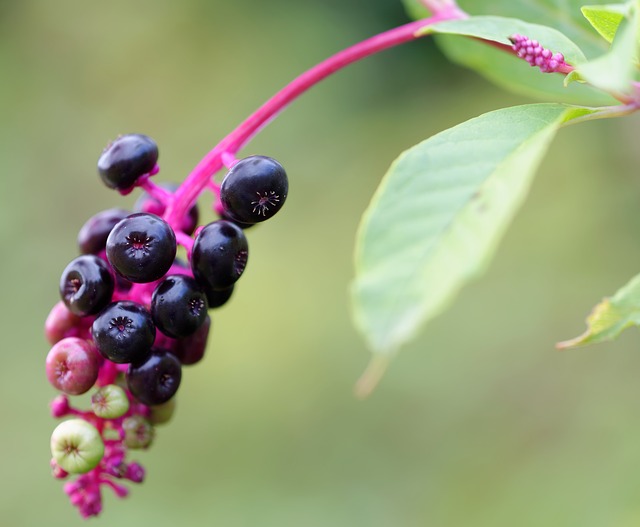
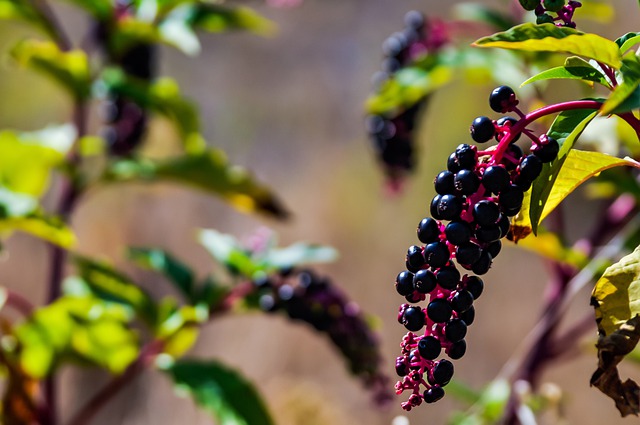
Not long after, I was “rewarded” with hanging clusters of delicious-looking deep purple berries. I say “rewarded,” because pokeweed is also known as American nightshade and those shiny, tasty-seeming berries are super poisonous.

Well, unless you’re a bird. Or a raccoon. (As I discovered when Vladimir, the very rotund beast that lived above my friend’s garage, began leaving disturbingly recognizable pokeberry doots in front of the beer fridge.) While pokeweed berries are extremely deadly to most mammals, they’re a very important food source for plenty of other species. After other snacks have run their course, pokeberries are still hanging on.

Humans can eat the young shoots, but only when they are very young, and only after cooking them in two changes of water. I’ve also read that the berries may be edible too, but you have to remove the seeds first. Personally, I’m not really willing to try that particular experiment.

This past weekend, my partner and I stumbled on a pokeweed plant on a walk. Though mostly eaten, there were still a few deep purple berries left, and the intensely pink stems hadn’t yet lost their luster. That’s when I got the idea to write this post.

Pokeweed Magical Uses and Folklore

Pokeweed has a long history of use as a medicinal herb by people indigenous to its native range. That said, the effective dose is extremely small and the line between “medicine” and “poison” is thin. Isolated compounds in the plant — like Pokeweed Antiviral Protein — show a lot of promise as antiviral, anti-HIV, and even anti-cancer agents, but that’s another story.

The United States Declaration of Independence was written in ink made of pokeberries. Soldiers during the American Revolution frequently wrote letters in pokeberry juice, since it grew pretty much everywhere and made a very useful ink.

Pokeweed is variously associated with Mars or Uranus.

The Mars association makes sense, as various parts of the pokeweed (especially the dried berries) are used in spells for courage.

On the other hand, the Uranus association makes just as much sense. One of pokeweed’s medicinal properties is as a purgative (and oh, what a purgative). Shamans relied on this purging power as a kind of sympathetic magic, to expel evil spirits from afflicted people. It’s also used to break hexes and exorcise spirits/demons from a space. In other words, pokeweed purges evil or unwanted influences.

Using Pokeweed

Crushing the berries creates a very powerful magical ink. Some people ferment them, others add vinegar, salt, or other natural preservatives and use it as-is. This ink is often used for hex breaking, and can also serve as a substitute for blood in a pinch (depending on the spell, of course).

You can also add the dried berries to sachets or spell jars for bravery or hex-breaking. I would avoid adding them to baths or incense, just in case, and definitely never add them to salves or teas. The juice of the plants can be absorbed through the skin, causing issues similar to poison ivy. It also contains compounds that can trigger mutations, so that’s neat.

Pokeweed is a striking-looking plant. The bright magenta stems, vibrant green leaves, and shiny clusters of dark berries are stunning. Like many poisonous plants, it holds a lot of power within it — but that power demands respect. Pokeweed has the ability to feed, heal, and harm, all depending on how it’s used.

Plants and Herbs · Witchcraft

Capers Folklore and Magical Properties

Edible flowers have always intrigued me — I love floral flavors, far more than floral scents. Lavender Italian soda, candied violets, briny capers… Give me all of the flowers. I was eating my favorite breakfast the other day (toasted sesame bagel, veggie cream cheese, sliced tomato, thinly sliced red onion, and capers) when one of the little pickled buds dropped out and rolled onto my plate. It was surprisingly pretty, a deep olive green at the tip, turning to a deeper violet near the base, and it got me thinking.

What are capers good for?
(Besides being delicious.)

I didn’t find many traditional magical uses for these guys in my search, but I did find some very interesting medical uses and folklore than seems to provide the basis for their modern magical properties.

Capers Magical Properties and Folklore

Going down to bone town.

No, really. They’re mostly used as aphrodisiacs.

Even the Christian Bible acknowledges this — in Ecclesiastes, translations dispute whether a certain passage should read as “desire” or “caperberry.” In Hebrew, the word for caperberry, aviyyonah, is linked to the word avah, meaning “desire.” The King James version of Ecclesiastes 12:5 reads, “the grasshopper shall be a burden, and desire shall fail.” Meanwhile, older translations render the word “desire” as “caperberry.” As a result, some modern translations go for “desire,” while others use “caperberry.” Confusing, huh?

In ancient Greek medicine, capers were used to relieve gas and bloating. This isn’t really tied to any aphrodisiac effect, but it’s probably easier to want to do the do when you aren’t farting like a Clydesdale.

The Witch’s Cottage Garden lists capers as a Mars plant. This is most likely due to the plant’s thorns — plants associated with Mars tend to be prickly — but also fits its use as an aphrodisiac. While Venus plants are associated with love and beauty, Mars energy can be passionate and lustful, in addition to assertive and warlike.

Other sources list as useful in magic for lust and potency, which also suits it’s Mars energy and desire-promoting qualities.

Using Capers

Eat them, but not too much. Capers are preserved, so they’re very high in sodium. (Ironically, if you have sodium-sensitive blood pressure and blood pressure-related sexual dysfunction, they can make it harder to get in the mood.)

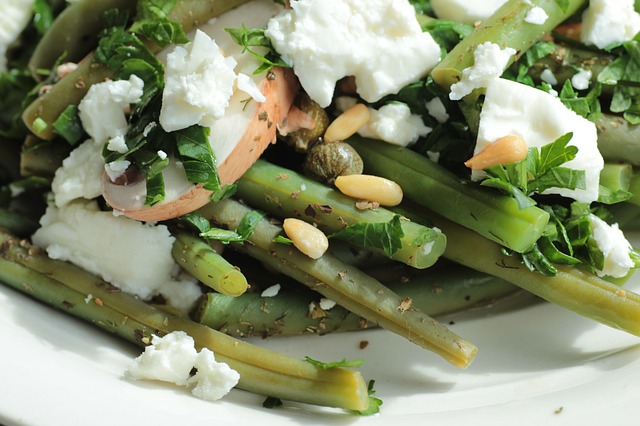
I like including them in salads or, as I mentioned before, on a bagel with cream cheese. If you don’t eat cheese, a nondairy alternative or some avocado would work — I find that the salty, lemony bite of capers benefits greatly from something cool and creamy to offset it.

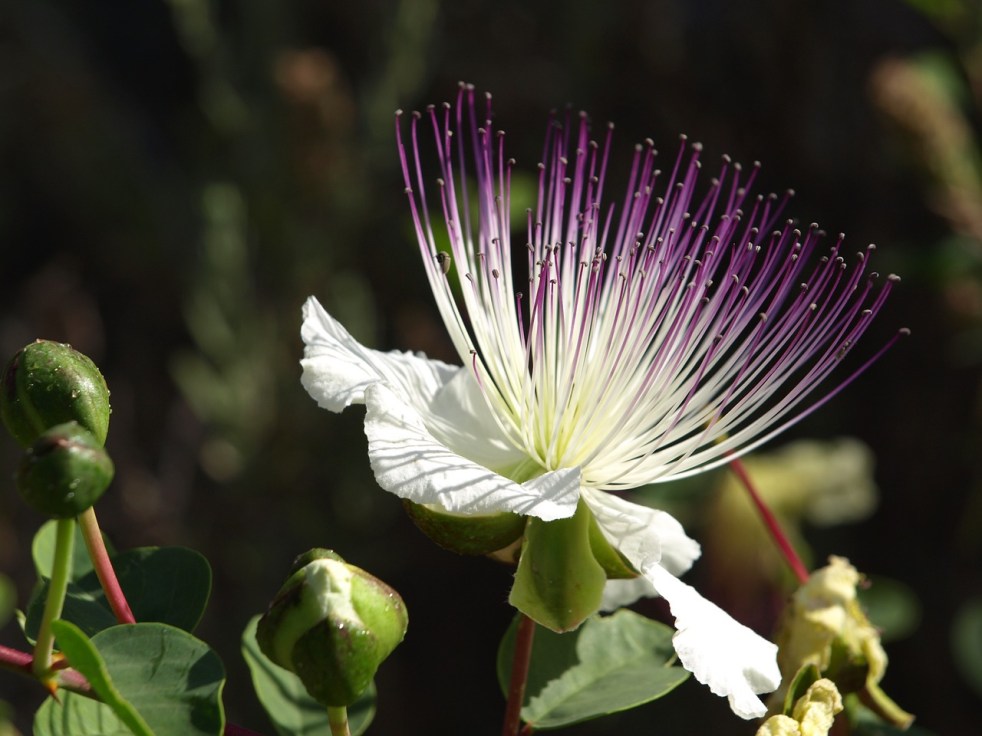
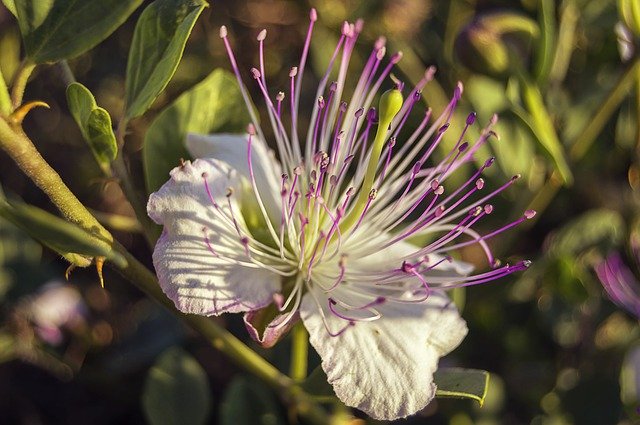
If you want to use capers in your magic without eating them, the mature flowers are very pretty and unusual-looking. While I haven’t seen the flowers for sale (I think most people prefer to pick them when they’re just buds, for culinary purposes), you can find the whole plant for sale and grow them fairly easily if you’ve got a dry climate and plenty of sun.

As a note of caution, the caper spurge (Euphorbia lathyris) is a poisonous plant that is often confused for capers. Eating the buds can cause mouth pain, nausea, cardiac arrhythmia, fainting, and delirium. So, if you going to go try to find capers, maybe stick to garden centers and grocery stores unless you’re really, really good at IDing plants.

Plants and Herbs · Witchcraft

Dandelion Folklore and Magical Properties

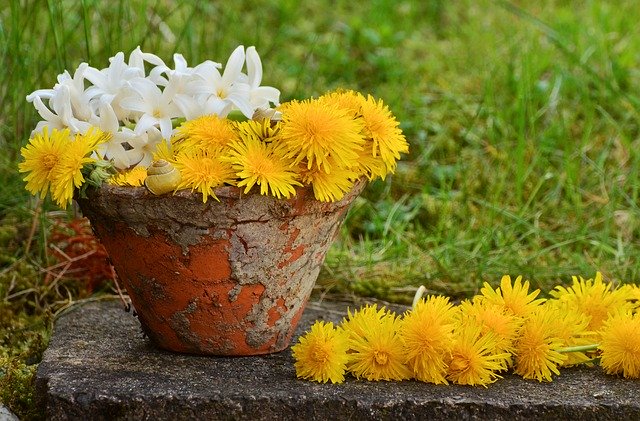
In places that enjoy warm winters, these bright yellow flowers can be spotted year round. If you’re in a temperate area like I am, then you’re probably seeing them all over as we get ready to enter the last month or so of their peak flowering season — especially as business closures and shelter-in-place orders leave a lot of outdoor spaces untended.

Believe it or not, these ubiquitous yellow blooms aren’t actually native to the U.S. In places where they grow naturally, they’re a valuable source of food for honeybees. While they may not be quite as useful to U.S. wildlife, they still have a ton of magical properties that make them a valuable addition to your herb cabinet (and, if you enjoy the flavor, your tea cupboard and salad bowl).

Dandelion Magical Uses and Folklore

The name dandelion comes from the French phrase “dent de lion,” or “tooth of the lion.” Another, more accurate, name is “pissenlit.” “Lit” means “bed.” The rest, I’ll leave up to your imagination.

On a related note, dandelion is a diuretic.

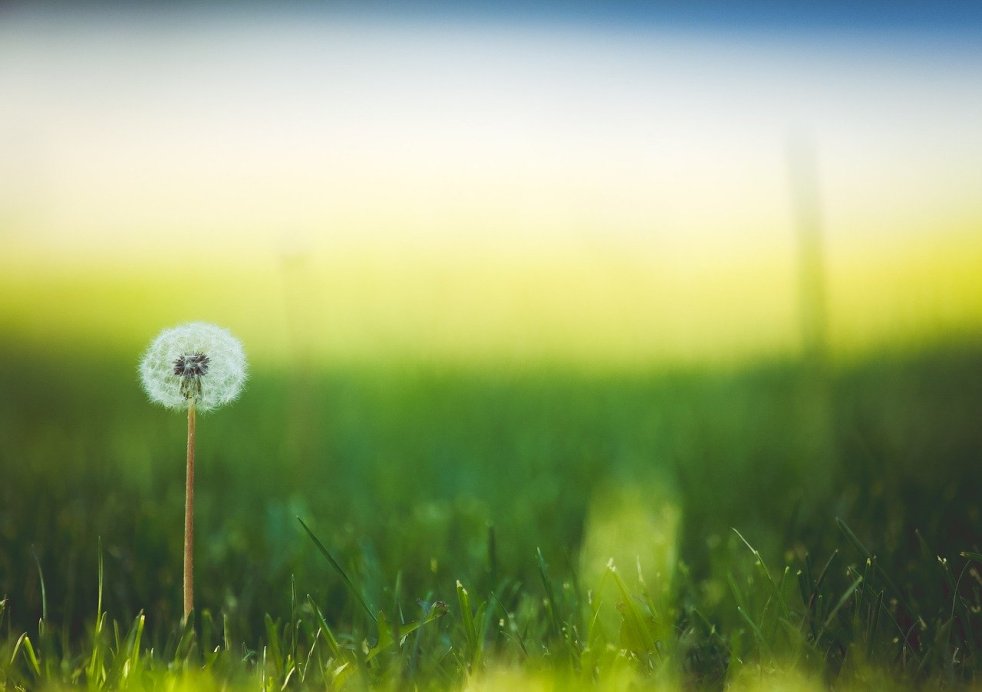
When a dandelion sets seeds, its yellow flower turns into a nimbus of fluff. Pick a dandelion, make a wish, and give it a good, hard puff — the seeds will scatter, carrying your wish with them.

Similarly, if you have a bad habit you want to get rid of, blowing on a dandelion puff will carry it away from you. They can also carry your affections to a distant loved one.

Dandelion puffs are also used in love divination. If you think of your beloved and blow on one, it will show you how loved you are. If the seeds completely disperse, your beloved is infatuated with you. If some seeds remain, they have some reservations.

After you blow on a dandelion puff, watch the direction that the seeds go. It will show you where to seek your fortune.

Hold a dandelion under your chin. If it shines yellow, you’ll be rich some day. A similar belief holds that, the brighter the yellow glow, the kinder you are.

In the Encyclopedia of Magical Herbs, Scott Cunningham writes that dandelion root tea can help with divination and prophetic dreams.

Brewing dandelion root tea and leaving a cup of it by your bedside is said to call spirits.

Including dandelions in a wedding bouquet is said to ensure happiness for the married couple.

Dandelion sap was used as a remedy for warts. Squeezing some milky sap from the stem of the plant onto a wart is said to make the wart disappear. (Though this folk remedy has been in use for hundreds — if not thousands — of years, there’s no real clinical data to back it up.)

Some use the dandelion to predict the weather. After they’ve gone to seed and become all fluffy, they are very sensitive to changes in moisture — when the weather’s likely to be wet, they’ll close up. When the rain has passed and things are going to be dry for a bit, they open so their seeds can disperse.

Dandelion is ruled by Jupiter.

The plants are associated with Hecate, Aphrodite, Brigid, Belenos, and solar deities.

Using Dandelion

The easiest way to use dandelions is in a salad. The young leaves are very good, though the adult leaves have a tendency to be bitter. You can also boil the leaves up with onions, carrots, and parsley, strain, and save the broth. It’s delicious and packed with minerals.

Roast the ground root and use it as a caffeine-free coffee substitute. I often drink a beverage made from dandelion root extract called Dandy Blend — it’s good for scratching a coffee itch, especially since I have to avoid stimulants.

All parts of the dandelion can be eaten, or even fermented. Dandelion beer uses leaves, dandelion wine uses flowers, and some root beer recipes use the roots. You can also make a delicious jelly from the flowers.

Most magical uses of dandelion involve brewing it into a tea. You can purchase prepared dandelion teas, or collect your own leaves, dry them, and use a tea strainer. Leaf tea has a pleasantly grassy flavor with some bitterness, while the roots have an interesting nutty taste. Make yourself a cup before performing a divination.

If you choose to go dandelion-foraging, don’t pick any that grow by roadsides, or that may have been sprayed with pesticides, herbicides, or fungicides! These plants are extremely hardy and grow basically anywhere, so you’re best off planting your own so you know what they’ve been in contact with. Many other plants also resemble dandelions, so be absolutely sure you’ve IDed your potential meal correctly.

Plants and Herbs · Witchcraft

Turmeric Folklore and Magical Uses

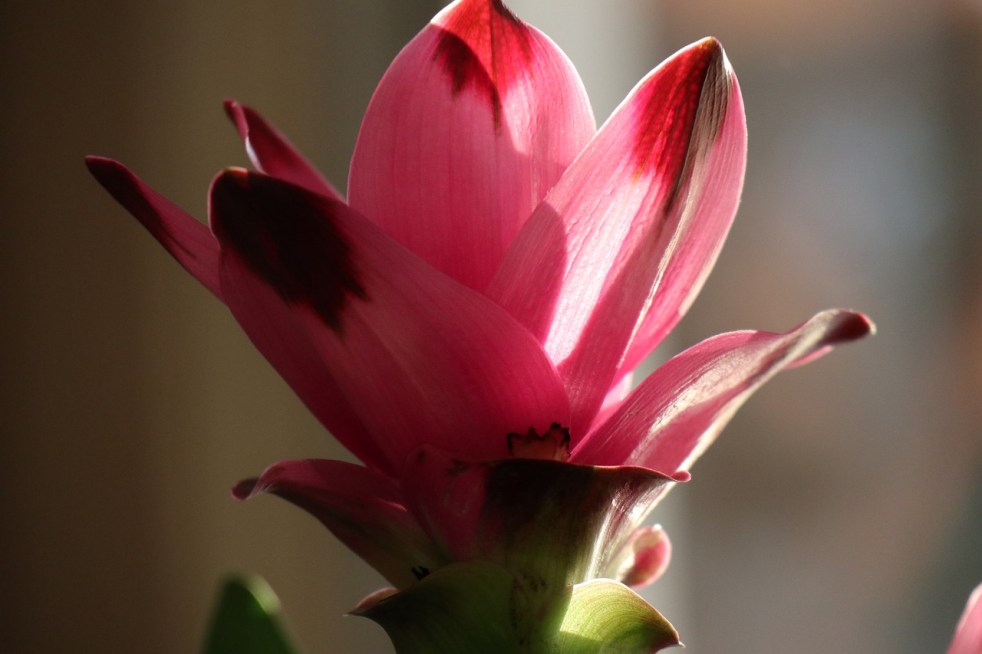
Turmeric is what gives curry a yellow color (as well as everything else it touches). It has a subtly spicy, earthy scent and flavor, and, to be honest, is next to impossible to find folklore or magical uses for.

It’s not that they don’t exist, of course. It’s just that they’re kind of drowned out by the number of blog posts, articles, and books on its nearly-magical health benefits. People use it for inflammation, diabetes, cardiovascular health, and to improve liver function. It’s a bit outside of the scope of this post to go into all of that — besides, I’m not a doctor — but it’s pretty evident that turmeric occupies an important place for a lot of people around the world.

Turmeric is native to southern Asia and some Pacific islands. In the places where it grows wild, it has a history of use as a medicinal herb going back about 4000 years. Interestingly, though turmeric was known in ancient Greece, it never really caught on except as a dye. (Interestingly, ginger, turmeric’s cousin, didn’t seem to have this problem.) Needless to say, if you’re looking for uses of turmeric in European-based witchcraft, they’re a little thin on the ground.

turmeric-3089308_640

Turmeric Magical Uses and Folklore

Nobody seems to be able to agree on what elemental correspondences go with this herb. Some say air, while one source I found said fire. While fire makes sense to me, I would probably say earth.

In India, turmeric seems to function as a sacred anointment. It’s used for brides and grooms during the pre-wedding haldi ceremony, girls entering puberty, and the bodies of the dead. Most of the sources for witchcraft uses of turmeric cite purification as one of its properties, so, while I doubt that its associations in Indian culture are exactly the same, this makes a lot of sense.

Malevolent spirits, particularly the angry dead, can be sent away with the smell of turmeric.

Turmeric is also indicated for spells for healing, strength, and vitality — since it’s a potent medicinal herb and general tonic.

Turmeric’s golden color is useful in color magic. Yellow is associated with abundance and happiness, while gold is associated with the energy of the sun, prosperity, success, and healing. (This sun energy might be an explanation for why turmeric is so useful for purification!)

Using Turmeric

Since turmeric stains pretty much everything it touches, that makes it great for making magical inks, dying sachets, bags, or poppets, or adding color to sweetening jars or other potions.

Turmeric essential oil has a very warming scent, and can be substituted for hot spices when you don’t necessarily want their sharp pepperiness. Like the root itself, though, the essential oil stains — use it with caution!

If you can keep it out of humidity, you can use turmeric to bury magical tools to purify them the way you might use sea salt. Again, be careful — don’t use it to bury anything porous, and keep it dry, or you might find that whatever you buried is now yellow.


I love turmeric, and I put it in everything. While I haven’t experienced the magical health benefits a lot of natural health websites attribute to it, it’s delicious, easy to use, and gives everything such a bright, pleasing color. If you’re looking for an ingredient for magical ink for a prosperity, abundance, joy, or purification spell, you can’t really go wrong with turmeric.

Plants and Herbs · Witchcraft

Dogwood Folklore and Magical Uses

I love dogwood blossoms, I think they’re my favorite non-flower flower. Even the wood and foliage of some species is absolutely breathtaking to look at — there’s nothing quite like a bloody dogwood in the snow.

Depending on where you are, dogwoods are either blooming, starting to bloom, or have been blooming for a few weeks. Since I’m missing the dogwoods at the National Arboretum so much, I figured this would be a good week to look at the folk and magical applications of Cornus wood, leaves, berries, and flowers.

tree-788956_960_720

Dogwood Magical Uses and Folklore

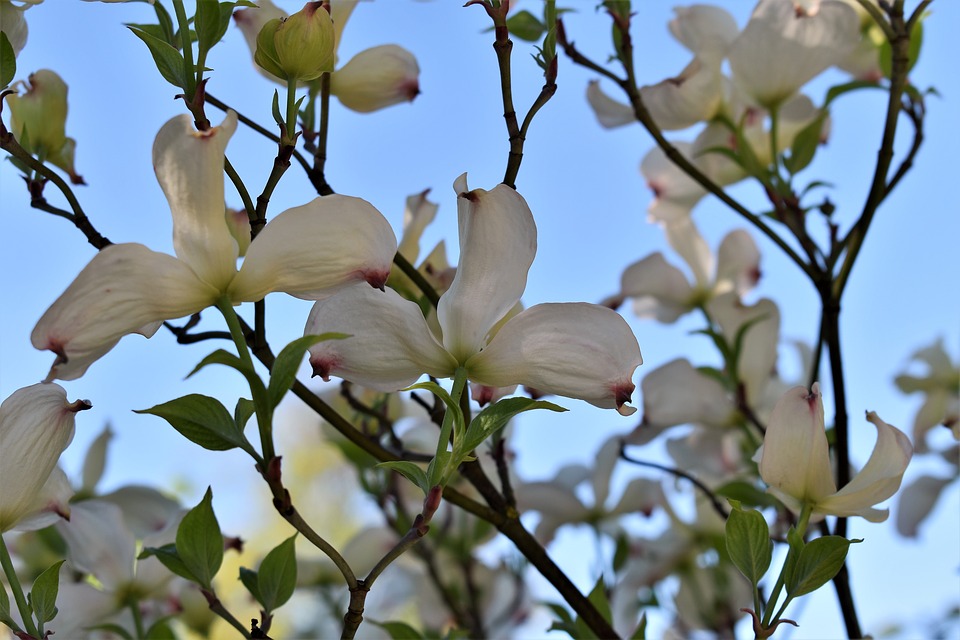
As a native American tree (eastern U.S. and Mexico), there’s not a lot of writing on flowering dogwood (Cornus florida) as it pertains to European-based witchcraft. Southern Europe does have a plant called the Cornelian cherry (Cornus mas), which is in the dogwood family, and most of Europe and western Asia has the common dogwood (Cornus sanguinea). C. mas and C. sanguinea both flower, but neither of these are quite as showy as the big white or pink blooms of C. florida. Since all of these plants are related, it’s possible, even preferable, to make substitutions depending on what species are locally available to you.

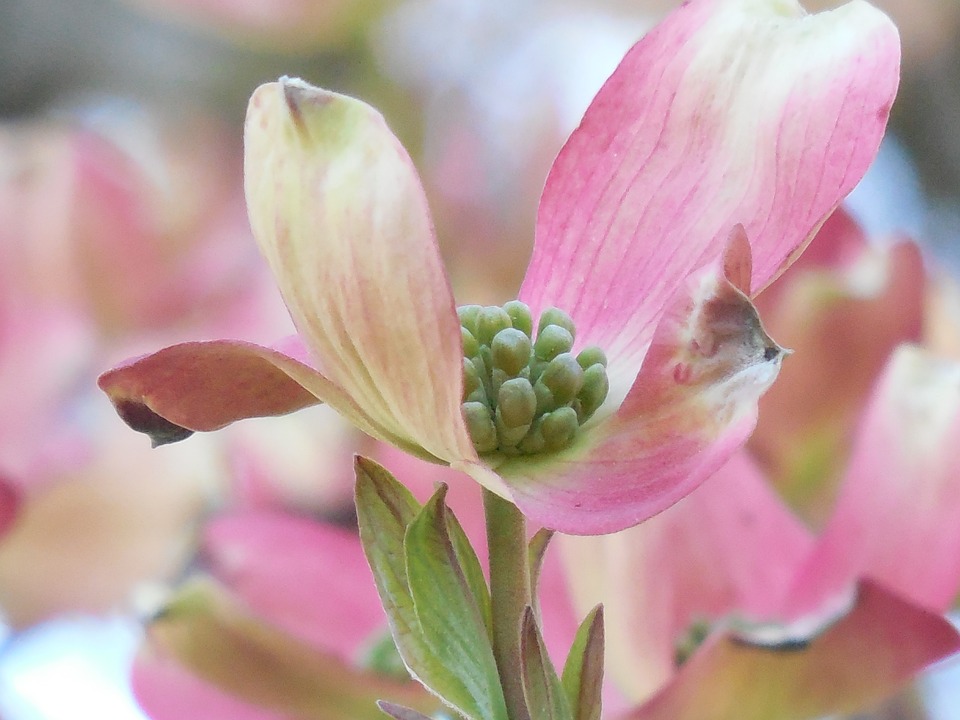
Dogwood is associated with loyalty, secrets, wishes, protection, fertility, desire, and illusion. (The illusion part, in particular, makes a lot of sense — the flowers of the flowering dogwood aren’t actually flowers at all, they’re modified leaves.)

The dogwood is strongly tied with Christian mythology, since the flowers form a cross shape. It was believed that the wood was used to form crosses for crucifixion, so Jesus prevented the dogwood from ever growing large enough to be used for this purpose again.

An old folk remedy for treating mange in dogs involved making a decoction of dogwood bark, and washing the affected areas with it.

Leaves, bark, or flowers can be used as a protective charm.

As an herb of secrecy, it’s a good idea to include some dogwood leaves in a diary, grimoire, or Book of Shadows. An oil made from the flowers can be used to dress a letter and keep prying eyes off of it.

Make a wish come true by catching a drop of dogwood sap on a cloth on the evening of Midsummer, and wishing on it. Carry it until you get your desire, then bury the cloth.

It’s bad luck to bring dogwood flowers into your home, or to burn the wood in your hearth.

dogwood-4157242_960_720

Using Dogwood

One theory for the etymology of “dogwood” is that the name stems from “dag,” from which we also get “dagger.” This is related to the straightness and density of the wood — the sticks are pretty much ideal for crafting shafts for tools or weapons (Ă–tzi was found with dogwood arrows), and the wood is dense enough to sink in water. In a practical sense, this makes dogwood an excellent material for crafting wands or other magical tools.

A lot of dogwood’s associations fit neatly into one another. Illusion, protection, and secrecy all blend well. I probably wouldn’t use dogwood in place of, for example, cayenne pepper as a protective herb because the energy is so different. Dogwood is subtler — it protects by concealment. It’s a smokescreen, not a fiery wall. Even its use as arrow shafts points to a plant that’s best used to take advantage of the shadows!

American flowering dogwood has four bracts. From a numerological standpoint, four is strength, stability, and pragmatism. This blends nicely with its use as an herb for protection and loyalty.

Dogwood is useful in color magic, since the blooms can range from white, to yellow, to pink, to red. Even the leaves can turn from gold or green to pink, yellow, orange, or red.


Environment · life · Neodruidry · Witchcraft

A Daily Earth-Healing Meditation

Since today is Earth Day, I figured it’d be a good time to post about a small, simple daily meditation that I use to start my day.

It’s a combination of a grounding exercise and a planet-healing. You don’t need anything to do it, other than a comfortable, quiet place to sit (or even lie down) and five or ten minutes to spare. It’s based around the incredibly important role that fungi play in every ecosystem.

eyelash-fungi-4593804_640
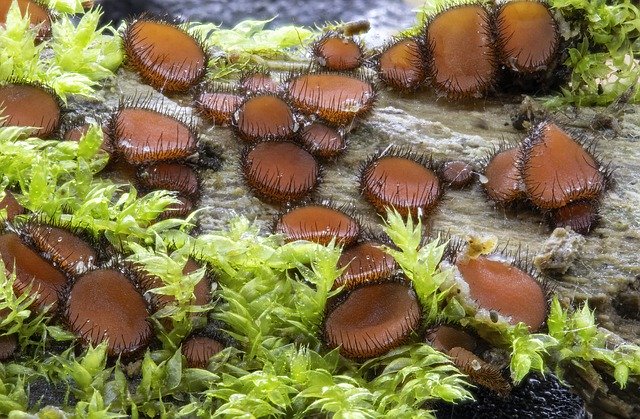
Tiny eyelash fungi on mossy wood.

The Fungi

Though we often picture mushrooms when we imagine fungi, fungal fruiting bodies make up a tiny portion of the whole organism. Beneath them, spread out in a web, is a vast network of mycelium. The hyphae spread out like thin threads, transporting nutrients, secreting enzymes to break down organic matter, and supplying nutrients to the plants that depend on them. Everything in the world relies on fungi for survival, in one form or another. They secrete carbon dioxide as part of the carbon cycle, and can break down almost anything that isn’t actively toxic to them — even plastic, petroleum, or pesticides. Some fungi turn carbon into melanin, a very stable carbon-containing compound, while others help soil retain moisture. Certain fungi increase soil aggregation, potentially increasing soil carbon storage.

Still, fungi respond to a very careful natural balance. While the soil is a carbon sink, soil fungi also return carbon dioxide to the air — especially in situations where elevated levels of carbon dioxide encourage plant growth, increasing nitrogen demand and upsetting the delicate balance of carbon and nitrogen. Fungi can be vital environmental allies, but the balance needs to be preserved.

white-mushrooms-2582319_640
A pair of boletes.

Soil fungi don’t just comprise one or two species, either. Every patch of soil could be a host to a thousand distinct species. Just like the natural microflora of the body shift and change in response to illness, stress, diet, and medication, different stressors affect how these fungi grow, compete with each other, and evolve.

It’s never been more clear that protecting the planet means preserving all of the microscopic activity below the soil, not just the plants and animals above.

The Meditation

To begin, position yourself comfortably. Let your shoulders drop. Relax your jaw and the muscles around your eyes. Unclench your hands, and let them rest softly in your lap.

Inhale deeply, using your diaphragm and pushing out your belly to take in as much air as you can. Breathe in for a count of four, gently hold your breath for a count of three, and exhale for a count of seven. Repeat this three to five times.

Visualize your energy reaching from the base of your spine, through your seat, the floor, and into the soil. You don’t have to go far below the grass here — once your energy reaches the ground, let it spread out like the roots of a tree. Picture the filaments of your energy reaching through the soil, touching the filaments of mycelium that connect everything. Let your roots engage with the hyphae, gently befriending. When you have spread your energy as far as you can, begin sending a stream of loving light down through your roots.

Don’t worry if you don’t know all of the ins and outs of your local soil’s chemistry. Visualize your energy stimulating where it is needed, calming where it is needed, and balancing where it is needed. Visualize the soil fungi doing their microscopic jobs to break down what is no longer needed, and return it to the earth in a usable, nourishing form. Let your contact with the living soil recalibrate your energy, grounding you.

Continue this visualization for as long as is comfortable for you. When you are ready, gently withdraw your energetic roots from the soil. Open your eyes, stretch your limbs, and go about your day with a renewed awareness of how our actions affect everyone — and everything — around us.


crystals

Irradiated Smoky Quartz: Is it really safe?

A lot — if not most — of the colorful quartz varieties on the market are enhanced in some way, and buyers are often none the wiser. Heated amethyst gets sold as citrine, and smoky quartz might even be treated with radiation to give it an extra impressive, uniform color.

Since a lot of crystal aficionados wear the stones and use them for healing purposes, this raises a serious question: Is it safe to use or wear irradiated smoky quartz?

crystals-3129390_640

How does quartz become smoky quartz?

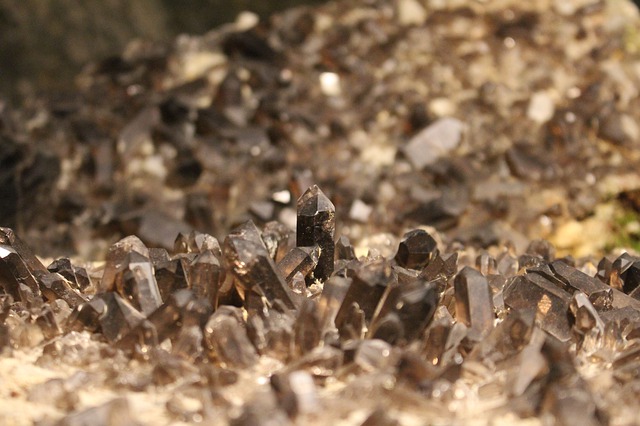
Before we delve into this subject, it’s important to note that all smoky quartz, natural or otherwise, is irradiated in some fashion. For natural smoky quartz, this happens due to the presence of radioactive minerals in the earth. For enhanced smoky quartz, this happens after it has been mined.

Smoky quartz gets its color from changes within the crystal produced by radiation. All quartz is made of silicon dioxide, with various colors produced by mineral inclusions within this silicon dioxide lattice. In smoky quartz’s case, this is trace amounts of aluminum, which form AlO4molecules that take the place of some of the SiO4 within the crystal. If you look at the molecules, you’ll notice that AlO4carries a negative charge, while SiO4 does not. Because of this, the crystal lattice of smoky quartz also contains small amounts of positive ions, usually hydrogen, lithium, or sodium. When this quartz is exposed to radiation, some of this silicon dioxide becomes free silicon and some of the electrons from the AlO4molecules get knocked out of place. They hook up with the positive ions, and create the characteristic “smoky” gray or brown color of smoky quartz.

Is irradiated quartz safe?

For the most part, irradiated quartz — whether naturally or artificially — is perfectly safe. Think of the color like a suntan. A person tans because they’ve been exposed to solar radiation, but that change in color means that radiation has acted on them, not that they are emitting radiation themselves.

Notice, however, that I say “for the most part.” After typical exposures to radiation, most smoky quartz is perfectly safe. Depending on the source of radiation, some crystals have a somewhat higher risk of becoming radioactive. It’s important to note that this is still a pretty low level of radiation, and decreases with time.

For a stone to become radioactive, radiation needs to add or remove a neutron from some of the atoms within the crystal. In other words, the energy of radiation striking the stone needs to be greater than the energy needed to bump a neutron out of place. The amount of energy it takes to do this varies by element.

Neutron bombardment using a nuclear reactor can irradiate stones, though this is a relatively uncommon method. Stones produced by this process tend to be very dark, and are almost always radioactive. Because of this, these stones are not released for sale until and unless the radioactivity had decayed to safe levels. Electron bombardment using a a particle accelerator streams a narrow beam of electrons at a stone. Many of these accelerators do not operate at a high enough energy to make a stone radioactive, but some do. Even so, the radioactivity of these stones decays quickly, making them perfectly safe within a day or two of treatment. Lastly, gamma irradiators use 60Co (cobalt 60) to produce energy. This does not meet the energy threshold needed to make smoky quartz radioactive. In fact, this process is also used to sterilize things like produce and medical equipment.

So, what does this all mean? By the time a smoky quartz has entered the market for purchase, it’s safe. Wearing or using natural or artificially irradiated smoky quartz is not going to hurt you. If it emits any radiation at all, it will be minimal compared to natural sources of radiation that you come in contact with every day — radioactive minerals in granite, or the potassium isotopes in a banana, for example.

How can you tell if a smoky quartz has been artificially irradiated?

Unlike heat-treated amethyst, there’s really no good way to tell. Some natural varieties of smoky quartz are very dark, like morion, so you can’t always go by color. This means that, unless the stone is labeled or the dealer tells you, the only way to tell if a stone has been artificially irradiated is by examining the matrix.

Naturally-occurring smoky quartz is found adjacent to minerals that contain radioactive material. This usually means intrusive igneous or metamorphic rocks (like granite, an intrusive igneous stone). On the other hand, radioactive material is less common in sedimentary rock like shale (with the exception of uranium, which can appear in limestone, dolomite, or sandstone, among others). This means that very dark smoky quartz with a sedimentary matrix is more likely to have been artificially irradiated, though that’s not really a hard and fast rule.

Smoky quartz is a very popular and versatile stone, and it’s easy to see why — it’s as abundant as it is beautiful. Despite its abundance in nature, some stones are irradiated to improve their color, which has made some people question their safety as jewelry or healing stones. Don’t worry, though — even after getting a radiation tan, smoky quartz is perfectly safe to handle and use.

crystals · Plants and Herbs · Witchcraft

3 Spells for Keeping the Peace

Ideally, you like the people you’re isolated with right now. Even if you do, though, it’s hard not to get on each other’s nerves once the cabin fever really starts setting in. There are tons of ways to fight boredom and keep busy, but you still might need a little extra help keeping the vibes smooth and tranquil.

That’s where these come in: Three spells to help you keep things happy and peaceful.

Starting with the Cleanest Slate You Can

Okay, so by now you’re probably already used to wiping down, washing, and disinfecting everything that isn’t literally on fire. Good! Physically cleaning a space is a key part of getting the magic flowing — dust, dirt, and clutter are less than optimal for energy flow. So, if you haven’t yet, do a solid spring clean. Set up containers for decluttering — one for things to keep, one for things that need repairing, one for trash, one for recyclables, and one for donations — and work room-by-room. When you’re through, get rid of anything you’re not keeping or fixing.

Once your space is as decluttered and clean as you can get it, rock on.

white-room-with-floral-curtain-2320016

A Wind Spell for Peace

The element of air is an oft-overlooked way to cleanse and freshen things. When it’s sunny and breezy out, open your windows and let the fresh air in. Close your eyes and feel the coolness against your skin. You can chant, pray, or state your intent here. I like to say something like,

“Let this breeze blow away all discord, so only peace and joy may remain. As I will, it shall be.”

An Herbal Tranquility Potion

I love making washing potions. It’s easy to do, too — add herbs to boiling water, as you might for tea, let them steep until the water cools, done. You can place dried herbs into a reusable tea bag, square of muslin cloth, or tea strainer, or just leave them loose and strain them out afterward. (As a word of caution, don’t mix the tools you use for potion-making with those you use for food-making. Not all magical herbs are edible, and many are poisonous.)

Some herbs and flowers that are useful here include:

  • Chamomile
  • Coltsfoot
  • Coriander
  • Lavender
  • Lilac flowers
  • Meadowsweet
  • Rose
  • Skullcap
  • Vervain
  • Violet

As the herbs steep, stir them clockwise nine times with a wooden spoon or wand held in your dominant hand. While you do this, say,

“No tension or strife shall come near,
Peace and tranquility alone reign here.”

Visualize the liquid filling with a calming, gentle golden light. When the potion is done and the herbs are removed, add it to a bucket of clean, warm water. Use this to wash your floors, doors, doorways, windows, and any steps leading to your front or back doors. Prepare the mixture fresh each time.

lavender-blossom-1595584_640

A Peaceful Herbal Sachet

The same herbs listed above can be made into an herb sachet. To make one, you’ll also need:

  • A square of white, blue, or light purple cloth
  • A ribbon or needle and thread (to close it with)
  • Any other peace-promoting curios you like. These can include metal peace sign charms, a small figure of a dove, tumbled amethyst stones, or anything else that feels right to you.

To begin, make sure the fabric, ribbon/thread, and curios are cleansed according to your favorite method. You can set them in the sun for a little bit, use sound, sprinkle them with blessed salt, fume them with cleansing incense, or whatever other way you like. When they are prepared, it’s time to get to work.

Hold the herbs in your dominant hand. Close your eyes, and feel yourself drawing power up from the earth, and down from the sky. Allow these energies to mingle in you, and direct them into the herbs in your hand. Say,

“[Name of herb(s)], I ask that you lend your power to this spell. Chase tension and stress from here, and bring peace and calm in its place.”

Place them in the center of the square of fabric.

Repeat this process with the curios, substituting the name of the curio for the name of the herb. Place them in the center of the fabric with the herbs as well.

Fashion the square of fabric into a little pouch, either by drawing the corners together and tying them with the ribbon, or by sewing it into a little pillow shape with the needle and thread. When you are through, lightly kiss the sachet, and hold it to your forehead. Say,

“With this spell, I draw in the energies of tranquility, that my home might be a respite from the hardships and strife in the world. Let no stress remain, only peace shall reign.”

Tuck the sachet in a hidden corner of the room you wish to influence. You can let that sachet take care of your whole home, or, if you think your place could use a little extra help, make a sachet to hide in every room of your home.

Remember: If You Can’t Source Ingredients…

… Don’t sweat it! Can’t find an amethyst? Most of the plain stones in your yard are actually variants of clear or white quartz, both of which will do in a pinch. No fresh lilac flowers or lavender buds? You might have a few bags of Earl Grey tea, which is made with lavender and bergamot (which is also helpful for lifting moods and instilling courage). Missing other herbs? See what plants you have in your yard — even “weeds” like clover are associated with things like love and protection, two properties that would be very useful here. You can also check your kitchen. Oranges, in particular, are great for bringing joy and sun energy to whatever spells include them. Zest the peels, allow the zest to dry, and keep it in a cool, dark place for whenever you need a little sun magic.

The most important part of any spell is declaring your intention and focusing your energy on that intention. You can have all of the right herbs, and it still won’t work if you don’t focus the power properly.

Magic is adaptable. You can experiment and bend things to suit what you have on hand. While there are some spells that don’t accept substitutions, the majority of them can be worked around to some degree. Since going out to shops to source rare and hard-to-find ingredients isn’t really feasible right now, this is the perfect time to see how you can adapt your magic to your landscape.

crystals · Witchcraft

“Fake” Crystals — Opalite, Goldstone, and More.

So, fake crystals.

Some materials that make it into the gem trade pretend to be something they aren’t. They might even come complete with a list of healing and metaphysical properties, leaving buyers none the wiser.

Wait, fake crystals?

There’s a whole spectrum of things covered by the term “fake crystal.” On one hand, it can mean a gem where the trade name doesn’t reflect the mineral itself (e.g. various types of crackled or dyed quartz). It can also mean a material that’s treated like a gem when it isn’t. It might be made into towers, molded into points, tumbled into nuggets, or even shaped into palm stones and spheres.

How can you tell if a gem is actually a crystal vs a man-made material?

Honestly, the best way I’ve found is to know the various types of art glass that end up in the gem trade. If you’re trying to suss out a man-made crystal masquerading as a natural one, there are certain tells you can look for. That’s a better subject for another post, however, so let’s look at art glass that’s frequently sold as and mistaken for natural gemstones.

Opalite

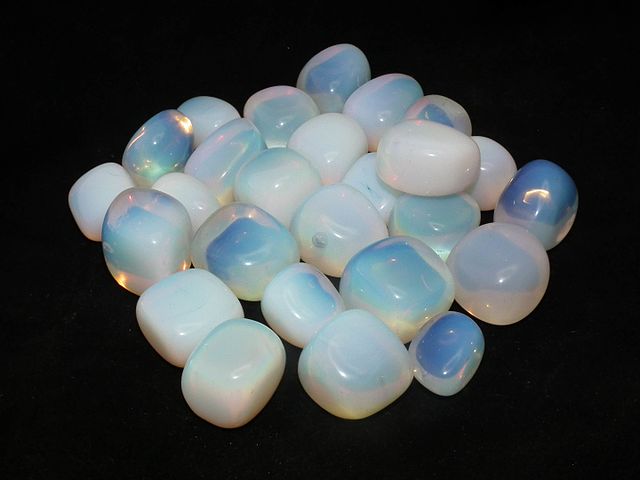
640px-10-20MM_Tumble_Polished_Opalite
Photo from Albion Fire and Ice. CC BY-SA 4.0.

Opalite is a type of opalescent glass, sometimes sold as sea opal or opal moonstone. There is a natural stone called “opalite,” but you’re more likely to come across it under the name “common opal” since synthetic opalite is much more prevalent.

Some unscrupulous sellers will try to pass off opalite glass as natural opal or moonstone. Fortunately, opalite is pretty recognizable — it’s smooth, evenly colored, doesn’t exhibit any cracks or inclusions, and may occasionally contain air bubbles.

Crystal healers sometimes credit opalite with the ability to shift energy blockages, improve one’s ability to communicate, and stimulate creativity.

Goldstone

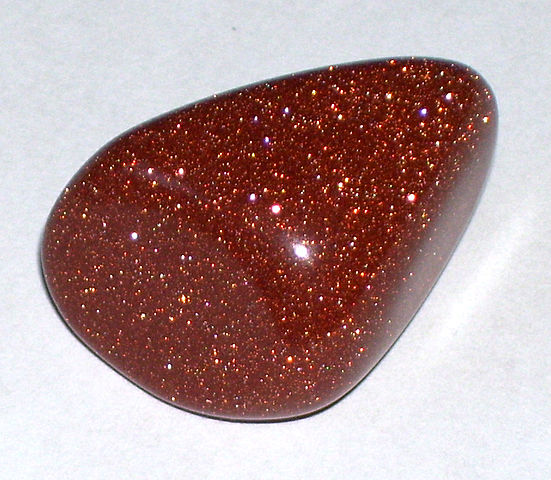
551px-Goldfluss_(Aventuringlas)
Goldstone photo by GDK. CC BY-SA 3.0. No changes were made.

Goldstone, or aventurine glass (no relation to aventurine), is a stunningly sparkly type of glass made in a low-oxygen environment. It has to be produced in a specific type of environment to allow the copper ions in the mixture to reduce to pure, elemental copper, and within a very narrow temperature range to allow the glass to stay liquid while the copper precipitates out, creating the evenly-distributed gold glitter throughout the glass.

I have seen goldstone marketed as sunstone, as well as sold in ways that obscure the fact that it’s a man-made glass. Goldstone doesn’t really look like natural sunstone, however — the color and distribution of metallic crystals is too even.

Some crystal healers say goldstone promotes energy, confidence, vitality, and ambition.

Blue Goldstone

Blue goldstone looks very similar to regular goldstone, the only difference is the color. Blue or purple goldstones use different metallic elements in their formulations, giving the stones a deep blue or purple color (hence the name) with silver glitter.

Blue goldstone doesn’t really resemble any natural stone, but I have seen it sold as “blue sunstone.”

Like goldstone, blue goldstone is said to help with vitality. It’s also credited with the ability to soothe anxiety and communication.

Fake Quartz

With a cursory visual inspection, molded glass can pass for quartz. There are a few key things to look for to be able to tell regular glass from the real McCoy:

  • Quartz is probably going to be cold to the touch, colder than glass.
  • Quartz will probably be slightly heavier — it generally (not accounting for differences in composition of the matrix, inclusions, etc) has a density of 2.65 g/cm3 while borosilicate glass is about 2.2 g/cm3.
  • Glass is likely to contain air bubbles, and probably won’t have the natural imperfections of quartz.
  • Glass is softer than quartz — it won’t be able to scratch a glass plate, but quartz will.

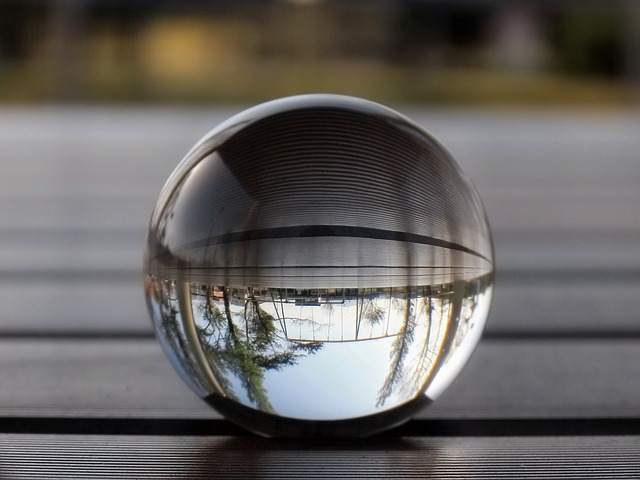
Some low-quality quartz crystals are ground up, melted down, and used to create reconstituted quartz. This is frequently used for scrying spheres, since it offers perfect clarity along with the other properties of quartz. The best way to tell reconstituted quartz from naturally-formed quartz is its lack of imperfections, and its price tag. A reconstituted crystal sphere of a given size and clarity is much less expensive than its natural counterpart.

natural-4596205_640
Reconstituted quartz spheres can be as transparent and flawless as glass, but natural quartz very rarely is.

Does it matter?

Eh, maybe.

If you have a piece of opalite, goldstone, or even resin or glass that you get something out of, I’m definitely not going to tell you you’re wrong. I’ll be the first to tell you that something’s origins or how natural it is don’t necessarily dictate its usefulness; I’ve used literal, actual garbage in spellwork before.

That said, it royally sucks to get mislead by an unscrupulous seller. If you enjoy opalite and find that it’s useful for you on your spiritual path, that’s awesome! Just please make sure you know what you’re buying, and don’t let someone overcharge you for their “super rare sea opal.”

It can also be important when you’re looking into making things like gem elixirs. While glass is pretty much inert, you really, really want to make absolutely certain that you’re not working with something that’s going to leach harmful compounds into your elixir. For that reason alone, you absolutely want to make sure that you know exactly what kind of minerals — natural or man-made — you’ve got.

Of course, no man-made material is going to have the exact same physical or metaphysical properties as the gemstone it’s imitating. But (as I mentioned in my post about identifying natural citrine) goldstone, blue goldstone, and opalite can have a legitimate use, even in a very traditional magical system. Color magic is a viable aspect of witchcraft, and goldstone being made in a factory instead of underground doesn’t make it any less orange and sparkly.


If you try to use nature-derived material in your spellwork, you might want to familiarize yourself with the man-made stones that occasionally make their way into the crystal and gemstone market. If you don’t really care, or feel drawn to these stones for their own sake, there’s no reason to avoid them. Opalite, goldstone, blue goldstone, and reconstituted quartz are all beautiful and useful in their own ways. If you find a piece that resonates with you, enjoy it and treasure it — no matter whether it came from the earth, or from a laboratory.