Uncategorized

Ginger Folklore and Magical Properties

Hot spices have a certain reputation in magic. On one hand, they’re catalysts — helping to speed things along and bring results more quickly. On the other, many of them are baneful or strongly protective. (Chili peppers, for example, are found in many a banishment and protection recipe.)

Then there are what I call the “sweet heat” spices. These are catalysts that don’t show the powerful banishing or repelling properties of other hot spices. They have heat, but their heat is more geared toward attracting things than driving or keeping them away. This is where things like cinnamon and ginger fall.

Since it’s December, I figured a post on ginger would be timely. After all, it’ll be time for ginger cryptids soon!

Ginger (Zingiber officinale) is related to turmeric, galangal, and cardamom. It originated in Southeast Asia, but there are a number of other plants that bear the name “wild ginger.” American wild ginger species are members of the family Aristolochiaceae, making them related to Dutchman’s pipe. While American wild ginger tastes and smells similarly to Z. officinale, they are not closely related. American wild ginger also contains Aristolochic acids which, while they have some medicinal properties, can also damage kidneys and trigger particular types of liver and urinary cancer. (Exposure to Aristolochic acid also correlates with a poor prognosis for liver cancer.) In short, anything that wild ginger can do, there are other remedies that can do it better and more safely. So, for all purposes that suggest ingesting ginger, please assume that this post refers to Z. officinale, and not members of Aristolochiaceae.

In ancient Greece, it was said that ginger flowers grew where Demeter’s tears had fallen after Persephone’s abduction.

In China, ginger was associated with the Monkey King Sun Wukong. He is a fiery-tempered trickster figure who first appeared in the novel Journey to the West published during the 16th century.
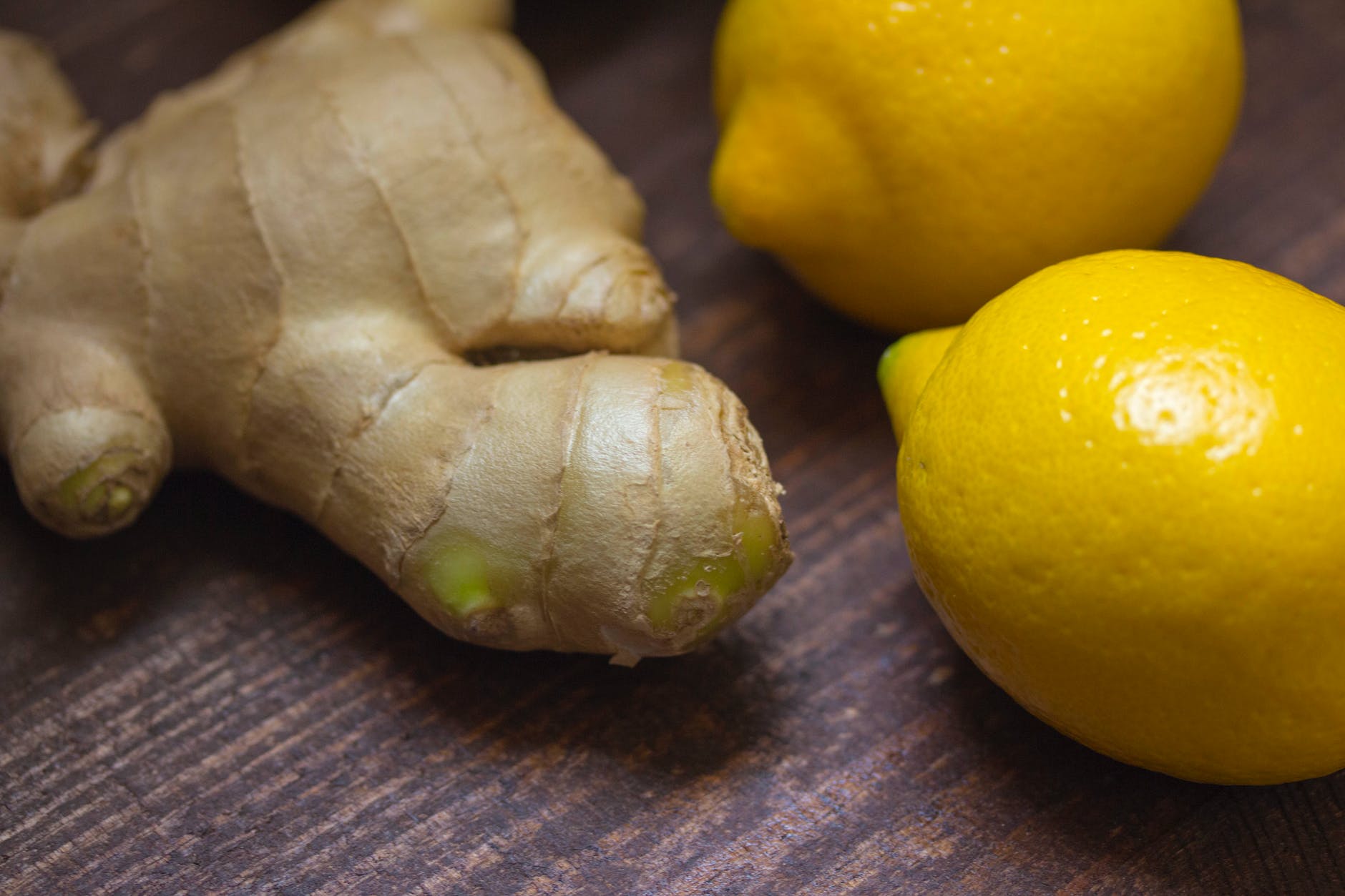
A knobby root of fresh ginger, alongside some whole lemons.

According to Hindu folklore, the first ginger plant arose when Lakshmi tossed a piece of ginger into the ocean.

Pretty much every culture that used ginger recognized it for its warming properties. In ancient Greek, traditional Chinese, and Ayurvedic medicine, ginger is regarded as a spice to ease respiratory ailments and improve digestion. Even today, ginger is used as a natural remedy to reduce nausea. It has shown remarkable efficacy for nausea triggered by pregnancy and chemotherapy.

One old healing ritual involves chewing a bit of fresh ginger root, spitting it out, and rubbing it either on a sick person, or on a photograph or poppet of the sick person.

Overall, ginger is a magical catalyst. This means that it helps achieve results more quickly. It’s also said to increase one’s “inner fire.”

Ginger is often used in romantic formulas to induce passionate feelings.

It’s said that the most powerful ginger roots are those that are shaped like humans, with a knobbly “head,” two arms, and two legs.

This root is associated with the element of Fire, as well as the Sun. As a solar herb, it’s frequently used in rituals and formulas for success and prosperity.

Just as a reminder, Z. officinale should be used for preparations that are intended to be ingested. Members of Aristolochiaceae should not be used internally.
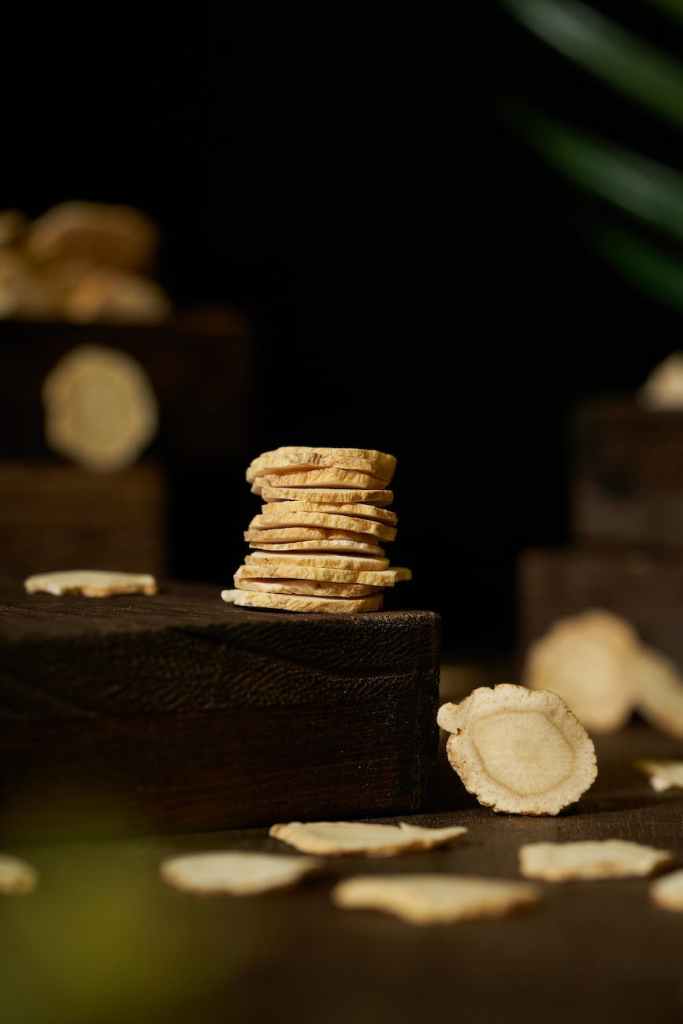
Coin-sized slices disks of ginger root.

Since ginger is a catalyst used in formulas for romantic love, it’s an excellent ingredient in “date night” recipes. Use it alone or with other love- and passion-inducing ingredients, like rose petals or cinnamon, in food or beverages to share with a lover.

A simple money spell involves sprinkling a bit of powdered ginger in your wallet. (You can also tuck a few disks of dried ginger in there, instead.)

As ginger is also considered a physically empowering, warming herb that increases heat and vitality, drinking a cup of ginger tea before a ritual may help facilitate power raising. You can also brew some ginger tea, enchant it for strength, and drink it before playing sports or doing anything physically demanding or competitive.

It’s the Yuletide season here, so ginger is very easy to come by. You can find it in tea, cookies, cakes, and savory dishes alike. With so much delicious ginger at your fingertips, why not use some in your spellcraft?

Plants and Herbs

Cypress Folklore and Magical Properties

I first started this post in January… of 2020.

A bald cypress in autumn. The needles are a vibrant read and very close to falling.

The reason it took so long was because I wanted to do the subject justice. Cypress trees are my favorite trees. I feel closer to them, and more power from them, than I do other trees. They’re sacred to me. I even have a glass pendant filled with slivers of lightning-struck bald cypress wood, and a pendulum made of a naturally fallen bald cypress’ knee.

Since the local bald cypresses have lived up to their names and done their trademark needle-shedding, I thought now would be a good time to dust this post off and finally finish it.

To the ancient Greeks, cypress trees had a tragic origin. Kyparissos was a youth who was beloved by Apollo. Apollo gave Kyparissos a beautiful tamed stag who accompanied the boy everywhere. Unfortunately, the stag was slumbering in the forest when the boy was out hunting, and he accidentally killed his stag with a hunting spear. Heartbroken, Kyparissos grieved so deeply that he transformed into a cypress tree.

The staff of Asklepios, the Greek God of Healing, was made of cypress wood. Though cypress does have some medicinal qualities, it’s likely that his staff used cypress less for its healing attributes, and more for its connections to immortality.

Sacrifices to Hades and Persephone were made under groves of cypress trees. Asklepios’ staff may have been a symbolic placation of the deities of the Underworld, so that they would not take his patients.

One of Athena’s names was “Lady of the Cypress.”

Bald cypresses are so named because they are deciduous. Every year, they shed their needles during the winter months.

Bald cypresses (Taxodium distichum, in the Cupressaceae family) are also unique in that they form “knees” — tall, knobbly growths that spring straight up from the trees’ roots. Nobody’s really sure why this happens, as the knees don’t appear to serve a particular purpose and removing them doesn’t seem to affect the trees negatively. They just kind of… happen. Some theories for cypress knees describe them as an adaptation for living in very wet environments, by helping to aerate the roots, provide an additional means of preventing erosion, or helping to stiffen and strengthen the root system.

Some cypress knees get pretty big. While they’re mostly conical in shape, they can be really irregular and knobby. It wasn’t uncommon for travelers, particularly those walking at night, to mistake them for other people or even monsters.

In general, cypresses are guardians of boundaries. Members of Cupressaceae are symbols of death, immortality, the afterlife, and liminal spaces. Their typically upright growth habit connects the earth to the sky, and they’re commonly planted on the borders of cemeteries. Kyparissos’ legend further associates these trees with death and grieving. Since these trees are evergreen, they are identified with the concepts of immortality and the afterlife as well.

I wasn’t able to find much information about Chinese cypress species, but the bit I did find suggests that cypress seeds were eaten to preserve longevity. In Japan, hinoki cypresses have a prominent place in Shinto rituals. Hinoki wood is used to start ritual fires, as well as to make the priests’ scepters.

A close up of a cluster of green cypress cones.

Though bald cypresses are native to America, they still connect to similar concepts as their Middle Eastern, European, and Asian counterparts. Though they resemble evergreen conifers, they shed their needles every year — a symbolic death and rebirth. They also grow where the water meets the land, which is another liminal space.

According to Persian legend, a cypress tree was the first tree to grow in Paradise. It’s evergreen leaves and extremely durable and rot-resistant wood made it a fitting symbol for immortality.

Cypress motifs are frequently used to decorate graves and tombs. You can see this on Christian graves, and in abstract depictions on Turkish Muslim tombs as well.

Some sources claim that Indigenous American peoples believed that cypress trees had a connection to the spirit world. This claim is vague, however, and since I couldn’t find any specific references to which tribes and nations believed this, it should be taken with a grain of salt.

Cypress wood, when used in wands, is said to have a calm and soothing energy. This follows cypress’ use as a symbol of, and remedy for, grief.

Medicinally, cypress oil is used to soothe coughs, treat warts, ease hemorrhoids, treat cuts and broken skin, relieve pain from muscle aches and varicose veins, and ease symptoms of anxiety and depression.

Personally, I love cypress and get a lot out of its connection to the other worlds. Bald cypresses, in particular, are excellent emblems of the thin border between the material plane and the spirit worlds. I’ve used cypress to ease thanatophobia, and as part of an excellent oil for trancework.

If you don’t have access to cypress trees or wood, the easiest way to work with them is probably through their oil. Cypress trees are fragrant and produce a lovely essential oil. If you avoid using essential oils due to safety or sustainability concerns, you can also try purchasing some cypress needles and infusing your own oils. I’m fortunate that bald cypresses are native to this area, so there are plenty around when I need to gather twigs, needles, or cones.

If you work with grief, or as part of the counseling or deathcare industries, it may be worthwhile to explore the properties of cypress wood or oil. Even if you don’t choose to use incorporate this into your work, the aromatherapeutic and energetic properties may help ease the stress of confronting death and grief on a daily basis.

A close up of the base of a bald cypress trunk, showing four distinct knees. A pond and more trees are visible right behind them.

I have several bald cypress knees around my house. Some are altar pieces, some are floor sculptures, some are cabinet specimens. It doesn’t hurt bald cypress trees to have their knees removed, and many homeowners do so in order to make their yards a little safer and easier to maintain. You can often find cypress knees for sale on Etsy or eBay.

Cypress trees are great. If you live in an area with a native cypress species, plant one. They’re beautiful, they’re useful, and they’re powerful.

Witchcraft

The Wheel of the Moon

I’ve mentioned before that I’m a big fan of the Wheel of Life exercise. I was introduced to it by my psychologist, and I found that it was a) really helpful and b) fun. I like lists. I like charts. I like ways to visualize data, and that’s pretty much exactly what this exercise does. It’s also really flexible and customizable.

This last bit is why I’ve made it part of my full moon observations. I light a candle (a handmade full moon candle from the wonderful 13 Magickal Moons in Occoquan, VA) and some incense. I draw the wheel. I section it off and label it however is most fitting. I make the assessments, I draw the lines, and I compare the shape with the shape of the previous month.

The full moon rising behind some pines.

It’s a meditative exercise that helps me to acknowledge the changes I’ve made from month to month, because I can see them right in front of me. It highlights areas that need help, so I can use the power of the full moon to change them. By doing the wheel monthly, instead of every few months, it makes it easier for me to make incremental changes (and keep tabs on things like The Ennui).

It’s also useful for relating to the cycle of the moon. Even at the height of its power, the full moon heralds its own decrease. By that same token, the waning moon promises future growth. Looking at the Wheel of Life shows what has grown, what hasn’t, and, if need be, what should be pruned.

Below is a simple ritual outline that just about anyone can use to help better their physical and mental health, improve their relationships, and generally pull off a whole-life glow up.

You will need:

  • A pen or pencil.
  • A piece of paper with a circle drawn on it.
  • A candle, preferably in white or silver.
  • Incense. Ethically harvested sandalwood, myrrh, white rose, bay leaf, or lemon balm work well here.
  • If this isn’t your first time performing the ritual, you may also want to have a fireproof bowl.

First, consider the areas of your life that you wish to focus on. This could be your physical health, mental health, physical environment, friendships, family, love life, career, spirituality, creativity, or anything else you desire. Count up how many areas you want to work on, and divide the circle up into that many sections — like a pie chart. Alternatively, you can use an online Wheel of Life creator.

Think of each area carefully. If you had to rate that area of your life from 1 to 10, what would you rate it? Pretend the center of the circle is zero, and the very edge of each slice is 10. Draw a dot roughly corresponding to the numerical rating you choose for each section. Connect these dots with lines, and you should have a kind of asymmetrical star shape.

Here’s an example from Wheeloflife.io’s generator.

This is your Wheel of Life. It’s a visual representation of how you feel about things right now. Look at the areas where the shape is most lopsided — this is where you feel your life needs the most help at this moment. For example, if you rated “family relationships” at a 7, and “career” at a 3, “career” would be the area to focus on.

Now, light the candle and the incense. If you can, place the Wheel of Life in a spot where the full moon’s light can fall on it. If not, observe it under the candle’s glow.

White candles, burning.

Say,

“See the moon’s glow, charging the Wheel.
My life is unfolding, with each turn I feel.
Full moon energy, guide me this night.
Transform me, renew me,
With your radiant light.”

As you meditate on your Wheel, consider what changes you can make to the areas of your life that need the most help. What can you do within the next week? The next two or three weeks? The next month?

Come up with three simple actions you can do over the next week. They can follow the energy of the waning moon, but they don’t necessarily have to.

Come up with three more that you can do over the next two to three weeks.

Finish by coming up with three more that you can complete by the next full moon.

Save this Wheel. Place it somewhere where you’ll see it often. Refer to it as many times as you need to in order to keep yourself motivated and on track.

(If you like, you can turn your actions into statements of intent, and use your preferred method to further empower them. Turn them into sigils, shorten them to symbols and inscribe them on candles, and so forth.)

If this isn’t your first time performing this ritual, then take out the last full moon’s Wheel.

Take a moment to compare this full moon’s Wheel to the last one. What progress have you made? What seeds have you sown, and what have you reaped? Give thanks for any advancements you’ve made, no matter how small.

A crackled clay firebowl filled with burning herbs. A small pile of herbs sits in the foreground.

If you wish, you can light the last full moon’s Wheel in the candle’s flame and drop it into the fireproof bowl. Scatter the ashes on the wind.

Plants and Herbs

Milkweed Folklore & Magical Properties

I planted a swamp milkweed (Asclepias incarnata) in the back yard not too long ago. Though I did it well after I could hope for monarch butterflies, I still wanted one of these beautiful, interesting native plants. (Besides, they’re perennials — if it could survive this year, there’ll be plenty of plant for the monarch babies next year!)

It was blooming happily, playing host to all kinds of tiny fauna, and finally put out lots of big, fat pods. Apparently it wanted to wait until the recent supermoon to bust those suckers open, because that whole part of the yard is inundated with milkweed fluff!

Flat, brown milkweed seeds, showing their tassels of silky white fluff.

I gathered a good quantity of the fluff and seeds to save, share, and use for various purposes. So, I figured, now’s probably a good time to write about this lovely plant’s magical properties!

Like many of the plants I choose to explore, this one’s native to the Americas. That means that you won’t see it in a lot of older folk or ceremonial magic resources. This plant is still powerful, however, and has a lot to offer practitioners in its native range.

Like I mentioned, milkweed produces tons of fluff. This fluff appears as silky white tassels on its seeds and helps them disperse via wind — just like dandelions. If you catch a floating milkweed seed, make a wish, then release it to go along its merry way, its said that your wish will come true.

Milkweed fluff can also be used as filling for pillows, sachets, and poppets. Thistledown is a traditional poppet filling, but, if you don’t live in an area with abundant thistles, milkweed fluff can be used as a substitute.

Filling a dream pillow with milkweed fluff is said to cause the user to dream of the fae.

The juices of the milkweed plant, when used for anointing, are said to strengthen one’s “third eye.” (However, these juices are also irritating, so maybe just place a whole leaf or sprig of flowers to your forehead instead.)

In World War II, military life jackets were filled with milkweed fluff as an alternative to kapok (Ceiba pentandra).

Milkweed’s genus, Asclepias, was named for Asclepius. He’s the Greek God of Healing, and a son of Apollo.

Though it’s associated with a god of Healing, one of milkweed’s primary virtues is its toxicity. When monarch caterpillars feed on milkweed, they take in the plant’s toxins. This, in turn, makes the vulnerable caterpillars toxic and unpalatable to predators. As a result, milkweed is associated with protection.

A plump, stripey monarch caterpillar.

There’s also a very fine line between “poison” and “medicine.” To the people indigenous to milkweed’s native range, milkweed sap was used to remove warts. Boiling helps leach out the toxins in the plant’s sap, and cleaned up extracts of milkweed proved useful for respiratory ailments, sore throats, and kidney problems. Some of the toxins in milkweed sap are cardiac glycosides, which, in small doses, behave similarly to the digitalin extracted from foxglove (genus Digitalis).

Milkweed is a very liminal plant. Swamp milkweed (A. incarnata) can be found at the edges of wetlands, where the water meets the land. Common milkweed (A. syriaca) often grows in disturbed areas, like roadsides.

Milkweed is associated with the Moon and the element of Earth. (Personally, I also associated swamp milkweed with water.)

Milkweed’s a really lovely plant, though it can also be hazardous to work with if you aren’t careful. Personally, I limit myself to the flowers, fluff, and seeds — I have sensitive skin, and the last thing I want to worry about is getting milkweed sap on myself!

The fluff is really lovely as a filling for poppets and dream pillows. Blend it with herbs like mugwort, hops, and lavender, and add a clear Herkimer quartz crystal for a wonderful dream pillow that’ll help improve dream recall and make it easier to dream lucidly.

The seeds, like a lot of native American seeds, need to be stratified. That means that they’re great to use for sowing rituals during the colder months — the winter solstice, for example.

Seeds are a great spell component in general, because they embody as-yet-unrealized potential. They’re a bit of sympathetic magic, too. As the seed grows, so will the thing you hope to get from your spell.

Milkweed seeds are also flat, so they’re nice to incorporate into homemade paper. Once the paper’s used, you can plant it and allow the seeds to grow. Just make sure that you’re using varieties native to your area!

The pink flower clusters of A. incarnata.

Milkweed is a beautiful, protective plant that has much to offer those who can get past its defense mechanisms. Inside those pods, protected by poisonous, milky-white sap, is an abundance of silky, silvery fluff and seeds. If you have the ability to grow or otherwise hang out with milkweed, I highly recommend it.

Plants and Herbs

I decided to eat the anise hyssop (and here’s a really tasty recipe).

Not too long ago, I wrote a bit about the magical properties of hyssop. The thing that prompted me to do this was the ludicrous abundance of anise hyssop blooms (and also bees, moths, and butterflies) in the little pollinator garden in the front yard.

Anise hyssop and regular hyssop aren’t related, though. Anise hyssop, also called anise mint, is a member of the mint family. It’s called “anise hyssop” because the leaves and flowers have an anise-like scent and flavor — though I think it’s more reminiscent of root beer!

Anyhow, since some of the anise hyssop was getting tall enough to block the coreopsis and beautyberry, I figured I’d go harvest some. Sickle in hand, I shooed the bees to the other anise hyssop plants and got cutting. I also cut a few lavender flowers that were growing at odd angles.

From there, I separated the good leaves from the wilted or damaged ones, and removed the flower heads. I gave everything a good wash, then boiled it in equal parts sugar and water to make a lovely, herb-infused simple syrup.

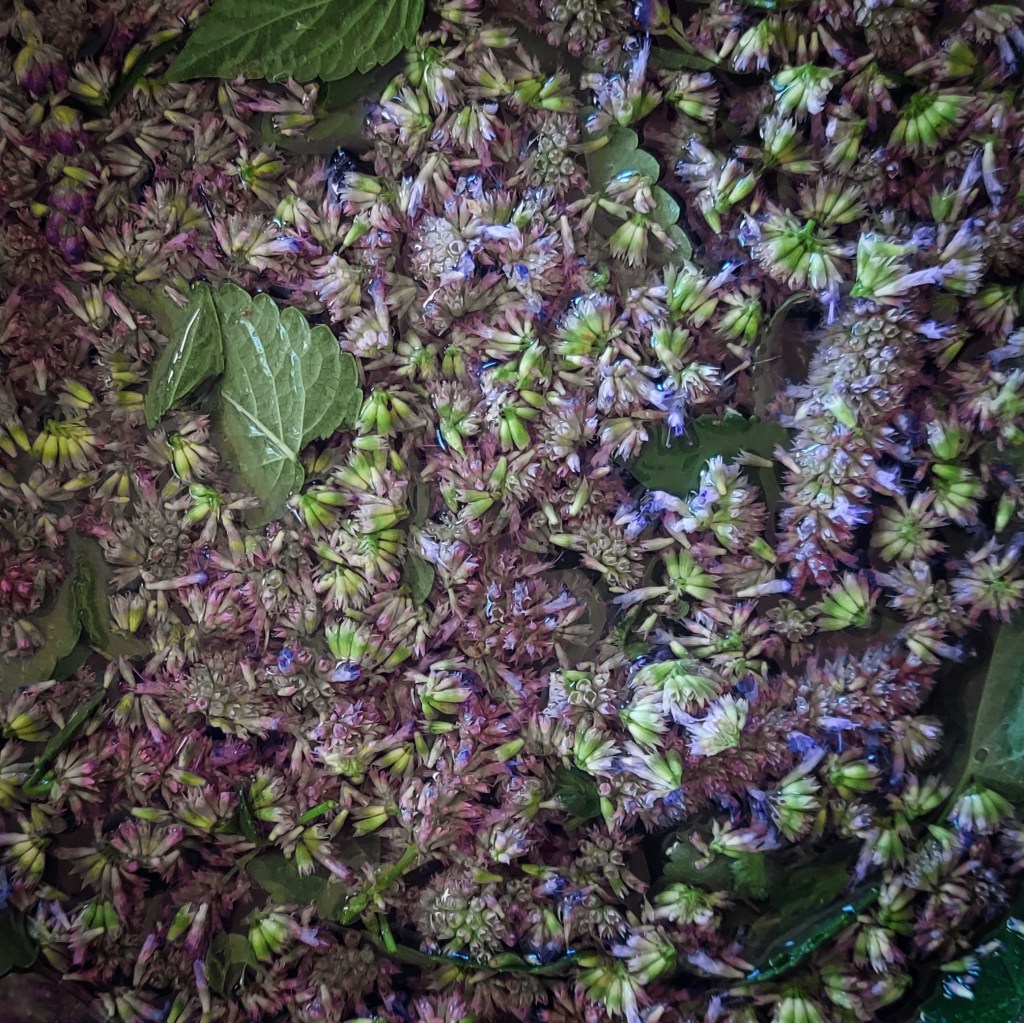
A bowl of small, bright purple flowers and green leaves soaking in water.

Once the syrup was made, I strained out the plant matter and spread it on a bit of parchment paper in my dehydrator. After an hour and a half at 165 degrees F, once everything was dried to a crisp, I was left with some lovely candied flowers that do, in fact, taste exactly like root beer.

Anise hyssop is used as a carminative and expectorant, and is very soothing. I don’t really need an expectorant right now, but I plan to use the flowers and syrup to ease digestive complaints. The only thing is, I don’t really need that much. So what do I do when I’ve got way more delicious candied flowers than I need?

I make scones.

These are easy, nut-, egg-, and dairy-free, and delicious. They only require one bowl and about half an hour of your time.

Dry Ingredients:

  • 2 cups of flour (I used einkorn, but regular wheat flour is fine)
  • 1/2 cup sugar
  • 1 tablespoon flaxseed meal
  • 2 teaspoons baking powder
  • 1/2 cup cold vegan butter or coconut oil
  • 1 handful fresh anise hyssop flowers
  • 1 generous cup of blackberries (depending on their size, you may want to cut them into smaller pieces)

Wet ingredients:

  • 1/2 cup milk substitute of your choice (I used pea milk)
  • 1 teaspoon of vanilla extract

Tools:

  • A nice big mixing bowl
  • A spoon
  • A whisk or fork
  • A pastry cutter or fork (optional)
  • Measuring cups and spoons
  • A baking sheet
  • A sharp knife

Making the Scones

  1. Preheat your oven to 400 degrees F.
  2. Place the sugar and fresh anise hyssop flowers in your mixing bowl.
  3. Rub them together with your hands, until the flowers are mashed with the sugar and the mixture resembles moist sand.
  4. Add the flour, flaxseed meal, and baking powder. Whisk together until well mixed.
  5. Add the cold butter substitute or coconut oil. (You might want to do this in cubes or spoonfuls, it’ll make the next bit easier.) Use a fork, pastry cutter, or just your hands to work the fat into the dry ingredients. Keep at it until the mixture looks like coarse crumbs.
  6. Measure out a half cup of milk substitute. Add the vanilla extract to the milk and stir.
  7. Pour your milk into the mixing bowl. Stir until it’s just combined — avoid over stirring. If it seems too dry to hold together, add another tablespoon or two of milk.
  8. Fold in your blackberries.
  9. With floured hands, lightly knead the dough until it all comes together. Visualize yourself kneading health, love, and prosperity into the dough.
  10. Turn the dough out onto a floured surface. Form it into a ball, and pat it out into a flat circle roughly an inch thick.
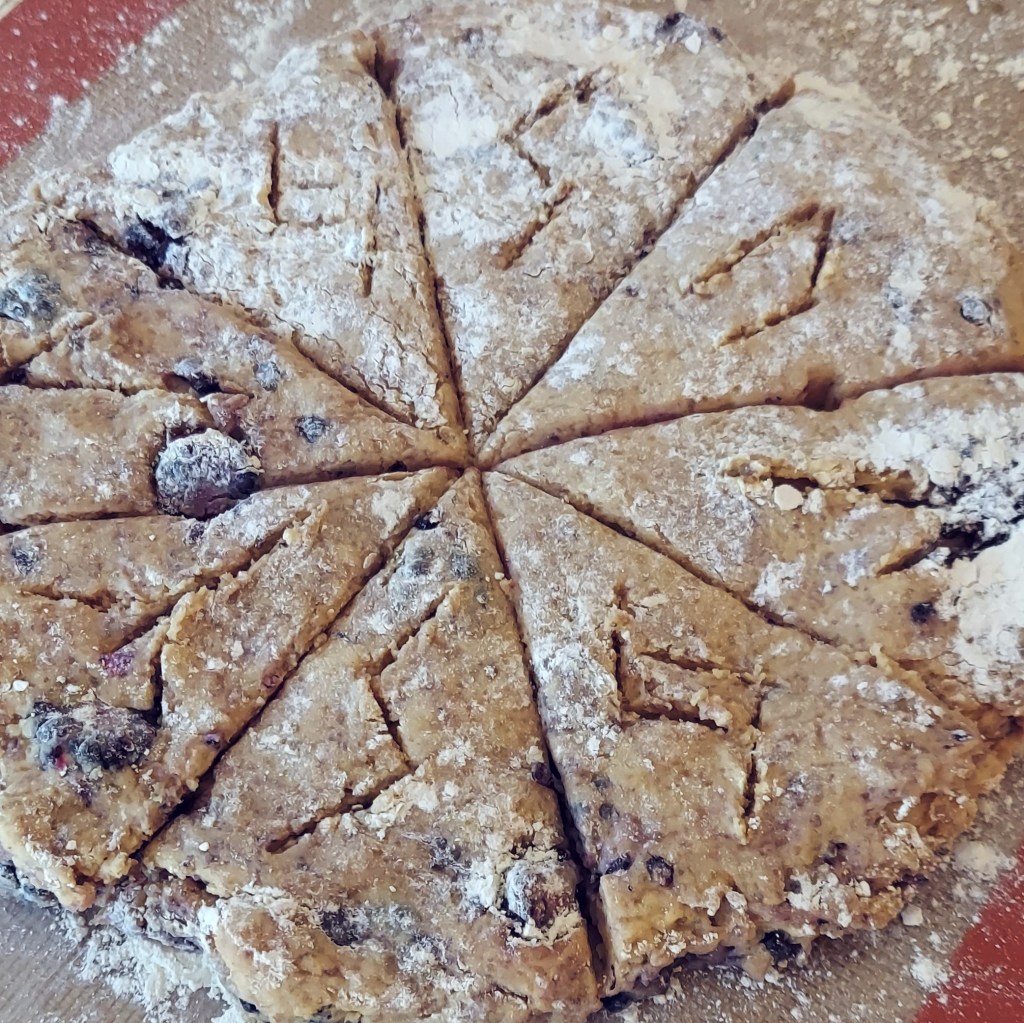
  11. Slice it into triangles. If you like, you can use a toothpick or the tip of a knife to carve the tops with runes, sigils, ogham feda, or other symbols significant to you.
  12. Place the triangles on a baking sheet. Bake for about 25 minutes, or until they’re golden brown.
Unbaked blackberry scone dough, formed into a circle, cut into triangles, and inscribed with the runes jera, sowilo, teiwaz, uruz, algiz, and laguz.

Making Them Extra Fancy

If you like, you can also ice your scones. Mix up a cup of confectioner’s sugar, two tablespoons of milk substitute, and, if you like, some finely crumbled candied anise hyssop leaves and flowers. Stir well until the mixture is smooth and liquid. If it seems too thick, add some more milk substitute. If it’s too thin, add more sugar.

Once your scones are cool (give them about 20 minutes), drizzle the icing on with a spoon. Give the icing a few minutes to harden, then serve.

A baked scone, inscribed with the rune uruz and covered with a sweet glaze.
Plants and Herbs · Witchcraft

Nutmeg Folklore & Magical Uses

It’s the time of year when Trader Joes brings out their Wassail Punch. I don’t really drink fruit juices straight, but I like ’em for flavoring water kefir. This one’s blend of fruit and spices makes the end result taste like cola, which is pretty neat.

(Cola is one of those flavors that isn’t really meant to taste like anything in particular. It’s spices. It’s citrus. It’s all kinds of things that add up to one immediately recognizable taste.)

Anyhow, one of the key flavors in Wassail Punch (and probably cola, to be honest), is nutmeg. It’s one of those things that I can immediately recognize when I taste it but am completely unable to remember on its own. It’s like… a clove- and cinnamon-less pumpkin pie? I guess?

It was also one of those most precious substances in the world for a while, and a nearly invaluable magical ingredient.

Nutmeg Magical Properties and Folklore

Nutmeg is a spice that comes from an evergreen tree, Myristica fragrans, native to Indonesia. It’s a weird seed, too — it grows inside of a fruit similar to an apricot, surrounded by an aril that looks kind of like a flat, fleshy spider or extremely underachieving facehugger. The dried aril is the source of the spice mace. The seed itself is the nutmeg.

An image of a ripe nutmeg fruit. The outside resembles an apricot, which has split to reveal the mace-covered nutmeg inside.

It takes a long time for nutmeg trees to bear fruit, though they can do so for several decades after that. Since the spice is native to such a small geographic area, an absolutely horrific amount of bloodshed happened in the name of obtaining it, farming it, and keeping anyone else from getting a hold of it. The Dutch tortured and killed the native people of Indonesia in order to control the nutmeg trade. They also tried their damnedest to keep the English and French from sneaking any viable seeds out of the country, by dipping the nutmegs in lime to keep them from sprouting.

People used to joke (inaccurately) about Manhattan being traded for glass beads. The Dutch really did trade Manhattan to the English for some sugar and nutmeg. For real, nutmegs were so valuable that traders would mix a handful of wooden replica nutmegs in with the real ones in order to dupe their customers.

A whole nutmeg, hollowed and filled with mercury, sealed with wax, and wrapped in a green cloth, is considered a powerful charm for luck in games of chance. (You can skip the mercury poisoning by just carrying a whole nutmeg. It’s fine. Really.)

Wrap a whole nutmeg in purple cloth, and it’s said to help you win court cases.

All forms of nutmeg are considered useful for money magic. Nutmeg oil is a common ingredient in money oils, while the powdered stuff is helpful in sachet and sprinkling powders.

Money and luck aren’t nutmeg’s only properties, however. An old spell from Louisiana involves sprinkling nutmeg in a woman’s shoe to get her to fall for you. Food and drinks flavored with nutmeg were also used as love potions.

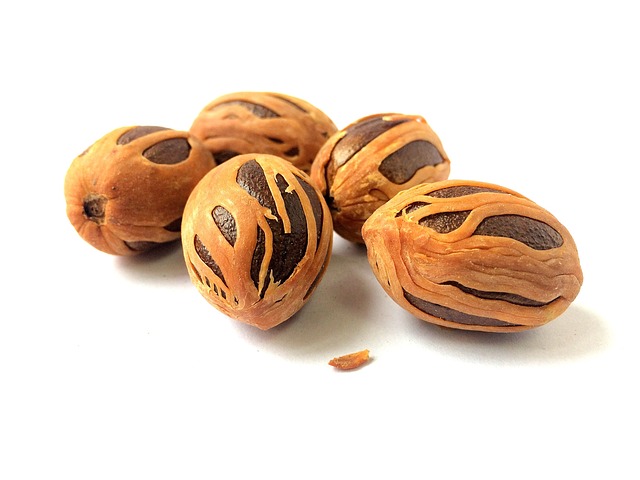
Whole nutmegs covered in mace.

Ground nutmeg was used as incense in ancient Rome.

One old remedy for rheumatism involved boiling nutmegs and cooling the resulting liquid. The nutmegs’ natural fats rise to the surface and cool, forming a solid layer. This is skimmed off and used as a topical balm. Nutmeg is a warming spice, so this would help encourage circulation and relieve some of the pain caused by cold weather aches.

Nutmeg can make you trip balls. This is not code language.
This spice is a hallucinogen, courtesy of a compound known as myristicin. Unfortunately, you have to consume a lot to feel the effects, at which point you’re putting yourself at risk of nutmeg poisoning. “A lot” is relative here — about 10 grams (two or so teaspoons) of ground nutmeg is about to trigger symptoms of toxicity. It’s not that much, but still way more than you’d typically use in cooking. Nutmeg poisoning is pretty awful, too. While I wasn’t able to find any stories of nutmeg-based fatalities, the cases I did find mentioned nausea, dizziness, heart palpitations, fatigue, confusion, and seizures. Yikes.

Nutmeg is associated with the element of Air, the suit of Swords in tarot, and the planets Jupiter and Mercury.

Using Nutmeg

The easiest way to use nutmeg is to make your favorite autumn or winter recipe that uses this spice for flavoring. Use a wooden or metal spoon to prepare it and stir it with your dominant hand. As you do this, picture energy coming up from the Earth, down from the sky, and running through your arm, down your hand, into the spoon, and finally into the food or beverage itself. Ask the nutmeg for help with whatever you want it to do, whether that’s getting laid or making some money. Pretty easy, bog-standard kitchen witchery, really.

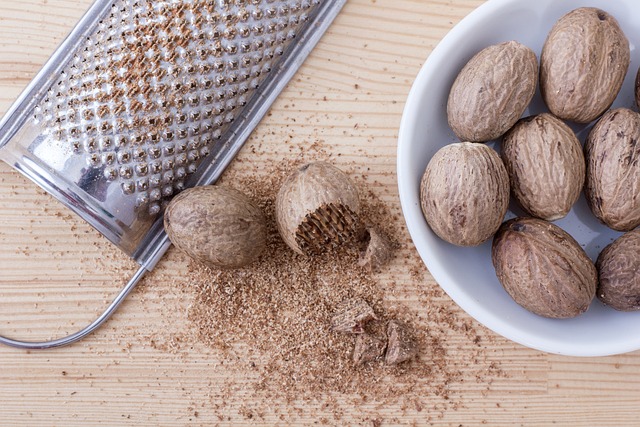
Whole nutmeg seeds, a nutmeg grater, and a little pile of ground nutmeg.

You can also use nutmeg by just… carrying it. As mentioned previously, whole nutmegs are a charm for luck and money. Wrap them in an appropriately colored cloth, anoint them with a suitable magical oil, ask them for their assistance, then keep them on you. When they get old and lose their potency, retire them by burying them in the soil and make a new charm with a fresh nutmeg.

You can also use nutmeg for meditation. I wouldn’t rely on it to induce a trance state, but drinking some warm milk flavored with honey and nutmeg can be a pleasant way to begin some meditative or journeying work. Just don’t use too much — the vast majority of nutmeg poisonings are from kids who eat it to get high and end up spending the night dizzy and throwing up instead.

Nutmegs are also good additions to charm bags or jar spells for money or luck. They’re very nice, potent, self-contained magical ingredients. If you have an assemblage of herbs, curios, and other tools, why not throw in a nutmeg? If you can’t afford a whole one, sprinkle in some of the ground stuff instead.

Nutmeg is a spice with a dark history (I mean, most of them have dark histories. Thanks, colonialism!). It’s preciousness as an incense and culinary ingredient has tied it to the concepts of luck and money, so you’ll most commonly see it in spells for financial abundance and good fortune. If you’re not a kitchen witch, a sprinkle of nutmeg can be a good place to start. If you need to practice magic discreetly, you really can’t go wrong with tucking a whole nutmeg in your bag or pocket.

crystals · Witchcraft

What is Devic Temple Quartz?

Lemurian. Elestial. Devic. Lightbrary.

Buying quartz can be complicated.

Sigil. Starbrary. Garden.

The truth is, most of these terms are just names for physical features of the crystal itself. Some claim that these physical traits line up with the stones abilities or affinities, but this isn’t always the case. One of these terms is “Devic Temple Quartz.”

So, what’s a Devic Temple quartz?

In simple terms, a Devic Temple quartz is a quartz crystal that has internal fractures that resemble seats or shelves. These usually also have some visible foggy wisps produced by trapped gasses or water, often called “fairy frost.”

If the water inclusions are large enough, it might also be called “enhydro.” If it appears to have the outline of another crystal inside, it might be called “phantom.” If it contains inclusions of hematite, chlorite, or other minerals, it might be called “lodolite.” As a word of caution, while lodolite is a common term among gem enthusiasts, it’s not actually a real name. It pretty much just means “stone that has some mud inside.” You might also see these called garden or shaman quartz.

Like I said, there are a lot of words involved. Try not to sweat it too much.

What can it do?

Devic Temple quartz is purported to house light beings, nature spirits, or other allies. Sometimes, if you look at the internal fractures, rainbows, fairy frost, and other features, you can see what appear to be faces, dancing bodies, or humanoid/animal shapes.

Since these crystals are said to act as “houses” for spiritual entities, they’re considered a way to communicate with them in meditation, healing, and so forth. Having one of these guys is pretty much like a direct line to the spirit in the crystal. Some also consider them a way to communicate with faeries and/or angels.

Here’s where my opinion differs…

Honestly, from my experience, all crystals have their own presence. Sometimes, you can perceive it as a kind of electric feeling in your fingers — like the feeling you’d get if you were holding a bird, a firefly, or some other tiny life, afraid of squeezing too hard. This isn’t to say that a crystal is alive the way we typically conceptualize life, but it’s in there. In this respect, Devic Temple crystals aren’t unique.

That said, they can make it easier to access that presence. It’s kind of like the difference between trying to find a hermit in the woods, and walking up to a numbered address with a brightly-painted front door and a sign that says “Free pies, inquire within.”

Sometimes, you can see the physical appearance of a crystal’s presence in the fairy frost, even if it isn’t a Devic Temple crystal. One of my favorite meditative activities is to sit with a a crystal, a macro lens, and a good light source, and look for tiny buddies.

If you look on the left, you might see a faint image that looks like a side-on view of a human skull. What else do you see?

Do you need a Devic Temple quartz? I wouldn’t say that they’re essential — but I wouldn’t say that about any crystal. Ultimately, if a stone resonates with you and is responsibly sourced, pick it up. Don’t buy it because of the names attached to it. Choose what you’re drawn to and discover its unique features afterward, when you have a chance to sit with it.

crystals

Working with Herkimer Diamonds

Note: This post contains affiliate links. These allow me to earn a small commission, at no additional cost to you. Thank you for supporting small retailers and this site!

I like crystals. Even if I didn’t work with them, I’d probably collect them.

I received my first one when I was very little — about five or so, I think. It was a piece of dyed hot pink agate, shaped into an egg about as long as my thumb. I didn’t know anything about geology or crystal properties, but I knew I liked it and so, like a corvid, I kept it with the rest of my treasures.

(Most of those “treasures” were dead swamp cicadas that I’d pick up on the sidewalk in late summer. I had — okay, have — a Thing for iridescent colors.)

I still collect crystals, though now they actually get used for things. Unfortunately, the reality of the crystal market means I can’t just buy whatever I like. There’s a vetting process. Since I’m also lazy, this means that, for the past couple of years, I’ve only picked up Arkansas quartz, Herkimer diamonds, and piece or two from Brazil after making a nuisance of myself to the seller.

All of this is to say that Herkimer diamonds kick ass and they’re very easy to obtain ethically. If I could only use one crystal for the rest of my life, it’d be one of these.

What are Herkimer diamonds?

Well, for one, they’re not diamonds. They earn their name because they come from Herkimer county, New York, and are an exceptionally hard, clear variety of (usually double-terminated) quartz.

Herkimer is known for these stones, so there are a bunch of mines you can visit to get your own from the source. There’s no child labor involved, and the process of mining is pretty much you, some hand tools, and a bucket, so these crystals are also lower on the social and environmental impact scale than many others. A bunch of Etsy merchants make a point to visit Herkimer once a year or so, dig for some, then sell them, so they’re also pretty easy to obtain even if you aren’t interested in making the trip yourself. (Two of my favorite sellers are Luminous Harvest and Greengem. Bonus, Greengem is also a source of beautiful, conflict-free rings — even some really fancy alternative engagement rings.)

How are Herkimer diamonds used for spiritual healing?

Herkimer diamonds have a reputation as extremely high-vibration crystals. They’re supposedly good for purifying the physical and astral body, attuning you to another person, group, or place, removing energy blocks, and increasing the “oomph” of the other stones they’re used with.

According to Michael Gienger’s Healing Crystals, they can be used for awareness, clarity, dream recall, heightened awareness and consciousness, and pain relief. It’s also trigonal and secondary, which makes it particularly helpful for people with “trigonal personalities,” and who wish to unlearn negative behavioral patterns and live in greater harmony with their external environment. For more information, read Gienger’s Crystal Power, Crystal Healing. It’s a very interesting read that outlines his really unique approach to the subject.

(Of course, I don’t endorse the use of crystals in place of conventional medicine. They’re great as a complementary therapy, but please consult a doctor first.)

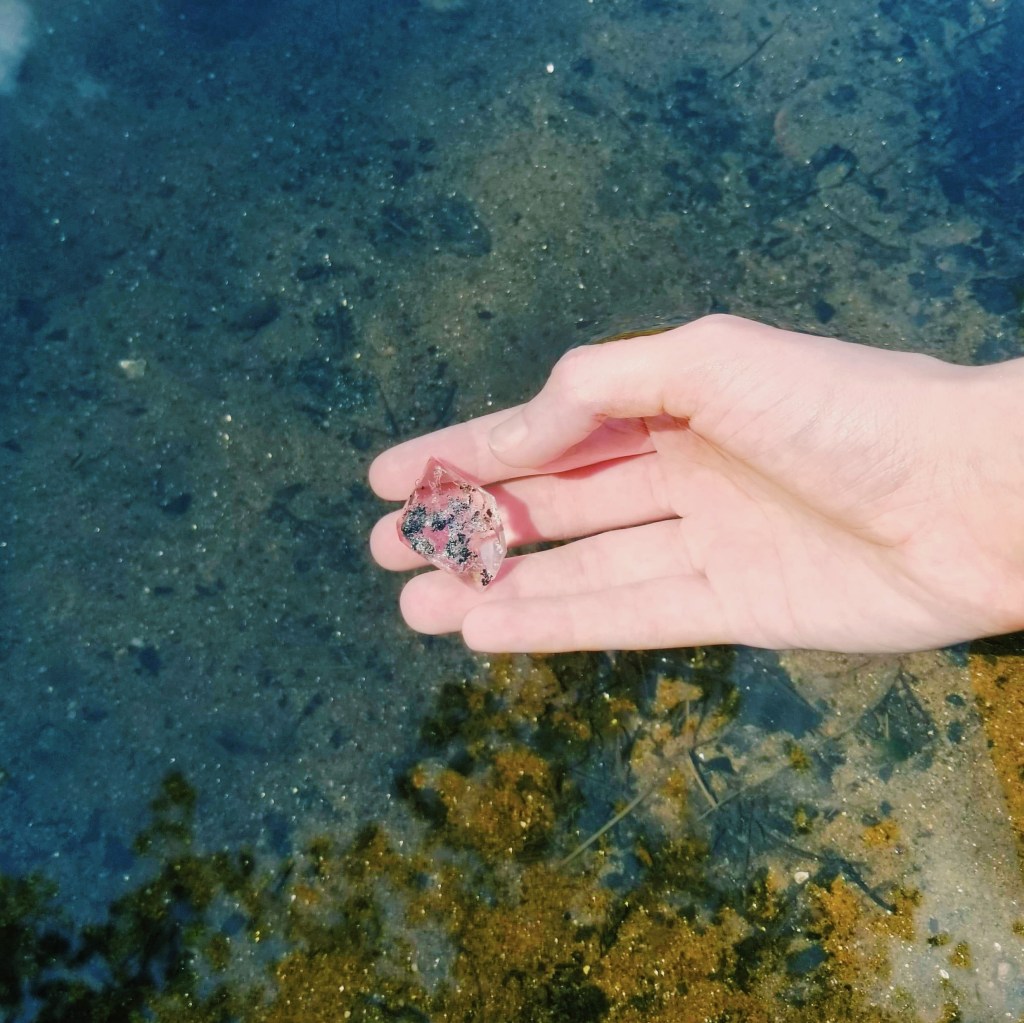
A hand holds a Herkimer diamond in clear river water.
Cleaning a Herkimer diamond in the river. Look at all of those hydrocarbon inclusions!

What are the magical properties of Herkimer diamonds?

Since they’re clear quartz, they are pretty efficient “all purpose” stones. They do often come with some neat, unique features that make them particularly useful, in a magical sense:

  • Many of them contain hydrocarbons, visible as black lines, dots, or flecks within the crystal. These bits of incredibly ancient vegetable matter connect us to our ancestors, all the way back to our pre-human family tree. For this reason, they can be very helpful for ancestor work.
  • Most of them are double terminated, which makes them helpful for simultaneously sending and receiving energy.
  • A lucky few contain deposits of water, too! “Enhydro” crystals are strongly connected to the water element, as well as earth. This makes them useful for rituals for purification and emotional healing.
  • Some of the rainbow fractures and water or hydrocarbon inclusions give them a character that’s similar to garden quartz (or shaman quartz). The inclusions and “flaws” can create beautifully complex scenes inside the crystal that are lots of fun to fall into. This makes them great as a meditative focus, or an aid to trance or journeying work.
  • They’re generally not huge. To be honest, most of the ones you’ll find in metaphysical shops are downright tiny. This makes them great for including in pouches, sachets, bottles, or whatever else your witchy heart desires.

Herkimer Diamond Clearing Spray Recipe

This is a recipe for something I whip up when I’m in a situation where salt, smoke, or other methods of clearing energy aren’t advisable. Plus, it smells really good.

You’ll need:

  1. First, make sure your ingredients are good to go — tell them what you’re using them for, and what you’d like them to do for you. Bergamot protects from evil, cuts off interference, and functions as a “power” herb. Lavender cleanses and promotes peace. Ylang ylang is calming and uplifting. Rosemary is cleansing and protecting. Vervain purifies, gets rid of negative energy, and enhances the action of other herbs in the mixture. Frankincense is purifying and energy raising.
  2. Add the dried herbs and oils first. You can go with your preference here, one is no more powerful than the other. You don’t need much — a drop or two of oil, a pinch or two of herbs.
  3. Swirl the mixture when you’re through, and speak your intention again. This can be simple. Start with, “With this mixture, I[…]” and state your intent.
  4. If you plan to keep this for a long time, fill the bottle two thirds of the way with high proof grain alcohol, like Everclear. (The Tisserand Institute has more information on preservation here.)
  5. Fill the bottle the rest of the way with lavender hydrosol or distilled water. Swirl to mix.
  6. Add the Herkimer diamond.
  7. Screw the top on the bottle and label it. You’re done!

While the sun is great for empowering things, it’s also not super great for scents. If you want to charge this mixture, do so either under moonlight, or very briefly under sunlight. To use it, simply mist the object, person, or space in need of some energy clearing.

Plants and Herbs · Witchcraft

Fern Folklore and Magical Properties

Ferns!

Fern fronds in sunlight.

FERNS!

Curling fern fronds.

I love ferns. If you want to feel like you live in some kind of magical woodland glade, get some ferns, a pack of Triloka Enchanted Forest, and cue up a couple tracks from The Moon and the Nightspirit. For real.

Ferns have a reputation for being fussy, and it’s not entirely undeserved. They’re not like most plants — their reproduction is weird, their lighting and humidity needs are weird, and some of them will die if you ever have the audacity to subject them to tap water, dirt, or a sidelong glance.

Still. Ferns.

One of my favorites is a little $4.99 “assorted fern” that makes frequent appearances on my Instagram. I put it the window, watered it often, and, to my surprise, it turned out to be a very robust staghorn fern. This was doubly astonishing to me, because a) I originally thought it was some kind of bird’s nest fern, and b) I once bought a staghorn on purpose, followed all of the care instructions to the letter, and it died within two weeks.

Ferns are weird. They’re also very magical plants that occupy a significant role in the folklore and esoteric practices of cultures everywhere they grow.

Fern Magical Uses and Folklore

In Slavic folklore, ferns produce a magic blossom once a year, on the eve of the Summer Solstice. Whoever is lucky enough to find a fern flower will receive good luck, prosperity, and the ability to understand the speech of animals. Baltic, Swedish, and Estonian culture has a similar tradition — in every case, the flower is believed to be protected by evil spirits. In some folklore, the Devil was said to appear and snatch the flowers for himself.

Unfortunately for the possessors of a fern flower, the story goes that any wealth granted to them would vanish if they ever shared it. To keep the riches of the fern flower, they would have to become cold-hearted, stingy, and isolated. In one tale, a boy who obtains the magical flower ends up losing all of his friends and loved ones because of it — eventually wishing for death to release him.

Ferns don’t actually flower, though. They have no need to. They are indescribably ancient plants, old enough to predate seeds. They do produce “fertile fronds,” which can appear as vaguely flowerlike clusters. These stories may refer to fertile fronds, a different flowering species that resembles a true fern, or the difficulty of attaining wealth and fortune.

Fern seeds were believed to be invisible, and only able to be found on Midsummer Eve. Possessing these seeds could make one invisible, help them understand birdsong, tell them where to find buried treasure, or grant them the strength of forty men.

In one Russian folktale, a farmer who lost his cattle was instantly granted knowledge of their whereabouts when a fern seed fell in his shoe.

In England, it was believed that you could catch the elusive fern seed by placing a stack of twelve pewter plates in a field of ferns. When the seeds appeared, they would fall through the first eleven plates and come to rest on the last.

Nicolas Culpepper claimed that, if a horse were to step on moonwort, it would cause them to throw a shoe. This could be because of its purported effect on iron — stuffing it into a lock was said to cause it to open.

In Hawai’ian folklore, the deity KamapuaÊ»a occasionally took the form of a fern. The earth goddess Haumea also had a species of tree fern as a kino lau (body form).

Ferns are tied to weather magic. Burning them was said to cause a storm, as could pulling one up by the roots. On the Devonshire Moors, it’s still customary to burn growing bracken to bring rain.

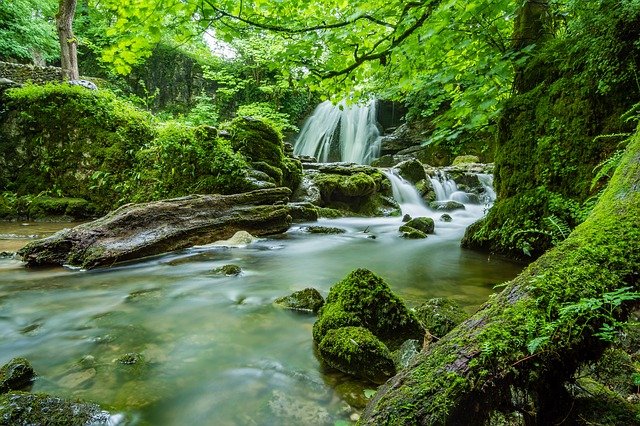
Ferns and mosses growing along a small waterfall.
I can see where the rain thing comes from, tbh.

Tying fern fronds to the ears of horses was said to protect them from the Devil.

In modern magic, ferns are used for rain-making, money spells, and protection. Adding the fronds to spells or arrangements of fresh flowers helps boost the magical properties of whatever they are placed with.

Last, but certainly not least, there’s the delightfully weird tale of the vegetable lamb of Tartary.

Using Ferns

There are so many species of fern with so many different medical uses, I can’t possibly cover them all here. While not all ferns (or all life stages of fern) are medicinal or edible, different fern species have been used for everything from stomach aches to snakebite. From what I have read and observed, they are most often used for skin afflictions — spores are said to reduce pain from stinging nettle, and ointments or pastes made of various fern species are used to tread cuts, bruises, and skin ulcers. In Scottish lore, ferns were mixed with egg and used as an ointment to restore sight or reduce redness in bloodshot eyes!
(Please don’t do this just because you read it here, though. I don’t want anybody getting some kind of raw egg eye infection.)

For protection, plant or place potted ferns near windows and doors. (Just make sure they have the right levels of sunlight and humidity!) Llewellyn has a spell using ferns to banish evil, which may piggyback on its use for rain-bringing. Rain is cleansing, ferns are protective, so these two properties could drive evil out of a place.

If you’re lucky enough to come across fern spores (those black dots along the backs of fronds), carry them when you want to go unnoticed.

In hoodoo, ferns seem to be largely for protective magic. Among other uses, sprinkling crushed fern leaves along windowsills is said to keep intruders away, and adding it to a floor wash with black snake root clears away jinxes.

That said, some spells may refer to specific ferns using secret names. Maiden’s hair is the maidenhair fern, for example, while horse’s tongue is the hart’s tongue.

Magically, your best bet is one of two things: purchasing fern fronds, or growing some of the easier-care varieties in pots. While older sources cited specific plants in their folklore, the modern herbals I consulted for this post didn’t — they just said “ferns.” In my opinion, I don’t think it matters much what type of fern you choose to work with. When it comes to spending my time tending a growing plant versus tracking down the exact species used in a spell, I’ve found I’m pretty much always better off using a plant I’ve developed a relationship with (or, at the very least, one that’s abundant where I live). They have an affinity for water, which explains their use in rain magic. They all have spores, not seeds, which explains their use in invisibility (and, to a lesser extent, protection) spells. Find a fern that will grow happily for you, and see what magical secrets it holds.

Plants and Herbs · Witchcraft

Arnica Folklore and Magical Properties

What’s black and blue and red all over?

Me. I am.

I wasn’t aware of it until recently, but one of the side effects of sertraline is bruising. This was never really a major issue, but, with the recent increase in leg days, I’ve been noticing that my lower extremities look like hobbits have been beating me with cricket bats in my sleep. This probably isn’t helped by the fact that I’ve had knee surgery, and any amount of physical activity makes my legs look like I fell down the stairs even under the best of circumstances. I’m planning to talk to my doctor about this, but I’m not in a bunch of pain, and my medication is working out well enough that I don’t want to change it if I don’t absolutely, positively need to. C’est la guerre.

For now, it’s lots of iron- and vitamin K-rich vegetables, and arnica. At the moment, I’m pretty much only using arnica to help my shins look less corpse-y, but that’s not all it can do.

It could also keep corn demons away from my knees.

Arnica Magical Uses and Folklore

Arnica is one of the best-known and most-used herbal remedies in much of Europe. The American variety was no slouch, either — both indigenous people and pioneers used it in abundance. (I don’t really want to go into all of its historical medical uses here, because there are a ton of them and not all of them were great ideas. It’s the kind of plant where it could either lower your fever, or make you bleed internally a bunch.)

The word “arnica” is derived from the Greek “arni,” meaning “lamb.” This could be in reference to any number of the plant’s parts — it’s got fuzzy sepals, leaves, and looks almost dandelion-like when it goes to seed.

Two of its common names are “wolf’s-” and “leopard’s bane.” I haven’t been able to find any reason for this — these are also names for aconite, which is far, far more baneful than arnica. I mean, the two don’t even look alike.

In Norway, arnica was strewn in fields during Midsummer. This was to protect crops from a creature called Bilwis. In Germanic areas, Bilwis is identified as a kind of Feldgeister (field spirit) or Korndämonen (corn demon). In the Prose Edda, this creature was half of a brother-sister pair — Hjúki and Bil — that followed the Moon across the sky. There isn’t much written about Hjúki and Bil outside of the Prose Edda, but they are theorized to represent the craters visible from Earth, which are said to resemble a pair of children carrying a bucket on a pole. Over time, Bil’s image was distorted from a minor Norse deity to a malevolent spirit that cuts down corn. Bilwis has no set form, and its appearance varies across all of the folklore in which it appears.

Sprinkling arnica around your property is said to protect your home and bring fertility to your garden. This probably stems from its use to thwart corn demons, as, over time, its folk use expanded from keeping your crops from being cut down by spirits, to general protection and plant fertility.

Planting arnica around an area is said to keep a spirit penned there. This only works as long as the arnica lives, however — once it dies back, the magical boundary dies with it.

As a bright yellow Midsummer plant, it’s associated with the Sun and the element of Fire.

Some sources claim that arnica was burned as an incense, particularly in weather magic. This seems largely used to drive away violent storms, and may also be tied to its general “protective” aspect.

Using Arnica

Not gonna lie, I’ve gotten pretty fond of dabbing it on myself. But I digress.

Arnica contains a sesquiterpene lactone called Helenalin, which is said to help reduce inflammation and thereby soothe away bruising when it’s applied soon after an injury. Though it’s very healing when used topically, it is toxic when used internally and can cause sensitization over time. If you’re using arnica medically, it’s best to use it topically, over unbroken skin, for short periods of time.

That said, some people do use it internally. It’s even been used as a flavoring in foods and beverages. (I wouldn’t recommend doing so unless you’re under the guidance of an herbalist, though.) If you’re pregnant or on blood thinners, avoid it — it can stimulate contractions and interfere with blood clotting.

Harvest and the flowers when they’re at their best, around Midsummer. Scatter fresh flowers around an area you wish to protect, or brew dried ones into a tea and sprinkle the liquid. You could theoretically include dried flowers in protective sachets, jars, or other container magic, but the herb’s primary historical uses seem to largely depend on strewing, scattering, or planting arnica to create a boundary.

To turn back storms, burn arnica and say, “Arnica bright, arnica alight. Thunderstorm, turn and take flight.”

Arnica has been treated as a one-herb first aid kit, credited with any number of medical marvels. While it’s certainly good at what it does, the herb does have a tendency to cause problems if it’s used in high doses and for long periods of time. If you’ve got corn demons to thwart, thunderstorms to get rid of, or spirits you need to babysit, arnica can’t be beat.