
Witchcraft

The Magical Meaning of String

When I was a tiny child (very tiny, maybe six or seven), my grandma taught me to crochet. I didn’t learn much — my clumsy little hands weren’t able to do more than work a piece of string into a basic chain — but it was something I’ve wanted to get back into. So, as part of my desire to continue reskilling this year, I picked up some merino yarn and a basic #5 hook and got to it.

(So far, I’ve managed to make one tiddy portion of a bikini top in single crochet, and most of a scarf that I accidentally did entirely in slip stitch. This is okay, though. Even if you do crochet wrong, as long as you do it wrong enough and consistently enough, you’ll most likely end up with a useable item once you’re done anyway.)

Close up photo of teal yarn and a copper colored crochet hook.
Photo by Castorly Stock on Pexels.com

So, since I’ve ended up with a number of odds and ends of string, I thought it’d be a good idea to point out its many magical virtues and uses.

Witches and Pagans — at least, the ones I know — are nothing if not resourceful. Every weed, seed, stick, stone, empty jar, scrap of paper, and bit of string has potential. Sure, supplies from a local metaphysical shop are beautiful and fun, but you’d be amazed at what you can get up to with the contents of your trash.

(Literally. One of my most successful workings involved nothing more than a Sharpie, some toilet paper, and about ten seconds a day for a week.)

Anyway. String.

One of the most recognizable uses of string/yarn/floss/twine/thread/etc is the witch’s ladder. This is a length of cord knotted at intervals, often with feathers, leaves, stones, or other curios placed within the knots. Ultimately, the ladder is a talisman — as it’s made, the creator imbues each knot and curio with their intention for the ladder.

Wikipedia describes a specific instance known as the Wellington Witch Ladder, the first recorded instance of someone finding a witch’s ladder in an old house. Charles Godfrey Leland discovered that it was remarkably similar the description of a kind of folk charm used in Italy. Witches would utter a baneful spell as they braided the cord (along with locks of the victim’s hair and feathers from a black hen) and place the finished piece under a victim’s bed, in order to cause them pain, illness, and misfortune.

(As a magical device, a witch’s ladder isn’t solely for baneful magic. The inclusion of different curios and chanting a different spell would, by necessity, give the finished product a different effect.)

String, envelopes, and a pocket knife.
Photo by Fotografia Eles Dois on Pexels.com

A more stripped-down version if the witch’s ladder is basic knot magic. This involves taking a length of string and tying knots (usually nine) at intervals, starting with the center, then both ends, then working back toward the center. Each knot is accompanied by a chant.

This is useful as a kind of magic “bank” — each knot holds a portion of the spell and, when the knots are undone, the spell is released. One way to use this involves untying a knot once a day for nine days. I’ve also used them to tie around my wrist or ankle. Once the string breaks, the spell is released.

Strings also have the more mundane use of securing magical sachets and pouches. In Hoodoo, the traditional knot for this is the miller’s knot. Other traditions may have their own methods that call for a particular knot (or number of knots), or none in particular. Here, the string is mostly just intended to keep the contents of the pouch from falling out, but it’s easy to apply basic techniques like color magic if you so choose.

If you know how to embroider, it’s easy to apply this skill to creating sigils or other magical images. Embroider them onto pouches, clothing, altar cloths, or any other fabric items sturdy enough to handle them. This is a great method for magic you wish to keep with you — think workings for protection, prosperity, or attraction.

Lastly, strings have a powerful symbolic component. Take the photographs of two would-be lovers, for example, place them face-to-face, and tie them together with red or pink string for a love spell. Or, use a string as a component of cord cutting magic, to help you visualize and act directly on the “etheric tethers” that hold you to old relationships, situations, or other undesirable things. Strings represent the “ties that bind,” for good or ill, and you can use them to either strengthen or sever these ties as you wish.

Okay, so. Like I said, I’ve been crocheting. I’ve ended up with a lot of odds and ends of yarn as a result. I probably don’t need all of these bits of yarn, so it pays to be a bit selective in what I decide to keep. If you hold on to odds and ends of string for magical purposes, you’re likely to end up in the same boat.

So, how do you decide?

First, I recommend against using synthetic fibers for magical purposes. This isn’t because I feel like they’ll necessarily have a bad impact on the magic itself — they’re just not practical. They don’t break down like cotton, hemp, linen, silk, or wool do, so they’re not great for spell cords that need to fall apart eventually. They also don’t burn well (and, when they do, tend to melt and produce awful, migraine-inducing fumes), so they’re not great for any spells that involve burning cords.

Close up shot of blue yarn in a wicker basket.
Photo by Miriam Alonso on Pexels.com

Second, you don’t necessarily need a ton of strings of the same length and color. You probably know what spells you tend to work the most, and what it makes sense to hold onto. (For example, if you’ve been focusing a lot on money magic, you probably don’t need an ever-increasing stash of red strings.) If you don’t, that’s fine — shoot for white or black strings, and one or two in other basic colors. Develop your preferences from there.

Third, destash periodically. There are a ton of posts and vlogs about people who fall out of practice, or struggle to find the motivation to continue regularly doing magical workings. Let decluttering your magical supplies be a reason to use them. With knot magic, this is especially practical — knot your cords, recite your chants, and put what you’ve made to good use. (Or gift them to your witchcraft-inclined friends.)

Often times, working magic means seeing the potential in what would otherwise be discarded. A plain piece of string can be everything from a curse to a love spell, from a healing charm to a magical battery.

Plants and Herbs

Dittany of Crete Folklore and Magical Properties

So, we watched Hereditary not long ago. When I was reading various social media posts about it afterward, one person mentioned that the herb placed in Charlie’s baby bottle and in Peter’s joint was dittany of Crete. And herb, they said, that is “known for making the body more susceptible to demonic possession.”

“Huh,” I said to myself, “I’ve got a whole bag of that in the kitchen cabinet.”

(It’s true. It smells like pizza.)

Seeing as how I have used it to facilitate demonic possession exactly zero times, I thought now might be an opportune time to talk about the actual folklore and magical uses of dittany of Crete.

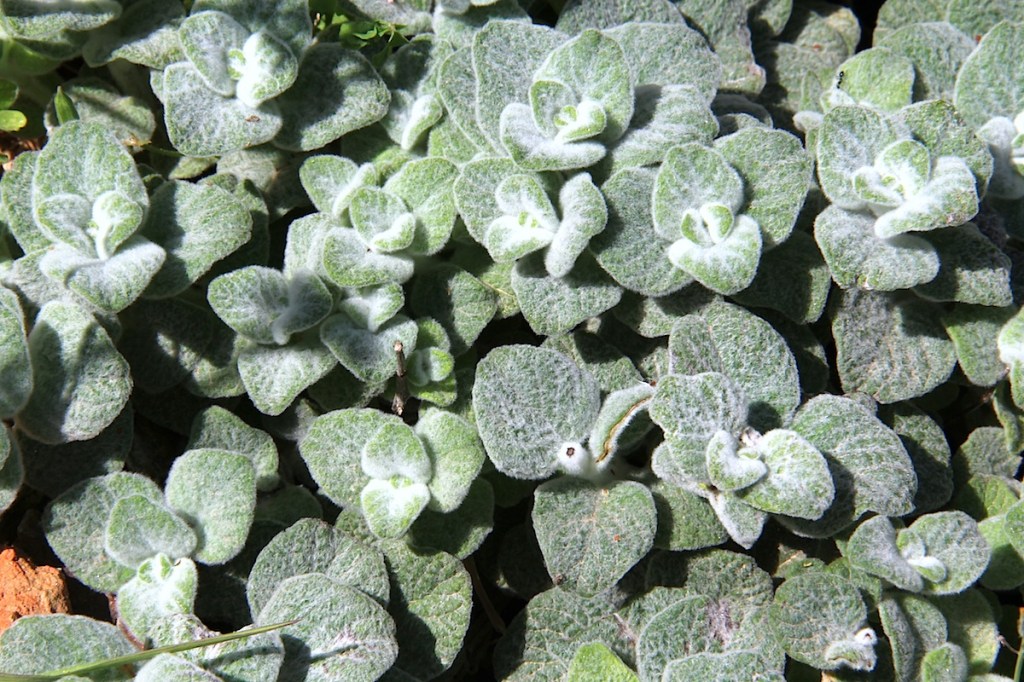
Dittany of Crete (Origanum dictamnus) is a perennial herb with velvety leaves, native to the mountainsides of Crete. It’s related to oregano and marjoram, which becomes immediately apparent the moment you smell it — it has that same kind of aroma.

A close-up of dittany of Crete leaves.
Photo by Peter Mansfeld.

In the past, it was used to decorate temples, as a kind of tonic and panacea, and as an aphrodisiac. It was also used to soothe stomachs, bring on late menstruation, and encourage wounds to heal. According to Aristotle, wounded goats would seek out dittany of Crete and consume it as medicine. (While this may be true, he also said that dittany helped them eject arrows from their bodies, which is… less credible.)

Really, dittany of Crete is mainly known for healing, not inviting in demons. Not only does it have a long history of use as a medicinal herb for specific maladies and general ill health, but it has also been referenced over and over again in fiction. In the Aeneid, Venus uses it to heal Aeneas. Beaudelaire references this in his poem Tout entière, where he proclaims that his lover is “entirely dittany” and therefore able to heal his wounded soul.

Even outside of Beaudelaire, dittany of Crete is also strongly connected to love. In the Cretan dialect, the herb is called erontas (έρωντας) which means “love.” Dittany-harvesters were called “love seekers,” and considered very brave and passion-driven. They’d have to be, in order to climb the tall, treacherous places dittany calls home!

In European folk magic, feeding a person dittany of Crete was said to make them fall in love with you.

Dittany (Origanum dictamnus): flowering plant.

In other esoteric arts, dittany is said to help spirits manifest (primarily by burning it to allow them to show themselves in the smoke) and to facilitate trancework and astral projection. Both Crowley and Blavatsky considered it a powerful magical herb.

A number of Greek dishes from Crete include dittany. Martini Rosso, red vermouth, includes it as a flavoring agent alongside many other herbs and fruits.

In fact, I was unable to find a single recorded instance of someone using dittany of Crete as a way to make someone susceptible to possession. The closest I could come was a rather large leap from its use as a way to help spirits manifest, and as an aphrodisiac. The thing is, dittany is said to help spirits manifest, not occupy people. But, if one were to generously interpret “aphrodisiac” and “love-inducing” as “increased suggestibility,” then one could see where a horror movie might get the idea that an herb that a) makes you horny, b) helps spirits appear in its smoke, and c) facilitates trancework could be a suitable fictitious catalyst for demonic shenanigans.

False dittany (Ballota acetabulosa (L.)
An illustration of “false dittany,” Ballota acetabulosa.

Be careful when you try to purchase dittany of Crete — the herb is classed as rare, and there are measures in place to protect it. As a result, the real stuff can be kind of expensive and not super easy to come by. Some shops will sell Dictamnus alba (fraxinella, gas plant, or burning bush), or even plain marjoram or oregano as dittany of Crete. Remember: Look for the fuzzy oval leaves and distinctive oregano-like smell.

I’ve only found this herb in its dried form and find that using it is much like using any other herb. Personally, I infuse it into a base of jojoba alongside other ingredients for a special oil that I make once a year for meditation and trance work. Otherwise, I don’t really have much use for it outside of this specific recipe. A tiny bit goes rather a long way.

Dried dittany of Crete is suitable for using in handmade incense. Mix it with other loose herbs and resins and spoon it over a lit block of charcoal. As mentioned above, it has been used in this way to help spirits manifest in the smoke.

You can also roll a candle in it. Anoint the wax with oil first, then give it a few rolls back and forth in some finely ground dried dittany. When you feel it’s ready, light it. Use a pink candle, anoint it with rose and jasmine oil, then roll it in ground rose petals, dittany of Crete, and a pinch (just a pinch) of cinnamon, then light it to get your romantic energies burning high.

Dittany of Crete is also suitable for jar spells, sachets, and other forms of container magic. It’s honestly a very nice herb with a delightful fragrance.

Really, Dittany of Crete is not nearly as dangerous as Hereditary makes it seem. I have a feeling they chose a somewhat obscure herb with an intriguing name, tangentially related to the goal of the movie’s antagonist, rather than inventing one whole cloth. It’s related to oregano. It smells like pizza. It’s a nice addition to a dream/vision oil. That’s really about it.

Plants and Herbs

Garlic Folklore and Magical Properties

Have you planted any garlic yet? I’ll admit it — I haven’t. The weather has been so weird here lately that I wasn’t sure if it was a great time to do it. (For real, we currently have one very lonely and confused violet in the front yard.)

Still, it’s good to get garlic in the ground in autumn in temperate areas. This ensures that it’ll be one of the first things to pop up in spring and will be mature and ready for harvest in summer. Since its garlic planting time, I figured it’d also be a good time to explore the magical and folkloric uses of garlic.

Garlic is probably best known as a way to repel vampires. Some believe that eating it can also help keep mosquitoes, ticks, and other blood suckers at bay. However, research has shown that it actually seems to attract leeches.

In China, garlic was one of the ways to repel the jiangshi (僵尸), a kind of undead, vampiric creature that moves primarily by hopping.

This herb is also well known for its medicinal properties. It has naturally occurring antibacterial, antifungal, and antioxidant compounds. It’s sometimes used to treat various types of infection, high blood pressure, arterial plaque formation, and as part of a general health tonic. However, taking medicinal quantities of it can be contraindicated in some instances, so it’s important to discuss using supplements with your doctor.
(True story: I used to habitually eat so much garlic that, when combined with some very necessary medications, I ended up with bleeding/bruising problems.
It was a truly bonkers amount of it, though.)

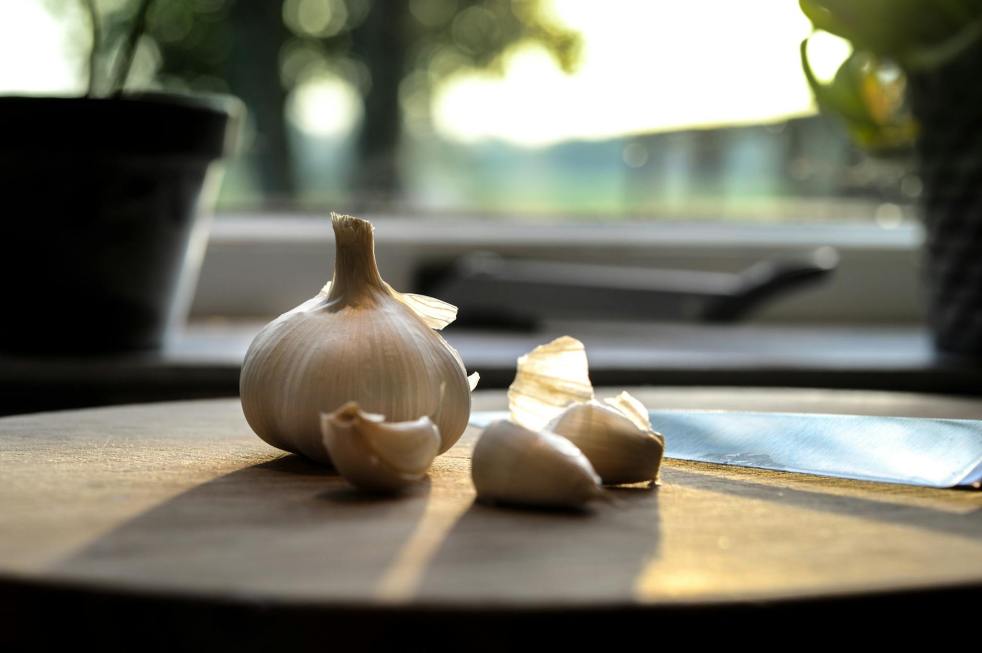
Garlic on white ceramic plate decorated with cats.
Photo by Cats Coming on Pexels.com

Garlic was very important in Egypt. This herb was a key part of the rations given to pyramid builders. When they threatened to abandon the project, they were given more garlic.
Pliny claimed that people in parts of Egypt invoked alliums as deities. He’s an outside source, so this should be viewed with some skepticism, but he also had a high opinion of garlic’s virtues. In Natural History, he offers a very long list of situations that call for it as a remedy.

Alexander Neckam, a 12th century English poet, theologian, and writer, recommended garlic as a remedy for the heat of the sun during hard labor.

In some traditions, garlic is considered an aphrodisiac and a charm for a happy wedding night. In India, it’s highly praised in the texts of the Ayurveda. However, those following ascetic paths avoid it, since it’s a food that increases sexual desire.
(Interestingly, some of the main causes of penile erectile dysfunction are high blood pressure, narrowed arteries, and high cholesterol. The clitoral bulbs also have erectile tissue. As an herb with cardiovascular benefits, the idea of garlic promoting/improving sexual desire and performance has credence.)

The Hindu texts Ashtanga Hridaya and Ashtanga Sangraha talk about how a rakshasa (essentially a demon) took a seat among the gods and received a sip of nectar from Vishnu. When Vishnu saw this, he cut off the demon’s head. The head fell to the ground, mouth open, spilling the nectar the demon had taken. From this spot, garlic sprang up. Since it comes from sacred nectar, it is a powerful remedy. However, since it also came from the mouth of a demon, some (especially Brahmin people) choose not to eat it.
On the other hand, the Bhavprakash nighantu, verse 217-220, says that garlic was created when Garuda stole the nectar of immortality from Indra. As he fled, some drops spilled on the soil and grew into garlic.
I think the most interesting aspect here is that, despite their very different origins and viewpoints about this plant, both of these stories acknowledge its sacred and powerful origins. In one, the plant is “defiled” by being tainted by the mouth of a demon. In the other, it isn’t. However, both see garlic as arising from a sacred source.

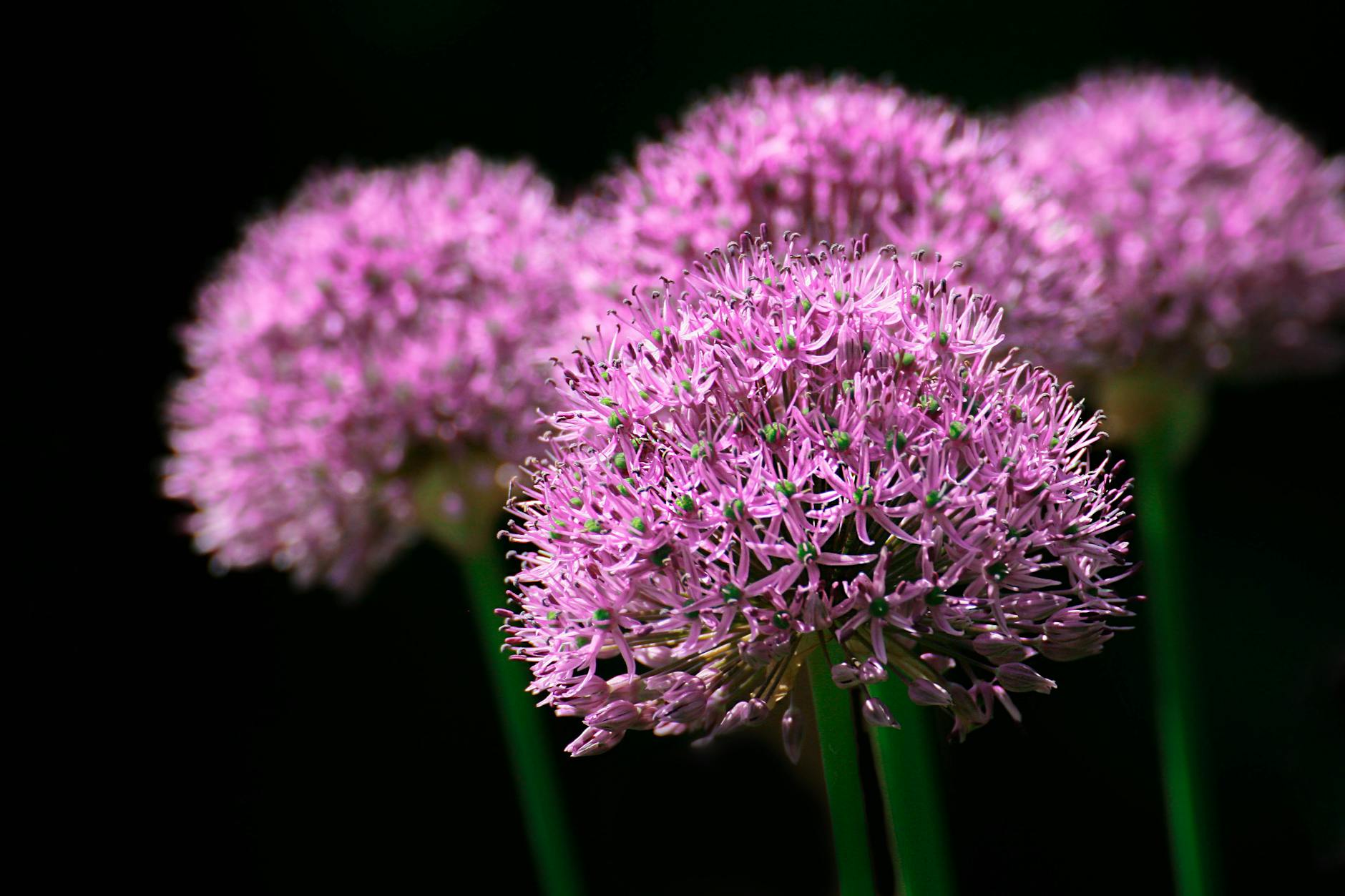
Selective focus photo of purple allium flowers.
Photo by Pixabay on Pexels.com

In The Schools’ Collection, an archival record of folk remedies, garlic is mentioned as a cure for multiple ailments. However, most of these are respiratory in nature. There are methods for treating tuberculosis, asthma, influenza, and the common cold, among many others. These range from boiling it in donkey’s milk, to keeping a piece in your shoe.
In China and Japan, it was used for digestive and intestinal complaints, as well as as an antiparasitic.

In central and western Europe, garlic is typically regarded as an herb for protection. The bulbs or flowers could be worn, hung in the home, or placed/rubbed on doors and windows to keep out malevolent spirits or repel the effects of the Evil Eye.

Though garlic is native to northeastern Iran and Central and South Asia, Roman armies were responsible for spreading the plants everywhere they went. Soldiers would eat it before battle, believing that it filled them with courage. They also planted it everywhere, so they’d always have access to it and that courage would be symbolically transferred to the battlefield.

In modern witchcraft, which is typically derived from European traditions, garlic is a protective and banishing herb.
In Hoodoo, which arose from the African diaspora, it is used to ward off evil and protect.

According to Culpepper, garlic is ruled by Mars. It’s considered an herb of Fire.

The easiest way to use garlic is in kitchen witchery. Before chopping, mashing, or otherwise adding it to foods, hold a clove in your dominant hand and ask the garlic to assist you. Include it in dishes when you need a little extra courage or protection from malevolent energies or envy.

You can also tap into garlic’s banishing properties with little more than a whole clove of it, a pot of soil, a slip of paper, and a windowsill. Write down the name of a bad habit that you wish to be rid of (nail biting, smoking, et cetera). Dig a small hole in the pot of soil, and place the slip of paper at the bottom. Plant the garlic clove over it and tend to it the way you would any other plant. As the garlic sprouts and grows, it’s said to help you overcome the habit.
This is a pretty old charm that uses both the herb’s reputation as a banishing and purification plant, and a bit of sympathetic magic. As the garlic grows, so, too, does the planter’s resolve and distance from their bad habit.

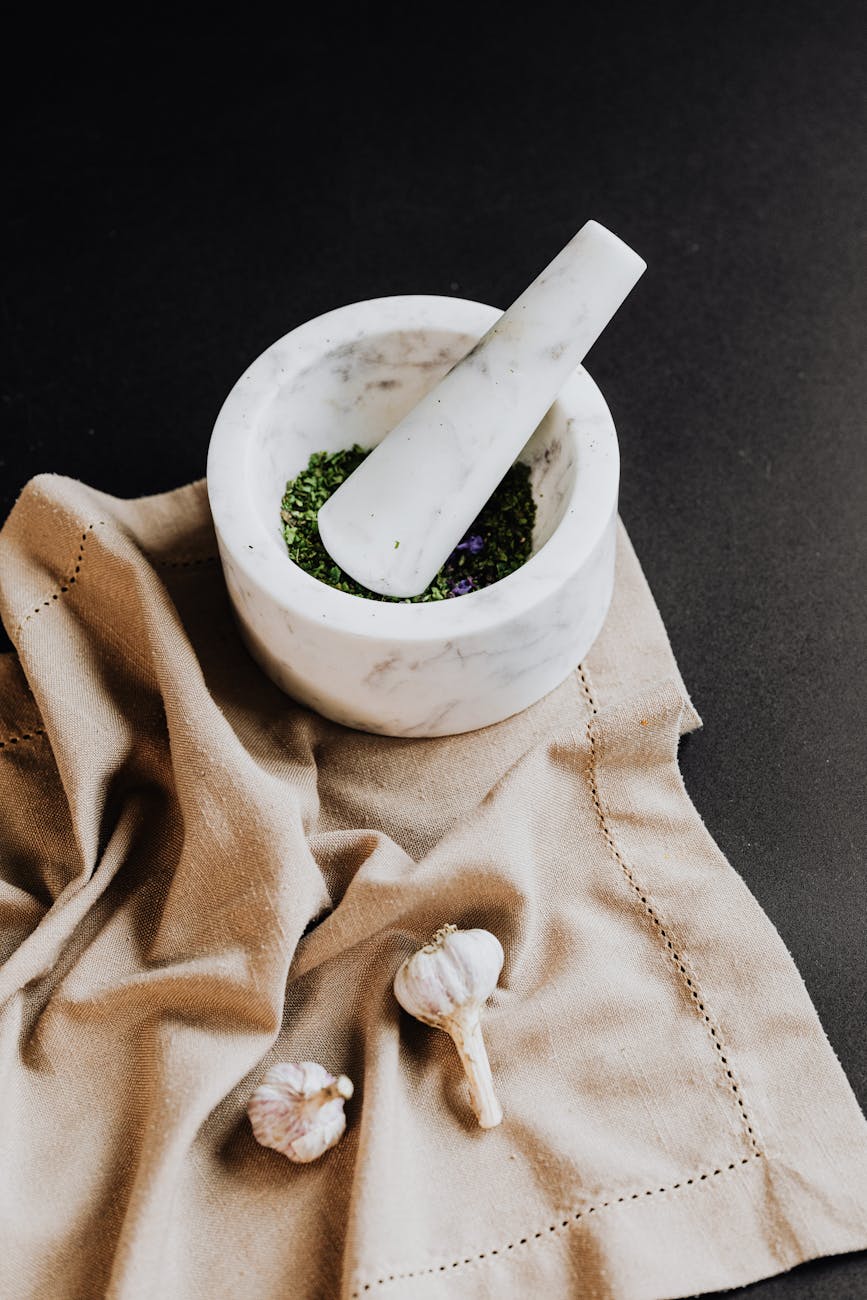
Close up shot of mortar and pestle near garlics.
Photo by Photo By: Kaboompics.com on Pexels.com

It’s also useful in salts or powders to protect an area. Mix dried, powdered garlic in black salt (or regular table salt) and sprinkle it in the corners of a room you wish to ward. If you want to use it outdoors, skip the salt and combine it with other protective herbs.
If you have pets, be aware that too much garlic can cause a condition called Heinz body hemolytic anemia. If you’re trying to ward a room that cats or dogs frequent, either skip the garlic and salt and go for pet-safe herbs or keep the animals out until you feel the herbs and salt have done their job and then sweep and vacuum the area thoroughly.

You can also decorate with garlic bulb wreaths/ropes, or even vases of the fresh flowers. Place them in any room you wish to keep clear of bad vibes. (Kitchens are typically considered the “heart” of a home, so they’re the perfect place for this. Also, you can pull off a fresh bulb to use whenever you need one).

Garlic is more than delicious — it’s healthful and powerfully protective. It’s also surprisingly easy to grow and harvest, making it a very useful addition to any magical or mundane home garden.

Plants and Herbs · Witchcraft

Wormwood Folklore and Magical Properties

Wormwood (Artemisia absinthum) is an African/Eurasian herb and relative of mugwort that’s widely grown in Canada and the US for its ornamental, medicinal, and even magical uses. It’s also a key ingredient in genuine absinthe, and is purportedly why the drink was rumored to cause hallucinations (but more on that in a bit). While the medicinal properties of A. absinthum have since been superseded by other herbs and pharmaceuticals, it’s still a powerful magical ingredient and a beautiful ornamental plant.

Wormwood is a very bitter herb, so much so that it’s been used over and over again in literature as a metaphor for bitterness. Shakespeare mentioned it. The Bible mentioned it.
This bitterness may, in part, be a source of its hepatoprotective properties: Bitter herbs are said to trigger the release of gastric juices, including bile from the liver, which helps sort of flush things out. This is why herbal digestifs and digestive bitters became a thing. There’s not a lot of peer-reviewed research on the subject, but bitters have a very long history of safe use as digestive aids.

Wormwood is also one of those magical plants that doubles as a pest repellent. This is something we see pop up over and over. There’s a logical progression from “herb that keeps disease-carrying pests away,” to “herb that keeps all unwanted influences at bay.” This makes wormwood valuable for protection and purification.
Interestingly, I have also seen wormwood listed as an ingredient for spirit calling. I don’t know if I’d use wormwood alone for this, but it certainly seems like it’d be a useful ingredient to make sure you’re calling the right spirits.
(I see parsley mentioned with wormwood pretty frequently, which is funny because it’s another weird one for spirit work. It is listed both as a spirit attractant and repellent, go figure.)

Leaves of a wormwood plant in close up photography.
Photo by Veronica on Pexels.com

This herb also plays a protective role in Slavic lore. The rusalka is an entity, said to be the spirit of a young woman who died by drowning, who is associated with life-giving rain… and, after the 19th century, with madness, death, and trickery.
Carrying wormwood was a way to guard against rusalki. They are said to target young men, so guys were told to carry a sprig of wormwood with them wherever they went. A rusalka would inevitably ask if they were carrying wormwood, or parsley. Say “wormwood,” and she’ll scream and try to flee, at which point you must throw the herb at her eyes. Say “parsley,” and she’ll ensnare, drown, and/or tickle you to death.
(As someone who is a) ticklish, b) hates it, and c) was frequently tickled against my will as a child, I think I’d rather drown.)

Wormwood is also connected to divination. It’s a relative of mugwort and has many similar properties. The two aren’t entirely interchangeable, but you can often substitute one for the other in certain situations. Wormwood’s focus seems to be more connected to protection and purification, while mugwort is more psychic and divinatory.
This herb is sometimes used in love magic, but not as an attractant — its main virtue seems to lie in love divination. There are multiple recipes and instructions for tying wormwood leaves to one’s forehead, placing them under a pillow, or brewing them with other herbs and honey and anointing oneself in order to get a vision of one’s future spouse.

Wormwood is tenuously connected to the Greek goddess Artemis (and Roman goddess Diana) through its name. However, the genus name Artemisia may be a reference to Artemisia II of Caria, and not Artemis directly.
In practice, this herb is considered to be ruled by Mars and Mercury, while Artemis and Diana are Lunar deities.

Wormwood is associated with Fire (which I can certainly see, as it’s a Mars-ruled herb that likes sunny spots and dry ground), but I’ve also seen it listed as an Air plant.

Contrary to popular depictions, absinthe wasn’t some kind of magic hallucination juice. Genuine absinthe does use wormwood, which contains the compound thujone. Thujone can, in concentrated form and large doses, cause hallucinations, convulsions, and death, but is present in absinthe in such tiny amounts that it doesn’t really do a whole lot. (Ironically, the compound absinthin is an anti-inflammatory and doesn’t have much to do with any of that.)
Absinthe’s hallucinatory effects have more to do with its high alcohol content (the stuff is about 50-75% ABV), the power of suggestion, and the fact that unscrupulous absinthe makers started adding copper salts as an artificial green coloring around the late 19th century.

Assorted liquor bottles.
Photo by Chris F on Pexels.com

During its heyday, absinthe was also much enjoyed by counterculture movements. This led to it being vilified by social conservatives, who had every motivation to hype up its “dangerous, toxic, and hallucinatory properties.”
So, what do you get when you mix an herb that might, potentially be toxic in specific circumstances, a buttload of alcohol, a bunch of bohemians, cheap absinthe full of poisonous colorants, and a bunch of social conservatives? You get a liquor with a legendary reputation as a toxic hallucinogen, and an unfair ban.

You can grow Artemisia absinthum fairly easily. Like mugwort, it grows in bright, dry, disturbed soil. It also self-seeds readily, so be prepared to either keep it confined to an area where it can’t do that (like a pot on a patio), deadhead the flowers, or keep up with rigorously removing new baby wormwoods as they pop up.

While wormwood isn’t as dangerous as popular depictions would have you think, it’s still a plant with toxic components that should be treated with respect.

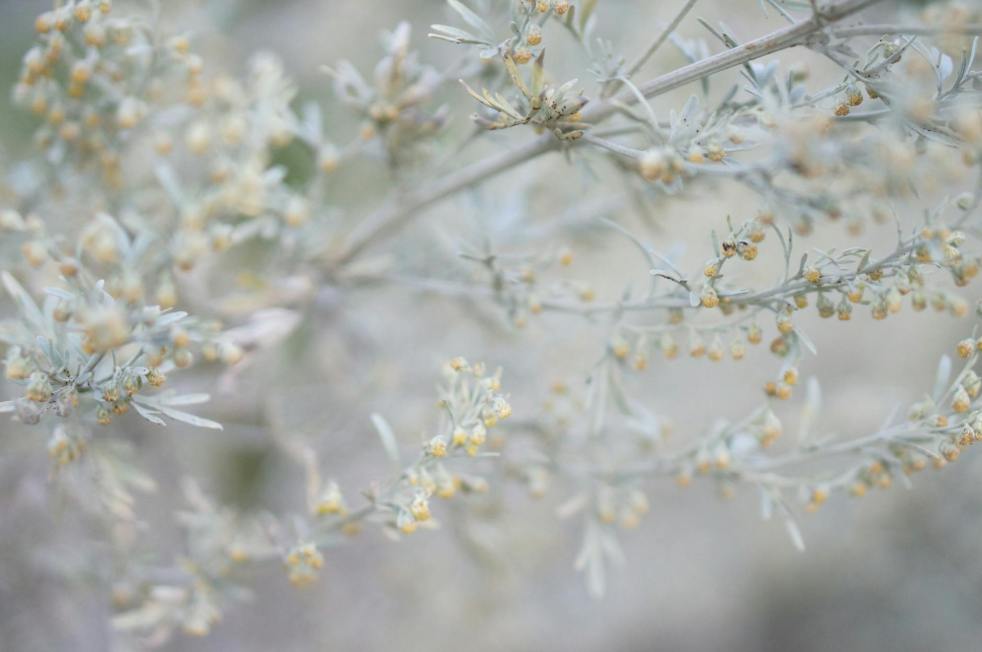
Close up of common wormwood.
Photo by Jeffry Surianto on Pexels.com

Wormwood has historically been used as a flavoring herb. If you want to use wormwood internally, do so under the guidance of a qualified herbalist. There are multiple health and pharmacological contraindications at play here, so it’s important to be careful.

Otherwise, dried wormwood makes a wonderful addition to protective bottles, sachets, and other charms. You can:

  • Grind it into a fine powder and sprinkle it on or around anything you wish to protect.
  • Burn it and waft the smoke around an object or area you wish to purify.
  • Keep some dried wormwood (perhaps with its cousin, mugwort) with divination tools to keep them cleansed and ready for use.
  • Soak it in water and asperge spaces, objects, or people to cleanse them.
  • Soak or steep it in water and use the resulting “tea” to wash your front and back doors for protection.
  • Grow wormwood near doors for protection against malevolent energies, entities, or bugs. (For real, a lot of what we consider pest insects really don’t seem to like it.)

These aren’t the only uses for this herb, of course, but they’re probably the ones most in wormwood’s wheelhouse. You can also use it for love divination or spirit work, but this may depend heavily on your specific tradition, techniques, and situation.

Wormwood is a beautiful, interesting, complex, and contradictory herb. It’s a poisonous healer, a repeller and attractor of spirits, and an invaluable addition to a magical herb collection.


animals

The Magical Meaning of Spiders

(If you’re arachnophobic, you probably want to skip this one. Don’t worry — I’ll be back next week with some more non-spider related lore.)

This is Matilda. I was out checking for more ground candy (aka, the delicious maypops that fall off my porch’s vines when they’re ripe), when I happened to look up and realize that I was face-to-face with a massive orbweaver (Neoscona species).

A close up of a large, hairy orb weaver perched in the center of a web.

Later that afternoon, once she’d had a chance to build a sizeable web right across the upper part of my window, I very carefully opened the window to snap multiple pics of her from a variety of angles.
It was then that I realized that there was a fire truck and an ambulance in front of one of my neighbor’s houses.

(Note to neighbors: THERE WAS A COOL SPIDER. I PROMISE THAT I’M NOT A MANIAC.)

(Also the emergency vehicles left pretty uneventfully, so hopefully everyone is okay.)

*Ahem*

Anyhow, this is the time of year when sightings of these guys peak around here. So, in honor of Matilda, I figured now would be a good time to write a bit about the magical meaning of spiders.

In Greek mythology, the first spider was a woman named Arachne. She was a marvelously talented weaver — allegedly better than Athena herself. She challenged her to a weaving contest, and Arachne’s weaving was, indeed, very beautiful. However, while her weaving was flawless, Arachne had chosen to create a tapestry mocking the gods. (In some tellings, Athena is simply enraged by Arache’s pride.) Angered, Athena transformed her into a spider.

A close up of a jumping spider's face, showing their fuzzy pedipalps and big, black, almost puppylike eyes.
Photo by Pixabay on Pexels.com

In Catholic Christian mythology, spiders are connected to faith. Saint Conrad of Constance, a German bishop, is said to have seen a spider fall into his cup during Easter Mass. While it was widely believed that all spiders were venomous (or, in this case, poisonous) Conrad drank the wine and trusted in his faith to preserve him.

Probably the best-known spider in mythology is Anansi, from the Ashanti people. He’s viewed as a cunning trickster figure. He’s so prominent, that he gave rise to the term “spider tales,” which encompasses several kinds of story within the Ashanti oral tradition.

In North America, spiders were viewed as either trickster figures, or ingenious creators. The Hopi and Diné people have Spider Grandmother, who plays a key role in the creation of the world.

Another close up of a very cute, fuzzy white jumping spider.
Photo by Pixabay on Pexels.com

In Peru, spiders frequently appear in ancient artworks (including the famous Nazca lines). While the specific significance of these depictions is often uncertain, it is known that the Cupisnique people had a spider deity associated with weaving, nets, war, and power.

In Australia, spiders sometimes appear in art and as clan totems.

The people of Kiribati Island and the Republic of Nauru, of Micronesia, both have spider figures that play a central role in their creation mythology.

In Japan, there are spider-like yokai called ogumo, yatsukahagi, or tsuchigumo. Tsuchigumo translates as “earth spider,” but likely didn’t originate as a spider at all. Historian Yoshiyuki Takioto put forth the idea that tsuchigumo were local chieftains (described as short people with long limbs, who lived in caves, eschewed civilization, and disregarded the imperial court), These chieftains were most likely shamans.
The yokai tsuchigumo first turns up in medieval literature, as a spider-like figure 60 meters long. When killed, the heads of almost 2000 people fell from its belly.

In Scotland, spiders were an inspirational figure during the First War for Scottish Independence. After a series of defeats, Robert the Bruce hid in a cave. While there, he watched a spider struggle to climb a strand of silk. Despite failing over and over, the spider eventually succeeded. This gave him the encouragement he needed to go back into battle and eventually win Scotland’s independence.

A slender black and yellow spider perched on its web.
Photo by Pixabay on Pexels.com

It’s often said to be bad luck to kill a spider that you find in your home. This has a (perhaps unsurprising) grain of truth to it — killing spiders in your house means that you’re opening yourself up to all of the much less desirable things that spiders eat. If an infestation of flies or ants looks like bad luck to you, then you might want to heed this bit of folklore!

In dream dictionaries, dreaming of spiders is believed to represent:

  • Feeling like an outsider — like a spider in a web in the corner of a room.
  • Wanting to be an outsider.
  • A protective force.
  • A strong or overbearing feminine figure.
  • Rewards for one’s hard work.
  • Unpleasant relationships. Relationships one can’t escape, a (usually feminine) person who is draining one’s energy, a conflict with an overbearing person.

However, dreaming specifically of a rainbow colored spider is said to point to a situation that you probably want to avoid.

Spiders have far-reaching symbolism. Across cultures, they’ve been everything from tricksters to cosmic creators, to the unfortunate fate of the proud.

In general, these animals are associated with industry and creativity. Spider webs come in an astonishing variety of shapes and sizes — from small, silk-lined burrows to impressive constructs that are as delicate as they are massive.

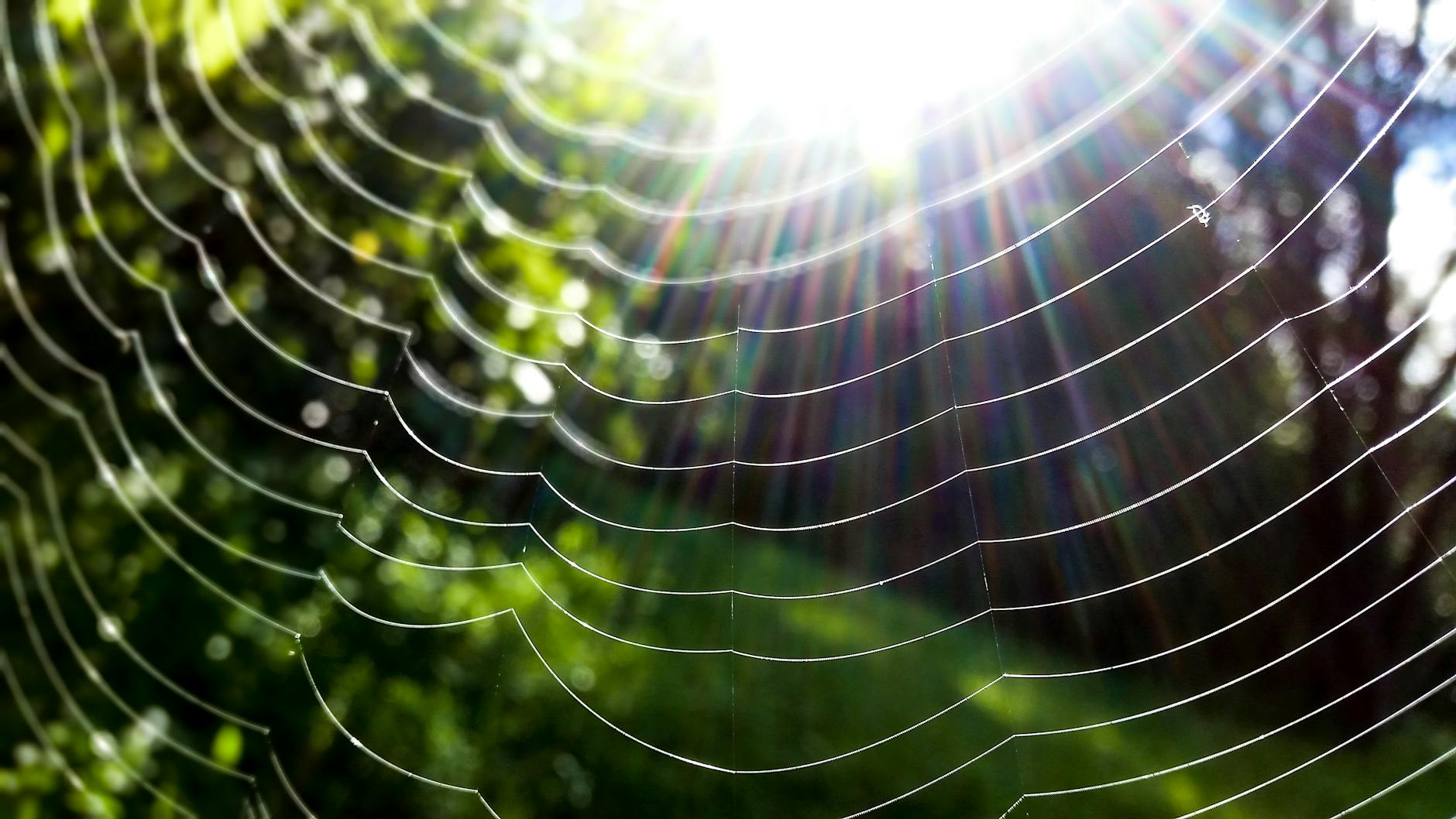
Strands of a spider's web, highlighted in the sunlight. There are trees and shrubs visible in the background.
Photo by Phil Kallahar on Pexels.com

They’re also associated with snares, webs, and trickery. Spiders who use webs to catch their food place them in places where they’ll be both efficient and unobtrusive — virtually invisible, until an unwitting insect (or unlucky hiker) bumps into them. Spiders who don’t use webs generally either rely on natural camouflage to hide them as they run down their prey, or conceal themselves and wait for the opportunity for ambush. In all cases, they are patient, diligent, and cunning.
This can be good for you, if you’re seeking to emulate the spider a la Robert the Bruce.
It can also be very bad, if you’re heading into a situation that may prove to be a trap.
As with all things, context is important when it comes to interpreting omens.

A close up of a jumping spider, on what appears to be a striped rug or blanket.
Jumping spiders are ambush predators. Photo by Skyler Ewing on Pexels.com

Spiders are also connected to resiliency. No matter how many times their webs are destroyed, they rebuild them. They get knocked down, and they climb right back up again.

To an extent, spiders are also symbols of healing and rebirth. A spider can lose a leg or two and (if they survive the injury without losing too much hemolymph) will regrow them with subsequent molts.

Not a lot of people like spiders. Personally, I was never a fan of them — they terrified me as a kid. Eventually, I forced myself to take an interest in them, their body language, and their habits. I’m glad I did, because they’re really beautiful, fascinating, helpful creatures when you get right down to it.

animals

The Magical Meaning and Symbolism of Spiders

(If you’re arachnophobic, you probably want to skip the whole “symbolism of spiders” post. Don’t worry — I’ll be back next week with some more non-spider related lore.)

This is Matilda. I was out checking for more ground candy (aka, the delicious maypops that fall off my porch’s vines when they’re ripe), when I happened to look up and realize that I was face-to-face with a massive orbweaver (Neoscona species).

A close up of a large, hairy orb weaver perched in the center of a web.

Later that afternoon, once she’d had a chance to build a sizeable web right across the upper part of my window, I very carefully opened the window to snap multiple pics of her from a variety of angles.
It was then that I realized that there was a fire truck and an ambulance in front of one of my neighbor’s houses.

(Note to neighbors: THERE WAS A COOL SPIDER. I PROMISE THAT I’M NOT A MANIAC.)

(Also the emergency vehicles left pretty uneventfully, so hopefully everyone is okay.)

*Ahem*

Anyhow, this is the time of year when sightings of these guys peak around here. So, in honor of Matilda, I figured now would be a good time to write a bit about the magical meaning and symbolism of spiders.

In Greek mythology, the first spider was a woman named Arachne. She was a marvelously talented weaver — allegedly better than Athena herself. She challenged her to a weaving contest, and Arachne’s weaving was, indeed, very beautiful. However, while her weaving was flawless, Arachne had chosen to create a tapestry mocking the gods. (In some tellings, Athena is simply enraged by Arache’s pride.) Angered, Athena transformed her into a spider.

A close up of a jumping spider's face, showing their fuzzy pedipalps and big, black, almost puppylike eyes.
Photo by Pixabay on Pexels.com

In Catholic Christian mythology, the symbolism of spiders relates to faith. Saint Conrad of Constance, a German bishop, is said to have seen a spider fall into his cup during Easter Mass. While it was widely believed that all spiders were venomous (or, in this case, poisonous) Conrad drank the wine and trusted in his faith to preserve him.

Probably the best-known spider in mythology is Anansi, from the Ashanti people. He’s viewed as a cunning trickster figure. He’s so prominent, that he gave rise to the term “spider tales,” which encompasses several kinds of story within the Ashanti oral tradition.

In North America, spiders were viewed as either trickster figures, or ingenious creators. The Hopi and Diné people have Spider Grandmother, who plays a key role in the creation of the world.

Another close up of a very cute, fuzzy white jumping spider.
Photo by Pixabay on Pexels.com

In Peru, spiders frequently appear in ancient artworks (including the famous Nazca lines). While the specific significance of these depictions is often uncertain, it is known that the Cupisnique people had a spider deity associated with weaving, nets, war, and power.

In Australia, spiders sometimes appear in art and as clan totems.

The people of Kiribati Island and the Republic of Nauru, of Micronesia, both have spider figures that play a central role in their creation mythology.

In Japan, there are spider-like yokai called ogumo, yatsukahagi, or tsuchigumo. Tsuchigumo translates as “earth spider,” but likely didn’t originate as a spider at all. Historian Yoshiyuki Takioto put forth the idea that tsuchigumo were local chieftains (described as short people with long limbs, who lived in caves, eschewed civilization, and disregarded the imperial court), These chieftains were most likely shamans.
The yokai tsuchigumo first turns up in medieval literature, as a spider-like figure 60 meters long. When killed, the heads of almost 2000 people fell from its belly.

In Scotland, spiders were an inspirational figure during the First War for Scottish Independence. After a series of defeats, Robert the Bruce hid in a cave. While there, he watched a spider struggle to climb a strand of silk. Despite failing over and over, the spider eventually succeeded. This gave him the encouragement he needed to go back into battle and eventually win Scotland’s independence.

A slender black and yellow spider perched on its web.
Photo by Pixabay on Pexels.com

It’s often said to be bad luck to kill a spider that you find in your home. This has a (perhaps unsurprising) grain of truth to it — killing spiders in your house means that you’re opening yourself up to all of the much less desirable things that spiders eat. If an infestation of flies or ants looks like bad luck to you, then you might want to heed this bit of folklore!

The symbolism of spiders in dreams includes:

  • Feeling like an outsider — like a spider in a web in the corner of a room.
  • Wanting to be an outsider.
  • A protective force.
  • A strong or overbearing feminine figure.
  • Rewards for one’s hard work.
  • Unpleasant relationships. Relationships one can’t escape, a (usually feminine) person who is draining one’s energy, a conflict with an overbearing person.

However, dreaming specifically of a rainbow colored spider is said to point to a situation that you probably want to avoid.

Spiders have far-reaching symbolism. Across cultures, they’ve been everything from tricksters to cosmic creators, to the unfortunate fate of the proud.

In general, these animals are associated with industry and creativity. Spider webs come in an astonishing variety of shapes and sizes — from small, silk-lined burrows to impressive constructs that are as delicate as they are massive.

Strands of a spider's web, highlighted in the sunlight. There are trees and shrubs visible in the background.
Photo by Phil Kallahar on Pexels.com

They’re also associated with snares, webs, and trickery. Spiders who use webs to catch their food place them in places where they’ll be both efficient and unobtrusive — virtually invisible, until an unwitting insect (or unlucky hiker) bumps into them. Spiders who don’t use webs generally either rely on natural camouflage to hide them as they run down their prey, or conceal themselves and wait for the opportunity for ambush. In all cases, they are patient, diligent, and cunning.
This can be good for you, if you’re seeking to emulate the spider a la Robert the Bruce.
It can also be very bad, if you’re heading into a situation that may prove to be a trap.
As with all things, context is important when it comes to interpreting omens.

A close up of a jumping spider, on what appears to be a striped rug or blanket.
Jumping spiders are ambush predators. Photo by Skyler Ewing on Pexels.com

Spiders are also connected to resiliency. No matter how many times their webs are destroyed, they rebuild them. They get knocked down, and they climb right back up again.

To an extent, spiders are also symbols of healing and rebirth. A spider can lose a leg or two and (if they survive the injury without losing too much hemolymph) will regrow them with subsequent molts.

Not a lot of people like spiders. Personally, I was never a fan of them — they terrified me as a kid. Eventually, I forced myself to take an interest in them, their body language, and their habits. I’m glad I did, because they’re really beautiful, fascinating, helpful creatures when you get right down to it.

Plants and Herbs · Witchcraft

Myrtle Folklore and Magical Properties

So, something funny happened.

Two years ago, I purchased a set of three elderberry starts. (Not quite saplings, since they were still very tiny.) I planted them, looked after them, and then pretty much let them do their thing once they got established. When I noticed buds on one, I was very excited — it was a little early for a baby elderberry to put out flowers, but so what? Elderberry flowers!

Except…

A close-up of a cluster of hot pink crepe myrtle/crape myrtle flowers.

Don’t get me wrong. They’re beautiful and vibrant. They’re just also extremely not elderberries.

Couldn’t be farther from elderberries, actually. This small tree is a stunning example of a Lagerstroemia — also known as the crape (or crepe, or crêpe) myrtle.

While I was looking forward to experiencing my first home-grown elderberries this year, I am willing to settle for a very pretty crape myrtle. This tree isn’t native to this area (in fact, there are no Lagerstroemia species native to the US), but it’s very common in the southeast and the seeds have become a food source for birds like goldfinches, cardinals, and dark-eyed juncos, among others. While I’m far more in favor of planting native plants, the fact that many native species of birds have shifted to using crape myrtle seeds as a winter food source is a very big (and legitimately fascinating) deal. If left unchecked, crape myrtles can produce a lot of seeds and will multiply prolifically. If native bird species are taking to crape myrtle seeds as a winter food source — and even seemingly preferring them to commercial bird seeds — that’s a good thing. It allows these birds to take the place of their natural predators and may keep volunteer crape myrtles from becoming a problem.

But enough about my myrtle problems. Here’s some more neat stuff about myrtles in general.

Crape myrtles (Lagerstroemia) are native to parts of Asia, Australia, and the Indian subcontinent, and they’re somewhat distantly related to what we usually consider myrtles (Myrtus). Same with lemon myrtles (Backhousia citriodora), which are found in Australia.
Myrtus species can be found in the Mediterranean, western Asia, India, and northern Africa. Lagerstroemia, Backhousia, and Myrtus are genera in the order Myrtales.

There are also bog myrtles (Myrica gale), which are found pretty much anywhere in the northern hemisphere where you can find bogs, and bayberries (like Myrica pensylvanica, M. carolinensis, M. californica, and a whole bunch of others). These are wax myrtles, part of the order Fagales, and are actually more closely related to beech trees.
(Vinca, also known as “creeping myrtle” or “lesser periwinkle,” is not related to myrtles. It’s also a bit of an invasive nightmare here.)

For the purpose of this post, I’m going to focus on members of Myrtaceae.
(Wax myrtles, you’ll get your turn. Promise.)

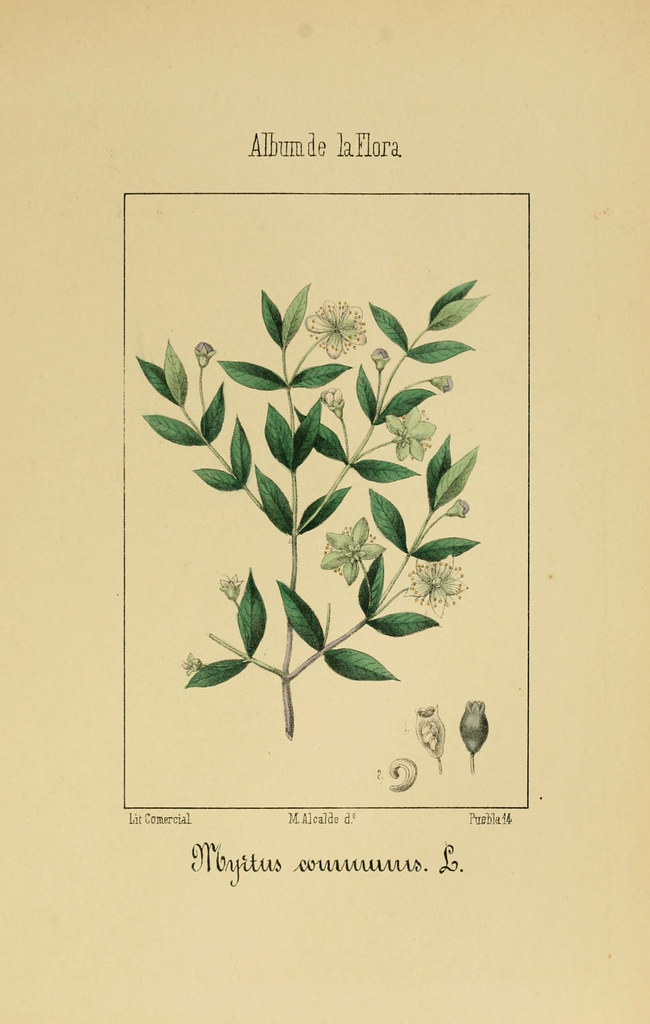
A botanical illustration of Myrtus communis, the common myrtle.
n208_w1150 by BioDivLibrary is licensed under CC-PDM 1.0

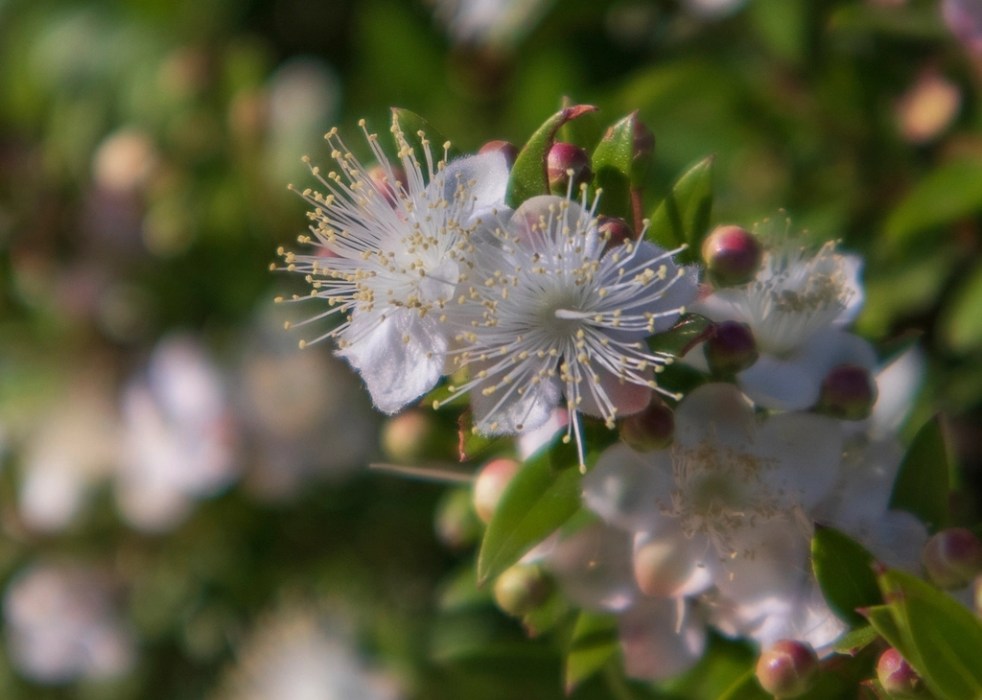
Common myrtle (Myrtus communis) is used as a culinary herb and medicinal plant. Figs, threated onto a myrtle skewer and roasted, acquire a unique flavor from the essential oils present in the wood. The seeds, dried and ground, have an interesting, peppery flavor often used in sausages. As a medicinal plant, it’s been used to treat scalp and skin conditions, to stop bleeding, and to treat sinus problems. (Unfortunately, there’s limited evidence that myrtle really does much for that last one.)

Lemon myrtle (Backhousia citriodora) is also a culinary and medicinal plant. As a culinary herb, it’s used to flavor any dish you might flavor with lemon: desserts, fish, poultry, or pasta. It’s especially useful for flavoring dairy-based dishes, since the acidity of actual lemon juice tends to ruin the texture of milk products.
Medicinally, the oil has some pretty significant antimicrobial activity. The leaves themselves are also very relaxing.
(I’ve had the dried leaves in tea, where I find it really shines — it’s got a delightful citrusy flavor with a bright, subtly sweet taste, and it absolutely knocks me out.)

In ancient Greece, the myrtle tree was a sacred tree for Aphrodite and Demeter. Seeing one in a dream or vision was considered good luck if you were either a farmer or a woman. It was also connected to the minor deity Iacchus, for whom there isn’t really much information — he was often syncretized with Dionysus, and Dionysus was all about wreaths and garlands. He could also have been a son of Dionysus, a son of Demeter, or a son of Persephone.

There are also three ancient Greek origin stories for the common myrtle. In one, an athlete named Myrsine outdid all of her rivals. In retaliation, they killed her and the goddess Athena turned her into a beautiful myrtle tree. In another, a priestess of Aphrodite broke her vows to get married (either willingly or unwillingly, depending on the version). Aphrodite then turned her into a myrtle tree, either as a punishment (for willingly breaking her vows) or as protection (against the husband who abducted her to marry). In the third version, a nymph turned herself into a myrtle tree in order to avoid Apollo’s unwanted advances.

Pink crape myrtle flowers on the branch.
Photo by Griffin Wooldridge on Pexels.com

In Japan, crape myrtles are known as sarusuberi (百日紅). Their striking flowers are often found in traditional artwork and make very striking bonsai.

Crape myrtles don’t have much history in old grimoires or European magical systems, purely because they weren’t really around centuries ago. When you’re reading about largely European folk magic, ceremonial magic, mythologies, or herbal medicine, they’re going to be talking about Myrtus species, not Lagerstroemia. That said, crape myrtle flowers are associated with general positivity, love, and romance.

Lemon myrtles don’t have much history in European magical systems, either. Like crape myrtles, this doesn’t mean that they don’t have value. In modern western magic, lemon myrtle is usually considered a solar herb and all of its attributes: purification, positivity, luck, and protection.

As a plant of Aphrodite and Demeter, common myrtle makes a good offering for either of these deities. (This isn’t always the case — sometimes, when a plant is sacred to a god, it means don’t touch that plant.) Since these goddesses are shown wearing wreaths of myrtle, it’s not a terrible idea to weave a myrtle wreath and either wear it while doing devotional work, or place it as an offering to one of them.

A hand holding a sprig of myrtle, showing the plant's leaves and berries.
Photo by Furkan Films on Pexels.com

Common myrtle is also very strongly associated with love and marriage. In Eastern Europe, myrtle wreaths were held over the heads of a marrying couple (now, people use crowns instead). All the way across the sea, in Appalachia, one method of love divination involves throwing a sprig of myrtle into a fire. If you watch the smoke closely, it’s said to form the shape of your true love’s face.

Myrtle is more than a love and marriage herb, however. It’s also considered protective. As mentioned in myrtle’s Greek origin stories, two of them describe women turning (or being turned) into myrtle trees in order to escape men. In England, it was also thought that blackbirds used myrtle trees to protect themselves against malevolent sorcery.

Common myrtle is associated with Venus and the Moon. Lemon myrtle is associated with the Sun.

If you have access to dried common or lemon myrtle as a culinary spice, you’re in luck — these are ideal ingredients for kitchen witchery. Combine them with other ingredients that match your intention (for example, make a delectable chamomile and lemon myrtle tea for luck, just be ready for a nap first), ask the herbs for their help, and you’re good to go.

Lemon and common myrtles have a high concentration of essential oils, so they’re good for infusing. Place some of the dried leaves in a carrier oil, like sweet almond or jojoba, and allow them to sit in a warm, dark area. Shake them regularly, and decant or strain the oil after a month or so. You’ve made an oil you can use for anointing, dressing candles, you name it.

If you want to use common myrtle for love divination, brew a cup of myrtle tea and read the leaves. You can also toss a branch of fresh myrtle into a fire and read the smoke.

I wouldn’t recommend planting myrtle trees if you live outside of their native range, but, if you’re in the southeastern US like me, you probably have access to loads of them anyway. You can find lemon myrtle in tea and spice shops. Same with common myrtle. Crape myrtle grows by the roadsides here as a landscaping plant. (If you’re me, you might even think you’re planting an elderberry start and end up with a crape myrtle instead!)

Even if you can’t grow myrtles yourself, I recommend experiencing their delightful colors, flavors, and aromas at least once. Each myrtle species and relative has their own fascinating folklore and history of use,

Neodruidry · Plants and Herbs · Witchcraft

Hydrangea Folklore and Magical Uses

I’ve written a bit about the hydrangeas we planted here. We’ve got two oakleaf and one bigleaf hydrangea, all of whom did pretty well after planting. (Well, until an incident with some botanical mosquito control, but that’s another story and everyone is fine.) It was interesting to see how the sunlight and shade seemed to affect them — the oakleaf hydrangea who got the most sun exhibited some signs of stress in the beginning, where the one planted in partial shade seemed to settle right in. Once it had time to acclimate, however, the sunny oakleaf hydrangea rapidly outgrew its compatriot!

It’s going to be a little while before I can see how my guys fared through the winter, but I’m confident that they’ll do okay and very excited to see them put out new flowers this year. In the meantime, I thought I’d soothe some of my impatience by writing about the various traditions, folklore, magical uses, and fun sciency things surrounding hydrangea.

(Also, as you read this, my Handsome Assistant is obtaining the Replacement Car. It has more cargo space than the Hyundai did, so you know what that means: I can convince him to haul home even more bushes, because I’ve got coupons to American Plant and a head full of weird ideas.)

The name “hydrangea” translates almost perfectly into “water jar.” It comes from the Greek words angeion, for vessel or capsule, and hydr-, for water. It makes sense, too — the seeds look like little amphorae, and these plants like water.

A blue cluster of hydrangea flowers against a backdrop of dark green leaves.
Photo by Rifqi Ramadhan on Pexels.com

In Victorian floriography, the cryptic language of flowers, hydrangeas have a somewhat contradictory meaning. On one hand, they represent gratitude. On the other, they represent heartlessness. This kind of makes sense if you consider them as a response to a would-be suitor. Very “thanks… but nah.”

In China, hydrangeas are associated with heartfelt apologies. These flowers are sometimes poetically called “the flowers of the Eight Immortals.” The Eight Immortals are legendary figures revered in Taoism. In one tale, the forces of the Immortals and the Dragon King clash. To apologize, the Dragon King offers seven of the Immortals beautiful hydrangea flowers.

Different colored hydrangeas can represent different things. Blue hydrangeas are the ones most commonly associated with regret and apology. White ones represent grace, purity, and vanity. Pink are for appreciation and gratitude. Yellow are for joy and friendship. Green hydrangeas are for rebirth, prosperity, abundance, and renewal. (This rather closely follows the meanings attributed to different colored roses, with the notable exception of blue. Roses do not produce blue pigment, so any “blue” roses are either actually lilac in color, artificially colored, or photo edited.)

It should be noted that a hydrangea’s colors can be variable. Unlike other plants, the things that give them their colors aren’t different pigments. Pink hydrangeas, for example, aren’t actually any different from blue ones. Hydrangeas act as giant, living masses of litmus paper. When they grow in acidic soil, their growing conditions cause their pigment to exhibit a blue color. If the soil is more basic, then it will exhibit a pinker color.

Here’s where it gets a bit more complicated. The soil pH itself isn’t actually what influences the hydrangeas’ color. It’s the naturally occurring aluminum ions in the soil. When soil is acidic, these aluminum ions are free to do their thing, hook up with other ions, have a gap year, go clubbing, get tiny little asymmetric haircuts, etc. They’re also easily taken up by the hydrangea plant, where they get all up in the hydrangea’s reddish pigment and turn it blue. In basic soil, aluminum ions connect with hydroxide ions, settle down, buy property, and get tiny little purse dogs. Aluminum hydroxide isn’t easily taken up by hydrangea plants, so the blooms stay pink. You can force a hydrangea’s blooms to change color, but it’s a whole Thing involving a lot of chemistry, soil amendments, and time.

Also, hydrangea flowers aren’t flowers at all — like flowering dogwoods, their “petals” are really modified leaves. The actual flowery bits (the tiny fertile parts in the center) aren’t super noticeable, so these jazzed-up leaves provide support and protection for the flowers, and help pollinators figure out what’s what.

Pink hydrangeas, the product of basic soil.
If you look closely at the center of each “flower,” you can see the actual hydrangea flower. You can also see the leafy veining pattern in each “petal.” Photo by Alena Yanovich on Pexels.com

From what I’ve seen, at least three online sources indicate that hydrangeas were once used to break curses. If a malevolent witch put a curse on someone, hydrangea flowers could get rid of it. However, I haven’t seen this attributed to any specific culture or tradition, nor have I found exactly how to use hydrangeas as hex-breakers.

A great many herbs with magical and folkloric significance have also historically been known for their medicinal properties. Hydrangeas are poisonous overall, but their roots and rhizomes do have some medicinal virtues. Both traditional medicine and modern research demonstrate some potential effectiveness against inflammation and problems with the bladder and kidneys, as well as a diuretic effect.

Hydrangeas aren’t just a little poisonous, either. They contain amygdalin, the same cyanide-producing compound in bitter almonds. It’s also related to the one that was rebranded as “laetrile” and “vitamin B17” and sold to unsuspecting and desperate cancer patients. That said, a completely different compound called hydrangenol may inhibit bladder cancer, and that’s neat!

Astrologically, hydrangeas are connected to Libra. Elementally, they’re associated with Water. (Which makes a lot of sense, considering their preferred growing conditions and the whole diuretic thing.)

Though I wasn’t able to find a source for breaking curses with hydrangeas, they can be useful to grow as boundary plants. In most cases, a plant’s magical function follows its mundane form and use. Hydrangeas are dense, lush, and also poisonous. () A nice, healthy hedge of hydrangeas is a wonderful boundary. Just shoot for native varieties — they’ll thrive more easily, require less intervention, and you’ll be helping out your local pollinators and combating habitat loss!

A cluster of light blue hydrangea flowers against a dark background.
Photo by Sonny Sixteen on Pexels.com

Hydrangeas also make beautiful, very easy bouquets, offerings, and altar decorations. Each head is pretty much a bouquet on its own. Choose a bloom that’s the right color for your intention — for money or fertility spells, for example, choose green ones. For purification, pick white. Just make sure to keep them away from children and pets.

Hydrangeas also dry beautifully, though they lose some of their color in the process. Still, the “flowers” have a structural beauty. They’re good for wreaths and basket arrangements. Consider making a dried hydrangea wreath and empowering it to energetically protect your home’s entryway.

I still have some time before these hydrangeas bloom, but I can hardly wait. Here’s hoping they’ve settled in enough to fill out and flower abundantly this year!

Neodruidry · Witchcraft

Traditional Healing Chants (also my blender tried to kill me)

Hello! I haven’t been around for like two weeks. Originally, I did plan to take a couple of days off for Yule, however one of my household’s Yuletide gifts was a hugely upgraded blender.

(To be fair, our bar for a blender upgrade was not high. The one we were using before cost, I think, six dollars at a thrift store. We used that thing until it flat out refused to be used anymore.)

Anyhow, long story short, fancy blenders do not always fit together the way that I assumed they would. They’re also way sharper than my old one. Yadda yadda yadda, the middle felt out, hit the side of my hand on the way down, and it took so many Steri-Strips to put everything back together. I’m talking a solid half-inch thick flap of hand meat. Enough blood for an axe murder. Half a box of strips. Most of a tube of some kind of fish glue that I’m told is supposed to seal cuts closed.

A large, flamey explosion. The remains of some kind of structure can be seen silhouetted in the flames.
A reenactment.

Anyhow, typing was problematic, so I took a little bit longer. I don’t generally keep a big bank of posts to drop automatically, hence there being no content for a little bit. C’est la guerre.

This seemed like a good time to talk about healing chants. I find these really interesting — they’re not quite sympathetic magic, since they’re just spoken words, but they do remind me a lot of certain forms of weather magic. In those, you pretty much go outside, pour water on the ground, and tell the sky to get its act together because it’s not like raining is difficult. Healing chants are essentially an instruction, telling bones to knit together, wounds to close, and blood to clot.

You can see this in the following healing chant, excerpted from Joanna van der Hoeven‘s The Book of Hedge Druidry (Spell for healing, page 274-275):

Bone to bone,

Flesh to flesh,

Sinew to sinew,

Vein to vein;

As Brighid healed that

May I heal this

This is far from a modern invention. The second Merseburg charm goes as follows:

Phol ende uuodan
uuorun zi holza.
du uuart demo balderes uolon
sin uuoz birenkit.
thu biguol en sinthgunt,
sunna era suister;
thu biguol en friia,
uolla era suister;
thu biguol en uuodan,
so he uuola conda:
sose benrenki,
sose bluotrenki,
sose lidirenki:
ben zi bena,
bluot zi bluoda,
lid zi geliden,
sose gelimida sin

“[B]en zi bena, bluot zi bluoda, lid zi geliden, sose gelimida sin” translates to “Bone to bone, blood to blood, joints to joints, so may they be glued.”

Similar healing spells are used to cast out “worms” (which may be literal parasites or maggots, or a way of conceptualizing infection in general). These use a similar “flesh to flesh, bone to bone, blood to blood” formula as the chants above, with the added step of sending the infection or infestation into an object — perhaps back into the object from which the wound and infection originated.

Interestingly, these chants are often called “horse charms.” Even the Merseburg charm above relates a story of how Uuodan (Odin), Sinthgunt, and Friia (Frigg) healed Phol’s (Balder’s) horse’s sprained foot. Of the surviving examples of these chants and charms, a disproportionate number of them seem to be for healing leg and hoof ailments in horses and sheep. (Charms for fixing blender accidents are conspicuously absent.)

This photo shows a crouched figure holding a horse hoof in one hand. It shows the relative tininess of the hoof and slenderness of the leg.
Four of these have to support an animal between 900 to 1400 pounds. It is not super surprising that there are a lot of charms for fixing horse problems. Even wild horses aren’t immune to issues — the life expectancy of a wild horse is, on the high end, about half that of a domestic one.

This form of charm isn’t exclusive to Europe, either. The Wikipedia article above cites an example from the Atharvaveda, hymn IV, that follows a similar construction:

 róhaṇy asi róhany asthṇaç chinnásya róhaṇî
róháye ‘dám arundhati
yát te rishṭáṃ yát te dyuttám ásti péshṭraṃ te âtmáni
dhâtấ tád bhadráyâ púnaḥ sáṃ dadhat párushâ páruḥ
sáṃ te majjấ majjñấ bhavatu sámu te párushâ páruḥ
sáṃ te mâmsásya vísrastaṃ sáṃ ásthy ápi rohatu
majjấ majjñấ sáṃ dhîyatâṃ cármaṇâ cárma rohatu
ásṛk te ásthi rohatu ṃâṇsáṃ mâṇséna rohatu
lóma lómnâ sáṃ kalpayâ tvacấ sáṃ kalpayâ tvácam
ásṛk te ásthi rohatu chinnáṃ sáṃ dhehy oshadhe

Here, “majjấ majjñấ sáṃ dhîyatâṃ cármaṇâ cárma rohatu ásṛk te ásthi rohatu ṃâṇsáṃ mâṇséna rohatu” translates to “Let marrow be put together with marrow, let skin grow with skin, let thy blood, bone grow, let flesh grow with flesh.” (Here is a further analysis from Sanskrit-linguistics.org.)

This charm is especially fascinating to me, because it means one of two things are true: Either this and the “horse charms” of Europe have a common, incredibly ancient root, or they’re an example of convergent cultural evolution. I’m inclined to believe it’s the former, but the latter would be really cool. I always get such a wonderful sense of eerie mystery when things like that happen, whether it’s culturally (everyone has some kind of bread) or physically (flight has evolved multiple times in unrelated organisms and nature tries to turn everything into crabs). It’s neat. It’s a little spooky. I love it.

Long story short, after a lot of Steri-Strips, gauze, fish glue, multiple recitations of a chant primarily intended to fix horses, and some healing time, my hand is operational again and normal content should resume next week unless I, I don’t know, get my head caught in the stand mixer or light my pants on fire again.

This is why my Handsome Assistant does the dishes, though.
I can’t be trusted.

crystals · Neodruidry · Plants and Herbs · Witchcraft

Working with the elements (when everything’s been paved).

They paved paradise, and put up a parking lot.
Or office blocks, apartments, and retail space, as it were.

A lot of, though certainly not all, magic involves working with all of the elements. Some people do this in absolutely every spell, some only invoke them in longer, more formalized rituals. Some keep representations of all of them on their altars, some have specific, strategically placed altars dedicated to each. Point being, Earth, Air, Fire, and Water will probably come into play at some point.

But what do you do if your daily contact with nature is limited to a window box, a weedy alley, or a grassy strip of median?

For a lot of people in urban areas, working with the elements takes a little ingenuity. You have to branch out from the idea of the sea as crashing waves and be able to see it in the azure blue of a stone, or the briny scent of a vial of seawater. You probably can’t build a bonfire, but you can smell its power in the warm spice of cinnamon incense.

Every element has its own correspondences. Each has its respective colors, crystals, herbs, and symbols. Bringing them into your home or your altar space is as good a beginning as any when it comes to working with natural energies you may not fully experience in your usual environment. You can follow your intuition here, or use some herbs, stones, or other objects usually associated with each element:

Earth

Herbs: Vetiver, potato, turnip, ivy, mushrooms, alfalfa, myrrh, patchouli, sandalwood.
Crystals: Jade, onyx, salt.
Tools: Dishes of salt, crystals or other stones.
Animals: Turtles, bulls, wolves, bears.

Generally, brown, black, or green things, root vegetables, and autumnal herbs are associated with Earth.

Air

Herbs: Anise, fennel, lavender, mint, lemon.
Crystals: Celestite, citrine.
Tools: Incense, wands, fans, feathers.
Animals: Eagles and other birds.

Generally, yellow or blue things, pastel colors, and “bright” flavors are associated with Air.

A person holds a handful of lit incense sticks. Smoke wafts from their glowing, ash-covered tips.

Fire

Herbs: Ginger, rosemary, chili pepper, sunflower, dragon’s blood, cinnamon, clove.
Crystals: Amber, citrine, carnelian, ruby, fire agate, fire opal, red tourmaline, sunstone.
Tools: Blades, wands, candles, burned things.
Animals: Deer, dragons, salamanders.

Generally, red or orange things, things that thrive in sunlight, stinging things, and things that are warm or spicy correspond to the element of Fire.

Water

Herbs: Benzoin, clary sage, Irish moss, water lily, buckthorn, lotus, aloe vera, cacti.
Crystals: Aquamarine, coral, pearl, opal.
Tools: Cups or chalices, cauldrons.
Animals: Salmons and other fish, sea mammals, frogs.

Generally, blue, green, or black things, things that grow in water, things with a high water content, and things that are cool and moist correspond to the element of Water.

A big part of Druidry is the idea of reciprocity. It’s the idea that building a relationship with something — anything, whether it’s a person, a community, or the spirits of the land — requires a conscious effort to give back. Nobody waters dead flowers, and relationships that are one-sided quickly fade.

Cities provide ample opportunities to engage in reciprocity. I remember laying in bed once, in a studio apartment in Washington DC, and seeing a black and white hummingbird hover just outside the window. It was a wonderful little surprise, and a reminder that, once natural sources of food, water, and shelter are taken away, it’s up to us to make up for the loss.
Pavement and metal don’t kill the spirits of the land, just muffle them for a while.

If you work with plants, cities can provide a surprisingly diverse biome. Bricks are a substrate for multiple species of moss. Concrete is no match for the plants that push themselves up through the cracks. Climbing vines, native and otherwise, cling on to rain gutters and windowsills with an admirable tenacity.

Moss growing on and around pavement at the base of a brick wall.

Urban areas are really good for some elemental work, though. The element of Earth is present in the bones of a city, from the steel beams of buildings to the ubiquitous concrete underfoot. Tall buildings give great access to working with Air — few things are as invigorating as a good energy cleanse by standing on a balcony in a strong breeze.

Living in an urban environment doesn’t always make it more difficult to work with the elements. It just takes a little digging.