life · Uncategorized

What’s going down in Rock Creek (and why it’s a big deal)

This weekend, my Handsome Assistant and I attended an educational picnic to save Rock Creek, which is currently at risk from the continued expansion of a golf course. Construction has already begun, parts of the forest are being turned into mulch as we speak. Over 1,200 trees are slated to be cut down, including some that would otherwise be considered special or heritage trees under DC law.

This deforestation is part of an effort to expand multiple golf courses throughout the DC area.

Yeah, I know.

Even without further examination, I mean — who is building golf courses right now, of all things? The answer is the National Links Trust. While people worry about paying rent and getting their next meal, the National Links Trust apparently thinks that the public yearns for more golf courses. It’s something that sounds almost moustache-twirlingly villainous. Like the plot of an after school special where the heroes are a band of plucky cartoon kittens. Unfortunately, this is actually happening.

What’s the deal with the National Links Trust?

The NLT’s stated intention is “positively impacting our community and changing lives through affordable and accessible municipal golf.”

This is something that doesn’t sound… terrible, barring the whole “people-can’t-afford-food-right-now-you-rich-weirdoes” aspect. However, here’s what the NLT isn’t saying:

Lem Smith, NLT board member, International & Federal Government Affairs Manager for Chevron, and Former VP, Federal Government Relations for the American Petroleum Institute.
  • One of the board members, Lem Smith, is the International and Federal Government Affairs Manager for Chevron. The Chevron responsible for dumping 16 billion gallons of toxic wastewater into the Amazon basin. The Chevron currently denying millions in fossil fuel transit fees to the Palestinian people. The Chevron currently funding apartheid and war crimes. That Chevron.
  • While they claim that they’re attempting to mitigate the harm done by the deforestation of Rock Creek (harm that is, once again, completely unnecessary and unasked for), they are not adhering to the best practices for doing so. There are multiple ways to mitigate the damage of both removing old growth trees and the presence of invasive plants, but their policy seems to be to mulch everything and call it good.
  • They’re not actually accountable to anyone. They can make half-hearted promises to plant meadows and maintain the forest all they want, but there is no incentive for them to keep them and nothing to stop them from doing whatever they want.

They claim that they’re willing to dedicate unused golf courses to being replanted as meadows. This is not a suitable compromise for multiple reasons:

There’s also the fact that it doesn’t seem like anybody actually asked for this. When asked, local golfers appear to be ambivalent at best. The NLT was able to scrape together some who are in favor of it to make a public appearance, but these don’t appear to reflect the opinion of the majority of the new course’s ostensible user base. They are absolutely not reflective of the larger population of DC and the adjacent area.

Here’s why it matters (no matter where or who you are).

So the NLT is attempting to build a golf course. Like I said, this is a huge deal and will have far-reaching effects even if you don’t live anywhere near DC. Here’s why:

Old growth areas are carbon sinks.

It is generally thought that old forests cease to accumulate carbon, but this isn’t the case. Research shows that in forests between 15-800 years of age, “net ecosystem productivity (the net carbon balance of the forest including soils) is usually positive.” What’s more, carbon doesn’t cease to exist once it’s taken up. When these areas are disturbed, that carbon is liberated as plant matter decays or is burned. Rather than trees dying naturally over time, breaking down, and having their nutrients (including carbon) absorbed into the mature forest, deforestation disrupts this natural cycle.

Rock Creek is part of the Potomac watershed.

Trees support healthy watersheds. Rock Creek itself connects to the Potomac River, and eventually drains into the Atlantic Ocean via the Chesapeake Bay. Trees contribute to healthy waterways by anchoring soil in place, preventing erosion. Their root systems (including the mycorrhizae within the soil that surrounds their roots) help capture nutrients. Without these systems in place, they would otherwise flow into the water to encourage algal blooms and fish kills, a process known as eutrophication. Removing these trees and replacing them with grass that requires a regimen of fertilizers and treatments to maintain is a terrible idea.

The last thing anyone needs is golf course runoff oozing into our local waterways.

Golf courses need a lot of water.

I already mentioned supplemental irrigation, but I’ll say it again: Golf courses need a lot of water. They are generally watered with sprinkler systems that lead to a lot of waste and loss through evaporation. This also puts strain on existing systems, reducing the availability of water for other uses and increasing scarcity issues. Only about 12% of golf courses surveyed use recycled water, and even with more efficient irrigation methods, turf grass remains a very wasteful use of land and water.

We’ve already had droughts here. We’re already told not to use any more water than necessary during the summer because of scarcity issues. Why are they building a golf course?

This could increase the transmission of avian flu.

I’m not being hyperbolic when I say this. Destruction of wildlife habitats drive populations of wild animals into greater contact with humans. If old growth trees are destroyed, the thousands of birds that they house and feed get pushed elsewhere. That “elsewhere” is going to be people’s back yards.

How does that relate to the H5N1 virus? More displaced birds mean more contact between wild birds and flocks of backyard fowl. It means more indoor-outdoor cats that come in contact with potentially infected birds. It means more bird feces on cars, decks, and feeders. A higher overall population of birds congregating in the same feeding and shelter areas means a higher risk of potentially zoonotic H5N1 moving through that population.

Birds aren’t the only ones that’re going to be displaced, either. Look for more conflicts with foxes, raccoons, rodents, and coyotes, too.

If it was living in that part of Rock Creek, it’s gonna need a new place to go. In an area as densely populated as DC and the surrounding suburbs, there aren’t many other options.

This further undermines Washington, DC, as a political entity.

Washington, DC, has been pushing for statehood for some time now. (A significant part of the reason why it keeps getting struck down is that DC would be a majority blue state, so it benefits the Conservative party to avoid allowing it to have any more representation than it already does.) While it isn’t a state, DC does still have home rule in some aspects. For example, DC’s tree law provides numerous protections specifically for heritage trees. Removal of a tree that qualifies as a “special tree” requires a permit. Healthy heritage trees cannot be removed, period.

Rock Creek is part of the National Park System. As such, even though a significant portion is within DC, DC isn’t able to enforce its tree laws to protect it. This inability to protect trees within its area further undermines DC as a legal and political entity.

The National Park Service is part of the problem.

Rock Creek is a national park, but it hasn’t been maintained as one. Invasive plants are a significant issue, and one that the National Park Service hasn’t adequately remedied. There are local people who are trained as Weed Warriors, who are able to legally remove invasive plants. However, there’s only so much they can do.

Part of the inception of the National Park Service was to push Indigenous Americans off of their ancestral land, with the claim that the land must be “preserved.” (Madison Grant helped launch the national parks movement — he also wrote The Passing of the Great Race, which gave a very detailed account of his negative views of Indigenous people, Black people, and immigrants.) In reality, the land in the National Park System was being preserved just fine while its original stewards were living there.

The neglect of Rock Creek shows that this land is not being protected or preserved. Furthermore, its current state has incentivized the NPS to sell part of Rock Creek in order to have it cut down and turned into a golf course. The idea is, I guess, that the National Links Trust would do the preserving instead, by… cutting the trees down and turning the land into a putting green.

It’s all so, so ridiculous, and it’s a terrible omen of things to come. Nothing good will come of the NPS being allowed to neglect public lands, then sell them off.

Light pollution is going to be a problem, too.

In addition to the loss of exceptionally old trees, biodiversity, and wildlife habitat, the presence of a golf course will increase light pollution in the area. The plans call for a driving range that will be lit through the night hours. This will disrupt nocturnal animals, including (especially) insects. We’re already experiencing a dramatic drop in insect populations. We don’t need a @#$%ing driving range that nobody asked for to begin with.

The land is removed from public use.

Right now, you can just go to Rock Creek. You can walk around. Picnic. Bird watch. Have a grand old time.

Already, the area of the forest that is earmarked for cutting has been removed from public use. You can’t just go there — people who have have been told to leave.

Meadows aren’t forests.

Even if the NTL carries out their plan to turn unused golf courses into meadows, meadows do not provide the same benefits as forests. I’ve been very vocal here about my efforts to remediate the immature, hard clay soil and turn it into mature soil. Cultivating turf grass is terrible for soil and doesn’t allow it to mature.

So here’s a bunch of immature soil that’ll be used to grow some (one can hope, but certainly not assume) native flowers and grasses. This will take over a hundred years become anything like the area that’s currently being cut down, in a process known as forest succession. While meadows are certainly better than the sterile monoculture of a putting green, they do not play the same role or have the same benefits as a century old forest.

Here’s what you can do.

Right now, the easiest thing to do is to boycott Chevron and its associated companies. People across the US and around the world are rejecting Chevron. Coupled with lower sales of jet fuel and other factors, Chevron recently reported a loss for the first time since 2020.

This effort to turn part of Rock Creek into a golf course is just a continuation of Chevron’s ongoing pattern of land acquisition and destruction. They are promoting this destruction via the National Links Trust. If you are interested in helping to put a stop to this, please visit Defend Rock Creek’s Linktree for further steps that you can take.

Environment

Park Cleanup!

There are a lot of small, local waterways in this area. Creeks feed into streams, streams into rivers, rivers into the sea, like a vast circulatory system. All of the trash that ends up in parks and little groves around these creeks doesn’t just stay locally, it eventually moves along, causing more damage as it goes. That’s why it’s so important not to litter in the first place. But, since people are gonna people, it also helps to go actively engage in a park cleanup.

This past Saturday, five of us (from the Neodruidry group I’m part of) went to a park that’s part of the local watershed. Armed with grabbers, bags, and gloves, we started along the trail and kept going for about an hour and a half, filling bags with a speed that was honestly pretty surprising. Old clothes, broken dishes, water bottles (mostly water bottles), liquor bottles, diapers, shopping bags, takeout containers, plastic wrap, aluminum foil… There was a surprising variety of grossness.

At one point, I was just following along from one bit of trash to the next like I was pursuing some kind of very disturbed Hansel and/or Gretel. Next thing I know, I’m on a steep, rocky bank with no easy way to climb up and a bag that’s too heavy to let me even if there was.

A rocky creek winding between trees in yellow and orange autumn color. This park cleanup helped keep trash from ending up in here and being carried to the river, then to the sea.

Oh well. That’s one fun thing about a park cleanup — you sometimes end up in interesting places you didn’t expect to be.

I continue along the creek, fishing trash out and stuffing it into the bag. I eventually find a spot that looks easier to climb, right beside a bridge. I conk my head in the process, but I do eventually emerge, crashing through the undergrowth like Sasquatch, to run into my Handsome Assistant.

“Oh. There you are! I was looking for you.”

“Ha ha, yep!” I laugh, trying my best not to look like someone who’d just climbed out of a creek with a sack of trash and sticks in their hair, arms studded with fresh scabs and thorns. “Look!” I pull an object out of my pocket. “I found a cool thing!” It is an abandoned wasp nest.

An abandoned wasp nest in the palm of a dusty, black gloved hand.

He is very understanding about all of this.
We join the others and continue bagging trash.

By the end of the park cleanup, we’ve got nine bags (nine!) of garbage. No scale, but most of them were pretty heavy (I’d say they ranged from 15-35 pounds). Some people thanked us as we worked, which was really nice — I just feel a little bad because I wasn’t expecting it and thought they were talking to someone else at the time, so I didn’t think to acknowledge it.

Nine black trash bags, beside a small table, some gloves, and some metal grabber sticks.

I’m tired and sore now, but it’s totally worth it. It’s the good kind of tired. The park was beautiful even before cleaning it up, but it’s great to know that none of those metals or plastics will end up in our waterways now.

life · Neodruidry · Witchcraft

Mabon 2024

This past weekend was the Mabon camping trip! My Handsome Assistant and I are part of a local Druidry group, and that group teams up with another Pagan group to go have a fantastic time in the woods.

(If you aren’t sure what Mabon is, here is a brief rundown.)

There’s food (lots of food), singing, stories, rituals, and catching up with friends, all set in a beautiful forest. Last year, things got a bit cold and damp. This year, the weather was better, and my Assistant and I knew what to expect. We were more thoroughly prepared (air mattress, extra blankets and sleeping bags, extra dishes, a solar powered fan), so it made for a much more comfortable trip.

The rain also stayed away just long enough for the weekend’s rituals, which was very important.

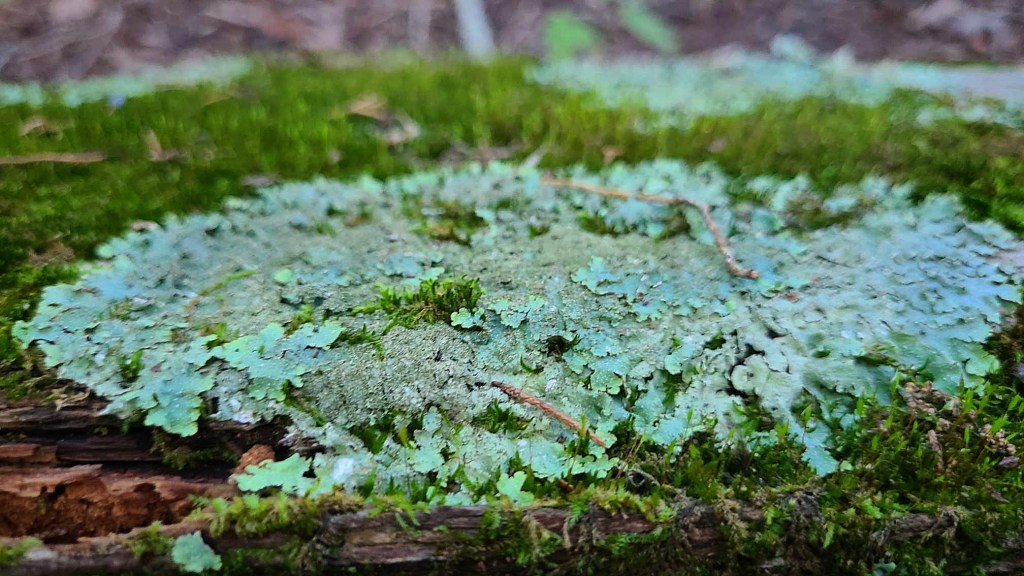
A close-up of some very pretty lichen, growing in a bed of moss.
Fortunately, there was just enough rain to make the mosses and lichens really pop.

Earlier, during the Midsummer goods and gear swap, a couple of us floated the idea of having a masquerade party. It wasn’t a serious plan at the time — mainly a “this would be really cool” kind of thing. Later, during a planning Zoom call, I mentioned that some of us thought a masquerade would be really neat. Maybe for Samhain?

One of the group’s Stewards knew of a ritual that involved masking — the Council of All Beings. Another person found chants that suited the occasion. Another wrote the transitions and spoken parts of the ritual structure. By the end, it was a beautiful, adaptable, and powerfully creative work.

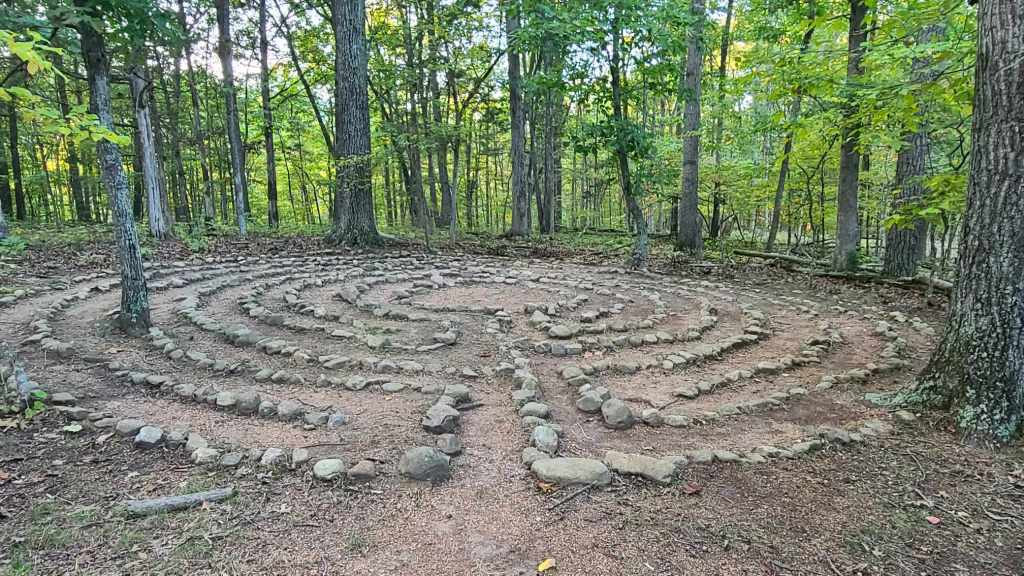
Some people came to the trip prepared, already knowing which being they’d embody, having a mask or costume, and knowing exactly what they wanted to say. Others took time in the woods or labyrinth, waiting to see what reached out to them and asked to be represented. I’d gotten some inspiration a while before Mabon, so I was all set to go.

A photo of a labyrinth in a forest. The labyrinth is made up of stones, set in a spiraling pattern in a clearing.

The ritual itself was wonderful. The masks were gorgeous, and seeing what kind of entities inspired/spoke through people was fascinating. Some represented a specific organism — like the critically endangered regent honeyeater. Others represented a genus or type of being, like moths, small snakes, or coral. Others represented something broader, like smoke or the sun. Some were natural features, like the bedrock or an underground spring. There were representations from a variety of cultures and cosmologies, all brought together to express themselves through us. I loved it.

(I was the necrobiome, aka all of the little guys that dispose of trash and dead things. I had some trouble figuring out how to express “a tiny ecosystem of various bacteria, fungi, insects, and scavengers” through a mask, so I ended up settling on a skeletal deer mask instead. The presence of decomposition bacteria and fungi was somewhat implied.)

A humanoid figure in a forest. The figure is standing with their arms at their sides, staring directly at the camera. They are wearing gray boots, bandages around both hands, and a black shroud that covers them from their head down to their knees. They are also wearing a deer's skull as a mask, over the shroud. 
The photo also appears to be glitchy, with smeared areas and light leaks.
My Handsome Assistant took some photos of me all dressed up. I used them for some little analog horror-style photo manips, and I’ll be honest… this one really makes me want to go ominously photobomb strangers.

We also had an icebreaking and learning exercise called Birds of a Feather, where we wore small tags labeled with subjects we wanted to talk about — either things we found interesting and were well versed in already, or stuff we wanted to learn. It sparked a lot of very interesting conversations!

There was also a chants workshop, where a group of us got together to try various chanting techniques and see how they felt both through our own voices and hearing them in a group. (Some of the non-verbal chants, I thought, felt especially powerful. I love exploring and working with different sonic frequencies, so feeling and participating in chants that ran the gamut from “results in full-body tingles” to “surprisingly like the drone of a titanic beehive” was particularly fascinating.)

One group member also gave a talk about spiritual experiences at various megaliths in Ireland. Both my Assistant and I found it really interesting — enough to where he’s sincerely trying to figure out how to create some form of mobile hyperbaric compression chamber so I can get on a plane without Problems.

And then there was food.
(So much food.)
Every meal was a potluck, and there was something for everyone. Vegan, vegetarian, carnivore, gluten-free, nut-free. There was fresh fruit, Koren barbecue ribs, vegan fennel and garlic sausages, fresh bread, pudding made from foraged pawpaws, homebrewed peach mead, vegetable soup made from home-grown vegetables, curried chickpea salad, and a ton of other things I’m probably forgetting.
I ate like a combination of a Redwall character and some kind of Roman emperor all weekend, and it was delightful.
(My Handsome Assistant jokes that he puts on five pounds over Mabon, then spends the rest of the year losing it.)

I also stayed up way too late every night, mostly sitting around the fire hearing/telling stories, talking about things, and having the occasional smoke. This came back to bite me on Saturday, when I set an alarm to wake up, realized I had a terrible headache, and decided to sleep in. This would have meant that I’d miss the Equinox ritual Saturday morning, fortunately my Assistant and I had accidentally set up our tent right next to the ritual area.
I heard the drums going, bolted upright, wrapped myself in a blanket, and poked my head through the tent flap to watch.
It worked out okay until the calling of the quarters got to the South, which meant that everyone turned to face me, who was currently sitting due south and staring out of my tent like some kind of small cryptid. (I kind of slowly retreated behind my tent flap again until that part was over, Homer-Simpson-backing-into-a-bush style.)

So, while I am glad to be home again, I’m sad Mabon’s over. I’ll see (almost) everyone soon, but man do I miss that vibe.

life

The bowels of the Earth are not great places to discover that you’re claustrophobic, tbh.

So, my Handsome Assistant and I took a bit of a staycation. Our original plan was to stay in a lovely (and haunted) bed and breakfast in Cape May, but we decided to put that trip off until next year and do more local activities.

One of those was visiting Luray Caverns.

I’ve wanted to check it out for a while. I like the idea of exploring caves. We didn’t really have them around where I grew up, so my friends and I compensated by finding unguarded drainage culverts and having many adventures in the glorious sewers of Long Island. I covered miles upon miles of that place, completely underground.

I had some reservations about Luray at first — not because I’m scared of caves (how much worse than a sewer can they be?) but because a lot of the reviews pointed out that the owners seemed to be more concerned with making money by packing as many people into the place as possible versus protecting and presenting the natural features of the caverns.

Still, we were planning on going in the middle of the week. It seemed kind of doubtful that we’d have massive throngs of people to contend with, so the crowd thing didn’t really worry me.

I did not, however, realize that my biggest problem would be air.

Let me be totally upfront with you — still, heavy air is an enormous panic trigger for me. It makes me feel like I can’t breathe. Like my lungs are working to pull air in, but not enough is actually moving. A lot of caves still have air flow patterns, governed by changes in air pressure and temperature. Caves with multiple entrances can even have breezes as fresh air enters and pushes old air out. I figured it’d be okay. Can’t be worse than a storm sewer, right?

We were somewhere on the banks of Dream Lake when the adrenaline began to take hold.

A photo of a cave filled with stalactites and stalagmites. The center is a very still pool of water, perfectly reflecting the cave ceiling.
Dream Lake. The water here is so clear and still, it perfectly reflects the stalactites above.

The closeness of the space, the thick, humid air, and the lack of any kind of movement got to me. It got to me bad. I felt a hot flush in my cheeks, tingling down both my arms, and a heavy feeling in my chest. Sweat prickled over every inch of my skin. I turned to my Handsome Assistant.

OkayIneedtogooutside.

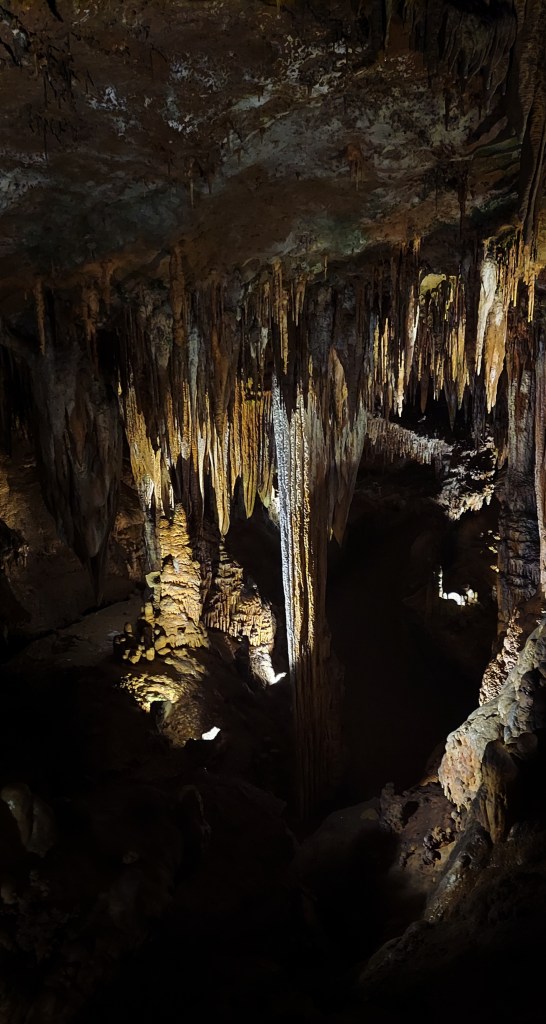
Another formation, primarily of stalactites. One group has grown down to meet the stalagmites on the cave floor, forming a long, continuous pillar.
Pluto’s Ghost.

We turned around and started heading back in the wrong direction. Luray is arranged so that, once you’re in, the only way out is through. Fortunately, we weren’t super deep in and there weren’t large crowds. The walk back felt like it took forever, but we made it back out to breezes, space, and sunlight.

As far as the caverns themselves, they’re strange and beautiful. A lot of the formations have been damaged by irresponsible patrons, but many of them are still “living.” You can see water dripping. You can see the patterns of growth and erosion forming in real time. You can see the bright orange of deposited iron oxides, the white of calcite, the greens and blues of algae blooming from the lights in the cave.

A photo of the cavern ceiling, showing dripping stalactites pointing straight down.

I do agree with a lot of the reviews that criticize the ownership, however. For example, you enter and exit through the gift shop. While this may have been a matter of practicality in the beginning, they’ve recently excavated a new entrance and probably could have done so in a way that would’ve made the shop’s traffic patterns a bit easier to manage.

There are also a lot of very tight areas. People mentioned having to stand shoulder-to-shoulder and shuffle along the entire length of the caverns, which can be tough to manage with small, antsy children. One reviewer’s daughter experienced an asthma attack, and still had to go through the entire length of the caverns because there was no way to get her out otherwise. Things weren’t nearly as crowded when we went, but, again, we were able to go on a weekday. Scheduling a trip for an off-peak time seems like it makes everything a lot easier.

Would I go again? I don’t think so. Even though we weren’t there for very long, I feel like we got enough out of the experience. I also wouldn’t want to chance being there with a large crowd. Has this experience turned me off of caves in general? Also no. If anything, it’s made me more interested.

I just need to have a good escape plan. You know, just in case.

Plants and Herbs

The beauties are berrying!

Thank you for being patient with me while I slept for essentially a week straight. It may have “just” been a vintage cold, but that coupled with the rainy weather was enough to put me out. If there’s one nice thing to come out of that, though, it’s emerging from my tiny, forced hibernation to see the ways the garden is changing as the days shorten and temperatures drop.

Earlier this year, I planted an American beautyberry (Callicarpa americana) bush. By “planted a bush,” I primarily mean “stuck a stick in the ground.”

The original sapling was a tiny, nearly leafless thing with just a few roots. This year alone, it’s managed to grow into a roughly three-foot-tall bush with tons of leaves, tiny flowers, and — eventually — fruits.

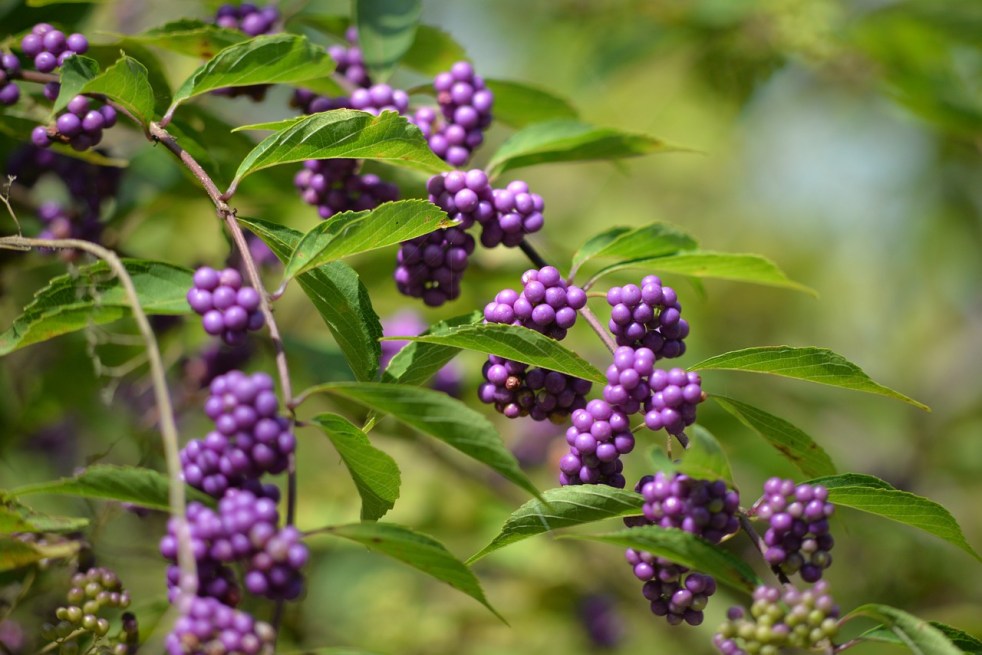
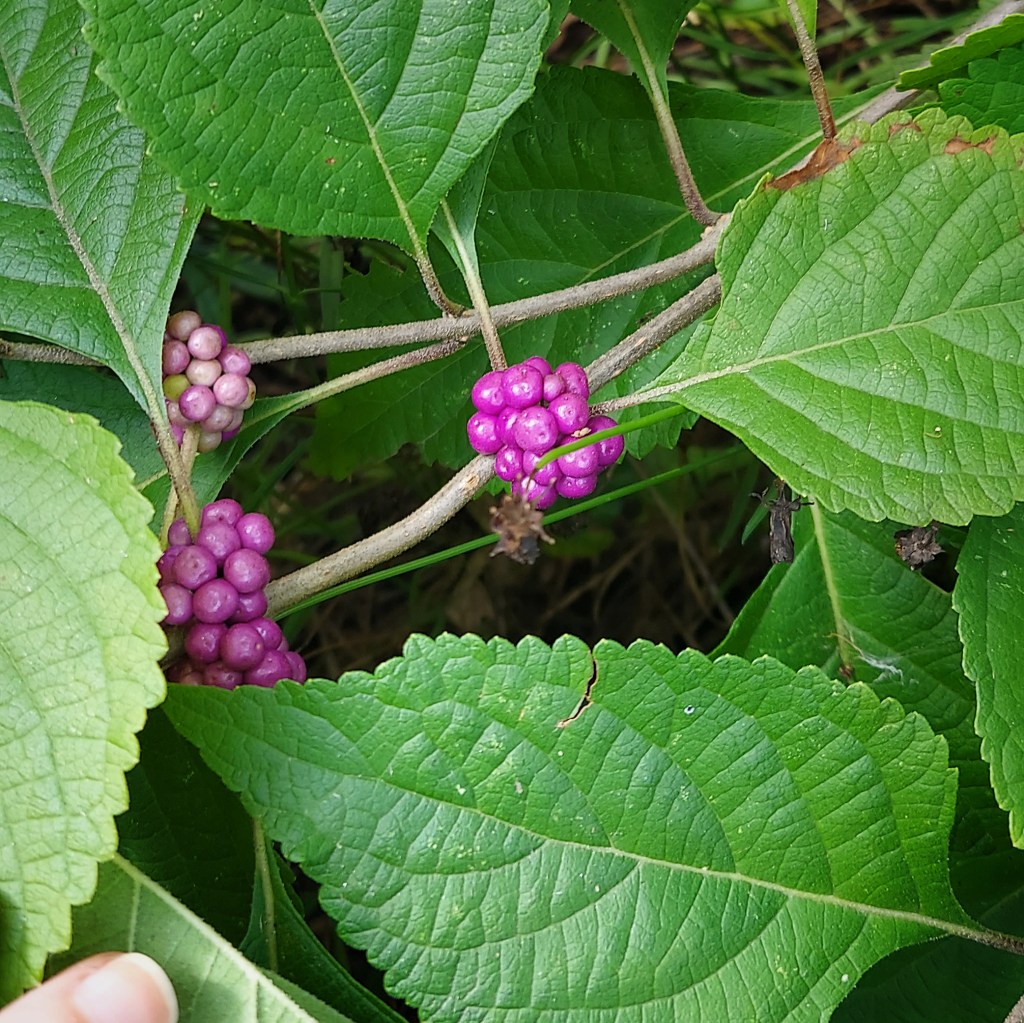
Tiny clusters of bright pink beautyberries hidden among serrated green leaves.

The fruits are all starting to really ripen, which has been incredible to see. While the flowers of beautyberry are rather indistinct and unremarkable, the berries are absolutely gorgeous: tight clusters of tiny, round, bright magenta berries that can persist through the cold months. While they aren’t a first choice for birds and other animals, this actually makes them even more valuable to wildlife once winter really hits. When other, more palatable sources of food are used up, beautyberry’s there to help keep everyone going.

The berries are bright, attention-grabbing, and non-toxic, so why aren’t they more popular among wildlife? It’s purely a matter of taste — literally. I’ve eaten a few ripe beautyberries straight off of the bush, and the opening flavor is sweet and very unique. It’s hard to describe, but, if I had to, I’d say it’s a combination of lemon, grape, and cucumber, perhaps with very subtle notes of raspberry and bergamot.

A close-up of a cluster of beautyberries, held in the palm of my hand.

Unfortunately, this is followed by a rather bitter aftertaste. I don’t think it’s a dealbreaker when it comes to snacking on a few here and there, but I can absolutely see how an animal with an abundance of other food sources might. If I had to describe the bitterness, I’d say it’s about on the level of grapefruit.

Medicinally, beautyberries are really interesting. The leaves contain aromatic compounds that have been said to repel mosquitoes comparatively to DEET. People indigenous to its range have used it as a natural bug repellent, and researchers have extracted some unique compounds that “showed significant repellent activity against [Aedes egypti] and Anopheles stephensi.” Anecdotally, some people claim it’s also effective against ticks, but other users have found it to be of little use. There are loads of DIY mosquito repellent recipes using C. americana available on the internet, but those that macerate the leaves in alcohol (ethanol or isopropanol) are likely to be more effective than those that use water.

Other than making mosquito repellent, the leaves and roots are traditionally used to treat colic, edema, dysentery, stomach pain, rheumatism, and symptoms of malaria.

Researchers have also found an aromatic compound, 12(S),16ξ-dihydroxycleroda-3,13-dien-15,16-olide, that can help treat antibiotic-resistant staph infections. MRSA is a big deal because it can be very difficult to treat. Beta-lactam antibiotics are some of the safest ones we’ve got, but don’t work very well against resistant bacteria. The compound found in beautyberry helps to restore drug-resistant staph’s sensitivity to oxacillin, a beta-lactam antibiotic.

C. americana is only one species of beautyberry. There are also C. japonica from Japan, and C. dichotoma and C. bodinieri from China. Beautyberries all look alike, but there are some key differences to look for if you’re not sure which bush you’ve got.

C. americana has magenta berries that grow very closely around the stems of the bush. There’s basically no airspace between the bark and the berries, which gives these plants a rather unusual appearance. One cultivar, C. americana var. lactea, produces white berries.

A close-up of C. americana, showing the berries closely packed around the stems.
Another shot of “my” beautyberry, showing the lack of space between the berries and the stem.

Asian species of beautyberry look very similar to C. americana but produce berries in clusters on short stems. Instead of closely circling the branches of the bush, there’s a little bit of air space between them.

An image of C. bodinieri, showing the fruits on short stems.
C. bodinieri, showing its slightly different fruit distribution.

If you’re me, you get a little sapling, find a place with lots of sun, stick it in the ground, and wish it the best of luck. Wild beautyberry is found in meadows, woods, and the edges of ponds and streams. It’s not really picky.

I admit, I’m probably not a great person to ask how to grow things. Most of my most successful plants have been accidents (hi, pumpkins) and part of the reason that I love gardening with native plants and nativars is because they don’t require coddling. Find an appropriate spot, and the plant’ll know what to do.

At the moment, the beautyberry bush I planted is still fairly small. While it’s putting out berries like a champ, there aren’t enough for me to harvest some and leave enough for the birds. Since it’s done so well, though, I’ll definitely be looking for more places to add it to the landscape. By next year, I’ll hopefully have enough for jam, sauce, and even pie!

Uncategorized

What’re you gonna do when Dracula comes for you?

I don’t usually write much about current events. It isn’t that I ignore them, or feel like they’ll bring down my vibe, or think I’m somehow above them — it’s mostly because I don’t think that anyone really needs or wants to hear about them from yet another random blogger. If I lack the experience and language to engage with something on more than a surface level, if I’m going through the same learning process as most everyone else, then there’s no real reason for me to give my two cents, you know?

Every once in a while, though, the news hits different.

By now, you’ve probably heard about the destruction of Lahaina, Hawaii. Depending on your personal social media ecosystem, you may have heard this blamed on Reptilians, energy weapons, and astrological occurrences. The thing that really got me, though, was an image of a “demonic face” in the flames.

It got me, because I remember seeing pretty much the same picture long ago. Only it wasn’t Hawaii, and it wasn’t an entire town — just two buildings. A devil’s face in the smoke billowing from the World Trade Center. A Rorshach’s test for the afraid.
“Look at that! A demon face!”
How easy is it for someone to dehumanize an enemy when they have a sign — however pareidolic, however blurry — that their enemies are in league with the forces of ultimate evil?

History may not repeat itself, but it certainly rhymes.

I remember another photo. Then-President Bush as he was delivered a folder of important documents, quietly setting them aside. That folder probably didn’t contain any information that could’ve stopped 9/11, but it was no less damning. The CIA had warned his administration months before, and nothing was done.

Sometimes, evil lives in mundane things.

Mundane things, like golf courses and farm land. When Hawaii was taken and sown with sugar cane and pineapples, its water was diverted from wetlands to farmland. When resorts and golf courses came, so was more water diverted. Monoculture brought with it invasive grasses, ill-adapted to Hawaii’s water cycle. Without wetlands, packed now with tinder, Hawaii gave all of the warning signs of a devastating fire. And nothing was done.

Evil lives in a jar of dirt, waiting for analysis. “Handle it with extra care,” they told me, “it’s evidence in litigation.” Evil lives in a board room where it’s debated whether or not it’s cheaper to remediate the soil, or just paying off the people who get sick from it.

It’s easy to point the finger at some kind of Evil Other. Dogmatic religions have been doing it for millennia in the form of devils and heathens. Cults do it by isolating members from non-members. The New Age movement does it by calling its devotees enlightened and high-vibrational and pointing the finger at the “unenlightened” and “low-vibrational.” Some just straight-up blame aliens.

It’s easy to do this, because we will never consider ourselves part of this Evil Other. If we aren’t part of the Evil Other, then we can’t have caused bad things, because it’s common knowledge that the Evil Other is responsible. It’s a tautology that saves us from examining our own mundane habits, and the way that they shape the world.

It’s also easy to blame an Evil Other, because cults, enlightenment, or orthorexia (or whatever your dogma of choice may be) always have a baked-in means of spiritual bypassing. Have the right beliefs, eat the right foods, be born the right way, wear the right things, buy the right stuff, and it will outweigh whatever mundane evil you might contribute to.

But it doesn’t really, does it?

Capitalism came to Hawaii, stripped it of its water, stripped its people of the ability to steward the land, and let it burn for the sake of the money it could get for sugar, pineapples, and vacations.

How many of the same people selling spiritual advice, Starseed activations, and life-coaching courses are willing to blame the Evil Other instead? How many more people are willing to try to extract money from the land even while it burns?

Reptilians, space lasers, and demons didn’t do this. (The photo of an “energy weapon” is a long exposure shot of a launch from years ago. It’s not the only one.) Greed did. The thirst for gold at any cost did. The Evil Other isn’t an alien or supernatural force, it’s us. Every time we engage in spiritual bypassing, every time we point the finger and blame the Other, it’s us. It always was.

There’s not a lot of money to be made in saying that capitalism is the problem. At least, not as much as posting about energy weapons and conspiracies (interspersed with the requisite amounts of platitudes, bare skin, and beach photos, as the algorithm demands).

There’s an old saying, “Before Enlightenment chop wood, carry water. After enlightenment chop wood, carry water,” and I think it fits here. Enlightenment — whatever form that may take for each of us — is within. It doesn’t change how we have to move through and engage with the world. It absolves us of nothing.

But say I’m wrong. Say that it’s all true — the Reptilians, the demons, the space lasers. History has rhymed often enough to show us the tools they use. We should know what unchecked greed looks like, what it does, and how it operates. Why are we willing to use these same tools as long as they’re making us money?

What makes us think that saying the right words, buying the right things, eating the right foods, and thinking the right things make us immune from wrongdoing?

Evil is what evil does. Not what it says, wears, eats, or believes. Would we even recognize it when it stares us in the face?

Environment · life

I mean, it’s pretty much an avian daycare at this point.

I don’t know why this surprises me. I knew — or at the very least hoped — that developing a relationship with the birds here would mean lots of baby birds.

I just didn’t really count on their parents dropping them off on my doorstep.

This is not code language. After dealing with deadbeat cabbage butterflies last year, I thought my need to concern myself with the reproduction of the local wildlife had more or less come to an end. However, I was incorrect. Like, really incorrect.

The crows (there are seven or eight of them now) dropped off a fledgling in the back yard. He hops and makes a few bold (if futile) attempts at flying, then ends up hiding behind my shed most of the time. Magni and the others post up on the roof of the shed most of the day, and I’ve seen Magni carrying peanut butter puffs to the baby, so at least the little one’s parents are aware of what their kid is doing.

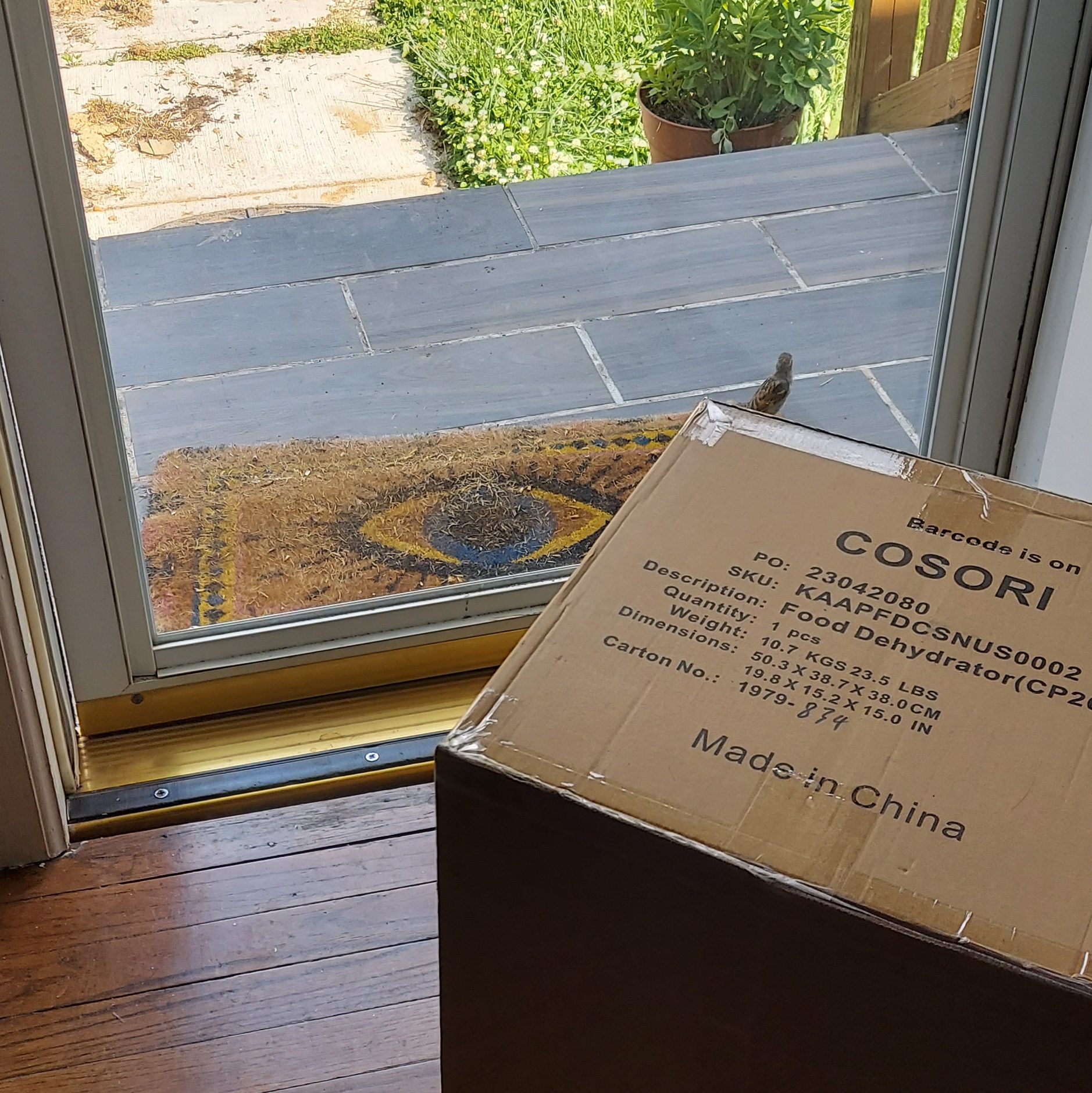
The house sparrows dropped one of their kids off on my porch. It came up and kind of scratched at the door, much to the confusion of myself and the cats.

A view of a sparrow fledgling on a doormat, seen through a glass storm door.
Kid, where are your parents?!

All of this means that I spend a not-insignificant portion of the day treating the yard like some kind of avian daycare center. I keep the bowls topped up with fresh, cool water, leave fruit and dried bugs where they can forage without going into the road or where neighborhood cats can get them, make sure there aren’t any confrontations, and make sure there are shady spots for them to hide out during the sunniest part of the day. It’s been kind of hot, and the wildfire smoke hasn’t done anyone any favors, so I’ve tried to make things easy on everybody involved. I don’t want the babies to become too used to just scooping up snacks from the bird feeders, though, so I toss them berries and bugs on the grass.

A handsome crow stands on a deck railing, looking up toward the camera.

We have a pair of cardinals here, too, but I don’t know what they’re up to just yet. There’s still the side yard and the driveway, so who knows where they’ll unload their brood.

I have to admit, as much as I worry about the babies (are they learning to find food well? Are they staying hydrated? Are they away from cats and snakes?), it’s kind of nice knowing that their parents seem to consider this a safe spot. They’ve even stopped flying far when I go out to refill the feeders and water dishes — the sparrows stay in the apple trees, and the crows hop to the fence and roof until I’m finished. Sometimes, when I sit out there to meditate and get some sunlight, they’ll land on the deck and go about their business anyhow.
It’s nice. Being ignored never felt so good.

A curious crow peers down from the edge of a roof.
Pardon the blurriness. I looked up and spied this one watching me and had a fraction of a second to snap a pic before they hopped down to the water dish.
life · Neodruidry · Plants and Herbs

Increasing Landscape Resilience with Native-ish Plants

Hello! It’s April, it’s going to be almost 90° F this weekend, and winter skipped us.

Well, we had like one cold week, but that was it.

Honestly, it’s had me worried. A number of plant species that are native to this area require cold stratification — in other words, they need a period of cold and some pretty big temperature swings in order to trigger them to germinate at the correct time. This includes a tree that’s very important to me, the bald cypress. They’ve evolved to need cold stratification because without it, their seeds could germinate far too early and die off in the middle of winter.

I have packets of seeds that I want to plant, too, that need to be sown within a narrow window of time. I’m talking when temperatures are cool (but not too cool), usually right around the last frost date. The trouble is… like I said, it’s going to be in the high 80s this weekend. Our official last frost date was a few days ago.

Now that I’ve gotten my complaining out of the way, there’s an idea I’ve been exploring.

I first ran into it when I was researching native hydrangeas. I love hydrangeas in general (my grandfather had a big hydrangea next to the house I grew up in, alongside a strangely persistent and hardy opuntia cactus), but they’re not really known for their heat tolerance. They are, by far, not the only plants that are going to suffer as temperatures increase either.

A hand touches a cluster of purple Hydrangea macrophylla flowers.

Smooth hydrangea (Hydrangea arborescens) is native to this area. They also prefer daytime temperatures in the 70s and require supplemental irrigation when it gets too hot and dry.

Oakleaf hydrangeas (Hydrangea quercifolia) are native to the Southeastern United States. In other words, they’re from the US, just a bit lower than where I live. Changes in average temperatures are expanding the range of some southern plants and animals, while driving others further north.

Unfortunately, there’s not much that a single person can do to keep their cool temperature-loving plants from suffering from this effect. It’s also debatable whether we should — landscapes are ever-changing and evolving, and state borders are artificial constructs that plants and animals don’t recognize. It may increase the resilience of the landscape to work with this shift, rather than against it.

For this reason, I’m experimenting with oakleaf and smooth hydrangeas. Experts point out that this area’s climate is slowly aligning with species that used to be relegated to more southern states. Blending some Southern species with Midatlantic species could help create a plant, animal, and fungal community that’s more resilient to climate change, and decrease the need for supplemental irrigation or treatment for diseases related to heat stress.

Saving seeds from the individual native plants that seem to struggle less with the heat can help their species adapt over time, which will feed and protect the native animal species that depend on them. Adding in native-ish species from a bit further south can help the land adapt. It also ensures sources of food and nesting sites for the animals that are also being driven north as temperatures rise.

Environment · life

In which the squirrels pay their tab.

So, remember how I accidentally got a bunch of squirrels hammered a bit ago?

They paid their tab.

Like I mentioned in that previous post, permaculture requires a lot of fallow time, at least initially. There are a few things I could plant, but otherwise it’s mostly observing, identifying what’s already there, and tending to the raised beds in the front yard. In this process, I’ve decided on a few plants that I think will do very well.

So, imagine my surprise when I went out and noticed a bunch of seedlings of these same plants, newly growing adjacent to the squirrel kegger.

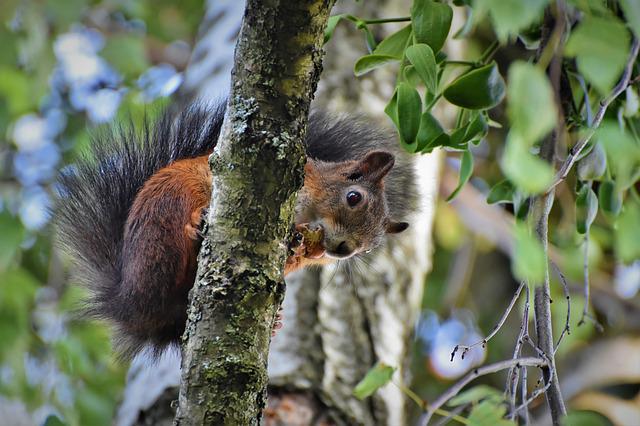
A squirrel peers down from a branch.

Seriously. My delinquents planted tomatoes (so many tomatoes), beans, and a whole host of other plants I’m excited about. It’s late in the season, so I don’t know how well they’re going to do right now, but still. I’m basically feeling like the hillbilly trash Snow White of gardening right now.

It was slightly annoying to have a band of rowdy rodents making and chugging bathtub squirrel gin in my platform feeders, but I’m not even mad.
Well done, my dudes.

(I’m still not buying you more cranberries, though.)

Environment · life

I made a rodent speakeasy.

I’ve tried to be conscientious in the way I take care of this yard. Permaculture isn’t achieved overnight — it can take up to a year of just observation to understand what should actually go in a space, and what arises naturally. While I’ve been on a crusade to get rid of a lot of the less-useful, non-native plants that were introduced here, I’ve tried to balance this with working slowly, patch-by-patch, and providing more sources of food, water, and habitat to replace what I’ve removed, and then some. (I even found and transported a yellow woolly bear caterpillar from a soon-to-be-doomed spot in the front yard, to a thriving bee balm plant in the back.)

Still, until I’m able to provide more food plants and water sources, I figured I’d put out some simple platform feeders. I’d already noticed bees descending on my yard after I watered the raised bed there — even when nothing had been planted yet, they were attracted to the water. Thirsty little buzzy people bobbed from tiny puddle to tiny puddle, eagerly drinking it up and trying to beat the heat. A platform feeder, I figured, would allow me to provide some water sources and a little bit of food for the larger guys out there.

I started fairly simply. I threw in a handful or so of sunflower seeds and some sulphite-free dried cranberries that I’d had laying around for a while, and put a bit of fresh water in the water dish.

Then I forgot about it. I mean, I had a lot of other things to contend with, like my war against lawns as a concept (and this lawn specifically). It was after a few days of rain and a bit of a hot spell that my partner called me into his office.

“Those feeders are really busy!”

“Yeah?” I asked, leaning in to peer out of the window overlooking the deck.

“Yeah! There’ve been a bunch of squirrels there all day!”

“Huh. Weird, they weren’t paying any attention to it befo-”

I squinted at the squirrels as it all clicked.
Fruit. Water. Heat.
The feeders didn’t collect rainwater, but it had rained enough to make those dried cranberries plump and juicy. The warmth just helped the sugar, water, and natural yeast along.

“Oh, shit,” I muttered.

Those hairy little delinquents were doing shots of fermented cranberry on my deck.

There was an excellent reason why these fruits, long ignored and forgotten about, were suddenly teeming with squirrels.
Glassy-eyed squirrels.
Glassy-eyed squirrels with burgeoning alcoholism.

Through my own negligence, I had managed to create some kind of speakeasy for squirrels. And they were having a fantastic time. Fantastic enough that I hesitated to rush out and try to chase them away from their ersatz kegger. (I mean, I don’t know how many drunken squirrels it’d take to kick my ass, but I knew how many they had on their side.)

I haven’t yet found any of them nursing tiny hangovers or passed out in the grass, but I still discarded the old fruit and put out fresh cranberries. If they liked dried fruit, they could have those.

Then I noticed that they were putting them in the water dish next to the feeder, presumably to create some kind of backyard rodent pruno.

I’m a little worried about what’s going to happen when I run out of cranberries, to be honest.